In an era of fleeting digital interactions, your business card is no longer a mere data carrier; it is the definitive physical anchor for your brand's identity. We understand the frustration of seeing meticulously crafted materials discarded or noticing a jarring disconnect between your polished website and your printed assets. This guide delivers the essential business card design tips 2026 to help you navigate these challenges, ensuring your first impression is both tactile and transformative.
You deserve a brand presence that moves seamlessly from a physical handshake to a digital follow-up. We will explore how to utilise sophisticated finishes like brushed copper and champagne gold, alongside the strategic integration of dynamic QR codes that actually drive engagement. By applying our signature five-stage design methodology, you can transition from a standard template to a bespoke piece of craftsmanship that commands attention. Discover how to elevate your corporate identity and create a lasting connection that survives the initial meeting. Our insights will help you master the synergy between high-end printing solutions and modern tech integration.
The business card has transcended its origins as a simple contact directory to become a sophisticated tactile brand ambassador. Whilst the history of business cards shows a progression from 15th-century social visiting cards to corporate staples, 2026 marks a pivotal shift towards the card as a high-value marketing asset. As digital noise reaches a saturation point, a physical card serves as a grounded anchor, offering a tangible connection that an email or a LinkedIn request simply cannot replicate.
To better understand how these physical assets are evolving, watch this helpful video:
Modern business card design tips 2026 focus on the card as a "leave-behind" piece of collateral. It's no longer just about sharing a phone number; it's about leaving a physical remnant of your brand's excellence. We see a move away from the cluttered, information-heavy layouts of the past. Instead, the focus has shifted toward minimalist, high-impact designs that command respect through simplicity and strategic craftsmanship.
Tactile interaction remains a powerful psychological tool for building trust. When you hand over a premium card, you're initiating a multi-sensory experience that cements your professional authority. In the South African business environment, this exchange is a vital ritual of mutual respect and reliability. It facilitates a friction-free contact exchange, removing the awkwardness of typing into a smartphone during a meaningful conversation. Physical cards allow you to remain present whilst ensuring your brand stays in the recipient's hand long after the meeting concludes.
The most effective business card design tips 2026 emphasise the strategic use of "white space" and bold focal points. By stripping away non-essential elements, you guide the recipient's attention to your core identity. This "less is more" philosophy directly improves information retention, as the brain processes a singular, well-defined message more effectively than a crowded list of services. Purposeful colour palettes are also central to this evolution. We help our partners select tones that evoke specific brand emotions, moving beyond aesthetic preference to a deeper, psychological level of brand alignment.
Visual hierarchy serves as a silent guide, directing the recipient's attention to your most critical information with surgical precision. On a canvas as compact as a business card, every millimetre must be earned. Effective business card design tips 2026 prioritise a clear path for the eye, typically moving from the brand mark to the individual's name and then to the primary call to action. This structured approach prevents cognitive overload, ensuring your brand message remains clear and memorable during those vital first few seconds of an encounter.
Typography acts as the voice of your brand. To maintain a professional polish, your primary contact details should never drop below an 8pt font size. This ensures accessibility for all recipients whilst projecting a sense of quiet confidence. You only have about three seconds to capture a recipient's interest during a scan; if the text is too small or the layout is cluttered, the card loses its utility immediately. It's vital to align these choices with your brand style guide essentials to maintain national consistency. Observing current business card trends for 2026, we see a move toward high-contrast serif fonts that provide a sophisticated, editorial feel, standing out amongst a sea of generic sans-serif templates.
Your logo functions as the anchor of the entire design. It requires sufficient "breathing room," or padding, to retain its visual impact and avoid looking cramped against the edges or other text elements. When considering what makes a good logo design, remember that simplicity often scales better on physical print. A well-placed logo creates a sense of balance, allowing the eye to rest before moving to the essential contact details. Our experts at ThinkTank Creative excel in Logo and Corporate Identity Design, ensuring that your physical assets are a perfect mirror of your digital presence. This synergy is non-negotiable for high-level corporate identities that want to be taken seriously. By following these business card design tips 2026, you ensure that your logo remains the hero of the card, reinforcing brand recognition every time the card is pulled from a wallet or desk drawer.
Selecting the right substrate is the physical manifestation of your brand's promise. Whilst the visual hierarchy organises your message, the material you choose communicates your values before a single word is read. Our business card design tips 2026 prioritise the haptic experience, recognising that the physical "feel" of a card is the final delivery stage of a high-level corporate identity. By moving beyond standard templates, you transform a simple contact tool into a bespoke piece of craftsmanship that reflects your commitment to excellence.
The weight of your card, measured in grams per square metre (gsm), serves as a silent indicator of professional authority. While a standard 350gsm card is functional, upgrading to a 450gsm or a luxury 600gsm+ triple-layer stock creates an immediate sense of stability and prestige. This added substance prevents the card from feeling flimsy or disposable. We often recommend textured papers such as linen, felt, or soft-touch lamination to add a sophisticated layer of sensory engagement. The tactile quality of a card correlates directly with perceived business reliability, as it suggests an investment in enduring quality rather than temporary convenience.
Premium finishes allow you to highlight specific elements of your design, such as a logo or a strategic tagline, with surgical precision. Spot UV creates a compelling contrast between matte and gloss surfaces, inviting the recipient to run their fingers over the card. For high-end corporate identity designs, metallic foils in champagne gold or brushed copper offer an elite finish that catches the light and the eye. Modern techniques like Scodix or 3D effects provide a tech-forward aesthetic that feels both innovative and grounded. These finishes shouldn't be used at random; they should serve the strategic reasoning behind your brand, elevating the most important information through physical depth.
Sustainability has become a non-negotiable standard for 2026. Incorporating eco-friendly materials, such as recycled stocks or seed paper, demonstrates that your organisation is forward-looking and responsible. To further differentiate your brand, consider die-cutting to create unique shapes that break the traditional rectangular mould. Whether it is rounded corners for a softer approach or a custom shape that mirrors your logo, die-cutting adds a distinct personality to your business card design tips 2026. Our comprehensive Printing Solutions ensure that these complex finishes are executed with meticulous detail, resulting in a card that is not just kept, but admired.
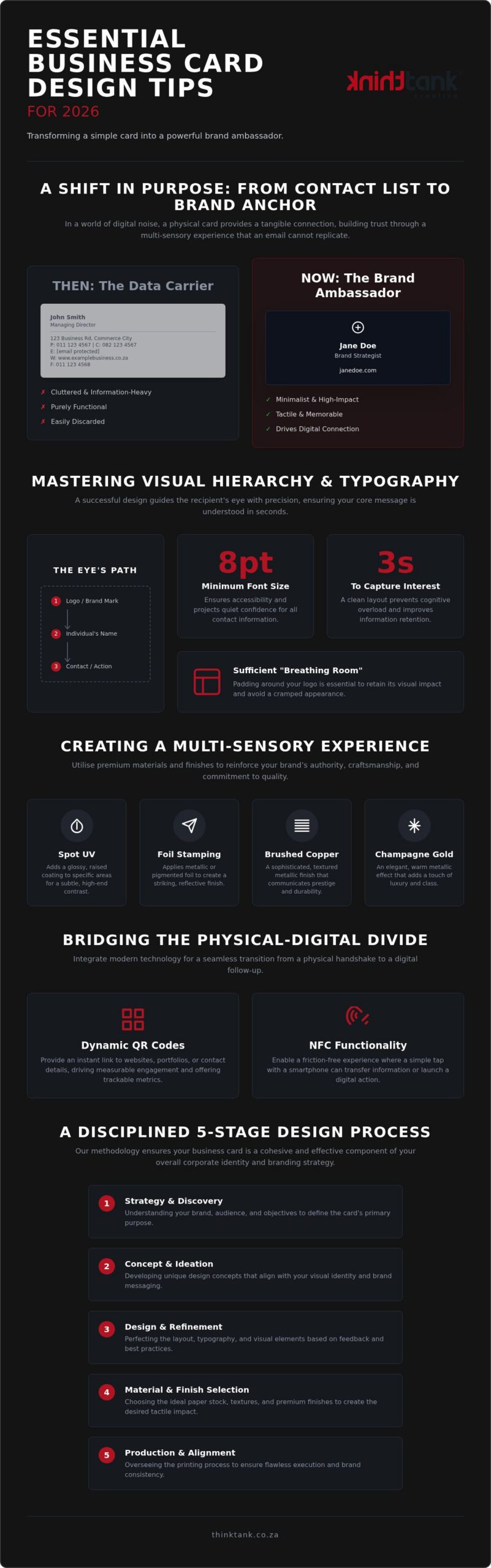
Physical branding in 2026 is no longer an isolated effort. It serves as the definitive starting point of a digital journey, acting as a high-fidelity portal between a handshake and a lead conversion. Modern business card design tips 2026 focus heavily on this "phygital" integration, ensuring your physical assets work in perfect synergy with your online presence. By embedding digital touchpoints directly into your card, you provide a frictionless transition that respects the recipient's time whilst elevating your brand's technical competence. This synergy ensures that your card isn't just kept; it's used.
A common mistake is treating a QR code as a visual intrusion. In 2026, we design these codes to complement the aesthetic, using custom colours or brand-aligned frames that feel intentional rather than accidental. The destination is just as critical as the code itself. Every scan should lead to a custom website design that is meticulously optimised for mobile interaction. We recommend using dynamic QR codes, which grant you the flexibility to update your digital portfolios or contact details without the cost and waste of reprinting your entire physical inventory. This approach ensures your cards remain relevant for years, regardless of how your digital assets evolve.
Near Field Communication (NFC) technology has moved from a niche novelty to a standard for high-level corporate identity. Embedding a small chip within your premium stock creates an immediate "wow" factor during networking, allowing for instant vCard downloads or portfolio links with a simple tap. It bridges the gap for a broader demographic, appealing to traditionalists who value the feel of paper and tech-forward professionals who prefer digital efficiency. This technology also allows you to track the ROI of your physical cards through digital analytics, providing data-driven proof of your networking success. You can see exactly when and where your card was tapped, allowing for more strategic follow-ups.
Beyond contact details, your card should serve as an invitation to explore your broader digital ecosystem. Including subtle, well-placed social media handles or a direct link to a digital portfolio allows potential clients to witness your expertise in real-time. This level of transparency builds trust quickly, moving the relationship from a brief introduction to an active engagement. By combining these digital elements with premium print, you create a brand anchor that is both timeless and technologically advanced. If you're ready to integrate these features, our team offers the elite Creative design and tech expertise required to transform your physical networking strategy.
ThinkTank Creative stands as your dedicated all-rounder partner, bridging the gap between visionary branding and high-fidelity printing. We recognise that applying business card design tips 2026 requires more than just an eye for aesthetics; it demands a strategic partner who can manage the entire lifecycle of your brand's physical presence. Our philosophy is simple: "We Do It All So You Don’t Have To." This approach allows you to focus on your core operations whilst we ensure every tactile touchpoint reflects your elite corporate identity with meticulous precision.
Every project we undertake is governed by our rigorous 5-stage design process, ensuring that the final product is both beautiful and functional. We begin with Research & Strategy, where we dive deep into your brand's DNA to inform every visual choice. This is followed by Design & Production, where our award-winning in-house team brings concepts to life. During the Choices and Presentation stages, we collaborate closely with you, offering curated directions that align with your objectives. Finally, the Fine-Tuning stage allows for precise adjustments, ensuring the final delivery meets the highest South African printing standards. This methodical rhythm ensures reliability and high-quality outcomes for every client.
Your business card is a singular component of a much larger ecosystem. To achieve true national consistency, your card must be intimately connected to your broader logo design process. We support businesses across the spectrum, from local startups requiring simple flyers to international web companies needing complex corporate identities. Our expertise extends to Printing Solutions, serving as the final delivery stage where your digital vision becomes a tangible asset. By positioning ourselves as a partner rather than just a vendor, we remain deeply invested in your journey of growth, providing ongoing service and post-project support that ensures your brand remains elevated in a competitive market. We invite you to embark on a journey of imagination with us, transforming your professional identity into a powerful brand anchor.
Mastering the nuances of business card design tips 2026 allows you to move beyond the limitations of digital-only networking. We've explored how the synergy between high-gsm stocks and sophisticated finishes, such as spot UV or metallic foils, creates a multi-sensory brand experience that commands respect. By integrating dynamic QR codes and NFC technology, you ensure your physical card functions as a seamless gateway to your digital portfolio, providing a friction-free experience for your clients.
Since 2001, ThinkTank Creative has empowered businesses to navigate these evolving trends with our award-winning design team and comprehensive in-house printing solutions. We don't just create cards; we build physical anchors for your corporate identity. It's time to Elevate your corporate identity with ThinkTank Creative today and turn every handshake into a strategic opportunity. Your brand's potential is limitless when backed by meticulous craftsmanship and visionary design. We look forward to partnering with you on your journey of brand transformation.
Business cards remain vital because they offer a tactile connection that digital requests lack. In 2026, they serve as "leave-behind" marketing collateral that reinforces trust and professional authority. Handing over a card is a ritual of mutual respect that ensures your brand stays in the recipient's hand. These business card design tips 2026 highlight the card's role as a physical anchor for your corporate identity, bridging the gap between a handshake and a digital follow-up.
Maintaining a minimum font size of 8pt is essential for professional legibility and accessibility. Whilst your name or logo may be significantly larger to establish hierarchy, your primary contact details must remain clear to avoid frustrating the recipient. A well-designed card respects the "three-second rule" for scanning. Choosing clean, high-contrast typography ensures that your brand message is communicated effectively, even during a brief encounter in a busy professional setting.
At ThinkTank Creative, an estimated cost is provided after a thorough discussion of your specific requirements and timeline. We avoid a one-size-fits-all approach, as each project is tailored to the unique needs of your organisation. Whether you require a simple layout or a complex corporate identity design with premium finishes, our 5-stage process ensures high-quality outcomes. This collaborative methodology allows us to deliver bespoke solutions that align perfectly with your brand's strategic goals.
A modern card should include your name, job title, company logo, and essential contact details like a phone number and email address. It is also vital to include a link to your website and a digital portal, such as a QR code or NFC trigger. These business card design tips 2026 recommend keeping the layout minimalist to ensure that the most important information remains the focal point, preventing the cognitive overload of cluttered designs.
You can differentiate your brand by utilising premium finishes such as spot UV, foil stamping, or 3D effects that create a multi-sensory experience. Custom die-cut shapes also break the traditional rectangular mould, making your card more memorable. By focusing on a "less is more" philosophy and using purposeful colour palettes, you evoke specific brand emotions. These strategic choices transform a standard card into a sophisticated tactile ambassador that commands attention amongst generic templates.
Standard paper stocks typically sit around 350gsm, providing a functional but basic feel. Premium stocks, ranging from 450gsm to luxury 600gsm+ triple-layer cards, offer a significant increase in physical authority and durability. Texture also plays a role; premium options include linen, felt, or soft-touch lamination. This added substance prevents the card from feeling disposable and correlates directly with perceived business reliability, suggesting a long-term investment in quality and professional excellence.
Integrating social media handles or digital portfolios is highly recommended to provide a seamless transition to your digital ecosystem. You can use subtle icons or a dynamic QR code that leads directly to your LinkedIn profile or an online showcase of your work. This level of transparency builds trust quickly, allowing potential partners to witness your expertise in real-time. It ensures your physical card serves as an active portal for deeper engagement beyond the initial meeting.
Using a QR code is a strategic necessity in 2026, provided it is implemented with design in mind. We recommend dynamic QR codes, which allow you to update the destination URL without needing to reprint your physical cards. Ensure the code is at least 2.5 x 2.5 cm for reliable scanning and leads to a mobile-optimised landing page. This tech-forward approach demonstrates your brand's competence and provides a friction-free way for contacts to save your details.


