LinkedIn advertising for B2B lead generation in South Africa
Reach is not the same as a qualified enquiry. LinkedIn advertising for B2B lead generation in South Africa can focus campaigns on professional attributes such as job title, industry, company, seniority and skills. Sponsored Content appears in targeted members’ feeds, while Lead Gen Forms give interested prospects a way to respond within LinkedIn.
If you’re weighing up LinkedIn as a channel, the key is making sure the audience, message and next step work together. A campaign can attract attention, but its value depends on reaching relevant decision-makers and giving them a clear reason to engage.
This article explains how LinkedIn campaigns support B2B lead generation, what ad formats and targeting can contribute, and which strategic choices shape campaign quality. You’ll also see where professional campaign planning fits, from aligning advertising with your wider marketing to creating a considered path from first impression to enquiry.
Key Takeaways
Build your campaign around the people involved in the buying decision, not just a broad industry category.
Use useful, credible content to earn attention and help potential buyers assess your business.
Understand how LinkedIn’s ad auction works and how campaign budgets can be controlled as priorities evolve.
Connect advertising to a clear next step so interested prospects can move naturally towards an enquiry.
Professional PPC support can help align campaign strategy with your website, creative and wider marketing activity.
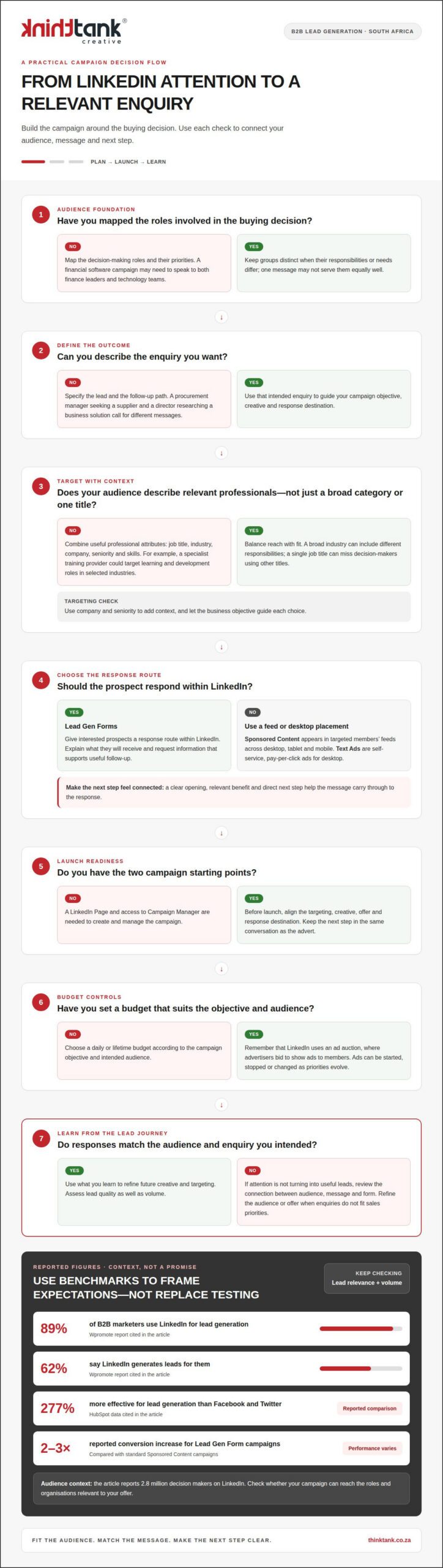
A strong LinkedIn campaign starts with the buying decision, not the advert format. Map the roles involved in choosing your service, then shape the campaign around their priorities. For example, a business selling financial software might need to reach finance leaders and technology teams. One message is unlikely to address both groups equally well.
Define the lead you want before setting campaign objectives. A relevant lead might be a procurement manager looking for a supplier or a director researching a business solution. These examples call for different messages and follow-up paths. Clarifying the enquiry you want helps connect audience selection, creative and the landing experience.
LinkedIn targeting can use professional attributes such as job title, industry, company, seniority and skills. Combine attributes to describe a meaningful audience instead of narrowing the campaign around a title alone. For instance, a specialist training provider could target learning and development roles in selected industries. Let the business objective guide each targeting decision.
Audience choices also affect relevance. A broad industry may include people with different responsibilities, while a specific job title may exclude decision-makers who use other titles. Company and seniority attributes can add useful context. Balance reach with fit, then align the message with the professional needs of the audience.
LinkedIn Sponsored Content appears in targeted members’ feeds on desktop, tablet and mobile devices. It can introduce an insight, service or useful resource in a professional browsing experience. A clear opening, relevant benefit and direct next step help the content connect. For example, inviting prospects to explore a practical guide gives them a defined action.
Lead Gen Forms let prospects respond within LinkedIn, creating a shorter route from an advert to an enquiry than sending everyone to another page. The form still needs a clear purpose: explain what the person will receive and request information that supports useful follow-up. Avoid asking for details without explaining their relevance.
Other campaign choices support different roles in the journey. Text Ads are self-service, pay-per-click ads for desktop. Sponsored Content suits feed placements across devices, while form campaigns centre the response within LinkedIn. The appropriate format depends on the audience, offer and action required, rather than a single format being right for every B2B objective.
Campaign costs are shaped by LinkedIn’s ad auction, where advertisers bid to show ads to members. Advertisers can set a daily or lifetime budget, and start, stop or change ads. These controls help manage spend as campaign priorities change. Set the budget according to the campaign objective and intended audience.
To launch a campaign, you need a LinkedIn Page and access to Campaign Manager. These are the starting points for campaign creation and management. Before launch, align the targeting, creative, offer and response destination. If an advert addresses a particular business challenge, the next step should continue that same conversation.
Measure the lead journey, not just initial engagement. Review whether responses match the intended audience and whether the offer attracts appropriate enquiries. If the campaign gets attention but few useful leads, assess the connection between audience, message and form. If responses are relevant, use those insights to refine future creative and targeting.
For South African B2B organisations, the central planning task is fit: identify the decision-makers, communicate a relevant business benefit, and make the next action clear. A considered campaign can then use LinkedIn’s professional targeting and formats to support a coherent path from first exposure to enquiry.
Benchmarks can help frame expectations, but they do not replace campaign testing. In the Wpromote report cited by the page, 89% of B2B marketers use LinkedIn for lead generation, while 62% say LinkedIn generates leads for them. HubSpot data cited by the page found LinkedIn 277% more effective for lead generation than Facebook and Twitter. The page reports that LinkedIn had 2.8 million decision makers, a reminder to assess whether a campaign can reach the roles and organisations that matter to your offer.
Treat these figures as context rather than a promise of results. LinkedIn Lead Gen Form campaigns are reported to increase conversions by 2-3x compared with standard Sponsored Content campaigns, but performance still depends on relevance, form friction and follow-up. Review lead quality as well as volume, and refine the audience or offer when enquiries do not match your sales priorities. Keep every claim supportable and make the next step clear. UK Government says UK marketing and advertising must be accurate, legal, decent, truthful, honest and socially responsible.
ThinkTank Creative offers Pay-Per-Click (PPC) Advertising to help businesses bring structure and focus to paid campaigns. Turn to this support when LinkedIn activity needs to connect more clearly with your B2B audience, campaign message and desired enquiry.
Effective advertising depends on more than platform settings. Campaign creative should speak to the audience’s priorities, while the destination page should carry the same message through to the next step. ThinkTank Creative can bring PPC advertising together with creative design or website design and development to create a more coherent campaign experience.
If you’re ready to explore professional support for LinkedIn advertising, contact ThinkTank Creative to discuss your campaign goals.
Turn campaign intent into lasting momentum
LinkedIn advertising for B2B lead generation in South Africa works best as part of a considered growth plan, not as an isolated campaign. Let the quality of enquiries shape what comes next: refine the audience, sharpen the message and align the next campaign with the opportunities your business wants to develop.
That wider experience matters too. A prospect’s impression is shaped by the creative they see and the website they reach, as well as the advert itself. ThinkTank Creative offers creative design, Website Design and Development, and Social Media Marketing to support a cohesive presence across these touchpoints.
When you’re ready to explore a PPC approach that reflects your business priorities, contact ThinkTank Creative. Start with the outcomes you want to pursue, and build a campaign strategy that gives your next stage of growth a clear direction.
Instagram marketing examples to help South African brands choose an agency
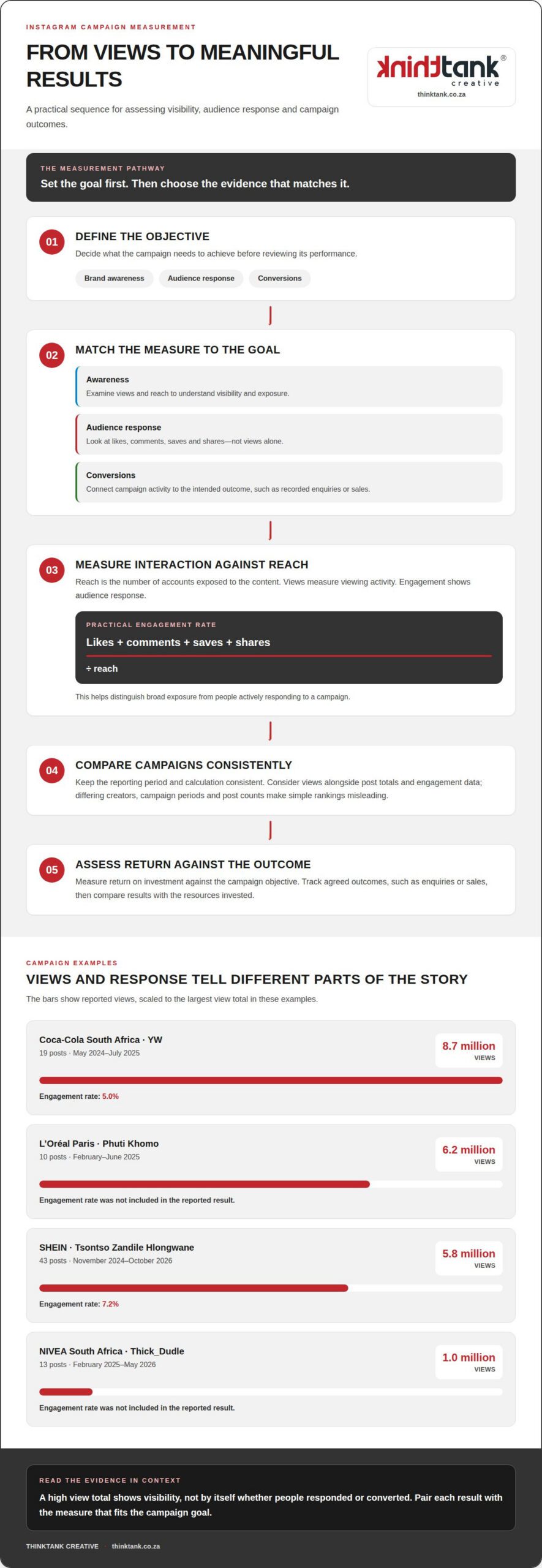
Effective Instagram marketing for South African brands starts with a clear goal, content planned for the audience and measurement that looks beyond views. A practical engagement rate counts likes, comments, saves and shares, divided by reach. This helps show whether people responded to a campaign, rather than simply saw it.
Choosing an agency is about more than finding someone to publish posts. You need a partner who can shape a distinctive content plan, connect creative choices to brand awareness or conversions, and assess performance against the outcome you want. Look for clear thinking as well as appealing visuals.
This article explores how South African brands and creators can use Instagram content in practice. It covers planning for awareness and action, interpreting engagement alongside views, and assessing what an agency or platform feature could contribute. Use these considerations to make your next Instagram decision with greater clarity.
Key Takeaways
Use South African campaign examples to understand how creator partnerships can build visibility, then assess results against your own objectives.
Plan a content mix that supports brand awareness and conversion, with formats and publishing rhythms suited to your audience and capacity.
When choosing an agency, look for a clear connection between creative direction, campaign goals and meaningful performance measures.
Explore Instagram Business features, including analytics, advertising and profile action buttons, to see which tools support your customer journey.
Instagram has over 4 million active users in South Africa, but audience relevance matters more than reach alone when deciding whether the platform fits your brand.
Views show how often campaign content was watched, while engagement indicates audience response. For South African creator Tsontso Zandile Hlongwane, 43 SHEIN promotion posts generated 5.8 million views between November 2024 and October 2026. Those posts recorded a 7.2% engagement rate, adding a response measure alongside visibility.
To assess engagement consistently, divide the total of likes, comments, saves and shares by reach. Reach measures the accounts exposed to content; views measure viewing activity. Comparing the figures helps distinguish broad exposure from active audience response. A high view total alone doesn’t show whether people saved a post, shared it or took another useful action.
A professional Instagram marketing team measures return on investment (ROI) against the campaign objective, linking activity to outcomes such as enquiries or sales. It tracks conversions through agreed campaign reporting, then compares the results with the resources invested.
Creator campaigns: reach and response
Situation: SHEIN ran Instagram promotions with South African creator Tsontso Zandile Hlongwane. Action: The partnership appeared across 43 posts during the period from November 2024 to October 2026. Result: The posts generated 5.8 million views and a 7.2% engagement rate. Together, these measures show both exposure and interaction, rather than treating views as the complete performance story.
Situation: Coca-Cola South Africa also worked with creator YW on Instagram promotions. Action: The activity comprised 19 posts between May 2024 and July 2025. Result: Those posts generated 8.7 million views and a 5.0% engagement rate. Comparing this example with Hlongwane’s campaign illustrates why post totals and view totals should sit beside engagement data.
Different campaigns, different measures
Situation: L’Oréal Paris promotions featured South African creator Phuti Khomo. Action: Khomo published 10 Instagram posts between February and June 2025. Result: The posts generated 6.2 million views. This example provides a visibility measure, but the supplied campaign result doesn’t include an engagement rate. Avoid treating view totals alone as proof of audience response.
Situation: NIVEA South Africa partnered with Thick_Dudle for Instagram promotion. Action: The creator published 13 posts between February 2025 and May 2026. Result: The posts generated 1.0 million views. This gives a further point of comparison, but not a direct ranking: campaign periods, creators and post counts differ.
For a useful report, set the objective first, then choose measures that match it. A brand-awareness campaign can examine views and reach; a response-focused campaign should also examine likes, comments, saves and shares. For conversions, connect campaign activity to the intended outcome, such as recorded enquiries or sales. Keep the reporting period and calculation consistent so you can interpret changes across campaigns fairly.
Content planning for brand awareness and conversion
For organic reach, Instagram Reels lead the formats discussed in 2026. Short-form videos lasting 15-60 seconds can introduce a product, demonstrate a service or show how a customer uses it. Carousels of 5-8 slides suit step-by-step explanations, comparisons and useful advice. Stories can support timely updates and reminders, especially when they give followers a clear next action.
No format guarantees sales. Reels can help a South African brand reach new viewers, whilst carousels can explain an offer in more detail. Stories can draw attention to an event, product or enquiry route. A professional team selects formats according to the campaign objective, then shapes each post around an action the audience can take.
Build a workable publishing rhythm
Publishing recommendations vary: one approach suggests 3-4 feed posts per week for South African SMEs, whilst another favours three strong posts over seven mediocre ones. The practical lesson is to plan a consistent cadence that preserves quality and fits the available content. Daily Stories can add timely touchpoints when relevant, rather than becoming a daily obligation without purpose.
Situation: Garnier South Africa worked with creator Hope Mbhele. Action: The campaign used 10 Instagram promotional posts between November 2024 and July 2025. Result: Those posts generated 955.7 thousand views. The example shows how a defined series can deliver campaign visibility; it doesn’t establish which formats were used or prove sales outcomes.
Make content useful beyond visual products
A service brand can still create visual Instagram content. An agency might turn a frequently asked question into a short Reel, map a process across carousel slides or use Stories to share an update. For example, a professional service could explain what happens during an initial enquiry. The creative treatment makes an otherwise abstract offer easier to understand.
Situation: Vaseline South Africa partnered with creator Snikiwe Mhlongo. Action: The promotion appeared in 11 Instagram posts between November 2021 and March 2026. Result: The posts generated 1.3 million views. For a brand planning its own activity, the example supports considering a sustained sequence rather than relying on one isolated post; it doesn’t identify a specific content format.
For a small business with a limited budget, an agency can concentrate production on one campaign objective, prioritise reusable creative and adapt a core idea for Reels, carousels and Stories. This reduces scattered planning without inventing a budget or promising a particular return. A co-ordinated social media content plan can connect the publishing rhythm with the brand’s awareness or conversion goal.
Instagram advertising agencies in South Africa
Instagram can suit South African businesses when its audience, creative formats and campaign goals align. TikTok and Facebook offer different audience environments and content experiences, so compare platforms against the same objective. Assess audience fit, suitable creative and the conversion path instead of assuming one platform always performs best.
For sponsored Instagram posts, make the commercial relationship clear, keep product claims accurate and document approvals. An agency can build these safeguards into creator briefs and content review. This is a practical campaign control, not a substitute for advice on specific legal obligations.
There is no single South African rand price for Instagram advertising that applies to every campaign. Cost depends on the campaign and is provided after a quote request; factors include audience, duration, creative requirements, ad spend and reporting scope.
Match creators to the campaign
An agency can define the intended audience and outcome, then shortlist creators whose content and community fit the brief. It can organise deliverables, agree usage and approval terms, and assess proposed fees against the campaign scope. A brand seeking local product awareness, for example, needs a different creator fit from a business seeking qualified enquiries.
Situation: Cleanipedia South Africa worked with South African creator Thick_Dudle. Action: The partnership used 10 Instagram posts between May 2025 and October 2026. Result: The posts generated 1.1 million views. This demonstrates campaign visibility, but views alone don’t establish sales or return on investment.
Situation: Castle Lite SA partnered with South African actor and creator SENZOKUHLE OFFICIAL. Action: The creator published 15 Instagram posts between November 2022 and December 2023. Result: Those posts generated 775.4 thousand views. The example offers a concrete reference for discussing creator content, not a guaranteed benchmark for another brand.
Protect the campaign and brand
Account security and reputation need attention before publishing. A brand should retain control of its Instagram account, limit access to people involved in campaign delivery, and avoid sharing login credentials through informal messages. An agency can document approvals, access arrangements and creator deliverables, reducing confusion if a post needs correction.
Scams can involve impersonation, suspicious collaboration requests or misleading engagement claims. Review a creator’s content quality, audience relevance and past brand work before agreeing terms. A sudden mismatch between a creator’s usual tone and a proposed sponsored message can also create reputational risk.
For South African brands, a strong agency relationship begins with a clear brief: objective, audience, deliverables, approval process and intended measure. This framework lets the agency compare Instagram with TikTok or Facebook for campaign fit, then recommend a creator or paid approach with defined responsibilities.
Instagram features for businesses
An Instagram Business account gives a South African brand access to analytics and advertising tools. Its profile can also include additional call-to-action buttons, helping direct visitors towards a relevant next step. A bio allows 150 characters, so each word should clarify the offer, audience or action. For example, a local bakery could identify its products and guide profile visitors towards an enquiry or order route.
Instagram analytics cover posts and Stories, giving campaign teams information to assess content performance. A professional can use these insights to compare audience responses across formats and refine the next content plan. If a product demonstration draws more profile actions than a static announcement, for example, the team can consider developing that style further. The goal is to connect each result with a practical decision, rather than collect figures without context.
Local advertising with a clear objective
An agency can set up Instagram ads by defining the campaign objective, choosing suitable creative and selecting an audience relevant to the business. For a South African company serving a specific area, the agency can focus delivery on the locations that matter to its service or sales model. It then aligns the advert’s message and call to action with the intended outcome, such as enquiries, visits or product interest.
Consider a Durban restaurant promoting a new menu. The agency could build an advert around appetising menu imagery, focus its audience on relevant nearby customers, and direct people towards the restaurant’s chosen contact or booking route. A Johannesburg service business would need a different location focus and a message explaining its service. These examples show why location, offer and action need to work together.
Turn profile visits into useful actions
Instagram supports businesses seeking to market and sell directly to consumers in the app. A campaign can connect discovery with product consideration and purchase where that journey suits the business. A professional team plans the creative and profile experience together, so the advert doesn’t promise a route the customer can’t follow.
Before launch, an agency should establish the campaign’s purpose, intended audience, creative format and success measures. It can then use Instagram’s post and Story analytics to review performance against that purpose. An awareness campaign, for example, needs a different assessment from an advert intended to prompt enquiries. This distinction keeps reporting relevant to the decision the business wants customers to make.
A business profile works best when its 150-character bio, call-to-action buttons and campaign message communicate a consistent next step. A South African retailer might direct profile visitors towards product information, whilst a professional service could prioritise enquiries. Aligning these features helps transform Instagram from a posting channel into a more coherent customer journey.
How many South Africans use Instagram, and what are the audience demographics?
Instagram has over 4 million active users in South Africa. That figure signals a substantial potential audience, but it doesn’t show how many users match a particular brand’s customer profile. For a Johannesburg retailer, relevant reach means reaching likely buyers, not simply a large group of people elsewhere in the country.
Demographics matter because age, location, interests and purchasing needs shape how people respond to content. No audience profile fits every South African business. A service company may prioritise people near its operating area, whilst a national retailer may need content that speaks to customers across the country. The campaign’s objective should guide which audience characteristics matter.
A professional team starts with the business’s existing customer knowledge and campaign goal. It can shape the audience and creative around those details, then use Instagram Business analytics for posts and Stories to assess how published content performs. A campaign aimed at product discovery, for example, needs a different message from one designed to prompt enquiries. Comparing performance against the objective helps refine later content.
Translate audience knowledge into relevant content
Situation: A fitness studio wants to promote a new class to prospective members nearby. Action: The campaign team centres the creative on the class experience and gives the intended audience a clear next step. Result: The campaign has a defined audience and purpose, making its performance easier to interpret than a general post aimed at everyone.
Situation: A South African homeware retailer wants to introduce a product to customers across the country. Action: The team develops content around how the product fits everyday household needs, then assesses post and Story performance. Result: The brand can identify which creative direction is more relevant to its campaign, without assuming that broad reach alone proves customer interest.
Audience data needs context. A post may attract attention from people who aren’t likely to buy, whilst a smaller audience may include more suitable prospects. A team should therefore interpret Instagram activity alongside the business goal and customer journey. For a Gauteng-based service provider, for instance, enquiries from relevant local prospects may matter more than broad exposure across South Africa.
Use the 4 million active-user figure as market context, not a forecast for any single campaign. A clear brief should identify the customer, location and desired action before content is planned. Build an audience-led Instagram strategy around those priorities, then use campaign results to sharpen the next decision.
ThinkTank Creative
ThinkTank Creative helps South African brands turn Instagram insights into a coherent marketing direction. Its Social Media Marketing and creative design services can align campaign content with your brand identity and business goals, whether you’re building awareness or encouraging enquiries. When Instagram activity needs to connect with a broader digital presence, Website Design and Development can support the customer journey beyond the social profile.
Bring a clear sense of your audience, the outcome you want and the content challenges you’re facing. These priorities provide a useful starting point for shaping an approach around your brand, rather than relying on a generic posting template.
Make your next campaign a deliberate step towards stronger brand recognition and customer relationships. Effective Instagram marketing for South African brands begins with a clear business goal, then brings audience insight, creative direction and measurement into alignment.
ThinkTank Creative can support that direction through Social Media Marketing, creative design and Website Design and Development. These services can connect Instagram activity with a consistent brand presence and the experience customers encounter beyond the platform. Start by clarifying what you want your audience to notice, understand or do.
Looking for a top Instagram agency in South Africa?
Choose an agency whose capabilities suit the work your brand needs, rather than relying on a title such as “top”. ThinkTank Creative offers Social Media Marketing and creative design, supporting businesses with campaign planning and brand-consistent content. A retailer preparing a product launch, for example, can benefit from a joined-up approach to campaign messaging and visual direction, with responsibilities and objectives clearly understood.
Posting Frequency: How Often is Enough?
Post at a pace your team can sustain whilst keeping each update relevant to customers. A business with changing stock might share timely product updates, whilst a professional service could prioritise useful explanations and customer questions. Review the workload alongside audience response, then adjust the schedule if quality or consistency starts to slip. The right rhythm serves the business and its followers, rather than meeting a fixed quota for its own sake.
What Instagram marketing strategies work best for South African brands?
Effective Instagram marketing for South African brands connects a clear business objective with content that reflects the brand’s audience and context. For example, a retailer could build a campaign around a seasonal product range, while a service business could address a recurring customer question. Use a consistent brand voice across campaign posts, profile messaging and follow-up, then assess whether the activity supports the intended outcome before shaping the next campaign.
What are South Africa’s legal rules for influencer marketing and sponsored Instagram posts?
For sponsored posts, make the commercial relationship clear, keep product claims accurate and document approvals. These are practical campaign safeguards, not a substitute for advice on specific legal obligations.
How can brands find and price South African Instagram influencers?
Define the campaign’s audience and outcome, then shortlist creators whose content and community fit the brief. Agree on deliverables, usage and approval terms, and assess proposed fees against the campaign scope.
How does Instagram marketing compare with TikTok and Facebook for South African businesses?
Instagram, TikTok and Facebook offer different audience environments and content experiences. Compare them against the same campaign objective, considering audience fit, suitable creative and the conversion path rather than assuming one platform performs best.
How to Target Customers on Facebook in South Africa with Smarter Ads
More audience filters don’t automatically make a Facebook campaign smarter. A practical approach to how to target customers on Facebook in South Africa combines relevant demographic and life-event audiences with a clear campaign objective. For location-led advertising, Facebook can target a 10-mile radius around a central point.
Choosing an audience is only the starting point. Even a well-defined group needs messaging that speaks to its needs, followed by careful review of campaign performance so you can refine the targeting and creative.
This article explains how to shape audience choices for the South African market, interpret campaign results and make informed adjustments. These elements work together to create a considered Facebook advertising strategy.
Key Takeaways
Assess campaign results against the objective, then use those signals to guide thoughtful refinements.
Combine relevant demographic and life-event audiences with messaging suited to the people you want to reach.
Build a campaign around a clear goal, audience, creative direction and measurement plan.
Shape location targeting around where customers are, from broad areas to more focused local audiences.
Understand how CPM and CPC reflect different ways of measuring ad costs, and what can influence them.
1. How professionals analyse and iterate on ad campaigns
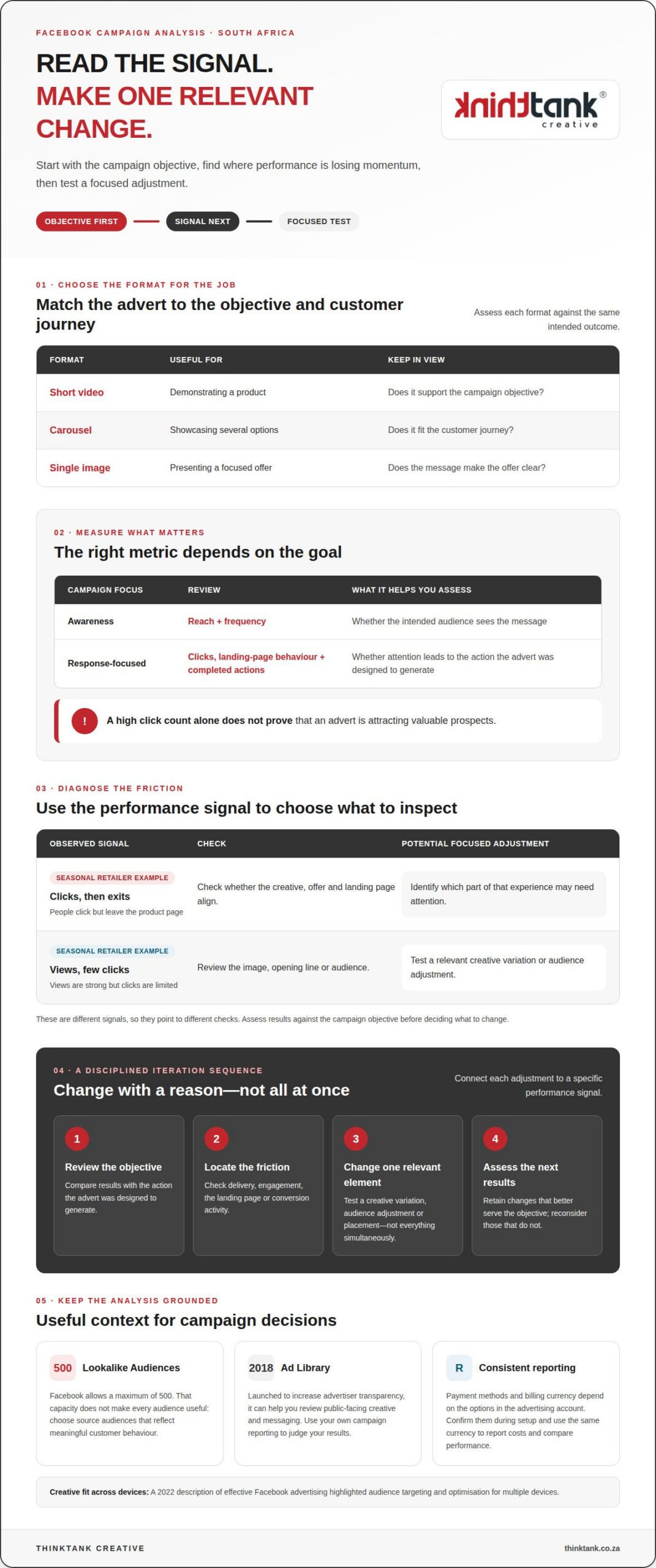
Facebook ad formats work best when they match the campaign objective and customer journey. You might use a short video to demonstrate a product, a carousel to showcase several options, or a single image for a focused offer. Assess each format against the same goal, such as qualified enquiries or completed purchases.
Start analysis with the objective, not the most visible metric. For an awareness campaign, reach and frequency help show whether the intended audience sees the message. For a response-focused campaign, examine clicks, landing-page behaviour and completed actions. A high click count alone does not prove that an advert is attracting valuable prospects.
Imagine a South African retailer promoting a seasonal range. If people click the advert but leave the product page, check whether the creative, offer and landing page align. If views are strong but clicks are limited, the image, opening line or audience may need adjustment. Each diagnosis points to a different test.
Keep campaign changes meaningful by refining them in a structured sequence:
Review the objective: compare campaign results with the action the advert was designed to generate.
Locate the friction: assess whether the issue appears in delivery, engagement, the landing page or conversion activity.
Change a relevant element: test a creative variation, audience adjustment or placement without changing everything simultaneously.
Assess the next results: retain changes that better serve the objective and reconsider those that do not.
Audience testing also requires discipline. Facebook allows advertisers to create a maximum of 500 Lookalike Audiences. That capacity does not make every audience useful: professionals select source audiences that reflect meaningful customer behaviour, then assess whether the resulting delivery supports the campaign objective.
Facebook launched the Ad Library in 2018 to increase transparency around advertisers. It can help professionals review the public-facing creative and messaging used by advertisers, while campaign reporting remains essential for judging their own results. A 2022 description of effective Facebook advertising highlighted audience targeting and optimisation for multiple devices. These remain useful considerations when assessing creative fit across placements.
For South African businesses, payment methods and billing currency depend on the options shown in the advertising account. During account setup, confirm the selected method and currency, then report campaign costs clearly in that currency. Use the same currency consistently when making budget decisions and comparing performance.
Iteration is not a sequence of arbitrary edits. Connect each adjustment to a specific signal so you can distinguish a creative issue from an audience or landing-page issue, then make the next campaign decision with greater clarity.
2. How professionals target by demographics and life events
Strong audience choices start with the customer, not a long list of filters. Map your product or service to relevant demographic signals, such as location, age range or language, and check that each choice supports the campaign objective. A tutoring service, for example, should define its intended learners and guardians before setting its audience.
Life events can make a message more timely when the offer genuinely relates to that moment. A moving company might tailor creative around relocation, while a photographer could develop messaging for engagements. Match the audience signal to the service, and do not treat a life event as proof that someone needs to buy.
Meta’s advertising rules and targeting controls apply in South Africa. Plan campaigns around relevant, non-discriminatory criteria, avoid sensitive personal assumptions, and make sure the advert and audience choices comply with Meta’s current policies.
POPIA is an important privacy consideration when customer data informs Facebook targeting. Use customer information through appropriate business processes, limit its use to the campaign purpose and handle it carefully. Your business should have a sound basis for using those records.
For custom audiences, you can use suitable customer information or engagement with your business’s content, then assess whether the source reflects meaningful interest. For lookalike audiences, the selected source audience guides Meta towards people with similar characteristics. The source matters: genuine customer records can provide a more relevant signal than a broad collection of casual interactions.
Audience design is a sequence of considered choices:
Define relevance: connect the offer to the customer’s needs, location and likely decision stage.
Select suitable signals: use demographics or life events only when they support that connection.
Review data suitability: consider the origin, relevance and intended use of customer information.
Assess delivery: analyse whether the audience produces useful engagement or business outcomes.
For instance, a Durban furniture retailer could separate people engaging with its product content from existing customers. Distinct groups allow professionals to shape different messages, rather than showing every person the same advert. They can then assess performance and refine the audience or creative accordingly.
Audience settings also need room to reach relevant people. Adding overlapping demographic filters may narrow delivery without improving customer fit. A professional weighs each filter against the offer and campaign objective, then uses performance signals to guide adjustments. For businesses planning paid campaigns, professional PPC advertising can bring audience strategy and campaign execution into one considered plan.
3. How does a professional create a Facebook ad campaign targeting customers in South Africa?
A professional begins with the business outcome, then builds the campaign around it. A Johannesburg retailer may want online purchases, while a South African consultancy may prioritise qualified enquiries. That distinction shapes the advert’s objective, audience, message and destination. A clear goal also gives the professional a practical basis for assessing whether the campaign is reaching suitable customers.
A considered approach to how to target customers on Facebook in South Africa starts with customer needs and the business’s reach. Define who the offer serves, then select relevant geographic and audience settings. A business serving customers nationally may need a different campaign structure from one whose service depends on local access.
Organise campaigns to make results easier to interpret. In Meta Ads Manager, group adverts according to distinct audiences or creative approaches. For example, a retailer might separate people who have engaged with its content from a broader prospect audience. This structure helps reveal which message and audience combination is producing useful responses.
Make the offer clear in your creative. Match the image or video, wording and call to action to the action you want customers to take. An advert for a consultation, for instance, can explain the service’s relevance and direct interested people to an appropriate enquiry page. The page should continue the same message, not introduce an unexpected offer.
The destination forms part of the campaign experience. Before launch, the professional reviews whether it loads, works on mobile screens and makes the advertised next step clear. If a South African retailer promotes a particular product, the relevant product information should be easy to find. A confusing or mismatched destination can weaken the response to an otherwise well-targeted advert.
Before activating a campaign, check its objective, audience, creative, destination and tracking arrangements. Measurement should reflect the intended outcome. A lead-focused campaign, for example, needs attention on the relevance of enquiries, not just the number of advert interactions. This preparation gives later analysis a meaningful point of reference.
Once the campaign is running, base adjustments on evidence. If people engage but do not enquire, examine the offer and destination before changing the audience. If responses are poorly matched to the business, refine the advert’s wording or audience criteria. Each change should address a specific point in the customer journey.
Ultimately, how to target customers on Facebook in South Africa depends on aligning business goals with the audience, message and next step. Develop that alignment into a coherent campaign, then use customer responses to guide ongoing decisions. The result is a strategy shaped around your business and the people it aims to serve.
4. How can a professional target South African customers by province, city, or location on Facebook?
Location targeting should reflect where customers can realistically buy or receive a service. First map the business’s operating area, then select suitable places in Meta Ads Manager. A retailer delivering nationally may target a broad South African audience, while a local clinic would focus on nearby customers.
Province-level targeting suits offers available across a large area. For example, a business serving an entire province can shape its audience around that area rather than paying to reach people elsewhere. Consider delivery coverage, travel requirements and customer demand before choosing a province-wide audience.
City targeting makes sense when a business concentrates on a particular urban market. A Cape Town restaurant, for instance, may prioritise customers near its location, while a Johannesburg service provider could focus on areas it can reach. City boundaries alone may not reflect practical travel distance, so professionals assess the business’s actual service footprint.
Facebook can use a radius of 10 miles around a central point. A professional might centre that radius near a shop, venue or service hub, then consider whether the resulting area aligns with customer access. The stated radius is in miles, so it should not be silently treated as kilometres when planning a South African campaign.
If your business serves several distinct areas, structure locations to make campaign delivery easier to interpret. You might group or separate markets according to the offer and operational reach. The right structure depends on whether customers receive the same service and message in each place.
Location settings also need to match the advert. A promotion tied to a specific branch should name that location clearly, rather than implying nationwide availability. A national online offer can use broader geographic coverage, while its creative and landing page explain delivery details to South African customers.
Professionals typically assess these location decisions in sequence:
Map service coverage: identify provinces, cities and local areas the business can serve.
Choose geographic scale: match province, city or radius targeting to the offer.
Align the message: make branch-specific or national availability clear in the advert.
Review results by area: assess which locations generate relevant enquiries or purchases.
For example, if a Pretoria campaign attracts enquiries from outside the business’s practical service area, the professional can refine the geographic selection. If a Cape Town advert performs well in one part of its intended market, that signal can inform future campaign planning. These adjustments connect location choices to real business outcomes, rather than treating every South African audience as one uniform market.
5. Facebook Ad Costs in South Africa: CPM and CPC
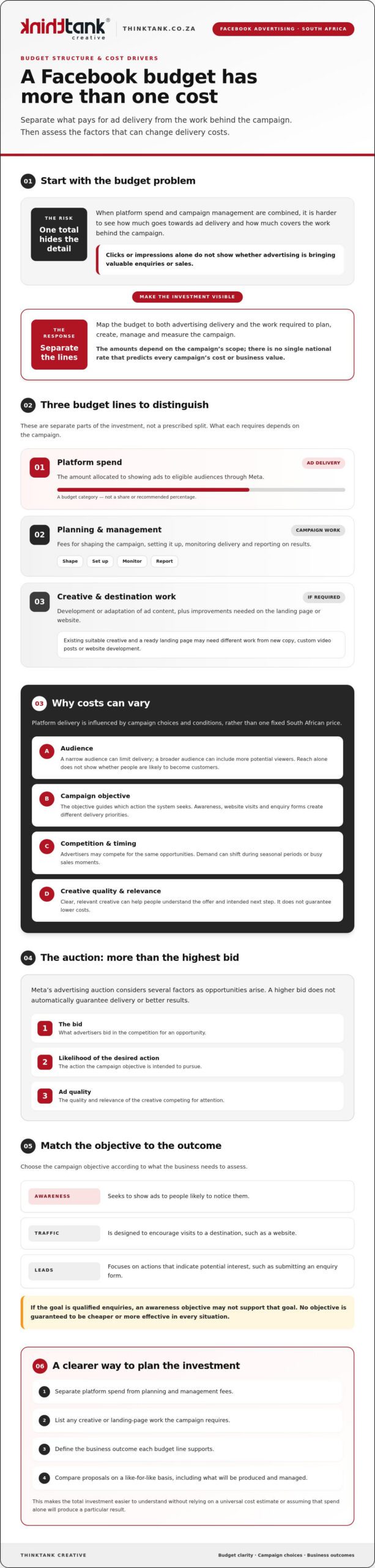
Facebook advertising has no single fixed average CPM or CPC for every South African campaign. Costs depend on the auction, audience, campaign objective, advert and competition for placements. A national retail campaign and a focused local campaign can therefore have different costs.
CPM means cost per thousand impressions. It helps a business assess how much it pays to show an advert, making it useful for campaigns focused on awareness or reach. A lower CPM alone does not prove success, since impressions may not lead to meaningful interest or action.
CPC means cost per click. It indicates the cost associated with advert clicks and can help assess campaigns intended to bring people to a website or another destination. Clicks still need context: a campaign generating visits but few relevant enquiries may not deliver the intended business value.
For example, a Cape Town retailer promoting a new range might compare CPM when assessing exposure and CPC when assessing visits. If the campaign’s purpose is product enquiries, the professional also considers whether those clicks lead to useful conversations. The right metric follows the objective, not simply the lowest reported cost.
Several campaign conditions influence CPM and CPC. A narrowly defined audience may compete for a different set of placements than a broad audience. Creative quality and relevance can affect how people respond, while the campaign objective influences which actions Meta seeks. Seasonal demand and competing advertisers may also affect auction conditions.
Evaluate cost alongside the customer journey. If CPC rises, examine the audience, creative and placement before changing the campaign. If clicks remain steady but enquiries fall, assess the landing page and offer. This prevents one metric from prompting an adjustment that misses the actual issue.
Cost planning should distinguish Meta’s advertising spend from professional campaign fees. Advertising spend is set for the campaign, while professional fees depend on the project and an estimated cost is provided after discussion of needs and timeline. A clear plan identifies the intended outcome, audience, creative needs and measurement approach before budget decisions are made.
For a South African business, a professional can compare campaign results using the same objective and reporting period, then interpret CPM and CPC alongside relevant outcomes. That makes cost comparisons more useful than treating one campaign’s rate as a universal benchmark. Plan Facebook campaign costs around the audience, objective and results that matter to your business.
There is no single average CPM or CPC for South Africa. Both vary with the auction, audience, campaign objective, advert and competition for placements.
ThinkTank Creative
ThinkTank Creative helps South African businesses bring audience strategy, campaign messaging and creative direction together in a coherent digital approach. Its Social Media Marketing service supports businesses seeking professional guidance with Facebook campaign planning, audience selection and performance refinement.
Turn to ThinkTank Creative when your campaigns need a clearer connection between the people you want to reach, the message they see and the action you want them to take. When a campaign leads to a website, Website Design & Development can create a destination that reflects the advert and guides visitors towards the next step. Branding & Creative Design can also shape advertising visuals around your brand.
Share your campaign goals and the customers you want to reach. Contact ThinkTank Creative to discuss a considered approach to your Facebook advertising.
Build a stronger connection with your audience
Make each campaign a starting point for a more relevant relationship with your customers. Learn what earns their attention, what prompts meaningful engagement and how your brand can respond with communication that feels timely and useful.
A considered approach to how to target customers on Facebook in South Africa is not simply about choosing an audience. Align your message with what your business wants to achieve, then make deliberate decisions as customer needs evolve. This perspective helps keep your advertising connected to the people it is intended to serve.
ThinkTank Creative can help shape that direction through its work in digital marketing and creative development. If you’re ready to discuss your Facebook advertising goals, start a conversation with ThinkTank Creative. Take the next step with clarity, and give your campaigns a thoughtful foundation for what comes next.
Frequently Asked Questions
What Facebook ad strategy can a professional use to reach customers in South Africa?
A professional can tailor campaign messages to where potential customers are in their decision journey. For a South African software firm, one advert might introduce a service to new prospects, while another addresses people who have already engaged with the business. The professional then assesses which approach attracts more relevant enquiries, rather than focusing on volume alone, and adapts messaging to better reflect each audience’s familiarity with the offer.
What Facebook audience targeting options are available for South African advertisers?
South African advertisers can use geographic and demographic selections, interests, life-event signals, custom audiences and lookalike audiences. Each option serves a different purpose: a local retailer might focus on people near its shop, while an established business could use an appropriate customer group to inform audience expansion. Consider how audience groups overlap and choose options that support the campaign’s purpose, rather than layering on filters without a clear reason.
Can Facebook ads target South Africans by language, interests, age, and demographics?
Yes, Facebook campaign settings can include language, interests, age and other demographic criteria, subject to the options available and advertising policies. An education provider, for example, might create language-appropriate advert copy and choose age settings relevant to its intended audience. Make sure these selections suit the offer, keep the advert clear and avoid messaging that suggests sensitive personal knowledge about the people who see it.
What are Meta's advertising rules and prohibited targeting practices in South Africa?
In South Africa, campaigns must follow Meta’s advertising rules and targeting controls. Use relevant, non-discriminatory criteria, avoid sensitive personal assumptions, and ensure the advert and audience choices comply with Meta’s current policies.
Social Media Engagement: Ideas for More Interaction
A like is only one part of the conversation. Social media engagement includes the interactions that build community and customer loyalty, from comments and shares to thoughtful replies. To understand how to increase social media engagement, look beyond reaction counts: consider what prompts people to respond, how each platform shapes interaction and how you measure the rate.
Posting more often is not the only answer. Relevant content and genuine two-way communication give people a reason to take part. This guide covers practical ways to invite interaction, including questions, polls and community content, and how to keep your brand voice consistent. You’ll also learn how engagement differs across platforms and how to calculate a basic engagement rate using likes, comments, shares and followers, so you can assess performance more clearly.
Key Takeaways
Measure meaningful interactions, not just likes, to understand whether your content is building community and customer loyalty.
Use audience insights to shape relevant posts, then invite participation with polls, thoughtful questions and community contributions.
Adapt your content to each platform, as formats and typical engagement levels differ across social networks.
Keep your brand voice recognisable in posts and replies, while sharing stories that make your business feel more human.
Calculate a basic engagement rate by dividing likes, comments and shares by your follower count, then multiplying by 100.
Social media engagement describes how people interact with content and a brand. It includes likes, comments, saves, replies, mentions and shares, but the count alone doesn’t show what those actions mean. A detailed comment or a customer sharing a useful post may signal stronger interest than a quick reaction. Treat engagement as evidence of a conversation, not simply a popularity score.
Start by defining the audience you want to reach. Consider location, age group, language, interests and the problems your product or service addresses. In South Africa, language preferences and interests can vary across customer groups, so one message may not suit everyone. Use available audience analytics to examine demographics, content interactions and follower behaviour. Compare those patterns with the questions customers raise in comments and messages.
Native analytics tools include Meta Business Suite, Instagram Insights, LinkedIn analytics, TikTok analytics and X analytics. They provide platform-specific information about reach and interactions. The cost of paid analytics and social-listening tools in South Africa varies by provider, features and account needs.
Buying followers or using bots and engagement pods can make performance figures less representative of genuine audience interest. Engagement bait, such as asking for unrelated comments or shares, may generate activity without useful feedback. Focus instead on interactions from people who care about your subject, and assess whether their responses support your communication goals.
Choose platforms based on audience behaviour and content format. A professional service might use LinkedIn to share industry insights, while a visually focused brand could use Instagram to present product photography. TikTok suits short-form video, whereas Facebook can support community discussions and local updates. These are starting points, not fixed rules: compare interaction quality on each platform before deciding where to focus your effort.
Use social listening to understand what your audience discusses beyond your own posts. Review recurring questions, customer feedback, relevant mentions and the language people use to describe their needs. For example, repeated questions about delivery could inspire a clear explainer post. This helps uncover content opportunities and shows which topics prompt meaningful responses.
Tailor each post to an observed preference. If followers save practical checklists, create another useful guide; if they share customer stories, invite them to contribute their experiences. Look for recurring themes in comments and user-generated content, then adapt your examples, format and tone. This is a practical foundation for learning how to increase social media engagement: listen, publish with purpose and use responses to shape what comes next.
2. Using polls, questions, competitions, and user-generated content
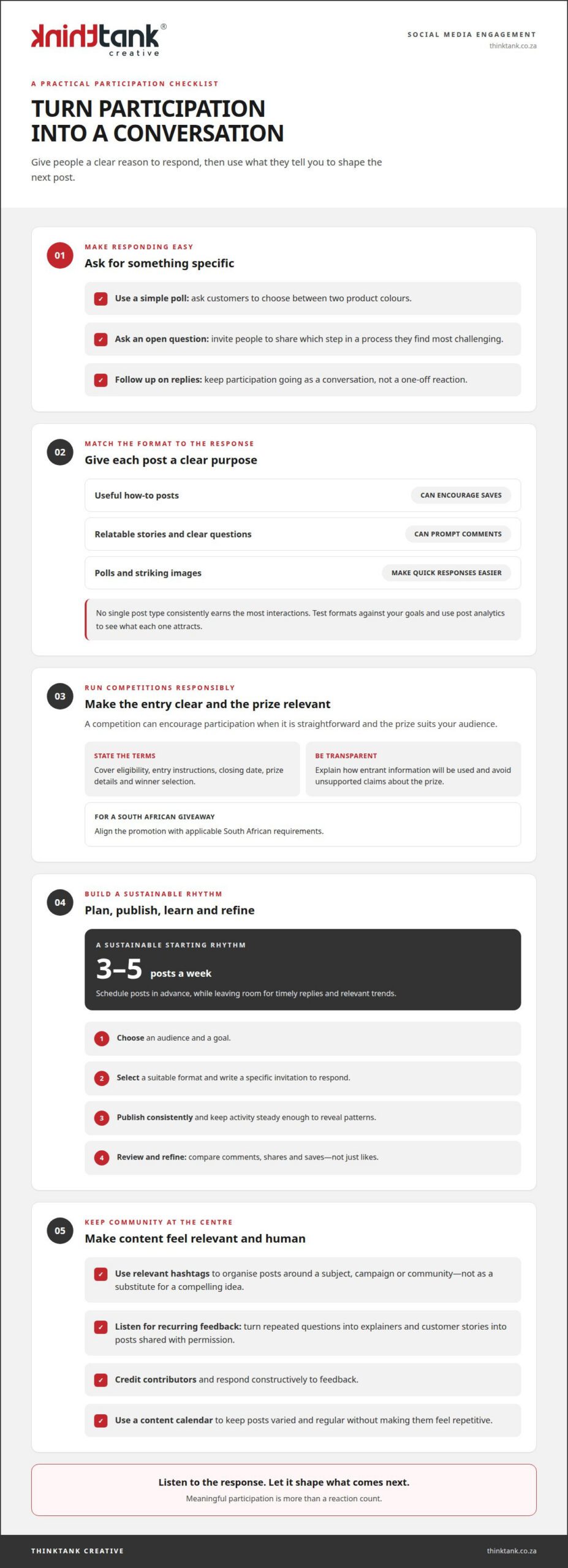
Give people an easy, specific reason to respond. A poll asking customers to choose between two product colours is simpler to answer than a broad request for opinions. Open questions work well when they invite useful experiences, such as asking which step in a process people find most challenging. Follow up on answers so participation becomes a conversation, not a one-off reaction.
No single post type consistently earns the most comments, shares, saves and reactions. Useful how-to posts can encourage saves, while relatable stories and clear questions can prompt comments. Polls and striking images can make quick responses easier. Test formats against your goals, then use post analytics to see which interactions each one attracts.
Competitions can encourage participation when entry is straightforward and the prize suits your audience. For a South African giveaway, publish clear terms covering eligibility, entry instructions, closing date, prize details and winner selection. Align the promotion with applicable South African requirements, explain how entrant information will be used, and avoid unsupported claims about the prize.
Use hashtags to organise relevant posts, not as a substitute for a compelling idea. Choose tags connected to the subject, campaign or community, then check whether they attract relevant conversations. Customer feedback can guide future content too: a recurring question might become a short explainer, while a customer story could inspire a post shared with permission.
There isn’t one best posting time for every South African audience. Use platform analytics to identify when your followers are active, test different time slots and compare the resulting interactions. A sustainable starting rhythm is three to five posts a week. Schedule them in advance, while leaving room for timely replies and relevant trends.
Build and test a strategy in a clear sequence: choose an audience and goal, select a suitable format, write a specific invitation to respond, publish consistently, then review the results and refine the next post. For example, compare a product-choice poll with a practical tip by looking at comments, shares and saves, not just likes. Maintain a consistent level of activity to reveal patterns.
Authenticity matters more than manufacturing activity. Share customer contributions with permission, credit the creator, and respond constructively to feedback. A content calendar can keep these posts varied and regular without making them feel repetitive. For tailored planning and creative execution, explore social media marketing.
3. Differences in engagement across platforms
Compare like with like: each platform has different audiences, formats and interaction habits. Typical median engagement rates are approximately 6.2% on LinkedIn, 5.6% on Facebook, 5.5% on Instagram, 4.6% on TikTok, 4.0% on Pinterest and 2.5% on X. These figures offer context, not targets for every South African account. A business should compare its own posts with similar content on the same platform.
A rate between 1% and 6% is generally considered good, depending on platform, industry and other factors. That broad range makes context essential: a specialist B2B account on LinkedIn serves a different purpose from a retailer connecting with consumers on Instagram. Look at comments, shares and other meaningful actions alongside the rate. A smaller audience that responds to relevant posts may be more valuable than a larger, less active following.
Format also changes the picture. Instagram Reels generate approximately 36% more reach than carousels, whilst carousels earn approximately 12% more engagement than Reels. LinkedIn document or PDF carousel posts have a median engagement rate of 21.77%. These comparisons suggest that reach and interaction are separate outcomes. Choose a format based on whether the post needs to attract new viewers or encourage deeper responses.
Platform algorithms influence which content appears in people’s feeds, but their signals and ranking systems differ and change. A useful strategy is to create posts suited to each platform, then observe how followers respond. For instance, a LinkedIn document can present a detailed process, while an Instagram carousel can break a visual guide into clear steps. Replying to comments also keeps the conversation active: replies present were associated with an estimated 30% engagement lift on LinkedIn and 42% on Threads.
Give each channel a defined audience and purpose. LinkedIn can support professional discussion; Instagram can showcase visual storytelling; TikTok centres on short-form video; Pinterest helps people discover visual ideas; and X supports concise, timely conversation. Facebook can bring community updates and discussions together. These roles are starting points, not rigid rules. Let audience behaviour and the content itself determine where each post belongs.
Review platform analytics separately instead of blending every interaction into one figure. Track reach, comments, shares and saves for comparable posts, then note the format and subject. If Instagram Reels attract more reach but carousels prompt more saves, keep both for their distinct purposes. This gives your social media strategy a practical basis: focus on platforms that help your business connect with the right people, and adapt creative choices to audience responses.
4. Maintaining an authentic and consistent brand voice
A recognisable voice makes each post feel connected to the same brand, whether it appears on Facebook, Instagram or LinkedIn. Define a few practical traits, such as warm, informed and direct, and use them to guide captions, customer replies and product announcements. An approachable brand, for example, can explain a service clearly without jargon or exaggerated promises.
Turn those traits into a short voice guide. Include preferred wording, the level of formality, topics the brand can speak about and examples of suitable replies. If a customer raises a concern on Facebook, the response should sound as considered as a product-launch post. Consistency doesn’t mean copying identical captions across platforms; it means expressing the same values in formats suited to each audience.
Authenticity comes from showing the people and decisions behind the brand. Share an employee’s perspective, a customer story or the steps involved in creating a product. These stories give followers something specific to discuss and help explain what the business stands for. Ask permission before featuring customer contributions, and represent their words and experiences accurately.
Plan a content calendar around recurring themes, such as customer questions, expertise, team stories and product information. Scheduling drafts in advance helps maintain a steady presence while leaving space for timely updates and genuine replies. Before publishing, check that the wording, visual style and invitation to respond match the brand’s voice guide. A calendar supports consistency; it shouldn’t make every post feel formulaic.
Keep the relationship active after publishing. Monitor comments and messages, respond within 24 hours where possible, and use feedback to inform future communication. A thoughtful reply can acknowledge a customer’s point, answer their question and invite a useful next step. If criticism appears, address the issue calmly rather than switching to a defensive tone that conflicts with the brand’s usual manner.
Give the approach time to develop. Consistent posting and interaction often take 1 to 3 months to show engagement results, so review patterns across that period rather than judging the voice by one post. Look for recurring questions, constructive conversations and audience responses to different story types. If a message feels unlike the brand, revise it before publishing; if a particular tone prompts meaningful discussion, carry that learning into the next campaign.
5. Defining and calculating social media engagement
Engagement can be counted as interactions or expressed as an engagement rate. The count shows how many likes, comments and shares a post received. The rate puts those actions in context, helping you compare performance against audience size. These measures answer different questions, so decide whether you need a total activity figure or a proportional view.
For a basic follower-based rate, add likes, comments and shares, divide the total by your follower count, then multiply by 100. For example, a post with 200 engagements and 5,000 followers has a 4% engagement rate: (200 ÷ 5,000) × 100. Keep the formula consistent across the posts you compare.
Some reports calculate engagement using reach rather than followers. Reach-based rates show interactions relative to the people who saw a post; follower-based rates compare them with your account audience. The denominators are not interchangeable. Label the formula beside each result, or an apparent change may reflect a different calculation rather than a stronger audience response.
Set the measurement period and content scope before reviewing results. You might calculate a rate for each post, then compare similar posts from the same platform over a consistent period. Separate organic posts from paid promotion, and note the format, topic and call to action. A visual guide, short video and hashtag-led announcement may each invite different interactions.
Interpret the numbers in light of each post’s purpose. A useful tutorial may earn saves, while a discussion prompt may attract comments. If your calculation includes only likes, comments and shares, it won’t represent every valuable response. Track relevant measures such as saves or link clicks separately, and use customer feedback to understand why an interaction happened.
Use the result to guide your next decision, not simply to rank posts. If a post receives a lower rate, review its audience fit, clarity, timing and format. Then test one change, such as a more specific question or a stronger opening visual. Record the change and compare the next results using the same formula. This feedback loop turns measurement into a practical way to refine content.
ThinkTank Creative provides Social Media Marketing to help businesses build a considered presence and create content that invites meaningful interaction. Turn to this support when posting feels inconsistent, engagement is difficult to interpret or your social channels need a clearer connection to your wider brand.
A focused approach can bring audience insights, platform choices, content planning and performance measurement into one coherent strategy. Branding & Creative Design can help align your visual expression with your brand, while Website Design & Development can support a consistent experience beyond social media. The work is shaped around your business objectives, audience and preferred direction.
Ready to bring more structure and purpose to your social media? Contact ThinkTank Creative to discuss your goals.
Turn interaction into lasting momentum
Make your next step deliberate: choose one audience response you want to understand better, then shape upcoming content around that opportunity. The question of how to increase social media engagement becomes more valuable when it leads to clearer decisions, stronger conversations and a closer connection between your brand and its community. Keep learning from how people respond, and let those insights guide your next creative move.
As your approach develops, align social media activity with the wider experience people have of your business. ThinkTank Creative can support that direction through Social Media Marketing, Creative design, and Website Design and Development. If you’re ready to turn your ideas into a considered strategy, contact ThinkTank Creative to discuss your strategy. A thoughtful next step can set the foundation for more purposeful interaction and continued growth.
Frequently Asked Questions
What is Social Media Engagement?
Social media engagement describes how people respond to and participate in a brand’s activity on social platforms. A customer might comment with a product question, share a useful post with a colleague or mention a business in their own update. These actions signal different kinds of interest. Consider what each response reveals about customer needs instead of treating every interaction as equally valuable.
What does social media engagement include, and how is engagement rate calculated?
Engagement can include likes, comments and shares, alongside platform-specific actions such as saves, replies or mentions. For a basic follower-based rate, add likes, comments and shares, divide by the follower count, then multiply by 100. A post with 200 engagements and 5,000 followers has a 4% rate. Keep the same formula when comparing posts, and label which interactions your calculation includes.
What are the best ways to increase engagement on Instagram, TikTok, Facebook, LinkedIn and X?
Match the format to the platform and the response you want. On Instagram, test a carousel that guides viewers through a process; on TikTok, make a short video answering a common question. Facebook can host a community discussion, LinkedIn can invite professional perspectives, and X can carry a concise prompt about a timely topic. Review responses on each channel, then develop the formats that attract relevant conversations.
How often should businesses post on social media to increase engagement?
A practical starting point is three to five posts a week, adjusted to your team’s capacity and audience response. For example, a local service business could schedule educational posts and customer updates throughout the week rather than publishing several rushed messages in one day. A regular rhythm helps audiences know what to expect. Review the quality of replies and shares, then adapt the schedule to keep posting useful and sustainable.
How can businesses use hashtags, captions, questions and calls to action to boost engagement?
Make each element support one clear idea. Use hashtags relevant to the subject, open the caption with a specific benefit, then ask a question people can answer from experience. For example, a café could ask which seasonal drink customers would like to see return. Finish with a direct invitation, such as “Tell us your pick below.” Avoid unrelated tags or requests for reactions that don’t contribute to the conversation.
How can brands encourage user-generated content, community participation and replies?
Invite customers to share how they use a product or service, then feature suitable contributions with permission and clear creator credit. A gardening business could ask followers to post progress from a home project, giving others a topic to discuss. Respond with a specific observation or follow-up question. Acknowledging people by name, where appropriate, helps their participation feel valued and gives the community a reason to return.
What are typical social media engagement rate benchmarks by platform and industry?
Typical median engagement rates are approximately 6.2% on LinkedIn, 5.6% on Facebook, 5.5% on Instagram, 4.6% on TikTok, 4.0% on Pinterest and 2.5% on X. A rate between 1% and 6% is generally considered good, depending on platform, industry and other factors. Treat these figures as context, not fixed targets: compare similar content on the same platform and account for audience size and purpose.
What are the best times to post on social media in South Africa?
There is no single best posting time for every South African audience. Use platform analytics to find when your followers are active, test different time slots and compare interactions.
Social Media Posting Times in South Africa by Platform
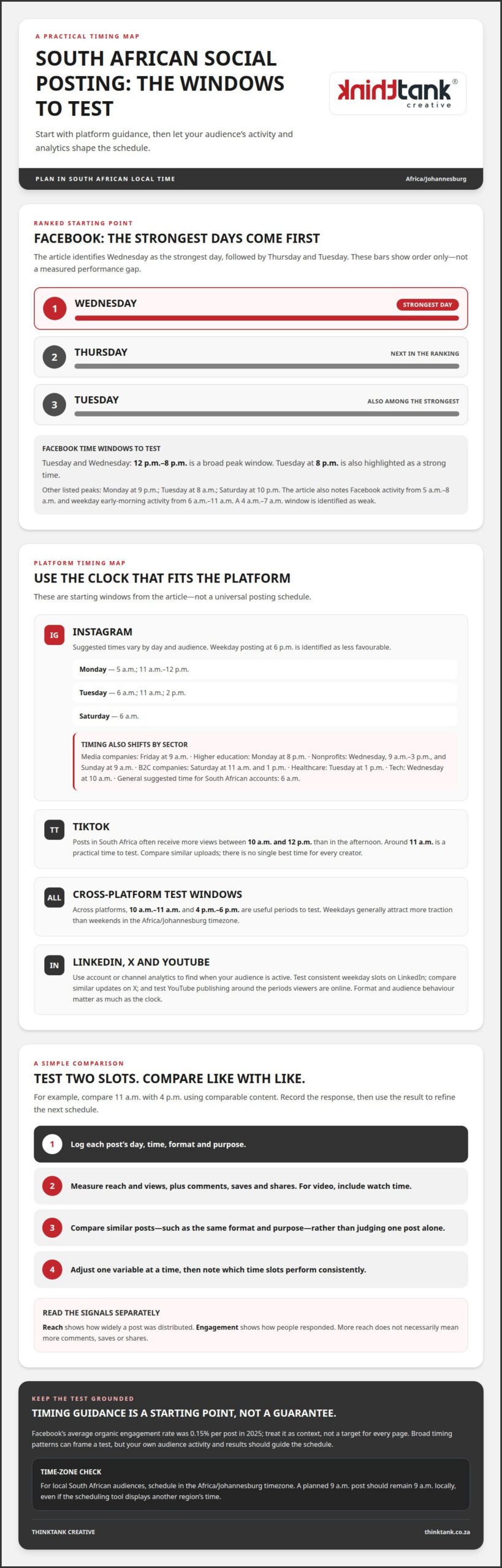
Tuesday and Wednesday, from 12 p.m. to 8 p.m. South African time, are a useful starting window for Facebook posts. The best times to post on social media in South Africa still vary by platform and audience, with Tuesday at 8 p.m. also identified as a strong time to test.
It’s understandable to want a clear schedule: posting at the wrong time can limit the chance for good content to be seen. Treat suggested times as a starting point, then refine your schedule using your audience’s activity and your own analytics.
This guide covers recommended posting times by platform and day, explains how to adapt them for different audiences, and shows how to use engagement data to build a schedule for your brand. It also accounts for South African local time, so you can plan posts for the people you want to reach.
Key Takeaways
Use platform- and audience-specific timing rather than relying on one universal posting schedule.
Compare Instagram’s recommended weekday and weekend windows with your audience’s own activity patterns.
Assess posts through meaningful engagement signals, including views, watch time, comments, saves and shares.
Test posting days and times consistently, then use the results to refine your schedule.
Plan around South African local time and account for time-zone differences when reaching audiences elsewhere.
What is the best time to post on social media in 'Africa/Johannesburg' timezone?
For Facebook, Tuesday and Wednesday from 12 p.m. to 8 p.m. form a broad peak window. Tuesday at 8 p.m. is also identified as a strong time. Across platforms, 10 a.m. to 11 a.m. and 4 p.m. to 6 p.m. are useful periods to test. Weekdays generally attract more traction than weekends in the Africa/Johannesburg timezone. These patterns help identify the best times to post on social media in South Africa, but your audience’s activity should guide the final schedule.
Instagram recommendations differ by weekday and audience. Monday suggestions are 5 a.m. and 11 a.m. to 12 p.m.; Tuesday suggestions are 6 a.m., 11 a.m. and 2 p.m. Saturday’s suggested time is 6 a.m. Media companies’ Instagram content performs best on Fridays at 9 a.m. Higher education content performs best on Mondays at 8 p.m. Nonprofits see strong windows on Wednesdays from 9 a.m. to 3 p.m., and Sundays at 9 a.m. Weekday Instagram posting at 6 p.m. is identified as less favourable.
TikTok posts in South Africa often receive more views between 10 a.m. and 12 p.m. than during the afternoon. Around 11 a.m. is a practical starting point for testing. There is no single best time for every TikTok creator, so compare performance across similar uploads.
For LinkedIn, start with the periods when your audience is active, as shown in account analytics. Test a consistent weekday slot, then compare impressions and engagement across posts. On X, schedule comparable updates at different times when your audience is active and assess the response. On YouTube, check channel analytics to see when viewers are online, then test publishing around those periods. Format and audience behaviour matter as much as the clock.
South African businesses reaching local audiences should schedule in the Africa/Johannesburg timezone. This keeps a planned 9 a.m. post at 9 a.m. locally, even when the scheduling tool displays another region’s time.
To find the best times to post on social media in South Africa for your page, run a simple comparison. Choose two candidate slots, such as 11 a.m. and 4 p.m., and publish comparable content in each. Record reach, views, comments, saves and shares; compare like with like, rather than judging one post alone. Facebook’s weekday early-morning activity has also been noted between 6 a.m. and 11 a.m., while 4 a.m. to 7 a.m. is identified as a weak window. Treat these platform patterns as starting points, then let page performance shape your next schedule.
Using social media analytics to improve engagement
Use analytics to turn publishing times into testable decisions. Record each post’s publishing time, weekday, format and audience response. Then compare similar posts, such as two product demonstrations published in different time slots. This separates timing effects from differences in subject or creative execution. Facebook’s average organic engagement rate was 0.15% per post in 2025. Treat this as context, not a guaranteed target for every page or post.
Look for patterns across your own account before changing the schedule. Sprout Social identifies weekends as Facebook’s weakest days overall, while weekday performance can vary by audience. Buffer’s analysis found Facebook engagement tends to fall between 12 p.m. and 5 p.m. These broad patterns help frame a test, but they don’t show how your followers behave. Compare weekday results with weekend results using the same content type and measurement period.
Measure reach and engagement separately. Reach shows how widely a post was distributed; engagement shows how people responded. A post can reach more people without earning more comments, saves or shares. Set a baseline for your account by comparing posts with similar formats and goals. For example, assess awareness posts by reach and views, then compare discussion posts by comments and shares. Use the same measure for each comparison.
Format matters too. Socialinsider’s benchmarks found Reels were the only Facebook content format to increase engagement in Q1 2026. That makes format an important variable in timing tests: compare Reels with Reels, rather than crediting a time slot for a format difference. For video, include watch time alongside views. For other posts, track comments, saves and shares to understand whether the content prompted useful action.
Build a simple review routine around each publishing test:
Log the post’s day, time, format and purpose.
Measure views, watch time, comments, saves and shares.
Compare like-for-like posts, then note which time slots perform consistently.
Adjust one variable at a time before testing another.
Reviewing these signals together helps distinguish a timing pattern from a one-off result. An analytics-led social media publishing strategy can connect content planning with performance measurement, making each schedule adjustment more deliberate.
Best day and time to post
Wednesday is the strongest Facebook posting day, followed by Thursday and Tuesday. Weekdays generally attract more social media traction in South Africa, but the best day depends on the platform, audience and content. Treat these patterns as a starting point, not a universal schedule for every account.
For Facebook, daily peak hours can sharpen that starting point. Monday’s listed peaks are 7 p.m., 9 p.m. and 10 p.m., with 9 p.m. the strongest. Tuesday’s are 7 a.m., 8 a.m. and 7 p.m., with 8 a.m. the peak. Saturday’s listed hours are 6 a.m., 9 p.m. and 10 p.m., with 10 p.m. highest. Hootsuite’s data also places Facebook activity between 5 a.m. and 8 a.m. Use these morning windows as tests alongside weekday evening activity.
Instagram timing shifts with sector. South African B2C companies see their best engagement on Saturdays at 11 a.m. and 1 p.m. Healthcare companies perform best on Tuesdays at 1 p.m., while tech companies see strong engagement on Wednesdays at 10 a.m. A general suggested time for South African Instagram accounts is 6 a.m. These differences show why business type and audience habits matter as much as platform-wide averages.
Which days of the week get the most social media engagement in South Africa? Wednesday, Thursday and Tuesday are the leading Facebook days in Buffer’s ranking, while Instagram results vary by sector. For example, B2C Instagram engagement peaks on Saturday, so a weekday-only schedule could miss that audience.
Choose a posting day according to the action you want people to take. A B2C brand could test Saturday at 11 a.m. against 1 p.m.; a healthcare page could compare Tuesday at 1 p.m. with another suitable weekday slot. Keep the topic and format as consistent as possible, then compare reach and interactions. This helps show whether timing, rather than a different creative approach, shaped the response.
Treat the algorithm as one factor in distribution, rather than a reason to chase every reported peak. A morning slot may suit one audience, while an evening post may better match another’s routine. Choose a small set of day-and-time combinations, publish consistently, then use your account’s performance to refine the schedule. For a Facebook page, Wednesday is a sound first test. For Instagram, choose a sector-specific window that best matches your audience.
Local-time and time-zone considerations
Schedule for the clock your South African audience uses. The Africa/Johannesburg timezone is the reference for local posting recommendations, so a Tuesday slot listed at 8 p.m. means 8 p.m. there. If a dashboard or imported chart displays another timezone, its clock time may not match the local recommendation. Confirm the schedule’s timezone before setting a post to publish.
Time differences can shift recommended windows. Some charts may need a one-hour adjustment to account for timezone and daylight-saving differences. That matters when applying a global report to a South African account: a displayed 10 a.m. peak might need to be interpreted against the report’s stated timezone before scheduling. Preserve the original time and timezone in your planning notes, then convert the slot for your target audience.
Use a consistent conversion method for every scheduled post. First, identify the timezone used by the recommendation. Next, identify the timezone selected in your publishing tool. Then convert the intended local posting time before scheduling. For example, if your target is Tuesday at 8 p.m. in Africa/Johannesburg, make sure the tool’s displayed time represents that local moment, not simply the same clock reading elsewhere.
Separate local and international audiences rather than forcing them into one schedule. A South African post planned for 4 p.m. should reach local followers at that time. If a campaign also targets people in another timezone, create a separate publishing slot based on their local activity. This keeps the South African schedule anchored to local behaviour while allowing international posts to follow their intended audience’s clock.
Keep a timezone record beside each performance result. Include the platform, intended location, scheduled time and timezone, then compare engagement only after confirming the records use a consistent local reference. A Tuesday post recorded as 8 p.m. Africa/Johannesburg should not be compared casually with a report showing 8 p.m. in another timezone. That distinction helps prevent a scheduling conversion from being mistaken for an audience preference.
Before publishing, use this short time-zone check:
Confirm whether the recommendation uses Africa/Johannesburg or another timezone.
Check the timezone selected for the scheduled post.
Convert the intended slot, allowing for a one-hour difference where applicable.
Record the local posting time alongside engagement results.
For a campaign aimed at a South African audience, keep the final calendar in South African local time. If you use an international chart, check its timezone first, then convert the suggested window to Africa/Johannesburg. This makes a Tuesday peak or another recommended slot actionable without confusing the chart’s reporting time with the time your audience sees the post.
Scheduling posts across time zones
Start with the audience’s local clock, not the location of the person scheduling. For South African followers, plan posts in Africa/Johannesburg time. A post intended for 9 a.m. locally should reach that audience at 9 a.m., even if the person preparing it works elsewhere.
For a campaign serving audiences in South Africa and other countries, create separate time slots for each location. One publishing time might be morning for one group and evening for another. Separate schedules help each audience see the same campaign at a time that fits its local routine.
Before scheduling, establish which timezone the platform or planning calendar displays. Compare that setting with the timezone used by the timing recommendation. If a chart gives a peak at 10 a.m. in another timezone, don’t enter 10 a.m. automatically. Convert the intended moment to the target audience’s local time first.
Some charts may need a one-hour adjustment to account for timezone and daylight-saving differences. Preserve the source timezone alongside any converted slot, so the original recommendation remains clear. For example, record both the source’s 10 a.m. suggestion and the resulting Africa/Johannesburg schedule time. This makes later review more reliable than keeping only a clock reading.
Use a repeatable scheduling workflow for every platform:
Identify the audience location and the timezone used for its schedule.
Record the recommendation’s original timezone and suggested posting time.
Convert that time for the intended audience before scheduling.
Check the displayed publishing time against the local calendar entry.
Review performance using the audience’s local posting time.
Keep records for each platform and audience segment. For example, a South African Facebook post and an international Instagram post might use the same campaign artwork but need separate local publishing slots. Label each calendar entry with its platform, market, timezone and intended posting time. This helps your team distinguish the scheduled time from a converted display time.
When comparing results, group posts by audience location and local time. A South African post published at 9 a.m. should not be treated as equivalent to an overseas post published at 9 a.m. unless both audiences experienced the same local timing. Compare similar content within each market, then adjust the relevant schedule based on its own engagement.
ThinkTank Creative’s Social Media Marketing service helps businesses build a more cohesive social media presence. It’s a natural next step when your team needs support aligning platform-specific timing with consistent content and a clear brand identity.
Social media works best as part of a considered brand experience. Creative design and Logo and Corporate Identity Design help keep campaign visuals recognisable across posts, while Website Design and Development can support the journey from social content to your online presence. The right combination depends on your goals and the role social media plays in your wider marketing.
To shape a more coordinated social media approach, contact ThinkTank Creative to discuss your goals.
Make your next publishing cycle more intentional
Make your social media calendar a working plan, not a fixed set of times. Use the best times to post on social media in South Africa as a starting point, then let audience responses guide what you publish next. Your campaign can evolve as your content, objectives and audience behaviour change.
Next, connect posting times with the wider experience your brand creates. Social Media Marketing, Creative design and Website Design and Development can each support a more coherent journey from a post to meaningful interaction with your business. ThinkTank Creative can shape that work around your brand and marketing priorities.
Bring your goals and the questions you want your social media activity to answer. A considered conversation can help clarify the direction of your next campaign and how its content should work together.
Contact ThinkTank Creative to discuss a more cohesive approach to your social media presence. Build on what you’ve learned, keep refining your direction, and give your next publishing cycle a purposeful start.
Frequently Asked Questions
What are the best days and times to post on Facebook?
Wednesday, Thursday and Tuesday rank as Facebook’s strongest days in the available weekday ranking. Tuesday and Wednesday from 12 p.m. to 8 p.m. are broad posting windows, while Tuesday at 8 p.m. is a specific time to test. For a practical comparison, schedule similar posts on Wednesday and Thursday, then assess their responses using the same measures and time period.
Can a business enjoy greater profits by timing their social media posts?
Better timing can help a post reach people when they’re active, but publishing time alone doesn’t determine profit. The offer, creative, audience fit and path to purchase all affect whether engagement leads to a sale. To assess commercial impact, use tracked links or campaign-specific codes, then compare enquiries or purchases with the posts that generated them.
Does time of day matter when posting?
Yes. Publishing when your intended audience is active gives a post a better opportunity to be seen promptly. However, suitable times vary by platform, audience and content. A morning post may suit one audience, while an evening slot may better match another’s routine. Compare similar posts published at different times to find what fits your followers’ behaviour.
Does time-zones matter when scheduling social media posts?
Yes. A scheduling tool may display a different timezone from the one in your posting plan. For South African audiences, use Africa/Johannesburg as the local reference and confirm that the scheduled time reflects it. If a recommendation uses another timezone, convert the suggested time before scheduling. Keep the original timezone in your records so later comparisons remain meaningful.
Does timing on Facebook matter?
Timing can influence whether a Facebook post appears when followers are available to engage, but it’s only one part of performance. Format and content also affect the response. For example, compare similar posts published at different times, then measure reach and interactions separately. This helps you avoid mistaking wider distribution for stronger audience engagement.
When is the best time to post on Instagram in South Africa?
Six a.m. is a recommended starting time for South African Instagram accounts, but suitable slots vary by sector. For example, healthcare content performs best on Tuesdays at 1 p.m., whilst tech content sees strong engagement on Wednesdays at 10 a.m. Choose the window closest to your audience and content, then assess results against comparable posts rather than relying on one upload.
Why is it important to publish content at the right time on social media?
Timing helps align a post with periods when its intended audience is likely to be active, giving useful content a better opportunity to attract attention and interaction. For example, publishing a campaign announcement during a relevant audience window may make it easier for people to see and respond promptly. A good schedule also supports consistency without treating every platform alike.
What are the best times to post on Instagram in South Africa?
For a general starting point, test 6 a.m. on Instagram, then compare it with times suited to your industry. Media companies’ content performs best on Fridays at 9 a.m.; nonprofits see strong windows on Wednesdays from 9 a.m. to 3 p.m. and Sundays at 9 a.m. Treat these as audience-specific clues, and compare like-for-like posts before changing your ongoing schedule.
How to Build a Social Media Content Calendar From Your Ideas
A social media content calendar should do more than mark dates. It brings together what you’ll post, where and when it will appear, and the details needed to prepare each piece of content. Learning how to create a social media content calendar starts with organising your ideas around your audience, goals and capacity to publish consistently.
If social media planning often feels like a scramble, a clear calendar can organise your ideas without making content feel rigid. It helps you see what’s coming, balance different post types and leave room to respond when priorities shift.
This guide explains what to include in your calendar and how it differs from a broader content plan. You’ll set goals, choose platforms and a realistic posting frequency, then schedule posts and track performance to refine your approach over time.
Key Takeaways
Set clear, measurable social media goals before turning ideas into scheduled posts.
Focus on platforms where your audience is active and you can publish quality content consistently.
Choose a posting rhythm that fits your resources, then refine it using audience behaviour.
Give each calendar entry the practical details needed to prepare, review and publish the content.
Track performance against your goals and use the results to shape your next round of posts.
A social media content calendar sets out what you’ll publish, where and when. A content plan establishes strategy and themes, while an editorial calendar maps broader priorities across months or quarters. Learning how to create a social media content calendar means connecting audience needs and clear goals with practical publishing details.
Set SMART social media goals: specific, measurable, achievable, relevant and time-bound. Choose content pillars, such as product education, customer stories and useful advice, to give posts recurring themes.
Start with audience behaviour. Identify who you want to reach, what they need and which platforms they use. For younger consumers aged 18-25, TikTok or Instagram may be more effective than Facebook. Use audience insights, comments and engagement patterns to guide platform choices, rather than assuming every channel deserves equal attention.
Choose platforms you can serve well. Select 2-3 platforms where potential customers are active and you can publish quality content consistently. Consider each format: a short video, carousel or written update may communicate the same idea differently. Focusing your efforts makes it easier to maintain a coherent workflow and review engagement meaningfully.
Set a realistic publishing rhythm. Use audience activity and available time to decide how often to post on each platform. Start with a schedule your team can sustain, then compare posting times and engagement. If LinkedIn brings relevant interactions but another platform stays quiet, focus more effort on the audience showing interest.
Choose a template that supports decisions. Organise the calendar in Google Sheets, Excel or a social media management tool. A shared spreadsheet may suit a solo creator, while a more complex workflow may benefit from a tool that combines scheduling and approvals. Choose based on how work moves from idea to published post.
Customise the fields. Start with publication date, time, platform and post content. Add fields for format, working title, copy snippet, image link, content link, owner and approval status when useful. A video post might need a script and edit status, while a link post needs its destination and caption.
Connect ideas to goals and review. Give each entry a content pillar and purpose, such as informing the audience or prompting an action. Keep the template flexible enough to accommodate changing priorities. Review engagement against each post’s goal, then use what you learn to refine future topics and timing. That’s how to create a social media content calendar that can evolve with your audience.
Benefits of planning social media content
Planning gives you room to coordinate campaigns, prepare graphics and meet deadlines. But planning too far ahead can leave messages out of step with changing priorities, audience concerns or event details. Keep entries further out flexible.
Use the calendar to coordinate work. Assign each campaign post a purpose, format, owner and deadline. For example, a launch announcement may need a caption, product graphics and a review before publication. Recording these dependencies together helps the team spot missing assets early, rather than discovering them on launch day. Add notes when a post relies on input from another team.
Plan around key dates and events
Mark relevant holidays, industry events and business milestones in the calendar, then connect each date to an audience need. A seasonal campaign might require advance graphics, an announcement and a follow-up post. Check event details and business priorities as publication approaches, and avoid filling every key date with promotional content. Leave room for timely updates if circumstances change.
Allow lead time for campaigns
Begin planning six to eight weeks before an anchor moment, such as a launch or event. Work backwards from publication, mapping idea development, copy, graphics, review and scheduling. This gives contributors clear deadlines and reveals dependencies early. Make campaign themes visible in advance, but keep final wording adaptable if audience needs or plans shift.
Record useful campaign notes. Add the campaign objective, intended audience, key message, required assets and approval status to relevant calendar entries. For a launch, notes might identify a teaser, announcement and follow-up, each with its own purpose. These details show collaborators how individual posts support the wider campaign and reduce repeated conversations about responsibilities and next steps.
Keep the plan flexible and useful. Schedule at least a month ahead where practical, while reviewing the calendar regularly for changes. Treat far-off entries as themes or placeholders, not locked copy. A local event, updated business priority or audience response may call for a change. A clear review point helps protect deadlines without forcing unsuitable content into the schedule. For support aligning campaigns and content, explore social media campaign planning.
Scheduling, publishing, and tracking performance
Turn each approved calendar entry into a publish-ready post, then measure its performance against a clear objective. A consistent workflow helps keep posts across channels accurate, timely and aligned with campaign goals.
Add posts and publishing slots
Assign each post a publication date, time, channel, format and status. For example, a teaser reel can be scheduled for Monday at 10:00, followed by a launch announcement on Tuesday at 11:00. Add the final copy and creative asset to each slot, and leave enough time for review before publishing. Check that planned posts don’t compete for attention or repeat the same message across channels.
Upload the calendar to publishing software
Transfer calendar entries into your chosen publishing software, using its import option if the template supports it. Match each field carefully: put publication time in the schedule, copy in the caption, and the correct asset with its post. Preview queued content before confirming it, checking the channel, date, time and formatting. A media calendar template remains a useful shared reference throughout the workflow.
Hand approved posts off clearly. Mark posts as approved only after copy and creative are ready, then make the publishing responsibility visible. Keep approval steps lean, since each extra layer can slow delivery. Set an approval workflow with a 24-hour feedback period so contributors know when to respond. If feedback arrives late, update the slot rather than publishing content that hasn’t received approval.
Track results against the post’s purpose. Record the measure that matches each objective, such as engagement for a conversation post or visits for a launch announcement. In one campaign example, the goal was 100 visits to the launch page during launch week; posts brought 80 visits the following Monday. That comparison shows the gap clearly and gives the next review a practical starting point.
Use performance to refine the next schedule. Review results by post, format and channel, then note what earned attention or prompted action. Compare similar posts rather than drawing conclusions from a single result. For instance, if a video and a carousel supported the same campaign, assess both against the same goal. Carry useful observations into the next calendar and adjust future slots, creative or messaging accordingly.
Setting posting frequency
Choose a publishing rhythm that suits audience interest, platform behaviour and available resources. Treat platform recommendations as a starting point, then use your own results to shape future posts.
Set a sustainable baseline. Decide how much time your team can give to planning, creating, reviewing and publishing. A solo marketer might begin with fewer, stronger posts rather than commit to daily content across several channels. Allow time to produce captions and creative assets, not just to publish. Document the rhythm in your calendar so collaborators can plan around it.
Use platform guidance as a reference. Suggested starting frequencies include 3-5 Instagram posts per week, 5-7 Reels per week and 7-15 Stories per week. Other recommendations include 10-20 X posts per week, 5-10 Threads posts per day and 5-7 TikTok posts per week. Google Business Profile has a suggested range of 1-3 posts per week, whilst YouTube has 1-2. These are examples, not a universal rule.
Match frequency to audience interest. Review when people interact with your posts, which formats attract meaningful responses and what questions appear in comments. If LinkedIn generates useful conversations but X posts receive little engagement, prioritise the channel that reaches your audience. A few relevant LinkedIn posts each week may serve that audience better than numerous posts that go unseen elsewhere.
Set a test period and measure consistently. Record the chosen frequency for each platform in your calendar, then track engagement against each post’s purpose. Compare similar formats and topics over the same review period. If posting more often coincides with weaker responses or strained production, adjust the schedule. If a cadence supports interaction and remains manageable, keep it.
Build a balanced weekly pattern. Give each slot a role, such as education, conversation or promotion, instead of repeating one format. For example, a weekly schedule could pair a practical advice post with a customer question and a product update. Vary captions and creative formats to give followers reasons to engage. Leave room for timely updates rather than filling every slot in advance.
Revisit the schedule with collaborators. Share the planned cadence with everyone responsible for writing, design and approvals. Check whether each person can manage the workflow before committing to additional posts. Record changes and the reason for them, such as shifting audience interest or a campaign requirement. This helps the team make deliberate adjustments instead of increasing frequency without a clear purpose.
What a social media content calendar includes
Build each calendar entry to move a post from idea to publication without losing its purpose. A useful template combines scheduling details with the creative and practical information needed for consistent delivery.
Record the publishing essentials. Give every post a publication date, time and platform. Add a working title and content type, such as an Instagram carousel or LinkedIn article. These fields help collaborators scan the schedule quickly and distinguish posts with similar themes. Include the intended audience or campaign where it helps explain why a post belongs in that slot.
Make the creative easy to find. Add the draft caption, copy snippet and links to final visual assets. For an Instagram carousel, note the image sequence and where the caption will appear; for a LinkedIn update, attach the relevant graphic or document. Use clear, consistent asset names so the person preparing a post can match the right file to its calendar entry.
Track status and ownership. Include a status such as idea, in progress, awaiting approval, approved or published. Assign an owner for the caption, visual or final scheduling task when several people contribute. For example, a designer can see which graphic needs review, while the publisher can identify approved posts ready to go.
Connect each post to its purpose. Add a content pillar, campaign name and objective where these details guide the work. A customer tip might support an education theme, while a launch post serves a campaign objective. This context helps the team assess whether the calendar has a coherent mix rather than a sequence of unrelated updates.
Customise the template to the workflow. Start with essential columns, then add fields only when they meet a practical need. A small team may need dates, platforms, captions, visuals and status; a collaborative campaign may also need approval notes and content links. A crowded template can hide deadlines, so remove unused fields and group related details together.
Keep the calendar usable as plans evolve. Use a shared spreadsheet or publishing tool as the current source of truth, and update a post’s status when it changes. A postponed LinkedIn announcement should show its revised date; an Instagram visual awaiting approval should remain marked as in progress. Review entries regularly to keep the planned schedule consistent with published content.
ThinkTank Creative helps businesses turn social media ideas into a considered, consistent publishing approach. Its Social Media Marketing service supports planning, content development and campaign coordination, giving each post a clear role in your wider communication.
Consider this support when maintaining a calendar alongside daily business demands becomes difficult, or when your content needs stronger alignment with your brand. Creative design can shape visual assets, while Logo and Corporate Identity Design can help create a cohesive identity across social channels. For a broader digital experience, Website Design and Development can connect social content with a well-designed online destination.
Bring your goals, audience and current ideas together, then contact ThinkTank Creative to discuss social media marketing support.
Make your next idea count
A calendar becomes more valuable when it helps your team make better decisions, not simply fill available dates. Treat each new idea as a chance to learn what your audience responds to and sharpen the direction of future content. Learning how to create a social media content calendar is an ongoing process as your priorities and audience interests evolve.
Choose one upcoming idea and give it a clear purpose before it enters your workflow. As you develop the content, keep your brand’s wider communication in view, so each post contributes to a recognisable, considered presence. Small, deliberate refinements can help your approach grow alongside the business.
If you’d like a collaborative partner to strengthen your social media approach, contact ThinkTank Creative. Take the next step with confidence and build a calendar that gives your ideas room to develop.
Frequently Asked Questions
How do I create a content calendar template?
Start with a blank spreadsheet and build columns around your team’s decisions. Include a campaign or content theme, draft owner, review date, publication slot and final destination link. For example, a post promoting a downloadable guide needs a destination link and someone responsible for checking it. Test the template with a small batch of planned content, then remove fields that don’t help anyone take action.
How many posts per week should I publish on each platform?
Use platform suggestions as a practical starting point, then adjust to your audience and production capacity. Current examples include 3-5 Instagram posts, 5-7 TikTok posts, 10-20 X posts and 1-2 YouTube posts per week. Threads guidance suggests 5-10 posts per day, whilst Google Business Profile suggests 1-3 weekly. These are not mandatory quotas; the useful frequency is one your team can sustain and assess.
What’s the difference between a content calendar and an editorial calendar?
A content calendar manages individual deliverables, while an editorial calendar sets broader themes and priorities across months or quarters. For example, an editorial calendar might mark a seasonal campaign for a quarter; the content calendar then assigns its posts, formats and publishing slots. Keeping both views helps teams connect long-term direction with the practical work due each week, without treating every future post as final copy.
What is a social media content calendar and what should it include?
A social media content calendar is a working schedule for planned posts across selected platforms. Include each post’s date, publishing time, format, working title, draft copy and relevant asset or destination link. A campaign tag and status can clarify context, while an owner field shows who will move the post forward. For a community question, for instance, note the response prompt and who will monitor replies.
What steps are involved in creating a social media content calendar?
First define your audience and the outcome each platform should support. Choose content themes, select suitable channels and set a realistic publishing rhythm. Then build a template, add post ideas and production details, assign owners, and schedule approved work. After publishing, compare results with the original objective and use what you learn to adjust the next cycle. For example, a campaign focused on page visits needs a link and a measure related to visits.
How often should you post on each social media platform?
There isn’t one frequency that suits every account; audience behaviour and available resources should guide it. For example, suggested ranges include 5-7 Instagram Reels and 7-15 Instagram Stories per week, alongside the platform’s other posts. Treat each format separately, since Stories and feed posts serve different purposes. Review whether the cadence supports useful interactions, and change it if production becomes difficult to sustain or audience responses shift.
How do you choose the best social media platforms for your audience?
Choose platforms where your intended audience is active and your team can create content suited to their expectations. Use existing enquiries, customer conversations and engagement patterns to identify where people already interact. For instance, a business whose audience engages with professional advice might test LinkedIn content before committing effort to several channels. Focus on a manageable selection, then assess the quality of responses rather than judging a platform by activity alone.
What tools and templates can you use to plan a social media content calendar?
Google Sheets and Excel work well for shared schedules, while social media management tools can support a more integrated publishing workflow. Choose based on how your team drafts, reviews and schedules posts. A spreadsheet may suit a small team that needs clear ownership; a tool may help when posts pass through several approval stages. Whichever you choose, keep one current calendar and make changes visible to everyone involved.
Ways to Promote Your New Website and Attract More Users
A new website needs a launch plan, not just a launch date. To learn how to promote your new website launch, begin with two marketing channels and use them consistently. Email and social media can announce the site, show people what’s new and guide them towards useful pages.
You’ve invested time in building a website that reflects your business; attracting visitors takes a deliberate next step. This guide shows how to build interest through email, social media, guest blogging, press releases and paid advertising, so launch day isn’t your only chance to be seen.
Give the announcement a clear purpose and coordinate it across channels that suit your audience. Plan the rollout over several weeks so each message supports the next and gives potential visitors a reason to explore.
Key Takeaways
Choose two promotional channels to start, then tailor your launch messages to the people you want to reach.
Use email to tell existing customers what’s new and guide them to relevant pages on your website.
Share useful, engaging social content and make the next step clear, whether that’s visiting a page or joining your mailing list.
Explore guest posts with local groups and coordinate press releases or paid adverts with the experience visitors find on your site.
Plan announcements over several weeks so each message builds on the last and keeps your launch visible beyond its first day.
Measure website launch marketing by connecting each email to activity on your website. Use tagged campaign links, then compare email analytics with website traffic, page visits and completed actions, such as an enquiry or signup. This shows which messages bring relevant visitors, not just opens.
Start with people who already know your business. Email customers and members with a clear announcement, explain what has changed and show how the new site helps them. For example, point customers to a refreshed service page or a simpler way to find information. Make the next step obvious by linking directly to the page that delivers the promised benefit.
Give friends, family and existing clients a personal heads-up before or on launch day. Invite them to visit the site and share the announcement with someone who may find it useful. Tailor each note: a client might value a new portfolio page, while a friend may be glad to pass on your business details. Personal relevance makes a message feel considered, not like mass promotion.
Add an email signup form to useful places on your new website, such as the homepage, blog or contact page. Explain what subscribers will receive, such as launch updates, practical advice or new content. Ask only for the information needed to sign up, and make the call to action clear. Social posts can direct interested people to the form, turning launch attention into an audience you can reach again.
A giveaway can encourage signups when the reward suits your business and audience. For example, offer a 5% discount on services in exchange for joining the newsletter. Make the entry steps clear and ensure the prize feels worthwhile to participants. Then follow up with useful emails, rather than relying on the giveaway announcement alone to maintain interest.
Coordinate email and social media so both channels reinforce the same launch message. Share a short announcement on your social accounts, then send subscribers a more detailed email with direct links to relevant pages. Adapt the wording for each audience, but keep the core message consistent. This gives people more than one way to discover the site without making every post or email identical.
Plan the email around the launch, prepare it before publishing and test its links on mobile and desktop. After sending, review which messages attract visits and meaningful actions. Use those insights to refine the next email, whether by changing its subject, destination page or call to action.
2. Social media promotion
Make your website launch visible where your audience already spends time. Share a clear announcement across your social media accounts, then direct each post to a relevant page. A product launch post could lead to the new product page, while a business update might point visitors to revised services or contact details.
Choose platforms by audience and purpose, not by popularity alone. Facebook can support both B2B and B2C marketing, with advertising options based on demographics and behaviour. Instagram suits visual storytelling and short-form video, giving brands space to showcase their creative side. LinkedIn is a natural fit for professional expertise, networking and reaching business decision-makers.
Consider YouTube if demonstrations, explainers or customer stories help people understand your offer. Videos can build brand awareness, grow an email list and direct viewers to your website. TikTok may suit a brand targeting younger audiences with creative short-form videos. Focus on platforms where your audience is likely to engage instead of spreading effort across every available channel.
Refresh your online profiles before announcing the site. Update profile descriptions, contact details, opening information and website links on platforms such as Facebook, Instagram and LinkedIn. Check that each link opens the right page on mobile. If you use Google Business Profile, make sure its website link and business details match the information on your new site.
Build a useful content rhythm around the announcement. Share a preview, explain a feature, introduce a helpful page, then post the launch announcement with a direct call to action. Aim to make helpful content 70-80% of your social posts and sales or purchase requests 20-30%. Publishing daily or a few times a week can help maintain visibility, provided each post offers a reason to engage.
Encourage interaction with specific prompts. Ask followers which new resource they’d find useful, respond to comments and share answers that could help other visitors. Track campaign links and compare clicks with meaningful website actions, such as enquiries or signups. Social content can also guide interested followers to an email signup form, helping you stay in touch after launch.
Keep the message consistent, but adapt its format to each platform. A LinkedIn post can foreground business value, whilst an Instagram story can offer a visual tour. For support shaping a connected social media campaign, align each post with the page it promotes and the action you want visitors to take.
3. Guest blogging
Reach new readers by contributing useful articles to websites your audience already trusts. A South African business could write for a local chamber of commerce or community organisation, explaining how its website helps residents solve a familiar problem. A relevant guest post introduces your expertise, gives readers a reason to visit and directs interested visitors to a focused page.
For local opportunities, approach your chamber of commerce, business associations, neighbourhood groups and community publications. These can help you find organisations whose readers live or work near your business. Ask whether they accept guest contributions, then suggest a specific topic showing how your website helps local residents. Keep the pitch relevant to their audience rather than making it a general advert.
Choose a subject that offers practical value and naturally connects to a page on your site. For example, a South African accountant might write about preparing records for a small business, then link readers to a relevant service page. A home-care business could explain how families compare local support options. Answer the subject fully, with the website link offering a useful next step.
Shape each contribution around the publication’s audience and editorial style. Read existing articles, note the questions they address and propose a fresh angle. Use clear headings, concrete examples and accurate information. Don’t republish a page from your website as a guest article. Original, useful content earns attention, while a relevant author biography can explain your expertise and direct readers to your site.
Podcast interviews offer another way to introduce your work. Look for South African shows covering your sector, local enterprise or issues your customers care about. Pitch a discussion topic, such as common mistakes in your field, rather than asking for a platform to promote your launch. Prepare examples and a concise explanation of what listeners can find on your website.
Make every referral easy to track. Link to the page that best matches the guest article or interview, rather than sending everyone to your homepage. Use campaign tracking in the link and review referral traffic in your analytics. Compare visits, enquiries and other meaningful actions to see which publication or podcast attracts engaged visitors. Use these results to improve your outreach.
Guest blogging supports visibility, but works best alongside on-page optimisation. Check that the destination page answers the question raised in your contribution, works well on mobile and offers a clear next step. For instance, a local guide should lead to relevant details, not an unrelated announcement. Build relationships with editors and community organisers by responding thoughtfully to feedback and suggesting useful follow-up topics.
South African chambers of commerce, business associations, neighbourhood groups and community publications can help you reach local readers. Approach those whose audiences live or work near your business and ask whether they accept relevant guest contributions.
4. Press releases and paid advertising
Give journalists a clear reason to cover your website launch. Lead a press release with what is genuinely new, such as a South African service becoming available online or a useful resource for local residents. Include the launch date, intended audience, a concise business description and a contact for media enquiries. Send it to relevant publications and journalists instead of widely distributing a generic announcement.
To earn backlinks and press coverage, offer a publication a timely local story, expert comment or original resource its readers can use. Make the website link relevant to the story, such as a detailed guide that supports the article. Follow up with a concise pitch and make it easy for the journalist to verify names, details and quotes.
Pay-per-click advertising can put a relevant page in front of people already searching for a product or service. Choose a clear target, such as a location or search phrase, then match the advert to a landing page that answers that need. A campaign estimate suggests that an advert shown to 10,000 people could produce 100-200 buyers or subscribers at a 1-2% conversion rate. Treat this as a planning estimate, not a forecast for every campaign.
Build the advert around what the searcher is looking for. For example, a South African business promoting a booking page could target searches related to its service and the areas it serves. Write specific advert copy, use relevant keywords and send clicks to the booking page rather than the homepage. If the advert and landing page don’t match, visitors may lose trust and leave before taking action.
Paid advertising carries financial risk: clicks can use your budget without producing enquiries or sales. Set a spending limit, define what counts as a conversion and review performance before expanding. Consider how competitive your target terms are, whether the landing page is relevant and what each conversion is worth. Pause poorly matched adverts and refine the message or destination before spending more.
Don’t launch adverts before the destination page works properly. Broken links, unclear calls to action and slow-loading pages can waste paid traffic. Another common mistake is relying on paid promotion alone; combine it with useful content and direct announcements. Avoid broad targeting that attracts unlikely customers, and don’t judge success by impressions alone.
Review results by campaign and landing page. Compare clicks with conversions, enquiries and signups, then identify which message attracts visitors who take meaningful action. Press coverage and paid search serve different purposes: editorial attention can introduce your story, while PPC can reach people expressing intent through a search engine. Use each channel deliberately and refine your approach based on what the data shows.
5. Planning website launch announcements
Before launching a new website, complete checks on its pages, links, forms and mobile display. Keep the site marked as coming soon until those checks are complete or your website professional confirms it’s ready. Verify that 301 redirects work correctly, since working redirects prevent 404 errors when the new site goes live.
A practical plan for promoting your new website launch starts with a schedule covering several weeks. Set the launch date, prepare key messages and assign each task an owner, audience and purpose. For example, plan an email for existing customers, a social post for followers and a press release for relevant publications. Allow time to review every message before it goes out.
Make the announcement useful, not just celebratory. Explain what has changed, who the website serves and where visitors should start. A new booking feature, updated service information or downloadable guide gives people a clear reason to explore. Use one main call to action in each message, such as viewing the guide or submitting an enquiry.
Prepare launch-day material in advance. Draft social posts, email copy and a short announcement for your business blog, then check that each links to the intended page. Keep the message consistent across channels while adapting its format for each audience. A concise social post can introduce the update; a blog post can explain its purpose in more depth.
Include search engine readiness in the plan. Submit or share your sitemap with Google so the search engine can discover the website’s pages. Check that old page addresses point to their relevant new destinations through working 301 redirects. Make sure important pages have clear titles and descriptions, and that visitors can reach key information without dead ends.
On launch day, publish the site before sending announcements, then open the links in your messages to make sure they work. Monitor analytics for referral traffic, page visits and completed actions, such as enquiries or signups. Record which channels brought visitors and which pages held their interest. Use those findings to shape follow-up messages and decide how to promote your new website launch beyond the initial announcement.
Assign time after launch to respond to questions, fix broken links and share useful updates. A planned follow-up can highlight a page people missed or answer a question raised by customers. For a coordinated approach to your website launch planning, map each announcement to its audience, destination page and desired action.
ThinkTank Creative: Website Design and Development
ThinkTank Creative helps businesses build a consistent digital presence through custom website design and development. If you’re preparing to launch, your website should support the same message and identity as your promotional activity. A clear structure, purposeful page content and cohesive creative design give visitors a consistent experience from announcement to action.
For businesses refreshing their online presence, ThinkTank Creative can also align social media marketing and logo and corporate identity design with the website. This coordinated approach connects the brand people see in a campaign with the pages they visit afterwards. Consider this support when you need a new site or a more unified launch across digital channels.
To discuss your website project, contact ThinkTank Creative or visit thinktank.co.za.
Build on your launch momentum
Treat launch day as the start of an ongoing relationship, not the finish line. A thoughtful approach to promoting your new website launch connects each campaign’s promise with the experience visitors find when they arrive. Use early responses to understand what people value, where they hesitate and which pages need more attention. Then refine the site and future communications around those signals, keeping the experience relevant as your business evolves.
Look beyond immediate traffic when deciding what to improve next. Consider whether visitors understand your offer, find the information they need and know what action to take. These observations can guide decisions about content, design and the journey from first interaction to enquiry. Small, considered refinements help keep your website aligned with customer needs and your business direction.
When you’re ready to create a more cohesive digital presence, ThinkTank Creative offers Website Design and Development, Social Media Marketing and Creative design. These capabilities can bring your website, campaign visuals and social content together around a consistent brand direction.
Give the people you want to reach a clear reason to visit and a useful next step once they arrive. For example, a South African consultancy could publish a practical guide answering a question prospective clients often ask, then link it to a relevant service page. Make navigation straightforward, explain benefits in plain language and ensure key pages work smoothly on mobile devices.
How do I get traffic to my website?
Combine discovery with reasons to return. Publish useful pages that answer your customers’ questions, then share them through channels where those customers are active. Ask relevant business partners or community organisations to mention a resource when it genuinely helps their audience. Review which sources bring visitors who explore further or enquire, then focus your effort on the sources that support your business goals.
What’s the cheapest way to promote a new website?
Start with channels you already control, such as your social accounts, customer conversations and business email list. Share a useful resource rather than a bare announcement, and invite relevant partners to pass it on if it helps their audience. These approaches avoid paid media spend, though they still take time to create, publish and respond to useful content consistently.
How can you promote a new website using SEO and Google Search Console?
Use SEO to make important pages clear to search engines and valuable to visitors. In Google Search Console, check whether key pages are indexed, review the queries generating impressions and identify pages with impressions but few clicks. Use the findings to improve page titles, descriptions and content relevance. Submit your sitemap, then revisit the reports as your site gains search visibility.
How do you announce a website launch on social media and email?
Make the announcement specific to each audience. A customer email can explain how a change affects an existing service, while a social post can introduce a useful new resource to a wider audience. Use a clear subject line or opening sentence, identify who benefits and direct people to the relevant page. Make sure the message remains accurate if someone shares it without extra context.
How can paid search and social media ads drive traffic to a new website?
Paid search can reach people actively looking for a relevant service, while social adverts can introduce it to audiences selected by interests or other targeting options. Match each advert to a dedicated landing page, define the action you want visitors to take and monitor conversions alongside clicks. If visitors arrive but don’t act, review the advert’s promise, audience and landing-page relevance before increasing spend.
What website launch promotions, offers or giveaways attract visitors?
Choose an offer that is genuinely useful to your intended audience, such as a downloadable checklist, introductory resource or relevant service benefit. Explain the entry steps clearly and make sure the perceived value of the reward matches or exceeds the effort required to participate. Keep the promotion connected to your business, then direct entrants to a page where they can explore the offer further.
How much should you budget to promote a new website in South Africa?
Start with free options, such as regular, engaging social media posts.
Social Media Management Packages in South Africa: A Practical Comparison Template
The package with the most posts may be the wrong choice for your business. Comparing social media management packages south africa can be difficult when different providers use different names for similar services, or bundle very different deliverables under the same label. Posting frequency is easy to compare, but activity alone doesn’t show whether your social channels support meaningful business goals.
A stronger comparison starts with what you want social media to achieve, who you need to reach and what your team can manage internally. From there, assess whether the package’s platforms, content formats, community management, approvals and reporting suit your needs.
This practical framework will help you compare scope consistently and choose an approach based on strategic fit, not post volume alone. We’ll cover the questions to ask about each package, how to connect deliverables to outcomes, and how to account for your audience and internal capacity. ThinkTank Creative brings campaign planning, content creation, paid advertising and reporting together as part of a coordinated marketing approach shaped around your objectives.
Key Takeaways
Set a clear business objective before comparing social media management packages south africa, so the scope serves a purpose beyond regular posting.
Separate strategy, content, publishing, community management, paid campaigns and reporting when recording package deliverables.
Use a consistent comparison template to assess platforms, responsibilities, approvals and reporting side by side.
Judge strategic fit separately from activity volume. A higher post count doesn’t automatically mean greater value.
Consider how an integrated approach can connect social media activity with creative work and wider digital marketing.
What social media management packages in South Africa should help your business achieve
A social media package should be more than a menu of posts. It’s an agreed scope of strategic, creative and management work across selected social channels, shaped around what the business needs those channels to do. The right fit isn’t necessarily the package with the most deliverables. It’s the one that connects the work to your objectives, audience behaviour and available internal capacity.
That distinction matters when comparing social media management packages south africa. A tier name such as “starter” or “growth” doesn’t tell you which platforms are covered, who creates the content, how the community is managed or what the reporting measures. Treat the label as a starting point, then assess the activities and responsibilities behind it.
For a practical perspective on how deliverables can be structured, watch this video from Latasha James:
Start with business goals, audience and available capacity
Choose the outcome before choosing the channel or content cadence. Awareness, community engagement, website visits and lead generation are different objectives, so each calls for a suitable mix of content and measurement. For example, a business seeking relevant website visits needs a plan for directing people to useful pages, not simply a schedule for publishing posts.
Use audience research to understand which channels your intended customers use, what they respond to and which formats suit their behaviour. Then map the work your own team can contribute:
Approvals: Who reviews content, and how will feedback be consolidated?
Expertise: Which product, service or industry knowledge can your team provide?
Original assets: Can you supply photographs, video, announcements or other source material?
These inputs affect the practical scope. A team with limited time for approvals or content gathering may need a different working rhythm from one that can regularly provide subject expertise and assets.
Understand what “management” can cover
Separate the work into clear areas: planning, content creation, publishing, community management and reporting. Occasional content creation may produce assets without ongoing channel management. Campaign work may have a defined start and finish. Paid advertising adds a promotional activity that should be understood separately from organic publishing. These activities can work together, but don’t assume one includes the others.
ThinkTank Creative’s social media activities include campaign planning, copywriting, custom video posts, community management, digital paid advertising and reporting. These are examples of work that can form part of a tailored approach, rather than fixed inclusions in every engagement. A useful reference for social media optimization and engagement metrics can also help clarify how channel optimisation and audience response relate to the work.
Quotable definition: A social media package fits when its agreed scope connects your goals, audience and team capacity, regardless of the tier name.
What social media management package deliverables can include
A useful proposal makes the work visible. Rather than relying on a broad label such as “content management”, look for distinct deliverables covering strategy, content, publishing, community management, paid campaigns and reporting. This makes it easier to see how each activity supports your objectives and compare social media management packages south africa on a like-for-like basis.
Start with the channels and formats. Specify whether the work covers Facebook, Instagram or LinkedIn, for example, and whether content includes static graphics, short-form video, stories or written posts. Then record the planned cadence and who is responsible for each task. A post count alone can hide important differences in creative development, approvals and ongoing channel care. A strategy should connect platform and content choices to audience and business outcomes, as described in this guide to aligning social media strategy with business goals.
Compare content creation, publishing and community management
Look for clear descriptions of planning, copywriting, creative assets and publishing. “Content included” could mean anything from supplying text to developing finished graphics or video, so record each format separately. Note how often content is planned and published, which channels it covers, and whether scheduling is included.
Community management is a separate responsibility. Establish whether it covers monitoring comments, responding to messages, escalating customer queries or encouraging conversation. Also record what your team must provide: product information, source materials, subject expertise and timely approvals. A workflow is easier to sustain when everyone understands their responsibilities and the review steps.
Separate paid campaigns, reporting and additional activities
Distinguish the work of planning and managing paid campaigns from the advertising spend used to run them. Record these as separate fields. A management fee isn’t the media budget, and paid activity shouldn’t be assumed to be included simply because a proposal mentions advertising. This distinction clarifies both the work being delivered and the amount allocated to platform promotion.
Reporting should explain what happened and why it matters, not just present a collection of figures. Note the reporting frequency, the measures provided and whether results are interpreted against the agreed goal. Depending on the objective, useful measures might include reach for awareness, meaningful interactions for engagement, or website visits and enquiries for response-focused campaigns. Choose measures that match the brief.
Finally, assess additional activities according to their relevance rather than treating every option as essential. ThinkTank Creative’s social media work can include custom video posts, event coverage, auto-responders and FAQ setup, alongside content creation, community management, paid advertising and reporting. These are possible areas of scope, not automatic inclusions in every engagement. A tailored approach can connect social activity with broader marketing and creative work through ThinkTank Creative’s integrated social media marketing.
Channels: Which platforms are covered?
Formats and cadence: What content is produced, and how often is it published?
Responsibilities: Who creates, approves, publishes and responds?
Paid activity: What campaign management is included, and how is advertising spend handled separately?
Reporting: How often are results shared, which measures are tracked, and what do they indicate?
Quotable takeaway: Deliverables should be explicit enough to compare like for like, from the channel and format to the owner, cadence and measure of success.
How to compare social media management packages fairly
Bring every proposal into the same framework before deciding which offers the strongest fit. When comparing social media management packages south africa, use neutral criteria that make scope, accountability and strategic value visible, rather than favouring the proposal with the longest list of activities. Keep the same criteria for each option, and record evidence from the stated deliverables instead of relying on package names or first impressions.
Use a weighted comparison matrix
Start by ranking your business objectives according to their importance. If lead generation is the priority and brand awareness is secondary, give lead generation greater weight in your assessment. Then score each proposal against the same criteria, using a consistent scale, such as one for a weak fit and five for a strong fit. A score is useful only when you can explain it: note the specific scope detail that supports it.
Goals: Does the proposed work connect to your prioritised business outcomes?
Platforms: Are the selected channels relevant to your audience and objectives?
Deliverables: Are formats, publishing cadence and community work described clearly?
Responsibilities: Can you see who supplies assets, approves content and manages responses?
Reporting: Are measures and reporting arrangements linked to the objectives?
Paid activity: Is campaign management distinguished from the advertising budget?
Keep strategic fit separate from activity volume. A proposal with more posts might score well for cadence, but that alone doesn’t show that the content suits your audience or advances your goals. An unanswered field isn’t proof of poor service either. Mark it as information to clarify in your comparison, rather than assigning an unfavourable score based on an assumption.
Assess organic and paid activity separately
Review organic planning and community management as one area of scope. Consider the content approach, publishing responsibilities and how interactions are handled. Assess paid campaigns separately, looking at the proposed strategy and management work alongside the media spend, which is a distinct budget. This separation shows whether a proposal supports ongoing presence, campaign promotion or both, without confusing activity with investment.
Check that reporting makes the distinction visible too. Organic engagement and paid campaign performance answer different questions, so a combined headline figure may not explain what is working. Look for measures tied to each activity and an interpretation of results against your objectives. If a campaign is intended to drive website visits, for instance, ask whether the reporting distinguishes those visits from general engagement.
Finally, compare the working relationship. Record how updates are shared, how approvals move between teams, and how changes are handled if results suggest a different approach. Clear communication and a considered review process help turn reporting into useful decisions, rather than a recap with no next step. The strongest comparison is one you can explain: why the scope fits, where responsibilities sit and how progress will be assessed.
A social media management package comparison template to adapt
Turn your requirements into a brief before reviewing proposals. This gives each option the same context and makes it easier to see whether its activities answer your needs. Use the worksheet below to compare social media management packages south africa consistently, rather than letting different package labels set the terms of the comparison.
Complete the brief before comparing proposals
First, describe the outcome you want and the audience you need to reach. Note the channels you currently use, what is challenging about them and any existing content or brand assets that could support the work. Be practical about internal capacity too: identify who can provide expertise, supply material and review content, and what level of involvement your team can sustain.
Business and audience brief
Business objective: What should social media contribute to?
Audience: Who do you want to reach, and what do you understand about their interests or behaviour?
Current channels: Which platforms are active, and which are priorities?
Current challenges: What isn’t working or is difficult to maintain?
Internal resources: What expertise, source material, brand assets and time can your team contribute?
Approvals: Who gives feedback, and who makes the final decision?
Then set expectations for communication and review. Record how updates should be shared, how often you want performance reporting, and when you’ll assess progress against the objective. Clear expectations help establish a workable collaboration from the outset.
Turn the comparison into a practical decision
Use the same fields for every proposal. Write down what each one says instead of filling gaps with assumptions. If a detail isn’t clear, mark it as an open question. This keeps the assessment fair and gives you a focused basis for discussion.
Proposal comparison fields
Proposed activities: What strategy, content, publishing or community work is described?
Cadence and formats: What will be delivered, in which formats and how often?
Responsibilities: What does the provider handle, and what does your team supply or approve?
Paid activity: Is campaign work described separately from advertising spend?
Reporting: Which measures will be reviewed, how often and in relation to what objective?
Communication: How are updates, approvals and changes to the plan handled?
Now ask the key decision question: Which proposed activities directly support the stated objective? Separate essential work from optional ideas, and assess whether the scope is manageable with your available capacity. A polished list of deliverables isn’t enough if the connection to your goal is hard to explain.
Use the same criteria across every proposal, and record the evidence behind each judgement. That simple discipline helps reveal where approaches align, where they differ and what needs clarification. For a collaborative discussion about a social media approach tailored to your objectives, discuss your social media requirements with ThinkTank Creative.
How ThinkTank Creative can shape a social media management approach
A useful social media approach connects work on your channels with the wider direction of your business. ThinkTank Creative brings strategy, creative work and digital marketing together, shaping social media activity around your objectives rather than treating every business as if it needs the same scope. The aim is to define work that makes sense for your audience, brand and internal capacity.
ThinkTank Creative has operated since 2001, combining social media marketing with broader marketing and creative expertise. That integrated perspective can help align how your brand is presented across social channels, your website and other marketing activity. It doesn’t mean every service or activity automatically belongs in one package. The scope is shaped around the brief and the work required.
Connect social media work with the wider marketing strategy
Social media can support a consistent brand experience when its content reflects your identity and points people towards relevant information. For example, a campaign that directs users to a website should feel connected to the page they arrive on. Page and channel optimisation can support a more coherent digital presence, alongside content creation, copywriting and campaign planning where these suit your objectives.
The work can also draw on a considered mix of formats and management activities. Depending on the brief, relevant examples may include custom video posts, event coverage, community management, reporting, digital paid advertising, auto-responders or FAQ setup. These are possible areas of scope, not a promise that every activity is included in every engagement. Prioritising helps keep the approach focused and practical.
ThinkTank Creative’s integrated model also brings creative and digital work into the conversation. Social activity can be considered alongside branding, website design and development, SEO or other marketing needs, helping identify where channels can complement one another. The value lies in coordination: each activity has a role, and the overall scope remains guided by the business objective.
Move from comparison to a tailored conversation
Your completed comparison template is a strong starting point for a productive discussion. Bring the business outcome you want to support, the audience you’re trying to reach, the channels that matter and the scope differences you’ve identified. Include your current challenges and internal capacity too. This gives the conversation useful context and helps distinguish essential requirements from optional activity.
ThinkTank Creative works collaboratively to shape social media marketing around the needs of each project. Bring your objectives, requirements and business goals to the conversation so the scope can reflect the work you need.
Your comparison doesn’t have to be a one-off buying tool. Keep it as a working reference as your priorities develop, so future conversations can build on what your business has learned rather than starting from scratch. As audience responses and business needs shift, revisit whether the channels, content and measures in your agreed scope still support the direction you want to take.
That forward view can make choosing between social media management packages south africa less about selecting a fixed tier and more about shaping a partnership that can respond thoughtfully to your objectives. Start with the priorities that matter now, then identify what you want to learn and improve over time.
With a clear direction and a collaborative approach, your social presence can keep evolving alongside your business.
Frequently Asked Questions
What should a social media management package include?
A package should set out the work needed to maintain and develop your chosen social channels, with clear responsibilities and a way to review progress. For instance, if a business wants to promote a seasonal offer, the scope might identify who prepares the campaign content, who publishes it and how enquiries are handled. The precise mix depends on the brief, so assess the described work rather than relying on a package title.
How do I choose the right social media management package for my business?
Choose a scope that matches your main business objective, audience and capacity to contribute. When comparing social media management packages south africa, assess proposals against the same priorities, then note which activities support each one and what your team must provide. A business with a small internal team, for example, may value a clearly defined approval process as much as the number of posts. Treat unresolved details as questions, not assumptions.
Are social media management and paid advertising the same service?
No. Social media management commonly focuses on the ongoing work of planning and maintaining a brand’s social presence, whilst paid advertising involves promoting content or campaigns through advertising placements. The two can complement each other, but they have different roles and should be described separately. For example, a campaign may need both organic posts that explain an offer and paid promotion to reach a wider or more targeted audience.
Should a social media package include content creation and community management?
Include them if they address a genuine need in your workflow. Content creation can help when your team lacks the time or expertise to prepare suitable posts; community management matters if comments and messages need consistent attention. Consider a product launch: the content may explain the offer, whilst community interactions can surface questions that need a timely, accurate response. Make responsibilities clear so customer-facing replies reflect your business.
How can I measure whether social media management is working?
Measure progress against the outcome you set, rather than treating follower growth as the only indicator. If the goal is to attract website visits, compare social referral activity over time and consider whether visitors take relevant next steps, such as viewing a service page or submitting an enquiry. Keep track of the reporting period and any campaign changes so you can interpret results in context and decide what to adjust.
Do social media management packages guarantee followers or sales?
No package should be treated as a guarantee of follower numbers or sales. Audience response depends on factors beyond posting activity, including the offer, market conditions and how people behave on each platform. A sound scope can establish planned work and agreed ways to assess performance, but results should be evaluated using relevant measures over time. Be cautious of promises that present audience growth or revenue as certain outcomes.
Can a social media management package cover more than one platform?
Yes, a package can cover multiple platforms if that suits your audience and the work is clearly scoped. Define what happens on each channel, since the same campaign may need different formats, messages or publishing plans across platforms. For example, a professional update and a short visual product story may call for distinct treatments. Choose channels your business can support consistently, rather than spreading effort too thinly.
Email Marketing Services in South Africa: Costs and Options
There’s no standard price for email marketing services in South Africa. Costs depend on factors such as the platform, list quality, automation, segmentation, deliverability requirements and level of agency support. Compare the work you need, not just the monthly subscription. The price for a tailored service depends on the scope and is provided after a quote request.
It’s reasonable to expect a clear view of what drives the cost before choosing a platform or agency. This guide explains the main cost factors and shows how to compare options by their automation capabilities, approach to list quality, segmentation tools and deliverability support. You’ll also find a practical decision guide to help match those priorities to your business needs, so you can assess the value of each option with greater confidence.
Key Takeaways
Compare the full cost drivers, including list size, automation, segmentation and the level of strategic support, rather than judging an option by its subscription alone.
Review how you collect and maintain subscriber data; a smaller, engaged list can be more valuable than a larger, inactive one.
Match segmentation and deliverability features to your sending needs so relevant messages reach the right audience.
Choose between a self-managed platform and agency support by weighing the expertise, time and ongoing campaign management your team needs.
Use the decision guide to narrow your options according to your business goals, audience and available resources.
List quality affects campaign relevance, engagement and deliverability, so review it regularly. For a POPIA-conscious email process in South Africa, keep evidence of consent and make unsubscribe requests easy to submit and action.
For an overview of email tools and their features, watch this video:
Maintaining List Quality
List hygiene means keeping subscriber records accurate, permission-based and useful for relevant campaigns. Email lists decay by 22 to 30 per cent annually, so review engagement and remove invalid addresses regularly. A list of 5,000 engaged subscribers can outperform one with 50,000 unengaged or lower-quality subscribers. This makes list health a stronger measure than raw size alone.
Build a repeatable review process. Remove duplicate records, correct formatting errors and suppress addresses that repeatedly bounce. Separate inactive subscribers for a considered re-engagement message instead of sending every campaign to them. Most platforms leave list hygiene to the user, so assign responsibility within your team and record each review.
Unsubscribe Requests
An unsubscribe request is an instruction to stop receiving marketing emails. Treat it differently from a temporary bounce: add the address to your suppression list so it’s excluded from future marketing sends. Make the process simple, with a visible unsubscribe option and clear confirmation. Don’t require recipients to explain their decision.
Record consent and any subsequent changes to each subscriber’s status. Note the sign-up source and date, for example, then record when someone withdraws permission. Apply the suppression record when exporting or combining lists so an unsubscribed address doesn’t re-enter a campaign through an older file. This helps keep list management consistent.
Interpret open rates carefully. Apple’s Mail Privacy Protection has made them less reliable as a measure of genuine reader activity. Where appropriate, compare them with more direct signals, such as clicks, completed sign-ups or purchases. Review results by campaign and audience segment, as a single open-rate figure can hide differences between active and inactive subscribers.
Before sending, check the audience, message and destination together. Confirm that selected contacts have a recorded basis for receiving the email, that the content matches why they subscribed, and that links lead to the intended page. After sending, review bounces, complaints, clicks and unsubscribe requests. Use these signals to refine future campaigns and remove records that no longer support a healthy list.
List segmentation and deliverability
Segmentation helps each campaign reach subscribers who are more likely to find it relevant. Deliverability is about getting those messages accepted by recipients’ email services and placed where they can be seen.
Start with information that has a clear marketing purpose. For example, a retailer could group customers by products viewed, previous purchases or preferred store location. A business-to-business firm might segment contacts by industry, enquiry type or stage in the sales process. Use information subscribers have provided or their recorded activity, and link every segment to a useful message.
Build segments around actions, not assumptions. A recent purchaser may need product guidance, while a prospect who downloaded a service guide may benefit from a relevant follow-up. Set a clear rule for each group, such as “purchased category A” or “requested a quotation”. Review the rules as offers and customer behaviour change, so contacts don’t remain in an unsuitable segment.
Deliverability also depends on consistent sending practices. Introduce new sending activity gradually, use a consistent sender name and address, and avoid sudden changes in volume. Authenticate your sending domain with SPF, DKIM and DMARC records. These technical settings help receiving services assess whether messages are authorised to come from your domain.
For South African teams, response time can matter during a campaign problem. A platform headquartered fourteen time zones away may not respond to a deliverability issue at 10am SAST. Consider the support hours and troubleshooting process alongside the platform’s segmentation features, particularly if a time-sensitive campaign depends on prompt resolution.
Before each send, test the message with a small internal group. Check the sender details, subject line, links and display on mobile devices. Then review delivery reports for hard bounces, spam complaints and sudden changes in engagement. If a segment performs poorly, inspect its source and selection rule before increasing send volume. This diagnosis is more useful than sending the same message to every contact.
Keep a simple campaign log recording the audience, send date, message purpose and results. Comparing similar segments over time can show whether a subject line, offer or audience rule needs adjustment. For example, compare repeat customers with first-time buyers rather than treating them as one audience. Clear segments make results easier to interpret and future campaigns easier to refine.
For a more coherent customer journey, connect audience choices with the wider message and brand experience. Explore audience-focused campaign planning as you shape that approach.
Choosing a platform for different business needs
Platform features, billing and integrations vary, so choose one that suits your business model and workflow. Some platforms used by South African businesses support rand billing and local integrations; others use foreign-currency billing or third-party connectors.
Start by mapping how you’ll use email. A small service business sending occasional updates needs a different setup from an online retailer sending abandoned-cart messages and post-purchase follow-ups. Compare audience management, automation, integration fit, reporting and the time your team can devote to campaigns.
Option
Best suited to
Compare carefully
Basic newsletter platform
Small teams sending planned updates
Contact limits, templates and reporting
Automation-focused platform
Businesses building triggered customer journeys
Workflow complexity and setup effort
E-commerce platform integration
Retailers using purchase or browsing activity
Product data, order syncing and event triggers
CRM-connected platform
Sales teams managing enquiries and follow-ups
Contact-field mapping and record synchronisation
Managed platform with support
Teams needing help with campaign operations
Scope of support and responsibility split
Check billing currency separately from the subscription structure. Find out whether charges are in rand or another currency, and what affects the bill, such as stored contacts, sending volume, user seats or optional features. A lower entry tier may not suit a growing list if essential automation is only available on a higher plan.
For local integrations, list the systems your team already uses, such as an online shop, customer database or payment workflow. Then check whether the platform connects directly, uses an established connector or requires manual data transfer. A retailer, for example, needs reliable order and product data before sending purchase-related messages. A service firm may prioritise enquiry forms and CRM records instead.
Assess the user experience, not just the feature list. Can staff build a campaign, apply a saved audience and review results without specialist help? A complex workflow can be valuable if it reduces repetitive manual work, but unnecessary automation adds setup and maintenance. Match the level of sophistication to the customer journey you actually run.
Use a short decision process: define your campaign types, list required integrations, estimate how your contact base may change, then compare plans against those needs. Test a representative workflow, such as a welcome email after sign-up, before committing. The right fit supports the next stage of your marketing without making routine sends harder to manage.
Email marketing agencies in South Africa
A South African email marketing agency can bring strategy, campaign production and ongoing optimisation together. The value depends on the scope, from planning and copywriting to audience setup, design, testing and performance reporting. Compare the work included, not just the label “agency”, as responsibilities differ between providers.
Some agencies focus on campaign execution, preparing a scheduled newsletter, formatting its content and coordinating a send using your existing platform. Others offer broader strategic support, such as customer journey planning, automation mapping and analysis. A retailer preparing a seasonal promotion may need creative production and scheduling, while a business nurturing sales enquiries may prioritise automated follow-ups.
Agency fees depend on the scope and are provided after a quote request. Key cost factors include the number and complexity of campaigns, level of strategy, copy and design requirements, automation setup, reporting, and whether the agency or your team manages the platform.
Clarify ownership and responsibilities before work begins. A useful scope sets out the campaign calendar, approval process, data your team will supply and the person responsible for each task. For a welcome sequence, agree who writes the messages, builds the workflow, tests links and reviews results. Clear handovers help prevent missed steps and unexpected rework.
Consider how the agency’s support fits your working day. An agency operating locally may coordinate around SAST, while an overseas team may work to different hours. This can matter during a live campaign issue, such as a broken link or incorrect offer. Compare the agreed communication process and escalation route, not location alone.
Assess an agency’s capability against observable outcomes. Look for a clear explanation of how campaign goals inform audience selection, message content and reporting. A useful report connects activity to the intended objective, such as event registrations or service enquiries. Open rates alone give an incomplete picture, particularly since Apple’s Mail Privacy Protection made them less reliable.
Use this decision guide to compare agency support with a self-managed platform:
Choose self-management when your team can plan campaigns, maintain the platform and review performance consistently.
Consider agency support when strategy, production or optimisation requires expertise your team cannot allocate internally.
Define a blended approach when your staff own customer knowledge but need external help with design, automation or campaign execution.
Before committing, map one upcoming campaign from brief to reporting. That practical exercise reveals whether the proposed scope covers the work your South African business needs.
What email marketing services are available in South Africa?
Businesses in South Africa can choose a self-managed email platform, specialist agency support or a combination of both. The right service depends on whether you need campaign production, technical setup, ongoing strategy or simply a tool for sending newsletters.
A platform gives your team software to create, schedule and monitor campaigns. Your staff generally manage the audience, content and sending process. For example, a small consultancy might send a monthly update and track link clicks. This approach suits teams with time to manage campaigns and a clear process for reviewing results.
Agency-managed support can cover more of the work behind each send. Depending on the scope, it may include planning, copywriting, email design, campaign setup, testing and reporting. A retailer preparing a product launch may need coordinated messages before and after launch, rather than a single newsletter. Define which tasks are included and which remain with your team.
Some businesses use a blended model. Their staff provide product knowledge and approve content, while an external specialist handles campaign design or automation. This can suit a team that understands its customers but needs extra capacity to build a welcome sequence or organise a campaign calendar. Agree responsibilities, approval stages and reporting needs before work starts.
Common service components include:
Strategy and planning: set campaign objectives, audiences and a schedule, such as a product announcement followed by a reminder.
Content and design: develop subject lines, copy and layouts that reflect the brand and make the next action clear.
Automation: create triggered messages, such as a welcome email after someone subscribes.
Technical and campaign support: configure sending details, test links and review delivery reports.
Measurement: assess clicks, enquiries or sales against the campaign’s intended outcome.
Compare the scope of services rather than relying on labels like “full service”. Ask for a clear breakdown of campaign planning, content creation, platform management and performance reporting. A proposal may include newsletter design, for example, but leave copywriting and audience preparation to your team. That affects the time and expertise you’ll need internally.
Choose based on the gap you need to fill. If your team can produce content and manage sends, a platform may be sufficient. If campaigns need strategic direction or specialist execution, agency support may fit better. To shape a more cohesive approach, explore email marketing campaign planning as part of your wider marketing activity.
ThinkTank Creative: Website Design and Development
ThinkTank Creative can connect your email activity with a website experience that supports your business goals. Its Website Design and Development service is relevant when campaign traffic needs a clear destination, such as a service page explaining an offer or a form inviting enquiries.
Consistent branding also matters across email and social channels. ThinkTank Creative’s creative design, Logo and Corporate Identity Design, and Social Media Marketing can help align the way your business presents itself to customers. Consider this support when your campaigns and website feel disconnected, or when your digital presence needs a more coherent direction.
To discuss how ThinkTank Creative’s services could support your marketing, get in touch with the team.
Turn your email strategy into a connected customer experience
Take a practical next step: decide what action you want readers to take after opening an email, then make sure the destination supports it. A campaign can introduce your brand, while a clear website journey helps visitors understand your offer and move towards an enquiry. That connection gives email marketing services in South Africa a purposeful role in your wider digital presence.
ThinkTank Creative can bring that experience together through Website Design and Development, Social Media Marketing and creative design. These offerings can help align your campaign messages with the pages and brand identity customers encounter elsewhere. The result is a more coherent foundation for communicating with your audience and guiding them towards meaningful next steps.
Ready to shape an email approach that fits your business and its wider marketing goals? Contact ThinkTank Creative about email marketing to start the conversation and explore a considered direction for your campaigns.
Frequently Asked Questions
How much does email marketing cost in South Africa?
Costs vary according to whether you use software independently or pay for managed campaign work. A platform subscription and an agency’s planning, content, design or reporting are separate cost components. For email marketing services in South Africa, the price depends on the scope and is provided after a quote request. Main cost factors include campaign frequency, audience size, automation complexity, creative requirements and the level of ongoing support.
What kind of activities will an email marketing company develop?
An email marketing company can plan and produce campaigns around specific business objectives. These may include promotional newsletters, product announcements, event invitations, customer onboarding messages and enquiry follow-ups. For example, a training business could send course information to prospective learners, then a reminder before enrolment closes. Before production, agree on the audience, message, desired action and how you’ll measure each campaign.
Which email marketing platform should you choose?
Choose a platform that suits your team’s workflow, not simply the one with the most features. A business sending occasional newsletters may prioritise simple campaign creation, while a retailer may need purchase-triggered messages and shop integration. Consider contact management, automation, reporting, billing currency and available support. Test a typical task, such as creating a newsletter and reviewing its click report, before deciding.
Which South African email marketing platforms are best for small businesses?
The best option for a small business is one its team can manage consistently and affordably within its budget. Compare South African billing options, contact or sending limits, ease of use, customer support and connections to tools already in use. A local service business may need enquiry-form connections, while a small online shop may prioritise order data. Select features that support current needs without complicating routine campaigns.
How much do email marketing services cost in South Africa?
Service costs depend on the agreed scope, so compare the campaign work included rather than relying on a headline fee. A project covering strategy, copywriting and design differs from one involving campaign execution alone. The price depends on the scope and is provided after a quote request. Relevant factors include campaign volume, creative work, automation setup, reporting requirements and the division of responsibilities between your team and the provider.
How can a business choose and set up an email marketing service in South Africa?
Start by defining a campaign goal, such as event registrations or product enquiries, then choose a service suited to that workflow. Prepare approved brand assets, a permission-based contact source and the destination page before setup. Configure the sender identity and domain authentication, import only relevant records, and test the message across devices. Send a controlled first campaign, then use the results to refine the next one.
Which email marketing services offer automation, segmentation, and analytics?
Many email platforms offer these capabilities, but their depth and usability vary. Check whether automation supports the triggers you need, such as a follow-up after a form submission, and whether segments can use relevant customer fields. Analytics should connect campaign activity to your objective, such as link clicks leading to enquiries. Trial a representative workflow, then assess whether your team can act on the reporting.
What deliverability and spam risks affect email marketing in South Africa?
Common risks include outdated addresses, contacts without appropriate permission, sudden changes in sending patterns and messages reported as spam. Errors in sender authentication can also affect how receiving services handle a campaign. Keep contact records current, use a recognisable sender identity and test links before sending. Monitor bounce and complaint reports, and investigate unusual changes rather than repeating the same send.
Facebook Advertising Costs in South Africa: A 2026 Budgeting Guide
Could a smaller Facebook budget produce better business results than a larger one? It can, if it’s built around the right objective. Facebook advertising costs south africa businesses face aren’t set by one universal rate: the campaign goal, audience, placements, ad quality and competition all influence what you pay.
It’s understandable to want a clear figure before you begin. But costs can be difficult to assess when platform spend and campaign management are combined, and clicks or impressions alone don’t show whether advertising is bringing in valuable enquiries or sales.
This guide explains what shapes campaign costs in South Africa and how to plan a test budget around a specific business outcome. You’ll learn how to assess performance beyond reach and clicks, separate ad spend from management fees, and compare managing campaigns yourself with professional support. We’ll also look at how objectives, audiences and creative choices affect delivery, and how planning, reporting and the experience on your website can help you judge whether your investment is working.
Key Takeaways
Understand what shapes facebook advertising costs south africa businesses may encounter, including the campaign objective, audience, competition and ad quality.
Separate the amount paid to Meta from fees for planning and managing campaigns to see how your budget is allocated.
Compare Facebook placements with other campaign options by audience fit, objective, destination and how results will be measured.
Build a test around an affordable business goal, with tracking and a review plan in place before the campaign launches.
Assess advertising support by how clearly it connects planning, creative, reporting and communication to your agreed objective.
What makes up Facebook advertising costs in South Africa?
Start by separating two budget lines: the amount allocated to ads on Meta and the fees for planning or managing the campaign. They cover different things. Keeping them distinct shows how much is going towards ad delivery and how much covers the work behind the campaign.
Platform spend and agency fees are separate budget lines. Your total investment may also include creative work or changes to the page people land on after clicking an ad. These are separate parts of the campaign, and whether they’re needed depends on its scope.
Facebook advertising costs south africa businesses encounter aren’t set by a single national rate. Platform delivery costs can vary with the audience, campaign objective, competition and timing. A general benchmark may offer context, but it can’t reliably predict the cost of every campaign or the business value it will generate.
Which parts of a Facebook advertising budget should you separate?
Map your budget to both the work and the advertising delivery. A useful starting structure is:
Platform spend: the amount allocated to showing ads to eligible audiences through Meta.
Planning and management: the work involved in shaping the campaign, setting it up, monitoring delivery and reporting on results.
Creative and destination work: the development or adaptation of ad content and any improvements needed on the landing page or website.
These categories make it easier to compare proposals on a like-for-like basis. A campaign using suitable existing creative and a ready landing page may require different work from one needing new copy, custom video posts or website development. Define what needs to be produced and managed before comparing fees, rather than assuming every campaign requires the same services.
Why do South African campaign costs vary?
Your chosen audience affects who is eligible to see your ads. A narrow audience can limit delivery, while a broader one can include more potential viewers. Competition matters too: advertisers may compete for the same opportunities, and the campaign objective influences which actions the system seeks. The auction is part of real-time bidding in advertising, where opportunities are assessed as they arise.
Timing can also affect delivery. Demand for attention may shift during seasonal periods or busy sales moments, while the quality and relevance of your creative can influence how people respond. South Africa is the audience market, not a guarantee of one uniform price. Costs can differ by sector, target group, objective and campaign period.
For a practical working plan, allocate one portion of your available budget to platform delivery, another to campaign planning and management, and a separate allowance for creative or landing-page work if required. Define the outcome each portion supports. This makes the total investment easier to understand without relying on a universal cost estimate or assuming that spend alone will produce a particular result.
How Meta’s advertising auction influences Facebook campaign costs
Meta doesn’t simply sell each advertising opportunity to the highest bidder. Advertisers compete to reach people who fit their targeting, and the platform’s auction considers factors such as the bid, the likelihood of the desired action and the ad’s quality. A higher bid doesn’t automatically guarantee delivery or better results.
Meta’s auction-based delivery is not a fixed price list. That’s why two campaigns aimed at South African audiences can spend differently, even with similar budgets. The objective, eligible audience and strength of the creative all shape the conditions in which an ad competes. This puts facebook advertising costs south africa businesses see into context: the cost is connected to campaign choices, not just a set national rate.
How do campaign objectives affect delivery and cost?
An objective tells the system what kind of result the campaign is intended to pursue. An awareness campaign seeks to show ads to people likely to notice them. A traffic campaign is designed to encourage visits to a destination, such as a website. A lead campaign focuses on actions that indicate potential interest, such as submitting an enquiry form.
Each objective creates different delivery priorities. If your business needs qualified enquiries, choosing an awareness objective simply because it offers broad exposure may not support that goal. The system is being directed towards a different action. Set the objective according to the outcome you want to assess, then measure the campaign against that purpose. No objective is guaranteed to be cheaper or more effective in every situation.
How can audience, creative and timing change results?
Targeting defines who is eligible to see an ad. A narrow audience can focus delivery on a specific group, but it also limits the pool of eligible people. Broader targeting creates a wider pool, though reach alone doesn’t show whether those people are likely to become customers. Choose an audience based on the business goal and how clearly you can define the people you want to reach.
Creative quality matters because people need a reason to pause, understand the offer and take the intended next step. Relevant copy, clear design and a suitable destination can make that journey more coherent. They don’t guarantee lower costs, but they can give the audience a clearer and more consistent experience. If an ad promises one thing and its landing page presents another, the campaign may attract attention without supporting the action you want.
Timing changes the competitive context too. Other advertisers may increase activity around seasonal promotions or busy shopping periods, while demand can vary at other times. Treat timing as a factor to monitor, not a fixed calendar rule. Meta can update campaign tools, labels and delivery options, so verify the current terminology and settings in Ads Manager before applying guidance to a live campaign.
Connect the decisions: choose an objective that reflects the business outcome, define an audience that makes sense for it, and create relevant content for that audience. Paid advertising campaign planning and reporting can bring these choices together, helping you see whether delivery supports the agreed goal rather than relying on impressions or clicks alone.
How to compare Facebook advertising with other campaign options
Choose a channel based on how it connects your audience with a useful next step, not on cost alone. Facebook placements can support audience discovery, awareness and enquiries, but their suitability depends on whether your intended customers are reachable there, whether the creative fits their needs and whether the destination makes it easy to act. Compare each option against the same business objective.
Use this framework to assess what role each channel could play. The measures are starting points, not guarantees of performance.
Option
Audience fit
Possible objective
Destination
What to measure
Facebook advertising
People you want to reach through social placements, including potential customers who may not be actively searching
Build awareness, introduce an offer or generate enquiries
A relevant website page, product page or enquiry form
Relevant reach, visits, enquiries and the quality of responses
Search advertising
People expressing interest through a search query
Capture demand for a product, service or solution
A page closely aligned with the search and ad
Qualified visits, enquiries or sales attributed to the campaign
Search engine optimisation
People finding relevant pages through unpaid search results
Build discoverability for useful topics over time
Informative service or resource pages
Relevant organic visits, enquiries and page engagement
Email marketing
People who have opted to receive business communications
Share updates, nurture interest or encourage a next step
A suitable offer, resource or website page
Engagement and the actions taken after a message
These options can complement one another. For example, Facebook advertising may introduce a service to new audiences, while search activity can capture people already looking for a solution. The right mix depends on the customer journey and the evidence you need. For a broader view of how channels can support acquisition, explore lead generation strategies for South African businesses.
When might Facebook advertising suit a business objective?
Consider Facebook when your intended audience is reachable through its placements and your message can earn attention in a social setting. It may support awareness, introduce an offer or encourage enquiries, provided the creative gives people a clear reason to respond. Check that the destination matches the promise: a relevant landing page or enquiry form should make the next step straightforward. The channel is a stronger fit when audience, creative and destination work together.
What should you compare before choosing DIY or agency support?
Channel choice and campaign management are separate decisions. Managing a campaign in-house can suit a team with time to learn the platform, prepare creative, review delivery and make considered adjustments. Account access alone isn’t the whole task. Agency support can bring planning, copywriting, creative production and reporting into a defined process. Compare what each approach covers, the time your team can commit and the reporting you need to connect activity with the agreed objective. This makes the facebook advertising costs south africa discussion more useful, because you’re comparing both the channel and the work required to manage it.
How to set a Facebook advertising test budget and measure value
Make the test answer a business question. Rather than choosing a figure because it sounds typical, decide what result would make the campaign worth continuing. Then allocate an amount your business can afford to test without putting essential operating costs at risk. A disciplined test gives you evidence to guide the next decision, not a promise of a particular return.
How do you plan a fair campaign test?
Work through these steps before launching:
Choose one primary outcome. Define whether the campaign should build awareness, bring relevant visitors to a page or generate enquiries. Keep the outcome specific enough to measure.
Set the test allocation and scope. Decide what you can commit to the test, and distinguish that platform allocation from any planning, creative or management work. Keep the test affordable for your business.
Make the variables interpretable. Choose an audience, creative and destination that support the same objective. If you change several elements at once, it can be difficult to tell which change influenced the result.
Confirm tracking before launch. Identify the relevant action, such as a page visit, form submission, phone enquiry or completed purchase, and make sure you can record it consistently.
Set a review point. Agree when you’ll assess the results. Record what changed and why, then adjust deliberately rather than making multiple changes without a clear comparison.
Creative should fit the wider brand rather than being treated as a one-off advert. A planned series of useful messages can give a campaign more continuity. Creating a content marketing plan can help align paid creative with the content your business shares elsewhere.
Which measures help assess campaign value?
Match measurement to the outcome. For awareness, review reach and engagement to understand whether the campaign is being seen and whether people are responding. For traffic, examine visits to the intended destination and whether those visitors take a useful next step. For lead generation, count enquiries and assess their relevance, not just the number of clicks or form starts.
A click is an initial interaction, not proof of a qualified lead, completed action or sale. Compare results with your business objective and consider the quality of responses. If people click but don’t complete an enquiry, review the page experience as well as the ad. Clear information, a relevant offer and a straightforward route to act can support conversion. Improving website user experience may help identify friction in that journey.
Keep a simple record of the objective, audience, creative, destination, spend allocation and observed actions. This makes facebook advertising costs south africa easier to assess in business terms: you can see what was invested, what happened and what you’ll change next. For support bringing campaign planning, creative and reporting together, plan your paid advertising campaign with ThinkTank Creative.
How to choose Facebook advertising support for your South African business
Choose support by the quality of the process, not by confident promises. A useful campaign plan starts with your business objective, explains how advertising will serve it and sets out how progress will be reported. This gives you a practical basis for assessing whether the work aligns with your priorities and whether the investment is managed transparently.
Use this checklist to assess the working approach:
Planning: Is the objective clear, and does the proposed audience make sense for it?
Creative: Are copy and visual content suited to the audience, offer and placement?
Reporting: Will updates connect campaign activity to meaningful actions, not just surface-level metrics?
Communication: Are responsibilities, review points and decisions explained in a way your team can follow?
Adaptability: Can the scope reflect your requirements, available resources and timeline?
What should a clear campaign scope include?
Agree the essentials before work begins: the campaign objective, intended audience, creative responsibilities, destination and reporting expectations. Make the boundary between Meta media spend and campaign planning or management explicit, so each budget line has a clear purpose. The scope should also reflect what your business needs, including whether creative or destination work is required and the timeline for planning, launching and reviewing the campaign.
A well-defined scope helps everyone understand what’s included and which decisions need your input. It also makes later reviews more constructive: compare delivery with the original goal, discuss what the reporting shows and agree on any adjustments. Facebook advertising costs south africa businesses plan for are easier to assess when platform spend and the work around it are clearly distinguished.
How can an agency support the wider customer journey?
A campaign is one part of a customer’s experience with your business. Planning can align the objective and audience, copywriting can make the offer clear, and reporting can show how people respond. The destination matters too. A relevant landing page with considered UX/UI can help visitors understand what to do next, while a confusing or mismatched page may interrupt the journey after an ad click.
ThinkTank Creative provides digital paid advertising, campaign planning and reporting, alongside website design and development that includes UX/UI. This joined-up approach connects campaign activity with the experience that follows, shaped around your business needs. To discuss a tailored digital advertising approach, talk with ThinkTank Creative. An estimated cost follows a discussion of your needs and timeline.
“We Do It All So You Don’t Have To”
Turn your next campaign into a clearer decision
A well-planned test can do more than assess one advert. It can reveal which message resonates, what people need before taking action and where the customer journey could be clearer. Carry those learnings into your next campaign to make future budget decisions more deliberate.
Keep your objective visible as you assess facebook advertising costs south africa businesses face. Align the campaign plan, creative and destination with the outcome you want to achieve, then agree how you’ll evaluate progress. That gives your investment a clear purpose from the outset.
Can I set a spending limit for Facebook advertising?
Yes. Meta Ads Manager generally lets you set a daily or lifetime budget for a campaign or ad set, depending on its setup. You can also review account-level spending controls in the billing settings where available. Check which level the limit applies to, as a payment threshold is not the same as a campaign budget cap. Interface labels and options can change, so verify the current settings before publishing.
Does Facebook charge for adverts that are paused?
Pausing an advert stops further delivery once the change takes effect, but it doesn’t erase charges already accrued. You may still see billing for eligible impressions or clicks delivered before the pause, and any outstanding balance remains payable. After pausing, check the campaign’s delivery status and billing activity rather than assuming the account will show no charge immediately. If another campaign remains active, it may continue spending separately.
Do I need a website to run Facebook advertising?
No. A website isn’t essential for every campaign. Depending on the objective and options available in your account, an advert may direct people to a Meta-hosted lead form or another suitable destination. For example, a service business could collect enquiry details through a form, whilst an online shop may need product pages for browsing and checkout. Choose a destination that lets people complete the action you’re asking them to take.
Can Facebook advertising reach customers across South Africa?
Yes. You can configure location targeting to reach eligible audiences across South Africa, or focus delivery on selected areas if that better fits your business. Review the location settings carefully before launch, especially if your service or delivery coverage has limits. A national audience setting doesn’t guarantee that every person in the country will see the advert; delivery also depends on campaign settings, audience eligibility and available placements.
Is Facebook Ads Manager the same as Meta Business Suite?
No. They’re related Meta tools, but they serve different purposes. Ads Manager is centred on creating and managing advertising campaigns, with controls and reporting for campaign delivery. Meta Business Suite is designed to help manage a business’s Facebook and Instagram presence, such as publishing content and handling messages. Some advertising features may be accessible from both, so use Ads Manager when you need more detailed campaign controls and performance views.
What should I do if my advert is approved but not delivering?
First, check that the campaign, ad set and advert are switched on and that the schedule has started. Then review the delivery status, audience settings, budget or bid controls, payment method and any account alerts. A very restricted audience or settings that limit delivery can also affect whether an approved advert runs. Make one adjustment at a time, then check the status again so you can identify what resolved the issue.