When to Hire a PPC Manager or Choose In-House Management

A PPC manager does more than keep adverts running. They plan paid campaigns, monitor performance and refine targeting, creative and budgets to support business goals. Knowing when to hire a PPC manager depends on whether your campaigns need consistent specialist attention that your current team can’t provide. The right support can help you make clearer decisions and use your advertising budget more deliberately.

It’s worth weighing the options carefully. An in-house specialist can focus on your business day to day, while an agency can bring broader digital marketing expertise. The right fit depends on your workload, team and growth priorities.

This article explains what a PPC manager does, the signs it may be time to hire one, and how fees, salaries, experience and media budgets shape the decision in South Africa. You’ll also learn what to expect from professional campaign management, so you can choose an approach that fits your goals and capacity.

Key Takeaways

  • Recognise when campaign oversight is taking attention away from other priorities and specialist management could help.
  • Understand how a PPC manager uses targeting, creative testing and performance data to refine paid campaigns.
  • Compare agency support with an in-house hire by weighing ongoing workload, expertise and the different cost structures.
  • Assess candidates through relevant campaign experience and their ability to explain results, strategy and optimisation decisions.
  • Separate management costs from media spend, then consider how your budget and campaign goals shape the level of support you need.

PPC manager responsibilities and campaign optimisation

A PPC manager turns business objectives into paid campaigns, then uses performance data to refine decisions. The right time to hire depends on campaign complexity, available expertise and the cost of leaving campaigns unattended.

Campaign warning signs

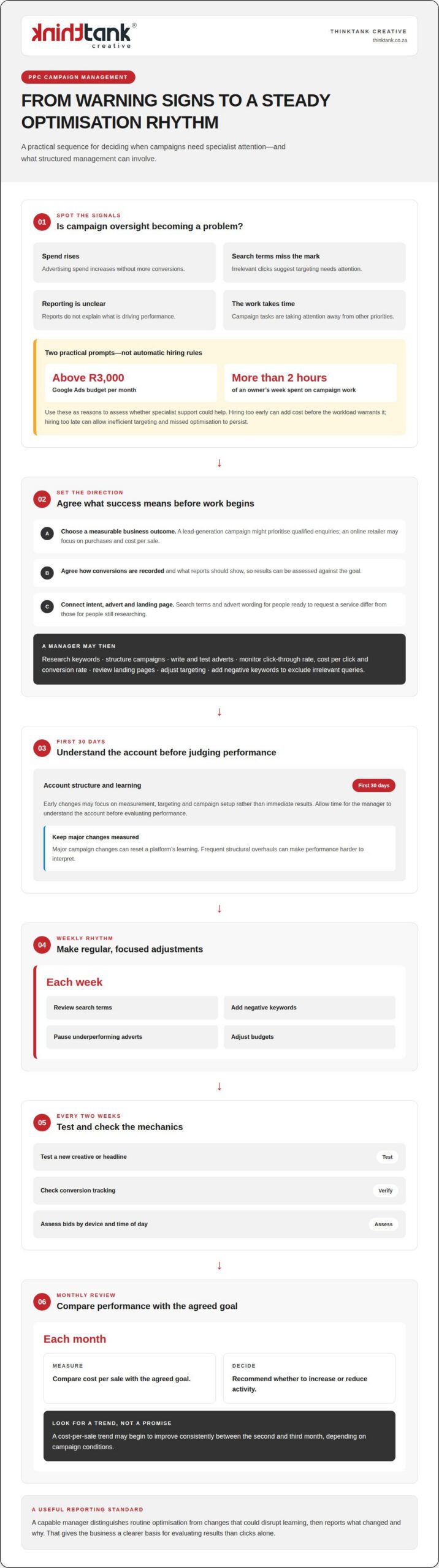
Look for recurring signs that campaigns need more structured oversight: spend rises without more conversions, search terms attract irrelevant clicks, or reports fail to explain performance. A PPC manager researches keywords, structures campaigns, writes and tests ads, and monitors click-through rate, cost per click and conversion rate. They can also review landing pages and adjust targeting to better align the advert with the customer journey.

Two practical signals are a Google Ads budget above R3,000 per month and campaign work taking more than two hours of an owner’s week. These are prompts to assess whether specialist support could help, not automatic hiring rules. Hiring too early can add cost before the workload warrants it; hiring too late can allow inefficient targeting and missed optimisation to persist.

Define the role around a measurable business outcome before hiring. A lead-generation campaign might prioritise qualified enquiries, while an online retailer may focus on purchases and cost per sale. Set the target, establish how conversions are recorded, and agree what reports should show. In South Africa, campaign planning should account for applicable tax treatment, privacy considerations when handling personal information, and advertising standards for accurate claims. A manager should consider these when setting up tracking, handling data and reviewing ads.

Keyword strategy should connect customer intent with your offer and landing page. For example, a campaign aimed at people ready to request a service needs different search terms and advert wording from one targeting people at the research stage. The manager can review search terms, add negative keywords to exclude irrelevant queries and test advert variations. This helps focus budgets on searches that better match the campaign objective.

Expected results timelines

Allow time for the manager to understand the account before judging performance. The first 30 days are usually spent on account structure and learning, so early changes may focus on measurement, targeting and campaign setup rather than immediate results. A cost-per-sale trend may begin to improve consistently between the second and third month, depending on campaign conditions.

Ongoing optimisation needs a measured rhythm. Each week, the manager can review search terms, add negative keywords, pause underperforming ads and adjust budgets. Every two weeks, they can test a new creative or headline, check conversion tracking and assess bids by device and time of day. Each month, they can compare cost per sale with the agreed goal and recommend whether to increase or reduce activity.

Major campaign changes can reset a platform’s learning, so frequent structural overhauls can make performance harder to interpret. A capable manager distinguishes routine optimisation from changes that could disrupt learning, then reports what changed and why. This gives the business a clearer basis for evaluating results than clicks alone.

How much does it cost to hire a PPC specialist?

In South Africa, the cost of hiring a PPC specialist depends on the role, workload and engagement model. Freelance work, an agency contract and a permanent appointment each have different cost structures. Compare the work included, not just the fee or salary: campaign strategy, account management, reporting and conversion tracking may fall under different scopes.

Before interviewing candidates, define what the role needs to deliver. List the platforms, campaign types, target audience and business outcomes involved. For example, managing Google Ads search campaigns involves different day-to-day work from coordinating paid search, display and social campaigns. This scope helps you identify a specialist suited to your account, rather than someone whose experience only matches the job title.

Evaluate evidence rather than broad claims. Ask candidates to explain a campaign they managed, its objective, the decisions they made and how they measured results. A strong response connects changes to outcomes such as conversion rate or cost per sale, and explains what the data couldn’t show. If an account is confidential, a candidate can describe their process without disclosing client information.

Ask: “How would you structure campaigns for our goals?”, “Which metrics would guide your decisions?” and “How do you report results and explain underperformance?” Then ask how they would approach a landing page with relevant clicks but few conversions. Their reasoning should connect targeting, advert messaging, tracking and the customer journey.

Experience gives useful context, but it doesn’t replace clear examples. A common PPC manager qualification is 3-5 years in PPC management, digital advertising, search engine marketing or a related field. Google Ads and Meta Blueprint certifications are preferred qualifications in some role descriptions. Treat these as useful signals, then explore how the candidate applies that knowledge to accounts with comparable objectives and complexity.

Estimate the total hiring cost by identifying what each arrangement includes. A permanent employee involves salary and associated employment costs, as well as training, equipment and management time. An agency or freelancer may charge for a project or ongoing management, with the agreed scope determining what work is covered. For any option, costs depend on account complexity, platforms, reporting needs and the level of strategic involvement. A service fee depends on the case and is provided after a quote request.

Use consistent criteria to compare candidates or proposals. Record agreed responsibilities, reporting frequency, account access, campaign data ownership and how strategic changes will be approved. For example, a candidate who clearly explains conversion tracking and reporting may be a better fit than one who offers only a list of platform credentials. Choose the arrangement that matches your workload and the expertise your campaigns need.

Agency fees and in-house hiring costs

Compare what each arrangement covers before weighing its cost. A PPC agency may provide campaign strategy, implementation and ongoing optimisation under a project contract or retainer. An in-house PPC manager is a full-time employee responsible for the company’s paid campaigns. The models differ in commitment, team structure and how much specialist capacity is available.

A project contract can suit a defined need, such as restructuring an account or creating a campaign plan. A retainer supports continuing work, including campaign monitoring, advert copy testing and performance reporting. Scope matters: an agreement covering Google Ads search campaigns differs from one that includes several platforms, landing pages and ongoing optimisation.

With an in-house hire, salary is only one part of the employment cost. Factor in recruitment, benefits, equipment, management time and ongoing training. PPC platforms and advertising practices change, so a permanent specialist needs continuing development to maintain relevant technical skills. The role also needs a steady workload to make dedicated capacity productive.

That workload creates a clear trade-off. An employee can build detailed knowledge of your products, customers and internal priorities, then coordinate PPC with other teams. However, fixed employment costs remain if campaign demand falls. For a business with seasonal activity, you may be paying for capacity that is less useful during quieter periods.

An agency offers a different capacity model through contracted work. A project can address a specific need, while a retainer provides ongoing management. The agreement should clarify responsibilities, including strategy, implementation, advert copy, reporting and optimisation. This helps distinguish active campaign management from a narrower arrangement covering selected tasks only.

Build a like-for-like comparison with these steps:

For example, a business with a continuing stream of campaigns may make good use of an employee’s dedicated focus. A business needing a defined account rebuild followed by a lighter workload may prefer project-based support. Neither structure is automatically cheaper. Workload, scope and the need for ongoing expertise shape the comparison.

Choose the model that fits the work, not just the label. A clear scope makes agency proposals easier to assess, while a defined role helps establish the full commitment of an in-house hire. Compare responsibilities and expected capacity first, then decide which arrangement aligns with your campaign needs over time.
When to Hire a PPC Manager or Choose In-House Management

Certifications and relevant experience

Assess credentials alongside practical campaign experience. Google Ads and Meta Blueprint certifications can indicate platform knowledge, but they don’t show how a specialist applies it to your business goals. Ask candidates to explain how their training informs decisions about targeting, bidding, advert formats and conversion measurement.

Relevant experience means more than having managed an advertising account. Look for work with similar objectives, customer journeys and campaign complexity. For example, a candidate who has managed lead-generation campaigns should be able to explain how they assessed enquiry quality, not just click volume. Ask what they changed, why, and how they judged the effect.

Use a structured review to compare candidates fairly:

Technical skills need to go hand in hand with sound judgement. A specialist may understand conversion tracking but still need to determine whether a recorded action represents a valuable enquiry. Ask how they validate tracking, investigate discrepancies and use the data. Their explanation should show a clear method, rather than relying on platform terminology alone.

Test strategic thinking with a realistic scenario. Describe a Google Ads campaign that receives relevant clicks but few enquiries. Ask how the candidate would investigate the search terms, advert promise, landing-page relevance and conversion setup. A considered answer explores possible causes before recommending changes, rather than immediately increasing bids or replacing every advert.

Platform knowledge also needs regular development. Advertising interfaces and features change, so ask how the specialist keeps their skills current and applies new learning. A useful response might describe a recent platform change they evaluated, the business objective it related to and how they decided whether to use it. This shows whether their learning informs deliberate campaign decisions.

Finally, assess how the specialist will work with your team. Ask who will manage the account, how recommendations are prioritised and what reporting will make progress clear. For an in-house appointment, discuss collaboration with sales or customer-service colleagues who can clarify lead quality. For external support, establish how campaign context and feedback will inform optimisation.

Choose a specialist whose experience matches your campaign needs and whose reasoning you can follow. Certifications offer one useful signal; practical examples, disciplined measurement and clear communication show how that knowledge may translate into day-to-day account management.

PPC management fees and media budgets

Separate media budget from management fees when assessing a PPC plan. Media spend pays for advertising on platforms such as Google Ads; the management fee covers professional work. Combining the two obscures how much goes towards reaching an audience and how much funds strategy, optimisation and reporting.

Set the media budget against a defined business outcome. A lead-generation campaign might prioritise qualified enquiries, while an online retailer may assess purchases and revenue. The PPC manager can use these goals to recommend how to allocate budget across campaigns, then monitor whether spend is producing relevant traffic and conversions. Click volume alone doesn’t show whether advertising supports business performance.

Budget size also affects the potential cost of inefficiency. A market fact notes that 20% of wasted ad spend can exceed the campaign management fee once a monthly budget is above R3,000. This makes account oversight especially relevant as spend grows, but the figure isn’t a universal benchmark for every business. Campaign structure, targeting and conversion tracking all influence whether spend is being used effectively.

Ask for a clear breakdown of the work covered by any management arrangement. A proposal should distinguish account setup from ongoing optimisation, and state whether keyword strategy, advert copy, creative testing, reporting and landing-page recommendations are included. For example, a plan covering bid changes alone may not address weak messaging or a landing page that fails to convert.

Agree how budget decisions will be reviewed before campaigns begin. The manager should report spend alongside measures tied to the business goal, such as cost per sale or qualified lead volume. A monthly review can help decide whether to maintain, increase or reduce investment, while regular monitoring can identify search terms or adverts that need attention sooner.

Revenue attribution needs careful interpretation. A sale may follow several interactions, while a lead may need follow-up before its value becomes clear. The manager should explain how conversions are recorded and how reporting connects advertising activity with business outcomes. This gives you a more useful basis for evaluating media spend than platform-reported clicks alone.

Use these points to frame a budget discussion:

For a more coherent customer experience, explore campaign creative and social media alignment alongside paid activity. A consistent message across adverts and social channels can help customers recognise the offer as they move between touchpoints.

ThinkTank Creative

ThinkTank Creative can help you consider PPC management alongside the wider digital experience that supports your campaigns. Turn to the team when you’re assessing how paid activity fits with your website, social channels and brand presentation, or when campaign traffic reaches a website that needs a clearer customer journey.

Website Design and Development, Social Media Marketing, creative design, and Logo and Corporate Identity Design can help create a more cohesive presence around your marketing. The right priorities depend on your goals, audience and current digital foundations. A conversation can clarify how these elements fit as you decide how to manage paid campaigns and what support your business needs.

Contact ThinkTank Creative to discuss your marketing priorities.

Make your next move with clarity

Deciding when to hire a PPC manager is ultimately about creating the right conditions for your campaigns to be managed well. Consider whether your goals are clear, whether someone can act on performance insights, and whether your current arrangement gives campaigns the attention they need. A considered choice can help align marketing activity with the direction you want your business to take.

ThinkTank Creative can help you consider how paid campaigns fit within your broader digital presence. Use a conversation with the team to clarify your priorities, identify where your marketing needs greater alignment and decide what support makes sense for your next stage.

Contact ThinkTank Creative to discuss your marketing direction and take your next step with confidence.

Frequently Asked Questions

What does a PPC manager do?

A PPC manager oversees the decisions that connect paid advertising with business objectives. Beyond adjusting campaigns, they coordinate information from sales or customer service so lead quality can inform targeting and messaging. For example, if enquiries repeatedly lack a required service, the manager can use that feedback to refine the searches and audiences that campaigns prioritise.

How long until I see results with a specialist?

Initial account analysis and restructuring commonly take the first 30 days; cost per sale may start dropping consistently between the second and third month. The pace depends on factors such as conversion volume, the sales cycle and tracking quality. A business with longer consideration periods should assess qualified leads and pipeline movement, rather than expecting every sale to appear immediately in advertising reports.

What signs indicate a business should hire a PPC manager?

Consider professional management if paid campaigns are a recurring responsibility without clear ownership, or if decisions stall because nobody can interpret performance data. Knowing when to hire a PPC manager also depends on whether sales feedback reaches the person managing campaigns. If enquiries arrive but you can’t identify which campaigns attract suitable prospects, specialist oversight can connect that insight with campaign decisions.

How much monthly ad spend justifies hiring a PPC manager?

A monthly Google Ads budget above R3,000 is a useful point to review whether specialist oversight makes sense, not a universal hiring threshold. For deciding when to hire a PPC manager, consider account complexity, campaign workload and the value of each conversion alongside spend. A smaller budget may still merit support if campaigns are strategically important, whilst a larger budget needs a clear plan for monitoring performance and allocating investment.

Should a business hire an in-house PPC manager, freelancer, or agency?

Choose based on how continuous and varied the work is. An in-house manager suits a business that needs close internal collaboration and a steady stream of campaign decisions. A freelancer can suit a more defined specialist workload, while an agency may fit businesses seeking broader expertise across their campaign needs. For example, seasonal activity may make flexible external support more practical than a permanent role.

What tasks and results should a PPC manager be responsible for?

Set clear responsibility for campaign planning, account management, measurement quality and reporting. Agree how the manager will communicate changes, protect account access and connect advertising results with business outcomes. For example, a lead-generation campaign should distinguish submitted forms from qualified prospects where the business can provide that feedback. Assess results against agreed objectives, not clicks alone.

How can a business assess whether its PPC campaigns are underperforming?

Compare campaign outcomes with business targets and the quality of customers or enquiries generated. A high click-through rate can still conceal weak commercial performance if visitors don’t take useful action. Check whether conversion records match actual enquiries or sales, then examine performance by campaign and audience. This helps distinguish measurement problems from issues with targeting, messaging or the landing page.

What skills and certifications should a PPC manager have?

Look for analytical judgement, clear communication and hands-on experience with the platforms your campaigns use. Google Ads or Meta Blueprint certification can indicate platform learning, while examples of campaign decisions show how those skills are applied. Ask how the candidate diagnosed a challenge, chose a response and evaluated the outcome. Their explanation should make the reasoning clear, rather than relying on technical terms alone.
How to Handle Negative Comments on Social Media with Care

A negative comment isn’t just criticism to contain; it’s a visible chance to show how your business listens. Knowing how to handle negative comments on social media starts with responding within 24 hours whenever possible, acknowledging the customer’s frustration and offering a constructive next step.

It’s understandable to want to defend your brand or hide an uncomfortable complaint. A measured response can reassure the person who raised the issue and the wider audience reading along. Learn how to apologise without making excuses, decide when to move a conversation to private messages, and distinguish genuine feedback from abuse or trolling. Negative comments can also reveal what customers need and help strengthen your social media presence.

Key Takeaways

  • Acknowledge the customer’s frustration, apologise sincerely where appropriate and offer a clear next step.
  • Respond promptly and thoughtfully, checking the facts before addressing a complaint in public.
  • Distinguish useful criticism from abuse or trolling so each comment receives a suitable response.
  • Keep the public reply focused, then invite the customer to continue privately before discussing personal or account details.
  • Use comments as a source of customer insight that can help shape stronger service and brand communication.

How does a social media professional respond to a negative comment?

A professional begins by assessing the comment, checking relevant facts and choosing whether to respond, ignore or remove it. When deciding how to handle negative comments on social media, they consider whether the person has raised a genuine concern, posted spam or made an abusive attack. If the meaning is unclear, they can check records or ask the relevant team before replying. This reduces the chance of turning a misunderstanding into a dispute.

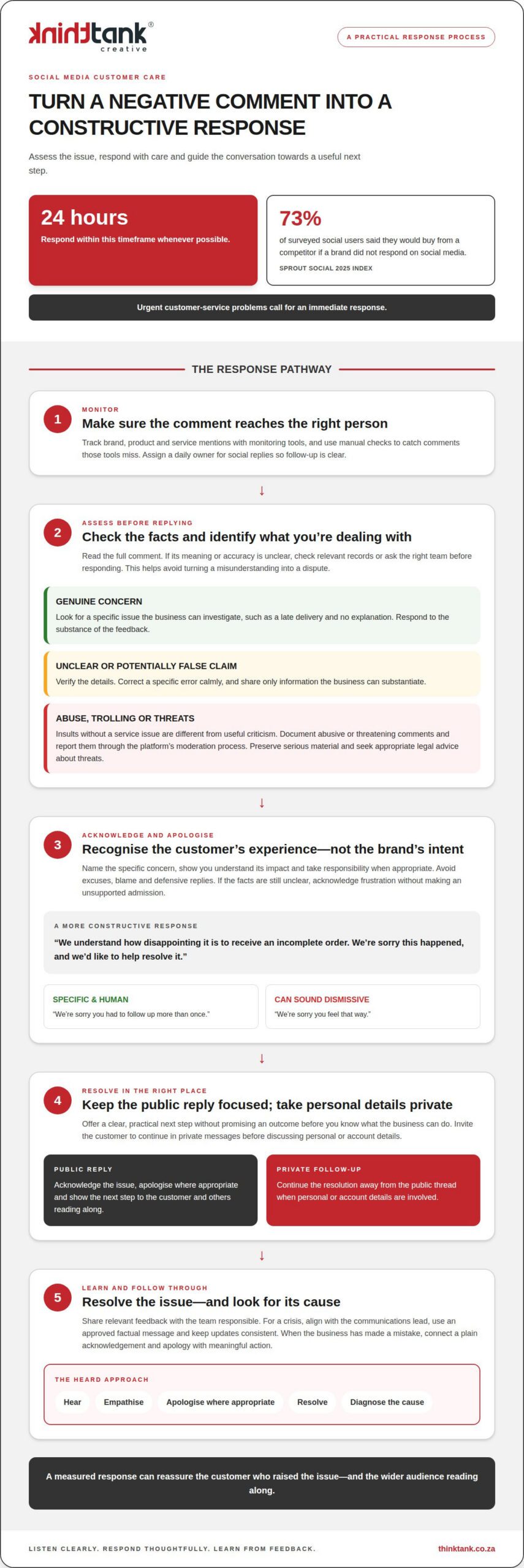
Prompt monitoring helps comments reach the right person. Businesses are advised to respond within 24 hours whenever possible, while urgent customer-service problems call for an immediate response. Monitoring tools can track brand, product and service mentions, but manual checks help catch comments those tools miss. Assigning a daily owner for social replies makes it clearer who is responsible for follow-up.

A public response also speaks to people who are reading without commenting. In the Sprout Social 2025 Index, 73% of surveyed social users said they would buy from a competitor if a brand did not respond on social media. This makes each complaint an opportunity to show concern and approach customer service with care, rather than treating the comment as an interruption.

Airbnb, Nike and Starbucks offer useful examples of how replies can be tailored. For an Airbnb booking complaint, a professional could recognise the disruption and invite the customer to discuss reservation details privately. For a Nike product concern, they could ask for relevant item information before explaining the next step. For a Starbucks service complaint, they might apologise for the experience and ask which visit needs attention. These are example responses, not quotations from the brands.

When a company has made a mistake, the professional should acknowledge it plainly, apologise and explain the next step without blaming the customer. Starbucks closed 8,000 stores for racial-bias training in 2018 after the wrongful arrest of two men. That was a company response, not a social-media reply. The relevant lesson is to connect acknowledgement with meaningful action.

In South Africa, defamatory, threatening or abusive online comments can raise legal concerns, depending on their content and context. Preserve serious material and seek appropriate legal advice about threats, rather than publicly declaring that a law has been broken.

For false claims, check the facts, correct the specific error calmly and share only information the business can substantiate. Knowing how to handle negative comments on social media also means having a crisis escalation process: align with the communications lead, use an approved factual message and keep updates consistent. Document threatening or abusive comments and report them through the platform’s moderation process.

2. Acknowledging customer frustration and apologising

A thoughtful response recognises the customer’s experience rather than defending the brand. Read the full comment, identify the frustration and respond to that specific concern. For example: “We understand how disappointing it is to receive an incomplete order. We’re sorry this happened, and we’d like to help resolve it.” This acknowledges the impact without assuming facts that still need checking.

Before apologising for a specific mistake, assess the feedback. Compare the customer’s account with relevant order records, service notes or team information to establish what happened. If the complaint is valid, acknowledge the error directly and explain the next step. If details remain unclear, recognise the customer’s frustration without making an unsupported admission.

A sincere apology avoids excuses, blame and defensive phrasing. “We’re sorry you had to follow up more than once” recognises a stated experience; “We’re sorry you feel that way” can sound dismissive. Name the concern, take responsibility where appropriate and offer a practical route towards resolution. Don’t promise an outcome before the business knows what it can do.

This sequence reflects the HEARD technique: hear the customer, empathise, apologise where appropriate, resolve the issue and diagnose its cause. If a customer reports a damaged product, for instance, acknowledge the inconvenience, discuss a suitable resolution and pass the incident to the team reviewing fulfilment. Addressing the immediate complaint matters, and understanding its cause can help prevent similar experiences.

Legitimate criticism deserves a response that takes its substance seriously. If a customer points out an incorrect opening time in a post, thank them, correct the information and apologise for the confusion. If the original post is wrong, correcting or removing it and explaining the change shows accountability. A short, specific reply is more constructive than arguing about the customer’s tone.

For a consistent approach across public replies and direct conversations, social media marketing support can help shape a response process that reflects the brand’s voice and treats feedback as useful information.

3. But Why Negative Comments?

Distinguish criticism from trolling by assessing what the commenter says, not just how it feels to read. A customer who writes, “The delivery arrived late, and I wasn’t told why,” identifies a service issue the business can investigate. A comment that only insults someone’s appearance or intelligence offers no comparable detail. This distinction helps you respond to useful feedback and moderate abuse appropriately.

Constructive criticism often describes a specific experience, raises a product or service concern, or requests a change. For example, “The booking page wouldn’t accept my address” points to a possible website problem. Trolling typically aims to provoke, ridicule or attract attention through personal attacks rather than resolve a consumer issue. One sharp or angry comment alone doesn’t establish intent, so consider its content and context before acting.

A practical review can ask three questions: Does the comment describe a verifiable experience? Does it contain a question or actionable concern? Does it address a business issue or attack a person? A complaint about unclear pricing merits investigation, while repeated insults aimed at an employee may need moderation. These checks help prevent legitimate criticism from being dismissed as trolling just because its tone is uncomfortable.

Moderation should support a constructive community without hiding genuine dissatisfaction. Leave a specific complaint visible, respond to the concern and record recurring themes for the relevant team. Spam, abusive language or baseless personal attacks can be hidden or removed under the channel’s moderation approach. Log the action too, so the team can see what was moderated and why.

Perspective matters. One hostile commenter doesn’t represent every consumer, and a public argument can give a troll the attention they seek. If someone posts, “Your staff are all useless,” don’t answer with a sarcastic comeback. Avoid engaging with the insult, moderate it if appropriate, and focus on substantive comments from customers seeking help.

If criticism combines a real issue with inflammatory language, separate the two. A comment such as “Your support is hopeless; my account still won’t open” includes an actionable account problem. Address the access issue through an appropriate channel while moderating any abusive language. This approach neither rewards provocation nor ignores a consumer who may need customer service.

Consistent moderation can encourage useful participation and protect a brand’s reputation. A response matrix helps the team distinguish service complaints, factual errors, spam and personal abuse, then apply the same principles across channels. It also reduces reactive replies: pause, classify the comment and choose a proportionate action, rather than letting a troll set the tone.

How to Handle Negative Comments on Social Media with Care

4. Moving complaint resolution to private messages

Move a complaint to a private channel when resolving it requires personal details, account access or a detailed exchange. A public comment can identify the concern, but it isn’t the place to request an order number, email address or account information. First acknowledge the issue publicly, then explain how the customer can continue safely.

That public hand-off matters to the wider audience. A silent direct message may leave other readers wondering whether the business noticed the complaint. Instead, write: “We’re sorry you’ve had trouble accessing your account. Please send us a direct message so we can look into this with you.” This shows the business is responding without exposing private details.

Make the next step specific. If a customer reports a missing delivery, ask them to send a direct message with the information needed to locate the order. If they describe a billing concern, invite them to use the business’s designated private support channel. Don’t ask them to post personal details publicly, and don’t assume a direct message has reached them unless the platform shows a reply.

A considered workflow helps each hand-off remain clear:

Keep the public message focused on the action, not a lengthy explanation. If a customer’s booking details need checking, invite them to send a direct message so you can review the relevant information privately. If the issue can’t be resolved immediately, give a realistic timeframe and provide updates through the agreed channel. Avoid promising a resolution before the facts are clear.

Don’t use private channels to hide criticism. A public reply shows that the concern has been seen, while the private conversation supports a more detailed exchange. If a customer doesn’t move channels, keep the public discussion courteous and restate the next step, rather than posting sensitive questions or repeatedly sending unsolicited messages.

After the private exchange, a concise public follow-up can reassure the audience that the business addressed the concern. Keep it general, such as, “We’ve followed up with you directly and are working through the next steps.” Don’t share the customer’s account details, complaint history or outcome without permission. This supports the individual customer while respecting everyone reading the conversation.

5. Why social media comments matter for businesses

A social media comment is both a customer-service interaction and a public signal. A question about a delayed delivery, for example, can reveal a problem affecting more than one customer. Logging recurring concerns gives the relevant team specific evidence to investigate. Comments can therefore surface patterns that other feedback channels miss, not just express satisfaction or frustration.

Each public exchange also shows the audience how a business behaves when something goes wrong. A clear reply to a billing concern can demonstrate attentiveness, while silence may leave readers without context. The response can help the original customer and inform others considering the same service. Comment management is part of the customer experience, not merely a task for the social media queue.

Positive comments matter too. A customer who praises helpful staff or an easy booking process gives the business a concrete example of what is working. Acknowledge the compliment and share the insight with the relevant team. Repeated praise may point to strengths worth preserving, while recurring complaints can show where processes or information need attention.

Recommendations carry particular weight in that public setting. A reported 88% of global consumers trust earned media, such as recommendations from friends and family, more than any other form of advertising. A comment thread is not automatically a personal recommendation, but it can contain real customer experiences that prospective buyers read alongside brand messaging. Thoughtful engagement helps provide context around those experiences.

Retention is another reason to take concerns seriously. Acquiring a new customer costs five to 25 times more than retaining an existing customer. Resolving a complaint won’t ensure someone stays, but a useful response gives the business an opportunity to address the experience before the relationship ends. If the issue needs investigation, a clear update can show that it remains in progress.

Turn comments into practical insight by recording the issue, its channel and the action taken. Repeated questions about delivery areas, for example, may show that a website needs clearer information. More complaints about appointment changes may point to a communication gap. Reviewing these themes helps teams prioritise improvements instead of treating every comment as an isolated event.

Make comment management part of a wider customer-care approach: acknowledge useful feedback, escalate recurring concerns and update customers when an issue is being addressed. To build a more considered approach to audience engagement, explore social media marketing support.

ThinkTank Creative: Social Media Marketing

ThinkTank Creative provides Social Media Marketing for businesses seeking a more considered approach to audience engagement and brand communication. If comments go unanswered, responses feel inconsistent or recurring complaints are difficult to manage, professional support can bring social activity into closer alignment with your brand’s voice and priorities.

Social media works alongside the wider customer experience. Website Design and Development and Creative design can support a consistent presence across the channels where customers encounter your business. The right focus depends on your goals, the conversations taking place and the role social media should play in your marketing.

If you’d like to explore a more considered approach to your social media, contact ThinkTank Creative.

Build a more responsive brand presence

Let each public conversation inform how your brand communicates and serves its audience. Knowing how to handle negative comments on social media can become part of a wider listening practice, helping your team spot recurring concerns, refine messages and make customer interactions more consistent. The next step is to turn those insights into a clear direction for your social presence.

ThinkTank Creative can work with your business on a cohesive digital presence, bringing social communication into alignment with your wider brand and website. Shape the focus around your priorities, from the conversations customers are having to the experience you want them to recognise across your channels.

When you’re ready to explore a considered approach for your brand, contact ThinkTank Creative. With a clear strategy and thoughtful execution, your social presence can keep moving forward.

Frequently Asked Questions

But why negative comments?

Negative comments can reveal a gap between what a business promises and what customers experience. A complaint about unclear delivery information, for example, may show that a product page needs better guidance. These conversations also show prospective customers which concerns matter to existing customers. Reviewing the themes can help improve messaging, service design and the customer journey, rather than treating each critical comment as an isolated reputation problem.

How does a social media professional handle trolls?

Avoid turning a provocative comment into a public argument. Assess whether it contains a real question or customer issue, then respond to the useful substance. Repeated personal attacks, spam or abuse can be handled through the platform’s moderation features and the brand’s documented policy. A measured approach protects the community’s tone and helps the team avoid replies written in frustration.

How should a social media professional respond to a negative comment?

Respond to the specific concern with calm, clear language and a relevant next step. If a customer says a service disruption interrupted an appointment, for example, recognise the disruption and share a verified update about what happens next. Avoid speculation, blame or promises the business cannot support. A response guide helps team members maintain a consistent voice across channels.

Quick definition: what is comment triage?

Comment triage means sorting incoming comments by type and priority, then assigning an appropriate action. You might classify a product question for a customer-service response, a factual error for correction and spam for moderation. This makes busy feeds easier to manage and helps urgent or sensitive issues reach the right person without overlooking ordinary feedback.

Should a social media professional reply publicly or privately?

Reply publicly when the answer can help the original commenter and other readers, such as when correcting an inaccurate opening time. Move the detailed conversation to a private channel if it involves an individual booking, payment or account. The public reply should still make clear that the concern has been noticed. This keeps useful information visible while protecting personal details from the wider audience.

What reply scripts can a social media professional use for common complaint types?

Scripts can give a team a starting point without making replies sound automated. For a late delivery: “We’re sorry your order hasn’t arrived as expected. Please message us with your order details so we can investigate.” For incorrect information: “Thank you for pointing this out. We’ve corrected the post.” For a service issue: “We’re sorry this affected your experience. We’re reviewing what happened and will update you.”

What constitutes a negative comment?

A negative comment expresses dissatisfaction, criticism or concern about a business, product, service or interaction. It might be a detailed complaint, a brief statement such as “This wasn’t what I expected”, or a critical reaction to a post. Its tone can range from disappointed to angry. The professional should consider the comment’s meaning and context before deciding whether it needs a customer-service response or moderation.

What do consumers expect when they complain on social media?

Consumers generally expect a business to notice their concern, treat it respectfully and explain what can happen next. Someone reporting an incorrect invoice, for instance, needs a clear route to have it reviewed, not a generic promotional reply. If an investigation takes time, an update can clarify that the issue is being handled. Direct, relevant communication helps customers understand what to expect from the conversation.

POPI Act Website Compliance and the Rules for Personal Data

POPIA reaches beyond online shops: it applies to public and private organisations that process personal information about individuals in South Africa, regardless of industry. South Africa’s Protection of Personal Information Act is Act 4 of 2013. That makes popi act compliance for websites relevant whenever a site collects or uses personal information, including through enquiry forms, mailing lists or online identifiers.

A privacy notice is important, but it is only one part of website compliance. POPIA also affects how a site collects, uses, stores and protects personal information, including how it presents consent choices and handles requests from people.

This guide explains who POPIA applies to, what counts as personal information and what an Information Officer does. It also covers practical website considerations, from consent on forms to clear privacy information, so you can identify steps to align your site’s data practices with the Act.

Key Takeaways

  • Recognise the personal information a website may collect, including through forms, cookies and online identifiers.
  • Understand how data subject rights shape the way your organisation handles access, correction and removal requests.
  • Clarify the Information Officer’s role in guiding privacy practices and supporting compliance responsibilities.
  • See how POPIA’s scope and penalties make responsible data handling relevant to organisations of different sizes.
  • Explore how clear consent choices, privacy notices and thoughtful website design can support stronger data practices.

What counts as personal information under POPIA?

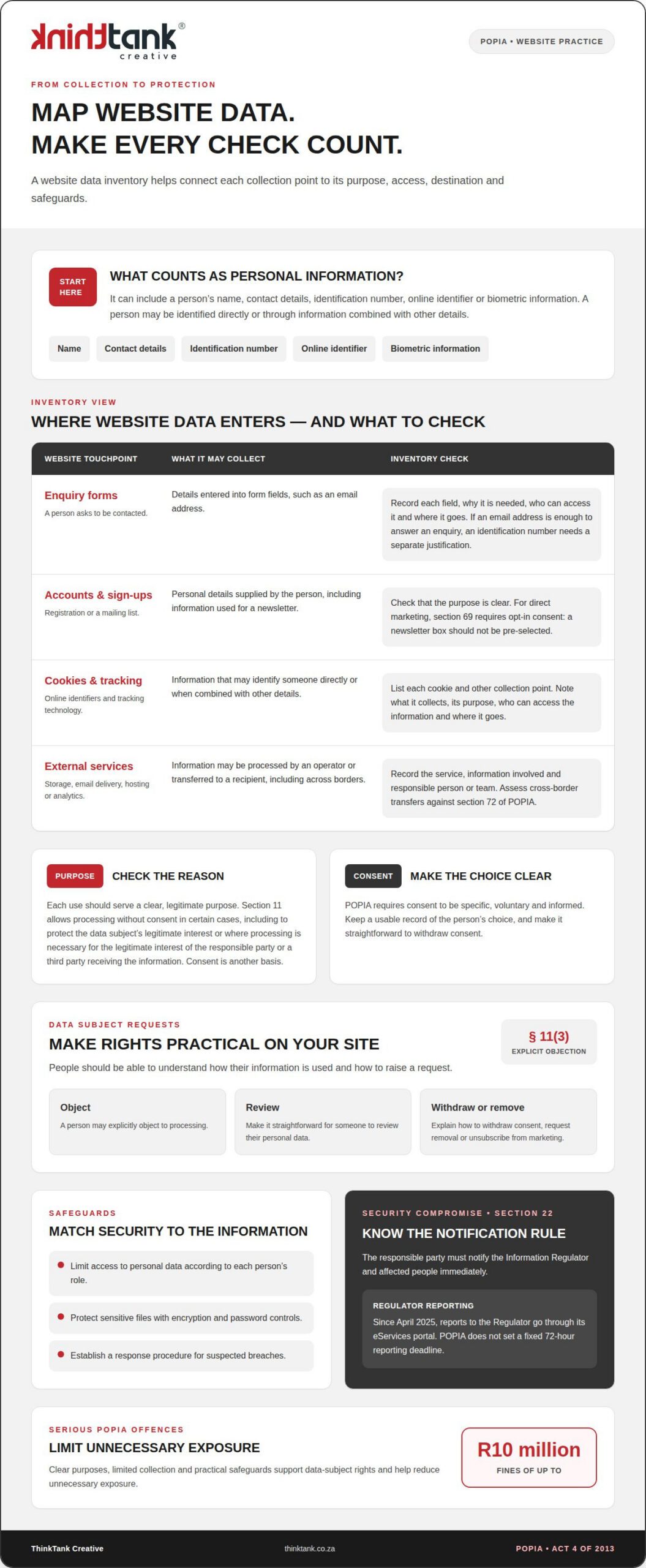
Under South Africa’s Protection of Personal Information Act, personal information can include a person’s name, contact details, identification number, online identifier or biometric information. A website may collect it through an enquiry form, account registration, newsletter sign-up or tracking technology. Information can identify someone directly or when combined with other details.

Start with a data inventory. List every form field, cookie and other collection point, noting what information it collects, why, who can access it and where it goes. Then check whether each use serves a clear, legitimate purpose. If a contact form needs only an email address to answer an enquiry, collecting an identification number requires a separate justification.

Section 11 of POPIA allows processing without consent in certain cases, including where it protects the data subject’s legitimate interest or is necessary for the legitimate interest of the responsible party or a third party receiving the information. Consent is another basis, and POPIA requires it to be specific, voluntary and informed. Section 69 requires opt-in consent for direct marketing, so a newsletter box should not be pre-selected.

Data subjects have a role in how their information is processed. Under section 11(3), a person may explicitly object to processing. A website should also make it straightforward for someone to withdraw consent, review their personal data or request its removal. A privacy policy should explain what information is collected, why it is used and how people can raise a request or unsubscribe from marketing.

Security needs to match the information held. Limit access to personal data according to each person’s role, protect sensitive files with encryption and password controls, and establish a response procedure for suspected breaches. Section 22 concerns security-compromise notification. The responsible party must notify the Information Regulator and affected people immediately; since April 2025, reports to the Regulator go through its eServices portal. POPIA does not set a fixed 72-hour reporting deadline.

Keep the inventory and privacy notice aligned as website forms, analytics tools and marketing practices change. If a data breach exposes an email list, for example, the response procedure should identify the affected information, restrict access and guide the required notifications. Serious POPIA offences may result in fines of up to R10 million. Clear purposes, limited collection and practical safeguards help reduce unnecessary exposure while supporting data-subject rights.

Information Officer registration and responsibilities

Every company in South Africa is legally required to appoint an Information Officer. Businesses should register the officer with the Information Regulator, which monitors and enforces POPIA. The role links an organisation’s personal-information practices with its compliance responsibilities. For a website, this means understanding how enquiry forms, mailing lists and analytics tools collect or use information.

Make the Information Officer’s responsibilities practical. The officer can coordinate processes for privacy queries, help staff understand how information is handled and support responses to data-subject requests. Map each website collection point to the person or team responsible. For example, record who manages newsletter subscriptions and who handles requests to withdraw consent.

Clear terminology helps define those responsibilities. A data subject is the person whose personal information is processed. The responsible party determines why and how that information is processed, whilst an operator processes it for the responsible party. If an online form sends details to an external service for storage or email delivery, the Information Officer should record that relationship and the information involved.

Cross-border transfers need particular attention. Section 72 of POPIA sets out conditions for transferring personal information across borders. A website may involve an overseas hosting or analytics provider, so the Information Officer’s assessment should identify where information goes and which recipient handles it. The transfer must be considered against section 72, rather than assumed acceptable simply because the service supports the website.

Consent records also need to be understandable and usable. Consent requests should clearly explain the processing and let people make an informed choice. The Information Officer can help ensure that a consent request identifies the relevant processing and records the person’s choice. For instance, a marketing sign-up should distinguish an affirmative opt-in from a pre-selected box, while preserving a record of the choice made.

Registration is only one part of the role. The Information Officer also needs a working understanding of how website information moves through the organisation, from collection to access, sharing and removal. A processing register can link each form or tool to its purpose, internal owner, operator and any cross-border transfer. This helps route requests to the right team and explain the organisation’s practices consistently.

As website features change, update the Information Officer’s records too. Adding a booking form, CRM integration or overseas email platform can change who receives information and how it is used. Recording such changes helps the officer coordinate consent processes, review responsibilities and keep POPIA practices aligned with the site’s actual operation.

What is POPIA compliance?

POPIA compliance means handling personal information lawfully, with safeguards that match its use. South Africa’s Protection of Personal Information Act is Act 4 of 2013. For a website, this can mean documenting why an enquiry form collects an email address, who can access submissions and how long they are retained. A privacy notice alone cannot show whether those practices are correct.

The Information Regulator monitors and enforces compliance by public and private bodies. An organisation should be able to explain its website practices with records, not just policy statements. For example, document what a mailing-list form collects, why it collects it and how consent is recorded. Assigning the Information Officer to coordinate these records creates a practical point of accountability.

Non-compliance can carry serious consequences. Serious offences under POPIA may result in fines of up to R10 million. That figure is a maximum, not an automatic charge for every website error. The nature of the conduct matters: an organisation should distinguish an isolated process gap from practices that disregard lawful handling of personal information.

Criminal penalties can also include imprisonment. Individuals responsible for serious POPIA violations may face imprisonment for up to 10 years, while less serious offences may carry imprisonment of up to 12 months. These are distinct maximum periods, not a prediction of the outcome in a particular case. They underline why clear responsibilities and documented measures matter.

Civil proceedings are another consideration if personal information is mishandled. Preserve relevant records, such as the privacy notice in force, form wording and consent logs. If a dispute concerns an online marketing sign-up, these records can help establish what the person was told and what choice they made. Once a complaint arises, avoid changing or deleting relevant material.

Build compliance into routine decisions. Before adding a website feature, record its purpose, the information it uses and the people or systems that can access it. When a form changes, update the privacy information and internal records together. The Information Officer can coordinate these steps, while responsible teams ensure the published wording reflects how the site actually works.

A proportionate response starts by identifying and addressing the cause of a gap. If a subscription form obscures its marketing purpose, make the choice clear and retain evidence of the revised process. Consider whether the correction also affects existing records or connected systems. Consistent documentation helps an organisation explain its decisions to the Information Regulator and respond coherently if concerns escalate.

POPI Act Website Compliance and the Rules for Personal Data

POPI: Why is Website Compliance Important?

POPIA’s scope depends on the processing of personal information, not an organisation’s size or industry. A website may process information when it collects or uses details about people in South Africa, making popi act compliance for websites relevant to organisations with an online presence.

Compliance for small businesses

For a small business, popi act compliance for websites means considering how online forms, mailing lists and other features handle personal information. A sole trader’s contact form raises the same kinds of data-handling questions as a larger company’s website. Identify what each feature collects, why it is needed and who is responsible. This gives small teams a practical starting point without tying compliance to business size.

POPIA applies to public and private organisations processing personal information about individuals in South Africa, regardless of industry. A community organisation collecting membership details online and a company receiving sales enquiries both need to consider the Act. The Information Regulator monitors and enforces compliance by public and private bodies. The relevant factor is the processing of personal information, not workforce size or public profile.

Websites collect information directly through forms, account registration and mailing-list subscriptions. They may also process online identifiers through analytics or advertising tools. Define a purpose for each feature and explain it clearly to the data subject. For example, an enquiry form can explain why it requests contact details, while a separate marketing sign-up makes its purpose clear before submission.

POPIA and GDPR applicability

POPIA applies to processing personal information about individuals in South Africa. The GDPR may also apply to a South African business processing the personal data of EU consumers. This distinction matters for websites serving audiences in both markets. Consider whose information the organisation processes and where those individuals are, rather than relying only on the organisation’s location.

The GDPR and POPIA are separate laws, so meeting one does not automatically resolve obligations under the other. The GDPR’s maximum fine can be 4% of global annual turnover; this is not a POPIA penalty. For a South African website addressing EU consumers, assess the audience, information collected and activities involving that information to determine which law may apply to each processing activity.

Website features and audiences can change. Adding an online shop, analytics tool or international marketing campaign may affect whose information is processed and where it goes. Record each significant update, its purpose and its relevant audience. This helps an organisation reassess POPIA’s scope and whether GDPR considerations arise, rather than assuming every feature has the same compliance impact.

Website compliance solutions

Build privacy choices into the points where visitors interact with your website. Forms, cookie notices and mailing-list sign-ups should explain the relevant processing of personal information. Effective popi act compliance for websites starts with consent that is specific, voluntary and informed. A pre-ticked box does not demonstrate an active choice, so use an empty box or another clear opt-in action.

Connect each form field to a clear purpose. An enquiry form might request a name and email address to respond, while a separate, optional choice covers marketing messages. Explain what happens after submission and provide a simple way to withdraw consent. For direct marketing, section 69 requires opt-in consent. Keep a record of each choice and let recipients unsubscribe from future messages.

Cookie notices should clearly describe the site’s cookie use and obtain explicit consent. Do not present acceptance as the only practical route. A visitor who declines optional tracking has not agreed to it. Review each analytics or advertising tool, including the information it collects and the parties that receive it. A banner is useful only if the site behaves in line with the visitor’s choice.

Give people a practical way to exercise their data-subject rights. A privacy notice should explain how individuals can request access to personal information, ask for correction or seek removal. Provide a suitable contact channel and explain what details are needed to locate a record. Internally, route requests to the responsible team and track progress rather than leaving them in a general inbox.

Technical safeguards should support those commitments. Limit access to personal information by role, protect sensitive files with encryption and password controls, and remove access when staff responsibilities change. Keep a record of website systems that handle submissions, such as a form database or email platform. This gives the Information Officer a clearer view of the systems involved if a suspected breach occurs.

Review the site whenever its features change. Before adding a booking tool, advertising pixel or sign-up field, assess its purpose, collection points and recipients. Then update the privacy notice, consent wording and internal records together. This keeps explanations aligned with actual data processing and makes ongoing popi act compliance for websites part of the change process, not a late addition.

For a redesign or technical update, align the interface and data choices from the outset. Plan a website design and development project around clear forms, accessible privacy information and deliberate consent choices, so these elements work together.

ThinkTank Creative

ThinkTank Creative designs and develops websites that present privacy information and data choices clearly. If you’re planning a new site or revising forms, the team’s Website Design and Development and creative design services can support a considered user experience. Bring consent options, privacy notices and enquiry journeys into the design process, while your organisation remains responsible for its POPIA obligations and personal-information decisions.

Consider this support when website changes affect how visitors submit information or make choices. A coherent design can make these interactions easier to understand and use. Contact ThinkTank Creative to discuss your website and its privacy-related design needs.

Build privacy into your next digital step

Treat privacy as part of the experience you create for every visitor, not text added after a website goes live. A thoughtful approach to popi act compliance for websites connects clear information, meaningful choices and a consistent user journey. As your site and digital communications evolve, revisit how each interaction feels to visitors and how it supports your organisation’s data practices.

ThinkTank Creative can shape your digital experience through website design and development, creative design and social media marketing. These services support how your organisation presents itself online, while compliance decisions remain grounded in your responsibilities under POPIA.

Start a conversation about the next stage of your online presence. Contact ThinkTank Creative to discuss your goals and explore a considered way forward. Clearer digital experiences begin with deliberate choices, and each thoughtful improvement can strengthen the relationship between your organisation and its audience.

Frequently Asked Questions

What is POPIA and who does it apply to?

POPIA is South Africa’s Protection of Personal Information Act, Act 4 of 2013. It applies to public and private organisations processing personal information about people in South Africa, regardless of industry or business size. For example, a community organisation collecting membership details online may need to consider the Act, just like a retailer receiving customer enquiries. The individual whose information is processed is known as the data subject.

What is the penalty for non-compliance?

Serious POPIA offences may result in fines of up to R10 million, and individuals responsible for serious violations may face imprisonment for up to 10 years. Less serious offences may carry imprisonment for up to 12 months. These are maximum penalties, not automatic outcomes for every compliance failure. The nature of the conduct matters, so a neglected marketing preference and deliberate misuse of personal information are not interchangeable situations.

Does POPIA require cookie consent?

Websites should clearly explain cookie use and obtain explicit consent, particularly when cookies support tracking or advertising. A banner should let visitors make an active choice rather than rely on a pre-ticked box. For example, someone selecting “No” should not be treated as having agreed to optional tracking. The notice and the site’s actual behaviour should match, so the choice has practical effect.

What are consumer rights under POPIA?

People whose information is processed can object to processing under section 11(3) and withdraw consent. They should have a clear way to unsubscribe from marketing and to review or request removal of personal information. For example, a person who no longer wants promotional emails should be able to use an unsubscribe route. Organisations should explain how to raise requests and ensure they reach the team responsible for handling them.

What are the benefits of being compliant?

Compliance gives an organisation a clearer framework for handling personal information and responding to people’s choices. For example, keeping a record of newsletter preferences can help prevent messages being sent after someone unsubscribes. Clear explanations also help visitors understand why a form asks for particular details. These practices support consistent interactions and give the organisation a stronger basis for explaining how its website uses information.

What are the exceptions to the POPIA Act?

Section 11 allows certain processing without consent, including where processing protects a data subject’s legitimate interest or is necessary for the legitimate interest of the responsible party or a recipient. This is a basis for processing, not a general exemption from POPIA. The purpose and circumstances matter. A business should not assume that a legitimate-interest rationale removes the need to explain its processing or respect a person’s explicit objection.

What is an Information Officer and is one required?

An Information Officer is appointed to support an organisation’s POPIA responsibilities. Every company in South Africa is legally required to appoint one, and businesses should register the officer with the Information Regulator. For example, the officer can coordinate who handles website privacy enquiries and how requests reach the appropriate team. Registration provides a formal point of accountability, but relevant staff still need to follow the organisation’s processes.

What does POPIA require from websites in South Africa?

A website should explain its personal-information practices, make consent choices clear and handle information securely. For example, an enquiry form can state why it requests contact details, while a separate, unselected option invites visitors to sign up for marketing. Sites should also provide a way for people to exercise their choices and unsubscribe. Appropriate measures depend on the information collected, the site’s purposes and its connected tools.

Link building strategies for South African businesses that fit the local market

A backlink is only as valuable as the trust and relevance behind it. The strongest link building strategies for South African businesses prioritise credible local websites, useful content and genuine relationships over a high volume of unrelated links. Start with the audiences and organisations that matter to your market, then build reasons for them to reference your business.

It’s easy to see why link building can feel like a numbers game: more links may seem like a faster route to stronger search visibility. But links that reflect your business’s credibility and fit your sector are more meaningful than links pursued simply to increase a count. Local context matters, too, because audiences, competition and business relationships differ across markets.

This guide explains how to research relevant South African websites, assess link opportunities and earn attention through useful, credible contributions. You’ll also learn how to account for local competition, avoid shortcuts that can undermine trust, and shape a sustainable approach around your business goals. The result is a clearer way to build authority that feels grounded in the market, not copied from a generic playbook.

Key Takeaways

  • Prioritise links from credible South African websites that are relevant to your audience and strengthen your business’s local legitimacy.
  • Give journalists and publications a clear reason to reference your business, such as useful expertise, timely insight or original material.
  • Assess directories and industry associations for relevance and credibility before deciding whether a listing supports your goals.
  • Build partnerships and community involvement around genuine shared value, then make it easy for partners to acknowledge the work online.
  • Link building costs depend on the work involved; understand the scope, content and outreach behind a service before comparing proposals.

Local legitimacy and market competition

Local relevance gives a backlink context. A mention from a South African organisation familiar with your sector can connect your business with the market it serves. Prioritise publishers, associations, suppliers and community organisations whose readers overlap with your customers. A link from an unrelated website may add little local credibility, even if that site appears prominent.

Adapt links to the places and customers your business serves. For local SEO, seek references from organisations with a genuine connection to your service areas, then make sure your website clearly explains where you operate. Use city and province names accurately in relevant page content, rather than pursuing links from organisations with no meaningful relationship to those places.

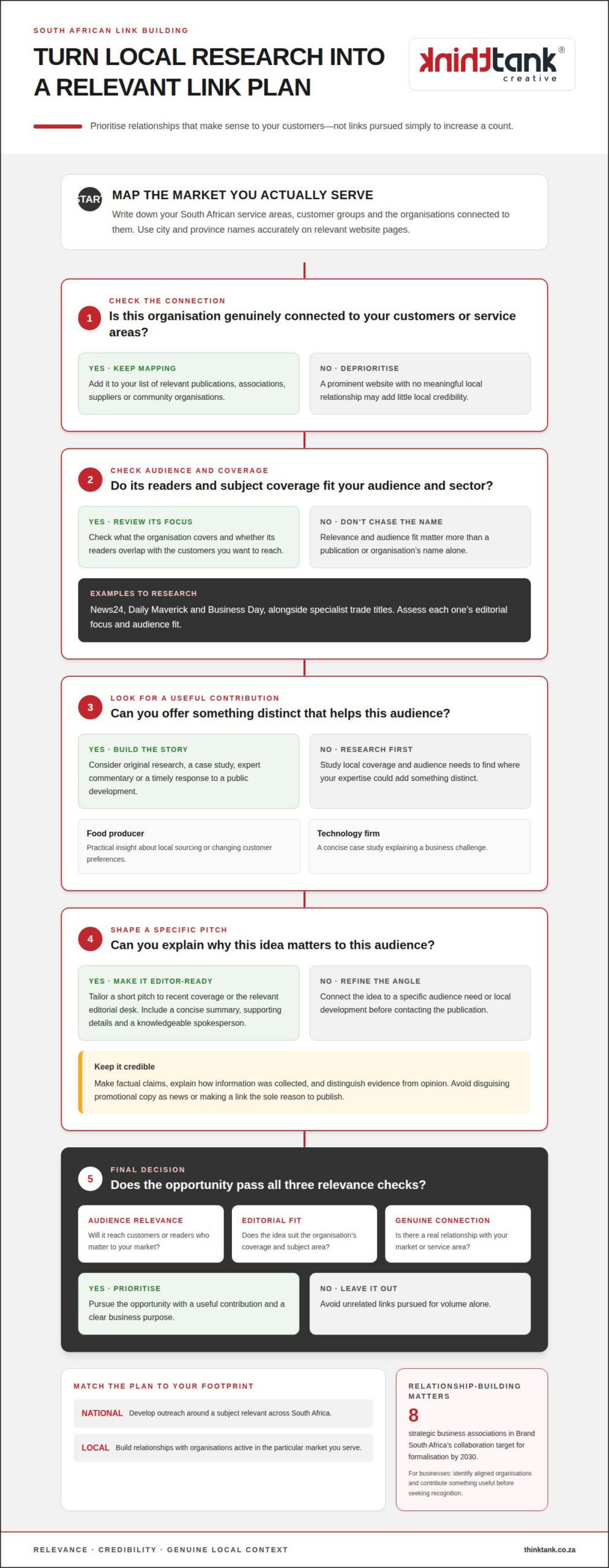
Effective link building strategies for South African businesses begin with a focused market map. Record your service areas, customer groups, relevant organisations and the subjects each organisation covers. Then review which websites already earn attention in your sector. Look for specialist commentary, business resources and community initiatives. This reveals where competitors have established relationships and where your expertise could add something distinct.

Competition also shapes how local businesses establish credibility. A company entering a new South African market needs to understand its customers, established organisations and trusted sources of information. Speaking with people in that market can reveal which publications and associations matter. Use those insights to tailor outreach, choose relevant topics and avoid treating every audience as interchangeable.

Brand South Africa has set a target of formalising collaborations with 8 strategic business associations by 2030. This highlights the value of structured relationships in strengthening connections. For an individual business, the practical lesson is to identify organisations aligned with its sector and contribute something useful before seeking recognition.

Use these steps to turn local research into an actionable link plan:

For example, a business serving customers nationally could develop outreach around a subject relevant across South Africa. A business focused on a particular market could seek relationships with organisations active there. The strongest link building strategies for South African businesses reflect this distinction, connecting each opportunity with a real audience and a clear business purpose.

Assess opportunities by audience relevance, editorial fit and genuine connection to your market. These criteria help businesses build credibility while responding to competition, without relying on a generic list of websites.

Give editors a story their readers can use, not a request for a favour. A backlink may follow when a publication references your business as a relevant source. Identify South African publications whose coverage matches your sector, customers or business goals. News24, Daily Maverick and Business Day are examples to research, alongside specialist trade titles. Their editorial focus and audience fit matter more than their names alone.

Build a clear story before contacting a newsroom. A food producer could share practical insight about local sourcing or changing customer preferences. A technology firm might explain a business challenge through a concise case study. Keep claims factual, explain why the subject matters to South African readers and make a knowledgeable spokesperson available for comment.

Useful editorial material can include original research, a case study, expert commentary or a timely response to a public development. Share the underlying information, explain how it was collected and distinguish evidence from opinion. Editors need material they can assess independently. Avoid disguising promotional copy as news or making a link the sole reason to publish.

Make outreach specific. Read the publication’s recent coverage, identify the journalist or relevant editorial desk, then tailor a short pitch to their subject area. For a national story, explain its relevance to South African readers. Include a concise summary, supporting details and spokesperson contact information. A generic message sent to a long list of journalists is easy to ignore.

For instance, an engineering business could offer a journalist a specialist explanation of a relevant infrastructure issue. The pitch should provide an informed perspective, not imply endorsement or demand a link. If the story is published, a natural reference to the company’s relevant resource can help readers explore the subject further.

Prepare your destination before outreach. A journalist or reader should find clear information that supports the story, such as an expert profile or detailed resource. Strong website content for editorial outreach can make that reference useful, while a focused pitch gives South African publications a concrete reason to consider your contribution.

A business expanding into other African markets can make its pitch more useful by explaining how local conditions shape its decisions. South African multinationals expanding elsewhere in Africa face intense competition from local competitors and need to adapt their strategies. A newsroom pitch can describe what local knowledge changed in a company’s approach, while keeping claims tied to its own experience. This gives editors context readers can assess, rather than a broad claim about regional success.

For a proposed international-growth plan, Month 3 is when a South African business should launch a pilot in an international market and establish local partnerships. Documenting the pilot and partnership lessons can provide a concrete follow-up story. The article states that 90% of mobile profits come from applications rather than operating systems. Businesses in that field can use this distinction to frame an informed explanation of where value is created, without turning the pitch into an advert.

Link building strategies for South African businesses that fit the local market

A useful listing connects your business with customers who already use a relevant directory or association. In South Africa, Yellow Pages and Brabys are examples of general business directories to assess. A sector-specific membership directory, such as one maintained by an industry body, may be more relevant than a broad listing. First check whether the organisation serves your market and publishes member profiles online.

Directories differ in purpose. Yellow Pages and Brabys help people discover businesses by category and location, whilst a national business association may connect members with a professional audience. Business Unity South Africa and the South African Chamber of Commerce and Industry are examples to assess for relevance to your organisation. A listing is most useful when its details are accurate and its audience matches your customers.

Industry associations can provide a closer fit for specialist businesses. Master Builders South Africa, for example, is relevant to the building sector; the Institute of Directors in South Africa is more pertinent to governance professionals. Membership may bring opportunities to appear in an online directory, contribute expertise or participate in association activities. Those opportunities depend on each organisation’s membership and publishing practices.

Assess each option before submitting details. Search the organisation’s website for a member directory, profile pages and recent activity. Check whether listings link to members’ websites and whether the page gives visitors useful context. A directory with clear categories and identifiable member information offers more value to users than a page filled with unrelated entries.

For example, a construction firm could compare a Brabys category listing with a profile in a relevant Master Builders South Africa directory. The first may support general discovery, whilst the second can place the company in a sector-specific context. A professional services firm might instead consider a suitable national association, depending on its clients and expertise.

Prioritise quality over accumulating profiles. Avoid submitting the same generic description to every directory, and keep an internal record of each listing’s purpose and details. Yellow Pages, Brabys and national associations are starting points for research, not automatic endorsements. The strongest choices help people understand what your business does and why it belongs in that professional community.

Companies that lead in ESG practices see an average increase of 2.6% in their valuations over companies that lag in those areas.

Build partnerships around a shared purpose, then make the collaboration useful to both audiences. A Johannesburg accounting firm could work with a local entrepreneur network on practical financial education. The network might publish an event recap or resource mentioning the firm. The link follows from a real contribution, rather than a sponsorship payment alone.

Start by mapping organisations connected to your customers and region. A Cape Town retailer might consider a neighbourhood business association, whilst a KwaZulu-Natal tourism operator could approach a local conservation group. Look for shared audiences, active programmes and clear online communication. A partner’s website should explain its work and give visitors a reason to explore its resources.

Sponsorship can create a natural reason for public recognition. Before supporting a school fundraiser, arts event or community sports club, agree how the contribution will be acknowledged. The organiser could include sponsors on an event page, explain their role in a recap or link to a relevant resource. Keep the arrangement transparent and ensure the acknowledgement reflects genuine support.

Community events offer useful material before and after the gathering. A Pretoria business hosting a skills workshop could publish an agenda, speaker profiles and a summary of practical insights. The partner organisation can share those resources with attendees. After the event, provide approved photographs, key points and participant resources, making it easier for partners to create an accurate follow-up page.

For example, a Gqeberha engineering firm could help a youth organisation run a career session. The firm might provide a speaker and a concise guide about engineering pathways. The organisation could publish a recap for families and participants, with a contextual link to the guide. This gives the link a clear purpose for readers.

Keep a specific record of each partnership: the organisation, activity, audience, agreed recognition and resulting page. A link should describe the relationship accurately, not imply an endorsement that never occurred. When a partner publishes event information, share it through your own channels and credit their contribution. That follow-through can strengthen the relationship beyond a single mention.

In South Africa, link building costs depend on the work required, not simply the number of links promised. The price depends on the case and is given after a quote request, with the scope shaped by research, content creation, outreach and reporting. A campaign involving specialist research and original resources requires different work from updating existing business information.

Look at the process behind a proposal. Research may include assessing your website, competitors, target audiences and relevant publications. Content work could involve expert interviews, local case studies or resource development. Outreach takes time to identify suitable contacts, personalise pitches and follow up professionally. Reporting should show what was done and which placements resulted.

Compare proposals by scope rather than headline totals. One provider may focus on prospect research and editorial outreach, whilst another includes content production and campaign management. A monthly retainer, project fee or per-placement arrangement can each describe a different service. Ask what tasks, deliverables and reporting each model covers before comparing them.

For example, a small business with useful existing resources may need targeted outreach and careful prospect selection. A company entering a new South African market may need more research and locally relevant content first. The difference lies in the starting point, audience and work required, not an assumed standard rate.

Businesses should also consider their internal capacity. If your team can provide expert input but cannot develop content, the support required differs from that of a team needing help with research, writing and outreach. A clear brief helps define the work and keep the campaign aligned with business priorities.

Before committing, compare the proposed activities with your objectives. A low headline fee may cover limited tasks, while a broader scope may include more preparation and reporting. Ask for a breakdown of work, intended audiences and how the approach will adapt when a publication declines a pitch. To support outreach with consistent social promotion, plan social promotion for useful content alongside your campaign.

ThinkTank Creative: Website Design and Development

ThinkTank Creative helps businesses build a stronger digital foundation through tailored Website Design and Development. When outreach earns attention, a clear, credible website gives journalists, partners and prospective customers a useful place to learn about your business. Thoughtful page structure can also make your expertise and resources easier to discover and reference.

For businesses refining their online presence, Branding & Creative Design can support a consistent brand experience. Digital Marketing & SEO can help share useful content with relevant audiences. These services work together to present your business clearly, keeping the focus on valuable information rather than links alone.

Contact ThinkTank Creative to discuss your website and digital marketing goals.

Build relationships that support your next stage of growth

Make your next step a repeatable process, not a one-off campaign. Set aside time to review which relationships bring your business closer to relevant audiences, and nurture those connections through useful contributions. A thoughtful follow-up after a publication feature or community project can open the door to future collaboration. Keep your outreach aligned with your business priorities as your markets and customer needs evolve.

Effective link building strategies for South African businesses should sit within a wider digital presence. ThinkTank Creative can support that foundation through Website Design & Development, Digital Marketing & SEO and Branding & Creative Design, helping businesses present and share their work consistently. The right combination depends on what your website and marketing need to communicate.

For a considered next step, contact ThinkTank Creative about link building and discuss how your digital presence can support your growth. Keep building with purpose, and let each relationship strengthen the next opportunity.

Frequently Asked Questions

What link building strategies work best for South African businesses?

The strongest approach combines relevant editorial mentions, accurate industry listings and partnerships that reflect real business activity. Prioritise opportunities that reach your target customers, then direct links to a useful page rather than automatically sending every mention to your homepage. For example, a specialist supplier could connect a technical article with its matching service page. Track each opportunity’s relevance and referral activity to guide future outreach.

How can South African businesses assess backlink quality and domain authority?

Assess whether the linking site is credible, relevant to your sector and service area, and reaches an audience that overlaps with your customers. Editorial fit and a genuine local connection matter more than the website’s prominence or the number of links.

How to Use Data to Personalise Email Content

A more relevant email often starts with sending fewer subscribers the same message. A practical starting point for segmenting your email list for better results is to create 3 to 5 core groups, then refine them as you learn what resonates. Use meaningful differences in subscriber data, buying patterns, product usage and customer value to shape content for each group, rather than relying on one broad audience.

A single campaign may seem easier to manage, especially when subscriber data is scattered or audience needs are unclear. But thoughtful segmentation helps you send messages that are more useful and timely. This article explains how to choose relevant criteria, turn customer behaviour into practical segments and adapt your approach as engagement changes. You’ll also learn how to match each group’s interests and relationship with your business to email content that feels personal, without making the process needlessly complex.

Key Takeaways

  • Start with a small set of useful audience groups, then refine them as your campaign goals and performance become clearer.
  • Use subscriber preferences and buying patterns to shape content around what different customers are interested in and when they may need it.
  • Bring product usage, lead scores and customer value into your decisions to make messages more relevant to each relationship stage.
  • Combine demographic details with observable behaviour, such as browsing, clicking or purchasing, rather than relying on one type of data alone.
  • Review engagement and purchase history to adjust who receives each message and how often they hear from you.

1. Collecting data for segmentation

Build segments from reliable information, not assumptions. Start by identifying the decisions your emails need to support, such as what content to send or when to follow up. Then match each decision to a useful data field, such as purchase history, product interest or email engagement. Effective segmenting your email list for better results starts with data that is accurate, relevant and organised.

Centralise contact records so each subscriber has one dependable profile. Bring together details from sign-up forms, transactions, customer service interactions and email activity. Standardise fields such as email address, purchase date and product category, then remove duplicates and correct obvious errors. Otherwise, a customer listed twice under different spellings could receive conflicting messages. Record the source and date of each field so your team can judge whether it is still useful.

Collect only information that supports a clear marketing purpose. For example, a homeware retailer might record product categories viewed, purchases made and preferred content topics. Avoid gathering details merely because a form allows it. Around 20% of marketers identified securing the right data for segmentation and personalisation as a major obstacle in the email production cycle. A focused data plan helps teams prioritise quality over volume.

Intent-based micro-segmentation combines meaningful signals to identify a specific, timely interest. A subscriber who viewed a product category, clicked a related email and recently purchased an accessory may be interested in content about complementary products. Use signals that suggest a genuine next step, rather than combining unrelated attributes. Small, useful groups help you tailor messages; groups that are too narrow may not contain enough subscribers for a meaningful campaign.

For South African email marketing, consider POPIA when collecting and using subscriber data. Explain why you request information, limit its use to the stated purpose, protect access and respect opt-outs. Keep records of consent and preferences with each contact, and avoid using personal details that do not serve the campaign.

To create and automate segments in an email platform, set a rule using fields such as purchase category, recent clicks or subscription preferences. Apply it using the platform’s filters, tags or automation conditions, then test the resulting audience before sending. For example, a welcome sequence could branch according to the subscriber’s selected interest.

Update data when subscribers change their preferences or make purchases. Review segment rules during campaign planning and schedule a fuller audit annually. In slower-moving industries, you might also review segments annually or after significant changes. Remove outdated records and revise rules when products, customer journeys or business priorities shift.

Compare segmented campaigns with similar unsegmented sends using open rate, click-through rate, conversion rate, revenue per recipient and unsubscribe rate. Keep the offer, timing and audience conditions as consistent as possible, so differences are easier to interpret. Track results for each segment and for the list as a whole.

Common mistakes include relying on stale data, creating too many tiny groups and treating a click as proof of purchase intent. Set a clear rule for every segment, check that the audience matches it, and exclude contacts who have opted out. Start with 3 to 5 core segments, then refine them using campaign results and business goals.

2. Content and seasonal buying patterns

Match email content to what subscribers may want to do next. Someone researching winter skincare needs different guidance from someone comparing festive-season gifts. Use past purchases, product-page visits and email clicks to identify these interests. Then tailor the subject line, examples and recommended next step for each group, rather than changing only the greeting.

Build seasonal segments from observed buying patterns, not assumptions about the calendar. In South Africa, Black Friday, the festive season, back-to-school periods and winter may influence what people consider buying. Interest varies by product and customer, though. Before sending a timely offer or guide, compare previous seasonal clicks and purchases with each subscriber’s usual activity.

Separate seasonal intent from lasting preferences. A customer who buys school supplies may appreciate a back-to-school checklist, while a homeware shopper may prefer ideas for preparing for winter. Tag the seasonal interaction, but retain the customer’s broader interests. This prevents one temporary purchase from defining every email they receive afterwards.

Use content choices as segmentation signals. If a subscriber repeatedly clicks practical buying guides but ignores product announcements, prioritise useful advice in their next campaign. Someone engaging with product comparisons may value feature explanations instead. Track clicks by content type and connect them to later actions, such as browsing a related category or completing a purchase.

Plan seasonal campaigns in stages. Before Black Friday, offer decision-support content to subscribers exploring relevant categories. During the event, send product details to people who have shown interest. Afterwards, follow up with care guidance or complementary suggestions for purchasers, while giving non-buyers a different next step. Make each message reflect the person’s latest signal.

Compare campaign timing with your audience’s actual activity. Assess seasonal campaigns against similar messages sent outside the peak period, using clicks, purchases and unsubscribes as measures. A rise in opens alone does not show whether the content matched buying intent. If a seasonal segment clicks but does not convert, adjust the offer, landing-page content or message relevance before repeating the campaign.

Keep seasonal rules clear and temporary where appropriate. For example, label subscribers who clicked a winter range, then retire that condition when the campaign ends. Store enduring preferences, such as interest in a product category, separately. This makes future seasonal planning more precise and reduces the risk of outdated recommendations.

Make the campaign feel coherent across its messages, from subject line to landing-page experience. If you’re shaping seasonal email content, explore creative campaign ideas that support a consistent customer journey.

3. Product usage, lead scores and customer lifetime value

Use product behaviour to understand what subscribers may need next. A customer who regularly uses a software feature may benefit from advanced guidance. Someone who has stopped using it could need a refresher or practical support. For physical products, repeat purchases, accessories bought and time since the last order can suggest useful follow-up content. Choose signals that connect directly to a relevant email, rather than tracking activity without a clear purpose.

Build lead scores from observable actions that indicate interest. Give more weight to actions closer to a decision, such as requesting a product demonstration or viewing detailed pricing information. A general newsletter click can show interest, but it signals a different level of intent from a direct enquiry. Set scoring rules around your customer journey, then use the score to prioritise relevant content, such as a case study for active prospects.

Keep scores understandable. Record which actions add or reduce points, and ensure the score reflects recent behaviour as well as past activity. A prospect who once clicked several emails may no longer be considering a purchase. By contrast, repeated visits to one product category could signal renewed interest. Use both patterns to guide timing and message relevance, not as automatic proof that someone is ready to buy.

Customer lifetime value can help distinguish one-off purchases from ongoing relationships. Consider purchase frequency, order value and the time between purchases together. A customer who regularly replenishes a product, for example, may appreciate a timely reorder reminder. A high-value customer with a long gap between orders might need a different message, such as new product information or a personal service update. Keep the content useful rather than relying on value alone to justify frequent promotion.

Purchase history can also inform email sequencing. In one reported account, customers who had bought three or more times had an average email open rate of 11%. A separate reported three-email reorder sequence for repeat buyers achieved a 43% conversion rate. These are individual campaign results, not universal benchmarks. Use them as prompts to test reorder messages against your own audience and product cycle.

Review each segment’s response through clicks, conversions and repeat purchases. If highly scored leads open messages but do not take the intended next step, reconsider the content or scoring criteria. If repeat customers ignore reorder prompts, examine purchase timing and product use. These refinements make product signals, lead scores and customer value practical inputs for more relevant campaigns.

How to Use Data to Personalise Email Content

4. Segmentation criteria, including demographics and behaviour

Choose criteria that clarify what a subscriber needs from your next email. Demographic details, such as age or location, can guide relevance, but do not reveal intent on their own. Combine them with observable behaviour, such as product-page visits, email clicks or previous purchases. Subscribers across South Africa may share the same product interest despite having different location details.

Use demographic information only when it supports a clear content decision. For example, a B2C campaign might target women aged 25-40 with a 20% discount on a new collection. The age range helps define the intended audience, but shouldn’t replace evidence of interest. Pair it with relevant preferences or previous engagement before tailoring the message.

Location can help tailor practical details for a national audience. A business serving customers across South Africa could use a voluntarily supplied province to share relevant delivery information or highlight local events. Do not treat location as a proxy for income, lifestyle or product preference. Such assumptions can exclude suitable subscribers and make otherwise relevant emails feel inaccurate.

Behaviour offers direct clues about current interests. A subscriber who views a product category, clicks a related guide and then visits a product page has shown several connected signals. Someone who has not interacted with the brand for 30 days may need a different message from an active reader. Use the action and its timing to decide what content fits.

Micro-segmentation combines criteria to create a more precise audience. One example targets urban millennial women aged 25-35 who bought eco-friendly products in the last 30 days and clicked the last three emails. Each condition narrows the group around demonstrated interest. The resulting content could focus on related sustainable products, rather than broad promotions to every subscriber.

Give each criterion a clear purpose before adding it to a segment. Ask whether it changes the message, offer or timing. If a subscriber’s age does not affect the content, leave it out. Check for overlapping groups, too: a recent purchaser should not receive an introductory offer intended for people who have not bought yet.

Email list segmentation is associated with 14.31% more opens and 101% more click-throughs than non-segmented emails. These figures point to the value of relevance, not a guaranteed outcome for every audience. Compare similar campaigns and review opens, clicks, conversions and unsubscribes to see which criteria are useful for your subscribers.

Start with a clear test: choose one audience signal, such as recent interest in a category, and match it to one content variation. Keep the other campaign elements consistent, then compare results with a broader-audience send. If the tailored version earns more relevant clicks without increasing unsubscribes, keep the criterion and test another signal.

5. How can you segment subscribers by email engagement and purchase history?

Combine email activity with transactions to understand each subscriber’s relationship with your business. Start by separating recent purchasers, repeat customers, interested non-buyers and subscribers whose engagement has declined. Choose a message for each group that fits its next likely need, such as product guidance, a reorder reminder or a re-engagement email.

Use purchase recency as a practical starting point. Create a segment for customers who purchased in the last 90 days, then tailor content to the product or category bought. Someone who recently purchased running shoes, for example, might appreciate care advice or information about suitable accessories. Keep the follow-up connected to their order, rather than sending a generic promotion.

Purchase frequency adds useful context. One reported email account found an average open rate of 34% among people who had bought once. That figure describes a single account, but it illustrates why first-time buyers deserve a distinct follow-up. Welcome them after purchase, provide relevant product information and invite their next action without treating them like established repeat customers.

For repeat buyers, consider content that supports replenishment or complementary purchases. A reported campaign to an engaged group of 22,000 people achieved a 60% open rate. Use engagement alongside order history to identify who may welcome a reorder prompt. Check the typical buying cycle and product type before deciding when that reminder makes sense.

Email behaviour can refine these purchase groups. Subscribers who have had no engagement for 30-60 days can move into a segment aligned with their previous open behaviour. Try a different subject line or content angle, then observe clicks and purchases. If a customer has recently bought, prioritise useful post-purchase information over another acquisition message.

Set a clear inactivity rule before reducing sends. For example, exclude subscribers who haven’t interacted for a defined period, using 60-120 days as a possible range. Subscribers showing no engagement after 9 months can enter a sunset flow, with a final preference or re-engagement message. Keep opted-out contacts excluded from campaigns.

Compare segments using open rate, click rate, conversion and unsubscribe rate. A fashion retailer once had more than 92,000 contacts who hadn’t clicked an email in over 90 days. That example shows why list size alone doesn’t indicate an audience’s current interest. Review each group’s response and adjust its content or sending eligibility accordingly.

Keep the rules simple enough to maintain: define the purchase window, engagement signal and message for each group. Review performance after campaigns and update criteria when buying patterns change. For support shaping targeted email activity, plan your email marketing campaigns around customer behaviour and purchase history.

ThinkTank Creative: Website Design and Development

ThinkTank Creative can help connect relevant email campaigns with a consistent digital experience. Once your segments reveal different customer needs, the destination matters too: a first-time buyer and a repeat customer may need different landing-page content. ThinkTank Creative’s Website Design and Development service can shape website journeys around those priorities, while Email Marketing supports campaign planning and delivery. This is a useful next step when your segmentation strategy is ready but your emails and website feel disconnected. Aligning the message with the landing page gives subscribers a clearer path from email to action. To plan how your campaigns and website can work together, contact ThinkTank Creative or visit thinktank.co.za.

Turn audience insight into your next campaign

Make your next step a focused experiment. Choose one audience group and shape a campaign around a demonstrated need, then use the response to refine your approach. Over time, segmenting your email list for better results becomes an ongoing learning practice, helping each campaign build on what subscribers actually engage with.

What you learn can also inform the wider experience around your emails. ThinkTank Creative’s Website Design and Development, Social Media Marketing and creative design can support a consistent brand journey across channels, from the email a subscriber opens to the content they see next. A strong strategy connects these touchpoints with a clear purpose.

Contact ThinkTank Creative to discuss your email strategy, and take the next step towards more relevant customer communication.

Frequently Asked Questions

What is email segmentation?

Email segmentation means organising subscribers into groups so each group receives content suited to its needs. For example, a community organisation could separate event attendees from people who signed up for general updates. Attendees might receive practical event information, while other subscribers get broader news. Group membership shapes the content, rather than every person receiving the same message.

What is email list segmentation and how does it improve campaign results?

Email list segmentation divides subscribers by useful shared characteristics, making it easier to tailor campaign content. For example, a South African retailer could send product-care advice to customers who bought an item that needs maintenance, rather than sending it to the entire list. Relevance gives each message a clearer purpose. Assess results by the action that matters to the campaign, such as a booking, product enquiry or completed order.

Which customer data should you use to segment an email list?

Use data that helps determine what a subscriber should receive next. Useful examples include chosen content preferences, previous purchases, enquiry topics and responses to earlier campaigns. A training provider could record whether someone asked about an introductory or advanced course, then send information suited to that choice. Keep data accurate and connected to a legitimate communication purpose. Avoid collecting sensitive or unrelated details that do not help make an email more relevant.

How do you segment an email list by demographics, location, and interests?

Start with information subscribers have provided, then connect it to a specific content decision. For instance, a South African organisation could use a subscriber’s province to share details of a local event, and their expressed interest to select a relevant topic. Keep demographic fields separate from inferred preferences. If someone selects an interest on a sign-up form, use that choice to guide content rather than assuming their interests from age or location.

What are the most effective email list segments for small businesses?

Small businesses can start with groups that call for distinct messages: prospective customers, first-time buyers, repeat customers and subscribers who have gone quiet. A South African café, for example, could send new-menu updates to opted-in subscribers interested in food news, while sharing loyalty information with returning customers. Choose groups that are manageable and useful. If two groups would receive the same content, combine them until their needs differ.

Managed Website Support Services for Business Websites

A business website needs regular care after launch. Managed website support services can bring together routine checks, software updates, backups, content changes and work to maintain performance and search visibility. The right plan matches these tasks to the website and the business behind it.

A website is useful only while it remains accurate, secure and easy to use. Maintenance helps catch issues such as broken links, outdated content and software that needs attention, while ongoing support can make site management more manageable for your team. This guide explains what maintenance can include, why security matters and how WordPress updates fit into a support plan. It also shows how to compare packages by your site’s complexity, required work and the level of ongoing attention your business needs.

Key Takeaways

  • Match daily, weekly, monthly and quarterly checks to the work your website needs, from backups and monitoring to content and usability reviews.
  • Keep software current and monitor security issues to help reduce risks linked to outdated components and weak access practices.
  • Look for common performance and usability problems, including slow-loading pages, broken links and layouts that are difficult to use on mobile.
  • Plan WordPress, theme and plugin updates carefully, testing major changes before they reach the live website.
  • Choose a support package by aligning its maintenance tasks with your website’s complexity, priorities and business goals.

What does website maintenance include?

Website maintenance keeps a site current, relevant and working as intended. A practical plan combines regular checks with content, design and performance improvements that suit the website’s purpose.

Maintenance schedules

Set tasks at daily, weekly, monthly and quarterly intervals. Daily or weekly checks may cover uptime, performance, backups, security alerts, urgent patches, comment moderation, and domain and SSL expiry dates. Monthly work can include security scans, mobile and speed testing, software-update testing and content changes. Quarterly reviews can assess SEO, broken links, functionality, analytics, accessibility and usability.

Use this schedule to compare a support plan with your site’s actual needs. An active publishing site, for example, may need frequent content checks, while a smaller brochure site may prioritise quarterly functionality and usability reviews. Plan seasonal audits ahead of high-traffic periods, such as a product launch.

DIY, hybrid and professional support

With a DIY approach, your team schedules and completes every task, from checking links to updating pages. Hybrid support divides responsibilities: staff can handle routine content edits while a professional manages technical checks or complex changes. Professional support can bring maintenance, design and digital marketing guidance together, which may suit teams without the time or skills to manage every task themselves.

Onboarding starts by documenting the site’s purpose, platform, current issues and required access, then agreeing responsibilities and a maintenance schedule. Under the support contract, set out who owns the website, hosting account and data; keep ownership and account access clear for your business. Cancellation or changes follow the contract’s terms, so review its notice period, scope-change process and handover arrangements before signing.

Content, design and performance upkeep

Review service descriptions, contact details and calls to action whenever business information changes. Check that layouts are consistent across pages, images support the message and navigation leads visitors to useful content. SEO upkeep can address missing meta tags, duplicate content and keyword use, all of which can affect search rankings and organic traffic.

Use analytics reviews to identify pages that attract visits but do not guide users towards the next step. Then prioritise a specific improvement, such as revising a service page or simplifying its navigation. Evaluate accessibility against WCAG 2.2 guidance and review usability quarterly to biannually.

Costs and budgeting factors

Website build, hosting and maintenance are separate budget lines, even when one contract groups them together. A build’s complexity, integrations, content requirements and design scope influence its cost; hosting depends on the site’s technical and traffic needs. Maintenance costs depend on task frequency, website complexity, content volume and the level of specialist support required. The price depends on the case and is given after a quote request, with scope, workload and hosting requirements shaping the estimate.

Compare package descriptions for included tasks, exclusions, reporting and how additional work is handled. A clear breakdown helps you budget for routine upkeep separately from a redesign or feature addition.

Why is Ongoing Website Security and Malware Protection Important?

Security takes more than installing software once. Regular monitoring, timely updates and clear response steps help protect website data, visitors and reliable access.

Security monitoring and software updates

Monitoring can flag unusual activity, suspicious file changes, failed sign-in attempts and alerts from website software. Pair these checks with uptime monitoring, which identifies when visitors cannot reach the site. A useful process records the issue, its impact, the action taken and any follow-up required.

Outdated software, weak passwords and missing SSL certificates are common website security issues. Keep the content management system, themes and plugins under review, and apply relevant updates through a controlled process. Test important changes before they reach the live website, especially if they affect forms, payments or sign-in functions.

South African websites that handle personal information should account for POPIA responsibilities. Support arrangements should clarify who can access that information, how it is handled and who responds to a security incident.

Without ongoing maintenance, an outdated component or compromised account can expose information, change website content or interrupt access. Visitors may lose confidence if pages show suspicious material, forms stop working or the site becomes unavailable.

Malware protection and security testing

Malware protection combines preventative measures with checks for signs of compromise. Security scans can help identify suspicious files or known vulnerabilities, while access controls and strong, unique passwords reduce opportunities for unauthorised entry. SSL helps protect information exchanged between a website and its visitors, but does not replace broader security checks.

Security testing assesses how a site behaves under examination, rather than simply confirming that a scan has run. Testing may focus on exposed components, access permissions and forms that collect information. Ask for findings to be recorded with their severity, recommended fix and resolution status, so your business can prioritise meaningful action.

Certifications can indicate that an organisation follows a defined security assessment framework, but their relevance depends on scope. Certification for an organisation’s general systems does not automatically prove that every website feature has been tested. Look for clear descriptions of what was assessed and how website-specific findings are handled.

Security and performance are connected: malicious code or unauthorised scripts can affect loading and functionality. Updates can also introduce conflicts, so controlled testing helps identify problems before visitors encounter them. When an issue interrupts service, monitoring helps establish when the disruption began and whether access has been restored.

A practical security routine brings together software updates, monitoring, testing and documented follow-up. A considered website maintenance and support plan can help organise these tasks around the website’s role and the information it handles.

What are Website Support Services?

Website support combines technical checks, testing and improvements to help a site work reliably. The focus is practical: identify what disrupts visitors, then prioritise fixes by impact.

Common performance and usability issues

A broken link can lead visitors to a 404 Not Found page instead of useful information. Large image files, unoptimised code and poor server performance can also slow loading. On mobile, small text, hard-to-tap controls and layouts that don’t adapt to screen sizes make pages difficult to use.

Start by testing key journeys, such as finding a service, completing a contact form and reaching its confirmation. Check these on mobile and desktop, then record the page, issue and steps needed to reproduce it. This gives the support team clear evidence for prioritising repairs.

In South Africa, website agencies, web-development firms and specialist support providers offer managed website support services. Their work can include technical troubleshooting, performance checks and improvements to website functionality.

Reducing performance issues and downtime

Performance work starts by locating the cause, rather than changing several elements at once. Review image sizes, page scripts and server responses, then test the affected page again. If a contact form loads slowly, check its scripts and integrations alongside the page itself.

Uptime monitoring helps identify when a website becomes inaccessible, while regular functionality checks can reveal faults before they disrupt essential activities. Keep a record of incidents, affected pages and fixes. This history can help identify recurring problems, such as a form failing after a particular change.

Set priorities according to user impact: a failed enquiry form may need attention before a minor spacing issue. Clear escalation steps help the team identify the problem, assign responsibility, apply a fix and test the live page afterwards.

Quality assurance checks whether a change works across the site, not just on the edited page. Test navigation, forms, buttons and page layouts after significant updates. Major changes to complex websites can be tested in a staging environment before they go live.

For speed optimisation, compare the same page before and after each adjustment. Compress oversized images, remove unnecessary code and retest mobile layouts. A measured sequence makes it easier to see which change helped and avoid fixes that create new usability problems.

When comparing support options, look for defined testing activities, incident records and a clear process for addressing faults. This helps you understand how performance problems are investigated, corrected and reviewed over time.

Managed Website Support Services for Business Websites

WordPress, theme and plugin updates

WordPress websites rely on connected components: the core content management system, active theme and installed plugins. Updates can improve software, add functionality or address technical issues. Since a plugin may interact with the theme or another plugin, review compatibility and purpose before changing a live site.

Use a deliberate update sequence. First, list the WordPress version, active theme and plugins, then check each component’s update notes and dependencies. Prioritise security-related updates, remove plugins the website no longer uses, and apply remaining changes in a controlled order. After each change, check key pages and functions, such as navigation, enquiry forms and checkout steps.

Updates can affect a site’s appearance or behaviour. A theme update might alter a page layout, while a plugin change could affect a form or booking feature. Record the current configuration and changes made, so the team can identify which component may be involved if an issue appears. For major updates to complex websites, test in a staging environment before applying changes to assess their effect.

Content updates keep information accurate as the business changes. Review service descriptions, staff details, contact information and calls to action against current business needs. For a minor change, such as a revised telephone number, check the relevant page and footer so visitors do not encounter conflicting details. Layout adjustments should preserve readable text, clear navigation and consistent branding.

Blog post updates need editorial and technical attention. Refresh an article when a service description, process or supporting detail changes, and check its headings, internal references and images at the same time. If a page title or URL changes, review links to the old address and update relevant references. This keeps the article aligned with the information readers need.

Separate routine content edits from technical fixes when planning support. Replacing a paragraph differs from diagnosing a broken plugin or repairing a page that no longer displays correctly. A clear task description should name the affected page, explain the intended change and identify the result to check, such as a working contact form.

Set update responsibilities according to the site’s platform and your team’s capacity. For a WordPress site, staff can handle approved text edits while someone familiar with its configuration manages software changes. Documenting update dates, completed work and outstanding issues creates a useful maintenance record and helps organise future website changes.

Website management packages tailored to business needs

Choose a provider whose package suits your website’s platform, priorities and internal capacity. Compare the actual tasks, reporting and processes included, rather than relying on package labels alone.

Start with a short needs list: identify your content management system, essential visitor journeys, regular publishing tasks and recurring technical issues. A WordPress site with frequent blog updates may need a different mix from a small service website with occasional content changes. This baseline helps you compare managed website support services against practical requirements.

Packages may combine software updates, backups, security checks, content changes, performance testing and technical fixes. Link each task to a business need. For example, a site that relies on enquiry forms should include checks that they submit correctly. A publishing site may need regular editorial updates and link reviews.

Scope matters. Check how the package handles routine work, urgent faults, larger changes and requests outside the agreed tasks. A minor text correction differs from adding a new section or integrating a booking feature. Clear definitions help your team plan work and understand which activities need separate approval.

Choose a reporting approach that makes completed work visible. Useful reports can record support issues, website uptime and performance, ongoing problems and actions taken. Review these alongside analytics, such as which pages attract visitors and whether key journeys work as intended. A report should help prioritise the next improvement, not merely list completed tasks.

To choose managed website support, compare written scopes, reporting, communication processes and how technical changes are tested. Look for a clear account of responsibilities, access, ownership and contract changes, so your business retains control of its website and hosting arrangements.

Tailoring support also means balancing professional help with work your team can manage. Staff may handle approved text edits, while a technical specialist manages software changes and troubleshooting. For each task, agree who supplies content, who approves changes and how the finished page will be checked.

Review the package whenever your website’s role changes. A new service, campaign or online booking journey can introduce different content and functionality needs. Reassess the task list, identify gaps and adjust the scope before those changes become routine work.

Build a package around your real priorities, then refine it as the website evolves. Discuss a website support plan that reflects the work your business needs.

ThinkTank Creative: Website Design and Development

ThinkTank Creative can help when your website needs a considered redesign, new functionality or a stronger connection to your brand. Its Website Design and Development service shapes a site around your business goals, audience and content, rather than treating maintenance as disconnected fixes.

If your website’s visual identity also needs attention, creative design and Logo and Corporate Identity Design can bring greater consistency to its pages and supporting materials. Social Media Marketing can complement the website by aligning its presence across digital channels.

Turn to ThinkTank Creative when your current site no longer reflects your services or planned changes call for a broader design and development approach. Contact ThinkTank Creative to discuss your website’s next step.

Shape the next stage of your website

Give your website a clear role in the next stage of your business. Managed website support services can form part of a wider digital direction, helping your online presence develop alongside your goals rather than remain static. Consider what you want visitors to understand, feel and do, then let that vision guide future improvements.

ThinkTank Creative brings Website Design and Development, Social Media Marketing and creative design together to help businesses build a cohesive digital presence. This broader perspective can help when your website needs to move beyond routine upkeep and better reflect your brand or ambitions.

Start a conversation about the direction you want your website to take. Contact ThinkTank Creative to explore a considered next step, and move forward with confidence.

Frequently Asked Questions

What Does A Website Management Company Do?

A website management company coordinates agreed work to keep a business website functional and aligned with its purpose. Managed website support services may include technical tasks, content changes and tracking unresolved issues. When a new service launches, for example, the team can coordinate a page update and check its navigation. Agreeing responsibilities upfront helps staff know which requests to submit and who approves changes.

How Quickly Can Updates, Fixes, or Content Changes be Completed?

Completion time depends on the request’s complexity, priority, required access and approval process. Changing a short paragraph differs from diagnosing a broken form or rebuilding a page layout. To help work progress smoothly, describe the affected page, intended change and business impact. Include any required text or images, and name the person authorised to approve the finished work.

How often are backups taken?

Website backups are commonly scheduled daily or weekly, with frequency shaped by how often the site changes and the importance of recent data. A site receiving frequent orders has different recovery needs from a mostly static information site. Clarify what a backup covers, how restoration works and whether a restore is tested. Restoring a site returns it to an earlier state, but does not identify the original fault.

What if my website is hacked or stops working?

Follow the incident process agreed with your support provider and share what you observed, when it began and which pages are affected. If you still have access, avoid uncoordinated changes that could complicate diagnosis. The response may involve investigating suspicious activity, fixing the underlying issue and restoring the site if needed. A backup can return a website to an earlier state, but the cause still needs separate investigation.

What do website support packages include?

Website support packages can combine technical upkeep with practical help for a site’s ongoing needs. Managed website support services may include software updates, content changes, troubleshooting, performance checks and search optimisation, depending on the agreed scope. For example, a business might request a service page update, then have its links and enquiry route reviewed. Define routine tasks and how larger changes are scoped and approved.

How much do website support services cost in South Africa?

The price depends on the case and is provided after a quote request. For managed website support services, costs are shaped by website complexity, platform, required maintenance tasks, content workload and hosting arrangements. A small site needing occasional edits differs from one with custom features and frequent changes. Compare written scopes carefully to distinguish routine support from separately scoped development or redesign work.

What response times and service-level agreements do providers offer?

Response times and service-level agreements vary by provider and contract. Check how the agreement defines priority, when its response clock starts, which communication channel to use and how updates are shared. A response confirms that a request has been received, but does not necessarily mean the fault is fixed. Also review the escalation process for an issue affecting an important customer journey, such as submitting an enquiry.

What website maintenance, security, backups, and updates are included?

Included work depends on the package’s written scope. Check whether it names the website platform and components covered, such as the content management system, theme and plugins. Clarify whether backups include site files and relevant data, and how restoration is arranged. Security scans, software changes, content edits and technical troubleshooting should also be described clearly. This makes it easier to identify gaps before a new feature or campaign adds work.

Website maintenance packages in South Africa and starting budgets

The lowest monthly figure isn’t necessarily the lowest website maintenance budget. Costs depend on your site’s complexity and the work required, such as updates, routine checks and ongoing support. A clearly defined scope shows what a package covers and what affects its cost.

It’s reasonable to want a dependable website without paying for work your business doesn’t need. When comparing website maintenance packages in South Africa, look beyond tier names and assess the tasks, support and exclusions that fit your site. Start by understanding how your website works and what upkeep it needs.

This guide explains what starting project budgets involve and how to assess website maintenance packages across South Africa. You’ll learn which scope details to compare, what to look for in an agency proposal and when maintenance may need to sit alongside broader website design and development.

Key Takeaways

  • Set a realistic starting budget by defining the maintenance work your website actually needs, rather than comparing package labels alone.
  • Assess agencies by the clarity of their scope and how well their proposed support fits your site and business priorities.
  • Compare basic, standard and premium plans by the tasks covered, including updates, backups and security measures.
  • Clarify how support time, content changes and technical assistance are handled so you can plan for ongoing needs.
  • Separate maintenance from hosting, domain renewal and SSL costs to understand what your overall website budget must cover.

Website maintenance agencies in South Africa

South African agencies differ in scope, specialisation and how they describe their work. ThinkTank Creative offers comprehensive national coverage, while other providers operate from various regional hubs. These operational bases offer a starting point for understanding where agencies are situated, but a physical address alone does not show whether their approach suits your website.

Read each agency’s service description for the actual maintenance tasks. A clear description should explain routine work, support requests and exclusions. For example, a business needing regular content changes should distinguish those requests from technical fixes. Compare the stated work, not just labels such as “basic” or “complete”. This makes website maintenance packages in South Africa easier to assess against your requirements.

For a practical overview of possible inclusions and plan tiers, watch this video:

Use a short comparison to assess agency fit. Record each provider’s stated specialisation, maintenance tasks and support process. Then match these details to your site’s needs, such as WordPress updates, new pages or technical fixes. If an agency focuses on a particular platform or website type, that experience may suit your setup. Treat it as a fit criterion, not proof of quality. This comparison helps distinguish website maintenance packages in South Africa by their actual scope.

Ratings and reviews add context, but look beyond an overall score. Seek specific comments about communication, follow-through and issue handling. A review about a redesign may not describe ongoing maintenance, so look for feedback about post-launch support. Compare recurring themes and consider whether the examples resemble your needs. Several detailed accounts provide more context than an isolated comment.

A service-level agreement should define support hours, issue priorities, escalation steps and the difference between acknowledging a request and resolving it. Response targets should be explicit for each priority, with operating hours clearly stated.

Without maintenance, outdated software can create security exposure, while unresolved faults may cause downtime or broken pages. If search engines cannot reliably access important pages, search visibility may also be affected.

Before choosing an agency, map your priorities against its written scope. A nationwide presence can help with flexible communication, while a clearly described specialisation can indicate relevant experience. Use reviews to understand reported working relationships, and the agreement to see how support operates. Together, these details give you a grounded basis for comparing providers beyond their plan names.

What are the differences between basic, standard and premium website maintenance plans?

Basic, standard and premium are package labels, not fixed industry definitions. Agencies in South Africa can use them differently. Compare the written tasks, limits and exclusions instead of assuming plans with matching names provide identical support. One basic plan, for example, may cover routine software updates, while another offers only limited technical assistance.

A basic plan may suit a straightforward website that needs few changes. Its scope might focus on essential upkeep, such as applying available updates and checking key pages remain accessible. For a small business site with service descriptions and a contact form, identify whether the plan covers the components your site relies on, not just its main platform.

A standard plan may include a broader range of recurring tasks. Check whether it covers routine checks, minor site changes or attention to features such as enquiry forms. An organisation that regularly updates staff details, for example, may need content assistance as well as technical upkeep. Confirm whether these tasks are included or treated as additional work.

A premium plan is typically positioned for websites with more complex requirements or a greater need for ongoing attention. A shop with changing product information, for instance, may need broader support than a simple brochure site. Assess whether the proposed plan addresses the actual components and workflows involved. A higher tier adds value only when its extra tasks match your operational needs.

Use this comparison method to assess any tier:

Then compare the proposal against your list, line by line. A plan that excludes a key feature may leave a practical gap, even if its tier sounds comprehensive. The fee is set after a quote request and depends on site complexity, task scope, support volume and required expertise. Ask for the deliverables to be described plainly, including how the agency handles work beyond routine maintenance.

Choose the smallest scope that reliably covers your website’s needs, then review it when the site changes. A new booking function, refreshed page structure or expanding content library can alter the work required. This step-by-step comparison makes website maintenance packages in South Africa easier to evaluate without treating “basic”, “standard” or “premium” as guarantees of specific inclusions.

Do website maintenance packages cover WordPress updates, backups, security and malware removal?

Some plans include these tasks; others separate them or limit their scope. For a WordPress site, ask for each task to be named in the package. “Security included” might mean routine checks, not investigation and removal after an infection. A written scope helps distinguish preventative upkeep from specialist repair work.

WordPress updates may cover the core software, themes and plugins. These components work together, so an update could affect a contact form, layout or payment function. A useful maintenance process identifies what will be updated, how compatibility will be checked and what happens if a change causes a fault. For example, updating a form plugin should include checking that enquiries still reach the right inbox.

Backups need equally clear detail. Find out what is copied, where it is stored and how restoration is handled. A database backup may preserve website content, while files can include images, themes and uploaded documents. If a product page disappears after an update, restoring a suitable backup may help recover it. A backup is most useful when its contents and restoration process are clear.

Security work may include routine software updates, account checks or monitoring for suspicious activity. These measures differ from malware removal, which involves finding and cleaning malicious code, then addressing how it entered the site. A package should state whether investigation, cleanup and recovery are included or treated as separate work. Ask how the agency handles a compromised WordPress login or an unfamiliar script.

Use this checklist to compare the written scope:

Consider a small business site with a WordPress contact form and several service pages. Routine updates may keep its components current, while a form test confirms enquiries still work. If malware is found, cleaning the site may require separate expertise and a defined response process. Package wording should make that distinction clear before work begins.

When comparing website maintenance packages in South Africa, assess named tasks rather than broad claims such as “fully protected”. Match the scope to your platform, plugins and business-critical functions. This gives you a practical basis for choosing ongoing maintenance and understanding which issues need a separate remediation project.

Website maintenance packages in South Africa and starting budgets

How much support time, content updates and technical support do plans include?

Support time depends on the plan’s scope, not its label. One agreement may reserve time for routine requests, while another defines tasks individually. Focus on the work that allocation can complete. Changing a staff photograph, for example, differs from investigating a checkout fault. Compare the allowance with your likely workload and find out whether unused time carries forward or expires.

Content updates might include adding a news item, replacing a service description or changing opening hours. Each task takes different effort: replacing a short sentence is not the same as building a new landing page. A clear plan defines what counts as a small edit, how requests are submitted and whether image preparation or copywriting is included. This helps prevent a simple content change from becoming an unexpected project.

Technical support covers problems that affect the site’s function. Examples include a broken enquiry form, a display issue after a browser update or an error following a plugin change. The plan should explain how requests are logged, prioritised and escalated. It should also distinguish initial acknowledgement from resolution, since diagnosing a fault may take longer than confirming receipt.

Map your needs before comparing website maintenance packages in South Africa. Review recent requests and group them by task: content changes, routine troubleshooting or larger development work. A business publishing monthly news may need regular editorial assistance. A company relying on online enquiries may place greater value on prompt help with form problems. This review helps align the support allocation with actual website activity.

A small retailer, for instance, might need seasonal banner changes and help correcting product-page errors. These requests are different: one is planned content work, while the other may require technical diagnosis. A documented allocation makes the distinction clear, helping the business plan recurring updates and recognise when a larger change needs separate scoping.

Keep a simple request log with the date, task, outcome and time used. Over time, patterns become clearer: repeated image edits may call for a different content workflow, while recurring form faults may signal a deeper technical issue. Use these examples to refine the scope, so support time meets day-to-day needs rather than being consumed by unclear requests.

Are website hosting, domain renewal and SSL certificates included in South African maintenance packages

Hosting, domain renewal and SSL certificates are separate parts of keeping a website online. A maintenance plan may bundle them, manage them or exclude them. The package name alone won’t tell you which applies. Check the written scope for each item, renewal arrangements and who controls the relevant account.

Hosting provides the server space where a website’s files and data are stored. It can also involve server configuration, performance and account administration. A business might pay its host directly while an agency handles website updates. In that arrangement, maintenance support does not automatically include hosting fees. Confirm whether the plan covers hosting costs, technical hosting assistance, both or neither.

A domain is the address people use to reach your website. Renewal keeps the registration active, while maintenance covers work on the site itself. If your business owns its domain account, it can manage renewal independently. If an agency administers it, establish who receives renewal notices and handles payment. Make account ownership and access clear, especially if you change providers.

An SSL certificate enables encrypted connections between a website and its visitors. Browsers may show a security indicator when a valid certificate is in place. Certificate arrangements vary: a plan may include configuration, renewal management or troubleshooting, while the certificate cost is separate. Ask what happens if a certificate expires or causes a browser warning, and who is responsible for resolving it.

Use this checklist to compare proposals:

Consider a retailer whose website uses a domain, hosted server and SSL certificate. Its maintenance agreement could cover site changes, while the retailer pays hosting and domain renewals separately. Another arrangement might bundle administration. Compare the actual inclusions and exclusions, and separate recurring third-party charges from agency work. This gives you a clearer view of the website budget without confusing technical upkeep with infrastructure costs.

Before approving a proposal, map each responsibility to a named account and renewal process. If hosting, domain management or certificate configuration needs to be coordinated with site work, discuss a website maintenance scope that reflects those requirements.

ThinkTank Creative: Website Design and Development

ThinkTank Creative can help when website upkeep reveals a need for broader structural change. If your current site no longer supports your services, customer journey or brand direction, Website Design and Development provides a way to rethink its design and functionality. This differs from routine maintenance: it addresses the website’s foundations and how they serve your business.

A business adding new services, for example, may need clearer page structure, while a refreshed visual identity may call for coordinated creative design or logo and corporate identity design. These elements can create a more cohesive experience across the website and brand. Choose this next step when your priorities extend beyond keeping existing pages operational.

If you’d like to discuss your website’s next steps, visit thinktank.co.za.

Build your website’s next phase with intention

Think of maintenance as part of your website’s wider direction, not simply a recurring task. As your business evolves, your site may need clearer messaging, a refreshed visual identity or a stronger connection with your marketing. Comparing website maintenance packages in South Africa is a practical starting point. Then consider whether your existing site still supports where you want to go.

ThinkTank Creative brings together Website Design and Development, Social Media Marketing and creative design. These capabilities can help align your online presence with your business goals, whether you’re refining an existing site or planning a broader refresh. Take the next step with a focused conversation about what your website needs to do.

Contact ThinkTank Creative about your website and explore a considered path forward for your brand.

Frequently Asked Questions

What do website maintenance packages in South Africa typically include?

Packages may combine technical upkeep with agreed support tasks, but inclusions vary. Beyond updates and troubleshooting, look for clear documentation of completed work, a record of changes and a process for approving requests. A business with staff editing pages, for example, should know how changes are tracked and who can authorise them. Compare the deliverables with your website’s ownership, workflows and business-critical features before deciding.

How much do website maintenance packages cost in South Africa in 2026?

There’s no single standard fee for website maintenance in South Africa in 2026. The price depends on the case and is given after a quote request; factors include site complexity, required tasks, support volume and the expertise involved. A simple informational site and a website with more complex functions can require different levels of work. Use the scope, rather than a package label, to understand what a quoted fee covers.

Which South African providers offer website maintenance packages, and what do they charge?

ThinkTank Creative offers ongoing website maintenance and support in South Africa. Its charge depends on the project scope and is provided after a quote request, rather than as a published package price. To make the proposed work easier to assess, outline your website’s purpose, platform, current issues and expected changes. That context helps define the maintenance tasks and support your business needs.

Are website maintenance package prices quoted in rand inclusive of VAT?

Don’t assume a quoted amount is inclusive of VAT unless the proposal states this clearly. Check that the document identifies the currency as South African rand and distinguishes the service fee from any applicable tax or third-party charges. For example, a quote may list maintenance separately from hosting or domain costs. Compare the stated total payable, not just the headline amount, before approving the work.

What should businesses check before choosing a South African website maintenance provider?

Check that the agreement identifies the website covered, included tasks, exclusions, support process and billing basis. Confirm who controls the domain, hosting and administrator accounts, and how access is handled if the arrangement ends. Ensure your business retains access to its website credentials and project records. A written scope, clear ownership and practical handover terms help prevent avoidable disruption as your needs change.

Digital Growth Strategy for Business: A Practical 2026 Framework

What if your website, search activity, paid advertising and social media all supported the same business outcome instead of competing for attention? Digital activity often grows one channel at a time, making it hard to tell what deserves investment or whether marketing is moving the business forward. A digital growth strategy for business brings those efforts into a connected, measurable plan.

The answer isn’t simply to add another platform or campaign. Start with clear business priorities, understand how customers discover and evaluate your offer, then give each channel a purposeful role. Progress is easier to assess when the measures you track reflect what matters to the business, not just activity for its own sake.

This practical 2026 framework will help you set priorities, connect your website, SEO, paid advertising, social media and content, and choose useful measures. You’ll learn how to turn scattered digital activity into a coherent plan that can be reviewed and refined as your business and customer needs evolve, from setting goals and understanding your audience to coordinating channels and measuring progress.

Key Takeaways

  • A digital growth strategy for business connects your objectives, customer needs and digital activity in one practical plan.
  • Give your website a clear role in helping customers understand your offer and take the next step.
  • Compare SEO, paid advertising, social media, content and website improvements by relevance, capacity and how progress can be assessed.
  • Turn priorities into action by recording who is responsible, what each task depends on and which customer action it supports.
  • Strategy, website design and digital marketing can work together to support a more cohesive approach.

What a digital growth strategy for business actually connects

When a website, search activity, social posts and advertising are planned separately, it can be hard to see which priorities matter or whether the work is supporting progress. A digital growth strategy brings these moving parts in line, so each decision has a purpose beyond simply keeping a channel active.

A digital growth strategy is a plan that connects business objectives and customer needs to purposeful digital activity and measurable outcomes. It’s broader than a channel list, campaign calendar or website project. Those can all be part of the plan, but strategy explains why they belong, who they serve and how they relate to the business. This differs from the broader concept of digital transformation, which describes how digital technologies can reshape business models and operations.

For an overview of how strategic choices can shape a business’s position, watch this video:

Start with business outcomes, not a list of platforms

Begin by naming the business outcome you want digital activity to support. It could be greater awareness among a relevant audience, more enquiries from prospective customers, sales through a clear online route or better retention through useful follow-up communication. Define the audience and the action you want them to take. If the priority is enquiries, for example, specify which prospects you want to reach and what you want them to do after finding your business.

Separate outcomes from activity measures. Publishing posts, launching adverts and sending emails describe work completed. On their own, they don’t show whether the objective is being supported. Choose measures that reflect the intended action, such as relevant enquiries if your objective is to attract enquiries. This makes it easier to adjust activity without mistaking busyness for business progress.

Treat the customer journey as the organising principle

Map the customer’s path from discovering your business to evaluating your offer and engaging with you. At each stage, consider what they need to understand, what questions might hold them back and what a useful next step looks like. Someone who encounters your brand on social media may need a clear route to detailed information. A prospective customer comparing options may need relevant service details before making an enquiry.

Consistency matters throughout that journey. If a post sets one expectation but the landing page is unclear, confidence can falter between discovery and evaluation. Align your message, useful information and next action so customers can move forward without unnecessary friction. For more on clarity and ease of use, explore this website user experience guide.

A digital growth strategy for business gives you a practical way to make considered choices: connect each priority to a customer need, a business objective and a meaningful measure. That shared logic gives channels a role and makes the overall plan easier to assess and refine.

How a connected digital growth system works across channels

Channels create more value when they support one another rather than operate as separate projects. A useful digital growth strategy for business gives the website a central role: it helps visitors understand your offer, find answers to their questions and take a relevant next step, such as making an enquiry.

Channels work best when planned around the same audience, objective and next customer action. This turns channel selection into a connected system, with each activity contributing something distinct to the customer experience. The Research Handbook on Digital Strategy offers a broader academic perspective on managing digital strategy as technologies and business environments evolve.

Give each digital channel a clear job

Choose channels according to what your audience needs and what the business is trying to achieve. Search engine optimisation (SEO) can help relevant audiences discover useful pages through search. Paid advertising can promote a targeted campaign to a selected audience, while social media supports ongoing communication and interaction. Content creation gives these channels useful material to share, such as service explanations, answers to common questions or practical insights.

For example, a business promoting a particular service could publish a detailed website page, improve its search relevance, share a concise explanation on social media and use paid advertising to bring a selected audience to that page. Each element has a different job, while the message and intended next step stay consistent. This makes it easier to see how the activity fits together without assuming that any one channel will deliver a particular result.

Make the website support the whole journey

Make sure the destination matches the promise that brought someone there. If an advert promotes a service, the linked page should explain that service, provide the information visitors need to evaluate it and make the next action clear. A prominent enquiry route may suit someone ready to engage. A visitor still comparing options may first need clear details about what the service involves.

Design matters, but appearance alone isn’t enough. Intuitive navigation, readable content, working forms and a clear page structure all affect whether visitors can find what they need and proceed confidently. These considerations are central to custom website design in South Africa, where planning a site around its purpose helps align its content and functionality with the wider digital system.

Before launching activity, map each channel to its destination, message and intended action. ThinkTank Creative’s digital services bring together website design and development, SEO, paid advertising, social media and content work.

Digital Growth Strategy for Business: A Practical 2026 Framework

How to prioritise digital growth opportunities and channel trade-offs

You don’t need to use every channel at once. A practical digital growth strategy for business focuses on opportunities that fit your audience, objective and available resources. Before committing, ask four questions: Is this relevant to the customer? Does it support a business priority? Can the team sustain the work? Can you assess whether it’s helping?

Choose focus areas that fit the business

Start with customer needs, not platform popularity. If prospective customers are already searching for the service, improving useful website pages and their search visibility may be a sensible priority. If the destination page is unclear, promoting it more widely could send visitors into a confusing experience. Improve the page first so later activity has a clearer destination.

Sequence work rather than launching everything at once. A business might first clarify its offer and improve a key website page, then support that page with search and a focused social campaign. The right order depends on existing assets, audience behaviour and the team’s capacity to deliver consistently.

Opportunity Potential role Consider before prioritising
SEO Help relevant audiences find useful pages through search. Are there valuable pages to improve, and can the business maintain them?
Paid advertising Promote a defined offer or campaign to a selected audience. Is the destination relevant, and can the campaign be monitored and refined?
Social media Share updates and encourage audience interaction. Can the business publish and respond with suitable consistency?
Content Answer questions and explain the offer across touchpoints. Can useful content be created and kept aligned with customer needs?
Website improvements Make information clearer and intended actions easier to take. Where do visitors need more clarity or a smoother next step?

Use this comparison as a starting point, not a universal ranking. Channel suitability depends on the audience, the offer, the quality of existing assets and available resources. Content planning is especially useful when it connects audience needs with organisational goals, an approach also reflected in Content Strategy on Digital.gov.

Balance digital activity with capacity and customer expectations

Every active channel needs attention: people to plan and create content, review performance and respond to customers. A channel that isn’t maintained can create a gap between what the brand promises and what visitors experience. Set a realistic publishing rhythm and clarify who owns updates, approvals and follow-up before adding more activity.

Keep service descriptions, visual identity and calls to action aligned across your website, search results and social profiles. This helps customers encounter a recognisable, coherent business as they move between touchpoints. If generating enquiries is the priority, lead generation strategies for South African businesses offer related guidance. Focus on a small set of connected priorities, then review their contribution before expanding the plan.

How to turn digital growth priorities into a practical plan

Turn your selected priorities into work people can own and review. A practical plan makes the connection between the business objective and each digital task visible, so the team knows what it is doing, why it matters and how progress will be assessed. Keep the plan concise enough to revisit as circumstances change.

  1. Clarify the objective. State the business outcome in plain language, such as improving awareness with a particular audience or generating more qualified enquiries.
  2. Understand the audience. Record who you need to reach, what they need to know and what action would represent a useful next step.
  3. Review current assets. Assess the website, existing content, search visibility and active channels. Note what is useful, what needs attention and where gaps may interrupt the customer journey.
  4. Choose priorities. Select a manageable set of actions that fits the objective and available capacity. For each, record an owner, dependencies, timing and intended customer action.
  5. Define measures. Choose indicators that relate to the task and business objective, then record the current baseline before interpreting changes.

For content work, give each planned piece a purpose, audience, owner, destination and next action. A content marketing plan template can help organise these details and keep the content connected to the wider plan.

Set useful measures and establish a starting point

Choose measures that reflect the objective, such as qualified enquiries for lead generation or relevant engagement with a key website page. Record the current position using available analytics and reporting before judging movement. A baseline offers context, not a guarantee or a benchmark to copy. Visits alone can’t show whether the right people arrived, understood the offer or became customers, so interpret activity alongside business results.

Review, learn and refine the plan

Choose a review rhythm that suits the work. A campaign may need closer attention during delivery, while longer-term activity can be assessed at planned intervals. Look for patterns, note what has changed and adjust one relevant element at a time, such as the message, channel emphasis or page experience. Measurement supports informed iteration; it doesn’t guarantee growth.

Keep a simple record of the decision, the evidence behind it and what you’ll observe next. This helps the team learn without reacting to every short-term fluctuation or changing several parts of the plan at once. ThinkTank Creative’s digital strategy services connect planning with website and marketing work.

How ThinkTank Creative can bring a digital growth strategy to life

A strategy becomes practical when the thinking and delivery work together. ThinkTank Creative works with businesses to align website design and development with SEO, digital paid advertising, social media and content creation. The work is shaped around agreed priorities rather than treating each channel as a separate project. Founded in 2001, the agency brings strategic and creative experience to this collaborative process.

Connect strategy with creative and technical delivery

Begin with discussion and research. Understanding your business needs, audience and priorities helps shape a considered direction before creative and technical work starts. ThinkTank’s in-house, award-winning design team contributes work tailored to the project, rather than relying on an assumed template or one-size-fits-all channel mix.

Website projects can span research and strategy, design, development, testing, launch, training and support. This end-to-end view considers the site as part of the wider digital system, with relevant SEO, advertising, social media and content activity connected to its role. Ongoing support is available after project completion, so the relationship can continue beyond launch.

Agree a tailored way forward

Set the scope together before planning delivery. A collaborative discussion helps clarify which activities should come first, how website work relates to marketing priorities and what the project needs to include. This creates a practical foundation for coordinating digital work without assuming every channel needs attention at once.

Cost depends on the needs and timeline discussed for the project. ThinkTank provides an estimated cost after those details have been discussed, so the proposed work reflects the project scope rather than an assumed fixed price.

The guiding idea is simple: We Do It All So You Don’t Have To. ThinkTank Creative can help shape a digital growth strategy for business around your priorities. Learn more about working with ThinkTank Creative.

Turn your next digital decision into a deliberate step

Your digital growth strategy for business doesn’t need to become another document that sits untouched. Let it guide the choices ahead: what to develop, what to pause and where your team’s attention can make the most difference. As customer needs and business priorities shift, revisit those choices and use what you learn to shape the next move.

Progress can begin with a considered conversation about where you want your business to go and what may help move it forward. ThinkTank Creative works collaboratively with businesses to shape digital direction and bring aligned creative and technical work to life. Start with a shared understanding of your priorities, not a predetermined package.

ThinkTank Creative’s digital planning and creative services can help bring your next steps into focus, with an approach shaped around your business.

Frequently Asked Questions

How much does a digital growth strategy cost for a business?

There isn’t one fixed cost for a digital growth strategy, because the scope depends on your business needs and timeline. A plan focused on refining priorities will differ from work that also includes website design and development, SEO, paid advertising or content creation. ThinkTank Creative provides an estimated cost after discussing the project’s needs and timeline, so the proposed work can reflect what matters to your business.

Can a small business use a digital growth strategy?

Yes. A small business can keep its strategy manageable by focusing on one clear audience and a practical objective, rather than trying to maintain every channel. For example, a specialist firm might improve a key service page and share useful information through one channel its customers use. Review available time, skills and budget before adding more activity, so the plan fits the business’s capacity.

How long does it take for a digital growth strategy to show results?

There’s no dependable timeframe that applies to every business. The pace depends on factors such as the channels selected, the starting condition of existing assets, the level of activity and how customers make decisions. Some indicators, such as engagement with a new page, may be visible before wider business outcomes. Set a baseline, choose review points suited to the work and avoid treating early movement as a promise of future results.

What happens if a business relies on just one digital channel?

Relying on one channel can make a business more exposed if audience behaviour changes or that channel becomes less effective for its needs. It may also leave gaps: social media attention, for instance, is less useful if interested people can’t find clear information about the offer. This doesn’t mean every business needs to be everywhere. Consider whether one channel is sufficient for your audience and provide a clear route to learn more or engage.

Is a digital growth strategy useful for both B2B and B2C businesses?

Yes. Both B2B and B2C businesses can use digital activity to help relevant audiences understand an offer and decide what to do next. The emphasis may differ: a business buyer could need detailed service information to support internal evaluation, while a consumer may want straightforward product or service details before making a purchase enquiry. Shape the content, channels and calls to action around how your customers assess options.

Can digital growth activity support offline sales as well as online enquiries?

Yes. Digital activity can help people discover a business, understand its offer and decide to make an in-person purchase or enquiry. A campaign might direct someone to a website for product details before they visit a showroom, attend an event or speak with a sales team. Make the next step clear, then consider how staff can ask customers what prompted their visit. This helps connect online activity with offline conversations. Talk to ThinkTank Creative about a digital growth strategy for your business.

Marketing Agency vs In-House Team: Which Model Fits Your Business?

What if the best answer to the marketing agency vs in house team question isn’t choosing one at all? The right structure depends on who understands your business from the inside and where you need additional skills or capacity to move marketing forward.

An internal team can stay close to your brand, customers and changing priorities. But one team may not have the capacity or specialist skills to cover every need, from SEO and PPC to creative design and website development. An agency can add those capabilities, provided responsibilities, business context and decision-making are shared clearly.

This guide compares in-house, agency and hybrid models to help you weigh your goals against the capacity you already have. It also explains how to divide responsibilities and keep collaboration focused, including when an agency can support connected website and marketing work. The aim isn’t to follow a one-size-fits-all formula, but to find a balance of control, expertise and capacity that fits your business.

Key Takeaways

  • Compare an in-house team and an agency by the context, specialist skills and coordination each brings to your business.
  • Use your priorities and existing capacity to decide whether internal ownership, agency-led delivery or a hybrid model fits best.
  • Break down the marketing agency vs in house team decision by separating strategic choices from the work that supports them.
  • Follow a five-step process to set objectives, map tasks, assess capability, assign ownership and review collaboration.
  • See how a clearly scoped agency partnership can complement internal marketing, including across website design, development and support.

Marketing agency vs in-house team: what is the real business decision?

The marketing agency vs in house team decision isn’t about finding a structure that works for every business. It’s about making sure the work your organisation needs is planned, delivered and reviewed, with clear responsibility for each part. A small business launching a new website, for example, may need design and development expertise for a defined project, while employees retain responsibility for business knowledge, priorities and approvals.

An in-house team consists of employees responsible for marketing within the organisation. A marketing agency is an external partner engaged to deliver agreed services. The difference matters in day-to-day work: internal staff take part in the business’s everyday decisions, while an agency works to an agreed scope and communication process. Neither arrangement automatically takes ownership of every marketing decision or task.

Consider the choice through three connected questions: who owns the work, what capabilities are available, and how will people coordinate? An organisation might set its objectives and approve brand messaging, for instance, while assigning specific creative or digital tasks to an agency. The right division depends on priorities and capacity, not on a universal winner.

What does an in-house marketing team own?

Internal employees can stay close to company priorities, products, customers and everyday decisions. That context can help them connect marketing activity to what is happening across the organisation, such as a change in product focus or a new business priority. Ownership means being responsible for planning, coordinating or delivering agreed work, not simply being the person who knows the brand best.

That responsibility varies between businesses. One organisation may have staff who plan campaigns and create content; another may have one employee coordinating external support. Define ownership by the tasks and decisions involved, rather than assuming every business needs the same roles or skills.

What does a marketing agency contribute?

An agency provides external support, with responsibilities agreed around the work required. Its role may focus on a particular project or selected marketing activities. The broader Advertising agency overview describes the functions associated with agencies; for your business, the practical question is which capabilities will support its objectives.

For example, a business might retain internal responsibility for priorities and approvals while assigning website design and development, SEO, PPC advertising, social media marketing, creative design or email marketing to an agency. This connects specialist delivery with the organisation’s own knowledge without treating the agency as a replacement for every internal role. A clear brief, shared priorities and an agreed feedback process help keep the work aligned.

Once the operating model is clear, make the comparison practical: identify what must stay close to the business, what work needs additional capability, and who will coordinate handovers. Those decisions provide a foundation for comparing the models against your actual delivery needs.

Compare an agency and in-house team across capability, context and control

A useful comparison looks beyond headcount. Consider who holds day-to-day knowledge, which skills are available, who makes decisions and how work moves between people. These factors show where each model can contribute and where responsibilities need to be explicit.

Area In-house team Agency
Internal context Employees may be close to colleagues, products, processes and changing priorities. Works from the context shared by the business, with alignment supported by clear briefs and communication.
Specialist breadth Skills depend on the roles and experience the organisation has built internally. Can bring together agreed disciplines, depending on the agency’s services and the scope of the engagement.
Ownership Can retain responsibility for priorities, approvals and ongoing internal coordination. Can take responsibility for specified work and deliverables, as agreed with the business.
Coordination May be able to communicate directly with internal stakeholders as part of everyday work. Needs a clear point of contact, shared priorities and a defined feedback process to work in step with the organisation.

The distinction isn’t absolute. An employee may have deep product knowledge but limited capacity to deliver every specialist task. An agency may bring relevant expertise but rely on the business for context and timely decisions. The comparison is most useful when you assess actual responsibilities, rather than assuming every internal team or agency is structured in the same way.

Where can an internal team have an advantage?

Proximity can matter. Internal staff may hear about operational changes directly, understand how decisions are made and know which colleagues need to contribute. That familiarity can support consistent communication across teams, particularly when marketing depends on product details or input from other parts of the organisation. These are potential strengths, not automatic guarantees: they depend on the team’s roles, access and capacity.

Where can agency collaboration add breadth?

External support can bring together capabilities that an organisation may not have within one team. For example, a business might coordinate website design and development with SEO, PPC advertising and social media marketing, while keeping internal stakeholders involved in priorities and approvals. The right mix depends on the work agreed. Coordination matters too: set a shared brief, clarify who provides input and identify who approves the output.

For a website project, responsibilities might cover UX/UI design, coding, testing and launch, with internal staff providing business context and feedback at agreed stages. This division makes control practical: the business remains involved in key decisions while the agency is responsible for its defined work. Website design and development can be one such defined area of collaboration.

The right model depends on your priorities, internal capacity and clearly assigned ownership. Use that principle to weigh the options, rather than treating agency and in-house as competing answers.

Should you build in-house, hire an agency or combine both?

Choose the operating model that gives essential marketing work a clear owner and realistic capacity. A business with experienced marketing employees may keep planning and coordination internal, while a business with a specialist skills gap may assign particular work to an agency. If both internal knowledge and external capability matter, a hybrid arrangement can bring them together. The marketing agency vs in house team choice should reflect your priorities and workload, not an assumption that one structure is automatically cheaper, quicker or more effective.

Consider three ways to organise responsibility:

These are working arrangements, not fixed stages. A business can adjust the balance as its objectives, internal skills or workload change. Start by identifying the activity that needs regular attention, then consider who has the knowledge, time and authority to oversee it. For example, a priority that depends on close coordination with several internal teams may suit internal ownership, whilst a defined specialist project may be easier to scope separately.

When might an in-house-led model fit?

This model may suit a business with relevant internal capability and a clear person responsible for setting priorities, coordinating input and keeping marketing aligned with company activity. Internal ownership can help maintain continuity in planning, but it doesn’t mean employees have to deliver every task themselves. A team can lead the work and bring in external specialists for a defined need, such as a website project or a particular creative requirement.

Be practical about capacity. If important work repeatedly competes with other responsibilities, decide whether to narrow the scope, change who owns it or bring in support. The aim is a structure your business can sustain, not an org chart that looks complete on paper.

When might agency or hybrid support fit?

Agency support can help when a priority calls for capabilities that aren’t available within the internal team, or when a defined workstream needs dedicated delivery. For instance, an agency could take on website design and development while internal staff provide business information, review key decisions and coordinate the website with other company activity. The scope should clarify what the agency delivers and what input the business is responsible for.

A hybrid model can be practical when internal staff need to own priorities but want external support for selected activities. One workable division might see the business set objectives and approve messaging, while an agency handles an agreed website or marketing workstream. Name a main contact, set out how feedback is gathered and agree who signs off each deliverable. This reduces uncertainty at handover points without removing the business’s involvement.

For a defined website workstream, website design and development can sit alongside internal ownership of business priorities. The right mix makes responsibilities visible and gives each important task a realistic owner.

Marketing Agency vs In-House Team: Which Model Fits Your Business?

How to choose a marketing structure and divide responsibilities

Turn the marketing agency vs in house team decision into an operating plan. Connect business priorities with the people who can lead, contribute to and approve the work. Separate strategic decisions, such as which audiences or objectives to prioritise, from the production and coordination tasks that bring those decisions to life.

Clear ownership means knowing who leads, who contributes and who approves each activity. Use this five-step process to make those roles practical:

  1. Set objectives. Identify the business outcomes marketing needs to support. Be specific about priorities, such as strengthening the website, building social media activity or improving how the brand is presented.
  2. Map the work. List the work required to pursue each objective. Distinguish strategic choices from deliverables and coordination, including research, content, design, implementation, feedback and reporting.
  3. Assess capability. Review the skills, knowledge and available capacity within the business. Identify where internal expertise can lead, where additional support may be useful and where delivery needs to be shared.
  4. Assign ownership. Name a lead for each workstream, identify who needs to contribute and establish who has approval authority. Record these responsibilities in a written brief alongside deliverables, communication arrangements and reporting expectations.
  5. Review collaboration. Set review points to assess progress against the objectives, clarify blockers and adjust responsibilities if priorities or capacity change. Use these discussions to keep the working arrangement aligned with the work, not simply to report activity.

Map priorities to skills and responsibilities

Start with your priorities, not a list of roles you assume the business needs. Match each workstream to internal capability, agency support or shared delivery, then make the handovers clear. For a website project, outline responsibilities across research and strategy, design, development, testing, launch and support. Decide who supplies information, gives feedback and approves each stage before work begins.

A useful brief turns that map into a shared reference. It can set out the intended outcomes, deliverables, decision-makers, feedback process and how progress will be reported. For a more detailed look at website scope and planning, explore this custom website design guide.

Set a working relationship that can adapt

Agree how the business and agency will communicate, share feedback and make decisions. Establish review points that fit the work, and use them to revisit ownership when business priorities or internal capacity shift. This doesn’t mean changing the plan constantly; it means creating a considered way to respond when the brief or circumstances genuinely change.

If a defined website or marketing workstream would help your team focus its responsibilities, discuss your project with ThinkTank Creative. A clear conversation about needs and timeline can inform an estimated cost for the work.

How ThinkTank Creative can complement your in-house marketing team

ThinkTank Creative works alongside internal teams on defined website and marketing responsibilities. The aim isn’t to replace the people who know your organisation best, but to bring agreed delivery capabilities into a collaborative working relationship. Your team can retain ownership of priorities and business context, while ThinkTank Creative supports the workstreams you assign to the agency.

That support can span website design and development, digital and social media marketing, branding, advertising, printing and system development. Related marketing services include SEO, PPC advertising, creative design and email marketing. The appropriate mix depends on your objectives and the responsibilities you want to share. “We Do It All So You Don’t Have To” reflects the breadth of the agency’s work, while a clear scope keeps roles tailored to your business.

What does a ThinkTank Creative website project involve?

A website project can follow an end-to-end process, from research and strategy through design, development, testing, launch, delivery and support. Website work includes UX/UI design, coding and training alongside those project stages. Setting out the stages and responsibilities at the outset helps everyone understand how the work will progress and where business input is needed.

Your internal stakeholders can contribute the knowledge an external team needs to shape the project: business priorities, product information, audience insights and feedback on key decisions. Agree who will provide that input and who approves work at each stage. If you’re developing the project scope, this website user experience guide offers related planning context.

ThinkTank Creative is an independent South African agency founded in 2001, and website work includes support after launch. That helps define the relationship beyond delivery, with responsibilities for ongoing website needs included in the conversation.

What are the next steps for working together?

Begin with a practical discussion about your goals, priorities, current internal capacity and timeline. Identify the work you’d like to keep in-house and the responsibilities where an external partner could contribute. For a website project, this may mean clarifying the scope from research and strategy to launch and support. For marketing, define the services and deliverables that align with your objectives.

Once your needs and timeline have been discussed, ThinkTank Creative provides an estimated cost for the proposed work. Use it to consider the scope and how it fits your plans, rather than assuming a fixed package will suit every business.

Explore a tailored agency relationship with ThinkTank Creative, and shape a collaborative approach around the responsibilities your team wants support with.

Build a marketing partnership around your next priority

Your next step doesn’t need to be a sweeping restructure. Choose one marketing priority where ownership or capacity feels unclear, then decide what your team should lead and where additional expertise could contribute. That gives you a practical starting point for shaping the marketing agency vs in house team arrangement around the work ahead, rather than choosing a model before you know what it needs to deliver.

ThinkTank Creative’s in-house, award-winning web and graphic designers can contribute to defined website and creative responsibilities alongside your internal team. A collaborative partnership can begin with a focused workstream and develop as your needs and priorities evolve.

Bring your goals, questions and intended timeline into a conversation, then explore an approach that fits your business. Discuss a marketing and website partnership with ThinkTank Creative and take a considered next step towards the growth you want to achieve.

Frequently Asked Questions

Is a marketing agency better than an in-house team?

Neither is automatically better; the right choice depends on what your business needs to deliver and who has the capacity to do it. The marketing agency vs in house team decision might look different for a business with an experienced marketer managing regular campaigns than for one planning a website project requiring specific skills. Compare the options against your current priorities, internal expertise and the work that needs ongoing attention.

Can a small business use both an agency and an in-house marketer?

Yes, a small business can combine an internal marketing owner with agency support for selected activities. For example, the marketer could coordinate campaign priorities and gather input from colleagues, while an agency delivers agreed creative or digital work. To avoid duplication, record who briefs each task, who supplies information and who gives final approval. This makes the arrangement easier to manage even when the same people cover several responsibilities.

What should an in-house marketing team keep responsibility for?

Keep responsibility for the decisions and knowledge that need close connection to your business, based on your priorities and available skills. Internal staff might set campaign priorities, explain product changes or coordinate input from sales and customer-facing colleagues. For each workstream, document who plans it, who produces or coordinates the work, who approves it and who reports progress. This helps prevent essential tasks from being overlooked or assigned to two people.

How do you measure whether an agency or in-house arrangement is working?

Measure it against agreed business objectives and the responsibilities set out for each party. For a campaign, you might review whether planned activities were delivered, whether approvals and information arrived as expected, and whether progress is being reported usefully. Schedule reviews around the work’s milestones, then record decisions and any changes to ownership. This gives you a practical basis for improving the arrangement rather than relying on assumptions.

How much does it cost to hire a marketing agency compared with an in-house team?

The cost depends on the scope, skills required and how work is divided, so a generic figure may not reflect your situation. Compare the expected agency scope with the internal time and capability available, considering which responsibilities each option covers. ThinkTank Creative discusses a project’s needs and timeline before providing an estimated cost. Use that estimate alongside your own assessment of the work required, rather than treating unlike arrangements as directly comparable.

What should a business include in an agency brief?

Include the business context, objectives, intended audience, priorities and the specific work you want delivered. Add relevant background materials, the internal people who will contribute, who can approve decisions and any important dates or dependencies. For a website brief, describe what visitors need to find or do and what information the business can provide. These details help establish a shared understanding before tasks are scoped and work begins.

Can an agency work with our existing marketing team?

Yes, an agency can take on defined responsibilities alongside an existing team. For example, your marketer might manage the internal campaign calendar and stakeholder updates, while the agency handles an agreed creative or digital workstream. Set a shared point of contact, clarify how feedback will be consolidated and decide where project updates will be recorded. ThinkTank Creative works collaboratively, so the relationship can be shaped around the agreed project and business needs.

Best Digital Marketing Agency in South Africa: 2026 Guide

The best agency isn’t necessarily the one with the longest service list. Finding the best digital marketing agency south africa can support your business means looking beyond polished promises. Assess whether its strategy, creative work and digital channels connect to your priorities and whether you understand what the agency will deliver.

When agency claims sound similar, it can be difficult to tell what will make a practical difference. Disconnected campaigns, unclear reporting and vague processes can make a long-term partnership feel like a risk. A good fit brings relevant work together, defines responsibilities and keeps activity focused on your business objectives.

This 2026 guide will help you assess an agency’s strategic thinking, creative capabilities, digital services and ongoing support. You’ll learn how these elements can work together, what to look for in a clear process and useful reporting, and what information to prepare before an agency discussion. With a focused brief and the right questions, you can compare potential partners more confidently and discuss an estimated cost based on your needs and timeline.

Key Takeaways

  • Find the best digital marketing agency south africa for your business by matching its strategy and capabilities to your objectives, audience and delivery needs.
  • Look beyond a long channel list: assess how an agency connects relevant services with communication, reporting and accountability.
  • Weigh integrated agency support against separately coordinated specialists, focusing on which approach suits your scope and resources.
  • Prepare objectives, audience insights, current challenges, scope and timeline to make agency discussions and estimates more useful.
  • Discover how ThinkTank Creative brings connected services and ongoing support together, drawing on experience since 2001.

Best digital marketing agency in South Africa: what should the right fit deliver?

Agency proposals can look remarkably similar at first glance. SEO, paid advertising, social media and website development appear on many service lists, but the difference lies in how those activities are selected, connected and delivered. A strong fit starts with your organisation’s priorities and intended audience, then defines a practical scope around the work that supports them.

There’s no universal winner. The best digital marketing agency south africa for one business may not suit another: requirements depend on desired outcomes, customer behaviour and the capacity available within the organisation. A business launching a website may need a defined project; another may need ongoing marketing activity and regular collaboration. Knowing which channels exist is a useful starting point, but their value depends on how they support your goals.

For background on the channels and activities agencies may bring together, see this Digital Marketing Overview. Use that context to identify which channels may be relevant to your organisation, rather than treating every option as essential.

What should a South African business expect from a digital marketing agency?

Expect a working relationship that links marketing activity to business objectives and the people you want to reach. The agency should explain its recommended approach in plain language: what it proposes to do, why those activities suit the brief, who is responsible for each part, what will be delivered and how communication will work. This gives both sides a shared reference point before work begins.

Agency fit is the alignment of business goals, audience needs, suitable channels and a clear delivery process. In practice, discuss whether your priority is strengthening your brand identity, developing a website, improving organic visibility or coordinating several activities. Distinguish a one-off project, such as a website build, from ongoing work that needs continuing planning, content, maintenance or review.

Why do service lists alone make agency comparisons difficult?

A service name tells you what an agency may do, but not how that work relates to your situation. SEO may help reach people searching for your products or services; paid advertising may support a different objective, while social media and a website each play distinct roles. The right mix depends on your audience, existing assets, internal capacity and priorities, not simply on how many channels appear in a proposal.

Compare the thinking and delivery behind the list. Look for a clear explanation of how activities fit together, what each deliverable includes, how progress will be communicated and what your team needs to contribute. Before work begins, make sure responsibilities and scope are clear so everyone understands the work involved.

This turns agency comparison into a decision about fit, not a contest between service menus.

How to assess a digital marketing agency’s strategy, services and accountability

A useful agency assessment goes beyond whether a provider offers a particular channel. Look for recommendations shaped around your business, a clearly scoped project and a way to understand what is happening as the work progresses. The following framework helps you compare substance, not just polished proposals.

Which questions reveal whether an agency understands your business?

Start with discovery. A useful discussion should cover who you want to reach, what the business needs to achieve, what marketing is already in place and what practical constraints could affect delivery. Recommendations should follow from those details, rather than defaulting to the same channel package for every organisation.

Notice whether the agency listens, clarifies assumptions and explains its reasoning in accessible language. At ThinkTank Creative, research and strategy establish project direction before design and delivery. This discussion-led approach brings client needs into the work from the outset, rather than treating the brief as a channel checklist.

How can you assess service breadth and reporting?

Broad capabilities are valuable when they match your requirements. A brief focused on organic search may call for SEO and relevant website improvements; a wider plan might also involve paid advertising, social media, content, copywriting or email marketing. Website development and reporting may be relevant too, depending on the scope. Ask how each proposed service contributes to the plan and what the work involves in practice.

Use this checklist to assess whether the proposal is relevant and accountable:

Reporting should support conversation and review. It gives both sides a shared view of the work, helps surface questions and creates an opportunity to refine priorities. It does not guarantee a particular business outcome. Before work begins, clarify what will be reported, how often you’ll review it and who will discuss the findings with you.

These criteria can help you identify the best digital marketing agency south africa for your needs, rather than the provider with the broadest-sounding promise. To see how connected services can support a project, explore ThinkTank Creative’s services.

Does one full-service digital marketing agency suit every South African business?

No single agency model is right for every organisation. A broad range of services can be useful when several parts of a project need to work together, but breadth alone is no reason to commission work you don’t need. Base the decision on your objectives, requirements and the time and skills your team can contribute.

An integrated agency can bring related activities into one coordinated relationship. A business with a clearly defined need may instead scope a focused project within a wider agency partnership. Consider how much coordination the work involves, how you want responsibilities handled and how much internal capacity is available.

Consideration Integrated agency support Separately coordinated specialists
Coordination Related work can be planned within one agency relationship. Your team may need to coordinate handovers between providers.
Scope A wider mix of services can be brought together when the brief calls for it. Each engagement can focus on a specific requirement.
Communication Updates and discussion can be managed through a shared agency relationship. Communication may happen across separate working relationships.
Internal capacity May suit teams seeking a connected partner across several work areas. May suit teams able to manage different relationships and workflows.

When can an integrated agency approach make sense?

Integration can be practical when a project spans brand identity, website development and digital marketing. For example, a business refreshing its corporate identity and website may want the visual direction, site content and planned marketing activity to feel consistent to customers. Shared communication can help keep decisions and project information connected across those work areas.

ThinkTank Creative brings services such as branding, websites, advertising, printing and digital marketing together where they fit the brief. Its process moves from research and strategy into design and delivery, with ongoing service after project completion. The value comes from matching connected capabilities to the project, not using every service by default.

When might a business need a narrower project scope?

A defined objective can call for a focused brief. If your immediate requirement is a new website, for example, the initial scope can centre on that project rather than expanding automatically into every marketing channel. Priorities, timing and the people available to contribute internally all shape what is realistic to deliver and manage.

Choose the working model that fits the brief. Separate essential work from possible future activity, then decide which responsibilities your team can own and where you need agency support. The best digital marketing agency south africa for your organisation isn’t determined by a universal preference for full-service or specialist support; it’s the one whose approach aligns with the work you need and how you can collaborate.

Best Digital Marketing Agency in South Africa: 2026 Guide

How to prepare a useful South African agency brief and measure progress

A clear brief gives an agency a stronger starting point and helps you assess whether its recommendations fit your business. It doesn’t need to be lengthy. Focus on the decisions and context that will shape the work, then agree how you’ll review progress before delivery begins.

What information belongs in an agency brief?

Build the brief in a practical sequence. First, describe your organisation and the business objective behind the project. Next, identify the audiences you want to reach, your current marketing activity and the challenges you want to address. Then set out the scope, desired outcomes and timeline, separating essential work from possible future activity.

Make the intended outcome as clear as possible. If lead generation is a priority, define what a useful lead means to your organisation and how you’ll recognise one; lead generation strategies for South African businesses can help you shape that objective. If content is part of the scope, clarify its role, audience and subject areas, then use a strategic content marketing plan to organise your thinking.

How should a business review marketing progress?

Agree the review framework with the agency before work starts. Choose measures that reflect the objectives in the brief, rather than adopting generic targets. If the agreed goal is to generate enquiries, for example, decide what counts as an enquiry and how it will be recorded. If the project is a website build, clarify which deliverables and project stages will be reviewed. Choose measures in context rather than assuming a benchmark.

Set expectations for responsibilities, communication, reporting and review points. Confirm who supplies information or approvals, who presents updates, what the report will cover and how often you’ll discuss it. This makes the collaboration easier to manage and helps prevent different expectations from emerging mid-project.

At each review, consider three questions: what work was completed, what does the agreed reporting show, and what should happen next? Keep recommendations tied to the scope and the evidence available. A report should inform discussion and decisions, not be treated as a promise of a particular result.

A well-prepared brief can make your conversation with the best digital marketing agency south africa more focused and useful. To discuss a project shaped around your objectives and timeline, talk to ThinkTank Creative about your brief.

Why consider ThinkTank Creative as your digital marketing agency in South Africa?

ThinkTank Creative is an independent South African agency founded in 2001. It brings branding, advertising, printing, website and system development, and digital marketing into one agency relationship. Depending on your brief, this can include logo and corporate identity design, creative design, SEO, paid advertising, social media marketing, email marketing, and website maintenance and support.

This range of capabilities can help keep related work aligned, from how a brand is presented to how its website and marketing communicate with customers. The right combination depends on your objectives and project requirements. ThinkTank Creative’s collaborative approach brings client needs into the discussion, research, strategy and delivery, with ongoing service after project completion.

What does ThinkTank Creative’s project process involve?

For design work, the process can move from research and strategy into design and production, followed by presentation, refinement and feedback before delivery. This gives clients room to develop the direction through discussion and refine the work, rather than treating delivery as a one-way handover.

Website development follows a considered sequence, from planning and design through programming and development, revision and testing. After launch, training and support form part of the process. These stages take a website project from its initial brief to launch and support, while allowing the work to respond to the agreed requirements. The scope is shaped around the project, rather than assumed to be the same for every business.

How can a business begin a conversation with ThinkTank Creative?

Bring a clear starting point, even if every detail isn’t settled. Share what you want to achieve, who you need to reach, which services you have in mind and your preferred timeline. It’s also useful to outline current challenges, existing marketing or brand materials, and who will be involved in decisions. This context makes the discussion specific and gives the agency a basis for understanding the work.

If you’re considering the best digital marketing agency south africa for your organisation, focus the conversation on fit: what needs to be done, how the work should support your objectives and what collaboration will look like. After discussing your needs and timeline, ThinkTank Creative provides an estimated cost tailored to the project, rather than a fixed figure detached from its scope.

ThinkTank Creative’s guiding principle is: “We Do It All So You Don’t Have To”. Start with your goals and the work you have in mind, then start a conversation with ThinkTank Creative.

Turn your next marketing decision into a clear first step

The search for the best digital marketing agency south africa doesn’t need to end with a perfect plan. Begin with one meaningful business priority, then use it to guide a focused conversation about what to do next, what to leave for later and how you’ll work together. A thoughtful starting point can make a complex marketing challenge more manageable.

ThinkTank Creative’s collaborative approach starts with understanding your needs and shaping the work around them. Bring your objectives, audience context and preferred timeline to the discussion. From there, you can explore a suitable scope and next steps with greater clarity.

Discuss your marketing goals with ThinkTank Creative and take the next step towards marketing that feels purposeful, connected and right for your business.

Frequently Asked Questions

How do I choose the best digital marketing agency in South Africa?

Choose the best digital marketing agency south africa by assessing whether its recommendations make sense for your business, not by comparing slogans. Ask how it would approach a real priority, such as refreshing a service page or supporting a product launch. Notice whether the discussion clarifies your needs, assumptions and the input required from your team. You should leave with a clearer sense of the proposed scope and working relationship.

What services should a digital marketing agency offer?

The right services depend on your objectives. A business strengthening its online presence might need website design and development, SEO, social media marketing or paid advertising. Other needs may call for creative design, logo and corporate identity design, email marketing, website maintenance and support, or printing solutions. Consider which activities address your current priorities and how they relate to one another, rather than assuming a longer service list is more suitable.

Is a full-service digital marketing agency right for a small business?

It can be, if the business needs support across several connected areas and can manage the agreed scope. For instance, a small organisation preparing a rebrand might need identity design, a website update and supporting digital activity. It may make sense to begin with the most pressing requirement and plan other work for later. A clear project owner on your side can help keep decisions and approvals moving.

Can one agency manage SEO, social media and paid advertising together?

Yes. One agency can coordinate SEO, social media marketing and paid advertising as parts of a broader digital marketing approach. The activities still need distinct plans and responsibilities. Agree which content is planned for social channels, what paid campaigns will cover and how SEO work relates to the website. Shared objectives and regular communication help your team understand how the separate workstreams fit together.

How much does a digital marketing agency cost in South Africa?

Costs vary according to the work required, so there isn’t one suitable price for every business. A focused website project differs from a scope involving several marketing services and ongoing support. ThinkTank Creative provides an estimated cost after discussing your needs and timeline. To make the estimate more relevant, describe the outcomes you want, the services under consideration and any important timing requirements.

What should I include in a digital marketing agency brief?

Include a concise description of your business, the audience you want to reach and the reason for starting the project now. Add links to relevant website pages or examples of existing marketing materials, plus the services you’re considering, preferred timeline and key decision-makers. If you have constraints, such as limited staff time for approvals or content input, state them early so the proposed workflow reflects reality.

How can I measure whether a digital marketing agency is making progress?

Agree on measures that correspond to the project’s purpose, then review them alongside the work completed. For a website project, check progress against agreed stages and deliverables; for an enquiry-focused campaign, define what qualifies as an enquiry and how it will be recorded. Ask for reporting that explains activity, observations and recommended next steps. Use review meetings to discuss adjustments, rather than expecting a report to guarantee results.