Voice Search Optimisation: South Africa Guide 2026
What if the best way to prepare for voice search isn’t to chase a special ranking trick, but to make your website easier to understand? If you’re unsure how spoken searches differ from typed ones, or whether international advice applies to South African audiences, start with the questions your customers actually ask. This guide to voice search optimization tips for za focuses on practical improvements, not promises of guaranteed rankings.
Voice searches often sound like everyday questions, while typed searches tend to be shorter phrases. That difference can help you identify the information people need, but it can also make it harder to turn spoken questions into useful website content. Your answers need to make sense to people searching in South Africa, rather than echoing generic advice.
Learn how to shape pages around real questions, write clear answers in relevant language and improve the mobile experience. We’ll also look at how research, content, website design and testing can work together, so you can assess what helps visitors and refine your approach without relying on unsupported claims about how voice assistants rank results.
Key Takeaways
- Use customer conversations, sales enquiries and relevant query data to identify the questions your South African audience asks, then prioritise pages that can answer them.
- Put a clear response near the beginning of a relevant page, followed by context that helps readers understand what to do next.
- Apply these voice search optimization tips for za by reviewing content relevance, technical accessibility and accurate business information as separate parts of your website.
- Test proposed updates across content, mobile usability and business details, using a method suited to each change.
- Measure relevant organic visits, engagement with question-led pages and enquiries where possible. Don’t assume search platforms can attribute results precisely to voice.
What voice search means for South African businesses
Voice search is a spoken query sent to a phone, voice assistant or other enabled device to find information or complete a search. Someone might ask a phone how to maintain a business website instead of typing a few related words into a search box. The device processes the request and returns or reads out a response.
Voice search builds on the same foundations as broader search engine optimisation: pages need to be discoverable, relevant and helpful. It doesn’t replace SEO or require a separate version of every page. Thinking about how people phrase questions can, however, help you make existing content clearer and easier to use. For a brief overview of the technology, see What is Voice Search?
How spoken searches differ from typed queries
A typed search might be “business website maintenance”. A spoken version could be “How do I get help maintaining my business website?” The first is a compact phrase; the second gives more context and sounds like a question someone might ask another person. That distinction can help you understand a searcher’s intent and shape a page around the information they need.
But don’t assume every spoken query is long, local or phrased as a question. Someone may dictate a short phrase, ask a detailed question or use voice input simply because speaking is more convenient. Wording also varies by person, device and situation. Treat conversational queries as useful research prompts, not a template to impose on every page.
What South African businesses should understand first
South Africa’s audience is diverse, so there isn’t one search pattern that applies to everyone. People may use different terminology, accents and preferred languages. Avoid reducing those differences to stereotypes. Start with the words your own customers use, then consider whether a page needs clearer explanations, familiar terms or content for a particular audience.
- Gather the questions customers raise in conversations and enquiries.
- Notice regional or language differences in that feedback without assuming they apply to everyone.
- Distinguish national examples from local SEO content aimed at a specific place.
For example, a page explaining a service to customers across South Africa serves a different purpose from one designed to appear for searches tied to a particular town. Both can be useful, but the content should reflect its intended audience rather than add place names without a clear reason.
Voice search optimization tips for za should start with people’s needs: make your website content accessible and relevant, and let broader SEO support discovery. When writing for a specific assistant or language, check its current features before making platform-specific claims. Capabilities can change, so don’t promise that an assistant will understand or serve every language in the same way.
How to research voice-search questions in South Africa
Build your content plan from evidence, not guesses about what people might say to a device. Customer conversations, sales enquiries and the search data available to your business can reveal the questions behind a query. You don’t need to invent search volumes. Instead, find out which needs your website already meets and where useful information is missing.
A considered process connects voice-search research to broader SEO. For wider context, compare your findings with a South African SEO strategy guide, and use South Africa's Digital Landscape as a reference for the local digital context. Then focus your research on your own customers instead of treating any national example as a universal pattern.
Find the questions customers actually ask
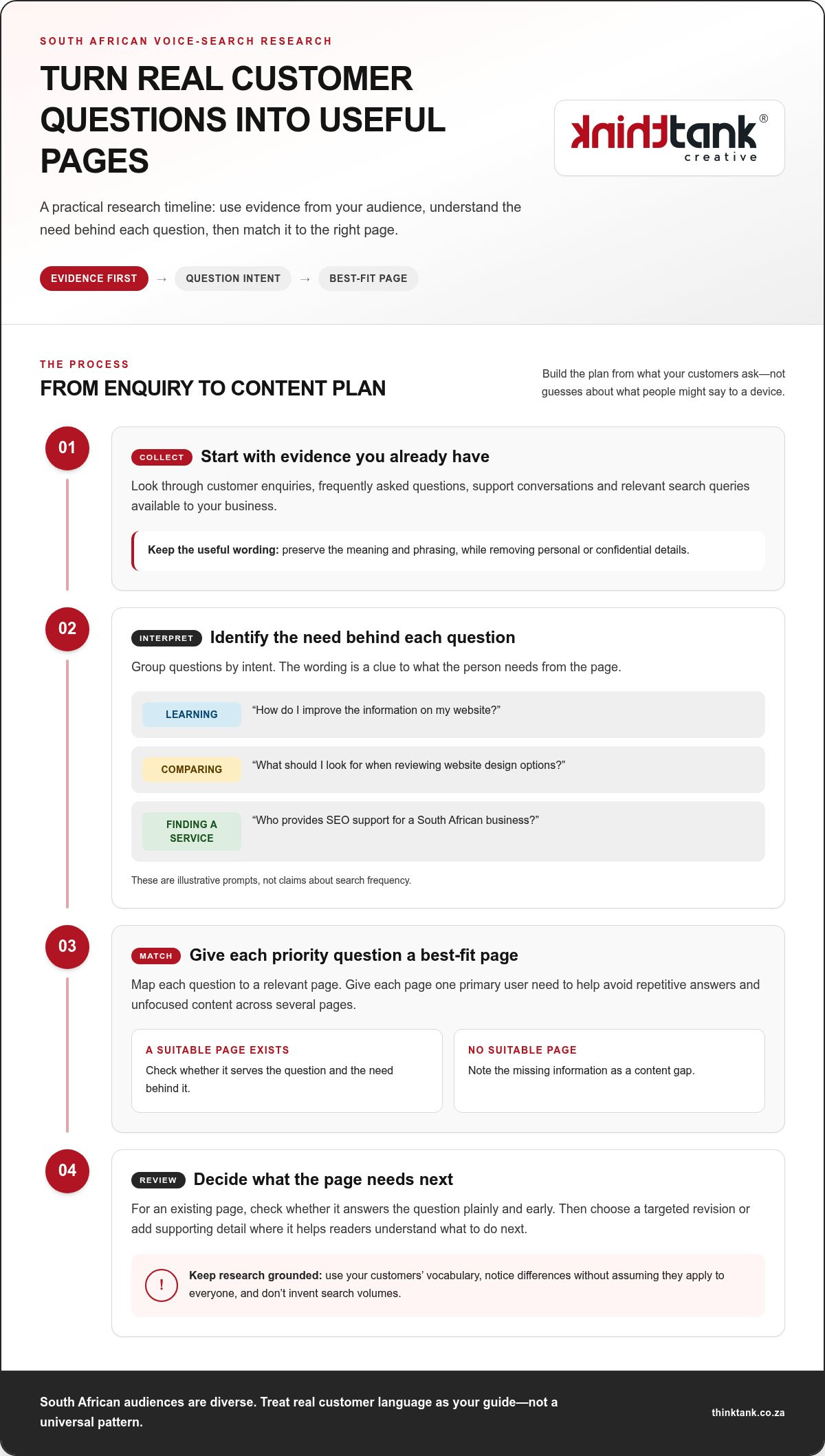
Start with language your business already encounters. Review enquiries, frequently asked questions, support conversations and relevant search queries available to you. Preserve the meaning and phrasing while removing personal or confidential details. Listen for the task behind each question: someone asking “How do I prepare my website for a new service?” needs guidance, while “What should I look for in a website redesign?” suggests they’re comparing approaches.
Group questions by intent so the next step is clear:
- Learning: “How do I improve the information on my website?”
- Comparing: “What should I look for when reviewing website design options?”
- Finding a service: “Who provides SEO support for a South African business?”
These are illustrative prompts, not claims about search frequency. Your customers may use different terms, spellings or language preferences. The most useful voice search optimization tips for za begin with that real-world vocabulary, then organise it into questions your content can answer accurately.
Match each question to the right page
Before drafting anything new, map each priority question to a relevant page. Give each page one primary user need to avoid repetitive answers and unfocused content across several pages. If a suitable page already exists, check whether it answers the question plainly and early. Then decide whether it needs a targeted revision or more supporting detail.
- Record the question and the customer need behind it.
- Identify the best-fit page, or note that no suitable page exists.
- Assess the answer for clarity, accuracy and usefulness to the intended audience.
- Prioritise the update according to customer relevance and the value of improving that page.
Keep a simple working table with the question, intent, matched page and next action. This gives you a repeatable way to review priorities as new enquiries and query data emerge. If you’re refining how research informs website content and SEO, ThinkTank Creative’s SEO and website planning can support a considered approach from research through implementation.
How to optimise South African website content for voice search
Make the answer easy to find, then give readers the detail they need to act on it. On a relevant page, place a straightforward response near the beginning, close to the question it addresses. Follow it with supporting explanation, evidence or practical steps. This helps someone looking for a quick answer without leaving readers who need more context with an oversimplified response.
A voice-search-ready answer is a clear, self-contained response to a relevant question, supported by accurate context on the page. That’s a useful writing standard, not a promise that an assistant will select or read out your content. Concision can improve usability, but the selection of a result depends on factors beyond the wording of one answer.
Write for people first. Don’t repeat a target phrase mechanically or force natural South African English into a search template. Apply this principle to your voice search optimization tips for za: answer a genuine need in language your audience recognises, then make the page straightforward to read and use.
Write direct answers without flattening the detail
Use a heading framed as a customer question when it suits the page, such as “What should I prepare before requesting a website update?” Answer it plainly in the next paragraph. Then explain relevant steps, conditions or limitations so the short response remains accurate. If a question doesn’t belong on that page, don’t add it just because it sounds conversational.
Keep each answer focused. A paragraph that tries to address several needs can obscure the main point. A concise opening followed by well-organised detail gives readers a clear route through the information.
Make pages easy to use and interpret
Clear writing works best when the page structure reinforces it. Choose a descriptive page title, use meaningful headings and arrange related information in a coherent sequence. Make important information available as text, not only inside an image or media element, so visitors can access it as they read. Keep each explanation close to the question it answers.
Review the page on a mobile screen as well as a larger display. Check that text is legible, navigation is understandable and key content is easy to reach. Notice loading behaviour too: delays or layout problems can interrupt the experience before a visitor reaches the answer. These checks overlap with broader website user experience improvements, because a clear, usable page benefits visitors whether they arrive by voice or another search method.
Before publishing, read the page aloud. Does the answer sound natural? Is its meaning clear without relying on a heading or image alone? Can someone quickly find the next useful detail? Refine awkward wording, preserve necessary qualifications and keep the page aligned with its purpose. Thoughtful content and considered design work together. The aim isn’t to imitate a voice assistant, but to make useful information accessible to the people searching for it.
How to improve technical and local relevance for voice search in South Africa
Review three areas separately: content relevance, technical accessibility and accurate business information. A strong answer may still be hard to use if a page doesn’t display properly on a phone. Technically accessible pages can also confuse visitors if their business details are inconsistent. Check each area, then consider how they work together.
Use this checklist to turn voice search optimization tips for za into practical website checks. Match the verification method to the change you’re reviewing.
| Area | What to review | How to verify |
|---|---|---|
| Content relevance | Whether the page addresses a genuine customer need with clear, accurate information. | Compare the page with customer questions and check that its purpose and answer are easy to identify. |
| Technical accessibility | Mobile rendering, readable text, navigation, working links and other page elements. | Test the live page on mobile and desktop, and follow up on usability or accessibility issues you find. |
| Business information | Whether contact details, business descriptions and stated service coverage are consistent. | Compare relevant website pages and check that each detail accurately reflects the business. |
Check accessibility, mobile usability and structured data
Inspect important pages on a mobile device. Check that text is readable, navigation works, links lead to the right places and key information isn’t hidden behind a broken or difficult-to-use element. Test the live page, not only how it looks in an editor.
Structured data is code that describes page information in a format search engines can interpret. It can help clarify what a page is about, but it doesn’t guarantee a voice result or enhanced search display. Before adding or changing markup, consult the search engine’s current official documentation for supported features and eligibility rules. Validate the syntax and relevant eligibility with current testing tools, correct any errors, then review the page again. Don’t add markup that describes information visitors can’t find on the page.
Keep South African business information clear
For a business serving customers nationally, keep its name, contact details and service descriptions consistent across relevant website pages. State national coverage plainly when it applies. Use location wording only when it reflects genuine service coverage and helps visitors understand whether the business can meet their needs.
Voice optimisation doesn’t require a page for every city or wording that implies coverage the business doesn’t provide. A clearly written national service page can be more useful than a collection of thin location pages. Review business details when services or contact information change, and remove outdated wording so customers aren’t left with conflicting expectations.
ThinkTank Creative brings website design and development, SEO, testing and ongoing support together to help businesses implement and maintain considered improvements. Improve your website’s technical and search foundations with a collaborative review of its content, usability and business information.
How to test voice-search improvements and plan your next steps
Improve through a measured cycle, rather than expecting one edit to secure a spoken result. Search platforms may not report voice queries separately, so it’s rarely possible to attribute a precise visit or enquiry to voice search alone. Instead, assess whether the pages you’ve improved are becoming more useful and performing well for relevant search needs.
Choose indicators that connect to each page’s purpose. Relevant organic visits can show whether people are finding it through search. Engagement with question-led pages can help you assess whether visitors continue reading or take a next step. Where measurable, enquiries can indicate whether the information supports business goals. None of these measures proves that a visit came from a voice assistant, so describe results carefully.
Build a practical test-and-improve cycle
Keep a simple record for each update: the page, the customer question it addresses, the change made and the date. Note the reason for the change too, such as clarifying an answer or fixing a mobile navigation issue. This gives you a useful reference when reviewing performance and helps colleagues understand why the page was updated.
- Check the experience: view the page on a mobile device and confirm the answer, links and navigation work as intended.
- Review relevant indicators: compare organic visits, page engagement and enquiries where data is available.
- Interpret changes cautiously: consider other content, website or search changes that may have influenced the trend.
- Choose the next action: keep what serves readers, refine what remains unclear and investigate technical problems.
Look at trends over time instead of treating one fluctuation as proof of success or failure. Search visibility can change for reasons unrelated to voice, and a useful page may support visitors even when its direct contribution is difficult to isolate. These voice search optimization tips for za are most valuable when they lead to better experiences you can observe and refine.
Bring content, design and development together
A lasting improvement often involves more than rewriting a paragraph. Research identifies audience needs; UX/UI design shapes how visitors find information; development brings changes to life; and testing helps reveal issues before and after launch. Ongoing support makes it possible to revisit pages as customer questions, service details or platform documentation change.
ThinkTank Creative brings website design and development together with SEO, content creation, testing and ongoing support. This collaborative process can align the words on a page with its structure and functionality, rather than treating each as a separate task. Review updates as part of your broader website improvement plan, and record what you learn so future decisions are grounded in evidence.
If you’re ready to shape a website around your customers’ needs, Discuss a website built around your audience.
Make your next improvement count
Your next step doesn’t need to be a full website overhaul. Choose a page that matters to your audience, identify one clear improvement and record what changes after it’s made. This measured approach keeps voice-search work connected to genuine customer needs and helps you make sound decisions without relying on unsupported ranking promises.
Use these voice search optimization tips for za as a starting point, then adapt your priorities as your audience, services and website evolve. The opportunity lies in making each interaction clearer, whether someone finds you by speaking, typing or following a recommendation.
ThinkTank Creative has been building its South African agency experience since 2001, with website design and development, SEO and content creation supporting businesses as they strengthen their digital presence. Explore a website and SEO approach shaped around your audience, and take your next step with confidence.
Frequently Asked Questions
What is voice search optimisation?
Voice search optimisation is the practice of making website information easier for search systems and people to understand when a query is spoken. It can involve refining the wording of a service page, organising its headings or making key details easier to access. For example, a page explaining what a service includes can answer a spoken question as well as a typed search, provided its answer is clear and relevant.
How do I optimise my website for voice search in South Africa?
Start with a page that supports an important customer task, such as understanding how to request a service. Check that it uses familiar language, explains relevant terms and makes the next action easy to find. Review it on a mobile device and confirm contact details and service information are accurate. The phrase voice search optimization tips for za can guide your research, but your own customer questions should shape the final wording.
Does voice search require a different SEO strategy?
No. Treat voice search as an additional way people discover information, not a replacement for your broader SEO strategy. Continue building useful, accessible pages around your audience’s needs. You can then refine relevant content to address natural questions without creating duplicate pages for every possible spoken phrase. For instance, a service page can explain who the service suits and what it involves while still supporting visitors who arrive through conventional searches.
Should I create an FAQ page for voice search?
Only if a dedicated FAQ page genuinely helps visitors find answers. A short set of useful questions may work well on an existing service page, while broader queries may merit a separate resource. Avoid publishing a long list of near-identical questions just to capture search variations. Keep each answer accurate, specific to your business and connected to a next step, such as viewing the relevant service information or making an enquiry.
Can voice search optimisation help a business serving customers across South Africa?
Yes. A nationally focused business can make its website more useful to people in different parts of South Africa by explaining its services and coverage accurately. Use terminology your customers recognise, and avoid implying that one local expression or audience represents everyone. If your service is available nationally, say so clearly on relevant pages. Create location-specific content only when it reflects a real difference in what customers can access.
How can I measure whether voice search optimisation is working?
Measure the performance of the pages you’ve improved rather than assuming you can identify every voice-driven visit. Compare relevant organic traffic, page engagement and enquiries where those actions can be tracked. Record the change made and review performance over time, noting other factors that may affect results. If a page receives visits but few useful actions, examine whether its information, navigation or next step meets visitor expectations.