What if the issue isn’t how much you market your service business, but how well each channel works with the others? Digital marketing for service-based businesses is most effective when potential customers can discover your business, find clear reasons to trust it and take a straightforward next step.
If your marketing feels scattered across search, social media, paid advertising and email, you’re not alone. Keeping every channel active takes time, and visibility alone doesn’t guarantee suitable enquiries. The opportunity is to connect your efforts around how customers research and choose a service provider.
This guide will help you prioritise channels based on customer behaviour, create a measurable path from discovery to enquiry and follow-up, and decide what makes sense to manage in-house or with support. We’ll look at how your website, SEO, social media, PPC and email can work together, and what to measure so you can refine your approach with confidence.
Service businesses sell expertise, trust and a clear next step, not just a product. Customers often need to understand what a service involves and whether the provider is right for them before they enquire. That makes digital marketing for service-based businesses more than a collection of posts and adverts. It’s coordinated online activity that helps suitable customers discover, assess and contact a business.
Services can be harder to evaluate before purchase because customers can’t simply inspect or try them in advance. The unique characteristics of service marketing help explain why clear information and confidence-building matter. Aim to guide people from awareness and consideration through to enquiry, follow-up and, where appropriate, repeat engagement.
For a useful perspective on marketing a service business, watch this conversation:
A potential customer may begin with a need or question, then search online, see a social media post or hear about a provider through someone they trust. As they compare options, your website should make the service, intended audience and next step easy to understand. Useful content can answer common questions and help people judge whether your approach suits their needs.
Make the next step visible, whether that’s completing an enquiry form or contacting your business through a stated channel. Check that the form works, the contact details are easy to find and the page tells visitors what information to include. The journey doesn’t end when someone gets in touch. A clear process for responding, answering questions and following up helps connect marketing activity to the real customer experience.
Consistent messaging across your website, search presence, social media and email helps customers recognise what you do and who you do it for. Straightforward service descriptions reduce guesswork, while relevant proof, such as a suitable example of your work or a clear explanation of your process, can help address uncertainty. Keep claims accurate and make it easy for a prospective customer to find the information they need.
Digital marketing for a service business connects each online interaction to help the right customer move from discovering your expertise to trusting your offer and taking a clear next step. Measure progress by suitable enquiries and the quality of follow-up, not reach alone. Visibility can introduce your business to people, but its value depends on whether it helps the right prospects move forwards.
Choose channels for the role they can play, not because every business appears to be using them. In digital marketing for service-based businesses, search, a useful website, social media, paid advertising and email can support different steps, from first discovery to continued engagement. The right mix depends on how your audience researches services, what you offer, the capacity available and the business outcome you’re working towards.
| Channel | Customer-journey role | Typical activity | Useful measure |
|---|---|---|---|
| SEO | Discovery and research | Improve relevant service pages and answer customer questions | Relevant organic visits and enquiries |
| Website | Assessment and enquiry | Explain services, share relevant proof and make contact routes clear | Enquiry form submissions or calls |
| Content | Consideration and trust | Publish helpful articles or service explanations | Engaged visits and assisted enquiries |
| Paid advertising | Targeted discovery | Promote relevant services to selected audiences | Qualified enquiries against campaign objectives |
| Social media | Awareness and engagement | Share useful content and respond to audience conversations | Meaningful engagement and enquiries |
| Follow-up and repeat engagement | Send campaigns or relevant automated responses to permission-based contacts | Replies, clicks or subsequent enquiries |
SEO helps connect prospective customers’ searches with relevant service pages and helpful content. A useful service page explains what the service includes, who it is for and what to do next. It should also address questions someone is likely to have before making contact. Explore this search engine optimisation strategic guide for further context.
Once visitors arrive, clear navigation, readable information and a visible enquiry route help them decide what to do next. Check that the page content matches the promise made in a search result or campaign, and that visitors don’t have to search for contact details. Search visibility has limited value if the page doesn’t match the visitor’s intent or make contacting the business straightforward.
Paid advertising can place a relevant service in front of a selected audience. Assess it against its purpose, such as suitable enquiries, rather than impressions alone. Social media supports useful content, engagement and community management, while email can continue the conversation with contacts who have given permission to hear from you. Give each channel a distinct role, a manageable level of activity and a measure linked to your objective.
These channels work best as a connected system, not a checklist. Social content might prompt someone to explore a service page, whilst a follow-up email can help an interested contact take the next step. If you’re considering how to align your website, SEO, advertising, social media and email, explore ThinkTank Creative’s digital marketing support.
A focused plan beats a long list of activities that nobody has time to sustain. For digital marketing for service-based businesses, identify the business need first, then select channels your team can manage and measure. A gap in enquiry follow-up may need attention before a longer-term goal such as improving search visibility.
Start with the people you want to reach and the questions customers raise before enquiring. Then take an honest view of the skills, content resources, budget and time available to execute consistently. Choose a manageable combination of activities rather than launching every channel at once.
Use this five-step framework to make the decision practical:
Not every need has the same timeframe. If enquiries are arriving but aren’t being handled consistently, clarify responsibility and follow-up first. If enquiry handling is sound but suitable prospects aren’t finding the business, invest in longer-term discovery activity such as SEO. Neither priority replaces the other. Sequence them according to the current constraint.
Give each activity a purpose: discovery, trust-building or follow-up. Match campaign messages to a relevant service page, and make the next step clear. A useful starting point is to map how each activity can contribute to an enquiry, as outlined in this lead generation framework for South African businesses.
Marketing doesn’t always produce immediate results, particularly when the goal is to build visibility over time. Set realistic expectations, agree what evidence you’ll review and allow room to learn. In-house execution can suit a team with the right skills and time; specialist support can fill a defined capability gap; an integrated agency relationship may help coordinate strategy, implementation and ongoing work. Choose the arrangement that fits your needs, rather than assuming one model suits every business.
If coordinating the work is a challenge, ThinkTank Creative’s digital marketing support may be worth exploring as one option for bringing channel activity together.
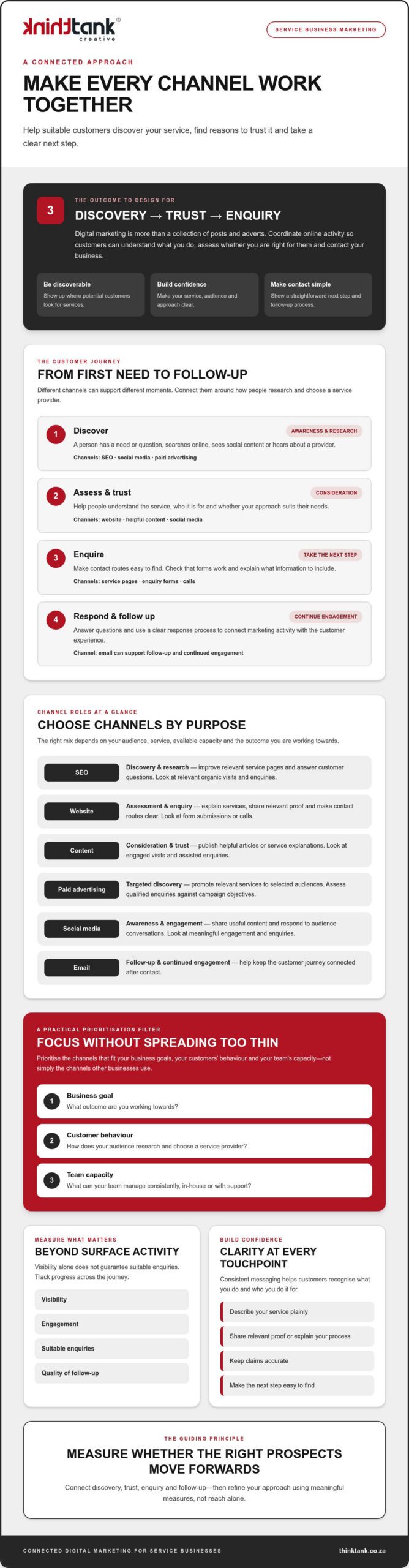
Measure whether your marketing is helping the business move towards its goals, not simply how much activity each channel produces. For digital marketing for service-based businesses, a compact set of measures can show where prospective customers find you, what helps them assess your services, and whether they make contact and receive follow-up.
Useful marketing measurement connects activity with a defined business objective. Choose measures that reflect the purpose of each activity, then interpret them alongside the service you provide, your audience and the period being reviewed. A rise in reach, for example, doesn’t tell you on its own whether the right prospective customers are taking action.
Organise your measures around the customer journey. For awareness, review relevant search visibility or qualified visits to your website. For consideration, check whether visitors engage with service information and helpful content. For enquiries, track completed contact actions and, where your tracking allows, whether those enquiries receive appropriate follow-up.
Keep the set small enough to review consistently. Depending on your goal, it could include:
Channel reports offer one view; website activity and feedback from the people handling enquiries can add context. If a campaign attracts visits but few contacts, check whether the landing page matches the campaign message, whether the call to action is clear and whether the enquiry route works as expected. If enquiries arrive but don’t progress, review the follow-up process before changing the advertising.
Use a simple review cycle: inspect the evidence, identify a point of friction, adjust one relevant element and review the result again. Changing one element at a time can make it easier to understand what may have influenced the outcome. Avoid judging a longer-term visibility activity by the same immediate expectations as a campaign designed to prompt direct enquiries.
For help planning content around your objectives, explore this guide to creating a content marketing plan. To align reporting with your marketing activity, discuss digital marketing and reporting support with ThinkTank Creative.
Outside support can be valuable when marketing priorities are unclear, your team lacks time to execute consistently, or channels feel disconnected. The right partner should help you make informed choices, not simply add more activity. For digital marketing for service-based businesses, that means understanding your objectives and audience before recommending work, then agreeing how responsibilities and progress will be managed.
Look for a collaborative discovery process that explores your business goals, audience and customer journey. Before engaging a provider, ask how the proposed work will address your needs and what your team will be responsible for. Make sure you understand how communication, reporting and ongoing support will work in practice.
Clear answers help you compare in-house execution, specialist support and a broader agency relationship on practical grounds. The best fit depends on the skills and capacity you already have, the work you need done and how closely different activities need to be coordinated.
ThinkTank Creative is a South African agency founded in 2001, working with businesses nationally. Its relevant digital capabilities include SEO, paid advertising, social media marketing, content creation, copywriting, reporting and website design and development. Depending on your needs, these services can be brought together so that campaign activity and website experience support the same business objectives.
The agency’s collaborative process spans research and strategy through delivery and support. Website projects can include UX/UI design, coding, testing, launch, training and support. This provides a clear foundation for discussing how digital activity fits together, while keeping the scope shaped around your requirements rather than assuming every service is needed.
Good marketing makes the company look smart; great marketing makes the customer look smart. If your priorities or next steps are still taking shape, ThinkTank Creative invites you to start a collaborative conversation about your needs and timeline. An estimated cost is provided after discussing them. “We Do It All So You Don’t Have To”.
Effective digital marketing for service-based businesses isn’t about being everywhere. It’s about choosing channels that fit your customers’ behaviour, connecting them to a clear next step and measuring whether they lead to meaningful enquiries. Prioritise what your team can sustain, then use reporting and customer feedback to refine your approach.
If your website, campaigns and follow-up feel disconnected, a collaborative partner can help bring the pieces into focus. ThinkTank Creative, founded in 2001, brings together digital marketing, website design and development, and ongoing support. Its approach centres on research, strategy, communication and service beyond project delivery, helping shape work around your business needs.
Discuss your digital marketing needs with ThinkTank Creative and explore a practical way forward for your business. Every well-considered step can help the right customers find, trust and contact you.
Digital marketing for a service-based business is coordinated online activity that helps suitable customers discover, assess and contact the provider. It can connect a website, SEO, paid advertising, social media and email across the customer journey. The aim isn’t simply to attract attention, but to explain the service clearly, build confidence, make enquiries straightforward and support follow-up, so marketing activity contributes to meaningful business goals.
The most suitable channels depend on how your audience researches services, your business objectives and your capacity to execute consistently. SEO can help people discover relevant services through search, while a clear website supports their assessment and enquiry. Paid advertising can promote specific services, social media can build engagement, and email can support follow-up with permission-based contacts. Start with the channels that best match your customers’ behaviour and your immediate priorities.
There’s no universal marketing budget that suits every service business. Set your spend in relation to your objectives, available resources, chosen channels and ability to handle the enquiries generated. Consider what work your team can manage and where specialist support may be needed, then review results against business goals. If you’re discussing digital marketing with ThinkTank Creative, an estimated cost is provided after your needs and timeline have been discussed.
Make it easy for suitable customers to understand your service and take the next step. Ensure your website describes what you offer, who it’s for and how to enquire. Align search, social media or paid campaign messages with the relevant service information, and make contact options visible. Then assign responsibility for responding and following up. Track completed enquiries and their quality, so you can identify whether the issue is visibility, page clarity or follow-up.
Social media can support awareness, useful content and engagement, but relying on it alone may leave gaps in how customers find and assess your service. A clear website can provide detailed service information and an enquiry route, while SEO can support discovery through relevant searches. Email may help maintain contact with people who have agreed to hear from you. Choose a connected mix based on customer behaviour and what your team can sustain.
There’s no fixed timeframe for results, because timing depends on the channel, your starting point, the audience and the outcome you’re measuring. Paid advertising may be assessed against campaign objectives, while SEO and content are typically part of a longer-term visibility effort. Set realistic expectations for each activity, track progress consistently and use the evidence to refine your approach. Avoid treating a short-term measure as proof of lasting business impact.
Manage marketing in-house if your team has the skills and time to plan, execute and review it consistently; seek outside support when priorities are unclear, capacity is limited or channels need coordination. A provider should clarify strategy, scope, responsibilities, communication, reporting and ongoing support before work begins. ThinkTank Creative, founded in 2001, offers digital marketing, website design and development, and ongoing support through a collaborative process shaped around business needs.


