The bid that wins the most clicks may still be wrong for your goal. Understanding Google Ads bidding strategies starts with matching the approach to your campaign objective: Maximise Clicks can pursue website traffic, while Smart Bidding can optimise for conversions or conversion value.
Automated bidding is not always the best choice, and manual bids do not offer more control in every situation. Understanding Google Ads bidding strategies means weighing your campaign objective against the quality of your conversion tracking.
This guide builds on that understanding of Google Ads bidding strategies by explaining when Manual CPC or automated approaches may suit your campaign. You’ll also learn how conversion tracking informs the choice and why automated bidding can manage clicks and impressions differently from Smart Bidding, helping you make a considered decision for your South African campaigns.
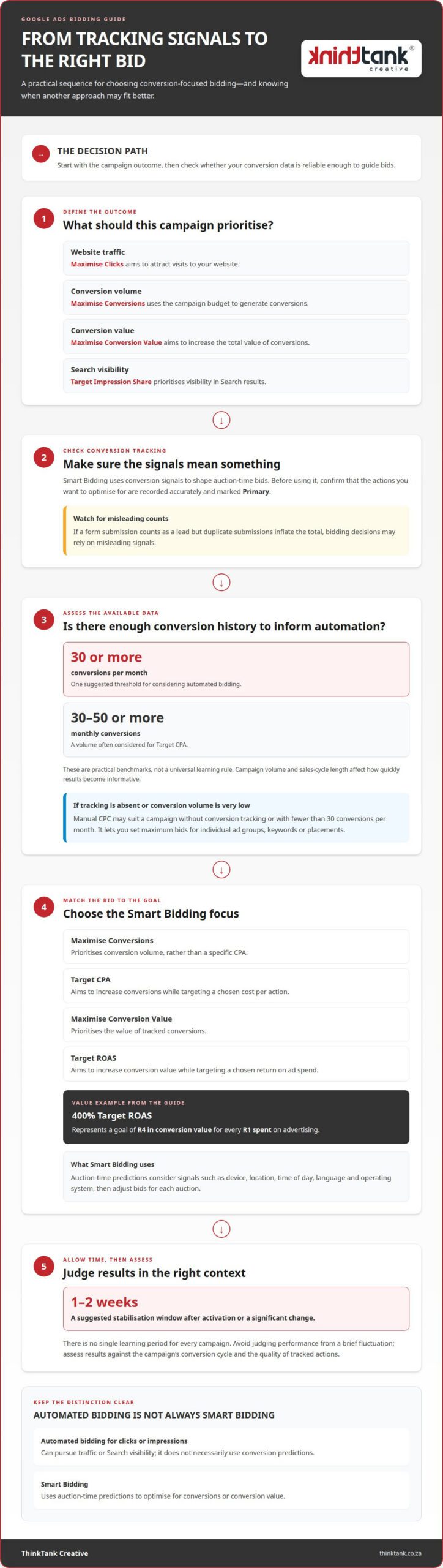
Conversion tracking gives Google Ads signals about valuable outcomes. Smart Bidding uses those signals to shape auction-time bids, so the strategy works best when each recorded action reflects a meaningful business result.
Maximise Conversions aims to use the campaign budget to generate conversions. Maximise Conversion Value aims to increase their total value. This distinction matters when a lead and a completed sale have different business value.
For sales campaigns, Google Ads lists Maximise Conversions and Maximise Conversion Value as bidding options. Choose the first when the priority is conversion volume; consider the second when tracked purchases carry different values. For example, a 400% Target ROAS represents a goal of R4 in conversion value for every R1 spent on advertising.
Smart Bidding is Google Ads’ automated bidding approach for optimising towards conversions or conversion value, using auction-time predictions. It considers signals such as device, location, time of day, language and operating system, then adjusts bids for each auction.
Target CPA aims to increase conversions while targeting a specific cost per action. Target ROAS aims to increase conversion value while targeting a chosen return on ad spend. Both depend on accurate tracking, and targets should start close to current campaign performance.
Set up tracking before using conversion-focused bidding. Confirm that the intended actions are recorded accurately and marked Primary, so Google Ads optimises towards the outcomes that matter. For example, if a form submission counts as a lead but duplicate submissions inflate the total, bidding decisions may rely on misleading signals.
Volume also affects whether a strategy has useful data. One suggested threshold for considering automated bidding is 30 or more conversions per month; Target CPA is often considered with 30-50 or more monthly conversions. These are practical benchmarks, not a universal learning rule: campaign volume and sales-cycle length affect how quickly results become informative.
Allow Smart Bidding time to stabilise after activation or a significant change. A suggested window is 1-2 weeks, although there is no single learning period for every campaign. Avoid judging performance from a brief fluctuation; assess results against the campaign’s conversion cycle and the quality of tracked actions.
Keep the objective clear. Maximise Clicks seeks website traffic, Maximise Conversions uses the budget to optimise for conversions rather than a specific CPA, and Maximise Conversion Value prioritises tracked value. Target Impression Share focuses on Search visibility. Let tracking and campaign goals guide your choice, not the strategy label alone.
Manual CPC lets you set a maximum cost-per-click bid for individual ad groups, keywords or placements. Automated bidding adjusts bids to pursue the campaign objective. That is the central difference: you set the bid directly with manual bidding, while the system manages it with automated bidding.
With manual bidding, the European Union says, you set the maximum amount you are willing to pay per click, though you may pay less depending on the auction. The actual cost may be lower, depending on the auction. This gives you direct control over bid ceilings. For example, you can set different maximums for keywords with distinct commercial value instead of applying one bid across every ad group.
Manual CPC can suit campaigns without conversion tracking or with very low conversion volume, defined as fewer than 30 conversions per month. In these cases, there may be too little conversion data to guide conversion-focused automation. A manual approach lets you decide which keywords deserve higher bids, then assess their clicks and results before adjusting those limits.
Control also brings responsibility. A maximum CPC bid is a ceiling, not a promise that every click will cost that amount. Review bids alongside the daily budget and the quality of traffic each keyword attracts. If a keyword receives clicks but does not support the campaign objective, reduce its bid or exclude it from the campaign.
Enhanced CPC is an optional feature used with Manual CPC. You set baseline bids, and Google Ads can adjust them in an attempt to maximise conversions. This introduces automation without handing over every initial bid decision. However, these conversion-focused adjustments still rely on useful signals, so recorded actions should reflect genuine outcomes.
Smart Bidding differs from both standard manual bidding and automated bidding for other goals. It uses auction-time conversion predictions, while other automated strategies do not necessarily use those predictions. Target Impression Share is another automated option: it aims for a position on Google Search results, prioritising visibility rather than a manually chosen maximum CPC for each keyword.
For brand awareness, visibility may matter more than conversion volume, making impression-share bidding a relevant alternative. For tighter bid control, Manual CPC keeps individual keyword ceilings in your hands. If a campaign’s goal or tracking setup changes, reviewing PPC campaign strategy can help align its bidding approach with the new objective.
A bidding strategy determines how Google Ads sets bids in each auction. Choose one by matching the desired campaign outcome with available conversion data and ad format.
Campaign goals determine whether bids should prioritise traffic, leads, sales or visibility. A strategy optimised for clicks may not deliver the conversion value a sales campaign needs.
For lead generation, Maximise Conversions can prioritise recorded enquiries, while Target CPA adds a specific cost-per-action goal. For ecommerce, Maximise Conversion Value or Target ROAS suits campaigns focused on sales value. Brand-awareness campaigns can prioritise visibility with Target Impression Share or CPM-based bidding. Choose the outcome first, then select a strategy that aligns with it.
Campaign type shapes which bidding options are relevant, but the advertising goal remains central. For Search, Maximise Clicks can pursue website traffic, while Target Impression Share focuses on visibility in search results.
For Display and Video campaigns, CPM-based bidding can prioritise impressions or reach. Shopping campaigns focused on sales can use conversion-focused options such as Maximise Conversion Value or Target ROAS. These are not rigid format rules: the right choice depends on whether your campaign needs traffic, conversions, conversion value or awareness.
Maximise Clicks seeks as many clicks as possible within the campaign budget, making it relevant when website traffic is the goal. Maximise Conversions uses the budget to optimise for conversions rather than targeting a specific CPA.
Target CPA aims to increase conversions around a chosen cost per action, while Target ROAS aims to increase conversion value against a return-on-ad-spend target. Choose between them by considering whether your priority is click volume, conversion volume, cost control or revenue value, and whether tracking provides useful conversion data.
Smart Bidding uses machine learning to predict the likelihood or value of a conversion in each auction. It can consider signals including device, location, time of day, language and operating system.
These signals help Google Ads adjust bids for each auction instead of relying only on a fixed maximum. The distinction matters: Smart Bidding optimises for conversions or conversion value, while automated bidding can also pursue clicks or impressions.
Common mistakes include changing strategies before tracking is reliable or making repeated significant changes during learning. Allow 1-2 weeks for Smart Bidding to stabilise after activation or a significant change; campaign learning periods can differ, especially with longer sales cycles.
For South African advertisers, the strategy choice follows the campaign goal, while actual costs reflect the auctions entered and the bids made. Set and assess campaign budgets in South African Rand (R), then judge performance against the intended outcome, such as leads, sales value or Search visibility.
Target Impression Share is an automated Search bidding strategy that aims to place an ad at the absolute top, top or elsewhere on Google search results pages. It suits campaigns where visibility for selected searches matters more than maximising clicks or conversions.
Set a desired impression share to define how often you want your ad to appear for eligible searches. For example, an 80% target for a search term expresses a visibility goal, not a promise that every search will show the ad. The strategy adjusts bids towards that goal, so the target should reflect the value of appearing for those searches.
Brand keywords can make impression share especially relevant. A 95% target is suggested for brand terms where frequent visibility is important; a separate example aims to show an ad 100% of the time for searches related to a brand. These targets prioritise presence, so review them alongside campaign performance and the importance of protecting brand visibility.
Choose the placement setting carefully. Absolute top prioritises the first ad position, top aims for an upper position, and anywhere focuses on appearing somewhere in Search results. Each setting defines visibility differently. A brand defending its name may favour a prominent position, while a campaign seeking broader exposure may choose a less restrictive placement.
Target Impression Share is not interchangeable with Target CPA or Target ROAS. Target CPA aims to increase conversions while targeting a cost per action; Target ROAS aims to increase conversion value against a return-on-ad-spend target. A visibility-focused campaign can use impression share, while a lead-generation campaign may prioritise conversions and an ecommerce campaign may focus on sales value.
For Target ROAS, the percentage expresses conversion value relative to ad spend. A 500% target represents an aim of R5 in conversion value for every R1 spent on advertising. That makes it a value-based goal, not a visibility target. Target CPA, by contrast, centres on the desired cost for each action rather than the total value of sales.
Display campaigns use different visibility measures from Search. CPM-based bidding can suit awareness campaigns that value impressions, while Target Impression Share is intended to increase Search visibility. Keep campaign type and objective aligned: choose Search impression share for the desired Search presence, and use conversion-based targets when leads or revenue matter more than exposure.
Before setting a target, identify the searches and placements that matter, then choose a visibility level that supports the campaign’s purpose. Track impression share alongside clicks and conversions, so you can assess a stronger presence in context rather than treating it as the outcome by itself.
Automated bidding sets bids for individual auctions instead of relying on one fixed amount for every opportunity. The European Commission describes algorithms that consider multiple signals to set a bid dynamically for each impression. For campaigns focused on traffic or visibility, this differs from Smart Bidding, which optimises specifically for conversions or conversion value.
Maximise Clicks automatically manages bids to seek as many clicks as possible within the campaign budget. It can suit a traffic campaign or one without enough conversion data for Target CPA or Target ROAS. Set a maximum CPC limit to define the most you’re willing to pay per click. Without a suitable limit, a high-cost auction could use more of your budget than expected.
Maximise Clicks pursues click volume, not lead quality or sales. For example, if broad keywords attract visits but few relevant enquiries, more clicks may not advance your business goal. Review search terms and add negative keywords to reduce irrelevant traffic. Automated bidding changes bid decisions, but keyword relevance still matters.
Impression-based strategies serve a different purpose. Google Ads CPM bidding charges for every 1,000 times an ad is shown, making it relevant when exposure matters more than clicks. Target CPM optimises bids to maximise unique reach for video or Display campaigns, while aiming to keep average CPM at or below the target.
For viewable Display impressions, vCPM lets advertisers set the highest amount they’re willing to pay for every 1,000 viewable impressions. This differs from Target Impression Share, which aims for a chosen presence on Search results pages. Match the setting to the placement and intended outcome: reach across Display or Video, or visibility for Search terms.
Target CPC automatically adjusts bids to try to achieve your target average cost per click. It can help guide click costs, while the right bidding approach depends on your campaign goals. The key distinction across these automated options is what the system is instructed to pursue: clicks, average CPC, impression volume or unique reach.
Keep the daily budget and campaign goal aligned, then assess whether the chosen volume is useful. If conversions are the real objective, conversion tracking and Smart Bidding may be more appropriate than a clicks strategy. If awareness is the priority, impression-based bidding may fit better. Plan a PPC campaign around your bidding goal to connect the strategy with the outcome you want.
ThinkTank Creative can help connect Google Ads decisions with the wider digital experience your audience encounters. A bidding strategy works alongside clear campaign goals, relevant creative and a website experience that supports the next step, whether that is an enquiry or a sale.
For businesses refining their digital presence, ThinkTank Creative offers Website Design and Development, Social Media Marketing, creative design, and Logo and Corporate Identity Design. These capabilities can support a more coherent experience across campaign messaging and customer touchpoints, without treating the bid as the only factor in performance.
To discuss how your digital strategy can support your advertising goals, contact ThinkTank Creative.
Let the business outcome guide your next bidding decision, rather than choosing a setting simply because it is automated or familiar. Understanding Google Ads bidding strategies helps you connect campaign intent with the experience people encounter after clicking, from the ad message to the next step on your website.
Bidding is one part of a coherent digital presence. ThinkTank Creative can bring together advertising goals, relevant creative, website design and development, and social media marketing to shape a consistent experience across customer touchpoints.
As your priorities evolve, revisit whether your campaign is designed to attract attention, generate enquiries or support sales. A considered review can help keep the strategy aligned with the direction of your business. Contact ThinkTank Creative to discuss your ads and explore a thoughtful next step for your digital marketing.
Yes, but choose a strategy suited to the available data and the outcome your budget can support. If conversion tracking is unavailable or conversion volume is very low, Manual CPC can provide more direct control. For traffic, Maximise Clicks can manage bids within the campaign budget; set a maximum CPC limit to control the highest bid. Review search terms regularly, since irrelevant clicks can use a limited budget without advancing your objective.
During learning, automated bids may adjust as Google Ads gathers signals and evaluates the strategy against your objective. Performance can fluctuate, so a short-term change in clicks or conversions may not reflect the campaign’s longer-term direction. Avoid making several significant changes close together, as each can affect the assessment. Compare results over a period that reflects your sales cycle, and assess the quality of recorded outcomes as well as their volume.
If you mean manual versus automated bidding, the difference is who sets bids in each auction. With Manual CPC, you choose maximum bids for keywords, ad groups or placements. Automated strategies adjust bids towards a selected goal, such as clicks or impressions. Smart Bidding is the conversion-focused subset: it uses auction-time predictions to optimise for conversions or conversion value rather than simply pursuing traffic.
Google Ads strategies include Manual CPC, Maximise Clicks, Maximise Conversions, Target CPA, Target ROAS and Target Impression Share. They guide bids towards different outcomes: click volume, conversions, conversion value or Search visibility. CPM-based options can focus on impressions in Display or Video campaigns. Start by naming the outcome that matters most, then choose a strategy that optimises for it and matches your campaign’s tracking and data.
Set a target close to the campaign’s current performance, using reliable conversion tracking as your baseline. For Target CPA, use the average cost per action as a starting reference, or set the target slightly above it. For Target ROAS, base the goal on observed conversion value relative to ad spend. Avoid an abrupt, unrealistic target; assess performance after changes and adjust in measured increments as results stabilise.
There is no universal learning period because volume and sales-cycle length affect how quickly results become informative. Allow around 1-2 weeks after activation or a significant change before judging stability. As a practical benchmark, testing Smart Bidding after 15-30 conversions over 30 days can provide useful data. Target ROAS may need 15 to 50 conversions in the previous 30 days for effective performance, depending on campaign type.
For South African campaigns, Manual CPC lets you set maximum bids for keywords, ad groups or placements, though the actual cost per click may be lower. Automated strategies set bids to pursue goals such as clicks, conversions, conversion value or Search visibility; Smart Bidding uses auction-time signals to optimise conversions or value. A 400% Target ROAS, for example, aims for R4 in conversion value per R1 spent.


