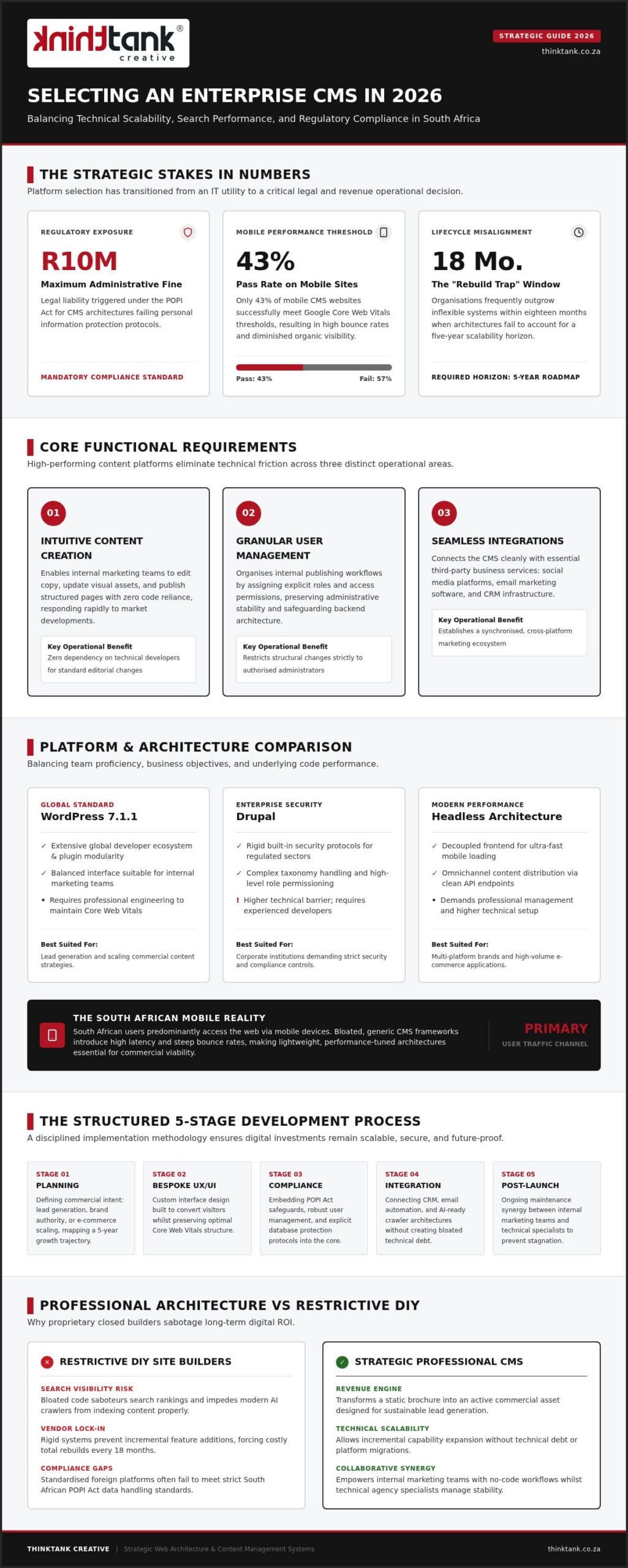
Could the platform you use to publish a simple blog post actually trigger a R10 million administrative fine? As we move through 2026, understanding how to choose a cms for your website has evolved from a simple comparison of features into a high-stakes strategic decision that impacts both your legal standing and your bottom line. You likely recognise that a website should be a dynamic engine for revenue, yet the fear of technical lock-in or failing POPIA compliance keeps many leaders awake at night. It's exhausting to feel caught between restrictive DIY builders that sabotage your search rankings and professional systems that seem unnecessarily opaque.
This guide promises to demystify the selection process, helping you secure a system that ensures technical scalability whilst driving measurable growth. We'll examine why only 43% of mobile CMS sites pass modern Core Web Vitals thresholds and how to navigate the transition to WordPress 7.1.1 or headless architectures. By the end of this article, you'll have a clear roadmap to a professional digital presence that justifies your investment and simplifies your daily operations. We'll move from high-level strategic concepts to the concrete methodology required to elevate your brand in a competitive digital marketplace.
Your website is no longer a digital brochure; it's the central nervous system of your brand's growth. At its core, content management systems serve as the foundational architecture that allows you to control your digital narrative without technical barriers. Mastering how to choose a cms for your website starts with recognising that this software is the bridge between your high-level strategy and your customer's experience. It transforms your online presence from a collection of static pages into a dynamic, content-driven revenue engine that evolves alongside your business.
Adopting a "set and forget" mindset is a dangerous gamble for South African businesses. A website that remains stagnant quickly loses relevance in search rankings and fails to meet the shifting expectations of your audience. Instead, view your CMS as a sophisticated collaborative tool. It creates a synergy between your internal marketing team, who understand your brand's voice, and your creative agency, who ensure the technical framework remains robust and scalable. This partnership ensures that every update contributes to a cohesive, professional digital presence whilst maintaining the integrity of the original design.
A high-performing CMS empowers your team by removing technical friction. It provides a centralised environment where you can manage critical areas of your digital footprint:
The digital landscape has shifted toward AI-driven search and multimodal engagement. Understanding how to choose a cms for your website requires looking beyond the immediate interface to the underlying technical potential. Your CMS structure now dictates how easily AI engines can crawl and understand your content, which is a vital component of modern search engine optimisation. Performance is non-negotiable. For South African users, who predominantly access the web via mobile devices, a bloated system leads to slow loading times and high bounce rates. By selecting the right platform now, you reduce long-term maintenance costs and avoid the technical debt that plagues businesses using rigid, outdated architectures.
Align your digital architecture with your long-term commercial objectives to ensure your platform serves as a catalyst for growth rather than a technical bottleneck. Mastering how to choose a cms for your website requires a shift from technical checklists to strategic foresight. You must begin by defining the primary intent of your digital presence. Whether you are focused on aggressive lead generation, complex e-commerce transactions, or high-level brand awareness, your choice must mirror these goals. Avoid the common "rebuild trap" where businesses outgrow their systems within eighteen months because they failed to account for a five-year growth trajectory. A scalable system allows you to add features incrementally, preserving your initial investment whilst expanding your reach.
Honest evaluation of your internal team's technical proficiency is equally vital. An interface that is too complex for your marketing staff leads to content stagnation and an over-reliance on external developers for minor updates. Conversely, a system that is too simplistic may lack the sophisticated controls needed for high-level search engine optimisation. You need to balance user-friendly dashboards with robust custom functionality. Following best practices outlined in Google's SEO Starter Guide ensures that your chosen architecture supports essential crawlability and indexing requirements from day one.
Consider the depth and variety of the information you intend to share. A simple blog requires far less architectural support than a multi-layered resource centre or a multilingual corporate portal. If you require multi-site management or need to publish updates daily across various regional subdomains, your system must handle these high-frequency demands without compromising performance. Identifying these needs early prevents the frustration of discovering your platform cannot support essential content types or complex navigational structures as your site expands.
Your CMS should function as a collaborative hub within your broader marketing stack. It's essential to ensure seamless connectivity with CRM systems like HubSpot or Salesforce to track leads accurately from the first click to the final sale. Even if you aren't selling products online today, planning for future e-commerce requirements prevents a costly migration later. Partnering with a specialist for website design and development ensures these technical choices align with your broader brand vision and existing digital strategy, creating a unified ecosystem that supports measurable growth.
Selecting the right platform requires a deep understanding of the current technological ecosystem and your specific business trajectory. In 2026, the market is no longer a one-size-fits-all environment. Understanding how to choose a cms for your website involves balancing immediate ease of use with the long-term technical integrity required to stay competitive. Whether you opt for a globally recognised open-source system or a modern decoupled architecture, your choice dictates your ability to pivot as market demands shift.
WordPress remains the dominant force in the digital space, powering over 42% of all websites globally. The stable release of WordPress 7.1.1 has further refined the block-editing experience, making it a favourite for South African marketing teams who value autonomy. Its vast ecosystem of plugins allows for rapid feature deployment, but this flexibility requires a disciplined approach to maintenance. Research indicates that unmaintained third-party add-ons accounted for more than 90% of breach vectors on DIY setups in 2025. To avoid these pitfalls, professional brands should move away from generic templates in favour of custom website design. This bespoke approach ensures high performance and clean code, which are essential for passing Google’s Interaction to Next Paint (INP) thresholds and providing a superior user experience.
The rise of headless or decoupled systems represents a significant shift for brands requiring ultimate design freedom. By separating the content management layer from the front-end presentation, a headless CMS allows you to deliver structured data to web browsers, mobile apps, and customer portals simultaneously. This market is expanding rapidly, with valuations projected to exceed $4.4 billion by the early 2030s. A hybrid approach often provides the best of both worlds, offering the structured content benefits of headless with the user-friendly editing interfaces of traditional platforms. These systems are inherently more secure and performant, which is vital for maintaining compliance with the Protection of Personal Information Act. For enterprise-level needs, Drupal 11.4.7 continues to be a robust choice, especially with Drupal 12 scheduled for launch in late 2026, providing the high-security architecture needed for complex data environments.
Ultimately, the decision between open-source and proprietary systems rests on your desire for control versus convenience. Open-source platforms provide a community-driven roadmap and no licensing fees, whilst proprietary systems offer a more controlled, managed environment. Your choice should reflect your internal technical capacity and your vision for brand transformation. By focusing on a system that supports your unique workflows, you ensure that your digital presence remains an asset rather than a liability.
Security is a non-negotiable pillar of modern brand trust. When you evaluate how to choose a cms for your website, you are essentially selecting the fortress that protects your intellectual property and customer data. With over 11,334 documented vulnerabilities across CMS plugins and extensions in the last year alone, your choice of platform determines your resilience against cyber threats. A secure digital environment requires more than just a strong password; it demands an architecture that supports automated security headers, encrypted database connections, and a rigorous schedule for patches. Failing to prioritise these technical safeguards leaves your business vulnerable to breaches that can dismantle years of reputation building in hours.
Your CMS architecture directly influences your search engine optimisation. Google's 2026 ranking evaluation prioritises Interaction to Next Paint (INP) scores of 200 milliseconds or less. A bloated CMS with excessive JavaScript and unoptimised CSS will struggle to meet these performance thresholds, especially for the mobile-first South African audience. You need a system that allows for granular control over metadata, automated schema markup generation, and clean URL structures without requiring developer intervention for every minor adjustment. Clean code and fast loading speeds are no longer optional extras; they are the baseline for visibility in an AI-driven search landscape.
For South African organisations, the Protection of Personal Information (POPI) Act is a critical operational framework. The Information Regulator is empowered to issue administrative fines of up to R10 million for serious non-compliance, making your CMS's data handling capabilities a high-stakes business priority. Your chosen platform must integrate "privacy by design," featuring robust cookie management systems that restrict script loading prior to user consent. It must also provide secure, encrypted storage for any customer information collected through lead generation forms or user portals. Compliance is not a one-time task; it requires a system that can adapt to evolving regulatory interpretations and provide automated tools for data subject access requests.
Maintaining a secure and compliant digital presence requires a commitment to regular updates and proactive monitoring. A managed approach ensures your digital presence stays ahead of both security risks and regulatory changes. If you are concerned about your current platform's resilience or compliance status, our team offers professional website maintenance and support to keep your system peak-performing and secure. By choosing a partner who understands the local regulatory landscape, you ensure your technology investment remains an asset rather than a liability.
Whilst understanding how to choose a cms for your website is a vital first step, the actual execution of that choice defines your brand's future success. DIY builders often promise rapid simplicity, yet they frequently deliver hidden technical debt and generic aesthetics that fail to resonate with a sophisticated audience. At ThinkTank Creative, we believe your digital presence deserves the precision of bespoke craftsmanship. We've refined a structured 5-stage development process—Planning, Design, Program, Development, and Revise—to ensure every technical decision aligns with your commercial vision. This methodical approach removes the guesswork, allowing you to focus on your core operations whilst we handle the complex architecture of your growth.
Our award-winning designers prioritise the synergy between aesthetic appeal and technical functionality. Professional UX/UI design isn't just about surface-level visuals; it's about creating an intuitive journey that converts casual visitors into loyal customers. During the initial strategy phase, we deep-dive into your brand identity to ensure the chosen CMS supports your specific internal workflows. The program and development stages are where your vision takes a concrete form, built on clean code that ensures speed and scalability. Before any site goes live, our exhaustive testing phase ensures every link, form, and page is flawless, providing a stable foundation for your digital operations from day one.
The partnership doesn't end when your website goes live. In fact, that's where the real journey of brand transformation begins. Ongoing service and maintenance are essential for security retention and maintaining your hard-earned search rankings in an ever-changing digital landscape. As an all-rounder agency, we pride ourselves on being a strategic partner that manages everything so you don't have to. Our expertise ensures you never have to worry about how to choose a cms for your website in isolation, as we guide you toward the system that best supports your long-term objectives. We provide an estimated cost only after a thorough evaluation of your specific needs and timeline, ensuring our solution is tailored rather than templated. By embarking on a journey of imagination with us, you secure a professional digital presence that justifies the investment and scales effortlessly as your business evolves.
Your choice of platform is the foundation upon which your entire digital marketing ecosystem rests. We've explored how to choose a cms for your website by balancing technical scalability with the strict requirements of the POPI Act. A well-selected system ensures that your team remains autonomous whilst your brand stays secure and visible in an AI-driven search environment. It's about moving beyond the limitations of DIY builders to embrace a system that grows alongside your ambitions.
Since 2001, ThinkTank Creative has partnered with South African businesses to navigate these complex technological shifts. Our award-winning design team utilises a comprehensive 5-stage development process to ensure your website is more than just a tool; it's a high-performance asset designed for longevity. We're ready to help you transform your digital vision into a measurable engine for growth. The potential for your brand's elevation is limitless when you have the right strategic partner by your side.
Book your 2026 website strategy session with ThinkTank Creative
WordPress is frequently the most versatile choice for South African small businesses due to its perfect balance of intuitive editing and long-term scalability. It allows you to begin with essential features and expand into complex e-commerce or lead-generation systems as your revenue grows. ThinkTank Creative specialises in custom WordPress development to ensure your site remains professional and unique, avoiding the restrictive templates that often hinder brand identity and search engine visibility.
Whilst you can migrate to a different platform as your organisation expands, it is a complex technical undertaking that requires careful planning to protect your data integrity and search rankings. A more efficient strategy is to select a scalable system from the outset. Understanding how to choose a cms for your website involves planning for a five-year growth trajectory to ensure your digital presence remains an asset through every stage of your business evolution.
WordPress is an exceptionally secure foundation for professional websites when managed with a focus on technical excellence and regular maintenance. Most security risks originate from unmaintained third-party add-ons or poor development practices rather than the core software. Our comprehensive 5-stage development process includes rigorous testing and proactive support to ensure your site remains a fortress against cyber threats. Professional management transforms this flexible platform into an enterprise-grade solution that protects your intellectual property.
The investment required to implement a new system depends on your specific functional requirements, design complexity, and the level of integration your marketing stack demands. We provide an estimated cost only after a detailed discussion of your commercial objectives and timeline to ensure our solution is perfectly tailored to your brand. This bespoke approach ensures you receive a high-quality system that justifies the investment by driving measurable growth and providing long-term technical stability.
No, a professionally designed CMS empowers your marketing team to manage daily content updates, such as publishing blog posts or adjusting product details, without needing technical intervention. We prioritise usability in our UX/UI design to ensure your internal workflows are intuitive and efficient. Whilst we provide ongoing website maintenance for technical security, your staff will have the autonomy to keep your digital narrative current and responsive to shifting market trends and customer needs.
A CMS is a robust software application designed to manage complex content and data across multiple channels, offering deep customisation and scalability. Website builders are typically simpler, proprietary tools that trade flexibility for ease of use, often resulting in technical debt as your business grows. Understanding these differences is vital when learning how to choose a cms for your website, as a professional CMS provides the architectural freedom needed for bespoke brand transformation and high-performance SEO.
Your platform choice dictates the technical foundation of your SEO, influencing critical factors like site speed, mobile responsiveness, and clean URL structures. A bloated or poorly coded system can lead to slow loading times that penalise your visibility in search results. By selecting a CMS that supports clean code and fast interaction speeds, you ensure that your content is easily crawlable and indexed, providing a significant competitive edge in an increasingly AI-driven search landscape.
A headless CMS decouples the back-end content management from the front-end presentation layer, allowing you to deliver structured data to multiple devices via APIs. This architecture offers ultimate design freedom and enhanced security, making it ideal for brands with complex multi-channel needs. Whilst not every business requires a headless setup in 2026, it is a powerful option for those seeking high performance and a future-proof solution that scales effortlessly across diverse digital touchpoints.


