Create SEO-friendly content by starting with what readers want to know, then organising the page so the answer is clear, useful and easy to navigate. Learning how to create SEO-friendly content means researching relevant keywords and search intent, using related terms naturally, and adding original information that gives readers a reason to choose your page.
It’s easy to focus on keywords and overlook the people behind the searches. Yet a page works best when it meets a real need, reads smoothly and offers more than familiar advice repeated.
This guide explains how to research keywords and your audience, plan a clear page structure, write helpful headings and link thoughtfully. You’ll also learn how original insights can serve search intent, improve the reader experience and support your wider search visibility.
Choose one primary keyword, then build a focused page around related searches, useful answers and original detail. On-page SEO improves elements such as headings and body text; technical SEO concerns how a site can be crawled, indexed and used.
Start with topics that connect a reader’s need to your expertise, then assess search demand and keyword difficulty using a keyword research tool. Compare related phrases, estimated traffic and the strength of pages in search results. A broad term may attract interest but face strong competition, while a focused phrase may offer a more realistic chance to reach readers. For example, compare “kiwi fruit” with “kiwi fruit health benefits” before choosing a page topic.
Choose specific phrases that reflect what a reader might actually want to know. Wordstream reports that 56% of buyers use search queries with three or more words, whilst 7% type a single-word query. A phrase such as “how to store kiwi fruit” signals a clearer need than “fruit”. Use the target keyword where it fits, then add natural variations in relevant paragraphs. Avoid repeating one phrase just to increase its frequency.
Group related searches by the answer readers need, then decide whether one page can satisfy them together. For the kiwi example, basic information and health benefits may need different emphasis because they reflect distinct interests. A thorough page answers connected questions without drifting into unrelated material. Use an outline to spot gaps, then add sections only when they deepen the answer or clarify a useful detail.
SEO-friendly content clearly answers a reader’s need, uses a suitable format and offers useful information. Identify the audience’s goal, then shape the page around the task they want to complete.
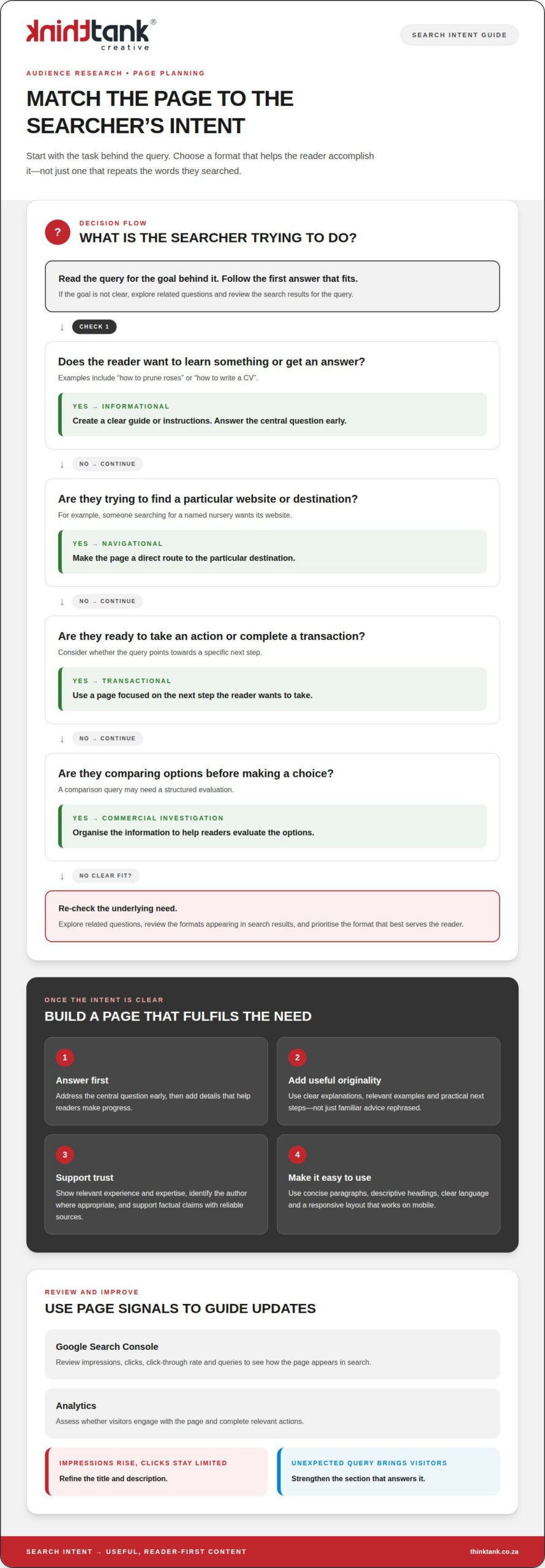
Identify the audience behind each query and what they need next. Search intent generally falls into four types: informational, navigational, transactional and commercial investigation. Someone searching “how to prune roses” wants instructions, whilst someone searching for a named nursery wants its website. Use Google’s People Also Ask to discover related questions, then check that your page answers the same underlying need.
Choose a format that helps readers act on the answer. An informational query such as “how to write a CV” suits a clear guide; a comparison query may need a structured evaluation. A navigational search usually calls for a direct route to a particular destination, while transactional intent favours a page focused on the next step. Review the search results for the query and note which formats appear, but prioritise what serves the reader.
Answer the central question early, then add details that help readers make progress. Useful, original content satisfies intent with clear explanations, relevant examples and practical next steps, rather than rephrasing familiar advice. Build trust by showing relevant experience and expertise, identifying the author where appropriate, and supporting factual claims with reliable sources. For example, a gardening guide can explain a pruning technique and distinguish it from methods for other plants.
Optimise titles, meta descriptions, headings, image details and internal links so each element clarifies the page’s purpose. Keep the wording accurate and useful: these elements help readers understand what they’ll find before opening the page.
Write a distinct title tag that puts the page’s main subject near the beginning and gives readers a clear reason to click. Aim for 50 to 60 characters, such as “Pruning Roses: A Practical Guide for Gardeners”. Keep the promise accurate; a title that suggests a complete guide should lead to one.
Organise the page with one H1 for its main title, followed by descriptive subheadings. Make each heading introduce the content beneath it, rather than repeating the same keyword. For example, use “When to prune roses” for a section explaining timing. This hierarchy makes the writing easier to scan and helps search engines interpret page structure.
Summarise the page’s subject and reader benefit in a concise meta description. A useful working range is 140 to 160 characters. Place the focus keyword near the beginning when it reads naturally, then use an active phrase to highlight what the reader will learn. For example: “Learn when to prune roses, which tools to use and how to care for new growth.”
Give each page a description that reflects its actual content. Avoid generic copy, repeated keyword strings and promises the page doesn’t fulfil. Search engines may generate a different search snippet, so make the description a clear, accurate invitation rather than relying on it as guaranteed wording in search results.
Compress image files to reduce their size whilst preserving visual quality. Choose JPEG for photographs, PNG for graphics or WebP for modern, lighter image use. These choices keep images useful without adding unnecessary weight to a page.
Finally, review the page on mobile and check that headings remain clear, snippets communicate the main benefit, and image filenames describe their contents. Consistency between the search result and page experience helps readers find the information they expected.
Use links to connect useful information, guide readers and clarify how pages relate. A considered linking structure can support organic visibility and make a website easier to explore.
Link each page to relevant content elsewhere on your website. For example, a blog post about choosing running shoes could link to a guide explaining shoe materials. Use descriptive anchor text such as “compare running shoe materials”, rather than “click here”. The link should help readers take a useful next step and give Google context about the linked page.
Link externally when an authoritative source supports a factual claim or gives readers valuable context. For example, a page discussing Google Search features can cite relevant Google documentation. Choose sources closely connected to the claim, and make the anchor text describe the destination. Avoid linking to a source simply to make a page appear more researched.
A key part of how to create SEO-friendly content is giving readers more than a polished version of information they can find elsewhere. Original content adds a useful perspective, evidence or practical detail that helps someone understand a topic or take their next step.
ThinkTank Creative helps businesses bring their digital presence into alignment, from website structure to the visual identity that supports its message. When you’re applying these content principles across a new or existing site, its Website Design & Development and Branding & Creative Design services can help create a cohesive reader experience. These services are a natural next step when your content, site structure and brand presentation need to work together rather than feel like separate parts.
Build content that reflects your expertise and gives readers a clear path through your website. Contact ThinkTank Creative to discuss your digital content goals.
Treat each new page as an opportunity to deepen your relationship with readers. A distinctive point of view can strengthen your brand’s voice, whilst careful attention to changing questions keeps your content useful over time. The aim isn’t simply to publish more; it’s to make each contribution worth returning to.
Learning how to create SEO-friendly content is an ongoing practice. Review how your audience responds, listen for emerging needs and let those signals shape what you create next. Consistent, thoughtful choices can help your content strategy develop alongside your business.
If you’re ready to connect your content with a broader digital presence, ThinkTank Creative can help bring that work into focus through its social media marketing offering. Contact ThinkTank Creative to discuss your next step, and keep moving towards a more cohesive online presence.
SEO writing creates clear, helpful content that addresses readers’ needs and is structured for search engines to understand. It brings together accurate information, natural language and a defined purpose. For example, a home-maintenance business could publish a guide explaining how to prepare a roof for heavy rain, with advice suited to homeowners. The goal is to make the page useful in its own right, not to write solely for algorithms.
SEO content is a web page, article or other digital material created to answer relevant searches and reach an intended audience. It might be a service page explaining what a business does, a blog post answering a common question, or a guide that helps readers make a decision. Its format depends on the reader’s task, while its substance should provide accurate, worthwhile information rather than simply repeat a search term.
Begin with the audience’s problem, then use a keyword research tool to explore the phrases people use and the questions behind them. Compare the wording and purpose of related searches. For example, “how to fix a leaking tap” suggests someone wants instructions, whilst “plumber near me” signals a service search. Group phrases with the same underlying need, then plan a page that answers that need directly.
Give each page one clear subject, a descriptive main heading and subheadings that guide readers through its sections. Use a concise URL that reflects the page topic, such as “/roof-maintenance/” for a roof-care guide. Avoid changing an established URL without considering its existing links and visitors. If a change is needed, plan a redirect to the new address so people and search engines can still reach the relevant content.
Update a page when its information, examples or purpose no longer match what readers need. A seasonal travel guide, for instance, may need review before the next planning period, whilst an evergreen explanation may remain useful longer. Check for outdated claims, changed processes, broken links and new audience questions. Make revisions that improve accuracy or usefulness, and avoid changing dates or wording just to make an unchanged page appear fresh.
Practices designed to manipulate search visibility rather than help readers can put a page at risk. Avoid keyword stuffing, copied material, misleading claims and artificial link schemes. Repeating a phrase unnaturally across every paragraph, for example, makes a page harder to read and adds little value. Focus on original, accurate answers and links with a clear purpose. Review Google’s current Search guidance before adopting tactics intended to influence rankings.


