A backlink is only as valuable as the trust and relevance behind it. The strongest link building strategies for South African businesses prioritise credible local websites, useful content and genuine relationships over a high volume of unrelated links. Start with the audiences and organisations that matter to your market, then build reasons for them to reference your business.
It’s easy to see why link building can feel like a numbers game: more links may seem like a faster route to stronger search visibility. But links that reflect your business’s credibility and fit your sector are more meaningful than links pursued simply to increase a count. Local context matters, too, because audiences, competition and business relationships differ across markets.
This guide explains how to research relevant South African websites, assess link opportunities and earn attention through useful, credible contributions. You’ll also learn how to account for local competition, avoid shortcuts that can undermine trust, and shape a sustainable approach around your business goals. The result is a clearer way to build authority that feels grounded in the market, not copied from a generic playbook.
Local relevance gives a backlink context. A mention from a South African organisation familiar with your sector can connect your business with the market it serves. Prioritise publishers, associations, suppliers and community organisations whose readers overlap with your customers. A link from an unrelated website may add little local credibility, even if that site appears prominent.
Adapt links to the places and customers your business serves. For local SEO, seek references from organisations with a genuine connection to your service areas, then make sure your website clearly explains where you operate. Use city and province names accurately in relevant page content, rather than pursuing links from organisations with no meaningful relationship to those places.
Effective link building strategies for South African businesses begin with a focused market map. Record your service areas, customer groups, relevant organisations and the subjects each organisation covers. Then review which websites already earn attention in your sector. Look for specialist commentary, business resources and community initiatives. This reveals where competitors have established relationships and where your expertise could add something distinct.
Competition also shapes how local businesses establish credibility. A company entering a new South African market needs to understand its customers, established organisations and trusted sources of information. Speaking with people in that market can reveal which publications and associations matter. Use those insights to tailor outreach, choose relevant topics and avoid treating every audience as interchangeable.
Brand South Africa has set a target of formalising collaborations with 8 strategic business associations by 2030. This highlights the value of structured relationships in strengthening connections. For an individual business, the practical lesson is to identify organisations aligned with its sector and contribute something useful before seeking recognition.
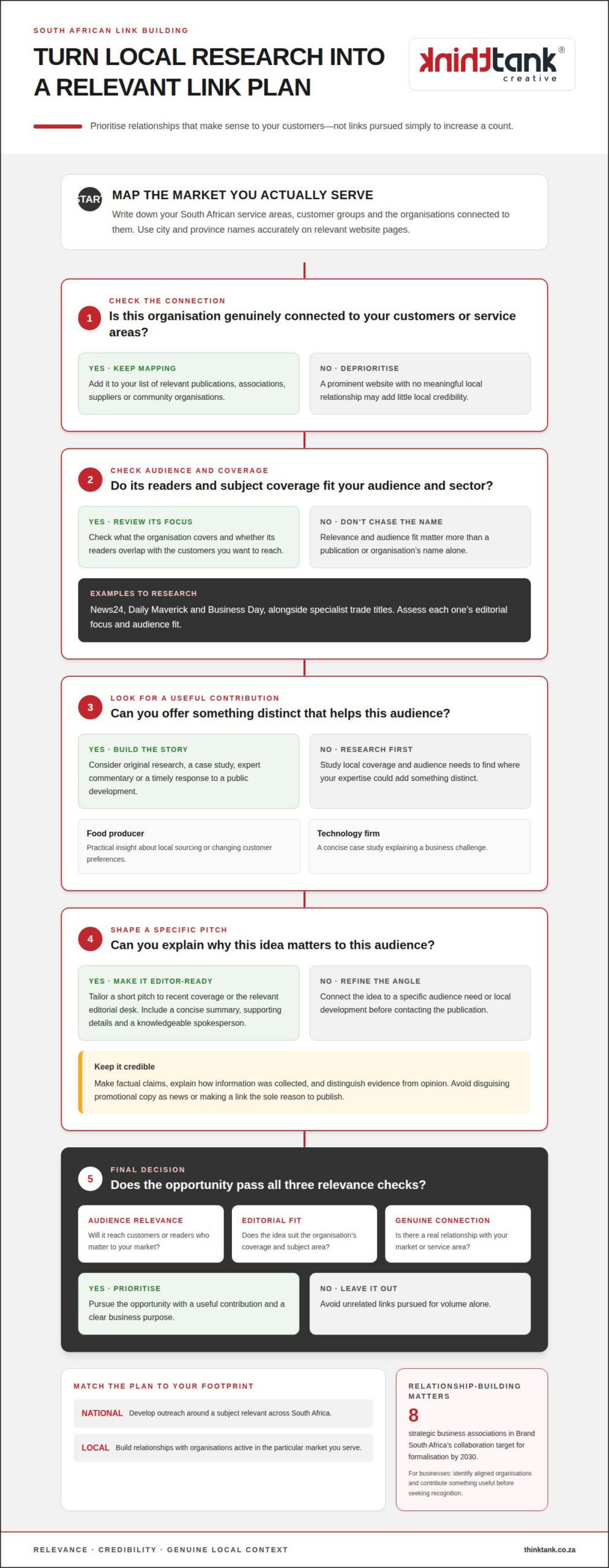
Use these steps to turn local research into an actionable link plan:
For example, a business serving customers nationally could develop outreach around a subject relevant across South Africa. A business focused on a particular market could seek relationships with organisations active there. The strongest link building strategies for South African businesses reflect this distinction, connecting each opportunity with a real audience and a clear business purpose.
Assess opportunities by audience relevance, editorial fit and genuine connection to your market. These criteria help businesses build credibility while responding to competition, without relying on a generic list of websites.
Give editors a story their readers can use, not a request for a favour. A backlink may follow when a publication references your business as a relevant source. Identify South African publications whose coverage matches your sector, customers or business goals. News24, Daily Maverick and Business Day are examples to research, alongside specialist trade titles. Their editorial focus and audience fit matter more than their names alone.
Build a clear story before contacting a newsroom. A food producer could share practical insight about local sourcing or changing customer preferences. A technology firm might explain a business challenge through a concise case study. Keep claims factual, explain why the subject matters to South African readers and make a knowledgeable spokesperson available for comment.
Useful editorial material can include original research, a case study, expert commentary or a timely response to a public development. Share the underlying information, explain how it was collected and distinguish evidence from opinion. Editors need material they can assess independently. Avoid disguising promotional copy as news or making a link the sole reason to publish.
Make outreach specific. Read the publication’s recent coverage, identify the journalist or relevant editorial desk, then tailor a short pitch to their subject area. For a national story, explain its relevance to South African readers. Include a concise summary, supporting details and spokesperson contact information. A generic message sent to a long list of journalists is easy to ignore.
For instance, an engineering business could offer a journalist a specialist explanation of a relevant infrastructure issue. The pitch should provide an informed perspective, not imply endorsement or demand a link. If the story is published, a natural reference to the company’s relevant resource can help readers explore the subject further.
Prepare your destination before outreach. A journalist or reader should find clear information that supports the story, such as an expert profile or detailed resource. Strong website content for editorial outreach can make that reference useful, while a focused pitch gives South African publications a concrete reason to consider your contribution.
A business expanding into other African markets can make its pitch more useful by explaining how local conditions shape its decisions. South African multinationals expanding elsewhere in Africa face intense competition from local competitors and need to adapt their strategies. A newsroom pitch can describe what local knowledge changed in a company’s approach, while keeping claims tied to its own experience. This gives editors context readers can assess, rather than a broad claim about regional success.
For a proposed international-growth plan, Month 3 is when a South African business should launch a pilot in an international market and establish local partnerships. Documenting the pilot and partnership lessons can provide a concrete follow-up story. The article states that 90% of mobile profits come from applications rather than operating systems. Businesses in that field can use this distinction to frame an informed explanation of where value is created, without turning the pitch into an advert.
A useful listing connects your business with customers who already use a relevant directory or association. In South Africa, Yellow Pages and Brabys are examples of general business directories to assess. A sector-specific membership directory, such as one maintained by an industry body, may be more relevant than a broad listing. First check whether the organisation serves your market and publishes member profiles online.
Directories differ in purpose. Yellow Pages and Brabys help people discover businesses by category and location, whilst a national business association may connect members with a professional audience. Business Unity South Africa and the South African Chamber of Commerce and Industry are examples to assess for relevance to your organisation. A listing is most useful when its details are accurate and its audience matches your customers.
Industry associations can provide a closer fit for specialist businesses. Master Builders South Africa, for example, is relevant to the building sector; the Institute of Directors in South Africa is more pertinent to governance professionals. Membership may bring opportunities to appear in an online directory, contribute expertise or participate in association activities. Those opportunities depend on each organisation’s membership and publishing practices.
Assess each option before submitting details. Search the organisation’s website for a member directory, profile pages and recent activity. Check whether listings link to members’ websites and whether the page gives visitors useful context. A directory with clear categories and identifiable member information offers more value to users than a page filled with unrelated entries.
For example, a construction firm could compare a Brabys category listing with a profile in a relevant Master Builders South Africa directory. The first may support general discovery, whilst the second can place the company in a sector-specific context. A professional services firm might instead consider a suitable national association, depending on its clients and expertise.
Prioritise quality over accumulating profiles. Avoid submitting the same generic description to every directory, and keep an internal record of each listing’s purpose and details. Yellow Pages, Brabys and national associations are starting points for research, not automatic endorsements. The strongest choices help people understand what your business does and why it belongs in that professional community.
Companies that lead in ESG practices see an average increase of 2.6% in their valuations over companies that lag in those areas.
Build partnerships around a shared purpose, then make the collaboration useful to both audiences. A Johannesburg accounting firm could work with a local entrepreneur network on practical financial education. The network might publish an event recap or resource mentioning the firm. The link follows from a real contribution, rather than a sponsorship payment alone.
Start by mapping organisations connected to your customers and region. A Cape Town retailer might consider a neighbourhood business association, whilst a KwaZulu-Natal tourism operator could approach a local conservation group. Look for shared audiences, active programmes and clear online communication. A partner’s website should explain its work and give visitors a reason to explore its resources.
Sponsorship can create a natural reason for public recognition. Before supporting a school fundraiser, arts event or community sports club, agree how the contribution will be acknowledged. The organiser could include sponsors on an event page, explain their role in a recap or link to a relevant resource. Keep the arrangement transparent and ensure the acknowledgement reflects genuine support.
Community events offer useful material before and after the gathering. A Pretoria business hosting a skills workshop could publish an agenda, speaker profiles and a summary of practical insights. The partner organisation can share those resources with attendees. After the event, provide approved photographs, key points and participant resources, making it easier for partners to create an accurate follow-up page.
For example, a Gqeberha engineering firm could help a youth organisation run a career session. The firm might provide a speaker and a concise guide about engineering pathways. The organisation could publish a recap for families and participants, with a contextual link to the guide. This gives the link a clear purpose for readers.
Keep a specific record of each partnership: the organisation, activity, audience, agreed recognition and resulting page. A link should describe the relationship accurately, not imply an endorsement that never occurred. When a partner publishes event information, share it through your own channels and credit their contribution. That follow-through can strengthen the relationship beyond a single mention.
In South Africa, link building costs depend on the work required, not simply the number of links promised. The price depends on the case and is given after a quote request, with the scope shaped by research, content creation, outreach and reporting. A campaign involving specialist research and original resources requires different work from updating existing business information.
Look at the process behind a proposal. Research may include assessing your website, competitors, target audiences and relevant publications. Content work could involve expert interviews, local case studies or resource development. Outreach takes time to identify suitable contacts, personalise pitches and follow up professionally. Reporting should show what was done and which placements resulted.
Compare proposals by scope rather than headline totals. One provider may focus on prospect research and editorial outreach, whilst another includes content production and campaign management. A monthly retainer, project fee or per-placement arrangement can each describe a different service. Ask what tasks, deliverables and reporting each model covers before comparing them.
For example, a small business with useful existing resources may need targeted outreach and careful prospect selection. A company entering a new South African market may need more research and locally relevant content first. The difference lies in the starting point, audience and work required, not an assumed standard rate.
Businesses should also consider their internal capacity. If your team can provide expert input but cannot develop content, the support required differs from that of a team needing help with research, writing and outreach. A clear brief helps define the work and keep the campaign aligned with business priorities.
Before committing, compare the proposed activities with your objectives. A low headline fee may cover limited tasks, while a broader scope may include more preparation and reporting. Ask for a breakdown of work, intended audiences and how the approach will adapt when a publication declines a pitch. To support outreach with consistent social promotion, plan social promotion for useful content alongside your campaign.
ThinkTank Creative helps businesses build a stronger digital foundation through tailored Website Design and Development. When outreach earns attention, a clear, credible website gives journalists, partners and prospective customers a useful place to learn about your business. Thoughtful page structure can also make your expertise and resources easier to discover and reference.
For businesses refining their online presence, Branding & Creative Design can support a consistent brand experience. Digital Marketing & SEO can help share useful content with relevant audiences. These services work together to present your business clearly, keeping the focus on valuable information rather than links alone.
Contact ThinkTank Creative to discuss your website and digital marketing goals.
Make your next step a repeatable process, not a one-off campaign. Set aside time to review which relationships bring your business closer to relevant audiences, and nurture those connections through useful contributions. A thoughtful follow-up after a publication feature or community project can open the door to future collaboration. Keep your outreach aligned with your business priorities as your markets and customer needs evolve.
Effective link building strategies for South African businesses should sit within a wider digital presence. ThinkTank Creative can support that foundation through Website Design & Development, Digital Marketing & SEO and Branding & Creative Design, helping businesses present and share their work consistently. The right combination depends on what your website and marketing need to communicate.
For a considered next step, contact ThinkTank Creative about link building and discuss how your digital presence can support your growth. Keep building with purpose, and let each relationship strengthen the next opportunity.
The strongest approach combines relevant editorial mentions, accurate industry listings and partnerships that reflect real business activity. Prioritise opportunities that reach your target customers, then direct links to a useful page rather than automatically sending every mention to your homepage. For example, a specialist supplier could connect a technical article with its matching service page. Track each opportunity’s relevance and referral activity to guide future outreach.
Assess whether the linking site is credible, relevant to your sector and service area, and reaches an audience that overlaps with your customers. Editorial fit and a genuine local connection matter more than the website’s prominence or the number of links.


