POPIA reaches beyond online shops: it applies to public and private organisations that process personal information about individuals in South Africa, regardless of industry. South Africa’s Protection of Personal Information Act is Act 4 of 2013. That makes popi act compliance for websites relevant whenever a site collects or uses personal information, including through enquiry forms, mailing lists or online identifiers.
A privacy notice is important, but it is only one part of website compliance. POPIA also affects how a site collects, uses, stores and protects personal information, including how it presents consent choices and handles requests from people.
This guide explains who POPIA applies to, what counts as personal information and what an Information Officer does. It also covers practical website considerations, from consent on forms to clear privacy information, so you can identify steps to align your site’s data practices with the Act.
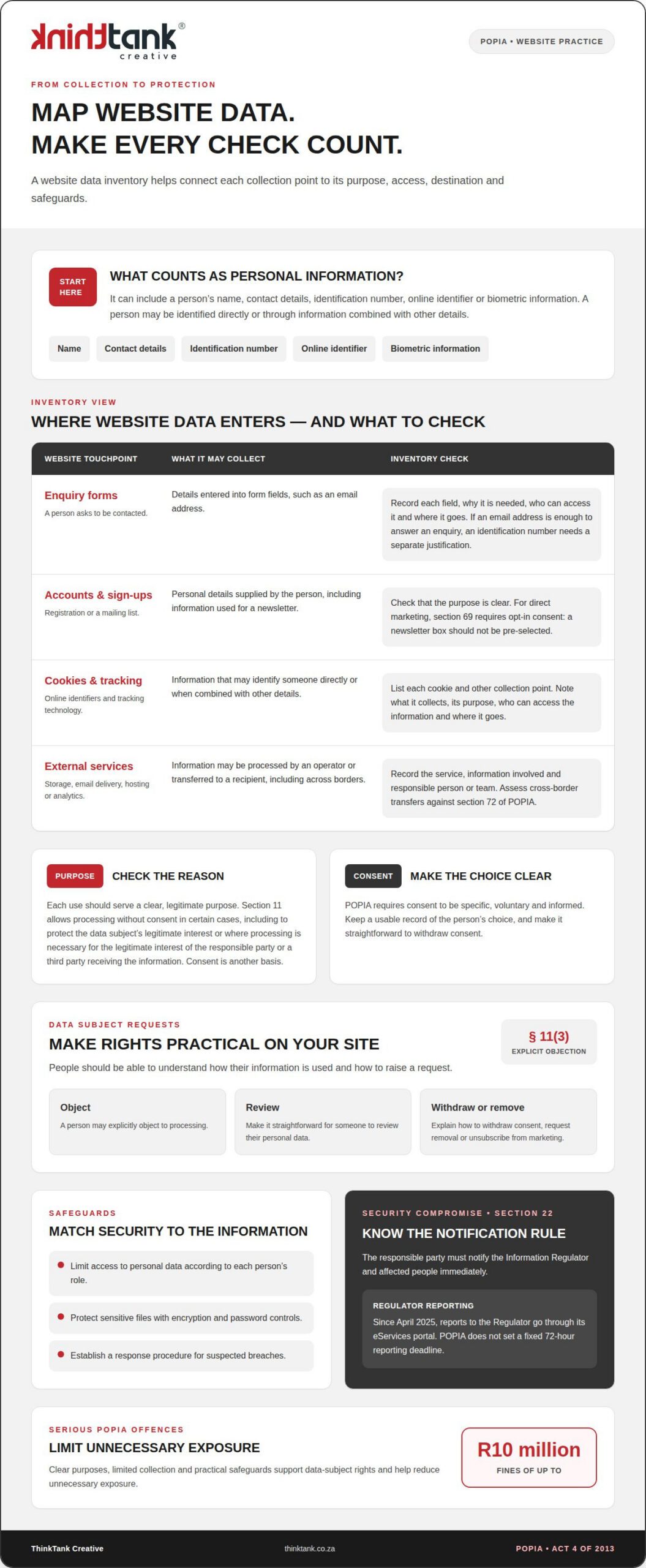
Under South Africa’s Protection of Personal Information Act, personal information can include a person’s name, contact details, identification number, online identifier or biometric information. A website may collect it through an enquiry form, account registration, newsletter sign-up or tracking technology. Information can identify someone directly or when combined with other details.
Start with a data inventory. List every form field, cookie and other collection point, noting what information it collects, why, who can access it and where it goes. Then check whether each use serves a clear, legitimate purpose. If a contact form needs only an email address to answer an enquiry, collecting an identification number requires a separate justification.
Section 11 of POPIA allows processing without consent in certain cases, including where it protects the data subject’s legitimate interest or is necessary for the legitimate interest of the responsible party or a third party receiving the information. Consent is another basis, and POPIA requires it to be specific, voluntary and informed. Section 69 requires opt-in consent for direct marketing, so a newsletter box should not be pre-selected.
Data subjects have a role in how their information is processed. Under section 11(3), a person may explicitly object to processing. A website should also make it straightforward for someone to withdraw consent, review their personal data or request its removal. A privacy policy should explain what information is collected, why it is used and how people can raise a request or unsubscribe from marketing.
Security needs to match the information held. Limit access to personal data according to each person’s role, protect sensitive files with encryption and password controls, and establish a response procedure for suspected breaches. Section 22 concerns security-compromise notification. The responsible party must notify the Information Regulator and affected people immediately; since April 2025, reports to the Regulator go through its eServices portal. POPIA does not set a fixed 72-hour reporting deadline.
Keep the inventory and privacy notice aligned as website forms, analytics tools and marketing practices change. If a data breach exposes an email list, for example, the response procedure should identify the affected information, restrict access and guide the required notifications. Serious POPIA offences may result in fines of up to R10 million. Clear purposes, limited collection and practical safeguards help reduce unnecessary exposure while supporting data-subject rights.
Every company in South Africa is legally required to appoint an Information Officer. Businesses should register the officer with the Information Regulator, which monitors and enforces POPIA. The role links an organisation’s personal-information practices with its compliance responsibilities. For a website, this means understanding how enquiry forms, mailing lists and analytics tools collect or use information.
Make the Information Officer’s responsibilities practical. The officer can coordinate processes for privacy queries, help staff understand how information is handled and support responses to data-subject requests. Map each website collection point to the person or team responsible. For example, record who manages newsletter subscriptions and who handles requests to withdraw consent.
Clear terminology helps define those responsibilities. A data subject is the person whose personal information is processed. The responsible party determines why and how that information is processed, whilst an operator processes it for the responsible party. If an online form sends details to an external service for storage or email delivery, the Information Officer should record that relationship and the information involved.
Cross-border transfers need particular attention. Section 72 of POPIA sets out conditions for transferring personal information across borders. A website may involve an overseas hosting or analytics provider, so the Information Officer’s assessment should identify where information goes and which recipient handles it. The transfer must be considered against section 72, rather than assumed acceptable simply because the service supports the website.
Consent records also need to be understandable and usable. Consent requests should clearly explain the processing and let people make an informed choice. The Information Officer can help ensure that a consent request identifies the relevant processing and records the person’s choice. For instance, a marketing sign-up should distinguish an affirmative opt-in from a pre-selected box, while preserving a record of the choice made.
Registration is only one part of the role. The Information Officer also needs a working understanding of how website information moves through the organisation, from collection to access, sharing and removal. A processing register can link each form or tool to its purpose, internal owner, operator and any cross-border transfer. This helps route requests to the right team and explain the organisation’s practices consistently.
As website features change, update the Information Officer’s records too. Adding a booking form, CRM integration or overseas email platform can change who receives information and how it is used. Recording such changes helps the officer coordinate consent processes, review responsibilities and keep POPIA practices aligned with the site’s actual operation.
POPIA compliance means handling personal information lawfully, with safeguards that match its use. South Africa’s Protection of Personal Information Act is Act 4 of 2013. For a website, this can mean documenting why an enquiry form collects an email address, who can access submissions and how long they are retained. A privacy notice alone cannot show whether those practices are correct.
The Information Regulator monitors and enforces compliance by public and private bodies. An organisation should be able to explain its website practices with records, not just policy statements. For example, document what a mailing-list form collects, why it collects it and how consent is recorded. Assigning the Information Officer to coordinate these records creates a practical point of accountability.
Non-compliance can carry serious consequences. Serious offences under POPIA may result in fines of up to R10 million. That figure is a maximum, not an automatic charge for every website error. The nature of the conduct matters: an organisation should distinguish an isolated process gap from practices that disregard lawful handling of personal information.
Criminal penalties can also include imprisonment. Individuals responsible for serious POPIA violations may face imprisonment for up to 10 years, while less serious offences may carry imprisonment of up to 12 months. These are distinct maximum periods, not a prediction of the outcome in a particular case. They underline why clear responsibilities and documented measures matter.
Civil proceedings are another consideration if personal information is mishandled. Preserve relevant records, such as the privacy notice in force, form wording and consent logs. If a dispute concerns an online marketing sign-up, these records can help establish what the person was told and what choice they made. Once a complaint arises, avoid changing or deleting relevant material.
Build compliance into routine decisions. Before adding a website feature, record its purpose, the information it uses and the people or systems that can access it. When a form changes, update the privacy information and internal records together. The Information Officer can coordinate these steps, while responsible teams ensure the published wording reflects how the site actually works.
A proportionate response starts by identifying and addressing the cause of a gap. If a subscription form obscures its marketing purpose, make the choice clear and retain evidence of the revised process. Consider whether the correction also affects existing records or connected systems. Consistent documentation helps an organisation explain its decisions to the Information Regulator and respond coherently if concerns escalate.
POPIA’s scope depends on the processing of personal information, not an organisation’s size or industry. A website may process information when it collects or uses details about people in South Africa, making popi act compliance for websites relevant to organisations with an online presence.
For a small business, popi act compliance for websites means considering how online forms, mailing lists and other features handle personal information. A sole trader’s contact form raises the same kinds of data-handling questions as a larger company’s website. Identify what each feature collects, why it is needed and who is responsible. This gives small teams a practical starting point without tying compliance to business size.
POPIA applies to public and private organisations processing personal information about individuals in South Africa, regardless of industry. A community organisation collecting membership details online and a company receiving sales enquiries both need to consider the Act. The Information Regulator monitors and enforces compliance by public and private bodies. The relevant factor is the processing of personal information, not workforce size or public profile.
Websites collect information directly through forms, account registration and mailing-list subscriptions. They may also process online identifiers through analytics or advertising tools. Define a purpose for each feature and explain it clearly to the data subject. For example, an enquiry form can explain why it requests contact details, while a separate marketing sign-up makes its purpose clear before submission.
POPIA applies to processing personal information about individuals in South Africa. The GDPR may also apply to a South African business processing the personal data of EU consumers. This distinction matters for websites serving audiences in both markets. Consider whose information the organisation processes and where those individuals are, rather than relying only on the organisation’s location.
The GDPR and POPIA are separate laws, so meeting one does not automatically resolve obligations under the other. The GDPR’s maximum fine can be 4% of global annual turnover; this is not a POPIA penalty. For a South African website addressing EU consumers, assess the audience, information collected and activities involving that information to determine which law may apply to each processing activity.
Website features and audiences can change. Adding an online shop, analytics tool or international marketing campaign may affect whose information is processed and where it goes. Record each significant update, its purpose and its relevant audience. This helps an organisation reassess POPIA’s scope and whether GDPR considerations arise, rather than assuming every feature has the same compliance impact.
Build privacy choices into the points where visitors interact with your website. Forms, cookie notices and mailing-list sign-ups should explain the relevant processing of personal information. Effective popi act compliance for websites starts with consent that is specific, voluntary and informed. A pre-ticked box does not demonstrate an active choice, so use an empty box or another clear opt-in action.
Connect each form field to a clear purpose. An enquiry form might request a name and email address to respond, while a separate, optional choice covers marketing messages. Explain what happens after submission and provide a simple way to withdraw consent. For direct marketing, section 69 requires opt-in consent. Keep a record of each choice and let recipients unsubscribe from future messages.
Cookie notices should clearly describe the site’s cookie use and obtain explicit consent. Do not present acceptance as the only practical route. A visitor who declines optional tracking has not agreed to it. Review each analytics or advertising tool, including the information it collects and the parties that receive it. A banner is useful only if the site behaves in line with the visitor’s choice.
Give people a practical way to exercise their data-subject rights. A privacy notice should explain how individuals can request access to personal information, ask for correction or seek removal. Provide a suitable contact channel and explain what details are needed to locate a record. Internally, route requests to the responsible team and track progress rather than leaving them in a general inbox.
Technical safeguards should support those commitments. Limit access to personal information by role, protect sensitive files with encryption and password controls, and remove access when staff responsibilities change. Keep a record of website systems that handle submissions, such as a form database or email platform. This gives the Information Officer a clearer view of the systems involved if a suspected breach occurs.
Review the site whenever its features change. Before adding a booking tool, advertising pixel or sign-up field, assess its purpose, collection points and recipients. Then update the privacy notice, consent wording and internal records together. This keeps explanations aligned with actual data processing and makes ongoing popi act compliance for websites part of the change process, not a late addition.
For a redesign or technical update, align the interface and data choices from the outset. Plan a website design and development project around clear forms, accessible privacy information and deliberate consent choices, so these elements work together.
ThinkTank Creative designs and develops websites that present privacy information and data choices clearly. If you’re planning a new site or revising forms, the team’s Website Design and Development and creative design services can support a considered user experience. Bring consent options, privacy notices and enquiry journeys into the design process, while your organisation remains responsible for its POPIA obligations and personal-information decisions.
Consider this support when website changes affect how visitors submit information or make choices. A coherent design can make these interactions easier to understand and use. Contact ThinkTank Creative to discuss your website and its privacy-related design needs.
Treat privacy as part of the experience you create for every visitor, not text added after a website goes live. A thoughtful approach to popi act compliance for websites connects clear information, meaningful choices and a consistent user journey. As your site and digital communications evolve, revisit how each interaction feels to visitors and how it supports your organisation’s data practices.
ThinkTank Creative can shape your digital experience through website design and development, creative design and social media marketing. These services support how your organisation presents itself online, while compliance decisions remain grounded in your responsibilities under POPIA.
Start a conversation about the next stage of your online presence. Contact ThinkTank Creative to discuss your goals and explore a considered way forward. Clearer digital experiences begin with deliberate choices, and each thoughtful improvement can strengthen the relationship between your organisation and its audience.
POPIA is South Africa’s Protection of Personal Information Act, Act 4 of 2013. It applies to public and private organisations processing personal information about people in South Africa, regardless of industry or business size. For example, a community organisation collecting membership details online may need to consider the Act, just like a retailer receiving customer enquiries. The individual whose information is processed is known as the data subject.
Serious POPIA offences may result in fines of up to R10 million, and individuals responsible for serious violations may face imprisonment for up to 10 years. Less serious offences may carry imprisonment for up to 12 months. These are maximum penalties, not automatic outcomes for every compliance failure. The nature of the conduct matters, so a neglected marketing preference and deliberate misuse of personal information are not interchangeable situations.
Websites should clearly explain cookie use and obtain explicit consent, particularly when cookies support tracking or advertising. A banner should let visitors make an active choice rather than rely on a pre-ticked box. For example, someone selecting “No” should not be treated as having agreed to optional tracking. The notice and the site’s actual behaviour should match, so the choice has practical effect.
People whose information is processed can object to processing under section 11(3) and withdraw consent. They should have a clear way to unsubscribe from marketing and to review or request removal of personal information. For example, a person who no longer wants promotional emails should be able to use an unsubscribe route. Organisations should explain how to raise requests and ensure they reach the team responsible for handling them.
Compliance gives an organisation a clearer framework for handling personal information and responding to people’s choices. For example, keeping a record of newsletter preferences can help prevent messages being sent after someone unsubscribes. Clear explanations also help visitors understand why a form asks for particular details. These practices support consistent interactions and give the organisation a stronger basis for explaining how its website uses information.
Section 11 allows certain processing without consent, including where processing protects a data subject’s legitimate interest or is necessary for the legitimate interest of the responsible party or a recipient. This is a basis for processing, not a general exemption from POPIA. The purpose and circumstances matter. A business should not assume that a legitimate-interest rationale removes the need to explain its processing or respect a person’s explicit objection.
An Information Officer is appointed to support an organisation’s POPIA responsibilities. Every company in South Africa is legally required to appoint one, and businesses should register the officer with the Information Regulator. For example, the officer can coordinate who handles website privacy enquiries and how requests reach the appropriate team. Registration provides a formal point of accountability, but relevant staff still need to follow the organisation’s processes.
A website should explain its personal-information practices, make consent choices clear and handle information securely. For example, an enquiry form can state why it requests contact details, while a separate, unselected option invites visitors to sign up for marketing. Sites should also provide a way for people to exercise their choices and unsubscribe. Appropriate measures depend on the information collected, the site’s purposes and its connected tools.


