A like is only one part of the conversation. Social media engagement includes the interactions that build community and customer loyalty, from comments and shares to thoughtful replies. To understand how to increase social media engagement, look beyond reaction counts: consider what prompts people to respond, how each platform shapes interaction and how you measure the rate.
Posting more often is not the only answer. Relevant content and genuine two-way communication give people a reason to take part. This guide covers practical ways to invite interaction, including questions, polls and community content, and how to keep your brand voice consistent. You’ll also learn how engagement differs across platforms and how to calculate a basic engagement rate using likes, comments, shares and followers, so you can assess performance more clearly.
Social media engagement describes how people interact with content and a brand. It includes likes, comments, saves, replies, mentions and shares, but the count alone doesn’t show what those actions mean. A detailed comment or a customer sharing a useful post may signal stronger interest than a quick reaction. Treat engagement as evidence of a conversation, not simply a popularity score.
Start by defining the audience you want to reach. Consider location, age group, language, interests and the problems your product or service addresses. In South Africa, language preferences and interests can vary across customer groups, so one message may not suit everyone. Use available audience analytics to examine demographics, content interactions and follower behaviour. Compare those patterns with the questions customers raise in comments and messages.
Native analytics tools include Meta Business Suite, Instagram Insights, LinkedIn analytics, TikTok analytics and X analytics. They provide platform-specific information about reach and interactions. The cost of paid analytics and social-listening tools in South Africa varies by provider, features and account needs.
Buying followers or using bots and engagement pods can make performance figures less representative of genuine audience interest. Engagement bait, such as asking for unrelated comments or shares, may generate activity without useful feedback. Focus instead on interactions from people who care about your subject, and assess whether their responses support your communication goals.
Choose platforms based on audience behaviour and content format. A professional service might use LinkedIn to share industry insights, while a visually focused brand could use Instagram to present product photography. TikTok suits short-form video, whereas Facebook can support community discussions and local updates. These are starting points, not fixed rules: compare interaction quality on each platform before deciding where to focus your effort.
Use social listening to understand what your audience discusses beyond your own posts. Review recurring questions, customer feedback, relevant mentions and the language people use to describe their needs. For example, repeated questions about delivery could inspire a clear explainer post. This helps uncover content opportunities and shows which topics prompt meaningful responses.
Tailor each post to an observed preference. If followers save practical checklists, create another useful guide; if they share customer stories, invite them to contribute their experiences. Look for recurring themes in comments and user-generated content, then adapt your examples, format and tone. This is a practical foundation for learning how to increase social media engagement: listen, publish with purpose and use responses to shape what comes next.
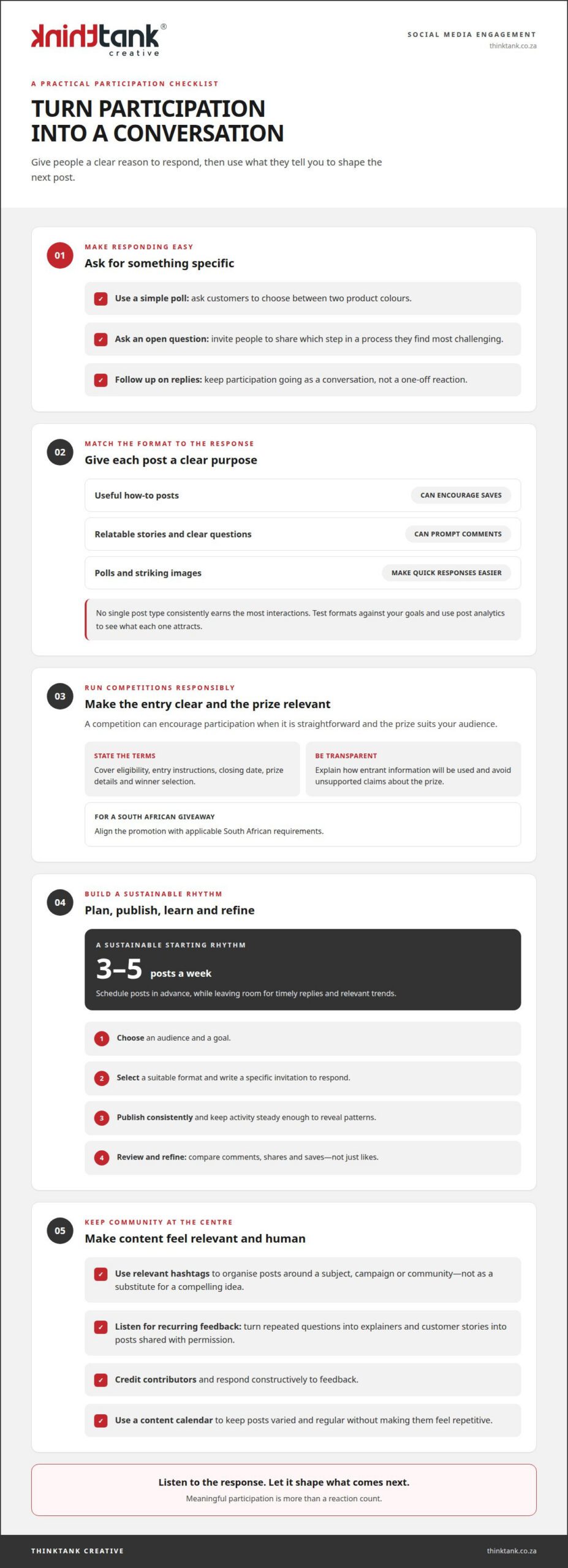
Give people an easy, specific reason to respond. A poll asking customers to choose between two product colours is simpler to answer than a broad request for opinions. Open questions work well when they invite useful experiences, such as asking which step in a process people find most challenging. Follow up on answers so participation becomes a conversation, not a one-off reaction.
No single post type consistently earns the most comments, shares, saves and reactions. Useful how-to posts can encourage saves, while relatable stories and clear questions can prompt comments. Polls and striking images can make quick responses easier. Test formats against your goals, then use post analytics to see which interactions each one attracts.
Competitions can encourage participation when entry is straightforward and the prize suits your audience. For a South African giveaway, publish clear terms covering eligibility, entry instructions, closing date, prize details and winner selection. Align the promotion with applicable South African requirements, explain how entrant information will be used, and avoid unsupported claims about the prize.
Use hashtags to organise relevant posts, not as a substitute for a compelling idea. Choose tags connected to the subject, campaign or community, then check whether they attract relevant conversations. Customer feedback can guide future content too: a recurring question might become a short explainer, while a customer story could inspire a post shared with permission.
There isn’t one best posting time for every South African audience. Use platform analytics to identify when your followers are active, test different time slots and compare the resulting interactions. A sustainable starting rhythm is three to five posts a week. Schedule them in advance, while leaving room for timely replies and relevant trends.
Build and test a strategy in a clear sequence: choose an audience and goal, select a suitable format, write a specific invitation to respond, publish consistently, then review the results and refine the next post. For example, compare a product-choice poll with a practical tip by looking at comments, shares and saves, not just likes. Maintain a consistent level of activity to reveal patterns.
Authenticity matters more than manufacturing activity. Share customer contributions with permission, credit the creator, and respond constructively to feedback. A content calendar can keep these posts varied and regular without making them feel repetitive. For tailored planning and creative execution, explore social media marketing.
Compare like with like: each platform has different audiences, formats and interaction habits. Typical median engagement rates are approximately 6.2% on LinkedIn, 5.6% on Facebook, 5.5% on Instagram, 4.6% on TikTok, 4.0% on Pinterest and 2.5% on X. These figures offer context, not targets for every South African account. A business should compare its own posts with similar content on the same platform.
A rate between 1% and 6% is generally considered good, depending on platform, industry and other factors. That broad range makes context essential: a specialist B2B account on LinkedIn serves a different purpose from a retailer connecting with consumers on Instagram. Look at comments, shares and other meaningful actions alongside the rate. A smaller audience that responds to relevant posts may be more valuable than a larger, less active following.
Format also changes the picture. Instagram Reels generate approximately 36% more reach than carousels, whilst carousels earn approximately 12% more engagement than Reels. LinkedIn document or PDF carousel posts have a median engagement rate of 21.77%. These comparisons suggest that reach and interaction are separate outcomes. Choose a format based on whether the post needs to attract new viewers or encourage deeper responses.
Platform algorithms influence which content appears in people’s feeds, but their signals and ranking systems differ and change. A useful strategy is to create posts suited to each platform, then observe how followers respond. For instance, a LinkedIn document can present a detailed process, while an Instagram carousel can break a visual guide into clear steps. Replying to comments also keeps the conversation active: replies present were associated with an estimated 30% engagement lift on LinkedIn and 42% on Threads.
Give each channel a defined audience and purpose. LinkedIn can support professional discussion; Instagram can showcase visual storytelling; TikTok centres on short-form video; Pinterest helps people discover visual ideas; and X supports concise, timely conversation. Facebook can bring community updates and discussions together. These roles are starting points, not rigid rules. Let audience behaviour and the content itself determine where each post belongs.
Review platform analytics separately instead of blending every interaction into one figure. Track reach, comments, shares and saves for comparable posts, then note the format and subject. If Instagram Reels attract more reach but carousels prompt more saves, keep both for their distinct purposes. This gives your social media strategy a practical basis: focus on platforms that help your business connect with the right people, and adapt creative choices to audience responses.
A recognisable voice makes each post feel connected to the same brand, whether it appears on Facebook, Instagram or LinkedIn. Define a few practical traits, such as warm, informed and direct, and use them to guide captions, customer replies and product announcements. An approachable brand, for example, can explain a service clearly without jargon or exaggerated promises.
Turn those traits into a short voice guide. Include preferred wording, the level of formality, topics the brand can speak about and examples of suitable replies. If a customer raises a concern on Facebook, the response should sound as considered as a product-launch post. Consistency doesn’t mean copying identical captions across platforms; it means expressing the same values in formats suited to each audience.
Authenticity comes from showing the people and decisions behind the brand. Share an employee’s perspective, a customer story or the steps involved in creating a product. These stories give followers something specific to discuss and help explain what the business stands for. Ask permission before featuring customer contributions, and represent their words and experiences accurately.
Plan a content calendar around recurring themes, such as customer questions, expertise, team stories and product information. Scheduling drafts in advance helps maintain a steady presence while leaving space for timely updates and genuine replies. Before publishing, check that the wording, visual style and invitation to respond match the brand’s voice guide. A calendar supports consistency; it shouldn’t make every post feel formulaic.
Keep the relationship active after publishing. Monitor comments and messages, respond within 24 hours where possible, and use feedback to inform future communication. A thoughtful reply can acknowledge a customer’s point, answer their question and invite a useful next step. If criticism appears, address the issue calmly rather than switching to a defensive tone that conflicts with the brand’s usual manner.
Give the approach time to develop. Consistent posting and interaction often take 1 to 3 months to show engagement results, so review patterns across that period rather than judging the voice by one post. Look for recurring questions, constructive conversations and audience responses to different story types. If a message feels unlike the brand, revise it before publishing; if a particular tone prompts meaningful discussion, carry that learning into the next campaign.
Engagement can be counted as interactions or expressed as an engagement rate. The count shows how many likes, comments and shares a post received. The rate puts those actions in context, helping you compare performance against audience size. These measures answer different questions, so decide whether you need a total activity figure or a proportional view.
For a basic follower-based rate, add likes, comments and shares, divide the total by your follower count, then multiply by 100. For example, a post with 200 engagements and 5,000 followers has a 4% engagement rate: (200 ÷ 5,000) × 100. Keep the formula consistent across the posts you compare.
Some reports calculate engagement using reach rather than followers. Reach-based rates show interactions relative to the people who saw a post; follower-based rates compare them with your account audience. The denominators are not interchangeable. Label the formula beside each result, or an apparent change may reflect a different calculation rather than a stronger audience response.
Set the measurement period and content scope before reviewing results. You might calculate a rate for each post, then compare similar posts from the same platform over a consistent period. Separate organic posts from paid promotion, and note the format, topic and call to action. A visual guide, short video and hashtag-led announcement may each invite different interactions.
Interpret the numbers in light of each post’s purpose. A useful tutorial may earn saves, while a discussion prompt may attract comments. If your calculation includes only likes, comments and shares, it won’t represent every valuable response. Track relevant measures such as saves or link clicks separately, and use customer feedback to understand why an interaction happened.
Use the result to guide your next decision, not simply to rank posts. If a post receives a lower rate, review its audience fit, clarity, timing and format. Then test one change, such as a more specific question or a stronger opening visual. Record the change and compare the next results using the same formula. This feedback loop turns measurement into a practical way to refine content.
For a measurement-led approach to planning and improving your social media presence, get support with social media marketing.
ThinkTank Creative provides Social Media Marketing to help businesses build a considered presence and create content that invites meaningful interaction. Turn to this support when posting feels inconsistent, engagement is difficult to interpret or your social channels need a clearer connection to your wider brand.
A focused approach can bring audience insights, platform choices, content planning and performance measurement into one coherent strategy. Branding & Creative Design can help align your visual expression with your brand, while Website Design & Development can support a consistent experience beyond social media. The work is shaped around your business objectives, audience and preferred direction.
Ready to bring more structure and purpose to your social media? Contact ThinkTank Creative to discuss your goals.
Make your next step deliberate: choose one audience response you want to understand better, then shape upcoming content around that opportunity. The question of how to increase social media engagement becomes more valuable when it leads to clearer decisions, stronger conversations and a closer connection between your brand and its community. Keep learning from how people respond, and let those insights guide your next creative move.
As your approach develops, align social media activity with the wider experience people have of your business. ThinkTank Creative can support that direction through Social Media Marketing, Creative design, and Website Design and Development. If you’re ready to turn your ideas into a considered strategy, contact ThinkTank Creative to discuss your strategy. A thoughtful next step can set the foundation for more purposeful interaction and continued growth.
Social media engagement describes how people respond to and participate in a brand’s activity on social platforms. A customer might comment with a product question, share a useful post with a colleague or mention a business in their own update. These actions signal different kinds of interest. Consider what each response reveals about customer needs instead of treating every interaction as equally valuable.
Engagement can include likes, comments and shares, alongside platform-specific actions such as saves, replies or mentions. For a basic follower-based rate, add likes, comments and shares, divide by the follower count, then multiply by 100. A post with 200 engagements and 5,000 followers has a 4% rate. Keep the same formula when comparing posts, and label which interactions your calculation includes.
Match the format to the platform and the response you want. On Instagram, test a carousel that guides viewers through a process; on TikTok, make a short video answering a common question. Facebook can host a community discussion, LinkedIn can invite professional perspectives, and X can carry a concise prompt about a timely topic. Review responses on each channel, then develop the formats that attract relevant conversations.
A practical starting point is three to five posts a week, adjusted to your team’s capacity and audience response. For example, a local service business could schedule educational posts and customer updates throughout the week rather than publishing several rushed messages in one day. A regular rhythm helps audiences know what to expect. Review the quality of replies and shares, then adapt the schedule to keep posting useful and sustainable.
Make each element support one clear idea. Use hashtags relevant to the subject, open the caption with a specific benefit, then ask a question people can answer from experience. For example, a café could ask which seasonal drink customers would like to see return. Finish with a direct invitation, such as “Tell us your pick below.” Avoid unrelated tags or requests for reactions that don’t contribute to the conversation.
Invite customers to share how they use a product or service, then feature suitable contributions with permission and clear creator credit. A gardening business could ask followers to post progress from a home project, giving others a topic to discuss. Respond with a specific observation or follow-up question. Acknowledging people by name, where appropriate, helps their participation feel valued and gives the community a reason to return.
Typical median engagement rates are approximately 6.2% on LinkedIn, 5.6% on Facebook, 5.5% on Instagram, 4.6% on TikTok, 4.0% on Pinterest and 2.5% on X. A rate between 1% and 6% is generally considered good, depending on platform, industry and other factors. Treat these figures as context, not fixed targets: compare similar content on the same platform and account for audience size and purpose.
There is no single best posting time for every South African audience. Use platform analytics to find when your followers are active, test different time slots and compare interactions.


