Facebook Advertising Costs in South Africa: A 2026 Budgeting Guide
Could a smaller Facebook budget produce better business results than a larger one? It can, if it’s built around the right objective. Facebook advertising costs south africa businesses face aren’t set by one universal rate: the campaign goal, audience, placements, ad quality and competition all influence what you pay.
It’s understandable to want a clear figure before you begin. But costs can be difficult to assess when platform spend and campaign management are combined, and clicks or impressions alone don’t show whether advertising is bringing in valuable enquiries or sales.
This guide explains what shapes campaign costs in South Africa and how to plan a test budget around a specific business outcome. You’ll learn how to assess performance beyond reach and clicks, separate ad spend from management fees, and compare managing campaigns yourself with professional support. We’ll also look at how objectives, audiences and creative choices affect delivery, and how planning, reporting and the experience on your website can help you judge whether your investment is working.
Key Takeaways
- Understand what shapes facebook advertising costs south africa businesses may encounter, including the campaign objective, audience, competition and ad quality.
- Separate the amount paid to Meta from fees for planning and managing campaigns to see how your budget is allocated.
- Compare Facebook placements with other campaign options by audience fit, objective, destination and how results will be measured.
- Build a test around an affordable business goal, with tracking and a review plan in place before the campaign launches.
- Assess advertising support by how clearly it connects planning, creative, reporting and communication to your agreed objective.
What makes up Facebook advertising costs in South Africa?
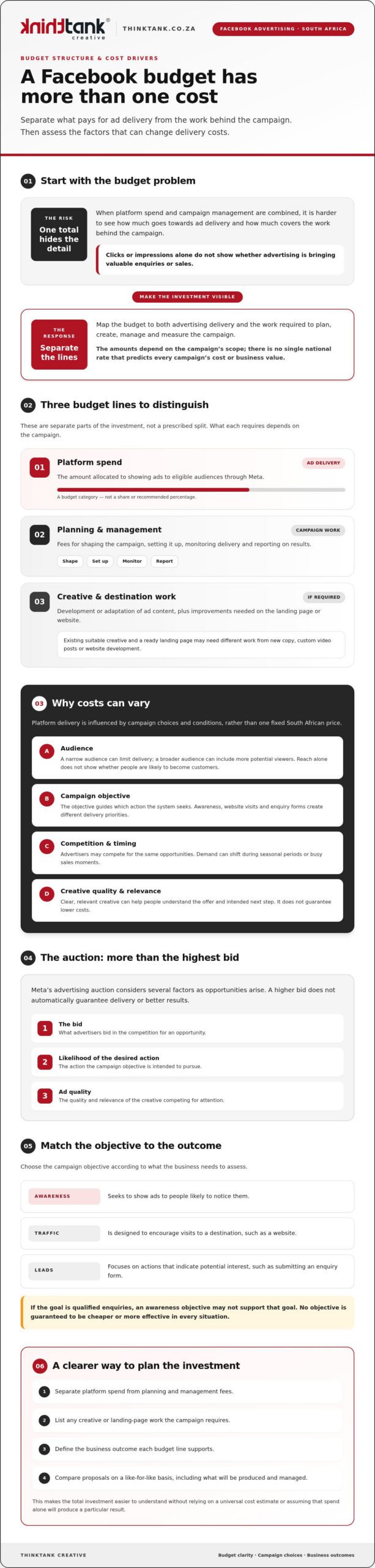
Start by separating two budget lines: the amount allocated to ads on Meta and the fees for planning or managing the campaign. They cover different things. Keeping them distinct shows how much is going towards ad delivery and how much covers the work behind the campaign.
Platform spend and agency fees are separate budget lines. Your total investment may also include creative work or changes to the page people land on after clicking an ad. These are separate parts of the campaign, and whether they’re needed depends on its scope.
Facebook advertising costs south africa businesses encounter aren’t set by a single national rate. Platform delivery costs can vary with the audience, campaign objective, competition and timing. A general benchmark may offer context, but it can’t reliably predict the cost of every campaign or the business value it will generate.
Which parts of a Facebook advertising budget should you separate?
Map your budget to both the work and the advertising delivery. A useful starting structure is:
- Platform spend: the amount allocated to showing ads to eligible audiences through Meta.
- Planning and management: the work involved in shaping the campaign, setting it up, monitoring delivery and reporting on results.
- Creative and destination work: the development or adaptation of ad content and any improvements needed on the landing page or website.
These categories make it easier to compare proposals on a like-for-like basis. A campaign using suitable existing creative and a ready landing page may require different work from one needing new copy, custom video posts or website development. Define what needs to be produced and managed before comparing fees, rather than assuming every campaign requires the same services.
Why do South African campaign costs vary?
Your chosen audience affects who is eligible to see your ads. A narrow audience can limit delivery, while a broader one can include more potential viewers. Competition matters too: advertisers may compete for the same opportunities, and the campaign objective influences which actions the system seeks. The auction is part of real-time bidding in advertising, where opportunities are assessed as they arise.
Timing can also affect delivery. Demand for attention may shift during seasonal periods or busy sales moments, while the quality and relevance of your creative can influence how people respond. South Africa is the audience market, not a guarantee of one uniform price. Costs can differ by sector, target group, objective and campaign period.
For a practical working plan, allocate one portion of your available budget to platform delivery, another to campaign planning and management, and a separate allowance for creative or landing-page work if required. Define the outcome each portion supports. This makes the total investment easier to understand without relying on a universal cost estimate or assuming that spend alone will produce a particular result.
How Meta’s advertising auction influences Facebook campaign costs
Meta doesn’t simply sell each advertising opportunity to the highest bidder. Advertisers compete to reach people who fit their targeting, and the platform’s auction considers factors such as the bid, the likelihood of the desired action and the ad’s quality. A higher bid doesn’t automatically guarantee delivery or better results.
Meta’s auction-based delivery is not a fixed price list. That’s why two campaigns aimed at South African audiences can spend differently, even with similar budgets. The objective, eligible audience and strength of the creative all shape the conditions in which an ad competes. This puts facebook advertising costs south africa businesses see into context: the cost is connected to campaign choices, not just a set national rate.
How do campaign objectives affect delivery and cost?
An objective tells the system what kind of result the campaign is intended to pursue. An awareness campaign seeks to show ads to people likely to notice them. A traffic campaign is designed to encourage visits to a destination, such as a website. A lead campaign focuses on actions that indicate potential interest, such as submitting an enquiry form.
Each objective creates different delivery priorities. If your business needs qualified enquiries, choosing an awareness objective simply because it offers broad exposure may not support that goal. The system is being directed towards a different action. Set the objective according to the outcome you want to assess, then measure the campaign against that purpose. No objective is guaranteed to be cheaper or more effective in every situation.
How can audience, creative and timing change results?
Targeting defines who is eligible to see an ad. A narrow audience can focus delivery on a specific group, but it also limits the pool of eligible people. Broader targeting creates a wider pool, though reach alone doesn’t show whether those people are likely to become customers. Choose an audience based on the business goal and how clearly you can define the people you want to reach.
Creative quality matters because people need a reason to pause, understand the offer and take the intended next step. Relevant copy, clear design and a suitable destination can make that journey more coherent. They don’t guarantee lower costs, but they can give the audience a clearer and more consistent experience. If an ad promises one thing and its landing page presents another, the campaign may attract attention without supporting the action you want.
Timing changes the competitive context too. Other advertisers may increase activity around seasonal promotions or busy shopping periods, while demand can vary at other times. Treat timing as a factor to monitor, not a fixed calendar rule. Meta can update campaign tools, labels and delivery options, so verify the current terminology and settings in Ads Manager before applying guidance to a live campaign.
Connect the decisions: choose an objective that reflects the business outcome, define an audience that makes sense for it, and create relevant content for that audience. Paid advertising campaign planning and reporting can bring these choices together, helping you see whether delivery supports the agreed goal rather than relying on impressions or clicks alone.
How to compare Facebook advertising with other campaign options
Choose a channel based on how it connects your audience with a useful next step, not on cost alone. Facebook placements can support audience discovery, awareness and enquiries, but their suitability depends on whether your intended customers are reachable there, whether the creative fits their needs and whether the destination makes it easy to act. Compare each option against the same business objective.
Use this framework to assess what role each channel could play. The measures are starting points, not guarantees of performance.
| Option | Audience fit | Possible objective | Destination | What to measure |
|---|---|---|---|---|
| Facebook advertising | People you want to reach through social placements, including potential customers who may not be actively searching | Build awareness, introduce an offer or generate enquiries | A relevant website page, product page or enquiry form | Relevant reach, visits, enquiries and the quality of responses |
| Search advertising | People expressing interest through a search query | Capture demand for a product, service or solution | A page closely aligned with the search and ad | Qualified visits, enquiries or sales attributed to the campaign |
| Search engine optimisation | People finding relevant pages through unpaid search results | Build discoverability for useful topics over time | Informative service or resource pages | Relevant organic visits, enquiries and page engagement |
| Email marketing | People who have opted to receive business communications | Share updates, nurture interest or encourage a next step | A suitable offer, resource or website page | Engagement and the actions taken after a message |
These options can complement one another. For example, Facebook advertising may introduce a service to new audiences, while search activity can capture people already looking for a solution. The right mix depends on the customer journey and the evidence you need. For a broader view of how channels can support acquisition, explore lead generation strategies for South African businesses.
When might Facebook advertising suit a business objective?
Consider Facebook when your intended audience is reachable through its placements and your message can earn attention in a social setting. It may support awareness, introduce an offer or encourage enquiries, provided the creative gives people a clear reason to respond. Check that the destination matches the promise: a relevant landing page or enquiry form should make the next step straightforward. The channel is a stronger fit when audience, creative and destination work together.
What should you compare before choosing DIY or agency support?
Channel choice and campaign management are separate decisions. Managing a campaign in-house can suit a team with time to learn the platform, prepare creative, review delivery and make considered adjustments. Account access alone isn’t the whole task. Agency support can bring planning, copywriting, creative production and reporting into a defined process. Compare what each approach covers, the time your team can commit and the reporting you need to connect activity with the agreed objective. This makes the facebook advertising costs south africa discussion more useful, because you’re comparing both the channel and the work required to manage it.
How to set a Facebook advertising test budget and measure value
Make the test answer a business question. Rather than choosing a figure because it sounds typical, decide what result would make the campaign worth continuing. Then allocate an amount your business can afford to test without putting essential operating costs at risk. A disciplined test gives you evidence to guide the next decision, not a promise of a particular return.
How do you plan a fair campaign test?
Work through these steps before launching:
- Choose one primary outcome. Define whether the campaign should build awareness, bring relevant visitors to a page or generate enquiries. Keep the outcome specific enough to measure.
- Set the test allocation and scope. Decide what you can commit to the test, and distinguish that platform allocation from any planning, creative or management work. Keep the test affordable for your business.
- Make the variables interpretable. Choose an audience, creative and destination that support the same objective. If you change several elements at once, it can be difficult to tell which change influenced the result.
- Confirm tracking before launch. Identify the relevant action, such as a page visit, form submission, phone enquiry or completed purchase, and make sure you can record it consistently.
- Set a review point. Agree when you’ll assess the results. Record what changed and why, then adjust deliberately rather than making multiple changes without a clear comparison.
Creative should fit the wider brand rather than being treated as a one-off advert. A planned series of useful messages can give a campaign more continuity. Creating a content marketing plan can help align paid creative with the content your business shares elsewhere.
Which measures help assess campaign value?
Match measurement to the outcome. For awareness, review reach and engagement to understand whether the campaign is being seen and whether people are responding. For traffic, examine visits to the intended destination and whether those visitors take a useful next step. For lead generation, count enquiries and assess their relevance, not just the number of clicks or form starts.
A click is an initial interaction, not proof of a qualified lead, completed action or sale. Compare results with your business objective and consider the quality of responses. If people click but don’t complete an enquiry, review the page experience as well as the ad. Clear information, a relevant offer and a straightforward route to act can support conversion. Improving website user experience may help identify friction in that journey.
Keep a simple record of the objective, audience, creative, destination, spend allocation and observed actions. This makes facebook advertising costs south africa easier to assess in business terms: you can see what was invested, what happened and what you’ll change next. For support bringing campaign planning, creative and reporting together, plan your paid advertising campaign with ThinkTank Creative.
How to choose Facebook advertising support for your South African business
Choose support by the quality of the process, not by confident promises. A useful campaign plan starts with your business objective, explains how advertising will serve it and sets out how progress will be reported. This gives you a practical basis for assessing whether the work aligns with your priorities and whether the investment is managed transparently.
Use this checklist to assess the working approach:
- Planning: Is the objective clear, and does the proposed audience make sense for it?
- Creative: Are copy and visual content suited to the audience, offer and placement?
- Reporting: Will updates connect campaign activity to meaningful actions, not just surface-level metrics?
- Communication: Are responsibilities, review points and decisions explained in a way your team can follow?
- Adaptability: Can the scope reflect your requirements, available resources and timeline?
What should a clear campaign scope include?
Agree the essentials before work begins: the campaign objective, intended audience, creative responsibilities, destination and reporting expectations. Make the boundary between Meta media spend and campaign planning or management explicit, so each budget line has a clear purpose. The scope should also reflect what your business needs, including whether creative or destination work is required and the timeline for planning, launching and reviewing the campaign.
A well-defined scope helps everyone understand what’s included and which decisions need your input. It also makes later reviews more constructive: compare delivery with the original goal, discuss what the reporting shows and agree on any adjustments. Facebook advertising costs south africa businesses plan for are easier to assess when platform spend and the work around it are clearly distinguished.
How can an agency support the wider customer journey?
A campaign is one part of a customer’s experience with your business. Planning can align the objective and audience, copywriting can make the offer clear, and reporting can show how people respond. The destination matters too. A relevant landing page with considered UX/UI can help visitors understand what to do next, while a confusing or mismatched page may interrupt the journey after an ad click.
ThinkTank Creative provides digital paid advertising, campaign planning and reporting, alongside website design and development that includes UX/UI. This joined-up approach connects campaign activity with the experience that follows, shaped around your business needs. To discuss a tailored digital advertising approach, talk with ThinkTank Creative. An estimated cost follows a discussion of your needs and timeline.
“We Do It All So You Don’t Have To”
Turn your next campaign into a clearer decision
A well-planned test can do more than assess one advert. It can reveal which message resonates, what people need before taking action and where the customer journey could be clearer. Carry those learnings into your next campaign to make future budget decisions more deliberate.
Keep your objective visible as you assess facebook advertising costs south africa businesses face. Align the campaign plan, creative and destination with the outcome you want to achieve, then agree how you’ll evaluate progress. That gives your investment a clear purpose from the outset.
Shape your next digital advertising approach with ThinkTank Creative. We’ll discuss your needs and timeline and provide an estimated cost, then help you build from a considered plan and learn from the results.
Frequently Asked Questions
Can I set a spending limit for Facebook advertising?
Yes. Meta Ads Manager generally lets you set a daily or lifetime budget for a campaign or ad set, depending on its setup. You can also review account-level spending controls in the billing settings where available. Check which level the limit applies to, as a payment threshold is not the same as a campaign budget cap. Interface labels and options can change, so verify the current settings before publishing.
Does Facebook charge for adverts that are paused?
Pausing an advert stops further delivery once the change takes effect, but it doesn’t erase charges already accrued. You may still see billing for eligible impressions or clicks delivered before the pause, and any outstanding balance remains payable. After pausing, check the campaign’s delivery status and billing activity rather than assuming the account will show no charge immediately. If another campaign remains active, it may continue spending separately.
Do I need a website to run Facebook advertising?
No. A website isn’t essential for every campaign. Depending on the objective and options available in your account, an advert may direct people to a Meta-hosted lead form or another suitable destination. For example, a service business could collect enquiry details through a form, whilst an online shop may need product pages for browsing and checkout. Choose a destination that lets people complete the action you’re asking them to take.
Can Facebook advertising reach customers across South Africa?
Yes. You can configure location targeting to reach eligible audiences across South Africa, or focus delivery on selected areas if that better fits your business. Review the location settings carefully before launch, especially if your service or delivery coverage has limits. A national audience setting doesn’t guarantee that every person in the country will see the advert; delivery also depends on campaign settings, audience eligibility and available placements.
Is Facebook Ads Manager the same as Meta Business Suite?
No. They’re related Meta tools, but they serve different purposes. Ads Manager is centred on creating and managing advertising campaigns, with controls and reporting for campaign delivery. Meta Business Suite is designed to help manage a business’s Facebook and Instagram presence, such as publishing content and handling messages. Some advertising features may be accessible from both, so use Ads Manager when you need more detailed campaign controls and performance views.
What should I do if my advert is approved but not delivering?
First, check that the campaign, ad set and advert are switched on and that the schedule has started. Then review the delivery status, audience settings, budget or bid controls, payment method and any account alerts. A very restricted audience or settings that limit delivery can also affect whether an approved advert runs. Make one adjustment at a time, then check the status again so you can identify what resolved the issue.