How to Target Customers on Facebook in South Africa with Smarter Ads

More audience filters don’t automatically make a Facebook campaign smarter. A practical approach to how to target customers on Facebook in South Africa combines relevant demographic and life-event audiences with a clear campaign objective. For location-led advertising, Facebook can target a 10-mile radius around a central point.

Choosing an audience is only the starting point. Even a well-defined group needs messaging that speaks to its needs, followed by careful review of campaign performance so you can refine the targeting and creative.

This article explains how to shape audience choices for the South African market, interpret campaign results and make informed adjustments. These elements work together to create a considered Facebook advertising strategy.

Key Takeaways

  • Assess campaign results against the objective, then use those signals to guide thoughtful refinements.
  • Combine relevant demographic and life-event audiences with messaging suited to the people you want to reach.
  • Build a campaign around a clear goal, audience, creative direction and measurement plan.
  • Shape location targeting around where customers are, from broad areas to more focused local audiences.
  • Understand how CPM and CPC reflect different ways of measuring ad costs, and what can influence them.

1. How professionals analyse and iterate on ad campaigns

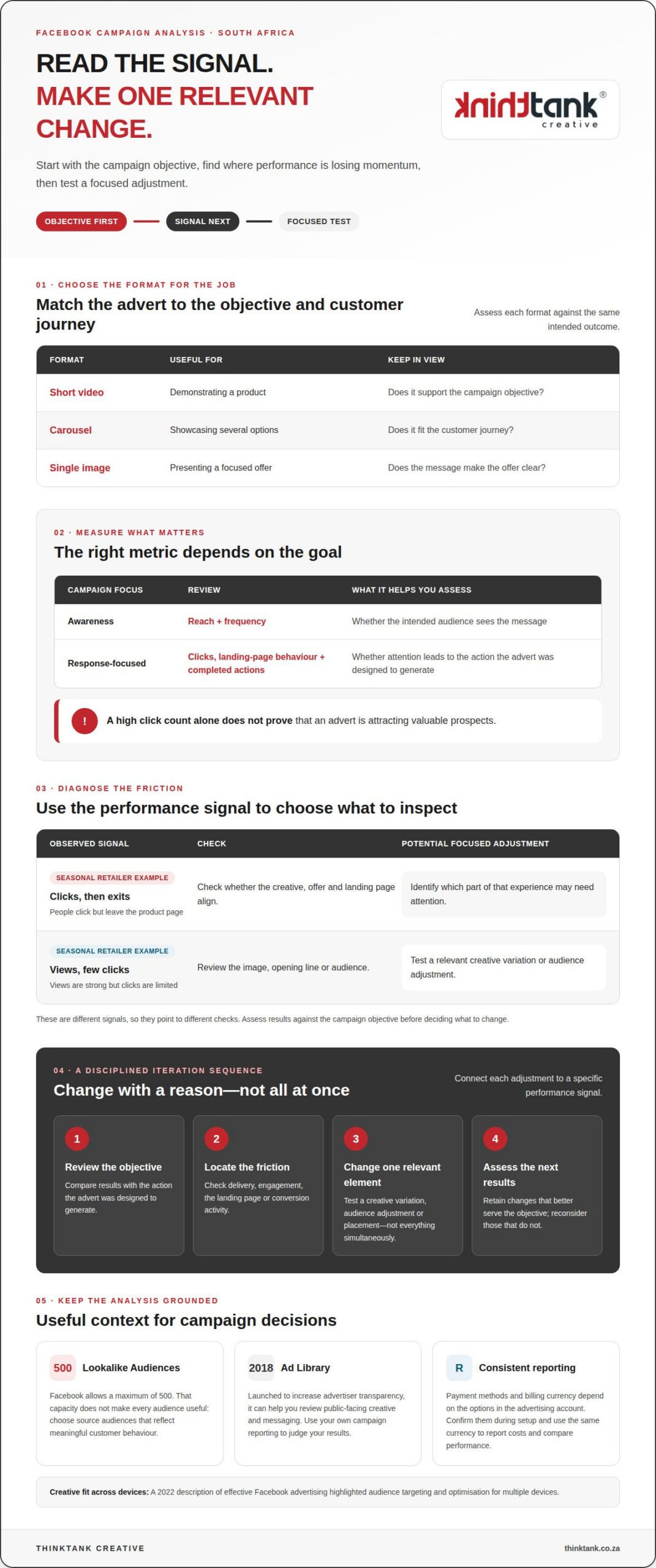
Facebook ad formats work best when they match the campaign objective and customer journey. You might use a short video to demonstrate a product, a carousel to showcase several options, or a single image for a focused offer. Assess each format against the same goal, such as qualified enquiries or completed purchases.

Start analysis with the objective, not the most visible metric. For an awareness campaign, reach and frequency help show whether the intended audience sees the message. For a response-focused campaign, examine clicks, landing-page behaviour and completed actions. A high click count alone does not prove that an advert is attracting valuable prospects.

Imagine a South African retailer promoting a seasonal range. If people click the advert but leave the product page, check whether the creative, offer and landing page align. If views are strong but clicks are limited, the image, opening line or audience may need adjustment. Each diagnosis points to a different test.

Keep campaign changes meaningful by refining them in a structured sequence:

Audience testing also requires discipline. Facebook allows advertisers to create a maximum of 500 Lookalike Audiences. That capacity does not make every audience useful: professionals select source audiences that reflect meaningful customer behaviour, then assess whether the resulting delivery supports the campaign objective.

Facebook launched the Ad Library in 2018 to increase transparency around advertisers. It can help professionals review the public-facing creative and messaging used by advertisers, while campaign reporting remains essential for judging their own results. A 2022 description of effective Facebook advertising highlighted audience targeting and optimisation for multiple devices. These remain useful considerations when assessing creative fit across placements.

For South African businesses, payment methods and billing currency depend on the options shown in the advertising account. During account setup, confirm the selected method and currency, then report campaign costs clearly in that currency. Use the same currency consistently when making budget decisions and comparing performance.

Iteration is not a sequence of arbitrary edits. Connect each adjustment to a specific signal so you can distinguish a creative issue from an audience or landing-page issue, then make the next campaign decision with greater clarity.

2. How professionals target by demographics and life events

Strong audience choices start with the customer, not a long list of filters. Map your product or service to relevant demographic signals, such as location, age range or language, and check that each choice supports the campaign objective. A tutoring service, for example, should define its intended learners and guardians before setting its audience.

Life events can make a message more timely when the offer genuinely relates to that moment. A moving company might tailor creative around relocation, while a photographer could develop messaging for engagements. Match the audience signal to the service, and do not treat a life event as proof that someone needs to buy.

Meta’s advertising rules and targeting controls apply in South Africa. Plan campaigns around relevant, non-discriminatory criteria, avoid sensitive personal assumptions, and make sure the advert and audience choices comply with Meta’s current policies.

POPIA is an important privacy consideration when customer data informs Facebook targeting. Use customer information through appropriate business processes, limit its use to the campaign purpose and handle it carefully. Your business should have a sound basis for using those records.

For custom audiences, you can use suitable customer information or engagement with your business’s content, then assess whether the source reflects meaningful interest. For lookalike audiences, the selected source audience guides Meta towards people with similar characteristics. The source matters: genuine customer records can provide a more relevant signal than a broad collection of casual interactions.

Audience design is a sequence of considered choices:

For instance, a Durban furniture retailer could separate people engaging with its product content from existing customers. Distinct groups allow professionals to shape different messages, rather than showing every person the same advert. They can then assess performance and refine the audience or creative accordingly.

Audience settings also need room to reach relevant people. Adding overlapping demographic filters may narrow delivery without improving customer fit. A professional weighs each filter against the offer and campaign objective, then uses performance signals to guide adjustments. For businesses planning paid campaigns, professional PPC advertising can bring audience strategy and campaign execution into one considered plan.

3. How does a professional create a Facebook ad campaign targeting customers in South Africa?

A professional begins with the business outcome, then builds the campaign around it. A Johannesburg retailer may want online purchases, while a South African consultancy may prioritise qualified enquiries. That distinction shapes the advert’s objective, audience, message and destination. A clear goal also gives the professional a practical basis for assessing whether the campaign is reaching suitable customers.

A considered approach to how to target customers on Facebook in South Africa starts with customer needs and the business’s reach. Define who the offer serves, then select relevant geographic and audience settings. A business serving customers nationally may need a different campaign structure from one whose service depends on local access.

Organise campaigns to make results easier to interpret. In Meta Ads Manager, group adverts according to distinct audiences or creative approaches. For example, a retailer might separate people who have engaged with its content from a broader prospect audience. This structure helps reveal which message and audience combination is producing useful responses.

Make the offer clear in your creative. Match the image or video, wording and call to action to the action you want customers to take. An advert for a consultation, for instance, can explain the service’s relevance and direct interested people to an appropriate enquiry page. The page should continue the same message, not introduce an unexpected offer.

The destination forms part of the campaign experience. Before launch, the professional reviews whether it loads, works on mobile screens and makes the advertised next step clear. If a South African retailer promotes a particular product, the relevant product information should be easy to find. A confusing or mismatched destination can weaken the response to an otherwise well-targeted advert.

Before activating a campaign, check its objective, audience, creative, destination and tracking arrangements. Measurement should reflect the intended outcome. A lead-focused campaign, for example, needs attention on the relevance of enquiries, not just the number of advert interactions. This preparation gives later analysis a meaningful point of reference.

Once the campaign is running, base adjustments on evidence. If people engage but do not enquire, examine the offer and destination before changing the audience. If responses are poorly matched to the business, refine the advert’s wording or audience criteria. Each change should address a specific point in the customer journey.

Ultimately, how to target customers on Facebook in South Africa depends on aligning business goals with the audience, message and next step. Develop that alignment into a coherent campaign, then use customer responses to guide ongoing decisions. The result is a strategy shaped around your business and the people it aims to serve.
How to Target Customers on Facebook in South Africa with Smarter Ads

4. How can a professional target South African customers by province, city, or location on Facebook?

Location targeting should reflect where customers can realistically buy or receive a service. First map the business’s operating area, then select suitable places in Meta Ads Manager. A retailer delivering nationally may target a broad South African audience, while a local clinic would focus on nearby customers.

Province-level targeting suits offers available across a large area. For example, a business serving an entire province can shape its audience around that area rather than paying to reach people elsewhere. Consider delivery coverage, travel requirements and customer demand before choosing a province-wide audience.

City targeting makes sense when a business concentrates on a particular urban market. A Cape Town restaurant, for instance, may prioritise customers near its location, while a Johannesburg service provider could focus on areas it can reach. City boundaries alone may not reflect practical travel distance, so professionals assess the business’s actual service footprint.

Facebook can use a radius of 10 miles around a central point. A professional might centre that radius near a shop, venue or service hub, then consider whether the resulting area aligns with customer access. The stated radius is in miles, so it should not be silently treated as kilometres when planning a South African campaign.

If your business serves several distinct areas, structure locations to make campaign delivery easier to interpret. You might group or separate markets according to the offer and operational reach. The right structure depends on whether customers receive the same service and message in each place.

Location settings also need to match the advert. A promotion tied to a specific branch should name that location clearly, rather than implying nationwide availability. A national online offer can use broader geographic coverage, while its creative and landing page explain delivery details to South African customers.

Professionals typically assess these location decisions in sequence:

For example, if a Pretoria campaign attracts enquiries from outside the business’s practical service area, the professional can refine the geographic selection. If a Cape Town advert performs well in one part of its intended market, that signal can inform future campaign planning. These adjustments connect location choices to real business outcomes, rather than treating every South African audience as one uniform market.

5. Facebook Ad Costs in South Africa: CPM and CPC

Facebook advertising has no single fixed average CPM or CPC for every South African campaign. Costs depend on the auction, audience, campaign objective, advert and competition for placements. A national retail campaign and a focused local campaign can therefore have different costs.

CPM means cost per thousand impressions. It helps a business assess how much it pays to show an advert, making it useful for campaigns focused on awareness or reach. A lower CPM alone does not prove success, since impressions may not lead to meaningful interest or action.

CPC means cost per click. It indicates the cost associated with advert clicks and can help assess campaigns intended to bring people to a website or another destination. Clicks still need context: a campaign generating visits but few relevant enquiries may not deliver the intended business value.

For example, a Cape Town retailer promoting a new range might compare CPM when assessing exposure and CPC when assessing visits. If the campaign’s purpose is product enquiries, the professional also considers whether those clicks lead to useful conversations. The right metric follows the objective, not simply the lowest reported cost.

Several campaign conditions influence CPM and CPC. A narrowly defined audience may compete for a different set of placements than a broad audience. Creative quality and relevance can affect how people respond, while the campaign objective influences which actions Meta seeks. Seasonal demand and competing advertisers may also affect auction conditions.

Evaluate cost alongside the customer journey. If CPC rises, examine the audience, creative and placement before changing the campaign. If clicks remain steady but enquiries fall, assess the landing page and offer. This prevents one metric from prompting an adjustment that misses the actual issue.

Cost planning should distinguish Meta’s advertising spend from professional campaign fees. Advertising spend is set for the campaign, while professional fees depend on the project and an estimated cost is provided after discussion of needs and timeline. A clear plan identifies the intended outcome, audience, creative needs and measurement approach before budget decisions are made.

For a South African business, a professional can compare campaign results using the same objective and reporting period, then interpret CPM and CPC alongside relevant outcomes. That makes cost comparisons more useful than treating one campaign’s rate as a universal benchmark. Plan Facebook campaign costs around the audience, objective and results that matter to your business.

There is no single average CPM or CPC for South Africa. Both vary with the auction, audience, campaign objective, advert and competition for placements.

ThinkTank Creative

ThinkTank Creative helps South African businesses bring audience strategy, campaign messaging and creative direction together in a coherent digital approach. Its Social Media Marketing service supports businesses seeking professional guidance with Facebook campaign planning, audience selection and performance refinement.

Turn to ThinkTank Creative when your campaigns need a clearer connection between the people you want to reach, the message they see and the action you want them to take. When a campaign leads to a website, Website Design & Development can create a destination that reflects the advert and guides visitors towards the next step. Branding & Creative Design can also shape advertising visuals around your brand.

Share your campaign goals and the customers you want to reach. Contact ThinkTank Creative to discuss a considered approach to your Facebook advertising.

Build a stronger connection with your audience

Make each campaign a starting point for a more relevant relationship with your customers. Learn what earns their attention, what prompts meaningful engagement and how your brand can respond with communication that feels timely and useful.

A considered approach to how to target customers on Facebook in South Africa is not simply about choosing an audience. Align your message with what your business wants to achieve, then make deliberate decisions as customer needs evolve. This perspective helps keep your advertising connected to the people it is intended to serve.

ThinkTank Creative can help shape that direction through its work in digital marketing and creative development. If you’re ready to discuss your Facebook advertising goals, start a conversation with ThinkTank Creative. Take the next step with clarity, and give your campaigns a thoughtful foundation for what comes next.

Frequently Asked Questions

What Facebook ad strategy can a professional use to reach customers in South Africa?

A professional can tailor campaign messages to where potential customers are in their decision journey. For a South African software firm, one advert might introduce a service to new prospects, while another addresses people who have already engaged with the business. The professional then assesses which approach attracts more relevant enquiries, rather than focusing on volume alone, and adapts messaging to better reflect each audience’s familiarity with the offer.

What Facebook audience targeting options are available for South African advertisers?

South African advertisers can use geographic and demographic selections, interests, life-event signals, custom audiences and lookalike audiences. Each option serves a different purpose: a local retailer might focus on people near its shop, while an established business could use an appropriate customer group to inform audience expansion. Consider how audience groups overlap and choose options that support the campaign’s purpose, rather than layering on filters without a clear reason.

Can Facebook ads target South Africans by language, interests, age, and demographics?

Yes, Facebook campaign settings can include language, interests, age and other demographic criteria, subject to the options available and advertising policies. An education provider, for example, might create language-appropriate advert copy and choose age settings relevant to its intended audience. Make sure these selections suit the offer, keep the advert clear and avoid messaging that suggests sensitive personal knowledge about the people who see it.

What are Meta's advertising rules and prohibited targeting practices in South Africa?

In South Africa, campaigns must follow Meta’s advertising rules and targeting controls. Use relevant, non-discriminatory criteria, avoid sensitive personal assumptions, and ensure the advert and audience choices comply with Meta’s current policies.
How to Use Data to Personalise Email Content

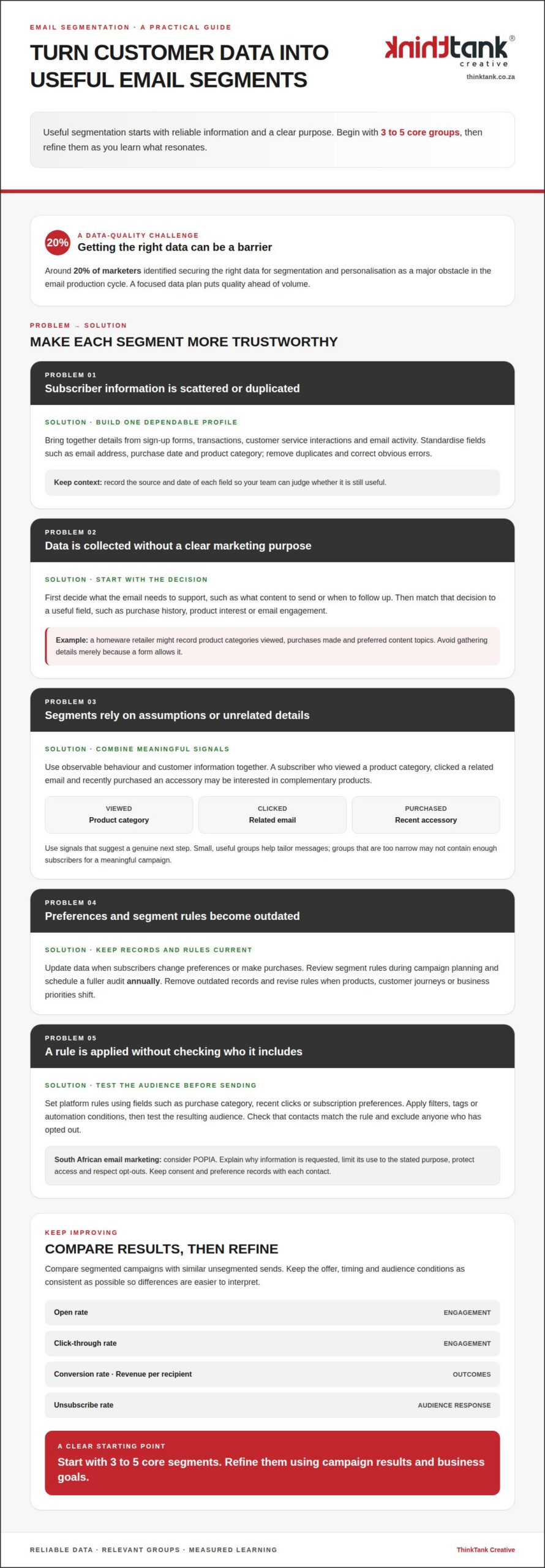
A more relevant email often starts with sending fewer subscribers the same message. A practical starting point for segmenting your email list for better results is to create 3 to 5 core groups, then refine them as you learn what resonates. Use meaningful differences in subscriber data, buying patterns, product usage and customer value to shape content for each group, rather than relying on one broad audience.

A single campaign may seem easier to manage, especially when subscriber data is scattered or audience needs are unclear. But thoughtful segmentation helps you send messages that are more useful and timely. This article explains how to choose relevant criteria, turn customer behaviour into practical segments and adapt your approach as engagement changes. You’ll also learn how to match each group’s interests and relationship with your business to email content that feels personal, without making the process needlessly complex.

Key Takeaways

  • Start with a small set of useful audience groups, then refine them as your campaign goals and performance become clearer.
  • Use subscriber preferences and buying patterns to shape content around what different customers are interested in and when they may need it.
  • Bring product usage, lead scores and customer value into your decisions to make messages more relevant to each relationship stage.
  • Combine demographic details with observable behaviour, such as browsing, clicking or purchasing, rather than relying on one type of data alone.
  • Review engagement and purchase history to adjust who receives each message and how often they hear from you.

1. Collecting data for segmentation

Build segments from reliable information, not assumptions. Start by identifying the decisions your emails need to support, such as what content to send or when to follow up. Then match each decision to a useful data field, such as purchase history, product interest or email engagement. Effective segmenting your email list for better results starts with data that is accurate, relevant and organised.

Centralise contact records so each subscriber has one dependable profile. Bring together details from sign-up forms, transactions, customer service interactions and email activity. Standardise fields such as email address, purchase date and product category, then remove duplicates and correct obvious errors. Otherwise, a customer listed twice under different spellings could receive conflicting messages. Record the source and date of each field so your team can judge whether it is still useful.

Collect only information that supports a clear marketing purpose. For example, a homeware retailer might record product categories viewed, purchases made and preferred content topics. Avoid gathering details merely because a form allows it. Around 20% of marketers identified securing the right data for segmentation and personalisation as a major obstacle in the email production cycle. A focused data plan helps teams prioritise quality over volume.

Intent-based micro-segmentation combines meaningful signals to identify a specific, timely interest. A subscriber who viewed a product category, clicked a related email and recently purchased an accessory may be interested in content about complementary products. Use signals that suggest a genuine next step, rather than combining unrelated attributes. Small, useful groups help you tailor messages; groups that are too narrow may not contain enough subscribers for a meaningful campaign.

For South African email marketing, consider POPIA when collecting and using subscriber data. Explain why you request information, limit its use to the stated purpose, protect access and respect opt-outs. Keep records of consent and preferences with each contact, and avoid using personal details that do not serve the campaign.

To create and automate segments in an email platform, set a rule using fields such as purchase category, recent clicks or subscription preferences. Apply it using the platform’s filters, tags or automation conditions, then test the resulting audience before sending. For example, a welcome sequence could branch according to the subscriber’s selected interest.

Update data when subscribers change their preferences or make purchases. Review segment rules during campaign planning and schedule a fuller audit annually. In slower-moving industries, you might also review segments annually or after significant changes. Remove outdated records and revise rules when products, customer journeys or business priorities shift.

Compare segmented campaigns with similar unsegmented sends using open rate, click-through rate, conversion rate, revenue per recipient and unsubscribe rate. Keep the offer, timing and audience conditions as consistent as possible, so differences are easier to interpret. Track results for each segment and for the list as a whole.

Common mistakes include relying on stale data, creating too many tiny groups and treating a click as proof of purchase intent. Set a clear rule for every segment, check that the audience matches it, and exclude contacts who have opted out. Start with 3 to 5 core segments, then refine them using campaign results and business goals.

2. Content and seasonal buying patterns

Match email content to what subscribers may want to do next. Someone researching winter skincare needs different guidance from someone comparing festive-season gifts. Use past purchases, product-page visits and email clicks to identify these interests. Then tailor the subject line, examples and recommended next step for each group, rather than changing only the greeting.

Build seasonal segments from observed buying patterns, not assumptions about the calendar. In South Africa, Black Friday, the festive season, back-to-school periods and winter may influence what people consider buying. Interest varies by product and customer, though. Before sending a timely offer or guide, compare previous seasonal clicks and purchases with each subscriber’s usual activity.

Separate seasonal intent from lasting preferences. A customer who buys school supplies may appreciate a back-to-school checklist, while a homeware shopper may prefer ideas for preparing for winter. Tag the seasonal interaction, but retain the customer’s broader interests. This prevents one temporary purchase from defining every email they receive afterwards.

Use content choices as segmentation signals. If a subscriber repeatedly clicks practical buying guides but ignores product announcements, prioritise useful advice in their next campaign. Someone engaging with product comparisons may value feature explanations instead. Track clicks by content type and connect them to later actions, such as browsing a related category or completing a purchase.

Plan seasonal campaigns in stages. Before Black Friday, offer decision-support content to subscribers exploring relevant categories. During the event, send product details to people who have shown interest. Afterwards, follow up with care guidance or complementary suggestions for purchasers, while giving non-buyers a different next step. Make each message reflect the person’s latest signal.

Compare campaign timing with your audience’s actual activity. Assess seasonal campaigns against similar messages sent outside the peak period, using clicks, purchases and unsubscribes as measures. A rise in opens alone does not show whether the content matched buying intent. If a seasonal segment clicks but does not convert, adjust the offer, landing-page content or message relevance before repeating the campaign.

Keep seasonal rules clear and temporary where appropriate. For example, label subscribers who clicked a winter range, then retire that condition when the campaign ends. Store enduring preferences, such as interest in a product category, separately. This makes future seasonal planning more precise and reduces the risk of outdated recommendations.

Make the campaign feel coherent across its messages, from subject line to landing-page experience. If you’re shaping seasonal email content, explore creative campaign ideas that support a consistent customer journey.

3. Product usage, lead scores and customer lifetime value

Use product behaviour to understand what subscribers may need next. A customer who regularly uses a software feature may benefit from advanced guidance. Someone who has stopped using it could need a refresher or practical support. For physical products, repeat purchases, accessories bought and time since the last order can suggest useful follow-up content. Choose signals that connect directly to a relevant email, rather than tracking activity without a clear purpose.

Build lead scores from observable actions that indicate interest. Give more weight to actions closer to a decision, such as requesting a product demonstration or viewing detailed pricing information. A general newsletter click can show interest, but it signals a different level of intent from a direct enquiry. Set scoring rules around your customer journey, then use the score to prioritise relevant content, such as a case study for active prospects.

Keep scores understandable. Record which actions add or reduce points, and ensure the score reflects recent behaviour as well as past activity. A prospect who once clicked several emails may no longer be considering a purchase. By contrast, repeated visits to one product category could signal renewed interest. Use both patterns to guide timing and message relevance, not as automatic proof that someone is ready to buy.

Customer lifetime value can help distinguish one-off purchases from ongoing relationships. Consider purchase frequency, order value and the time between purchases together. A customer who regularly replenishes a product, for example, may appreciate a timely reorder reminder. A high-value customer with a long gap between orders might need a different message, such as new product information or a personal service update. Keep the content useful rather than relying on value alone to justify frequent promotion.

Purchase history can also inform email sequencing. In one reported account, customers who had bought three or more times had an average email open rate of 11%. A separate reported three-email reorder sequence for repeat buyers achieved a 43% conversion rate. These are individual campaign results, not universal benchmarks. Use them as prompts to test reorder messages against your own audience and product cycle.

Review each segment’s response through clicks, conversions and repeat purchases. If highly scored leads open messages but do not take the intended next step, reconsider the content or scoring criteria. If repeat customers ignore reorder prompts, examine purchase timing and product use. These refinements make product signals, lead scores and customer value practical inputs for more relevant campaigns.

How to Use Data to Personalise Email Content

4. Segmentation criteria, including demographics and behaviour

Choose criteria that clarify what a subscriber needs from your next email. Demographic details, such as age or location, can guide relevance, but do not reveal intent on their own. Combine them with observable behaviour, such as product-page visits, email clicks or previous purchases. Subscribers across South Africa may share the same product interest despite having different location details.

Use demographic information only when it supports a clear content decision. For example, a B2C campaign might target women aged 25-40 with a 20% discount on a new collection. The age range helps define the intended audience, but shouldn’t replace evidence of interest. Pair it with relevant preferences or previous engagement before tailoring the message.

Location can help tailor practical details for a national audience. A business serving customers across South Africa could use a voluntarily supplied province to share relevant delivery information or highlight local events. Do not treat location as a proxy for income, lifestyle or product preference. Such assumptions can exclude suitable subscribers and make otherwise relevant emails feel inaccurate.

Behaviour offers direct clues about current interests. A subscriber who views a product category, clicks a related guide and then visits a product page has shown several connected signals. Someone who has not interacted with the brand for 30 days may need a different message from an active reader. Use the action and its timing to decide what content fits.

Micro-segmentation combines criteria to create a more precise audience. One example targets urban millennial women aged 25-35 who bought eco-friendly products in the last 30 days and clicked the last three emails. Each condition narrows the group around demonstrated interest. The resulting content could focus on related sustainable products, rather than broad promotions to every subscriber.

Give each criterion a clear purpose before adding it to a segment. Ask whether it changes the message, offer or timing. If a subscriber’s age does not affect the content, leave it out. Check for overlapping groups, too: a recent purchaser should not receive an introductory offer intended for people who have not bought yet.

Email list segmentation is associated with 14.31% more opens and 101% more click-throughs than non-segmented emails. These figures point to the value of relevance, not a guaranteed outcome for every audience. Compare similar campaigns and review opens, clicks, conversions and unsubscribes to see which criteria are useful for your subscribers.

Start with a clear test: choose one audience signal, such as recent interest in a category, and match it to one content variation. Keep the other campaign elements consistent, then compare results with a broader-audience send. If the tailored version earns more relevant clicks without increasing unsubscribes, keep the criterion and test another signal.

5. How can you segment subscribers by email engagement and purchase history?

Combine email activity with transactions to understand each subscriber’s relationship with your business. Start by separating recent purchasers, repeat customers, interested non-buyers and subscribers whose engagement has declined. Choose a message for each group that fits its next likely need, such as product guidance, a reorder reminder or a re-engagement email.

Use purchase recency as a practical starting point. Create a segment for customers who purchased in the last 90 days, then tailor content to the product or category bought. Someone who recently purchased running shoes, for example, might appreciate care advice or information about suitable accessories. Keep the follow-up connected to their order, rather than sending a generic promotion.

Purchase frequency adds useful context. One reported email account found an average open rate of 34% among people who had bought once. That figure describes a single account, but it illustrates why first-time buyers deserve a distinct follow-up. Welcome them after purchase, provide relevant product information and invite their next action without treating them like established repeat customers.

For repeat buyers, consider content that supports replenishment or complementary purchases. A reported campaign to an engaged group of 22,000 people achieved a 60% open rate. Use engagement alongside order history to identify who may welcome a reorder prompt. Check the typical buying cycle and product type before deciding when that reminder makes sense.

Email behaviour can refine these purchase groups. Subscribers who have had no engagement for 30-60 days can move into a segment aligned with their previous open behaviour. Try a different subject line or content angle, then observe clicks and purchases. If a customer has recently bought, prioritise useful post-purchase information over another acquisition message.

Set a clear inactivity rule before reducing sends. For example, exclude subscribers who haven’t interacted for a defined period, using 60-120 days as a possible range. Subscribers showing no engagement after 9 months can enter a sunset flow, with a final preference or re-engagement message. Keep opted-out contacts excluded from campaigns.

Compare segments using open rate, click rate, conversion and unsubscribe rate. A fashion retailer once had more than 92,000 contacts who hadn’t clicked an email in over 90 days. That example shows why list size alone doesn’t indicate an audience’s current interest. Review each group’s response and adjust its content or sending eligibility accordingly.

Keep the rules simple enough to maintain: define the purchase window, engagement signal and message for each group. Review performance after campaigns and update criteria when buying patterns change. For support shaping targeted email activity, plan your email marketing campaigns around customer behaviour and purchase history.

ThinkTank Creative: Website Design and Development

ThinkTank Creative can help connect relevant email campaigns with a consistent digital experience. Once your segments reveal different customer needs, the destination matters too: a first-time buyer and a repeat customer may need different landing-page content. ThinkTank Creative’s Website Design and Development service can shape website journeys around those priorities, while Email Marketing supports campaign planning and delivery. This is a useful next step when your segmentation strategy is ready but your emails and website feel disconnected. Aligning the message with the landing page gives subscribers a clearer path from email to action. To plan how your campaigns and website can work together, contact ThinkTank Creative or visit thinktank.co.za.

Turn audience insight into your next campaign

Make your next step a focused experiment. Choose one audience group and shape a campaign around a demonstrated need, then use the response to refine your approach. Over time, segmenting your email list for better results becomes an ongoing learning practice, helping each campaign build on what subscribers actually engage with.

What you learn can also inform the wider experience around your emails. ThinkTank Creative’s Website Design and Development, Social Media Marketing and creative design can support a consistent brand journey across channels, from the email a subscriber opens to the content they see next. A strong strategy connects these touchpoints with a clear purpose.

Contact ThinkTank Creative to discuss your email strategy, and take the next step towards more relevant customer communication.

Frequently Asked Questions

What is email segmentation?

Email segmentation means organising subscribers into groups so each group receives content suited to its needs. For example, a community organisation could separate event attendees from people who signed up for general updates. Attendees might receive practical event information, while other subscribers get broader news. Group membership shapes the content, rather than every person receiving the same message.

What is email list segmentation and how does it improve campaign results?

Email list segmentation divides subscribers by useful shared characteristics, making it easier to tailor campaign content. For example, a South African retailer could send product-care advice to customers who bought an item that needs maintenance, rather than sending it to the entire list. Relevance gives each message a clearer purpose. Assess results by the action that matters to the campaign, such as a booking, product enquiry or completed order.

Which customer data should you use to segment an email list?

Use data that helps determine what a subscriber should receive next. Useful examples include chosen content preferences, previous purchases, enquiry topics and responses to earlier campaigns. A training provider could record whether someone asked about an introductory or advanced course, then send information suited to that choice. Keep data accurate and connected to a legitimate communication purpose. Avoid collecting sensitive or unrelated details that do not help make an email more relevant.

How do you segment an email list by demographics, location, and interests?

Start with information subscribers have provided, then connect it to a specific content decision. For instance, a South African organisation could use a subscriber’s province to share details of a local event, and their expressed interest to select a relevant topic. Keep demographic fields separate from inferred preferences. If someone selects an interest on a sign-up form, use that choice to guide content rather than assuming their interests from age or location.

What are the most effective email list segments for small businesses?

Small businesses can start with groups that call for distinct messages: prospective customers, first-time buyers, repeat customers and subscribers who have gone quiet. A South African café, for example, could send new-menu updates to opted-in subscribers interested in food news, while sharing loyalty information with returning customers. Choose groups that are manageable and useful. If two groups would receive the same content, combine them until their needs differ.