Rebranding Strategy Checklist: A Practical Guide for 2026

A new logo may be the least important part of a rebrand. If your business strategy has shifted but the customer experience still reflects an earlier direction, changing the visuals alone won’t close the gap. A rebranding strategy checklist helps you identify what’s driving the disconnect before you commit to a full rebrand or a more focused refresh.

It’s understandable to feel uncertain about how much needs to change. You’ll also want to avoid overlooking customer touchpoints or launching an identity your team isn’t ready to use consistently. Start with clear business and audience needs, not a design preference in isolation.

This practical guide will help you assess the gap between your strategy and customer experience, decide whether to refresh, reposition or rebrand, and plan the work across your identity, digital channels and printed materials. You’ll find ways to align decision-makers and employees, coordinate a rollout and review progress afterwards. Each step turns a complex project into a manageable plan, with a clear reason behind every change.

Key Takeaways

  • Use a rebranding strategy checklist to connect each proposed change to a clear business objective and customer need.
  • Build your direction around audience insight, positioning, messaging and evidence, rather than visual preference alone.
  • Compare a focused refresh, repositioning and full rebrand to choose a scope that fits the challenge.
  • Track identity, website, marketing, print and internal updates with clear owners, priorities and approval steps.
  • Plan a joined-up launch, then measure progress against the objectives that shaped the rebrand.

Rebranding Strategy Checklist: Identify the Business and Customer Gap

Uncertainty about whether your brand needs a refresh or a more substantial change is a useful starting point. A dated logo or mismatched marketing materials may be visible symptoms, but the underlying issue could be that the business has evolved while its positioning, message or customer experience has not.

Rebranding is a deliberate change to how a business is positioned, expressed or experienced. The scope can range from adjusting visual elements to reshaping the story customers encounter across the organisation. For an overview of corporate rebranding principles, consider how motivations and scope differ between minor identity adjustments and more fundamental change.

Before choosing a solution, use this diagnostic to connect business direction with audience experience:

Look for patterns rather than reacting to one isolated comment. If the same misunderstanding comes up in sales conversations, website feedback and customer enquiries, it may point to a messaging or positioning gap. If people understand the offer but encounter conflicting colours, names or materials, the problem may be visual or operational instead.

What signals that your current brand needs attention?

Compare the brand customers see with the organisation you are building. Review your offer, priorities and business direction, then check how they appear on your website, social channels and printed materials. Ask employees what they believe the business stands for and compare their answers with customer feedback. Repeated differences can show where recognition, relevance or consistency is weakening.

Is the issue strategic, visual or operational?

Separate the cause from the symptom. Unclear positioning can leave people unsure why the business is relevant; unclear messaging means the explanation is not reaching them. Outdated visual expression calls for a different response, while inconsistent touchpoints may need clearer identity guidance and coordinated updates. These issues can overlap, so identify the primary problem before selecting a remedy.

Write one evidence-based problem statement before proposing a solution. For example: “Customers understand our service, but feedback shows our website and printed materials describe it differently.” This is more actionable than “our brand looks old” because it identifies an observable gap and who experiences it. Support the statement with customer comments, staff observations or a review of existing materials. The goal is fit and clarity, not change for its own sake. This evidence gives the next stage of your rebranding strategy checklist a sound basis for deciding what should change.

Build the Rebranding Strategy Checklist Around Audience, Positioning and Proof

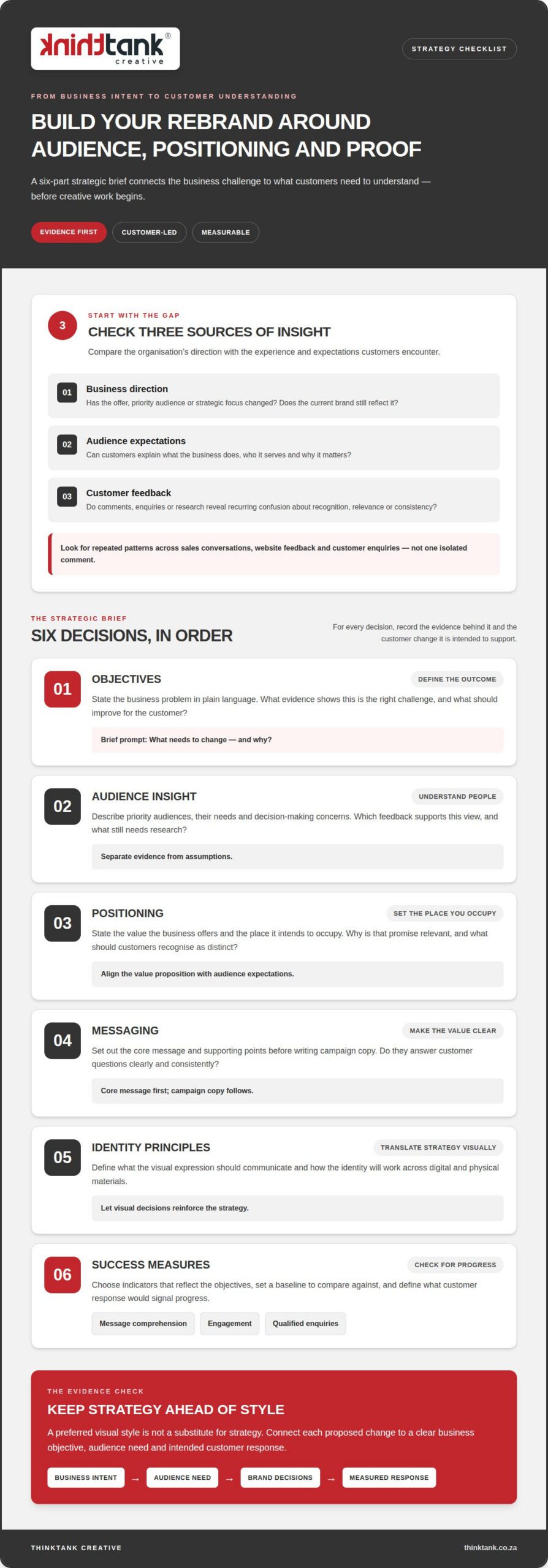
Turn the gap you’ve identified into a clear strategic brief before creative work begins. Connect business intent to what customers need to understand, then carry that direction into identity, website and campaign decisions. At each stage, record the evidence behind the decision and the customer change it is intended to support.

Set objectives and understand the audience

Start with the business problem in plain language, such as “our current message doesn’t explain the value of our expanded offer”. Then describe the people the brand needs to reach, what matters to them and what they should understand or feel. Separate evidence from assumptions: note existing feedback and identify unanswered questions rather than treating an internal opinion as a customer insight.

Clarify positioning, messaging and measures

Work through the decisions in order. This keeps a preferred visual style from standing in for strategy and makes the rebranding strategy checklist useful to both creative and digital teams.

  1. Objectives: Define the business outcome. What evidence shows this is the right challenge, and what should improve for the customer?
  2. Audience insight: Describe priority audiences, their needs and decision-making concerns. Which feedback supports this view, and what still needs research?
  3. Positioning: State the place the business intends to occupy and the value it offers. Why is that promise relevant to the audience, and what should they recognise as distinct?
  4. Messaging: Set out the core message and supporting points before writing campaign copy. Do they answer customer questions clearly and consistently?
  5. Identity principles: Define how visual expression should reinforce the strategy. What should the identity communicate, and how will it work across digital and physical materials? A practical good logo design guide can help translate these principles into visual decisions.
  6. Success measures: Choose indicators that reflect the objectives, such as message comprehension, engagement or qualified enquiries. What baseline will you compare against, and what customer response would signal progress?

Positioning is more than a cosmetic adjustment: strategic brand repositioning involves aligning the value proposition with audience expectations. Use that distinction to test whether the proposed change alters how customers understand the business, not just how it looks.

Align decision-makers before creative development

Agree who provides input, who approves the work and who makes the final decision. Set a shared method for gathering feedback, resolving conflicting views and keeping comments tied to the agreed objectives. This prevents the strategy from becoming a collection of individual preferences.

Bring the decisions together in a concise brief: objectives, priority audiences, positioning, core messages, identity principles, evidence and measures. Share it with creative and digital teams so the same direction informs logo and corporate identity, website content and marketing activity. ThinkTank Creative’s integrated marketing and creative approach connects strategy with the work customers encounter across channels.

Refresh, Reposition or Rebrand? Compare the Right Scope of Change

Choose the scale of change that addresses the gap, not the one that sounds most ambitious. A refresh may solve inconsistent visual expression, while a shift in audience or value proposition calls for deeper strategic work. These categories are decision-making guides, not rigid labels or promises of a particular outcome. A project can also combine elements from more than one category.

Use this comparison to test the likely scope against your evidence, business direction and the impact on customers:

Approach Scope and typical trigger What it involves
Focused refresh The core position remains relevant, but visual expression or materials feel dated or inconsistent. Targeted updates to identity elements and selected assets, preserving familiar recognition cues.
Repositioning The business needs to communicate a different value or become relevant to an audience whose expectations have shifted. Reworking the intended position and messaging, then aligning customer-facing materials with that promise.
Full rebrand Evidence points to substantial change in business direction, audience, offer or customer experience. Revisiting strategy and expression across the identity and the touchpoints that deliver the brand.

When is a focused brand refresh enough?

A refresh may be appropriate when customers still understand and value the business’s position, but the identity is difficult to use consistently or no longer feels clear. Update the elements linked to the diagnosed issue, such as templates or selected visual assets, rather than replacing everything by default. Keep recognisable cues where they support familiarity, while improving legibility and practical use.

When does repositioning or a full rebrand make sense?

Consider repositioning when the intended place in the audience’s mind needs to change, not simply the visual styling. If the business direction, priority audience or value proposition has materially shifted, review the strategy and messages before settling on a new expression. A broader rebrand is warranted only when evidence supports change across both foundations and customer experience.

How should you compare scope and effort?

Include implementation and internal alignment in the decision, not just creative deliverables. A change to messaging may require updates to website pages and campaigns; a broader identity shift may also affect printed materials and how employees explain the offer. The custom website design strategic guide explores how a website can support business objectives as part of that wider change.

Before committing, list the audiences, messages, identity assets and touchpoints affected by each option. Then consider what teams must approve, prepare or adopt. If the logo changes but customers still encounter unclear positioning or conflicting messages, the underlying problem remains. Let the diagnosed gap set the scope, and shape project planning around the requirements and timeline.
Rebranding Strategy Checklist: A Practical Guide for 2026

Use This Rebranding Strategy Checklist to Plan Every Touchpoint

A consistent launch depends on coordinating the details, not simply approving a new identity. Use this rebranding strategy checklist to turn decisions into assigned updates, so customers and employees encounter a coherent brand across digital and physical channels.

Audit the assets customers and employees encounter

Start with an inventory of what people see and use. Include customer-facing assets as well as internal templates and guidance. For each item, record its current version, intended audience and required change. Then assign the fields that will keep work moving:

Group the inventory so nothing is missed:

Coordinate website, marketing and production updates

Set dependencies before work begins. Website and campaign updates should use approved messaging and visual identity, while printed items should move into production only after their content and artwork are signed off. This reduces the risk of a new identity appearing in one channel while outdated materials remain in circulation elsewhere.

Prioritise high-visibility touchpoints first, such as the website and active social profiles. Then schedule lower-priority or less frequently used materials in manageable phases, with an owner and completion check for each. If the website changes, consider the organic search implications alongside design and content updates. The search engine optimisation strategic guide can help frame those considerations.

Prepare people and manage the rollout

Give employees accessible guidance on the positioning, key messages and correct use of identity assets. A short reference document and approved templates can help teams apply the same direction in everyday communications. Set a launch sequence with named owners, review points and a clear route for reporting and correcting inconsistencies.

Prepare customer-facing communication for changes that affect how people recognise or engage with the business. Keep explanations useful and straightforward, focusing on what customers need to know. ThinkTank Creative brings together identity, website, digital marketing and print services through connected marketing and creative support.

Turn the Rebranding Checklist into a Measurable, Joined-Up Launch

A brand change is ready to launch when the strategy, customer-facing assets and people responsible for using them are aligned. Close your rebranding strategy checklist with a sequence that makes ownership clear and gives the team a way to learn from the rollout:

  1. Approve: Sign off the positioning, messages and identity assets that will guide the launch.
  2. Prepare: Confirm channel owners, customer communication, launch responsibilities and baseline measures.
  3. Launch: Release approved updates in the planned order, coordinating website, marketing and production activity.
  4. Monitor: Review audience responses and selected performance measures against the original objectives.
  5. Refine: Use observations and feedback to prioritise practical improvements across touchpoints.

Prepare the launch and establish a baseline

Before launch, confirm that priority assets are approved, owners know their responsibilities and customer communication is ready. Record relevant pre-launch measures, such as existing engagement, enquiry patterns or website activity, so later reviews have a useful comparison point. Check key touchpoints together: the website, social channels and customer materials should all express the agreed positioning and identity, even if lower-priority updates are scheduled for a later phase.

Review performance and refine the experience

Connect each review to an objective rather than relying on general impressions. If the aim is clearer understanding, examine customer questions and feedback for signs of comprehension. If the aim is stronger engagement, review relevant interaction patterns; if it is more qualified enquiries, consider the nature of enquiries alongside their volume. These observations don’t prove a single cause, but they can reveal where messages or experiences need refinement.

Choose a collaborative partner for connected delivery

A joined-up launch needs the strategic direction to carry through creative work, website updates, digital marketing and production. When those disciplines are coordinated, approved messages and identity can be applied consistently across online and printed customer touchpoints. ThinkTank Creative is a marketing and creative agency established in 2001, bringing together strategy, branding and creative design, website design and development, digital marketing and SEO, and printing and production.

That collaboration can continue after launch, as review findings help guide practical refinements to the brand experience. Define the needs and timeline, then shape a plan around the project’s priorities. ThinkTank Creative’s connected services bring strategy and rollout together.

Make Your Next Brand Move With Confidence

A rebrand’s value is shaped not only by the identity you introduce, but by how consistently your business brings it to life as it grows. Treat the launch as the start of an ongoing practice: listen to customers, notice where the experience falls short of the intended position, and use those insights to guide thoughtful improvements. A rebranding strategy checklist gives your team a shared reference point for carrying that direction forward.

For a collaborative partner across strategy, creative, digital and production, ThinkTank Creative brings integrated capabilities to rebranding projects. The website states: “We are rated as one of the Top 5 Website design companies in South Africa by our clients according to The Independent Authority on Search Vendors.”

Ready to shape a clear next step for your business? Discuss your rebranding strategy with ThinkTank Creative. With a considered plan and the right people working together, your brand can move forward with greater clarity and purpose.

Frequently Asked Questions

Can a business rebrand without changing its name?

Yes. A business can retain its name while updating its value proposition, visual identity or the way it explains its offer. For example, a familiar name might stay in place while a clearer descriptor helps new customers understand what the organisation does. Before changing a name, consider the recognition it already carries and whether the real source of confusion lies in the name or in how the business presents itself.

How often should a business rebrand?

There’s no set interval that suits every business. Review the brand when you’re planning a meaningful change to your offer, audience or direction, or when customer feedback suggests people no longer understand its value. A regular review doesn’t need to trigger a redesign. Use your rebranding strategy checklist to assess whether the evidence points to a specific update or a more substantial shift.

What happens if a business changes its brand but keeps the same positioning?

The new look may attract attention without helping customers understand the business any better. For instance, if an expanded service offer is still described using language that only explains the original offer, the visual update won’t resolve that mismatch. Before approving creative work, test whether the core explanation makes sense to someone unfamiliar with the organisation. If it doesn’t, clarify the message before applying it across brand materials.

Is a rebrand only a new logo and colour palette?

No. Customers experience a brand through more than its visual identity: the words used to describe services, the tone of emails and the way information is organised all contribute to their impression. A new logo can’t fix confusing service names or inconsistent explanations. Include these everyday interactions in your review, so the identity and the practical experience customers receive support the same understanding of the business.

Can a rebrand be launched in phases?

Yes. A phased launch can make a complex set of updates easier to coordinate. For example, prepare approved website and campaign assets together, then schedule less frequently used materials for a later stage. Keep a shared record of which versions are current, who owns outstanding updates and what depends on earlier approvals. This helps employees avoid using old files while different channels move through their planned sequence.

How do you protect brand consistency after a rebrand?

Make correct brand use straightforward for the people creating customer communications. Keep approved messages, identity files and templates in an accessible shared location, and name someone to maintain them as the business evolves. When a new service or campaign is introduced, use the same guidance to review its language and presentation. Periodically check recurring materials, such as email templates and sales documents, for outdated details or conflicting versions.

Professional Business Logo Design: The 2026 Strategic Guide to Brand Identity

Whilst many entrepreneurs believe a brand is built on service alone, recent data confirms that 75% of consumers recognise a business primarily through its logo, making your visual mark the most hardworking employee on your payroll. In an era where 60% of people actively avoid brands with outdated or unappealing visuals, settling for a generic template isn't just a design choice; it's a significant commercial risk. You've likely felt the frustration of appearing "invisible" amongst more polished competitors or the technical headache of low-resolution files that fail on large-scale signage. Investing in professional business logo design is the definitive shift from being a mere company to becoming a recognisable national brand that commands immediate respect.

We understand that you want your visual identity to do more than just look pretty; you want it to make your customers feel smart for choosing you. This strategic guide explores how to bridge the gap between looking professional and achieving the 23% revenue boost associated with brand consistency. We will navigate the 2026 legal realities of AI-generated imagery, detail our signature 5-stage collaborative process, and show you how to secure bespoke, scalable assets that grow with your vision. By the end, you'll know exactly how to cultivate an identity that ensures you never blend into the background again.

Key Takeaways

  • Understand why a professional mark serves as the strategic cornerstone of your corporate identity, bridging the gap between mere visibility and true brand authority.
  • Explore a 5-stage collaborative process that transforms market research into a bespoke visual identity tailored to your specific growth objectives.
  • Learn why professional business logo design provides the unique craftsmanship and legal security that automated AI templates simply cannot replicate.
  • Master the principles of scalability to ensure your brand remains consistent and impactful across all digital platforms and physical printing solutions.
  • Discover how an end-to-end branding approach eliminates technical friction and creates a unified presence that makes your customers feel smart.

What is Professional Business Logo Design in 2026?

Professional business logo design serves as the definitive anchor for your entire corporate identity. It isn't merely a decorative element; it's a strategic asset that dictates how the market perceives your professional authority. In 2026, where 75% of consumers recognise a brand primarily by its logo, the precision of your visual mark directly correlates with your commercial success. A truly professional design moves beyond aesthetics, utilising the synergy of psychology and technical excellence to command respect in a crowded marketplace.

To better understand how a strategic approach differentiates a mere drawing from a powerful brand asset, watch this helpful video:

Strategic design choices are never arbitrary. Professional designers use colour psychology and bespoke typography to influence consumer behaviour, ensuring your brand feels dependable and sophisticated. This meticulous selection process ensures your identity remains consistent on a national scale, preventing the fragmented appearance that often plagues smaller competitors. By aligning your visual cues with your business goals, you transform a simple graphic into a tool that fosters long-term loyalty.

The Difference Between a Logo and a Brand

Think of your logo as the initial handshake and your brand as the reputation that follows. A well-crafted mark triggers specific emotional responses, building trust before a single word is spoken. It tells a cohesive story, moving beyond a simple graphic to represent your company's mission and culture. When 60% of people avoid businesses with poor visual design, your logo becomes the primary filter for customer acquisition. Research indicates that maintaining this visual consistency across all touchpoints can lead to an average revenue increase of 23%, proving that professional business logo design is a driver of growth rather than a sunk cost.

Technical Requirements for Modern Business Identity

Modern identity systems must be agile and resilient. We prioritise vector files over raster images because infinite scalability is non-negotiable for everything from social media favicons to massive physical billboards. A professional suite includes responsive variants that adapt to different viewports, ensuring the design remains legible in monochrome, greyscale, or full-colour formats. This technical rigour prevents the low-resolution issues that make a company look amateurish, providing the high-fidelity files necessary for professional printing solutions and digital excellence. By investing in these scalable assets, you ensure your brand remains sharp and recognisable, regardless of the medium.

The Strategic 5-Stage Logo Design Process

Success in branding is rarely the result of a single "eureka" moment. Instead, it's the outcome of a methodical, disciplined roadmap that ensures every pixel serves a commercial purpose. At ThinkTank Creative, we've refined a five-stage framework that transforms abstract ideas into high-impact visual assets. This journey ensures that your professional business logo design isn't just aesthetically pleasing but is strategically engineered to withstand the pressures of a competitive market.

Phase 1: Why Research Precedes Design

We begin by immersing ourselves in your industry's visual landscape. Designing without research is merely decorating; we aim to solve business problems through visual communication. By analysing your competitors, we identify visual clichés to avoid and opportunities for distinction. This phase is crucial for establishing your mark as a unique source identifier, which is a fundamental requirement according to USPTO trademark guidelines. We translate your core values into a strategic brief, ensuring the final design is anchored in reality and avoiding "pretty but pointless" designs that fail to communicate your value.

Once the strategy is set, we move into Design and Production. This is where our award-winning team explores technical execution, testing bespoke typography and high-contrast foundations. We then curate the most promising directions into a Presentation of Choices. We don't overwhelm you with hundreds of sketches. Instead, we present a refined selection of strategic paths that align with your growth objectives.

Phase 4: The Power of Collaborative Feedback

We view our clients as creative partners rather than passive recipients. During the Fine-Tuning stage, we engage in what we call "challenging interaction." This collaborative friction allows us to stress-test the design against your real-world needs. We don't just take orders; we provide professional guidance on how specific revisions might affect brand perception. This iterative cycle is essential for achieving 100% satisfaction and ensures the final result feels like a natural extension of your business.

The process concludes with Final Delivery and Support. We provide a comprehensive suite of scalable files, from website favicons to large-scale printing solutions, ensuring your professional business logo design remains crisp across every touchpoint. Because we've been a national South African partner since 2001, we provide the stability you need for long-term brand evolution. If you're ready to begin this transformation, our team is here to help you organise your corporate identity with precision and flair.

Professional Design vs AI: Why Strategy Beats Automation

Speed often masquerades as efficiency, yet the rise of automated logo generators has highlighted a significant "Uncanny Valley" in brand identity. These tools produce marks that feel soulless because they lack the contextual nuance of human experience. Whilst a machine can arrange shapes, it cannot understand your market's emotional pulse or the subtle cues that build trust. Research indicates that at the 12-month mark, custom identities developed by professional human designers hold a 94% satisfaction rate, compared to just 61% for automated marks. According to Harvard Business Review research on logo design effectiveness, specific descriptive characteristics in a logo significantly influence consumer willingness to buy, a level of strategic intentionality that AI simply cannot replicate.

There's also a looming legal reality that many businesses overlook. Purely AI-generated imagery currently lacks legal copyright protection because it lacks human authorship, as affirmed by the 2026 legal precedent in Thaler v. Perlmutter. Choosing a non-unique, generated template leaves your brand unprotected against competitors who can legally copy your visual mark without consequence. Our award-winning human team prioritises usability and functionality, ensuring your mark is a defensible asset that makes your customers feel smart for choosing you. By investing in professional business logo design, you're securing a unique visual signature that belongs exclusively to your company.

The Hidden Costs of "Cheap" Logo Solutions

Opting for a generic solution often triggers a cycle of diminishing returns. When a low-cost logo fails to scale or lacks the technical fidelity for high-quality printing, the subsequent rebranding costs can average between $5,000 and $20,000. Beyond the financial drain, an inconsistent visual presence erodes your credibility amongst national competitors. You risk appearing as a temporary player rather than an established authority, a perception that is difficult and expensive to reverse. A professional approach eliminates these technical nightmares by providing scalable, high-resolution files from the outset.

The All-Rounder Advantage: Beyond the Digital File

Our "We Do It All" philosophy ensures your identity isn't confined to a single digital file. We specialise in integrating your mark with custom website design, ensuring your brand story remains fluid and impactful across the digital space. Because we also provide comprehensive printing solutions, we guarantee that your identity translates perfectly from a smartphone screen to a physical billboard. This long-term partnership means we're here for the fine-tuning and maintenance that automated platforms ignore, providing a steady, reassuring foundation for your brand's future growth.

Professional Business Logo Design: The 2026 Strategic Guide to Brand Identity

Essential Elements of a Scalable Corporate Identity

Scaling a brand isn't just about size; it's about maintaining integrity across every medium. A professional business logo design succeeds when it remains recognisable whether it's on a tiny social media icon or a massive national billboard. We prioritise simplicity because the human brain processes simple shapes faster than complex ones. This ease of recall is why the most iconic brands avoid clutter. We also ensure your mark is relevant to your specific sector, avoiding fleeting trends that will look dated by 2028. By focusing on timelessness, we protect your investment, ensuring you don't face the $20,000 rebranding costs that often follow short-sighted design choices.

Versatility is the true test of a corporate identity. We stress-test every design to ensure it functions in black-and-white, as a physical stamp, and as a high-fidelity digital asset. This technical rigour prevents the "invisible" feeling that occurs when a logo disappears against a busy background or loses detail on a mobile screen. By creating a responsive visual system, we ensure your brand commands respect in every environment, from a humble business card to a prominent physical storefront.

Choosing the Right Brand Colours

Colours are the emotional language of your business. In the South African market, specific palettes evoke trust, energy, or heritage, and choosing the wrong shade can alienate your target audience. We meticulously select hues that bridge the gap between digital screens and physical print marketing collateral. Consistency here is vital; maintaining a uniform appearance across all touchpoints is linked to an average revenue increase of 23%. This careful selection process is a core part of what makes a good logo design, ensuring your identity feels deliberate rather than accidental.

Typography and Visual Hierarchy

The fonts you choose speak as loudly as the words they form. We select bespoke letterforms that reflect professional authority whilst allowing for imaginative creativity. This balance is achieved through the strategic use of white space, which prevents visual fatigue and highlights your most important information. Whether your logo appears on a letterhead or a custom video post, it must remain legible and command respect. A clean visual hierarchy ensures your message is never lost in translation, making your brand appear organised and dependable.

Our end-to-end approach ensures your stationery and signage are as sharp as your digital presence. If you're ready to build a visual system that scales effortlessly, you can book a brand identity consultation with our expert team today.

Elevating Your Brand with ThinkTank Creative

Choose a partner that understands the holistic nature of your business ecosystem. Our "We Do It All So You Don’t Have To" philosophy is designed to save you time and resources by providing a single, authoritative point of contact for your entire brand journey. We don't just hand over a digital file and walk away; we ensure your professional business logo design integrates seamlessly into a wider corporate identity. This includes everything from high-fidelity stationery to physical signage and digital assets that command attention.

Visibility is the companion of great design. Integrating your new visual mark with search engine optimisation ensures that your brand isn't just beautiful, but also visible to the right audience. A cohesive identity improves user engagement metrics and builds the trust necessary for higher conversion rates. We remain committed to delivering complete solutions for national organisations, ensuring that your brand's voice remains clear and consistent across every province and platform.

The ThinkTank Credentials: 25 Years of Excellence

Founded in 2001, ThinkTank Creative has spent over two decades evolving alongside the digital landscape. We've grown into a top all-rounder agency by treating every project with meticulous precision, whether we're designing simple flyers for a local start-up or managing the complex requirements of international companies. Our award-winning in-house design team brings a wealth of experience to the table, as seen in successful projects like Lebo the Accountant for the TaxShop franchise. Working with us means you're not just hiring a vendor; you're gaining a strategic visionary partner invested in your long-term growth.

Starting Your Brand Transformation Today

Your journey toward a more authoritative brand begins with a collaborative discussion. We believe that every business is unique, which is why an estimated cost is provided only after we've explored your specific needs and timeline. This ensures that the value we provide is perfectly aligned with your commercial objectives. During your initial imaginative journey with our team, we'll peel back the layers of your current identity to find the core values that will drive your future success.

The transition from a mere company to a recognisable national brand is a significant milestone. By choosing professional business logo design that's backed by strategic depth and technical excellence, you're setting a foundation that will serve you for decades. If you're ready to elevate your presence and make your customers feel smart for choosing you, it's time to take the first step. Embark on your branding journey with ThinkTank Creative and discover the power of a bespoke visual identity.

Secure Your Brand's Future through Strategic Distinction

Your visual identity is the silent ambassador of your business, and its effectiveness depends on the strategic depth behind its creation. We've detailed why professional business logo design is a non-negotiable investment for those seeking a 23% revenue boost whilst maintaining brand consistency and a defensible legal standing. By moving beyond the soulless output of automated tools, you secure a bespoke asset that scales effortlessly from digital screens to physical billboards.

ThinkTank Creative has championed this collaborative approach since 2001, offering complete end-to-end branding and printing solutions that simplify your path to success. Our award-winning in-house designers don't just create marks; they build legacies that resonate with the South African market and beyond. If you're ready to transform your presence and command the authority your hard work deserves, we're here to guide you. Partner with ThinkTank Creative for your professional logo design and let's build something extraordinary together.

Frequently Asked Questions

Is it worth paying for professional business logo design in 2026?

Investing in professional business logo design is essential because it serves as the strategic foundation of your corporate identity. Beyond aesthetics, a professional mark provides the legal copyright protection that automated AI tools currently lack. Since 75% of consumers recognise brands primarily by their logos, a bespoke design ensures you stand out amongst competitors whilst driving a measurable 23% increase in revenue through visual consistency and improved customer trust levels.

How much does a professional logo design cost in South Africa?

We provide an estimated cost after a comprehensive discussion regarding your specific requirements and project timeline. This tailored approach ensures that the value we deliver aligns perfectly with your commercial goals. Whether you're a small start-up needing a simple mark or a national organisation requiring a complete corporate identity, our pricing reflects the bespoke craftsmanship and strategic depth involved in creating a unique, scalable brand asset that grows with your vision.

How long does the professional logo design process typically take?

The timeline for a professional business logo design project typically spans several weeks to ensure thoroughness at every stage. We follow a disciplined 5-stage process, including research and strategy, design and production, and fine-tuning. This methodical rhythm allows for the "challenging interaction" and collaborative debate necessary to generate great ideas. The final duration depends on the complexity of your market and the specific revision cycles required to perfect your new visual identity.

What files should I receive at the end of a logo design project?

You'll receive a comprehensive suite of high-fidelity files designed for every possible application. This includes scalable vector formats for large-scale printing solutions and billboards, along with high-resolution raster files for digital use. We also provide responsive variants for social media profiles, favicons, and monochrome versions for dark modes or physical stamps. These assets ensure your brand remains sharp and recognisable across every digital and physical touchpoint, maintaining your professional authority everywhere.

Can a professional designer help me refresh an existing logo?

Yes, we frequently assist organisations in modernising their visual identity through a strategic brand refresh. This process involves refining your existing mark to improve its technical functionality and aesthetic relevance whilst preserving the brand equity you've already built. We focus on enhancing legibility and scalability for modern platforms, ensuring your updated identity reflects your company's evolution and remains impactful in a competitive national marketplace through 2026 and across all customer touchpoints.

Why is a brand style guide included in professional identity packages?

A brand style guide is a critical tool for maintaining national brand consistency across all customer touchpoints. It provides clear instructions on colour palettes, bespoke typography, and white space usage to ensure your identity is never diluted or misrepresented. By following these guidelines, you prevent the fragmented appearance that makes businesses feel "invisible" to consumers. This document empowers your team to produce marketing collateral that always aligns with your core strategic vision and values.

What happens if I don’t like the initial logo design concepts?

Our collaborative 5-stage process is designed to ensure you're deeply involved in the journey of imagination. If the initial concepts don't perfectly align with your vision, we enter a dedicated fine-tuning and revision phase. We use your feedback as creative fuel to refine the designs until we achieve 100% satisfaction. This iterative cycle of discussion and debate ensures the final mark is a powerful, authentic representation of your business's professional authority and long-term growth.

How to Create a Content Marketing Plan: The 2026 Strategic Template

Most businesses are currently shouting into a digital void, mistaking volume for value whilst their actual brand voice remains muffled by the noise. You've likely felt the exhaustion of maintaining a relentless posting schedule only to see minimal ROI or inconsistent engagement across your channels. It's frustrating to invest high effort into content that fails to align with your broader vision or move the needle on national search results. Learning how to create a content marketing plan that actually converts requires moving beyond mere templates and embracing a journey of imagination.

We understand that true brand transformation stems from a deliberate balance of strategic building and customer-centric value. This guide provides a sophisticated framework to organise your narrative, ensuring every piece of creative design or SEO-driven copy makes your brand look like the smartest expert in the room. We'll explore a repeatable workflow that transforms your digital presence from a series of disjointed posts into a cohesive, authoritative strategy. By the end of this article, you'll possess the tools to drive national engagement and secure your position as an industry leader through bespoke craftsmanship and precision.

Key Takeaways

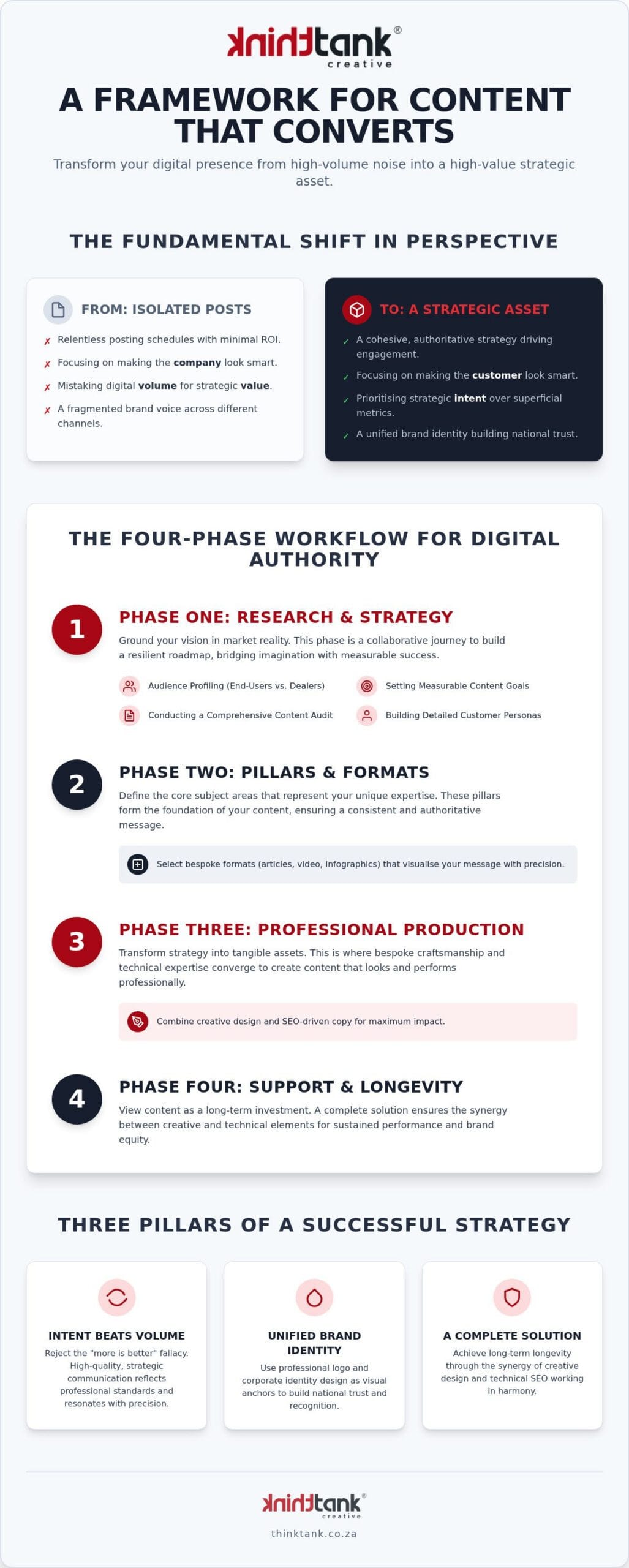
  • Shift your perspective from viewing content as isolated posts to treating it as a strategic asset that prioritises making your customer look smart.
  • Master how to create a content marketing plan by following a structured process that moves seamlessly from deep research to professional production and support.
  • Identify the core content pillars that represent your unique expertise and select bespoke formats that visualise your message with precision.
  • Refine your audience profiling to distinguish between end-users and dealers, ensuring your brand voice resonates with the specific needs of each segment.
  • Discover the value of a complete solution where creative design and technical SEO work in synergy to ensure the long-term longevity of your content.

The Foundation of Strategic Content Marketing in 2026

Transform your digital presence by shifting how you perceive your creative output. Content marketing is not merely a series of isolated social media posts or a checklist of blog entries. It's a powerful strategic asset. When you understand how to create a content marketing plan that treats every word and image as an investment, you move away from temporary noise toward long-term brand equity.

Distinguish between good marketing and great marketing to elevate your brand position. Good marketing focuses on making the company look smart, highlighting features and shouting about accolades. Great marketing, however, focuses on making the customer look smart. It provides the insights, tools, and clarity your audience needs to make informed decisions. This approach builds a deep, collaborative relationship where your brand is seen as an indispensable partner rather than just a vendor.

Secure your brand consistency across South Africa through a formalised strategy. Without a clear roadmap, your brand voice can become fragmented across different channels. When you master how to create a content marketing plan, you ensure that your message remains cohesive across every touchpoint. By viewing content as a complete solution for branding and lead generation, we follow a philosophy that We Do It All So You Don't Have To. This allows you to focus on your core operations whilst we manage the intricate synergy between strategy and execution.

Why Intent Beats Volume

Reject the "more is better" fallacy that currently plagues digital marketing. The digital space is saturated with superficial metrics that often lead businesses into a cycle of constant, low-value output. We believe in moving away from this frantic pace. High-quality, high-register communication reflects the professional standards of your business much more effectively than daily updates. Prioritising strategic depth ensures that your message resonates with precision, reaching the right people amongst a sea of generic content.

The Role of Brand Identity in Content

Utilise professional logo and corporate identity design as the visual anchors for every piece of content you produce. Your visual storytelling must align perfectly with your core mission to build national trust. When your creative design is unified, it creates a sense of reliability and excellence. This bespoke craftsmanship ensures that your brand remains recognisable and respected, regardless of the platform. A unified brand voice is the foundation of a journey of imagination that transforms prospects into partners.

Phase One: Research, Strategy, and Audience Profiling

Strategy is the bridge between imagination and measurable success. Before you produce a single word of copy, you must ground your vision in the reality of South African market dynamics. This initial phase isn't just about gathering data; it's about understanding the pulse of your industry to ensure your voice resonates with authority. We treat this as a collaborative journey where your insights and our expertise combine to form a resilient roadmap.

Identifying your audience is the first critical pivot point. Are you speaking directly to end-users who crave personal transformation, or are you addressing dealers focused on logistical excellence and commercial synergy? Each group requires a distinct vocabulary and a different set of value propositions. By defining clear objectives, whether that's top-of-funnel brand awareness or high-intent lead generation, you give your creative team a specific target. A comprehensive content audit follows, exposing the gaps in your current digital presence that a complete digital solution can resolve with precision. We believe in providing a seamless experience, which is why We Do It All So You Don't Have To.

Building Detailed Customer Personas

Generic demographics won't suffice in the modern landscape. You need to uncover the emotional drivers that influence South African decision-makers amongst various sectors. ZA audiences value reliability and local relevance, so your personas must reflect the specific challenges they face daily. Do they frequent LinkedIn for professional insights, or are they more responsive to visual storytelling on social platforms? Mapping these behaviours allows you to tailor your message with bespoke craftsmanship. When you understand how to create a content marketing plan, these personas become the north star for every piece of creative design you commission.

Setting Measurable Content Goals

Precision is the hallmark of a visionary strategy. When learning how to create a content marketing plan, you must distinguish between vanity metrics and conversion-focused data. Whilst a high follower count looks impressive, it doesn't always translate to bottom-line growth. Align your content objectives with broader business KPIs such as lead quality, email sign-ups, or customer retention rates. Establishing a solid baseline for reporting now ensures that every subsequent campaign is an exercise in optimisation rather than guesswork. This methodical approach ensures your content remains a dependable asset for years to come.

Defining Content Pillars and Choosing the Right Formats

Organise your expertise into distinct content pillars that act as the structural framework for your brand voice. These pillars represent the core areas of your authority, such as Website Design, SEO, and Branding, ensuring your message remains focused and impactful. When you understand how to create a content marketing plan that respects these boundaries, you avoid the common pitfall of producing disjointed information that confuses your audience. Instead, you build a library of assets that reinforce your position as a national industry leader.

Select formats that best visualise your message based on the complexity of the information and the preferences of your audience. Custom video posts and intricate infographics can transform dense data into engaging narratives, whilst long-form guides provide the strategic depth required for thought leadership. It's essential that all collateral, including physical "leave-behind" materials produced through bespoke printing solutions, maintains absolute visual synergy. This consistency ensures that whether a prospect is reading a digital whitepaper or holding a professionally designed corporate brochure, the experience feels like a single, unified journey of imagination.

Balance your output by mixing educational "how-to" content with visionary pieces. Whilst practical guides solve immediate problems and build trust, thought leadership pieces challenge the status quo and make your customers look smart by providing them with forward-looking insights. This blend of utility and inspiration is what transforms a standard marketing effort into a complete solution for brand growth.

The Power of Visualisation and UX

Award-winning design is not a luxury; it's a critical component of content readability and engagement. Our team integrates UX/UI principles into every piece of content, ensuring that your landing page design and digital assets are as functional as they are beautiful. High-quality graphics simplify complex technical information, allowing your audience to grasp sophisticated concepts with ease. This focus on precision and bespoke craftsmanship reflects the elite standards of your business and keeps users engaged for longer.

Choosing Your Distribution Channels

Distribution requires a methodical rhythm where different channels work in synergy to amplify your pillars. Social media marketing provides the immediate engagement and feedback loop, whilst email marketing allows for a more personalised, nurturing connection with your leads. Optimising every piece of content for search engines ensures long-term national visibility, creating a sustainable asset that continues to perform. For high-priority campaigns, utilising pay-per-click (PPC) advertising can provide the necessary momentum to reach a wider audience amongst a competitive digital landscape. To ensure your paid campaigns remain cost-efficient alongside your organic efforts, understanding how to reduce Google Ads cost per click is an essential complement to any comprehensive content distribution strategy. Equally important is re-engaging visitors who have already shown interest in your brand; following proven remarketing campaign best practices ensures that your content continues to convert warm audiences long after their initial visit.

How to Create a Content Marketing Plan: The 2026 Strategic Template

The Content Marketing Plan Template: A Step-by-Step Execution Guide

Executing a visionary strategy requires more than just a list of tasks; it demands a disciplined methodology that transforms abstract ideas into tangible results. Whilst many guides focus on the conceptual side of marketing, understanding how to create a content marketing plan at an agency level involves a rigorous five-stage production cycle. This structured approach ensures that your brand voice remains consistent whilst every piece of collateral meets the highest standards of professional excellence.

By following this template, you move beyond guesswork and into a repeatable workflow that delivers a complete solution for your business. If you are ready to elevate your digital presence with a partner who values precision, we invite you to explore our creative design and digital marketing services to begin your brand's evolution.

Creating a Realistic Content Calendar

Organising your production schedule is essential to avoid burnout and maintain a steady, reassuring cadence. A realistic calendar balances evergreen content, which provides long-term value, with timely coverage of industry events or seasonal trends. We utilise sophisticated systems to manage this workflow effectively, ensuring that your brand remains visible without sacrificing quality. This methodical rhythm creates a sense of reliability that your audience will come to depend on.

Quality Control and Brand Alignment

Technical and visual excellence are non-negotiable in high-register communication. Every piece of content must pass through a final delivery checklist to ensure it aligns with your professional yet creative brand tone. To guide all future creators, define your brand voice with absolute clarity: our voice is an authoritative yet approachable partner that inspires growth through strategic precision and elite craftsmanship. This single sentence acts as the north star for all your creative output, ensuring your national reputation remains untarnished amongst your competitors.

Elevating Your Content Strategy with Professional Agency Support

Transitioning from a conceptual template to an international-standard digital presence requires more than just internal effort. Whilst many businesses attempt to manage their output in-house, partnering with an all-rounder agency provides a complete solution that bridges the gap between creative vision and technical execution. Professional support ensures that your brand doesn't just participate in the conversation but leads it with authority and precision. We believe that true brand transformation occurs when every element of your strategy works in perfect synergy, allowing you to move beyond the basics of how to create a content marketing plan toward a model of sustained excellence.

Our in-house designers prioritise usability and functionality alongside aesthetic appeal, ensuring that your content serves a clear purpose in the user journey. Content that looks beautiful but fails to convert is a wasted investment. By integrating award-winning creative design with robust technical standards, we ensure your assets remain effective long after their initial launch. Ongoing maintenance and support are vital components of this process, protecting the longevity of your digital footprint and ensuring your message remains relevant amongst shifting market dynamics. We Do It All So You Don't Have To.

The Collaborative Journey with ThinkTank Creative

Success is a shared destination. Our structured 5-stage process ensures your vision is realised with meticulous precision, moving from initial ideation through to post-launch support. We foster a culture of constant communication and innovative creativity, acting as a dedicated partner rather than a mere vendor. This collaborative journey of imagination allows us to tailor every campaign to your specific business objectives. Because every brand's needs are unique, an estimated cost for our bespoke services is provided after a thorough discussion of your requirements and goals.

Integrating Content with Your Broader Digital Ecosystem

Content does not exist in a vacuum; it is the fuel for your entire digital engine. To achieve maximum impact, your plan must be seamlessly integrated with a high-performing custom website design South Africa that provides the perfect stage for your storytelling. This foundation is then amplified by search engine optimisation South Africa, ensuring your pillars are visible to those searching for your expertise at a national level. When these elements align, your content becomes a primary driver for sophisticated lead generation strategies for South African businesses, turning engagement into measurable growth and reinforcing your position as a strategic visionary in your field.

Secure Your Brand's Digital Future

Master the transition from disjointed digital noise to a cohesive, strategic narrative that positions your brand as a national leader. We've explored the necessity of treating content as a strategic asset and the power of a rigorous, five-stage execution workflow. Understanding how to create a content marketing plan is more than an administrative task; it's an invitation to elevate your brand voice through precision and bespoke craftsmanship.

Since our founding in 2001, we've remained dedicated to delivering complete end-to-end digital solutions that drive measurable growth. Our award-winning design team is ready to transform your vision into a high-performing reality whilst ensuring your message resonates with authority. We invite you to partner with ThinkTank Creative for a bespoke content strategy that reflects the unique excellence of your business. We do it all so you don't have to. Let's embark on this journey of imagination together and secure the future your brand deserves.

Frequently Asked Questions

What should be included in a 2026 content marketing plan?

Learning how to create a content marketing plan for 2026 requires a focus on defined content pillars, detailed audience profiling, and a multi-channel distribution strategy. You should incorporate SEO, social media management, and email marketing to ensure a complete solution. It's essential to outline a structured workflow for ideation and production whilst maintaining a focus on high-quality visualisation. This ensures your brand voice remains consistent across all national touchpoints and effectively addresses the emotional drivers of your specific target audience.

How often should a business post new content for national visibility?

Strategic depth is far more valuable than sheer volume in the modern digital space. Whilst there is no universal number, maintaining a steady, reassuring cadence is vital for building national trust. You should prioritise high-register, impactful pieces that resonate with your audience rather than flooding channels with superficial updates. A consistent schedule, perhaps two to three high-quality assets per week, often yields better long-term engagement than a frantic, daily posting habit that sacrifices quality for quantity.

Can I create a content marketing plan without a large internal team?

You certainly don't need a massive internal department to execute a sophisticated strategy. Many businesses find that partnering with an all-rounder agency provides the specialised expertise and bespoke craftsmanship they lack internally. By leveraging an external team for creative design, SEO, and copywriting, you can implement a professional framework without the overhead of a large team. This collaborative approach allows you to focus on your core business whilst experts manage the intricate details. We Do It All So You Don't Have To.

How do I measure the success of my content marketing efforts?

Success is measured by aligning your content objectives with broader business KPIs rather than relying on vanity metrics. You should track lead quality, conversion rates, and national search visibility to gauge actual ROI. Using reporting tools to monitor how your audience interacts with your pillars provides the necessary data for future optimisation. This methodical approach ensures your efforts contribute directly to brand transformation and sustainable growth rather than just generating temporary digital noise that fails to convert.

What is the difference between a content strategy and a content plan?

A content strategy defines the high-level vision, audience profiling, and the specific reasons behind your communication. Conversely, knowing how to create a content marketing plan involves the tactical execution, including specific formats, distribution channels, and production schedules. Think of the strategy as your north star and the plan as the repeatable workflow that brings that vision to life. Both are essential components of a complete digital solution that drives national engagement and long-term brand authority.

How does professional branding influence content marketing performance?

Professional branding acts as the visual anchor for every piece of content you produce, establishing immediate national trust. High-quality logo and corporate identity design ensure that your collateral is recognisable and respected across all platforms. When your visual storytelling aligns with your core values, it enhances readability and engagement. This synergy between creative design and strategic messaging makes your brand look like an authoritative industry leader amongst a sea of generic competitors who lack a unified visual voice.

Is email marketing still relevant in a 2026 content plan?

Email marketing remains a cornerstone of a successful digital ecosystem because it offers a direct, personalised connection with your leads. It's an ideal channel for nurturing relationships and distributing high-value thought leadership pieces directly to your audience's inbox. By using automated auto-responders and targeted campaigns, you can keep your brand at the forefront of your customers' minds. It works in perfect synergy with SEO and social media to provide a comprehensive communication strategy that drives national engagement.

How long does it take to see results from a content marketing strategy?

Content marketing is a long-term investment in brand equity rather than a quick fix. Whilst you might see immediate engagement through PPC advertising or social media, organic results through SEO typically take three to six months to gain significant momentum. This steady progress builds a sustainable asset that continues to perform for years. We focus on content longevity through ongoing maintenance and support, ensuring your brand transformation is both deep and enduring across the country.