Choosing a Domain Name in South Africa: 2026 Guide
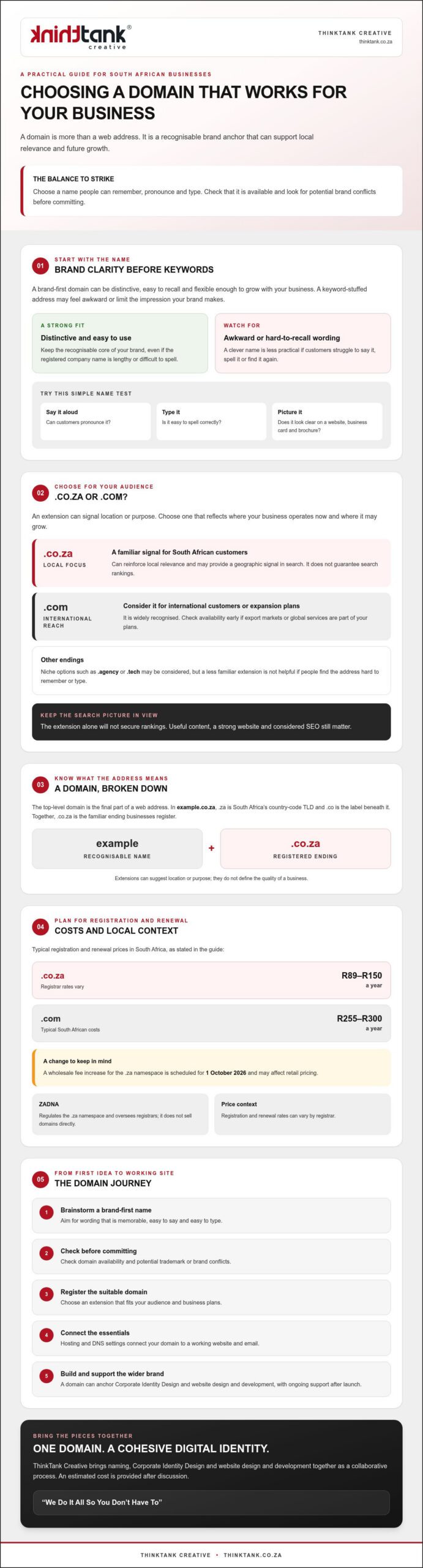
What if the best domain for your South African business isn’t the one with the most keywords? When choosing the right domain name for your business za, you’re doing more than selecting a web address: you’re creating a recognisable brand anchor that can support local relevance and future growth. It’s worth balancing a name that’s memorable and available with checks for potential trademark conflicts, then deciding whether .co.za or .com better suits your audience.
This guide explains how to weigh brand clarity against keywords, choose an extension and check and register a suitable domain. It also covers what happens next: hosting and DNS settings connect your domain to a working website and email. From the first naming ideas to launch and ongoing website support, the process can be collaborative. ThinkTank Creative brings that work together through Corporate Identity Design and website design and development, guided by our tagline: “We Do It All So You Don’t Have To”.
Key Takeaways
- Learn how choosing the right domain name for your business za can support a distinctive brand identity and signal local relevance.
- Compare .co.za’s local focus with .com’s international reach, then choose the extension that fits your audience and plans.
- Choose wording that’s easy to type and pronounce, and check availability and potential brand conflicts before committing.
- Follow the practical steps from brainstorming and registration to connecting your domain with a website and email.
- See how a domain can anchor Corporate Identity Design and website development through ThinkTank Creative’s process, with ongoing support after launch. An estimated cost is provided after discussion. We Do It All So You Don’t Have To.
What is a Business Domain Name and Why Does It Matter in 2026?
Your domain is more than an online address. It’s the name people type, remember and associate with your business, making it an important part of your brand identity. A domain such as brightpath.co.za is easier to recognise than a long string of unrelated words, helping customers identify your business before they reach your website.
In 2026, choosing the right domain name for your business za means looking beyond keywords. A brand-first name can be distinctive, easy to recall and flexible enough to grow with your business. By contrast, a keyword-stuffed address may feel awkward or limit the impression your brand makes. Your domain also sets expectations for the experience that follows, making it a natural starting point for improving website user experience.
For a concise overview of how domains work within the Domain Name System, see What is a Business Domain Name.
This video offers a practical South African perspective on domains and hosting:
The Difference Between Your Brand Name and Your Domain
Your public-facing brand and registered company name don’t have to match word for word. If the company name is lengthy or difficult to spell, consider a shorter domain that keeps its recognisable core. Test the name aloud: customers should be able to say it, type it correctly and find it again. Before deciding, picture it on your website, business card, brochure and other printed materials. It should be clear and consistent in each setting.
Domain Names as a Strategic Business Asset
A well-chosen domain can support long-term brand recognition and give your business a consistent home online. It can also underpin professional email communication and Corporate Identity Design, bringing your website, logo and other brand materials into alignment. For South African audiences, a .co.za address can signal local relevance. The extension alone won’t secure search rankings, so pair it with useful content and considered SEO.
ThinkTank Creative approaches naming as a collaborative journey of imagination, connecting the domain to the wider identity and digital experience. An estimated cost for related design and development work is provided after discussion. We Do It All So You Don’t Have To.
Domain Extensions: Is .co.za or .com Right for You?
Choose an extension that reflects where your business operates now and where it may grow. In a web address, the top-level domain (TLD) is the final part, such as .za or .com. In example.co.za, .za is South Africa’s country-code TLD and co is the label beneath it. Together, .co.za is the familiar domain ending businesses register. Extensions can signal location or purpose, but they don’t define the quality of a business.
For a business focused on South African customers, .co.za can reinforce local relevance and may provide a geographic signal in search. It doesn’t guarantee rankings: useful content, a strong website and considered SEO still matter. A .com may suit a business serving international customers or planning to expand beyond South Africa. Some brands also consider niche endings such as .agency or .tech, but an unusual extension is less useful if customers find the address hard to remember or type.
When to Prioritise a .co.za Extension
A .co.za address can make a locally focused business feel familiar and clearly rooted in South Africa, which may reassure customers looking for a local provider. Typical registration and renewal prices range from R89 to R150 a year, though registrar rates vary. ZADNA regulates the .za namespace and oversees registrars; it doesn’t sell domains directly. A wholesale fee increase is scheduled for 1 October 2026, which may affect retail pricing.
The Case for .com and International Extensions
If export markets or global services are part of your plans, check .com availability early. It’s widely recognised, but don’t choose an unfamiliar extension just because it sounds distinctive. A memorable, easy-to-spell name is more practical than a clever one people can’t recall. Typical .com registration and renewal costs in South Africa are R255 to R300 a year, and Verisign’s wholesale fee increase is scheduled for 1 November 2026.
Use Multiple Extensions Strategically
For some businesses, registering both .co.za and .com is a sensible defensive step. It can help protect the brand across local and international audiences, without requiring separate websites. Choose one primary domain and configure the other to redirect to it, so visitors reach the same destination. As Cloudflare explains when integrating your domain, DNS connects a human-readable address with the relevant online resources. Check that the redirects and settings work as intended.
Choosing the right domain name for your business za is a branding decision, not simply a registration task. ThinkTank Creative can help connect your domain with Corporate Identity Design and website development. Explore ThinkTank Creative’s services; an estimated cost is provided after discussion. We Do It All So You Don’t Have To.
The Strategic Criteria for Selecting a High-Performance Name
Choose a name that works with your brand and plans. Consider what the business offers now, as well as how people will remember, share and experience the name as the business grows. Treat naming as a collaborative journey of imagination: generate possibilities, test them against your goals, then refine the strongest options into a distinctive foundation for Corporate Identity Design.
Make the name easy to type and pronounce. Try the radio test: say it aloud to someone who hasn’t seen it and ask them to spell it. If they hesitate or guess incorrectly, customers may mistype the address after hearing it in conversation. Hyphens and numbers can create uncertainty about whether to include a hyphen or spell out a numeral. A clean, professional name is generally easier to communicate across websites, email and marketing materials.
Branded vs. Keyword-Rich Domains
A descriptive domain such as southafricancatering.co.za tells visitors what a business does, but may be hard to distinguish from competitors and restrictive if its services evolve. A distinctive brand name can be more memorable and give marketing a broader creative platform. A middle ground is to pair a unique brand with a broad industry cue, as long as the result remains easy to say and spell. Keywords can clarify relevance, but shouldn’t come at the expense of identity or readability.
Future-Proof Your Choice
Look beyond launch. A name tied to one location may not suit a business serving customers nationally, while a domain focused on a single service could become limiting if the offering expands. Check whether your preferred name also works across social media handles, so customers can recognise and find your brand consistently. For more on availability checks and choosing a registrar, see this guide to how to register a domain name.
As you shortlist options, ask: Is it memorable after one hearing? Can someone spell it without help? Will it still fit if the business changes or grows? These tests add discipline to the creative process and help turn a promising idea into a name with room to develop. ThinkTank Creative connects that foundation to Corporate Identity Design, website development and ongoing support after launch. An estimated cost is provided after discussion.
The Step-by-Step Process for Research and Registration
Turn a promising idea into a domain you can build on. Choosing the right domain name for your business za involves more than finding an available address: make brand, reputation and ownership checks before registering.
- Step 1: Brainstorm collaboratively. Explore names that reflect your purpose, audience and ambitions. Shortlist options that are distinctive, easy to say and flexible enough to grow with the business.
- Step 2: Check availability across extensions. Search your preferred name with relevant endings, such as .co.za and .com. Availability under one extension doesn’t mean the name is available under another, so assess the options together before deciding.
- Step 3: Review potential trademark conflicts. An available domain isn’t necessarily safe to use as a brand. Search relevant South African trademark records, including CIPC resources, and consider professional advice if a similar name appears. A conflict could lead to costly changes or a dispute. This check can also inform decisions about protecting your brand from confusingly similar registrations, a practice commonly called cybersquatting.
- Step 4: Investigate the domain’s history. If the address has been registered before, look for signs of previous use, such as old website content or unrelated or spammy search results. Check available search-engine status and reputation information, too. These checks may highlight concerns, but can’t guarantee a clean history.
- Step 5: Register through a reputable registrar. ZADNA regulates the .za namespace; it doesn’t sell domains directly. Register through a registrar, supply accurate contact and payment details, and review the available renewal and account-management options.
Protect Your Ownership and Keep It Current
Use your business’s own contact details for the registrant account rather than relying solely on a developer’s details. Make sure authorised people can access the account, keep the contact information current and enable auto-renewal if the registrar offers it. Domain registration is a renewable service, not permanent ownership. Track renewal dates and payment arrangements to reduce the risk of an expired domain disrupting your website or email.
Domain management is part of preparing a reliable website, not an isolated technical task. It connects your brand identity to hosting, DNS and the visitor experience. Explore how it fits into custom website design in South Africa, from planning through launch and ongoing support.
ThinkTank Creative can help shape a considered digital foundation through website design and development and Corporate Identity Design. Discuss your domain and website project.
Integrating Your Domain into a Complete Digital Strategy
A domain should lead into a coherent digital experience, not sit apart from one. It’s a starting point for design and development: the name you choose helps shape how your brand looks, sounds and welcomes visitors online. It can also anchor Corporate Identity Design, giving your logo, website and communications a shared point of reference.
Keep the name, visual identity and message aligned. A distinctive domain paired with a mismatched logo or unclear website copy can leave visitors unsure whether they’ve found the right business. Consider how your wording carries through every touchpoint, including effective website copy. A consistent identity helps people recognise your brand as they move from an advert or social post to your website.
From Domain to Live Website: The Development Arc
Your domain can inform UX and UI decisions by setting expectations for the audience and the experience they’ll find. For example, a simple, welcoming brand name should be supported by clear navigation and equally accessible language. Before launch, arrange suitable website hosting and ensure the site uses an SSL certificate to encrypt connections. These are separate from domain registration, so clarify who manages each element and how access is retained.
Launch is a milestone, not the end of the work. Keep contact and renewal details current, check that DNS settings direct visitors correctly, and maintain the website as your content and business develop. Ongoing website maintenance and support can help keep the site aligned with your goals after it goes live.
The ThinkTank Creative Collaborative Approach
ThinkTank Creative’s design and development process takes a project from its domain foundation towards launch. As an all-rounder agency in South Africa, ThinkTank Creative brings together Logo and Corporate Identity Design, website development, SEO, PPC advertising and social media marketing. A consistent domain can make campaigns easier to recognise and share, while a considered brand name gives each channel a common thread.
Choosing the right domain name for your business za begins a broader brand-building decision. Bring your naming ideas and digital goals into a discussion about how they can work together, from identity and website design to ongoing support.
Set Your Brand’s Digital Foundation in Motion
A considered domain gives your business a clear starting point online. The strongest option balances a memorable brand name with an extension suited to your audience, while availability and trademark checks help you make an informed decision. Choosing the right domain name for your business za also begins a joined-up digital identity, connecting your name with your visual brand, website and future marketing.
ThinkTank Creative was founded in 2001 and brings together branding, website design and development, and digital marketing, with support that continues beyond launch. Its award-winning design team works across these services as part of an all-rounder agency.
Ready to shape a digital presence around your ambitions? Embark on your journey of imagination with ThinkTank Creative today. Bring your ideas and goals to a discussion about a brand identity and website that work together.
Frequently Asked Questions
Should I choose a .com or .co.za domain for my South African business?
Choose .co.za if your primary audience is in South Africa, and consider .com if you’re targeting international customers or planning global expansion. A local extension can signal relevance to South African visitors, but doesn’t guarantee search rankings. If both versions are available and protecting your brand across markets makes sense, register both and direct one to your main website.
Can I change my business domain name later if I rebrand?
Yes, you can move to a new domain, but plan the change carefully to reduce disruption. Keep control of the old address and arrange redirects to relevant pages on the new site. Update your email addresses, social profiles, advertising and printed materials, and tell customers about the change. A domain migration can affect search visibility, so consider SEO and technical requirements before launch.
How much does it cost to register a business domain in South Africa?
As a 2026 guide, .co.za registration and renewal commonly fall between R89 and R150 per year, while .com domains are generally R255 to R300 per year. Prices vary by registrar, and a promotional first-year rate may differ from the renewal fee. Domain registration doesn’t include website or email hosting, so check what each service costs and when renewals are due.
Is it better to have a short domain name or one with keywords?
Prioritise a name that’s easy to remember, type and pronounce over one packed with keywords. A relevant word can help visitors understand your business, but it shouldn’t make the address long or difficult to share. Try the radio test: say the domain aloud and ask someone to spell it. A distinctive brand name can also give you more room to grow than a phrase tied to one service.
What happens if the domain name I want is already taken?
First, check whether a suitable version is available under another extension, such as .co.za or .com. You could also refine the name with a clear, relevant word, provided it remains easy to say and spell. Before choosing an alternative, check for possible trademark conflicts and avoid confusingly similar names. Don’t assume an unavailable domain is safe to use as a business identity.
Do I need to register multiple versions of my domain name?
No, it isn’t essential, but registering relevant versions can help protect your brand and make it easier for visitors to reach you. For example, a South African business might use .co.za as its main address and register the matching .com if available. Direct additional domains to the primary website, and track each renewal so a protective registration doesn’t lapse unexpectedly.
How do I check if a domain name is trademarked in South Africa?
Search South African trademark records, including resources provided by the Companies and Intellectual Property Commission (CIPC), for the proposed name and similar variations. A domain being available doesn’t confirm that using it as a brand is clear of conflicts. Trademark rights can depend on factors beyond an exact-name match, so consult an intellectual property professional if your search raises concerns or the name is central to your brand.
Who should legally own the domain name: me or my web designer?
Your business should generally be named as the registrant, using contact details it controls, rather than leaving the domain solely in a designer’s name. Make sure an authorised person in your business can access the registrar account, manage renewals and update contact information. Your web designer can have the access needed to work on the site without becoming the only person able to control this important business asset.