Improving Business Search Rankings: Where Should You Focus
A useful first checkpoint for improving business search rankings is 4–6 months: review SEO impressions then, while recognising that this is a point to assess progress, not a promised date for higher positions. Search results respond to a combination of relevant content, technical performance, local information and other ranking signals, so changes may take time to show.
If your visibility hasn’t improved as quickly as you’d hoped, you’re not alone in looking for a clearer way to prioritise the work. Repeating keywords more often isn’t the answer. Focus instead on making each page useful, easy to understand and technically accessible to visitors and search engines.
This article explains where to place keywords, how AI search affects the way people discover businesses, and why site speed, local listings and other ranking factors matter. You’ll also learn how to track progress and use the results to guide your next improvements.
Key Takeaways
- Give each page a clear search focus, then use relevant terms naturally in its title, headings and content rather than repeating them excessively.
- Match content to what people are trying to find, whether they need information, a particular website or a service.
- Prioritise a responsive mobile experience and review Core Web Vitals, including a Largest Contentful Paint under 2.5 seconds and Cumulative Layout Shift under 0.1.
- Keep your local business details accurate and complete; Google’s local results are mainly shaped by relevance, distance and prominence.
- Track impressions and other performance signals over time. SEO progress depends on several ranking factors, so use the data to guide ongoing improvements.
1. Keyword placement in URLs, titles, headings and content
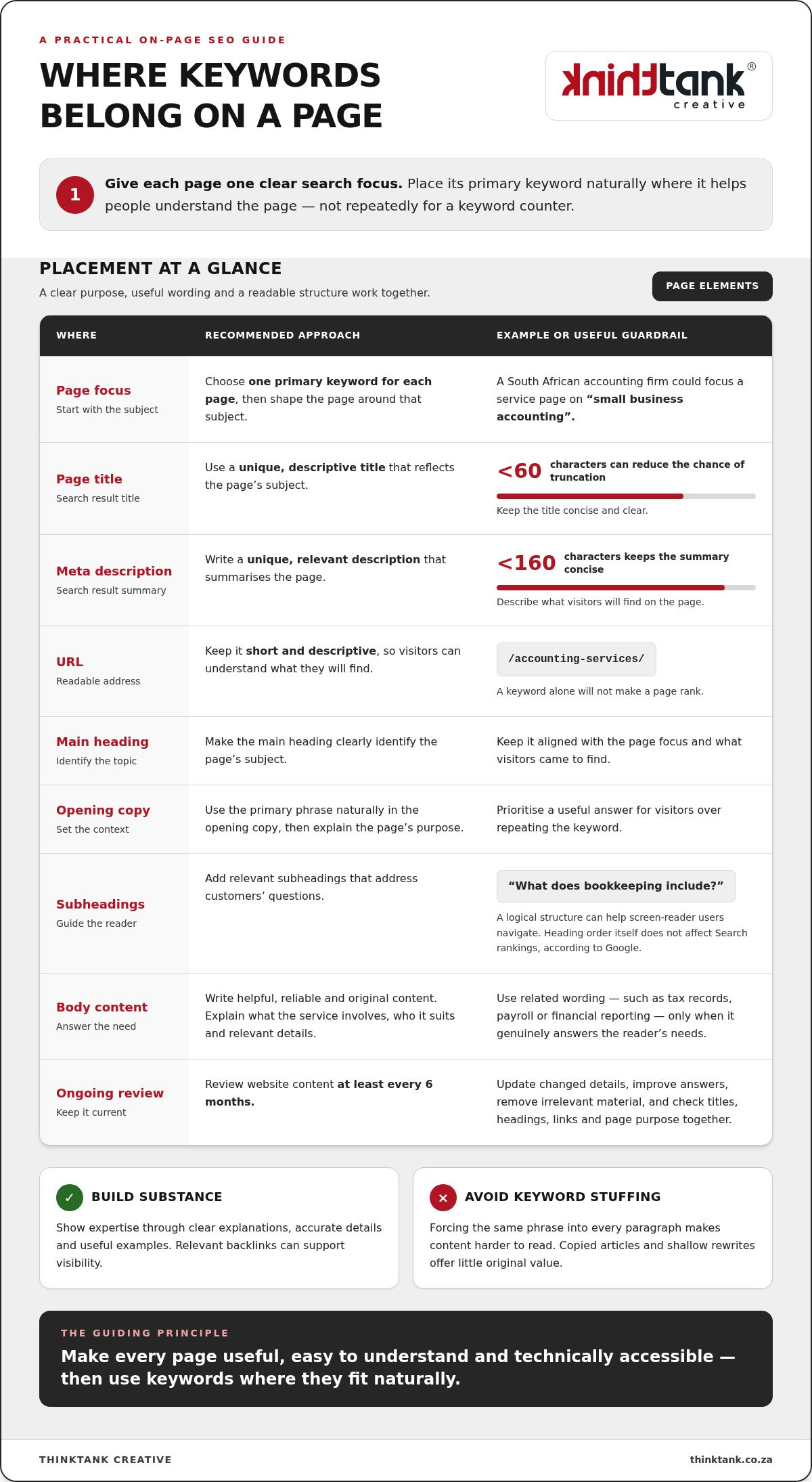
Start with one primary keyword for each page, then shape the page around that subject. For example, a South African accounting firm could focus a service page on “small business accounting”. This gives the page a clear purpose and helps visitors judge its relevance before reading further.
Place the phrase naturally in the page title, main heading, opening copy and relevant metadata. Give every page a unique, descriptive title and meta description. A title under 60 characters can reduce the chance of truncation, while a meta description under 160 characters keeps its search-result summary concise.
For a practical overview of prioritising search visibility, watch Ahrefs’ video:
Keep URLs short and descriptive, such as “/accounting-services/”, rather than using random identifiers. Google recommends descriptive URLs, but a keyword alone won’t make a page rank. A readable address also helps visitors understand what they’ll find before clicking.
Organise the page with a clear heading structure. Use the main heading to identify the topic, then add relevant subheadings that address customer questions, such as “What does bookkeeping include?” Google says heading order doesn’t affect Search rankings, although a logical structure can help screen-reader users navigate.
Write for visitors, not a keyword counter. Google recommends helpful, reliable and original content that answers people’s questions. Explain what the service involves, who it suits and what a prospective customer should do next. Add relevant keywords where they fit, rather than forcing the same phrases into every paragraph.
Keyword stuffing makes content harder to read, and Google doesn’t recommend it as an SEO focus. Use related wording when it clarifies meaning. An accounting page might naturally cover tax records, payroll or financial reporting, provided those details genuinely answer the reader’s needs.
Build authority through substance: show expertise with clear explanations, accurate details and useful examples. Relevant backlinks can support visibility, but copied articles and shallow rewrites give other sites little reason to reference your work. Prioritise original insight over keyword repetition.
Review website content at least every 6 months. Update details that have changed, improve answers that no longer serve visitors, and remove material that has become irrelevant. Check titles, headings, links and page purpose together, so each update strengthens the content and its technical structure.
2. How to Optimise for AI Search?
Make search intent your starting point, including when preparing content for AI search. Someone searching “accounting services” may be comparing options, while “how to prepare invoices” signals an informational need. Google recognises informational, navigational and transactional intent. Match each page to one clear need and answer it directly, rather than trying to serve every possible search.
Build a focused keyword plan before you publish. Use Google Keyword Planner, SEMrush or Ahrefs to explore relevant terms, search volume and competition. Use keyword metadata thoughtfully, focusing on phrases that accurately reflect the page’s subject. Treat that range as a planning prompt, not a reason to cram phrases into a page. Prioritise terms that connect your offer to a real customer need.
Compare search results for each target phrase. If results show service pages, create a page that explains your service; if they show guides, prepare a useful explanation. This simple check helps align format with intent. An algorithm can match a page to a query, but clear relevance gives people a reason to choose and read it.
Search volume helps estimate interest, while ranking difficulty indicates how challenging a term may be to compete for. Consider both alongside content quality, niche difficulty and user intent. Avoid targeting keywords with no search volume, as they may consume effort without reaching an active audience. For a South African business, assess whether a phrase reflects its actual services and target market.
Long-tail keywords often reveal the detail behind a search. Instead of targeting only “accountant”, consider a specific phrase such as “bookkeeping for small businesses”, if that accurately reflects the service. Another example is “how to organise receipts for tax records”. These searches point to different needs, so separate service pages from educational articles where appropriate.
Use the chosen phrase naturally in the page title, opening, relevant headings and body copy. Add related terms only where they clarify the topic. The guidance recommends using the target phrase once or twice across the opening and closing paragraphs. Keep headings specific, such as “What records should a small business keep?”, rather than repeating the same keyword in every heading.
To support discovery across Google Search and AI-led search experiences, publish original answers that are easy to scan. Use concise explanations, descriptive headings and examples that reflect customers’ real questions. A page about invoices, for instance, can explain the process, common records and next steps. Revisit performance data and update the page when customer needs or search patterns change.
3. Website speed and Core Web Vitals
Technical SEO helps search engines access and understand a website, while speed and mobile usability shape the visitor’s experience. Structured data describes page details in a consistent format, helping Google interpret content. A clear site structure also helps crawlers find important pages.
Google has used site speed as a ranking factor since 2010, and its 2018 Speed Update affected mobile search ranking. Core Web Vitals assess loading, responsiveness and visual stability, giving you measurable signals to investigate rather than relying on a general impression of performance.
Use these thresholds to identify areas for improvement: Largest Contentful Paint should be under 2.5 seconds, First Input Delay under 100 milliseconds, and Cumulative Layout Shift under 0.1. A product page that loads its main image slowly, for example, may need image compression or a review of how page elements load.
Start with the pages that matter most to your customers, such as a South African service page or contact page. Compress large images, remove unnecessary page elements and investigate technical issues. Then test the page on mobile, where small text, crowded buttons or shifting layouts can make key actions difficult.
Google’s mobile-first indexing makes mobile-friendliness important for search visibility. Check that menus, forms and page content work on a phone, not just on a desktop screen. Visitors trying to submit an enquiry should be able to find the form and use its fields without awkward zooming or horizontal scrolling.
Google Search uses crawlers to explore the web, discover pages and process their content for indexing. Make sure important pages, including their CSS and JavaScript, are accessible to crawlers. A sitemap can help search engines find new content, but submitting one is optional and doesn’t guarantee indexing.
Structured data adds machine-readable context, such as a page’s subject or details about an organisation. Keep the markup aligned with visible page content and correct any errors. It can help Google understand a page, but no markup guarantees a particular search result display or ranking.
Links from other websites can also contribute to how search engines assess authority. Focus on earning relevant backlinks from trusted industry or community sources through useful resources and genuine collaboration. A relevant South African business association referencing a practical guide is more valuable than unrelated links created simply to influence search results.
Encourage discovery by sharing useful content with people who may reference it. Social media engagement isn’t a direct ranking factor, but wider reach can support visits and opportunities to earn backlinks. Prioritise a positive user experience, accessible pages and trustworthy sources alongside technical fixes.
Review technical performance regularly, then resolve issues according to their impact on visitors and crawlers. Website maintenance and support can help keep page components functioning as content changes, while a sound development approach can address speed, structure and mobile usability at their source.
4. Local SEO and business listings
For local visibility, make your business easy to identify and relevant to nearby searches. Google says local results are mainly based on relevance, distance and prominence. A local electrician, for example, should clearly describe their services and the areas they serve.
Complete and verify your Google Business Profile, then keep its details accurate. Add the correct business category, address or service area, opening hours and contact information. Google says a complete, detailed profile can help it understand a business and match it with relevant searches.
Consistency matters across your website and local directories. Use the same business name, address and telephone details wherever they appear. If your trading name or premises change, update the profile and directory listings. Conflicting information can confuse potential customers and weaken their confidence.
Prominence reflects signals that help establish a business’s presence. According to Google, links to a business and customer reviews contribute to prominence. Encourage genuine reviews from customers, respond thoughtfully to feedback and earn relevant mentions from trusted local organisations. Google says businesses cannot request or pay for better local rankings.
Make your website support your profile. Create a location page for each genuine customer-facing branch, with useful details such as services, directions and local contact information. Use a clear title and meta description, and ensure the page answers what a nearby customer needs. Don’t create pages for locations the business doesn’t serve.
Relevant images can help customers understand what a business offers. Add current, accurate photographs to the profile, and use descriptive file names and alt text for website images. These details help search engines interpret image content, while accessible descriptions also help people who cannot see an image.
How can businesses measure search rankings, organic traffic and SEO return on investment? Use Google Search Console to monitor search impressions, clicks and queries, then review organic traffic and engagement in Google Analytics. To assess return, compare SEO-attributed enquiries or sales with the cost of the work over the same period.
What SEO tactics can cause ranking penalties, and how can businesses avoid them? Google identifies keyword stuffing as a practice to avoid, and manipulative backlinks can also put visibility at risk. Publish useful content, use keywords naturally and build links through relevant, trustworthy relationships rather than schemes.
Local results can appear in map packs, featured snippets and traditional search listings. Track which queries bring visitors, which profile actions lead to enquiries and which pages attract organic traffic. That evidence helps you prioritise practical updates rather than judging performance by one ranking alone.
Review local profiles whenever business details change, and check your website pages alongside them. Accurate hours, clear service descriptions and a consistent customer experience help people move from discovery to contact. Search engine optimisation works best as an ongoing process, guided by real customer behaviour and performance data.
5. Search engine algorithms and ranking factors
A search engine weighs multiple signals, not one optimisation trick. Google considers hundreds of factors when assessing relevance and authority. A page’s position reflects how its content, links and technical accessibility work together for a particular search.
What are the most effective SEO strategies for improving business rankings? Develop useful pages that match search intent, keep them accessible and earn quality backlinks from relevant, reputable websites. Then use performance data to refine the work, rather than chasing one phrase or ranking signal.
Start with relevance. Google’s systems assess whether a page answers the search, so a Durban accounting service page should explain that service clearly. Include the phrases customers use where they fit naturally, but don’t force them into every sentence. Google says keywords in a domain name or URL path alone have little ranking effect.
Content length isn’t a shortcut either. Google says there’s no target minimum or maximum word count for ranking. A concise page can serve a clear query better than a longer page that adds unrelated detail. Develop content around the customer’s task, then include enough explanation to answer it accurately.
Authority is shaped by signals beyond your own website. Links and citations from other websites can help search engines assess a page’s reputation. A relevant mention from a respected South African industry association may be more meaningful than several links from unrelated sites. Focus on quality backlinks earned through useful resources, expertise and genuine collaboration.
Technical trust matters, too. HTTPS is a ranking factor, while accessible pages help Google’s automated crawlers explore and understand content. Check that important pages load and their essential content is available to crawlers. A polished page that search engines cannot access cannot effectively serve its search audience.
Social media signals aren’t direct ranking factors. However, sharing a useful guide can increase its reach, bring visitors and create opportunities for other websites to reference it. Treat social engagement as a way to support discovery, not as a direct lever for moving a page higher in Google Search.
For local searches, location can change which businesses appear. Google may use what it knows about a searcher’s location, and local results weigh relevance, distance and prominence. A business serving a particular area should make its location and service details clear, rather than relying on broad phrases alone.
Avoid tactics designed to manipulate ranking signals. Google warns against keyword stuffing and spammy backlinks, which can undermine visibility. Build pages for people, use phrases in context and pursue references that make sense for your business. A practical review should consider relevance, technical access, link quality and local context together.
Apply these principles through a measured SEO strategy, then assess how changes affect relevant searches and enquiries. Explore SEO support for your business to develop a considered approach to search visibility.
ThinkTank Creative: Website Design and Development
ThinkTank Creative can bring your search strategy into your website through Website Design and Development. Consider this work when your site structure, mobile experience or brand presentation needs a considered refresh. Clear navigation, purposeful page layouts and cohesive creative design can make it easier for visitors to understand your offer and take the next step. Logo and Corporate Identity Design can also help create a consistent presence across your website and other customer touchpoints.
Strong search visibility depends on useful content and a website that supports it. ThinkTank Creative can shape a digital experience around your business goals, rather than applying a one-size-fits-all template. Contact ThinkTank Creative to discuss your website design and development needs, or visit thinktank.co.za.
Turn search visibility into sustained momentum
A durable approach to improving business search rankings is built on decisions you can keep refining. Treat each change as part of a wider digital experience: what people discover, what they understand about your business and what helps them take the next step. This keeps search activity connected to broader goals, rather than making rankings an end in themselves.
ThinkTank Creative can help align that experience through Website Design and Development, Social Media Marketing and Creative design. These disciplines can work together to express your brand consistently and give your audience a clearer journey from discovery to engagement. Choose a starting point based on the opportunity you want to address, then develop the next step with purpose.
If you’re ready to shape a stronger digital presence, contact ThinkTank Creative to discuss your goals. Your next considered improvement can create a foundation for continued growth.
Frequently Asked Questions
How long until I see impact in search results?
Look for early visibility signals before expecting a steady change in enquiries. Google Search Console can show whether updated pages begin receiving impressions for relevant searches. Review SEO impressions after 4–6 months, then compare query patterns and clicks with your earlier data. For improving business search rankings, use that review to decide which pages need clearer answers, stronger relevance or further technical attention.
How to Optimise for AI Search?
Make each page answer a specific customer question in language people naturally use. For example, a service page can explain who the service suits, what it involves and what happens next. Use clear headings and distinct, factual answers so readers can find key details quickly. Keep business information consistent across your website, and update pages when your services or customer questions change.
Why Is It Important to Rank High on Google?
A prominent position can put your business in front of people already looking for relevant information or services. That visibility matters only if the result accurately represents what you offer. A clear search listing, for example, can help a prospective customer distinguish your specialist service from a broad category. Consider rankings alongside qualified visits, enquiries and sales, rather than treating position as the sole measure of success.
Why Prioritize Content Creation Over Off-Page SEO?
Useful content gives people and other websites a substantive reason to engage with your business. It can explain a service, address a customer concern or provide a practical resource worth referencing. Off-page activity can support visibility, but promoting a page with little original value offers a weaker foundation. Develop helpful pages first, then share them with relevant audiences and build relationships that may earn genuine references.
How do Google search rankings work for businesses?
Google’s automated systems discover and assess pages, then return results that appear relevant to a search. A business page’s visibility can reflect its usefulness, accessibility, reputation and the searcher’s location. The same business may appear differently for broad and local queries because the search context changes. Give each page a clear purpose, and judge performance against the searches and customers it is meant to reach.
How can a business research keywords and optimise website pages for search?
Begin with customer language: note the questions you hear during sales conversations, support requests and enquiries. Compare those phrases in keyword research tools, then inspect search results to understand what format people expect. Assign a clear topic to each page, such as a service explanation or practical guide. After publishing, review which queries generate impressions and refine pages to address gaps in usefulness or clarity.
How can businesses earn quality backlinks without violating Google guidelines?
Create resources that others have a genuine reason to cite, such as original guidance, a useful checklist or clear explanations of industry processes. Share them with relevant professional groups and consider contributing informed guest articles where appropriate. Build links through genuine relevance and relationships, not paid schemes or automated exchanges intended to manipulate rankings. Check prospective references for topical fit and audience value before investing time in outreach.
How long does SEO take to improve rankings, and what results are realistic?
SEO develops over time as search engines process changes and competing pages continue to evolve. Review impressions after 4–6 months, then assess whether relevant queries, qualified visits and enquiries are moving in the right direction. A realistic outcome is a clearer understanding of what is gaining traction and what needs refinement, rather than a promised position. The pace depends on competition, site condition, content relevance and the work sustained.