How Long Does It Take to Build a Business Website? A Clear Project Timeline

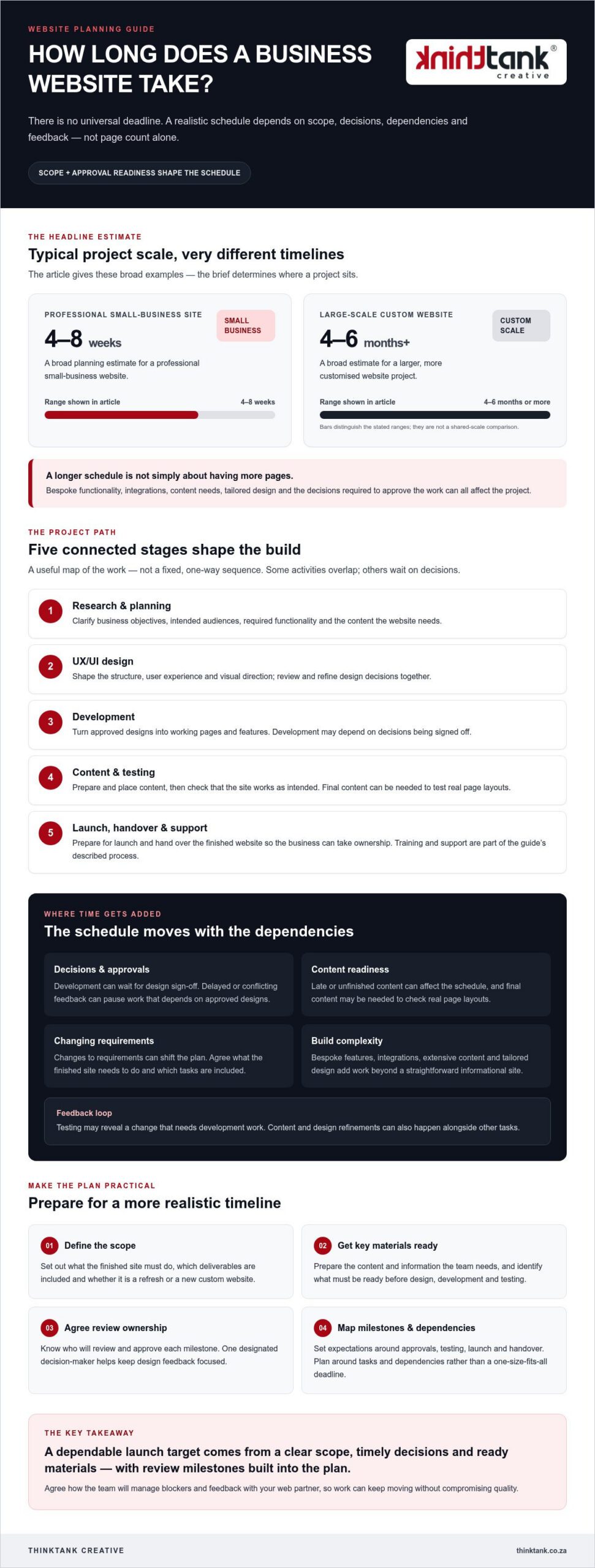
A website timeline depends on decisions, dependencies and feedback, not a universal deadline. If you’re asking how long does it take to build a business website, a professional small-business site may take around 4-8 weeks, while a large-scale custom website can take 4-6 months or more. The difference comes down to more than the number of pages.

It’s understandable to want a clear launch date before work begins. Planning is harder when you’re unsure what needs to happen before design and development, or whether late content and changing requirements could push the schedule back. In practice, timing depends on the project’s scope, how quickly decisions are made and whether key materials are ready when needed.

This guide explains the stages that shape a business website timeline, where the main dependencies sit and what your team can prepare to help prevent avoidable delays. You’ll see how research and planning, design, development, testing and launch fit together, so you can set a realistic schedule with your web partner and keep work moving without compromising quality.

Key Takeaways

  • To answer “how long does it take to build a business website”, clarify the scope, decisions and deliverables that will shape the project plan.
  • Understand how research, design, development, testing and handover connect, and why phases may overlap or need another review.
  • Identify potential blockers, from unfinished content to changing requirements, and agree how your team will manage them.
  • Build a practical timeline around milestones, dependencies and clear review ownership rather than relying on a one-size-fits-all deadline.
  • See how ThinkTank Creative’s collaborative process can guide a website from planning through launch, training and support.

How long does it take to build a business website? Start with the scope

There’s no reliable universal duration for a business website project without understanding its scope and how decisions will be made. A focused informational site has different demands from a custom build with bespoke functionality, integrations or extensive content. To answer “how long does it take to build a business website”, first define what the finished site needs to do and which tasks are included.

Building a website means more than putting pages online. It can include research and planning, UX/UI design, content preparation, coding, testing, launch and handover. Scope and approval readiness shape a website schedule. The more specific the requirements and timely the feedback, the more confidently the work can progress.

For a broader overview of the web development process, including front-end and back-end work, see Wikipedia’s introduction.

For a practical perspective on project timing, watch this video:

What does “building a business website” include?

A site refresh updates an existing website, perhaps by refining its design, content or structure. A new custom website shapes the experience and builds the pages and functionality around the business’s needs. A more complex project may also involve bespoke features or connections to other systems, which add work that a simple informational site doesn’t require.

These activities are distinct, even when they overlap. Design establishes how visitors navigate and interact with the site; coding turns those designs into working pages and features. Content needs to be prepared and placed, while testing checks that the site works as intended before launch. Launch preparation and handover help the business take ownership of the finished website.

Why a single timeline estimate can be misleading

Page count is only one part of the brief. A handful of pages with tailored functionality may need more coordination than a larger set of straightforward informational pages. Integrations, content requirements and the amount of bespoke design also influence the work involved.

Approvals create dependencies, too. Design decisions may need sign-off before development can proceed, and final content may be needed to test real page layouts. An initial website-builder setup is not necessarily a complete, launch-ready business website. The project still needs appropriate content, review, testing and handover. Define these deliverables and agree who will review them before setting a launch target.

Which website project stages shape the build timeline?

A website project is a connected set of activities, not simply a block of design followed by a block of coding. A website timeline links tasks and approval milestones. Some activities can overlap, while others depend on decisions being made. Understanding those connections helps explain how long does it take to build a business website, and where progress may pause while information or approval is outstanding.

The work often moves from research and strategy into design, development, testing, launch and support. That’s a useful way to map a project, but not every build follows a fixed, one-way path. Testing may reveal a change that needs development work, and content or design refinements can happen alongside other tasks.

From research and strategy to approved design

Early planning establishes direction. The project team clarifies business objectives, intended audiences, required functionality and the content the website needs. These decisions inform the structure and user experience, helping design respond to real priorities rather than assumptions.

Design is collaborative. The agency may present a direction for review, discuss choices such as page layouts and visual treatments, then refine the work based on feedback. Clear priorities and one designated decision-maker help keep this stage focused. If feedback is delayed or conflicting, development work that depends on approved designs may have to wait.

From development and testing to launch

Once the direction is sufficiently clear, developers build the website’s pages and functionality. The team can review progress as the work takes shape, resolving issues and making agreed refinements. Testing then checks that key features work, content displays appropriately and the experience is usable across relevant devices and browsers.

Launch requires preparation, not just a final switch-on. The project team needs to confirm readiness, coordinate the release and arrange delivery and any training the business needs to manage its website. Support can continue after launch, so the relationship doesn’t have to end when the site goes live.

For more detail on planning a tailored project, explore this custom website design and development guide. ThinkTank Creative’s website services include UX/UI design, coding, testing, launch, training and support. If you’re considering a project, you can also learn about website design and development and discuss how its stages could fit your requirements.

What makes a business website take longer, or move faster?

A website schedule is shaped by more than the work itself. Prepared content, timely decisions and a stable brief help a project progress; changing requirements, unresolved approvals or external dependencies can interrupt it. If you’re asking how long does it take to build a business website, consider how these factors affect both the work and the decisions it depends on.

A quick first draft isn’t necessarily a quicker route to a reliable launch. Adding functionality or changing direction can mean revisiting the design, updating code and testing the result again. Speed matters, but it needs to be balanced with a website that works as intended.

Helps work move forward Can slow progress
Clear business goals, audiences and page requirements Unclear priorities or new requirements added during the build
One agreed process for gathering and approving feedback Conflicting comments or delayed sign-off
Copy, images and other content prepared for the project Missing or unfinished materials needed for page layouts
Known functionality and confirmed third-party requirements Integrations or external services that need further investigation

Project inputs that are within your control

Before work begins, document the outcomes the website should support, who it needs to serve, which pages it requires and what visitors should be able to do. For example, note whether a page simply explains a service or needs a form to collect enquiries. Organise copy and images, and confirm who is responsible for anything still outstanding.

Choose a decision-maker and agree how feedback will be gathered, consolidated and approved. This gives the project team a clear route to decisions and reduces the risk of overlapping or contradictory requests. Keep review cycles focused on the agreed brief.

Scope and technical dependencies to clarify early

List required integrations, such as connections to an existing business system or an external service, and clarify what each one needs to do. Confirm who will provide access, information or approvals, and whether the third-party service is ready to use. Check domain and hosting arrangements early, including who manages them and what access the project team will need.

Agree how proposed additions or changes will be assessed before they become part of the active scope. The team can then consider the implications for design, development and testing, and decide whether to incorporate the change or plan it separately. To discuss a project brief with a website design and development partner, explore ThinkTank Creative’s website services.
How Long Does It Take to Build a Business Website? A Clear Project Timeline

How to plan a realistic business website timeline

Build the schedule around what needs to be delivered and what each task depends on. A launch date can help focus a project, but it’s more useful when supported by agreed milestones, clear responsibilities and enough room for review. This approach gives you a practical way to assess how long does it take to build a business website without relying on a one-size-fits-all estimate.

Use this planning sequence with your website partner:

  1. Define the outcomes. Clarify what the website should help the business achieve, who it needs to serve and what visitors should be able to do.
  2. Agree the brief and deliverables. Record the required pages, functionality, content responsibilities and what must be complete for the website to be considered ready to launch.
  3. Map dependencies. Identify which decisions, materials or access are needed before related work can proceed, such as approved design before development or final copy before page checks.
  4. Set milestones and owners. Agree checkpoints for research, design review, development review, testing and launch. Name the contact who will consolidate feedback, and identify who has authority to approve key decisions.
  5. Plan for review and revision. Agree review windows and allow time in the schedule for considered feedback and refinements. The amount needed depends on the project and review process, so discuss it with your partner rather than applying an arbitrary standard buffer.

Keep reviews and launch preparation moving

Maintain a shared record of open decisions, content gaps, technical dependencies and proposed changes to the brief. This makes it easier to see what is holding up dependent tasks and who needs to act next. If feedback conflicts, use the agreed decision-maker and approval route to resolve it before revisions spread across the project.

Include user needs in planning conversations, not just the visual preferences of the team. The website user experience guide can help frame design decisions around how visitors will use the site.

Treat testing and launch checks as milestones, not formalities to squeeze in at the end. Confirm that the agreed functionality works, content is in place and launch responsibilities are clear. A realistic schedule leaves room to address issues identified during testing rather than rushing to meet a date at the expense of readiness.

Discuss your website timeline with ThinkTank Creative and agree milestones around your project’s scope and dependencies.

How ThinkTank Creative guides a website from brief to launch

A clear project brief gives the agency and business a shared starting point. ThinkTank Creative’s website process brings research and strategy together with UX/UI design, coding, testing, launch, training and support. The work is coordinated around the project’s requirements, with discussion and communication helping both sides clarify decisions as the project develops.

This collaborative approach can make responsibilities and open questions easier to manage, but it doesn’t guarantee a shorter schedule. The time needed still depends on the agreed scope, the materials available and how promptly decisions can be made. That’s why a useful discussion about how long does it take to build a business website begins with the work involved, not a promised deadline.

A collaborative process from research to delivery

Research and strategy help establish what the website needs to achieve and who it needs to serve. That direction informs design and production, while client input helps keep decisions aligned with the brief. As the site takes shape, development, revision and testing connect the intended experience with how the website actually works.

Clear communication matters whenever a decision, review or approval affects the next task. Testing helps identify issues to resolve before launch, while launch planning, delivery and training prepare the business to take over the finished website. ThinkTank Creative also provides ongoing service after project completion, so launch isn’t necessarily the end of the relationship.

What to prepare before discussing your website project

You don’t need a complete technical specification to begin a scope discussion. Bring what you know and flag what still needs to be decided. Useful starting materials include:

These details help an agency understand the project’s requirements, identify questions that could affect planning and outline the work needed. They also provide a more grounded basis for discussing an estimated cost, which should reflect the specific scope rather than an assumed standard package.

If you’re considering a new website or a substantial update, bring your objectives, requirements and open questions to ThinkTank Creative’s website design and development team. A scope discussion can help clarify the inputs, decisions and milestones to plan for, without presuming a fixed launch date.

Set your website project up for a confident launch

There’s no dependable one-size-fits-all answer to how long does it take to build a business website. The schedule depends on the scope, the work each stage requires and how quickly reviews and decisions move forward. Define the outcomes, prepare key content and agree milestones with clear owners to give your team and web partner a practical plan.

A realistic timeline makes room for design, development, testing and launch preparation, rather than treating a quick first draft as the finish line. It recognises that revisions and dependencies may affect the path, and that quality checks help establish when a website is ready to go live.

Founded in 2001, ThinkTank Creative provides end-to-end website design and development, including testing, launch, training and support, with ongoing service after project completion. Bring your goals, requirements and questions to a project discussion, then work together to clarify the scope and an estimated cost.

Discuss your website project with ThinkTank Creative and take the next step towards a considered, well-planned launch.

Frequently Asked Questions

How long does it take to build a business website?

There’s no universal duration. The schedule depends on the website’s scope, functionality, content readiness, review process and technical dependencies. A clearly defined informational site differs from a custom build with complex requirements. To understand how long does it take to build a business website for your organisation, ask the provider to map deliverables, dependencies and approval points into a schedule tailored to your brief.

What is the longest stage when building a business website?

No single stage takes the longest in every project. Strategy, design, development, content preparation, client reviews or testing may need more attention, depending on the requirements. Ask your website team to identify critical dependencies and explain what must be ready before each activity can proceed. For example, the team may need approved designs before building certain pages, or final content to check how it fits.

Can I speed up the process of building a business website?

You can help the work move smoothly, although no preparation guarantees a particular launch date. Agree the scope, gather copy and brand materials, appoint decision-makers and provide consolidated feedback through an agreed review process. Discuss how changes will be assessed and how testing fits into the schedule. Functionality and external dependencies can still affect progress, so plan these with your provider rather than assuming preparation removes every possible delay.

What can delay a business website project?

Changing requirements, incomplete content, slow approvals and unclear responsibilities can interrupt dependent work. Integrations or other technical requirements may also need further investigation, while testing can uncover issues that need attention before launch. Ask the project team to record open decisions and dependencies, and agree how changes to scope will affect milestones. Addressing questions collaboratively helps everyone understand what is holding up progress and what needs to happen next.

Does website content need to be ready before design starts?

Not always, but the team needs to understand what content the website must support. Final copy and images can influence page structure, design choices and development, so missing materials may affect later work. Agree which content is required, who will provide it and when it needs approval. Then ask your provider which design tasks can begin before everything is final, so early work can progress without relying on assumptions.

What happens after a business website is built?

Depending on the agreed scope, delivery may include testing, launch preparation, handover, training and support. Confirm who is responsible for final checks, what training is included and what support arrangements apply after delivery. ThinkTank Creative offers website maintenance and support, as well as ongoing service after project completion. Discuss the specific requirements for your website with the provider, since launch does not automatically define what happens next.

How should I choose a website agency based on its timeline?

Choose a provider that explains the work behind its proposed schedule, asks about your goals and dependencies, and clarifies who will review and approve decisions. Ask how design, development, testing and launch fit together, and how changes will be handled. A credible timeline should reflect your project’s scope and required deliverables, rather than present a universal deadline. Clear answers help you judge whether the plan is practical for your team.
Professional Website Redesign: Strategic 2026 Guide

Your business website is no longer a digital business card; in 2026, it's either the most powerful member of your sales team or your greatest competitive liability. You've likely noticed that whilst your brand has evolved and your internal goals have scaled, your current digital interface feels stuck in a previous era. It's frustrating to watch conversion rates dip or see potential clients struggle with a clunky mobile experience. By engaging with professional business website redesign services, you can ensure your digital presence finally reflects the premium quality and sophisticated expertise your brand provides.

We understand the hesitation that comes with change, especially the fear of technical downtime or losing hard-earned search rankings. Our goal is to guide you through a strategic transformation that turns your site into a high-performing lead generation engine. This guide details the methodology behind a seamless transition that ensures your new, responsive site delivers measurable increases in lead quality. We'll explore how to align your digital platform with your broader marketing strategy to secure long-term growth and maintain market authority in the South African market.

Key Takeaways

  • Learn why 2026 demands a shift from simple navigation to immersive brand experiences that prioritise mobile-first connectivity for South African audiences.
  • Understand the critical difference between a cosmetic facelift and professional business website redesign services that overhaul architecture and user experience to solve conversion problems.
  • Identify the internal and external signals, such as declining lead quality and brand misalignment, that indicate your platform requires a strategic overhaul.
  • Discover a methodical process for aligning your new digital presence with your corporate identity whilst ensuring seamless integration with SEO and marketing efforts.
  • Explore how 25 years of local expertise can transform your website into a bespoke business tool that offers both aesthetic excellence and technical security.

Why Business Website Redesign Services are Vital in 2026

Digital interactions have shifted. Users no longer merely navigate; they seek immersive brand experiences that feel intuitive and immediate. If your interface feels like a relic from 2021, you aren't just losing aesthetics; you're losing market share. In the South African context, mobile-first connectivity is the absolute baseline. With diverse network speeds across the country, your platform must perform flawlessly regardless of whether a client is on high-speed fibre or a constrained mobile data connection. Professional business website redesign services ensure that your technical foundation meets the rigorous demands of Core Web Vitals, which now dictate national search rankings more than ever before. A tired, unresponsive site actively erodes trust amongst high-value B2B and B2C clients who equate digital polish with operational excellence.

Adapting to the High-Speed Digital Economy

Search engine algorithms in 2026 have evolved to prioritise genuine user engagement signals over static keyword density. They measure how users interact with your content, rewarding sites that offer fluid transitions and rapid load times. For South African businesses, this means adopting lightweight, high-performance code that remains resilient in varied connectivity environments. Performance-led design is the delicate equilibrium between visual richness and technical speed. By optimising these technical layers, you create a frictionless path that keeps visitors engaged rather than frustrated by lag.

Aligning Digital Presence with Brand Maturity

Your business has grown, yet your website might still be telling the story of who you were five years ago. This disconnect creates a brand gap that confuses potential partners and undermines your authority. Custom web design is essential for establishing a unique market position amongst competitors who rely on generic templates. Moving from a static brochure site to a conversion-centric platform requires a strategic rethink of your user journeys. Investing in business website redesign services allows you to bridge this gap, ensuring your digital presence acts as a 24/7 consultant that reflects your current maturity and scales with your future ambitions.

Facelift vs. Strategic Redesign: Understanding the Difference

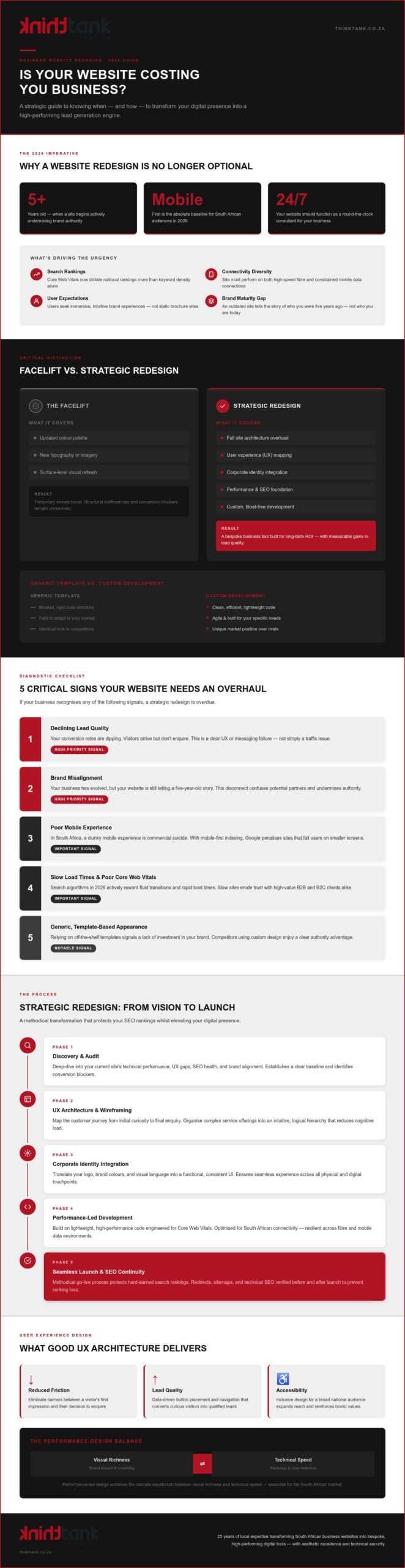
A superficial facelift is often a missed opportunity. Whilst updating your colour palette might provide a temporary boost in morale, it rarely addresses the structural inefficiencies that stifle growth. A strategic redesign, by contrast, is a holistic overhaul of your site's architecture, user experience, and brand messaging. It treats your digital presence as a living extension of your business goals. When you invest in professional business website redesign services, you aren't just buying a new look; you're building a bespoke business tool designed for long-term ROI. Generic templates often carry bloated code and rigid structures that fail to adapt to your specific market needs. Custom development offers the agility required to outperform competitors by providing a clean, efficient foundation that search engines and users both appreciate. This approach ensures your technical infrastructure is as robust as your visual presentation.

The Role of User Experience (UX) Architecture

Strategic design begins with mapping the customer journey to eliminate friction. By understanding how your visitors move from initial curiosity to final enquiry, we can organise complex service offerings into an intuitive structure. This clarity is essential for increasing lead generation. In South Africa, accessible design is a commercial necessity. Ensuring your platform is usable for a broad national audience, regardless of their technical proficiency, expands your reach and reinforces your brand's inclusivity. Utilising professional business website redesign services allows for a data-driven approach to UX, where every button placement and menu item is a deliberate choice to enhance the user experience. We focus on creating logical hierarchies where the most important information is always within reach, reducing the cognitive load on your potential clients.

Integrating Corporate Identity into the UI

Synergy between your physical and digital presence is paramount. Your website should be the digital embodiment of your corporate identity design, translating your logo and brand colours into a functional user interface. This visual consistency ensures that a client's experience remains seamless, whether they are viewing a printed brochure or your latest landing page. High-quality typography and bespoke imagery elevate the perceived value of your services, positioning your brand as a meticulous leader in its field. This collaborative approach ensures that every pixel serves a purpose, moving your brand forward with confidence and precision whilst maintaining a sophisticated aesthetic that resonates with your target audience.

5 Critical Signs Your Business Needs a Website Overhaul

Recognise your website as the primary engine of your digital growth. When this engine begins to stall, the impact is felt across your entire sales pipeline. Identifying the right moment for a change requires a clinical look at your performance metrics and user feedback. Professional business website redesign services act as the catalyst for turning these technical frustrations into measurable growth. If your platform no longer serves your objectives, it's a liability rather than an asset.

Look for these five definitive indicators that your current platform is holding you back:

Analysing Conversion and Performance Data

Sales funnel leaks are often hidden in plain sight within your analytics dashboard. You might see a high volume of traffic that fails to reach your contact page, suggesting a friction point in the user journey. The cost of inaction is high, especially when calculating lost revenue from a poor mobile experience. A three-second delay in loading can result in a 50% drop in conversions, effectively halving your marketing ROI before a user even sees your value proposition. By addressing these bottlenecks, you ensure that every Rand spent on marketing works harder for your business.

The Competitive Gap Analysis

Evaluating your site against the current digital leaders in your industry reveals a widening competitive gap. Customers in 2026 expect integrated features like live chat, secure client portals, and bespoke interactive elements as standard. Being good enough is no longer sufficient in a saturated online market where your rivals are just a click away. Strategic business website redesign services allow you to close this gap and re-establish your brand as a sophisticated industry authority. This process isn't about chasing trends; it's about meeting the evolved expectations of a modern, digital-first clientele.

Professional Website Redesign: Strategic 2026 Guide

The Strategic Redesign Process: From Vision to Launch

A successful digital transformation requires a methodical, step-by-step framework that prioritises precision over speed. When you engage with professional business website redesign services, the journey begins with a deep discovery phase where we audit your existing assets and define clear commercial objectives. This is followed by creative conceptualisation, where your brand's vision is translated into a high-fidelity digital interface that remains faithful to your corporate identity. The development phase focuses on building a secure, scalable foundation, ensuring that technical SEO is baked into the code from the very first line, a hallmark of high-quality business website redesign services. Before any site goes live, it undergoes rigorous quality assurance testing across a wide range of devices and browsers to ensure a flawless user experience for every visitor. The final launch is not an end point, but a transition into a growth phase where your new platform is integrated with broader digital marketing and email campaigns to maximise impact.

Preserving SEO Equity During Transition

One of the most significant risks during an overhaul is the potential loss of search rankings. We mitigate this through meticulous 301 redirect mapping, ensuring that the authority of your old pages is transferred seamlessly to the new architecture. By auditing your existing content, we identify high-performing pages that must be preserved whilst refreshing outdated sections to align with current market trends. Technical SEO checks are performed throughout the process to guarantee that the new site structure is easily crawlable and indexed by search engines, protecting your digital footprint during the transition.

Post-Launch Support and Maintenance

The digital landscape of 2026 demands constant vigilance. Secure website maintenance and support are essential for protecting your investment against emerging security vulnerabilities and ensuring long-term functionality. During the first 30 days post-launch, we utilise real-time data to monitor user behaviour and refine conversion paths. This iterative approach allows us to make minor adjustments to the UX based on how your audience actually interacts with the live site, ensuring that the platform continues to evolve alongside your business. Ongoing support provides the stability needed for your brand to thrive in a competitive environment, allowing you to focus on your core operations whilst we manage the technical complexities.

Partnering with ThinkTank Creative for Brand Transformation

ThinkTank Creative approaches every project with the understanding that we aren't just building a website; we're crafting a sophisticated business tool. Our methodology is rooted in a collaborative partnership that seeks to understand your unique commercial DNA. With 25 years of expertise in the South African marketing and web development landscape, we've witnessed the digital shift from simple brochures to complex, high-performing engines. This legacy, dating back to our founding in 2001, allows us to offer bespoke business website redesign services that are as resilient as they are beautiful. By integrating Branding, SEO, PPC, and Printing Solutions under one roof, we ensure that your digital presence remains in perfect synergy with your physical touchpoints. This holistic perspective prevents the fragmentation that often occurs when working with multiple disconnected vendors.

A Legacy of Creative Excellence

Our "Strategic Visionary" persona serves as a steady guide throughout your transformation journey. We believe that high-end creative design and technical SEO are not mutually exclusive; they're two sides of the same coin. This dual focus ensures that your platform doesn't just attract visitors through search rankings but converts them through an elite user experience. We don't use templates. Our commitment to high-quality outcomes is backed by our focus on bespoke craftsmanship that reflects your brand maturity and drives measurable growth. We take pride in being a dependable partner that is deeply invested in your success, providing the meticulous attention to detail your business deserves.

Ready to Elevate Your Digital Presence?

The digital landscape of 2026 moves quickly, making now the ideal time to plan your transformation. A strategic redesign serves as the fundamental bedrock for all your future digital marketing and social media efforts. Without a high-performing destination, your advertising spend is often wasted on a leaky funnel. By revitalising your platform today, you secure a competitive advantage that will last for years. We invite you to discover how ThinkTank Creative can revitalise your business website and help you reclaim your market authority. Our team is ready to move you from a high-level concept to a concrete, high-performing reality. Let's build something exceptional together.

Secure Your Competitive Advantage in the Digital Economy

A high-performing website is the foundation of your brand's growth. We've explored how moving beyond a cosmetic facelift to a strategic overhaul ensures your platform resonates with the mobile-first South African market whilst solving deep-seated conversion issues. By identifying the signals of technical debt and aligning your digital presence with your brand maturity, you transform a static site into a powerful lead generation engine. Professional business website redesign services are no longer an optional luxury; they're a commercial necessity for maintaining authority in 2026.

As a full-service agency established in 2001, ThinkTank Creative brings 25 years of expertise to every bespoke project. We specialise in delivering SEO-centric, high-performance websites that harmonise perfectly with your corporate identity. Our collaborative approach ensures that your transition is seamless and your ROI is measurable. It's time to move from a high-level concept to a concrete reality. Begin your brand transformation with a professional website redesign from ThinkTank Creative. We look forward to helping you reach new heights of digital excellence.

Frequently Asked Questions

How much do business website redesign services cost in 2026?

Pricing is determined by the scope of your technical requirements and the complexity of bespoke development. Factors such as the total page count, custom integrations, and the depth of the initial strategy phase influence the final investment. Because every business has unique commercial goals, we provide tailored quotes based on a thorough audit of your digital needs. This ensures you receive a solution that scales with your growth without paying for unnecessary bloat.

How long does a typical professional website redesign take from start to finish?

A comprehensive redesign typically spans between eight to twelve weeks, depending on the project's scale. This timeline accounts for discovery, strategy, design conceptualisation, and meticulous development. We prioritise a methodical pace to ensure rigorous quality assurance across all devices. By following a structured roadmap, we maintain strategic depth whilst ensuring your team is collaborative and informed at every milestone, leading to a polished launch that meets your 2026 business objectives.

Will a redesign negatively affect my current Google search rankings?

A strategic redesign is designed to protect and enhance your search visibility rather than hinder it. We utilise precise 301 redirect mapping and technical SEO audits to preserve your existing search equity. By improving Core Web Vitals and mobile responsiveness, professional business website redesign services often result in improved rankings over the long term. We focus on maintaining the integrity of your high-performing pages whilst optimising the site architecture for better crawlability by search engines.

What is the difference between a website refresh and a full redesign?

A refresh is a cosmetic update focusing on visual elements like colours and typography, whilst a redesign is a holistic structural overhaul. Redesigns involve rethinking the user experience (UX) architecture, content strategy, and underlying code to solve conversion issues. If your business has outpaced its current digital presence, business website redesign services offer the strategic depth needed to realign your platform with your current market maturity and the technical requirements of the modern digital economy.

Do I need to change my hosting or domain when I redesign my website?

You aren't required to change your domain name, and in most cases, keeping your established URL is beneficial for SEO. However, a redesign is an ideal time to evaluate if your current hosting provider meets modern performance and security standards. If your current server causes slow load times or lacks robust security, moving to a high-performance environment can significantly improve your site's speed and reliability, protecting your new digital investment from the start.

Can you integrate my existing branding and logo into the new design?

We specialise in ensuring your digital presence remains in perfect synergy with your established corporate identity. Our creative team takes your professional logo and brand guidelines as the foundation for the new user interface. We translate these elements into a modern digital environment, utilising custom typography and imagery to elevate your brand's perceived value. This consistency ensures that your website feels like a natural and sophisticated extension of your existing business across every touchpoint.

How often should a business consider redesigning its website?

Most industry leaders recommend a strategic review every two to three years to keep pace with evolving user behaviour and technological shifts. In the fast-moving South African market, waiting longer can result in a significant competitive gap. If your conversion rates are declining or your site feels clunky on modern mobile devices, it's a clear signal that an overhaul is necessary. Regular updates ensure your business tool remains agile, secure, and commercially effective.

Will my new website be easy for my internal team to manage and update?

Yes, we build our bespoke platforms with internal agility in mind. We provide intuitive content management solutions that allow your team to update text, imagery, and SEO metadata without needing deep technical expertise. This empowers your marketing team to remain responsive to market changes whilst we handle the complex technical maintenance in the background. Our goal is to provide you with a high-performance tool that simplifies your daily operations and supports long-term business growth. For businesses seeking a flexible and scalable foundation, exploring professional WordPress web design in South Africa can provide the bespoke framework needed to maintain full control over your brand narrative. South African businesses looking to go further can also explore professional website design for South African businesses to understand how strategic website design transforms a digital presence into a high-converting business asset.