Social Media Engagement: Ideas for More Interaction

A like is only one part of the conversation. Social media engagement includes the interactions that build community and customer loyalty, from comments and shares to thoughtful replies. To understand how to increase social media engagement, look beyond reaction counts: consider what prompts people to respond, how each platform shapes interaction and how you measure the rate.

Posting more often is not the only answer. Relevant content and genuine two-way communication give people a reason to take part. This guide covers practical ways to invite interaction, including questions, polls and community content, and how to keep your brand voice consistent. You’ll also learn how engagement differs across platforms and how to calculate a basic engagement rate using likes, comments, shares and followers, so you can assess performance more clearly.

Key Takeaways

  • Measure meaningful interactions, not just likes, to understand whether your content is building community and customer loyalty.
  • Use audience insights to shape relevant posts, then invite participation with polls, thoughtful questions and community contributions.
  • Adapt your content to each platform, as formats and typical engagement levels differ across social networks.
  • Keep your brand voice recognisable in posts and replies, while sharing stories that make your business feel more human.
  • Calculate a basic engagement rate by dividing likes, comments and shares by your follower count, then multiplying by 100.

1. What is Social Media Engagement?

Social media engagement describes how people interact with content and a brand. It includes likes, comments, saves, replies, mentions and shares, but the count alone doesn’t show what those actions mean. A detailed comment or a customer sharing a useful post may signal stronger interest than a quick reaction. Treat engagement as evidence of a conversation, not simply a popularity score.

Start by defining the audience you want to reach. Consider location, age group, language, interests and the problems your product or service addresses. In South Africa, language preferences and interests can vary across customer groups, so one message may not suit everyone. Use available audience analytics to examine demographics, content interactions and follower behaviour. Compare those patterns with the questions customers raise in comments and messages.

Native analytics tools include Meta Business Suite, Instagram Insights, LinkedIn analytics, TikTok analytics and X analytics. They provide platform-specific information about reach and interactions. The cost of paid analytics and social-listening tools in South Africa varies by provider, features and account needs.

Buying followers or using bots and engagement pods can make performance figures less representative of genuine audience interest. Engagement bait, such as asking for unrelated comments or shares, may generate activity without useful feedback. Focus instead on interactions from people who care about your subject, and assess whether their responses support your communication goals.

Choose platforms based on audience behaviour and content format. A professional service might use LinkedIn to share industry insights, while a visually focused brand could use Instagram to present product photography. TikTok suits short-form video, whereas Facebook can support community discussions and local updates. These are starting points, not fixed rules: compare interaction quality on each platform before deciding where to focus your effort.

Use social listening to understand what your audience discusses beyond your own posts. Review recurring questions, customer feedback, relevant mentions and the language people use to describe their needs. For example, repeated questions about delivery could inspire a clear explainer post. This helps uncover content opportunities and shows which topics prompt meaningful responses.

Tailor each post to an observed preference. If followers save practical checklists, create another useful guide; if they share customer stories, invite them to contribute their experiences. Look for recurring themes in comments and user-generated content, then adapt your examples, format and tone. This is a practical foundation for learning how to increase social media engagement: listen, publish with purpose and use responses to shape what comes next.

2. Using polls, questions, competitions, and user-generated content

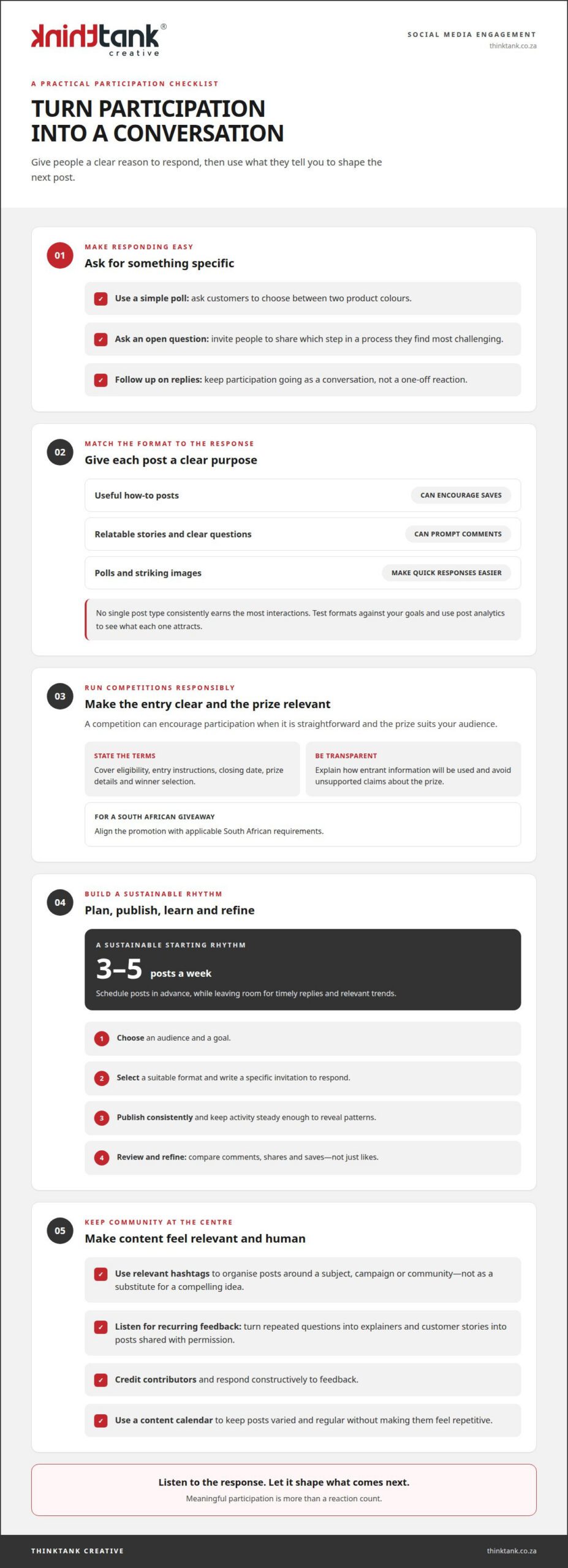
Give people an easy, specific reason to respond. A poll asking customers to choose between two product colours is simpler to answer than a broad request for opinions. Open questions work well when they invite useful experiences, such as asking which step in a process people find most challenging. Follow up on answers so participation becomes a conversation, not a one-off reaction.

No single post type consistently earns the most comments, shares, saves and reactions. Useful how-to posts can encourage saves, while relatable stories and clear questions can prompt comments. Polls and striking images can make quick responses easier. Test formats against your goals, then use post analytics to see which interactions each one attracts.

Competitions can encourage participation when entry is straightforward and the prize suits your audience. For a South African giveaway, publish clear terms covering eligibility, entry instructions, closing date, prize details and winner selection. Align the promotion with applicable South African requirements, explain how entrant information will be used, and avoid unsupported claims about the prize.

Use hashtags to organise relevant posts, not as a substitute for a compelling idea. Choose tags connected to the subject, campaign or community, then check whether they attract relevant conversations. Customer feedback can guide future content too: a recurring question might become a short explainer, while a customer story could inspire a post shared with permission.

There isn’t one best posting time for every South African audience. Use platform analytics to identify when your followers are active, test different time slots and compare the resulting interactions. A sustainable starting rhythm is three to five posts a week. Schedule them in advance, while leaving room for timely replies and relevant trends.

Build and test a strategy in a clear sequence: choose an audience and goal, select a suitable format, write a specific invitation to respond, publish consistently, then review the results and refine the next post. For example, compare a product-choice poll with a practical tip by looking at comments, shares and saves, not just likes. Maintain a consistent level of activity to reveal patterns.

Authenticity matters more than manufacturing activity. Share customer contributions with permission, credit the creator, and respond constructively to feedback. A content calendar can keep these posts varied and regular without making them feel repetitive. For tailored planning and creative execution, explore social media marketing.

3. Differences in engagement across platforms

Compare like with like: each platform has different audiences, formats and interaction habits. Typical median engagement rates are approximately 6.2% on LinkedIn, 5.6% on Facebook, 5.5% on Instagram, 4.6% on TikTok, 4.0% on Pinterest and 2.5% on X. These figures offer context, not targets for every South African account. A business should compare its own posts with similar content on the same platform.

A rate between 1% and 6% is generally considered good, depending on platform, industry and other factors. That broad range makes context essential: a specialist B2B account on LinkedIn serves a different purpose from a retailer connecting with consumers on Instagram. Look at comments, shares and other meaningful actions alongside the rate. A smaller audience that responds to relevant posts may be more valuable than a larger, less active following.

Format also changes the picture. Instagram Reels generate approximately 36% more reach than carousels, whilst carousels earn approximately 12% more engagement than Reels. LinkedIn document or PDF carousel posts have a median engagement rate of 21.77%. These comparisons suggest that reach and interaction are separate outcomes. Choose a format based on whether the post needs to attract new viewers or encourage deeper responses.

Platform algorithms influence which content appears in people’s feeds, but their signals and ranking systems differ and change. A useful strategy is to create posts suited to each platform, then observe how followers respond. For instance, a LinkedIn document can present a detailed process, while an Instagram carousel can break a visual guide into clear steps. Replying to comments also keeps the conversation active: replies present were associated with an estimated 30% engagement lift on LinkedIn and 42% on Threads.

Give each channel a defined audience and purpose. LinkedIn can support professional discussion; Instagram can showcase visual storytelling; TikTok centres on short-form video; Pinterest helps people discover visual ideas; and X supports concise, timely conversation. Facebook can bring community updates and discussions together. These roles are starting points, not rigid rules. Let audience behaviour and the content itself determine where each post belongs.

Review platform analytics separately instead of blending every interaction into one figure. Track reach, comments, shares and saves for comparable posts, then note the format and subject. If Instagram Reels attract more reach but carousels prompt more saves, keep both for their distinct purposes. This gives your social media strategy a practical basis: focus on platforms that help your business connect with the right people, and adapt creative choices to audience responses.
Social Media Engagement: Ideas for More Interaction

4. Maintaining an authentic and consistent brand voice

A recognisable voice makes each post feel connected to the same brand, whether it appears on Facebook, Instagram or LinkedIn. Define a few practical traits, such as warm, informed and direct, and use them to guide captions, customer replies and product announcements. An approachable brand, for example, can explain a service clearly without jargon or exaggerated promises.

Turn those traits into a short voice guide. Include preferred wording, the level of formality, topics the brand can speak about and examples of suitable replies. If a customer raises a concern on Facebook, the response should sound as considered as a product-launch post. Consistency doesn’t mean copying identical captions across platforms; it means expressing the same values in formats suited to each audience.

Authenticity comes from showing the people and decisions behind the brand. Share an employee’s perspective, a customer story or the steps involved in creating a product. These stories give followers something specific to discuss and help explain what the business stands for. Ask permission before featuring customer contributions, and represent their words and experiences accurately.

Plan a content calendar around recurring themes, such as customer questions, expertise, team stories and product information. Scheduling drafts in advance helps maintain a steady presence while leaving space for timely updates and genuine replies. Before publishing, check that the wording, visual style and invitation to respond match the brand’s voice guide. A calendar supports consistency; it shouldn’t make every post feel formulaic.

Keep the relationship active after publishing. Monitor comments and messages, respond within 24 hours where possible, and use feedback to inform future communication. A thoughtful reply can acknowledge a customer’s point, answer their question and invite a useful next step. If criticism appears, address the issue calmly rather than switching to a defensive tone that conflicts with the brand’s usual manner.

Give the approach time to develop. Consistent posting and interaction often take 1 to 3 months to show engagement results, so review patterns across that period rather than judging the voice by one post. Look for recurring questions, constructive conversations and audience responses to different story types. If a message feels unlike the brand, revise it before publishing; if a particular tone prompts meaningful discussion, carry that learning into the next campaign.

5. Defining and calculating social media engagement

Engagement can be counted as interactions or expressed as an engagement rate. The count shows how many likes, comments and shares a post received. The rate puts those actions in context, helping you compare performance against audience size. These measures answer different questions, so decide whether you need a total activity figure or a proportional view.

For a basic follower-based rate, add likes, comments and shares, divide the total by your follower count, then multiply by 100. For example, a post with 200 engagements and 5,000 followers has a 4% engagement rate: (200 ÷ 5,000) × 100. Keep the formula consistent across the posts you compare.

Some reports calculate engagement using reach rather than followers. Reach-based rates show interactions relative to the people who saw a post; follower-based rates compare them with your account audience. The denominators are not interchangeable. Label the formula beside each result, or an apparent change may reflect a different calculation rather than a stronger audience response.

Set the measurement period and content scope before reviewing results. You might calculate a rate for each post, then compare similar posts from the same platform over a consistent period. Separate organic posts from paid promotion, and note the format, topic and call to action. A visual guide, short video and hashtag-led announcement may each invite different interactions.

Interpret the numbers in light of each post’s purpose. A useful tutorial may earn saves, while a discussion prompt may attract comments. If your calculation includes only likes, comments and shares, it won’t represent every valuable response. Track relevant measures such as saves or link clicks separately, and use customer feedback to understand why an interaction happened.

Use the result to guide your next decision, not simply to rank posts. If a post receives a lower rate, review its audience fit, clarity, timing and format. Then test one change, such as a more specific question or a stronger opening visual. Record the change and compare the next results using the same formula. This feedback loop turns measurement into a practical way to refine content.

For a measurement-led approach to planning and improving your social media presence, get support with social media marketing.

ThinkTank Creative: Social Media Marketing

ThinkTank Creative provides Social Media Marketing to help businesses build a considered presence and create content that invites meaningful interaction. Turn to this support when posting feels inconsistent, engagement is difficult to interpret or your social channels need a clearer connection to your wider brand.

A focused approach can bring audience insights, platform choices, content planning and performance measurement into one coherent strategy. Branding & Creative Design can help align your visual expression with your brand, while Website Design & Development can support a consistent experience beyond social media. The work is shaped around your business objectives, audience and preferred direction.

Ready to bring more structure and purpose to your social media? Contact ThinkTank Creative to discuss your goals.

Turn interaction into lasting momentum

Make your next step deliberate: choose one audience response you want to understand better, then shape upcoming content around that opportunity. The question of how to increase social media engagement becomes more valuable when it leads to clearer decisions, stronger conversations and a closer connection between your brand and its community. Keep learning from how people respond, and let those insights guide your next creative move.

As your approach develops, align social media activity with the wider experience people have of your business. ThinkTank Creative can support that direction through Social Media Marketing, Creative design, and Website Design and Development. If you’re ready to turn your ideas into a considered strategy, contact ThinkTank Creative to discuss your strategy. A thoughtful next step can set the foundation for more purposeful interaction and continued growth.

Frequently Asked Questions

What is Social Media Engagement?

Social media engagement describes how people respond to and participate in a brand’s activity on social platforms. A customer might comment with a product question, share a useful post with a colleague or mention a business in their own update. These actions signal different kinds of interest. Consider what each response reveals about customer needs instead of treating every interaction as equally valuable.

What does social media engagement include, and how is engagement rate calculated?

Engagement can include likes, comments and shares, alongside platform-specific actions such as saves, replies or mentions. For a basic follower-based rate, add likes, comments and shares, divide by the follower count, then multiply by 100. A post with 200 engagements and 5,000 followers has a 4% rate. Keep the same formula when comparing posts, and label which interactions your calculation includes.

What are the best ways to increase engagement on Instagram, TikTok, Facebook, LinkedIn and X?

Match the format to the platform and the response you want. On Instagram, test a carousel that guides viewers through a process; on TikTok, make a short video answering a common question. Facebook can host a community discussion, LinkedIn can invite professional perspectives, and X can carry a concise prompt about a timely topic. Review responses on each channel, then develop the formats that attract relevant conversations.

How often should businesses post on social media to increase engagement?

A practical starting point is three to five posts a week, adjusted to your team’s capacity and audience response. For example, a local service business could schedule educational posts and customer updates throughout the week rather than publishing several rushed messages in one day. A regular rhythm helps audiences know what to expect. Review the quality of replies and shares, then adapt the schedule to keep posting useful and sustainable.

How can businesses use hashtags, captions, questions and calls to action to boost engagement?

Make each element support one clear idea. Use hashtags relevant to the subject, open the caption with a specific benefit, then ask a question people can answer from experience. For example, a café could ask which seasonal drink customers would like to see return. Finish with a direct invitation, such as “Tell us your pick below.” Avoid unrelated tags or requests for reactions that don’t contribute to the conversation.

How can brands encourage user-generated content, community participation and replies?

Invite customers to share how they use a product or service, then feature suitable contributions with permission and clear creator credit. A gardening business could ask followers to post progress from a home project, giving others a topic to discuss. Respond with a specific observation or follow-up question. Acknowledging people by name, where appropriate, helps their participation feel valued and gives the community a reason to return.

What are typical social media engagement rate benchmarks by platform and industry?

Typical median engagement rates are approximately 6.2% on LinkedIn, 5.6% on Facebook, 5.5% on Instagram, 4.6% on TikTok, 4.0% on Pinterest and 2.5% on X. A rate between 1% and 6% is generally considered good, depending on platform, industry and other factors. Treat these figures as context, not fixed targets: compare similar content on the same platform and account for audience size and purpose.

What are the best times to post on social media in South Africa?

There is no single best posting time for every South African audience. Use platform analytics to find when your followers are active, test different time slots and compare interactions.
How to Build a Social Media Content Calendar From Your Ideas

A social media content calendar should do more than mark dates. It brings together what you’ll post, where and when it will appear, and the details needed to prepare each piece of content. Learning how to create a social media content calendar starts with organising your ideas around your audience, goals and capacity to publish consistently.

If social media planning often feels like a scramble, a clear calendar can organise your ideas without making content feel rigid. It helps you see what’s coming, balance different post types and leave room to respond when priorities shift.

This guide explains what to include in your calendar and how it differs from a broader content plan. You’ll set goals, choose platforms and a realistic posting frequency, then schedule posts and track performance to refine your approach over time.

Key Takeaways

  • Set clear, measurable social media goals before turning ideas into scheduled posts.
  • Focus on platforms where your audience is active and you can publish quality content consistently.
  • Choose a posting rhythm that fits your resources, then refine it using audience behaviour.
  • Give each calendar entry the practical details needed to prepare, review and publish the content.
  • Track performance against your goals and use the results to shape your next round of posts.

What is a Social Media Content Calendar?

A social media content calendar sets out what you’ll publish, where and when. A content plan establishes strategy and themes, while an editorial calendar maps broader priorities across months or quarters. Learning how to create a social media content calendar means connecting audience needs and clear goals with practical publishing details.

Set SMART social media goals: specific, measurable, achievable, relevant and time-bound. Choose content pillars, such as product education, customer stories and useful advice, to give posts recurring themes.

  1. Start with audience behaviour. Identify who you want to reach, what they need and which platforms they use. For younger consumers aged 18-25, TikTok or Instagram may be more effective than Facebook. Use audience insights, comments and engagement patterns to guide platform choices, rather than assuming every channel deserves equal attention.
  2. Choose platforms you can serve well. Select 2-3 platforms where potential customers are active and you can publish quality content consistently. Consider each format: a short video, carousel or written update may communicate the same idea differently. Focusing your efforts makes it easier to maintain a coherent workflow and review engagement meaningfully.
  3. Set a realistic publishing rhythm. Use audience activity and available time to decide how often to post on each platform. Start with a schedule your team can sustain, then compare posting times and engagement. If LinkedIn brings relevant interactions but another platform stays quiet, focus more effort on the audience showing interest.
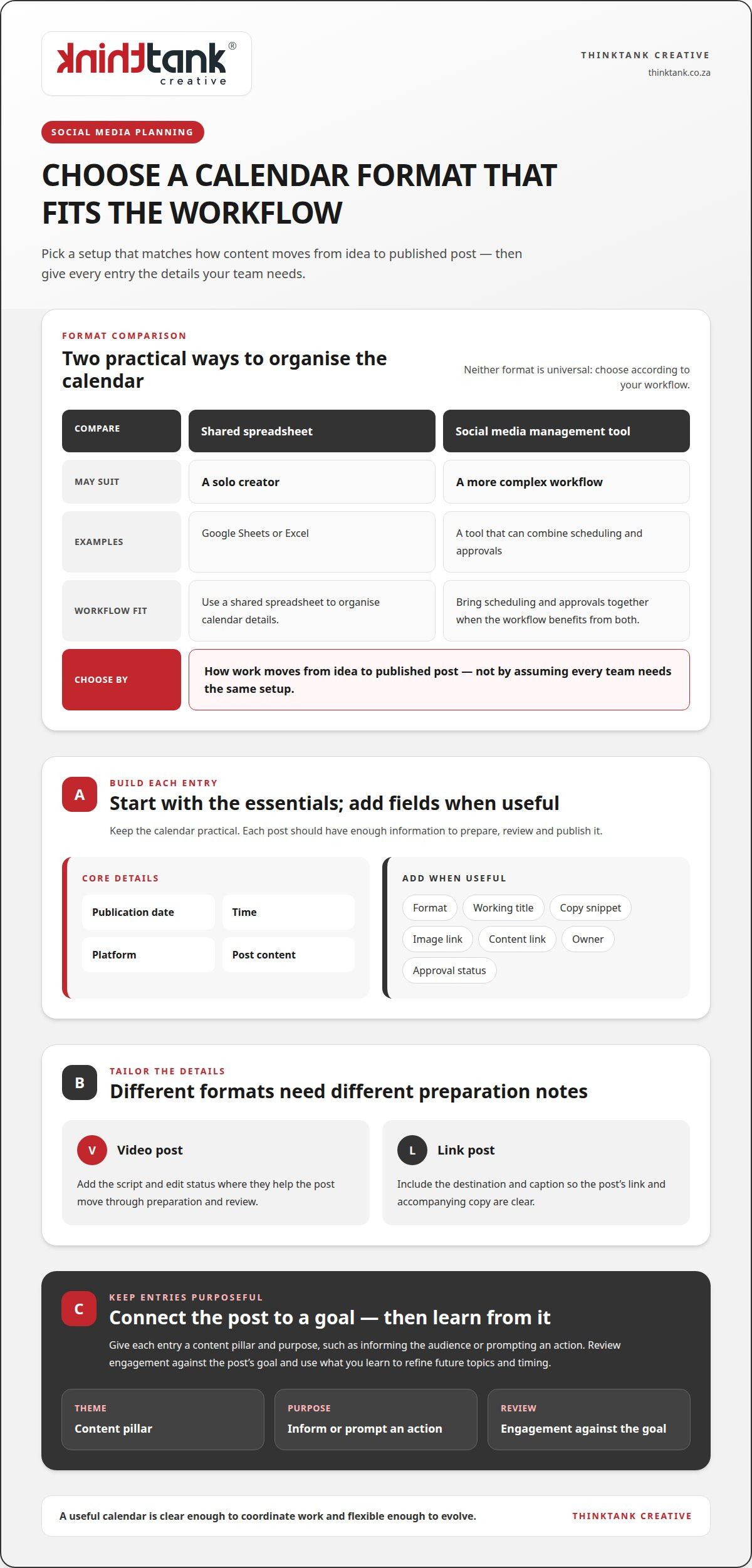
  4. Choose a template that supports decisions. Organise the calendar in Google Sheets, Excel or a social media management tool. A shared spreadsheet may suit a solo creator, while a more complex workflow may benefit from a tool that combines scheduling and approvals. Choose based on how work moves from idea to published post.
  5. Customise the fields. Start with publication date, time, platform and post content. Add fields for format, working title, copy snippet, image link, content link, owner and approval status when useful. A video post might need a script and edit status, while a link post needs its destination and caption.
  6. Connect ideas to goals and review. Give each entry a content pillar and purpose, such as informing the audience or prompting an action. Keep the template flexible enough to accommodate changing priorities. Review engagement against each post’s goal, then use what you learn to refine future topics and timing. That’s how to create a social media content calendar that can evolve with your audience.

Benefits of planning social media content

Planning gives you room to coordinate campaigns, prepare graphics and meet deadlines. But planning too far ahead can leave messages out of step with changing priorities, audience concerns or event details. Keep entries further out flexible.

  1. Use the calendar to coordinate work. Assign each campaign post a purpose, format, owner and deadline. For example, a launch announcement may need a caption, product graphics and a review before publication. Recording these dependencies together helps the team spot missing assets early, rather than discovering them on launch day. Add notes when a post relies on input from another team.
  2. Plan around key dates and events

    Mark relevant holidays, industry events and business milestones in the calendar, then connect each date to an audience need. A seasonal campaign might require advance graphics, an announcement and a follow-up post. Check event details and business priorities as publication approaches, and avoid filling every key date with promotional content. Leave room for timely updates if circumstances change.

  3. Allow lead time for campaigns

    Begin planning six to eight weeks before an anchor moment, such as a launch or event. Work backwards from publication, mapping idea development, copy, graphics, review and scheduling. This gives contributors clear deadlines and reveals dependencies early. Make campaign themes visible in advance, but keep final wording adaptable if audience needs or plans shift.

  4. Record useful campaign notes. Add the campaign objective, intended audience, key message, required assets and approval status to relevant calendar entries. For a launch, notes might identify a teaser, announcement and follow-up, each with its own purpose. These details show collaborators how individual posts support the wider campaign and reduce repeated conversations about responsibilities and next steps.
  5. Keep the plan flexible and useful. Schedule at least a month ahead where practical, while reviewing the calendar regularly for changes. Treat far-off entries as themes or placeholders, not locked copy. A local event, updated business priority or audience response may call for a change. A clear review point helps protect deadlines without forcing unsuitable content into the schedule. For support aligning campaigns and content, explore social media campaign planning.

Scheduling, publishing, and tracking performance

Turn each approved calendar entry into a publish-ready post, then measure its performance against a clear objective. A consistent workflow helps keep posts across channels accurate, timely and aligned with campaign goals.

  1. Add posts and publishing slots

    Assign each post a publication date, time, channel, format and status. For example, a teaser reel can be scheduled for Monday at 10:00, followed by a launch announcement on Tuesday at 11:00. Add the final copy and creative asset to each slot, and leave enough time for review before publishing. Check that planned posts don’t compete for attention or repeat the same message across channels.

  2. Upload the calendar to publishing software

    Transfer calendar entries into your chosen publishing software, using its import option if the template supports it. Match each field carefully: put publication time in the schedule, copy in the caption, and the correct asset with its post. Preview queued content before confirming it, checking the channel, date, time and formatting. A media calendar template remains a useful shared reference throughout the workflow.

  3. Hand approved posts off clearly. Mark posts as approved only after copy and creative are ready, then make the publishing responsibility visible. Keep approval steps lean, since each extra layer can slow delivery. Set an approval workflow with a 24-hour feedback period so contributors know when to respond. If feedback arrives late, update the slot rather than publishing content that hasn’t received approval.
  4. Track results against the post’s purpose. Record the measure that matches each objective, such as engagement for a conversation post or visits for a launch announcement. In one campaign example, the goal was 100 visits to the launch page during launch week; posts brought 80 visits the following Monday. That comparison shows the gap clearly and gives the next review a practical starting point.
  5. Use performance to refine the next schedule. Review results by post, format and channel, then note what earned attention or prompted action. Compare similar posts rather than drawing conclusions from a single result. For instance, if a video and a carousel supported the same campaign, assess both against the same goal. Carry useful observations into the next calendar and adjust future slots, creative or messaging accordingly.

How to Build a Social Media Content Calendar From Your Ideas

Setting posting frequency

Choose a publishing rhythm that suits audience interest, platform behaviour and available resources. Treat platform recommendations as a starting point, then use your own results to shape future posts.

  1. Set a sustainable baseline. Decide how much time your team can give to planning, creating, reviewing and publishing. A solo marketer might begin with fewer, stronger posts rather than commit to daily content across several channels. Allow time to produce captions and creative assets, not just to publish. Document the rhythm in your calendar so collaborators can plan around it.
  2. Use platform guidance as a reference. Suggested starting frequencies include 3-5 Instagram posts per week, 5-7 Reels per week and 7-15 Stories per week. Other recommendations include 10-20 X posts per week, 5-10 Threads posts per day and 5-7 TikTok posts per week. Google Business Profile has a suggested range of 1-3 posts per week, whilst YouTube has 1-2. These are examples, not a universal rule.
  3. Match frequency to audience interest. Review when people interact with your posts, which formats attract meaningful responses and what questions appear in comments. If LinkedIn generates useful conversations but X posts receive little engagement, prioritise the channel that reaches your audience. A few relevant LinkedIn posts each week may serve that audience better than numerous posts that go unseen elsewhere.
  4. Set a test period and measure consistently. Record the chosen frequency for each platform in your calendar, then track engagement against each post’s purpose. Compare similar formats and topics over the same review period. If posting more often coincides with weaker responses or strained production, adjust the schedule. If a cadence supports interaction and remains manageable, keep it.
  5. Build a balanced weekly pattern. Give each slot a role, such as education, conversation or promotion, instead of repeating one format. For example, a weekly schedule could pair a practical advice post with a customer question and a product update. Vary captions and creative formats to give followers reasons to engage. Leave room for timely updates rather than filling every slot in advance.
  6. Revisit the schedule with collaborators. Share the planned cadence with everyone responsible for writing, design and approvals. Check whether each person can manage the workflow before committing to additional posts. Record changes and the reason for them, such as shifting audience interest or a campaign requirement. This helps the team make deliberate adjustments instead of increasing frequency without a clear purpose.

What a social media content calendar includes

Build each calendar entry to move a post from idea to publication without losing its purpose. A useful template combines scheduling details with the creative and practical information needed for consistent delivery.

  1. Record the publishing essentials. Give every post a publication date, time and platform. Add a working title and content type, such as an Instagram carousel or LinkedIn article. These fields help collaborators scan the schedule quickly and distinguish posts with similar themes. Include the intended audience or campaign where it helps explain why a post belongs in that slot.
  2. Make the creative easy to find. Add the draft caption, copy snippet and links to final visual assets. For an Instagram carousel, note the image sequence and where the caption will appear; for a LinkedIn update, attach the relevant graphic or document. Use clear, consistent asset names so the person preparing a post can match the right file to its calendar entry.
  3. Track status and ownership. Include a status such as idea, in progress, awaiting approval, approved or published. Assign an owner for the caption, visual or final scheduling task when several people contribute. For example, a designer can see which graphic needs review, while the publisher can identify approved posts ready to go.
  4. Connect each post to its purpose. Add a content pillar, campaign name and objective where these details guide the work. A customer tip might support an education theme, while a launch post serves a campaign objective. This context helps the team assess whether the calendar has a coherent mix rather than a sequence of unrelated updates.
  5. Customise the template to the workflow. Start with essential columns, then add fields only when they meet a practical need. A small team may need dates, platforms, captions, visuals and status; a collaborative campaign may also need approval notes and content links. A crowded template can hide deadlines, so remove unused fields and group related details together.
  6. Keep the calendar usable as plans evolve. Use a shared spreadsheet or publishing tool as the current source of truth, and update a post’s status when it changes. A postponed LinkedIn announcement should show its revised date; an Instagram visual awaiting approval should remain marked as in progress. Review entries regularly to keep the planned schedule consistent with published content.

For a calendar that connects content, creative and publishing needs, develop a social media content strategy with considered support.

ThinkTank Creative: Social Media Marketing

ThinkTank Creative helps businesses turn social media ideas into a considered, consistent publishing approach. Its Social Media Marketing service supports planning, content development and campaign coordination, giving each post a clear role in your wider communication.

Consider this support when maintaining a calendar alongside daily business demands becomes difficult, or when your content needs stronger alignment with your brand. Creative design can shape visual assets, while Logo and Corporate Identity Design can help create a cohesive identity across social channels. For a broader digital experience, Website Design and Development can connect social content with a well-designed online destination.

Bring your goals, audience and current ideas together, then contact ThinkTank Creative to discuss social media marketing support.

Make your next idea count

A calendar becomes more valuable when it helps your team make better decisions, not simply fill available dates. Treat each new idea as a chance to learn what your audience responds to and sharpen the direction of future content. Learning how to create a social media content calendar is an ongoing process as your priorities and audience interests evolve.

Choose one upcoming idea and give it a clear purpose before it enters your workflow. As you develop the content, keep your brand’s wider communication in view, so each post contributes to a recognisable, considered presence. Small, deliberate refinements can help your approach grow alongside the business.

If you’d like a collaborative partner to strengthen your social media approach, contact ThinkTank Creative. Take the next step with confidence and build a calendar that gives your ideas room to develop.

Frequently Asked Questions

How do I create a content calendar template?

Start with a blank spreadsheet and build columns around your team’s decisions. Include a campaign or content theme, draft owner, review date, publication slot and final destination link. For example, a post promoting a downloadable guide needs a destination link and someone responsible for checking it. Test the template with a small batch of planned content, then remove fields that don’t help anyone take action.

How many posts per week should I publish on each platform?

Use platform suggestions as a practical starting point, then adjust to your audience and production capacity. Current examples include 3-5 Instagram posts, 5-7 TikTok posts, 10-20 X posts and 1-2 YouTube posts per week. Threads guidance suggests 5-10 posts per day, whilst Google Business Profile suggests 1-3 weekly. These are not mandatory quotas; the useful frequency is one your team can sustain and assess.

What’s the difference between a content calendar and an editorial calendar?

A content calendar manages individual deliverables, while an editorial calendar sets broader themes and priorities across months or quarters. For example, an editorial calendar might mark a seasonal campaign for a quarter; the content calendar then assigns its posts, formats and publishing slots. Keeping both views helps teams connect long-term direction with the practical work due each week, without treating every future post as final copy.

What is a social media content calendar and what should it include?

A social media content calendar is a working schedule for planned posts across selected platforms. Include each post’s date, publishing time, format, working title, draft copy and relevant asset or destination link. A campaign tag and status can clarify context, while an owner field shows who will move the post forward. For a community question, for instance, note the response prompt and who will monitor replies.

What steps are involved in creating a social media content calendar?

First define your audience and the outcome each platform should support. Choose content themes, select suitable channels and set a realistic publishing rhythm. Then build a template, add post ideas and production details, assign owners, and schedule approved work. After publishing, compare results with the original objective and use what you learn to adjust the next cycle. For example, a campaign focused on page visits needs a link and a measure related to visits.

How often should you post on each social media platform?

There isn’t one frequency that suits every account; audience behaviour and available resources should guide it. For example, suggested ranges include 5-7 Instagram Reels and 7-15 Instagram Stories per week, alongside the platform’s other posts. Treat each format separately, since Stories and feed posts serve different purposes. Review whether the cadence supports useful interactions, and change it if production becomes difficult to sustain or audience responses shift.

How do you choose the best social media platforms for your audience?

Choose platforms where your intended audience is active and your team can create content suited to their expectations. Use existing enquiries, customer conversations and engagement patterns to identify where people already interact. For instance, a business whose audience engages with professional advice might test LinkedIn content before committing effort to several channels. Focus on a manageable selection, then assess the quality of responses rather than judging a platform by activity alone.

What tools and templates can you use to plan a social media content calendar?

Google Sheets and Excel work well for shared schedules, while social media management tools can support a more integrated publishing workflow. Choose based on how your team drafts, reviews and schedules posts. A spreadsheet may suit a small team that needs clear ownership; a tool may help when posts pass through several approval stages. Whichever you choose, keep one current calendar and make changes visible to everyone involved.

Long-tail keywords for South African businesses and how they work

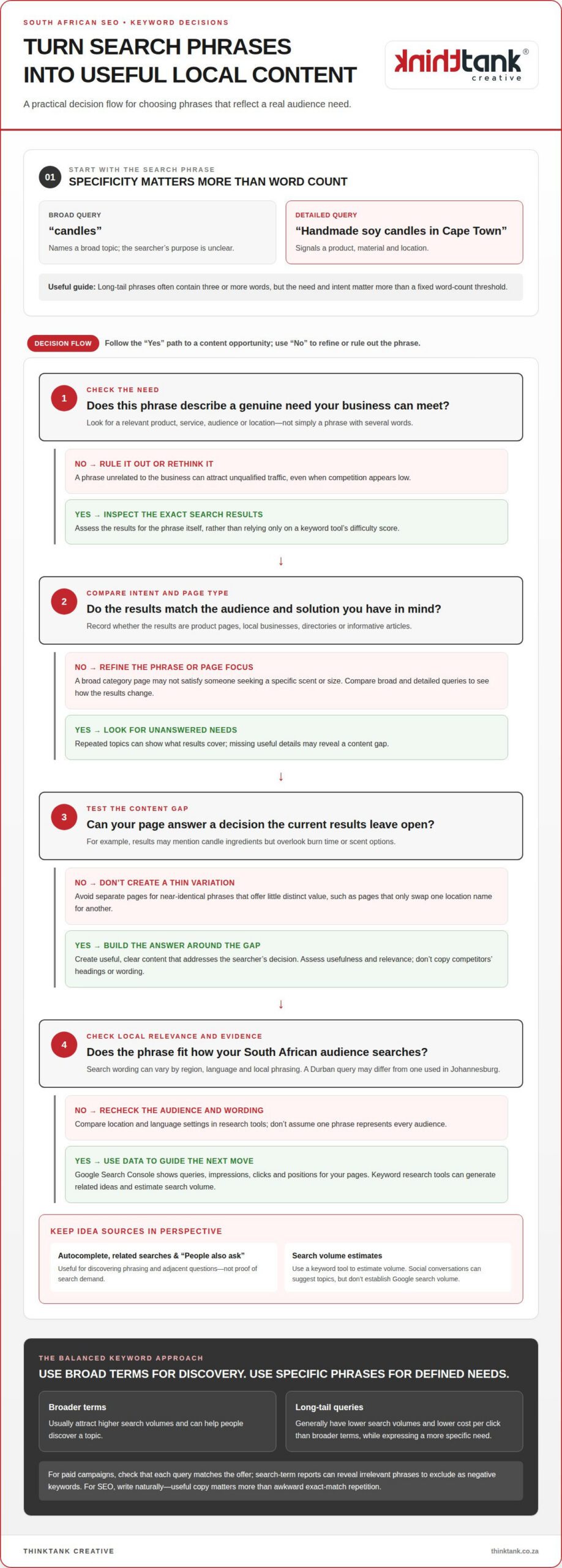
A more specific search can be more useful than a popular one. Long-tail keywords for South African businesses are detailed search phrases that reveal what someone wants, rather than simply naming a broad topic. They often contain three or more words, but specificity and intent matter more than a fixed word count.

Broad keywords can help people discover a topic, while a more detailed phrase can signal a particular need, service or location. The challenge is finding phrases that reflect how your audience searches, then using them naturally in useful content. This article explains how long-tail keywords work, how they reveal search intent and how to uncover ideas that fit a South African audience. It also shows why a balanced strategy combines specific phrases with broader terms, rather than relying on either alone.

Key Takeaways

  • Judge a phrase by the specific need it expresses, not simply by how many words it contains.
  • Compare broad and detailed searches to see how competition and the kind of results change.
  • Use search intent to shape pages around what people in your audience are actually looking for.
  • Explore autocomplete, related searches and existing search data to uncover useful keyword ideas.
  • Combine focused phrases with broader terms to support discovery across different stages of the customer journey.

What Are Long-Tail Keywords?

Long-tail keywords are specific search phrases that describe a particular need. They usually contain three or more words, but intent matters more than a word-count threshold. A short-tail query such as “candles” leaves the searcher’s purpose unclear. “Handmade soy candles in Cape Town” points to a product, material and location. Short-tail phrases typically contain one or two words and cover broader subjects.

Assess competition by examining the results for the exact phrase, not just a keyword tool’s difficulty score. Search “handmade soy candles in Cape Town” and note what appears: product pages, local businesses, directories or informative articles. These results reveal the format and purpose search engines consider relevant. A page competing with established retailers may need stronger product detail than one competing with general advice articles.

Use a consistent comparison when assessing the results:

That comparison can reveal content gaps. If results mention candle ingredients but overlook burn time or scent options, a useful page can address those needs clearly. A gap is not simply a missing phrase; it is an unanswered part of the searcher’s decision. Competitor analysis should therefore assess usefulness, relevance and clarity, rather than copy headings or wording.

Specific phrases often face less competition because fewer pages target that precise need. They can attract visitors with clearer intent, which may support conversion when a page offers the right answer or product. But low competition alone does not establish value. A phrase with little relevance to the business can bring unqualified traffic, even if its search results look easy to enter.

Long-tail keywords generally have lower search volumes and lower cost per click than broader terms in paid campaigns. This can make them useful in a PPC strategy, but assess whether each query matches the offer before using it. Search-term reports can reveal irrelevant phrases to exclude as negative keywords. For SEO, avoid awkward repetition: natural, useful copy matters more than exact-match insertion.

Common risks include targeting phrases solely because they contain several words, pursuing queries unrelated to the business and creating thin pages for near-identical variations. For example, separate pages that only swap “Cape Town” for another location may offer little distinct value. Choose phrases that express a genuine need, inspect their search results and create content that answers that need fully.

Comparing search results for specific and generic queries

Compare the results for a broad phrase and a detailed query to see how Google interprets each need. Search suggestions and performance data can then help refine ideas for South African audiences.

Search Console and Keyword Research Tools

Google Search Console shows queries already bringing people to your pages, whilst keyword research tools help generate related ideas and estimate search volume. Together, they reveal opportunities to improve existing content and explore terms your pages don’t yet target. For example, Search Console may show a page appearing for a detailed service query on the 2nd, 3rd, or 4th page of Google search results. A related tool can help assess that phrase against other options.

Start with a broad query such as “accountant”, then compare its Google results with “accountant for small businesses in Durban”. The first may lead to directories, definitions and local firms; the second may surface pages focused on a particular audience and place. Record which page types appear. This comparison shows whether searchers want general information, a nearby service or a specific solution.

Google Autocomplete suggests completions as you type, while “People also ask” and related searches reveal adjacent questions and alternative wording. For example, a search about Durban bookkeeping may suggest questions about small businesses or monthly records. Treat these as idea sources, not proof of demand: suggestions reveal phrasing, but a keyword tool is needed to estimate volume.

Keyword research tools can generate hundreds, sometimes thousands, of related phrases. Group them by customer need rather than creating a separate page for every variation. Social media searches can add another perspective: comments and platform suggestions may surface the language customers use when discussing a product. These conversations can shape topics, but they do not establish Google search volume.

Search Volumes and Regional Trends

Short-tail terms usually attract higher search volumes, while long-tail queries are more specific and generally have lower volumes. South African search patterns can differ by region, language and local wording; comparing location and language settings in research tools helps identify relevant variations. For instance, people seeking a service in Durban may phrase a query differently from those searching in Johannesburg. Use local context to judge relevance, rather than assuming one phrase represents every audience.

Search Console can show which queries bring impressions and clicks to a page, helping distinguish emerging opportunities from phrases that merely sound useful. Compare the wording and performance of related queries before changing content. A focused search engine optimisation strategy can use broad topics for discovery and specific phrases for clearly defined needs.

Long-tail keyword specificity and search intent

Specificity reveals what a person wants from a search, while intent helps shape the right response. Measure SEO results through Google Search Console impressions, clicks and query positions, then assess whether relevant landing pages lead to enquiries or sales.

Specificity and Audience Intent

A specific search term combines a topic with details that clarify the searcher’s audience, location or need. “Accountant” could mean someone seeking career information, whereas “accountant for a small business in Durban” signals a particular service and audience. The extra detail helps businesses create pages that answer a defined query instead of competing for every possible interpretation.

Geography and wording can refine intent further. Someone searching for “wedding photographer in Pretoria” is likely seeking a local service, while “how to choose a wedding photographer” points to research. In South Africa, English or Afrikaans phrasing may also shape how people describe the same need. Treat each variation as a clue, then match the page language and content to its audience.

Specificity alone does not establish intent. “Affordable laptop for students” could signal active comparison, but “what is a laptop” suggests early learning. Inspect the search results and ask what would satisfy the query: an explainer, comparison, product page or local service page. This alignment helps an SEO strategy serve the searcher rather than simply insert a phrase.

Business Value and Conversion Intent

Conversion intent describes how closely a query connects to an action, such as requesting a quote or making a purchase. “Buy accounting software for a small business” is more commercially focused than “what is accounting software”. Long-tail terms typically have conversion rates 2.5 times higher than head terms, making their potential value relevant even when their search volume is lower.

Consider the customer journey in digital marketing. Someone searching “what does a solar installer do” may be learning, while “solar panel installation quote in Gqeberha” suggests a more specific requirement. The first query suits educational content; the second needs clear service information and a straightforward route to enquire. Match the page’s purpose to the likely stage, not just the keyword.

Track outcomes by connecting query themes to the pages created for them. In Search Console, review impressions, clicks and average position for relevant phrases, then compare those visits with enquiries or purchases recorded for the matching landing page. If “bookkeeping services for a Cape Town startup” earns clicks but few enquiries, examine whether the page clearly addresses that audience’s needs. This gives marketing teams a practical way to refine content, rather than treating rankings as the final measure of business value.

Long-tail keywords for South African businesses and how they work

Definition and characteristics of long-tail keywords

Specificity, not a fixed word count, gives a search phrase its long-tail character. For South African businesses, the detail can reveal which audience or need a page should serve.

Defining Long-Tail Keywords

A long-tail keyword is a specific search phrase, usually containing three or more words, that expresses a clearer need than a broad term. “Garden services” is general; “indigenous garden design in Pretoria” narrows the subject, service and location. This distinction helps businesses create content for particular queries instead of treating every visitor as though they want the same information.

Word count is a useful clue, not a strict test. A four-word phrase can still be broad, while a shorter phrase can communicate a precise need through its context. For instance, “wedding venue Stellenbosch” points to a particular service and place. Judge the phrase by the searcher’s likely purpose and whether a relevant page can answer it.

Long-tail keywords often have lower search volumes than broad terms, but they can attract more relevant traffic. Someone looking for “bulk compost delivery Stellenbosch” has supplied more context than someone searching “compost”. That detail creates an opportunity to explain delivery options, product suitability and the intended location on one focused page.

Characteristics of Long-Tail Keywords

Long-tail phrases typically combine a topic with a qualifier, such as a location, audience, product feature or intended outcome. “Accounting software” becomes more specific as “accounting software for South African freelancers”. The added words help distinguish one audience from others, giving content creators a clearer basis for choosing page topics and examples.

These phrases often have lower search volumes and face less competition than broad terms. Their value depends on relevance, not just ranking potential. A page about accounting software for freelancers should address needs that audience recognises, such as invoicing or organising expenses. Adding “South African” without meaningful local context will not make the content more useful.

Variations can express the same need in different ways. Someone may search “find a wedding photographer in Durban” or “Durban wedding photography packages”. The first focuses on finding a service; the second suggests comparing an offer. Group closely related variations when one page can satisfy both, but create separate content when the intent or answer differs.

For SEO, use the phrase where it fits naturally, including in a page title, heading or relevant passage. Search engines need clear context, while readers need coherent information. Repeating a long-tail phrase in every heading can make copy awkward and obscure its purpose. Instead, build the page around the need expressed by the query, then include useful variations where they clarify the topic.

Long-tail keywords for South African businesses can guide focused content without defining success by word count alone. Assess each phrase’s specificity, audience and search purpose before deciding whether it merits a page. That approach turns variations into content opportunities that serve real queries, rather than a collection of phrases chosen only to attract traffic.

Find niche ideas by combining a core service with a customer need, audience or location. For South African searches, examples include “guesthouse near Addo Elephant Park”, “plumber in Sandton” and “wedding caterer in Stellenbosch”.

Expand each seed topic with Google suggestions, related searches, customer questions and local variations. For popular industries, useful starting examples include “bookkeeping for small businesses in Cape Town”, “family-friendly lodge near Kruger National Park” and “emergency plumber in Pretoria”, then assess whether each reflects a genuine offer and audience.

Expanding Basic Keyword Ideas

Expand a basic keyword by adding details that clarify the service, audience, location or problem. Begin with a seed such as “solar panels”, then develop phrases like “solar panel installation for homes in Durban” or “solar panel maintenance in Johannesburg”. These variations can reveal distinct topics and give each content idea a clearer target.

Use modifiers that match real customer decisions, such as “for small businesses”, “near me” or “cost of installation”. Google Autocomplete can suggest completions as you type a seed term. Record useful search terms, then group phrases that share the same purpose instead of creating pages for every wording variation.

Community Discussions as Keyword Sources

Community discussions reveal how people describe problems in their own words. Questions in local Facebook groups, Reddit discussions or industry forums may surface phrases such as “which guesthouse is close to Addo” or “how do I find a reliable electrician in Soweto”. These examples can suggest content topics grounded in audience language.

Look for repeated questions, not isolated comments, and note the context around each phrase. A Cape Town small-business forum might discuss choosing an accountant, while a gardening group could ask about indigenous plants for dry conditions. Use these signals to shape useful pages, then compare the wording with Google search suggestions.

Finding Keywords for a South African Niche

Finding niche keywords means combining a business’s subject expertise with the specific questions its audience asks. A Durban tour operator might explore “family wildlife tour from Durban”, while a Johannesburg baker could consider “custom birthday cake delivery in Rosebank”. These examples are valuable when the business genuinely serves those needs.

Build topic clusters from related questions. A South African accounting firm could group “tax preparation for freelancers”, “bookkeeping for a new business” and “monthly accounting support for a small company”. Each phrase points to a different audience concern. Separate pages make sense when the answers differ; related questions can share one comprehensive resource.

Local Keywords by Province, City or Suburb

Find local phrases by pairing a service with the places the business serves, moving from province to city and suburb. For example, “plumber in Gauteng” can become “plumber in Pretoria” or “plumber in Hatfield”. This structure helps identify whether a page needs province-wide information or details for a specific neighbourhood.

Use Google suggestions and Search Console queries to discover the place names and service combinations people use. A Cape Town business might compare searches mentioning “Western Cape”, “Cape Town” and “Claremont”. Create local content only where it can offer meaningful detail, such as service coverage or relevant local examples, rather than swapping place names across identical pages.

Turn audience questions and location insights into a coherent SEO keyword strategy that connects each phrase with useful content.

ThinkTank Creative

ThinkTank Creative helps turn audience insights into a coherent digital presence, connecting relevant topics with clear, engaging content. If your keyword ideas reveal gaps in how your business presents its services, Website Design and Development can help shape pages around customer needs. Social Media Marketing and creative design can support consistent communication across your digital channels.

Bring your audience, services and priority topics into the conversation, and ThinkTank Creative can help you consider how they fit together across your online presence. Contact ThinkTank Creative to discuss your goals and decide on a considered next step.

Turn search insight into your next opportunity

Let audience questions shape what your business publishes next. A considered approach to long-tail keywords for South African businesses can connect useful content with the people and places it is meant to reach. Choose a clear priority, then make sure your online presence gives that audience a relevant way to engage.

ThinkTank Creative can help align your digital presence through Website Design and Development, Social Media Marketing and creative design. These elements can work together to present your business consistently, from the page answering a specific query to the wider brand experience. The right focus depends on your audience, goals and the content you need to support them.

Ready to shape a more considered digital strategy? Contact ThinkTank Creative to discuss the direction that suits your business. Each useful insight can become a stronger connection with the people you want to reach.

Frequently Asked Questions

Keyword Generated, Now What?

Decide whether the phrase deserves a new page or belongs in existing content. Review your site’s current pages, choose the closest match, then define what the visitor should do next, such as request a quote or view a product. Add the phrase naturally where it clarifies the page’s purpose. After publication, monitor impressions, clicks and relevant enquiries so you can refine the content based on real performance.

Which free and paid keyword research tools work well for South African SEO?

Start with free Google Search Console to find queries already generating impressions, alongside Google Autocomplete and related search suggestions for wording ideas. Google Ads search-term reports can also show phrases that triggered adverts. Paid keyword research platforms can add estimated search volumes, keyword difficulty comparisons and competitor data, helping you prioritise a larger list. Compare tools using the same South African location and language settings, and treat estimates as planning signals rather than exact demand.

How can businesses assess keyword difficulty, search intent, and conversion potential?

Assess difficulty by reviewing the pages currently ranking and the quality of their coverage, authority and relevance. Identify intent from the results’ format: product listings suggest shopping, while guides signal research. To assess conversion potential, consider whether the query connects to an offer and a measurable action, such as an enquiry or completed purchase. For example, track those actions against visits to the page targeting a quote-related phrase.

How should businesses use long-tail keywords on service pages, product pages, and blog posts?

Give each page a purpose that matches its visitor. A service page can address a defined audience and describe the service clearly; a product page can use specific product attributes in its title and description. A blog post can answer a detailed informational query, such as how to prepare for a service. Use related wording where it reads naturally, and avoid creating near-identical pages solely to target minor phrase variations.

SEO South Africa: How Google Finds and Ranks Your Pages

Strong search rankings begin before a page appears in results. A beginner’s guide to SEO in South Africa starts with how Google discovers pages, adds eligible content to its index and ranks pages according to how well they match a search and help the reader. Useful content matters, and sound technical foundations help Google access and understand it.

If SEO feels like a mix of keywords and hidden technical rules, that’s understandable. A useful page may still struggle to reach its audience if Google can’t crawl it or its content doesn’t match what people are looking for.

This guide explains crawling, indexing and ranking, then shows how search intent, useful content and technical SEO work together. It also covers responsive design, page speed and structured data, which can make the experience clearer for visitors and search engines.

Key Takeaways

  • Create original, useful pages that answer a reader’s need clearly, and keep business details current as they change.
  • Make sure Google can access your pages: crawling helps it discover content, while indexing makes eligible pages available to appear in search.
  • Choose keywords by considering what people want to accomplish, then shape each page around that intent rather than repeating search terms.
  • Strengthen technical foundations with responsive design, fast-loading main content and structured data that helps search engines interpret pages.
  • For South African audiences, consider local wording, locations and search needs when researching terms and planning your website content.

1. Creating useful, readable, original, up-to-date content

Start with the reader’s task, then create a page that fulfils it. A South African customer comparing solar installers, for example, needs clear service details, coverage areas and next steps. Give each page a distinct purpose, use descriptive headings and put the most useful answer near the beginning. This helps search engines interpret the page and visitors decide what to do.

Write original material instead of lightly reworking another website’s copy. For an online shop, explain what a product does, who it suits, its materials and care requirements. Helpful descriptions distinguish similar items and support informed decisions. Review them when product or service details change, and keep contact information current, including the address, phone number, email and operating hours shown on your contact page and in your footer.

Shape each page’s title, URL and description around its subject. A page about Cape Town bookkeeping should not have a vague title such as “Our services”. Clear wording helps people assess a result before clicking. Google says keywords in a domain name or URL path alone have little effect on rankings, so prioritise accuracy over extra search terms. Add descriptive alt text that explains an image and its connection to the page.

Make important pages easy to discover: include them in an XML sitemap and submit it through Google Search Console. A sitemap can help Google find URLs, but doesn’t guarantee indexing. Link related pages through clear navigation too. If two URLs show substantially the same content, choose the preferred version and use a canonical URL to signal that choice. When a page moves permanently, redirect its old URL to the closest relevant replacement rather than leaving visitors at an error page.

For local SEO, keep your Google Business Profile details consistent with your website, including the business name, address, phone number and opening hours. Local SEO aims to improve visibility in relevant local searches, so describe the towns or areas you genuinely serve and keep the details accurate. A Durban bakery, for example, should make its location and collection information easy to find.

For South African searchers who use different languages, research how your customers describe the same need, then create accurate, useful pages in the languages your business can support. A local service page, for example, should use natural customer-facing wording, not a literal translation that changes the offer. Before publishing, check that it reads clearly, has accurate details and gives readers a clear next step.

2. How Google crawls, indexes, and understands websites

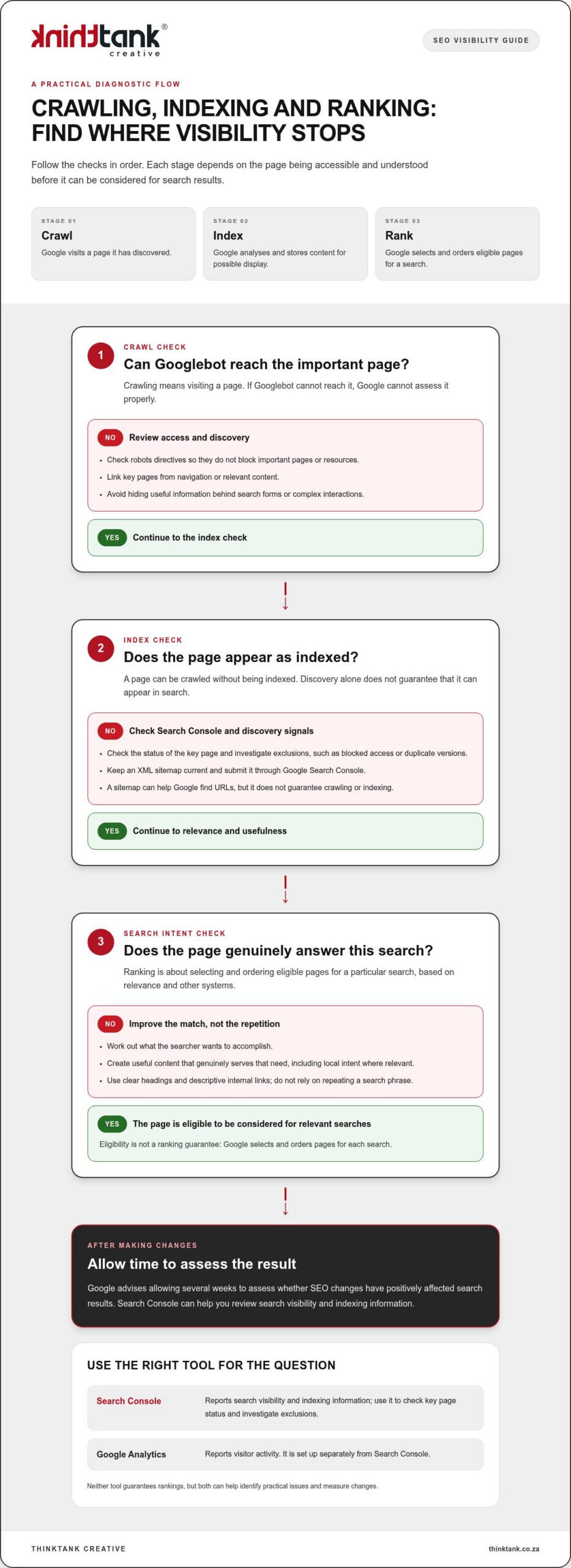
Google follows links and other discovery signals to find pages across the web. Crawling means visiting a page; indexing means analysing and storing its content for possible display in search results. A page can be crawled without being indexed, so discovery alone doesn’t guarantee visibility. Crawl accessibility is fundamental: if Googlebot can’t reach important pages, it can’t assess them properly.

Build a clear route through your website. Link important pages from the navigation or relevant content, and avoid hiding useful information behind search forms or complex interactions. For example, a South African legal practice could link from its services overview to separate conveyancing and employment law pages. Review robots directives to ensure they don’t block pages or resources Google needs to access.

A sitemap gives Google a structured list of URLs you consider important. Keep it current as pages are added, removed or moved, then submit it through Google Search Console. A sitemap helps with discovery, but doesn’t make Google crawl or index every listed URL. Check the status of key pages in Search Console and investigate exclusions, such as blocked access or duplicate versions.

Google analyses accessible page content, including text, links and relationships between pages, to understand what each URL is about. Clear headings and descriptive internal links provide context. If a page about a Johannesburg accounting service links to a related tax-planning page, the connection helps visitors and search systems understand how the topics relate. Consistent page details also reduce ambiguity.

To set up Google Search Console, add your website as a property, verify ownership and submit your sitemap. Set up Google Analytics separately by creating a property and adding its measurement tag to your website. Analytics reports visitor activity, while Search Console reports search visibility and indexing information. Neither tool guarantees rankings, but both can help you identify practical issues and measure changes.

Crawling, indexing and ranking are separate stages. Ranking occurs when Google selects and orders eligible pages for a particular search, based on relevance and other systems. A page targeting “accountant in Gqeberha” needs content that genuinely serves local intent, not repeated mentions of the phrase. Google advises allowing several weeks to assess whether SEO changes have positively affected search results.

If site structure or technical barriers make discovery difficult, consider how website design and development can create clearer navigation and more accessible pages. A well-organised foundation helps search engines reach relevant content and gives visitors a more direct path to the information they need.

3. Keyword research and audience intent

Choose keywords by starting with the person, not a spreadsheet. Someone searching “plumber Pretoria” may need a nearby professional, while “how to fix a leaking tap” suggests a do-it-yourself answer. Moz says that putting users first in keyword research supports an approach search engines reward. The aim is to understand what the searcher wants and create a page that meets that need clearly.

Build a focused list from customer questions, sales enquiries and language used in your industry. A Pretoria plumbing business could note phrases such as “blocked drain repair” and “plumbing inspection”. Compare them with Google autocomplete and related search suggestions, then check whether results show service pages, guides or product listings. The format of the results offers clues to the intent behind a query.

Group related terms into page themes instead of creating a separate page for every wording variation. “Emergency plumber Pretoria” and “urgent plumbing repairs Pretoria” may belong on one service page if searchers expect the same service. By contrast, “how to prevent burst pipes” calls for a practical guide. A clear theme helps each page serve one central purpose without competing with another page on your site.

Classify intent before choosing a page format. Informational searches seek explanations, comparison searches weigh options, and transactional searches show readiness to act. For example, someone researching “how solar panels work” needs educational content; a person searching “solar installation quote Bloemfontein” likely wants to assess a service. These distinctions help marketing teams match useful information to each stage of a customer’s decision.

Prioritise opportunities by relevance, not search volume alone. Ask whether a phrase describes your actual offer, whether you can answer it credibly and whether the searcher fits your audience. A small South African firm serving clients in Polokwane could favour a specific local service phrase over a broad national term. It may attract fewer searches, but better reflect the firm’s reach and expertise.

Use keywords naturally in the page title, main heading, introduction and relevant subheadings. Then write in ordinary language, adding related terms only when they clarify the subject. Moz says keyword optimisation can help attract searchers and search engines. Read the finished page aloud: if “accountant Durban” sounds awkward, rewrite the sentence for people instead of forcing an exact-match phrase.

Finally, review terms against real outcomes. Compare enquiries and engagement on pages addressing distinct themes, then refine wording where visitors seem to expect something different. A keyword plan is a working guide, not a fixed script. This approach turns research into relevant pages, clearer marketing priorities and a website structure that reflects how South African customers describe their needs.

SEO South Africa: How Google Finds and Ranks Your Pages

4. Technical SEO, responsive design, and structured data

Technical SEO helps search engines access and interpret a website while giving visitors a smoother journey. Moz identifies fast loading and a compelling user experience as elements of good SEO. Start by checking that important pages work, navigation is clear and key content appears without broken layouts. A South African retailer, for example, should make product categories easy to reach from its homepage.

Responsive design adapts a page to different screen sizes, rather than creating separate experiences for desktop and mobile. More than 70% of ecommerce traffic comes from mobile devices, according to Dynamic Yield. Test a South African shop on a phone: product descriptions, menus and checkout controls should remain readable and usable without horizontal scrolling or awkward zooming.

Speed is another practical priority. Google recommends that the main content of a page load within 2.5 seconds. Compress large files, reduce unnecessary scripts and review page elements that delay useful content. A Cape Town restaurant site, for instance, should show its menu and booking information promptly, rather than making visitors wait for decorative features to finish loading.

Structured data gives search engines a clearer description of specific page content. It uses a defined format to label details such as a product, event or local business. Moz recommends snippet or schema markup to help a result stand out in search results. Apply markup only to information visible on the page, such as an event’s genuine date and venue.

Technical checks also include meta tags and robot directives. Moz recommends responsive design, robot directives, structured data and meta tags as technical SEO elements. A meta description can summarise a page for searchers, while a robot directive can guide crawling or indexing. Review these settings carefully: accidentally blocking a key service page can prevent Google from accessing it.

Use a repeatable review process. Open key pages on a phone and desktop, test the navigation, and check that buttons and forms work. Then review performance reports and inspect crawling or indexing issues in Google Search Console. For example, a Johannesburg professional services firm could prioritise its enquiry page if it loads slowly or fails on mobile.

Technical work supports the wider content strategy; it doesn’t replace it. Moz recommends responsive design and structured data, but clear information must still match the page’s purpose. Prioritise issues according to their impact: inaccessible pages and unusable mobile layouts deserve attention before minor visual refinements. This keeps technical improvements focused on helping people and search engines use the site.

5. How do I do keyword research for a South African audience?

Start with South African customers’ real questions, not a generic list of popular terms. Write down what people ask before choosing, buying or booking your service. A Gqeberha guesthouse might hear questions about secure parking, breakfast or proximity to local attractions. These questions reveal the words customers use and the details they need to make a decision.

Next, gather search suggestions for your core topics. Enter a service into Google and note autocomplete phrases, related searches and wording on relevant South African results. Compare “plumber in Polokwane” with “Polokwane plumbing services”, for example. The phrases describe a similar need, but your research should show which wording fits your customers and the results Google displays.

Check geographic scope before planning pages. A business serving clients across South Africa may need broader terms, while a practice working only in Kimberley should prioritise relevant local searches. Record the city, town or province alongside each phrase. Don’t create near-identical location pages by swapping place names; each page should offer genuinely useful local information.

Consider language carefully. South African customers may search in English, isiZulu, Afrikaans or another language, depending on their audience and context. Ask sales or support teams which phrases customers use, then have a fluent speaker review translations for natural wording and accurate meaning. A literal translation can miss how people describe a service in everyday conversation.

Use Google Trends to compare interest in different terms over time and across locations. Treat relative patterns as a planning signal, not a measure of guaranteed demand. For instance, compare searches for a product category across provinces before deciding whether your site needs national content or pages tailored to particular areas.

Organise your findings in a simple research sheet. Add each phrase, intended audience, location, likely need, relevant existing page and next content action. Mark terms that call for a service page, practical guide or clear comparison. This keeps research connected to useful website work instead of leaving it as an unstructured keyword list.

Review the sheet as customer language and business priorities change. Compare actual enquiries with the phrases and pages you’ve selected, then revise content where the match is weak. For focused SEO support for your keyword research, connect your South African search insights to a practical optimisation plan.

ThinkTank Creative: Website Design and Development

ThinkTank Creative helps businesses turn SEO priorities into websites that are clear, useful and easy to navigate. Its Website Design and Development service supports new sites and redesigns, bringing content, page structure and visual design together. It’s a natural next step when your pages are difficult to organise, your brand no longer reflects your business or customers struggle to find key information.

Creative design and Logo and Corporate Identity Design can also help create a consistent experience across your digital presence. For businesses building awareness beyond search, Social Media Marketing can complement that work.

Contact ThinkTank Creative to discuss your website goals, or visit thinktank.co.za.

Build momentum with your next SEO decision

Turn what you’ve learnt into a focused improvement instead of trying to change every page at once. Choose a business priority, identify the website work that supports it and decide how you’ll assess progress. This gives your SEO activity a clear purpose and makes it easier to shape future decisions around real business needs.

A beginner’s guide to SEO in South Africa is a starting point, not a fixed formula. Customer language, services and priorities evolve, so revisit your approach as your business develops. Each deliberate refinement can help keep your online presence aligned with the people you want to reach.

If you’re ready to plan the next step for your website, contact ThinkTank Creative to discuss your goals. A considered strategy can turn your next idea into meaningful progress. Keep moving forward with clarity and confidence.

Frequently Asked Questions

How does SEO work?

SEO helps search engines find, interpret and present relevant website pages to people searching online. Google may discover a new page through links, assess its content and then consider it for relevant results. For example, a South African furniture maker could publish a detailed guide to choosing locally made dining tables. Clear product information and links from related pages help people and search engines understand its purpose.

How long until I see impact in search results?

SEO can take three to six months to show meaningful progress, and competitive search terms may take longer. Google advises allowing several weeks to assess whether changes have positively affected search results. For example, after updating a service page, record its search impressions and enquiries, then review them over time. This gives you a more useful view than judging a change immediately after publication.

What are the most important elements of an effective SEO strategy?

An effective strategy connects business priorities with the needs of people searching for your services. Set a clear goal, such as increasing qualified enquiries for a specific service, then choose relevant pages to improve. A South African law firm might track enquiries from its employment law page instead of focusing only on general website visits. Review content quality, technical access and meaningful outcomes together.

What is SEO Marketing?

SEO marketing means improving a website’s visibility in unpaid search results to reach people looking for related information, products or services. It differs from paid advertising, where businesses purchase advertising placements. A Cape Town tour operator, for instance, could use SEO marketing to make its walking-tour pages more relevant to travellers researching local activities. The aim is to attract appropriate visitors with useful, search-focused pages.

What is SEO?

SEO stands for search engine optimisation. It involves improving website content and technical accessibility so search engines can discover and understand pages and users can find relevant information. For a South African online shop, this could mean making product categories easy to navigate and describing each item accurately. SEO isn’t simply adding keywords; a page must also serve a clear purpose for its visitors.

What is SEO and how does it work for beginners?

SEO helps the right people find useful pages through search engines. If you’re new to it, start by choosing one service or product and identifying the question a potential customer would ask. A beginner’s guide to SEO in South Africa should connect that need to a suitable page, clear wording and a useful next step. Review how visitors respond, then refine the page as their questions or your business priorities change.

What are the essential on-page SEO steps for a new website?

For each new page, choose one main subject, write a descriptive title and organise the information under clear headings. Explain the service or product specifically and include a relevant next step, such as requesting an appointment. For example, a South African accounting firm’s tax service page should explain what the service covers and who it helps. Check that the page reads naturally and links to related information.

How do I improve technical SEO, site speed, and mobile usability?

Start by testing key pages on a phone and desktop, then fix obstacles that stop people accessing essential content. Google recommends that a page’s main content loads within 2.5 seconds. Compress large files, remove unnecessary scripts and check that forms and navigation work on smaller screens. Dynamic Yield reports that more than 70% of ecommerce traffic comes from mobile devices, making phone usability particularly relevant for online shops.

How to Write Effective Website Copy: The 2026 Strategic Framework

Effective website copy isn't about proving how clever your brand is; it's about making your customer feel like the smartest person in the room for choosing you. You likely recognise the frustration of watching healthy traffic numbers fail to translate into meaningful enquiries, whilst your messaging feels stuck in a loop of corporate-speak and generic promises. Balancing the technical demands of search engines with the emotional needs of a human reader often feels like a zero-sum game, yet mastering how to write effective website copy in 2026 requires a shift from self-promotion to strategic empathy.

At ThinkTank Creative, we believe in a journey of imagination that transforms your digital presence into a high-performance asset. This guide introduces our professional 2026 Strategic Framework, a methodology designed to help you master the art of conversion-led storytelling. We will explore how to refine your brand voice, structure your pages for maximum impact, and ensure your content remains both professional and approachable. You will gain a clear, actionable roadmap to elevate your messaging, ensuring your website does the heavy lifting so you don't have to.

Key Takeaways

  • Master how to write effective website copy by shifting your focus from internal company features to the customer's specific transformation journey.
  • Secure immediate engagement on your homepage by applying the five-second rule to a punchy, vision-setting value proposition.
  • Build professional trust on service pages by balancing benefit-focused narratives with clear discussions around methodology and the provision of estimated costs after discussion.
  • Prioritise a copy-first design strategy to create a sophisticated visual hierarchy that guides visitors naturally toward your desired conversion goals.
  • Leverage a structured narrative template to address pain points immediately, positioning your professional services as the logical resolution for your audience.

Beyond the Words: Why Effective Website Copy is Your Silent Salesperson

Your website copy acts as the quiet architect of your digital success, building a strategic bridge between a visitor's urgent problem and your bespoke solution. In the competitive South African market, "invisible" copy, text that is technically present but emotionally absent, carries a heavy cost in lost opportunities and diluted brand equity. As we move through 2026, the digital space demands high-empathy, human-centric narratives that resist the generic patterns of AI-generated content. Understanding how to write effective website copy is no longer just about filling space; it's about crafting a dialogue that resonates with the specific needs of your audience. This strategic approach directly influences how to improve website user experience, ensuring that every word serves a functional and emotional purpose. When copy is treated as a secondary thought, the user journey becomes fragmented and confusing.

Think of your website as a digital storefront where the copy serves as your most dedicated employee. It greets visitors, answers their unspoken questions, and gently steers them toward a decision without the need for aggressive sales tactics. This silent salesperson operates with a quiet assurance, reflecting the stability and expertise of your enterprise whilst remaining approachable to new enquiries. When your text is crafted with this level of strategic depth, it becomes a dependable asset that works tirelessly to convert casual browsers into loyal brand advocates.

The Difference Between Good and Great Marketing

Good marketing often focuses on proving the company's intelligence, yet great marketing shifts the spotlight to make the customer look smart. This philosophy defines our approach at ThinkTank Creative, where we view every project as a collaborative journey of imagination. We move away from traditional lists of features to focus on the transformation your business achieves through our partnership. Professional copywriting is a foundational investment that elevates your brand identity, acting as a catalyst for growth rather than a mere administrative expense. It ensures your message is not just heard, but felt by those who matter most to your business.

Copywriting as a Conversion Tool

Precision in your language serves as a powerful conversion mechanism. Micro-copy, those small snippets of text on buttons or form fields, plays a vital role in reducing user anxiety and guiding them toward the next step. Effective headings must capture attention within the first three seconds to reduce bounce rates and maintain engagement. By understanding how to write effective website copy that aligns with our five-stage development process, you ensure that the narrative remains consistent from the initial planning phase to the final launch. This synergy creates a polished, invitation-based experience that encourages mutual success. We do it all so you don't have to, providing a complete solution that integrates strategic writing with award-winning design.

The Customer-Centric Copywriting Framework: Moving from Good to Great Marketing

Elevate your perspective by placing the customer at the heart of your narrative rather than your own corporate structure. Whilst many businesses focus on internal hierarchies, the most successful digital platforms organise information based on user intent and specific psychological triggers. Identifying your core brand message before a single word is penned ensures that your content remains purposeful and aligned with your broader strategic objectives. This alignment is the fundamental secret to how to write effective website copy that doesn't just inform, but actively inspires action through a sense of shared vision.

Great marketing is distinguished by its ability to make the reader feel empowered and understood. By analysing the transformation journey your service facilitates, you can map out a content path that leads the visitor from their current frustration to a future of professional growth. This methodology requires a deep commitment to synergy between your business goals and the user's needs, creating a polished experience that feels like an invitation to success rather than a generic sales pitch. We do it all so you don't have to, allowing you to focus on your core operations whilst we craft the narrative that drives your expansion.

Researching Your Audience's Behaviour

Listen to the subtle nuances in how your clients describe their challenges during initial consultations or in feedback forms. By utilising existing customer data, you can adopt the "language of the client", which builds immediate rapport and professional trust. This process allows you to identify specific pain points that competitors frequently ignore, creating a "journey of imagination" where the reader clearly sees themselves succeeding through your partnership. It is about moving beyond surface-level features to understand the emotional and practical transformation your service facilitates in their daily professional lives.

Defining Your Brand Personality

Establish a consistent tone of voice that reflects both your innovative spirit and your professional reliability. Whether your persona is a "Strategic Visionary" or a "Friendly Helper", maintaining this character across all digital channels is essential for building long-term brand recognition and authority. Your corporate identity should naturally influence your writing style, ensuring a synergetic relationship between your visual assets and your verbal communication. At ThinkTank Creative, we believe a complete branding solution requires this level of meticulous detail to be truly effective and memorable in a crowded marketplace.

Page-by-Page Strategy: Structuring High-Conversion Copy for Your Business

Strategic architecture dictates how your audience perceives your value within seconds of arrival. Your homepage must command immediate attention by adhering to the five-second rule, where your primary value proposition is articulated with absolute clarity. This initial interaction sets the tone for the entire relationship, moving the visitor from curiosity to a genuine interest in your methodology. When considering how to write effective website copy for service pages, shift your focus from technical specifications to the tangible benefits and transformations your clients experience. We provide estimated costs after discussion to ensure every quote reflects the bespoke nature of our collaborative solutions, maintaining transparency whilst honouring the unique requirements of your project.

Trust is cultivated through the narrative depth of your About and Contact pages. Your About page shouldn't be a dry history of the firm; instead, it should serve as an invitation into the ThinkTank collaborative environment where we treat your success as our own. We view the Contact page as the gateway to a productive debate and discussion, removing all possible friction to encourage that vital first enquiry. By aligning your text with our five-stage development process, from initial planning through to launch and support, you create a seamless transition that reflects professional stability and creative energy. We do it all so you don't have to, ensuring your digital presence remains a powerful, conversion-focused asset.

Writing Headlines That Command Attention

Command authority by using active verbs that signal movement and progress in every headline. Every subheading must pass the "So What?" test, ensuring that the information provided is directly relevant to the reader's professional growth. Mastering how to write effective website copy involves a rhythmic balance where SEO keywords are integrated naturally without disrupting the sophisticated flow of the text. This precision ensures your message remains accessible to search engines whilst feeling deeply personal to the human reader.

The Power of Social Proof and Proof Points

Integrate social proof naturally by weaving success stories, such as our work with Lebo the Accountant, into your service descriptions. Authenticity is paramount; testimonials should sound like genuine professional endorsements rather than manufactured marketing slogans. Utilise specific stats and industry awards to build confidence, reinforcing the idea that your brand is a dependable leader in its field. This evidence-based approach provides the quiet assurance your audience needs to move forward with a partnership, grounded in the reality of your proven excellence.

How to Write Effective Website Copy: The 2026 Strategic Framework

The ThinkTank Copywriting Template: A Step-by-Step Guide for ZA Businesses

Structured frameworks remove the guesswork from digital growth. When you understand how to write effective website copy using a repeatable template, you transform your site from a static brochure into a dynamic conversion engine. Our framework is designed to guide your visitors through a logical progression of empathy, authority, and action. This methodical approach ensures that your message remains consistent across every touchpoint, mirroring the stability of a long-standing enterprise whilst maintaining the fluid energy of a creative agency.

Step 1: The Hook. Capture attention by addressing the primary pain point your audience faces immediately. This demonstrates that you understand their professional reality and establishes an instant connection. Step 2: The Solution. Introduce your service as the most logical and sophisticated resolution to the challenge you've just highlighted. Step 3: The Process. Reduce user uncertainty by explaining our comprehensive development journey, which moves through meticulous planning, design, and technical delivery. Step 4: The Proof. Reinforce your claims by highlighting trust signals and the expertise we have gathered since our founding in 2001. Step 5: The Action. Conclude with a clear, confident call to action that invites the reader to start their own journey of imagination with us. We do it all so you don't have to, providing a complete solution that integrates strategic writing with award-winning design.

Applying the Template to Your Services

Adapting this structure for custom website design South Africa ensures that your technical capabilities are always framed through the lens of business benefits. Your corporate identity should breathe through the words, ensuring a bespoke result rather than a templated feel. Use bullet points to organise complex features for better readability:

This structured clarity helps visitors grasp the value of your offerings without feeling overwhelmed by technical jargon.

Editing for Impact and Clarity

Ruthlessly remove industry jargon and fluff that might feel exclusionary to your audience. A second set of eyes is essential during the fine-tuning stage to ensure that your narrative remains polished and professional. Maintaining British English spelling consistency is a hallmark of national professionalism, reinforcing your status as an authoritative industry leader. Mastering how to write effective website copy requires this level of meticulous oversight to turn your vision into a high-conversion reality. Every word must serve a purpose, moving the reader closer to a shared success.

Ready to elevate your brand's narrative with a professional framework? Partner with ThinkTank Creative for a complete copywriting and design solution tailored to your growth.

Elevating Your Narrative: Integrating Professional Copy with Strategic Web Design

Integrate your narrative into the very fabric of your digital architecture to ensure a seamless user journey. Whilst many treat text and layout as separate silos, a copy-first design philosophy ensures that the visual elements serve the story you've meticulously crafted. Mastering how to write effective website copy in 2026 requires understanding that words do not exist in a vacuum; they require a supportive environment to thrive. A strategic visual hierarchy guides the reader's eye along the narrative arc established in your framework, ensuring that key value propositions receive the prominence they deserve. This alignment reduces friction and creates a logical flow that leads visitors toward a confident decision. For businesses seeking to go further, understanding the principles behind lead generation website design in South Africa can help you transform well-crafted copy into a measurable pipeline of high-quality enquiries.

Maintain the relevance of your message through consistent updates and professional oversight. Digital landscapes shift rapidly, and copy that resonated last year might feel stagnant today. Our commitment to website maintenance and support ensures your content remains fresh and aligned with your evolving business goals. This holistic approach is why our tagline, "We Do It All So You Don't Have To", encompasses a complete professional content strategy. We take the burden of narrative management off your shoulders, allowing you to focus on the growth of your enterprise whilst we ensure your digital assets continue to perform at an elite level.

The Synergy of Design and Content

Our award-winning in-house design team works in tandem with our strategists to enhance the readability of every sentence. We utilise white space as a deliberate tool, allowing your brand message to breathe and preventing cognitive overload for the visitor. This collaborative process involves visualising complex data points through bespoke creative design, transforming dry statistics into engaging proof points. When design and content operate in synergy, the result is a polished experience that reflects the precision and excellence your brand promises to every client.

Next Steps: Embarking on Your Journey of Imagination

Begin your transformation with a professional audit during the initial research and strategy phase. This meticulous assessment identifies gaps in your current messaging and clarifies the path toward improved conversion rates. When briefing an agency on how to write effective website copy, focus on your desired brand behaviour and the emotional response you wish to elicit from your audience. Moving from a DIY approach to a professionally managed solution provides the quiet assurance of expert execution. For entrepreneurs and growing companies, exploring dedicated small business website design South Africa strategies can provide a focused roadmap for building a mobile-first, high-converting online presence. We invite you to join us in a journey of imagination where we elevate your brand together, ensuring your digital presence is both elite in its execution and enduring in its impact.

Mastering Your Digital Transformation

Elevate your brand by moving beyond generic messaging to a narrative that truly resonates with your audience's unique professional needs. We've explored how a customer-centric framework and a copy-first design approach can turn your website into a silent salesperson that works tirelessly for your success. Mastering how to write effective website copy in 2026 is no longer an optional skill; it's a foundational requirement for any business seeking sustainable growth in a crowded digital marketplace. By aligning your message with a structured template and strategic visual hierarchy, you create a polished experience that fosters trust and inspires immediate action.

Leverage our decades of expertise to transform your digital presence into a high-performance asset. Since our founding in 2001, our award-winning in-house design team has utilised a meticulous 5-stage development process to ensure every project achieves its full potential. We take the complexity out of digital strategy, allowing you to focus on your core operations whilst we build the assets that drive your expansion. We invite you to let us craft your brand story; contact ThinkTank Creative today. Your journey of imagination starts here, and we are ready to partner with you to achieve a bespoke result that reflects the excellence of your enterprise.

Frequently Asked Questions

How long should the copy be on my homepage?

Your homepage copy should be extensive enough to satisfy search engines whilst remaining concise enough to respect your visitor's time. We typically recommend between 300 and 600 words, focused on a primary value proposition that passes the five-second rule. This volume allows for strategic keyword integration without overwhelming the user. Every sentence must drive the narrative forward, ensuring the visitor understands your solution before they feel the urge to scroll away.

Do I need to write different copy for mobile users in South Africa?

Mobile-first writing is essential in the South African market, where a significant portion of web traffic originates from handheld devices. You don't necessarily need different text, but you must prioritise a visual hierarchy that places critical information at the top. Use shorter paragraphs and punchy subheadings to accommodate smaller screens. This approach reduces cognitive load and ensures your brand message remains clear, regardless of the device your audience chooses to use.

How does website copy affect my search engine optimisation (SEO)?

High-quality copy is the cornerstone of search engine optimisation because it signals relevance and authority to modern algorithms. Understanding how to write effective website copy involves balancing semantic keywords with a natural, human-centric flow that keeps visitors on the page. Search engines reward content that provides genuine value and answers user intent accurately. By crafting text that reduces bounce rates, you naturally improve your rankings whilst building a dependable reputation.

Should I use AI to write my website content in 2026?

AI should be viewed as a collaborative tool for brainstorming rather than a replacement for professional, high-empathy human narratives. In 2026, audiences are increasingly sensitive to generic, machine-generated content that lacks a bespoke feel. Use technology to organise your thoughts or check for consistency, but rely on human expertise to inject personality and strategic depth. This ensures your corporate identity remains authentic and resonates emotionally with your potential clients in a way software cannot replicate.

How often should I update my website copy?

We recommend a professional content audit at least every six months to ensure your messaging remains aligned with market shifts. Regular updates are a vital part of our website maintenance and support services, keeping your narrative fresh and technically relevant. If your business introduces new methodologies or achieves significant milestones, your copy should reflect these changes immediately. Consistent refinement prevents your digital presence from becoming stagnant, ensuring you remain a forward-looking leader.

What is the most common mistake in business website copywriting?

The most frequent error is producing content that is too company-focused rather than addressing the customer's specific transformation. Many businesses fall into the trap of listing features whilst ignoring the emotional and practical benefits their clients seek. This generic approach fails to build a bridge between the visitor's problem and your solution. Shifting your perspective to make the customer the hero of the story is the most effective way to improve your conversion rates.

How do I balance being professional with being creative in my writing?

Achieving this balance requires a sophisticated vocabulary that emphasises precision whilst remaining accessible to your audience. We adopt the persona of a Strategic Visionary, combining authoritative industry leadership with an approachable creative partnership. Use active verbs to command attention and multi-clause statements to explain your strategic reasoning. This rhythmic consistency creates a sense of reliability, projecting a personality that is both elite in its execution and warm in its professional relationships.

Can ThinkTank Creative help with both design and copywriting?

ThinkTank Creative provides a complete solution that seamlessly integrates award-winning design with strategic copywriting. Our 5-stage development process ensures that your narrative and visual assets are developed in synergy from the initial planning phase. We do it all so you don't have to, providing the quiet assurance that every aspect of your digital presence is meticulously crafted. Estimated costs for these bespoke services are provided after a thorough discussion of your unique goals.