Measuring the ROI of a Website Redesign: Strategic 2026 Framework
Treating an enterprise digital overhaul as a mere cosmetic face-lift is the quickest way to squander capital. When internal stakeholders view web development as an operational overhead rather than a hardworking commercial asset, measuring the roi of a website redesign becomes an exhausting uphill battle. It's entirely reasonable to dread post-migration search visibility dips, or to feel frustrated whilst trying to link modern user experience design directly to closed pipeline revenue.
True commercial returns stem from conversion velocity and technical efficiency, never surface-level decoration alone. In this strategic guide, you'll discover how to quantify tangible financial gains, operational savings, and measurable conversion growth across both immediate and multi-year horizons. We'll walk through the definitive ROI formula, critical Core Web Vitals benchmarks, and the reporting models required to build an airtight business case that earns unshakeable executive backing.
Key Takeaways
- Master the commercial formula for measuring the roi of a website redesign, balancing net conversion revenue and operational savings against project outlay.
- Discover how technical speed, responsive mobile architecture, and optimised Core Web Vitals accelerate transaction velocity without increasing paid acquisition spend.
- Quantify indirect dividends such as reduced internal administrative overheads, elevated brand credibility, and mitigated regulatory risks.
- Implement a disciplined 90-day pre-launch baseline protocol to isolate design-driven commercial gains accurately from seasonal market fluctuations.
- Protect long-term asset yield by pairing full-lifecycle development engineering with proactive search retention and structured ongoing maintenance.
The Financial Case: Defining Website Redesign ROI Beyond Surface Aesthetics
Executive teams frequently commit capital to digital projects expecting transformative growth, only to judge the finished work through subjective visual preferences. A corporate website isn't a static digital brochure; it's an active commercial engine designed to drive pipeline velocity. Surface refreshes alone never justify significant capital outlays. Successfully measuring the roi of a website redesign requires shifting attention from visual novelty toward quantifiable financial expansion, structural cost reduction, and sustained customer lifetime value.
To grasp how behavioural user experience choices influence commercial returns before committing development resources, watch this strategic breakdown from Nielsen Norman Group:
The Fundamental Formula for Calculating Website Redesign Return
Standardising your economic model simplifies board-level justification. At its core, applying a structured return on investment (ROI) calculation establishes the exact commercial yield produced by your capital allocation:
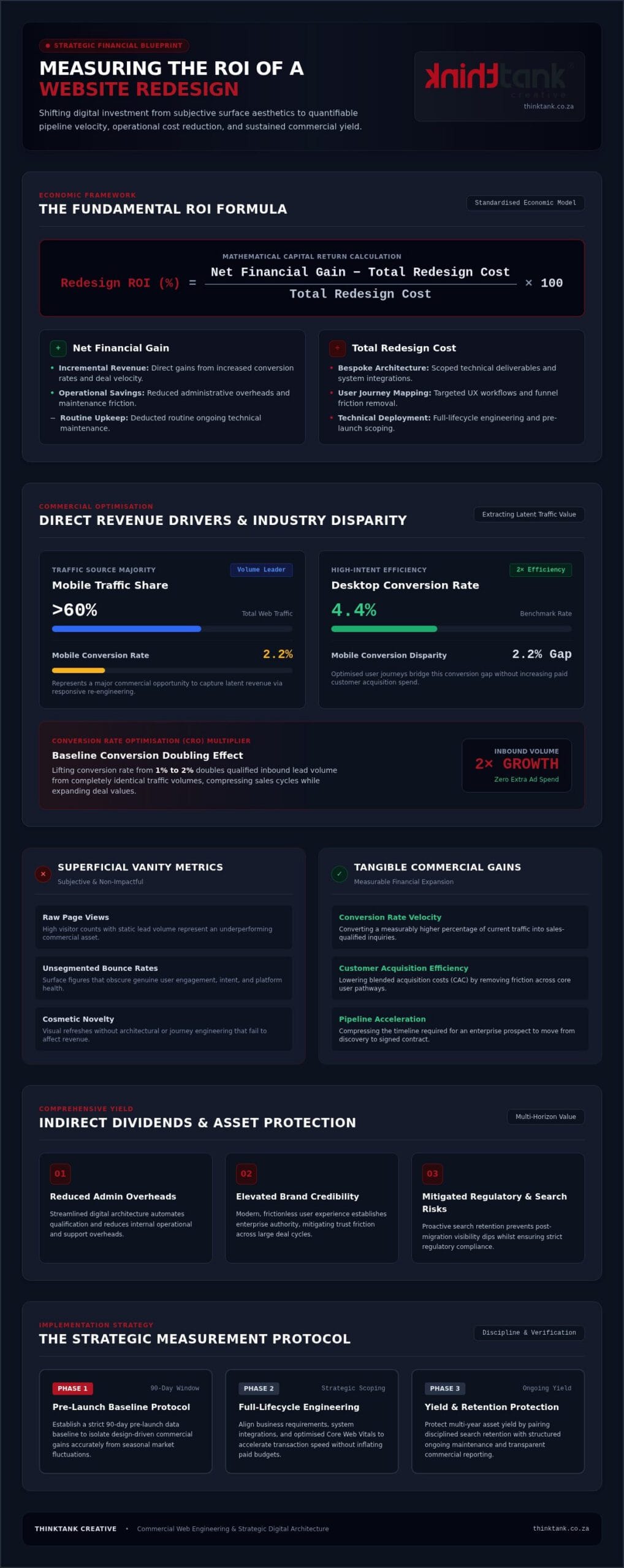
$$text{Redesign ROI (%)} = left(frac{text{Net Financial Gain} - text{Total Redesign Cost}}{text{Total Redesign Cost}}right) times 100$$
Here, net financial gain represents incremental revenue from conversion lifts combined with operational cost reductions, minus routine upkeep. Initial capital expenditure covers bespoke architecture, user journey mapping, and technical deployment. Transparent digital partners establish this outlay systematically. For example, ThinkTank Creative calculates an estimated cost only after conducting an in-depth strategic scoping of business requirements and system integrations, ensuring financial expectations match technical deliverables from day one.
Distinguishing Tangible Commercial Gains from Vanity Metrics
Superficial metrics like raw page views or unsegmented bounce rates obscure genuine business health. An aesthetically pleasing platform that attracts substantial traffic yet yields static lead volumes represents an underperforming asset. Conversely, deliberate UX engineering streamlines user funnels, accelerating lead qualification whilst significantly reducing customer acquisition costs (CAC). When measuring the roi of a website redesign, focus on indicators that alter your commercial ledger:
- Conversion Rate Velocity: Converting a measurably higher percentage of current traffic into sales-qualified inquiries.
- Customer Acquisition Efficiency: Lowering blended acquisition costs by removing friction across core user pathways.
- Pipeline Acceleration: Compressing the timeline required for an enterprise prospect to move from initial discovery to signed contract.
Direct Revenue Drivers: Measuring Conversion Velocity and Commercial Value
Direct commercial returns materialise when your platform extracts greater transaction value from existing traffic volumes. Global data reveals that over 60% of web traffic originates from mobile devices, yet mobile conversion rates hover around 2.2% compared to 4.4% on desktop environments. This disparity highlights an immediate commercial opportunity. By re-engineering responsive layouts and user pathways, a conversion-focused overhaul captures latent revenue without inflating paid acquisition budgets.
Conversion Rate Optimisation (CRO) and Lead Value Modelling
Lifting your baseline conversion rate from 1% to 2% doubles qualified inbound volume from identical traffic. When modelling pipeline velocity, multiply projected conversion lift against your historical lead-to-close ratio and average contract valuation. Research from Nielsen Norman Group on calculating ROI for design projects demonstrates that structured usability enhancements directly compress sales cycles while expanding deal values. Prioritise improving website user experience across key landing environments to eliminate friction, ensuring visitors navigate seamlessly toward commercial action.
E-commerce Checkout Velocity and Cart Abandonment Reduction
Every unnecessary checkout step or sluggish payment integration actively suppresses transaction completion. Akamai and Portent benchmarks show that a single 1-second delay in mobile loading time degrades conversions by approximately 7%. Conversely, accelerating interface responsiveness and deploying frictionless checkout funnels yields an immediate 5% to 15% rebound in completed sales. Measuring the roi of a website redesign requires tracking this recaptured revenue against prior abandonment baselines:
- Friction Point Remediation: Consolidate form fields and introduce intuitive guest checkouts to prevent mid-funnel drop-offs.
- Latency Reduction: Optimise rendering speeds to keep on-the-go buyers engaged through the final transaction screen.
- Commercial Value Expansion: Embed relevant cross-sells within redesigned user flows to elevate average order value naturally.
Organisations deploying bespoke lead generation strategies for South African businesses consistently discover that streamlined digital touchpoints turn casual browsing into measurable pipeline growth. If you're assessing whether your current architecture supports this commercial velocity, a collaborative discovery session with ThinkTank Creative can pinpoint where structural friction restricts your conversion potential.
Indirect Dividends: Operational Efficiencies, Brand Equity, and Search Retention
Revenue expansion tells only half the commercial story. When measuring the roi of a website redesign, indirect dividends represent substantial cost avoidances that protect your operating cash flow. An engineered digital platform reduces internal administrative friction, shields existing organic traffic equity, and establishes the executive credibility required to command premium market pricing.
Quantifying Administrative Time and Technical Support Savings
Legacy websites bleed operational resources through manual interventions. Outdated systems force personnel to re-enter leads manually, answer repetitive customer service queries, and triage frequent technical glitches. Strategic redevelopment replaces these labour sinks with automated CRM synchronisation, structured self-service customer portals, and unified database workflows.
- Administrative Hours Recaptured: Calculate internal hours saved across sales and marketing teams when customer data synchronises seamlessly with back-office platforms.
- Support Ticket Compression: Intuitive self-service resource centres and contextual search architectures drastically lower support volume per active account.
- Infrastructure Stability: Modern hosting configurations and clean codebases eliminate unplanned outages, protecting both staff productivity and transactional revenue.
Protecting Organic Capital: Search Engine Visibility Retention
Your existing organic search positions represent hard-earned balance sheet equity. A poorly executed migration can instantly erase keyword rankings, forcing you to replace lost qualified visitors through costly paid search auctions. Protecting this equity demands meticulous pre-launch URL mapping, canonical preservation, and comprehensive 301 redirection frameworks. Engaging specialists in search engine optimisation in South Africa ensures algorithmic equity transitions cleanly into your new environment, defending your customer acquisition pipelines without unexpected ad spend spikes.
Elevating Brand Perception and Corporate Credibility
Visual credibility carries real commercial weight. Landmark findings from the Stanford Web Credibility Research show that 75% of a website's perceived business credibility stems directly from design aesthetics and structural professionalism, whilst 94% of initial user impressions are visual. In high-stakes B2B markets, a tired interface signals institutional stagnation. A bespoke, cohesive digital identity projects market leadership, reassuring institutional buyers and validating premium pricing structures. Measuring the roi of a website redesign means factoring in how elevated corporate perception shortens enterprise sales deliberations and insulates your market share against newer entrants.
The Measurement Protocol: Establishing Pre-Launch Baselines and Tracking Windows
Accurate financial attribution collapses if you launch without establishing clean comparative data. Without disciplined pre-launch controls, separating design-led performance improvements from seasonal swings or paid campaign shifts becomes impossible. Measuring the roi of a website redesign requires a staged measurement methodology that tracks system health from early deployment through mature commercial operation.
Step 1 & 2: Pre-Launch Audits and Analytics Calibration
Lock down an uncompromised 90-day baseline before altering a single template. Capture conversion rates by device, assisted conversion paths, organic click-through rates, and exact Core Web Vitals thresholds. Ensure technical readiness by validating Google's responsiveness benchmark, Interaction to Next Paint (INP), targeting 200 milliseconds or less, alongside Largest Contentful Paint (LCP) under 2.5 seconds. Configure server-side tracking and test event triggers to confirm that lead submissions, transaction values, and customer actions record with absolute precision.
- Commercial Content Inventory: Identify top revenue-generating URLs and conversion assets to guarantee exact structure and redirection preservation.
- Technical Experience Baselines: Document legacy field data across real-user metrics to prove user experience acceleration post-launch.
- Attribution Hygiene: Standardise goal definitions within your analytics setup so pre- and post-launch outcomes share identical measurement criteria.
Step 3 & 4: 30-Day Technical Stabilisation and 90-Day Performance Reviews
Dedicate the initial 30 days to technical verification. Monitor crawl error logs, indexation coverage, and redirection chains to confirm search bots process the new architecture without friction. Once technical stability is established, use the 90-day review to analyse commercial shifts against your historic baseline. Normalise this data against macroeconomic conditions to isolate genuine conversion velocity gains from external seasonal lift.
Step 5: Annual Total Cost of Ownership (TCO) Assessment
Evaluate your full economic return across a 12-month operating window. Compare incremental top-line revenue and recaptured administrative savings against the total cost of ownership. This calculation must incorporate the initial project investment, established via tailored scoping rather than arbitrary fixed fees, alongside ongoing managed hosting and maintenance. Factoring routine support into lifetime returns confirms whether your platform remains an appreciating asset.
Ready to establish rigorous tracking baselines and deploy a high-yielding digital engine? Partner with an experienced team and request a strategic website consultation with ThinkTank Creative to model your commercial upside.
Maximising Investment Yield: Partnering for Strategic Web Engineering
Maximising capital yield requires treating web redevelopment as a rigorous engineering project rather than an isolated aesthetic sprint. When measuring the roi of a website redesign over multi-year cycles, collaborative strategic alignment consistently outperforms transactional agency engagements. Partnering with a consultative team ensures that every structural layout, code choice, and user interface component actively contributes to conversion volume and operational resilience.
The ThinkTank Creative Methodology: De-risking Digital Capital Investments
Operating across South Africa since 2001, ThinkTank Creative deploys a battle-tested delivery framework that replaces commercial guesswork with structured execution. Our award-winning in-house web and graphic designers work in close harmony with systems developers, methodically balancing intuitive usability with deep back-end stability. Rather than providing arbitrary off-the-shelf quotations, we supply an accurate estimated cost only after conducting thorough strategic scoping aligned with your bespoke organisational goals.
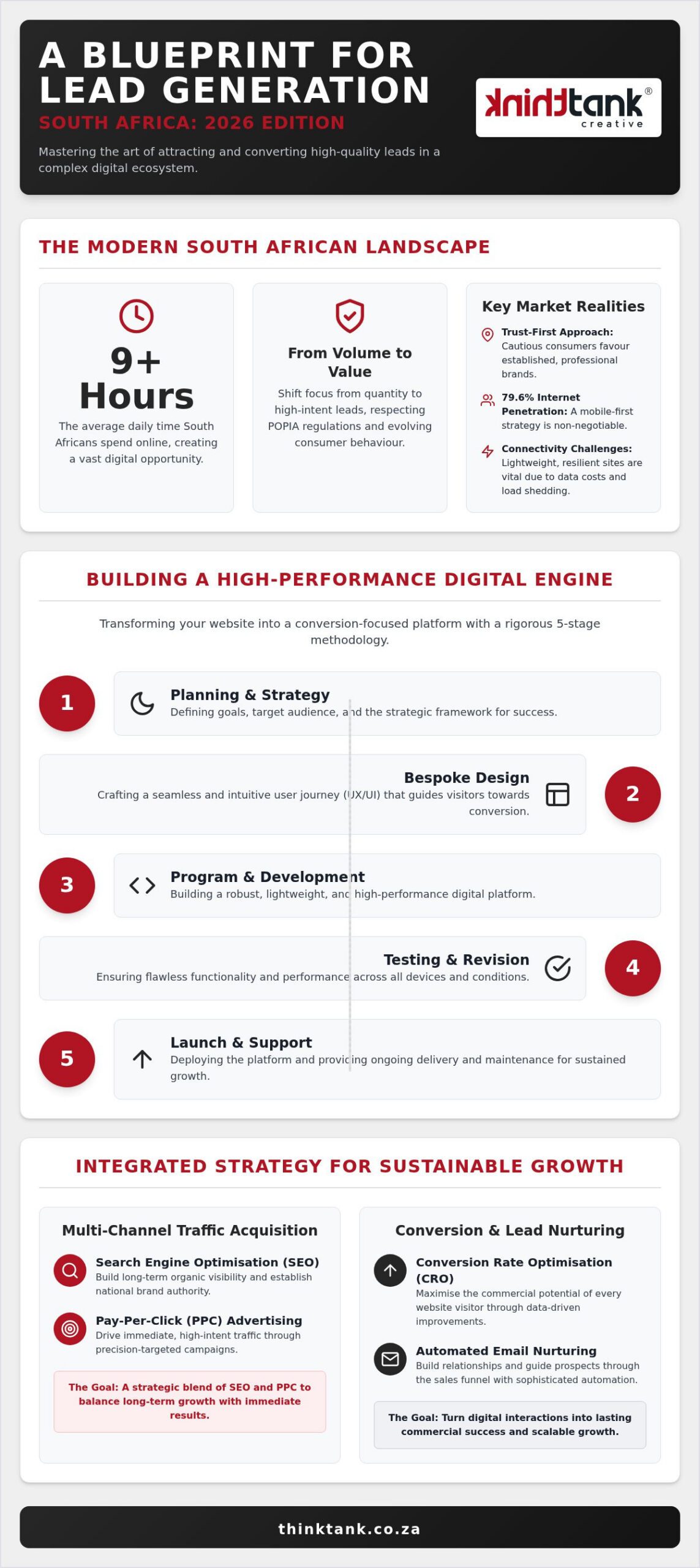
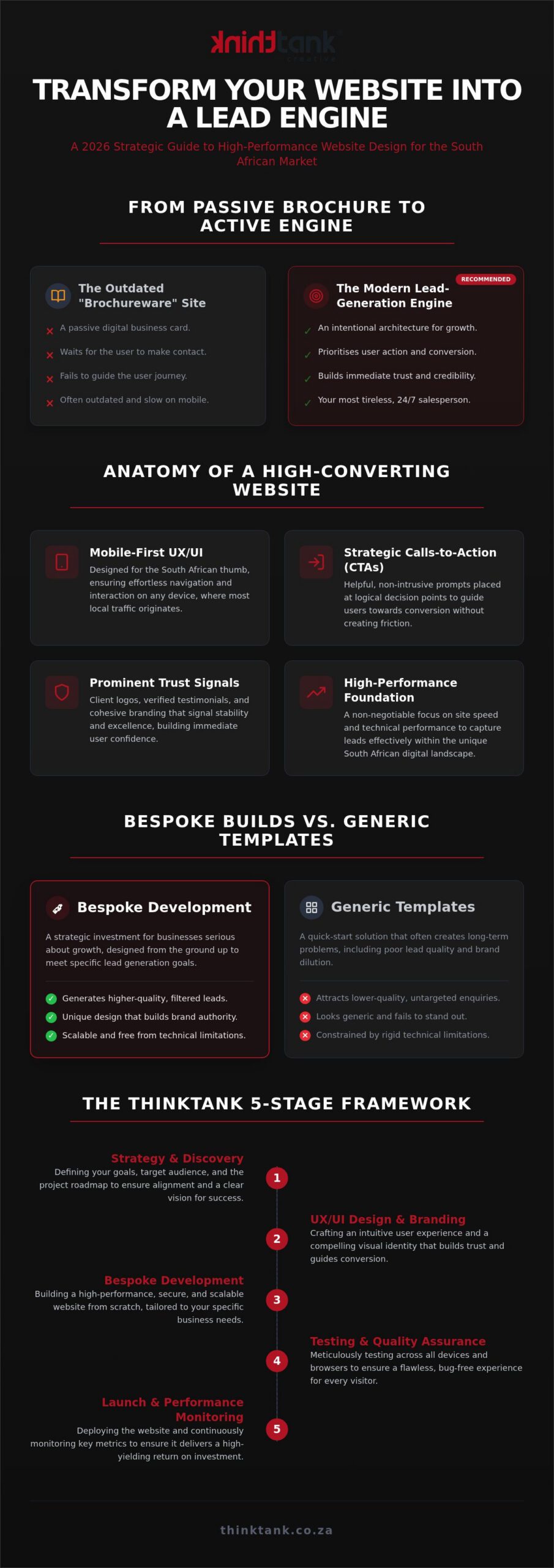
This transparent model guides your investment through a proven five-stage development journey:
- Planning and Strategy: Interrogating commercial goals, mapping detailed visitor journeys, and establishing airtight tracking parameters.
- Creative Visualisation: Designing responsive, high-impact interfaces that reinforce corporate authority whilst prioritising streamlined user action.
- Programming and System Engineering: Developing modern, high-speed codebases built for search engine retention and frictionless database integration.
- Rigorous Testing: Conducting comprehensive multi-device audits, cross-browser validation, and data tracking verification before deployment.
- Launch and Delivery: Executing seamless technical hand-offs and URL migration protocols to protect existing market visibility.
Long-Term Support: Protecting Asset Performance Beyond Launch Day
A digital asset begins deprecating the moment it launches unless actively maintained. HTTP Archive benchmarks reveal that only 48% of mobile websites successfully pass all three Core Web Vitals metrics, illustrating how quickly neglected codebases lose their competitive edge. Ongoing maintenance, technical enhancements, and system security updates are vital safeguards that preserve your initial capital efficiency.
Eliminating multi-vendor friction further protects your commercial yield. By uniting bespoke custom website design in South Africa with integrated SEO, search advertising, and branding services, your organisation maintains complete technical cohesion. When measuring the roi of a website redesign across its full lifecycle, continuous optimisation ensures your digital footprint consistently drives pipeline growth. Take the definitive step toward commercial expansion and partner with ThinkTank Creative to engineer an enduring digital asset.
Engineering Your Platform for Measurable Commercial Growth
Capturing the full economic return of a digital overhaul requires looking far beyond cosmetic enhancements. By balancing direct conversion velocity against internal labour savings and search visibility retention, measuring the roi of a website redesign transforms from subjective speculation into an airtight commercial asset. When you establish clean pre-launch baselines and hold development teams accountable to Core Web Vitals, your platform actively compounds balance sheet value.
Securing these dividends demands a committed, highly capable partner. Established across South Africa since 2001, ThinkTank Creative unites award-winning designers with experienced system developers through a proven five-stage methodology. Operating with transparent strategic discovery, our team provides an accurate estimated cost aligned directly with your bespoke operational requirements. We safeguard your technical integrity at every milestone, ensuring your new digital architecture delivers sustained competitive differentiation. Maximise your digital investment with ThinkTank Creative and build a digital flagship engineered for long-term commercial triumph.
Frequently Asked Questions
How long after a website redesign can a business expect to see positive ROI?
B2B organisations and professional service firms typically realise full capital payback within 4 to 14 months following launch. Early indicators such as reduced mobile bounce rates and increased enquiry volume often emerge within the first 60 days. However, long-term commercial returns continue compounding across an average two- to three-year asset lifespan as search rankings solidify and sales teams close leads generated by the streamlined interface.
What is the standard formula used for measuring the roi of a website redesign?
When measuring the roi of a website redesign, the standard economic equation divides net commercial gain by total project expenditure:
$$text{Redesign ROI (%)} = left(frac{text{Net Financial Gain} - text{Total Investment}}{text{Total Investment}}right) times 100$$
Net financial gain combines gross revenue from new conversion lift and quantified operational labour savings, minus ongoing technical maintenance costs. This formula provides executive leadership with a clear percentage yield relative to capital outlay.
Can a business measure website redesign ROI without selling products online?
Yes, non-transactional businesses measure return by tracking pipeline acceleration and lead values. By establishing baseline lead-to-opportunity ratios and average client contract values, each form submission or consultation booking carries a precise monetary figure. A platform that lifts inbound qualified enquiries from 20 to 40 per month delivers quantifiable financial return directly to the sales ledger, even without an integrated transactional payment portal.
Will our organic search traffic drop immediately following a website redesign launch?
Temporary algorithmic fluctuations can occur for two to four weeks whilst search engines crawl and re-index new site structures. However, severe or permanent drops only happen when technical migrations are mishandled. Implementing exhaustive 301 redirection maps, preserving high-performing URL structures, and maintaining on-page metadata ensures search equity transfers intact. Proactive search engine optimisation safeguards existing rankings and quickly accelerates organic visibility post-launch.
How do operational cost savings factor into overall website redesign return calculations?
Operational cost savings represent direct cash preservations that factor alongside top-line revenue gains. When modern system integrations automatically synchronise form submissions with internal CRMs, staff spend fewer administrative hours on manual data entry. Similarly, comprehensive digital self-service resources reduce inbound customer service tickets. Multiplying the hours saved across operational teams by standard labour rates provides a concrete financial saving to add into overall return calculations.
What pre-launch data must be recorded to accurately assess redesign performance later?
Accurate attribution requires capturing an uncompromised 90-day baseline prior to redevelopment. Key metrics include device-specific conversion rates, organic search traffic volumes, top-performing commercial landing pages, and average lead acquisition costs. Additionally, technical benchmarks such as Core Web Vitals (including Interaction to Next Paint and Largest Contentful Paint) must be documented. Without this baseline, proving that subsequent growth stems from design engineering rather than external market shifts is virtually impossible.
How does ThinkTank Creative ensure a website redesign generates measurable commercial value?
ThinkTank Creative applies an established five-stage development framework spanning strategic planning through post-launch delivery and support. Operating nationwide across South Africa since 2001, our award-winning in-house web designers and developers reject generic templates. We calculate an estimated cost only after conducting rigorous commercial discovery, aligning user experience architecture directly with measurable business objectives. This disciplined engineering ensures every deployed asset protects organic equity whilst accelerating transaction velocity.