How to Measure Social Media Marketing ROI and Track Business Impact

A campaign’s value isn’t measured by likes alone. Measuring social media marketing ROI means comparing the value generated with the total investment: subtract costs from earnings, divide the result by costs, then multiply by 100 to express the return as a percentage. For an e-commerce business, the calculation is only as useful as the objectives and sales attribution behind it.

It’s understandable to want a clear link between social activity and business results, especially when a sale may follow several interactions rather than a single click. A considered approach to measuring social media marketing ROI shows what social contributes, which parts of a strategy are working and where there’s room to improve.

This guide explains how to define social media ROI, choose awareness, engagement and conversion metrics, and assess returns for an e-commerce business. It also explores why measurement matters and how professional social media marketing can connect campaign activity with meaningful business outcomes.

Key Takeaways

  • Separate campaign costs from the value generated to build a more meaningful view of e-commerce returns.
  • Connect social interactions with purchase behaviour by considering the customer journey, not just the final click.
  • Choose awareness, engagement and conversion metrics that match the business objective you want to assess.
  • Set a clear definition of value before comparing campaigns, so financial and non-financial outcomes have context.
  • Use consistent measurement to identify what is working, refine strategy and make stronger decisions about investment.

How does a professional calculate social media ROI for an e-commerce business?

A sound measurement approach connects campaign objectives with costs, tracked customer actions and business value. Keep organic activity, paid media and financial reporting distinct to understand what each contributes.

  1. How a professional measures organic and paid social media ROI separately

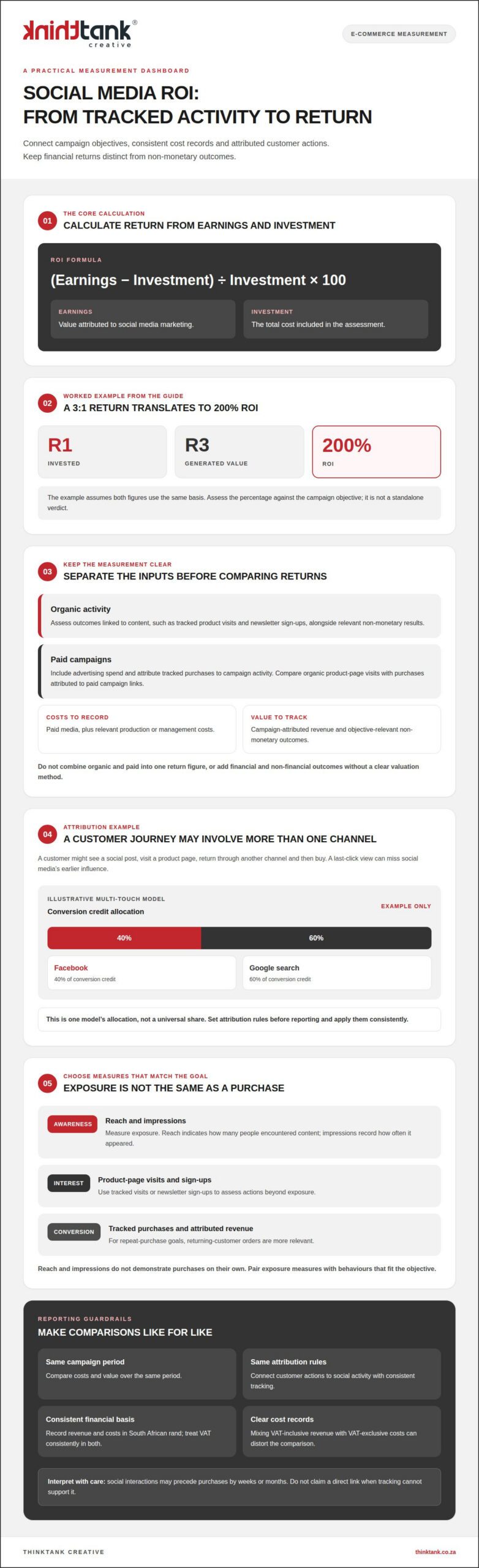
    Separate organic and paid social media before assigning value. For organic activity, assess outcomes linked to content, such as tracked product visits or newsletter sign-ups, alongside relevant non-monetary results. For paid campaigns, include advertising spend and attribute tracked purchases to campaign activity. This distinction helps show whether results came from paid distribution or organic engagement. Avoid combining both into a single return figure, which can obscure how each approach contributes to the campaign objective.

    For example, compare organic product-page visits with purchases attributed to paid campaign links. Apply the same attribution method consistently to both.

  2. How a professional calculates campaign costs and revenue

    Keep a campaign cost record that captures the investment being assessed, including paid media and relevant production or management costs. Compare that total with campaign-attributed revenue, using tracking data that links social interactions to e-commerce purchases. A purchase is not automatically attributable just because it happened during a campaign: the tracking rules must connect the customer action with social activity.

    There is no single typical advertising cost or return for South African businesses. Costs depend on campaign objectives, paid spend and the scope of the work; returns depend on attributed revenue and which costs are included.

  3. How a professional compares social media costs with value

    Compare like with like: use the same campaign period and attribution rules for costs and value. Value may include revenue from tracked purchases or non-monetary outcomes, such as comments or newsletter sign-ups, when they support the stated objective. Keep these outcome types separate rather than adding them together without a clear valuation method.

    For financial reporting, record revenue and costs consistently in South African rand. Treat VAT consistently in both figures and keep the underlying financial records clear. Mixing VAT-inclusive revenue with VAT-exclusive costs can distort the comparison.

  4. How a professional calculates ROI from earnings and costs

    Apply the formula: (earnings minus investment) divided by investment, multiplied by 100. In this calculation, earnings are the value attributed to social media marketing, and investment is its total cost. For example, a 3:1 return means R3 in generated value for every R1 invested; if both figures use the same basis, the formula produces a 200% ROI.

    Use the result to assess the campaign against its objective, not as a standalone verdict. A percentage may look strong while overlooking non-monetary outcomes or an incomplete cost record.

Can a Professional Measure the ROI of Your Social Media Marketing?

Yes. A considered approach connects social activity with business objectives, tracked actions and purchase behaviour. Common mistakes include treating reach as revenue, relying only on last-click attribution and overlooking the influence of other channels.

  1. How a professional matches goals with ROI measures

    Start by translating each marketing objective into a metric that shows progress towards it. For a product launch, reach and product-page visits can indicate whether the campaign is attracting attention. For repeat purchases, returning-customer orders are more relevant. Avoid using the same metric for every objective: a large audience alone doesn’t show that a campaign generated sales.

    Record the objective, its matching metric and the assessment period in the measurement plan. This gives brands a consistent basis for interpreting results and keeps marketing strategy connected to business priorities. For awareness, assess exposure and subsequent interest; for sales, assess tracked purchases and attributed revenue.

  2. How a professional connects social metrics to purchases

    Map the customer journey from social interaction to purchase, using tracked visits and defined conversion events. A customer might see a post, visit a product page, return through another channel and then buy. A last-click view may award all the credit to that final channel, obscuring social media’s earlier influence.

    Set attribution rules before reporting, then apply them consistently across the campaign. Multi-touch attribution can distribute conversion credit across channels according to predefined rules or a statistical model. For example, one model assigns 40% of conversion credit to Facebook and 60% to Google search. The allocation describes that model, not a universal share for either channel.

    Allow for delayed influence when interpreting results. Social interactions can precede purchases by weeks or months, particularly for B2B and enterprise buyers. For e-commerce, compare the tracked journey with purchase records, and avoid claiming a direct link when tracking cannot support it.

  3. How a professional uses reach and impression measures

    Use reach and impressions to assess exposure, then connect that exposure with deeper actions. Reach indicates how many people encountered content; impressions record how often it appeared. Neither measure demonstrates purchases on its own, so pair it with relevant behaviours such as product-page visits, sign-ups or completed orders.

    Interpret each measure against the campaign objective and audience. An increase in impressions may reflect repeated exposure rather than more distinct people or stronger purchase intent. Compare it with engagement and subsequent actions to see whether content moved audiences towards the next step. Qualitative feedback, including positive comments, can add context to numerical metrics.

    Fragmented platform dashboards can make this assessment harder. Nielsen’s 2025 Marketing Report identifies bringing data together across separate platform dashboards as a top barrier to calculating ROI. A unified reporting view helps professionals interpret the campaign’s signals together. A coordinated social measurement approach can connect those signals with business objectives.

Awareness, engagement and conversion metrics

Useful KPIs depend on the objective: awareness uses reach and impressions, engagement tracks interactions, and conversion measures actions such as sign-ups or purchases. A professional groups these measures to show how social media efforts move audiences from exposure towards business outcomes.

  1. How a professional tracks awareness and engagement measures

    Choose awareness measures that describe exposure, then pair them with engagement measures that show audience response. Reach and impressions indicate whether content appeared before an audience; comments, shares, saves and clicks show how people interacted. A high impression count alone doesn’t establish brand awareness or commercial impact, so interpret it alongside meaningful engagement.

    Use campaign examples to give the figures context. Blendtec’s “Will It Blend?” videos had been viewed more than 100 million times on YouTube, illustrating substantial content exposure. That view count is an awareness signal, not proof of purchases. A professional assesses it alongside responses and subsequent actions, rather than treating views as a complete measure of return.

    For website activity, compare social-driven visits with relevant behaviour after arrival. Southwest Airlines’ redesigned blog recorded a 25% increase in visits and a 40% increase in page views. Those measures show changes in site activity; a separate conversion measure is needed to establish whether visitors took a valuable action.

  2. How a professional distinguishes micro and macro conversions

    Classify each conversion by its place in the customer journey. Ebook downloads, newsletter sign-ups and trial registrations are micro-conversions: they indicate interest before a final purchase. A completed product order is a macro-conversion for an e-commerce business. This distinction helps explain progress when a campaign generates engagement before sales appear.

    Where tracking allows, link each micro-conversion to a relevant later outcome. For example, assess whether newsletter sign-ups from social activity are followed by purchases, rather than automatically assigning them the same value. Keep the two event types separate in reporting, and don’t count one person’s sign-up and purchase as two completed sales.

    Micro-conversions can help assess campaigns whose immediate objective is consideration. They are useful indicators, but not substitutes for a purchase KPI when the objective is revenue. Report the sequence clearly, from social interaction to sign-up and, where tracked, purchase.

  3. How a professional selects conversion performance indicators

    Match conversion KPIs to the action the campaign is designed to generate. For an online shop, these may include tracked orders and revenue; for a lead-focused campaign, they may include qualified enquiries. Google Analytics can support analysis of website activity and defined events, while social platform reports provide channel-specific interaction measures.

    Set a consistent reporting window and event definition before comparing campaign performance. A click is not a purchase, and a landing-page visit is not necessarily a sign-up. Pair conversion volume with conversion value where available, then interpret both against campaign costs and the stated objective.

    Include qualitative feedback when it helps explain performance. Positive comments can add context to engagement figures, while completed orders show a direct commercial outcome. Reporting both gives decision-makers a clearer view of what social media activity achieved.
How to Measure Social Media Marketing ROI and Track Business Impact

Defining social media ROI

Define social media marketing ROI before measuring it. The business objective determines which outcomes count as value, from sales to newsletter sign-ups.

  1. How a professional sets social media goals

    Translate a business priority into a specific social media goal. For example, a retailer launching a product could target product-page visits, while a brand focused on repeat purchases could track returning-customer orders. The goal should describe a business outcome, not simply activity such as publishing posts or gaining followers.

    Next, match the goal to an observable measure and decide how the result will be attributed. For a Facebook campaign, track visits from campaign links and subsequent purchases. Don’t choose metrics just because a platform makes them easy to report: each measure should help assess the intended outcome.

    Set the scope before evaluating results. Specify which campaign, platforms and audience the assessment covers, and keep those boundaries consistent when comparing performance. If a campaign supports both awareness and sales, record them as distinct objectives so engagement doesn’t become a substitute for purchase results.

  2. Define the return being measured

    Social media ROI is the value generated by social media investment, assessed against the chosen objective. Value may be financial, such as attributed e-commerce revenue, or non-financial, such as comments and newsletter sign-ups. Both outcomes can matter, but they shouldn’t be combined as if they were equivalent measures.

    For a sales objective, focus on purchases and revenue attributed to social activity. For an awareness objective, relevant indicators might include audience response or new newsletter sign-ups. Define what counts as value before reporting, so measuring social media marketing ROI reflects the goal rather than whichever metric looks most impressive.

    Then document the attribution approach. A customer may encounter a social post, visit a product page later and complete a purchase after another interaction. The chosen rules determine how much credit social receives. Applying the same approach across campaigns makes comparisons more meaningful, while recognising that a single platform interaction may not capture the whole customer journey.

    Finally, separate return from performance activity. Facebook likes, comments and clicks describe interactions; they don’t automatically demonstrate financial return. If the objective is community engagement, comments may represent relevant value. If it is sales, connect platform activity to tracked purchases before presenting it as revenue generated.

Reasons to measure social media ROI

Measurement turns social activity into evidence for decisions about strategy, investment and customer relationships. Its value goes beyond showing whether a campaign generated sales.

  1. Use performance evidence to explain social media’s contribution to business outcomes. Sixty-eight per cent of marketers report worrying about proving the return on their social media efforts, while 46% believe social media use improves sales. Tracking results against a stated objective helps distinguish evidence of progress from assumptions about impact.

    For example, an e-commerce team can connect social activity with product interest and tracked orders. If orders rise but social-attributed visits do not, examine the attribution approach before claiming social caused the increase.

  2. Compare results over time to identify which content supports growth. Tracking progress across six months, for example, can show whether product demonstrations or customer stories generate stronger responses. A consistent comparison period helps teams interpret changes without treating one successful post as proof of a lasting trend.

    Pair the figures with platform context. Google Analytics can help assess website activity alongside platform engagement, while positive comments may explain why a particular message resonated. Neither comments nor visits alone prove revenue, but together they can inform the next campaign decision.

  3. Connect social insights with decisions beyond the marketing team. Among marketers who work with social data, 98% agree that social insights have enabled cross-functional business outcomes. Social feedback can help teams consider customer experience, retention and messaging, rather than limiting reporting to likes or reach.

    For instance, repeated questions in comments about product sizing could help a retailer identify an issue with content or product information. Sharing that pattern with the relevant team gives the feedback a practical purpose, while keeping it distinct from measured sales outcomes.

  4. Use audience signals to inform retention and market decisions. Among marketers reporting business outcomes from social intelligence, 45% cite customer retention as a benefit, and 40% cite identifying a new audience or market shift. These findings show why social analysis can contribute to decisions beyond campaign reporting.

    A rise in positive comments from a previously overlooked audience, for example, may prompt a brand to examine that audience’s needs. Comments are a signal to investigate, not proof of demand or a substitute for purchase data.

  5. Make budget discussions more evidence-led by showing what social activity supports. Kellogg found that Special K cereal’s online return on investment was twice the return from television over 18 months. The comparison illustrates how channel-level evaluation can inform investment choices, while each business still needs measures suited to its own objectives.

    Use findings to refine the next campaign, not simply to defend past spending. Strengthen your social media measurement approach by connecting campaign results with the business decisions they can inform.

ThinkTank Creative: Social Media Marketing

ThinkTank Creative provides Social Media Marketing to help businesses shape campaigns around clear objectives and meaningful outcomes. Turn to this support when social activity needs a more considered strategy, or when reporting needs to connect engagement with business impact.

Effective measurement depends on more than platform figures. It requires a coherent approach to objectives, audience response and the actions that matter to the business. Where digital touchpoints need closer alignment, Website Design and Development and Creative design can support a consistent experience from social content to the website.

Bring your business goals and current measurement challenges into the conversation. Contact ThinkTank Creative to discuss your social media marketing needs.

Turn your social data into your next decision

Make each reporting cycle a starting point for a sharper business decision. A disciplined approach to measuring social media marketing ROI can help your team decide which audience to prioritise, what creative direction to develop and how social activity should support the wider customer experience. The next opportunity may not be another campaign; it could be improving how people move from discovering your brand to engaging with it.

That work benefits from alignment between strategy, creative and the digital destination. ThinkTank Creative offers Social Media Marketing, Creative design and Website Design and Development, bringing relevant disciplines together around your business objectives. Use each measurement cycle to refine the connection between what your audience sees and the action you want them to take.

Ready to shape a more considered approach for your business? Contact ThinkTank Creative to discuss your goals and take the next step with confidence.

Frequently Asked Questions

How do data silos across platforms affect ROI tracking?

Data silos make it harder to connect platform activity with website behaviour and completed orders. For example, Facebook may record an advert click while website analytics records a later purchase under another source. Align campaign names, tracking labels and conversion definitions across reports, then investigate mismatches. This helps reduce inconsistent attribution and prevent the same purchase from being counted more than once.

How do delayed conversions and long sales cycles affect ROI measurement?

Delayed conversions can make a campaign appear ineffective if reporting ends before customers purchase. Social media influence may precede a decision by weeks or months, particularly in B2B and enterprise sales. A professional follows campaign cohorts over a reporting window suited to the sales journey, separating early indicators from completed revenue. This gives later conversions room to appear without treating every subsequent sale as social-driven.

How does a professional calculate ROI for brand awareness campaigns?

To calculate awareness ROI, assign a defensible value to the awareness outcome, then compare it with campaign investment. For example, a business might assess a defined increase in relevant audience attention against its campaign objective. Any monetary valuation should use a consistent method and be labelled as estimated value, not sales revenue. Without a credible valuation, report awareness outcomes separately rather than implying financial ROI.

How does a professional quantify non-monetary value?

First define which non-monetary outcomes matter, such as positive comments, newsletter sign-ups or qualified interactions. Count each outcome using a consistent event definition, then assess it against the campaign objective. If a business assigns a financial equivalent, it needs a clear rationale, such as a known relationship between sign-ups and later purchases. Otherwise, keep the outcome as a separate performance measure.

What is multi-touch attribution across channels?

Multi-touch attribution distributes conversion credit across the channels a customer interacted with before purchasing. A customer might discover a product through a social post, return through an email and complete an order after a search. Apply predefined rules or a statistical model to allocate credit across those interactions. The chosen model shapes the reported contribution, so comparisons require consistent attribution rules.

What metrics should you track for awareness and reach?

Track reach to understand how many people saw content, and impressions to assess total exposure. Audience growth, video views and relevant profile visits can add context, depending on the campaign format. Compare these measures with the intended audience and content type: high exposure alone doesn’t demonstrate recognition or purchase intent. Comments and shares can also help explain how people respond to the message.

What metrics should you track for conversion and revenue?

For an e-commerce campaign, track completed purchases and revenue attributed to social activity. Conversion rate shows how often relevant visits lead to the chosen action, while average order value adds context to revenue. Cost per acquisition can help compare spending with acquired customers. Define whether cancelled or refunded orders are included, then apply that treatment consistently across campaign reports.

How does a professional calculate social media marketing ROI?

A professional subtracts social media investment from the value attributed to social activity, divides the result by that investment and multiplies by 100. The result is a percentage. For example, a return above zero indicates attributed value exceeded the included investment; a result below zero indicates the opposite. The calculation is only meaningful when earnings and costs cover the same campaign scope and reporting period.
Measuring Google Ads ROI through costs, revenue and net profit

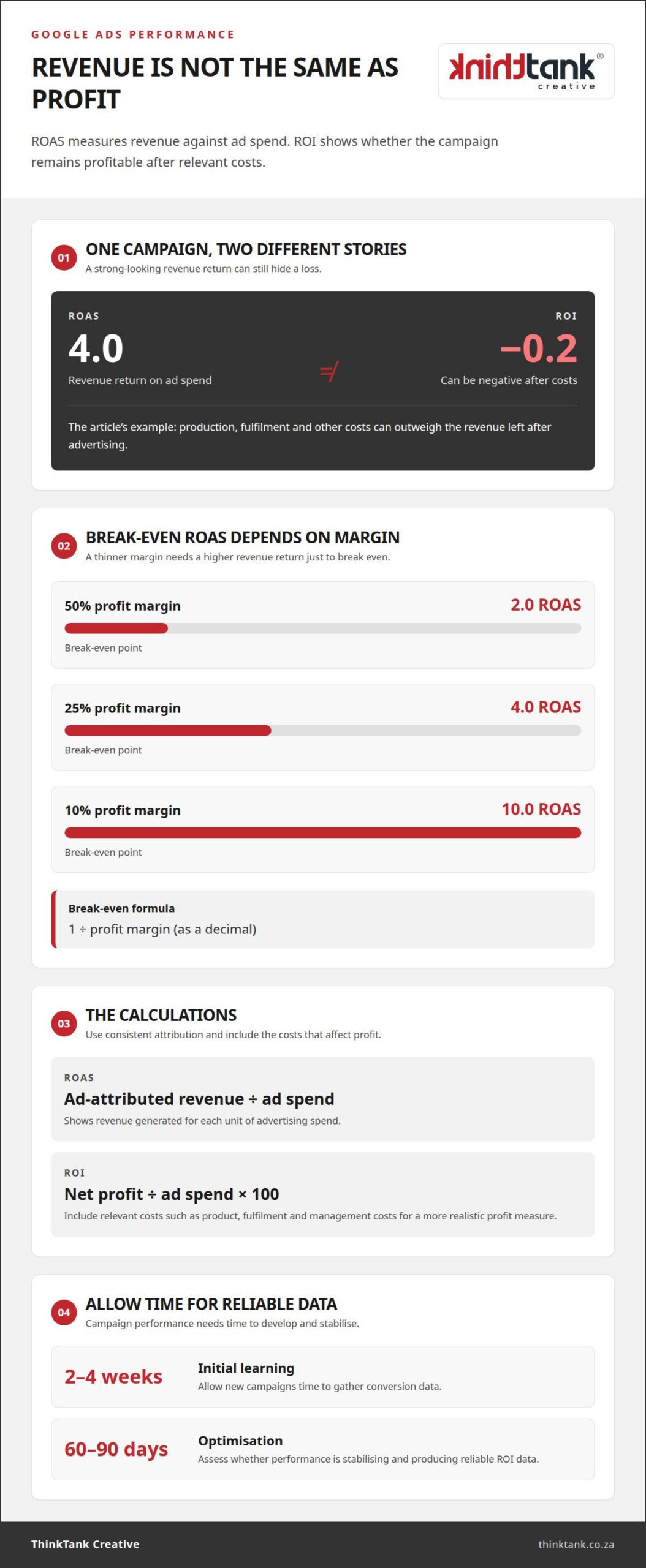
A healthy-looking Google Ads return can still hide an unprofitable campaign. Measuring Google Ads ROI means looking beyond revenue and ROAS to account for the costs that determine net profit. New campaigns need time to gather conversion data: allow 2-4 weeks for initial learning and 60-90 days of optimisation to assess whether performance is stabilising and producing reliable ROI data.

It’s understandable to want a clear answer quickly, especially when every click uses part of your marketing budget. But conversion tracking, lead quality, sales outcomes and business costs all affect the result. Revenue alone cannot show whether advertising is contributing to profit.

This article explains how to track conversions, calculate ROI and distinguish it from ROAS. It also explores how results vary by business type, when campaigns may show meaningful performance, and how the data can guide focused improvements.

Key Takeaways

  • Set conversion tracking around meaningful outcomes, then connect lead activity with the sales or revenue it generates.
  • Use ROAS to understand revenue relative to ad spend, and ROI to see whether the campaign remains profitable after relevant costs.
  • Include product, fulfilment and management costs in your calculations to build a more realistic view of net profit.
  • Segment performance by campaign and audience to find where budget changes or creative tests could make the greatest difference.
  • Judge results against your business model, margins and customer value rather than relying on a single benchmark for every industry.

Conversion tracking

Reliable ROI measurement starts by recording the actions that matter to a South African business. Google Ads conversion tracking connects ad interactions with those outcomes, giving performance analysis a stronger foundation than click totals alone.

Tracking conversions and micro-conversions

Conversion tracking records valuable actions after an ad interaction, while micro-conversions capture meaningful steps towards those outcomes. Choose actions that match the business goal, such as a completed purchase, qualified enquiry, phone call or appointment booking. For an auto repair shop, calls from an ad, calls after an ad click, contact form submissions and completed booking forms can all count as conversions.

Google Ads provides a free conversion tracking tool to measure how many clicks lead to conversions. You can also connect Google Ads with Google Analytics to understand campaign activity across channels. This helps distinguish a completed sale from an early signal, such as a form start, so minor interactions don’t inflate the value assigned to advertising.

Conversion rate is total conversions divided by total clicks, multiplied by 100. Cost per acquisition (CPA) is total ad spend divided by total conversions; cost per lead uses total advertising spend divided by the number of leads. These measures answer different questions: conversion rate shows how often clicks lead to action, whilst CPA shows the spend associated with each recorded outcome.

For South African reporting, keep revenue, advertising spend, conversion values and VAT treatment consistent. If sales or costs are in another currency, record the exchange rate used to convert them into Rand rather than mixing currencies in one calculation. Use actual local transaction values for conversions, not assumed values that obscure what the business earned.

Conversion benchmarks also depend on the service and the action being measured. Legal and healthcare industries often have search conversion rates above 6%, but that figure isn’t a universal target for South African service businesses. A professional compares like-for-like actions and considers whether enquiries become qualified leads, appointments or paying customers.

Attribution and conversion profitability

Attribution assigns credit to advertising interactions that contribute to a conversion, while profitability analysis checks whether the resulting value exceeds its costs. A Google Ads attribution window may be 30 or 90 days; conversions outside the chosen window aren’t counted. Professionals consider multi-touch attribution when several advertising touchpoints influence a customer journey.

For revenue measurement, set up conversion tracking for a purchase or revenue event. When a sale happens offline, such as after a phone enquiry or in-person visit, offline conversion tracking can connect the outcome to the earlier ad interaction. A CRM can link campaign activity with revenue, lead quality and customer lifetime value. Together, these records make cost per conversion more useful: the key question is not just how many actions occurred, but whether they produced profitable business.

What Is the Difference Between Google Ads ROAS and ROI?

ROAS compares ad-attributed revenue with advertising spend, while ROI measures profit against investment. To compare Google Ads with other marketing channels, assess each using consistent attribution, time periods and cost calculations.

ROAS and profit-based ROI

ROAS shows how much revenue advertising generates for each unit of ad spend. Profit-based ROI asks whether the campaign earns more than its attributable costs. A 4.0 ROAS can still produce a -0.2 ROI when production, fulfilment and other costs outweigh the revenue left after advertising.

These metrics answer different business questions. ROAS helps compare revenue efficiency between campaigns, while ROI indicates whether the investment creates profit. Clicks and attributed sales describe activity, but they don’t show the full return unless you also account for costs and profit margins.

Break-even returns and profit margins

Break-even ROAS is the revenue-to-ad-spend ratio needed to cover advertising costs at a given profit margin. Calculate it by dividing 1 by the profit margin expressed as a decimal. At a 50% margin, a 2.0 ROAS breaks even; at a 25% margin, break-even rises to 4.0.

A 10% margin requires a 10.0 ROAS to break even. The same revenue return can therefore mean profit for one business and a loss for another. Use the margin on the revenue driven by ads, rather than treating a general ROAS benchmark as a profit target.

Calculating ROAS and ROI

For ROAS, divide revenue attributed to ads by ad spend. For ROI, divide net profit by ad spend, then multiply by 100. A professional includes relevant costs when calculating net profit, so the result reflects more than the sales value recorded against campaign clicks.

Related metrics add context. CPA is the cost of acquiring a customer or lead; AOV means average order value. LTV estimates customer value over their relationship with a business, using average purchase value, purchase frequency and customer lifespan. A higher CPA may be viable when LTV supports it.

Compare channel returns on equivalent terms: use consistent attribution rules, conversion values and cost coverage for Google Ads, social media and email. A channel’s reported revenue can reflect different customer journeys, so assess the profit it contributes, not just its attributed sales. For a more joined-up view, consider campaign performance analysis.

Optimising campaigns using performance data

Campaign optimisation works best when you compare meaningful results over time, not isolated clicks. In South Africa, that means balancing growth opportunities with cash flow and the campaign’s actual goals.

Baselines and industry benchmarks

A baseline is a campaign’s starting performance, assessed against its previous 3-6 months of data where available. It gives professionals context for changes in conversions, costs and revenue, rather than judging an adjustment against a single day. Industry benchmarks add perspective, but they can’t replace a business-specific comparison.

For example, retail search conversion rates average around 2.8%. That figure is a reference point, not a target for every South African online shop. A professional compares similar products, customer journeys and conversion actions, then considers whether the landing page reflects the ad’s promise and supports purchases.

Analytics can show where performance changes: by campaign, device, location, time of day or creative. You can adjust bids towards stronger segments, exclude irrelevant searches with negative keywords, and align each landing page with search intent. These changes connect observed behaviour with practical optimisation decisions.

Learning and stabilisation periods

A learning period gives a new campaign time to gather conversion data before performance is judged. Allow at least 2-4 weeks for that data to accumulate, then assess whether changes are improving outcomes. Reliable ROI often needs a longer view: campaigns may take 60-90 days to stabilise and produce dependable results.

This timeline matters for cash flow. A business should account for advertising spend during the learning period, while avoiding abrupt budget changes that make results harder to interpret. Once a campaign has meaningful data, professionals can adjust budgets gradually, such as increasing spend by 10-20% every few days whilst monitoring performance.

Performance against campaign goals

Compare campaign results with the agreed business goal, such as qualified enquiries, purchases or revenue. Consider both volume and value: a campaign producing more leads may still underperform if few progress to sales. CRM outcomes can help connect campaign activity with lead quality and revenue.

Goals also guide which optimisation matters. For online commerce, the focus may be purchase value and profitable growth; for lead generation, it may be qualified enquiries and their eventual contribution to sales. Segment performance by campaign and creative so budget decisions reflect which activity supports the intended outcome.

When a campaign falls short, investigate the evidence before changing direction. You might test ad copy or landing-page variations, review device and location performance, or refine targeting. A controlled test isolates the change, making it easier to tell whether it improved conversions or simply shifted clicks.

Use each review to make a clear decision: retain what meets the goal, refine weak points and keep testing where evidence is limited. This measured approach helps protect cash flow while making room for sustainable growth.

Measuring Google Ads ROI through costs, revenue and net profit

Calculating revenue, costs, net profit, and ROI

For lead-generation campaigns, connect Google Ads spend with qualified enquiries, sales and revenue. Measuring Google Ads ROI means assessing the profit those results contribute after relevant costs, not treating every recorded lead as a completed sale.

Revenue, costs and net profit

Revenue is the Rand value of sales attributed to advertising; net profit is what remains after relevant costs are subtracted. This distinction shows whether campaign-generated business contributes profit after delivery and operating expenses.

A professional connects campaign records with sales data, then accounts for costs such as goods or service delivery, fulfilment and allocated overhead. Payment processing fees may also affect the result; one calculation approach uses a 2-3% allowance of revenue. Consistent cost categories make comparisons across campaigns more meaningful, because each result reflects a similar view of what it took to generate sales.

Lead-generation revenue requires a link between enquiries and completed sales. If one sale results from every 10 leads, professionals use actual sales records and the value of those sales to assess the revenue associated with the leads. CRM data can distinguish qualified prospects from enquiries that do not progress, giving the ROI calculation a clearer commercial basis.

ROI calculations and examples

Calculate ROI by dividing net profit by ad spend, then multiplying by 100. Net profit must account for the advertising cost and other relevant expenses, so the result reflects profit against campaign investment.

For example, a 200% ROI means the net profit equals twice the ad spend under this formula. When measuring Google Ads ROI, a professional examines the underlying sales and cost records before interpreting that percentage. If fulfilment or overhead is omitted, the calculation can overstate the campaign’s contribution.

Keep the reporting period consistent by matching campaign spend with the related revenue and costs. A sale may follow an enquiry later, so use attribution and sales records to connect the transaction with the advertising that contributed to it. This gives you a more useful ROI assessment than clicks or enquiries alone.

Cost per lead and lead-generation returns

Cost per lead is total advertising spend divided by the number of leads. It shows the average campaign spend per enquiry, but does not establish whether those leads become profitable customers.

To assess lead returns, a professional follows the path from ad interaction to enquiry, qualified opportunity and sale. If 10 leads produce one sale, the business’s actual sale value and related costs help determine the profit generated. Measuring Google Ads ROI for lead generation therefore depends on connecting lead quality with later sales outcomes, rather than assigning equal value to every enquiry.

These insights can also guide targeting decisions. A campaign with a lower cost per lead may deliver weaker returns if its enquiries rarely convert, while higher-cost leads may produce stronger sales. Professionals compare lead quality, sales outcomes and spend before adjusting targeting or budgets.

Typical Google Ads ROI by business type

There’s no single return that defines success for every business. A useful benchmark depends on profit margins, customer value, sales cycles and the conversion the campaign is designed to generate.

For direct-to-consumer businesses, a ROAS guideline is 3.0x to 5.0x. This range can help frame campaign performance, but it doesn’t establish profitability by itself. Product costs, delivery expenses and other operating costs affect how much revenue remains as profit. A South African retailer should assess its own margins before treating a return in this range as a success.

E-commerce guidance also gives a 2.75x ROAS benchmark. That figure differs from the direct-to-consumer range because benchmarks can use different assumptions and business models. Rather than combine them into one target, a professional identifies the closest comparison, then considers the store’s average order value, repeat purchases and costs.

Business-to-business campaigns have a wider ROAS guideline, from 4.0x to 10.0x, depending on sales cycle and conversion value. A longer sales process can mean that a click or enquiry takes time to generate revenue. Campaign analysis should connect the keyword and audience to qualified opportunities, then follow those opportunities through to sales.

Service businesses also need to judge lead quality, not just enquiry volume. Optimised campaigns for service businesses can exceed 200% ROI when focused on lead quality. That isn’t a universal result: the return depends on how many leads become customers, the value of each sale and the costs involved. A strategy that captures more suitable enquiries may contribute more than one generating a larger number of unqualified leads.

Results can vary widely across digital product campaigns and businesses, so benchmarks should be treated as context rather than a promise. These figures offer context, not a promise or a target for every South African advertiser. Differences in margins, sales journeys and customer value make direct comparisons unreliable unless the calculations use comparable costs and attribution.

Use benchmarks to ask better questions: does this campaign attract the right audience, generate valuable conversions and support profitable growth? A professional can compare results with the business’s margins and goals, then optimise targeting, keywords and campaign strategy accordingly. For support refining your Google Ads campaign strategy, connect your performance goals with a focused PPC approach.

ThinkTank Creative

ThinkTank Creative helps businesses connect campaign goals with the digital experiences customers encounter along the way. If ad clicks lead to a website that doesn’t clearly guide visitors towards an enquiry or purchase, Website Design and Development can strengthen that journey. Social Media Marketing and creative design can also support consistent communication across customer touchpoints.

Consider this support when performance data points to gaps between attracting an audience and helping people take action. A clear website experience and cohesive messaging give your campaigns a stronger foundation for turning relevant visits into meaningful outcomes.

Contact ThinkTank Creative to discuss how your digital experience can better support your marketing goals.

Build your next growth decision on evidence

Make campaign measurement part of a wider growth conversation, not just a reporting exercise. A disciplined approach to measuring Google Ads ROI can help your team decide where to focus, which parts of the customer experience need attention, and how advertising supports your business priorities.

ThinkTank Creative can help shape that wider digital experience through Website Design and Development, Social Media Marketing and creative design. These capabilities support a consistent journey from the first interaction to the point where a potential customer takes action. Discuss how your campaign objectives and customer experience can work together.

Discuss your campaigns with ThinkTank Creative and explore a considered path towards your marketing goals.

Frequently Asked Questions

How quickly should Google Ads show positive ROI?

Allow time for reliable conversion data before judging a campaign’s return. New campaigns may need 2-4 weeks to gather data, while 60-90 days can provide a better view of stabilising performance. The timeline depends on how quickly clicks turn into trackable sales or qualified leads. A long sales cycle can delay visible revenue, so early results may not reflect the campaign’s eventual contribution.

Is negative immediate ROI acceptable if lifetime value is high?

It can be acceptable if later customer value is supported by actual purchase and retention data. For example, a 1:1 ROAS may be acceptable when a customer is expected to generate four times as much revenue over time. However, future revenue isn’t the same as profit: consider the cost of serving repeat purchases and the time required to earn them before treating an initial loss as sustainable.

What are the Common Mistakes When Measuring Advertising ROI?

Common mistakes include counting every enquiry as a sale, relying on revenue without accounting for costs, and giving all credit to the final ad interaction. For example, a form submission may be an unqualified lead rather than a paying customer. Double-counted conversions can also distort results. Clear definitions of valuable actions, consistent attribution and sales records help prevent these errors from shaping budget decisions.

What constitutes good ROI for Google Ads?

Good ROI is positive net profit relative to ad spend, with a return that supports the business’s goals. Around 200% is a broad reported benchmark for businesses, not a universal target. Profit margins, customer value and sales costs change what counts as a sustainable result. Compare performance with the business’s break-even point and lead or purchase quality, rather than judging success against one industry-wide figure.

What is ROI in Paid Advertising?

ROI in paid advertising measures the net profit generated relative to the advertising investment. It helps a business assess whether a campaign contributes profit after relevant costs, rather than simply producing clicks or sales revenue. A useful calculation connects ad-attributed results with the expenses required to earn them. ROI is therefore a business outcome metric, while engagement measures describe activity along the customer journey.

How does a professional calculate Google Ads ROI and ROAS?

A professional divides ad-attributed revenue by ad spend to calculate ROAS. To calculate ROI, they divide net profit by ad spend and multiply by 100. For example, the calculation should include costs that affect the profit from those sales, not just campaign spend. They also align the attribution period and reporting timeframe, so revenue and costs relate to comparable campaign activity.

Which costs should be included when measuring Google Ads ROI?

Include ad spend and the costs of delivering the sales it generated. Depending on the business, these may include product or service costs, fulfilment, payment processing and allocated overhead. Management time may also matter when it represents a real resource used to run campaigns. Apply the same approach across reporting periods: leaving out a major cost can make an unprofitable campaign appear to generate a return.

How does a professional track conversions and revenue accurately in Google Ads?

A professional records meaningful outcomes, such as purchases or qualified leads, and connects them with the campaign activity that contributed to them. For offline sales, CRM records or offline conversion data can link a phone enquiry or in-person visit to an earlier ad interaction. Revenue values should reflect actual transactions, and duplicate or low-value actions should not inflate the results used for campaign decisions.

Google Ads bidding strategies for choosing bids that fit your goals

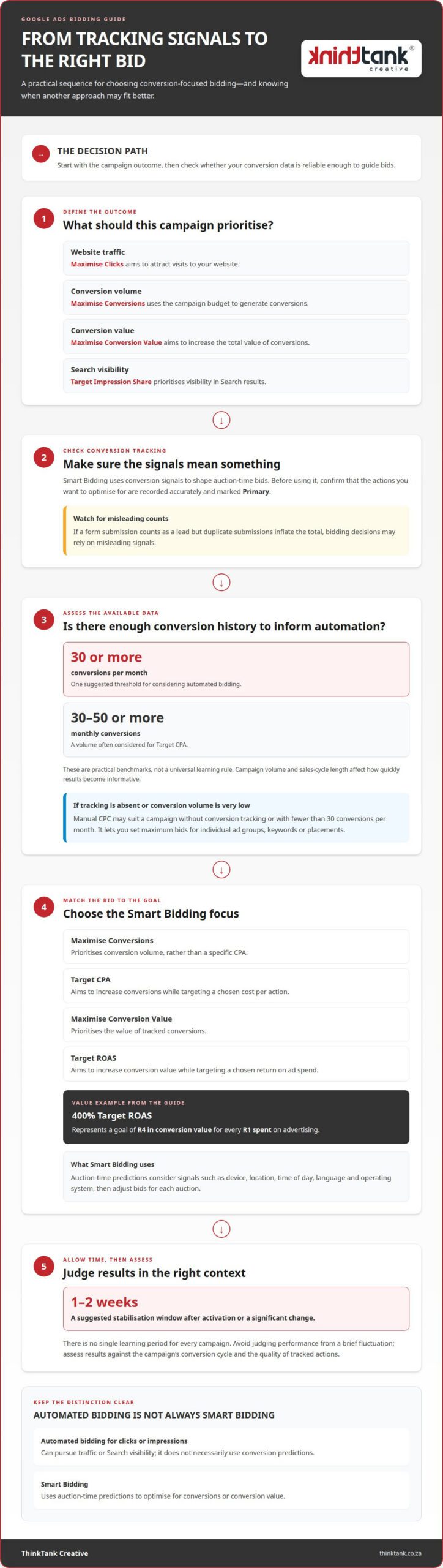
The bid that wins the most clicks may still be wrong for your goal. Understanding Google Ads bidding strategies starts with matching the approach to your campaign objective: Maximise Clicks can pursue website traffic, while Smart Bidding can optimise for conversions or conversion value.

Automated bidding is not always the best choice, and manual bids do not offer more control in every situation. Understanding Google Ads bidding strategies means weighing your campaign objective against the quality of your conversion tracking.

This guide builds on that understanding of Google Ads bidding strategies by explaining when Manual CPC or automated approaches may suit your campaign. You’ll also learn how conversion tracking informs the choice and why automated bidding can manage clicks and impressions differently from Smart Bidding, helping you make a considered decision for your South African campaigns.

Key Takeaways

  • Use Manual CPC when you need direct control over maximum keyword or placement bids, particularly while conversion data is limited.
  • Before choosing conversion-focused Smart Bidding, ensure tracking is accurate and the actions you want to optimise for are set as Primary.
  • Match the strategy to the campaign goal: sales, leads and brand awareness call for different bidding priorities.
  • Target Impression Share can help prioritise visibility in Search results, while Maximise Clicks aims to attract website traffic.
  • Automated bidding for clicks or impressions is not the same as Smart Bidding, which uses auction-time signals to optimise for conversions or conversion value.

Conversion tracking and Smart Bidding best practices

Conversion tracking gives Google Ads signals about valuable outcomes. Smart Bidding uses those signals to shape auction-time bids, so the strategy works best when each recorded action reflects a meaningful business result.

Maximising conversions and conversion value

Maximise Conversions aims to use the campaign budget to generate conversions. Maximise Conversion Value aims to increase their total value. This distinction matters when a lead and a completed sale have different business value.

For sales campaigns, Google Ads lists Maximise Conversions and Maximise Conversion Value as bidding options. Choose the first when the priority is conversion volume; consider the second when tracked purchases carry different values. For example, a 400% Target ROAS represents a goal of R4 in conversion value for every R1 spent on advertising.

Smart Bidding for conversion goals

Smart Bidding is Google Ads’ automated bidding approach for optimising towards conversions or conversion value, using auction-time predictions. It considers signals such as device, location, time of day, language and operating system, then adjusts bids for each auction.

Target CPA aims to increase conversions while targeting a specific cost per action. Target ROAS aims to increase conversion value while targeting a chosen return on ad spend. Both depend on accurate tracking, and targets should start close to current campaign performance.

Set up tracking before using conversion-focused bidding. Confirm that the intended actions are recorded accurately and marked Primary, so Google Ads optimises towards the outcomes that matter. For example, if a form submission counts as a lead but duplicate submissions inflate the total, bidding decisions may rely on misleading signals.

Volume also affects whether a strategy has useful data. One suggested threshold for considering automated bidding is 30 or more conversions per month; Target CPA is often considered with 30-50 or more monthly conversions. These are practical benchmarks, not a universal learning rule: campaign volume and sales-cycle length affect how quickly results become informative.

Allow Smart Bidding time to stabilise after activation or a significant change. A suggested window is 1-2 weeks, although there is no single learning period for every campaign. Avoid judging performance from a brief fluctuation; assess results against the campaign’s conversion cycle and the quality of tracked actions.

Keep the objective clear. Maximise Clicks seeks website traffic, Maximise Conversions uses the budget to optimise for conversions rather than a specific CPA, and Maximise Conversion Value prioritises tracked value. Target Impression Share focuses on Search visibility. Let tracking and campaign goals guide your choice, not the strategy label alone.

Manual CPC bidding

Manual CPC lets you set a maximum cost-per-click bid for individual ad groups, keywords or placements. Automated bidding adjusts bids to pursue the campaign objective. That is the central difference: you set the bid directly with manual bidding, while the system manages it with automated bidding.

With manual bidding, the European Union says, you set the maximum amount you are willing to pay per click, though you may pay less depending on the auction. The actual cost may be lower, depending on the auction. This gives you direct control over bid ceilings. For example, you can set different maximums for keywords with distinct commercial value instead of applying one bid across every ad group.

Manual CPC can suit campaigns without conversion tracking or with very low conversion volume, defined as fewer than 30 conversions per month. In these cases, there may be too little conversion data to guide conversion-focused automation. A manual approach lets you decide which keywords deserve higher bids, then assess their clicks and results before adjusting those limits.

Control also brings responsibility. A maximum CPC bid is a ceiling, not a promise that every click will cost that amount. Review bids alongside the daily budget and the quality of traffic each keyword attracts. If a keyword receives clicks but does not support the campaign objective, reduce its bid or exclude it from the campaign.

Enhanced CPC is an optional feature used with Manual CPC. You set baseline bids, and Google Ads can adjust them in an attempt to maximise conversions. This introduces automation without handing over every initial bid decision. However, these conversion-focused adjustments still rely on useful signals, so recorded actions should reflect genuine outcomes.

Smart Bidding differs from both standard manual bidding and automated bidding for other goals. It uses auction-time conversion predictions, while other automated strategies do not necessarily use those predictions. Target Impression Share is another automated option: it aims for a position on Google Search results, prioritising visibility rather than a manually chosen maximum CPC for each keyword.

For brand awareness, visibility may matter more than conversion volume, making impression-share bidding a relevant alternative. For tighter bid control, Manual CPC keeps individual keyword ceilings in your hands. If a campaign’s goal or tracking setup changes, reviewing PPC campaign strategy can help align its bidding approach with the new objective.

What Are Google Ads Bidding Strategies, Really?

A bidding strategy determines how Google Ads sets bids in each auction. Choose one by matching the desired campaign outcome with available conversion data and ad format.

Matching strategies to campaign goals

Campaign goals determine whether bids should prioritise traffic, leads, sales or visibility. A strategy optimised for clicks may not deliver the conversion value a sales campaign needs.

For lead generation, Maximise Conversions can prioritise recorded enquiries, while Target CPA adds a specific cost-per-action goal. For ecommerce, Maximise Conversion Value or Target ROAS suits campaigns focused on sales value. Brand-awareness campaigns can prioritise visibility with Target Impression Share or CPM-based bidding. Choose the outcome first, then select a strategy that aligns with it.

Choosing strategies across campaign types

Campaign type shapes which bidding options are relevant, but the advertising goal remains central. For Search, Maximise Clicks can pursue website traffic, while Target Impression Share focuses on visibility in search results.

For Display and Video campaigns, CPM-based bidding can prioritise impressions or reach. Shopping campaigns focused on sales can use conversion-focused options such as Maximise Conversion Value or Target ROAS. These are not rigid format rules: the right choice depends on whether your campaign needs traffic, conversions, conversion value or awareness.

Comparing click and conversion strategies

Maximise Clicks seeks as many clicks as possible within the campaign budget, making it relevant when website traffic is the goal. Maximise Conversions uses the budget to optimise for conversions rather than targeting a specific CPA.

Target CPA aims to increase conversions around a chosen cost per action, while Target ROAS aims to increase conversion value against a return-on-ad-spend target. Choose between them by considering whether your priority is click volume, conversion volume, cost control or revenue value, and whether tracking provides useful conversion data.

Machine learning and auction-time signals

Smart Bidding uses machine learning to predict the likelihood or value of a conversion in each auction. It can consider signals including device, location, time of day, language and operating system.

These signals help Google Ads adjust bids for each auction instead of relying only on a fixed maximum. The distinction matters: Smart Bidding optimises for conversions or conversion value, while automated bidding can also pursue clicks or impressions.

Common mistakes include changing strategies before tracking is reliable or making repeated significant changes during learning. Allow 1-2 weeks for Smart Bidding to stabilise after activation or a significant change; campaign learning periods can differ, especially with longer sales cycles.

For South African advertisers, the strategy choice follows the campaign goal, while actual costs reflect the auctions entered and the bids made. Set and assess campaign budgets in South African Rand (R), then judge performance against the intended outcome, such as leads, sales value or Search visibility.

Google Ads bidding strategies for choosing bids that fit your goals

Target Impression Share bidding

Target Impression Share is an automated Search bidding strategy that aims to place an ad at the absolute top, top or elsewhere on Google search results pages. It suits campaigns where visibility for selected searches matters more than maximising clicks or conversions.

Set a desired impression share to define how often you want your ad to appear for eligible searches. For example, an 80% target for a search term expresses a visibility goal, not a promise that every search will show the ad. The strategy adjusts bids towards that goal, so the target should reflect the value of appearing for those searches.

Brand keywords can make impression share especially relevant. A 95% target is suggested for brand terms where frequent visibility is important; a separate example aims to show an ad 100% of the time for searches related to a brand. These targets prioritise presence, so review them alongside campaign performance and the importance of protecting brand visibility.

Choose the placement setting carefully. Absolute top prioritises the first ad position, top aims for an upper position, and anywhere focuses on appearing somewhere in Search results. Each setting defines visibility differently. A brand defending its name may favour a prominent position, while a campaign seeking broader exposure may choose a less restrictive placement.

Target Impression Share is not interchangeable with Target CPA or Target ROAS. Target CPA aims to increase conversions while targeting a cost per action; Target ROAS aims to increase conversion value against a return-on-ad-spend target. A visibility-focused campaign can use impression share, while a lead-generation campaign may prioritise conversions and an ecommerce campaign may focus on sales value.

For Target ROAS, the percentage expresses conversion value relative to ad spend. A 500% target represents an aim of R5 in conversion value for every R1 spent on advertising. That makes it a value-based goal, not a visibility target. Target CPA, by contrast, centres on the desired cost for each action rather than the total value of sales.

Display campaigns use different visibility measures from Search. CPM-based bidding can suit awareness campaigns that value impressions, while Target Impression Share is intended to increase Search visibility. Keep campaign type and objective aligned: choose Search impression share for the desired Search presence, and use conversion-based targets when leads or revenue matter more than exposure.

Before setting a target, identify the searches and placements that matter, then choose a visibility level that supports the campaign’s purpose. Track impression share alongside clicks and conversions, so you can assess a stronger presence in context rather than treating it as the outcome by itself.

Automated bidding for clicks and impressions

Automated bidding sets bids for individual auctions instead of relying on one fixed amount for every opportunity. The European Commission describes algorithms that consider multiple signals to set a bid dynamically for each impression. For campaigns focused on traffic or visibility, this differs from Smart Bidding, which optimises specifically for conversions or conversion value.

Maximise Clicks automatically manages bids to seek as many clicks as possible within the campaign budget. It can suit a traffic campaign or one without enough conversion data for Target CPA or Target ROAS. Set a maximum CPC limit to define the most you’re willing to pay per click. Without a suitable limit, a high-cost auction could use more of your budget than expected.

Maximise Clicks pursues click volume, not lead quality or sales. For example, if broad keywords attract visits but few relevant enquiries, more clicks may not advance your business goal. Review search terms and add negative keywords to reduce irrelevant traffic. Automated bidding changes bid decisions, but keyword relevance still matters.

Impression-based strategies serve a different purpose. Google Ads CPM bidding charges for every 1,000 times an ad is shown, making it relevant when exposure matters more than clicks. Target CPM optimises bids to maximise unique reach for video or Display campaigns, while aiming to keep average CPM at or below the target.

For viewable Display impressions, vCPM lets advertisers set the highest amount they’re willing to pay for every 1,000 viewable impressions. This differs from Target Impression Share, which aims for a chosen presence on Search results pages. Match the setting to the placement and intended outcome: reach across Display or Video, or visibility for Search terms.

Target CPC automatically adjusts bids to try to achieve your target average cost per click. It can help guide click costs, while the right bidding approach depends on your campaign goals. The key distinction across these automated options is what the system is instructed to pursue: clicks, average CPC, impression volume or unique reach.

Keep the daily budget and campaign goal aligned, then assess whether the chosen volume is useful. If conversions are the real objective, conversion tracking and Smart Bidding may be more appropriate than a clicks strategy. If awareness is the priority, impression-based bidding may fit better. Plan a PPC campaign around your bidding goal to connect the strategy with the outcome you want.

ThinkTank Creative

ThinkTank Creative can help connect Google Ads decisions with the wider digital experience your audience encounters. A bidding strategy works alongside clear campaign goals, relevant creative and a website experience that supports the next step, whether that is an enquiry or a sale.

For businesses refining their digital presence, ThinkTank Creative offers Website Design and Development, Social Media Marketing, creative design, and Logo and Corporate Identity Design. These capabilities can support a more coherent experience across campaign messaging and customer touchpoints, without treating the bid as the only factor in performance.

To discuss how your digital strategy can support your advertising goals, contact ThinkTank Creative.

Build your next campaign around a clear objective

Let the business outcome guide your next bidding decision, rather than choosing a setting simply because it is automated or familiar. Understanding Google Ads bidding strategies helps you connect campaign intent with the experience people encounter after clicking, from the ad message to the next step on your website.

Bidding is one part of a coherent digital presence. ThinkTank Creative can bring together advertising goals, relevant creative, website design and development, and social media marketing to shape a consistent experience across customer touchpoints.

As your priorities evolve, revisit whether your campaign is designed to attract attention, generate enquiries or support sales. A considered review can help keep the strategy aligned with the direction of your business. Contact ThinkTank Creative to discuss your ads and explore a thoughtful next step for your digital marketing.

Frequently Asked Questions

Can I use automated bidding with a small budget?

Yes, but choose a strategy suited to the available data and the outcome your budget can support. If conversion tracking is unavailable or conversion volume is very low, Manual CPC can provide more direct control. For traffic, Maximise Clicks can manage bids within the campaign budget; set a maximum CPC limit to control the highest bid. Review search terms regularly, since irrelevant clicks can use a limited budget without advancing your objective.

How Does the Learning Period Affect Performance?

During learning, automated bids may adjust as Google Ads gathers signals and evaluates the strategy against your objective. Performance can fluctuate, so a short-term change in clicks or conversions may not reflect the campaign’s longer-term direction. Avoid making several significant changes close together, as each can affect the assessment. Compare results over a period that reflects your sales cycle, and assess the quality of recorded outcomes as well as their volume.

What’s the Difference?

If you mean manual versus automated bidding, the difference is who sets bids in each auction. With Manual CPC, you choose maximum bids for keywords, ad groups or placements. Automated strategies adjust bids towards a selected goal, such as clicks or impressions. Smart Bidding is the conversion-focused subset: it uses auction-time predictions to optimise for conversions or conversion value rather than simply pursuing traffic.

What are the main Google Ads bidding strategies and how do they work?

Google Ads strategies include Manual CPC, Maximise Clicks, Maximise Conversions, Target CPA, Target ROAS and Target Impression Share. They guide bids towards different outcomes: click volume, conversions, conversion value or Search visibility. CPM-based options can focus on impressions in Display or Video campaigns. Start by naming the outcome that matters most, then choose a strategy that optimises for it and matches your campaign’s tracking and data.

How do I set and adjust target CPA or target ROAS in Google Ads?

Set a target close to the campaign’s current performance, using reliable conversion tracking as your baseline. For Target CPA, use the average cost per action as a starting reference, or set the target slightly above it. For Target ROAS, base the goal on observed conversion value relative to ad spend. Avoid an abrupt, unrealistic target; assess performance after changes and adjust in measured increments as results stabilise.

How long does Google Ads Smart Bidding take to learn, and how much conversion data does it need?

There is no universal learning period because volume and sales-cycle length affect how quickly results become informative. Allow around 1-2 weeks after activation or a significant change before judging stability. As a practical benchmark, testing Smart Bidding after 15-30 conversions over 30 days can provide useful data. Target ROAS may need 15 to 50 conversions in the previous 30 days for effective performance, depending on campaign type.

How do Google Ads bidding strategies and costs differ for advertisers in South Africa?

For South African campaigns, Manual CPC lets you set maximum bids for keywords, ad groups or placements, though the actual cost per click may be lower. Automated strategies set bids to pursue goals such as clicks, conversions, conversion value or Search visibility; Smart Bidding uses auction-time signals to optimise conversions or value. A 400% Target ROAS, for example, aims for R4 in conversion value per R1 spent.

How to Set Up a Google Ads Campaign at a Profitable CPC

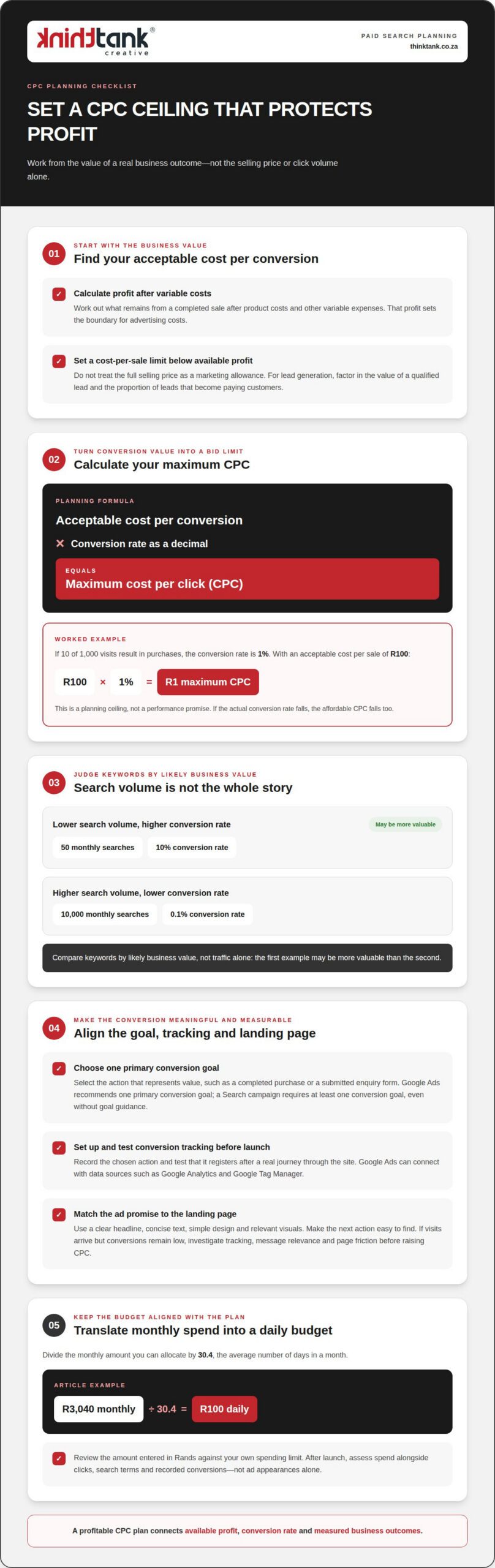
A low cost per click can still lose money if the clicks don’t become customers. The practical answer to how to set up a Google Ads campaign at a profitable CPC is to base your maximum bid on what a conversion is worth to your business and how often clicks convert. Set a daily budget by dividing your monthly budget by 30.4, then track conversions so you can assess results against real business outcomes.

It’s easy to focus on choosing keywords and writing ads, but approval and performance also depend on how well your campaign, ad copy and landing page work together. A relevant click matters only if the next step is clear and the page gives visitors a reason to act.

This guide explains how to set a CPC ceiling, choose a budget and bidding approach, organise keywords and targeting, and prepare ads for approval. It also covers what to monitor after launch, so optimisation decisions are based on conversion data rather than clicks alone.

Key Takeaways

  • Shape your campaign around a clear business goal, then align keywords, ads and landing pages with the action you want visitors to take.
  • Use focused keyword groups and negative keywords to help limit irrelevant clicks and keep your targeting purposeful.
  • Set location, language and audience settings to reflect who you want to reach in South Africa.
  • Prepare relevant ad variations and review approval status before launch, then use campaign performance data to guide changes.
  • When campaign setup, creative or landing-page alignment needs a considered approach, ThinkTank Creative can support the work through PPC advertising, website design and development, and creative design.

Calculating a profitable CPC from margins and conversion rates

  1. Start with profit, not revenue. Calculate what remains from a completed sale after product costs and other variable expenses. This sets a boundary for advertising: a campaign can attract profitable sales only if acquisition costs leave enough margin for the business.

    Next, estimate the maximum cost per sale you can accept. Set the target below the profit available, rather than treating the full selling price as a marketing allowance. For lead generation, consider the value of a qualified lead and the proportion of leads that become paying customers.

  2. Translate that cost-per-conversion limit into a maximum CPC. Multiply your acceptable cost per conversion by your conversion rate, expressed as a decimal. For example, if 10 of 1,000 visits result in purchases, the conversion rate is 1%. A maximum cost per sale of R100 would therefore support a maximum CPC of R1 at that rate.

    This is a planning ceiling, not a promise of performance. If actual conversion rates fall, the affordable CPC falls too. Compare keywords by likely business value, not traffic alone: a keyword with 50 monthly searches and a 10% conversion rate may be more valuable than one with 10,000 monthly searches and a 0.1% conversion rate.

  3. Choose your campaign objective before selecting a campaign type. Google Ads recommends one primary conversion goal, such as sales, lead generation or brand awareness, to guide that choice. A Search campaign requires at least one conversion goal, even when created without goal guidance.

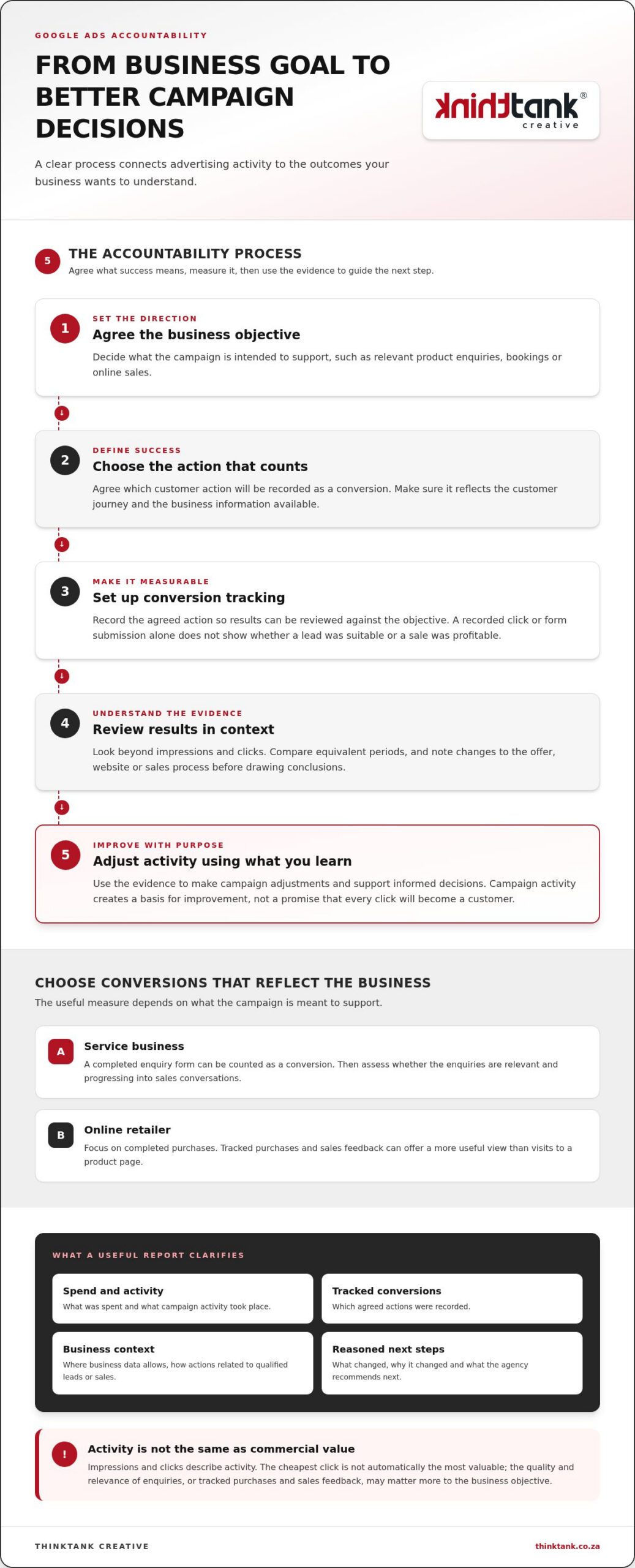
    Define the action that represents value for your business. A completed purchase is clearer than a product-page visit for an online shop; a submitted enquiry form may suit a service business. Align the goal with your CPC calculation so reported conversions reflect meaningful outcomes.

  4. If you’re optimising for online conversions, set up conversion tracking before launch. Record the chosen action, then test that it registers after a real journey through the site. Google Ads can connect with data sources such as Google Analytics and Google Tag Manager, bringing campaign and website activity into the same measurement process.

    Finally, match each ad to a landing page with a clear headline, concise text, simple design and relevant visuals. Make sure the page delivers on the ad’s promise and makes the next action easy to find. If visits arrive but conversions remain low, investigate tracking, message relevance and page friction before raising your CPC.

Daily budgets and bidding strategies

Set a spending limit that supports your campaign goal and gives Google Ads a clear bidding framework. Your bids compete for placement in search results, so budget and bidding choices need to work together.

  1. Set a daily campaign budget

    Choose a daily budget by dividing the monthly amount you can allocate by 30.4, the average number of days in a month. For example, a monthly budget of R3,040 gives a daily budget of R100. This calculation helps translate a South African Rand budget into a campaign setting without relying on a foreign-currency example.

    Enter your intended budget in the campaign settings, then review it before publishing. Google Ads provides recommendations based on your chosen audience and budget setup, but compare these with your own spending limit. Don’t treat a recommendation as a reason to exceed the amount you can sustain.

  2. Choose a bidding strategy

    Choose a bidding approach that matches your campaign objective and the data available. Google Ads uses a pay-per-click model, so advertisers pay for each ad click. Decide whether the campaign aims to attract relevant visits or achieve a measured conversion goal, then align the bid settings with that outcome.

    Keep your profitable CPC ceiling in mind when setting bids. The auction determines ad placement for relevant keywords, but a higher bid alone doesn’t make a click more valuable. Use your campaign’s conversion tracking to assess whether the traffic supports its chosen goal.

  3. Decide whether to use a daily budget or a total campaign budget. A total campaign budget requires a start date and an end date, making it suitable for campaigns with a defined run. For ongoing activity, a daily budget provides a recurring amount to manage in the campaign settings.

    Before launch, compare the campaign’s budget field with your planned spend. A misplaced digit can make the entered limit very different from your intention. Review the amount in Rands and confirm you’ve selected the right campaign, especially if your account contains multiple campaigns.

  4. After launch, review the budget and bidding combination using actual campaign activity, not assumptions. Compare spend with clicks, search terms and recorded conversions. If the campaign aims for sales or lead generation, focus on whether the budget supports that goal, not simply how often the ads appear.

    Make one considered adjustment at a time, then observe how it affects campaign delivery and results. For example, revise the daily limit if spend is constrained, or refine bids when click costs exceed your planned ceiling. A well-aligned search engine optimisation strategy can also support visibility beyond paid search results.

Keyword match types and negative keywords

Build your keyword list around what potential customers want, then control which searches can trigger your ads. Google Ads match settings affect reach, so review them alongside each ad group and its message.

  1. Use Google Keyword Planner to explore terms related to your products or services. Enter a core offer, such as “plumbing repairs”, then assess suggested keywords for relevance and likely customer intent. Prioritise phrases that signal a next step, such as “book a plumber” or “plumber quote”, over broad research terms.

    Group terms by the need they express. Someone searching “emergency plumber Johannesburg” has a specific service and location in mind; someone searching “plumbing tips” may simply want information. Separate these intentions so the ad and landing page address the searcher’s actual need.

  2. Choose keyword match types

    Choose a match type for each keyword based on how closely you want to control search relevance. Google Ads defaults to broad match, which can show ads for searches that aren’t closely related to your products or services. Review the search terms it attracts, and don’t use broad match without checking that those queries fit your offer.

    Use focused ad groups with 5 to 15 closely related keywords. For example, keep “plumbing repairs” and “leaking tap repair” together only when one ad and landing page can address both clearly. Separate distinct services into different groups to keep the keyword, ad and destination aligned.

  3. Add negative keywords

    Add negative keywords to stop ads appearing for searches that don’t match your offer. If you sell plumbing services, terms such as “jobs” or “training” may be unsuitable if you don’t provide employment or courses. Review search-term reports and exclude irrelevant phrases carefully.

    Check negative keywords against your intended customers before applying them. Excluding “cheap”, for instance, could block useful searches if your business serves price-conscious customers. Keep a shared exclusion list for unrelated intent, then add campaign-specific negatives where a term conflicts with the service being advertised.

  4. Write headlines that reflect the searcher’s intent and the offer on the landing page. A Google Ads Search ad can have 1-3 headlines, and responsive search ads can include up to 15 headlines, each with a maximum of 30 characters. Use distinct messages, such as the service, location or a clear next step.

    Keep descriptions concise and specific: Search ads can include up to 2 lines of description text, with each description allowing up to 90 characters. For “emergency plumber Johannesburg”, a headline could name the service and location; the description should explain the next action. This keeps ad copy relevant to its keyword group.

How to Set Up a Google Ads Campaign at a Profitable CPC

Location, language and audience targeting

Define where your campaign should appear, which languages it should reach, and which audience it should prioritise. For a South African business, match each setting to the customers and service areas the campaign can genuinely serve.

  1. Set location and language targeting

    Choose the South African locations relevant to your offer, such as the whole country, a province or a city. If your business serves customers only in Cape Town, targeting that city is more precise than selecting every province.

    Select languages your intended customers use when searching, and keep the ad copy consistent with those choices. Review location and language settings together: an English ad aimed at a specific service area should lead to a page that clearly explains the offer to that audience.

  2. Select audience targeting

    Choose an audience based on the people most likely to need your product or service. Choose interests and other audience signals that genuinely relate to your offer.

    For example, a business promoting gardening services could consider people interested in gardening, then assess whether the campaign’s search terms and conversions reflect relevant demand. Avoid adding unrelated interests simply to make an audience seem more specific.

  3. Decide whether audience settings should focus on reaching a selected group or observing its performance alongside other traffic. The right approach depends on your campaign goal: a new service may need room to find relevant searchers, whilst a specialised offer may benefit from tighter audience selection.

    Use conversion tracking to evaluate audience quality, not just click volume. Compare which audience segments lead to meaningful actions, such as completed enquiries, and adjust targeting if the data shows a group engaging without converting.

  4. Build remarketing around a clear follow-up purpose. For example, you can show remarketing ads for 30 days to people who visited your website but didn’t buy. Tailor the message to their previous interest, such as returning to a product page, rather than showing a broad advert with no connection to their visit.

    Keep the audience and message aligned with the campaign’s location, language and offer. A visitor who viewed a service page in Johannesburg should see relevant follow-up content, not an advert for a different service or an area the business doesn’t serve.

  5. Review targeting as a connected system after launch. If a campaign attracts visits from the right South African locations but few meaningful actions, examine the audience, language, ad and destination together. Change one setting at a time so you can tell which adjustment affects performance.

    Let campaign evidence guide refinements. Search terms can reveal what people want, while conversion tracking shows whether visits lead to the intended next step. Use both signals to keep targeting purposeful without excluding prospective customers too early.

Ad approval and campaign optimisation

Prepare accurate ads, review the campaign settings, then use performance data to guide refinements. Approval is a checkpoint, not proof that your advertising is reaching the right people.

  1. Check ads against policies and advertising rules

    Review every claim, offer and destination against Google Ads policies and applicable South African advertising requirements. Keep statements truthful, support claims with evidence, and make offer conditions clear in the ad or landing page. Avoid misleading wording, mismatched destinations and creative that does not accurately represent the advertised product or service.

    Before submission, check that the landing page works and matches the ad. Google Ads ads are typically approved within one business day, but they may take a few days to start showing after campaign setup.

  2. Review setup mistakes and optimise the campaign

    Before launch, check the campaign’s daily budget, location, language, keyword settings and conversion goal. Common causes of wasted spend include an incorrect budget, broad keywords that attract unrelated searches, and a landing page that doesn’t match the ad. Check each setting against the campaign objective.

    Google Ads recommends creating at least 3 ads per ad group for a Search campaign. Use variations that test distinct messages, such as a service benefit against a location-led headline, without changing the underlying offer.

  3. Give the campaign time to collect useful evidence before making major changes. Allow most campaigns 2 to 4 weeks of data before meaningful optimisation decisions. During that period, monitor clicks, search terms and conversions; fix clear setup errors promptly, but avoid changing several variables at once.

    Assess keyword relevance alongside Quality Score, which runs from 1 to 10 and reflects expected click-through rate, ad relevance and landing-page experience. A score below 5 signals that ad copy or landing-page relevance needs attention. Improve the specific weak element rather than raising bids automatically.

  4. Use conversion results to decide what to refine. If clicks increase but enquiries don’t, review whether the ad promise, mobile page experience and conversion action align. If irrelevant searches appear, add suitable negative keywords; if relevant traffic converts, preserve that intent as you adjust the campaign.

    For focused support with campaign setup, review and ongoing PPC advertising optimisation, take the next step with a strategy built around your business goals.

ThinkTank Creative

ThinkTank Creative helps businesses create a coherent digital experience around their marketing goals. If an advertising campaign needs a clearer destination or stronger brand consistency, website design and development, creative design, and logo and corporate identity design can help bring the customer journey together.

Social Media Marketing can also complement a broader digital presence and help keep brand messaging consistent across customer touchpoints. The right combination depends on your campaign, audience and existing assets, with each element serving a defined role rather than operating in isolation.

Ready to strengthen the wider experience around your campaign? Contact ThinkTank Creative to discuss your goals.

Build your next campaign with intention

Your next campaign can be more than a source of clicks. Treat it as part of a connected customer experience, where every interaction strengthens your understanding of what people need and how your business can respond. This keeps future decisions anchored in meaningful business outcomes.

A thoughtful approach to how to set up a Google Ads campaign gives you a framework for learning as your objectives evolve. Use what each campaign reveals to refine the experience around it, from the first impression to the next step a potential customer takes. Progress comes from deliberate choices, not simply increasing activity.

When you’re ready to shape the next stage of your digital marketing, plan your campaign with ThinkTank Creative. Take the next step with a clear direction and room to grow.

Frequently Asked Questions

What are the steps to create a Google Ads account and campaign?

To set up a Google Ads campaign, add your business name and website, select a primary objective, then configure the campaign. Link relevant Google accounts, such as Google Analytics, to support setup and recommendations. Create the ads and choose their audience, keywords and budget. Before submitting, confirm payment details and review the settings. Google Ads saves campaign changes as a draft during creation, so you can revisit them before launch.

Which Google Ads campaign type should I choose for my business?

Choose the campaign type that best supports your main marketing objective. For example, a business seeking enquiries should prioritise a lead-focused approach, while an online shop may centre its campaign on sales. Brand awareness and app promotion call for different goals. Consider where prospective customers are likely to respond, then make sure the campaign’s creative and destination support that action.

How do I choose keywords and set up keyword match types?

Choose keywords that reflect what a potential customer might search before taking action. Google Keyword Planner can help you explore terms related to your offer; separate research searches from purchase-ready phrases. Then select match settings according to how closely you want searches to align with each keyword. After launch, review actual search terms and add negative keywords when queries clearly relate to a different need.

How do I set a daily budget and bidding strategy in Google Ads?

Set a daily budget that fits the amount your business can allocate to advertising, then choose bidding settings that support the campaign’s objective. Evaluate a sales campaign against sales outcomes and a lead campaign against qualified enquiries. Keep the daily limit and bid approach consistent with your acceptable acquisition cost. Review spend alongside conversion quality before changing either setting.

How do I target locations, languages, and audiences in Google Ads?

Target places where you can serve customers, and select languages that match your ads and landing pages. In South Africa, a business serving nationally can choose broad coverage, whilst a locally focused service can narrow its intended area. Add audience signals only when they relate to likely customers. For example, interests connected to a specialist product may help distinguish relevant prospects from general browsers.

What conversion tracking and analytics should I set up before launching?

Track actions that indicate genuine business value, such as a completed purchase or submitted enquiry, and ensure each is recorded only when it happens. Link Google Ads with relevant Google Analytics or Google Tag Manager data sources. Test the full customer journey, including confirmation pages and mobile forms. Avoid counting every page view as a conversion, since that can make campaign reports less useful.

How much does Google Ads cost in South Africa, and what is a realistic starting budget?

Google Ads costs depend on the keywords, competition, bids and daily limit you choose; there isn’t one starting budget for every South African business. Begin with an amount you can allocate to a controlled test, then estimate how many clicks it could buy at your planned CPC. Compare that traffic with your conversion rate and acceptable acquisition cost before setting the campaign limit.

How do I monitor campaign performance and optimise ads after launch?

Review search terms, clicks, conversions and spend together, rather than judging performance by impressions alone. Check whether each search matches your offer and whether the resulting visit completes the intended action. If the ad attracts relevant traffic but few conversions, examine the landing page and conversion setup. Test one meaningful change at a time, such as a new headline or a more relevant destination.

How to Measure SEO Success Through Traffic and Authority

A ranking can rise while search results still fail to bring the right visitors to your website. To understand how to measure SEO success, track search visibility, click-through rate (CTR), organic traffic, visitor engagement, conversions and backlink quality together. CTR shows whether search listings turn visibility into visits: Carnegie Higher Ed reports an overall site CTR benchmark of 2% to 3% for higher education websites. That figure is specific to higher education, but the principle applies broadly: impressions matter most when they attract relevant searchers.

Rankings and traffic matter, but neither tells the whole story. A useful SEO measurement connects search visibility with visitor quality, business outcomes, brand authority and backlinks. This guide explains which metrics to track, how to interpret click-through rate (CTR) in context, and how to tell meaningful progress from activity that looks impressive but has little impact.

Key Takeaways

  • Assess SEO performance across visibility, organic visits, engagement and conversions rather than relying on rankings alone.
  • Compare branded and non-branded search traffic to distinguish existing awareness from discovery by new audiences.
  • Evaluate backlinks by relevance and trust, and watch for anchor-text patterns that could look unnatural.
  • Interpret click-through rates in context: search position and sector affect how impressions translate into visits.
  • Use Google Search Console to explore queries, pages and search trends, then connect those insights to on-site outcomes.

What are SEO performance metrics?

SEO performance metrics show whether organic search is supporting visibility, engagement and business goals. To understand how to measure SEO success, connect search activity to valuable actions rather than counting rankings alone.

Setting SEO goals and choosing KPIs

An SEO goal describes the change you want, while a key performance indicator (KPI) tracks progress towards it. This distinction helps you choose metrics that reflect business priorities. If the goal is to grow organic traffic, measure visits alongside leads or sales from those visits. For example, a company targeting 5% year-on-year organic traffic growth that achieves 10% has exceeded its target, but should still assess visitor relevance.

For lead generation, compare organic visits with qualified enquiries. Calculate organic SEO cost per acquisition by dividing SEO spend by the number of customers it generates. This connects search activity to customer outcomes instead of treating every additional visit as valuable.

Monitoring SEO performance with tools

Analytics and webmaster tools show different aspects of SEO performance. Google Analytics can report organic sessions, engaged sessions, conversions and landing pages. Search Console reports impressions, clicks, click-through rate and average position. Reviewing both helps connect search visibility with what visitors do after arriving.

For example, 75 engaged sessions out of 100 sessions produce a 75% engagement rate. Compare trends over consistent periods, then inspect the pages or queries behind a change. Check rankings and technical alerts weekly, review analytics and Search Console trends monthly, and assess backlinks, Core Web Vitals, content decay and revenue attribution quarterly.

Business, accessibility and proxy KPIs

Business KPIs connect organic search with leads, sales or revenue. Accessibility measures can reveal barriers, while proxy KPIs indicate technical progress. Together, these measures can help explain why a page performs poorly despite receiving search exposure.

Review website templates for issues involving headings, landmarks, alt text, focus order and form labels. These accessibility improvements can reduce friction for users and crawlers. To assess technical coverage, track the ratio of crawled to indexed URLs. Google’s good threshold for Interaction to Next Paint is 200 milliseconds or faster, providing a reference point for this Core Web Vitals measure.

Reporting and misleading metrics

Match your review schedule to the metric. Weekly checks can catch ranking changes and technical alerts; monthly reviews help reveal analytics and Search Console trends; quarterly audits can assess backlinks, Core Web Vitals, content decay and revenue attribution. A consistent schedule helps you respond to issues without overreacting to isolated changes.

Rankings, impressions and raw traffic can mislead if they aren’t connected to relevant visits or business actions. Measuring SEO success also means separating branded from non-branded queries and checking whether visibility leads to useful engagement. Rising impressions alongside few clicks, for example, may point to a mismatch between the page and the query, not stronger performance.

How Do You Measure The Quality Of Organic Traffic?

Quality organic traffic comes from people whose search intent matches your offer and who engage meaningfully. Compare queries and landing pages with visitors’ subsequent actions instead of treating every visit as equally valuable.

Branded and non-branded organic traffic

Branded traffic comes from searches that include a business or product name; non-branded traffic comes from broader topic or service searches. Separating them helps show whether organic search is building discovery or capturing existing awareness.

Google Search Console lets you compare queries and landing pages, then connect each group to on-site conversions. Branded searchers convert at rates 3-5 times higher, so a rise in total conversions may reflect stronger brand awareness rather than wider reach among new audiences. Review both segments to understand what is driving progress.

Organic impressions and clicks

An impression means a listing appeared in search results; a click means someone selected it. Together, these metrics show whether a page is visible and attracting visits for its target queries.

Compare impressions, clicks, click-through rate and average position by query and page. Rising impressions with few clicks may mean a listing appears for relevant searches but doesn’t persuade people to visit. Check the page title, description and search intent, then assess whether changes increase clicks without reducing relevance.

Clicks alone don’t show whether traffic is valuable. Compare organic visits to the landing page with engagement and conversion actions to see whether searchers find what they expected.

Core Web Vitals and impressions

Core Web Vitals measure aspects of page experience, while impressions indicate search visibility; reviewing both helps connect technical performance with organic search activity. Google’s good threshold for Largest Contentful Paint is 2.5 seconds or faster, and its good threshold for Cumulative Layout Shift is 0.1 or lower.

Track these measures alongside impressions and clicks for key landing pages. If a page gains visibility but provides a poor experience, investigate its loading behaviour and layout stability. Improving the experience can reduce friction after the click, while impression trends show whether search exposure is changing.

Measuring conversions and organic revenue

Conversion measurement attributes valuable actions, such as enquiries or purchases, to organic search visits. Revenue measurement connects those actions to business value, giving you a clearer picture than traffic alone.

In analytics, define meaningful actions and track the landing pages and organic sessions associated with them. Compare conversion volume and revenue over the same reporting period, segmenting by page or query where possible. If visits rise while revenue falls, investigate weaker intent, a less effective landing page or a change in demand.

Conversion rates depend on the offer and industry; a 1% visitor-to-sale or visitor-to-lead rate can be excellent in some industries. Use your own baseline and the quality of resulting leads or orders to judge performance. For a clearer link between search activity and site outcomes, consider a focused SEO measurement strategy.

A backlink profile is the collection of links pointing to your website. Domain authority scores estimate its relative strength. These measures can help assess whether other sites refer to your content, but they don’t reveal search visibility or conversions on their own. Treat an authority score as a comparative signal from its provider, not a direct measure of business results.

Look beyond the total number of links. Assess referring websites for relevance, credibility and genuine audience value, and consider whether their pages attract people interested in your subject. A hundred backlinks from unsafe, low-traffic or unrelated websites may bring fewer page views and conversions than a handful from reputable sites. Link quality and context matter more than a large tally.

Anchor text, the clickable wording of a backlink, gives readers and search engines context about its destination. A profile where over 85% of referring pages use targeted keywords in anchor text can appear unnatural. For links built in an SEO campaign, aim for 95% or more to use branded, raw-URL or generic anchor text. Relevant, descriptive anchors still have a role, but an overly repetitive pattern can look manipulated.

Review referring domains, destination pages and anchor wording together. Ask whether each link is relevant to the page and could send an interested visitor. Look for sudden changes, repeated keyword-rich anchors and links from unrelated subjects. These patterns can guide further investigation, but don’t assume every low-value link is harmful or every high-authority link will improve performance.

Google Search Console’s links report can help you review external links and the pages they point to. Compare its findings with backlink data from the same SEO platform over time, as tools can show different link sets and authority scores. Use a consistent source for comparisons, then connect changes in referring pages with organic landing-page visibility, engagement and conversions. Search Console performance reports provide query and click context, while analytics show what visitors do after arriving.

Make backlink measurement useful by linking it to optimisation decisions. If a relevant industry site links to a detailed resource, for example, track whether that page earns organic impressions and qualified visits. If a campaign builds links but target pages show no corresponding movement, investigate relevance, page quality and search intent before drawing conclusions. Authority is a supporting indicator; a sound evaluation combines a credible backlink profile with visibility and meaningful audience outcomes.

How to Measure SEO Success Through Traffic and Authority

Click-through rate benchmarks

Good SEO benchmarks depend on sector, search position and business goals, so compare like with like. Carnegie Higher Ed reports an overall site click-through rate (CTR) of 2% to 3% for higher education websites, and page-level rates of 1% to 2%. For traffic, rankings and conversions, use your own relevant baseline and assess whether trends bring qualified visits and business outcomes.

CTR measures the share of search impressions that become clicks. A result with 100 impressions and 50 clicks has a 50% CTR, showing how the calculation works, not a typical target. Google Search Console provides impressions, clicks and CTR by query or page. Segmenting those figures helps you see whether a particular source, landing page or search intent affects performance.

Search position changes the opportunity to earn clicks. A first-position result has an estimated CTR of approximately 28%, compared with approximately 15% for second position. These are estimates, not promises for every query. Compare pages competing for similar searches, then investigate whether title wording, result features or intent may explain a difference.

Rankings offer another reference point: positions one through 10 count as page one, positions 11 through 20 as page two, and positions 21 to 30 as page three. Track movement by target query and landing page, but connect it to clicks and sessions. A competitor’s position can provide context, yet it doesn’t show whether their visitors convert or whether your audience has the same needs.

To benchmark traffic, compare organic sessions over consistent periods and across relevant pages. A growing session count is useful when it reflects searchers who engage or take valuable action. If impressions rise but clicks remain flat, inspect CTR and average position before changing content. If clicks increase but sessions or conversions don’t, review analytics tracking and the landing-page experience.

Conversion benchmarks need the same care. Compare actions that matter to your organisation, such as completed enquiries or purchases, with organic sessions. A rate can mislead without a clear conversion definition, audience and measurement period. Check that Google Analytics records the intended action, then interpret changes alongside traffic quality and revenue.

Use each benchmark as a diagnostic, not a pass-or-fail score. A page gaining impressions but losing CTR may need a closer review of its search snippet and query match. A page with strong CTR but few conversions requires a different investigation. This layered approach turns comparisons with competitors into practical decisions and keeps visibility, visits and business impact distinct.

How to use Google Search Console to analyse SEO performance

Google Search Console shows how your pages appear and perform in Google Search. Its Performance report connects queries and pages with impressions, clicks, click-through rate and average position. These measures help identify which searches bring visibility and where a page’s search presence may need attention.

Start by selecting a consistent date range and comparing it with an earlier period. Review the totals before filtering by query or page. A page that gains impressions while clicks stay level, for example, warrants a closer look at its search snippet, position and query relevance. Don’t treat one change as proof of a lasting trend.

Use the query table to explore the words people use before reaching your site. Filter by a service or topic, then compare impressions and clicks across related queries. Search Console can also separate branded from non-branded searches, helping you see whether visibility comes from people who already know your name or from broader discovery.

Next, open the Pages view and select a landing page. Review the queries leading to it, then compare its performance with pages serving a similar purpose. If unrelated queries dominate, the page may not align clearly with search intent. If relevant queries generate impressions but few clicks, assess the title and description shown in Google Search.

Use device and country filters to see whether performance varies across audiences. For a South African business, the country filter can isolate impressions and clicks from South Africa instead of combining them with other markets. Device comparisons can show whether pages attract search activity on mobile but receive fewer clicks on desktop, or vice versa.

Search Console can also help investigate issues beyond the Performance report. Review indexing reports to identify pages Google has or hasn’t indexed, then inspect affected URLs to understand their reported status. Check the links data to see which pages receive external links and which internal pages are linked most often. These reports connect technical coverage and link discovery with organic visibility.

Keep a log when you change a page. Record its URL, query group, change date and subsequent Search Console movement. Compare equivalent periods rather than drawing conclusions from a single day. Search Console reporting can involve a three-day wait, so give data time to appear before assessing a recent change.

Turn those findings into focused improvements: refine a page’s search alignment, investigate indexing issues or strengthen internal links. If you want expert support interpreting search data and prioritising SEO improvements, get help with SEO performance.

ThinkTank Creative: Website Design and Development

ThinkTank Creative designs and develops websites around business goals and audience needs. If your SEO reports show that searchers reach important pages but don’t take the next step, the website experience may need attention. Clear navigation, relevant content and a considered user journey help visitors understand your offer and find the right action.

ThinkTank Creative’s Website Design and Development service can shape a site around your business needs. Creative design and logo and corporate identity design can support a consistent brand experience. These services can help when your measurements reveal a disconnect between search visibility and what visitors encounter on the page.

To discuss how your website can better support your digital goals, contact ThinkTank Creative.

Turn your SEO insight into purposeful growth

Make your next step a clear decision, not another dashboard metric. Use your data to prioritise the pages, audience needs and website experience most closely connected to your business goals. Measuring SEO success this way keeps attention on outcomes and helps your strategy adapt as customer behaviour changes.

ThinkTank Creative supports the wider digital picture through Search Engine Optimization, Website Design and Development, Social Media Marketing and creative design. These services can help when your next opportunity is to improve organic visibility, strengthen the website journey or create a more consistent brand experience. Let the challenge your data reveals guide your focus.

Contact ThinkTank Creative for SEO support to discuss a considered next step for your digital growth. Build on what you’ve learned and keep moving towards a stronger online presence.

Frequently Asked Questions

How can you tell if SEO is helping sales?

Compare sales opportunities from organic visits with your usual lead-to-sale process. For example, label enquiry forms by acquisition source, then follow each qualified lead through your customer relationship management system. This shows whether organic search contributes to closed business, not just form submissions. Also review assisted conversions: someone may first discover your business through search, then return through another channel before purchasing.

How do I prioritise which metrics to focus on?

Choose metrics based on the decision you need to make. If a key service page attracts enquiries but few become qualified opportunities, prioritise lead quality and page-specific conversion actions. If visibility is the immediate concern, examine search exposure and query relevance first. Keep the main report focused, adding supporting metrics only when they explain a change or guide a practical next step.

How do you build an SEO dashboard that reflects real growth?

Build your dashboard around a clear business question, such as whether organic search generates qualified enquiries. Show the outcome alongside its source pages and supporting indicators, and annotate major website or campaign changes. Separate acquisition from conversion outcomes so readers can follow the journey. Use consistent date ranges and labels, and don’t combine figures based on different attribution definitions.

How do you know when SEO is failing despite good rankings?

Good rankings can hide weak results if they attract the wrong audience or lead to an unhelpful page. Check whether the query matches the page’s offer, visitors can complete the intended action, and forms or checkout steps work. Compare affected pages and look for changes in demand or competitor search features before deciding rankings alone explain the problem.

How do you measure SEO in business terms?

Connect search activity to outcomes your organisation values, such as qualified enquiries, completed purchases or opportunities entering the sales pipeline. Define each outcome clearly, then report which organic landing pages contributed. For longer sales cycles, compare lead quality and progression through sales stages instead of judging performance only by the date someone first visited the website.

How do I measure user engagement on my website?

Track meaningful interactions that show what visitors do after arriving. In Google Analytics, consider events such as starting a form, completing an enquiry, using site search or clicking to view contact details. Separate these actions by landing page and traffic source. A page may encourage exploration without an immediate sale, so interpret interactions according to its role in the customer journey.

Which SEO KPIs should you track to measure success?

Choose a focused set of metrics that reflects your objective: search visibility for discovery, organic visits for acquisition, engagement actions for page usefulness, and qualified leads or sales for business impact. Add a technical indicator only when it supports a specific investigation. If important pages aren’t appearing in search, for example, examine index coverage. Review each KPI alongside its related pages and intended audience.

How do you track keyword rankings and search visibility?

Track a representative group of queries that reflect your products, services and audience needs. Record the ranking page for each query, as different pages can compete for similar searches. Keep tracking settings consistent, including country and device, so comparisons remain useful. Combine ranking observations with actual search impressions and clicks: a position change alone doesn’t show how visibility or traffic has changed.

Common Google Ads Mistakes to Avoid: A Practical 2026 Checklist

More clicks can make a weak Google Ads campaign look healthier than it is. If your adverts attract visitors but not relevant enquiries, the problem may lie in targeting, messaging or measurement. This practical guide to common google ads mistakes to avoid starts with checks that can show where your budget is losing impact.

Use the checklist to assess your campaign in a clear order before changing bids or increasing spend. Review search intent, targeting, advert relevance, landing pages and conversion tracking to distinguish a traffic problem from a gap further along the customer journey.

We’ll also cover negative keywords, campaign structure and how to compare reported results with real business enquiries. Google Ads settings and automation can evolve, but the fundamentals remain the same: the right audience needs a relevant message, a useful page and reliable measurement. Checking each link in that chain helps you make better-informed decisions about your campaign and website.

Key Takeaways

  • Start with a clear business objective so campaign settings and budget decisions support the outcome you want.
  • Review audience, keyword relevance, actual search queries, exclusions and location settings to identify irrelevant traffic.
  • Align the search query, advert message and landing page to create a coherent visitor journey.
  • Check for missing, duplicated or incorrectly recorded conversion actions before interpreting results or changing bids.
  • Use this practical checklist of common google ads mistakes to avoid to prioritise improvements by relevance, measurement confidence and visitor experience.

Common Google Ads mistakes to avoid start with weak campaign foundations

Campaign problems are easier to investigate when you work methodically. Before changing bids, budgets or targeting, establish what the campaign is meant to achieve and how you’ll recognise progress. A rise in clicks may look encouraging, but if those visitors aren’t relevant to your business, it may not bring you closer to a useful enquiry.

Start by defining the business outcome, then check whether the campaign structure and measurement support it. Google Ads offers different campaign types and advertising formats, as outlined in Google Ads Wikipedia. A clear purpose makes these choices easier to assess. One of the common google ads mistakes to avoid is treating platform activity as a result in itself, rather than asking whether it contributes to the outcome that matters.

Mistake: launching without a defined business outcome

Describe what a valuable action means for your business. It could be a relevant enquiry submitted through your website, rather than any form submission, visit or interaction. Be specific about what makes an enquiry useful, such as whether it relates to a service you provide. This gives you a practical standard for reviewing performance.

Separate primary outcomes from supporting signals. Clicks, visits and engagement can help explain how people respond to an advert, but they don’t necessarily show that someone has taken a meaningful next step. If you treat every signal as equally valuable, it becomes harder to tell whether a campaign is attracting potential customers or simply generating activity.

Campaign goals must come before optimisation, because you can only judge settings against the business outcome they’re designed to support.

Write down the primary action you want to encourage and the signals that help you understand the visitor journey. Then check that conversion goals are consistent across campaigns you intend to compare. If one campaign counts a relevant enquiry while another counts a page visit, their reported conversions don’t represent the same kind of value.

Mistake: creating an account structure that is hard to manage

A clear account structure makes it easier to understand what each campaign is doing. Give campaigns distinct purposes, use consistent names and record the audience each is intended to reach. Names should be descriptive enough for someone reviewing the account to identify each campaign’s role without opening several screens or relying on memory.

Overlapping campaign purposes make comparisons harder. If two campaigns target similar audiences with similar objectives, it may be unclear whether a change in results reflects the campaign’s purpose, its audience or another difference in setup. That ambiguity can lead to budget decisions based on incomplete comparisons.

Keep a simple campaign record with:

With these foundations documented, you can investigate underperformance in a useful order. Clarify the intended result first, then confirm that campaign organisation and conversion goals make it visible. Once those checks are complete, changes to settings or budget are easier to assess with confidence.

Targeting determines who has the opportunity to see your adverts, but your chosen settings don’t always describe every search that can trigger them. Review targeting in a consistent order: clarify who you want to reach, check keyword relevance, inspect actual searches, consider exclusions and confirm geographic coverage. This helps you spot mismatches without excluding useful potential customers too quickly.

Use this numbered review to investigate the common google ads mistakes to avoid in targeting:

  1. Intended audience: Define the people or organisations your offer suits and the need they’re likely trying to meet. A clearly described audience gives you a reference point for judging search queries and location choices.
  2. Keyword relevance: Compare your keywords with the service, product or enquiry you want to attract. A term can sound related but carry a different intent, so consider what someone searching that phrase is likely to want.
  3. Actual queries: Review the searches that triggered your adverts, not only the keywords you selected. Keyword matching can connect your choices with related searches, so ongoing query reviews matter.
  4. Exclusions: Identify recurring search themes that don’t fit your offer or audience. Consider negative keywords where a theme is clearly unsuitable, but take care not to block terms that could indicate relevant intent in context.
  5. Location settings: Compare the selected geographic coverage with the areas you intend to serve and the campaign’s purpose. For a South African campaign, decide deliberately whether national coverage is appropriate rather than relying on an unchecked default.

Mistake: trusting keyword settings without reviewing search terms

Your chosen keywords are targeting inputs; actual search queries show what people typed before an advert appeared. Look for recurring mismatches, such as searches for employment or free options when the campaign promotes a paid service. Google’s Official Google Ads Guide provides platform information, but reviewing your own queries reveals whether your targeting fits the intent you want to reach.

Before adding an exclusion, read the query in context and check which campaign it relates to. A broad theme may include both irrelevant and valuable searches. Exclude a term only when the search clearly conflicts with your offer or audience, then review the results to see whether the adjustment has improved relevance.

Mistake: setting broad or inaccurate audience locations

Location choices should reflect where your business serves customers and what each campaign is intended to achieve. National targeting can make sense for a countrywide offer, but it still needs to be a deliberate choice. Don’t assume a default setting matches your goals.

Google Ads location controls and labels can change. Review the current options in your account, then check that the selected areas reflect your intended audience rather than an overly broad or narrow interpretation. ThinkTank Creative’s PPC advertising support can help connect audience decisions with campaign objectives and planning.

A relevant advert is only the beginning of the visitor’s journey. The search query, advert message and landing-page content should work together, helping visitors see they’ve arrived in the right place and understand what to do next. If any part of that sequence feels unrelated, they may hesitate before enquiring. This connection between message and page is central to the common google ads mistakes to avoid.

Review the journey as a whole rather than judging the advert or page in isolation. Imagine someone searching for a specific service: does the advert address that need, does the page explain the same offer, and is the next step clear? The comparison below shows how a mismatch can create friction.

Journey point Mismatched journey Relevant, consistent journey
Search query Specific intent, such as website maintenance The same service need is addressed
Advert Promotes one service with a broad or different message Uses wording that reflects the search and offer
Landing page Opens on a general homepage with no clear route Explains the advertised service and next step
Call to action Unclear or difficult to find Visible and relevant to the visitor’s intent

Mistake: making an advert promise the landing page does not fulfil

Compare the search intent with the advert headline, offer details and call to action. Then check that the landing page carries the same message through. If an advert highlights a particular service but sends visitors to a generic homepage, they may have to search again for the information they expected. Direct each advert to the most relevant existing page or campaign page, where the offer and next step are easy to understand.

Consistency doesn’t mean repeating identical wording everywhere. It means making the relationship clear. If the advert names a service, the page should explain it; if the advert invites someone to enquire, the page should make that action straightforward. Relevant ad assets should support the core message, not introduce details the destination page doesn’t clarify.

Mistake: overlooking the landing-page experience on mobile

Check the complete journey on a mobile device, from opening the advert’s destination to finding and using the next step. Readability, navigation, loading experience and the visibility of enquiry details all affect whether visitors can use the page comfortably. A page that works on a larger screen may feel crowded or difficult to navigate on a phone, so test the actual experience rather than assuming it transfers well.

  1. Open the landing page on a mobile device and follow the route an advert visitor would take.
  2. Check that key information is readable and navigation makes sense without unnecessary searching.
  3. Find the intended next step, then confirm it’s visible and usable.
  4. Review relevant ad assets alongside the destination page to ensure they support the same offer.

For a broader perspective on clear, visitor-centred journeys, see Improving Website User Experience: 2026 Strategic Guide. Treat the advert and landing page as connected parts of the customer experience, and assess both before making changes based on clicks alone.

Common Google Ads Mistakes to Avoid: A Practical 2026 Checklist

Conversion figures are useful only if they accurately reflect real actions. Before deciding whether a campaign is performing well or changing bids, check that the actions you value are recorded correctly. Missing data can hide genuine enquiries; duplicated or incorrectly recorded actions can make results look stronger than they are. Decisions based on unreliable figures risk steering the campaign away from meaningful business outcomes.

Distinguish valuable results from activity that offers context but doesn’t prove an enquiry has happened. A click or page view may show interest, but it isn’t the same as a completed contact form or another action your business considers worthwhile. This distinction matters because automated bidding can use conversion information to guide its decisions. Among the common google ads mistakes to avoid is asking a campaign to optimise towards signals that don’t represent the outcome you want.

Mistake: making decisions with unreliable conversion tracking

Check that each intended enquiry action is recorded once and associated with the appropriate campaign activity. Missing tracking can leave genuine actions out of reports. Duplicate tracking may count one completed action more than once, while an incorrect setup might count an action that doesn’t represent a completed enquiry.

Test the full journey, from an advert click through to the completed action. Confirm that the page or form works as expected and that the action appears in your measurement records. Repeat the check after relevant website or tracking changes, and compare recorded conversions with the enquiries your business can actually see.

Optimisation is only as trustworthy as the measurement guiding it.

Mistake: adjusting bids or budget before diagnosing the cause

A change in reported performance on one day isn’t, by itself, a diagnosis. Start with a question, such as: “Are fewer relevant enquiries being recorded because tracking has stopped working, or has the campaign’s traffic changed?” Check the conversion journey and available campaign information before deciding that bids or budget are responsible.

Before making a change, write down what you expect it to address and how you’ll review the result. That gives the adjustment a clear purpose and review point, rather than prompting a series of reactive edits. Where useful, examine performance over a suitable period and look for a pattern that supports your hypothesis. Avoid changing several elements at once if you need to understand which change may have influenced the outcome.

If you’re assessing the relationship between bids, budget and click costs, Reducing Your Google Ads Cost Per Click in ZA may offer useful related guidance. ThinkTank Creative’s PPC advertising support connects campaign reporting with measurement and enquiry goals.

A practical Google Ads mistake-audit checklist and next steps

Turn your findings into a short action plan, not a long list of disconnected settings. The common google ads mistakes to avoid are easier to address when you record what you observed, how it affects the customer journey and what you’ll review after making a change. Start with issues that compromise measurement or stop relevant visitors taking the next step. Then schedule lower-risk tests that need more evidence.

A repeatable review for campaign owners

Work through the audit in order. If a check reveals a problem, note it before making changes. This helps you distinguish urgent fixes from adjustments that should be tested against a clearer performance pattern.

  1. Confirm the goal: Record the business outcome the campaign is intended to support and the primary action used to assess it.
  2. Check query relevance: Review actual searches for recurring themes that don’t fit the intended audience or offer. Record potential exclusions for review rather than applying them automatically.
  3. Verify locations: Compare the campaign’s selected coverage with the intended service area and business objective.
  4. Follow the message: Check that the search intent, advert promise and destination page describe a coherent offer and next step.
  5. Test the page journey: Visit the destination on mobile and check that key information, navigation and the intended action are easy to use.
  6. Validate conversion records: Test whether the intended enquiry action is captured accurately, without being missed or counted more than once.

Prioritise a broken conversion record before making bid decisions, because unreliable measurement weakens your ability to judge campaign performance. Next, address clear mismatches between targeting, advert and page. Reserve changes based on less certain patterns for a considered test, rather than treating a short-term fluctuation as proof.

For every finding, record the evidence, proposed change, date made and review date. Add the result when you assess it. This creates useful context for future reviews, especially when more than one person is involved in campaign decisions. Where practical, change one related element at a time so you can better understand what the evidence suggests.

When collaborative digital support can help

Some issues span both the campaign and the website. PPC planning and reporting help shape the advertising approach, while website design and development influence the experience after a visitor clicks. ThinkTank Creative provides digital paid advertising alongside website UX/UI design, coding, testing, launch and ongoing support, bringing these connected parts of the visitor journey into view.

If your audit points to challenges across campaign performance and the website experience, a joined-up review can help clarify where to focus next. ThinkTank Creative takes projects through research and strategy, design, development, testing, launch and post-launch support. Consider how paid advertising and website improvements could work together. We Do It All So You Don’t Have To.

Make your next campaign decision with confidence

The next step isn’t to change everything at once. Choose one well-evidenced improvement, record what you expect it to address, then review what happens. This turns the common google ads mistakes to avoid into a practical learning process and helps you understand how campaign decisions shape the customer journey over time.

When an issue spans paid advertising and the website experience, a joined-up perspective can bring the moving parts into focus. ThinkTank Creative combines digital paid advertising, campaign planning and reporting with website UX/UI design, testing, launch and ongoing support, so campaign strategy and the destination experience can be considered together.

Discuss your Google Ads campaign with ThinkTank Creative and explore a considered next step. With clear goals and measured decisions, you can keep refining the path from search to enquiry with confidence.

Frequently Asked Questions

Is Google Ads suitable for small businesses?

Yes, Google Ads can suit a small business when the campaign has a clear objective and a realistic customer journey. Before starting, consider whether your team can respond to relevant enquiries and whether your website gives visitors enough information to take the next step. Avoid copying another advertiser’s campaign structure or budget: its audience, offer and capacity may differ from yours. Assess results by their relevance to your business, not simply by click volume.

Can Google Ads guarantee leads or sales?

No, Google Ads can’t guarantee leads or sales. A click is an opportunity to reach a potential customer, not a promise that they’ll enquire or buy. Results can be affected by audience relevance, the strength of the offer, competition and the destination-page experience. Be cautious about claims of guaranteed outcomes. Instead, set realistic goals, use transparent reporting and evaluate whether campaign activity contributes to valuable business outcomes.

How much should a business spend on Google Ads?

There’s no single budget that suits every business, and this guide doesn’t prescribe a standard amount. Set a spending limit that reflects your campaign objective, the audience you want to reach, the value of a successful customer and your capacity to handle enquiries. Before launching, decide what evidence would justify maintaining or adjusting the investment. A defined test plan and reliable conversion measurement can help you make that decision thoughtfully, rather than basing it on clicks alone.

What happens if my Google Ads receive clicks but no enquiries?

Start by checking whether the full enquiry process works, including any confirmation shown after someone submits a form or completes another contact action. Then consider whether the clicks come from people who need your offer, whether the advert sets an accurate expectation and whether visitors can find the next step. These checks help distinguish a tracking fault from a gap in the customer journey, so you can investigate the likely cause before changing campaign settings.

Is Google Ads the same as search engine optimisation?

No, Google Ads is paid advertising, while search engine optimisation (SEO) focuses on improving a website’s visibility in unpaid search results. The approaches can serve different purposes within a digital marketing plan: paid adverts can reach people through selected searches, while SEO develops a site’s relevance and visibility over time. They aren’t interchangeable, so consider your objectives, resources and customer journey when deciding how each could contribute to your wider marketing activity.

Can a business target customers across South Africa with Google Ads?

Yes, Google Ads supports location-based targeting, and a business can set up campaigns intended to reach audiences across South Africa. Review the selected coverage in the current interface rather than assuming an online campaign automatically reaches the whole country. As results come in, consider whether enquiries from different areas fit your business goals and service coverage. This gives you a more useful basis for refining geographic reach than relying on overall campaign totals alone.

Google Ads Agency South Africa: How to Choose the Right Partner

Clicks can look like progress while telling you little about business growth. A search for a google ads agency south africa can bring up plenty of confident promises, but the real challenge is finding a partner who can connect campaign activity to meaningful business objectives.

Before committing advertising spend, get clear on what success means, how it will be measured and what the reports will show. Impressions and clicks describe activity, but they don’t tell you on their own whether advertising is contributing to relevant enquiries or sales. This guide will help you assess an agency’s strategy, measurement and communication so you can choose an approach that fits your business and growth plans.

We’ll look at what effective Google Ads management involves, which questions to raise before work begins, and how to compare a paid-media specialist with a broader marketing partner. ThinkTank Creative offers digital paid advertising alongside website design and development, SEO and ongoing support. That combination can help connect advertising with the experience customers find after they click. Choose based on the strength of the plan for measuring and improving business outcomes, not on promises alone.

Key Takeaways

  • Assess a google ads agency south africa by how it links campaign planning and optimisation to agreed business objectives.
  • Look beyond clicks and impressions. Clear conversion tracking and reporting can help connect advertising activity with qualified enquiries.
  • Compare agencies on strategy, measurement, communication, website integration and ongoing support to find a suitable fit.
  • Prepare your goals, audience, offer and website context. Consider how your team records lead quality or sales feedback.
  • Decide whether a paid-media specialist or an integrated partner better suits your needs, especially if you want advertising aligned with your website and wider digital marketing.

What a Google Ads agency in South Africa should actually do

A Google Ads agency should do more than launch adverts. It should plan, manage and evaluate paid campaigns against business objectives agreed with you. That means connecting campaign choices to what the business needs, whether that is relevant product enquiries, bookings or online sales, then reviewing evidence to guide the next steps.

For a business searching for a google ads agency south africa, it helps to separate campaign activity from business outcomes. Activity is the work carried out; outcomes are what that work is intended to support. An agency can influence planning, targeting, advertising and measurement, but results also depend on the strength of the offer, the audience’s needs, the website experience and the quality of the tracking. Campaign activity alone cannot guarantee a particular outcome.

What does Google Ads campaign management include?

Campaign management begins with research and strategy. The agency needs to understand your objectives, audience and offer, then translate them into priorities that reflect what potential customers are looking for. The Google Ads platform supports paid advertising across different formats and campaign types. The appropriate choices depend on the goal and the options available in the platform.

From there, management can include preparing campaigns, overseeing advertising activity, reporting on performance and making adjustments as evidence develops. A considered process can involve:

These activities create a structured basis for improvement, not a promise that every click will become a customer.

How paid advertising fits into the wider marketing picture

Paid advertising can create visibility for selected audiences, while search engine optimisation (SEO) works to improve a website’s organic visibility in search results. They serve different roles and can complement one another: paid activity can support a focused campaign, while SEO and useful content can contribute to a longer-term presence. The right balance depends on your priorities, resources and customer journey.

The journey doesn’t end at the click. A relevant advert can bring someone to a landing page, but a confusing page, unclear offer or difficult enquiry process may weaken their experience. Website design, usability and a clear next step all matter. Social media marketing and content can also support how people discover and understand a business. A joined-up South African digital marketing strategy connects these channels rather than treating each campaign in isolation.

Choose an agency approach that considers the full path from audience intent to website interaction and business feedback. This wider view grounds campaign decisions and gives you a clearer basis for evaluating the work.

How strategy, tracking and reporting make Google Ads accountable

Accountability starts before the first advert runs. Agree the business objective, define the action that will count as a conversion, set up measurement, review the results and adjust activity. This sequence gives you and your agency a shared basis for decisions. Google’s Google Ads platform documentation offers guidance on working with the platform, but reliable conclusions still depend on defining what success means for your organisation.

For example, a service business might count a completed enquiry form as a conversion, then assess whether those enquiries are relevant and progressing into sales conversations. An online retailer might focus on completed purchases. A click or form submission can be recorded, but it doesn’t automatically show whether a lead was suitable or a sale was profitable. Measurement should reflect the customer journey and the business information available.

Campaign metrics only matter when interpreted against the business objective.

Which Google Ads measures matter to your business?

Impressions and clicks show that adverts were displayed or interacted with. They describe campaign activity, not necessarily commercial value. If the goal is to generate qualified enquiries, the number and quality of those enquiries matter more than click volume alone. If the goal is sales, tracked purchases and sales feedback may offer a more useful view than visits to a product page.

The cheapest click isn’t automatically the most valuable. A lower-cost visit that rarely leads to a relevant enquiry may be less useful than an interaction that supports the intended action. Before drawing conclusions, compare equivalent periods and note changes to the offer, website or sales process. This helps distinguish a genuine trend from differences in how data was collected.

What transparent reporting should help you understand

A useful report is a decision-making tool, not a dashboard of unexplained figures. It should make clear what was spent, what campaign activity took place, which conversions were tracked and, where business data allows, how those actions related to qualified leads or sales. It should also explain what changed, why the change was made and what the agency recommends doing next.

Good reporting distinguishes observed data from interpretation. A recorded form submission is an observed event; whether it represents a qualified prospect may require feedback from the team handling enquiries. If sales data isn’t connected to advertising data, the report should say so rather than presenting an assumption as proven attribution. Share lead-quality or sales feedback with your agency so campaign decisions reflect what happens after the conversion.

The post-click experience also shapes what the numbers mean. A visitor may arrive on the right page but leave because the offer or next step is unclear. Reviewing the website experience can help identify friction beyond the advert itself. If you’re evaluating a google ads agency south africa, look for a partner that connects measurement with practical next steps. ThinkTank Creative brings paid advertising together with wider digital capabilities. Explore ThinkTank Creative’s digital marketing approach to see how those pieces can work together.

How to compare Google Ads agencies in South Africa

Compare the work behind each proposal, not just its headline promise. A useful proposal shows how an agency will understand your objectives, manage the agreed scope and keep you informed. If you’re assessing a google ads agency south africa, the criteria below can make different approaches easier to compare side by side.

Criterion What to look for
Strategy Does the proposal connect your business priorities and audience intent to campaign choices?
Scope Are research, campaign management, reporting and optimisation responsibilities clearly described?
Measurement Does the approach explain what will be tracked and how performance will be interpreted?
Communication Are reporting frequency, points of contact and decision-making processes set out?
Website integration Does the plan consider the landing page and the experience after an advert is clicked?
Ongoing support Is it clear how reviews, feedback and campaign adjustments will be handled over time?

Use the table to identify gaps and differences, not to award points mechanically. A proposal that promises growth but doesn’t define the objective, measurement basis or responsibilities is difficult to assess. Treat performance claims with the same care: look for context, clear definitions and an explanation of how the result was measured. Headline figures alone may not show whether the work fits your business.

Specialist PPC agency or integrated marketing partner?

A specialist may suit a business with a clearly defined paid-media requirement and other marketing capabilities already in place. An integrated partner may be a better fit when paid advertising needs to work alongside website design, SEO, social media or creative activity. Neither model is automatically superior. The right choice depends on which capabilities your priorities require and how much coordination you want across the customer journey.

A specialist can bring depth to paid media; an integrated partner can coordinate paid activity with the wider marketing experience.

A practical agency comparison checklist

Before deciding, check that each proposal explains the objective, scope, responsibilities, reporting and communication process in comparable terms. Consider how the agency will work with your team and how feedback will inform decisions. If proposals use different definitions of a conversion or success, clarify those differences before comparing performance claims.

Fees and scopes vary, so compare the stated work with the estimated cost rather than choosing on price alone. ThinkTank Creative provides an estimated cost after discussing your needs and timeline. A clear discussion helps align expectations about deliverables and collaboration before work begins.

Google Ads Agency South Africa: How to Choose the Right Partner

What to prepare before engaging a Google Ads agency

A focused brief makes the first campaign discussion more useful. It gives an agency a clearer view of what your business needs, what customers can act on and where the customer journey may need attention. You don’t need perfect data or a complete campaign history. Share what you know, flag what’s uncertain and use the discussion to identify what needs further investigation.

Information that helps shape a useful campaign discussion

Start with the business priority, such as attracting relevant enquiries for a particular service or increasing sales of a specific offer. Describe your intended audience, the value you provide and the action you want visitors to take. Include your website address, relevant landing pages and practical constraints, such as pages that need updating or an enquiry process handled by a small team.

That last point matters. A campaign may generate enquiries, but the agency needs a feedback loop to understand which ones are relevant and how they progress. A considered lead-generation strategy takes follow-up into account instead of treating a submitted form as the end of the customer journey.

Questions that reveal how an agency works

Use the discussion to understand how the agency will turn your brief into a working plan. Ask how strategy connects to the stated objective, what campaign management includes, how results will be measured and what the reporting will help you decide. The answers should make responsibilities clear, including what your team needs to provide and who will approve changes.

Agree on practical ways of working before activity begins. Discuss communication routines, access responsibilities, the reporting format and how often the work will be reviewed. Ask how decisions and adjustments will be explained, and how your team’s feedback on lead quality or sales will shape future activity. A google ads agency south africa should be able to describe this collaboration in plain language, without relying on jargon or unsupported promises.

Preparation doesn’t mean having every answer. Bring your priorities, available information and open questions so research and strategy can be tailored to your business. To put these considerations into practice, discuss your paid advertising needs with ThinkTank Creative.

Working with ThinkTank Creative on paid advertising and digital growth

Choose a partner whose process starts with understanding your business, not simply selecting campaign settings. Founded in 2001, ThinkTank Creative is a South African agency offering digital paid advertising alongside website design and development, SEO, social media marketing and creative services. This broader perspective helps businesses consider how advertising fits into the experience customers have before and after they click.

A joined-up approach from strategy to ongoing support

Paid advertising is more useful when it reflects the wider context of your marketing. For example, a campaign may direct people to a landing page, so the page’s content, usability and next step should support the same objective as the advert. If your website needs attention, or your SEO and social media activity also contribute to customer discovery, these elements can be considered alongside PPC rather than in isolation.

ThinkTank Creative’s process puts research and strategy before delivery, with communication and feedback forming part of the working relationship. This creates space to understand your audience, business priorities and existing digital activity before shaping a suitable scope. Rather than applying a fixed campaign formula, the work is shaped around the needs and timeline discussed with you.

Collaboration continues beyond delivery. ThinkTank Creative provides ongoing service after project completion, supporting a longer-term relationship as business needs evolve. Clear communication and review keep the work connected to your priorities, while your feedback can bring practical insight into customer responses and enquiry quality.

Start a conversation about your business objectives

To make an initial discussion productive, share the outcomes you’re working towards, the audiences you want to reach and the offer or service you want to promote. It also helps to explain current challenges, the state of your website and any relevant marketing activity. You don’t need a perfect brief. A clear account of what you know and what you’re still working through gives the conversation a useful starting point.

ThinkTank Creative can discuss an approach and scope that reflect your requirements and timeline, then provide an estimated cost based on that discussion. This gives you a grounded basis for considering the work, rather than relying on a generic package or unsupported promise. The aim is to build a partnership around considered decisions and well-aligned activity.

If you’re looking for a google ads agency south africa that can discuss paid advertising in the context of your wider digital presence, bring your objectives and questions to the conversation. ThinkTank Creative’s guiding phrase, “We Do It All So You Don’t Have To”, reflects its collaborative, broad-service perspective. Start a conversation about your paid advertising goals and explore a scope tailored to your business.

Make your next advertising decision with clarity

Your first step doesn’t need to be a sweeping marketing overhaul. Choose one business priority that matters now, then use it to shape what to promote, what the visitor should do and what evidence will help you decide whether to refine the approach. That focus creates room for steady learning and a more considered path to growth.

The right google ads agency south africa should bring thoughtful collaboration to the process and help connect paid advertising with the wider direction of your business. With a clear shared purpose, campaign decisions can become part of a lasting growth plan rather than isolated activity.

Discuss your digital marketing goals with ThinkTank Creative and take the next step towards an approach shaped around your business.

Frequently Asked Questions

Is a Google Ads agency worth it for a small business in South Africa?

It can be worthwhile if paid search supports a specific business priority and your team can assess and follow up the resulting enquiries or sales. For example, a small business promoting one core service may benefit from structured campaign management, but should weigh the proposed work against internal capacity and marketing priorities. An agency can bring planning and reporting, but hiring one doesn’t guarantee results. Consider whether the proposed scope and working relationship suit your needs.

What does a Google Ads agency do?

A Google Ads agency can plan, manage and evaluate paid campaigns against objectives agreed with a business. The scope may cover research, campaign planning, advertising management, performance updates and adjustments. Before work begins, clarify who will provide business information, approve campaign materials and share feedback from customers. This division of responsibilities helps connect the agency’s activity with the website journey and the way your organisation responds to prospective customers.

How do I choose a Google Ads agency in South Africa?

Start by deciding what you want advertising to contribute, such as enquiries for a particular service or sales of a specific offer. Then compare agencies on how they explain their approach, measurement, communication and responsibilities. A google ads agency south africa should be able to describe how campaign activity relates to meaningful business actions, not just clicks. Consider whether your priorities call for paid-media focus or coordination with other marketing work, and assess claims in context.

How much does a Google Ads agency cost in South Africa?

There isn’t one fee that applies to every agency or campaign. The work required, account scope and level of support all influence an estimate, so compare proposals by what they include rather than by the headline figure alone. Also distinguish the agency’s management fee from the advertising budget paid to the platform. Ask for both to be explained clearly, along with the work and assumptions behind the proposed scope.

Can a Google Ads agency guarantee leads or sales?

No agency can responsibly treat leads or sales as certain outcomes. Results may be affected by the offer, audience, competition, website experience, measurement and how quickly enquiries are followed up. Instead of relying on a guarantee, look for a clear explanation of intended objectives, assumptions and how performance will be assessed. This helps you understand what campaign data can indicate, what it can’t establish on its own and which decisions are reasonable.

What should a Google Ads report include?

A useful report should help you decide what to do next, not simply present a collection of figures. It can show advertising spend, campaign activity and tracked conversions, with relevant trends and recommendations. Check that conversion terms are explained, reporting periods are consistent and data limitations are made clear. Where your team can share sales or enquiry outcomes, those details add context to campaign data and help distinguish recorded actions from business value.

Should I choose a specialist PPC agency or a full-service marketing agency?

Choose according to the work that needs to fit together. A business with an established website and marketing team may prefer a partner focused on paid media. If campaign activity also needs to align with a new landing page, SEO, social media or creative work, an integrated agency may help coordinate those elements. Compare the actual responsibilities, reporting and communication proposed; the agency label alone won’t tell you which model best suits your priorities.