How to Reduce Google Ads Cost Per Click: The 2026 Strategic Framework
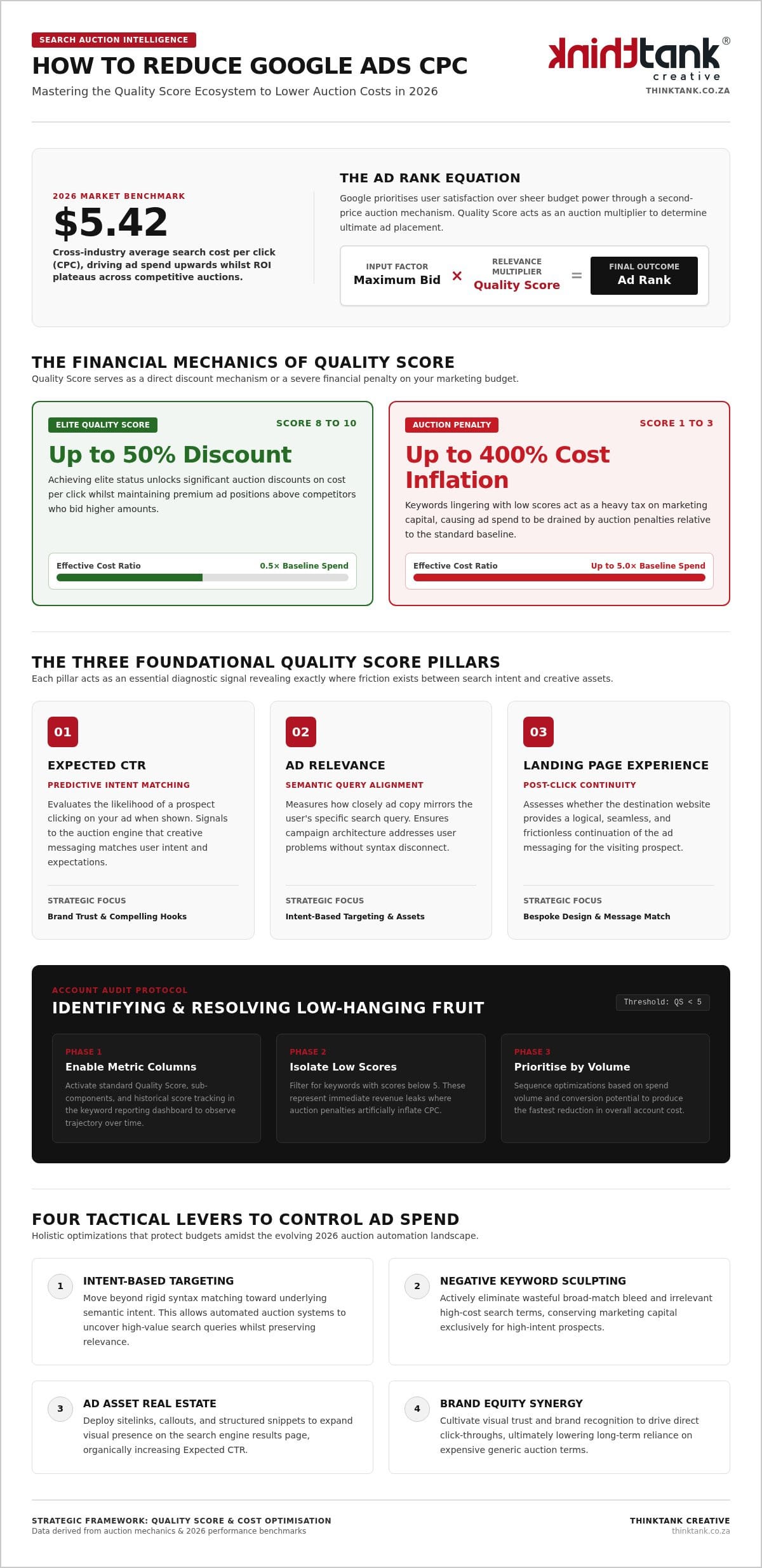
With the cross-industry average search cost per click reaching $5.42 in 2026, many South African advertisers feel they're being priced out of their own growth. It's a frustrating reality. When rising auction prices swallow your profit margins, you're left wondering how to reduce google ads cost per click without sacrificing lead quality. You likely feel the pressure of complex Quality Score metrics and the nagging suspicion that you're overpaying for traffic that doesn't resonate with your brand.
We agree that seeing your ad spend climb whilst your ROI plateaus is a challenge that requires more than just technical bidding tweaks. This guide promises to show you how to secure a sustainable reduction in your CPC by focusing on the synergy between your creative assets and the user experience. We'll explore a strategic framework that moves beyond simple bid adjustments. By the end, you'll understand how refined Quality Score components and precise landing page alignment can unlock higher ad positions for less money.
Key Takeaways
- Master the three foundational pillars of Quality Score to unlock significant auction discounts and improve your overall ad rank.
- Discover how to reduce google ads cost per click by refining your keyword strategy to focus on high-intent traffic whilst eliminating wasteful spend through negative lists.
- Optimise the post-click experience through bespoke website design that ensures your landing pages are a logical and relevant extension of your ad messaging.
- Utilise advanced bidding strategies and audience targeting to maintain control over your budget amidst the evolving 2026 automation landscape.
- Cultivate brand equity and visual trust to increase your click-through rates, ultimately lowering your reliance on high-cost generic keywords.
Understanding the Quality Score Ecosystem and Its Impact on Costs
Quality Score isn't just a metric; it's the fundamental lever that determines your financial efficiency in every auction. Think of it as a sophisticated discount mechanism that rewards precision and intent-matching. When you seek to understand how to reduce google ads cost per click, you quickly realise that Google prioritises user satisfaction over the highest bidder. The Google Quality Score mechanism evaluates three core pillars: Expected Click-Through Rate (CTR), Ad Relevance, and Landing Page Experience. Each pillar acts as a diagnostic signal, telling you exactly where the friction exists between your ad and the user's search intent.
These elements combine with your maximum bid to determine your Ad Rank. The formula is elegant in its simplicity: Ad Rank equals your Bid multiplied by your Quality Score. By focusing on quality rather than simply inflating your budget, you can outrank competitors who might be bidding significantly more. Achieving an elite Quality Score of 8 to 10 can lead to a 50% discount on your cost per click whilst maintaining a premium ad position.
To better understand how these mechanics work in practice, watch this helpful video:
The Financial Mechanics of Quality Score
Google rewards relevance because it ensures users find exactly what they're looking for, which maintains the long-term health of the search ecosystem. This alignment creates a direct correlation between higher scores and a lower cost-per-acquisition (CPA). Essentially, you're being rewarded for making the customer look smart and find answers quickly. Conversely, a low score acts as a heavy tax on your marketing budget. If your keywords linger between a score of 1 and 3, you're facing an auction penalty that can inflate your costs by up to 400% relative to the baseline. This financial drain often goes unnoticed until a thorough audit reveals the extent of the overpayment.
Diagnostic Steps for Your Current Account
Auditing your account in the 2026 interface requires a methodical and purposeful approach. Navigate to your keyword report and ensure you've enabled the columns for Quality Score and its three sub-components. You should also look at historical Quality Score data to identify trends over time. Identify your "low-hanging fruit" keywords that currently sit with scores below 5. Prioritise these improvements based on spend volume and conversion potential. Fixing a high-volume keyword with a low score will yield the most immediate results in your effort to learn how to reduce google ads cost per click, ensuring your budget is invested in growth rather than wasted on auction penalties.
Refining Keyword Strategy and Ad Relevance for Maximum Precision
Precision is the hallmark of a high-performing campaign. Whilst earlier eras of digital marketing relied on rigid match types, the 2026 landscape demands a shift toward intent-based targeting. This approach recognises that the semantic meaning behind a query is more valuable than the specific syntax used. By moving away from overly restrictive structures, you allow Google's AI to find high-value users that traditional exact-match lists might overlook. This evolution requires a sophisticated understanding of Generalized Second Price auction dynamics, where ad relevance serves as the primary filter for cost efficiency.
Ad relevance is not just about matching words; it's about matching expectations. When your ad copy mirrors the searcher's specific intent, your Expected CTR rises naturally. This improvement signals to the auction engine that your content is valuable, which is a core component of how to reduce google ads cost per click. You must also maintain rigorous negative keyword lists to eliminate irrelevant, high-cost traffic. Active sculpting ensures your budget is reserved for prospects with genuine conversion potential rather than being drained by broad-match bleed.
Utilising ad assets is another critical lever for success. These elements expand your visual real estate on the results page, providing additional touchpoints like sitelinks, callouts, and structured snippets. They don't just make your ad look larger; they provide immediate utility to the user, which consistently drives higher engagement rates and lowers your blended auction costs.
Strategic Keyword Selection and Grouping
Focusing on long-tail keywords remains a powerful strategy for brands seeking to elevate their performance. These specific, multi-word phrases often carry lower competition and significantly higher intent than generic terms. You should organise your account into tightly themed ad groups to ensure that every ad shown is a perfect reflection of the keyword that triggered it. Integrating a well-researched content marketing plan helps you identify these high-value search terms by understanding the questions your audience is actually asking.
Crafting High-Performance Ad Copy
Strong ad copy commands attention through action-oriented imperatives. Use verbs that invite the user into a partnership, reflecting a tone of quiet assurance and expertise. Incorporate your primary keyword naturally into headlines and descriptions to reinforce relevance. We recommend a constant cycle of A/B testing for your creative elements to refine your messaging. If you find the technical nuances of campaign structure overwhelming, our team is ready to collaborate on your Pay-Per-Click advertising to ensure every rand is spent with purpose.
Optimising Landing Page Experience to Minimise CPC
Elevate your digital performance by refining the destination that follows every click. Whilst many advertisers focus exclusively on bid adjustments, the post-click experience remains a critical pillar that accounts for a significant portion of your Quality Score. Investing in custom website design ensures your site isn't merely a digital brochure but a high-performance asset designed to satisfy user intent. This alignment is essential for anyone investigating how to reduce google ads cost per click, as it directly influences the auction engine's perception of value and relevance.
A landing page must serve as a logical, seamless extension of your ad creative. When a user clicks your ad, they expect an immediate answer to their specific query. If they encounter a generic homepage or irrelevant content, they'll bounce, driving up your costs and damaging your account health. High-quality destinations provide clear, accessible information that satisfies the searcher's needs whilst reinforcing your brand's authority and professional promise.
Technical Excellence and User Flow
Technical friction in the 2026 auction environment translates directly into financial penalties. Google's current standards for Core Web Vitals are stringent; failing to achieve an Interaction to Next Paint (INP) of 200 milliseconds or less can lead to higher CPCs. For the South African market, mobile-first design is a mandatory requirement rather than a secondary consideration. A mobile-optimised interface ensures that users on any device can navigate your site with ease, reducing bounce rates and improving the overall user flow. Security is equally vital. A secure HTTPS connection is a baseline expectation that protects user data and maintains your standing in the auction.
Content Synchronisation for Relevance
Continuity between your ad copy and your landing page content is a powerful lever for cost reduction. Map your primary ad keywords directly to your H1 headings and on-page descriptions to reinforce thematic relevance. Industry insights from Forbes detail how Quality Score reduces cost per click by rewarding this level of synchronisation between the search intent and the final destination. By utilising search engine optimisation principles, you build the structural authority that Google values. Rather than relying on a templated approach, create dedicated landing pages for specific campaigns to ensure every visitor finds a bespoke solution tailored to their search.
Advanced Bidding Strategies and Audience Targeting
Master the nuances of auction participation to protect your margins. In June 2026, the decoupling of Target CPA and Target ROAS from "Maximise Conversions" restored granular control to the user interface, allowing for a more bespoke approach to bid management. This structural shift provides the precision needed to apply strategic pressure on the algorithm, which is a vital step in learning how to reduce google ads cost per click. Whilst automated bidding remains the engine of modern search, elite advertisers still utilise manual bid adjustments for specific devices, locations, and peak times of day to prune away auction inefficiency.
Success in the current landscape requires a collaborative relationship between human strategy and machine learning. By leveraging first-party data to refine your audience targeting, you ensure that every rand is directed toward users with the highest intent. Implementing Remarketing Lists for Search Ads (RLSA) further enhances this efficiency, as it allows you to bid more aggressively on past visitors who have already engaged with your brand's professional identity. Understanding remarketing campaign best practices is essential to maximising the value of these warm audiences and reducing your overall cost per acquisition.
Smart Bidding and AI Integration
Following the August 17, 2026, update to budget-limited campaigns, the bidding algorithm now drifts toward your configured target rather than naturally beating it. This change makes setting appropriate Target CPA or Target ROAS goals essential to prevent the engine from driving up costs unnecessarily. Patience remains a strategic necessity during the "Learning Phase," as premature interventions can reset the data model and trigger bid inflation in competitive national sectors. We monitor these shifts meticulously to ensure the algorithm serves your business objectives rather than platform averages.
Audience and Demographic Refinement
Preserve your budget by excluding demographics that don't align with your conversion data. Using "Observation" mode allows you to gather significant performance insights before making aggressive bid changes, ensuring every adjustment is grounded in evidence. This methodical refinement aligns perfectly with a robust lead generation framework that prioritises high-value interactions over raw traffic volume. If you're ready to refine your auction strategy with a partner who understands the technical depth of this landscape, explore our Pay-Per-Click advertising services to secure your growth.
The Synergy of Branding and PPC for Long-Term Efficiency
Branding serves as the silent architect of auction success. Whilst many advertisers view Pay-Per-Click as a purely technical exercise, the most efficient campaigns rely on the psychological foundations of trust and recognition. When a searcher recognises your brand name or visual identity in the results, they're significantly more likely to engage with your ad. This elevated engagement directly raises your Expected CTR, providing a natural answer for how to reduce google ads cost per click without relying solely on aggressive bidding adjustments.
A cohesive brand identity creates a "Halo Effect" that extends from the first impression to the final conversion. By building brand equity, you reduce your reliance on high-cost generic keywords where competition is fiercest and margins are thinnest. Instead, you cultivate a presence that allows you to capture traffic through brand-led searches, which typically enjoy the highest Quality Scores and the lowest costs in the entire account. This synergy ensures your marketing budget is invested in building an asset rather than just renting temporary space on the results page. Complementing your paid search efforts with email marketing automation for beginners allows you to nurture those hard-won leads automatically, compounding the return on every click you've already paid for.
Visual Identity as a Conversion Lever
Professionalism begins with a visual promise that your business can deliver on its claims. Consistency across your ad assets and your website reduces user friction, ensuring the transition from search engine to landing page feels secure and intentional. The psychological impact of professional logo design cannot be overstated; it establishes a perceived value that allows you to stand out amongst generic competitors. High-quality design signals a level of bespoke craftsmanship and dependability that templated identities cannot replicate, turning a simple click into a confident, high-value lead.
Moving from Tactical Clicks to Strategic Growth
Integrated agencies deliver a superior ROI by ensuring that every marketing silo works in perfect harmony. Unlike specialists who focus only on the mechanics of the auction, ThinkTank Creative operates as a "Strategic Visionary," aligning your creative identity with your technical performance. Our collaborative 5-stage process moves from deep research and branding to post-launch ad support, ensuring your growth is both sustainable and measurable. We believe that great marketing makes the customer look smart, and our commitment is captured in our tagline: "We Do It All So You Don't Have To." By merging bespoke creative design with precision-targeted advertising, we transform your digital presence into a powerful engine for long-term success.
Mastering the Future of Paid Search
Achieving long-term efficiency in the Google Ads auction requires a shift from reactive bidding to proactive, holistic management. By mastering the Quality Score ecosystem and ensuring your landing pages meet the highest technical standards, you create a foundation for sustainable growth. We've explored how a refined keyword strategy and the synergy of professional branding work together to elevate your performance.
Understanding how to reduce google ads cost per click isn't just about technical settings; it's about building a brand that users trust and Google rewards. This strategic alignment ensures your marketing budget works harder whilst making your business look smart. Precise execution across every touchpoint is what separates market leaders from those merely participating in the auction.
Since 2001, our award-winning in-house team has delivered integrated marketing solutions for national South African brands. We invite you to elevate your digital strategy with ThinkTank Creative and leverage 25 years of expertise to transform your results. The digital landscape continues to evolve, but with a strategic partner by your side, the potential for brand transformation remains limitless.
Frequently Asked Questions
What is a good average CPC for South African businesses in 2026?
Average costs vary significantly by sector. Across all industries, the global average sits at $5.42, with legal services reaching $9.87 and arts as low as $1.63. For South African businesses, these figures serve as a useful benchmark, though your specific auction dynamics depend on local competition and Quality Score. We provide an estimated cost for your specific niche after assessing your campaign goals and historical data during our discovery phase.
How long does it take for Quality Score changes to affect my CPC?
Quality Score is calculated in real-time during every single auction. Whilst you might see the 1-10 diagnostic score update in your interface every few days, the actual auction impact is immediate. If you improve your landing page experience or ad relevance today, the algorithm begins factoring those signals into your Ad Rank right away. This rapid feedback loop is essential when learning how to reduce google ads cost per click effectively.
Can I reduce my CPC without changing my website?
You can lower your costs by improving ad relevance and expected click-through rates, but ignoring your website limits your potential. Landing page experience constitutes one-third of your Quality Score. Whilst refining keyword match types and ad copy will help, a technical or content mismatch on your site acts as a permanent tax. Our award-winning design team often finds that bespoke website adjustments provide the most significant long-term CPC discounts available.
Does increasing my budget help reduce my cost per click?
Increasing your budget doesn't directly lower your CPC; in fact, a higher budget without proper targets can lead to bid inflation. Following the August 2026 update, campaigns limited by budget often see the algorithm drift toward higher targets rather than beating them. Strategic growth requires balancing your spend with precise bidding limits and high Quality Scores. We focus on making your budget work smarter through integrated management rather than simply spending more.
How do negative keywords actually save me money on Google Ads?
Negative keywords act as a filter that prevents your ads from appearing for irrelevant search queries. By excluding terms that don't align with your offering, you stop paying for low-quality clicks that won't convert. This refinement naturally improves your click-through rate and ad relevance. These are two vital components of your Quality Score that directly determine how to reduce google ads cost per click over the duration of your campaign.
Will a better logo design really help lower my ad costs?
A professional logo design builds immediate trust, which significantly increases your ad's click-through rate. Because expected CTR is a primary component of Quality Score, this visual trust leads to lower auction costs. When users recognise a polished corporate identity, they're more likely to engage with your content. Our 25 years of expertise in branding ensures that your visual assets work in synergy with your technical PPC strategy to drive efficiency.
What is the difference between CPC and CPA in digital marketing?
Cost Per Click (CPC) measures the price you pay for a single interaction with your ad. In contrast, Cost Per Acquisition (CPA) tracks the total cost to secure a specific conversion, such as a lead or sale. Whilst lowering your CPC is important, the ultimate goal is often a sustainable CPA. We use a 5-stage development process to ensure your website converts those clicks into meaningful business results for your brand.
Is automated bidding better than manual bidding for cost reduction?
Automated bidding is highly effective when you have sufficient conversion data, but it requires human oversight to prevent overspending. Following recent algorithm updates, Smart Bidding can drift toward higher costs if targets aren't calibrated meticulously. Manual bidding offers more control for low-volume accounts or new campaigns. We often recommend a hybrid approach that leverages AI efficiency whilst maintaining the strategic intervention of a seasoned expert to protect your profit margins.