How to Measure Social Media Marketing ROI and Track Business Impact
A campaign’s value isn’t measured by likes alone. Measuring social media marketing ROI means comparing the value generated with the total investment: subtract costs from earnings, divide the result by costs, then multiply by 100 to express the return as a percentage. For an e-commerce business, the calculation is only as useful as the objectives and sales attribution behind it.
It’s understandable to want a clear link between social activity and business results, especially when a sale may follow several interactions rather than a single click. A considered approach to measuring social media marketing ROI shows what social contributes, which parts of a strategy are working and where there’s room to improve.
This guide explains how to define social media ROI, choose awareness, engagement and conversion metrics, and assess returns for an e-commerce business. It also explores why measurement matters and how professional social media marketing can connect campaign activity with meaningful business outcomes.
Key Takeaways
- Separate campaign costs from the value generated to build a more meaningful view of e-commerce returns.
- Connect social interactions with purchase behaviour by considering the customer journey, not just the final click.
- Choose awareness, engagement and conversion metrics that match the business objective you want to assess.
- Set a clear definition of value before comparing campaigns, so financial and non-financial outcomes have context.
- Use consistent measurement to identify what is working, refine strategy and make stronger decisions about investment.
How does a professional calculate social media ROI for an e-commerce business?
A sound measurement approach connects campaign objectives with costs, tracked customer actions and business value. Keep organic activity, paid media and financial reporting distinct to understand what each contributes.
-
How a professional measures organic and paid social media ROI separately
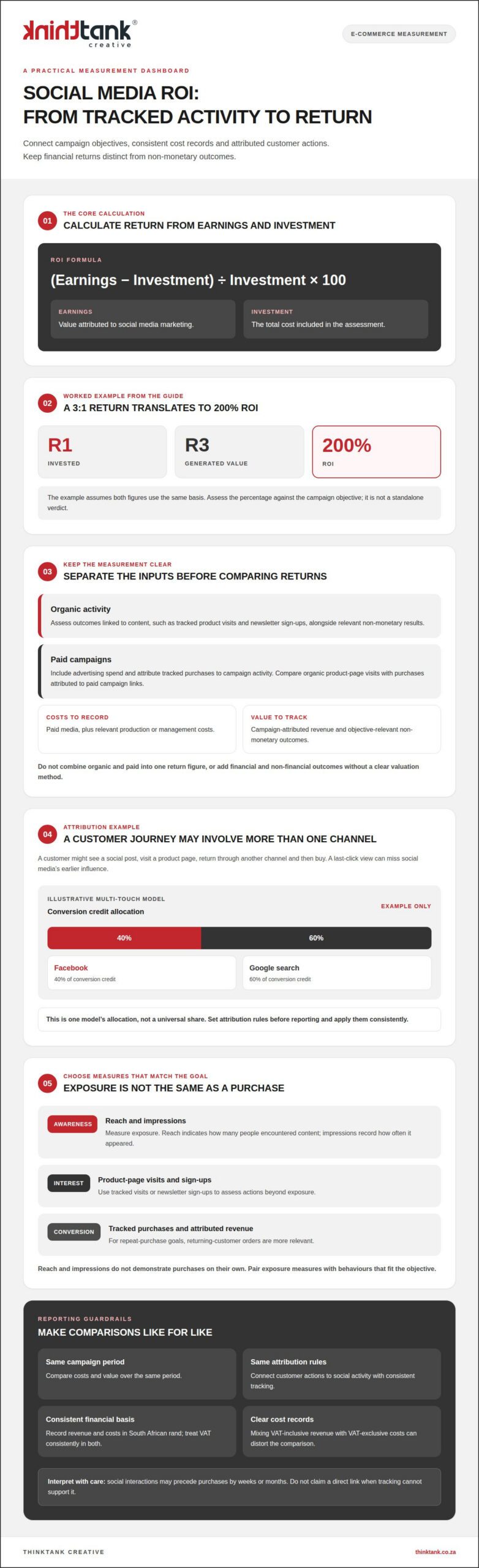
Separate organic and paid social media before assigning value. For organic activity, assess outcomes linked to content, such as tracked product visits or newsletter sign-ups, alongside relevant non-monetary results. For paid campaigns, include advertising spend and attribute tracked purchases to campaign activity. This distinction helps show whether results came from paid distribution or organic engagement. Avoid combining both into a single return figure, which can obscure how each approach contributes to the campaign objective.
For example, compare organic product-page visits with purchases attributed to paid campaign links. Apply the same attribution method consistently to both.
-
How a professional calculates campaign costs and revenue
Keep a campaign cost record that captures the investment being assessed, including paid media and relevant production or management costs. Compare that total with campaign-attributed revenue, using tracking data that links social interactions to e-commerce purchases. A purchase is not automatically attributable just because it happened during a campaign: the tracking rules must connect the customer action with social activity.
There is no single typical advertising cost or return for South African businesses. Costs depend on campaign objectives, paid spend and the scope of the work; returns depend on attributed revenue and which costs are included.
-
How a professional compares social media costs with value
Compare like with like: use the same campaign period and attribution rules for costs and value. Value may include revenue from tracked purchases or non-monetary outcomes, such as comments or newsletter sign-ups, when they support the stated objective. Keep these outcome types separate rather than adding them together without a clear valuation method.
For financial reporting, record revenue and costs consistently in South African rand. Treat VAT consistently in both figures and keep the underlying financial records clear. Mixing VAT-inclusive revenue with VAT-exclusive costs can distort the comparison.
-
How a professional calculates ROI from earnings and costs
Apply the formula: (earnings minus investment) divided by investment, multiplied by 100. In this calculation, earnings are the value attributed to social media marketing, and investment is its total cost. For example, a 3:1 return means R3 in generated value for every R1 invested; if both figures use the same basis, the formula produces a 200% ROI.
Use the result to assess the campaign against its objective, not as a standalone verdict. A percentage may look strong while overlooking non-monetary outcomes or an incomplete cost record.
Can a Professional Measure the ROI of Your Social Media Marketing?
Yes. A considered approach connects social activity with business objectives, tracked actions and purchase behaviour. Common mistakes include treating reach as revenue, relying only on last-click attribution and overlooking the influence of other channels.
-
How a professional matches goals with ROI measures
Start by translating each marketing objective into a metric that shows progress towards it. For a product launch, reach and product-page visits can indicate whether the campaign is attracting attention. For repeat purchases, returning-customer orders are more relevant. Avoid using the same metric for every objective: a large audience alone doesn’t show that a campaign generated sales.
Record the objective, its matching metric and the assessment period in the measurement plan. This gives brands a consistent basis for interpreting results and keeps marketing strategy connected to business priorities. For awareness, assess exposure and subsequent interest; for sales, assess tracked purchases and attributed revenue.
-
How a professional connects social metrics to purchases
Map the customer journey from social interaction to purchase, using tracked visits and defined conversion events. A customer might see a post, visit a product page, return through another channel and then buy. A last-click view may award all the credit to that final channel, obscuring social media’s earlier influence.
Set attribution rules before reporting, then apply them consistently across the campaign. Multi-touch attribution can distribute conversion credit across channels according to predefined rules or a statistical model. For example, one model assigns 40% of conversion credit to Facebook and 60% to Google search. The allocation describes that model, not a universal share for either channel.
Allow for delayed influence when interpreting results. Social interactions can precede purchases by weeks or months, particularly for B2B and enterprise buyers. For e-commerce, compare the tracked journey with purchase records, and avoid claiming a direct link when tracking cannot support it.
-
How a professional uses reach and impression measures
Use reach and impressions to assess exposure, then connect that exposure with deeper actions. Reach indicates how many people encountered content; impressions record how often it appeared. Neither measure demonstrates purchases on its own, so pair it with relevant behaviours such as product-page visits, sign-ups or completed orders.
Interpret each measure against the campaign objective and audience. An increase in impressions may reflect repeated exposure rather than more distinct people or stronger purchase intent. Compare it with engagement and subsequent actions to see whether content moved audiences towards the next step. Qualitative feedback, including positive comments, can add context to numerical metrics.
Fragmented platform dashboards can make this assessment harder. Nielsen’s 2025 Marketing Report identifies bringing data together across separate platform dashboards as a top barrier to calculating ROI. A unified reporting view helps professionals interpret the campaign’s signals together. A coordinated social measurement approach can connect those signals with business objectives.
Awareness, engagement and conversion metrics
Useful KPIs depend on the objective: awareness uses reach and impressions, engagement tracks interactions, and conversion measures actions such as sign-ups or purchases. A professional groups these measures to show how social media efforts move audiences from exposure towards business outcomes.
-
How a professional tracks awareness and engagement measures
Choose awareness measures that describe exposure, then pair them with engagement measures that show audience response. Reach and impressions indicate whether content appeared before an audience; comments, shares, saves and clicks show how people interacted. A high impression count alone doesn’t establish brand awareness or commercial impact, so interpret it alongside meaningful engagement.
Use campaign examples to give the figures context. Blendtec’s “Will It Blend?” videos had been viewed more than 100 million times on YouTube, illustrating substantial content exposure. That view count is an awareness signal, not proof of purchases. A professional assesses it alongside responses and subsequent actions, rather than treating views as a complete measure of return.
For website activity, compare social-driven visits with relevant behaviour after arrival. Southwest Airlines’ redesigned blog recorded a 25% increase in visits and a 40% increase in page views. Those measures show changes in site activity; a separate conversion measure is needed to establish whether visitors took a valuable action.
-
How a professional distinguishes micro and macro conversions
Classify each conversion by its place in the customer journey. Ebook downloads, newsletter sign-ups and trial registrations are micro-conversions: they indicate interest before a final purchase. A completed product order is a macro-conversion for an e-commerce business. This distinction helps explain progress when a campaign generates engagement before sales appear.
Where tracking allows, link each micro-conversion to a relevant later outcome. For example, assess whether newsletter sign-ups from social activity are followed by purchases, rather than automatically assigning them the same value. Keep the two event types separate in reporting, and don’t count one person’s sign-up and purchase as two completed sales.
Micro-conversions can help assess campaigns whose immediate objective is consideration. They are useful indicators, but not substitutes for a purchase KPI when the objective is revenue. Report the sequence clearly, from social interaction to sign-up and, where tracked, purchase.
-
How a professional selects conversion performance indicators
Match conversion KPIs to the action the campaign is designed to generate. For an online shop, these may include tracked orders and revenue; for a lead-focused campaign, they may include qualified enquiries. Google Analytics can support analysis of website activity and defined events, while social platform reports provide channel-specific interaction measures.
Set a consistent reporting window and event definition before comparing campaign performance. A click is not a purchase, and a landing-page visit is not necessarily a sign-up. Pair conversion volume with conversion value where available, then interpret both against campaign costs and the stated objective.
Include qualitative feedback when it helps explain performance. Positive comments can add context to engagement figures, while completed orders show a direct commercial outcome. Reporting both gives decision-makers a clearer view of what social media activity achieved.
Defining social media ROI
Define social media marketing ROI before measuring it. The business objective determines which outcomes count as value, from sales to newsletter sign-ups.
-
How a professional sets social media goals
Translate a business priority into a specific social media goal. For example, a retailer launching a product could target product-page visits, while a brand focused on repeat purchases could track returning-customer orders. The goal should describe a business outcome, not simply activity such as publishing posts or gaining followers.
Next, match the goal to an observable measure and decide how the result will be attributed. For a Facebook campaign, track visits from campaign links and subsequent purchases. Don’t choose metrics just because a platform makes them easy to report: each measure should help assess the intended outcome.
Set the scope before evaluating results. Specify which campaign, platforms and audience the assessment covers, and keep those boundaries consistent when comparing performance. If a campaign supports both awareness and sales, record them as distinct objectives so engagement doesn’t become a substitute for purchase results.
-
Define the return being measured
Social media ROI is the value generated by social media investment, assessed against the chosen objective. Value may be financial, such as attributed e-commerce revenue, or non-financial, such as comments and newsletter sign-ups. Both outcomes can matter, but they shouldn’t be combined as if they were equivalent measures.
For a sales objective, focus on purchases and revenue attributed to social activity. For an awareness objective, relevant indicators might include audience response or new newsletter sign-ups. Define what counts as value before reporting, so measuring social media marketing ROI reflects the goal rather than whichever metric looks most impressive.
Then document the attribution approach. A customer may encounter a social post, visit a product page later and complete a purchase after another interaction. The chosen rules determine how much credit social receives. Applying the same approach across campaigns makes comparisons more meaningful, while recognising that a single platform interaction may not capture the whole customer journey.
Finally, separate return from performance activity. Facebook likes, comments and clicks describe interactions; they don’t automatically demonstrate financial return. If the objective is community engagement, comments may represent relevant value. If it is sales, connect platform activity to tracked purchases before presenting it as revenue generated.
Reasons to measure social media ROI
Measurement turns social activity into evidence for decisions about strategy, investment and customer relationships. Its value goes beyond showing whether a campaign generated sales.
- Use performance evidence to explain social media’s contribution to business outcomes. Sixty-eight per cent of marketers report worrying about proving the return on their social media efforts, while 46% believe social media use improves sales. Tracking results against a stated objective helps distinguish evidence of progress from assumptions about impact.
For example, an e-commerce team can connect social activity with product interest and tracked orders. If orders rise but social-attributed visits do not, examine the attribution approach before claiming social caused the increase.
- Compare results over time to identify which content supports growth. Tracking progress across six months, for example, can show whether product demonstrations or customer stories generate stronger responses. A consistent comparison period helps teams interpret changes without treating one successful post as proof of a lasting trend.
Pair the figures with platform context. Google Analytics can help assess website activity alongside platform engagement, while positive comments may explain why a particular message resonated. Neither comments nor visits alone prove revenue, but together they can inform the next campaign decision.
- Connect social insights with decisions beyond the marketing team. Among marketers who work with social data, 98% agree that social insights have enabled cross-functional business outcomes. Social feedback can help teams consider customer experience, retention and messaging, rather than limiting reporting to likes or reach.
For instance, repeated questions in comments about product sizing could help a retailer identify an issue with content or product information. Sharing that pattern with the relevant team gives the feedback a practical purpose, while keeping it distinct from measured sales outcomes.
- Use audience signals to inform retention and market decisions. Among marketers reporting business outcomes from social intelligence, 45% cite customer retention as a benefit, and 40% cite identifying a new audience or market shift. These findings show why social analysis can contribute to decisions beyond campaign reporting.
A rise in positive comments from a previously overlooked audience, for example, may prompt a brand to examine that audience’s needs. Comments are a signal to investigate, not proof of demand or a substitute for purchase data.
- Make budget discussions more evidence-led by showing what social activity supports. Kellogg found that Special K cereal’s online return on investment was twice the return from television over 18 months. The comparison illustrates how channel-level evaluation can inform investment choices, while each business still needs measures suited to its own objectives.
Use findings to refine the next campaign, not simply to defend past spending. Strengthen your social media measurement approach by connecting campaign results with the business decisions they can inform.
ThinkTank Creative: Social Media Marketing
ThinkTank Creative provides Social Media Marketing to help businesses shape campaigns around clear objectives and meaningful outcomes. Turn to this support when social activity needs a more considered strategy, or when reporting needs to connect engagement with business impact.
Effective measurement depends on more than platform figures. It requires a coherent approach to objectives, audience response and the actions that matter to the business. Where digital touchpoints need closer alignment, Website Design and Development and Creative design can support a consistent experience from social content to the website.
Bring your business goals and current measurement challenges into the conversation. Contact ThinkTank Creative to discuss your social media marketing needs.
Turn your social data into your next decision
Make each reporting cycle a starting point for a sharper business decision. A disciplined approach to measuring social media marketing ROI can help your team decide which audience to prioritise, what creative direction to develop and how social activity should support the wider customer experience. The next opportunity may not be another campaign; it could be improving how people move from discovering your brand to engaging with it.
That work benefits from alignment between strategy, creative and the digital destination. ThinkTank Creative offers Social Media Marketing, Creative design and Website Design and Development, bringing relevant disciplines together around your business objectives. Use each measurement cycle to refine the connection between what your audience sees and the action you want them to take.
Ready to shape a more considered approach for your business? Contact ThinkTank Creative to discuss your goals and take the next step with confidence.
Frequently Asked Questions
How do data silos across platforms affect ROI tracking?
Data silos make it harder to connect platform activity with website behaviour and completed orders. For example, Facebook may record an advert click while website analytics records a later purchase under another source. Align campaign names, tracking labels and conversion definitions across reports, then investigate mismatches. This helps reduce inconsistent attribution and prevent the same purchase from being counted more than once.
How do delayed conversions and long sales cycles affect ROI measurement?
Delayed conversions can make a campaign appear ineffective if reporting ends before customers purchase. Social media influence may precede a decision by weeks or months, particularly in B2B and enterprise sales. A professional follows campaign cohorts over a reporting window suited to the sales journey, separating early indicators from completed revenue. This gives later conversions room to appear without treating every subsequent sale as social-driven.
How does a professional calculate ROI for brand awareness campaigns?
To calculate awareness ROI, assign a defensible value to the awareness outcome, then compare it with campaign investment. For example, a business might assess a defined increase in relevant audience attention against its campaign objective. Any monetary valuation should use a consistent method and be labelled as estimated value, not sales revenue. Without a credible valuation, report awareness outcomes separately rather than implying financial ROI.
How does a professional quantify non-monetary value?
First define which non-monetary outcomes matter, such as positive comments, newsletter sign-ups or qualified interactions. Count each outcome using a consistent event definition, then assess it against the campaign objective. If a business assigns a financial equivalent, it needs a clear rationale, such as a known relationship between sign-ups and later purchases. Otherwise, keep the outcome as a separate performance measure.
What is multi-touch attribution across channels?
Multi-touch attribution distributes conversion credit across the channels a customer interacted with before purchasing. A customer might discover a product through a social post, return through an email and complete an order after a search. Apply predefined rules or a statistical model to allocate credit across those interactions. The chosen model shapes the reported contribution, so comparisons require consistent attribution rules.
What metrics should you track for awareness and reach?
Track reach to understand how many people saw content, and impressions to assess total exposure. Audience growth, video views and relevant profile visits can add context, depending on the campaign format. Compare these measures with the intended audience and content type: high exposure alone doesn’t demonstrate recognition or purchase intent. Comments and shares can also help explain how people respond to the message.
What metrics should you track for conversion and revenue?
For an e-commerce campaign, track completed purchases and revenue attributed to social activity. Conversion rate shows how often relevant visits lead to the chosen action, while average order value adds context to revenue. Cost per acquisition can help compare spending with acquired customers. Define whether cancelled or refunded orders are included, then apply that treatment consistently across campaign reports.
How does a professional calculate social media marketing ROI?
A professional subtracts social media investment from the value attributed to social activity, divides the result by that investment and multiplies by 100. The result is a percentage. For example, a return above zero indicates attributed value exceeded the included investment; a result below zero indicates the opposite. The calculation is only meaningful when earnings and costs cover the same campaign scope and reporting period.