Brand consistency builds trust and recognition
Recognition grows when every customer touchpoint feels part of the same story. Brand consistency for businesses means presenting a recognisable identity and message across channels while adapting details to each context. That includes visual elements, tone of voice and the experience people have when interacting with a business.
Consistency matters because a familiar logo or voice can help customers recognise a brand, but it must also feel relevant wherever they encounter it. Repetition without flexibility can feel rigid; variation without a clear foundation can cause confusion.
This article explains what brand consistency involves and how it can support trust, recognition, customer loyalty, revenue and more effective marketing. It also covers how brand guidelines, organised assets and thoughtful adaptation help create a coherent identity across a business’s communications.
Key Takeaways
- Align your visual identity, messaging, tone and customer experience so each interaction feels recognisably part of the same brand.
- Make brand guidelines and approved assets easy for everyone working on your marketing to find and use.
- Adapt your communications to each channel without losing the identity customers recognise and trust.
- Review your website, social media and marketing materials to spot inconsistencies that could weaken recognition or confuse customers.
- Explore how coordinated website design, social media marketing and creative design can bring your brand identity to life.
What is brand consistency?
Brand consistency means presenting a recognisable identity across visual design, messaging, tone and customer experience. A South African business might express the same values through its website, social posts, printed materials and customer interactions.
A brand identity beyond visual elements
A brand identity is the combined impression created by visual elements, messaging, tone, values and customer experience. A logo and colour palette help people recognise a business, but its words and the way it treats customers shape that recognition too. For example, a business promising clear, practical advice should communicate plainly and make its service experience equally straightforward.
Build consistency by connecting each customer-facing element to the same principles. A brand guide can set out logo use, colours, typography, tone of voice and key messages, then show how to apply them to a website or social media post. This gives staff and collaborators a shared reference instead of leaving each person to interpret the identity independently.
Consider the full customer journey. A prospective customer may first see a social media post, visit the website, then speak with a staff member. If the post is warm and helpful, but the website is formal and the conversation feels dismissive, those experiences tell different stories. Consistent behaviour across touchpoints makes the brand promise more credible and can support customer loyalty.
Relevance within a core identity
Relevance within a core identity means adapting how a brand communicates without changing the values and character people recognise. A business can adjust its message for a new audience or platform while keeping its visual identity and central promise intact. This balance matters: an unchanged approach can feel out of step, while constant reinvention can weaken recognition.
For example, a professional services firm might use a concise LinkedIn post to explain an industry update, then offer fuller context on its website. The formats differ, but the same visual style, voice and commitment to useful guidance can connect them. In South Africa, a campaign may also need to reflect local language and audience context without losing the business’s distinctive character.
Use brand values as the decision point when reviewing a new design, campaign or channel. Ask whether the change expresses the same promise in a way that suits its audience. A refreshed layout may improve readability, while familiar typography, colours and wording preserve recognition. This lets a brand evolve with purpose rather than follow every passing trend.
For brand consistency for businesses, the goal isn’t identical content everywhere. It’s a clear identity people can recognise across a website, social media, print and customer interactions, even as each message suits its setting.
Centralising brand assets with digital asset management
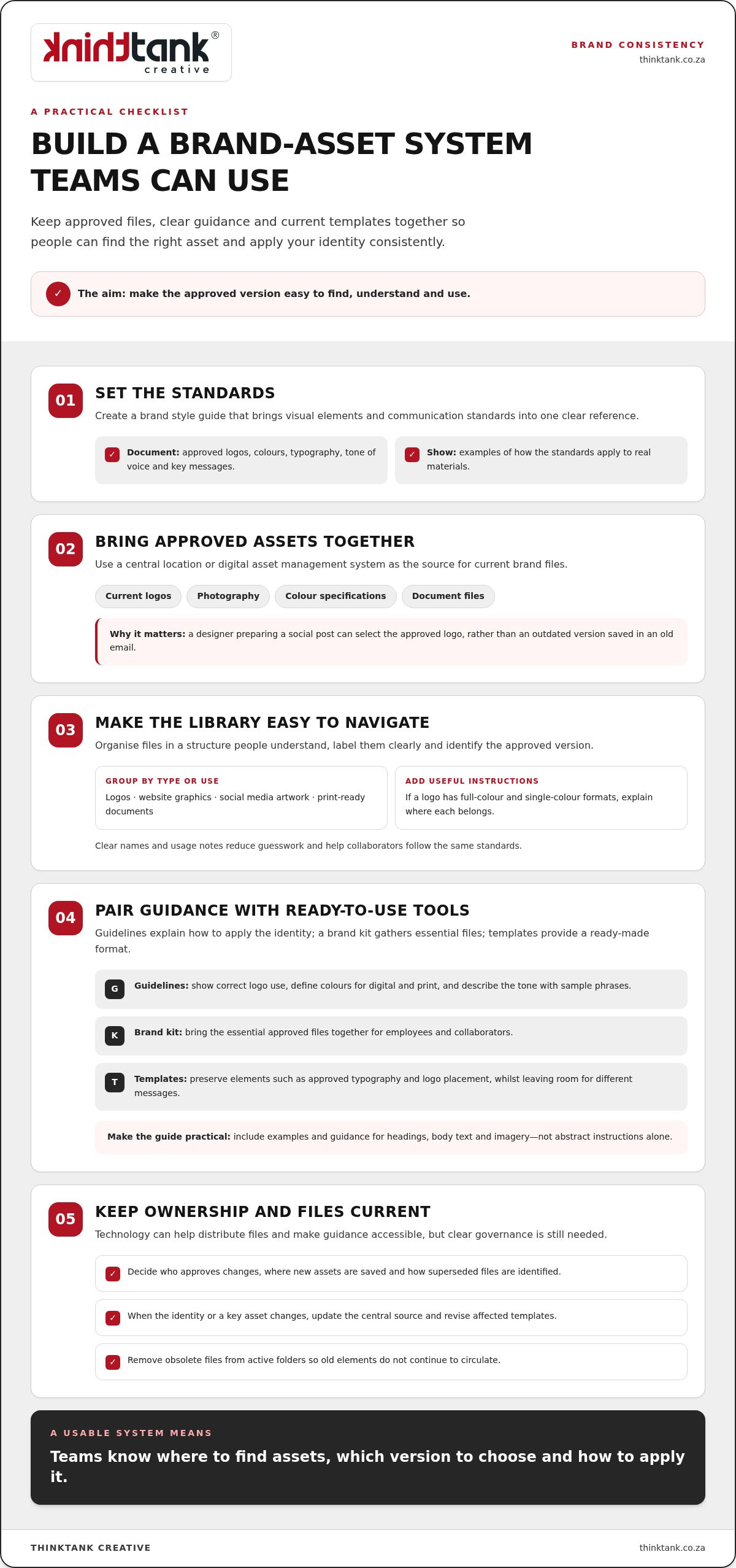
A brand style guide brings visual elements and communication standards into one clear reference. Create it by documenting approved logos, colours, typography, tone of voice and messaging, then add examples showing how each applies to real materials.
Centralising approved brand assets
Digital asset management brings approved brand files together in a central location, making it easier for teams to find and use the right source. Store current logos, photography, colour specifications and document files alongside usage notes. For example, a designer preparing a social post can use the approved logo rather than an outdated version from an old email.
Give the central library a structure people can understand. Group files by type or use, such as logos, website graphics, social media artwork and print-ready documents. Label each asset clearly and identify the approved version. If a logo has full-colour and single-colour formats, explain where each belongs. Clear naming and instructions reduce guesswork and help collaborators follow the same standards.
Guidelines, kits and templates
Brand guidelines explain how to apply identity elements, while a brand kit gathers essential files and a template provides a ready-made format. Together, they help employees, agencies and freelancers produce connected materials. A branded letterhead template, for instance, can preserve approved typography and logo placement while leaving room for different business messages.
Keep the document practical. Show examples of correct logo use, define the brand’s colours for digital and print applications, and describe the tone with sample phrases. Include guidance for headings, body text and imagery, so the standards are easier to apply than abstract instructions alone. An accessible guide is useful only when people can locate it and understand what to do.
Technology can support this process, but it can’t replace clear governance. A shared drive or digital asset management system can hold approved files, distribute them to teams and make the latest guidance easier to access. Set simple ownership rules: decide who approves changes, where new assets are saved and how superseded files are identified. This prevents competing versions from circulating across departments.
Review the library whenever the identity or a key asset changes. Update the central source, remove obsolete files from active folders and revise templates that still use old elements. For a website, aligning approved graphics and brand details with website maintenance and support can help keep published pages in step with current standards. The result is a usable system: teams know where to find assets, which version to choose and how to apply it.
Trust, customer loyalty, brand recognition, and revenue
Consistent branding helps customers connect familiar signals with a dependable experience. Its effects can extend from first recognition to repeat purchasing and revenue.
Consistency across customer touchpoints
Consistency across customer touchpoints means people encounter a coherent identity and experience wherever they interact with a business. A website, social media page, phone call and printed brochure should feel connected, even when each serves a different purpose. A gap between a campaign’s promise and the service experience can undermine confidence.
Map the journey from discovery to purchase, then review what each touchpoint communicates. For example, a South African retailer might use the same approved product descriptions and service details on its website, social posts and printed materials. Staff conversations should reflect those messages too. The words need not be identical, but the facts, tone and expectations should align.
Look for practical friction as well as visual differences. If customers see one set of opening hours on a social profile and another on the website, they may question which is current. Clear ownership of updates and a shared source for approved information help prevent these avoidable inconsistencies.
Recognition and customer loyalty
Brand recognition is the ability to identify a business through familiar visual and verbal cues; consistency reinforces those cues over time. A recurring logo, colour palette and phrase can help customers distinguish one business from another when comparing options. Familiarity makes an identity easier to recall when a need arises.
Familiarity alone doesn’t create loyalty. The customer experience must support what the brand signals. If a business presents itself as responsive but enquiries receive unclear or conflicting answers, repetition won’t fix the mismatch. Aligning materials with actual service behaviour gives customers a reason to return, not just remember the name.
Trust is also linked to purchasing behaviour: 81% of people must trust a brand before making a purchase, and customers who trust a brand are 88% more likely to buy again. These figures underline why consistency should extend beyond design. Reliable information, recognisable presentation and a customer experience that matches the brand promise work together.
Trust and revenue
Consistent brand presentation across all channels can increase business revenue by approximately 23%. This is a reported relationship, not a guaranteed result for every organisation. Consistency can support performance by helping customers recognise a business, understand its offer and feel confident moving towards a purchase.
Trust can also influence retention. Acquiring a new customer can cost up to five times more than retaining an existing customer, so a dependable experience has commercial relevance beyond the first sale. Review whether each interaction reinforces the same promise, from the first advertisement to after-sales communication.
Measure customer response alongside brand presentation. Track repeat purchases, feedback and points where people abandon an enquiry. If customers recognise a campaign but misunderstand the offer, refine the messaging. If the promise is clear but the experience varies, focus on the relevant touchpoints. This makes consistency a practical part of customer retention and revenue planning.
Marketing and advertising effectiveness
In competitive markets, a clear, repeated identity helps each campaign build on the last. More than 70% of companies believe inconsistent brand use creates confusion in the market. Consistency helps audiences connect an advertisement with the business behind it, rather than treating each message as a separate introduction.
Repetition also gives marketing a stronger cumulative effect. Customers may need to see a brand and its message at least 7 times before committing to a purchase decision. If each appearance changes its visual identity, tone or core promise, those encounters may not reinforce one another. A recognisable system lets a business adapt creative work for different channels while retaining familiar cues.
That doesn’t mean publishing identical content everywhere. A social post can introduce an idea, while an email explains it in more detail and a website supports the next step. The format and emphasis change, but the central message and visual identity remain connected. For example, Nike has kept its “Just Do It” slogan and swoosh logo consistent for decades.
Make campaigns easier to manage
A defined marketing strategy reduces repeated decisions during campaign production. Teams can start with approved visual elements, tone and key messages, then tailor each execution to its audience and channel. This helps a campaign feel coherent across paid advertising, email and social media without forcing every touchpoint into the same format.
Use this marketing leader checklist before a campaign goes live:
- Confirm the logo, colours, fonts and imagery match the current visual identity.
- Check that each channel communicates the same offer and intended customer action.
- Review tone and wording so the campaign reflects the brand’s established character.
- Compare advertisements, email and social content for conflicting claims or details.
Efficiency comes from making good decisions repeatable. Content management systems and social media schedulers can help teams coordinate messaging across channels. Shared campaign templates can preserve design standards, leaving staff to focus on the audience and message rather than rebuilding each asset.
Measure the system as well as the campaign. Audit websites, social media and marketing materials quarterly to identify outdated logos, off-brand colours or inconsistent messaging. Only 25% of companies actively enforce their brand guidelines, so clear ownership matters. Assign responsibility for review, record corrections and update the approved source, allowing the next campaign to begin with accurate materials.
Definition and business importance of brand consistency
Brand consistency connects a business’s identity and message across its audience-facing platforms. In South Africa, use brand names and visual assets you own or have permission to use, and keep advertising claims accurate and supportable.
Meaning of a consistent brand
A consistent brand presents its values, visual identity and messaging in recognisable ways across different contexts. Customers can more readily connect a campaign, service interaction and business to the same organisation. Consistency doesn’t require identical content everywhere; each expression should reflect the same central identity.
For example, a business promising straightforward advice can use clear language in an advert, on its website and in customer emails. Its tone may shift to suit each platform, but the promise remains recognisable. This alignment helps make the brand memorable for the right reasons, rather than relying on a logo alone.
Business importance of consistency
Consistency gives a business a coherent foundation for communicating with its audience. When brand assets, messages and customer experiences point in the same direction, each interaction can reinforce the last. This supports recognition and helps customers understand what the business stands for, especially when they encounter it through different channels.
It also makes internal decisions more focused. A team planning a campaign can compare its proposed design and language with the brand’s values and positioning. If an idea attracts attention but contradicts the business’s core promise, the team can refine it before publication. That discipline supports long-term success without ruling out fresh creative work.
Review consistency in real customer materials, not just a brand document. Compare a recent advert, website page and customer email. Check whether each uses current assets, describes the same offer and communicates a compatible tone. This simple comparison can reveal gaps between the identity a business intends to present and what its audience actually sees.
Branding and advertising rules
South African businesses should use their own branding or assets they’re authorised to use, and avoid advertising that could mislead customers. Keep claims clear and supportable, including statements about a product’s features, performance or benefits. These principles help protect customer understanding and reduce the risk of building a campaign around confusing or unsupported promises.
Before publishing an advertisement, match each claim to evidence the business can substantiate, and check that images and logos are approved for use. For instance, explain a promotion clearly and avoid visuals that suggest a benefit the business doesn’t provide. Consistent brand standards work best when creative choices and claims are reviewed together.
Brand consistency for businesses is both a communication discipline and a decision-making framework. Define what must stay recognisable, then adapt the delivery to each platform. That balance helps a brand remain distinctive as its audience, channels and marketing needs evolve.
ThinkTank Creative: Website Design and Development
ThinkTank Creative helps businesses bring their brand identity together through Website Design and Development, creative design, and Logo and Corporate Identity Design. Turn to these services when your website or visual materials no longer reflect a clear, unified identity, or when you’re shaping a new direction for your business.
A coherent website gives your messaging and visual identity a consistent home, while Social Media Marketing carries that identity into social channels. The work can be shaped around your brand’s priorities, from refining its visual foundations to aligning its digital presence.
If you’re ready to strengthen how your brand appears across your website and marketing, contact ThinkTank Creative or visit thinktank.co.za.
Shape a brand people recognise and remember
Make your next brand decision with the long view in mind. The choices you make today can create a clearer foundation for future campaigns, new channels and changing customer expectations. A deliberate approach to brand consistency for businesses helps keep that foundation coherent while leaving room for considered growth.
Start with the point where your brand feels least connected. Perhaps your website no longer reflects your current identity, or your social content has developed a different tone. A focused improvement can bring those pieces into closer alignment without requiring a complete brand overhaul.
ThinkTank Creative offers Website Design and Development, Social Media Marketing and creative design to help businesses develop a joined-up brand presence. If you’re ready to explore how your website and marketing can better reflect your brand, contact ThinkTank Creative to discuss your brand.
Build with clarity, and give your brand room to grow with purpose.
Frequently Asked Questions
Why is consistency important?
Consistency helps customers understand what to expect from a business. It also makes internal decisions easier: a team can assess a new campaign against established standards instead of debating every design choice from scratch. For example, a consistent service promise in an advertisement and an enquiry response reduces the chance of mismatched expectations. This supports clearer communication and a more dependable customer journey.
What is brand consistency and why does it matter for businesses?
Brand consistency is the disciplined use of a business’s identity and promises across its communications and actions. It matters because customers form impressions from separate interactions, not from a brand guide alone. A café, for example, should make its menu descriptions, online ordering information and staff communication feel connected. When those signals align, the business is easier to understand and distinguish from alternatives.
Which brand elements should stay consistent across channels?
Keep the core identity, logo treatment, colour palette, typography, imagery style, tone of voice and essential claims aligned. Maintain consistency in practical details too, such as product names, service descriptions and contact information. A business can vary a message’s length for different platforms, but a changed offer or conflicting detail can create uncertainty. Define what must stay fixed and where creative flexibility is appropriate.
How can businesses maintain brand consistency across social media, websites and print?
Use one approved source for brand files and current business information, then assign someone to review materials before publication. Compare a social post, website page and printed brochure for consistent details, visual treatment and tone. Use layouts suited to each channel rather than forcing one design everywhere. When an offer changes, update every active version, including scheduled posts and print files awaiting production.
What tools help manage brand assets and ensure consistent branding?
A shared, access-controlled folder can work well for a small team, while a digital asset management platform can help organise a larger library. Store approved logos, templates, photography and usage instructions together, with clear file names and version dates. A content management system and social media scheduler can support publishing. Set permissions and ownership so collaborators know which files are current and who approves changes.
How can a business measure brand consistency and its impact on customer trust or sales?
Measure the process and customer response separately. Audit a sample of current materials for correct logos, messages, tone and business details, then track indicators such as branded search activity, repeat enquiries, conversion rates and customer feedback. Compare performance across campaigns with similar audiences and objectives. These patterns are useful, although sales results can also reflect pricing, seasonality, product changes and campaign targeting.
What are common brand consistency mistakes and risks?
Common mistakes include using outdated logos, letting different teams make conflicting claims, and treating a style guide as a file nobody consults. Another risk is copying the same creative unchanged across channels, even when the format or audience differs. These choices can make a business seem disorganised or difficult to understand. Review live materials regularly and remove obsolete files from shared folders.
How should a business adapt its branding for different audiences without losing consistency?
Adapt the examples, language, format and level of detail to the audience, while keeping the brand’s central promise and character intact. A business might explain a technical service in simpler terms for first-time customers, then provide greater detail for experienced buyers. In South Africa, language and cultural context can shape how a message is received. Review each version for accuracy, respect and a recognisable brand voice.