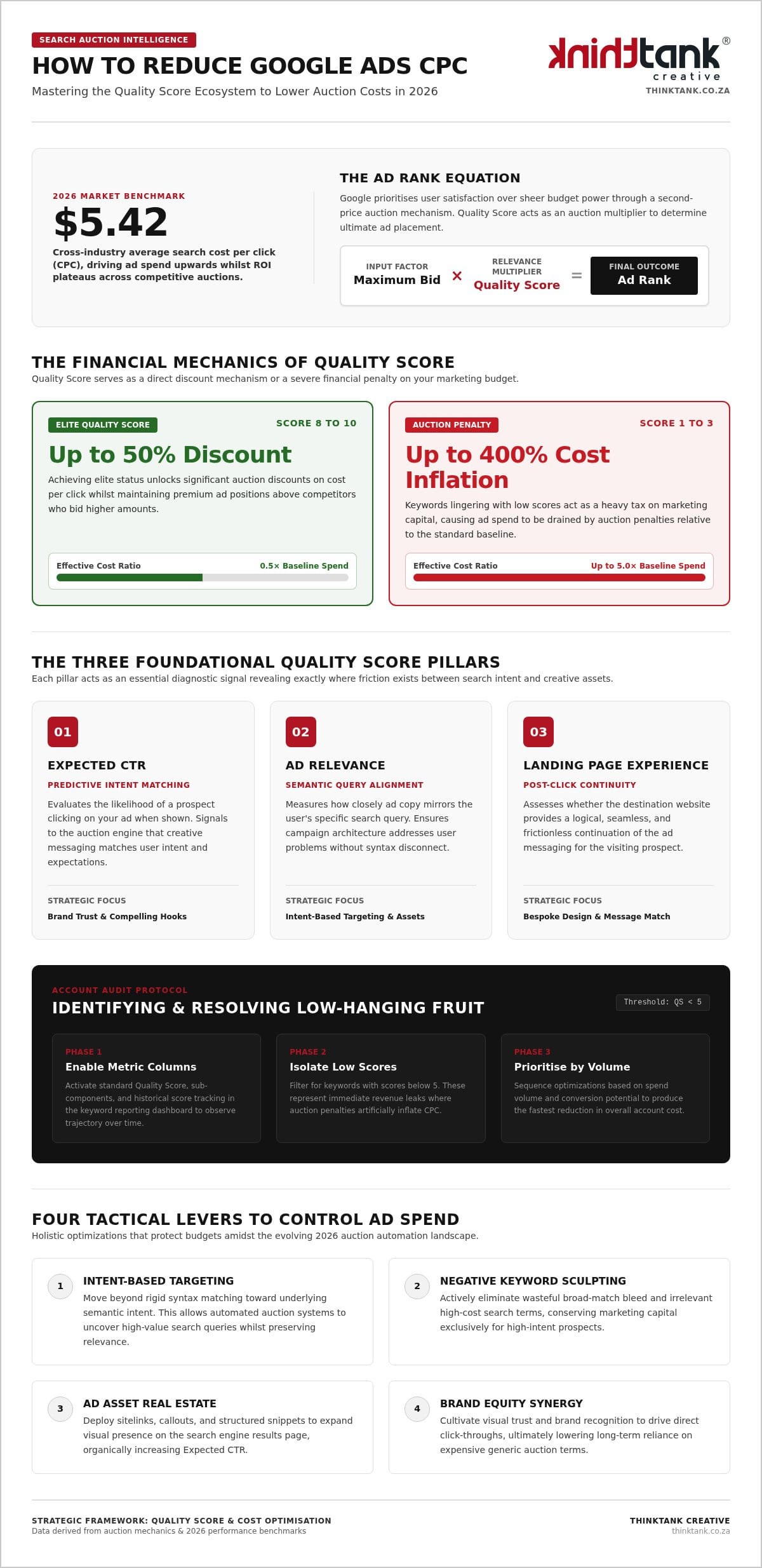
Google Ads bidding strategies for choosing bids that fit your goals

The bid that wins the most clicks may still be wrong for your goal. Understanding Google Ads bidding strategies starts with matching the approach to your campaign objective: Maximise Clicks can pursue website traffic, while Smart Bidding can optimise for conversions or conversion value.

Automated bidding is not always the best choice, and manual bids do not offer more control in every situation. Understanding Google Ads bidding strategies means weighing your campaign objective against the quality of your conversion tracking.

This guide builds on that understanding of Google Ads bidding strategies by explaining when Manual CPC or automated approaches may suit your campaign. You’ll also learn how conversion tracking informs the choice and why automated bidding can manage clicks and impressions differently from Smart Bidding, helping you make a considered decision for your South African campaigns.

Key Takeaways

  • Use Manual CPC when you need direct control over maximum keyword or placement bids, particularly while conversion data is limited.
  • Before choosing conversion-focused Smart Bidding, ensure tracking is accurate and the actions you want to optimise for are set as Primary.
  • Match the strategy to the campaign goal: sales, leads and brand awareness call for different bidding priorities.
  • Target Impression Share can help prioritise visibility in Search results, while Maximise Clicks aims to attract website traffic.
  • Automated bidding for clicks or impressions is not the same as Smart Bidding, which uses auction-time signals to optimise for conversions or conversion value.

Conversion tracking and Smart Bidding best practices

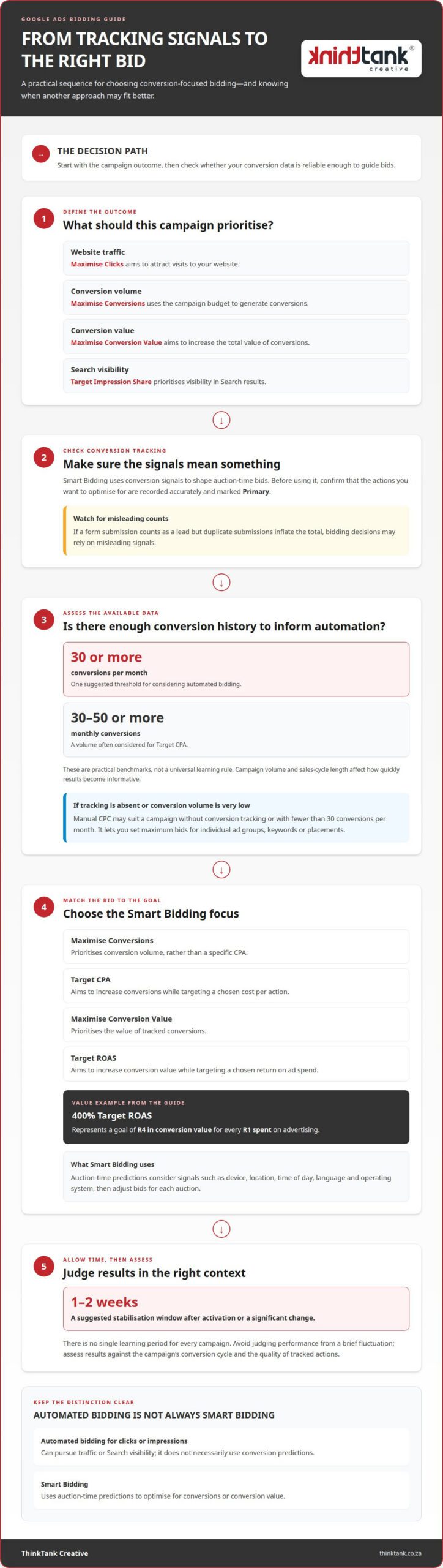
Conversion tracking gives Google Ads signals about valuable outcomes. Smart Bidding uses those signals to shape auction-time bids, so the strategy works best when each recorded action reflects a meaningful business result.

Maximising conversions and conversion value

Maximise Conversions aims to use the campaign budget to generate conversions. Maximise Conversion Value aims to increase their total value. This distinction matters when a lead and a completed sale have different business value.

For sales campaigns, Google Ads lists Maximise Conversions and Maximise Conversion Value as bidding options. Choose the first when the priority is conversion volume; consider the second when tracked purchases carry different values. For example, a 400% Target ROAS represents a goal of R4 in conversion value for every R1 spent on advertising.

Smart Bidding for conversion goals

Smart Bidding is Google Ads’ automated bidding approach for optimising towards conversions or conversion value, using auction-time predictions. It considers signals such as device, location, time of day, language and operating system, then adjusts bids for each auction.

Target CPA aims to increase conversions while targeting a specific cost per action. Target ROAS aims to increase conversion value while targeting a chosen return on ad spend. Both depend on accurate tracking, and targets should start close to current campaign performance.

Set up tracking before using conversion-focused bidding. Confirm that the intended actions are recorded accurately and marked Primary, so Google Ads optimises towards the outcomes that matter. For example, if a form submission counts as a lead but duplicate submissions inflate the total, bidding decisions may rely on misleading signals.

Volume also affects whether a strategy has useful data. One suggested threshold for considering automated bidding is 30 or more conversions per month; Target CPA is often considered with 30-50 or more monthly conversions. These are practical benchmarks, not a universal learning rule: campaign volume and sales-cycle length affect how quickly results become informative.

Allow Smart Bidding time to stabilise after activation or a significant change. A suggested window is 1-2 weeks, although there is no single learning period for every campaign. Avoid judging performance from a brief fluctuation; assess results against the campaign’s conversion cycle and the quality of tracked actions.

Keep the objective clear. Maximise Clicks seeks website traffic, Maximise Conversions uses the budget to optimise for conversions rather than a specific CPA, and Maximise Conversion Value prioritises tracked value. Target Impression Share focuses on Search visibility. Let tracking and campaign goals guide your choice, not the strategy label alone.

Manual CPC bidding

Manual CPC lets you set a maximum cost-per-click bid for individual ad groups, keywords or placements. Automated bidding adjusts bids to pursue the campaign objective. That is the central difference: you set the bid directly with manual bidding, while the system manages it with automated bidding.

With manual bidding, the European Union says, you set the maximum amount you are willing to pay per click, though you may pay less depending on the auction. The actual cost may be lower, depending on the auction. This gives you direct control over bid ceilings. For example, you can set different maximums for keywords with distinct commercial value instead of applying one bid across every ad group.

Manual CPC can suit campaigns without conversion tracking or with very low conversion volume, defined as fewer than 30 conversions per month. In these cases, there may be too little conversion data to guide conversion-focused automation. A manual approach lets you decide which keywords deserve higher bids, then assess their clicks and results before adjusting those limits.

Control also brings responsibility. A maximum CPC bid is a ceiling, not a promise that every click will cost that amount. Review bids alongside the daily budget and the quality of traffic each keyword attracts. If a keyword receives clicks but does not support the campaign objective, reduce its bid or exclude it from the campaign.

Enhanced CPC is an optional feature used with Manual CPC. You set baseline bids, and Google Ads can adjust them in an attempt to maximise conversions. This introduces automation without handing over every initial bid decision. However, these conversion-focused adjustments still rely on useful signals, so recorded actions should reflect genuine outcomes.

Smart Bidding differs from both standard manual bidding and automated bidding for other goals. It uses auction-time conversion predictions, while other automated strategies do not necessarily use those predictions. Target Impression Share is another automated option: it aims for a position on Google Search results, prioritising visibility rather than a manually chosen maximum CPC for each keyword.

For brand awareness, visibility may matter more than conversion volume, making impression-share bidding a relevant alternative. For tighter bid control, Manual CPC keeps individual keyword ceilings in your hands. If a campaign’s goal or tracking setup changes, reviewing PPC campaign strategy can help align its bidding approach with the new objective.

What Are Google Ads Bidding Strategies, Really?

A bidding strategy determines how Google Ads sets bids in each auction. Choose one by matching the desired campaign outcome with available conversion data and ad format.

Matching strategies to campaign goals

Campaign goals determine whether bids should prioritise traffic, leads, sales or visibility. A strategy optimised for clicks may not deliver the conversion value a sales campaign needs.

For lead generation, Maximise Conversions can prioritise recorded enquiries, while Target CPA adds a specific cost-per-action goal. For ecommerce, Maximise Conversion Value or Target ROAS suits campaigns focused on sales value. Brand-awareness campaigns can prioritise visibility with Target Impression Share or CPM-based bidding. Choose the outcome first, then select a strategy that aligns with it.

Choosing strategies across campaign types

Campaign type shapes which bidding options are relevant, but the advertising goal remains central. For Search, Maximise Clicks can pursue website traffic, while Target Impression Share focuses on visibility in search results.

For Display and Video campaigns, CPM-based bidding can prioritise impressions or reach. Shopping campaigns focused on sales can use conversion-focused options such as Maximise Conversion Value or Target ROAS. These are not rigid format rules: the right choice depends on whether your campaign needs traffic, conversions, conversion value or awareness.

Comparing click and conversion strategies

Maximise Clicks seeks as many clicks as possible within the campaign budget, making it relevant when website traffic is the goal. Maximise Conversions uses the budget to optimise for conversions rather than targeting a specific CPA.

Target CPA aims to increase conversions around a chosen cost per action, while Target ROAS aims to increase conversion value against a return-on-ad-spend target. Choose between them by considering whether your priority is click volume, conversion volume, cost control or revenue value, and whether tracking provides useful conversion data.

Machine learning and auction-time signals

Smart Bidding uses machine learning to predict the likelihood or value of a conversion in each auction. It can consider signals including device, location, time of day, language and operating system.

These signals help Google Ads adjust bids for each auction instead of relying only on a fixed maximum. The distinction matters: Smart Bidding optimises for conversions or conversion value, while automated bidding can also pursue clicks or impressions.

Common mistakes include changing strategies before tracking is reliable or making repeated significant changes during learning. Allow 1-2 weeks for Smart Bidding to stabilise after activation or a significant change; campaign learning periods can differ, especially with longer sales cycles.

For South African advertisers, the strategy choice follows the campaign goal, while actual costs reflect the auctions entered and the bids made. Set and assess campaign budgets in South African Rand (R), then judge performance against the intended outcome, such as leads, sales value or Search visibility.
Google Ads bidding strategies for choosing bids that fit your goals

Target Impression Share bidding

Target Impression Share is an automated Search bidding strategy that aims to place an ad at the absolute top, top or elsewhere on Google search results pages. It suits campaigns where visibility for selected searches matters more than maximising clicks or conversions.

Set a desired impression share to define how often you want your ad to appear for eligible searches. For example, an 80% target for a search term expresses a visibility goal, not a promise that every search will show the ad. The strategy adjusts bids towards that goal, so the target should reflect the value of appearing for those searches.

Brand keywords can make impression share especially relevant. A 95% target is suggested for brand terms where frequent visibility is important; a separate example aims to show an ad 100% of the time for searches related to a brand. These targets prioritise presence, so review them alongside campaign performance and the importance of protecting brand visibility.

Choose the placement setting carefully. Absolute top prioritises the first ad position, top aims for an upper position, and anywhere focuses on appearing somewhere in Search results. Each setting defines visibility differently. A brand defending its name may favour a prominent position, while a campaign seeking broader exposure may choose a less restrictive placement.

Target Impression Share is not interchangeable with Target CPA or Target ROAS. Target CPA aims to increase conversions while targeting a cost per action; Target ROAS aims to increase conversion value against a return-on-ad-spend target. A visibility-focused campaign can use impression share, while a lead-generation campaign may prioritise conversions and an ecommerce campaign may focus on sales value.

For Target ROAS, the percentage expresses conversion value relative to ad spend. A 500% target represents an aim of R5 in conversion value for every R1 spent on advertising. That makes it a value-based goal, not a visibility target. Target CPA, by contrast, centres on the desired cost for each action rather than the total value of sales.

Display campaigns use different visibility measures from Search. CPM-based bidding can suit awareness campaigns that value impressions, while Target Impression Share is intended to increase Search visibility. Keep campaign type and objective aligned: choose Search impression share for the desired Search presence, and use conversion-based targets when leads or revenue matter more than exposure.

Before setting a target, identify the searches and placements that matter, then choose a visibility level that supports the campaign’s purpose. Track impression share alongside clicks and conversions, so you can assess a stronger presence in context rather than treating it as the outcome by itself.

Automated bidding for clicks and impressions

Automated bidding sets bids for individual auctions instead of relying on one fixed amount for every opportunity. The European Commission describes algorithms that consider multiple signals to set a bid dynamically for each impression. For campaigns focused on traffic or visibility, this differs from Smart Bidding, which optimises specifically for conversions or conversion value.

Maximise Clicks automatically manages bids to seek as many clicks as possible within the campaign budget. It can suit a traffic campaign or one without enough conversion data for Target CPA or Target ROAS. Set a maximum CPC limit to define the most you’re willing to pay per click. Without a suitable limit, a high-cost auction could use more of your budget than expected.

Maximise Clicks pursues click volume, not lead quality or sales. For example, if broad keywords attract visits but few relevant enquiries, more clicks may not advance your business goal. Review search terms and add negative keywords to reduce irrelevant traffic. Automated bidding changes bid decisions, but keyword relevance still matters.

Impression-based strategies serve a different purpose. Google Ads CPM bidding charges for every 1,000 times an ad is shown, making it relevant when exposure matters more than clicks. Target CPM optimises bids to maximise unique reach for video or Display campaigns, while aiming to keep average CPM at or below the target.

For viewable Display impressions, vCPM lets advertisers set the highest amount they’re willing to pay for every 1,000 viewable impressions. This differs from Target Impression Share, which aims for a chosen presence on Search results pages. Match the setting to the placement and intended outcome: reach across Display or Video, or visibility for Search terms.

Target CPC automatically adjusts bids to try to achieve your target average cost per click. It can help guide click costs, while the right bidding approach depends on your campaign goals. The key distinction across these automated options is what the system is instructed to pursue: clicks, average CPC, impression volume or unique reach.

Keep the daily budget and campaign goal aligned, then assess whether the chosen volume is useful. If conversions are the real objective, conversion tracking and Smart Bidding may be more appropriate than a clicks strategy. If awareness is the priority, impression-based bidding may fit better. Plan a PPC campaign around your bidding goal to connect the strategy with the outcome you want.

ThinkTank Creative

ThinkTank Creative can help connect Google Ads decisions with the wider digital experience your audience encounters. A bidding strategy works alongside clear campaign goals, relevant creative and a website experience that supports the next step, whether that is an enquiry or a sale.

For businesses refining their digital presence, ThinkTank Creative offers Website Design and Development, Social Media Marketing, creative design, and Logo and Corporate Identity Design. These capabilities can support a more coherent experience across campaign messaging and customer touchpoints, without treating the bid as the only factor in performance.

To discuss how your digital strategy can support your advertising goals, contact ThinkTank Creative.

Build your next campaign around a clear objective

Let the business outcome guide your next bidding decision, rather than choosing a setting simply because it is automated or familiar. Understanding Google Ads bidding strategies helps you connect campaign intent with the experience people encounter after clicking, from the ad message to the next step on your website.

Bidding is one part of a coherent digital presence. ThinkTank Creative can bring together advertising goals, relevant creative, website design and development, and social media marketing to shape a consistent experience across customer touchpoints.

As your priorities evolve, revisit whether your campaign is designed to attract attention, generate enquiries or support sales. A considered review can help keep the strategy aligned with the direction of your business. Contact ThinkTank Creative to discuss your ads and explore a thoughtful next step for your digital marketing.

Frequently Asked Questions

Can I use automated bidding with a small budget?

Yes, but choose a strategy suited to the available data and the outcome your budget can support. If conversion tracking is unavailable or conversion volume is very low, Manual CPC can provide more direct control. For traffic, Maximise Clicks can manage bids within the campaign budget; set a maximum CPC limit to control the highest bid. Review search terms regularly, since irrelevant clicks can use a limited budget without advancing your objective.

How Does the Learning Period Affect Performance?

During learning, automated bids may adjust as Google Ads gathers signals and evaluates the strategy against your objective. Performance can fluctuate, so a short-term change in clicks or conversions may not reflect the campaign’s longer-term direction. Avoid making several significant changes close together, as each can affect the assessment. Compare results over a period that reflects your sales cycle, and assess the quality of recorded outcomes as well as their volume.

What’s the Difference?

If you mean manual versus automated bidding, the difference is who sets bids in each auction. With Manual CPC, you choose maximum bids for keywords, ad groups or placements. Automated strategies adjust bids towards a selected goal, such as clicks or impressions. Smart Bidding is the conversion-focused subset: it uses auction-time predictions to optimise for conversions or conversion value rather than simply pursuing traffic.

What are the main Google Ads bidding strategies and how do they work?

Google Ads strategies include Manual CPC, Maximise Clicks, Maximise Conversions, Target CPA, Target ROAS and Target Impression Share. They guide bids towards different outcomes: click volume, conversions, conversion value or Search visibility. CPM-based options can focus on impressions in Display or Video campaigns. Start by naming the outcome that matters most, then choose a strategy that optimises for it and matches your campaign’s tracking and data.

How do I set and adjust target CPA or target ROAS in Google Ads?

Set a target close to the campaign’s current performance, using reliable conversion tracking as your baseline. For Target CPA, use the average cost per action as a starting reference, or set the target slightly above it. For Target ROAS, base the goal on observed conversion value relative to ad spend. Avoid an abrupt, unrealistic target; assess performance after changes and adjust in measured increments as results stabilise.

How long does Google Ads Smart Bidding take to learn, and how much conversion data does it need?

There is no universal learning period because volume and sales-cycle length affect how quickly results become informative. Allow around 1-2 weeks after activation or a significant change before judging stability. As a practical benchmark, testing Smart Bidding after 15-30 conversions over 30 days can provide useful data. Target ROAS may need 15 to 50 conversions in the previous 30 days for effective performance, depending on campaign type.

How do Google Ads bidding strategies and costs differ for advertisers in South Africa?

For South African campaigns, Manual CPC lets you set maximum bids for keywords, ad groups or placements, though the actual cost per click may be lower. Automated strategies set bids to pursue goals such as clicks, conversions, conversion value or Search visibility; Smart Bidding uses auction-time signals to optimise conversions or value. A 400% Target ROAS, for example, aims for R4 in conversion value per R1 spent.
Ad copy that matches customer needs and drives action

Strong ad copy does more than describe an offer: it shows the right customer why it matters. Learning how to write compelling ad copy means connecting a real customer need to a clear benefit, using language that matches the search and offering a relevant next step. That turns a description into a reason to act.

It’s easy to focus on clever wording or try to include every product detail. But copy works harder when it answers the questions behind a customer’s decision: What will this help me do? Why is it right for me? What should I do next?

This guide sets out a practical approach, from understanding customer needs and choosing keywords to matching copy with each funnel stage and writing specific calls to action. It also explains how to use competitor messaging as context, so your adverts can express your own value clearly without relying on comparisons alone.

Key Takeaways

  • Make each call to action specific and relevant, showing readers the benefit of taking the next step.
  • Lead with the customer’s need, then support the benefit with a feature that makes your offer credible.
  • Align headlines and descriptions with the keywords and intent behind each search.
  • Adapt your message to the audience’s funnel stage, from initial awareness to a decision about what to do next.
  • Use competitor messaging to identify what matters to buyers, then make your own value clear without relying on disparaging comparisons.

1. Calls to action

A call to action turns an advert’s promise into a clear next step. Instead of ending with “Learn more”, connect the action to a useful outcome: “Compare website design options” or “Plan your next campaign”. Readers should know what happens after clicking and why that step matters to them.

Make the wording specific, relatable and easy to act on. “Get started” can feel vague because it doesn’t explain what the person will receive. “See how the service fits your business” gives more context, while “Request a tailored proposal” names a concrete next step. Match the invitation to what the page actually offers.

Choose a strong action verb, then address the reader directly where it feels natural. “Explore your options”, “Download your guide” and “Book a planning session” each tell the reader what to do. Direct language such as “Find the right approach for your team” makes the benefit feel relevant without sounding forceful.

Numbers can make an offer more tangible when they’re accurate and meaningful. For example, “Compare three service options” sets an expectation about what the click reveals. Don’t add a number just to make a button more persuasive: the landing page must deliver the stated detail or the message loses credibility.

AIDA and PAS are useful frameworks for building a message around a call to action. AIDA moves from attention and interest to desire and action; PAS presents a problem, highlights its impact, then offers a solution. Use either as a planning guide, not a rigid script, and make the final action fit the reader’s need.

Keep the instruction clear throughout the advert. In Google Ads, include at least one well-considered call to action and ensure it aligns with the headline, description and destination page. If the advert promises a guide, for instance, the click should lead to a page where readers can access it.

Adapt the wording to the platform and the audience’s readiness. A social media post introducing a new service might invite people to “Explore how it works”. A search advert for someone comparing solutions could say “View service details”. Each action should suit the intent behind the message, rather than repeat the same button everywhere.

Develop alternative versions that test different benefits, not just minor wording changes. Compare “Plan your next campaign” with “Build a clearer campaign strategy”, keeping the audience and destination consistent. Review clicks alongside conversions, since a high click rate alone doesn’t show whether people completed the intended action.

Before publishing, read the advert and its landing page as one journey. Check that the action is visible, the benefit is clear and the next step works as promised. This final review helps keep the message clear, the platform experience coherent and the conversion goal aligned with customer expectations.

2. Writing ad copy around user needs and benefits

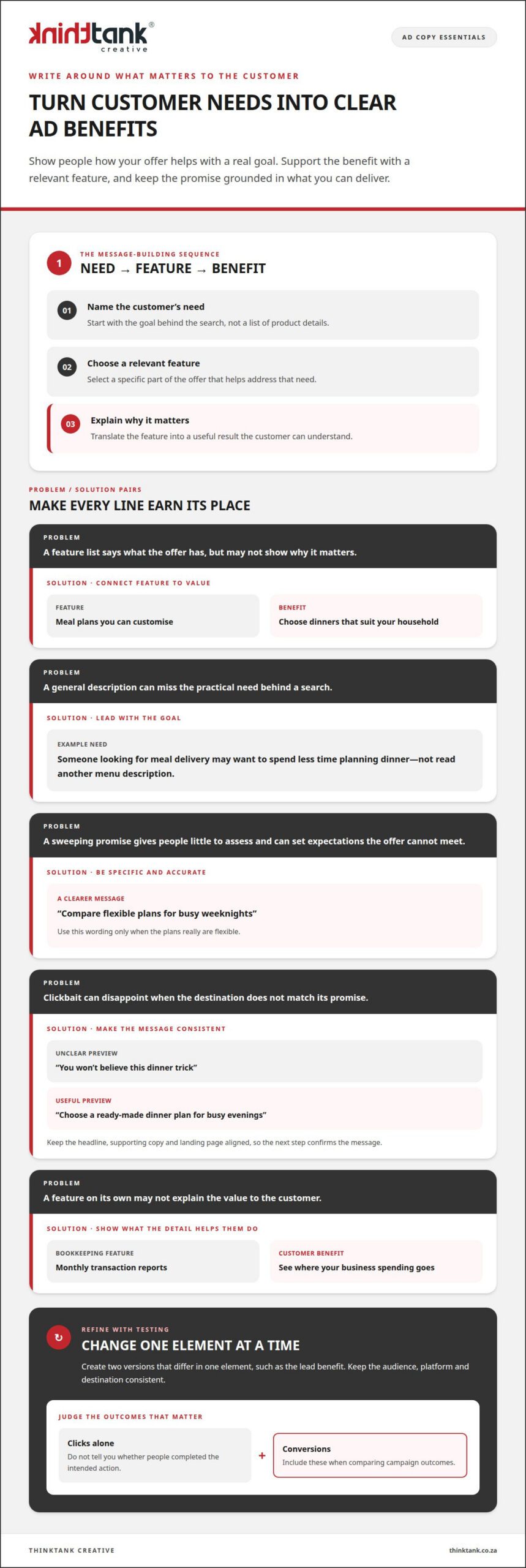
Start with the consumer’s goal, not a list of features. Someone searching Google for a meal delivery service may want to spend less time planning dinner, rather than read another menu description. Identify the practical need behind the search, then explain how the product or service helps meet it. This makes the message relevant from the outset.

Benefits-led writing connects an offer to a useful result. A feature describes what something has or does; a benefit explains why that matters. For example, “meal plans you can customise” is a feature, while “choose dinners that suit your household” translates it into value. Pairing both gives readers a reason to engage and a specific detail to consider.

Keep claims grounded in what the offer can deliver. An advert promising “the perfect solution for everyone” gives consumers little to assess and may set expectations the service cannot meet. A clearer message might say, “Compare flexible plans for busy weeknights”, provided the plans really are flexible. Accurate wording can attract people whose needs match the offer.

Clickbait may attract attention, but it disappoints when the destination fails to match its promise. “You won’t believe this dinner trick” tells readers little about the product or service. “Choose a ready-made dinner plan for busy evenings” gives a more useful preview. Keep the headline, supporting copy and landing page consistent, so the next step confirms the message.

Build each feature-benefit message with a simple sequence: name a customer need, choose a relevant feature, then explain its benefit. For example, a bookkeeping service might turn “monthly transaction reports” into “see where your business spending goes”. The feature supports the benefit; it doesn’t replace it. Use details that distinguish the offer without overloading the copy.

A/B testing can show which message resonates more. Create two versions that change one element, such as the lead benefit, while keeping the audience, platform and destination consistent. Compare the outcomes that matter to the campaign, including conversions, rather than judging a version on clicks alone. Use what you learn to refine the next test.

For a South African audience, reflect the customer’s actual context and vocabulary rather than relying on generic claims. A local service can state the problem it solves and show how its process addresses it, without promising an unsupported outcome. If paid campaigns need closer alignment between audience needs and ad messages, PPC advertising can bring that work together.

3. Matching headlines and descriptions to keywords

Build each Google Ads message around the words that signal customer intent. Keywords help determine when and where adverts can appear on Search and YouTube, so a headline should reflect the meaning of the query. Someone searching “accounting software for small business” needs a message about business accounting, not a general promise to “work smarter”.

Using relevant keywords in headlines and descriptions can help keep Google Ads copy aligned with what people are searching for. Relevance matters more than repeating the same phrase mechanically. For example, an advert targeting “Cape Town wedding photographer” might use “Wedding Photography in Cape Town” as its headline, then explain the service naturally in the description.

Start with the actual search intent, then choose the most useful keyword for the headline. Someone searching “emergency plumber Johannesburg” has a different need from someone searching “plumbing maintenance tips”. The first headline should speak to finding help; the second could offer practical guidance. Matching intent keeps the advert aligned with the reason behind the search.

Give each part of the advert a distinct role. The headline earns attention by naming the relevant service or outcome. The description adds context, such as the audience served or a key feature. The call to action points to an appropriate next step. For example: “Small Business Accounting Software”, “Track invoices and expenses in one place”, and “Explore the features”.

Make headlines specific enough to stand apart from generic alternatives. A useful approach is to combine the keyword with a clear benefit, audience or detail. “Garden Design for Compact Spaces” gives more direction than “Beautiful Gardens”. Numbers can help when they describe a real offer, such as “Choose from 3 garden styles”, but they should never imply a promise the page cannot fulfil.

Google Ads keyword insertion can place a keyword in ad copy based on a user’s search query. This can help the message reflect the search wording, but the surrounding copy still needs to read naturally. Ensure the headline makes sense when the insertion occurs and the description clarifies the actual offer. Avoid copy that becomes awkward or misleading when the query varies.

Before an advert goes live, review the headline, description and destination as one message. Check that the keyword fits the audience, the benefit is clear and the page carries the same idea forward. If an advert targets “online maths tutoring”, for example, its landing page should explain the tutoring offer rather than lead with unrelated educational content.

Use a consistent keyword strategy across related messages, while tailoring each version to its search intent. A headline can attract attention, but the description must provide relevant detail and the destination must meet the expectation. That alignment gives readers a clearer path forward and makes the advert more useful throughout their search.

Ad copy that matches customer needs and drives action

4. Matching copy to the audience funnel stage

Shape each message around what the audience is ready to decide. A reader discovering a service needs different information from someone comparing providers. For example, a first-time homebuyer exploring bond advice may need clear introductory guidance, while a reader comparing advisers may want to understand the service’s approach.

In South Africa, language and cultural differences affect which words, idioms and references feel natural to different audiences. Choose language and examples that suit the intended reader, then make sure the meaning remains clear and respectful. A phrase familiar to one community may not carry the same meaning elsewhere.

At the awareness stage, the audience may recognise a problem but not know which solution fits. Name the challenge plainly, as in “Need help planning household finances?” A gentle call to action, such as “Explore practical budgeting guidance”, invites the reader to learn without pushing for an immediate purchase.

At the consideration stage, people are weighing possible approaches. Someone comparing solar installation options, for example, may want to understand system components, installation processes or ongoing support. Address those objectives directly with specific information that helps the audience assess the offer, rather than broad claims about being the best.

At the decision stage, the audience is closer to choosing. Make the next step explicit and explain what it involves, such as “View service details” or “Request an assessment”. The destination should continue the advert’s message, so someone responding to a solar installation advert finds relevant service information rather than a general home page.

Research audience needs through search terms, customer enquiries and feedback. A Google Ads query such as “accountant for a new business” signals a different objective from “submit company tax return”. Use that distinction to shape the message: one person may need help setting up financial processes, while the other seeks support with a specific task.

Competitor research can reveal common claims and unanswered questions, but it should inform your positioning rather than dictate it. If other adverts emphasise speed, consider whether your audience also values clear communication or a defined process. Then describe your actual strengths with precise wording and evidence, rather than imitating a competitor’s promise.

Map each advert to one audience stage, one primary objective and one suitable next step. For someone researching business accounting, an informative message may be appropriate; for someone comparing providers, service details may be more useful. This structure helps Google Ads address intent and gives each reader a more coherent journey.

5. Competitive search ad copy

Compete on relevance, not volume. When someone searches “accountant for a small business”, several adverts may address the same need. A useful message gives the reader a clear reason to consider your offer, such as a defined specialism, a transparent process or a service feature that genuinely distinguishes it.

Begin with competitor and audience research. Review the search results for the terms you intend to target, then note recurring promises, language and unanswered questions. If several adverts emphasise speed, consider whether customers also need clear pricing information, regular updates or support with a particular task. Use those observations to guide your positioning, not to make claims about rivals.

Turn buyer objections into useful content. Cost, comparisons with competitors and the effort involved can all affect a decision. An advert for bookkeeping could address concerns about effort with “Organise your records with a structured bookkeeping service”, if that accurately describes the offer. A specific explanation helps readers assess its relevance without criticising another provider.

Make every comparison fair and verifiable. Avoid unsupported claims such as “the best service in South Africa” or “faster than every competitor”. Instead, state your actual features and explain their value. For example, if a service includes a dedicated onboarding process, describe what that process helps the customer do. Precision strengthens credibility and keeps advertising focused on the offer.

Search copy should respond to a direct query; display advertising often reaches people in a different browsing context. For a search such as “business email marketing service”, name the relevant service and benefit. A display message might introduce a useful outcome to an audience that hasn’t actively searched for it. Keep both formats consistent with the destination page.

Use a controlled test to learn which competitive message earns meaningful engagement. Create two versions, changing one element such as the benefit or proof point, while keeping the audience and landing page consistent. Review conversions alongside clicks. If one advert attracts attention but few enquiries, the message may not address the decision that matters.

Apply what you learn across your marketing without copying the same wording into every channel. A search advert, social media post and email can each express the same differentiator in a format suited to its audience. This coordinated approach helps keep the message consistent while allowing each platform to answer the customer’s specific question.

For a considered approach to competitive search advertising, plan your PPC advertising strategy around your audience, genuine strengths and campaign goals.

ThinkTank Creative

ThinkTank Creative helps businesses bring customer-focused messaging into a coherent digital presence. When you’re shaping ad copy, this means aligning the message with your audience, campaign and the experience customers find after clicking.

ThinkTank Creative’s Website Design and Development, Social Media Marketing and creative design services can support a consistent brand expression across customer touchpoints. Logo and Corporate Identity Design can also ensure your visual identity complements the words rather than competing with them. The right combination depends on your goals and where your audience engages with your business.

Ready to refine your messaging and create a more joined-up customer experience? Contact ThinkTank Creative to discuss your goals.

Turn strong messaging into lasting momentum

Knowing how to write compelling ad copy is a valuable starting point; the next step is to make every customer interaction feel consistent. When advertising, website content and social channels express the same distinctive value, customers can move from first impression to meaningful engagement with greater clarity. ThinkTank Creative brings together website design and development, social media marketing and creative design to help businesses create that connected experience.

Keep learning from how people respond, then use those insights to refine your message and strengthen the journey around it. Thoughtful copy isn’t a one-off exercise; it can evolve alongside your audience, goals and brand.

Contact ThinkTank Creative today to discuss how your marketing can move forward. A clearer message can be the beginning of something stronger.

Frequently Asked Questions

What Is Ad Copy?

Ad copy is the written message used to promote a product, service or idea and encourage a response. It can appear in a search result, social post, brochure or billboard. For example, a local tutoring business might use a short advert explaining which subjects it supports and inviting parents to view its teaching approach. The copy works alongside design and placement to communicate the offer.

What is ad copywriting?

Ad copywriting is the craft of planning and writing promotional messages for a defined audience and purpose. It involves choosing the central message, selecting language that suits the medium and refining the wording so it’s clear and credible. For a new café, copywriting might produce a launch advert, a social caption and a printed menu insert, each tailored to its context.

What are some examples of great Google Ads copy?

Effective examples make the service, audience and next step easy to understand. For a hypothetical bicycle repair shop: “Bicycle Repairs for Commuters” could headline an advert; “Book a service for your daily ride” could add context; and “View repair options” could guide the click. These are illustrative lines, not performance claims. A strong example also leads to a page that fulfils its promise.

What are the best practices for writing Google Ads?

Write each advert for a specific search intent, and make its destination page relevant to that intent. Check that the wording accurately describes the offer, reads naturally and gives a useful next step. For example, an advert for piano lessons should lead to information about lessons, not a general music shop page. Review results against the campaign’s objective, such as qualified enquiries.

What are the key principles of writing compelling ad copy?

Prioritise clarity, relevance, credibility and a suitable next step. A practical approach to how to write compelling ad copy is to imagine the reader’s immediate concern, then answer it plainly. For a home cleaning service, “Arrange a clean before moving day” speaks to a particular situation more directly than “Exceptional cleaning solutions”. Keep claims accurate and ensure the following page or contact point fits the message.

How do you write effective ad headlines and calls to action?

Give the headline one clear job, such as identifying the offer or naming its audience. Then use the call to action to describe a logical next move. A gardening business could pair “Garden Plans for New Homes” with “View design ideas”. Read both lines together: the headline should set an expectation, and the action should help the reader continue without suggesting a result the business cannot promise.

What makes ad copy persuasive to a specific target audience?

Persuasive copy reflects the audience’s circumstances, priorities and vocabulary. A message for parents arranging after-school care, for instance, should address scheduling and the child’s routine rather than focus only on the provider’s history. Use customer enquiries and feedback to identify the questions people actually ask. Then answer one relevant concern with concrete details the business can stand behind.

How should ad copy differ across Google, Facebook, Instagram, and print ads?

Google Ads should respond closely to the search that prompted them, while Facebook and Instagram copy can introduce an idea during social browsing and work alongside visual creative. Print advertising needs to communicate clearly within its physical layout, whether it appears on a flyer or poster. For a theatre production, search copy might highlight ticket information, social copy could introduce a performer, and a poster might foreground the show title and date.

Pay-per-click management company: how to choose the right partner

What should a pay per click management company do beyond generate clicks? A good partner connects campaign decisions to what happens after someone clicks, helping your advertising reach relevant prospects and guide them towards a clear next step.

Before investing in paid advertising, get clarity on what the agency will manage, what your team will contribute and how performance will be reported. You also need to understand how the budget will support business goals, rather than simply paying for traffic that does not become a meaningful enquiry.

This guide explains what effective PPC management can involve and how to compare agencies on planning, tracking, communication and reporting, rather than broad performance promises. It also explores how campaign creative and landing pages work together, and why paid advertising is more effective when it aligns with your website and wider marketing. With a collaborative approach, PPC can become a considered part of your business’s growth, not a channel operating in isolation.

Key Takeaways

  • Understand how PPC management brings campaign planning, advertising activity and ongoing review together, while keeping management fees and ad spend distinct.
  • Trace the path from audience targeting and ad messaging to the landing page, and assess whether the page delivers on the ad’s promise.
  • Compare a pay per click management company by the clarity of its strategy, scope, communication, reporting and website alignment, not broad success claims.
  • Prepare for a collaborative campaign process: agree objectives, share relevant business information, then review performance and refine the approach together.
  • See how ThinkTank Creative connects paid advertising with campaign planning, copywriting, reporting and website design and development.

What does a pay-per-click management company do for a business?

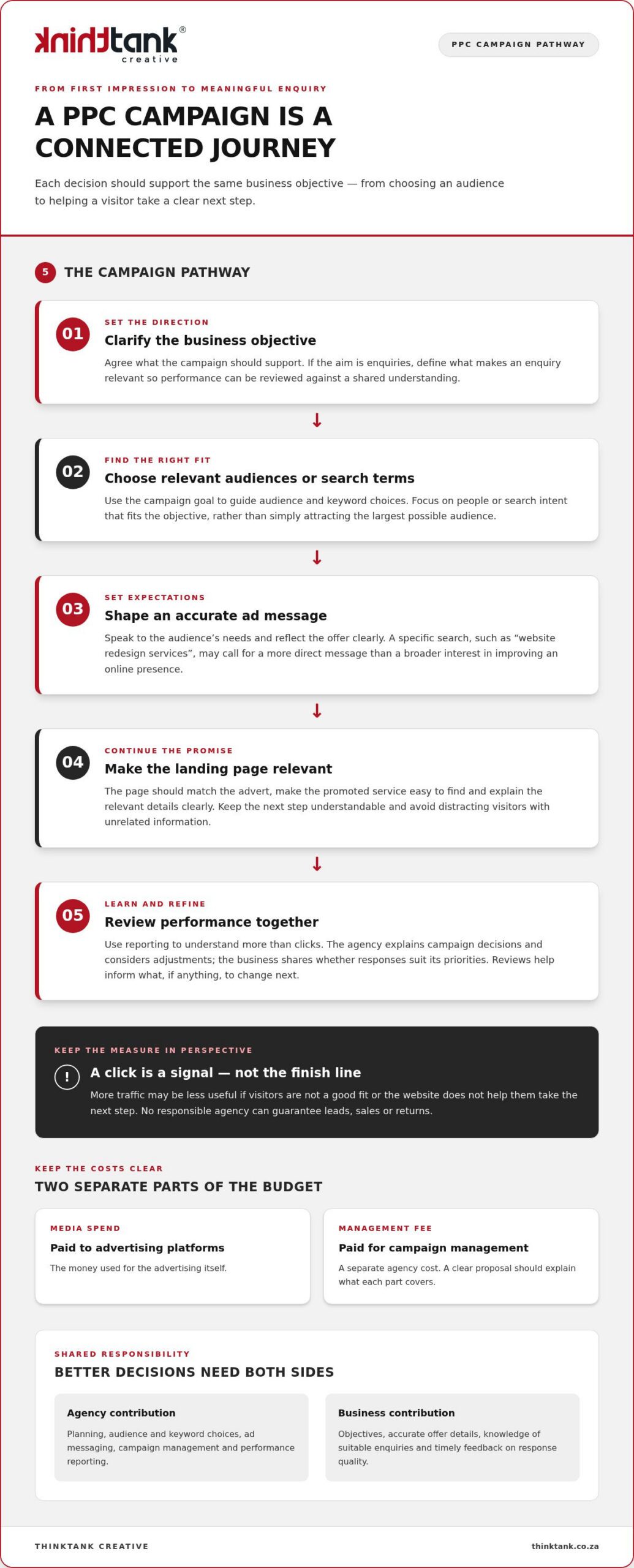
A paid campaign needs more than an advert and a budget. A pay per click management company plans, runs, reviews and improves paid advertising campaigns, connecting decisions about audiences and messages to the business objective. Pay-per-click (PPC) advertising generally charges the advertiser when someone clicks an advert, but managing a campaign involves much more than monitoring clicks.

Think of the budget in two parts: the money paid to advertising platforms for media, and the agency’s fee for campaign management. These are separate costs, so a clear proposal should explain what each covers. Results depend on several connected factors, including the objective, audience or keyword choices, creative, the website experience after the click and decisions made during performance reviews. No responsible agency can guarantee leads, sales or returns.

For a practical overview of what to consider when selecting an agency, watch this video:

Which tasks can PPC management cover?

Management commonly starts with campaign planning: clarifying the objective, selecting relevant audiences and keywords, and shaping ad messages around the offer. Once campaigns are live, the agency reviews performance and makes considered adjustments. Reporting should help both parties understand what the activity is doing and decide what, if anything, to change next.

Responsibilities are shared. The agency can manage campaign planning, copywriting, advertising activity and reporting. The business contributes its goals, accurate offer details, knowledge of customers and timely feedback. That context helps keep campaign decisions grounded in the organisation’s priorities.

What should a business expect from a PPC agency?

Expect an agreed objective, an understandable process, clear communication and reporting that explains more than the number of clicks. For instance, a business seeking enquiries should agree what makes an enquiry relevant, then use that shared definition when reviewing campaign activity. The agency can explain its decisions, while the business shares whether the responses match its priorities.

Clicks are one signal, not the whole purpose. A rise in traffic may be less useful if visitors are not a good fit or the website does not help them take the next step. Ask for a clear account of what is being managed, what information your team needs to provide and how reviews will inform future decisions. A sound partnership sets direction and learns from campaign data without presenting uncertain outcomes as guaranteed.

How a PPC campaign connects targeting, ads and the landing page

A paid campaign works as a connected journey: a person searches or is selected as part of an audience, sees an advert that speaks to their needs, then arrives on a page that helps them decide what to do next. Each step should support the same objective. If the targeting attracts the wrong audience, the message overstates the offer or the page feels unrelated, the journey loses coherence.

That connection matters more than click volume alone. A well-aligned campaign gives visitors a consistent experience from the first impression to the next action. A pay per click management company should consider the advert and destination page together, rather than treating the click as the finish line.

How do targeting and ad messaging work together?

Start with the campaign goal. It shapes which audiences or search terms are relevant and what the advert should say. Someone searching for a specific service may be ready to compare options; someone encountering an advert while browsing may need a clearer introduction. The message should reflect that difference without promising more than the business can deliver.

For example, a business offering website design might distinguish between a search for “website redesign services” and a broader interest in improving an online presence. The first advert could speak directly to redesign needs, whilst the second may introduce the business’s website services more generally. In both cases, relevance matters more than attracting the largest possible audience.

Why does the landing page matter after an ad click?

The landing page is where the visitor checks whether the advert’s promise matches the business’s offer. If an ad promotes a particular service, the page should make that service easy to find, explain the relevant details clearly and avoid distracting visitors with unrelated information. A useful page also makes the next action understandable, whether that means making an enquiry or exploring the offer further.

Clarity and usability influence how easily a visitor can move forward. Consider whether the page works logically, presents information in a helpful order and makes its main action easy to recognise. If the advert promises information about one service but leads to a broad homepage, visitors may have to search again to find what they expected.

ThinkTank Creative’s website design and development work includes UX/UI, which can help align the post-click experience with campaign messaging. A considered layout, clear content and purposeful next step give the advert somewhere relevant to lead. Explore this website user experience guide for further ways to assess how visitors interact with a page.

Message-to-page relevance makes a paid campaign feel like one coherent conversation, guiding the right visitor from interest towards an informed next step. ThinkTank Creative offers paid advertising alongside website design and development, bringing campaign and website considerations into the same conversation. Find out more at ThinkTank Creative.

How to compare pay-per-click management companies

Look beyond polished promises. Comparing a pay per click management company means understanding how its approach will work for your business: what it plans to manage, how it will communicate and how campaign activity will be assessed. A clear process is more useful than a broad claim of success because it shows how decisions connect to your objectives.

Use the same criteria to assess each agency. This makes differences in scope and working style easier to see, even when proposals use different language.

Area What to look for
Strategy Does planning begin with your business goals and intended audience?
Scope Are campaign planning, copywriting, management and reporting clearly described?
Communication Are responsibilities, contact points and review discussions explained?
Reporting Will reports explain the metrics, findings and proposed next steps?
Website alignment Does the approach consider the page visitors reach after clicking an ad?

Use the table as a prompt for discussion, not a scorecard that reduces every agency to a number. A suitable partner should be able to explain its process in language you understand and show how the work relates to your priorities.

Which questions reveal an agency’s working approach?

Ask how the agency connects campaign goals with planning, ad copy and reporting. Clarify what information it needs from your team, how campaign updates will be communicated and when you will review progress together. You could also ask how it decides whether to adjust a campaign and what evidence would support that change. The answers should describe a shared working relationship, not just a list of platform tasks.

How should you assess reporting and performance claims?

Separate activity metrics from business-relevant outcomes. Clicks show that people interacted with an advert; they do not, by themselves, establish whether those visitors were suitable prospects or took a valuable next step. Ask what each reported metric means, how it is measured and how it relates to the agreed objective.

Put examples and performance figures in context before using them to compare proposals. Consider the campaign goal, the period measured, the audience and the method used to define an outcome. A result from one campaign may not predict what another will achieve. Clear reporting should make strengths, limitations and possible next actions understandable, without implying that paid advertising can guarantee a particular result.

Campaign evaluation also benefits from a clear view of how enquiries fit into wider marketing activity. ThinkTank Creative’s lead generation strategies guide explores how businesses can think about attracting and developing potential customers. For a collaborative approach that connects PPC planning, copywriting and reporting with wider marketing work, explore ThinkTank Creative’s marketing services.

Pay-per-click management company: how to choose the right partner

What should happen during PPC planning, management and review?

A well-managed campaign follows a deliberate cycle, from agreeing what the business needs to learn or achieve through to reviewing activity and deciding what to refine. The agency brings campaign planning, copywriting and reporting; the business brings its knowledge of the offer, customers and commercial priorities. Each side contributes to decisions, keeping the work grounded in the business rather than turning it into a set of disconnected platform tasks.

What should be agreed before a campaign launches?

Before launch, clarify the objective, intended audience, offer and action you want visitors to take. For example, if the priority is service enquiries, discuss what makes an enquiry relevant and what information a potential customer needs before getting in touch. This gives the agency a useful foundation for planning and helps the business assess whether campaign activity is aligned with its aims.

Set expectations for the campaign’s scope, how information and feedback will be shared, and how progress will be reviewed. Accurate details about services and the intended audience help shape clear messaging. Timely feedback from the business can also inform campaign decisions, particularly when responses reveal that prospects are asking different questions or interpreting an offer in an unexpected way.

A practical sequence can keep planning focused:

  1. Define the objective: Agree what the campaign is intended to support and how the business will recognise a relevant response.
  2. Plan the campaign: Shape targeting and campaign structure around that objective and the information available.
  3. Prepare the messaging: Develop ad copy that represents the offer accurately and gives visitors a clear expectation.
  4. Launch and review: Observe campaign activity, share relevant business feedback and consider possible refinements.

How can reporting guide campaign improvements?

Reporting is most useful when it brings campaign observations back to the agreed objective. Rather than treating a metric as a verdict on the whole campaign, the agency and business can discuss what it indicates, what it does not show and what decision might follow. Reports should make the measures understandable and give the team a basis for considering changes, not imply that a particular performance level is guaranteed.

For instance, if an advert attracts attention but the responses are not well matched to the offer, the team might revisit the wording or audience choices. If visitors arrive but seem unsure how to proceed, the landing page’s message or next action may need attention. These are questions to investigate together, not automatic conclusions: campaign data gains meaning when considered alongside the business’s experience of the enquiries it receives.

Joined-up planning also helps keep paid campaigns connected to wider marketing activity. ThinkTank Creative’s digital marketing for service businesses guide can inform that broader perspective. To discuss how campaign planning, copywriting and reporting can support your priorities, explore ThinkTank Creative’s digital marketing services.

How ThinkTank Creative brings PPC into a broader marketing partnership

Paid advertising is more connected when campaign decisions sit alongside the website and wider marketing work. ThinkTank Creative is a South African agency offering digital paid advertising, campaign planning, copywriting and reporting, as well as website design and development. This breadth creates room to consider both the advert and the experience visitors encounter after clicking it.

Founded in 2001, ThinkTank Creative takes a collaborative approach to marketing projects. The aim is to understand the business’s needs, shape a plan around them and keep communication open as the work progresses. That partnership helps campaign choices reflect the business’s offer and priorities, without treating clicks or other activity as guaranteed commercial outcomes.

How can paid advertising and website work support one another?

Ad messaging sets an expectation. The page visitors land on should continue that message with relevant information and a clear next step. If the advert introduces a particular service, for example, the page should make it easy to understand that service rather than requiring visitors to search across the site. This continuity helps the campaign feel considered from first impression to next action.

ThinkTank Creative’s website design and development work includes UX/UI, coding, testing and launch. These capabilities support a thoughtful review of how the website presents information and guides visitors, alongside the campaign’s messaging. Website or advertising changes are not a promise of a particular result; they are opportunities to align the journey more closely with the business’s goals and customer needs.

When paid advertising and website work are considered together, teams can discuss whether the page reflects the offer, whether its content is clear and whether visitors can identify what to do next. The business contributes its knowledge of customers and enquiries, while campaign and website decisions can be shaped around that practical context.

What does working with ThinkTank Creative look like?

Start with a discussion about your business needs and timeline. That conversation helps establish the project’s direction and the work required, with an estimated cost provided after those details have been discussed. Planning is tailored to the needs of the project.

Collaboration matters throughout the work. ThinkTank Creative brings campaign planning, copywriting and reporting; the business shares relevant offer information, priorities and feedback. Reporting then supports discussion about campaign activity and possible next steps. ThinkTank Creative also provides ongoing service after project completion, helping maintain a continuing relationship as business needs evolve.

If you are considering a pay per click management company, look for a partner that can connect campaign activity with the experience your website provides. ThinkTank Creative brings paid advertising and broader marketing capabilities into the same conversation, guided by your objectives and project requirements. We Do It All So You Don’t Have To, with a collaborative process shaped around your business.

Shape your next campaign with a clear direction

Choosing a pay per click management company is an opportunity to create a more intentional connection between your marketing goals and the way people discover your business. Start by bringing your priorities into focus: consider what you want paid advertising to support, what your audience needs to understand and how your wider marketing can reinforce that experience.

A thoughtful partnership starts with a conversation, then develops through shared planning and clear decisions. With an agreed direction, campaign activity can be assessed in context and adjusted as your business learns more about what resonates with the people you want to reach.

ThinkTank Creative takes a collaborative approach, shaping digital marketing around each business’s needs and timeline. An estimated cost is provided after discussing the project, so the conversation can begin with your objectives and the work involved.

Discuss your digital marketing needs with ThinkTank Creative and take the next step towards a considered campaign partnership. Your business has room to grow, and a clear plan can help you move forward with confidence.

Frequently Asked Questions

What does a pay-per-click management company do?

A pay per click management company coordinates paid campaign work and helps the business make informed decisions about its advertising. Before starting, agree practical details such as who approves ad copy, who provides account access and what counts as a relevant enquiry. For example, a request that matches your offer and intended audience may be more valuable than a general question. Clear responsibilities help prevent delays and misunderstandings.

Is hiring a PPC management company worth it for a small business?

It can be worthwhile if specialist campaign work would otherwise take time away from serving customers or managing the business. Consider whether you can consistently plan, monitor and review campaigns internally, and compare that commitment with the agency’s proposed scope. A small business should also assess whether its offer and website are ready to support advertising. The decision should reflect available resources and priorities, not simply business size.

How much does a PPC management company cost in South Africa?

There is no one standard cost for PPC management in South Africa, because the work depends on the project’s needs and timeline. Keep the agency’s management fee separate from the budget paid to advertising platforms, then look at what the proposed scope includes. ThinkTank Creative provides an estimated cost after discussing project needs and timeline. Reviewing the scope alongside your objectives helps you understand what the estimate covers.

Can a PPC agency guarantee leads or sales?

No responsible PPC agency can guarantee a set number of leads or sales. Even a carefully planned campaign is influenced by factors outside the agency’s direct control, such as whether people are actively seeking the offer and how compelling they find it. Instead, agree what the campaign is intended to support and how you will assess progress. Treat projections as planning tools, not certain outcomes, and discuss changes as evidence develops.

What happens if my website is not ready for PPC advertising?

If your website is not ready, identify what needs attention before directing paid visitors to it. Check that the page explains the advertised offer, works well for its intended audience and provides a clear next step. A service page with missing details, for instance, may leave prospects unsure whether the offer suits them. Website improvements can be considered alongside campaign preparation, with priorities and timing shaped around the business’s requirements.

How long does it take to see results from PPC management?

There is no fixed timeframe for meaningful results, as campaign readiness, audience response and the amount of useful data available all differ. Agree in advance when the team will review activity and what evidence will inform decisions. Early engagement can show whether people notice an advert, but it may not reveal whether the campaign is contributing to business priorities. Use reviews to build a considered picture before judging its value.

Should I choose PPC or search engine optimisation?

The right choice depends on your objectives and how you want to build visibility. PPC uses paid advertising to reach an intended audience, while SEO works towards visibility in organic search results. For example, a business may use PPC to promote a specific offer while developing useful website content for longer-term search visibility. Consider how each channel supports your wider marketing plan, rather than assuming they are mutually exclusive.

How to Reduce Google Ads Cost Per Click: The 2026 Strategic Framework

With the cross-industry average search cost per click reaching $5.42 in 2026, many South African advertisers feel they're being priced out of their own growth. It's a frustrating reality. When rising auction prices swallow your profit margins, you're left wondering how to reduce google ads cost per click without sacrificing lead quality. You likely feel the pressure of complex Quality Score metrics and the nagging suspicion that you're overpaying for traffic that doesn't resonate with your brand.

We agree that seeing your ad spend climb whilst your ROI plateaus is a challenge that requires more than just technical bidding tweaks. This guide promises to show you how to secure a sustainable reduction in your CPC by focusing on the synergy between your creative assets and the user experience. We'll explore a strategic framework that moves beyond simple bid adjustments. By the end, you'll understand how refined Quality Score components and precise landing page alignment can unlock higher ad positions for less money.

Key Takeaways

  • Master the three foundational pillars of Quality Score to unlock significant auction discounts and improve your overall ad rank.
  • Discover how to reduce google ads cost per click by refining your keyword strategy to focus on high-intent traffic whilst eliminating wasteful spend through negative lists.
  • Optimise the post-click experience through bespoke website design that ensures your landing pages are a logical and relevant extension of your ad messaging.
  • Utilise advanced bidding strategies and audience targeting to maintain control over your budget amidst the evolving 2026 automation landscape.
  • Cultivate brand equity and visual trust to increase your click-through rates, ultimately lowering your reliance on high-cost generic keywords.

Understanding the Quality Score Ecosystem and Its Impact on Costs

Quality Score isn't just a metric; it's the fundamental lever that determines your financial efficiency in every auction. Think of it as a sophisticated discount mechanism that rewards precision and intent-matching. When you seek to understand how to reduce google ads cost per click, you quickly realise that Google prioritises user satisfaction over the highest bidder. The Google Quality Score mechanism evaluates three core pillars: Expected Click-Through Rate (CTR), Ad Relevance, and Landing Page Experience. Each pillar acts as a diagnostic signal, telling you exactly where the friction exists between your ad and the user's search intent.

These elements combine with your maximum bid to determine your Ad Rank. The formula is elegant in its simplicity: Ad Rank equals your Bid multiplied by your Quality Score. By focusing on quality rather than simply inflating your budget, you can outrank competitors who might be bidding significantly more. Achieving an elite Quality Score of 8 to 10 can lead to a 50% discount on your cost per click whilst maintaining a premium ad position.

To better understand how these mechanics work in practice, watch this helpful video:

The Financial Mechanics of Quality Score

Google rewards relevance because it ensures users find exactly what they're looking for, which maintains the long-term health of the search ecosystem. This alignment creates a direct correlation between higher scores and a lower cost-per-acquisition (CPA). Essentially, you're being rewarded for making the customer look smart and find answers quickly. Conversely, a low score acts as a heavy tax on your marketing budget. If your keywords linger between a score of 1 and 3, you're facing an auction penalty that can inflate your costs by up to 400% relative to the baseline. This financial drain often goes unnoticed until a thorough audit reveals the extent of the overpayment.

Diagnostic Steps for Your Current Account

Auditing your account in the 2026 interface requires a methodical and purposeful approach. Navigate to your keyword report and ensure you've enabled the columns for Quality Score and its three sub-components. You should also look at historical Quality Score data to identify trends over time. Identify your "low-hanging fruit" keywords that currently sit with scores below 5. Prioritise these improvements based on spend volume and conversion potential. Fixing a high-volume keyword with a low score will yield the most immediate results in your effort to learn how to reduce google ads cost per click, ensuring your budget is invested in growth rather than wasted on auction penalties.

Refining Keyword Strategy and Ad Relevance for Maximum Precision

Precision is the hallmark of a high-performing campaign. Whilst earlier eras of digital marketing relied on rigid match types, the 2026 landscape demands a shift toward intent-based targeting. This approach recognises that the semantic meaning behind a query is more valuable than the specific syntax used. By moving away from overly restrictive structures, you allow Google's AI to find high-value users that traditional exact-match lists might overlook. This evolution requires a sophisticated understanding of Generalized Second Price auction dynamics, where ad relevance serves as the primary filter for cost efficiency.

Ad relevance is not just about matching words; it's about matching expectations. When your ad copy mirrors the searcher's specific intent, your Expected CTR rises naturally. This improvement signals to the auction engine that your content is valuable, which is a core component of how to reduce google ads cost per click. You must also maintain rigorous negative keyword lists to eliminate irrelevant, high-cost traffic. Active sculpting ensures your budget is reserved for prospects with genuine conversion potential rather than being drained by broad-match bleed.

Utilising ad assets is another critical lever for success. These elements expand your visual real estate on the results page, providing additional touchpoints like sitelinks, callouts, and structured snippets. They don't just make your ad look larger; they provide immediate utility to the user, which consistently drives higher engagement rates and lowers your blended auction costs.

Strategic Keyword Selection and Grouping

Focusing on long-tail keywords remains a powerful strategy for brands seeking to elevate their performance. These specific, multi-word phrases often carry lower competition and significantly higher intent than generic terms. You should organise your account into tightly themed ad groups to ensure that every ad shown is a perfect reflection of the keyword that triggered it. Integrating a well-researched content marketing plan helps you identify these high-value search terms by understanding the questions your audience is actually asking.

Crafting High-Performance Ad Copy

Strong ad copy commands attention through action-oriented imperatives. Use verbs that invite the user into a partnership, reflecting a tone of quiet assurance and expertise. Incorporate your primary keyword naturally into headlines and descriptions to reinforce relevance. We recommend a constant cycle of A/B testing for your creative elements to refine your messaging. If you find the technical nuances of campaign structure overwhelming, our team is ready to collaborate on your Pay-Per-Click advertising to ensure every rand is spent with purpose.

Optimising Landing Page Experience to Minimise CPC

Elevate your digital performance by refining the destination that follows every click. Whilst many advertisers focus exclusively on bid adjustments, the post-click experience remains a critical pillar that accounts for a significant portion of your Quality Score. Investing in custom website design ensures your site isn't merely a digital brochure but a high-performance asset designed to satisfy user intent. This alignment is essential for anyone investigating how to reduce google ads cost per click, as it directly influences the auction engine's perception of value and relevance.

A landing page must serve as a logical, seamless extension of your ad creative. When a user clicks your ad, they expect an immediate answer to their specific query. If they encounter a generic homepage or irrelevant content, they'll bounce, driving up your costs and damaging your account health. High-quality destinations provide clear, accessible information that satisfies the searcher's needs whilst reinforcing your brand's authority and professional promise.

Technical Excellence and User Flow

Technical friction in the 2026 auction environment translates directly into financial penalties. Google's current standards for Core Web Vitals are stringent; failing to achieve an Interaction to Next Paint (INP) of 200 milliseconds or less can lead to higher CPCs. For the South African market, mobile-first design is a mandatory requirement rather than a secondary consideration. A mobile-optimised interface ensures that users on any device can navigate your site with ease, reducing bounce rates and improving the overall user flow. Security is equally vital. A secure HTTPS connection is a baseline expectation that protects user data and maintains your standing in the auction.

Content Synchronisation for Relevance

Continuity between your ad copy and your landing page content is a powerful lever for cost reduction. Map your primary ad keywords directly to your H1 headings and on-page descriptions to reinforce thematic relevance. Industry insights from Forbes detail how Quality Score reduces cost per click by rewarding this level of synchronisation between the search intent and the final destination. By utilising search engine optimisation principles, you build the structural authority that Google values. Rather than relying on a templated approach, create dedicated landing pages for specific campaigns to ensure every visitor finds a bespoke solution tailored to their search.

How to Reduce Google Ads Cost Per Click: The 2026 Strategic Framework

Advanced Bidding Strategies and Audience Targeting

Master the nuances of auction participation to protect your margins. In June 2026, the decoupling of Target CPA and Target ROAS from "Maximise Conversions" restored granular control to the user interface, allowing for a more bespoke approach to bid management. This structural shift provides the precision needed to apply strategic pressure on the algorithm, which is a vital step in learning how to reduce google ads cost per click. Whilst automated bidding remains the engine of modern search, elite advertisers still utilise manual bid adjustments for specific devices, locations, and peak times of day to prune away auction inefficiency.

Success in the current landscape requires a collaborative relationship between human strategy and machine learning. By leveraging first-party data to refine your audience targeting, you ensure that every rand is directed toward users with the highest intent. Implementing Remarketing Lists for Search Ads (RLSA) further enhances this efficiency, as it allows you to bid more aggressively on past visitors who have already engaged with your brand's professional identity. Understanding remarketing campaign best practices is essential to maximising the value of these warm audiences and reducing your overall cost per acquisition.

Smart Bidding and AI Integration

Following the August 17, 2026, update to budget-limited campaigns, the bidding algorithm now drifts toward your configured target rather than naturally beating it. This change makes setting appropriate Target CPA or Target ROAS goals essential to prevent the engine from driving up costs unnecessarily. Patience remains a strategic necessity during the "Learning Phase," as premature interventions can reset the data model and trigger bid inflation in competitive national sectors. We monitor these shifts meticulously to ensure the algorithm serves your business objectives rather than platform averages.

Audience and Demographic Refinement

Preserve your budget by excluding demographics that don't align with your conversion data. Using "Observation" mode allows you to gather significant performance insights before making aggressive bid changes, ensuring every adjustment is grounded in evidence. This methodical refinement aligns perfectly with a robust lead generation framework that prioritises high-value interactions over raw traffic volume. If you're ready to refine your auction strategy with a partner who understands the technical depth of this landscape, explore our Pay-Per-Click advertising services to secure your growth.

The Synergy of Branding and PPC for Long-Term Efficiency

Branding serves as the silent architect of auction success. Whilst many advertisers view Pay-Per-Click as a purely technical exercise, the most efficient campaigns rely on the psychological foundations of trust and recognition. When a searcher recognises your brand name or visual identity in the results, they're significantly more likely to engage with your ad. This elevated engagement directly raises your Expected CTR, providing a natural answer for how to reduce google ads cost per click without relying solely on aggressive bidding adjustments.

A cohesive brand identity creates a "Halo Effect" that extends from the first impression to the final conversion. By building brand equity, you reduce your reliance on high-cost generic keywords where competition is fiercest and margins are thinnest. Instead, you cultivate a presence that allows you to capture traffic through brand-led searches, which typically enjoy the highest Quality Scores and the lowest costs in the entire account. This synergy ensures your marketing budget is invested in building an asset rather than just renting temporary space on the results page. Complementing your paid search efforts with email marketing automation for beginners allows you to nurture those hard-won leads automatically, compounding the return on every click you've already paid for.

Visual Identity as a Conversion Lever

Professionalism begins with a visual promise that your business can deliver on its claims. Consistency across your ad assets and your website reduces user friction, ensuring the transition from search engine to landing page feels secure and intentional. The psychological impact of professional logo design cannot be overstated; it establishes a perceived value that allows you to stand out amongst generic competitors. High-quality design signals a level of bespoke craftsmanship and dependability that templated identities cannot replicate, turning a simple click into a confident, high-value lead.

Moving from Tactical Clicks to Strategic Growth

Integrated agencies deliver a superior ROI by ensuring that every marketing silo works in perfect harmony. Unlike specialists who focus only on the mechanics of the auction, ThinkTank Creative operates as a "Strategic Visionary," aligning your creative identity with your technical performance. Our collaborative 5-stage process moves from deep research and branding to post-launch ad support, ensuring your growth is both sustainable and measurable. We believe that great marketing makes the customer look smart, and our commitment is captured in our tagline: "We Do It All So You Don't Have To." By merging bespoke creative design with precision-targeted advertising, we transform your digital presence into a powerful engine for long-term success.

Achieving long-term efficiency in the Google Ads auction requires a shift from reactive bidding to proactive, holistic management. By mastering the Quality Score ecosystem and ensuring your landing pages meet the highest technical standards, you create a foundation for sustainable growth. We've explored how a refined keyword strategy and the synergy of professional branding work together to elevate your performance.

Understanding how to reduce google ads cost per click isn't just about technical settings; it's about building a brand that users trust and Google rewards. This strategic alignment ensures your marketing budget works harder whilst making your business look smart. Precise execution across every touchpoint is what separates market leaders from those merely participating in the auction.

Since 2001, our award-winning in-house team has delivered integrated marketing solutions for national South African brands. We invite you to elevate your digital strategy with ThinkTank Creative and leverage 25 years of expertise to transform your results. The digital landscape continues to evolve, but with a strategic partner by your side, the potential for brand transformation remains limitless.

Frequently Asked Questions

What is a good average CPC for South African businesses in 2026?

Average costs vary significantly by sector. Across all industries, the global average sits at $5.42, with legal services reaching $9.87 and arts as low as $1.63. For South African businesses, these figures serve as a useful benchmark, though your specific auction dynamics depend on local competition and Quality Score. We provide an estimated cost for your specific niche after assessing your campaign goals and historical data during our discovery phase.

How long does it take for Quality Score changes to affect my CPC?

Quality Score is calculated in real-time during every single auction. Whilst you might see the 1-10 diagnostic score update in your interface every few days, the actual auction impact is immediate. If you improve your landing page experience or ad relevance today, the algorithm begins factoring those signals into your Ad Rank right away. This rapid feedback loop is essential when learning how to reduce google ads cost per click effectively.

Can I reduce my CPC without changing my website?

You can lower your costs by improving ad relevance and expected click-through rates, but ignoring your website limits your potential. Landing page experience constitutes one-third of your Quality Score. Whilst refining keyword match types and ad copy will help, a technical or content mismatch on your site acts as a permanent tax. Our award-winning design team often finds that bespoke website adjustments provide the most significant long-term CPC discounts available.

Does increasing my budget help reduce my cost per click?

Increasing your budget doesn't directly lower your CPC; in fact, a higher budget without proper targets can lead to bid inflation. Following the August 2026 update, campaigns limited by budget often see the algorithm drift toward higher targets rather than beating them. Strategic growth requires balancing your spend with precise bidding limits and high Quality Scores. We focus on making your budget work smarter through integrated management rather than simply spending more.

How do negative keywords actually save me money on Google Ads?

Negative keywords act as a filter that prevents your ads from appearing for irrelevant search queries. By excluding terms that don't align with your offering, you stop paying for low-quality clicks that won't convert. This refinement naturally improves your click-through rate and ad relevance. These are two vital components of your Quality Score that directly determine how to reduce google ads cost per click over the duration of your campaign.

Will a better logo design really help lower my ad costs?

A professional logo design builds immediate trust, which significantly increases your ad's click-through rate. Because expected CTR is a primary component of Quality Score, this visual trust leads to lower auction costs. When users recognise a polished corporate identity, they're more likely to engage with your content. Our 25 years of expertise in branding ensures that your visual assets work in synergy with your technical PPC strategy to drive efficiency.

What is the difference between CPC and CPA in digital marketing?

Cost Per Click (CPC) measures the price you pay for a single interaction with your ad. In contrast, Cost Per Acquisition (CPA) tracks the total cost to secure a specific conversion, such as a lead or sale. Whilst lowering your CPC is important, the ultimate goal is often a sustainable CPA. We use a 5-stage development process to ensure your website converts those clicks into meaningful business results for your brand.

Is automated bidding better than manual bidding for cost reduction?

Automated bidding is highly effective when you have sufficient conversion data, but it requires human oversight to prevent overspending. Following recent algorithm updates, Smart Bidding can drift toward higher costs if targets aren't calibrated meticulously. Manual bidding offers more control for low-volume accounts or new campaigns. We often recommend a hybrid approach that leverages AI efficiency whilst maintaining the strategic intervention of a seasoned expert to protect your profit margins.