Google Ads Agency South Africa: How to Choose the Right Partner
Clicks can look like progress while telling you little about business growth. A search for a google ads agency south africa can bring up plenty of confident promises, but the real challenge is finding a partner who can connect campaign activity to meaningful business objectives.
Before committing advertising spend, get clear on what success means, how it will be measured and what the reports will show. Impressions and clicks describe activity, but they don’t tell you on their own whether advertising is contributing to relevant enquiries or sales. This guide will help you assess an agency’s strategy, measurement and communication so you can choose an approach that fits your business and growth plans.
We’ll look at what effective Google Ads management involves, which questions to raise before work begins, and how to compare a paid-media specialist with a broader marketing partner. ThinkTank Creative offers digital paid advertising alongside website design and development, SEO and ongoing support. That combination can help connect advertising with the experience customers find after they click. Choose based on the strength of the plan for measuring and improving business outcomes, not on promises alone.
Key Takeaways
- Assess a google ads agency south africa by how it links campaign planning and optimisation to agreed business objectives.
- Look beyond clicks and impressions. Clear conversion tracking and reporting can help connect advertising activity with qualified enquiries.
- Compare agencies on strategy, measurement, communication, website integration and ongoing support to find a suitable fit.
- Prepare your goals, audience, offer and website context. Consider how your team records lead quality or sales feedback.
- Decide whether a paid-media specialist or an integrated partner better suits your needs, especially if you want advertising aligned with your website and wider digital marketing.
What a Google Ads agency in South Africa should actually do
A Google Ads agency should do more than launch adverts. It should plan, manage and evaluate paid campaigns against business objectives agreed with you. That means connecting campaign choices to what the business needs, whether that is relevant product enquiries, bookings or online sales, then reviewing evidence to guide the next steps.
For a business searching for a google ads agency south africa, it helps to separate campaign activity from business outcomes. Activity is the work carried out; outcomes are what that work is intended to support. An agency can influence planning, targeting, advertising and measurement, but results also depend on the strength of the offer, the audience’s needs, the website experience and the quality of the tracking. Campaign activity alone cannot guarantee a particular outcome.
What does Google Ads campaign management include?
Campaign management begins with research and strategy. The agency needs to understand your objectives, audience and offer, then translate them into priorities that reflect what potential customers are looking for. The Google Ads platform supports paid advertising across different formats and campaign types. The appropriate choices depend on the goal and the options available in the platform.
From there, management can include preparing campaigns, overseeing advertising activity, reporting on performance and making adjustments as evidence develops. A considered process can involve:
- Researching relevant search intent and audience needs.
- Setting campaign priorities that align with the agreed objective.
- Reviewing performance and adjusting activity as evidence develops.
- Reporting findings in a way that supports informed decisions.
These activities create a structured basis for improvement, not a promise that every click will become a customer.
How paid advertising fits into the wider marketing picture
Paid advertising can create visibility for selected audiences, while search engine optimisation (SEO) works to improve a website’s organic visibility in search results. They serve different roles and can complement one another: paid activity can support a focused campaign, while SEO and useful content can contribute to a longer-term presence. The right balance depends on your priorities, resources and customer journey.
The journey doesn’t end at the click. A relevant advert can bring someone to a landing page, but a confusing page, unclear offer or difficult enquiry process may weaken their experience. Website design, usability and a clear next step all matter. Social media marketing and content can also support how people discover and understand a business. A joined-up South African digital marketing strategy connects these channels rather than treating each campaign in isolation.
Choose an agency approach that considers the full path from audience intent to website interaction and business feedback. This wider view grounds campaign decisions and gives you a clearer basis for evaluating the work.
How strategy, tracking and reporting make Google Ads accountable
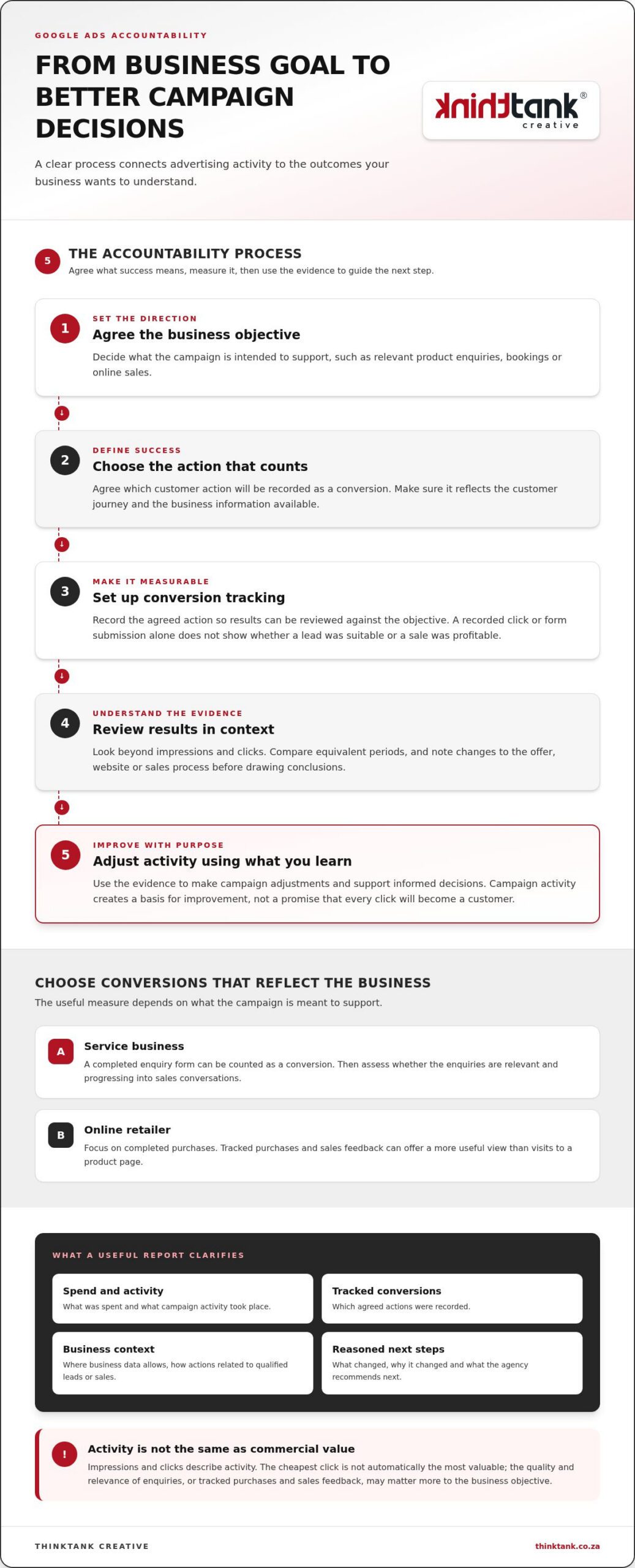
Accountability starts before the first advert runs. Agree the business objective, define the action that will count as a conversion, set up measurement, review the results and adjust activity. This sequence gives you and your agency a shared basis for decisions. Google’s Google Ads platform documentation offers guidance on working with the platform, but reliable conclusions still depend on defining what success means for your organisation.
For example, a service business might count a completed enquiry form as a conversion, then assess whether those enquiries are relevant and progressing into sales conversations. An online retailer might focus on completed purchases. A click or form submission can be recorded, but it doesn’t automatically show whether a lead was suitable or a sale was profitable. Measurement should reflect the customer journey and the business information available.
Campaign metrics only matter when interpreted against the business objective.
Which Google Ads measures matter to your business?
Impressions and clicks show that adverts were displayed or interacted with. They describe campaign activity, not necessarily commercial value. If the goal is to generate qualified enquiries, the number and quality of those enquiries matter more than click volume alone. If the goal is sales, tracked purchases and sales feedback may offer a more useful view than visits to a product page.
The cheapest click isn’t automatically the most valuable. A lower-cost visit that rarely leads to a relevant enquiry may be less useful than an interaction that supports the intended action. Before drawing conclusions, compare equivalent periods and note changes to the offer, website or sales process. This helps distinguish a genuine trend from differences in how data was collected.
What transparent reporting should help you understand
A useful report is a decision-making tool, not a dashboard of unexplained figures. It should make clear what was spent, what campaign activity took place, which conversions were tracked and, where business data allows, how those actions related to qualified leads or sales. It should also explain what changed, why the change was made and what the agency recommends doing next.
Good reporting distinguishes observed data from interpretation. A recorded form submission is an observed event; whether it represents a qualified prospect may require feedback from the team handling enquiries. If sales data isn’t connected to advertising data, the report should say so rather than presenting an assumption as proven attribution. Share lead-quality or sales feedback with your agency so campaign decisions reflect what happens after the conversion.
The post-click experience also shapes what the numbers mean. A visitor may arrive on the right page but leave because the offer or next step is unclear. Reviewing the website experience can help identify friction beyond the advert itself. If you’re evaluating a google ads agency south africa, look for a partner that connects measurement with practical next steps. ThinkTank Creative brings paid advertising together with wider digital capabilities. Explore ThinkTank Creative’s digital marketing approach to see how those pieces can work together.
How to compare Google Ads agencies in South Africa
Compare the work behind each proposal, not just its headline promise. A useful proposal shows how an agency will understand your objectives, manage the agreed scope and keep you informed. If you’re assessing a google ads agency south africa, the criteria below can make different approaches easier to compare side by side.
| Criterion | What to look for |
|---|---|
| Strategy | Does the proposal connect your business priorities and audience intent to campaign choices? |
| Scope | Are research, campaign management, reporting and optimisation responsibilities clearly described? |
| Measurement | Does the approach explain what will be tracked and how performance will be interpreted? |
| Communication | Are reporting frequency, points of contact and decision-making processes set out? |
| Website integration | Does the plan consider the landing page and the experience after an advert is clicked? |
| Ongoing support | Is it clear how reviews, feedback and campaign adjustments will be handled over time? |
Use the table to identify gaps and differences, not to award points mechanically. A proposal that promises growth but doesn’t define the objective, measurement basis or responsibilities is difficult to assess. Treat performance claims with the same care: look for context, clear definitions and an explanation of how the result was measured. Headline figures alone may not show whether the work fits your business.
Specialist PPC agency or integrated marketing partner?
A specialist may suit a business with a clearly defined paid-media requirement and other marketing capabilities already in place. An integrated partner may be a better fit when paid advertising needs to work alongside website design, SEO, social media or creative activity. Neither model is automatically superior. The right choice depends on which capabilities your priorities require and how much coordination you want across the customer journey.
A specialist can bring depth to paid media; an integrated partner can coordinate paid activity with the wider marketing experience.
A practical agency comparison checklist
Before deciding, check that each proposal explains the objective, scope, responsibilities, reporting and communication process in comparable terms. Consider how the agency will work with your team and how feedback will inform decisions. If proposals use different definitions of a conversion or success, clarify those differences before comparing performance claims.
- Is the proposed work specific to your priorities, rather than a generic list of services?
- Are performance statements supported by definitions and a clear measurement basis?
- Does the scope state what the agency will manage and what your team will provide?
- Can you see how website considerations and ongoing support fit into the work?
Fees and scopes vary, so compare the stated work with the estimated cost rather than choosing on price alone. ThinkTank Creative provides an estimated cost after discussing your needs and timeline. A clear discussion helps align expectations about deliverables and collaboration before work begins.
What to prepare before engaging a Google Ads agency
A focused brief makes the first campaign discussion more useful. It gives an agency a clearer view of what your business needs, what customers can act on and where the customer journey may need attention. You don’t need perfect data or a complete campaign history. Share what you know, flag what’s uncertain and use the discussion to identify what needs further investigation.
Information that helps shape a useful campaign discussion
Start with the business priority, such as attracting relevant enquiries for a particular service or increasing sales of a specific offer. Describe your intended audience, the value you provide and the action you want visitors to take. Include your website address, relevant landing pages and practical constraints, such as pages that need updating or an enquiry process handled by a small team.
- Goals and offer: What should advertising help the business achieve, and what are you promoting?
- Audience: Who are you trying to reach, and what needs or questions might prompt them to act?
- Website: Which pages support the offer, and are there known usability or content issues?
- Campaign context: Gather available analytics, previous advertising information and existing measurement details, while noting gaps in the records.
- Enquiry handling: Identify who responds to leads and how your team records quality, follow-up and sales feedback.
That last point matters. A campaign may generate enquiries, but the agency needs a feedback loop to understand which ones are relevant and how they progress. A considered lead-generation strategy takes follow-up into account instead of treating a submitted form as the end of the customer journey.
Questions that reveal how an agency works
Use the discussion to understand how the agency will turn your brief into a working plan. Ask how strategy connects to the stated objective, what campaign management includes, how results will be measured and what the reporting will help you decide. The answers should make responsibilities clear, including what your team needs to provide and who will approve changes.
Agree on practical ways of working before activity begins. Discuss communication routines, access responsibilities, the reporting format and how often the work will be reviewed. Ask how decisions and adjustments will be explained, and how your team’s feedback on lead quality or sales will shape future activity. A google ads agency south africa should be able to describe this collaboration in plain language, without relying on jargon or unsupported promises.
Preparation doesn’t mean having every answer. Bring your priorities, available information and open questions so research and strategy can be tailored to your business. To put these considerations into practice, discuss your paid advertising needs with ThinkTank Creative.
Working with ThinkTank Creative on paid advertising and digital growth
Choose a partner whose process starts with understanding your business, not simply selecting campaign settings. Founded in 2001, ThinkTank Creative is a South African agency offering digital paid advertising alongside website design and development, SEO, social media marketing and creative services. This broader perspective helps businesses consider how advertising fits into the experience customers have before and after they click.
A joined-up approach from strategy to ongoing support
Paid advertising is more useful when it reflects the wider context of your marketing. For example, a campaign may direct people to a landing page, so the page’s content, usability and next step should support the same objective as the advert. If your website needs attention, or your SEO and social media activity also contribute to customer discovery, these elements can be considered alongside PPC rather than in isolation.
ThinkTank Creative’s process puts research and strategy before delivery, with communication and feedback forming part of the working relationship. This creates space to understand your audience, business priorities and existing digital activity before shaping a suitable scope. Rather than applying a fixed campaign formula, the work is shaped around the needs and timeline discussed with you.
Collaboration continues beyond delivery. ThinkTank Creative provides ongoing service after project completion, supporting a longer-term relationship as business needs evolve. Clear communication and review keep the work connected to your priorities, while your feedback can bring practical insight into customer responses and enquiry quality.
Start a conversation about your business objectives
To make an initial discussion productive, share the outcomes you’re working towards, the audiences you want to reach and the offer or service you want to promote. It also helps to explain current challenges, the state of your website and any relevant marketing activity. You don’t need a perfect brief. A clear account of what you know and what you’re still working through gives the conversation a useful starting point.
ThinkTank Creative can discuss an approach and scope that reflect your requirements and timeline, then provide an estimated cost based on that discussion. This gives you a grounded basis for considering the work, rather than relying on a generic package or unsupported promise. The aim is to build a partnership around considered decisions and well-aligned activity.
If you’re looking for a google ads agency south africa that can discuss paid advertising in the context of your wider digital presence, bring your objectives and questions to the conversation. ThinkTank Creative’s guiding phrase, “We Do It All So You Don’t Have To”, reflects its collaborative, broad-service perspective. Start a conversation about your paid advertising goals and explore a scope tailored to your business.
Make your next advertising decision with clarity
Your first step doesn’t need to be a sweeping marketing overhaul. Choose one business priority that matters now, then use it to shape what to promote, what the visitor should do and what evidence will help you decide whether to refine the approach. That focus creates room for steady learning and a more considered path to growth.
The right google ads agency south africa should bring thoughtful collaboration to the process and help connect paid advertising with the wider direction of your business. With a clear shared purpose, campaign decisions can become part of a lasting growth plan rather than isolated activity.
Discuss your digital marketing goals with ThinkTank Creative and take the next step towards an approach shaped around your business.
Frequently Asked Questions
Is a Google Ads agency worth it for a small business in South Africa?
It can be worthwhile if paid search supports a specific business priority and your team can assess and follow up the resulting enquiries or sales. For example, a small business promoting one core service may benefit from structured campaign management, but should weigh the proposed work against internal capacity and marketing priorities. An agency can bring planning and reporting, but hiring one doesn’t guarantee results. Consider whether the proposed scope and working relationship suit your needs.
What does a Google Ads agency do?
A Google Ads agency can plan, manage and evaluate paid campaigns against objectives agreed with a business. The scope may cover research, campaign planning, advertising management, performance updates and adjustments. Before work begins, clarify who will provide business information, approve campaign materials and share feedback from customers. This division of responsibilities helps connect the agency’s activity with the website journey and the way your organisation responds to prospective customers.
How do I choose a Google Ads agency in South Africa?
Start by deciding what you want advertising to contribute, such as enquiries for a particular service or sales of a specific offer. Then compare agencies on how they explain their approach, measurement, communication and responsibilities. A google ads agency south africa should be able to describe how campaign activity relates to meaningful business actions, not just clicks. Consider whether your priorities call for paid-media focus or coordination with other marketing work, and assess claims in context.
How much does a Google Ads agency cost in South Africa?
There isn’t one fee that applies to every agency or campaign. The work required, account scope and level of support all influence an estimate, so compare proposals by what they include rather than by the headline figure alone. Also distinguish the agency’s management fee from the advertising budget paid to the platform. Ask for both to be explained clearly, along with the work and assumptions behind the proposed scope.
Can a Google Ads agency guarantee leads or sales?
No agency can responsibly treat leads or sales as certain outcomes. Results may be affected by the offer, audience, competition, website experience, measurement and how quickly enquiries are followed up. Instead of relying on a guarantee, look for a clear explanation of intended objectives, assumptions and how performance will be assessed. This helps you understand what campaign data can indicate, what it can’t establish on its own and which decisions are reasonable.
What should a Google Ads report include?
A useful report should help you decide what to do next, not simply present a collection of figures. It can show advertising spend, campaign activity and tracked conversions, with relevant trends and recommendations. Check that conversion terms are explained, reporting periods are consistent and data limitations are made clear. Where your team can share sales or enquiry outcomes, those details add context to campaign data and help distinguish recorded actions from business value.
Should I choose a specialist PPC agency or a full-service marketing agency?
Choose according to the work that needs to fit together. A business with an established website and marketing team may prefer a partner focused on paid media. If campaign activity also needs to align with a new landing page, SEO, social media or creative work, an integrated agency may help coordinate those elements. Compare the actual responsibilities, reporting and communication proposed; the agency label alone won’t tell you which model best suits your priorities.