Facebook Advertising Costs in South Africa: A 2026 Budgeting Guide

Could a smaller Facebook budget produce better business results than a larger one? It can, if it’s built around the right objective. Facebook advertising costs south africa businesses face aren’t set by one universal rate: the campaign goal, audience, placements, ad quality and competition all influence what you pay.

It’s understandable to want a clear figure before you begin. But costs can be difficult to assess when platform spend and campaign management are combined, and clicks or impressions alone don’t show whether advertising is bringing in valuable enquiries or sales.

This guide explains what shapes campaign costs in South Africa and how to plan a test budget around a specific business outcome. You’ll learn how to assess performance beyond reach and clicks, separate ad spend from management fees, and compare managing campaigns yourself with professional support. We’ll also look at how objectives, audiences and creative choices affect delivery, and how planning, reporting and the experience on your website can help you judge whether your investment is working.

Key Takeaways

  • Understand what shapes facebook advertising costs south africa businesses may encounter, including the campaign objective, audience, competition and ad quality.
  • Separate the amount paid to Meta from fees for planning and managing campaigns to see how your budget is allocated.
  • Compare Facebook placements with other campaign options by audience fit, objective, destination and how results will be measured.
  • Build a test around an affordable business goal, with tracking and a review plan in place before the campaign launches.
  • Assess advertising support by how clearly it connects planning, creative, reporting and communication to your agreed objective.

What makes up Facebook advertising costs in South Africa?

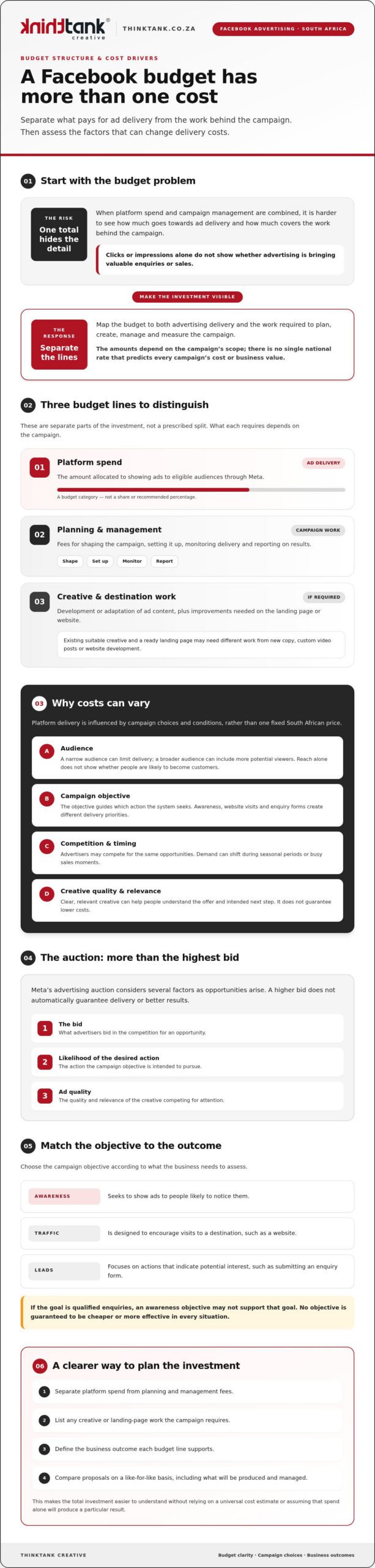
Start by separating two budget lines: the amount allocated to ads on Meta and the fees for planning or managing the campaign. They cover different things. Keeping them distinct shows how much is going towards ad delivery and how much covers the work behind the campaign.

Platform spend and agency fees are separate budget lines. Your total investment may also include creative work or changes to the page people land on after clicking an ad. These are separate parts of the campaign, and whether they’re needed depends on its scope.

Facebook advertising costs south africa businesses encounter aren’t set by a single national rate. Platform delivery costs can vary with the audience, campaign objective, competition and timing. A general benchmark may offer context, but it can’t reliably predict the cost of every campaign or the business value it will generate.

Which parts of a Facebook advertising budget should you separate?

Map your budget to both the work and the advertising delivery. A useful starting structure is:

These categories make it easier to compare proposals on a like-for-like basis. A campaign using suitable existing creative and a ready landing page may require different work from one needing new copy, custom video posts or website development. Define what needs to be produced and managed before comparing fees, rather than assuming every campaign requires the same services.

Why do South African campaign costs vary?

Your chosen audience affects who is eligible to see your ads. A narrow audience can limit delivery, while a broader one can include more potential viewers. Competition matters too: advertisers may compete for the same opportunities, and the campaign objective influences which actions the system seeks. The auction is part of real-time bidding in advertising, where opportunities are assessed as they arise.

Timing can also affect delivery. Demand for attention may shift during seasonal periods or busy sales moments, while the quality and relevance of your creative can influence how people respond. South Africa is the audience market, not a guarantee of one uniform price. Costs can differ by sector, target group, objective and campaign period.

For a practical working plan, allocate one portion of your available budget to platform delivery, another to campaign planning and management, and a separate allowance for creative or landing-page work if required. Define the outcome each portion supports. This makes the total investment easier to understand without relying on a universal cost estimate or assuming that spend alone will produce a particular result.

How Meta’s advertising auction influences Facebook campaign costs

Meta doesn’t simply sell each advertising opportunity to the highest bidder. Advertisers compete to reach people who fit their targeting, and the platform’s auction considers factors such as the bid, the likelihood of the desired action and the ad’s quality. A higher bid doesn’t automatically guarantee delivery or better results.

Meta’s auction-based delivery is not a fixed price list. That’s why two campaigns aimed at South African audiences can spend differently, even with similar budgets. The objective, eligible audience and strength of the creative all shape the conditions in which an ad competes. This puts facebook advertising costs south africa businesses see into context: the cost is connected to campaign choices, not just a set national rate.

How do campaign objectives affect delivery and cost?

An objective tells the system what kind of result the campaign is intended to pursue. An awareness campaign seeks to show ads to people likely to notice them. A traffic campaign is designed to encourage visits to a destination, such as a website. A lead campaign focuses on actions that indicate potential interest, such as submitting an enquiry form.

Each objective creates different delivery priorities. If your business needs qualified enquiries, choosing an awareness objective simply because it offers broad exposure may not support that goal. The system is being directed towards a different action. Set the objective according to the outcome you want to assess, then measure the campaign against that purpose. No objective is guaranteed to be cheaper or more effective in every situation.

How can audience, creative and timing change results?

Targeting defines who is eligible to see an ad. A narrow audience can focus delivery on a specific group, but it also limits the pool of eligible people. Broader targeting creates a wider pool, though reach alone doesn’t show whether those people are likely to become customers. Choose an audience based on the business goal and how clearly you can define the people you want to reach.

Creative quality matters because people need a reason to pause, understand the offer and take the intended next step. Relevant copy, clear design and a suitable destination can make that journey more coherent. They don’t guarantee lower costs, but they can give the audience a clearer and more consistent experience. If an ad promises one thing and its landing page presents another, the campaign may attract attention without supporting the action you want.

Timing changes the competitive context too. Other advertisers may increase activity around seasonal promotions or busy shopping periods, while demand can vary at other times. Treat timing as a factor to monitor, not a fixed calendar rule. Meta can update campaign tools, labels and delivery options, so verify the current terminology and settings in Ads Manager before applying guidance to a live campaign.

Connect the decisions: choose an objective that reflects the business outcome, define an audience that makes sense for it, and create relevant content for that audience. Paid advertising campaign planning and reporting can bring these choices together, helping you see whether delivery supports the agreed goal rather than relying on impressions or clicks alone.

How to compare Facebook advertising with other campaign options

Choose a channel based on how it connects your audience with a useful next step, not on cost alone. Facebook placements can support audience discovery, awareness and enquiries, but their suitability depends on whether your intended customers are reachable there, whether the creative fits their needs and whether the destination makes it easy to act. Compare each option against the same business objective.

Use this framework to assess what role each channel could play. The measures are starting points, not guarantees of performance.

Option Audience fit Possible objective Destination What to measure
Facebook advertising People you want to reach through social placements, including potential customers who may not be actively searching Build awareness, introduce an offer or generate enquiries A relevant website page, product page or enquiry form Relevant reach, visits, enquiries and the quality of responses
Search advertising People expressing interest through a search query Capture demand for a product, service or solution A page closely aligned with the search and ad Qualified visits, enquiries or sales attributed to the campaign
Search engine optimisation People finding relevant pages through unpaid search results Build discoverability for useful topics over time Informative service or resource pages Relevant organic visits, enquiries and page engagement
Email marketing People who have opted to receive business communications Share updates, nurture interest or encourage a next step A suitable offer, resource or website page Engagement and the actions taken after a message

These options can complement one another. For example, Facebook advertising may introduce a service to new audiences, while search activity can capture people already looking for a solution. The right mix depends on the customer journey and the evidence you need. For a broader view of how channels can support acquisition, explore lead generation strategies for South African businesses.

When might Facebook advertising suit a business objective?

Consider Facebook when your intended audience is reachable through its placements and your message can earn attention in a social setting. It may support awareness, introduce an offer or encourage enquiries, provided the creative gives people a clear reason to respond. Check that the destination matches the promise: a relevant landing page or enquiry form should make the next step straightforward. The channel is a stronger fit when audience, creative and destination work together.

What should you compare before choosing DIY or agency support?

Channel choice and campaign management are separate decisions. Managing a campaign in-house can suit a team with time to learn the platform, prepare creative, review delivery and make considered adjustments. Account access alone isn’t the whole task. Agency support can bring planning, copywriting, creative production and reporting into a defined process. Compare what each approach covers, the time your team can commit and the reporting you need to connect activity with the agreed objective. This makes the facebook advertising costs south africa discussion more useful, because you’re comparing both the channel and the work required to manage it.
Facebook Advertising Costs in South Africa: A 2026 Budgeting Guide

How to set a Facebook advertising test budget and measure value

Make the test answer a business question. Rather than choosing a figure because it sounds typical, decide what result would make the campaign worth continuing. Then allocate an amount your business can afford to test without putting essential operating costs at risk. A disciplined test gives you evidence to guide the next decision, not a promise of a particular return.

How do you plan a fair campaign test?

Work through these steps before launching:

  1. Choose one primary outcome. Define whether the campaign should build awareness, bring relevant visitors to a page or generate enquiries. Keep the outcome specific enough to measure.
  2. Set the test allocation and scope. Decide what you can commit to the test, and distinguish that platform allocation from any planning, creative or management work. Keep the test affordable for your business.
  3. Make the variables interpretable. Choose an audience, creative and destination that support the same objective. If you change several elements at once, it can be difficult to tell which change influenced the result.
  4. Confirm tracking before launch. Identify the relevant action, such as a page visit, form submission, phone enquiry or completed purchase, and make sure you can record it consistently.
  5. Set a review point. Agree when you’ll assess the results. Record what changed and why, then adjust deliberately rather than making multiple changes without a clear comparison.

Creative should fit the wider brand rather than being treated as a one-off advert. A planned series of useful messages can give a campaign more continuity. Creating a content marketing plan can help align paid creative with the content your business shares elsewhere.

Which measures help assess campaign value?

Match measurement to the outcome. For awareness, review reach and engagement to understand whether the campaign is being seen and whether people are responding. For traffic, examine visits to the intended destination and whether those visitors take a useful next step. For lead generation, count enquiries and assess their relevance, not just the number of clicks or form starts.

A click is an initial interaction, not proof of a qualified lead, completed action or sale. Compare results with your business objective and consider the quality of responses. If people click but don’t complete an enquiry, review the page experience as well as the ad. Clear information, a relevant offer and a straightforward route to act can support conversion. Improving website user experience may help identify friction in that journey.

Keep a simple record of the objective, audience, creative, destination, spend allocation and observed actions. This makes facebook advertising costs south africa easier to assess in business terms: you can see what was invested, what happened and what you’ll change next. For support bringing campaign planning, creative and reporting together, plan your paid advertising campaign with ThinkTank Creative.

How to choose Facebook advertising support for your South African business

Choose support by the quality of the process, not by confident promises. A useful campaign plan starts with your business objective, explains how advertising will serve it and sets out how progress will be reported. This gives you a practical basis for assessing whether the work aligns with your priorities and whether the investment is managed transparently.

Use this checklist to assess the working approach:

What should a clear campaign scope include?

Agree the essentials before work begins: the campaign objective, intended audience, creative responsibilities, destination and reporting expectations. Make the boundary between Meta media spend and campaign planning or management explicit, so each budget line has a clear purpose. The scope should also reflect what your business needs, including whether creative or destination work is required and the timeline for planning, launching and reviewing the campaign.

A well-defined scope helps everyone understand what’s included and which decisions need your input. It also makes later reviews more constructive: compare delivery with the original goal, discuss what the reporting shows and agree on any adjustments. Facebook advertising costs south africa businesses plan for are easier to assess when platform spend and the work around it are clearly distinguished.

How can an agency support the wider customer journey?

A campaign is one part of a customer’s experience with your business. Planning can align the objective and audience, copywriting can make the offer clear, and reporting can show how people respond. The destination matters too. A relevant landing page with considered UX/UI can help visitors understand what to do next, while a confusing or mismatched page may interrupt the journey after an ad click.

ThinkTank Creative provides digital paid advertising, campaign planning and reporting, alongside website design and development that includes UX/UI. This joined-up approach connects campaign activity with the experience that follows, shaped around your business needs. To discuss a tailored digital advertising approach, talk with ThinkTank Creative. An estimated cost follows a discussion of your needs and timeline.

“We Do It All So You Don’t Have To”

Turn your next campaign into a clearer decision

A well-planned test can do more than assess one advert. It can reveal which message resonates, what people need before taking action and where the customer journey could be clearer. Carry those learnings into your next campaign to make future budget decisions more deliberate.

Keep your objective visible as you assess facebook advertising costs south africa businesses face. Align the campaign plan, creative and destination with the outcome you want to achieve, then agree how you’ll evaluate progress. That gives your investment a clear purpose from the outset.

Shape your next digital advertising approach with ThinkTank Creative. We’ll discuss your needs and timeline and provide an estimated cost, then help you build from a considered plan and learn from the results.

Frequently Asked Questions

Can I set a spending limit for Facebook advertising?

Yes. Meta Ads Manager generally lets you set a daily or lifetime budget for a campaign or ad set, depending on its setup. You can also review account-level spending controls in the billing settings where available. Check which level the limit applies to, as a payment threshold is not the same as a campaign budget cap. Interface labels and options can change, so verify the current settings before publishing.

Does Facebook charge for adverts that are paused?

Pausing an advert stops further delivery once the change takes effect, but it doesn’t erase charges already accrued. You may still see billing for eligible impressions or clicks delivered before the pause, and any outstanding balance remains payable. After pausing, check the campaign’s delivery status and billing activity rather than assuming the account will show no charge immediately. If another campaign remains active, it may continue spending separately.

Do I need a website to run Facebook advertising?

No. A website isn’t essential for every campaign. Depending on the objective and options available in your account, an advert may direct people to a Meta-hosted lead form or another suitable destination. For example, a service business could collect enquiry details through a form, whilst an online shop may need product pages for browsing and checkout. Choose a destination that lets people complete the action you’re asking them to take.

Can Facebook advertising reach customers across South Africa?

Yes. You can configure location targeting to reach eligible audiences across South Africa, or focus delivery on selected areas if that better fits your business. Review the location settings carefully before launch, especially if your service or delivery coverage has limits. A national audience setting doesn’t guarantee that every person in the country will see the advert; delivery also depends on campaign settings, audience eligibility and available placements.

Is Facebook Ads Manager the same as Meta Business Suite?

No. They’re related Meta tools, but they serve different purposes. Ads Manager is centred on creating and managing advertising campaigns, with controls and reporting for campaign delivery. Meta Business Suite is designed to help manage a business’s Facebook and Instagram presence, such as publishing content and handling messages. Some advertising features may be accessible from both, so use Ads Manager when you need more detailed campaign controls and performance views.

What should I do if my advert is approved but not delivering?

First, check that the campaign, ad set and advert are switched on and that the schedule has started. Then review the delivery status, audience settings, budget or bid controls, payment method and any account alerts. A very restricted audience or settings that limit delivery can also affect whether an approved advert runs. Make one adjustment at a time, then check the status again so you can identify what resolved the issue.
SEO vs PPC for Small Businesses in South Africa: 2026

The channel that brings enquiries this month may not be the one that builds your most dependable source of demand. Choosing seo vs ppc for small business in south africa isn’t simply a choice between free traffic and paid clicks; it’s about matching your marketing to your goals, budget runway and ability to convert interest into business.

If you’re weighing up limited resources, it’s sensible to want a clear way to measure what they’re achieving. PPC can put your offer in front of people actively searching, while SEO works to build organic visibility over time. Paid activity can stop when campaigns pause; organic visibility may continue to attract visitors, although it requires ongoing attention and isn’t guaranteed.

This guide compares the roles, trade-offs and measurement needs of both channels, then shows how to decide whether to focus on one or combine them. You’ll also find practical next steps for testing performance, tracking meaningful outcomes and refining a plan around your South African business’s readiness to grow.

Key Takeaways

  • Understand how SEO builds unpaid search visibility over time, while PPC uses paid campaigns to reach potential customers.
  • Compare SEO and PPC by the effort, control and ongoing investment each requires, rather than assuming one is free or guarantees quick returns.
  • Use seo vs ppc for small business in south africa as a practical decision: align your channel choice with business goals, website readiness and capacity.
  • Follow a clear framework to select a channel, track meaningful outcomes and refine your approach as you learn.
  • See how coordinated SEO and PPC, supported by campaign planning, copywriting and reporting, can contribute to a more considered growth strategy.

SEO vs PPC for South African small businesses: what each channel does

Should your business build organic discoverability, pay for search visibility, or coordinate both? The answer depends on what you need to achieve and how ready your website is to turn visits into enquiries or sales. In the seo vs ppc for small business in south africa comparison, these channels serve different purposes, even though both can help connect your business with people searching online.

Search Engine Marketing (SEM) is an umbrella term for approaches that increase visibility in search, including Search Engine Marketing (SEM). SEO improves a website’s unpaid visibility in relevant search results. PPC, or pay-per-click advertising, places paid ads in front of selected audiences, with campaign spend and platform settings influencing when and where those ads may appear.

For a concise visual overview of how small businesses can weigh these channels, watch:

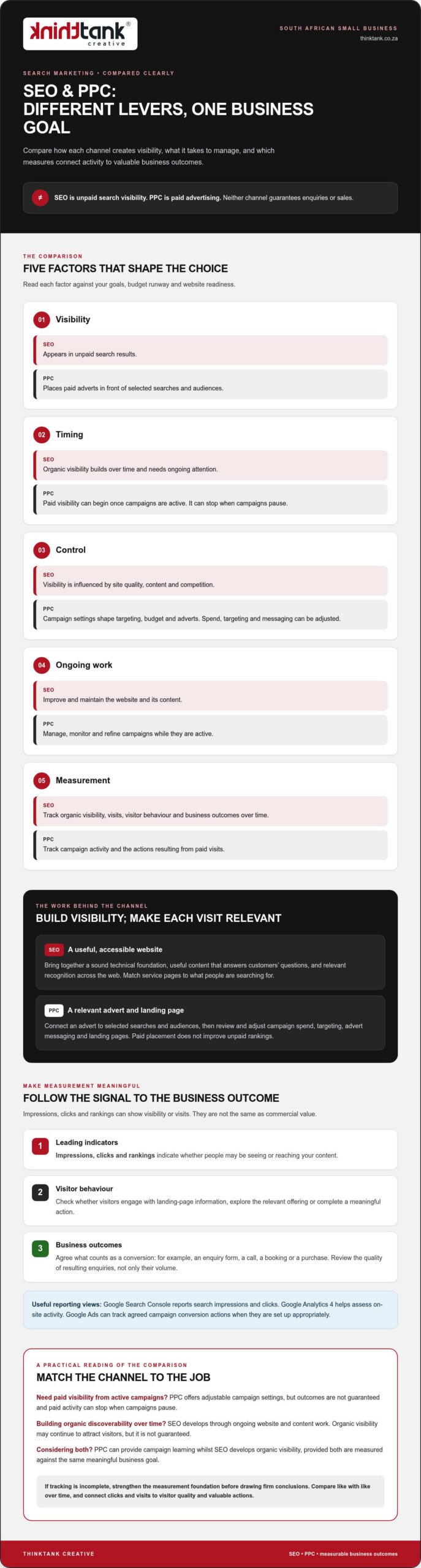
Factor SEO PPC
Visibility Unpaid search results Paid ad placements
Timing Builds over time Can begin once campaigns are active
Control Influenced by site quality, content and competition Campaign settings shape targeting, budget and ads
Ongoing work Improve and maintain the website and content Manage, monitor and refine campaigns
Measurement Track visibility, visits and business outcomes over time Track campaign activity and resulting actions

What does SEO involve for a small business?

SEO brings together a sound technical foundation, useful content and signals that help establish a website’s authority. That means making pages accessible to search engines, answering the questions potential customers actually ask, and earning relevant recognition across the web. A person searching for a particular service should land on a page that clearly explains that offering and what to do next. For more context, read this South African SEO strategic guide.

What does PPC involve in search marketing?

Paid search campaigns connect an advert to selected searches, audiences and a relevant landing page. Businesses can manage factors such as spend, targeting and ad messaging, then review results and adjust the campaign. Paid placement is separate from organic rankings: paying for an advert doesn’t improve a page’s unpaid position. PPC is controllable activity, not a promise of traffic, enquiries or sales.

Neither channel produces the same outcome for every business. Competition, execution, website readiness and the clarity of the offer all matter. A coordinated approach can use PPC to gather campaign learning while SEO develops organic visibility, provided both are measured against meaningful business goals.

How SEO and PPC work, and what South African businesses can measure

Measure activity in context, not in isolation. SEO develops through ongoing work, so assess changes in search visibility alongside what visitors do and whether they take valuable action. PPC performance reflects active campaigns, where targeting, advert creative, landing pages and spend settings can be adjusted and reviewed. Google offers a useful explanation of the difference between PPC and SEO, but your reporting should connect that distinction to your own business objectives.

Paid visibility comes from active advertising; organic visibility comes from appearing in unpaid search results. Impressions, clicks and rankings are leading indicators: they show whether people may be seeing or reaching your content. Enquiries, bookings, purchases or other agreed conversions are business outcomes. Define each measure before reporting, so a rise in clicks isn’t mistaken for a rise in commercial value.

Which measures help evaluate SEO?

Review relevant organic impressions and clicks, then examine how visitors behave on the landing pages they reach. Are they engaging with the information, exploring the relevant offering or completing a meaningful action? Google Search Console reports on a site’s search performance, including impressions and clicks. Google Analytics 4 helps assess on-site activity. Together, these views add context, but neither rankings nor traffic alone proves commercial success.

Set a regular review period and compare like with like, such as the same pages or search topics over time. This helps distinguish a visibility change from a change in visitor quality or conversion behaviour.

Which measures help evaluate PPC?

Track campaign impressions and clicks, then look at the conversion actions associated with those visits. Before launch, agree what counts as a conversion, whether that’s a completed enquiry form, a call or a purchase, and ensure the relevant action is tracked appropriately in Google Ads. Then review the quality of resulting enquiries, not just their volume. A lead generation strategy is more useful when it connects activity with the prospects a business can serve.

For a broader approach to assessing lead quality, explore this lead generation strategies framework.

For seo vs ppc for small business in south africa, use consistent definitions across channels and review performance against the same business goal. If the tracking is incomplete, improve that foundation before drawing firm conclusions. A clear reporting approach can connect campaign planning, website experience and customer outcomes; explore ThinkTank Creative’s digital marketing approach as you shape your measurement plan.

SEO or PPC: which trade-offs matter most to a small business?

Neither channel is a shortcut. SEO isn’t automatically free: it takes time and expertise to improve a website, create useful content and maintain visibility. PPC isn’t automatically profitable as soon as an advert goes live. Paid campaigns can be adjusted, but the offer, audience fit and landing page still shape whether clicks become worthwhile enquiries.

For seo vs ppc for small business in south africa, weigh the work each channel needs against what your business can sustain and learn. SEO and PPC answer different needs, and neither guarantees leads or revenue.

Trade-off SEO PPC
Ongoing effort Requires continuing site improvements, relevant content and optimisation. Requires active campaign monitoring and refinement.
Control Search visibility is influenced by relevance, site quality and competition. Campaign settings let you adjust targeting, adverts and spend.
Learning Can reveal which topics and pages attract relevant organic interest over time. Can test messages and audience choices within a defined campaign.
Dependence on activity Visibility may endure, but depends on ongoing quality and changing search conditions. Paid exposure depends on campaigns remaining active.
Key consideration Progress may take sustained effort and is shaped by competition. Control over campaign activity doesn’t guarantee profitable results.

When might SEO be the stronger starting point?

SEO may suit a business that can invest in useful content, site improvements and sustained optimisation, particularly if customers research services through search before deciding. For example, a customer comparing service options may value a clear page that answers common questions and explains what’s offered. That page can support discovery and decision-making, but organic visibility develops amid competition and changing search conditions, so it needs ongoing attention.

When might PPC be the more practical test?

PPC may be a practical way to test demand or messaging when you have a relevant landing page and can set aside capacity to manage a campaign. You can adjust targeting, advert creative and spend settings as you learn. However, a campaign can only direct attention to the offer and experience you provide. If the page is unclear or the next step is difficult, paid activity won’t fix the underlying issue.

Use each channel for the work it does best. PPC can support controlled experiments; SEO can build organic discoverability through continued improvements. A thoughtful mix may make sense when your team can support both, but prioritisation should reflect business readiness, customer behaviour and the outcomes you’re equipped to measure.

SEO vs PPC for Small Businesses in South Africa: 2026

How to choose an SEO and PPC mix for your South African business

Choose the channel mix that fits your business’s current capacity, customer behaviour and website readiness. A focused plan makes it easier to learn what supports your goals, without spreading effort across activities you can’t yet measure or maintain.

Set the goal, check your readiness, choose a channel, track the outcome and review what you learn. Use this framework to decide whether to prioritise SEO, PPC or a coordinated test:

  1. Set a business goal. Be specific about the result you want, such as relevant service enquiries or online sales. Choose an outcome you can track, not just a rise in visits.
  2. Assess website readiness. Check that the right page explains your offer clearly and gives visitors a relevant next step, such as making an enquiry or completing a purchase.
  3. Choose a starting channel. Consider whether customers search for your offering, how much time your team can commit and whether you need to test messaging or build lasting organic visibility.
  4. Track outcomes. Decide what counts as a meaningful action before activity begins, then make sure your reporting captures it consistently.
  5. Review and refine. Use what the data and customer response show to adjust the campaign, improve the page or shape the next piece of SEO work.

This is the practical lens for seo vs ppc for small business in south africa: match your first step to your goal, capacity, customer behaviour and ability to convert, then review before expanding.

Is your website ready to support either channel?

Check that the landing page matches the search message, explains the offering in plain language and makes the next step easy to find. Usability matters too: review the mobile experience, page clarity and loading experience, especially for visitors browsing on mobile data. If the journey feels confusing, improve it before directing more people to the page. Explore this website user experience guide for a deeper look at usability.

How should a small business structure a first test?

Keep the test focused. Agree one business objective, the intended audience, the conversion action and when you’ll review the results. For PPC, test relevant search terms and landing-page messaging, then assess the quality of the resulting actions. For SEO, prioritise useful pages and improvements that answer the same customer need. If both channels are viable, PPC can help explore messaging while SEO develops stronger pages around that demand.

Use the content marketing planning template to align useful content with business goals. For an integrated plan connecting channel choices with your website and customer journey, work with ThinkTank Creative on your SEO and PPC strategy.

Plan your next step with an integrated SEO and PPC strategy

The right mix starts with your business priorities, not a preference for one channel. If your website is ready and customers are actively searching for what you offer, PPC may help you test relevant search activity, while SEO builds a stronger foundation for organic visibility. If the site needs clearer pages or a smoother customer journey, address that readiness as part of the plan. Where capacity allows, coordinated paid tests and longer-term organic improvements can inform one another.

This is the practical conclusion of seo vs ppc for small business in south africa: align the channel with your goal, customer, website and ability to measure meaningful outcomes. There’s no universal mix, so a considered plan should reflect what your business can support and learn from.

What to prepare before planning your search marketing

Bring together the details that help turn a broad marketing ambition into a focused plan:

This preparation helps identify where to begin and which parts of the customer journey may need attention before more traffic is directed to the site.

How ThinkTank Creative can support the planning process

ThinkTank Creative brings SEO and digital paid advertising together with campaign planning, copywriting and reporting. That connected view helps keep channel activity aligned with business goals, the website experience and the actions you want visitors to take. Rather than treating each channel as a separate task, the planning process considers how they can support a coherent customer journey.

If your site needs to better support search visitors and conversions, website design and development can form part of the work. The process can include planning, UX/UI design, coding, testing, launch, training and support, creating a considered connection between how people find your business and what they experience when they arrive.

Discuss your needs and timeline, and an estimated cost is provided to reflect the project. This keeps the proposed scope grounded in your priorities rather than implying a fixed price for every business.

With a clear objective, an honest view of website readiness and a practical measurement plan, you can make a more informed choice about where to focus first. When you’re ready to shape a tailored digital marketing approach, discuss your digital marketing approach with ThinkTank Creative.

Build a search strategy around your next business goal

The choice between SEO and PPC comes down to more than visibility. Match your channel to your business priorities, website readiness and capacity, then measure meaningful outcomes rather than clicks alone. SEO can build organic discoverability through sustained work; PPC offers a way to test campaign activity and refine it. For many businesses, a coordinated approach can connect those roles.

That’s the practical lesson of seo vs ppc for small business in south africa: choose a starting point you can support, make sure your website gives visitors a clear next step, and review what the results tell you before refining the plan.

ThinkTank Creative has served businesses since 2001, bringing SEO and digital paid advertising together with campaign planning, copywriting and reporting. When your website needs to better support search visitors and conversions, its design and development process includes post-launch training and support.

Ready to shape a strategy around your goals and resources? Discuss a tailored SEO and PPC approach with ThinkTank Creative. A thoughtful first step can create a clearer path for your business’s next stage of growth.

Frequently Asked Questions

Is SEO or PPC better for a small business in South Africa?

For seo vs ppc for small business in south africa, the better option depends on your goals, website readiness and capacity. SEO may suit a business building useful content and organic visibility over time. PPC may suit one that wants to test search demand with a managed campaign and a relevant landing page. Compare both against meaningful outcomes, such as qualified enquiries or sales, rather than choosing on clicks alone.

Can a small business use SEO and PPC at the same time?

Yes, a small business can use SEO and PPC together if it can support and measure both. For example, PPC can test which search messages attract relevant visitors, while SEO improves pages that answer the same customer needs. Coordinate the landing pages, messaging and conversion definitions so the channels support a consistent customer journey. If resources are limited, start with a clear priority and expand when you can manage the work.

How long does SEO take compared with PPC?

PPC campaigns can begin generating ad exposure once they’re active, while SEO typically needs sustained work before organic visibility develops. Neither timing guarantees enquiries or sales. Results depend on factors such as competition, campaign or website execution, the relevance of the offer and the landing-page experience. Set an appropriate review period for each channel, and assess progress using agreed business outcomes as well as early indicators such as impressions and visits.

Does PPC improve organic SEO rankings?

No, paying for search adverts doesn’t directly improve a website’s organic rankings. PPC controls paid campaign exposure, whereas SEO work aims to improve unpaid visibility through relevant content, technical foundations and other search-quality factors. The channels can still inform one another: campaign activity may reveal which messages or search needs attract interest, helping you consider what content or pages to develop. Treat that learning as strategic insight, not a ranking boost.

Is SEO free for a small business?

No, SEO isn’t automatically free. A business may not pay for each organic click, but improving and maintaining visibility takes time and work, including website improvements, useful content and ongoing optimisation. There may also be a cost for professional support. Plan for the resources needed to create relevant pages and review their contribution, rather than treating organic traffic as cost-free or assuming that publishing content alone will deliver results.

What should a small business measure when comparing SEO and PPC?

Measure visibility and activity alongside business outcomes. For SEO, review relevant organic impressions and clicks, landing-page behaviour and meaningful enquiries or sales. For PPC, track impressions, clicks, conversion actions and the quality of resulting enquiries. Agree what counts as a conversion before reporting, and use consistent definitions across channels. Rankings or visits alone don’t show whether marketing is contributing to business goals, so review them in context.

Should I run PPC before investing in SEO?

Not necessarily. PPC may be a useful first test if you have a clear offer, a relevant landing page and the capacity to monitor campaign results. SEO may be a better starting point if customers research your services through search and you can invest in useful pages and ongoing improvement. You can also coordinate both around one customer need. Choose based on your readiness, learning priorities and ability to measure meaningful actions.

Lead Generation Website Design South Africa: The 2026 Strategic Guide

Why does a website with thousands of monthly visitors often result in a silent inbox and a frustrated sales team? You likely understand the exhausting reality of seeing healthy traffic metrics that fail to translate into meaningful growth, especially when your lead generation website design south africa feels outdated compared to national competitors. It's a common hurdle amongst local businesses; maintaining a digital presence that looks acceptable but lacks the strategic architecture required to convert a casual browser into a high-quality enquiry.

We believe your website should be your most tireless salesperson, working around the clock to build credibility and filter for the right opportunities. In this 2026 strategic guide, you'll learn how to transform your digital presence into a high-performance lead engine that commands authority and secures immediate trust. We'll explore the synergy of conversion-focused design, our proven 5-stage development process, and the essential POPIA compliance measures that define the most successful brands in our market, whilst explaining how a thorough discussion of your needs leads to a clear, estimated cost for your project.

Key Takeaways

  • Understand the shift from passive "brochureware" to intentional lead-gen architecture that prioritises user action and business growth.
  • Discover why mobile-first performance and site speed are non-negotiable factors for capturing leads within the unique South African digital landscape.
  • Master the nuances of lead generation website design south africa by choosing bespoke builds that avoid the technical limitations and poor lead quality of generic templates.
  • Learn how a structured 5-stage development process provides a clear roadmap from initial strategy and design through to a successful, high-performance launch.
  • Explore the vital synergy between professional branding and strategic content in building immediate authority and reducing bounce rates.

What is Lead Generation Website Design and Why is it Vital in 2026?

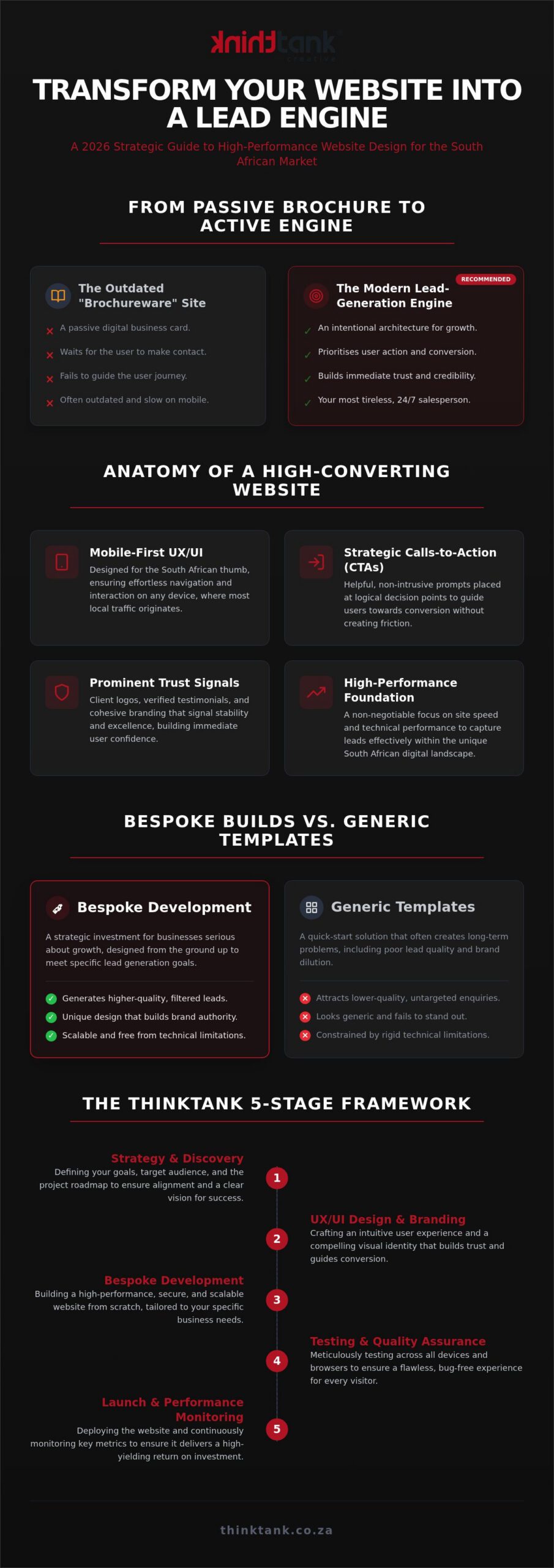
Static brochureware has officially reached its expiration date in 2026. For years, businesses treated their websites as digital business cards, passive repositories of information that waited for the phone to ring. Modern lead generation website design south africa has evolved into a sophisticated discipline of intentional architecture. It prioritises user action over passive browsing, transforming every pixel into a strategic touchpoint designed to capture interest and cultivate trust. This shift is driven by a market that no longer tolerates digital friction; if your site doesn't immediately solve a problem, your potential client is only one click away from a competitor who does.

Success in this space begins with your digital anchor, which is your strategic domain choice. A well-considered domain acts as the foundation for your lead generation efforts, signaling relevance to both search engines and local users. By aligning your technical infrastructure with a clear conversion-focused vision, you create an environment where high-performance growth becomes inevitable rather than accidental.

The Psychology of the South African Digital Consumer

Building trust is the primary hurdle in a national market where concerns regarding online fraud remain prevalent. South African consumers are discerning; they demand immediate value and professional credibility before they'll consider sharing their personal details. This is why professional branding is the critical first step in the lead conversion process. Meticulous logo and corporate identity design do more than look polished; they signal stability and excellence. Great marketing doesn't shout at the audience. It empowers them, providing the clarity and insight that makes the customer feel smart for choosing your business as their partner.

Key Metrics for Measuring Lead Generation Success

Precision in measurement is what separates a visionary strategy from a hopeful guess. We encourage our partners to look past vanity metrics like page views or generic traffic spikes. Instead, the focus must remain on conversion rates and the quality of the enquiries received. A "Qualified Lead" looks different depending on your sector; a B2B service provider might value a detailed project brief from a corporate decision-maker, whilst a B2C retailer seeks immediate transactional intent. Understanding these nuances is essential when measuring the ROI of a website redesign. By tracking the right data, you gain a concrete understanding of how your bespoke build contributes to your bottom line, ensuring your digital investment remains a high-yielding asset for years to come.

The Anatomy of a High-Converting Lead Generation Website

High-performance lead generation website design south africa relies on a meticulous arrangement of technical and visual components. It isn't enough to simply have a contact form; every element must work in synergy to guide the visitor toward a specific outcome. This architectural approach ensures that your digital presence acts as a filter, attracting high-quality enquiries whilst discouraging time-wasters. By integrating strategic Call-to-Action (CTA) placements that feel helpful rather than intrusive, you respect the user's journey whilst maintaining a clear path to conversion. These prompts should appear at logical decision points, providing the next step exactly when the user's interest is piqued.

Trust signals serve as the psychological glue of your lead engine. When a visitor arrives, they subconsciously look for indicators of stability and professional excellence. Integrating client logos, verified testimonials, and a cohesive corporate identity provides the immediate reassurance needed to move forward. At ThinkTank Creative, we've refined this process since 2001, ensuring that every design element reinforces your brand's authority within the national market. This level of meticulous detail transforms a generic website into a bespoke sales tool that commands respect and builds immediate rapport with your audience.

Mobile-First UX/UI for National Accessibility

Designing for the South African thumb is a practical necessity. With the majority of local traffic originating from mobile devices, navigation must be effortless and reachable. We prioritise large, tappable areas and streamlined forms that minimise friction on small screens. It's essential to ensure your site follows the principles in our Improving Website User Experience Guide to maintain engagement across all device types. This focus on accessibility ensures that even users on older smartphones or fluctuating networks can interact with your brand without frustration. Every tap should lead the user closer to a conversion, not a dead end.

Technical Performance and Lead Retention

Technical performance is the silent driver of lead retention. In a landscape where connectivity can be inconsistent, a slow-loading page is the fastest way to lose a prospect. Mastering lead generation website design south africa requires more than aesthetic appeal; it demands a deep understanding of technical performance. Data suggests that even a one-second delay can lead to a sharp increase in abandonment rates. Our development team focuses on clean, efficient coding that balances high-impact visualisations with rapid load times. This technical rigour doesn't just improve user experience; it significantly enhances your national search visibility, as search engines prioritise sites that provide a stable and fast environment. If you're ready to elevate your digital presence, our specialised website design team is here to help you build a platform that truly performs.

Bespoke vs. Template: Which Generates Better Leads in ZA?

Choosing between a pre-built template and a bespoke digital architecture is the first critical decision in your growth journey. Whilst templates offer a tempting shortcut, they often trap businesses in a cycle of mediocrity characterised by bloated code and a generic aesthetic that fails to inspire trust. This "Template Trap" might save costs during the initial build, but the long-term impact on lead quality is frequently devastating. A template is designed to fit everyone, which means it isn't specifically engineered to fit your unique customer journey or the specific nuances of the South African market. Entrepreneurs looking to avoid these pitfalls will find valuable guidance in our dedicated resource on small business website design South Africa, which outlines the strategic foundations needed for a high-converting online presence.

Strategic lead generation website design south africa requires a level of precision that only bespoke builds can provide. Custom architecture allows for the seamless integration of unique sales funnels tailored to your industry's specific pain points. For scaling organisations, the transition to custom website design in South Africa is a vital step in moving from a passive online presence to a proactive lead-generation engine. By building from the ground up, you ensure that every design choice serves a purpose, guiding the user toward a conversion with quiet, authoritative assurance.

Scalability and Long-Term Digital Growth

Bespoke builds offer a level of flexibility that templates simply cannot match as your business expands. Custom sites are inherently easier to maintain and upgrade because the underlying code is clean and purposeful, avoiding the technical debt that accumulates with pre-packaged themes. We focus on bespoke system development that can automate your lead management, ensuring that every enquiry is tracked and handled with precision. This approach maintains absolute brand consistency across every digital touchpoint, reinforcing your authority whilst your organisation grows. It's about creating a foundation that supports future innovation rather than one that restricts it.

The SEO Advantage of Custom Architecture

Bespoke coding provides a significant advantage when competing for national visibility. Unlike restrictive website builders that often impose an "SEO ceiling", custom architecture allows for the integration of on-page SEO from the very first stage of our 5-stage development process. By eliminating unnecessary scripts and optimising the site's structure, we ensure your platform is primed to rank for competitive national keywords. This technical excellence ensures that your lead generation efforts aren't hampered by the hidden limitations of a rigid, pre-packaged solution. You aren't just building a site; you're engineering a high-performance asset that search engines can easily understand and prioritise.

Lead Generation Website Design South Africa: The 2026 Strategic Guide

The ThinkTank 5-Stage Framework for Lead Generation Success

High-performance growth is never a product of chance; it's the outcome of a disciplined, methodical framework. We follow a structured 5-stage development process that has been refined since 2001 to ensure every project delivers measurable results. This journey begins with Step 1: Research & Strategy, where we define your lead goals, followed by Step 2: Planning & Design to visualise the customer journey. We then move into Step 3: Program & Development to build your technical engine, followed by a rigorous Step 4: Testing & Revise phase. Finally, Step 5: Launch & Support ensures your digital presence maintains its momentum long after the initial build is complete. This journey transforms your lead generation website design south africa from a conceptual vision into a concrete, high-yielding asset. To understand exactly what to expect at each milestone, our website design process for clients guide provides a transparent, step-by-step walkthrough of the entire collaborative journey.

Research & Strategy: The Foundation of Every Lead

Effective lead generation starts with a deep dive into the competitive landscape. We embark on a journey of imagination to define your lead goals, ensuring every technical decision serves a strategic purpose. This stage involves analysing competitor behaviour in the South African market to identify gaps and opportunities that allow your brand to stand out. We carefully define your primary and secondary lead actions, such as direct WhatsApp enquiries or detailed form submissions, to ensure the site architecture supports your specific sales goals. By aligning this strategy with your established corporate identity, we create a synergy between your brand's heritage and its digital future. We do it all so you don't have to, managing the complex research required to anchor your project in reality.

The Importance of Testing and Post-Launch Support

A high-performance lead engine is never truly finished. The digital environment is fluid, requiring constant vigilance to ensure every form and CTA performs flawlessly across all devices. Our Testing & Revise phase is meticulous, identifying potential friction points before they can impact your conversion rates or brand reputation. Once the site is live, we use real-world data and feedback to fine-tune your conversion funnels, ensuring the platform evolves alongside your business. ThinkTank Creative's commitment to ongoing service means you have an approachable creative partner dedicated to your long-term success, providing the stability of a long-standing enterprise with the agility of a creative agency. If you're ready to begin your brand transformation, we invite you to contact our expert design team for a thorough discussion of your needs and a bespoke project estimate.

Maximising Conversions: Integrating Branding and Content

High-performance growth is the result of a seamless marriage between visual authority and persuasive messaging. Whilst technical speed and mobile-first architecture provide the foundation, it is your brand's unique identity that ultimately secures a conversion. Professional logo and corporate identity design act as critical trust markers; they reduce bounce rates by immediately signaling that your business is established, capable, and elite. In the competitive landscape of lead generation website design south africa, a polished visual presence ensures that you don't just attract visitors, but you command their respect from the very first second they land on your page.

The true power of a lead engine lies in the synergy between writing effective website copy and bespoke visual design. Words and imagery must work in perfect unison to guide the user through the sales funnel without friction. We enhance this journey by utilising custom video posts and detailed reporting, keeping users engaged whilst providing you with the data needed to understand their behaviour. This holistic approach reinforces the ThinkTank promise: "We Do It All So You Don't Have To". By managing every aspect of the creative and technical process, we allow you to focus on your core operations whilst we engineer your growth.

Branding as a Trust Engine

A cohesive visual brand does more than just look attractive; it makes your organisation look smart and dependable. This sense of professional excellence must extend beyond the digital screen to include high-quality printing solutions. When your digital leads are supported by synchronised print marketing collateral, such as professional "leave-behind" brochures, it creates a unified brand experience that builds immediate authority. Ensuring your digital and physical branding are perfectly aligned prevents the cognitive dissonance that often kills a sale. It's about creating a bespoke craftsmanship feel that makes every client interaction feel tailored and high-value.

Ready to Transform Your Digital Presence?

Our "all-rounder" team provides a comprehensive solution that moves your business from a passive observer to an industry leader. We don't just build websites; we facilitate a collaborative process of discussion and debate that leads to innovative, results-driven outcomes. This partnership ensures that every facet of your lead generation website design south africa is meticulously planned and expertly executed. We invite you to contact us for a thorough discussion of your specific business needs. Following our consultation, we provide a detailed project proposal and an estimated cost, ensuring you have a clear understanding of the ROI and strategic path ahead. Let's embark on this journey together to elevate your brand and secure your digital future.

Elevate Your Brand and Secure Your Digital Future

Transforming your digital presence from a passive brochure into a high-performance engine requires a meticulous blend of strategy, technical excellence, and visual authority. We've explored how bespoke architecture and a mobile-first approach eliminate user friction, whilst a structured 5-stage framework ensures your investment delivers measurable growth. Mastering lead generation website design south africa is no longer just about aesthetics; it's about engineering a platform that builds immediate trust and converts casual browsers into loyal partners.

At ThinkTank Creative, our award-winning design team has been refining this collaborative process since 2001. As an all-rounder agency, we handle everything from corporate identity to complex development, ensuring your brand remains consistent and competitive. We do it all so you don't have to, providing the strategic depth and creative craftsmanship needed to scale your organisation with confidence. We invite you to embark on a journey of imagination with ThinkTank Creative today and discover the potential for your brand's transformation. The future of your digital growth starts with a single, purposeful step toward excellence.

Frequently Asked Questions

What is the best type of website for lead generation in South Africa?

The most effective platform for lead generation website design south africa is a bespoke build designed with a conversion-focused architecture. Unlike passive brochure sites, these platforms are engineered to guide visitors through a specific journey, utilising clear calls-to-action and strategic trust signals. By focusing on usability and functionality, you ensure the site acts as a tireless salesperson, filtering for high-quality enquiries that align with your business goals and national market demands.

How long does it take to design and launch a lead generation website?

Launch timelines vary based on the project's complexity and your specific requirements. We follow a structured 5-stage development process encompassing planning, design, programming, testing, and delivery to ensure precision at every step. This methodical approach allows us to maintain competitive time limits whilst delivering award-winning quality. We provide a detailed project timeline and estimated cost after a thorough discussion of your needs, ensuring you have a clear roadmap for your brand's digital transformation. For a detailed breakdown of what each stage involves, our guide to the website design process for clients offers a transparent overview of every milestone from concept to launch.

Do I need a separate landing page for my lead generation campaigns?

Dedicated landing pages are often essential for high-performance campaigns, such as PPC or social media advertising. By removing global navigation and focusing on a single objective, you significantly reduce user distraction and improve conversion rates. Whilst your main website serves as a comprehensive brand anchor, these specialised pages act as targeted entry points. They allow for precise reporting and A/B testing, ensuring your marketing spend generates the highest possible volume of qualified leads.

How does mobile-first design impact lead conversion in ZA?

Mobile-first design is a non-negotiable requirement for success in the South African market. With the majority of local internet traffic originating from smartphones, your site must perform flawlessly on devices with varying screen sizes and connectivity speeds. A mobile-optimised interface reduces friction, making it easier for users to complete forms or initiate calls whilst on the move. This accessibility directly correlates with higher lead retention and a more professional brand image amongst national consumers.

Is custom web design better than using a template for leads?

Bespoke web design consistently outperforms templates by providing a foundation of clean, efficient code and unique functionality. Templates often carry unnecessary technical debt and bloated scripts that can hinder site speed and national search visibility. A custom build allows for the integration of specific sales funnels tailored to your industry's nuances. This investment ensures your platform is scalable and perfectly synchronised with your corporate identity, avoiding the restrictive SEO ceiling found in generic builders.

How much should I budget for a lead generation website in 2026?

Budgeting for a digital project in 2026 depends entirely on your organisation's scale and the technical complexity required. We don't offer one-size-fits-all pricing because every business has unique goals and challenges. Instead, we provide a comprehensive estimated cost after an initial discussion and debate regarding your strategic needs. This collaborative approach ensures that your budget is allocated effectively toward features that drive actual ROI, rather than unnecessary bells and whistles that don't support growth.

What are the most important trust signals for a South African website?

Establishing credibility in the national market requires a mix of visual and technical trust signals. Professional logo and corporate identity design are the first indicators of stability, whilst clear contact details and verified testimonials provide social proof. Additionally, transparent compliance with POPIA regulations and secure data handling are vital for reassuring South African consumers. These elements work together to reduce bounce rates and create a sense of quiet assurance that encourages visitors to share their information.

Does ThinkTank Creative provide ongoing support after the site goes live?

We are committed to providing ongoing service long after your lead engine goes live. Our all-rounder team offers comprehensive website maintenance and support to ensure your platform remains secure, functional, and optimised for growth. This includes everything from reporting and content creation to channel optimisation and technical updates. By acting as your approachable creative partner, we ensure your digital presence continues to evolve, reinforcing our core promise: "We Do It All So You Don't Have To."