Signs of a Bad SEO Agency: A Practical Checklist for Businesses

What if the biggest warning sign isn’t a ranking drop, but an agency that can’t explain what it’s doing or why? The signs of a bad seo agency often show up in the gaps between promised results, completed work and evidence you can inspect. A change in traffic alone doesn’t prove an agency has failed, but vague answers and unexplained tactics deserve attention.

It’s reasonable to expect SEO reports to show more than rankings and activity. You need to understand how the work supports your business objectives, what the results mean and what happens next. Comparing agencies can be difficult when proposals use different terms and measures, so look for clarity as well as confidence.

This practical checklist will help you recognise risky practices, assess evidence and accountability, and ask informed questions about strategy, access and communication. You’ll also learn how to distinguish normal fluctuations from more serious concerns, so you can choose a collaborative SEO partner with a clear view of the next steps.

Key Takeaways

  • Treat the signs of a bad seo agency as prompts to investigate, not automatic proof of misconduct.
  • Use a structured review of goals, baseline results, completed work, supporting evidence and next steps to assess an agency’s reporting.
  • Compare contracts, account access and link-building practices, then use focused questions to clarify responsibilities and expectations.
  • If concerns arise, document them, request clear explanations and preserve access to accounts and records before making changes.
  • Look for a partner whose transparent process connects SEO with relevant content, paid advertising and website development.

Signs of a bad SEO agency: warning signs worth investigating

Vague promises, unclear work and reports that don’t connect activity to business results can leave you wondering what your SEO agency is actually doing. These are among the signs of a bad seo agency worth investigating, but a red flag calls for scrutiny, not an automatic conclusion. Look for repeated patterns and ask for evidence before deciding whether there’s a problem.

SEO involves more than chasing rankings. A neutral overview of search engine optimization can help clarify the range of work involved. Strategy should account for your business goals and circumstances, and the agency should be able to explain its approach in language you can understand.

Use this video as a prompt for questions to raise with your agency:

Which SEO agency promises should make you pause?

A guaranteed first-place ranking or a precise traffic outcome deserves questions, not blind trust. Search results are influenced by factors such as competition, your website’s condition and the resources available for the work. A credible agency can set measurable goals, explain its assumptions and review progress, but it shouldn’t present an uncertain outcome as assured.

Measurable targets show what you’re working towards; guaranteed rankings claim control over an outcome no agency can fully dictate. Be cautious if an agency promises results before discussing your goals or assessing your starting point. “Secret methods” that can’t be explained, or pressure to sign before the strategy is clear, also make the work and its risks harder to assess.

When does poor communication become a warning sign?

One delayed reply or a short-term ranking change isn’t enough to establish a problem. Pay attention to a pattern: questions repeatedly go unanswered, reports arrive without explanation, or updates use jargon instead of describing what was done and what comes next. Technical work can be complex, but its purpose and business relevance should still be understandable.

SEO often involves research, implementation, testing and adjustment over time. Rankings can move as search conditions and strategies change, so judge performance in context rather than reacting to a single fluctuation. Ask what changed, what evidence supports the explanation and whether any follow-up is planned. A clear, considered response helps distinguish normal movement from an accountability concern.

How to check an SEO agency’s strategy, evidence and reporting

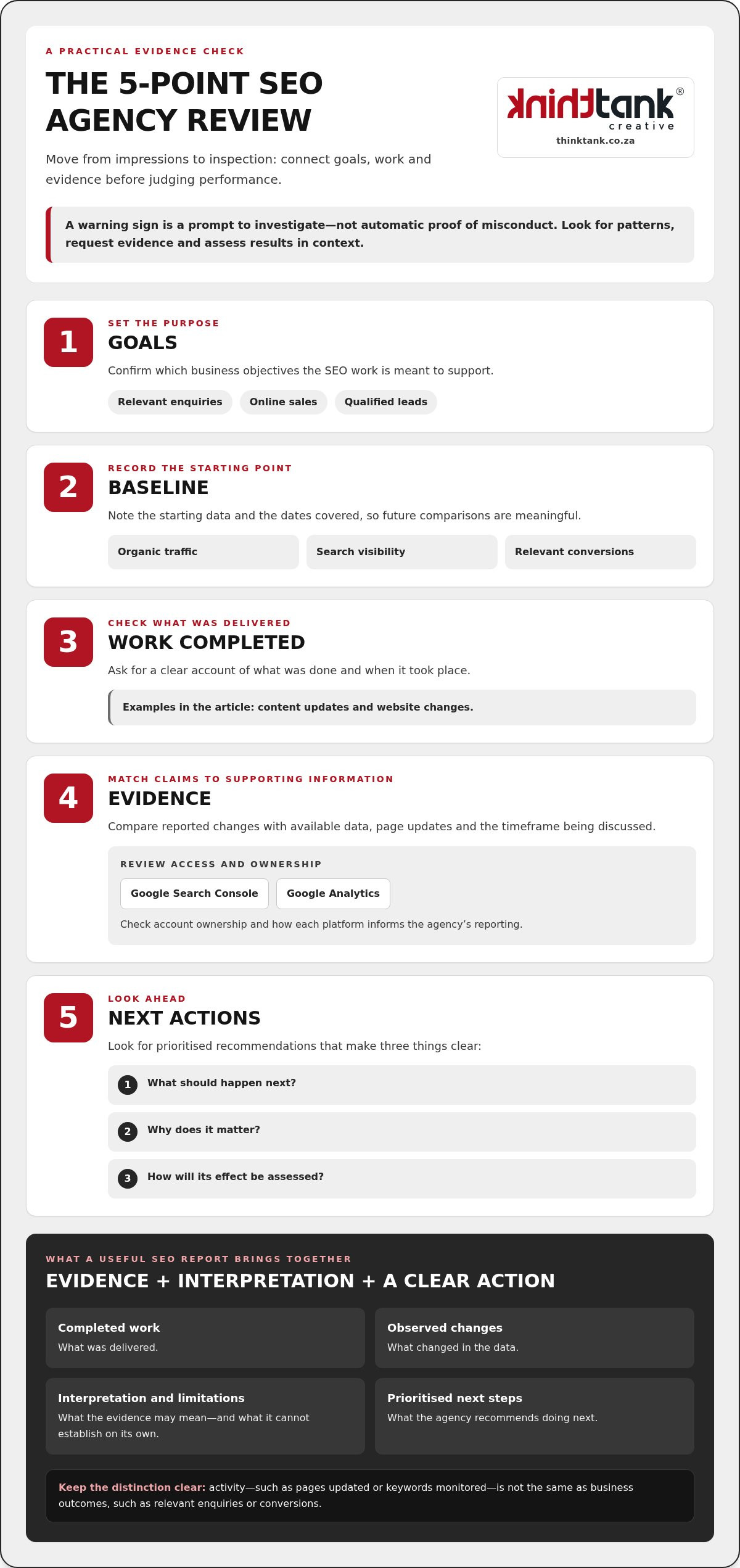
Move from impressions to inspection. Reviewing goals, baseline data, completed work and outcomes helps you assess whether an agency’s strategy is connected to your business, rather than simply producing activity. These checks can help distinguish genuine signs of a bad seo agency from a report that needs more context.

Use this five-step review:

For broader context on SEO strategy in South Africa, read this South African SEO strategic guide.

What should an SEO report explain?

A useful report sets out completed work, observed changes, the agency’s interpretation, any limitations and prioritised next steps. It distinguishes activity, such as pages updated or keywords monitored, from outcomes that matter to your business, such as relevant enquiries or conversions. Search visibility and organic traffic can indicate whether more people are finding your site, but the business context helps reveal whether that attention is valuable.

A useful SEO report combines evidence with interpretation and a clear action. If a metric has changed, the report should explain what it may mean, what it can’t establish on its own and what the agency recommends doing next.

How can you assess SEO claims without relying on rankings alone?

Compare each claim with the dates, baseline, pages changed, search data and relevant business outcomes. Rankings vary, so consider them alongside organic traffic, conversions and the quality of enquiries. A sudden traffic spike or impressive backlink total is a reason to ask for context: which pages or sources drove the change, and did it reach the intended audience?

Clear reporting makes collaboration easier. For more on assessing an SEO approach, explore SEO strategy and reporting as part of a wider digital marketing plan.

Review the working arrangements as carefully as the strategy. A clear agreement should explain what the agency will do, how progress will be communicated and what happens if the relationship ends. Vague terms, restricted access or unexplained link-building methods are signs of a bad seo agency worth examining, but they aren’t proof of wrongdoing on their own.

Use this comparison to identify what needs clarification:

Transparent practice Concerning practice Follow-up question
Deliverables, responsibilities and reporting cadence are described plainly. The scope is vague, or reports and updates are irregular or undefined. What work will be completed, by whom and how often will progress be reported?
Cancellation and exit terms are understandable. It’s unclear how to end the arrangement or what happens to work in progress. What steps, notice and handover apply if either party ends the agreement?
Your business can access its website and analytics accounts, with responsibilities agreed. Access is controlled solely by the agency, or account ownership is unclear. Who owns each account, and how can authorised people access it?
Link acquisition methods and their purpose can be explained. Links are undisclosed, irrelevant or presented in reports that can’t be verified. How were these links acquired, and where can I review them?

What contract details should an SEO client understand?

Before work begins, check that the scope, deliverables, each party’s responsibilities, reporting cadence and exit terms are clear. An agreed activity, such as updating pages, is different from a promised ranking or revenue result. If a clause is unclear or its implications matter, seek qualified professional advice on the contract rather than relying on an agency’s explanation alone.

Make access practical, too. Your organisation should understand who controls its website, Google Search Console and Google Analytics accounts, and how access can be maintained if the working relationship changes. Clarify who is responsible for changes and approvals so important work isn’t left in limbo.

What makes backlink work difficult to trust?

Ask the agency to explain how links are acquired and what role they play in the strategy. Undisclosed paid links, irrelevant placements or reports that don’t let you verify the sites involved warrant further questions. Link volume alone doesn’t show whether the work is relevant or responsibly carried out. For a deeper look at ethical authority-building, explore local link-building strategies in South Africa.

Look for explanations you can follow and records you can review. Clear terms and accessible accounts help you assess the work and keep your digital assets under your organisation’s control.
Signs of a Bad SEO Agency: A Practical Checklist for Businesses

What to do when your SEO agency shows warning signs

Take a measured approach. One disappointing metric or unclear report doesn’t automatically mean your agency is acting irresponsibly, but repeated gaps deserve a direct conversation. Document what concerns you, ask for an explanation and agree on specific next steps before making a decision about the relationship.

How should you raise concerns with an SEO agency?

Prepare for a focused review. Bring examples, dates, relevant reports and the business priorities the SEO work is meant to support. For instance, note which deliverable you expected, when it was due and what information you’ve received so far. This keeps the discussion grounded in observable details rather than general frustration.

Ask the agency to explain its findings, decisions and any risks or limitations, then set out what needs to happen next. Confirm the agreed actions, who is responsible and a practical date to review progress in writing. A clear record helps both sides understand the plan and makes it easier to assess whether concerns are being addressed.

When should you consider changing SEO agencies?

Consider a change if material concerns persist after you’ve raised them clearly and allowed for agreed follow-up. Repeatedly unexplained tactics, missing work or an unwillingness to clarify responsibilities may point to a working relationship that no longer supports your objectives. Slow progress on its own doesn’t prove poor or unethical work; SEO outcomes can take time, and performance needs to be assessed in context.

Before ending an engagement, review the transition carefully. Preserve access to your website, Google Search Console and Google Analytics accounts, along with reports, records of completed work and relevant communications. Clarify what work is under way, what remains outstanding and how access or responsibilities will be handed over. Check the agreement’s exit terms and seek professional advice if you need help interpreting them. Avoid making abrupt changes based on one ranking movement.

If you’re unsure how to interpret the evidence, return to the same practical checks: what work was agreed, what was completed, what the data shows and what action is proposed. Use the answers to make a considered decision rather than abandoning useful work without understanding the consequences.

For more context as you review your approach, explore ThinkTank Creative’s SEO strategic guide for South Africa.

To understand how SEO work can fit into a wider digital marketing plan, review ThinkTank Creative’s SEO services.

Choose an accountable SEO partner with a clear working process

A strong SEO partnership makes the work understandable and keeps it connected to your business priorities. Look for a transparent scope, clear responsibilities, reporting you can interpret and communication that welcomes informed questions. Realistic expectations matter, too: a credible partner can explain the intended direction and how progress will be assessed without promising instant, guaranteed transformation.

What does a credible SEO partnership look like?

Start with shared objectives. You and the agency should understand what SEO is meant to support, who is responsible for each part of the work and how decisions will be reviewed. As results and circumstances change, an accountable partner explains the evidence behind adjustments, including the trade-offs involved. The strategy shouldn’t be a black box.

SEO also works best when it fits the wider digital picture. Relevant content can support search visibility, paid advertising can complement broader marketing activity, and website development can help address user experience or site needs. The right mix depends on your goals; connected services should work together rather than become a list of disconnected tasks.

How does ThinkTank Creative approach connected digital work?

ThinkTank Creative’s approach includes research and strategy, clear communication, testing and delivery. Its digital work includes SEO alongside content creation, digital paid advertising, copywriting and reporting. Where appropriate, these activities can align with website development so search strategy, content and the website contribute to a coherent direction.

ThinkTank Creative provides ongoing service after project completion, supporting continued collaboration as priorities and learning develop. You should be able to understand what is being done, why it matters and how the work relates to your objectives. That’s a more dependable foundation than unexplained tactics or claims of overnight success. We Do It All So You Don’t Have To reflects an integrated approach, with communication and strategy helping connect the work.

As you weigh the signs of a bad seo agency against the qualities of a more accountable partner, focus on whether the process gives you clarity and a meaningful role in decisions. Consider how the proposed work will support your objectives, how progress will be communicated and what the next steps involve.

Discussing your SEO needs and timeline is a practical way to establish those priorities. An estimated cost is provided after discussion of your needs and timeline, so you can consider the proposed work in context.

Choose clarity and build a stronger SEO partnership

The signs of a bad seo agency are reasons to investigate, not a verdict based on one ranking change. Look for a consistent pattern: promises without a clear strategy, work you can’t verify, reports without business context or unclear access and responsibilities. A credible partner makes its approach understandable, connects activity to your goals and agrees practical next steps with you.

Founded in 2001, ThinkTank Creative provides connected digital work that includes SEO, content creation, digital paid advertising, copywriting and reporting, with ongoing service after project completion. This creates room for a considered approach that can bring related marketing activity together where it supports your objectives.

Ready to discuss your digital marketing needs and timeline? Talk with ThinkTank Creative. An estimated cost follows a discussion of your requirements, so the proposed work can reflect your priorities.

Choose a partnership built on clear communication, thoughtful strategy and progress you can understand.

Frequently Asked Questions

What are the biggest signs of a bad SEO agency?

The clearest signs of a bad seo agency include guaranteed rankings, unexplained tactics, unclear deliverables and reports that don’t connect work to business goals. Repeatedly unanswered questions or pressure to sign before the strategy is explained also deserve scrutiny. Look for patterns, not one isolated incident. Ask the agency to show what it has done, explain the evidence and outline what it recommends next before deciding whether there’s a serious concern.

Can an SEO agency guarantee first-page rankings?

No agency can credibly guarantee a specific first-page ranking, because search results depend on factors beyond its control, including competition and changes in search systems. A responsible agency can set measurable goals, explain its strategy and track progress against an agreed baseline. Treat promises of a precise position or outcome as a reason to ask how that result is assured. Distinguish a target the agency will work towards from a result it claims to guarantee.

How do I know if my SEO agency is doing a good job?

Assess whether the agency’s work is clear, evidence-led and relevant to your business objectives. Check what was completed, compare search visibility and organic traffic with a baseline, and review whether those changes are contributing to relevant enquiries or conversions. Reports should interpret results, acknowledge limitations and identify next actions, not just list rankings or activity. Good work also includes understandable communication, agreed responsibilities and a strategy that can be adjusted as evidence develops.

Should an SEO agency own my website or Google Analytics account?

Your business should retain ownership and control of its website and analytics accounts, whilst giving the agency the access it needs to carry out agreed work. Make sure authorised people in your organisation can access Google Analytics and Google Search Console, and understand who manages permissions. Clarify account responsibilities at the start of the relationship. Keeping access and records in your control helps protect continuity if staff, suppliers or working arrangements change.

Is a sudden drop in organic traffic proof my SEO agency is bad?

No. A traffic drop by itself doesn’t prove that your agency has done poor work or used harmful tactics. Check the dates, affected pages and search data, and consider whether website changes or broader search fluctuations could provide context. Ask the agency to investigate the change, explain what the evidence shows and recommend next steps. Look for a clear response and follow-through rather than drawing a firm conclusion from one metric.

What should I do if I think my SEO agency is using harmful tactics?

Document the specific work or claims that concern you, including dates, pages and reports, then ask the agency for a clear explanation of its methods and their purpose. Preserve access to your website and analytics accounts, along with relevant records, before making changes to the relationship. Agree corrective actions and a review point in writing. If concerns persist, assess the transition options carefully rather than reacting on incomplete evidence.

How often should an SEO agency report on its work?

Agree a reporting cadence that suits the scope of work and your decision-making needs; there isn’t one frequency that fits every SEO engagement. Reports should arrive consistently and explain completed work, changes in relevant metrics, context, limitations and prioritised next steps. Make sure you know who will provide updates and how questions will be handled between reports. A regular, understandable reporting rhythm helps you evaluate progress without treating every short-term movement as a final verdict.
What to Do After Your New Website Goes Live: Checklist

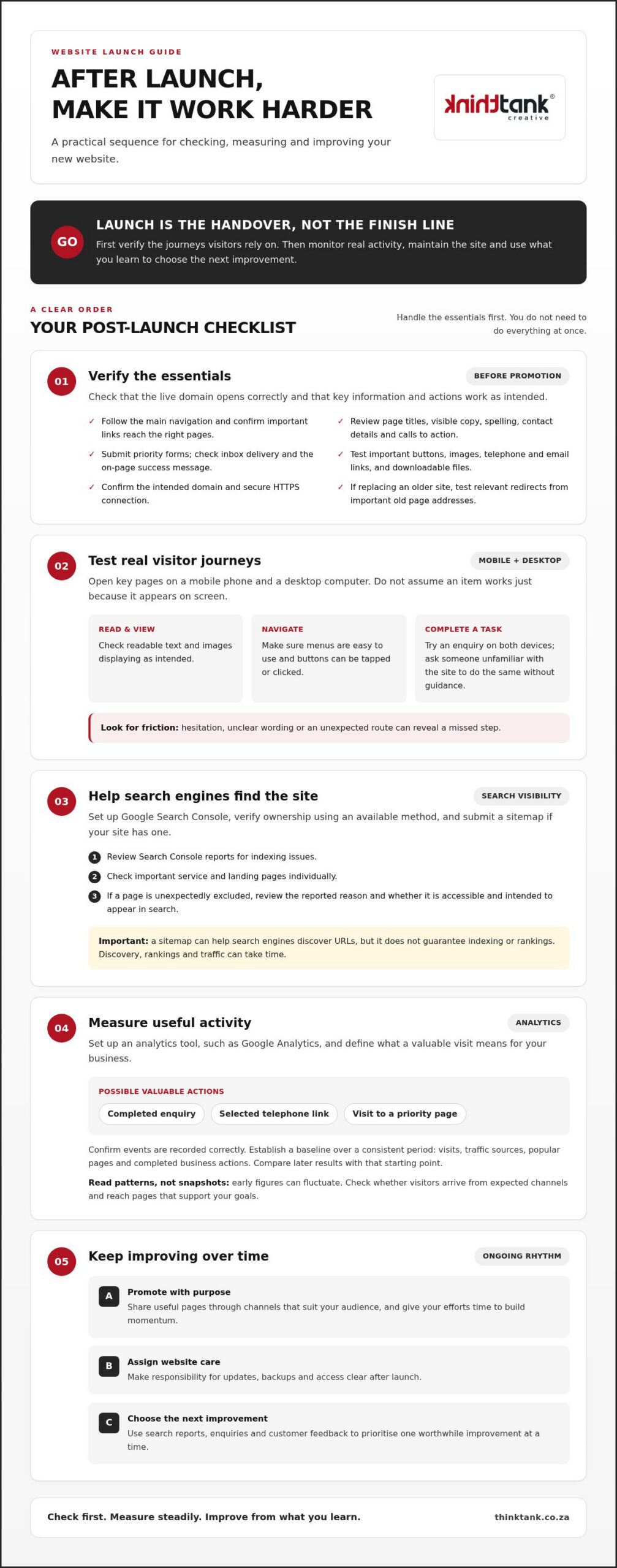
A website launch is a beginning, not a finish line. If you’re wondering what to do after your new website goes live, start by checking that it works as intended, then set a regular rhythm for monitoring and improvement. A site can look polished but still have broken links, forms that fail to submit or pages that search engines can’t find.

It’s natural to want to promote your new website straight away. First, run a few practical checks to catch issues early and make the experience smoother for visitors. You don’t need to do everything at once. A clear order makes the next steps easier to manage.

This checklist covers testing key pages and functions, checking search visibility, setting up performance tracking and planning ongoing maintenance. It also explains how promotion and regular review can help your website support your business over time. Treat launch as the handover, then use what you learn from real visitors to shape what comes next.

Key Takeaways

  • Use a structured checklist for what to do after your new website goes live, starting with the pages and tasks visitors rely on most.
  • Connect your site to search and analytics tools to monitor visibility and understand which actions visitors complete.
  • Promote useful pages through channels that suit your audience, and give your efforts time to build momentum.
  • Assign responsibility for updates, backups and access to keep your website maintained after launch.
  • Use search reports, enquiries and customer feedback to prioritise one worthwhile improvement at a time.

What to check immediately after your new website goes live

Start with the essentials: does the live domain open correctly, can visitors find the pages they need, and do the main actions work? Test common journeys, such as finding a service, calling your business or sending an enquiry. A polished homepage is only part of the picture. A broken contact form or an unclear route to key information can undermine the whole experience.

Use this first review to catch launch-critical issues, not to perfect every detail. Check page titles, visible copy, spelling, contact details and calls to action. These checks also help establish a clear foundation for Search engine optimization, which makes a site easier for search engines and people to understand.

How to test the live website across devices

Open your key pages on a mobile phone and a desktop computer. Check that text is readable, images display as intended, menus are easy to use, and buttons can be tapped or clicked. Test telephone and email links, along with downloadable files. Don’t assume something works just because it appears on the page.

Launch principle: verify critical visitor journeys before promoting the site. A quick, independent test can reveal unclear wording or a missed step that’s easy to overlook when you already know how the website is meant to work.

What to verify before sharing the new website

Submit each important form yourself. Confirm that the message reaches the intended inbox and that the visitor sees a clear success message after sending it. Check that the confirmation explains what happens next without promising a response time your business hasn’t committed to.

If the new site replaces an older one, test redirects from important old page addresses where relevant. Confirm that the website uses its intended domain and loads securely over HTTPS. Then review this pre-promotion checklist:

Once these essentials are in place, you’ll have a more reliable base for sharing the website and learning from visitor behaviour. If you’re working with a web partner, include these checks in the launch handover so responsibilities and outstanding issues are clear.

How to help search engines find your new website and measure visits

After the live site passes its essential checks, set up ways to monitor how search engines access it and what visitors do. Search visibility and audience activity are different signals. One helps you understand whether pages are appearing in search, while the other shows how people use the website after arriving.

How to submit and monitor a new website

Set up Google Search Console and verify ownership using one of the methods currently offered during setup. If your site has a sitemap, submit it through the platform and review its reports for indexing issues. A sitemap can help search engines discover URLs, but it doesn’t guarantee that every page will be indexed.

Check important pages individually, especially core service pages and key landing pages. If a page is unexpectedly excluded, review the reason reported in Search Console and investigate whether the page is accessible and intended to appear in search. Follow Google’s current guidance, as its interface and verification options may change.

Remember: submitting a sitemap helps search engines discover pages, but it doesn’t promise rankings. Search engines decide whether and where pages appear, and discovery, rankings and traffic can take time. Keep monitoring rather than treating submission as a one-off guarantee.

Which early website metrics are worth tracking?

Set up an analytics tool, such as Google Analytics, and decide what counts as a valuable visit for your business. Depending on your goals, useful actions might include a completed enquiry, a selected telephone link or a visit to a priority page. Confirm that these events are recorded correctly before using them to assess marketing activity.

Establish a baseline by recording visits, traffic sources, popular pages and completed business actions over a consistent period. Then compare later results with that starting point. Early figures can fluctuate, so avoid drawing firm conclusions from a brief snapshot. Look for patterns: are visitors arriving from the channels you expected, and are they reaching the pages that support your goals?

For a helpful introduction to interpreting reports, explore the existing guide, Understanding your website analytics report. Apply its principles to your own objectives rather than tracking every available metric. A short, relevant set of measures is easier to review and more likely to guide a practical next step.

These tools work best as part of an ongoing process. If you’d like support connecting search visibility with website performance, explore SEO and website support.

How to promote a new website without expecting instant results

Promotion works best when it connects the right audience with a useful next step. Instead of sharing every page everywhere, choose channels that match your customers, your offer and the time you can consistently devote to them. A focused plan is easier to manage and gives you clearer signals about what’s working.

How to bring the right visitors to a new website

Start with audiences you already reach. Share a relevant service or landing page through your social channels or an email update, and explain what visitors can do next, such as exploring an offering or sending an enquiry. A useful link with a clear purpose is more helpful than simply announcing that the website is live.

Use customer questions to shape ongoing content. If people often need help comparing options or understanding how a service works, create a page or post that answers those questions and points to a relevant next step. A considered publishing schedule can keep your content useful. The guide How to Create a Content Marketing Plan can help you organise topics over time.

Choose channels according to your objectives and capacity:

You don’t need to use every channel at once. Select one or two that fit your plan, then review the response before expanding your activity. This makes it easier to learn without creating more work than your team can sustain.

How to set realistic expectations after launch

Publishing a website or sharing a page doesn’t guarantee immediate rankings, enquiries or sales. Search visibility takes time to develop, and campaign results depend on factors such as audience fit, the offer and the visitor experience. Set a clear objective for each activity, then measure it against meaningful actions, not attention alone.

For example, a social post might aim to bring people to a service page, while an email campaign might encourage readers to complete an enquiry. Review which channels attract relevant visits and which lead to actions your business values. Use those findings to refine your approach rather than judging success by a single short-term result.

If you’d like support aligning promotion with your goals, explore digital marketing support, including SEO, social media marketing, email marketing and PPC advertising.

What to Do After Your New Website Goes Live: Checklist

How to protect and maintain your website after launch

A live website needs clear ownership as well as technical upkeep. Decide who is responsible for software updates, backups, access permissions and reporting issues. If a web partner is involved, make sure the handover explains what they manage and what your team needs to handle. Knowing who to contact and what information to provide can make problems easier to resolve.

What should a website maintenance routine include?

Set a routine that reflects how your website is built, how often it changes and the guidance for its platform and components. Include update checks, backup reviews, functional testing and monitoring for availability, speed and broken links. Keep a simple record of completed checks, outstanding work and who is responsible. This makes maintenance manageable without assuming every site needs identical tools or timing.

Backups are most useful when they can be restored. Confirm that copies are being created as intended and periodically check that the restoration process works, following the relevant platform or provider guidance. After significant updates, test key pages and functions so you can identify problems. Agree where issues should be reported and how they’ll be prioritised instead of leaving escalation unclear.

How to keep website content and security current

Maintenance also covers the information visitors rely on. Review important service details, contact information, opening hours and calls to action when business details change. Remove or update content that no longer reflects what you offer. Keep an organised record of who can edit the site, and remove accounts that are no longer needed.

Use strong, unique credentials for website accounts and grant access according to each person’s role. Check current recommendations from your platform and relevant security providers before changing technical settings, as requirements can vary depending on how the site is configured. Avoid sharing login details informally, and make sure everyone involved understands the agreed process for access and reporting issues.

To plan ongoing care, you may also find Annual Website Maintenance: Budgeting in ZAR for 2026 useful if it’s published. A maintenance plan should reflect your site’s needs and responsibilities, not an arbitrary checklist. Knowing what to do after your new website goes live includes assigning an owner for routine care and improvements.

For support with ongoing website care, explore website maintenance and support.

How to improve your website using post-launch feedback and data

Choose your website’s next improvements using evidence, not guesswork. Bring analytics, search reports, enquiries and customer feedback together to understand what visitors need and where their experience may be falling short. A drop-off on a key page, repeated questions from prospective customers or feedback that an important detail is hard to find can each point to an opportunity.

How to turn early feedback into website improvements

Look for patterns rather than reacting to a single comment or short-term change in traffic. Are visitors reaching a priority page but not taking the next step? Are similar questions appearing in enquiries? Ask customers or colleagues where the site feels unclear, and listen for moments when they hesitate or can’t find what they need. The guide Improving Website User Experience: 2026 Strategic Guide can help you consider the experience from a visitor’s perspective.

Prioritise possible changes with three practical questions: could this make an important task easier for customers, is there evidence supporting the change, and do you have the resources to implement it well? For example, if visitors struggle to find a contact option and feedback confirms the issue, clarifying that route may be more valuable than changing several design details at once.

Use a simple cycle: review the evidence, prioritise one change, then measure its effect. Before making an update, note the issue you’re addressing and the relevant measure, such as completed enquiries or visits to a key page. After implementation, compare the same measure over a suitable period and record what changed. This helps you assess whether the adjustment appears useful and gives future decisions a clear reference point.

When to get ongoing website support

Consider support when maintenance, technical issues or planned changes exceed your team’s capacity. ThinkTank Creative’s website work includes testing, launch, training and support, with ongoing website maintenance and support available after project completion. That continuity can help you plan changes while keeping the site’s upkeep in view.

As you decide what to do after your new website goes live, keep the process manageable: use visitor evidence to select a priority, make a considered change and review what follows. If you’d like to discuss website support or improvements, share your needs and timeline with ThinkTank Creative so the conversation can focus on the right next steps.

Build lasting value from your website launch

A successful launch is the starting point for stronger digital performance. First, verify that essential pages and visitor journeys work. Then help search engines discover your site, promote relevant pages through suitable channels and establish a manageable maintenance routine.

Knowing what to do after your new website goes live also means paying attention to what happens next. Review search and analytics data alongside enquiries and customer feedback, then prioritise one useful improvement and measure its effect. An evidence-led approach helps you refine the experience without trying to change everything at once.

ThinkTank Creative was founded in 2001, and its website process includes testing, launch, training and support. If you’d like a collaborative partner for your website’s next stage, discuss your website’s next steps with ThinkTank Creative.

Your website is live. Keep learning from it and improving it, using each considered step to create room for what comes next.

Frequently Asked Questions

What should I do first after my new website goes live?

Start by checking that your live website works for visitors. Open key pages on mobile and desktop, follow the navigation, test important links and submit an enquiry form to confirm it reaches the right inbox. Check the details visitors rely on, including contact information and calls to action. These practical checks come before promotion in what to do after your new website goes live.

How do I get Google to find my new website?

Set up Google Search Console and verify that you own the website using a method currently supported by Google. If a sitemap is available, submit it through Search Console, then review its reports for indexing issues. You can also inspect important page addresses individually. Submission helps Google discover URLs, but it doesn’t guarantee that every page will be indexed or appear prominently in search results.

How long does it take for a new website to appear on Google?

There’s no guaranteed timeframe for a new website or page to appear in Google Search. Discovery and indexing can take time, and being indexed doesn’t guarantee a particular ranking or amount of traffic. Use Search Console to check the status of important pages and investigate unexpected exclusions. Make sure pages you want found are accessible and follow Google’s current guidance, then continue monitoring rather than repeatedly resubmitting without cause.

Do I need Google Analytics when my website launches?

Google Analytics isn’t essential for a website to function, but an analytics tool can help you understand how visitors use it. Set one up if you want to monitor visits, traffic sources, popular pages or actions such as completed enquiries. Check that important events are being recorded correctly before relying on the reports. Choose measures that relate to your business goals rather than tracking figures without a clear purpose.

Can I start promoting my new website straight away?

Yes, you can start promoting once you’ve checked that key pages and visitor journeys work. Share relevant landing pages through suitable social channels or email, and make the next step clear to visitors. Choose channels that suit your audience, offer and available capacity. Promotion can bring visitors, but publishing alone doesn’t guarantee rankings, leads or sales. Monitor whether each channel attracts relevant visits and meaningful actions.

What happens if I do not maintain my website after launch?

Without ongoing maintenance, updates may be missed, backups may go unchecked and website issues can go unnoticed. Outdated content can also leave visitors with inaccurate information. The specific risks depend on how your site is built and managed, so establish who is responsible for updates, access, backup checks and reporting problems. A suitable routine helps you spot issues and keep essential functions and information current.

How often should I update my new website?

There isn’t one schedule that suits every website. Review software and component updates according to the platform’s current guidance, and check key functions, backups and content as part of a routine that reflects your site’s needs. Update business details promptly when they change. A simple maintenance record can help you track what was checked, what needs attention and who is responsible without making the process unnecessarily complicated.

For help planning your website’s next steps, contact ThinkTank Creative to discuss your website needs and timeline.

Digital Marketing for Service Businesses: 2026 Guide

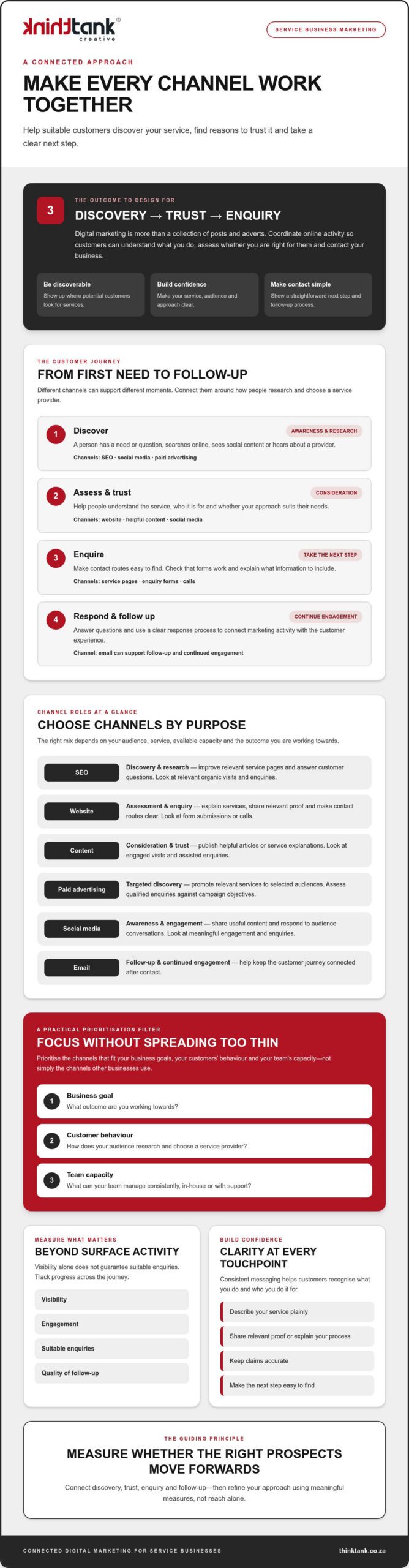
What if the issue isn’t how much you market your service business, but how well each channel works with the others? Digital marketing for service-based businesses is most effective when potential customers can discover your business, find clear reasons to trust it and take a straightforward next step.

If your marketing feels scattered across search, social media, paid advertising and email, you’re not alone. Keeping every channel active takes time, and visibility alone doesn’t guarantee suitable enquiries. The opportunity is to connect your efforts around how customers research and choose a service provider.

This guide will help you prioritise channels based on customer behaviour, create a measurable path from discovery to enquiry and follow-up, and decide what makes sense to manage in-house or with support. We’ll look at how your website, SEO, social media, PPC and email can work together, and what to measure so you can refine your approach with confidence.

Key Takeaways

  • Discover how digital marketing for service-based businesses can connect customer discovery, trust and enquiry across relevant channels.
  • See how to match channels such as SEO, social media, paid advertising and email to different stages of the customer journey.
  • Use a practical framework to choose priorities that fit your business goals, your customers’ behaviour and your team’s capacity.
  • Learn which measures can help you assess visibility, engagement, enquiries and follow-up beyond surface-level activity.
  • Identify when outside support may help bring greater clarity and consistency to your marketing, and what to ask a potential partner.

What digital marketing for service-based businesses needs to achieve

Service businesses sell expertise, trust and a clear next step, not just a product. Customers often need to understand what a service involves and whether the provider is right for them before they enquire. That makes digital marketing for service-based businesses more than a collection of posts and adverts. It’s coordinated online activity that helps suitable customers discover, assess and contact a business.

Services can be harder to evaluate before purchase because customers can’t simply inspect or try them in advance. The unique characteristics of service marketing help explain why clear information and confidence-building matter. Aim to guide people from awareness and consideration through to enquiry, follow-up and, where appropriate, repeat engagement.

For a useful perspective on marketing a service business, watch this conversation:

How the service-business customer journey works online

A potential customer may begin with a need or question, then search online, see a social media post or hear about a provider through someone they trust. As they compare options, your website should make the service, intended audience and next step easy to understand. Useful content can answer common questions and help people judge whether your approach suits their needs.

Make the next step visible, whether that’s completing an enquiry form or contacting your business through a stated channel. Check that the form works, the contact details are easy to find and the page tells visitors what information to include. The journey doesn’t end when someone gets in touch. A clear process for responding, answering questions and following up helps connect marketing activity to the real customer experience.

Why trust and clarity matter before the enquiry

Consistent messaging across your website, search presence, social media and email helps customers recognise what you do and who you do it for. Straightforward service descriptions reduce guesswork, while relevant proof, such as a suitable example of your work or a clear explanation of your process, can help address uncertainty. Keep claims accurate and make it easy for a prospective customer to find the information they need.

Digital marketing for a service business connects each online interaction to help the right customer move from discovering your expertise to trusting your offer and taking a clear next step. Measure progress by suitable enquiries and the quality of follow-up, not reach alone. Visibility can introduce your business to people, but its value depends on whether it helps the right prospects move forwards.

Which digital marketing channels support each stage of the customer journey?

Choose channels for the role they can play, not because every business appears to be using them. In digital marketing for service-based businesses, search, a useful website, social media, paid advertising and email can support different steps, from first discovery to continued engagement. The right mix depends on how your audience researches services, what you offer, the capacity available and the business outcome you’re working towards.

Channel Customer-journey role Typical activity Useful measure
SEO Discovery and research Improve relevant service pages and answer customer questions Relevant organic visits and enquiries
Website Assessment and enquiry Explain services, share relevant proof and make contact routes clear Enquiry form submissions or calls
Content Consideration and trust Publish helpful articles or service explanations Engaged visits and assisted enquiries
Paid advertising Targeted discovery Promote relevant services to selected audiences Qualified enquiries against campaign objectives
Social media Awareness and engagement Share useful content and respond to audience conversations Meaningful engagement and enquiries
Email Follow-up and repeat engagement Send campaigns or relevant automated responses to permission-based contacts Replies, clicks or subsequent enquiries

Search, content and the business website

SEO helps connect prospective customers’ searches with relevant service pages and helpful content. A useful service page explains what the service includes, who it is for and what to do next. It should also address questions someone is likely to have before making contact. Explore this search engine optimisation strategic guide for further context.

Once visitors arrive, clear navigation, readable information and a visible enquiry route help them decide what to do next. Check that the page content matches the promise made in a search result or campaign, and that visitors don’t have to search for contact details. Search visibility has limited value if the page doesn’t match the visitor’s intent or make contacting the business straightforward.

Paid advertising, social media and email

Paid advertising can place a relevant service in front of a selected audience. Assess it against its purpose, such as suitable enquiries, rather than impressions alone. Social media supports useful content, engagement and community management, while email can continue the conversation with contacts who have given permission to hear from you. Give each channel a distinct role, a manageable level of activity and a measure linked to your objective.

These channels work best as a connected system, not a checklist. Social content might prompt someone to explore a service page, whilst a follow-up email can help an interested contact take the next step. If you’re considering how to align your website, SEO, advertising, social media and email, explore ThinkTank Creative’s digital marketing support.

How to prioritise digital marketing channels without spreading your team too thin

A focused plan beats a long list of activities that nobody has time to sustain. For digital marketing for service-based businesses, identify the business need first, then select channels your team can manage and measure. A gap in enquiry follow-up may need attention before a longer-term goal such as improving search visibility.

Choose priorities from customer needs and business capacity

Start with the people you want to reach and the questions customers raise before enquiring. Then take an honest view of the skills, content resources, budget and time available to execute consistently. Choose a manageable combination of activities rather than launching every channel at once.

Use this five-step framework to make the decision practical:

Not every need has the same timeframe. If enquiries are arriving but aren’t being handled consistently, clarify responsibility and follow-up first. If enquiry handling is sound but suitable prospects aren’t finding the business, invest in longer-term discovery activity such as SEO. Neither priority replaces the other. Sequence them according to the current constraint.

Build a focused plan around leads and enquiries

Give each activity a purpose: discovery, trust-building or follow-up. Match campaign messages to a relevant service page, and make the next step clear. A useful starting point is to map how each activity can contribute to an enquiry, as outlined in this lead generation framework for South African businesses.

Marketing doesn’t always produce immediate results, particularly when the goal is to build visibility over time. Set realistic expectations, agree what evidence you’ll review and allow room to learn. In-house execution can suit a team with the right skills and time; specialist support can fill a defined capability gap; an integrated agency relationship may help coordinate strategy, implementation and ongoing work. Choose the arrangement that fits your needs, rather than assuming one model suits every business.

If coordinating the work is a challenge, ThinkTank Creative’s digital marketing support may be worth exploring as one option for bringing channel activity together.

Digital Marketing for Service Businesses: 2026 Guide

How to measure and improve digital marketing for a service business

Measure whether your marketing is helping the business move towards its goals, not simply how much activity each channel produces. For digital marketing for service-based businesses, a compact set of measures can show where prospective customers find you, what helps them assess your services, and whether they make contact and receive follow-up.

Useful marketing measurement connects activity with a defined business objective. Choose measures that reflect the purpose of each activity, then interpret them alongside the service you provide, your audience and the period being reviewed. A rise in reach, for example, doesn’t tell you on its own whether the right prospective customers are taking action.

Choose measures that reflect the service-business goal

Organise your measures around the customer journey. For awareness, review relevant search visibility or qualified visits to your website. For consideration, check whether visitors engage with service information and helpful content. For enquiries, track completed contact actions and, where your tracking allows, whether those enquiries receive appropriate follow-up.

Keep the set small enough to review consistently. Depending on your goal, it could include:

Use reporting to make informed adjustments

Channel reports offer one view; website activity and feedback from the people handling enquiries can add context. If a campaign attracts visits but few contacts, check whether the landing page matches the campaign message, whether the call to action is clear and whether the enquiry route works as expected. If enquiries arrive but don’t progress, review the follow-up process before changing the advertising.

Use a simple review cycle: inspect the evidence, identify a point of friction, adjust one relevant element and review the result again. Changing one element at a time can make it easier to understand what may have influenced the outcome. Avoid judging a longer-term visibility activity by the same immediate expectations as a campaign designed to prompt direct enquiries.

For help planning content around your objectives, explore this guide to creating a content marketing plan. To align reporting with your marketing activity, discuss digital marketing and reporting support with ThinkTank Creative.

When a digital marketing partner can help your service business move forward

Outside support can be valuable when marketing priorities are unclear, your team lacks time to execute consistently, or channels feel disconnected. The right partner should help you make informed choices, not simply add more activity. For digital marketing for service-based businesses, that means understanding your objectives and audience before recommending work, then agreeing how responsibilities and progress will be managed.

What to look for in a marketing partner

Look for a collaborative discovery process that explores your business goals, audience and customer journey. Before engaging a provider, ask how the proposed work will address your needs and what your team will be responsible for. Make sure you understand how communication, reporting and ongoing support will work in practice.

Clear answers help you compare in-house execution, specialist support and a broader agency relationship on practical grounds. The best fit depends on the skills and capacity you already have, the work you need done and how closely different activities need to be coordinated.

How ThinkTank Creative brings connected capabilities together

ThinkTank Creative is a South African agency founded in 2001, working with businesses nationally. Its relevant digital capabilities include SEO, paid advertising, social media marketing, content creation, copywriting, reporting and website design and development. Depending on your needs, these services can be brought together so that campaign activity and website experience support the same business objectives.

The agency’s collaborative process spans research and strategy through delivery and support. Website projects can include UX/UI design, coding, testing, launch, training and support. This provides a clear foundation for discussing how digital activity fits together, while keeping the scope shaped around your requirements rather than assuming every service is needed.

Good marketing makes the company look smart; great marketing makes the customer look smart. If your priorities or next steps are still taking shape, ThinkTank Creative invites you to start a collaborative conversation about your needs and timeline. An estimated cost is provided after discussing them. “We Do It All So You Don’t Have To”.

Make your next marketing steps count

Effective digital marketing for service-based businesses isn’t about being everywhere. It’s about choosing channels that fit your customers’ behaviour, connecting them to a clear next step and measuring whether they lead to meaningful enquiries. Prioritise what your team can sustain, then use reporting and customer feedback to refine your approach.

If your website, campaigns and follow-up feel disconnected, a collaborative partner can help bring the pieces into focus. ThinkTank Creative, founded in 2001, brings together digital marketing, website design and development, and ongoing support. Its approach centres on research, strategy, communication and service beyond project delivery, helping shape work around your business needs.

Discuss your digital marketing needs with ThinkTank Creative and explore a practical way forward for your business. Every well-considered step can help the right customers find, trust and contact you.

Frequently Asked Questions

What is digital marketing for a service-based business?

Digital marketing for a service-based business is coordinated online activity that helps suitable customers discover, assess and contact the provider. It can connect a website, SEO, paid advertising, social media and email across the customer journey. The aim isn’t simply to attract attention, but to explain the service clearly, build confidence, make enquiries straightforward and support follow-up, so marketing activity contributes to meaningful business goals.

Which digital marketing channels work best for service businesses?

The most suitable channels depend on how your audience researches services, your business objectives and your capacity to execute consistently. SEO can help people discover relevant services through search, while a clear website supports their assessment and enquiry. Paid advertising can promote specific services, social media can build engagement, and email can support follow-up with permission-based contacts. Start with the channels that best match your customers’ behaviour and your immediate priorities.

How much should a service business spend on digital marketing?

There’s no universal marketing budget that suits every service business. Set your spend in relation to your objectives, available resources, chosen channels and ability to handle the enquiries generated. Consider what work your team can manage and where specialist support may be needed, then review results against business goals. If you’re discussing digital marketing with ThinkTank Creative, an estimated cost is provided after your needs and timeline have been discussed.

How can a service business get more enquiries online?

Make it easy for suitable customers to understand your service and take the next step. Ensure your website describes what you offer, who it’s for and how to enquire. Align search, social media or paid campaign messages with the relevant service information, and make contact options visible. Then assign responsibility for responding and following up. Track completed enquiries and their quality, so you can identify whether the issue is visibility, page clarity or follow-up.

Is social media enough for a service business’s digital marketing?

Social media can support awareness, useful content and engagement, but relying on it alone may leave gaps in how customers find and assess your service. A clear website can provide detailed service information and an enquiry route, while SEO can support discovery through relevant searches. Email may help maintain contact with people who have agreed to hear from you. Choose a connected mix based on customer behaviour and what your team can sustain.

How long does digital marketing take to show results for a service business?

There’s no fixed timeframe for results, because timing depends on the channel, your starting point, the audience and the outcome you’re measuring. Paid advertising may be assessed against campaign objectives, while SEO and content are typically part of a longer-term visibility effort. Set realistic expectations for each activity, track progress consistently and use the evidence to refine your approach. Avoid treating a short-term measure as proof of lasting business impact.

Should a service business manage digital marketing in-house or hire an agency?

Manage marketing in-house if your team has the skills and time to plan, execute and review it consistently; seek outside support when priorities are unclear, capacity is limited or channels need coordination. A provider should clarify strategy, scope, responsibilities, communication, reporting and ongoing support before work begins. ThinkTank Creative, founded in 2001, offers digital marketing, website design and development, and ongoing support through a collaborative process shaped around business needs.

Email Automation for Beginners: 2026 Strategic Guide

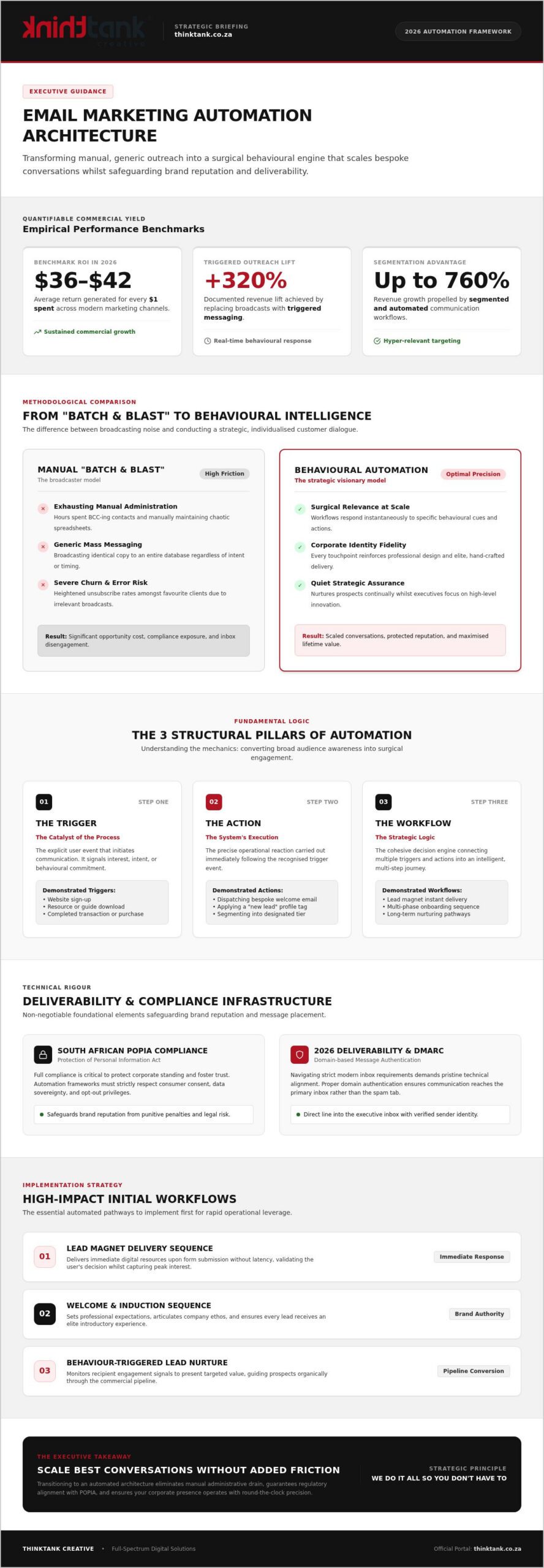
What if your brand's most persuasive conversations happened whilst you were focused on high-level strategy instead of your inbox? With email marketing generating an average return of $36 to $42 for every $1 spent in 2026, the potential for growth is immense; yet many businesses remain tethered to the exhausting cycle of manual BCC-ing and generic "blasts". Mastering email marketing automation for beginners isn't about becoming a technical wizard; it's about reclaiming your time and ensuring every lead receives a bespoke experience.

We understand that the transition from manual outreach to sophisticated workflows can feel daunting, especially when faced with complex jargon like "triggers" and "DMARC alignment". You likely feel that your current approach lacks the precision needed to cut through the noise of modern inboxes. This strategic guide provides a clear roadmap to transform those manual efforts into a high-performance engine that nurtures your audience automatically. We will explore which sequences to prioritise first, how to ensure South African POPIA compliance, and the methodology for achieving a 320% lift in revenue through triggered messaging. By the end, you will have the clarity to move from technical confusion to creative leadership, resting in the assurance that we do it all so you don’t have to.

Key Takeaways

  • Move beyond the exhausting "batch and blast" approach by mastering email marketing automation for beginners, focusing instead on triggered messages that respond to specific user behaviours.
  • Elevate your professional presence by ensuring every automated touchpoint reflects your corporate identity and provides immediate, bespoke value to your leads.
  • Navigate the complexities of 2026 deliverability standards and South African POPIA compliance to protect your brand reputation and ensure your messages reach the primary inbox.
  • Follow a structured roadmap to launch your first high-impact workflows, from welcome sequences to lead magnet delivery, without the typical technical friction.
  • Learn how a complete digital solution allows you to scale your best conversations and improve ROI whilst you remain focused on high-level creative strategy.

Understanding Email Marketing Automation: Beyond the Newsletter

Email marketing automation for beginners is the art of scaling your most valuable conversations without sacrificing a personal touch. Unlike the traditional "batch and blast" method, where a generic message is sent to an entire list regardless of their specific interests, automation relies on behavioural signals to deliver relevance. It's a fundamental shift from being a broadcaster to becoming a strategic partner in your customer's journey. By utilising marketing automation systems, you ensure that every interaction is timely, purposeful, and aligned with your brand's growth objectives.

To better understand how these systems function in a real-world setting, watch this helpful tutorial:

Adopting this technology represents the "Strategic Visionary" approach to business growth. Instead of reacting to immediate needs, you design a system that guides a prospect from their first touchpoint through to becoming a loyal advocate. This journey is no longer a manual struggle. It's a refined process that operates with quiet assurance, allowing you to focus on the creative strategy that truly moves the needle for your brand.

Why Manual Emailing is Costing Your Business

Manual administration is a silent drain on your most precious resource: time. Every hour spent BCC-ing clients or manually segmenting spreadsheets represents a significant opportunity cost that could be better spent on innovation. Beyond the administrative burden, manual list management is rife with the risk of human error, which can lead to embarrassing mistakes or compliance slips. Generic emails often feel exclusionary to recipients, which frequently leads to high unsubscribe rates amongst your favourite customers who expect a more tailored, professional experience.

The Core Components: Triggers, Actions, and Workflows

To master the technical side of email marketing automation for beginners, you only need to understand three fundamental pillars:

By organising these elements into a seamless flow, you create a sense of reliability that mirrors the stability of a long-standing enterprise. This methodical approach ensures that no lead is left behind, moving your audience from broad awareness to specific engagement with surgical precision.

The Strategic Benefits of Automating Your Outreach

Elevate your brand presence by delivering surgical relevance at scale. When exploring email marketing automation for beginners, the primary objective is to move beyond generic broadcasts toward a model of precision that honours the recipient's time and intent. This transition allows you to maintain a steady, reassuring cadence of communication that feels both elite in its execution and warm in its professional delivery.

Consistency is the hallmark of a professional enterprise. By automating your outreach, you ensure that every digital touchpoint reflects your professional logo and corporate identity design with absolute fidelity. This uniformity builds trust, transforming a cold lead into a confident advocate through a series of interactions that appear meticulously hand-crafted rather than mass-produced. It's about projecting the quiet assurance of a market leader whilst maintaining the fluid energy of a creative agency.

Strategic lead nurturing allows you to guide prospects through your sales funnel whilst you focus on high-level operations. This isn't merely a convenience; research indicates that segmented and automated campaigns can drive up to 760% more revenue compared to general blanket newsletters. By utilising data-driven reporting, you can fine-tune your messaging based on actual engagement behaviour, ensuring your strategy remains fluid and effective as you grow your national presence.

Scaling Your Personal Touch

Automation allows for bespoke communication on a national scale without the administrative burden of manual entry. By integrating custom video posts and tailored content creation into your sequences, you maintain a collaborative and imaginative tone that resonates deeply with your audience. This approach ensures that even as your volume grows, the quality of the interaction remains elite and personalised. It is essential to ensure your campaigns adhere to CAN-SPAM compliance requirements and local POPIA regulations to protect your brand's integrity and ensure long-term deliverability.

Improving ROI and Conversion Rates

The true power of automation is realised when it is integrated into your broader how to create a content marketing plan. Automated follow-ups significantly reduce the cost of lead acquisition by ensuring no opportunity is missed through human fatigue or oversight. There is also a powerful synergy between email sequences and remarketing campaign best practices, where your digital presence becomes a cohesive ecosystem of persuasion. If you are looking to refine these systems, our team can help you develop a bespoke email strategy tailored to your specific goals, with an estimated cost provided after our initial discussion.

Essential Tools and Requirements for Beginners

Building a high-performance engine requires the right components. For those embarking on email marketing automation for beginners, the focus shouldn't be on the most expensive enterprise tools, but on a scalable marketing automation strategy that aligns with your specific growth trajectory. This foundation rests on three pillars: a robust Email Service Provider (ESP), a clean subscriber list, and a website designed to convert visitors into leads. Without these elements working in synergy, even the most creative campaigns will struggle to find their audience.

Choosing the Right ESP for Your Budget

Your choice of platform should balance intuitive usability with the depth of segmentation required as your audience matures. Whilst entry-level platforms often provide essential auto-responder features, you must ensure the tool can eventually handle more complex behavioural workflows. We believe in providing a bespoke fit for every client; therefore, an estimated cost is provided only after we've discussed your list size and technical requirements. This ensures you aren't paying for enterprise-grade features you don't yet need, whilst maintaining the flexibility to scale as your national presence expands.

Lead Capture: The Foundation of Automation

Your website is the primary engine for list growth. It's not enough to simply have a "sign up" button; your lead capture forms must be an extension of your corporate identity, reflecting the same precision as your logo. Utilising custom website design allows you to place these forms strategically within the user journey, ensuring they appear at the exact moment of peak interest. Successful automation relies on a fair value exchange. By offering expertly crafted templates or industry guides in exchange for an email address, you build an ethically sourced list of individuals who are genuinely energised by your brand.

Integrating your chosen platform with your existing CMS or CRM is the final piece of the puzzle. This synergy allows for real-time data flow, ensuring your automated messages are triggered by actual user behaviour on your site. In the South African context, maintaining a clean, ethically sourced list is a legal necessity under POPIA. Avoid the temptation of purchased lists; they damage your deliverability and brand reputation. Instead, focus on organic growth and transparent consent, which yields far higher engagement rates and a more stable foundation for long-term success. By organising your technical stack this way, you move from manual administration to a system of quiet, automated assurance.

Email Automation for Beginners: 2026 Strategic Guide

The Beginner Roadmap: 3 Workflows to Start Today

Launch your automation journey with a deliberate, phased approach. When implementing email marketing automation for beginners, the goal is to create a series of self-sustaining loops that maintain your brand's presence without constant manual intervention. These workflows act as your digital representatives, ensuring that every lead is acknowledged and nurtured with the same meticulous care you would provide in person. Every sequence requires ongoing fine-tuning and revision based on the feedback provided by your reporting dashboard to ensure long-term resonance.

The Welcome Sequence: Your Virtual Handshake

A brilliant first impression is non-negotiable. Your welcome sequence should consist of at least three strategic touchpoints, beginning with the immediate delivery of your promised resource followed by a deeper introduction to your brand's core values. This initial email establishes your reliability. The second message should set clear expectations, sharing your "Strategic Visionary" story to build an emotional connection. Finally, the third email serves as an invitation to engage further, perhaps by following your social media channels or exploring your latest content creation. This methodical progression moves the subscriber from a casual sign-up to an energised participant in your brand's ecosystem.

Beyond the welcome, your lead magnet delivery sequence must provide immediate, high-register value. This workflow ensures that the guides or templates promised during sign-up are delivered seamlessly, reinforcing your position as a dependable partner. Conversely, a re-engagement flow targets cold subscribers who have not interacted with your emails in recent months. By offering a bespoke "win-back" incentive or simply asking for feedback, you can revitalise these relationships or clean your list to maintain high deliverability rates amongst your most active audience members.

Compliance and Ethics in South Africa

Operating within the South African market requires strict adherence to the Protection of Personal Information Act (POPIA). Under Section 69, direct marketing via automated emails is strictly opt-in, meaning outreach is prohibited unless the recipient has given prior, informed consent. The 2025 regulatory amendments clarified that pre-ticked opt-out boxes can never constitute lawful consent; it must be a specific and proactive choice by the user. You must ensure every automated message includes a clear, one-click unsubscribe option and that your data protection protocols are robust to avoid significant administrative fines. If you need assistance building a compliant, high-performance system, we invite you to partner with our digital marketing experts to ensure your strategy is both effective and legally sound.

Partnering for Automation Success

Transforming your digital outreach requires more than just software; it demands a strategic partnership that bridges the gap between technical execution and creative excellence. Whilst the initial steps of email marketing automation for beginners may seem straightforward, the path to long-term scalability often reveals complexities that can stall even the most energised brands. Choosing a complete solution over a DIY technical struggle ensures that your brand identity remains cohesive whilst your messaging remains precise. By integrating professional copywriting and meticulous reporting, you move beyond mere delivery to a state of sustained engagement that fuels national growth.

From Simple Auto-Responders to Full Funnel Management

Email serves as the connective tissue for your broader lead generation strategies, acting as the primary vehicle for nurturing interest into action. However, a common pitfall is viewing automation as a "set and forget" task. In reality, your sequences require ongoing support and maintenance to adapt to changing consumer behaviours and evolving inbox regulations. We believe in a holistic brand experience, which is why our digital marketing services include critical components such as FAQ setup and community management. This integrated approach ensures that every touchpoint, from an automated response to a direct query, feels like a seamless extension of your professional corporate identity.

This methodical progression allows you to transition from basic automation to advanced digital paid advertising with total confidence. By aligning your automated workflows with your Pay-Per-Click (PPC) and social media marketing efforts, you create a synergetic ecosystem where every lead is captured, tagged, and nurtured through a bespoke journey of imagination. This level of precision is what separates industry leaders from those who simply send newsletters.

Taking the Next Step with ThinkTank Creative

Since our founding in 2001, ThinkTank Creative has championed an end-to-end process that moves from deep research and strategy to award-winning final delivery. Our team of designers prioritises professional visualisation, ensuring that your email campaigns are as aesthetically compelling as they are functional. We manage the entire creative journey for your brand, providing the stability of a long-standing enterprise alongside the fluid energy of a creative agency.

Because every business possesses unique requirements and specific timelines, an estimated cost is provided after our initial consultation to ensure our solution is perfectly tailored to your needs. We invite you to contact us to embark on a journey of innovative creativity together. We do it all so you don’t have to.

Mastering the Future of Your Digital Conversations

Embracing email marketing automation for beginners is the first step toward transforming your outreach from a manual burden into a sophisticated engine of growth. By moving beyond generic broadcasts and implementing the targeted workflows we've discussed, you ensure that every lead receives a bespoke experience that honours their intent. This transition not only protects your brand reputation through POPIA compliance but also reclaims the time you need to focus on high-level creative strategy.

Since 2001, we've helped brands navigate the evolving digital landscape with quiet assurance and award-winning in-house design. Our comprehensive "We Do It All So You Don’t Have To" service model ensures that every technical hurdle is handled with precision. Because every brand's journey is unique, an estimated cost is provided after our initial discussion to ensure our solution aligns perfectly with your objectives. Ready to automate your growth? Contact ThinkTank Creative for a strategic email marketing consultation and let's begin your journey of transformation together. The potential for your business is limitless when your systems are as visionary as your goals.

Frequently Asked Questions

What is the difference between an auto-responder and email automation?

An auto-responder is a fundamental tool that sends a single message or a simple linear sequence after a specific trigger, such as a contact form submission. In contrast, email marketing automation for beginners involves more sophisticated, behaviour-based workflows. These systems use logic to send different messages based on how a user interacts with your brand. This methodical approach ensures that your communication remains relevant, providing a complete solution for nurturing leads without manual intervention.

Is email marketing automation expensive for a small business?

Automation is a scalable investment that grows alongside your business. Whilst entry-level software often has accessible tiers, the true value lies in the time saved and the increased ROI from targeted messaging. Because every project has unique requirements, an estimated cost is provided after we discuss your specific goals and list size. This ensures you receive a bespoke strategy that delivers professional results without the unnecessary overhead of exclusionary, enterprise-only features.

How do I ensure my automated emails do not end up in the spam folder?

Ensuring your messages reach the inbox requires a combination of technical precision and ethical practice. You must configure your SPF, DKIM, and DMARC records to authenticate your domain, whilst strictly adhering to South African POPIA regulations. Avoid purchased lists and focus on ethically sourced subscribers who have proactively opted in. By maintaining a clean list and providing high-register, valuable content, you build a dependable sender reputation that mailbox providers trust.

Do I need a large email list to start with automation?

You don't need thousands of subscribers to see the benefits of automated workflows. Starting with a smaller audience allows you to refine your "journey of imagination" and perfect your messaging before you scale. Implementing email marketing automation for beginners early on ensures that every new lead is greeted with a professional welcome sequence. This foundation creates a sense of reliability and elite execution that helps your brand grow steadily and purposefully.

What is the best time of day to send automated emails in South Africa?

Whilst global trends offer a baseline, the best time to send emails in South Africa depends entirely on your specific audience's behaviour. Generally, mid-week mornings are effective for professional services, whilst retail brands often find success during month-end periods or evenings. The key is to utilise the reporting and analytics provided in your automation platform. This data-driven approach allows you to move from guesswork to a strategic understanding of when your subscribers are most engaged.

Can I use email automation to improve my SEO or website traffic?

Automated sequences are a powerful driver of consistent website traffic. By directing subscribers to specific landing pages, custom video posts, or educational resources, you increase on-site engagement and reduce bounce rates. This steady flow of visitors signals to search engines that your website is a functional and authoritative resource. Integrating your email strategy with your broader SEO efforts creates a synergetic effect that elevates your brand's visibility across the entire digital space.

How do I measure the success of my automated email workflows?

Measuring success involves looking beyond simple open rates to understand the deeper impact on your business objectives. Key indicators include click-through rates, revenue per email, and the overall health of your subscriber list. Our end-to-end process includes comprehensive reporting to track these metrics, providing the insights needed for fine-tuning and revision. This methodical analysis ensures that your workflows remain effective and continue to support your long-term growth and brand transformation goals.

Is my business too small for email marketing automation?

No business is too small to benefit from the efficiency and precision that automation provides. In fact, smaller organisations often gain the most by reclaiming hours previously spent on manual administration. Automation allows you to project the quiet assurance of an industry leader whilst maintaining the approachable, creative partner persona your clients value. By organising your outreach this way, you can focus on innovative creativity and high-level strategy whilst your system nurtures leads automatically.

Remarketing Campaign Best Practices: The 2026 Strategic How-To Guide

Did you know that whilst 98% of your website visitors leave without converting, those who are retargeted are 70% more likely to complete a purchase? It is a staggering reality that highlights the immense untapped potential sitting within your existing traffic. By implementing sophisticated remarketing campaign best practices, you can transform these missed opportunities into loyal customers through precise, value-driven touchpoints that respect the modern user journey.

We understand the frustration of seeing high acquisition costs on cold traffic and the concern that repetitive ads might lead to negative brand perception. You want to build a cohesive digital presence that respects your audience's privacy whilst driving measurable growth. This strategic guide provides a clear framework for segmenting your audiences and navigating the technical shifts of 2026, such as the standardised 100-user audience thresholds and the move toward server-side tracking. We will show you how to refine your creative approach to ensure every interaction feels like a bespoke invitation rather than a generic reminder.

At ThinkTank Creative, we believe that great marketing makes your customer look smart. By the end of this article, you will have the tools to improve your ROI and deliver a seamless brand experience across all digital touchpoints. We do it all so you don't have to, allowing you to focus on your business whilst we elevate your digital strategy.

Key Takeaways

  • Move beyond generic lists by categorising users based on their specific level of intent, ensuring your budget is directed toward high-value prospects.
  • Maintain brand cohesion and trust through sophisticated design principles that align your creative assets with a customer-centric journey.
  • Master the essential Research & Strategy phase required to implement remarketing campaign best practices that drive high-quality leads and measurable sales.
  • Utilise a structured 5-stage methodology to ensure your technical setup and landing pages are perfectly optimised for conversion and long-term growth.
  • Shift your perspective from chasing users to providing sequential value, evolving your digital presence from standard advertising to truly great marketing.

The Strategic Foundations of Modern Remarketing

Remarketing is often misunderstood as a digital shadow that follows users across the internet. In reality, it's a precise strategic tool designed to re-engage high-intent visitors who showed interest but did not convert during their initial visit. By understanding behavioral retargeting fundamentals, you can move beyond "Good Marketing" that merely promotes your company. We focus on "Great Marketing" that centres on the customer's needs, making them feel smart and well-informed throughout their decision-making process.

To better understand how these technical foundations are built and managed, watch this helpful guide on setting up your segments correctly:

In the South African B2B and B2C sectors, sales cycles have lengthened as consumers become more discerning and price-sensitive. You shouldn't expect a single visit to result in a conversion when competitors are only a click away. Effective remarketing campaign best practices involve creating a sequential value journey that respects the user's intelligence. Instead of repetitive ad exposure that leads to fatigue, we aim to provide new information or social proof at every touchpoint, guiding the prospect naturally toward a successful outcome.

Why Remarketing is Critical for ROI

Digital spaces are more crowded than ever, making the traditional "Rule of Seven" even more relevant for brand resonance. A prospect often needs multiple interactions with your brand before they feel confident enough to commit to a purchase or an enquiry. By focusing your spend on these warmer leads, you can significantly assist in reducing Google Ads cost per click. This strategic focus ensures that your budget isn't wasted on cold traffic, ultimately elevating your long-term brand recall and customer lifetime value.

The 2026 Privacy Landscape in South Africa

Privacy isn't a hurdle; it's an opportunity for brand transformation and building deeper trust with your audience. All data collection in South Africa must remain strictly compliant with the POPI Act to protect consumer rights. As third-party cookies lose their efficacy, successful brands are pivoting toward robust first-party data strategies that offer more reliable insights. We define POPI compliance for remarketing as a fundamental ethical commitment to user privacy that ensures every interaction is both lawful and respectful.

Audience Segmentation: The Key to Relevance

Broad remarketing lists are often the quickest way to erode a digital marketing budget. When you treat a casual homepage browser with the same urgency as someone who abandoned a shopping basket, your messaging loses its edge. Precision in segmentation ensures that your creative assets resonate with the user's current mindset, transforming a generic advert into a timely, helpful reminder. This tailored approach is the cornerstone of remarketing campaign best practices in a market where relevance is the primary currency of attention.

A strategic visionary approach requires mapping a clear hierarchy of intent. High-intent users, such as those who reached the final checkout stage, require direct, objection-handling copy. Conversely, top-of-funnel visitors benefit from educational content that reinforces your brand's authority. This level of granular tracking is only possible when you invest in custom website design that prioritises data integrity and user journey mapping from the ground up.

The timing of these interactions is just as vital as the content itself. According to Stanford Graduate School of Business retargeting research, engaging users soon after their initial visit significantly boosts return rates and conversion efficacy. However, this momentum must be balanced with strict exclusion discipline. Failing to remove converted users from your active lists leads to wasted spend and customer annoyance, which can quickly tarnish your brand's reputation.

Behaviour-Based Segmentation Strategies

Distinguishing between "lurkers" and "active researchers" allows you to allocate your budget more effectively. If a visitor spends several minutes on a specific service page, they've signalled a high level of interest that warrants a deeper nurture sequence, such as a case study or a detailed testimonial. For those who interact with lead magnets but stop short of a booking, your remarketing should focus on providing the next logical step in their research journey, rather than a repetitive sales pitch.

Technical Implementation and Compliance

Success on a national scale requires a robust technical foundation using the Meta Pixel and Google Tag Manager. In South Africa, this setup must be balanced with a commitment to privacy. Your cookie consent banner should be a user-friendly, POPI Act compliant interface that builds trust rather than creating friction. By integrating these segments with your CRM, you create a unified view of the customer journey. This synergy ensures that your PPC advertising efforts are always informed by real-time sales data, allowing for more agile and effective campaign adjustments.

Creative Excellence and Brand Cohesion

Visual identity serves as the silent ambassador of your brand, providing a sense of continuity that bridges the gap between a visitor's initial interest and their final decision. Within our award-winning design team, we approach the "Visualisation" stage of creative development with meticulous care, ensuring that every asset reflects the bespoke craftsmanship your brand deserves. Maintaining this visual consistency is a non-negotiable anchor of trust, especially when implementing remarketing campaign best practices that target users who are already familiar with your digital presence.

However, even the most stunning visuals can lose their impact if shown too frequently. Ad fatigue is a genuine threat to ROI, typically manifesting when users see the same creative more than three or four times within an active window. To maintain engagement, you must embrace best practices for retargeting advertising campaigns, which include rotating your creative assets every two to four weeks. This proactive refreshing prevents your brand from becoming background noise and preserves the integrity of your professional reputation.

Recognition often begins with the smallest details. A strong, professional logo design ensures that your ad units are instantly identifiable, even on a cluttered social media feed or a busy mobile site. This immediate recognition reduces the cognitive load on the user, making them more likely to stop scrolling and engage with your message.

Designing for Conversion

High-converting remarketing ads rely on a precise anatomy: a compelling headline that addresses a specific pain point, a high-quality visual that evokes an emotional response, and a clear, punchy CTA. Integrating social proof, such as short testimonials or star ratings, can effectively dismantle the final objections a prospect might have. We believe in balancing sophisticated brand aesthetics with performance-driven imperatives, ensuring your ads are as effective as they are beautiful.

Dynamic Creative vs. Static Assets

Choosing between dynamic product ads and static assets depends entirely on your business model. E-commerce brands often thrive on dynamic creative that displays the exact products a user viewed, whilst service-based businesses benefit from bespoke static ads that highlight unique value propositions. Custom video posts have also emerged as a powerful tool for re-engaging South African audiences on social platforms. Given that the majority of local traffic is mobile-based, every creative asset must be designed with a mobile-first mindset to ensure seamless usability and visual impact.

Remarketing Campaign Best Practices: The 2026 Strategic How-To Guide

Step-by-Step: Implementing Remarketing Best Practices

Launch with purpose by establishing a comprehensive Research & Strategy phase before any technical assets go live. This foundational step ensures that every interaction is grounded in a deep understanding of your customer's intent and pain points. You must define your primary conversion goal with absolute clarity from the outset. Whether you're seeking a lead form submission, a direct phone call, or a completed sale, this goal will dictate the structure of your lists and the tone of your messaging.

Setting realistic frequency caps is essential to avoid the common pitfall of over-exposing your brand to potential customers. Performance data from 2026 confirms that campaign efficiency begins to decay once a user sees an ad more than 3 to 4 times within an active window. By implementing remarketing campaign best practices, you can maintain a presence that feels supportive rather than intrusive. A cross-channel approach is vital here, following the user seamlessly from a Google Search to an Instagram feed whilst maintaining a cohesive brand narrative.

Bidding and Budget Management

Strategic budget allocation requires a delicate balance between Brand Awareness and Direct Response remarketing. You don't want to spend your entire budget on users who have already decided not to buy. Whilst automated bidding strategies like Target CPA offer significant efficiency in the 2026 AI-driven landscape, they still require the discerning oversight of a human expert to ensure alignment with broader business objectives. We also recommend monitoring the View-Through Conversion metric closely. This provides a clearer picture of how display ads influence decisions, even when a direct click doesn't occur immediately.

Testing and Fine-Tuning

Continuous refinement is the hallmark of a high-performing campaign. You should regularly A/B test your CTAs, comparing options like "Enquire Now" against "Get My Free Estimate" to see which resonates more deeply with your specific audience segments. Analysing the "Time to Conversion" report allows you to optimise your list duration, ensuring your budget is focused on the window when prospects are most likely to act. We utilise our ThinkTank 5-stage development process to fine-tune landing page performance, ensuring the post-click experience is as polished as the ad itself.

If you're ready to transform your digital strategy, partner with us for expert PPC advertising that delivers measurable growth.

Scaling Your Success with ThinkTank Creative

Mastering the nuances of the digital landscape requires more than just technical proficiency; it demands a strategic visionary who can see the thread connecting every touchpoint. We manage the complexity of your cross-channel presence, ensuring that your brand remains prominent and persuasive without becoming a burden on your internal resources. Our guiding principle is simple: we do it all so you don't have to. This collaborative approach allows you to focus on your core operations whilst we orchestrate a sophisticated presence that reflects your brand's excellence and commitment to quality.

A truly effective engine requires high-quality fuel to maintain its momentum. This is why our integrated content marketing plans are so vital to the success of your digital strategy. By aligning your top-of-funnel content with your lower-funnel retargeting, we create a seamless flow of information that educates and excites your prospects. This synergy ensures that your remarketing campaign best practices are supported by relevant, authoritative messaging that builds trust at every stage of the buyer's journey, moving them naturally from curiosity to conversion. Pairing this approach with email marketing automation for beginners allows you to nurture those same prospects automatically, ensuring no lead falls through the cracks between ad impressions.

Our End-to-End Remarketing Process

We utilise a meticulous 5-stage process to ensure your campaigns are both resilient and high-performing. This journey begins with an in-depth Research & Strategy phase where we assess your specific needs and national growth goals. From there, we move through design, development, and fine-tuning, culminating in a launch that's backed by ongoing support. We provide continuous reporting and revisions based on real-time South African market data, ensuring your strategy remains agile. An estimated cost is provided only after a thorough discussion of your unique requirements and timelines, ensuring the solution is as bespoke as your brand.

Ready to Re-engage Your Audience?

Professional management transforms a standard advertising effort into a powerful engine for brand transformation. By choosing a partner deeply invested in your success, you move beyond the technical hurdles of audience thresholds and tracking pixels into a space of pure creative potential. We invite you to embark on a journey of imagination and conversion that makes your customers look smart and your brand feel indispensable. Contact us today for a professional consultation and let's begin the work of elevating your digital presence to new heights of excellence.

Elevate Your Digital Strategy for 2026

Mastering remarketing campaign best practices is no longer just about tracking visitors; it's about respecting the user's journey through sophisticated segmentation and visual excellence. By moving beyond generic lists and embracing a hierarchy of intent, you ensure your budget is invested in high-value prospects who are ready to convert. Consistency in your brand's visual identity, supported by professional design and mobile-first creative, remains the ultimate anchor of trust in a crowded digital landscape.

At ThinkTank Creative, we bring 25 years of digital marketing expertise and an award-winning design team to every partnership. Our comprehensive 5-stage strategic process ensures that your campaigns are meticulously planned, launched, and optimised for national growth. We believe that great marketing makes your customer look smart, and we're dedicated to helping you achieve that transformation whilst handling the technical complexity on your behalf. We do it all so you don't have to.

Contact ThinkTank Creative to Organise Your Strategic Remarketing Campaign and let's begin the work of re-engaging your audience with purpose. The potential for brand growth is immense, and we look forward to building your future together.

Frequently Asked Questions

What is the difference between remarketing and retargeting?

Remarketing and retargeting are often used interchangeably, although they traditionally held distinct technical meanings. Retargeting specifically refers to using browser pixels to serve ads to previous site visitors as they browse other websites. Remarketing historically focused on re-engaging existing customers through email or CRM lists. Today, most digital platforms have merged these concepts into a single strategic approach aimed at re-engaging high-intent users across multiple digital touchpoints.

How long should a user stay on my remarketing list?

The ideal duration for a user to stay on your list is determined by the length of your specific sales cycle. For quick impulse purchases, a window of 7 to 14 days is often sufficient to drive action. For complex B2B services, you might extend this to 60 or 90 days to stay top-of-mind. We recommend segmenting your lists by recency, as users who visited in the last 3 days typically show the highest conversion potential.

Is remarketing compliant with the POPI Act in South Africa?

Remarketing is fully compliant with the POPI Act provided you maintain transparency and secure explicit user consent. You must ensure your website features a clear, user-friendly cookie consent banner and an updated privacy policy that explains how data is collected. Implementing remarketing campaign best practices involves treating personal information as a private asset, ensuring all tracking is handled ethically and in accordance with national data protection regulations.

How many times should a potential customer see my ads per day?

We suggest a frequency cap of 3 to 4 impressions per user within a 24-hour window to maintain brand resonance without causing annoyance. Seeing an ad too often can lead to negative brand perception and diminishing returns on your ad spend. By carefully managing these limits, you ensure your brand remains visible whilst respecting the user's digital experience and preventing the intrusive "stalking" effect that many consumers find frustrating.

Do I need a large budget to start a remarketing campaign?

You don't need a massive budget to launch a successful remarketing campaign because you're only targeting a refined, pre-qualified audience. Since these users have already interacted with your brand, the cost-per-acquisition is often significantly lower than cold traffic prospecting. We provide an estimated cost after discussing your specific goals, allowing us to tailor a strategy that maximises your existing ROI regardless of your initial investment size.

Why are my remarketing ads not showing to my audience?

The most common reason remarketing ads don't show is that your audience list hasn't reached the minimum size threshold. Google Ads officially standardised the minimum audience size to 100 active users within the last 30 days across all networks. Other factors include overly restrictive bidding, narrow geographic settings, or technical issues with your tag implementation that prevent the pixel from firing correctly. We ensure your technical setup is flawless during our 5-stage development process.

Can I do remarketing across different platforms like Google and Meta simultaneously?

You can and should run remarketing campaigns across Google and Meta simultaneously to create a cohesive brand experience. A cross-channel approach ensures that your message follows the user from search results to their social media feeds, reinforcing brand recall. This synergy provides multiple opportunities for conversion across different devices. Our team handles this complexity for you, ensuring that your creative assets and messaging remain consistent across every digital touchpoint.

What is ad fatigue and how do I prevent it?

Ad fatigue occurs when your audience becomes so familiar with your creative that they stop noticing it or become annoyed by the repetition. You can prevent this by rotating your ad visuals and copy every two to four weeks to keep the message fresh. Using custom video posts and varying your value propositions helps maintain engagement. This proactive approach ensures your remarketing campaign best practices continue to deliver high click-through rates and strong performance.

How to Create a Content Marketing Plan: The 2026 Strategic Template

Most businesses are currently shouting into a digital void, mistaking volume for value whilst their actual brand voice remains muffled by the noise. You've likely felt the exhaustion of maintaining a relentless posting schedule only to see minimal ROI or inconsistent engagement across your channels. It's frustrating to invest high effort into content that fails to align with your broader vision or move the needle on national search results. Learning how to create a content marketing plan that actually converts requires moving beyond mere templates and embracing a journey of imagination.

We understand that true brand transformation stems from a deliberate balance of strategic building and customer-centric value. This guide provides a sophisticated framework to organise your narrative, ensuring every piece of creative design or SEO-driven copy makes your brand look like the smartest expert in the room. We'll explore a repeatable workflow that transforms your digital presence from a series of disjointed posts into a cohesive, authoritative strategy. By the end of this article, you'll possess the tools to drive national engagement and secure your position as an industry leader through bespoke craftsmanship and precision.

Key Takeaways

  • Shift your perspective from viewing content as isolated posts to treating it as a strategic asset that prioritises making your customer look smart.
  • Master how to create a content marketing plan by following a structured process that moves seamlessly from deep research to professional production and support.
  • Identify the core content pillars that represent your unique expertise and select bespoke formats that visualise your message with precision.
  • Refine your audience profiling to distinguish between end-users and dealers, ensuring your brand voice resonates with the specific needs of each segment.
  • Discover the value of a complete solution where creative design and technical SEO work in synergy to ensure the long-term longevity of your content.

The Foundation of Strategic Content Marketing in 2026

Transform your digital presence by shifting how you perceive your creative output. Content marketing is not merely a series of isolated social media posts or a checklist of blog entries. It's a powerful strategic asset. When you understand how to create a content marketing plan that treats every word and image as an investment, you move away from temporary noise toward long-term brand equity.

Distinguish between good marketing and great marketing to elevate your brand position. Good marketing focuses on making the company look smart, highlighting features and shouting about accolades. Great marketing, however, focuses on making the customer look smart. It provides the insights, tools, and clarity your audience needs to make informed decisions. This approach builds a deep, collaborative relationship where your brand is seen as an indispensable partner rather than just a vendor.

Secure your brand consistency across South Africa through a formalised strategy. Without a clear roadmap, your brand voice can become fragmented across different channels. When you master how to create a content marketing plan, you ensure that your message remains cohesive across every touchpoint. By viewing content as a complete solution for branding and lead generation, we follow a philosophy that We Do It All So You Don't Have To. This allows you to focus on your core operations whilst we manage the intricate synergy between strategy and execution.

Why Intent Beats Volume

Reject the "more is better" fallacy that currently plagues digital marketing. The digital space is saturated with superficial metrics that often lead businesses into a cycle of constant, low-value output. We believe in moving away from this frantic pace. High-quality, high-register communication reflects the professional standards of your business much more effectively than daily updates. Prioritising strategic depth ensures that your message resonates with precision, reaching the right people amongst a sea of generic content.

The Role of Brand Identity in Content

Utilise professional logo and corporate identity design as the visual anchors for every piece of content you produce. Your visual storytelling must align perfectly with your core mission to build national trust. When your creative design is unified, it creates a sense of reliability and excellence. This bespoke craftsmanship ensures that your brand remains recognisable and respected, regardless of the platform. A unified brand voice is the foundation of a journey of imagination that transforms prospects into partners.

Phase One: Research, Strategy, and Audience Profiling

Strategy is the bridge between imagination and measurable success. Before you produce a single word of copy, you must ground your vision in the reality of South African market dynamics. This initial phase isn't just about gathering data; it's about understanding the pulse of your industry to ensure your voice resonates with authority. We treat this as a collaborative journey where your insights and our expertise combine to form a resilient roadmap.

Identifying your audience is the first critical pivot point. Are you speaking directly to end-users who crave personal transformation, or are you addressing dealers focused on logistical excellence and commercial synergy? Each group requires a distinct vocabulary and a different set of value propositions. By defining clear objectives, whether that's top-of-funnel brand awareness or high-intent lead generation, you give your creative team a specific target. A comprehensive content audit follows, exposing the gaps in your current digital presence that a complete digital solution can resolve with precision. We believe in providing a seamless experience, which is why We Do It All So You Don't Have To.

Building Detailed Customer Personas

Generic demographics won't suffice in the modern landscape. You need to uncover the emotional drivers that influence South African decision-makers amongst various sectors. ZA audiences value reliability and local relevance, so your personas must reflect the specific challenges they face daily. Do they frequent LinkedIn for professional insights, or are they more responsive to visual storytelling on social platforms? Mapping these behaviours allows you to tailor your message with bespoke craftsmanship. When you understand how to create a content marketing plan, these personas become the north star for every piece of creative design you commission.

Setting Measurable Content Goals

Precision is the hallmark of a visionary strategy. When learning how to create a content marketing plan, you must distinguish between vanity metrics and conversion-focused data. Whilst a high follower count looks impressive, it doesn't always translate to bottom-line growth. Align your content objectives with broader business KPIs such as lead quality, email sign-ups, or customer retention rates. Establishing a solid baseline for reporting now ensures that every subsequent campaign is an exercise in optimisation rather than guesswork. This methodical approach ensures your content remains a dependable asset for years to come.

Defining Content Pillars and Choosing the Right Formats

Organise your expertise into distinct content pillars that act as the structural framework for your brand voice. These pillars represent the core areas of your authority, such as Website Design, SEO, and Branding, ensuring your message remains focused and impactful. When you understand how to create a content marketing plan that respects these boundaries, you avoid the common pitfall of producing disjointed information that confuses your audience. Instead, you build a library of assets that reinforce your position as a national industry leader.

Select formats that best visualise your message based on the complexity of the information and the preferences of your audience. Custom video posts and intricate infographics can transform dense data into engaging narratives, whilst long-form guides provide the strategic depth required for thought leadership. It's essential that all collateral, including physical "leave-behind" materials produced through bespoke printing solutions, maintains absolute visual synergy. This consistency ensures that whether a prospect is reading a digital whitepaper or holding a professionally designed corporate brochure, the experience feels like a single, unified journey of imagination.

Balance your output by mixing educational "how-to" content with visionary pieces. Whilst practical guides solve immediate problems and build trust, thought leadership pieces challenge the status quo and make your customers look smart by providing them with forward-looking insights. This blend of utility and inspiration is what transforms a standard marketing effort into a complete solution for brand growth.

The Power of Visualisation and UX

Award-winning design is not a luxury; it's a critical component of content readability and engagement. Our team integrates UX/UI principles into every piece of content, ensuring that your landing page design and digital assets are as functional as they are beautiful. High-quality graphics simplify complex technical information, allowing your audience to grasp sophisticated concepts with ease. This focus on precision and bespoke craftsmanship reflects the elite standards of your business and keeps users engaged for longer.

Choosing Your Distribution Channels

Distribution requires a methodical rhythm where different channels work in synergy to amplify your pillars. Social media marketing provides the immediate engagement and feedback loop, whilst email marketing allows for a more personalised, nurturing connection with your leads. Optimising every piece of content for search engines ensures long-term national visibility, creating a sustainable asset that continues to perform. For high-priority campaigns, utilising pay-per-click (PPC) advertising can provide the necessary momentum to reach a wider audience amongst a competitive digital landscape. To ensure your paid campaigns remain cost-efficient alongside your organic efforts, understanding how to reduce Google Ads cost per click is an essential complement to any comprehensive content distribution strategy. Equally important is re-engaging visitors who have already shown interest in your brand; following proven remarketing campaign best practices ensures that your content continues to convert warm audiences long after their initial visit.

How to Create a Content Marketing Plan: The 2026 Strategic Template

The Content Marketing Plan Template: A Step-by-Step Execution Guide

Executing a visionary strategy requires more than just a list of tasks; it demands a disciplined methodology that transforms abstract ideas into tangible results. Whilst many guides focus on the conceptual side of marketing, understanding how to create a content marketing plan at an agency level involves a rigorous five-stage production cycle. This structured approach ensures that your brand voice remains consistent whilst every piece of collateral meets the highest standards of professional excellence.

By following this template, you move beyond guesswork and into a repeatable workflow that delivers a complete solution for your business. If you are ready to elevate your digital presence with a partner who values precision, we invite you to explore our creative design and digital marketing services to begin your brand's evolution.

Creating a Realistic Content Calendar

Organising your production schedule is essential to avoid burnout and maintain a steady, reassuring cadence. A realistic calendar balances evergreen content, which provides long-term value, with timely coverage of industry events or seasonal trends. We utilise sophisticated systems to manage this workflow effectively, ensuring that your brand remains visible without sacrificing quality. This methodical rhythm creates a sense of reliability that your audience will come to depend on.

Quality Control and Brand Alignment

Technical and visual excellence are non-negotiable in high-register communication. Every piece of content must pass through a final delivery checklist to ensure it aligns with your professional yet creative brand tone. To guide all future creators, define your brand voice with absolute clarity: our voice is an authoritative yet approachable partner that inspires growth through strategic precision and elite craftsmanship. This single sentence acts as the north star for all your creative output, ensuring your national reputation remains untarnished amongst your competitors.

Elevating Your Content Strategy with Professional Agency Support

Transitioning from a conceptual template to an international-standard digital presence requires more than just internal effort. Whilst many businesses attempt to manage their output in-house, partnering with an all-rounder agency provides a complete solution that bridges the gap between creative vision and technical execution. Professional support ensures that your brand doesn't just participate in the conversation but leads it with authority and precision. We believe that true brand transformation occurs when every element of your strategy works in perfect synergy, allowing you to move beyond the basics of how to create a content marketing plan toward a model of sustained excellence.

Our in-house designers prioritise usability and functionality alongside aesthetic appeal, ensuring that your content serves a clear purpose in the user journey. Content that looks beautiful but fails to convert is a wasted investment. By integrating award-winning creative design with robust technical standards, we ensure your assets remain effective long after their initial launch. Ongoing maintenance and support are vital components of this process, protecting the longevity of your digital footprint and ensuring your message remains relevant amongst shifting market dynamics. We Do It All So You Don't Have To.

The Collaborative Journey with ThinkTank Creative

Success is a shared destination. Our structured 5-stage process ensures your vision is realised with meticulous precision, moving from initial ideation through to post-launch support. We foster a culture of constant communication and innovative creativity, acting as a dedicated partner rather than a mere vendor. This collaborative journey of imagination allows us to tailor every campaign to your specific business objectives. Because every brand's needs are unique, an estimated cost for our bespoke services is provided after a thorough discussion of your requirements and goals.

Integrating Content with Your Broader Digital Ecosystem

Content does not exist in a vacuum; it is the fuel for your entire digital engine. To achieve maximum impact, your plan must be seamlessly integrated with a high-performing custom website design South Africa that provides the perfect stage for your storytelling. This foundation is then amplified by search engine optimisation South Africa, ensuring your pillars are visible to those searching for your expertise at a national level. When these elements align, your content becomes a primary driver for sophisticated lead generation strategies for South African businesses, turning engagement into measurable growth and reinforcing your position as a strategic visionary in your field.

Secure Your Brand's Digital Future

Master the transition from disjointed digital noise to a cohesive, strategic narrative that positions your brand as a national leader. We've explored the necessity of treating content as a strategic asset and the power of a rigorous, five-stage execution workflow. Understanding how to create a content marketing plan is more than an administrative task; it's an invitation to elevate your brand voice through precision and bespoke craftsmanship.

Since our founding in 2001, we've remained dedicated to delivering complete end-to-end digital solutions that drive measurable growth. Our award-winning design team is ready to transform your vision into a high-performing reality whilst ensuring your message resonates with authority. We invite you to partner with ThinkTank Creative for a bespoke content strategy that reflects the unique excellence of your business. We do it all so you don't have to. Let's embark on this journey of imagination together and secure the future your brand deserves.

Frequently Asked Questions

What should be included in a 2026 content marketing plan?

Learning how to create a content marketing plan for 2026 requires a focus on defined content pillars, detailed audience profiling, and a multi-channel distribution strategy. You should incorporate SEO, social media management, and email marketing to ensure a complete solution. It's essential to outline a structured workflow for ideation and production whilst maintaining a focus on high-quality visualisation. This ensures your brand voice remains consistent across all national touchpoints and effectively addresses the emotional drivers of your specific target audience.

How often should a business post new content for national visibility?

Strategic depth is far more valuable than sheer volume in the modern digital space. Whilst there is no universal number, maintaining a steady, reassuring cadence is vital for building national trust. You should prioritise high-register, impactful pieces that resonate with your audience rather than flooding channels with superficial updates. A consistent schedule, perhaps two to three high-quality assets per week, often yields better long-term engagement than a frantic, daily posting habit that sacrifices quality for quantity.

Can I create a content marketing plan without a large internal team?

You certainly don't need a massive internal department to execute a sophisticated strategy. Many businesses find that partnering with an all-rounder agency provides the specialised expertise and bespoke craftsmanship they lack internally. By leveraging an external team for creative design, SEO, and copywriting, you can implement a professional framework without the overhead of a large team. This collaborative approach allows you to focus on your core business whilst experts manage the intricate details. We Do It All So You Don't Have To.

How do I measure the success of my content marketing efforts?

Success is measured by aligning your content objectives with broader business KPIs rather than relying on vanity metrics. You should track lead quality, conversion rates, and national search visibility to gauge actual ROI. Using reporting tools to monitor how your audience interacts with your pillars provides the necessary data for future optimisation. This methodical approach ensures your efforts contribute directly to brand transformation and sustainable growth rather than just generating temporary digital noise that fails to convert.

What is the difference between a content strategy and a content plan?

A content strategy defines the high-level vision, audience profiling, and the specific reasons behind your communication. Conversely, knowing how to create a content marketing plan involves the tactical execution, including specific formats, distribution channels, and production schedules. Think of the strategy as your north star and the plan as the repeatable workflow that brings that vision to life. Both are essential components of a complete digital solution that drives national engagement and long-term brand authority.

How does professional branding influence content marketing performance?

Professional branding acts as the visual anchor for every piece of content you produce, establishing immediate national trust. High-quality logo and corporate identity design ensure that your collateral is recognisable and respected across all platforms. When your visual storytelling aligns with your core values, it enhances readability and engagement. This synergy between creative design and strategic messaging makes your brand look like an authoritative industry leader amongst a sea of generic competitors who lack a unified visual voice.

Is email marketing still relevant in a 2026 content plan?

Email marketing remains a cornerstone of a successful digital ecosystem because it offers a direct, personalised connection with your leads. It's an ideal channel for nurturing relationships and distributing high-value thought leadership pieces directly to your audience's inbox. By using automated auto-responders and targeted campaigns, you can keep your brand at the forefront of your customers' minds. It works in perfect synergy with SEO and social media to provide a comprehensive communication strategy that drives national engagement.

How long does it take to see results from a content marketing strategy?

Content marketing is a long-term investment in brand equity rather than a quick fix. Whilst you might see immediate engagement through PPC advertising or social media, organic results through SEO typically take three to six months to gain significant momentum. This steady progress builds a sustainable asset that continues to perform for years. We focus on content longevity through ongoing maintenance and support, ensuring your brand transformation is both deep and enduring across the country.

Understanding Your Website Analytics Report: A 2026 Strategic Guide

With only 42% of websites currently passing Core Web Vitals in 2026, most businesses are unknowingly leaving growth on the table whilst drowning in data they cannot interpret. You likely feel the weight of endless spreadsheets and technical jargon that feels disconnected from your actual bottom line. It's frustrating to watch traffic figures rise without seeing a corresponding lift in your revenue or engagement. Mastering the art of understanding your website analytics report is no longer a technical chore; it's a vital strategic advantage that bridges the gap between digital activity and commercial success.

Our guide ensures you can transform these complex data points into actionable insights that fuel your business growth. This resource provides a clear framework for identifying which metrics truly move the needle, allowing you to make confident investment decisions with quiet assurance. We'll examine the latest 2026 GA4 updates, including custom conversion windows and AI-powered trend analysis, to ensure your digital strategy is both precise and forward-looking. By the end of this article, you'll possess the clarity needed to turn confusing vanity metrics into a bespoke roadmap for elevation and excellence.

Key Takeaways

  • Distinguish between deceptive vanity metrics and actionable data that reflects true commercial progress and revenue growth.
  • Gain confidence in understanding your website analytics report to pinpoint high-value traffic sources and optimise your digital marketing spend.
  • Decode the specific user behaviours that signal engagement and trust amongst your target audience to refine your creative strategy.
  • Apply a structured insight-to-action framework to translate monthly reporting trends into concrete, measurable website improvements.
  • Learn how a collaborative, research-driven approach to data serves as the essential bedrock for bespoke website design and long-term brand transformation.

Beyond Vanity Metrics: Why Interpreting Your Data is Non-Negotiable

Harness the power of raw data to fuel your creative evolution. At ThinkTank Creative, we view the Research & Strategy phase as the essential bedrock of our five-stage development process, where empirical data informs every design and marketing decision we make. A website analytics report is a strategic map for brand transformation. Without this clarity, your digital presence is guided by guesswork rather than the documented voice of your customer. True understanding your website analytics report begins by stripping away the noise of high-volume numbers that lack commercial substance.

We distinguish between two distinct categories of data to ensure your focus remains on growth:

The Shift from Reporting to Interpretation

A static report is a conversation starter, not a final destination for an ambitious business owner. We believe in a collaborative approach where numbers are translated into creative ideas through constant communication. You can easily overcome data fatigue by ignoring the hundreds of available data points and focusing exclusively on three core business objectives: lead quality, user retention, and brand authority. This methodical focus ensures that every adjustment to your website is purposeful and grounded in strategic depth rather than a reaction to temporary fluctuations.

Data Privacy and the ZA Regulatory Landscape

Respecting the privacy of your South African audience is a non-negotiable pillar of modern digital strategy. As we move through 2026, nuances in POPI Act compliance and the global shift towards first-party data have changed how we track user behaviour. Utilising web analytics with a privacy-first mindset is no longer just a legal requirement; it's a powerful tool for brand reputation. By implementing transparent consent mechanisms and cookieless tracking where appropriate, you signal to your clients that your organisation values their digital rights. This ethical approach to data collection builds a foundation of trust that is vital for long-term user engagement and bespoke brand growth amongst a discerning local market.

Decoding the Core Metrics: A Framework for Strategic Analysis

Transform raw data into a blueprint for sustainable growth. Within the Planning stage of our five-stage development process, we use empirical data to define the scope of your brand’s digital evolution. Deepening your understanding your website analytics report allows you to move beyond surface-level observations and into the strategic reasoning that drives high-quality outcomes. This methodical approach ensures that every creative decision is grounded in evidence rather than assumption, setting the stage for a website that performs as beautifully as it looks.

Acquisition: Where Does Your Audience Originate?

Identifying the origin of your traffic is the first step in refining your digital marketing spend. You must distinguish between organic search, paid advertising (PPC), and social media channels to see where your most loyal customers reside. Effective keyword research for South Africa serves as the vital starting point for this acquisition data, ensuring you attract users with high commercial intent. By pinpointing high-value sources, you can allocate resources with the quiet assurance that your investment is reaching the right eyes amongst a crowded digital marketplace.

Behaviour: How Do Users Interact with Your Brand?

Observe how visitors navigate your digital space to uncover their true needs and frustrations. In 2026, the focus has shifted towards engagement rate, which offers a more nuanced view of user satisfaction than the traditional bounce rate. Reviewing common website analytics metrics like average session duration helps you assess whether your content resonates with your audience. With mobile devices accounting for 61.19% of all website traffic this year, your behaviour metrics must be segmented to ensure your mobile experience is flawless. If visitors leave quickly, it often highlights friction points in the user journey that require bespoke creative intervention. By mastering the art of understanding your website analytics report, you gain the ability to make meticulous adjustments that improve user retention whilst elevating your brand authority.

Conversion rate remains the ultimate metric for measuring the ROI of a website redesign. It bridges the gap between creative excellence and commercial success by tracking specific actions that lead to growth. Data confirms that technical performance is a catalyst for these results; for instance, a page that loads in one second can achieve an average conversion rate of almost 40%. When you see a tangible lift in leads or sales, you validate the strategic depth of your digital presence. If you're ready to elevate your brand, our team is here to help you optimise your website design for maximum impact and synergy.

Analysing User Behaviour: Understanding the 'Why' Behind the Clicks

Uncover the psychological drivers that transform a casual visitor into a loyal advocate. Whilst previous sections focused on the 'what', understanding your website analytics report requires a deep dive into the 'why'. In the South African market, trust is a currency earned through reliability and seamless interaction. Every click is a customer telling you what they value. By improving website user experience, you align your digital presence with these user expectations, creating an environment where engagement feels natural and effortless.

Technical health is the invisible foundation of positive user behaviour. If your platform is sluggish, your data becomes skewed by high drop-off rates before the user even sees your value proposition. Research shows that whilst the average mobile page load time is 8.6 seconds, those that load in just one second see significantly higher conversions. A slow site doesn't just lose sales; it provides a fragmented view of your audience's intent. Reviewing 10 important website analytics reports can help you identify where these technical barriers are preventing users from reaching your core content.

The Impact of Performance on Analytics

Mobile-first design is essential for capturing accurate data in the ZA market, where 61.19% of traffic originates from handheld devices. You must fix a slow loading WordPress site to ensure your analytics reflect genuine user interest rather than frustration-driven exits. When your site performs with precision, the behaviour flow in your report becomes a reliable narrative of the customer journey. This technical stability allows our team to move from mere maintenance into high-level strategic elevation, ensuring your data is a true reflection of your brand's potential.

Visualisation and Heatmaps

Visual data provides a sophisticated layer of insight that standard tables cannot match. Heatmaps allow you to see exactly where users linger and which calls to action they ignore. Our award-winning design team utilises this visual feedback during the 'Revision' and 'Fine-Tuning' phases of our development process to ensure every element is meticulously placed. By translating these heatmaps into better corporate identity and layout choices, we ensure your brand transformation is guided by evidence. This collaborative approach turns raw interaction data into a bespoke user experience that resonates with your specific audience, moving them smoothly from broad objectives to specific service areas.

Understanding Your Website Analytics Report: A 2026 Strategic Guide

The Insight-to-Action Framework: Making Data-Driven Decisions

Elevate your decision-making process by adopting a structured methodology that converts observations into measurable outcomes. Understanding your website analytics report is only half the battle; the true value lies in how you respond to the patterns revealed. We guide our partners through a methodical five-step cycle that ensures every adjustment is purposeful, strategic, and grounded in reality. This approach moves your brand from a reactive state to one of proactive growth, where documented data dictates the creative path forward and eliminates the risks of speculative changes.

Our framework begins with identifying a specific anomaly or trend within your monthly reporting. Once a pattern emerges, we formulate a hypothesis based on established user behaviour. During the 'Program' phase of our development process, our creative team is briefed to design a bespoke solution that addresses the root cause of the data shift. We then execute these changes, using A/B testing to validate the new strategy against real-world interactions. Finally, we review the subsequent report to measure success, ensuring a steady, reassuring cadence of improvement that mirrors the stability of your business.

Turning Negative Data into Positive Change

High bounce rates on critical landing pages often signal a disconnect between user intent and page content. Rather than viewing this as a setback, use it as a catalyst for refinement. If you notice organic traffic has stalled, it may be necessary to pivot your local link building strategies South Africa to better align with the evolving ZA search landscape. This collaborative journey involves discussing these findings openly with your agency partner to ensure your marketing and design efforts work in perfect synergy.

Budgeting Based on Real-World Performance

Allocate your digital marketing spend with the quiet assurance that comes from empirical evidence. By identifying the specific channels that consistently show the highest levels of user engagement, you can move away from fragmented, low-yield investments. Data-driven budgeting allows you to justify the investment in a site expansion or a bespoke new feature based on documented user requirements rather than gut feel. This meticulous approach to financial planning is the hallmark of a truly visionary organisation. The process of understanding your website analytics report ensures that every Rand spent is an investment in a proven path to success. If you're ready to make more informed investment decisions that drive genuine ROI, connect with our specialists to begin a collaborative review of your digital strategy.

Elevating Your Digital Strategy with ThinkTank Creative

Adopt a philosophy where your digital presence serves as a testament to your customer's intelligence. At ThinkTank Creative, we believe that whilst good marketing makes a company look smart, great marketing makes the customer look smart. This belief drives our five-stage development process, ensuring that every creative choice is a deliberate response to user needs. By understanding your website analytics report, we move beyond aesthetic appeal to create high-functioning digital environments that foster genuine brand transformation and growth.

Our role as an all-rounder agency means we don't just hand over a spreadsheet and leave you to decipher the implications. We are your approachable creative partner, founded in 2001, with the capacity to design, develop, and even provide printing solutions that align with your digital findings. This end-to-end capability ensures that the synergy between your online data and your physical brand remains unbroken. We do it all so you don't have to, providing a polished, invitation-based approach that emphasises mutual success over aggressive sales tactics.

A Partnership Built on Imagination and Evidence

Embark on a journey where imagination and evidence coexist in perfect harmony. Our award-winning design team uses your data as a compass, ensuring that the 'Planning' and 'Design' phases are rooted in the reality of your audience's behaviour. We prioritise usability and functionality, tailoring every bespoke website design to resolve the specific friction points identified in your reporting. This meticulous attention to detail transforms your site from a simple URL into a powerful business tool that reflects the craftsmanship of your organisation.

Next Steps for Your 2026 Strategy

Transition your online presence from a static site into a living digital asset that evolves alongside your market. Constant communication is the hallmark of our ongoing service, and we remain deeply invested in your journey long after the initial launch. We invite you to join us for a collaborative discussion to audit your current setup. During this session, we can explore how understanding your website analytics report can lead to improved conversion and user engagement. We provide an estimated cost for a comprehensive digital performance review after our initial discussion, ensuring our proposal is as bespoke as the solutions we create. Let's work together to elevate your brand to its highest potential through precision, synergy, and excellence.

Charting Your Path to Digital Excellence

Your digital presence is a living asset that requires constant refinement and strategic depth. By moving beyond the surface of vanity metrics and embracing a meticulous framework for interpretation, you empower your brand to make investment decisions with quiet assurance. Mastering the art of understanding your website analytics report ensures that every creative adjustment is a purposeful step towards higher engagement and measurable ROI.

As an all-rounder agency founded in 2001, ThinkTank Creative possesses the seasoned expertise to translate these complex numbers into bespoke design and marketing solutions. Our award-winning design team remains energised by the possibilities of the 2026 digital landscape, offering a collaborative partnership that prioritises your growth. We invite you to move from broad objectives to concrete success by aligning your technical health with the psychological needs of your audience.

Let’s embark on a journey of imagination together; contact ThinkTank Creative for a strategic audit. We look forward to helping you transform your data into a powerful narrative of brand elevation and excellence.

Frequently Asked Questions

What are the most important metrics to look at in a website analytics report?

Focus on actionable metrics like conversion rate, engagement rate, and lead quality rather than vanity metrics like raw hits. In 2026, tracking referral traffic from AI sources and monitoring Core Web Vitals are also essential for digital success. These specific numbers provide the foundation for our Research and Strategy phase, ensuring your digital presence aligns with actual business growth rather than superficial popularity.

How often should I be reviewing my website analytics?

Review your data at least once a month to identify long-term trends and anomalies effectively. Whilst daily checks can lead to over-analysis of minor fluctuations, a monthly cadence allows for strategic depth and methodical adjustments. This regular review forms part of our ongoing service, where constant communication ensures your digital strategy remains fluid and responsive to new possibilities in the competitive South African market.

Why is my bounce rate so high, and should I be worried?

A high bounce rate often indicates a disconnect between user intent and your landing page content or technical friction like slow load times. In 2026, GA4 focuses more on 'Engagement Rate', which offers a more nuanced view of user behaviour. If visitors leave within seconds, it's likely time to refine your UX design to ensure your brand transformation resonates with your target audience.

Can website analytics help me improve my offline printing and branding efforts?

Yes, analytics provide deep insights into which messaging and visual elements drive the most digital engagement. As an all-rounder agency, we use these digital findings to inform your corporate identity and printing solutions. If a specific campaign theme performs exceptionally well online, we can mirror that success in your physical marketing collateral, ensuring a consistent and elite brand experience across all channels.

What is the difference between a user and a session in my report?

A user represents a unique individual visiting your site, whilst a session encompasses the group of interactions that occur within a specific timeframe. Understanding this distinction is vital for understanding your website analytics report as it clarifies how often your favourite customers return. Segmenting these metrics helps us determine if your site serves as a dependable resource for recurring engagement or a one-time discovery point.

How do I know if my digital marketing spend is actually working?

Track your conversion rate and cost-per-acquisition across different traffic sources like PPC and organic search. By identifying which channels deliver high-value leads, you can allocate your budget with quiet assurance. We use these insights to justify the strategic reasoning behind your digital marketing spend, moving away from fragmented tactics towards a bespoke strategy that prioritises actual commercial success and long-term growth.

Is Google Analytics 4 (GA4) compliant with the South African POPI Act?

GA4 can be configured to meet POPI Act requirements by implementing robust consent mechanisms and anonymising IP addresses correctly. Being a privacy-first brand is essential for building trust amongst your South African audience in 2026. Our team ensures your data collection respects local regulatory nuances, providing a secure foundation for your analytics whilst maintaining the high-quality outcomes your business demands.

How can I see which specific pages are leading to the most enquiries?

Navigate to the 'Pages and Screens' report and filter by 'Key Events' to see which content drives the most conversions. This allows you to identify your most popular content and understand the psychology behind the clicks. Pinpointing these high-performing pages is a critical part of understanding your website analytics report, helping our award-winning designers fine-tune your layout for maximum engagement and synergy.

Keyword Research for South Africa: 2026 Strategic Guide

In 2026, South African e-commerce is projected to hit R159-billion, marking the first time online sales account for a full 10% of our national retail turnover. If your digital presence isn't reflecting this massive shift, it's often because global SEO strategies fail to translate to our unique local context. Learning how to do keyword research for a south african audience requires more than just a tool subscription; it demands a deep understanding of our 11 official languages and the specific colloquialisms that define how we search.

You've likely experienced the frustration of seeing decent traffic numbers that simply don't turn into sales, or perhaps you're struggling to find accurate ZAR-based data in a sea of US-centric metrics. We're here to bridge that gap and help you identify the high-value keywords that truly resonate with local consumers. This strategic guide provides a repeatable framework for local keyword research. We'll show you how to achieve better visibility in both Google and AI-driven search results whilst driving meaningful growth from local leads.

Key Takeaways

  • Gain a competitive edge by mastering how to do keyword research for a south african audience, moving beyond generic global metrics to capture authentic local intent.
  • Explore the impact of linguistic diversity and colloquialisms, ensuring your digital presence speaks the specific language of your target market across all 11 official languages.
  • Future-proof your brand's visibility by aligning your strategy with the rise of AI-driven search and Answer Engine Optimisation (AEO) trends.
  • Recognise the critical importance of conducting research before the website design and development phase to ensure your site architecture supports long-term organic growth.
  • Adopt a structured, 5-stage methodology that transforms raw data into a bespoke digital strategy tailored to the unique South African search landscape.

Understanding the South African Search Landscape in 2026

Mastering how to do keyword research for a south african audience involves a deliberate shift from technical data mining to cultural mapping. South African keyword research is the systematic process of identifying the precise linguistic nuances and search intents used by our diverse population to ensure digital content resonates across multiple cultural contexts. Whilst global platforms provide a foundation, they often overlook the bespoke requirements of the ZAR market, where local intent and cultural relevance dictate visibility.

To truly grasp the complexities of South Africa's internet landscape, one must look past the high-level statistics. Standard international "best practices" typically prioritise high-volume English terms, yet this approach misses the synergy between our 11 official languages. By focusing on precision rather than just volume, businesses can move from being mere vendors to becoming trusted local partners who understand the heartbeat of the local consumer.

To better understand how these search dynamics are evolving and how to apply them to your strategy, watch this helpful tutorial:

The Mobile-First Reality of ZA Search

Mobile devices account for over 80% of searches in the country, creating an environment where speed and brevity are paramount. High data costs influence user behaviour, often leading to specific patterns that digital strategies must accommodate:

Designing your keyword strategy around these mobile-centric habits ensures your brand remains accessible to the 51.7 million active internet users nationwide. It's about creating a seamless path from the initial search to the final conversion.

Search Behaviour During Load Shedding

Power outages have fundamentally altered how we interact with the digital world. When the lights go out, search patterns shift instantly to mobile-first, offline-ready, or location-based behaviours. "Near me" searches for businesses with backup power or reliable Wi-Fi surge during these windows, making local SEO visibility a critical survival trait for retail and service providers. Understanding how to do keyword research for a south african audience means acknowledging that connectivity isn't a constant; it's a variable that requires a strategic, time-sensitive approach to content delivery. Whilst every business journey is unique, an estimated cost for a tailored search strategy is typically provided after a detailed discussion of your specific goals.

Linguistic Diversity: Beyond English Keywords

South Africa's search environment is a vibrant tapestry of 11 official languages. Mastering how to do keyword research for a south african audience requires looking beyond the dominant English queries that many global tools prioritise. Whilst English serves as a commercial bridge, a significant portion of the digital economy in South Africa is driven by users searching in their primary tongue or employing unique local dialects. Developing a framework for how to do keyword research for a south african audience involves a deep dive into these cultural intersections.

Direct translation is a common pitfall that limits reach. A keyword like "traffic light" might have high search volume globally, but a local user is just as likely to search for "robot repair" or "robot malfunctions." Similarly, a "pickup truck" is almost universally a "bakkie" here. Failing to account for these "South Africanisms" means leaving high-intent traffic on the table for your competitors. Code-switching is another reality, as users often blend languages within a single query, searching for "best braai tips" or "isizulu lessons online." This linguistic fusion creates a specific type of search intent that requires a nuanced, human-led approach to strategy.

Targeting Colloquialisms and Local Slang

Informal search terms often carry immense commercial weight with surprisingly low competition. For instance, using local slang in your Search Engine Optimisation strategy can help you connect with the "man on the street" who finds overly formal corporate language exclusionary. We identify these terms through social listening and community engagement, ensuring your brand speaks with an authentic local voice. It's this level of bespoke craftsmanship that distinguishes a generic campaign from a truly resonant one. We do it all so you don't have to.

Multilingual Keyword Mapping

Organising your keyword clusters across different language groups is a hallmark of a sophisticated digital strategy. Languages like Afrikaans and isiZulu frequently present lower difficulty scores, allowing for faster rankings for high-value terms that competitors often ignore. This isn't about simple duplication; it's about strategic alignment that respects the nuances of each audience. Maintaining brand consistency whilst adapting to these linguistic shifts ensures your business remains both elite in its execution and warm in its professional relationships. Our team provides an estimated cost for these bespoke services after a thorough discovery discussion, ensuring our partnership is built on transparency and mutual success.

The Transition to AI Visibility and AEO in South Africa

Search is undergoing a fundamental metamorphosis. Whilst traditional SEO focuses on driving traffic to a specific URL, Answer Engine Optimisation (AEO) aims to position your brand as the definitive response provided by generative AI agents. Understanding how to do keyword research for a south african audience in this new era requires a shift from tracking "blue links" to becoming an authoritative data point within the knowledge graphs of ChatGPT, Gemini, and Claude.

Traditional ranking ensures your site appears in a list, whereas being cited by an AI agent establishes your brand as the expert authority for a specific query. These AI models interpret South African business data by looking for "entities", which are verified facts about your services, location, and reputation. To succeed, you must provide clear, structured data that helps these engines navigate South Africa's linguistic diversity and cultural context without ambiguity.

Global Tools vs Local Reality

Relying solely on global platforms like Ahrefs or Semrush can lead to a significant "ZAR Data Gap." These tools often under-report search volumes for local terms because their data sets are primarily skewed toward Western markets. To master how to do keyword research for a south african audience, we supplement these metrics with manual research using Google Trends (ZA) and AnswerThePublic. This hybrid approach ensures we capture the high-intent queries that global algorithms might overlook, providing a more precise strategic roadmap for your brand's growth.

Optimising for AI Overviews

Google's AI-generated summaries now occupy the most valuable real estate on the search results page. To appear in these overviews, your content must adopt a natural language structure that mirrors how people actually speak and ask questions. We move away from rigid keyword placement toward answering complex, multi-layered queries with clarity and depth. By positioning your brand as a primary cited source for industry-specific queries, you build a level of trust that transcends traditional advertising. It's about creating a synergy between technical excellence and human-centric content that speaks directly to the needs of the local consumer. Whilst every project is unique, we provide an estimated cost for our bespoke strategy services after an initial consultation to ensure alignment with your specific vision.

Keyword Research for South Africa: 2026 Strategic Guide

A 5-Stage Framework for South African Keyword Research

Success in the local digital market is built on a foundation of rigorous methodology. At ThinkTank Creative, we've refined a professional framework that mirrors our proprietary 5-stage process, ensuring every decision is backed by strategic depth rather than guesswork. Mastering how to do keyword research for a south african audience requires moving beyond simple lists to a structured approach that respects our unique market dynamics.

Identifying High-Intent Local Keywords

Distinguishing between informational and transactional intent is vital for driving conversions. Whilst a user searching for "what is a retirement annuity" is seeking knowledge, someone searching for "best RA rates South Africa" is ready to commit. "How to" queries are particularly essential for building trust amongst ZA consumers, as they position your brand as a helpful expert before the sale occurs. We also mine local forums and social media to discover "hidden" keywords that global tools often miss, capturing the authentic voice of your customers. This level of precision is fundamental when learning how to do keyword research for a south african audience effectively.

Analysing the Competitive Landscape

Larger national competitors often leave significant gaps by focusing only on broad, high-volume terms. By evaluating SERP features such as Maps, Snippets, and "People Also Ask" boxes, we identify opportunities to capture visibility where others are absent. Search sentiment also plays a critical role in South Africa; understanding the emotional context of a query allows us to tailor your messaging for maximum impact. If you're ready to elevate your brand, we invite you to partner with our SEO specialists to develop a bespoke keyword roadmap. An estimated cost for this strategic work is provided after our initial discussion. We do it all so you don't have to.

Integrating Keyword Strategy into Website Development

Strategic digital foundations require that keyword research precedes the first line of code or the initial design mock-up. When businesses treat search strategy as a post-launch add-on, they often find themselves retrofitting content into an incompatible architecture that fails to engage. Understanding how to do keyword research for a south african audience ensures that your site's structure mirrors the actual search behaviour of your customers from the outset. This methodology allows us to develop keyword clusters that inform the entire site architecture, ensuring that user experience (UX) and interface design (UI) are aligned with commercial intent.

At ThinkTank Creative, our approach ensures every page is built to be found and recommended by both human users and search algorithms. By mapping high-value terms to specific landing pages before the development phase, we create a logical flow that guides visitors through the conversion funnel. This synergy between creative branding and SEO-driven content is what transforms a standard website into a powerful business tool. Every element of the site, from the navigation menu to the internal linking structure, is crafted with precision to support your long-term visibility goals.

Building for Usability and Visualisation

Great marketing makes the customer look smart, whilst smart marketing merely focuses on the company's own achievements. During the visualisation stage of our design process, we use keyword insights to determine which elements deserve prominence on the page. This data-driven perspective ensures that the most sought-after information is easily accessible. Because mobile search is dominant in the local market, our Website Design and Development process prioritises responsiveness. We ensure that your site captures high-volume mobile search terms whilst maintaining a sophisticated aesthetic that reinforces your brand's elite status.

Ongoing Service and SEO Maintenance

Digital excellence is a continuous evolution rather than a static destination. Keyword research is not a "once-off" task; it requires ongoing refinement to adapt to shifting market trends and competitor movements. Through our Website Maintenance and Support services, we provide the meticulous reporting and post-launch analysis necessary to track your keyword rankings and adjust your strategy in real-time. Complementing this with understanding your website analytics report ensures you can translate those ranking movements into actionable commercial decisions. We invite you to embark on a journey of imagination with a partner deeply invested in your growth. Whilst every project is bespoke, an estimated cost for our strategic services is provided after a detailed discussion of your vision. We do it all so you don't have to.

Elevating Your Digital Presence in 2026

The South African search landscape is a complex, vibrant environment where success is reserved for those who look beyond generic data. By prioritising linguistic nuance and the rise of AI-driven visibility, you position your brand to resonate deeply with local consumers. Mastering how to do keyword research for a south african audience isn't just about technical precision; it's about building a digital foundation that respects our cultural diversity whilst leveraging the latest in Answer Engine Optimisation.

ThinkTank Creative has been a partner in this evolution since 2001. Our award-winning in-house design team utilises a comprehensive 5-stage strategic process to ensure your website is both a creative masterpiece and a high-performing lead generator. We provide an estimated cost for our bespoke services after a thorough discussion of your unique goals, ensuring a partnership built on transparency and mutual growth.

Let's embark on a journey of imagination together; contact ThinkTank Creative today to transform your brand's digital trajectory. We do it all so you don't have to.

Frequently Asked Questions

How is keyword research different for South Africa compared to the UK or USA?

Cultural nuance and linguistic diversity are the primary differentiators. Whilst UK/USA markets are relatively homogeneous in language, South Africa requires a strategy that accounts for 11 official languages and unique colloquialisms. Mobile search dominance and connectivity issues like load shedding also influence local search behaviour. Understanding how to do keyword research for a south african audience means it's essential to prioritise these local realities over generic global trends.

Which tools are best for finding South African search volume?

Premium global platforms like Ahrefs and Semrush provide a solid baseline, yet they often under-report specific ZAR data. Mastering how to do keyword research for a south african audience requires supplementing these metrics with Google Trends (ZA) for local insights. Manual research into forums is also essential to capture authentic South Africanisms that automated tools might miss. This hybrid approach ensures your strategy's grounded in accurate, real-world data.

Should I target keywords in local languages like Afrikaans or isiZulu?

Yes, targeting languages like Afrikaans or isiZulu is a highly effective way to reach underserved market segments. These languages often have lower competition levels compared to English, so they're great for faster rankings and higher engagement. We use a multilingual mapping strategy to ensure your brand remains consistent whilst respecting the specific linguistic nuances of each audience. This bespoke approach fosters a deeper connection with the local consumer.

How does the POPI Act affect my keyword and data strategy?

The POPI Act primarily regulates how you collect and process personal information rather than the keywords themselves. However, it influences your broader data strategy by requiring transparency in how you track user behaviour through cookies and lead generation forms. Your keyword strategy should focus on intent-driven, permission-based marketing. This ensures compliance whilst building trust, as consumers are increasingly wary of intrusive digital practices that don't respect their privacy.

How many keywords should I target per page on my website?

We typically recommend targeting one primary keyword and three to five secondary or long-tail keywords per page. This creates a focused content cluster that signals clear intent to search engines without diluting the user experience. Overloading a page with too many terms can lead to keyword stuffing, which negatively impacts your rankings. Instead, we prioritise thematic depth and natural language that's designed to answer the specific questions your audience is asking.

What is the "estimated cost" for a professional keyword research and SEO strategy?

At ThinkTank Creative, we understand that every business has unique requirements and growth objectives. Since our work isn't templated, an estimated cost is provided after a detailed discussion of your specific needs and project timeline. This collaborative approach ensures that the investment aligns with the value delivered. We focus on providing a comprehensive solution that supports your brand's long-term transformation and commercial success.

How long does it take to see results from new keyword targeting in ZA?

SEO is a long-term investment, and you can generally expect to see meaningful movement in rankings within three to six months. Factors such as domain authority, the competitiveness of your industry, and the technical health of your website influence this timeline. Whilst some quick wins are possible through targeting low-competition colloquialisms, it's sustainable growth that requires a consistent, strategic effort. We provide regular reporting to track progress and refine your strategy.

Can I do keyword research myself or should I hire an agency?

Whilst basic research is possible in-house, a professional agency offers the strategic depth and technical tools required for high-level competition. Since 2001, our award-winning design team has refined a 5-stage process that bridges the gap between raw data and creative execution. Hiring specialists allows you to focus on your core business whilst we handle the complexities of algorithm updates and multilingual targeting. We Do It All So You Don't Have To.

Website Launch Marketing Plan: The Ultimate 2026 Checklist for South African Businesses

Did you know that as of May 2026, 82.1% of South Africans are active online, yet many local brands still debut their digital presence to nothing but silence? It's a common anxiety to fear that your significant investment will result in "launching to crickets" or that technical bugs will mar your brand's first impression. You've likely spent months perfecting your vision; the thought of fragmented social media messaging or a lack of immediate leads is genuinely daunting. At ThinkTank Creative, we believe a successful debut requires more than just pushing a button.

This guide provides the clarity you need to transform that uncertainty into a strategic advantage by using a meticulous website launch marketing plan. We'll walk you through a clear, 12-week roadmap that integrates our proven 5-stage development process to ensure your brand identity remains consistent across every channel. Whilst every project is unique and a tailored cost estimate is provided after our initial discussion, this checklist ensures you're equipped to handle POPIA compliance and AI-driven search trends. By the end of this article, you'll possess a bespoke strategy to drive growth and convert South African leads the moment your site goes live.

Key Takeaways

  • Secure your digital foundation by conducting pre-launch SEO audits and developing lead magnets that capture high-value enquiries from the moment you go live.
  • Execute a seamless debut with a strategic website launch marketing plan that spans twelve weeks of preparation, execution, and post-launch optimisation.
  • Eliminate technical anxiety with a rigorous launch day checklist, focusing on mobile-first responsiveness and fully functional lead-capture forms.
  • Harmonise your digital and physical presence by updating corporate identity materials and organising professional printing for a consistent brand experience.
  • Transition from a successful launch to long-term growth through disciplined maintenance schedules and data-driven marketing refinements.

Phase 1: Preparing Your Digital Foundation Before the Reveal

Precision is the hallmark of a successful debut. A robust website launch marketing plan begins long before the public reveal, acting as the strategic bridge between technical development and commercial success. By establishing a solid go-to-market strategy, you ensure that your domain starts indexing early and your brand voice is heard above the noise. This phase is about setting the stage for growth, ensuring that when the curtain rises, every technical and creative element is poised for high-performance engagement.

Start by conducting a meticulous pre-launch SEO audit to ensure meta tags, header hierarchies, and site structures are optimised for modern search behaviours. Simultaneously, develop a high-value lead magnet, such as an industry whitepaper or exclusive discount, to capture email addresses from your very first visitor. A "Coming Soon" landing page is vital; it builds anticipation amongst your audience and allows search engines to recognise your domain whilst your full site is under construction. With South African digital ad spend projected to reach US$2.40 billion in 2026, you must organise your marketing budget to include initial PPC and social media spend as part of your broader website launch marketing plan. Whilst every project varies, we provide a detailed estimated cost after a thorough discussion of your specific requirements.

To better understand the synergy between development and marketing, watch this helpful video:

The 5-Stage Development Alignment

Our 5-stage development process creates a seamless transition from concept to conversion. During Research & Strategy, we uncover the deep insights that inform your launch marketing, ensuring your messaging resonates with South African audiences. The Design & Production stage prioritises conversion-ready elements and bespoke aesthetics that turn casual visitors into loyal leads. Finally, the Program and Development phases support the exceptional loading speeds and mobile-first architecture essential for 2026 SEO rankings. We do it all so you don't have to, providing a meticulously crafted foundation for your digital brand.

Setting Up Analytics and Tracking

Data is the fuel for strategic decision-making and brand elevation. Install Google Analytics 4 and configure specific conversion goals to track user journeys from the very first click. It's essential to verify that the Facebook Pixel and LinkedIn Insight Tag are firing correctly to enable precise retargeting and audience segmentation. Tracking every interaction is the only way to measure your return on investment with absolute certainty.

Phase 2: The Launch Day Checklist for Technical Perfection

Launch day is the culmination of your creative journey, but it's also the moment where technical precision matters most. Your website launch marketing plan must include a rigorous final audit to ensure that your brand's first impression is flawless. With over 75% of South Africans accessing the internet via mobile devices, your site's mobile-first responsiveness isn't just a feature; it's a prerequisite for commercial survival. Test your site across a range of popular local devices to ensure the layout remains impeccable and functional for every user, regardless of their screen size.

Don't leave your lead generation to chance. Test every contact form and auto-responder personally to confirm that no potential client is lost in a technical void. In the 2026 regulatory environment, the Information Regulator has intensified compliance monitoring, making POPIA alignment mandatory for every data collection point. Verify that your privacy policy is accessible and that your consent mechanisms are explicit. Beyond POPIA, ensure your PAIA manual for website South Africa is correctly published and accessible, as the Information Regulator's increased scrutiny extends to this often-overlooked legal requirement. This level of detail prevents legal friction and builds immediate trust with your audience. Before you flip the switch, check all internal links and external redirects to prevent frustrating 404 errors that could damage your SEO equity.

Technical Stability and Speed

Security and performance are the pillars of digital authority. Ensure your SSL certificate is active to provide a secure HTTPS connection, which remains a fundamental ranking signal for search engines. Page load speeds should be measured against South African server benchmarks; aim for a median mobile speed that exceeds the national average of 66.15 Mbps to keep your visitors engaged. High bounce rates often stem from easily avoidable errors, so consult our guide on 7 Web Design Mistakes to Avoid to ensure your debut is technically sound. If you'd prefer a partner to manage these complexities, our website maintenance and support services provide the ongoing peace of mind you need.

The "Big Bang" Social Media Debut

A coordinated multi-channel announcement creates the "Big Bang" effect your brand deserves. Focus your efforts on LinkedIn, Facebook, and Instagram, using short-form video posts to showcase the new site's unique functionality and aesthetic. Video content continues to dominate social algorithms in 2026, making it the most effective medium for capturing attention quickly. Encourage your entire team to share the launch amongst their professional networks to amplify your organic reach and foster a sense of collective success. This synergy between technical perfection and social momentum ensures your website launch marketing plan delivers the impact your brand transformation requires.

Phase 3: Driving Traffic and Generating Leads Post-Launch

Momentum defines the success of your new digital presence. Whilst the initial launch creates a spark, a sustained website launch marketing plan ensures that spark becomes a steady flame of high-quality leads. You shouldn't wait for search engines to discover you naturally. Instead, take a proactive stance by initiating a targeted PPC campaign to drive immediate traffic to your most critical service pages. This immediate influx of visitors allows you to monitor user behaviour through heatmaps, identifying potential friction points before they impact your conversion rates.

Don't overlook the goldmine within your existing database. Launch an automated email marketing sequence to announce your new features, inviting loyal clients to experience your brand's transformation firsthand. This direct line of communication, combined with a consistent SEO content schedule, builds both immediate engagement and long-term organic authority. By providing valuable insights from day one, you position your brand as a dependable industry leader that understands the evolving needs of the South African market.

Strategic PPC and Paid Advertising

Google Ads serves as the essential bridge whilst your organic SEO matures, providing visibility for high-intent keywords that South African service-based businesses rely on. With the local digital ad market projected to reach US$2.40 billion in 2026, competition is fierce; precision in your targeting is non-negotiable. For a deeper dive into these methodologies, explore our Lead Generation Strategies for South African Businesses. We provide an estimated cost for managing these bespoke campaigns after a collaborative discussion about your specific growth targets.

Content Marketing and Social Growth

Plan a 90-day content calendar that addresses the specific pain points your clients face daily. This structured approach ensures your social media marketing remains purposeful and aligned with your new site's objectives. Utilise active community management to engage with users who comment on your launch posts, fostering a sense of partnership and trust. Social proof, such as client testimonials and case studies, acts as the final persuasive push that converts a curious visitor into a committed lead. It's this synergy between paid visibility and organic credibility that drives sustainable growth.

Website Launch Marketing Plan: The Ultimate 2026 Checklist for South African Businesses

Phase 4: Brand Continuity and Physical Marketing Integration

True brand transformation extends far beyond the confines of a browser window. Whilst your digital presence is the engine of modern growth, your physical touchpoints act as the tangible anchors of your professional reputation. A comprehensive website launch marketing plan must harmonise these two worlds to ensure a seamless experience for your clients. This phase focuses on the meticulous alignment of your offline collateral with your new digital identity, preventing the brand fragmentation that often dilutes market impact.

Begin by auditing all existing physical assets to reflect your updated URL and visual language. Organise professional printing for new business cards, letterheads, and "leave-behind" materials that mirror the sophistication of your new site. Distributing these promotional materials to your key clients serves a dual purpose; it celebrates your evolution whilst providing a physical reminder of your renewed commitment to excellence. This synergy between digital and print channels reinforces your authority as a cohesive, forward-thinking enterprise.

Logo and Corporate Identity Alignment

A website launch provides the ideal catalyst for a strategic brand refresh. If your visual identity feels dated, it will undermine the modern functionality of a 2026-standard website. High-quality logo and corporate identity design ensures that your brand remains legible and impactful across every medium, from a smartphone screen to a printed banner. The tactile quality of premium printing solutions shouldn't be underestimated; it communicates a level of meticulousness that digital pixels alone cannot replicate. For businesses seeking a partner capable of managing this complex synergy, understanding how to choose a web design agency in South Africa is the first step toward achieving a unified brand vision.

The Power of Print in a Digital World

Physical materials remain a potent tool for driving high-intent traffic to your new digital home. Printed company profiles and brochures can be transformed into interactive gateways by incorporating QR codes that lead directly to specific landing pages. This is particularly effective in B2B service-based sales, where "leave-behind" materials provide a lasting impression after a face-to-face meeting. These physical cues guide potential leads back to your website launch marketing plan's primary conversion points, bridging the gap between a handshake and a digital enquiry. By integrating these channels, you create a robust ecosystem that supports lead generation at every possible touchpoint.

Ready to elevate your brand's physical presence alongside your new digital home? Explore our bespoke printing solutions and let us bring your corporate identity to life with precision and excellence.

Phase 5: Long-Term Growth and Maintenance Strategy

Evolution is the engine of digital longevity. A sophisticated website launch marketing plan is a living strategy that requires consistent refinement to remain effective in the competitive South African market. We view the launch not as a final destination, but as the beginning of a collaborative journey toward market leadership. To maintain the momentum generated during your debut, you must transition from initial excitement to disciplined, data-driven growth. This ensures your brand remains a relevant and authoritative voice in an ever-shifting digital environment.

Success in the long term depends on your ability to adapt. Establish a monthly maintenance schedule to keep the site secure, functional, and aligned with the latest browser standards. Review your analytics reports every thirty days to refine your marketing strategy based on actual user behaviour rather than assumptions. By implementing ongoing SEO optimisations, you can protect and improve your search rankings as algorithms evolve. We recommend scheduling regular feedback sessions with your agency to discuss "Fine-Tuning" and "Revision" phases, ensuring your platform grows alongside your business objectives. Whilst every growth path is unique, a bespoke estimated cost for these ongoing services is provided after a detailed discussion of your specific goals.

Ongoing Website Maintenance and Support

The "set and forget" mentality is perhaps the most dangerous strategy a business can adopt after a successful debut. In 2026, the digital space is too volatile for static assets; security updates and plugin management are essential to prevent vulnerabilities and performance degradation. As part of our 5-stage development process, ThinkTank Creative provides dedicated ongoing service to ensure your platform remains elite in its execution. This meticulous care protects your corporate identity and ensures that the user experience stays as polished as it was on launch day. Meticulous maintenance is the hallmark of a brand that values its reputation and its customers' security.

Measuring Success and ROI

Precision in measurement leads to excellence in outcomes. Identify the key performance indicators that matter most for your first six months, such as lead conversion rates, organic traffic growth, and the median time spent on key service pages. Adjust your marketing plan based on actual user conversion data to eliminate friction and amplify what truly resonates with your audience. This methodical approach allows you to pivot with confidence, turning raw data into a strategic roadmap for expansion. Ultimately, we believe that exceptional marketing makes the customer look smart by solving their problems with effortless precision. By positioning yourself as a dependable partner through consistent performance, you secure not just a sale, but a lasting professional relationship.

Elevate Your Brand with a Strategic Digital Debut

A successful digital transformation requires moving beyond the "launch and leave" mentality. By integrating technical precision with a robust website launch marketing plan, you ensure your brand resonates with South African audiences from the very first click. Our award-winning design team, established in 2001, has refined a 5-stage development process that bridges the gap between creative vision and commercial performance. Whether you're aligning your corporate identity across print and digital or navigating the complexities of 2026 search trends, a meticulous approach is your greatest asset.

You don't have to manage this complex transition alone. As South Africa's premier all-rounder agency, we're deeply invested in your journey from the initial research phase to long-term maintenance and support. Whilst every project is unique, an estimated cost is provided after a collaborative discussion about your specific needs. Partner with ThinkTank Creative for a seamless website launch and strategic growth. Get your estimated cost today. We're ready to help you turn your digital presence into a powerful engine for sustainable growth and brand elevation.

Frequently Asked Questions

How long should a website launch marketing plan take to execute?

A comprehensive website launch marketing plan typically requires a twelve-week lead time to ensure strategic alignment across all channels. This duration allows for our meticulous 5-stage development process, moving from initial research and strategy through to testing and the final reveal. By starting three months in advance, you can build anticipation amongst your audience whilst ensuring every technical element is polished. This timeline provides the necessary space for SEO auditing and setting up tracking before the public launch.

What is the most important thing to do on the day my website goes live?

The most critical action on launch day is performing a final, live verification of all lead-capture mechanisms and technical functions. You must personally test every contact form, auto-responder, and checkout process to ensure no potential enquiry is lost. Simultaneously, check your site's mobile responsiveness on various devices popular in South Africa. Ensuring a flawless user experience from the first minute prevents brand friction and establishes immediate trust with your new visitors.

How do I ensure my new website is compliant with the POPI Act?

Ensuring POPIA compliance involves implementing explicit consent mechanisms and a transparent privacy policy at every data collection point. You must clearly state why you're collecting personal information and how it will be protected, especially since the Information Regulator has intensified enforcement in 2026. Verify that your cookie banners and email signup forms are updated to meet current legal standards. It's also essential to publish a compliant PAIA manual for your website in South Africa, as this is a distinct legal obligation that operates alongside POPIA and is increasingly scrutinised by regulators. It's essential to have a documented process for handling data subject rights to avoid significant penalties.

Should I run Google Ads immediately after my website launch?

Initiating a targeted PPC campaign immediately after launch is highly recommended to bridge the visibility gap whilst your organic SEO matures. Google Ads provides instant visibility on search engine results pages, allowing you to capture leads from day one. This proactive approach also generates valuable data on user behaviour, which helps us refine your broader website launch marketing plan. By targeting specific high-intent keywords, you ensure your brand is seen by the right audience immediately.

How often should I update the content on my new website?

You should aim to update your website content at least once a month to maintain search engine relevance and user engagement. Regular updates, such as blog posts or case studies, signal to search engines that your site is active and authoritative. This consistent content creation is a core part of our ongoing maintenance and support services. Fresh content addresses evolving client pain points whilst improving your long-term organic rankings in a competitive national landscape.

What is the difference between a website launch and a website redesign marketing plan?

A website launch focuses on establishing a brand's first digital foundation, whilst a redesign marketing plan prioritises the seamless transition of existing traffic and SEO equity. For a new launch, the emphasis is on building buzz from zero and indexing a new domain. In contrast, a redesign requires careful management of redirects and communicating new features to an established database. Both strategies utilise our 5-stage methodology to ensure consistent corporate identity across all digital touchpoints.

How much does a professional website launch marketing plan cost in South Africa?

The investment for a professional website launch marketing plan varies based on the complexity of your requirements and business size. At ThinkTank Creative, we provide a tailored estimated cost after a collaborative discussion about your specific goals and timeline. This ensures you receive a bespoke solution that aligns with your growth objectives. Whether you're a small enterprise or a large organisation, we offer comprehensive packages that cover everything from SEO to high-quality printing solutions.

Lead Generation Strategies for South African Businesses: The 2026 Strategic Framework

Did you know that the average South African now spends over nine hours online every day? While this digital immersion offers a massive opportunity, many organisations find that traditional lead generation strategies for south african businesses are failing to deliver the quality or volume required for sustainable growth. You've likely felt the frustration of rising costs on generic platforms or the anxiety of ensuring every enquiry form perfectly aligns with the latest POPIA enforcement trends. It's disheartening to see healthy traffic figures on your dashboard when those visitors simply don't convert into meaningful business relationships.

Elevate your brand beyond the noise of the digital marketplace by mastering the art of attracting and converting high-quality leads with our comprehensive 2026 digital marketing blueprint. This framework provides a steady path toward measurable returns by balancing technical precision with creative excellence. You'll discover how to integrate search engine optimisation, social media marketing, and sophisticated email nurturing into a singular, high-performing system. This guide details a strategic methodology designed to build national brand authority and turn digital interactions into lasting commercial success.

Key Takeaways

  • Shift your focus from lead volume to high-intent quality by understanding the evolving 2026 regulatory landscape and shifting consumer behaviours.
  • Optimise your digital presence using a rigorous 5-stage development process that transforms your website into a high-performance conversion engine.
  • Discover how to balance long-term organic visibility with immediate traffic through a strategic blend of professional SEO and precision-targeted PPC advertising.
  • Implement sophisticated conversion rate optimisation and automated email nurturing to ensure every visitor interaction is maximised for commercial growth.
  • Learn how to scale your reach effectively by implementing integrated lead generation strategies for south african businesses through a collaborative agency partnership.

Understanding the Modern South African Lead Generation Landscape

Lead generation in 2026 isn't just about collecting data; it's about initiating a meaningful dialogue within a complex digital ecosystem. To answer the fundamental question, What is lead generation?, we must look beyond simple contact forms and view it as the strategic cultivation of interest. In South Africa, this process has evolved into a sophisticated dance of precision and regulatory integrity. It requires a blend of creative vision and technical rigour to capture the attention of a discerning national audience.

Gone are the days of mass email blasts and unvetted lists. Today, the most effective lead generation strategies for south african businesses prioritises high-intent prospects who are ready to engage. This shift is driven by the intensification of POPIA enforcement in early 2026, where the Information Regulator has focused on proactive investigations into customer-heavy sectors like insurance and retail. Businesses must now balance marketing efficiency with strict data privacy to avoid significant administrative fines whilst building genuine rapport with their audience.

To gain further insight into how these dynamics play out in the local market, consider this overview of modern lead acquisition:

The Role of Trust in the ZA Market

South African consumers are inherently cautious, often favouring established brands that project a sense of quiet assurance and professional excellence. Your corporate identity serves as a visual shorthand for reliability, making cohesive creative design a core component of your sales funnel. Within this unique landscape, lead generation is a trust-first strategy that bridges the gap between a prospect's initial curiosity and their eventual commitment to a partnership. By adopting an 'all-rounder' agency approach, you ensure that every touchpoint—from your logo to your landing pages—reinforces this authority. This unified front reduces the perceived risk for the buyer, leading to higher conversion rates and better-qualified enquiries.

Mobile-First and Connectivity Realities

With internet penetration reaching 79.6% across the nation, a mobile-first approach is no longer optional. However, the South African context presents specific challenges such as fluctuating data costs and the impact of load shedding on network stability. Your digital presence must be lightweight and resilient to ensure it remains accessible even during power outages or on slower connections. Lead generation strategies for south african businesses must account for these friction points by streamlining user journeys and ensuring that enquiry forms are functional on basic mobile browsers. This technical precision ensures your brand remains visible and dependable, regardless of the external environment or the user's device constraints.

Building a High-Performance Digital Engine for Lead Capture

Your website serves as the central nervous system for all effective lead generation strategies for south african businesses. It's not merely a digital brochure; it's a sophisticated tool designed to capture intent and foster trust at every touchpoint. To achieve this, we employ a rigorous 5-stage development process that ensures every pixel serves a purpose. This methodology begins with strategic Planning and bespoke Design before moving into the Program and Development phase. We then transition into meticulous Testing and Revision, culminating in a successful Launch followed by ongoing Delivery and Support. This structured approach guarantees that your platform is both functional and future-proof.

Effective lead generation strategies rely on a seamless user journey where technical performance meets aesthetic excellence. If your site is slow or difficult to navigate, potential leads will vanish before they even see your offer. Precision in UX/UI design ensures that visitors are guided naturally toward conversion, removing the friction that often plagues generic, templated sites. Being aware of the common website design mistakes to avoid is an essential first step in ensuring your digital presence actively supports your lead generation goals rather than undermining them.

Custom Website Design as a Conversion Tool

Relying on standard templates often leads to a diluted brand presence that fails to stand out in a competitive market. By opting for bespoke Custom Website Design in South Africa: 2026 Strategic Guide, you create an environment tailored specifically to your audience's needs. This involves prioritising rapid loading times and clear calls-to-action that guide visitors toward secure, POPIA-compliant enquiry forms. A site built with conversion in mind reduces friction, making it effortless for a prospect to take the next step in their journey with you. Understanding how to choose a web design agency in South Africa is equally critical, as the right partner will ensure your site integrates branding, SEO, and user experience into a single, high-performance engine rather than a visually appealing but commercially ineffective platform.

The Power of Professional Branding

A professional logo and corporate identity design act as the silent ambassadors of your business. They inspire immediate confidence, signalling to potential leads that they're dealing with an industry leader. Understanding what makes a good logo design is fundamental to ensuring your visual identity commands attention and builds the trust required to convert prospects into clients. This visual cohesion should extend beyond the screen; integrating high-quality printing solutions into your multi-channel strategy provides tangible touchpoints that stay with a client long after they've closed their browser. When your digital and physical assets work in synergy, you craft a brand story that truly resonates across the nation. If you're ready to elevate your presence, you might consider how a tailored creative partnership can transform your results.

Multi-Channel Traffic Acquisition: SEO, PPC, and Beyond

Achieve market dominance by orchestrating a symphony of digital channels that work in perfect unison. Whilst organic visibility provides the foundation, paid interventions offer the acceleration your growth requires. According to the Digital 2026: South Africa report, there were 51.7 million internet users in the country as of late 2025. This vast audience demands a multi-faceted approach to capture attention across various digital touchpoints. Effective lead generation strategies for south african businesses don't rely on a single source of traffic; they leverage the unique strengths of SEO, PPC, and social media marketing to build a resilient pipeline.

Deciding where to allocate your budget depends on your immediate objectives. PPC delivers high-intent traffic instantly, making it ideal for seasonal promotions or rapid scaling. Conversely, SEO builds long-term equity that reduces your cost-per-lead over time. Social media marketing bridges the gap by fostering community engagement and brand loyalty amongst the 29.1 million active social users in the nation. For most service-based enterprises, the highest ROI emerges from an integrated model where these channels support rather than compete with each other. This holistic perspective ensures your brand remains visible throughout the entire customer journey.

Dominating Local Search Results

Optimise your organic footprint to ensure your business remains visible long after the initial ad spend has vanished. Precision keyword research tailored to local nuances ensures your brand appears when it matters most to your target audience. By implementing advanced on-page techniques, you elevate your national search rankings and establish lasting authority. Securing high-authority backlinks through proven local link building strategies south africa businesses can rely on is an equally vital component of this organic growth framework. For a deeper dive into these methodologies, explore our Search Engine Optimisation in South Africa: The 2026 Strategic Guide. This long-term investment ensures your brand remains the first choice for prospects navigating the organic landscape, providing a steady stream of enquiries without the recurring costs of traditional advertising.

Strategic Paid Advertising

Accelerate your market penetration with precision-targeted advertising that yields immediate, measurable outcomes. Google Ads allows you to intercept customers at the exact moment of need, whilst social media paid campaigns reach specific demographics with surgical accuracy. Incorporating custom video posts into your strategy significantly increases engagement, as visual storytelling resonates deeply with South African users who spend an average of three hours and 36 minutes on social platforms daily. This proactive approach ensures your brand remains top-of-mind across the most used platforms, including WhatsApp and Facebook. By combining these efforts with a refined creative vision, you turn simple clicks into high-quality enquiries that drive business growth.

Lead Generation Strategies for South African Businesses: The 2026 Strategic Framework

Conversion Optimisation and Lead Nurturing

Transforming passive visitors into active enquiries requires more than just a functional form; it demands a psychological alignment between your brand's promise and the user's intent. Lead generation strategies for south african businesses often fail at the final hurdle because the digital experience feels fragmented or untrustworthy. Conversion Rate Optimisation (CRO) is the meticulous process of refining these touchpoints to ensure your website functions as an elite sales representative that never sleeps. By analysing user behaviour and removing technical friction, you turn your traffic into a measurable stream of qualified opportunities.

In our unique market, instant engagement is a non-negotiable expectation. With WhatsApp being used by 93.9% of active social media users across the nation, it has become a primary channel for quotes and support. However, simply receiving a lead isn't enough. You must implement a fast follow-up system that contacts prospects within minutes, as delayed responses are the leading cause of lost revenue. Coupling this with a robust FAQ section allows you to address common concerns immediately, positioning your brand as a transparent and dependable partner from the very first interaction.

Crafting Compelling Calls to Action

Designing effective buttons and forms is an exercise in strategic empathy. You aren't just asking for data; you're inviting a conversation. Great marketing makes the customer feel smart, and your calls to action should reflect this by offering clear, high-value outcomes rather than generic "Submit" commands. Every element, from the colour of a button to the simplicity of a form field, must be optimised to reduce cognitive load. To explore how to refine these elements further, read our guide on Improving Website User Experience: 2026 Strategic Guide. This approach ensures that your lead generation strategies for south african businesses remain both persuasive and user-centric.

Nurturing the Sales Pipeline

Because B2B buyer behaviour in South Africa typically involves a three to nine month purchase decision window, consistent nurturing is vital. Automated email marketing and tailored auto-responders keep your brand top-of-mind whilst providing the prospect with the information they need to move forward. This isn't about aggressive selling; it's about maintaining a professional work environment through constant, high-quality communication. By leveraging detailed reporting and analytics, we can measure exactly which messages resonate and fine-tune the process for maximum impact. If you're ready to build a more resilient pipeline, our team is here to help you organise your digital strategy for long-term success.

Ongoing website maintenance and support are the final pieces of the retention puzzle. A broken form or a slow-loading page can undo months of hard work in an instant. Regular updates and security patches ensure your lead capture engine remains secure and POPIA-compliant, protecting both your business and your customers' data. This meticulous attention to detail ensures that your brand transformation is not just a moment in time, but a sustainable foundation for growth.

Scaling Your Business with an Integrated Marketing Partnership

Choosing a partner for your lead generation strategies for south african businesses is a decision that defines your brand's trajectory. Many organisations struggle with fragmented services, where the design team doesn't speak to the developers, and the marketers are left guessing the strategic intent. The 'All-Rounder' agency model eliminates this chaos by providing a unified vision from inception to execution. Since our founding in 2001, we've pioneered this collaborative approach, ensuring that every creative asset and technical update serves a singular goal: your sustainable growth.

Our methodology is a journey of imagination and strategic execution. Whether you're starting with a simple flyer and corporate identity or scaling into an international web company, our scalability ensures your brand remains consistent. We do it all so you don't have to, allowing busy entrepreneurs to focus on their core operations whilst we handle the complexities of the digital space. This quiet assurance in our expertise allows us to act as an approachable creative partner, moving your brand from a high-level concept to a concrete market leader.

The Value of End-to-End Execution

A seamless transition between creative design, website development, and search engine optimisation is only possible when all experts sit under one roof. Our award-winning in-house team follows a rigorous 5-stage development process: Planning, Design, Program, Development, and Launch. This ensures every enquiry form and landing page is functional and high-performing. This relationship doesn't end at the launch; ongoing website maintenance and support are essential for long-term lead retention and technical excellence. By eliminating the friction between different service areas, we provide a polished, invitation-based approach that emphasises mutual success and high-quality outcomes.

Securing Your 2026 Marketing Estimated Cost

Precision in marketing requires a bespoke approach, which is why we provide estimated costs only after a detailed discussion of your specific goals and target audience. Preparing for a strategic consultation with an industry leader is the first step toward achieving national brand dominance and a measurable return on your marketing spend. During this discussion, we'll explore how to align your lead generation strategies for south african businesses with your long-term vision. This methodical and purposeful cadence ensures that every cent of your budget is utilised effectively, mirroring the stability of a long-standing enterprise whilst maintaining the fluid energy of a creative agency.

Elevating Your Brand for Sustainable Growth

Mastering the digital landscape requires a deliberate shift from simply chasing volume to cultivating high-intent connections. Success in the 2026 market hinges on your ability to blend technical excellence with a trustworthy brand identity that resonates on a national scale. By prioritising user experience and maintaining strict regulatory integrity, you create a resilient foundation for long-term growth. This approach ensures that every interaction moves your prospect closer to a meaningful partnership whilst building your authority in the marketplace.

Implementing effective lead generation strategies for south african businesses is a journey best taken with a seasoned expert. Since 2001, we've provided comprehensive all-rounder marketing solutions that empower brands to reach their full potential. Our award-winning in-house design team is ready to transform your vision into a high-performing reality. It's time to elevate your market presence and secure a future defined by measurable success. Partner with ThinkTank Creative for your 2026 lead generation strategy and embark on your journey of transformation today. We look forward to building something extraordinary together.

Frequently Asked Questions

What is the most effective lead generation strategy for South African SMEs in 2026?

The most effective approach is a cohesive multi-channel strategy that integrates organic visibility with precision-targeted paid advertising. SMEs should focus on building a robust digital presence that balances long-term SEO with immediate PPC results. This ensures a steady flow of high-intent prospects who are actively searching for your services. By combining these efforts with automated email nurturing, you create a resilient system that captures and converts interest across the entire national market.

How do POPIA regulations affect my digital marketing and lead collection?

POPIA mandates that you collect personal information transparently and secure it against unauthorised access. As enforcement intensified in early 2026, the Information Regulator began proactive investigations into sectors with large consumer databases. You must ensure your enquiry forms include clear consent checkboxes and that your data storage protocols are fully compliant. Failing to align your lead generation strategies for south african businesses with these regulations can lead to significant administrative fines and damage your brand's reputation.

Is SEO or PPC better for generating leads in the South African market?

Neither is objectively better as they serve distinct strategic purposes within your sales funnel. PPC advertising offers immediate results by positioning your brand in front of high-intent searchers at the moment of need. Conversely, Search Engine Optimisation builds lasting organic authority that reduces your cost-per-lead over several months. A balanced framework uses PPC to drive rapid growth whilst SEO creates a sustainable foundation for long-term national visibility and brand dominance.

How much should a South African business budget for lead generation?

Your budget should align with your specific growth objectives and the competitiveness of your industry. Rather than a fixed fee, we provide an estimated cost after a thorough discussion of your needs and timeline. This bespoke approach ensures that your investment is allocated effectively across channels like SEO, PPC, and social media. Investing in a comprehensive marketing package typically yields a more measurable return than fragmented, low-budget attempts that fail to achieve critical mass.

Does social media marketing actually generate high-quality leads for service businesses?

Social media is a powerful tool for generating high-quality leads when used for more than just brand awareness. By utilising targeted digital paid advertising and active community management, service businesses can engage specific demographics across the country. Platforms like Facebook and Instagram are particularly effective for fostering trust through custom video posts. When integrated with WhatsApp for instant enquiries, social media becomes a high-conversion channel that drives meaningful commercial outcomes for professional organisations.

What role does website design play in the lead generation process?

Your website is the central engine of your entire lead capture system. Professional website design and development ensures that visitors experience a frictionless journey from their initial click to the final enquiry. By following a rigorous 5-stage development process, we prioritise usability and functionality to reduce bounce rates. A site that looks smart and functions perfectly inspires the confidence required for a prospect to share their contact details and engage with your brand.

How can I track the ROI of my lead generation campaigns?

Tracking ROI involves monitoring specific metrics through comprehensive reporting and analytics tools. You should measure your cost-per-lead, conversion rates, and the eventual lifetime value of the customers acquired through digital channels. By using auto-responders and CRM integration, you can trace an enquiry from the first click on a Google Ad to the final sale. This data-driven approach allows you to fine-tune your strategy and ensure every cent of your marketing spend is working effectively.

Why is a mobile-first approach critical for South African lead capture?

With internet penetration at 79.6% and a mobile-dominant population, your digital presence must be optimised for smartphones. South Africans spend an average of nine hours online daily, mostly via mobile devices. A mobile-first approach ensures your site loads quickly and functions perfectly despite fluctuating data costs or network instability during load shedding. If your lead generation strategies for south african businesses aren't mobile-friendly, you risk losing nearly 80% of your potential audience before they can even see your offer.