How to Plan a Website Redesign Project: A Practical 2026 Guide

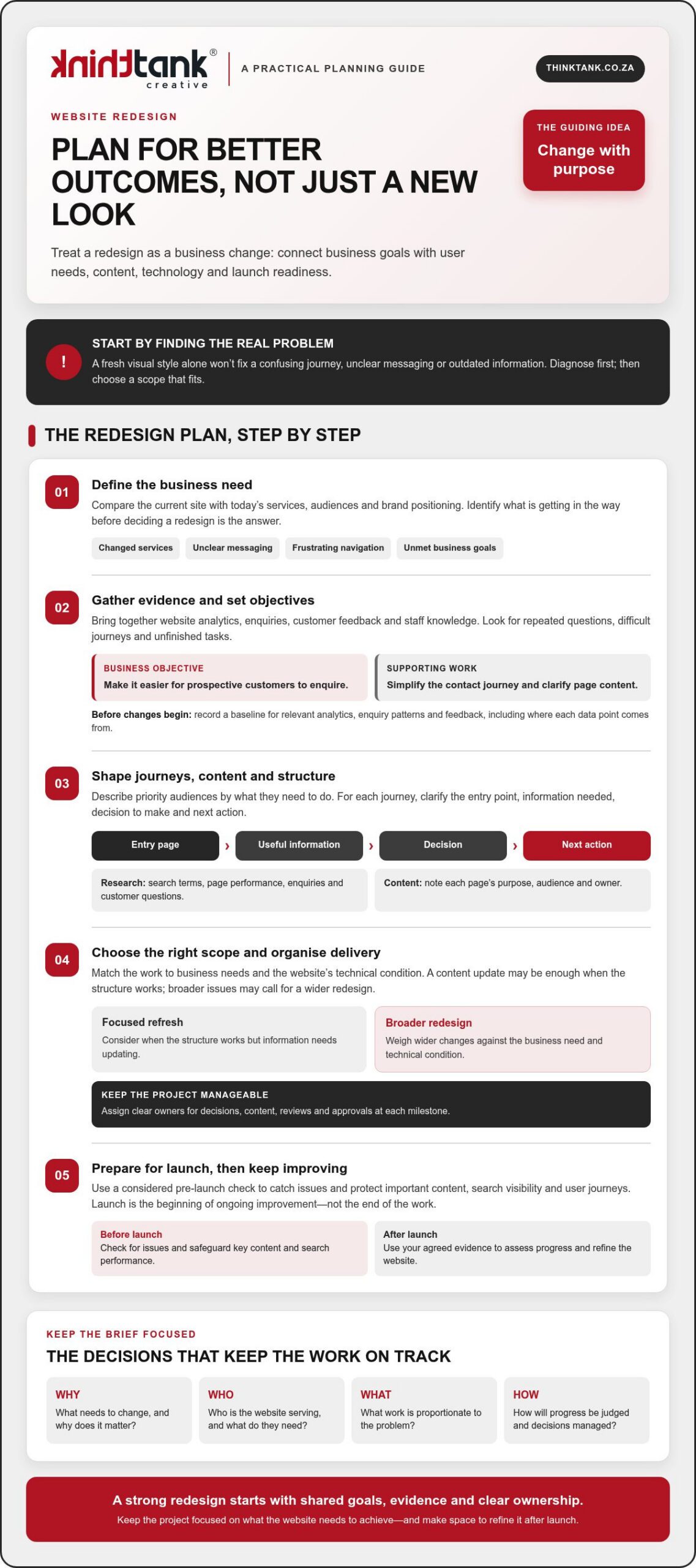
A website redesign planned as a visual refresh can leave the problems that matter most untouched. If you’re asking how to plan a website redesign project, start by treating it as a business change, not simply a new look.

Priorities can blur when stakeholders have different expectations, content needs reviewing and technical decisions start to mount up. Without a clear plan, a redesign can also put search visibility and important user journeys at risk. Agreeing on a shared direction makes decisions easier to manage and keeps the project focused on what the website needs to achieve.

This guide sets out a practical sequence for connecting business goals with user needs, content, technology and launch readiness. You’ll learn how to shape a brief that aligns stakeholders and delivery teams, decide what to keep or improve, and prepare for launch while protecting key content and search performance. The result is a considered foundation for your redesign and a website your team can continue to refine after it goes live.

Key Takeaways

  • Plan your website redesign around defined business goals, rather than visual change alone.
  • Use customer questions, website insights and staff knowledge to shape a brief around audience needs and next steps.
  • Choose between a focused refresh and a broader redesign by weighing the scope against your business needs and the website’s technical condition.
  • Make the project manageable by assigning clear owners for decisions, content, reviews and approvals at each milestone.
  • Use a considered pre-launch check to catch issues, then treat launch as the start of ongoing improvement.

How to Plan a Website Redesign Project Around Business Goals

Changed services, unclear messaging, frustrating navigation or business goals the website isn’t helping to meet are all valid reasons to review your site. First, identify the underlying problem before deciding that a redesign is the answer. A new visual style alone won’t resolve a confusing journey or outdated information.

Gather evidence from website analytics, enquiries, customer feedback and staff who speak with customers or update the site. Look for patterns: visitors may struggle to find a service, ask questions the website should answer or leave an important journey unfinished. This gives stakeholders a shared view of what needs attention and helps distinguish structural or technical issues from problems a focused content update could solve.

A good project plan turns that evidence into decisions. This short video offers another perspective on why planning matters:

Decide whether your website needs a redesign

Compare the current site with your present-day services, audiences and brand positioning. If visitors can’t tell what you offer or staff repeatedly answer the same basic questions, the issue may involve messaging, navigation or page structure. If the structure works but some information is out of date, a content update may be enough. Understanding the difference keeps the scope proportionate to the problem.

Design should support clarity and ease of use, not compete with them. Reviewing established web design principles can help frame discussions about how layout, visual choices and interaction work together to serve visitors.

Set objectives and agree how progress will be judged

Choose a small set of objectives tied to business priorities, then define what evidence could show progress. Keep the objective separate from the website deliverable: “make it easier for prospective customers to enquire” is a business objective; “simplify the contact journey and clarify the relevant page content” describes work that may support it.

Record a baseline before changes begin. Note the relevant analytics, enquiry patterns and feedback, along with where each data point comes from, so you can make a fair comparison after launch. For a deeper look at how usability decisions shape the experience, see this website user experience strategic guide.

A redesign brief is the shared record of a project’s goals, scope and success measures. Use it to align stakeholders, guide design and development decisions, and keep the work focused as details emerge. Knowing how to plan a website redesign project starts with agreeing what needs to change, why it matters and how you’ll assess the outcome.

Research, Content and Site Structure: Build the Redesign Brief

Once the project’s goals are clear, gather the evidence that will shape the experience. Review search terms, page performance and enquiry patterns alongside the questions customers ask your team. Staff who handle sales, service or website updates often know where people get stuck, what details they need and which information is frequently missing. Bringing these perspectives together helps the brief reflect real needs, not assumptions.

Describe priority audiences by what they’re trying to do. For each group, note their likely entry point, the information they need, the decision they must make and the next action you want them to take. A prospective customer might arrive on a service page, compare options, then enquire. Sketching that path can expose missing information or unnecessary steps before design and development begin. The lead generation strategies framework can also help connect audience journeys with meaningful next actions.

Turn audience research into useful user journeys

Map the important journeys in a simple diagram. Show how someone moves from an entry page through key decisions to a call to action, and mark where they may need reassurance or more detail. Keep the map focused on user tasks rather than imagined demographic profiles. Check that each step is clear, relevant and easy to complete, then use the findings to guide content and structure decisions.

Create a content inventory and draft the sitemap

List current pages and record each page’s purpose, intended audience, owner, available performance evidence and recommended action. Classify content to retain, revise, combine, remove or create. Flag material that needs subject-matter review, approval, rewriting or migration so content work doesn’t become a late-stage obstacle.

Next, group pages into a sitemap with clear, audience-friendly labels. A sitemap shows the proposed hierarchy; user-flow diagrams show how people move through it. Together, they can reveal duplicated sections, gaps in key information and journeys that lead nowhere. Share these drafts with relevant stakeholders and invite specific feedback before they become design assumptions.

This is how to plan a website redesign project with a brief grounded in evidence and ready to guide delivery. If you’re considering professional support, you can explore ThinkTank Creative’s website design and development as one option for taking the work from research and strategy through design, development and testing.

Compare Redesign Approaches, Platforms and Key Project Risks

Choose the scale of change to fit the problem. A focused refresh may suit a site with a sound technical foundation but outdated content or inconsistent visual presentation. A broader redesign may be more appropriate if the structure, user journeys or underlying technology no longer support your business needs. The ultimate guide to website redesign offers further considerations, but your decision should reflect your own scope, capacity and requirements.

Choose an approach that matches your resources and requirements

An in-house project can keep decisions close to the business, provided the team has the time and skills to do the work and maintain content afterwards. DIY tools may suit a straightforward site, but assess their limits against your design and technical needs. An agency-led project brings external design and development capability, while requiring clear communication and timely feedback from your team. Consider your available decision-makers, internal skills and responsibility for ongoing content before choosing.

Approach Control Internal capacity Complexity and support
In-house High Requires dedicated staff time and skills Internal team manages delivery and ongoing needs
DIY High over routine edits Requires time to build and maintain the site Best assessed against the project’s technical demands
Agency-led Shared through agreed decisions Needs a client-side contact for input and approvals Can support design, development and testing; agree responsibilities upfront

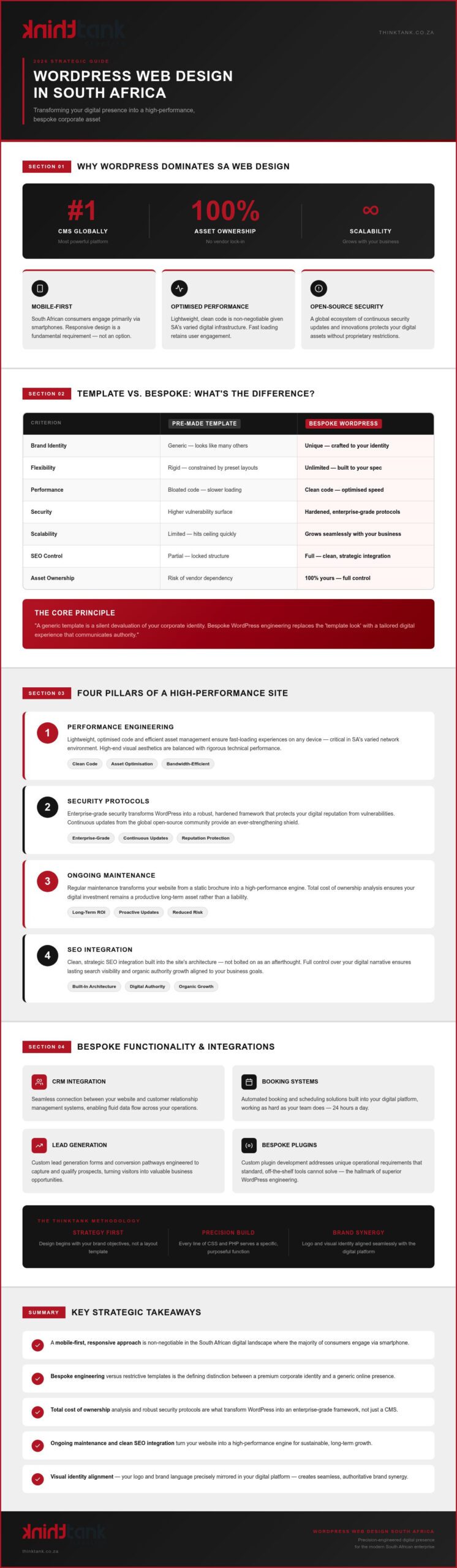
Assess a content management system (CMS) by how well it supports your publishing workflow, required integrations, accessibility needs and long-term maintainability. Avoid choosing on popularity alone. If you’re weighing bespoke requirements against other options, this custom website design strategic guide provides broader service considerations.

Plan for content migration, search continuity and data protection

Before build work starts, list pages, files, forms and important URLs, then record whether each will move, change, be combined or be retired. Map old URLs to relevant new destinations and arrange suitable redirects for changed or removed pages. Test those redirects and key page links before launch. Rankings can’t be guaranteed, so record search and analytics performance beforehand, then check for broken pages, indexing issues and changes in relevant traffic after launch.

Include forms and analytics in your migration checks. Identify where personal information is collected, used or stored, and ask an appropriate person to review the project against current South African privacy requirements. Knowing how to plan a website redesign project means addressing these risks early, not treating them as final launch tasks.
How to Plan a Website Redesign Project: A Practical 2026 Guide

Turn the Website Redesign Plan into a Manageable Project Roadmap

A clear sequence turns the agreed brief into work people can own and approve. Use a roadmap to move from planning to launch without leaving key decisions until the last moment:

For each milestone, record the person responsible, what they need to deliver and who has final approval. Set review windows that reflect people’s availability, and ask contributors to consolidate feedback before sending it to the project team. Keep approved materials, decisions, open questions and dependencies in one source of truth, such as a shared project document or workspace, so the latest agreed direction is easy to find.

Set responsibilities, approvals and project boundaries

Name a decision-maker, then identify contributors for business, content, design and technical reviews. Define what the project includes and what requires separate discussion. If a new request changes the agreed scope, assess its impact on priorities, timing and estimated cost before approving it. Clear ownership and approval points reduce avoidable project uncertainty.

Coordinate content, design and development work

Track dependencies: design may need approved copy and brand assets, while development may rely on agreed integrations and access to existing systems. Plan design reviews before build work, then test against the user and business requirements in the brief. Include training and handover planning so the team understands how to manage day-to-day website tasks after launch.

Keep the timeline proportionate to the scope, review capacity and dependencies rather than selecting a launch date before the work is understood. Costs depend on the project’s needs and timeline. ThinkTank Creative provides an estimated cost after discussing these with you, not a fixed price before the requirements are clear.

If you want a collaborative team to help shape and deliver the roadmap, discuss your website redesign project with ThinkTank Creative, from research and strategy through design, development, testing, launch and support.

Prepare for Launch and Choose the Right Redesign Partner

Launch is a handover, not a finish line. A thorough readiness check helps the team catch avoidable issues, while a clear plan for monitoring and support gives the new site room to improve as people use it.

Use a practical website launch-readiness checklist

Before going live, test priority journeys on relevant devices and confirm that essential content and contact routes work as intended. Use this checklist with the project team responsible for each area:

Use the agreed project requirements as your reference rather than assuming a site is ready because it looks polished. Once live, monitor the measures set in the brief, gather feedback from users and staff, and prioritise improvements based on what you learn. Launch begins the next cycle of observation and refinement; it doesn’t prove that every business objective has already been achieved.

Evaluate a redesign partner beyond visual presentation

Ask prospective partners how they approach research and strategy, UX/UI design, coding, testing, launch and support. Discuss who will make decisions, how feedback and approvals are managed, and what your team will need to provide. A clear, collaborative process makes responsibilities easier to understand and keeps the work aligned with the brief.

Plan for ownership after launch, too. Ask what training, documentation and support are included, and how your team will learn to manage routine website tasks. These details help make handover a practical transfer of knowledge, rather than simply receiving a completed site.

ThinkTank Creative, founded in 2001, offers end-to-end website design and development, from research and strategy through design, development, testing, launch, training and support. Its approach reflects the promise, “We Do It All So You Don’t Have To”, while keeping discussion and collaboration central to the project. If you’re considering a redesign, discuss your website redesign with ThinkTank Creative.

Turn Your Redesign Plan into Lasting Progress

A successful redesign starts with clear business goals, evidence about what users need and a brief that gives stakeholders a shared direction. From there, choose an approach and platform suited to your requirements, assign clear owners, and plan content, testing and launch with care.

Knowing how to plan a website redesign project also means looking beyond launch day. Track the measures you agreed, listen to user feedback and use what you learn to guide ongoing improvements. A thoughtful plan gives your team a stronger foundation for making those decisions with confidence.

ThinkTank Creative was founded in 2001 and offers website services spanning UX/UI design, coding, testing, launch, training and support, with ongoing service after project completion. If you’re ready to explore a collaborative approach to your redesign, discuss your website redesign project with ThinkTank Creative.

With shared goals and a practical roadmap in place, your next website can become a more useful, adaptable part of your business.

Frequently Asked Questions

When should a business plan a website redesign?

Plan a redesign when the site no longer reflects your services, confuses visitors or makes important tasks difficult. Other signs include outdated content, repeated customer questions, navigation problems or website goals that aren’t being met. First, check whether a content update or focused improvement could address the issue. A broader redesign makes sense when the underlying structure, technology or user journeys also need attention.

How do you start planning a website redesign project?

Start by agreeing on the business problem the redesign needs to solve. Gather evidence from website analytics, customer enquiries and feedback, and staff who work with customers or manage the site. Then identify priority audiences, their key tasks and the actions they need to take. This helps you shape the scope, choose suitable measures of progress and build a shared brief before design and development begin.

What should a website redesign brief include?

A useful redesign brief records the project’s goals, scope and success measures. It should also outline priority audiences, key user journeys, content requirements, technical considerations, responsibilities and approval points. Note current performance where relevant, so you can compare results after launch. Keep business objectives distinct from deliverables: improving the enquiry journey is an objective, while updating page content or navigation may be work that supports it.

How do you redesign a website without losing search visibility?

Protect search continuity by recording important pages and URLs before work begins. Map each URL that will change to its most relevant new destination, and arrange suitable redirects for changed or retired pages. Before launch, check links, redirects and agreed search settings. After launch, monitor relevant search and analytics data and investigate broken pages or unexpected changes. These steps help manage risk, but no redesign can guarantee unchanged rankings.

Should I redesign my website myself or work with an agency?

Choose based on the project’s complexity, your team’s skills and the time available for delivery and ongoing content management. A DIY approach may suit a straightforward site; an in-house team can keep decisions close to the business if it has the required capacity. An agency can contribute design and development expertise, with your team providing input and approvals. Clarify responsibilities, process and post-launch support before deciding.

Who should be involved in a website redesign project?

Involve a decision-maker who can keep priorities clear, alongside people responsible for business requirements, customer insight, content and technical knowledge. Include those who manage enquiries or maintain the current website, as they can identify practical user and workflow issues. Assign clear owners for decisions, content supply, reviews and approvals. The right contributors depend on the project, but everyone should understand their role and when their input is needed.

What should be checked before a redesigned website goes live?

Test priority journeys, navigation, page content, links, forms and contact routes. Review responsive layouts on relevant devices, and confirm agreed analytics, search, backup and technical checks with the responsible project team. Make sure launch responsibilities are assigned, including who records issues and coordinates their resolution. Use the agreed project requirements as your checklist, and resolve any problems that could prevent visitors from finding information or completing key tasks.

What happens after a website redesign launches?

After launch, monitor the measures agreed in the brief, gather feedback from users and staff, and prioritise improvements based on what you learn. Check that key journeys and forms continue to work as expected. Make sure the team has the training and documentation needed to manage routine website tasks. Launch marks the transition to using and refining the new site, not proof that every business objective has already been achieved.
Measuring the ROI of a Website Redesign: Strategic 2026 Framework

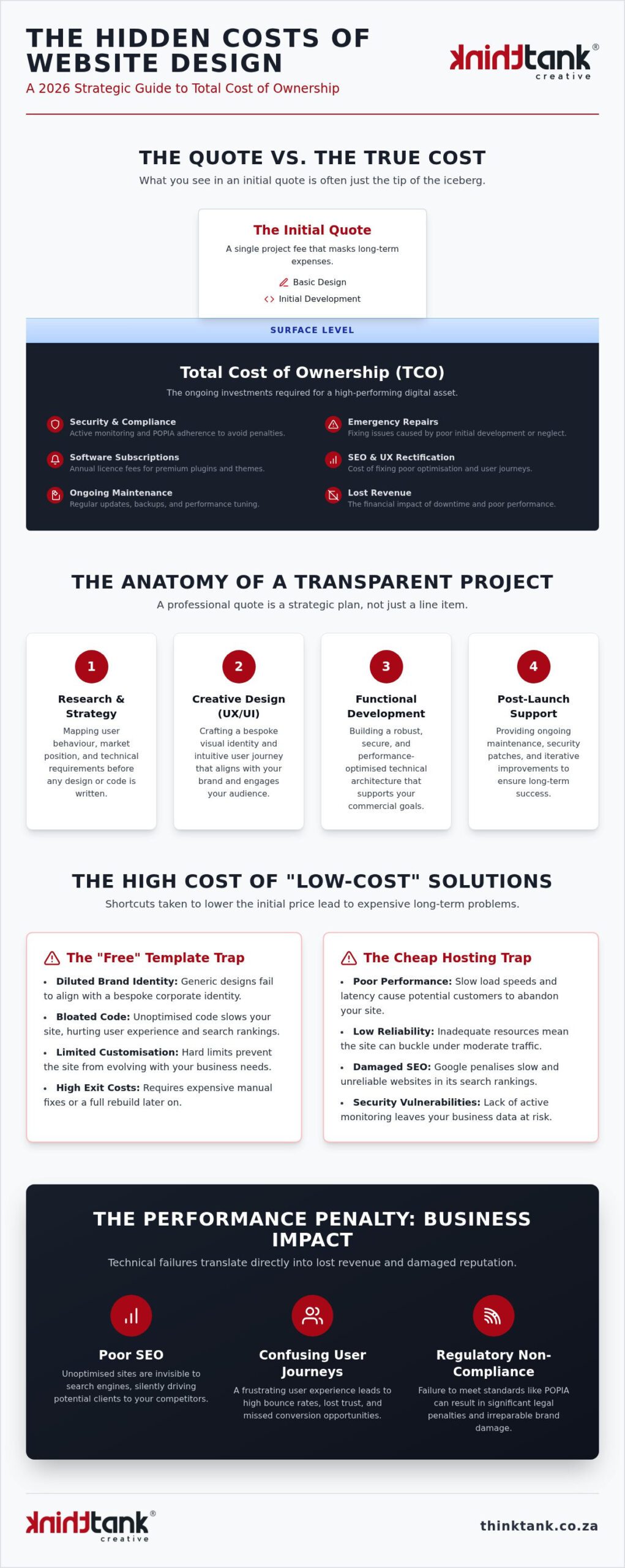
Treating an enterprise digital overhaul as a mere cosmetic face-lift is the quickest way to squander capital. When internal stakeholders view web development as an operational overhead rather than a hardworking commercial asset, measuring the roi of a website redesign becomes an exhausting uphill battle. It's entirely reasonable to dread post-migration search visibility dips, or to feel frustrated whilst trying to link modern user experience design directly to closed pipeline revenue.

True commercial returns stem from conversion velocity and technical efficiency, never surface-level decoration alone. In this strategic guide, you'll discover how to quantify tangible financial gains, operational savings, and measurable conversion growth across both immediate and multi-year horizons. We'll walk through the definitive ROI formula, critical Core Web Vitals benchmarks, and the reporting models required to build an airtight business case that earns unshakeable executive backing.

Key Takeaways

  • Master the commercial formula for measuring the roi of a website redesign, balancing net conversion revenue and operational savings against project outlay.
  • Discover how technical speed, responsive mobile architecture, and optimised Core Web Vitals accelerate transaction velocity without increasing paid acquisition spend.
  • Quantify indirect dividends such as reduced internal administrative overheads, elevated brand credibility, and mitigated regulatory risks.
  • Implement a disciplined 90-day pre-launch baseline protocol to isolate design-driven commercial gains accurately from seasonal market fluctuations.
  • Protect long-term asset yield by pairing full-lifecycle development engineering with proactive search retention and structured ongoing maintenance.

The Financial Case: Defining Website Redesign ROI Beyond Surface Aesthetics

Executive teams frequently commit capital to digital projects expecting transformative growth, only to judge the finished work through subjective visual preferences. A corporate website isn't a static digital brochure; it's an active commercial engine designed to drive pipeline velocity. Surface refreshes alone never justify significant capital outlays. Successfully measuring the roi of a website redesign requires shifting attention from visual novelty toward quantifiable financial expansion, structural cost reduction, and sustained customer lifetime value.

To grasp how behavioural user experience choices influence commercial returns before committing development resources, watch this strategic breakdown from Nielsen Norman Group:

The Fundamental Formula for Calculating Website Redesign Return

Standardising your economic model simplifies board-level justification. At its core, applying a structured return on investment (ROI) calculation establishes the exact commercial yield produced by your capital allocation:

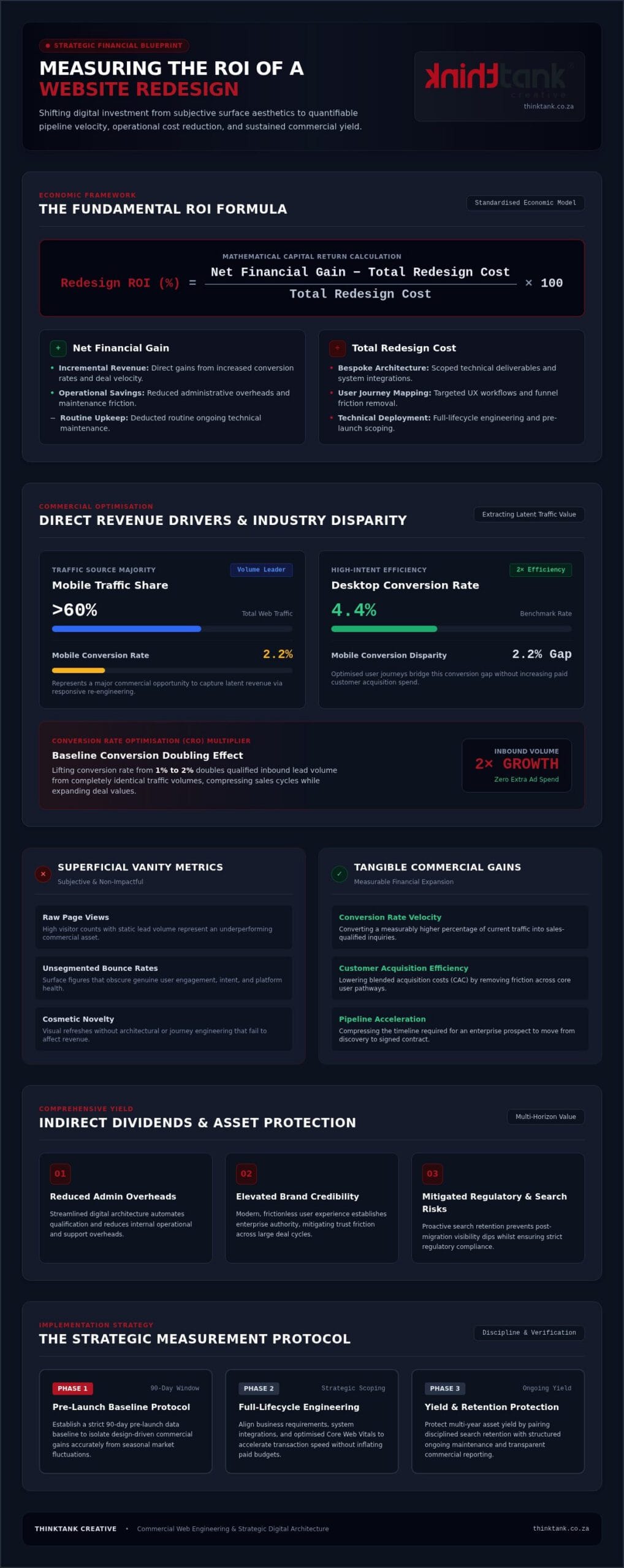
$$text{Redesign ROI (%)} = left(frac{text{Net Financial Gain} - text{Total Redesign Cost}}{text{Total Redesign Cost}}right) times 100$$

Here, net financial gain represents incremental revenue from conversion lifts combined with operational cost reductions, minus routine upkeep. Initial capital expenditure covers bespoke architecture, user journey mapping, and technical deployment. Transparent digital partners establish this outlay systematically. For example, ThinkTank Creative calculates an estimated cost only after conducting an in-depth strategic scoping of business requirements and system integrations, ensuring financial expectations match technical deliverables from day one.

Distinguishing Tangible Commercial Gains from Vanity Metrics

Superficial metrics like raw page views or unsegmented bounce rates obscure genuine business health. An aesthetically pleasing platform that attracts substantial traffic yet yields static lead volumes represents an underperforming asset. Conversely, deliberate UX engineering streamlines user funnels, accelerating lead qualification whilst significantly reducing customer acquisition costs (CAC). When measuring the roi of a website redesign, focus on indicators that alter your commercial ledger:

Direct Revenue Drivers: Measuring Conversion Velocity and Commercial Value

Direct commercial returns materialise when your platform extracts greater transaction value from existing traffic volumes. Global data reveals that over 60% of web traffic originates from mobile devices, yet mobile conversion rates hover around 2.2% compared to 4.4% on desktop environments. This disparity highlights an immediate commercial opportunity. By re-engineering responsive layouts and user pathways, a conversion-focused overhaul captures latent revenue without inflating paid acquisition budgets.

Conversion Rate Optimisation (CRO) and Lead Value Modelling

Lifting your baseline conversion rate from 1% to 2% doubles qualified inbound volume from identical traffic. When modelling pipeline velocity, multiply projected conversion lift against your historical lead-to-close ratio and average contract valuation. Research from Nielsen Norman Group on calculating ROI for design projects demonstrates that structured usability enhancements directly compress sales cycles while expanding deal values. Prioritise improving website user experience across key landing environments to eliminate friction, ensuring visitors navigate seamlessly toward commercial action.

E-commerce Checkout Velocity and Cart Abandonment Reduction

Every unnecessary checkout step or sluggish payment integration actively suppresses transaction completion. Akamai and Portent benchmarks show that a single 1-second delay in mobile loading time degrades conversions by approximately 7%. Conversely, accelerating interface responsiveness and deploying frictionless checkout funnels yields an immediate 5% to 15% rebound in completed sales. Measuring the roi of a website redesign requires tracking this recaptured revenue against prior abandonment baselines:

Organisations deploying bespoke lead generation strategies for South African businesses consistently discover that streamlined digital touchpoints turn casual browsing into measurable pipeline growth. If you're assessing whether your current architecture supports this commercial velocity, a collaborative discovery session with ThinkTank Creative can pinpoint where structural friction restricts your conversion potential.

Indirect Dividends: Operational Efficiencies, Brand Equity, and Search Retention

Revenue expansion tells only half the commercial story. When measuring the roi of a website redesign, indirect dividends represent substantial cost avoidances that protect your operating cash flow. An engineered digital platform reduces internal administrative friction, shields existing organic traffic equity, and establishes the executive credibility required to command premium market pricing.

Quantifying Administrative Time and Technical Support Savings

Legacy websites bleed operational resources through manual interventions. Outdated systems force personnel to re-enter leads manually, answer repetitive customer service queries, and triage frequent technical glitches. Strategic redevelopment replaces these labour sinks with automated CRM synchronisation, structured self-service customer portals, and unified database workflows.

Protecting Organic Capital: Search Engine Visibility Retention

Your existing organic search positions represent hard-earned balance sheet equity. A poorly executed migration can instantly erase keyword rankings, forcing you to replace lost qualified visitors through costly paid search auctions. Protecting this equity demands meticulous pre-launch URL mapping, canonical preservation, and comprehensive 301 redirection frameworks. Engaging specialists in search engine optimisation in South Africa ensures algorithmic equity transitions cleanly into your new environment, defending your customer acquisition pipelines without unexpected ad spend spikes.

Elevating Brand Perception and Corporate Credibility

Visual credibility carries real commercial weight. Landmark findings from the Stanford Web Credibility Research show that 75% of a website's perceived business credibility stems directly from design aesthetics and structural professionalism, whilst 94% of initial user impressions are visual. In high-stakes B2B markets, a tired interface signals institutional stagnation. A bespoke, cohesive digital identity projects market leadership, reassuring institutional buyers and validating premium pricing structures. Measuring the roi of a website redesign means factoring in how elevated corporate perception shortens enterprise sales deliberations and insulates your market share against newer entrants.

Measuring the ROI of a Website Redesign: Strategic 2026 Framework

The Measurement Protocol: Establishing Pre-Launch Baselines and Tracking Windows

Accurate financial attribution collapses if you launch without establishing clean comparative data. Without disciplined pre-launch controls, separating design-led performance improvements from seasonal swings or paid campaign shifts becomes impossible. Measuring the roi of a website redesign requires a staged measurement methodology that tracks system health from early deployment through mature commercial operation.

Step 1 & 2: Pre-Launch Audits and Analytics Calibration

Lock down an uncompromised 90-day baseline before altering a single template. Capture conversion rates by device, assisted conversion paths, organic click-through rates, and exact Core Web Vitals thresholds. Ensure technical readiness by validating Google's responsiveness benchmark, Interaction to Next Paint (INP), targeting 200 milliseconds or less, alongside Largest Contentful Paint (LCP) under 2.5 seconds. Configure server-side tracking and test event triggers to confirm that lead submissions, transaction values, and customer actions record with absolute precision.

Step 3 & 4: 30-Day Technical Stabilisation and 90-Day Performance Reviews

Dedicate the initial 30 days to technical verification. Monitor crawl error logs, indexation coverage, and redirection chains to confirm search bots process the new architecture without friction. Once technical stability is established, use the 90-day review to analyse commercial shifts against your historic baseline. Normalise this data against macroeconomic conditions to isolate genuine conversion velocity gains from external seasonal lift.

Step 5: Annual Total Cost of Ownership (TCO) Assessment

Evaluate your full economic return across a 12-month operating window. Compare incremental top-line revenue and recaptured administrative savings against the total cost of ownership. This calculation must incorporate the initial project investment, established via tailored scoping rather than arbitrary fixed fees, alongside ongoing managed hosting and maintenance. Factoring routine support into lifetime returns confirms whether your platform remains an appreciating asset.

Ready to establish rigorous tracking baselines and deploy a high-yielding digital engine? Partner with an experienced team and request a strategic website consultation with ThinkTank Creative to model your commercial upside.

Maximising Investment Yield: Partnering for Strategic Web Engineering

Maximising capital yield requires treating web redevelopment as a rigorous engineering project rather than an isolated aesthetic sprint. When measuring the roi of a website redesign over multi-year cycles, collaborative strategic alignment consistently outperforms transactional agency engagements. Partnering with a consultative team ensures that every structural layout, code choice, and user interface component actively contributes to conversion volume and operational resilience.

The ThinkTank Creative Methodology: De-risking Digital Capital Investments

Operating across South Africa since 2001, ThinkTank Creative deploys a battle-tested delivery framework that replaces commercial guesswork with structured execution. Our award-winning in-house web and graphic designers work in close harmony with systems developers, methodically balancing intuitive usability with deep back-end stability. Rather than providing arbitrary off-the-shelf quotations, we supply an accurate estimated cost only after conducting thorough strategic scoping aligned with your bespoke organisational goals.

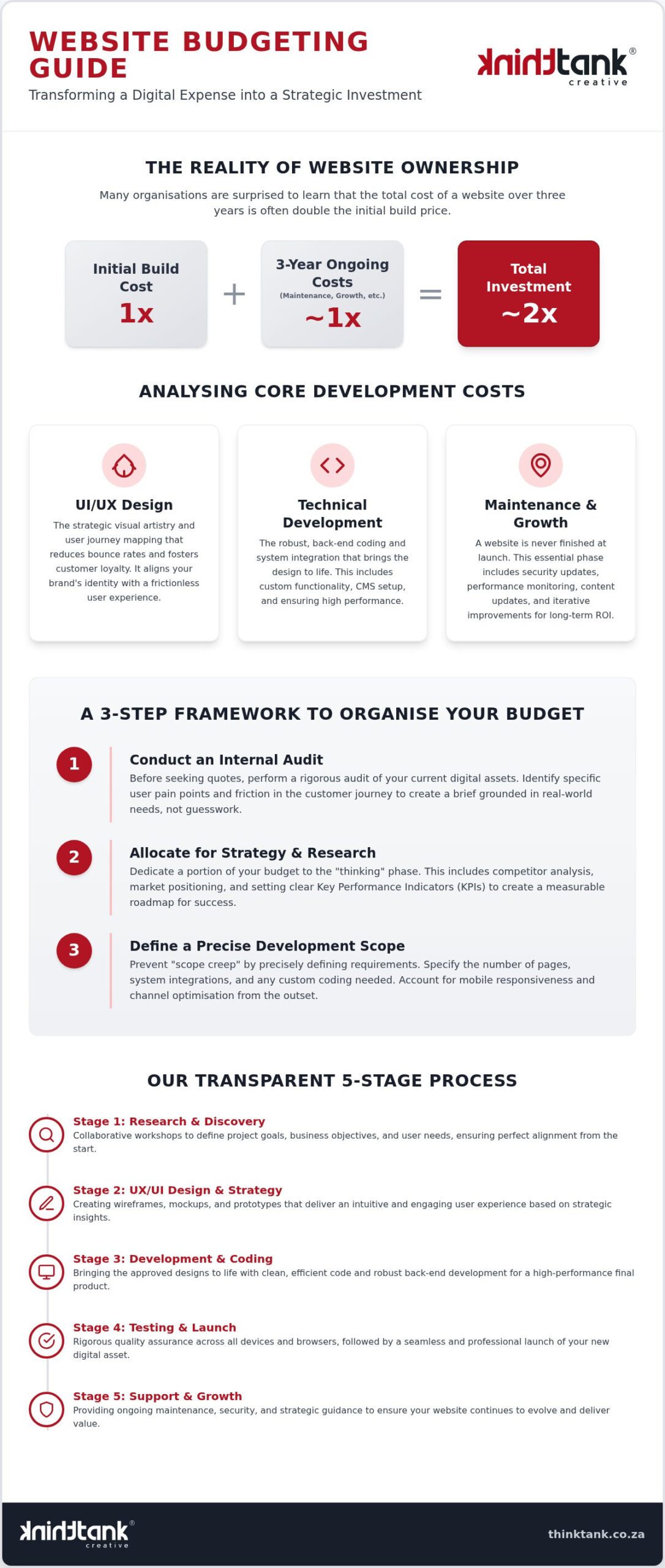
This transparent model guides your investment through a proven five-stage development journey:

Long-Term Support: Protecting Asset Performance Beyond Launch Day

A digital asset begins deprecating the moment it launches unless actively maintained. HTTP Archive benchmarks reveal that only 48% of mobile websites successfully pass all three Core Web Vitals metrics, illustrating how quickly neglected codebases lose their competitive edge. Ongoing maintenance, technical enhancements, and system security updates are vital safeguards that preserve your initial capital efficiency.

Eliminating multi-vendor friction further protects your commercial yield. By uniting bespoke custom website design in South Africa with integrated SEO, search advertising, and branding services, your organisation maintains complete technical cohesion. When measuring the roi of a website redesign across its full lifecycle, continuous optimisation ensures your digital footprint consistently drives pipeline growth. Take the definitive step toward commercial expansion and partner with ThinkTank Creative to engineer an enduring digital asset.

Engineering Your Platform for Measurable Commercial Growth

Capturing the full economic return of a digital overhaul requires looking far beyond cosmetic enhancements. By balancing direct conversion velocity against internal labour savings and search visibility retention, measuring the roi of a website redesign transforms from subjective speculation into an airtight commercial asset. When you establish clean pre-launch baselines and hold development teams accountable to Core Web Vitals, your platform actively compounds balance sheet value.

Securing these dividends demands a committed, highly capable partner. Established across South Africa since 2001, ThinkTank Creative unites award-winning designers with experienced system developers through a proven five-stage methodology. Operating with transparent strategic discovery, our team provides an accurate estimated cost aligned directly with your bespoke operational requirements. We safeguard your technical integrity at every milestone, ensuring your new digital architecture delivers sustained competitive differentiation. Maximise your digital investment with ThinkTank Creative and build a digital flagship engineered for long-term commercial triumph.

Frequently Asked Questions

How long after a website redesign can a business expect to see positive ROI?

B2B organisations and professional service firms typically realise full capital payback within 4 to 14 months following launch. Early indicators such as reduced mobile bounce rates and increased enquiry volume often emerge within the first 60 days. However, long-term commercial returns continue compounding across an average two- to three-year asset lifespan as search rankings solidify and sales teams close leads generated by the streamlined interface.

What is the standard formula used for measuring the roi of a website redesign?

When measuring the roi of a website redesign, the standard economic equation divides net commercial gain by total project expenditure:

$$text{Redesign ROI (%)} = left(frac{text{Net Financial Gain} - text{Total Investment}}{text{Total Investment}}right) times 100$$

Net financial gain combines gross revenue from new conversion lift and quantified operational labour savings, minus ongoing technical maintenance costs. This formula provides executive leadership with a clear percentage yield relative to capital outlay.

Can a business measure website redesign ROI without selling products online?

Yes, non-transactional businesses measure return by tracking pipeline acceleration and lead values. By establishing baseline lead-to-opportunity ratios and average client contract values, each form submission or consultation booking carries a precise monetary figure. A platform that lifts inbound qualified enquiries from 20 to 40 per month delivers quantifiable financial return directly to the sales ledger, even without an integrated transactional payment portal.

Will our organic search traffic drop immediately following a website redesign launch?

Temporary algorithmic fluctuations can occur for two to four weeks whilst search engines crawl and re-index new site structures. However, severe or permanent drops only happen when technical migrations are mishandled. Implementing exhaustive 301 redirection maps, preserving high-performing URL structures, and maintaining on-page metadata ensures search equity transfers intact. Proactive search engine optimisation safeguards existing rankings and quickly accelerates organic visibility post-launch.

How do operational cost savings factor into overall website redesign return calculations?

Operational cost savings represent direct cash preservations that factor alongside top-line revenue gains. When modern system integrations automatically synchronise form submissions with internal CRMs, staff spend fewer administrative hours on manual data entry. Similarly, comprehensive digital self-service resources reduce inbound customer service tickets. Multiplying the hours saved across operational teams by standard labour rates provides a concrete financial saving to add into overall return calculations.

What pre-launch data must be recorded to accurately assess redesign performance later?

Accurate attribution requires capturing an uncompromised 90-day baseline prior to redevelopment. Key metrics include device-specific conversion rates, organic search traffic volumes, top-performing commercial landing pages, and average lead acquisition costs. Additionally, technical benchmarks such as Core Web Vitals (including Interaction to Next Paint and Largest Contentful Paint) must be documented. Without this baseline, proving that subsequent growth stems from design engineering rather than external market shifts is virtually impossible.

How does ThinkTank Creative ensure a website redesign generates measurable commercial value?

ThinkTank Creative applies an established five-stage development framework spanning strategic planning through post-launch delivery and support. Operating nationwide across South Africa since 2001, our award-winning in-house web designers and developers reject generic templates. We calculate an estimated cost only after conducting rigorous commercial discovery, aligning user experience architecture directly with measurable business objectives. This disciplined engineering ensures every deployed asset protects organic equity whilst accelerating transaction velocity.

Improving Website User Experience: 2026 Strategic Guide

A website that merely functions is no longer a competitive advantage; it's the bare minimum for survival in an increasingly sophisticated digital economy. You might see healthy traffic numbers in your analytics, yet feel the frustration of high bounce rates as visitors slip away whilst searching for clarity. Understanding how to improve website user experience is the defining factor that separates an overlooked brand from a market leader. It's a delicate balance between bold creative vision and the technical precision required to keep a visitor engaged across every device they own.

We believe your digital presence should be a seamless extension of your professional identity, not a source of friction or developer jargon. This strategic guide provides a clear roadmap for your next optimisation project, detailing how to harmonise imaginative design with meticulous functionality. You will discover the actionable steps needed to elevate your brand and appreciate the significant ROI that follows a well-executed UX investment. By following our proven methodology, you can transform your website into a polished, high-performing asset that resonates with your audience and drives consistent conversions.

Key Takeaways

  • Distinguish between the aesthetic layers of UI and the strategic depth of UX to ensure your digital presence serves a clear business purpose.
  • Master how to improve website user experience by adopting a mobile-first mindset and optimising performance for the unique connectivity landscape of South Africa.
  • Utilise sophisticated visual storytelling techniques, such as the purposeful application of white space and consistent corporate identity, to enhance brand authority.
  • Establish a methodical audit framework using analytics and usability testing to identify and resolve the specific friction points that hinder your conversion rates.
  • Understand the value of a collaborative 5-stage development journey that moves seamlessly from initial planning through to rigorous testing and delivery.

Understanding User Experience: Why UX is the Engine of Business Growth

User experience is the invisible architecture that supports every successful digital transaction. It represents the strategic alignment between your customer's deepest needs and your core business objectives. Whilst many view it as a mere technical requirement, we see it as a journey of imagination where precision meets creativity. Understanding how to improve website user experience begins by recognising that UX isn't just a feature; it's the very engine of your brand's growth and long-term sustainability.

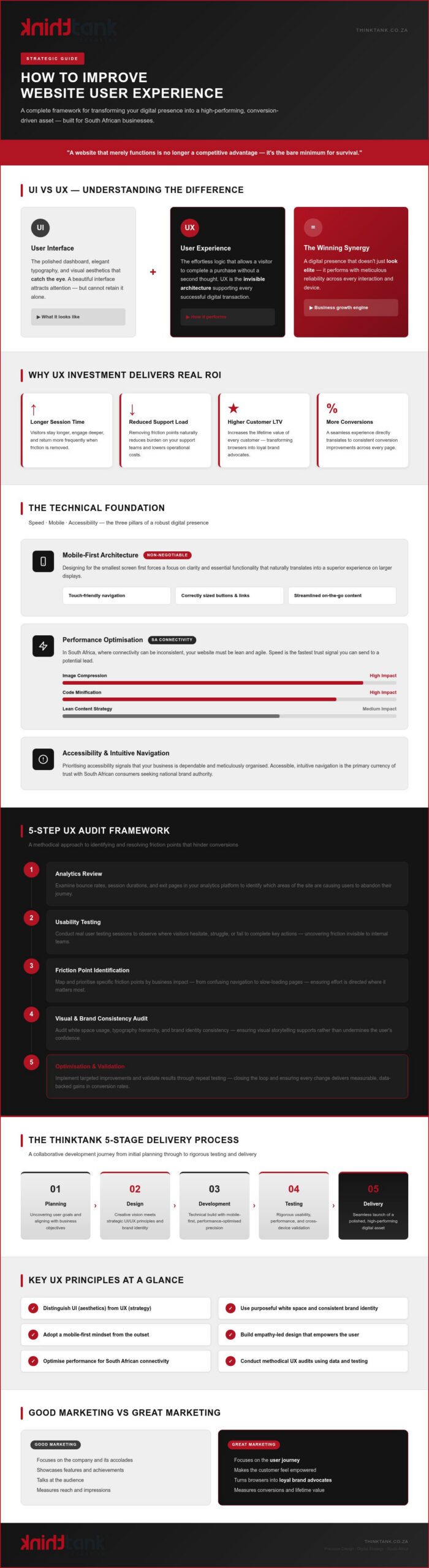
To gain clarity, one must distinguish between User Interface (UI) and User Experience (UX). If UI is the polished dashboard and elegant typography that catches the eye, UX is the effortless logic that allows a visitor to complete a purchase without a second thought. A beautiful interface might attract attention, but only a superior experience retains it. This synergy ensures that your digital presence doesn't just look elite; it performs with meticulous reliability across every interaction.

Investing in UX yields a tangible return that extends far beyond aesthetics. By removing friction points, you naturally reduce the burden on your support teams and increase the lifetime value of every customer. When a website is easy to use, visitors stay longer, engage deeper, and return more frequently. It's a calculated business strategy that transforms your site from a static brochure into a high-performing asset.

The Distinction Between Good and Great Marketing

Good marketing focuses on the company and its accolades; great marketing focuses on the user journey and makes the customer feel empowered. Our approach transforms your digital presence into a space where visitors feel understood and capable. This empathy-led design is what turns a casual browser into a loyal brand advocate. We prioritise a collaborative process that uncovers your users' true goals, ensuring every click feels like a step toward their own success rather than a hurdle to overcome.

UX as a Competitive Advantage in the South African Market

A polished digital presence is no longer optional for those seeking national brand authority amongst South African consumers. Trust is the primary currency of the web, and a seamless experience is the fastest way to earn it. By prioritising accessibility and intuitive navigation, you signal that your business is dependable and meticulously organised. For those looking to lead their industry, integrating these principles with custom website design South Africa provides the strategic context needed to dominate the local landscape and build lasting professional relationships.

Optimising the Technical Foundation: Speed, Mobile, and Accessibility

A flawless user experience is built upon a robust technical foundation. You cannot inspire confidence with a website that falters on a smartphone or takes an eternity to load over a standard mobile connection. When considering how to improve website user experience, you must begin with the mechanics that ensure your site is accessible to every South African, regardless of their device or data speed. This technical rigour provides the stability your brand needs to project an image of effortless professionalism and reliability.

The Mobile-First Architecture

Designing for the smallest screen first is a non-negotiable strategy for the modern digital landscape. By prioritising the mobile interface, you force a focus on clarity and essential functionality that naturally translates into a better experience on larger displays. Navigation must be touch-friendly, with buttons and links sized meticulously to avoid user frustration. Streamlining your content for on-the-go consumption ensures that your message remains impactful, even when viewed during a quick commute or a busy workday.

Performance Optimisation for National Reach

Speed is a critical component of trust. In a country where connectivity can be inconsistent, your website must be lean and agile to serve users effectively. Simple actions like image compression and the minification of code can have a profound impact on loading times, preventing potential leads from bouncing before your content even appears. These technical refinements are also deeply intertwined with your broader search engine optimisation South Africa strategy, as search engines increasingly penalise sluggish performance. Lighthouse scores are an automated metric provided by Google that assess your site's performance, accessibility, and best practices to ensure a high-quality digital experience in 2026. Maintaining these standards requires a commitment to excellence that often benefits from professional website maintenance and support.

Accessibility is the final, vital pillar of your technical foundation. Implementing inclusive design standards ensures your brand reaches a diverse audience, including those with visual or motor impairments. By utilising high-contrast colours, screen-reader-friendly layouts, and keyboard navigation, you demonstrate a level of corporate maturity that resonates with all users. This commitment to inclusivity doesn't just expand your reach; it solidifies your reputation as a forward-thinking industry leader that values every individual's journey.

Visual Storytelling and Brand Consistency

Visual appeal is the first handshake your brand offers a potential client. It acts as the emotional bridge between technical functionality and user engagement, transforming a cold digital interface into a space of professional resonance. When exploring how to improve website user experience, you must treat your visual assets as a unified language that speaks to your brand's authority and meticulous attention to detail. A site that looks fragmented or inconsistent suggests a lack of care, whilst a cohesive visual narrative projects stability and excellence.

Applying a consistent corporate identity across every page is fundamental to building trust. This includes the precise use of logos, specific colour palettes, and typography that reflects your brand's unique personality. Beyond these core elements, the strategic use of white space is essential for reducing cognitive load. By giving your content room to breathe, you direct user attention toward your most important messages and prevent the mental fatigue that often leads to high bounce rates. This deliberate organisation ensures that your visitors feel guided rather than overwhelmed.

The Power of Professional Brand Identity

A professional brand identity serves as the foundation of your digital reputation. When a visitor encounters a custom logo and stationery design that feels deliberate and high-quality, they immediately perceive a higher level of competence and reliability. Maintaining this cohesive vibe from your social media advertisements through to your website landing pages ensures a seamless transition for the user. The psychological impact of your chosen colour schemes and typography is profound; these elements subtly influence user behaviour and emotional response before a single word of copy is read. Pairing a strong visual identity with how to write effective website copy ensures that your messaging resonates just as powerfully as your design.

Information Architecture and Navigation

Strategic information architecture organises your content into a logical flow that leads users toward a specific, desired outcome. You can reduce friction significantly by limiting the number of clicks required to reach essential information. Our methodology incorporates specific "Choices" and "Feedback" stages during the design process to refine this navigation, ensuring every interaction feels intuitive and rewarding. Consider the following elements when refining your site's visual hierarchy:

By harmonising these visual components, you create a digital environment that is both beautiful and functional, reinforcing your position as a dependable partner in your client's success.

Improving Website User Experience: 2026 Strategic Guide

How to Conduct a UX Audit: A 5-Step Optimisation Framework

Transformative growth requires an honest assessment of your current digital performance. A UX audit is not merely a checklist of technical glitches; it is a meticulous strategic review designed to align your website with the evolving expectations of your audience. Learning how to improve website user experience is a continuous cycle of observation and refinement that ensures your brand remains relevant and resilient. By following a structured framework, you can move from guesswork to data-driven precision, identifying exactly where your digital presence excels and where it requires elevation.

Analysing User Behaviour

Data doesn't lie. It reveals the quiet frustrations of your visitors through metrics like bounce rates and exit pages. You don't need to be a data scientist to identify "rage clicks", those moments where a user clicks repeatedly on an unresponsive element, or confusing navigation paths that lead to dead ends. Heatmaps provide a vivid visual representation of user interaction, allowing you to see exactly where engagement thrives and where your most valuable content is being ignored. If you are ready to identify the hidden obstacles in your user journey, our team can help you conduct a professional UX audit that aligns with your long-term growth objectives.

Content and Conversion Review

A successful website guides the visitor toward a clear decision. Your calls to action (CTAs) must be noticeable, consistent, and focused entirely on the benefits provided to the user. We often find that removing even a single unnecessary form field can significantly increase lead generation by reducing the cognitive effort required to convert. This process of fine-tuning, based on authentic user feedback, ensures your website remains a polished and effective tool for business development. It's about creating a journey that feels less like a transaction and more like a collaborative success. For businesses seeking to maximise every visitor interaction, exploring lead generation website design South Africa strategies can provide the conversion-focused architecture needed to turn traffic into high-quality enquiries. Complementing this with proven lead generation strategies for South African businesses ensures your optimised UX is supported by a comprehensive framework for attracting and converting high-quality prospects.

The ThinkTank Process: Delivering Excellence Through Partnership

Excellence is never an accident; it's the result of a disciplined, collaborative process that values strategic depth over quick fixes. Achieving a superior digital presence requires more than just knowing how to improve website user experience; it demands a partner capable of executing that vision with surgical precision. We apply the standards of an international web-company to every project, ensuring that your site is as robust as it is beautiful. Our "all-rounder" capability means your branding, development, and marketing strategies are harmonised under one roof, reducing your stress whilst elevating your brand's authority.

Our methodology follows a comprehensive cycle designed to eliminate uncertainty and drive results. This proven path includes several critical phases:

From Imagination to Launch

Our designers prioritise usability and functionality as core tenets of every creative decision. We view the design phase as a collaborative journey of imagination where healthy debate and discussion lead to more refined UX outcomes. By favouring bespoke solutions over restrictive templates, we ensure your website is tailored to your specific business needs. This custom approach allows for greater flexibility and ensures your technical foundation can scale alongside your ambitions without the limitations of pre-packaged software.

Post-Launch Support and Evolution

A website is a living asset that requires constant attention to remain competitive. UX is never truly finished because user behaviour and technological standards are in a state of perpetual evolution. Our dedicated website maintenance and support services ensure your site remains secure, functional, and optimised for peak performance. We handle the technical complexities of your digital presence so you can focus on your core business operations with total confidence. Amplifying your site's authority through proven local link building strategies South Africa businesses rely on is an essential complement to ongoing UX refinement, ensuring your optimised experience is discoverable by the right audience. Embark on a journey of imagination with ThinkTank Creative today.

Elevating Your Brand Through Strategic Design

Mastering the digital landscape requires more than a functional website; it demands a meticulous commitment to the user journey. By harmonising technical performance with evocative visual storytelling, you transform your platform from a simple tool into a powerful engine for business growth. Understanding how to improve website user experience is a continuous process of auditing, refining, and innovating to meet the sophisticated expectations of your audience. Whether you are optimising for mobile-first connectivity or defining a bespoke corporate identity, every detail contributes to a cohesive and authoritative brand presence.

ThinkTank Creative has been a trusted partner in this journey since 2001, providing an elite end-to-end service that covers everything from initial research to ongoing support. Our award-winning in-house design team is ready to help you navigate these complexities with quiet assurance and creative excellence. It's time to move beyond the template and embrace a digital strategy that truly reflects your professional standard. Partner with ThinkTank Creative for a Bespoke UX Strategy and begin your brand's transformation today. We're excited to collaborate on your next milestone.

Frequently Asked Questions

What is the difference between UX and UI design?

UI is the visual interface, encompassing colours, buttons, and typography, whilst UX is the strategic logic governing how a user interacts with those elements. Think of UI as the beautiful finish on a vehicle and UX as the engine and handling that determine the drive's quality. Both must work in synergy to ensure your brand's digital presence is both aesthetically pleasing and meticulously functional for every visitor who engages with your brand.

How long does it typically take to improve a website's user experience?

The timeframe depends on the scope of the project, but initial high-impact optimisations can often be implemented within a few weeks. A comprehensive overhaul following our 5-stage development process typically spans several months to ensure every detail is tested and refined. We prioritise a methodical approach that balances rapid improvements with the strategic depth required for long-term brand transformation and sustainable growth across all digital channels.

Can I improve my website UX without a full redesign?

Yes, you can certainly implement incremental changes that yield significant benefits without a complete overhaul. Small refinements, such as optimising navigation menus, improving page load speeds, or clarifying your calls to action, can immediately enhance how to improve website user experience. These targeted adjustments allow you to resolve specific friction points identified in a UX audit whilst maintaining your existing brand structure and technical foundation.

How does website speed affect user experience and SEO?

Website speed is a fundamental pillar of both user satisfaction and search engine rankings. A sluggish site frustrates visitors, leading to higher bounce rates and lost conversions, whilst search engines like Google penalise slow-loading pages in their results. By prioritising performance through image compression and efficient coding, you create a seamless experience that encourages longer engagement and signals to search engines that your site is a high-quality resource.

What are the most common UX mistakes South African businesses make?

Many local businesses fail to account for the mobile-first reality of the South African market and the varying connectivity speeds across the country. Another frequent error is ignoring how to improve website user experience by using technical jargon that alienates the user. Overly complex forms and a lack of consistent corporate identity across different devices also create friction that prevents visitors from trusting a brand or completing a transaction.

Is mobile-first design really necessary for my B2B business?

Mobile-first design is absolutely essential for B2B enterprises because professional decision-makers increasingly research partners on their smartphones during transit or between meetings. If your site is difficult to navigate on a small screen, you risk appearing out of touch and unreliable. A responsive, mobile-optimised interface ensures your brand projects a consistent image of excellence, regardless of the device your potential partners choose to use.

How do I measure if my UX improvements are actually working?

You can measure success by monitoring key performance indicators such as conversion rates, average session duration, and bounce rates in your analytics. Qualitative feedback from usability testing and a reduction in customer support enquiries also provide clear evidence of a smoother user journey. These metrics allow you to see the tangible ROI of your UX investment and guide your future efforts for continuous digital evolution.

What is the estimated cost for a professional UX audit and redesign?

We provide an estimated cost only after discussing your specific business needs and the complexity of your current digital presence. Every project is unique, requiring a bespoke strategy that aligns with your brand's goals and technical requirements. By focusing on tailored solutions rather than templated packages, we ensure that your investment is directed toward the high-impact areas that will drive the most significant growth for your business.

15 Critical Signs You Need a New Website in 2026: The Strategic Checklist

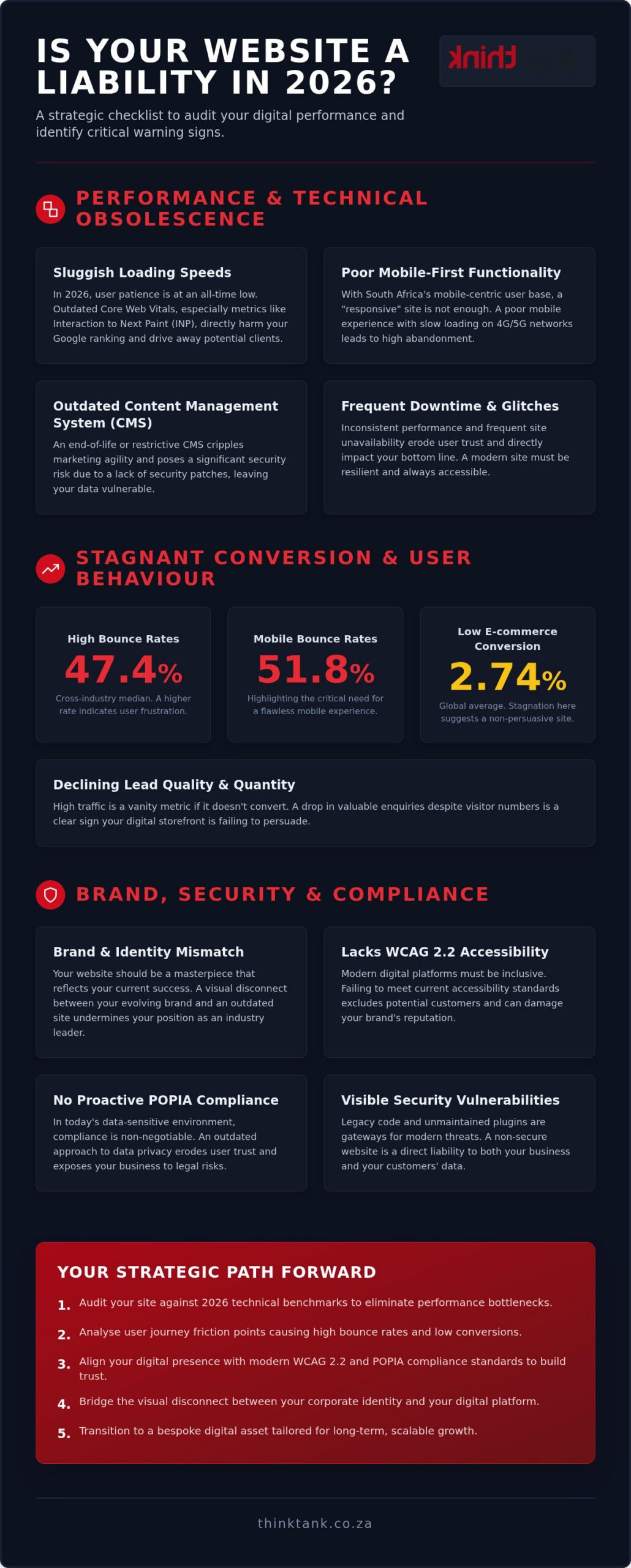
If your website were an employee on your sales team, would you be celebrating their targets today, or would they be facing a performance review? It is a confronting thought, but in the sophisticated digital environment of 2026, a platform that felt revolutionary a few years ago can quickly become a silent liability. You likely recognise the frustrating signs you need a new website, such as a dip in lead quality or a bounce rate that has climbed toward the current industry median of 47.4 per cent. It is common to feel a growing misalignment between your ambitious brand vision and a digital presence that no longer reflects your excellence.

We believe your website should be a bespoke masterpiece that evolves alongside your success. This guide provides a strategic checklist to help you audit performance bottlenecks and identify where your current site falls short of modern expectations. We will explore fifteen critical indicators, including WCAG 2.2 accessibility standards and the latest proactive POPIA compliance requirements, to give you total clarity on your next steps. This journey will move you from technical uncertainty to a position of quiet assurance, ready to craft a digital experience that truly resonates with your audience and restores your competitive edge.

Key Takeaways

  • Audit your digital performance against 2026 technical benchmarks to ensure that sluggish loading speeds and outdated Core Web Vitals are not driving potential clients toward your more modern competitors.
  • Recognise the critical signs you need a new website by identifying friction points in your customer journey that lead to declining lead quality and high bounce rates.
  • Align your digital presence with the latest WCAG 2.2 accessibility standards and proactive POPIA compliance to protect your brand reputation and foster trust amongst your users.
  • Bridge the visual disconnect between your evolving corporate identity and your current site, ensuring your online platform accurately reflects your status as an industry leader.
  • Master the strategic transition to a new platform using a collaborative five-stage development process designed to create a bespoke digital asset tailored for long-term growth.

Performance and Technical Obsolescence

Performance is the silent heartbeat of your brand's digital presence. In 2026, user patience has reached an all-time low. If your pages hesitate for even a few seconds, you're effectively handing your leads to a more agile competitor. This technical friction is one of the most undeniable signs you need a new website. Often, the culprit is a gradual build-up of technical obsolescence. Legacy code and unmaintained plugins behave like digital anchors, dragging down server response times and creating a fragile architecture prone to glitches.

Evaluating your site against 2026 Core Web Vitals is no longer optional. Google's focus on metrics like Interaction to Next Paint (INP) means that stability and responsiveness are now primary ranking signals. Frequent downtime isn't just a nuisance; it's a direct hit to your bottom line and brand authority. We've seen how inconsistent performance erodes the trust you've worked hard to build. A modern site must be resilient, ensuring your brand is always available when your customers need you most. This quiet assurance in your technical foundation allows your business to scale without the constant fear of a digital breakdown.

Mobile-First Functionality for ZA Users

South Africa's digital landscape is uniquely mobile-centric. Whilst global mobile traffic averages 59.6 per cent, local users frequently access the web via mobile data networks where every kilobyte counts. The cross-industry median bounce rate for mobile is currently 51.8 per cent, highlighting how quickly users abandon sites that don't perform. A site that is simply "responsive" often fails the 2026 mobile-first test. True mobile excellence requires bespoke craftsmanship, focusing on thumb-friendly navigation and generous touch-target spacing. If your mobile experience feels like a cramped version of your desktop site, you aren't meeting the needs of your audience. Fast loading on 4G and 5G networks is essential for maintaining engagement in a competitive market.

Outdated Content Management Systems

Your CMS should be a catalyst for growth, not a barrier to entry. Many businesses remain tethered to end-of-life platforms or restrictive systems that make content updates a technical ordeal. With WordPress powering 42.4 per cent of the web in 2026, the standard for ease-of-use is high. An outdated CMS isn't just difficult to manage; it's a security risk. End-of-life systems lack the patches needed to defend against modern threats, leaving your data vulnerable. Recognising that your platform limits your marketing agility is one of the key signs you need a new website. If updating a simple blog post requires a developer's intervention, your team's ability to react to market trends is being compromised.

Stagnant Conversion and User Behaviour

High traffic volume is a vanity metric if it fails to catalyse meaningful business growth. If your analytics show a steady stream of visitors but your inbox remains quiet, you are witnessing a classic disconnect between visibility and value. This stagnation is one of the most pressing signs you need a new website because it suggests your digital storefront is no longer persuasive. Great marketing isn't just about shouting louder; it is about making your customers look smart for choosing you. With global e-commerce conversion rates averaging just 2.74 per cent in 2026, every percentage point represents a significant shift in revenue. When a site feels intuitive and professional, it validates the user's decision to engage, whilst a clumsy interface creates immediate doubt.

Analysing where these friction points occur requires a methodical approach. By consulting a strategic checklist for a new website, you can begin to pinpoint whether the issue lies in your messaging, your layout, or a fundamental breakdown in user experience. We often find that businesses possess excellent products but present them through a digital lens that feels dated or difficult to navigate. This misalignment prevents you from reaching your full digital potential and keeps your conversion rates anchored to the floor. Recognising these signs you need a new website early allows you to pivot before the gap between you and your competitors becomes insurmountable.

High Bounce Rates and Low Engagement

Your bounce rate acts as a direct feedback loop from your audience. In 2026, the cross-industry median bounce rate sits at approximately 47.4 per cent, but a figure significantly higher than this often indicates user frustration. Cluttered layouts and confusing navigation menus force visitors to work too hard to find what they need. We recommend using heatmaps to observe exactly where users lose interest or encounter barriers. If people are dropping off before they even scroll, your "above the fold" content isn't doing its job. A clean, purposeful design respects the user's time and encourages deeper exploration of your brand's story.

Friction in the Customer Journey

A seamless path from discovery to enquiry is the hallmark of elite digital craftsmanship. If your calls-to-action are buried at the bottom of long paragraphs or use uninspiring language, you are missing vital opportunities to convert. Every click should feel like a natural progression toward a solution. This is where a sophisticated custom website design South Africa strategy becomes invaluable. It ensures that your user experience (UX) is not an afterthought but a core component of your business logic. By removing technical and cognitive hurdles, you empower your visitors to move confidently through your sales funnel. If you suspect your current journey is more of a maze than a motorway, it might be time to reimagine your digital presence with a partner who understands the nuances of conversion-driven design.

Brand Evolution and Identity Mismatch

Your business is a living entity that matures, adapts, and reaches new milestones. If your online presence remains frozen in a version of your company from five years ago, you are projecting an identity mismatch that confuses potential clients. This visual disconnect is one of the subtle yet profound signs you need a new website. When a prospect meets your high-calibre team or sees your polished corporate identity but finds a dated, uninspired website, their trust in your capabilities begins to waver. A professional redesign isn't merely a cosmetic upgrade; it is a strategic realignment that ensures your digital home reflects the excellence you've achieved today.

Evaluating your site's appeal to your primary target audience is a vital exercise in brand health. As markets shift, the visual language that once resonated may now feel disconnected from the expectations of your ideal customer. A professional redesign elevates your credibility amongst competitors, positioning you as a forward-thinking leader rather than a legacy player. We believe in a collaborative approach that treats your website as a dynamic asset capable of expressing your brand's full potential. By closing the gap between who you are and how you appear online, you create a foundation for sustained growth and deeper client relationships.

Outgrowing Your Digital Identity

Success often brings a diversification of services that your original site was never built to accommodate. If you find yourself struggling to showcase new offerings because the layout is too rigid, you've outgrown your digital architecture. Our award-winning design team specialises in creating a bespoke visual language that captures the unique essence of your brand. By integrating sophisticated logo and corporate identity design into your platform, we move away from templated solutions toward a tailored experience. This synergy between your physical brand and your digital presence ensures you never miss an opportunity to demonstrate your full range of expertise.

The Good vs Great Marketing Gap

Great marketing makes your customers look smart for choosing you. It shifts the narrative from a company-focused "about us" page to a customer-focused journey of transformation. Whilst good marketing tells people what you sell, great marketing uses customer-centric storytelling to build deep, lasting trust. Your website must act as a true reflection of your brand's excellence, positioning you as a collaborative partner in your client's success. If your current site feels like a static brochure rather than an engaging experience, it is one of the clear signs you need a new website. We focus on bridging this gap, ensuring that every interaction on your site reinforces your status as an industry visionary.

15 Critical Signs You Need a New Website in 2026: The Strategic Checklist

Accessibility, Security, and POPI Compliance

Integrity in the digital age is measured by how well you protect your users and how inclusive you make their experience. In 2026, failing to meet modern accessibility and security standards isn't just a technical oversight; it's a significant risk to your brand's reputation. As the South African Information Regulator moves toward proactive enforcement of the POPI Act, ensuring your data collection methods align with current regulations has become a business imperative. A platform that feels like a 'black box' regarding privacy or excludes users with disabilities is one of the most serious signs you need a new website. True brand transformation requires a foundation built on trust, excellence, and meticulous attention to legal requirements.

Protecting your brand reputation through robust security measures is a collaborative effort that begins with your site's architecture. We've seen how legacy platforms become targets for sophisticated threats, often due to outdated protocols or unsupported plugins. Beyond the technical fixes, there is an ethical necessity to ensure your digital presence is welcoming to all. By aligning your site with 2026 technical benchmarks, you project a personality that is both elite in its execution and deeply invested in the user's journey. This quiet assurance in your site's safety allows you to focus on growth whilst we handle the complexities of digital defence.

Meeting 2026 Accessibility Standards

Inclusive design has evolved from a tick-box exercise into a competitive business advantage. Meeting WCAG 2.2 AA standards ensures that your site is navigable for everyone, including those using screen readers or alternative input devices. This focus on clarity and structure provides a significant boost to your search engine optimisation South Africa strategy, as search engines increasingly reward sites that offer superior user experiences. By prioritising high colour contrast and logical heading structures, you invite a wider audience to engage with your brand whilst demonstrating an ethical commitment to digital equity.

Security Vulnerabilities and POPI Compliance

Security is the quiet guardian of your professional relationships. For South African enterprises, the proactive monitoring by the Information Regulator means that standard SSL certificates are no longer the finish line. Your site must handle personal data according to the eight conditions for lawful processing, particularly following the new health information regulations that came into force on 6 March 2026. If your current platform lacks robust security safeguards or relies on unsupported legacy code, these are critical signs you need a new website. We believe that ongoing maintenance and support are essential to prevent breaches before they occur, protecting both your data and your hard-earned credibility. To ensure your digital presence is both secure and compliant, we invite you to partner with our expert development team and secure your brand's future.

Transformation begins with a single, decisive step toward clarity. Once you recognise the signs you need a new website, the focus shifts from diagnosing the problem to architecting a solution that elevates your brand. We approach every project through a meticulous five-stage development process: strategy and planning, creative design, technical development, testing, and the final launch. This methodical cadence ensures that every pixel and line of code serves a specific business purpose. Our philosophy of 'We Do It All So You Don’t Have To' means you can focus on your core operations whilst we handle the intricate details of your digital evolution.

Defining Strategic Objectives

Setting measurable goals for traffic, leads, and brand engagement transforms your website from a digital brochure into a high-performing asset. We collaborate with you to define objectives that challenge the status quo, ensuring your new platform isn't just an iteration of the old one but a bold leap forward. Research and strategy form the bedrock of this phase, allowing us to align your brand identity with the technical requirements of the 2026 digital space. Identifying these signs you need a new website is simply the catalyst for a much larger transformation. This phase is about looking beyond the immediate horizon to see what your brand could truly become with the right tools and a clear roadmap.

Selecting a Collaborative Creative Partner

Synergy between design and code is most effectively achieved with an integrated, multidisciplinary team. Our award-winning team of in-house graphic and web designers work alongside our developers to ensure the vision we create together is executed with precision. We've been refining this collaborative approach since 2001, positioning ourselves as a partner in your journey of imagination. This elite level of craftsmanship avoids the 'templated' feel of many modern sites, offering instead a bespoke solution that feels as unique as your business. The relationship doesn't end at launch; we highlight the importance of ongoing support and maintenance to ensure your site remains a top-tier performer in an ever-changing market. Because every business has unique requirements, an estimated cost is provided only after we've discussed your bespoke needs and strategic goals. This ensures the value we provide is perfectly tailored to your specific journey of growth.

Elevate Your Digital Presence for 2026

Your website is more than a digital placeholder; it's the primary engine of your business growth. By identifying the technical and strategic signs you need a new website, you've taken the first step toward reclaiming your competitive advantage. Whether you're addressing stagnant conversion rates or ensuring your platform meets the latest POPIA and accessibility standards, the path forward requires a blend of technical precision and inspired creative vision. We believe every brand deserves a bespoke digital home that reflects its true excellence and maturity.

ThinkTank Creative has been guiding South African businesses through this journey of imagination since 2001. With 25 years of expertise, our all-rounder team utilises a proven 5-stage development process to ensure your project moves smoothly from concept to a high-performing launch. We invite you to discuss your vision with our award-winning design team and discover the potential for your brand's transformation. The future of your digital presence is a collaborative journey, and we're ready to partner with you to achieve extraordinary outcomes.

Frequently Asked Questions

How often should a business website be redesigned?

Most businesses should consider a redesign every two to three years to keep pace with rapid technological shifts and evolving user expectations. In 2026, the acceleration of AI-driven design and performance standards means a platform can feel dated faster than in previous cycles. Regular audits help you identify the technical signs you need a new website before your competitors gain a significant lead. This steady cadence ensures your brand remains a modern, authoritative leader.

What are the most common signs that my website is outdated?

Sluggish loading times, high bounce rates, and a visual disconnect from your current brand identity are the primary indicators of obsolescence. If your site is difficult to update or fails to convert mobile traffic effectively, these are undeniable signs you need a new website. You might also notice that your platform lacks modern accessibility features or fails to meet proactive POPIA compliance standards, creating both ethical and legal risks for your South African enterprise.

Can a slow website affect my search engine rankings in South Africa?

Performance is a critical ranking signal for search engines, especially considering South Africa's mobile-first user base. With mobile devices accounting for 59.6 per cent of global traffic in 2026, a slow site directly impacts your visibility. Search engines reward platforms that offer superior Core Web Vitals and stable user experiences. A sluggish site leads to higher bounce rates, signalling to algorithms that your content might not be the best result for users.

What is the difference between a website refresh and a full redesign?

A refresh focuses on cosmetic updates like new imagery or typography, whilst a full redesign involves a complete structural and technical overhaul. Think of a refresh as a new coat of paint and a redesign as rebuilding the foundation for better performance. If your current architecture is technically obsolete or fails to support your strategic goals, a full redesign is essential. This process allows for deeper integration of modern security protocols and bespoke user journeys.

How does the POPI Act affect my website design?

POPIA requires your website to handle personal data with transparency and robust security safeguards. Your design must include clear privacy policies and active consent mechanisms for data collection. Following the new health information regulations that came into force on 6 March 2026, the Information Regulator has intensified enforcement. A compliant design ensures that user data is processed according to the eight conditions for lawful processing, protecting your brand's hard-earned reputation and credibility.

Is it better to use a DIY builder or a professional agency for a redesign?

DIY builders offer speed but often lack the bespoke craftsmanship and strategic depth required for high-level brand transformation. A professional agency provides an integrated team of designers and developers who ensure technical excellence and brand alignment. This collaborative approach results in a tailored digital asset that scales with your business. For enterprises seeking a sophisticated, secure, and compliant presence, the expertise of a seasoned partner is a vital investment in long-term success.

What should I prepare before contacting a web design agency?

Clear strategic objectives and an understanding of your target audience are excellent starting points. Gather your current brand assets, such as logos and corporate identity guidelines, to help your partner understand your visual language. It's also helpful to identify specific pain points in your current user journey or performance bottlenecks you've observed. Coming prepared with measurable goals allows us to move efficiently into the research and strategy phase of our collaborative 5-stage development process.

How long does a professional website redesign typically take?

A bespoke redesign usually takes between 12 to 24 weeks depending on the project's complexity and your specific requirements. This timeframe allows for our thorough methodology, ensuring that every phase from initial strategy to final testing is handled with precision. We avoid rushing the journey of imagination to ensure the final product is a stable, high-performing asset. A methodical pace guarantees that your new site is built for long-term endurance in a competitive digital market.

Hidden Website Design Costs: 2026 Strategic Budgeting Guide

What if that "budget-friendly" website ends up costing your business more in lost revenue and emergency repairs than a premium solution would have in the first place? It's a frustratingly common scenario in the South African market, where a low initial quote often masks a mountain of technical debt. You likely understand that a digital presence is vital, yet the sting of unexpected monthly invoices for plugins or the sudden realisation that your site doesn't actually rank on Google can make the process feel like a financial trap. We agree that transparency is the foundation of any successful partnership, and you shouldn't have to choose between a bespoke design and a predictable budget.

This 2026 strategic guide uncovers the hidden costs of website design that often lurk beneath the surface of a standard proposal. By reading on, you'll learn how to secure a high-performing website that prioritises ROI whilst avoiding the "cheap" shortcuts that lead to long-term failure. We provide a transparent breakdown of total ownership costs, covering everything from POPIA compliance to technical infrastructure, ensuring your next digital move is grounded in strategic depth rather than financial surprises.

Key Takeaways

  • Shift your focus from the initial price tag to the Total Cost of Ownership (TCO) to ensure long-term financial stability for your digital assets.
  • Recognise how premium technical infrastructure and robust security measures protect your brand from the expensive fallout of performance failures and downtime.
  • Uncover the hidden costs of website design associated with poor search engine optimisation and confusing user journeys that silently drive potential clients away.
  • Ensure your digital presence remains compliant with South African POPIA regulations to avoid significant legal penalties and maintain professional integrity.
  • Leverage a transparent, 5-stage development methodology to eliminate budget surprises and transform your website into a high-performing engine for ROI.

The Initial Quote vs the Total Cost of Ownership (TCO)

Invest in a high-performing digital asset rather than a static online flyer. When businesses evaluate a proposal, they often focus exclusively on the initial project fee, yet this figure rarely reflects the long-term capital required to maintain a competitive edge. To build a sustainable presence, you must understand the Total Cost of Ownership (TCO). This financial metric accounts for every expense throughout the website's lifecycle, from the primary build to the ongoing maintenance, security patches, and iterative improvements that drive growth.

A low-entry quote often signals high-exit costs. Selecting the cheapest provider frequently uncovers the hidden costs of website design later, such as the need to rebuild unoptimised code or the loss of revenue caused by poor user journeys. At ThinkTank Creative, we view your website as a sophisticated business tool rather than a one-off expense. Our methodology focuses on long-term stability; we provide an estimated cost only after a deep-dive strategy session to ensure your budget aligns with your specific commercial objectives and the technical requirements of the South African market.

The Anatomy of a Transparent Web Design Quote

Professional quotes should never be a single, ambiguous line item. A transparent breakdown begins with a dedicated Research and Strategy phase, where we map out user behaviour and technical requirements before a single pixel is moved. The budget then differentiates between Creative Design, which focuses on your brand's visual impact, and Development, where the functional architecture is built. We believe post-launch support must be part of the initial conversation; ignoring the need for Website Maintenance and Support during the budgeting phase is a recipe for technical debt that can cripple your site within months of launch.

Why "Free" Templates Often Cost the Most

The allure of a free or low-cost template often fades when you encounter the hard limits of its customisation. Generic designs rarely align with a bespoke Logo and Corporate Identity Design, leading to a diluted brand presence that fails to resonate with your target audience. Beyond aesthetics, templates are frequently bloated with unoptimised code that slows down your site and hurts your search engine rankings. This technical debt requires expensive manual fixes later, making the "free" option significantly more costly than a tailored solution designed for performance from day one.

Technical Infrastructure: Hosting, Security, and Software

Secure your digital foundation with a robust infrastructure that prioritises performance over initial savings. Many businesses fall into the trap of selecting the cheapest hosting special, only to find their site buckles under moderate traffic or suffers from excessive latency. High-quality hosting is the silent engine of your online presence; it affects everything from load speeds to your Google ranking. If your server takes too long to respond, potential customers will abandon your site before they even see your offering.

Security is equally non-negotiable. Beyond a basic SSL certificate, which protects user data, you need active monitoring to prevent breaches. When researching average website costs in 2026, it becomes clear that security is a recurring investment rather than a one-time setup fee. Failing to account for these protections leaves your business vulnerable to data theft and the significant legal penalties associated with POPIA non-compliance in South Africa.

One of the most common hidden costs of website design is the "subscription trap" of premium plugins and themes. Modern websites rely on these tools for advanced functionality, yet many require annual licensing fees to receive security patches and updates. If these expire, your site may break or become a security risk. Regular backups add another layer of protection; the cost of a daily backup service is negligible compared to the thousands of Rand required for emergency data recovery after a server failure.

Premium Hosting and Local Reliability

Performance depends heavily on server proximity. For South African audiences, hosting your site on local servers reduces the physical distance data must travel, resulting in snappier interactions and better user engagement. We manage our infrastructure to prioritise this local reliability, moving beyond basic shared hosting to more robust VPS solutions that offer dedicated resources. This approach ensures constant uptime and a seamless experience for your clients, regardless of their connection speed.

The Ongoing Requirement for Website Maintenance

Software updates are the lifeblood of a secure CMS. Neglecting these leads to "version lag", where your site becomes incompatible with new browser technologies or security standards. Website maintenance is the proactive preservation of digital performance. Our team handles the technical troubleshooting and broken link monitoring so you don't have to. You can explore our Website Maintenance and Support options to ensure your digital asset remains in peak condition and continues to deliver a high return on investment.

The Performance Penalty: SEO and User Experience Gaps

Elevate your digital strategy by recognising that a visually stunning website is worthless if your target audience never finds it. One of the most significant hidden costs of website design is the performance penalty incurred when Search Engine Optimisation (SEO) and User Experience (UX) are treated as afterthoughts. When these elements are missing, your business pays a daily tax in the form of missed leads and abandoned shopping carts. A site that looks professional but fails to convert traffic is a liability rather than an asset.

Confusing navigation and cluttered layouts do more than just frustrate users; they actively drive revenue to your competitors. Conversion Rate Optimisation (CRO) ensures that the traffic you've worked hard to attract actually translates into measurable business growth. Neglecting mobile responsiveness is equally perilous. With mobile devices accounting for approximately 60% of web traffic in South Africa, a site that fails to scale correctly is essentially closing its doors to more than half of its potential market. This oversight results in a high cost of customer acquisition with a very low return on investment.

Search Engine Optimisation as a Foundation

Effective SEO is woven into the very fabric of a site's code rather than being a layer of keywords applied at the end. Many budget-conscious designers focus purely on visual on-page elements whilst neglecting technical SEO factors like schema markup, crawlability, and logical site architecture. Retrofitting these foundational elements onto a completed website is a complex and expensive process that often requires significant structural changes. We believe in a holistic approach where custom website design South Africa integrates these strategic requirements from day one, protecting you from the high cost of future technical corrections.

Speed and Performance Optimisation

Speed is a critical currency in the digital economy. A mere 3-second delay in load time can lead to a drastic increase in bounce rates, effectively nullifying your marketing spend. High-end design prioritises clean, lightweight code over the bloated scripts found in many pre-made templates. By investing in professional image optimisation and advanced server-side caching, you ensure your platform remains agile. This commitment to technical excellence minimises the hidden costs of website design by preventing the performance decay that typically plagues unoptimised digital assets. Clean code isn't just about aesthetics; it's about the long-term viability of your business tool.

Infographic titled The Hidden Costs of Website Design; contrasts initial quote with total cost of ownership and maps project stages and risks to avoid.

Content, Creative, and Regulatory Compliance

Transform your digital presence from a simple directory into a persuasive brand narrative by investing in high-calibre creative assets. Whilst technical infrastructure provides the foundation, your content is what ultimately converts a visitor into a loyal client. One of the most persistent hidden costs of website design is the creative burden that many businesses underestimate during the initial budgeting phase. Professional copywriting and bespoke imagery aren't just aesthetic choices; they're strategic investments that establish authority and build trust amongst your audience.

Consistency across your digital and physical touchpoints is vital for brand recognition. A disjointed visual identity, where your website looks disconnected from your Logo and Corporate Identity Design, creates cognitive dissonance for the user. This lack of synergy often results in a lower conversion rate, as potential clients hesitate to trust a brand that feels fragmented. By aligning your Creative design with your broader marketing goals, you ensure that every interaction reinforces your professional standing.

The Cost of Content Creation

Project timelines often stall because the "Client Provides Content" clause is taken too lightly. High-quality content creation involves more than just filling space; it requires a strategic blend of storytelling and Search Engine Optimisation. When content is delayed, the entire launch is compromised, leading to missed opportunities and extended overheads. We recommend integrating custom video posts and social media assets into your initial budget to ensure a cohesive launch that commands attention. If you're looking to elevate your brand's voice, our team can assist you in developing a comprehensive Creative design strategy that resonates with your target market.

Legal and Regulatory Compliance

Operating in the South African digital space requires strict adherence to the Protection of Personal Information Act (POPIA). This isn't a simple tick-box exercise; it involves the implementation of robust privacy policies, secure data handling procedures, and clear cookie consent mechanisms. You must account for the cost of professional legal drafting for your Terms and Conditions to avoid the significant financial penalties associated with non-compliance. Additionally, adhering to modern accessibility standards is becoming a legal necessity, ensuring your site is usable by all individuals whilst protecting your business from potential litigation and improving your overall market reach.

Strategic Budgeting with ThinkTank Creative

Master the complexities of your digital investment by partnering with a team that values transparency as much as technical excellence. Since 2001, we've refined a methodology designed to mitigate risk and maximise impact, ensuring your brand transformation is both inspirational and grounded in commercial reality. One of the most significant advantages of our 5-stage development process is its ability to eliminate the hidden costs of website design that typically plague less structured projects. By identifying technical requirements and strategic goals during the initial phases, we provide a clear roadmap that protects your budget from the friction of unexpected expenses.

Choosing an "all-rounder" agency offers a level of synergy that fragmented vendor models simply cannot match. When your Website Design and Development, Logo and Corporate Identity Design, and even your Printing Solutions are handled under one roof, you ensure absolute brand consistency whilst reducing the administrative overhead of managing multiple partners. We operate under the philosophy that "We Do It All So You Don’t Have To," allowing you to focus on your core business whilst we handle the intricate layers of your digital presence. This holistic approach ensures that your marketing efforts make your customers look smart for choosing your brand, reinforcing your position as a leader in your industry.

Our Collaborative Journey

Our process moves methodically from Research and Strategy through to the final launch, with constant communication serving as the foundation of our partnership. We prioritise usability, functionality, and visualisation at every step, ensuring that the final product is a high-performing business tool rather than just a static expense. This collaborative rhythm allows us to address potential technical debt early, resulting in a bespoke digital asset that is built for longevity and performance. We don't just deliver a site; we deliver a platform for growth that remains energised by new possibilities and innovative creativity.

Securing Your Digital Future

Every business journey is unique, which is why we provide an estimated cost tailored specifically to your commercial objectives and technical needs. Our award-winning team is deeply invested in your long-term success, offering ongoing Website Maintenance and Support to ensure your digital future remains secure and profitable. By moving beyond the "Final Delivery" stage and into a relationship of dependable support, we help you avoid the technical decay that often follows a project's completion. We invite you to embark on a journey of imagination with us, where our seasoned expertise and your strategic vision converge to create high-quality outcomes that elevate your brand to new heights.

Elevating Your Brand Beyond the Initial Quote

Securing a high-performing digital asset requires a shift from viewing a website as a one-off purchase to understanding it as a living investment. You've seen how the hidden costs of website design, from unoptimised technical infrastructure to regulatory compliance gaps, can silently erode your marketing budget. Prioritising the Total Cost of Ownership ensures that your platform remains a powerful engine for ROI rather than a source of technical debt. It's about building for longevity and impact.

As a trusted South African agency since 2001, we provide full-service digital and print solutions that bridge the gap between creative vision and technical precision. Our award-winning design team is ready to help you navigate these complexities with a transparent, 5-stage process that leaves no room for financial surprises. We invite you to Request an estimated cost for your bespoke website design today and take the first step towards a digital presence that truly reflects your corporate excellence. Your journey of brand transformation is just beginning, and we look forward to building a future of mutual success together.

Frequently Asked Questions

What are the most common hidden costs in a website design project?

The most frequent hidden costs of website design include premium hosting, SSL certificates, software licensing, and professional copywriting. Beyond the initial build, you must budget for technical SEO and ongoing security monitoring. These elements are often omitted from low-entry quotes but are essential for a high-performing digital asset. Failing to account for these invisible layers results in a site that depreciates rather than delivering a consistent return on investment.

How much does website maintenance typically cost per year?

Annual maintenance costs vary depending on the complexity of your platform and the level of support required. A professional maintenance plan typically covers CMS updates, security patches, daily backups, and technical troubleshooting. Whilst DIY options exist, they often lead to expensive emergency repairs when things go wrong. Investing in a structured support plan ensures your site remains secure and functional, protecting your brand from the fallout of avoidable downtime or performance decay.

Is it cheaper to use a DIY website builder or hire a professional agency?

While a DIY builder offers a low upfront cost, hiring a professional agency provides a significantly higher return on investment through bespoke strategy and clean code. DIY platforms often carry hidden costs of website design related to limited customisation, poor SEO performance, and slow load speeds. A professional team builds a scalable business tool that avoids technical debt, ensuring your digital presence grows alongside your enterprise rather than becoming a bottleneck for success.

What are the ongoing fees for hosting and domain registration in South Africa?

Ongoing fees for a .co.za domain registration and renewal are relatively modest, typically ranging from R150 to R300 per year. Hosting costs depend on whether you choose shared, VPS, or dedicated servers, with local South African hosting offering better latency for your target audience. You should also factor in the cost of domain privacy protection and SSL certificates. These recurring expenses are foundational to your site's availability and security in the local market.

Can I add new features to my website later, or will it cost more to rebuild?

You can certainly add new features later, provided your website was built on a scalable and flexible architecture from the outset. If a site is constructed with poor-quality code or restrictive templates, adding complex functionality often necessitates a costly rebuild. This is why we prioritise a Research and Strategy phase to anticipate future needs. Building a robust foundation now prevents the high cost of technical restructuring as your business requirements evolve.

Why is professional copywriting considered a "hidden" cost?

Professional copywriting is often considered a hidden cost because many businesses assume they can provide their own content, only to discover it lacks strategic depth. Expertly crafted copy does more than fill space; it drives search engine rankings and converts visitors into leads. Neglecting this investment often leads to project delays and a site that fails to resonate with its audience. High-quality content is a core driver of digital performance and brand authority.

What legal compliance costs should I budget for under POPIA?

Budgeting for POPIA compliance involves the professional drafting of privacy policies, cookie consent banners, and secure data handling protocols. These legal requirements are mandatory for any business operating in South Africa and handling personal information. Whilst there is a cost associated with professional legal review, it is negligible compared to the significant fines and reputational damage resulting from a data breach. Compliance is a proactive measure that safeguards your business and its clients.

How does poor website performance affect my long-term business costs?

Poor website performance, such as slow load times or broken navigation, results in a high bounce rate that wastes your marketing spend. When a site fails to engage visitors, your cost per lead increases and your brand's digital reputation suffers. Over the long term, the cost of lost opportunities far outweighs the initial investment in a high-performing, professionally designed platform. A well-optimised site is a prerequisite for sustainable growth and a competitive digital edge.

How to Budget for a New Website: A Strategic Guide for 2026

Your digital presence is a high-performance asset, yet many organisations still treat its creation as a static expense rather than a strategic investment. Research indicates that the total cost of owning a website over a three-year period is often double the initial build cost, a reality that catches many business leaders off guard. If you've ever felt overwhelmed by receiving wildly different quotes for the same brief, you're not alone. Understanding how to budget for a new website requires looking beyond the launch date to ensure your capital is allocated where it generates the highest return.

It's natural to feel a sense of hesitation when faced with the choice between a restrictive template and a bespoke development path, especially whilst fearing hidden costs that might surface post-launch. We believe that clarity is the foundation of a successful partnership. This guide offers a professional framework to calculate your investment accurately, helping you avoid common pitfalls whilst aligning your digital spend with long-term growth. We do it all so you don't have to, providing the expertise needed to transform your brand's digital trajectory.

In the following sections, we'll provide a comprehensive checklist of what to include in your 2026 budget and explain how our 5-stage development process ensures total transparency. You'll gain the confidence to evaluate agency proposals and a deeper understanding of the genuine ROI of professional web design.

Key Takeaways

  • Transform your digital presence from a simple expense into a strategic brand asset by aligning your spend with measurable business growth and customer engagement.
  • Learn how to budget for a new website by conducting a thorough audit of your current digital pain points and defining the specific system functionalities required for success.
  • Distinguish between the visual artistry of UI/UX design and the robust technical coding needed to ensure a high-performance, professional final product.
  • Recognise that a website is never truly finished at launch and discover how to allocate funds for essential monthly maintenance and iterative growth.
  • Leverage a proven 5-stage development process and an all-rounder agency partnership to ensure budget transparency whilst we do it all so you don't have to.

Understanding the Strategic Value of Your Digital Presence

Your website serves as the definitive online stamp for your brand amongst an increasingly crowded field of global competitors. It's often the first point of contact for a prospect, meaning your digital presence must project the same quiet assurance as your best sales representative. Shifting from a cost-centre mindset to an investment-growth mindset is the first step in understanding how to budget for a new website. Professional branding and a cohesive corporate identity are not mere aesthetics; they are the bedrock of trust that directly impacts your bottom line. Whilst good marketing makes your business look smart, great marketing makes your customer look smart by facilitating a frictionless journey toward their goals.

The ROI of Bespoke Design vs. Generic Templates

Custom UX/UI design is a strategic choice that pays dividends by significantly reducing bounce rates and fostering long-term loyalty. When you opt for bespoke development, you avoid the hidden costs of technical debt associated with rigid DIY site builders. These platforms often lack the flexibility required for true brand transformation as your business scales. A professional agency offers a comprehensive solution that freelancers typically cannot match, blending creative vision with technical precision. By understanding the web development process as a holistic journey, you ensure that every design choice supports user engagement. We follow a meticulous 5-stage process to ensure your investment remains transparent and effective from the initial research to the final launch. We do it all so you don't have to, ensuring that the transition from a concept to a high-performance asset is seamless.

Aligning Your Budget with Business Objectives

Clarity precedes success. Every successful project begins with a clear definition of its primary purpose. Whether you're focused on e-commerce, lead generation, or building brand authority, your budget must reflect these specific objectives. The required functionality changes drastically depending on whether your target audience consists of retail end-users or industrial dealers. We encourage a "challenging interaction" during the planning phase to refine these goals. A strategic visionary partner will interrogate your requirements to ensure the scope is lean yet powerful. This collaborative depth ensures that your digital spend is perfectly aligned with your long-term business trajectory. By viewing the project through the lens of business benefits rather than just technical specs, you can allocate your resources with confidence, knowing that every pound spent is an investment in your future growth.

A Step-by-Step Framework to Organise Your Website Budget

Organising your financial resources requires more than a cursory glance at your bank balance. It demands a rigorous internal audit of your current digital assets to identify exactly where the friction lies. Before you can determine how to budget for a new website, you must uncover the specific pain points your users encounter daily. This meticulous preparation ensures that your brief is grounded in reality rather than guesswork, allowing for a more accurate allocation of capital.

Phase 1: Research and Strategy Allocation

Allocate a specific portion of your budget to the "thinking" phase. Many businesses rush into the "doing", but the strategic reasoning behind your site's architecture is what ultimately drives conversion. We analyse competitor behaviour to identify gaps in the market that your brand can uniquely fill. By setting clear KPIs at this stage, you create a measurable roadmap for success. This ensures that the final product is not just a digital brochure, but a high-performance tool tailored to your specific market position.

Phase 2: Defining the Scope of Development

Precision in scoping prevents the "scope creep" that can derail projects. Determine the exact number of pages and the complexity of required integrations, such as advanced system development or custom video posts. Whilst existing CMS frameworks provide a solid foundation, bespoke custom coding is often necessary to achieve a truly unique user experience. Your budget must also account for comprehensive mobile responsiveness and channel optimisation to ensure a seamless brand experience across all devices. Understanding how to budget for a new website means accounting for these technical layers early in the process.

A successful project timeline allows ample room for thorough testing and fine-tuning. We provide estimated costs only after a deep-dive discussion into your bespoke needs, ensuring that our proposal reflects the actual requirements of your business. When evaluating partners, review their award-winning design portfolios to ensure their creative vision aligns with your brand's aspirations. Our end-to-end process is designed so that we do it all so you don't have to, moving you from a complex brief to a polished, professional reality with quiet assurance.

Analysing the Core Components of Website Development Costs

Every high-performance website is built upon four distinct pillars: creative visualisation, technical architecture, authoritative content, and search engine visibility. When you evaluate how to budget for a new website, it's essential to understand that these components work in synergy. A beautiful design fails if the technical coding is sluggish, whilst a robust system is useless if your target audience cannot find it through search engines. This holistic view ensures that your capital is allocated to areas that drive genuine business transformation.

UI/UX design is more than just "looking smart"; it's about crafting an intuitive journey that guides users toward conversion. This is followed by technical development, the complex "under the hood" coding and system development that ensures your site is secure and scalable. Content creation and copywriting then build the professional authority needed to turn visitors into advocates. Finally, integrated Search Engine Optimisation (SEO) ensures your investment is discoverable amongst your competitors from the moment it goes live.

Creative Branding and Identity Costs

Your website shouldn't just host your brand; it should be the ultimate expression of it. Integrating your logo and corporate identity into the web design requires a meticulous eye for detail to ensure consistency across all digital and physical marketing collateral. We believe in the power of bespoke craftsmanship. Choosing high-quality custom imagery and video over generic stock assets creates an immediate sense of elite quality. Our award-winning design team works to ensure that your visual presence is as unique as your business model, reinforcing your brand's quiet assurance in every pixel.

Technical Infrastructure: Hosting, Security, and Compliance

A strategic budget must also account for the invisible but vital foundations of your digital presence. When considering how to budget for a new website, choosing professional hosting is a non-negotiable step to guarantee the uptime and speed your users expect. Slow load times are a silent conversion killer. Additionally, budgeting for SSL certificates and advanced security protocols is essential for protecting both your data and your reputation.

In the South African context, meeting regulatory requirements such as the Protection of Personal Information Act (POPIA) is a critical compliance factor. Your site must be designed with data privacy as a core feature rather than an afterthought. By addressing these technical infrastructure needs early, you avoid the costly retrofitting that often plagues poorly planned projects. We do it all so you don't have to, managing these complexities to ensure your site is secure, compliant, and ready for growth.

How to Budget for a New Website: A Strategic Guide for 2026

Factoring in Ongoing Maintenance and Growth Strategies

The launch of your digital platform marks the beginning of its performance lifecycle, not the conclusion of your strategic journey. A professional website is a living asset that requires consistent refinement to remain effective amongst evolving market conditions. Research from 2026 indicates that a site left without post-launch investment can lose between 20% and 35% of its organic traffic within just 18 months. Understanding how to budget for a new website involves looking at the total cost of ownership over a three-year horizon, ensuring that your initial capital outlay is protected by a robust growth strategy.

Allocating funds for monthly website maintenance and support is a non-negotiable requirement for any serious enterprise. Beyond technical stability, your budget must also account for the digital marketing engines that drive traffic to your new site. Integrating social media management and email marketing into your monthly spend ensures that your brand remains at the centre of your customers' digital behaviour. This holistic approach transforms your website from a static brochure into a dynamic lead-generation machine that compounds in value over time.

Post-Launch Technical Support

Technical excellence requires vigilance. Your budget must accommodate regular software updates and security patches to defend against emerging vulnerabilities and ensure cross-browser compatibility. Industry benchmarks for 2026 suggest that annual maintenance costs for a corporate or e-commerce site typically range between $12,600 and $50,400, depending on the complexity of the technical infrastructure. We believe in providing ongoing service even after a project is complete, offering the peace of mind that comes with professional oversight. This includes ongoing training for your internal team to ensure they can manage content with confidence, maintaining the precision and excellence of your digital presence.

Marketing and Visibility Budgeting

Visibility is the oxygen of your digital presence. A strategic allocation for PPC advertising and SEO digital marketing ensures that your brand is visible to those who are actively searching for your expertise. By utilising sophisticated reporting and analytics, we help you refine your strategy over time, reallocating spend to the channels that deliver the highest ROI. Consistent content creation serves as the heartbeat of your digital presence, steadily compounding your domain authority whilst providing fresh value to your audience. If you are ready to secure your digital future with a partner who values long-term synergy, explore our comprehensive Website Maintenance and Support services. We do it all so you don't have to, allowing you to focus on your core business whilst we elevate your brand.

Collaborating with an All-Rounder Agency for Long-Term Success

Choosing a partner is as critical as the budget itself. An all-rounder agency provides a level of synergy that single-service vendors simply cannot replicate, ensuring every touchpoint of your brand works in harmony. When you are determining how to budget for a new website, consider the immense value of a partner that understands the entire lifecycle of your digital presence. Our in-house, award-winning designers work alongside technical specialists to ensure that your creative vision is never compromised by technical limitations. By consolidating your branding, printing, and digital marketing under one roof, you achieve a level of consistency that builds deep market trust. We do it all so you don't have to, allowing you to focus on high-level strategy whilst we handle the intricate details of your brand transformation.

The ThinkTank Creative 5-Stage Development Process

Transparency is the cornerstone of our collaborative approach. Our structured 5-stage development process moves from initial research and planning through to final support, ensuring total budget clarity at every milestone. This methodology allows for rigorous revision and feedback, ensuring the final result perfectly aligns with your expectations. Having been founded in 2001, we offer the dependability of a seasoned enterprise that has navigated the evolution of the digital world for over two decades. This long-standing expertise allows us to provide a reliable framework for how to budget for a new website without the risk of post-launch financial surprises. We provide estimated costs only after a thorough discussion of your bespoke needs to ensure our proposal is as unique as your vision.

Embarking on a Journey of Imagination Together

Innovation thrives on healthy debate and rigorous discussion. We view our clients as creative partners, using collaborative dialogue to generate ideas that push boundaries and challenge the status quo. This journey of imagination allows businesses to scale effectively, moving from the simplicity of a single flyer to the complexity of an international web-company. We are deeply invested in your journey, offering a polished, invitation-based approach that emphasises mutual success. Precision matters in every pixel and every line of code. Contact ThinkTank Creative today for a strategic website consultation and let us help you turn your digital aspirations into a tangible, high-performance business asset.

Elevate Your Brand with a Visionary Digital Strategy

Transforming your online presence requires moving beyond a simple price tag to embrace a lifecycle of continuous growth. By understanding how to budget for a new website, you've taken the first step toward creating a high-performance asset that compounds in value over time. Strategic clarity leads to business confidence. Remember that the initial build is only the foundation; true success lies in ongoing technical maintenance and the seamless integration of branding and digital marketing to keep your brand ahead of the curve.

Since 2001, our award-winning design team has functioned as a full-service all-rounder agency in South Africa, guiding partners through every stage of their digital evolution. We provide estimated costs only after a thorough discussion of your bespoke needs to ensure total transparency. We do it all so you don't have to, providing the quiet assurance that your brand is in expert hands. Partner with ThinkTank Creative for your bespoke website project and let's begin a journey of imagination together.

Frequently Asked Questions

How much does a new website normally cost in South Africa?

Costs vary significantly based on complexity and bespoke requirements. A simple template site differs vastly from a custom-coded system with advanced integrations. We provide estimated costs only after a thorough discussion of your specific business goals to ensure accuracy. This collaborative approach prevents the inaccuracies often found in generic price lists, ensuring your investment aligns with the high-quality outcomes your brand deserves.

What are the hidden costs of building a new website?

Common oversights include domain registration, SSL certificates, professional hosting, and regulatory compliance like POPIA. Additionally, businesses often forget to allocate funds for content creation, professional photography, and ongoing technical support. By understanding how to budget for a new website as a holistic lifecycle, you can avoid these financial surprises. Our 5-stage process is designed to bring these requirements to the surface early, ensuring total transparency from the start.

Should I budget for SEO during the website development phase?

Integrating SEO from the beginning is far more cost-effective than attempting to retrofit it later. Technical SEO, such as site structure and Core Web Vitals compliance, should be part of the initial build. Budgeting for professional copywriting and keyword strategy during development ensures your site is discoverable from launch day. This proactive approach protects your investment and ensures that your digital presence starts generating ROI immediately.

How often should I budget for a full website redesign?

Most professional websites require a significant redesign every three to five years to remain competitive. Rapid shifts in user behaviour and technological standards mean that a site can quickly feel dated or lose functionality. However, consistent monthly maintenance and iterative updates can often extend this lifecycle. When planning how to budget for a new website, viewing it as a rolling investment rather than a one-off expense ensures long-term brand relevance.

Is website maintenance a necessary monthly expense?

Maintenance is essential as it protects your site from security vulnerabilities and ensures peak performance. Regular software updates, security patches, and backups are necessary to prevent costly downtime or data breaches. A site without ongoing support can lose significant organic traffic within 18 months. We provide comprehensive maintenance services so you don't have to worry about the technical complexities, allowing your team to focus on core business growth.

Can I use my existing branding for a new website budget?

You can certainly use existing branding, provided it is high-quality and technically suitable for digital applications. If your logo or corporate identity feels dated, we may suggest a brand refresh to ensure it translates well across modern screens. Integrating your existing identity is a standard part of our creative process. However, if you require new creative design or printing solutions, these should be factored into your total project allocation.

How long does it take to build a professional business website?

A bespoke project typically takes between eight and twelve weeks, depending on the complexity of the functionality. This timeline allows for our rigorous 5-stage process, including research, design, development, and thorough testing. Rushing the process often leads to technical debt and compromised quality. We prioritise a steady, methodical pace to ensure that the final product meets the elite standards required for brand transformation and long-term stability.

What is the difference between an estimated cost and a fixed quote?

An estimated cost provides a realistic range based on your initial brief and bespoke needs. It allows for flexibility as we explore innovative ideas during the planning phase. A fixed quote is typically issued once the full scope of work is finalised and every technical requirement is documented. We provide estimated costs after our initial discussions to ensure you have a clear framework for your budget whilst allowing for strategic refinement.

Professional Web Design for Local Brands

A website that looks like a generic template isn't just a design choice; it's a silent devaluation of your entire corporate identity. For those pursuing excellence in wordpress web design south africa, many established businesses find themselves restricted by slow loading speeds and inconsistent branding that fails to mirror their professional excellence. You've likely felt the frustration of a site that feels rigid, or the anxiety of security vulnerabilities that threaten your digital reputation. It's a common challenge, but it doesn't have to be your reality.

We believe your digital presence should be a sophisticated, high-performance engine rather than a source of technical friction. This 2026 strategic guide promises to show you how to leverage WordPress as a bespoke framework for custom brand growth and lasting digital authority. Discover how to move beyond basic themes to achieve a secure, fast, and optimised platform that grants you full control over your narrative. We'll explore the methodology behind building a site that doesn't just exist online but actively elevates your corporate identity through precision engineering and strategic vision.

Key Takeaways

  • Recognise the necessity of a mobile-first, responsive approach to thrive within the unique South African digital landscape.
  • Distinguish between restrictive templates and custom-engineered wordpress web design south africa to ensure your site reflects a premium corporate identity.
  • Analyse the total cost of ownership and security protocols that transform WordPress into a robust, enterprise-grade framework.
  • Identify how ongoing maintenance and clean SEO integration turn your website into a high-performance engine for long-term growth.
  • Explore the collaborative methodology of aligning your logo and visual identity with your digital platform for seamless brand synergy.

WordPress has transitioned from a simple publishing tool into the most formidable content management system (CMS) available for the modern South African enterprise. It provides a versatile foundation that allows businesses to maintain absolute control over their digital narrative without being tethered to restrictive, proprietary software. For those investing in wordpress web design south africa, the platform offers a unique blend of bespoke customisation and proven reliability that is essential for building a credible, authoritative brand.

The South African market presents specific environmental challenges that require a highly strategic approach. We operate in a mobile-first environment where the vast majority of consumers engage with brands via smartphones. Responsive design is therefore a fundamental requirement for reaching your audience effectively across all touchpoints. By embracing the open-source nature of WordPress, national businesses avoid the risk of vendor lock-in. This ensures you retain full ownership of your digital assets whilst benefiting from a global ecosystem of continuous security updates and technological innovations.

The Evolution of WordPress as a Corporate Standard

The outdated perception of WordPress as a mere blogging tool has been replaced by its status as an enterprise-level powerhouse. It now supports robust corporate identities and complex brand architectures for some of the world's most influential organisations. This platform is designed to grow in synergy with your business objectives, scaling effortlessly from a sophisticated corporate brochure site to a complex, multi-layered e-commerce engine. This inherent scalability ensures that your digital investment remains a high-performance asset as your company expands and your requirements become more intricate.

Bandwidth and Performance in the South African Market

Digital infrastructure across our country remains varied, which makes lightweight, optimised code a non-negotiable priority for any successful project. Fast-loading experiences are vital for maintaining user engagement, especially when network conditions are less than ideal. We believe in balancing high-end visual aesthetics with rigorous technical performance, ensuring that your site remains responsive and fluid on any device. By focusing on clean engineering and efficient asset management, we create digital environments that respect the user's bandwidth whilst delivering a premium, polished experience that reflects your brand's commitment to excellence.

Beyond the Template: Engineering Bespoke WordPress Solutions for Brand Growth

Settling for a pre-made template often means forcing your unique corporate identity into a rigid, predetermined box. True brand elevation requires a departure from "off-the-shelf" limitations in favour of a custom-engineered environment. When we approach wordpress web design south africa, we treat the platform as a sophisticated framework for bespoke craftsmanship rather than a simple assembly line. This methodology ensures that every line of custom CSS and PHP development serves a specific purpose, lifting your site above the generic competition and establishing a presence that feels both elite and authentic.

Strategic web design begins with your brand objectives, not a layout. We believe in aligning digital architecture with your long-term business goals to create a scalable asset that evolves alongside your success. This "Strategic Visionary" approach replaces the "template" look with a tailored digital experience that communicates authority. If you're ready to transform your online presence into a high-performance engine, exploring a collaborative partnership for website design is the first step toward achieving lasting digital growth.

Custom Functionality and Third-Party Integrations

A high-converting website must do more than look impressive; it must function as a seamless extension of your operations. Integrating sophisticated CRMs, automated booking systems, and custom lead generation forms ensures that your digital platform works as hard as your team does. We focus on bespoke plugin development to meet unique operational needs that standard tools cannot address, a hallmark of superior wordpress web design south africa. This meticulous attention to detail facilitates a fluid data flow between your website and essential business management tools, reducing administrative friction and enhancing overall efficiency.

Crafting a Unique User Experience (UX)

Exceptional design is rooted in an intuitive understanding of professional behaviour. We craft navigation paths that guide visitors through your value proposition with quiet assurance and logical flow. Bespoke UI design directly impacts visitor trust, as a polished and unique interface signals a level of commitment that generic sites simply cannot match. By utilising custom WordPress blocks, we provide your team with the flexibility to create brand-consistent content layouts without compromising the integrity of the original design. This synergy between aesthetic excellence and functional simplicity ensures that your site remains a powerful tool for conversion and brand loyalty.

WordPress vs Bespoke Development: A Strategic Comparison for ROI

Choosing between a bespoke-coded site and a sophisticated CMS framework is a pivotal strategic decision for any national brand. Whilst proprietary code offers total control, it often carries a prohibitive total cost of ownership due to the constant need for specialist developer intervention for even minor updates. In contrast, wordpress web design south africa provides a balanced ecosystem where high-performance engineering meets long-term flexibility. This synergy allows businesses to allocate resources toward brand growth and marketing rather than basic infrastructure maintenance.

One of the most significant advantages for marketing teams is the intuitive nature of the WordPress dashboard. It empowers your internal staff to manage content, update imagery, and launch landing pages without waiting for a developer's schedule. This independence fosters a culture of agility, ensuring your digital presence remains as dynamic as your business operations. Because the platform is open-source, you avoid the trap of being locked in to a single vendor's proprietary code, making your digital asset truly future-proof and sustainable.

Development Speed and Market Agility

WordPress allows for a significantly reduced Time to Value compared to building from the ground up. Instead of spending months on foundational architecture, we focus on bespoke craftsmanship and strategic brand alignment from the outset. This acceleration enables national businesses to launch and iterate faster, responding to market shifts with precision. The existence of a massive global developer community also ensures that your site can be supported and expanded for decades, providing a level of sustainability that isolated, bespoke codebases rarely achieve.

Security and Compliance in a Modern Environment

Common misconceptions often label WordPress as vulnerable, yet a well-maintained, professionally engineered site is undeniably enterprise-grade. Security is a matter of meticulous ongoing care and strategic configuration rather than an inherent platform flaw. By utilising robust plugin ecosystems and managed maintenance protocols, we ensure your site adheres to modern data protection standards. This approach provides a secure environment for your corporate identity whilst maintaining the flexibility needed to integrate with complex business tools. A proactive security strategy within the context of wordpress web design south africa ensures your brand remains resilient against evolving digital threats.

Professional Web Design for Local Brands

Maximising Performance: Security, Maintenance, and SEO Integration

Your digital presence is not a static brochure; it's a living asset that demands meticulous ongoing care to remain competitive. In the competitive landscape of wordpress web design south africa, achieving peak performance requires a deliberate synergy between clean engineering and strategic search engine optimisation. This isn't just about technical boxes being ticked. It's about building national online authority by ensuring your site communicates effectively with both human users and search engine crawlers. A high-performance site serves as a 24/7 brand ambassador that reflects your commitment to excellence.

Google's emphasis on Core Web Vitals means that site speed and user experience metrics now directly influence your search visibility. A site that loads slowly or exhibits unstable layout shifts doesn't just frustrate visitors; it actively devalues your brand in the eyes of the algorithm. We believe that professional SEO starts with the very first line of code. By prioritising clean PHP development and optimised asset delivery, we ensure that your site meets the highest standards of technical performance. This proactive approach turns technical requirements into a competitive advantage for your business.

The Necessity of Website Maintenance and Support

Protecting your digital investment involves more than just occasional updates. Regular backups and proactive software patches are essential for maintaining professional credibility and preventing costly downtime that could alienate potential clients. Security audits should be a standard component of your comprehensive maintenance plan to identify and mitigate risks before they escalate. By viewing maintenance as a strategic necessity rather than an afterthought, you ensure your site remains a reliable tool for business growth. If you are looking for a partner to manage this complexity, you can enquire about our website maintenance and support services to keep your platform running at its peak.

Integrating SEO into the Design Process

Structuring a WordPress site for maximum visibility requires a deep understanding of content hierarchy and keyword-rich architecture. We don't just add SEO at the end of a project; we weave it into the design process from the very first wireframe. This involves creating a logical sitemap that search engines can crawl efficiently whilst providing a seamless experience for the user. Responsive design also plays a critical role here, as mobile-friendliness is a primary signal for search engine rankings in our mobile-centric market. By aligning your digital architecture with proven SEO principles, you create a foundation for long-term visibility and authority that scales with your business. Investing in professional wordpress web design south africa means building for the future from day one.

Elevating Your Digital Presence: The ThinkTank Approach to WordPress Excellence

ThinkTank Creative understands that a website is the digital heartbeat of your corporate identity. We don't just build sites; we engineer brand transformations through a collaborative methodology that prioritises your unique objectives. Our expertise in wordpress web design south africa allows us to blend technical precision with creative flair, ensuring your logo design and corporate identity are seamlessly integrated into the digital fabric of your platform. This holistic approach ensures that every touchpoint reflects a premium, cohesive brand narrative that resonates with your target audience.

We believe in the power of bespoke craftsmanship rather than the convenience of assembly-line templates. Every project we undertake is a meticulous exercise in digital strategy, designed to elevate your brand from a simple online participant to a market leader. By positioning ourselves as a dedicated partner rather than a mere vendor, we invest deeply in your journey towards digital authority. This relationship is built on quiet assurance and a shared vision for long-term growth, moving beyond transactional services to achieve genuine, sustainable success for your enterprise.

A Legacy of Strategic Vision (Since 2001)

Established in 2001, ThinkTank Creative brings 25 years of experience to the table as we look towards 2026. We've navigated the evolution of the digital space with a steady, purposeful hand, leveraging our history to provide insights that newer agencies simply cannot offer. Our multi-disciplinary team combines expertise in creative design, technical development, and marketing to deliver a synergistic result. We opt for a polished, invitation-based approach that ensures mutual success, focusing our energy on clients who value high-quality outcomes and meticulous attention to detail.

Comprehensive Digital Marketing Synergy

Your WordPress site should serve as the high-performance engine at the centre of your entire marketing ecosystem. We ensure your platform integrates perfectly with your social media marketing, PPC advertising, and email campaigns to create a unified digital front. By utilising data-driven insights, we refine and elevate your online presence to ensure it remains responsive to market shifts and user behaviour. This level of integration turns your website into a powerful lead-generation tool that scales alongside your business. If you're ready to move beyond the generic and embrace a tailored digital strategy, you can partner with us for your digital transformation and secure your brand's future in the South African market.

Securing Your Digital Legacy through Strategic Vision

Elevate your digital architecture from a standard website to a sophisticated growth engine that commands authority. We've explored how a bespoke approach to wordpress web design south africa transcends the limitations of generic templates to deliver genuine ROI and lasting brand elevation. By prioritising meticulous security protocols and clean SEO integration, you ensure your platform remains a resilient, high-performance asset in an ever-shifting market. It's about more than just aesthetics; it's about engineering a foundation for your future success.

ThinkTank Creative has championed this philosophy of creative excellence since 2001. As a full-service agency specialising in brand transformation, we combine 25 years of technical expertise with a collaborative spirit to turn your digital objectives into a concrete reality. We invite you to elevate your brand with custom WordPress web design that reflects the true calibre of your enterprise. Your journey toward a more authoritative and secure digital presence begins with a single strategic choice. Let's transform your vision into a lasting digital legacy together.

Frequently Asked Questions

Why is WordPress the preferred choice for South African business websites?

WordPress is the preferred choice because it offers unparalleled flexibility and scalability for national enterprises. It provides an open-source framework that prevents vendor lock-in; this ensures you retain full ownership of your digital assets. In our mobile-first market, its responsive capabilities are essential for reaching audiences across diverse devices. By investing in wordpress web design south africa, businesses gain access to a platform that grows in synergy with their long-standing corporate objectives.

Is a custom WordPress design better than a pre-made template?

A custom design is a superior choice because it aligns perfectly with your unique corporate identity rather than forcing your brand into a rigid template. Templates often carry bloat that slows down your site, affecting user behaviour and search rankings. Bespoke engineering ensures every line of code serves a specific purpose, delivering a high-performance engine tailored to your needs. This meticulous approach elevates your brand above the generic competition and fosters greater trust with your professional audience.

How much does professional WordPress web design cost in South Africa?

The cost of professional design varies based on the complexity of your requirements and the level of custom engineering required. A sophisticated corporate platform with bespoke functionality and CRM integrations requires a different investment than a simpler brochure site. Instead of looking for the lowest price, established businesses should focus on the total cost of ownership and the long-term ROI. A well-built site reduces administrative friction and serves as a high-value asset for many years.

How long does it take to develop a custom WordPress website?

Developing a custom platform typically takes between eight and twelve weeks, depending on the scope of the project and the depth of strategic planning required. This timeline accounts for the collaborative discovery phase, bespoke UI design, and rigorous technical development. We believe in a methodical pace that ensures thoroughness and precision. Rushing the process often compromises the quality of the final result, whereas a steady cadence delivers a site that is both stable and elite.

Can WordPress handle high-traffic corporate websites securely?

High-traffic corporate sites are handled with ease when the platform is managed with professional expertise. Many of the world's largest organisations rely on its robust architecture to deliver secure, fast-loading experiences. Security is maintained through proactive monitoring, regular software patches, and high-register hosting environments. By implementing meticulous maintenance protocols, we ensure your site remains resilient against digital threats whilst providing a stable experience for thousands of simultaneous visitors across the country.

Do I need a separate SEO agency for my WordPress site?

You don't necessarily need a separate agency if your web partner provides comprehensive SEO integration from the outset. We believe that search engine optimisation should be woven into the very fabric of your wordpress web design south africa project. This includes creating a clean content hierarchy and an optimised technical structure during the build phase. A full-service approach ensures that your design, development, and marketing strategies work in perfect synergy to build national online authority.

What kind of maintenance does a WordPress website require?

A professional website requires ongoing care to remain a high-performance asset. This includes regular core software updates, plugin management, and secure database backups to prevent downtime. Security audits are also essential to identify potential vulnerabilities before they affect your professional credibility. Treating your site as a living asset ensures it continues to function smoothly and securely, protecting your digital investment and maintaining a polished experience for your clients over the long term.

Can I manage my own content on a custom WordPress site?

You have full control over your content through an intuitive dashboard designed for ease of use. This empowers your internal marketing team to update imagery, publish articles, and manage service pages without needing a developer for every change. We ensure that the back-end is configured to match your specific workflow, providing a seamless experience that reduces operational friction. This independence is a key benefit of the platform, allowing your digital presence to remain dynamic and responsive. If your current site no longer reflects your brand's evolution, exploring professional website design for South African businesses can help you transition to a platform that truly serves your growth ambitions. If your current site no longer reflects your brand's evolution, exploring professional business website redesign services can help you transition to a platform that truly serves your growth ambitions.

Professional Website Maintenance in ZA: 2026 Guide

Your website is not a digital ornament; it's a high-performance engine that requires meticulous calibration and professional website maintenance services za to remain competitive in the South African market. Most business leaders recognise the frustration of slow loading speeds or the underlying anxiety that a security breach could compromise their brand reputation overnight. It's common to feel overwhelmed by the complexities of SSL certificates, PHP versions, and database optimisation, yet these elements are the essential bedrock of a successful online presence.

This guide reveals how consistent, expert care protects your digital investment while ensuring peak performance for your audience. You'll discover the specific technical pillars required to maintain a secure and fast environment, alongside the benefits of a predictable support structure that handles the heavy lifting for you. We provide a clear roadmap for moving beyond reactive fixes toward a proactive strategy that fosters long-term growth and digital excellence.

Key Takeaways

  • Recognise why treating your website as a static asset is a strategic risk and how proactive management secures its role as a resilient digital storefront.
  • Identify the essential security patches and core software updates required to shield your South African business from the escalating threat of automated cyber attacks.
  • Evaluate the long-term ROI of investing in professional website maintenance services za compared to the volatility and high costs of reactive, emergency repairs.
  • Learn how to select a support package that aligns with your platform's technical complexity while elevating your broader SEO and performance goals.
  • Discover the benefits of a bespoke partnership that combines technical precision with creative craftsmanship to preserve your brand's digital legacy.

Beyond the Basics: Why Website Maintenance is a Strategic Necessity

Elevate your perspective on digital assets by viewing your website as a living, breathing extension of your brand identity. True excellence in the online space requires moving beyond the "break-fix" mentality that often leaves businesses vulnerable to sudden failures. Professional website maintenance services za represent a proactive commitment to your brand's longevity, ensuring every technical component functions in perfect synergy with your creative vision. This disciplined oversight transforms a static site into a resilient, appreciating asset that grows alongside your business objectives.

South African businesses have become increasingly frequent targets for automated cyber attacks that exploit unpatched software and outdated security configurations. These malicious bots don't discriminate based on company size or industry; they simply seek the path of least resistance. Without meticulous oversight, a website can quickly fall victim to "digital decay," a slow degradation of functionality and speed that eventually makes a total, expensive redesign the only viable solution. Consistent upkeep prevents this decline, protecting the integrity of your original investment whilst allowing for incremental, strategic improvements that keep your brand at the forefront of your industry.

Protecting Your Digital Investment

View your website as a high-value business asset that requires the same level of care as physical infrastructure. You wouldn't operate a fleet of vehicles without scheduled servicing, yet many enterprises neglect the very platform that serves as their primary revenue generator. Downtime is more than a technical glitch; it's a direct threat to customer trust and lead generation. Professional oversight acts as a sophisticated form of digital insurance, mitigating risks before they manifest as costly emergencies. This approach ensures your digital storefront remains open, secure, and ready to convert visitors into loyal clients, regardless of the technical challenges happening behind the scenes.

The Evolution of Web Standards in 2026

The technical benchmarks of 2026 demand a more rigorous approach to digital stability and user experience. Browsers like Chrome and Safari frequently update their security protocols and rendering engines, requiring websites to adapt or risk broken layouts and security warnings. Securing reliable website maintenance services za ensures your platform remains compliant with these shifting benchmarks and maintains compatibility across an ever-expanding range of mobile devices and screen sizes. The South African market has shifted toward a performance-first ideology. In this environment, speed and security are no longer just technical metrics; they are the primary drivers of user engagement and brand perception that dictate your success in a crowded marketplace.

Core Elements of Professional Website Maintenance in ZA

Maintaining a high-performance digital presence requires a meticulous focus on the application layer, moving beyond simple server uptime to ensure every component of your site remains robust. Professional website maintenance services za provide the necessary technical rigour to keep your platform resilient against the ever-evolving standards of the modern web. This process involves a rhythmic cycle of updates, audits, and fine-tuning that prevents technical debt from accumulating and compromising your user experience. By prioritising these core elements, you transform your website from a static brochure into a dynamic business tool that consistently delivers value.

Security and Risk Mitigation

Security is a continuous journey rather than a single destination. Implementing a sophisticated security strategy involves more than just an SSL certificate; it requires advanced firewall configurations and active monitoring for malware or unauthorised access attempts that occur whilst you sleep. Automated daily backups form the backbone of a reliable disaster recovery plan, ensuring that your data remains protected and restorable in the event of an unforeseen incident. This proactive stance on risk mitigation preserves your brand's reputation and maintains the sanctity of your customer's data, fostering a relationship of trust that is essential for long-term growth.

Performance and User Experience Optimisation

Speed is a critical differentiator in the South African market, where variable local bandwidth can often hinder a visitor's journey. Optimising your site for performance involves sophisticated image compression and lazy loading techniques that ensure fast rendering even on slower mobile networks. By meticulously analysing Core Web Vitals, you can identify and rectify bottlenecks that affect loading stability and interactivity. Eliminating broken links and 404 errors further refines the experience, removing the friction that often leads to high bounce rates. Partnering with a team that provides comprehensive website maintenance and support ensures these technical complexities are managed with precision, allowing your creative vision to shine through without technical compromise.

Regular database optimisation and core software updates are equally vital for maintaining efficient site behaviour. Over time, databases can become cluttered with redundant data that slows down query times and impacts overall responsiveness. A disciplined maintenance schedule includes cleaning up these tables and ensuring that all plugins and core files are running the latest, most secure versions. This methodical approach to upkeep ensures your website maintenance services za deliver a platform that is not only fast and secure but also perfectly aligned with the strategic needs of your business.

The ROI of Proactive Support vs Reactive Repairs

Transforming your digital presence from a cost centre into a profit driver requires a fundamental shift in how you perceive technical upkeep. Many South African organisations fall into the trap of the "break-fix" cycle, only seeking assistance when a critical failure occurs or a security breach is detected. This reactive approach is inherently volatile, often resulting in inflated emergency fees and significant revenue loss during periods of downtime. By contrast, investing in consistent website maintenance services za establishes a stable foundation for growth, replacing unpredictable repair costs with a manageable, strategic retainer that preserves your brand's integrity.

Technical debt is the hidden tax on your business's future. When you ignore small updates or skip routine database cleaning, you create a backlog of issues that complicate future feature rollouts and platform migrations. This accumulation of neglect eventually makes your site fragile and difficult to scale. Proactive maintenance clears this debt continuously, ensuring that your digital infrastructure remains agile. Beyond the internal benefits, consider the impact on your paid advertising. If you are investing in PPC campaigns, every second of delay in page load time directly erodes your conversion rate, meaning that poor maintenance is effectively a drain on your marketing budget.

Maintenance as an SEO Catalyst

Search engines prioritise websites that demonstrate technical excellence and consistent activity. A well-maintained site ensures that your sitemap and robots.txt files are perfectly optimised, allowing search engine crawlers to navigate your content efficiently without wasting your crawl budget on broken paths. Regular audits keep your metadata functional and relevant, preventing the "link rot" that can penalise your rankings over time. When your technical foundation is sound, your content has the best possible chance to rank, turning your maintenance schedule into a powerful engine for organic visibility and user engagement.

Predictable Budgeting for Digital Growth

Adopting a proactive support model allows you to move away from the "sticker shock" associated with major platform overhauls or emergency data recovery. Instead of diverting resources to constant troubleshooting, you can allocate your budget toward innovation and bespoke enhancements that elevate the customer journey. This steady, incremental upkeep ensures your site evolves in lock-step with industry standards, preventing the need for a total, high-cost rebuild every few years. ROI in the context of website longevity is the measurable value derived from sustained performance, risk mitigation, and the preservation of brand equity over the asset's entire lifecycle.

Professional Website Maintenance in ZA: 2026 Guide

How to Evaluate Website Maintenance Packages for Your Business

Selecting a partner for website maintenance services za requires a nuanced understanding of your technical landscape. A templated approach often overlooks the unique architectural demands of your platform. Whether you are managing a high-traffic WordPress environment or a sophisticated bespoke application, the depth of oversight must align with the complexity of the build. You should assess your marketing velocity and the frequency of content updates your strategy demands. If your brand is highly active, your maintenance partner must be agile enough to implement changes whilst ensuring the site's structural integrity remains uncompromised.

Security and backup redundancy levels should also reflect your industry's risk profile. A financial services firm requires more rigorous data retention protocols and encryption standards than a local service provider. Identifying these requirements early prevents gaps in your coverage and ensures that your digital insurance is fit for purpose. Look for a partner who prioritises transparent communication and provides clear reporting on the health of your digital asset. If your current platform was built from a generic template and is struggling to meet your business goals, it may also be worth exploring custom website design in South Africa as a strategic foundation that makes ongoing maintenance more effective and scalable.

Identifying Your Specific Support Needs

E-commerce platforms require a high-intensity model of care where database synchronisation and checkout stability are monitored with precision. Conversely, corporate sites focus on absolute uptime and the preservation of brand authority through flawless visual performance. A robust Service Level Agreement (SLA) should clearly define response times and the scope of work to ensure transparency. Synergy is best achieved through a dedicated account manager who understands your brand's journey and acts as a bridge between technical execution and creative strategy.

Questions to Ask a Potential Maintenance Provider

Before committing to a long-term partnership, pose these critical questions to ensure your provider has the strategic depth your business requires:

These questions help separate elite partners from generic vendors who may only offer surface-level updates. If you are looking for a team that prioritises bespoke excellence and meticulous care, explore how our website maintenance and support services can provide the stability your business deserves.

Elevate Your Digital Presence with ThinkTank's Bespoke Support

Elevate your brand by choosing a partner that views technical stability as the canvas for creative growth. At ThinkTank Creative, our philosophy centres on the seamless merger of technical precision and creative excellence. We don't merely manage code; we protect the visual legacy and functional integrity of your corporate identity. By integrating our website maintenance services za with your broader SEO, PPC, and branding strategies, we ensure every technical update serves a strategic purpose. This holistic approach transforms routine upkeep into a catalyst for brand elevation and sustained market relevance.

Our methodology is born from 25 years of industry-leading expertise, having been established in 2001. We've witnessed the digital landscape's evolution and remain energised by the possibilities it presents for our clients. This long-standing experience provides a quiet assurance that your investment is in meticulous hands. We act as a collaborative partner rather than a simple vendor, deeply investing ourselves in your journey toward digital maturity. We understand that a website is a living asset that requires both technical rigour and creative empathy to thrive.

A Partnership Built on Reliability

Trust is the cornerstone of any successful digital partnership. Our meticulous attention to detail ensures that your brand's visual identity is honoured across every device and browser version. We provide transparent reporting and strategic consulting that moves beyond raw data to offer actionable insights. Established businesses across South Africa rely on ThinkTank Creative because we prioritise longevity and stability over quick, temporary fixes. This commitment to excellence ensures your platform remains a resilient asset that can withstand the pressures of a competitive economy.

Taking the Next Step in Your Digital Journey

Transitioning from a neglected, underperforming site to a high-performing digital asset requires a clear roadmap and an expert hand. We've refined an onboarding process that is both thorough and seamless, designed to identify immediate vulnerabilities whilst aligning your platform with your long-term vision. We handle the technical heavy lifting, allowing your team to focus on innovation and growth without the distraction of troubleshooting. It's time to move beyond reactive repairs and embrace a proactive strategy that secures your digital future.

Take the first step toward a more secure and efficient online presence. Enquire about our bespoke website maintenance services today to discover how our collaborative approach can transform your digital strategy.

Securing Your Digital Legacy and Future Growth

Secure your brand's digital resilience by moving beyond the limitations of reactive troubleshooting and ad-hoc fixes. You've discovered how professional oversight mitigates risk, enhances SEO performance, and provides the predictable budgeting necessary for sustainable growth in 2026. Choosing professional website maintenance services za is a strategic investment in the longevity of your digital storefront, ensuring it remains fast, secure, and perfectly aligned with your broader creative vision. ThinkTank has served as a reliable partner to South African businesses since 2001, offering the combined strength of a full-service creative and technical team with deep expertise in SEO and bespoke web development. Our collaborative approach ensures that your technical foundation supports your brand's elevation rather than hindering its progress. We invite you to experience the peace of mind that comes from meticulous, expert care.

Partner with ThinkTank for Expert Website Maintenance

Let's transform your digital presence into a resilient engine for excellence and innovation.

Frequently Asked Questions

What is included in professional website maintenance services?

Professional maintenance covers a spectrum of technical and creative tasks designed to ensure stability and brand integrity. This typically includes critical security patching, core software updates, and daily off-site backups to protect your valuable data. We also focus on performance tuning, database optimisation, and broken link remediation. By addressing these elements systematically, you maintain a seamless user experience whilst shielding your digital storefront from evolving vulnerabilities.

Why does my business need a monthly website maintenance plan?

A monthly plan transforms your digital presence into a resilient, appreciating asset through consistent oversight and care. Regular upkeep prevents the accumulation of technical debt and ensures your site remains compatible with evolving browser standards. It also offers predictable budgeting, replacing volatile emergency repair costs with a steady, strategic investment. This proactive approach allows you to focus on growth whilst we handle the complex technical heavy lifting.

Can website maintenance improve my search engine rankings in South Africa?

Technical upkeep directly influences your SEO by ensuring your platform is technically sound and exceptionally fast. Search engines prioritise sites with high loading speeds, mobile responsiveness, and clean code structures. Reliable website maintenance services za ensure your sitemaps are functional and your metadata remains relevant for your audience. This technical excellence provides the necessary foundation for your creative content to rank effectively in a competitive local market.

What happens if I do not maintain my website regularly?

Neglecting regular upkeep leads to "digital decay," where your site becomes slow, buggy, and increasingly vulnerable to cyber attacks. Outdated plugins and core files are primary entry points for malicious bots, which can compromise your customer data and brand reputation. Over time, the cost of fixing a neglected site often exceeds the total expense of consistent maintenance, eventually necessitating an expensive and premature total redesign.

Is website maintenance different from web hosting?

While hosting provides the server space where your files reside, maintenance focuses on the health and performance of the application itself. Think of hosting as the land and maintenance as the continuous care of the building on that land. Maintenance ensures your software is updated, your database is clean, and your security protocols are active. Both are essential, but hosting alone won't protect your site from software vulnerabilities.

How much time does professional website maintenance typically take each month?

The duration depends on the complexity of your platform and the frequency of your content updates. A corporate site might require a few hours of technical auditing and patching, whereas a high-traffic e-commerce platform demands more intensive oversight. We tailor our engagement to match your specific needs, ensuring that every minute spent contributes to the stability, security, and performance of your digital investment without disrupting your operations.

Can I perform my own website maintenance to save costs?

While basic updates are possible for some, professional maintenance requires a deep understanding of server environments, security protocols, and database management. Inexperienced attempts to update core files can lead to site-wide crashes or functionality conflicts that are costly to repair. Partnering with experts ensures that updates are tested in staging environments first, protecting your brand's visual legacy and ensuring your site remains functional for every visitor.

How do I know if my website is currently being maintained properly?

A properly maintained site demonstrates consistent speed, zero broken links, and a valid SSL certificate at all times. You should receive transparent monthly reports detailing the security patches applied, backup logs, and performance improvements achieved. If your site feels sluggish or you're seeing frequent errors, it's likely that the underlying technical foundation is being neglected. Reliable partners provide clear evidence of their work through proactive communication and strategic consulting.