How to Increase Domain Authority in South Africa: A Practical 2026 Guide
A higher Domain Authority score won’t, by itself, move your South African business up Google. If you’re searching for “how to increase domain authority south africa”, the more useful question is how to build a website that earns relevant links, serves its audience and strengthens search visibility over time.
It’s understandable to focus on a number when measuring SEO progress, particularly when relevant links can take time to earn. But Domain Authority is Moz’s third-party metric, not a Google ranking factor. Treat it as a comparative indicator, not a verdict on your website’s health or a score to chase at any cost.
This guide explains what Domain Authority can and can’t tell you, then sets out practical ways to build relevance in the South African market. You’ll learn how useful content, a well-functioning website and thoughtful link-building work together, and how to track progress through search visibility and meaningful business outcomes alongside third-party metrics.
Key Takeaways
- Learn why authority scores differ between SEO platforms, and use each metric with its calculation method in mind.
- Build a baseline by recording referring domains and organic performance, then compare your site with relevant South African competitors.
- Follow a practical process for how to increase domain authority south africa: create a useful asset, identify relevant sources and explain its value.
- Prioritise content that answers a specific audience need and gives credible websites a reason to reference it.
- Review earned links, search visibility and enquiries together to decide what to do next.
What domain authority means for South African websites
Domain Authority is a third-party estimate of how likely a website is to rank in search results compared with other sites. Moz developed the Domain Authority metric, which draws on signals such as a site’s link profile. It’s an estimate, not a complete assessment of your website’s SEO health or a promise of future rankings.
Put simply, a third-party authority metric estimates a website’s relative ranking potential. It isn’t a score assigned or used directly by Google. If you’re exploring how to increase domain authority south africa, understanding this distinction helps keep your strategy focused on meaningful progress rather than a number alone.
For a visual introduction to the topic, watch this video:
Domain Authority, Domain Rating and Authority Score: what differs?
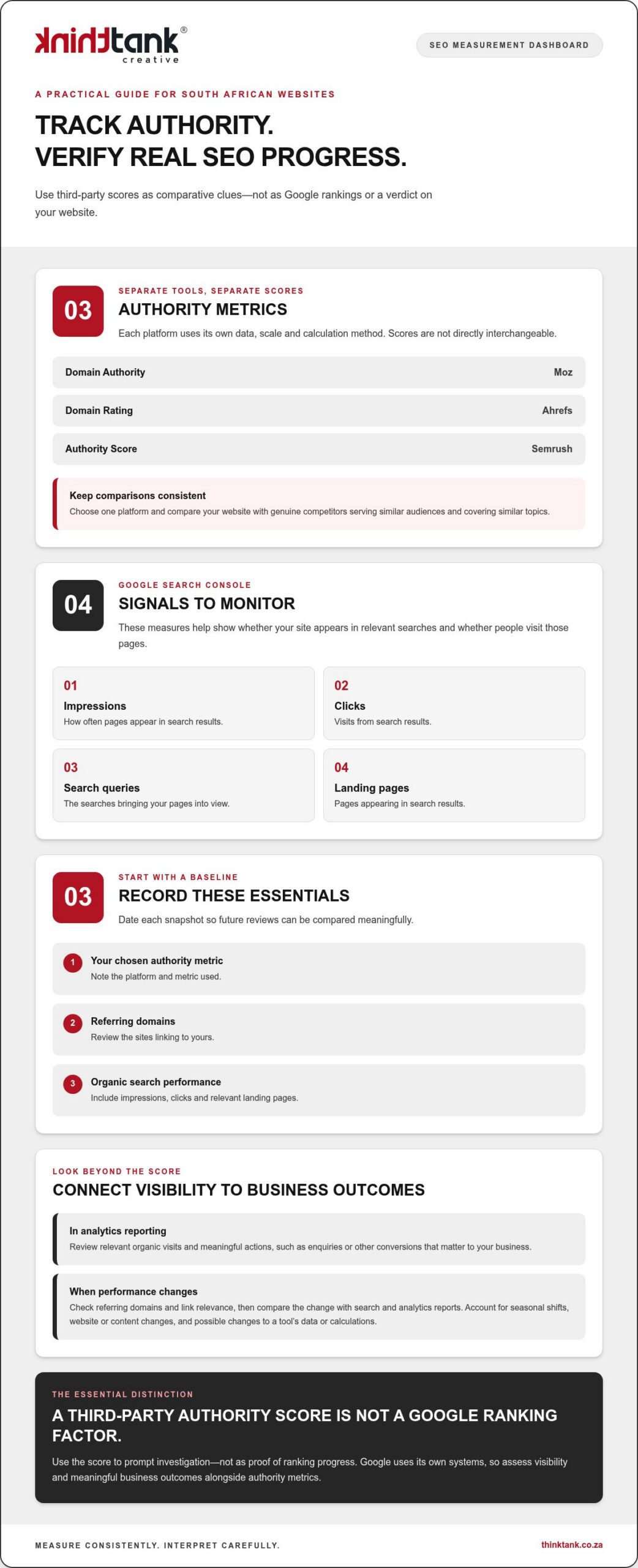
These are separate third-party metrics: Domain Authority is from Moz, Domain Rating from Ahrefs and Authority Score from Semrush. Each platform uses its own data, scale and calculation method, so the scores aren’t directly interchangeable. A site’s score can differ between tools even when its underlying search performance hasn’t changed.
For a useful comparison, choose one platform and use the same metric to review your website and a small set of genuine competitors with similar audiences and subject matter. This gives you a consistent benchmark instead of a misleading comparison between numbers calculated in different ways.
Why South African businesses should look beyond one score
Relevance depends on the people a website serves, the subjects it covers and the market it operates in. A focused South African business site may have a smaller link profile than a national or global publisher and still be useful to people looking for specialised expertise, products or services.
A higher score doesn’t prove that a site will rank above another, and it doesn’t cause Google to award better positions. Sites with stronger backlink profiles may also have better visibility, but that relationship alone doesn’t show that a third-party score caused the rankings. Google uses its own ranking systems.
Use authority scores to spot questions worth investigating, not as targets. A change can prompt you to review links or compare competitors, but assess it alongside relevant search visibility and audience response. That keeps SEO decisions grounded in what your audience needs.
Does domain authority affect Google rankings? Separate the metric from real SEO progress
No. A third-party Domain Authority score is not itself a Google ranking factor. Google doesn’t assign your website a Moz, Ahrefs or Semrush authority score. These tools provide estimates that can help you compare your site with others, but a change in the estimate doesn’t tell you directly what Google will rank or why.
Authority scores and search performance can move in the same direction: websites with strong backlink profiles may also have good visibility. But correlation isn’t causation. A higher third-party score doesn’t prove that the score caused improved rankings, or that every link contributing to it is valuable to your audience.
A rising authority score can’t guarantee better rankings, because Google uses its own systems to assess and rank pages. If you’re considering how to increase domain authority south africa, treat the metric as one diagnostic signal, then judge progress through search visibility and business outcomes.
Which signals are more useful for tracking SEO performance?
Use Google Search Console to monitor impressions, clicks, search queries and the landing pages appearing in results. These measures show whether your website is appearing for relevant searches and whether people are visiting those pages.
Pair that view with analytics reporting. Review relevant organic visits and meaningful actions on your site, such as enquiries or other conversions that matter to your business. Look at trends over time, account for seasonal shifts and note changes to your content or website. Don’t attribute every rise or fall to link-building alone.
Google’s guidance favours creating compelling material that people have a reason to reference, rather than relying on manipulative link schemes. Its advice on earning quality links supports a user-first approach: make your content genuinely useful and relevant.
How to interpret a domain authority score responsibly
Make comparisons consistent. Record the platform, metric and date each time you review your score, then compare it with relevant competitors serving similar audiences and covering similar topics. Unrelated websites and arbitrary targets make poor benchmarks.
If the number changes, investigate before drawing conclusions. Check whether referring domains have changed, review the relevance and quality of those links, and compare the results with your search and analytics reports. The score may also move because a tool’s data or calculations have changed. The aim is to understand what may have influenced the metric, not to pursue a particular number.
Clear reporting makes those signals easier to interpret. Learn more about SEO strategy and reporting as part of a considered approach to measuring website performance.
How to assess your South African website’s authority and link profile
Start with a baseline before deciding what to improve. Record your chosen authority metric and SEO platform, your number of referring domains, and organic search performance, including impressions, clicks and relevant landing pages. Date each snapshot so you can make meaningful comparisons later.
Next, select a small group of genuine South African competitors. Choose businesses that serve a similar audience and cover related topics, rather than simply picking websites with high scores. For a broader view of how link-building fits into search optimisation, explore this South African SEO strategic guide. Moz also explains how its own Domain Authority metric is intended to be used as a comparative measure.
What makes a backlink relevant and worth pursuing?
Assess the page that links to you, not just the referring domain’s score. Does the page cover a related subject, serve a similar audience or connect to your business community? Is your link included naturally in useful editorial or resource content, where it helps readers understand or explore the topic?
Consider the likely audience value. A link from a relevant South African industry association, professional resource or supplier could introduce your website to interested visitors. A link with no clear connection to your work may offer little practical value, even if a tool gives the referring site a strong score.
How to find gaps against relevant competitors
Review competitors’ referring pages for credible industry, professional, supplier and community sources. Note why each page linked, then ask whether you have a useful resource that could meet a similar need. Separate realistic opportunities from sites that appear to exist mainly to sell links. A raw link count won’t show the difference.
Use a simple comparison to organise your assessment:
| What to assess | What to look for | Question to ask |
|---|---|---|
| Relevance | Connection to your subject, audience or South African market | Would this source make sense to your customers? |
| Referring-site quality | Credible, useful content and a clear purpose | Does the site serve a real audience? |
| Link context | A natural mention in relevant editorial or resource content | Does the link help readers? |
| Audience value | A plausible route for interested visitors to discover your site | Could this referral support awareness or enquiries? |
This audit gives you a grounded starting point for how to increase domain authority south africa: identify gaps that matter to your audience, then prioritise relevant opportunities over score-chasing.
How to increase domain authority in South Africa through useful link earning
Earn links by giving relevant websites a genuine reason to reference your work. A strong authority-building plan starts with a useful resource and thoughtful outreach, not a target score. If you’re researching how to increase domain authority south africa, use this process to focus on links that make sense for your audience and market.
- Choose a useful asset. Identify a question your audience needs answered, then create a resource that responds clearly and thoroughly.
- Find relevant sources. Research South African industry bodies, professional networks, partners, publications and community resources that cover the topic or serve the same audience.
- Pitch the value. Contact each relevant organisation with a personal note explaining what the resource offers its readers and why it may be useful.
- Review the results. Track who you contacted, responses, links earned and referral or search performance. Use what you learn to refine the next round, without expecting a particular score increase.
For more detailed outreach guidance tailored to the local market, read these local link-building strategies for South Africa.
Create content that deserves references and recommendations
Build resources around genuine knowledge of your business and customers. This might be a practical guide, a clear explanation of a complex topic or a resource that helps people make an informed decision. Start with a defined audience need, then make the content specific, accurate and useful enough to stand on its own.
Presentation matters, too. Use clear headings, concise copy and an easy-to-follow structure so a publisher can quickly assess the resource. Coordinate content creation, copywriting and SEO priorities, rather than publishing material without a defined purpose or audience.
Build relationships without buying shortcuts
Personalise each approach. Refer to the recipient’s publication, resource or community, and explain why your content could help its audience. A relevant partner may value a useful resource, a publication may consider an expert explanation, and a community site may welcome material that answers a recurring question. Keep the pitch specific and respectful.
Avoid paid-link schemes, irrelevant directory submissions and mass-produced outreach promising easy results. These tactics can waste effort and don’t build relevant relationships that support lasting visibility. Record outreach and earned links, then assess quality and outcomes alongside any change in third-party metrics.
Bring research, content and outreach together in a considered plan. ThinkTank Creative provides SEO and content support to align this work with your website and business goals.
How to sustain authority growth and choose the right next steps
Turn your link-profile findings into a focused plan, not an endless list of SEO tasks. Set priorities for useful content and outreach, assign an owner to each action, and agree on reporting checkpoints. Sustainable progress comes from relevant, consistent activity and review. There’s no guaranteed timeline for an authority score or search result to improve.
Keep the objective clear: earn relevant references, improve search visibility and attract the right audience. A third-party score can help you spot changes, but it shouldn’t replace evidence that your website is reaching potential customers and supporting business goals.
What to review in a regular SEO report
Use each report to connect activity with outcomes. Review target-page visibility, organic clicks, relevant queries and meaningful conversions, such as enquiries. Check new referring domains for topical fit, the context of each link and whether the source’s audience is relevant to your business.
Then record what changed, what you learned and the next action that has a clear rationale. If a page earns links but attracts few relevant visits, consider whether its topic, search intent or next step needs refinement. If visibility changes, review other site and content updates before assuming outreach was the cause.
When integrated SEO and website support can help
Authority-building is easier to manage when research, strategy, content creation and reporting work together. Research identifies audience needs and realistic opportunities; strategy sets priorities; useful content gives relevant sources something worth referencing; reporting shows what is gaining traction. A functional, easy-to-use website gives visitors a clear experience once they arrive.
For a practical approach to how to increase domain authority south africa, treat SEO and website quality as connected parts of sustained improvement. ThinkTank Creative brings together SEO, content creation, copywriting, reporting, website development and ongoing support as part of its digital work.
To discuss your SEO and website project needs, explore ThinkTank Creative.
Build lasting search strength through relevant authority
Use Domain Authority as a diagnostic, not a destination. The most effective approach to how to increase domain authority south africa is to understand your baseline, create resources that meet real audience needs and earn relevant references from credible sources. Then assess progress through search visibility, useful website visits and enquiries, not one third-party score.
Keep the work focused and consistent. A practical plan with clear priorities, responsible outreach and regular reporting can help you learn what’s resonating and decide where to invest next. Strong SEO also relies on a functional website that makes it easy for visitors to find information and take action.
ThinkTank Creative, founded in 2001, brings SEO, content creation, copywriting and reporting together with a website process spanning research and strategy through launch and support. Explore ThinkTank Creative’s SEO and website services to discuss your project needs and shape a considered path forward.
Build with relevance, measure what matters and give your South African website room to grow.
Frequently Asked Questions
Is domain authority a Google ranking factor?
No. Domain Authority is a third-party metric developed by Moz, not a score Google uses to rank pages. Google has its own ranking systems, so a change in this metric doesn’t directly cause rankings to rise or fall. Use it as one comparative signal alongside Search Console visibility, relevant organic visits and enquiries. A higher score may coincide with a strong link profile, but that doesn’t prove the score caused better rankings.
How can I increase domain authority in South Africa?
To improve domain authority in South Africa, create genuinely useful content for a defined audience and earn relevant references from credible sources. Consider industry bodies, professional networks, partners, publications and community resources that serve your subject area. Personalise outreach by explaining the value to each source’s readers. Track referring domains and search performance, but don’t use link volume or a third-party score as the only measure of progress.
How long does it take to increase domain authority?
There’s no fixed timetable. Authority metrics can change gradually as your website earns relevant links and the SEO platform updates its data. Sustainable improvement may take several months or longer, and results depend on your starting point, competition and the consistency of your work. Set regular review points rather than expecting a quick score change, and monitor search visibility and business outcomes alongside the metric.
What is a good domain authority score for a South African business?
There isn’t a universal “good” score for South African businesses. Authority metrics are comparative estimates, and results depend on the tool and its calculation method. A useful benchmark is the score of relevant competitors serving similar audiences and covering similar topics, measured using the same platform. Focus on whether your website is improving its visibility for relevant searches and attracting valuable visitors, rather than pursuing an arbitrary score.
Can I improve domain authority without building backlinks?
You can improve other aspects of SEO without acquiring backlinks, including content usefulness, site structure and page experience. These improvements may support search visibility, but they’re unlikely to substantially increase a link-based authority metric on their own. For that, focus on creating resources that relevant websites may choose to reference. Measure progress across your search performance and website outcomes, not the authority score alone.
Should I buy backlinks to increase domain authority?
Don’t buy backlinks simply to inflate an authority score or manipulate search rankings. Paid links created to influence rankings can conflict with Google’s spam policies, and irrelevant links may deliver little audience value. Invest in useful content and relevant relationships instead. If a link is part of a legitimate paid promotion, make sure it’s handled transparently and in line with applicable search engine guidance.
How can I check my website’s domain authority?
Check the metric using the SEO platform that provides it, such as Moz for Domain Authority. Other platforms have their own measures, including Ahrefs’ Domain Rating and Semrush’s Authority Score, so don’t compare these scores as if they were interchangeable. Record the tool and date, then benchmark against relevant competitors using the same metric. Use Google Search Console separately to review impressions, clicks, queries and landing-page visibility.