How to Use Data to Personalise Email Content

A more relevant email often starts with sending fewer subscribers the same message. A practical starting point for segmenting your email list for better results is to create 3 to 5 core groups, then refine them as you learn what resonates. Use meaningful differences in subscriber data, buying patterns, product usage and customer value to shape content for each group, rather than relying on one broad audience.

A single campaign may seem easier to manage, especially when subscriber data is scattered or audience needs are unclear. But thoughtful segmentation helps you send messages that are more useful and timely. This article explains how to choose relevant criteria, turn customer behaviour into practical segments and adapt your approach as engagement changes. You’ll also learn how to match each group’s interests and relationship with your business to email content that feels personal, without making the process needlessly complex.

Key Takeaways

  • Start with a small set of useful audience groups, then refine them as your campaign goals and performance become clearer.
  • Use subscriber preferences and buying patterns to shape content around what different customers are interested in and when they may need it.
  • Bring product usage, lead scores and customer value into your decisions to make messages more relevant to each relationship stage.
  • Combine demographic details with observable behaviour, such as browsing, clicking or purchasing, rather than relying on one type of data alone.
  • Review engagement and purchase history to adjust who receives each message and how often they hear from you.

1. Collecting data for segmentation

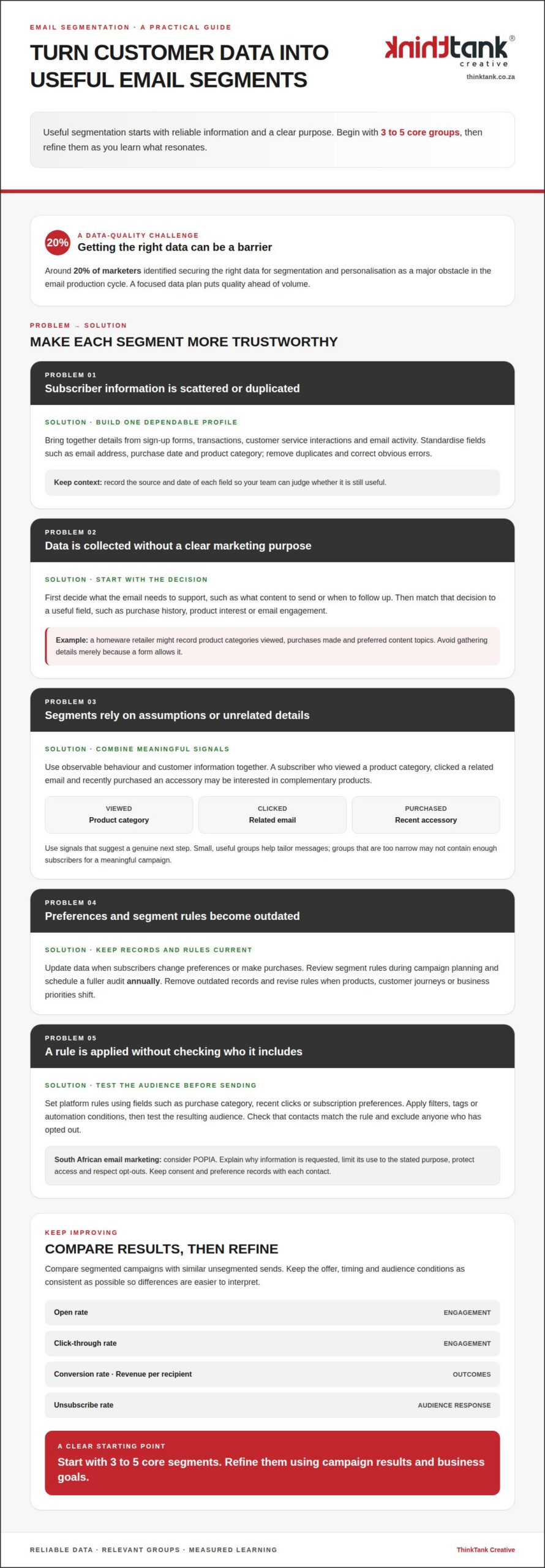
Build segments from reliable information, not assumptions. Start by identifying the decisions your emails need to support, such as what content to send or when to follow up. Then match each decision to a useful data field, such as purchase history, product interest or email engagement. Effective segmenting your email list for better results starts with data that is accurate, relevant and organised.

Centralise contact records so each subscriber has one dependable profile. Bring together details from sign-up forms, transactions, customer service interactions and email activity. Standardise fields such as email address, purchase date and product category, then remove duplicates and correct obvious errors. Otherwise, a customer listed twice under different spellings could receive conflicting messages. Record the source and date of each field so your team can judge whether it is still useful.

Collect only information that supports a clear marketing purpose. For example, a homeware retailer might record product categories viewed, purchases made and preferred content topics. Avoid gathering details merely because a form allows it. Around 20% of marketers identified securing the right data for segmentation and personalisation as a major obstacle in the email production cycle. A focused data plan helps teams prioritise quality over volume.

Intent-based micro-segmentation combines meaningful signals to identify a specific, timely interest. A subscriber who viewed a product category, clicked a related email and recently purchased an accessory may be interested in content about complementary products. Use signals that suggest a genuine next step, rather than combining unrelated attributes. Small, useful groups help you tailor messages; groups that are too narrow may not contain enough subscribers for a meaningful campaign.

For South African email marketing, consider POPIA when collecting and using subscriber data. Explain why you request information, limit its use to the stated purpose, protect access and respect opt-outs. Keep records of consent and preferences with each contact, and avoid using personal details that do not serve the campaign.

To create and automate segments in an email platform, set a rule using fields such as purchase category, recent clicks or subscription preferences. Apply it using the platform’s filters, tags or automation conditions, then test the resulting audience before sending. For example, a welcome sequence could branch according to the subscriber’s selected interest.

Update data when subscribers change their preferences or make purchases. Review segment rules during campaign planning and schedule a fuller audit annually. In slower-moving industries, you might also review segments annually or after significant changes. Remove outdated records and revise rules when products, customer journeys or business priorities shift.

Compare segmented campaigns with similar unsegmented sends using open rate, click-through rate, conversion rate, revenue per recipient and unsubscribe rate. Keep the offer, timing and audience conditions as consistent as possible, so differences are easier to interpret. Track results for each segment and for the list as a whole.

Common mistakes include relying on stale data, creating too many tiny groups and treating a click as proof of purchase intent. Set a clear rule for every segment, check that the audience matches it, and exclude contacts who have opted out. Start with 3 to 5 core segments, then refine them using campaign results and business goals.

2. Content and seasonal buying patterns

Match email content to what subscribers may want to do next. Someone researching winter skincare needs different guidance from someone comparing festive-season gifts. Use past purchases, product-page visits and email clicks to identify these interests. Then tailor the subject line, examples and recommended next step for each group, rather than changing only the greeting.

Build seasonal segments from observed buying patterns, not assumptions about the calendar. In South Africa, Black Friday, the festive season, back-to-school periods and winter may influence what people consider buying. Interest varies by product and customer, though. Before sending a timely offer or guide, compare previous seasonal clicks and purchases with each subscriber’s usual activity.

Separate seasonal intent from lasting preferences. A customer who buys school supplies may appreciate a back-to-school checklist, while a homeware shopper may prefer ideas for preparing for winter. Tag the seasonal interaction, but retain the customer’s broader interests. This prevents one temporary purchase from defining every email they receive afterwards.

Use content choices as segmentation signals. If a subscriber repeatedly clicks practical buying guides but ignores product announcements, prioritise useful advice in their next campaign. Someone engaging with product comparisons may value feature explanations instead. Track clicks by content type and connect them to later actions, such as browsing a related category or completing a purchase.

Plan seasonal campaigns in stages. Before Black Friday, offer decision-support content to subscribers exploring relevant categories. During the event, send product details to people who have shown interest. Afterwards, follow up with care guidance or complementary suggestions for purchasers, while giving non-buyers a different next step. Make each message reflect the person’s latest signal.

Compare campaign timing with your audience’s actual activity. Assess seasonal campaigns against similar messages sent outside the peak period, using clicks, purchases and unsubscribes as measures. A rise in opens alone does not show whether the content matched buying intent. If a seasonal segment clicks but does not convert, adjust the offer, landing-page content or message relevance before repeating the campaign.

Keep seasonal rules clear and temporary where appropriate. For example, label subscribers who clicked a winter range, then retire that condition when the campaign ends. Store enduring preferences, such as interest in a product category, separately. This makes future seasonal planning more precise and reduces the risk of outdated recommendations.

Make the campaign feel coherent across its messages, from subject line to landing-page experience. If you’re shaping seasonal email content, explore creative campaign ideas that support a consistent customer journey.

3. Product usage, lead scores and customer lifetime value

Use product behaviour to understand what subscribers may need next. A customer who regularly uses a software feature may benefit from advanced guidance. Someone who has stopped using it could need a refresher or practical support. For physical products, repeat purchases, accessories bought and time since the last order can suggest useful follow-up content. Choose signals that connect directly to a relevant email, rather than tracking activity without a clear purpose.

Build lead scores from observable actions that indicate interest. Give more weight to actions closer to a decision, such as requesting a product demonstration or viewing detailed pricing information. A general newsletter click can show interest, but it signals a different level of intent from a direct enquiry. Set scoring rules around your customer journey, then use the score to prioritise relevant content, such as a case study for active prospects.

Keep scores understandable. Record which actions add or reduce points, and ensure the score reflects recent behaviour as well as past activity. A prospect who once clicked several emails may no longer be considering a purchase. By contrast, repeated visits to one product category could signal renewed interest. Use both patterns to guide timing and message relevance, not as automatic proof that someone is ready to buy.

Customer lifetime value can help distinguish one-off purchases from ongoing relationships. Consider purchase frequency, order value and the time between purchases together. A customer who regularly replenishes a product, for example, may appreciate a timely reorder reminder. A high-value customer with a long gap between orders might need a different message, such as new product information or a personal service update. Keep the content useful rather than relying on value alone to justify frequent promotion.

Purchase history can also inform email sequencing. In one reported account, customers who had bought three or more times had an average email open rate of 11%. A separate reported three-email reorder sequence for repeat buyers achieved a 43% conversion rate. These are individual campaign results, not universal benchmarks. Use them as prompts to test reorder messages against your own audience and product cycle.

Review each segment’s response through clicks, conversions and repeat purchases. If highly scored leads open messages but do not take the intended next step, reconsider the content or scoring criteria. If repeat customers ignore reorder prompts, examine purchase timing and product use. These refinements make product signals, lead scores and customer value practical inputs for more relevant campaigns.
How to Use Data to Personalise Email Content

4. Segmentation criteria, including demographics and behaviour

Choose criteria that clarify what a subscriber needs from your next email. Demographic details, such as age or location, can guide relevance, but do not reveal intent on their own. Combine them with observable behaviour, such as product-page visits, email clicks or previous purchases. Subscribers across South Africa may share the same product interest despite having different location details.

Use demographic information only when it supports a clear content decision. For example, a B2C campaign might target women aged 25-40 with a 20% discount on a new collection. The age range helps define the intended audience, but shouldn’t replace evidence of interest. Pair it with relevant preferences or previous engagement before tailoring the message.

Location can help tailor practical details for a national audience. A business serving customers across South Africa could use a voluntarily supplied province to share relevant delivery information or highlight local events. Do not treat location as a proxy for income, lifestyle or product preference. Such assumptions can exclude suitable subscribers and make otherwise relevant emails feel inaccurate.

Behaviour offers direct clues about current interests. A subscriber who views a product category, clicks a related guide and then visits a product page has shown several connected signals. Someone who has not interacted with the brand for 30 days may need a different message from an active reader. Use the action and its timing to decide what content fits.

Micro-segmentation combines criteria to create a more precise audience. One example targets urban millennial women aged 25-35 who bought eco-friendly products in the last 30 days and clicked the last three emails. Each condition narrows the group around demonstrated interest. The resulting content could focus on related sustainable products, rather than broad promotions to every subscriber.

Give each criterion a clear purpose before adding it to a segment. Ask whether it changes the message, offer or timing. If a subscriber’s age does not affect the content, leave it out. Check for overlapping groups, too: a recent purchaser should not receive an introductory offer intended for people who have not bought yet.

Email list segmentation is associated with 14.31% more opens and 101% more click-throughs than non-segmented emails. These figures point to the value of relevance, not a guaranteed outcome for every audience. Compare similar campaigns and review opens, clicks, conversions and unsubscribes to see which criteria are useful for your subscribers.

Start with a clear test: choose one audience signal, such as recent interest in a category, and match it to one content variation. Keep the other campaign elements consistent, then compare results with a broader-audience send. If the tailored version earns more relevant clicks without increasing unsubscribes, keep the criterion and test another signal.

5. How can you segment subscribers by email engagement and purchase history?

Combine email activity with transactions to understand each subscriber’s relationship with your business. Start by separating recent purchasers, repeat customers, interested non-buyers and subscribers whose engagement has declined. Choose a message for each group that fits its next likely need, such as product guidance, a reorder reminder or a re-engagement email.

Use purchase recency as a practical starting point. Create a segment for customers who purchased in the last 90 days, then tailor content to the product or category bought. Someone who recently purchased running shoes, for example, might appreciate care advice or information about suitable accessories. Keep the follow-up connected to their order, rather than sending a generic promotion.

Purchase frequency adds useful context. One reported email account found an average open rate of 34% among people who had bought once. That figure describes a single account, but it illustrates why first-time buyers deserve a distinct follow-up. Welcome them after purchase, provide relevant product information and invite their next action without treating them like established repeat customers.

For repeat buyers, consider content that supports replenishment or complementary purchases. A reported campaign to an engaged group of 22,000 people achieved a 60% open rate. Use engagement alongside order history to identify who may welcome a reorder prompt. Check the typical buying cycle and product type before deciding when that reminder makes sense.

Email behaviour can refine these purchase groups. Subscribers who have had no engagement for 30-60 days can move into a segment aligned with their previous open behaviour. Try a different subject line or content angle, then observe clicks and purchases. If a customer has recently bought, prioritise useful post-purchase information over another acquisition message.

Set a clear inactivity rule before reducing sends. For example, exclude subscribers who haven’t interacted for a defined period, using 60-120 days as a possible range. Subscribers showing no engagement after 9 months can enter a sunset flow, with a final preference or re-engagement message. Keep opted-out contacts excluded from campaigns.

Compare segments using open rate, click rate, conversion and unsubscribe rate. A fashion retailer once had more than 92,000 contacts who hadn’t clicked an email in over 90 days. That example shows why list size alone doesn’t indicate an audience’s current interest. Review each group’s response and adjust its content or sending eligibility accordingly.

Keep the rules simple enough to maintain: define the purchase window, engagement signal and message for each group. Review performance after campaigns and update criteria when buying patterns change. For support shaping targeted email activity, plan your email marketing campaigns around customer behaviour and purchase history.

ThinkTank Creative: Website Design and Development

ThinkTank Creative can help connect relevant email campaigns with a consistent digital experience. Once your segments reveal different customer needs, the destination matters too: a first-time buyer and a repeat customer may need different landing-page content. ThinkTank Creative’s Website Design and Development service can shape website journeys around those priorities, while Email Marketing supports campaign planning and delivery. This is a useful next step when your segmentation strategy is ready but your emails and website feel disconnected. Aligning the message with the landing page gives subscribers a clearer path from email to action. To plan how your campaigns and website can work together, contact ThinkTank Creative or visit thinktank.co.za.

Turn audience insight into your next campaign

Make your next step a focused experiment. Choose one audience group and shape a campaign around a demonstrated need, then use the response to refine your approach. Over time, segmenting your email list for better results becomes an ongoing learning practice, helping each campaign build on what subscribers actually engage with.

What you learn can also inform the wider experience around your emails. ThinkTank Creative’s Website Design and Development, Social Media Marketing and creative design can support a consistent brand journey across channels, from the email a subscriber opens to the content they see next. A strong strategy connects these touchpoints with a clear purpose.

Contact ThinkTank Creative to discuss your email strategy, and take the next step towards more relevant customer communication.

Frequently Asked Questions

What is email segmentation?

Email segmentation means organising subscribers into groups so each group receives content suited to its needs. For example, a community organisation could separate event attendees from people who signed up for general updates. Attendees might receive practical event information, while other subscribers get broader news. Group membership shapes the content, rather than every person receiving the same message.

What is email list segmentation and how does it improve campaign results?

Email list segmentation divides subscribers by useful shared characteristics, making it easier to tailor campaign content. For example, a South African retailer could send product-care advice to customers who bought an item that needs maintenance, rather than sending it to the entire list. Relevance gives each message a clearer purpose. Assess results by the action that matters to the campaign, such as a booking, product enquiry or completed order.

Which customer data should you use to segment an email list?

Use data that helps determine what a subscriber should receive next. Useful examples include chosen content preferences, previous purchases, enquiry topics and responses to earlier campaigns. A training provider could record whether someone asked about an introductory or advanced course, then send information suited to that choice. Keep data accurate and connected to a legitimate communication purpose. Avoid collecting sensitive or unrelated details that do not help make an email more relevant.

How do you segment an email list by demographics, location, and interests?

Start with information subscribers have provided, then connect it to a specific content decision. For instance, a South African organisation could use a subscriber’s province to share details of a local event, and their expressed interest to select a relevant topic. Keep demographic fields separate from inferred preferences. If someone selects an interest on a sign-up form, use that choice to guide content rather than assuming their interests from age or location.

What are the most effective email list segments for small businesses?

Small businesses can start with groups that call for distinct messages: prospective customers, first-time buyers, repeat customers and subscribers who have gone quiet. A South African café, for example, could send new-menu updates to opted-in subscribers interested in food news, while sharing loyalty information with returning customers. Choose groups that are manageable and useful. If two groups would receive the same content, combine them until their needs differ.
Ways to Promote Your New Website and Attract More Users

A new website needs a launch plan, not just a launch date. To learn how to promote your new website launch, begin with two marketing channels and use them consistently. Email and social media can announce the site, show people what’s new and guide them towards useful pages.

You’ve invested time in building a website that reflects your business; attracting visitors takes a deliberate next step. This guide shows how to build interest through email, social media, guest blogging, press releases and paid advertising, so launch day isn’t your only chance to be seen.

Give the announcement a clear purpose and coordinate it across channels that suit your audience. Plan the rollout over several weeks so each message supports the next and gives potential visitors a reason to explore.

Key Takeaways

  • Choose two promotional channels to start, then tailor your launch messages to the people you want to reach.
  • Use email to tell existing customers what’s new and guide them to relevant pages on your website.
  • Share useful, engaging social content and make the next step clear, whether that’s visiting a page or joining your mailing list.
  • Explore guest posts with local groups and coordinate press releases or paid adverts with the experience visitors find on your site.
  • Plan announcements over several weeks so each message builds on the last and keeps your launch visible beyond its first day.

1. Email marketing

Measure website launch marketing by connecting each email to activity on your website. Use tagged campaign links, then compare email analytics with website traffic, page visits and completed actions, such as an enquiry or signup. This shows which messages bring relevant visitors, not just opens.

Start with people who already know your business. Email customers and members with a clear announcement, explain what has changed and show how the new site helps them. For example, point customers to a refreshed service page or a simpler way to find information. Make the next step obvious by linking directly to the page that delivers the promised benefit.

Give friends, family and existing clients a personal heads-up before or on launch day. Invite them to visit the site and share the announcement with someone who may find it useful. Tailor each note: a client might value a new portfolio page, while a friend may be glad to pass on your business details. Personal relevance makes a message feel considered, not like mass promotion.

Add an email signup form to useful places on your new website, such as the homepage, blog or contact page. Explain what subscribers will receive, such as launch updates, practical advice or new content. Ask only for the information needed to sign up, and make the call to action clear. Social posts can direct interested people to the form, turning launch attention into an audience you can reach again.

A giveaway can encourage signups when the reward suits your business and audience. For example, offer a 5% discount on services in exchange for joining the newsletter. Make the entry steps clear and ensure the prize feels worthwhile to participants. Then follow up with useful emails, rather than relying on the giveaway announcement alone to maintain interest.

Coordinate email and social media so both channels reinforce the same launch message. Share a short announcement on your social accounts, then send subscribers a more detailed email with direct links to relevant pages. Adapt the wording for each audience, but keep the core message consistent. This gives people more than one way to discover the site without making every post or email identical.

Plan the email around the launch, prepare it before publishing and test its links on mobile and desktop. After sending, review which messages attract visits and meaningful actions. Use those insights to refine the next email, whether by changing its subject, destination page or call to action.

2. Social media promotion

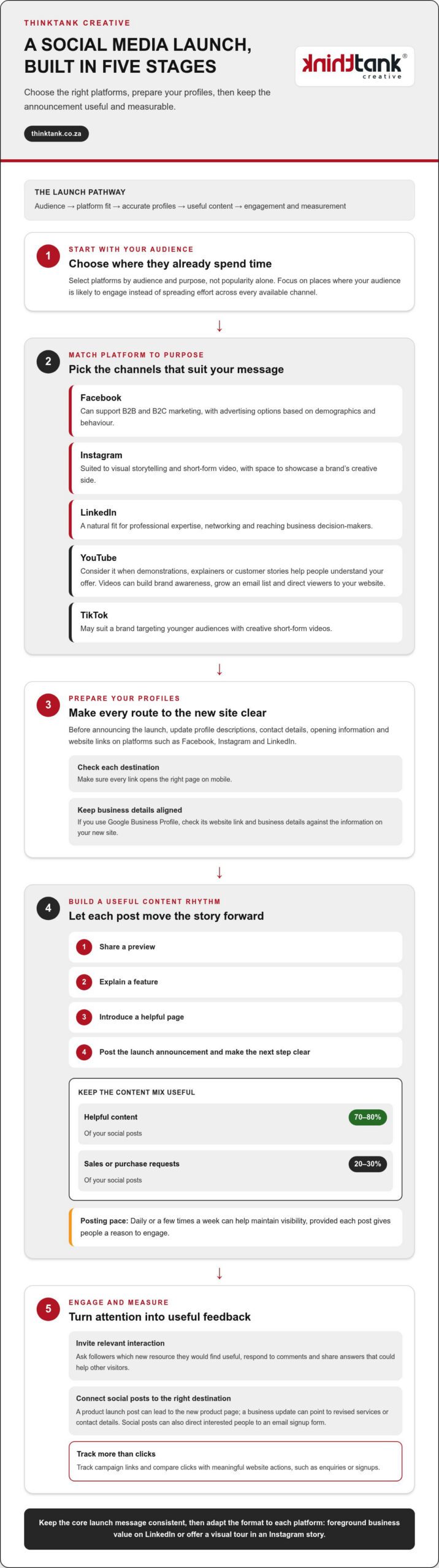
Make your website launch visible where your audience already spends time. Share a clear announcement across your social media accounts, then direct each post to a relevant page. A product launch post could lead to the new product page, while a business update might point visitors to revised services or contact details.

Choose platforms by audience and purpose, not by popularity alone. Facebook can support both B2B and B2C marketing, with advertising options based on demographics and behaviour. Instagram suits visual storytelling and short-form video, giving brands space to showcase their creative side. LinkedIn is a natural fit for professional expertise, networking and reaching business decision-makers.

Consider YouTube if demonstrations, explainers or customer stories help people understand your offer. Videos can build brand awareness, grow an email list and direct viewers to your website. TikTok may suit a brand targeting younger audiences with creative short-form videos. Focus on platforms where your audience is likely to engage instead of spreading effort across every available channel.

Refresh your online profiles before announcing the site. Update profile descriptions, contact details, opening information and website links on platforms such as Facebook, Instagram and LinkedIn. Check that each link opens the right page on mobile. If you use Google Business Profile, make sure its website link and business details match the information on your new site.

Build a useful content rhythm around the announcement. Share a preview, explain a feature, introduce a helpful page, then post the launch announcement with a direct call to action. Aim to make helpful content 70-80% of your social posts and sales or purchase requests 20-30%. Publishing daily or a few times a week can help maintain visibility, provided each post offers a reason to engage.

Encourage interaction with specific prompts. Ask followers which new resource they’d find useful, respond to comments and share answers that could help other visitors. Track campaign links and compare clicks with meaningful website actions, such as enquiries or signups. Social content can also guide interested followers to an email signup form, helping you stay in touch after launch.

Keep the message consistent, but adapt its format to each platform. A LinkedIn post can foreground business value, whilst an Instagram story can offer a visual tour. For support shaping a connected social media campaign, align each post with the page it promotes and the action you want visitors to take.

3. Guest blogging

Reach new readers by contributing useful articles to websites your audience already trusts. A South African business could write for a local chamber of commerce or community organisation, explaining how its website helps residents solve a familiar problem. A relevant guest post introduces your expertise, gives readers a reason to visit and directs interested visitors to a focused page.

For local opportunities, approach your chamber of commerce, business associations, neighbourhood groups and community publications. These can help you find organisations whose readers live or work near your business. Ask whether they accept guest contributions, then suggest a specific topic showing how your website helps local residents. Keep the pitch relevant to their audience rather than making it a general advert.

Choose a subject that offers practical value and naturally connects to a page on your site. For example, a South African accountant might write about preparing records for a small business, then link readers to a relevant service page. A home-care business could explain how families compare local support options. Answer the subject fully, with the website link offering a useful next step.

Shape each contribution around the publication’s audience and editorial style. Read existing articles, note the questions they address and propose a fresh angle. Use clear headings, concrete examples and accurate information. Don’t republish a page from your website as a guest article. Original, useful content earns attention, while a relevant author biography can explain your expertise and direct readers to your site.

Podcast interviews offer another way to introduce your work. Look for South African shows covering your sector, local enterprise or issues your customers care about. Pitch a discussion topic, such as common mistakes in your field, rather than asking for a platform to promote your launch. Prepare examples and a concise explanation of what listeners can find on your website.

Make every referral easy to track. Link to the page that best matches the guest article or interview, rather than sending everyone to your homepage. Use campaign tracking in the link and review referral traffic in your analytics. Compare visits, enquiries and other meaningful actions to see which publication or podcast attracts engaged visitors. Use these results to improve your outreach.

Guest blogging supports visibility, but works best alongside on-page optimisation. Check that the destination page answers the question raised in your contribution, works well on mobile and offers a clear next step. For instance, a local guide should lead to relevant details, not an unrelated announcement. Build relationships with editors and community organisers by responding thoughtfully to feedback and suggesting useful follow-up topics.

South African chambers of commerce, business associations, neighbourhood groups and community publications can help you reach local readers. Approach those whose audiences live or work near your business and ask whether they accept relevant guest contributions.

Ways to Promote Your New Website and Attract More Users

4. Press releases and paid advertising

Give journalists a clear reason to cover your website launch. Lead a press release with what is genuinely new, such as a South African service becoming available online or a useful resource for local residents. Include the launch date, intended audience, a concise business description and a contact for media enquiries. Send it to relevant publications and journalists instead of widely distributing a generic announcement.

To earn backlinks and press coverage, offer a publication a timely local story, expert comment or original resource its readers can use. Make the website link relevant to the story, such as a detailed guide that supports the article. Follow up with a concise pitch and make it easy for the journalist to verify names, details and quotes.

Pay-per-click advertising can put a relevant page in front of people already searching for a product or service. Choose a clear target, such as a location or search phrase, then match the advert to a landing page that answers that need. A campaign estimate suggests that an advert shown to 10,000 people could produce 100-200 buyers or subscribers at a 1-2% conversion rate. Treat this as a planning estimate, not a forecast for every campaign.

Build the advert around what the searcher is looking for. For example, a South African business promoting a booking page could target searches related to its service and the areas it serves. Write specific advert copy, use relevant keywords and send clicks to the booking page rather than the homepage. If the advert and landing page don’t match, visitors may lose trust and leave before taking action.

Paid advertising carries financial risk: clicks can use your budget without producing enquiries or sales. Set a spending limit, define what counts as a conversion and review performance before expanding. Consider how competitive your target terms are, whether the landing page is relevant and what each conversion is worth. Pause poorly matched adverts and refine the message or destination before spending more.

Don’t launch adverts before the destination page works properly. Broken links, unclear calls to action and slow-loading pages can waste paid traffic. Another common mistake is relying on paid promotion alone; combine it with useful content and direct announcements. Avoid broad targeting that attracts unlikely customers, and don’t judge success by impressions alone.

Review results by campaign and landing page. Compare clicks with conversions, enquiries and signups, then identify which message attracts visitors who take meaningful action. Press coverage and paid search serve different purposes: editorial attention can introduce your story, while PPC can reach people expressing intent through a search engine. Use each channel deliberately and refine your approach based on what the data shows.

5. Planning website launch announcements

Before launching a new website, complete checks on its pages, links, forms and mobile display. Keep the site marked as coming soon until those checks are complete or your website professional confirms it’s ready. Verify that 301 redirects work correctly, since working redirects prevent 404 errors when the new site goes live.

A practical plan for promoting your new website launch starts with a schedule covering several weeks. Set the launch date, prepare key messages and assign each task an owner, audience and purpose. For example, plan an email for existing customers, a social post for followers and a press release for relevant publications. Allow time to review every message before it goes out.

Make the announcement useful, not just celebratory. Explain what has changed, who the website serves and where visitors should start. A new booking feature, updated service information or downloadable guide gives people a clear reason to explore. Use one main call to action in each message, such as viewing the guide or submitting an enquiry.

Prepare launch-day material in advance. Draft social posts, email copy and a short announcement for your business blog, then check that each links to the intended page. Keep the message consistent across channels while adapting its format for each audience. A concise social post can introduce the update; a blog post can explain its purpose in more depth.

Include search engine readiness in the plan. Submit or share your sitemap with Google so the search engine can discover the website’s pages. Check that old page addresses point to their relevant new destinations through working 301 redirects. Make sure important pages have clear titles and descriptions, and that visitors can reach key information without dead ends.

On launch day, publish the site before sending announcements, then open the links in your messages to make sure they work. Monitor analytics for referral traffic, page visits and completed actions, such as enquiries or signups. Record which channels brought visitors and which pages held their interest. Use those findings to shape follow-up messages and decide how to promote your new website launch beyond the initial announcement.

Assign time after launch to respond to questions, fix broken links and share useful updates. A planned follow-up can highlight a page people missed or answer a question raised by customers. For a coordinated approach to your website launch planning, map each announcement to its audience, destination page and desired action.

ThinkTank Creative: Website Design and Development

ThinkTank Creative helps businesses build a consistent digital presence through custom website design and development. If you’re preparing to launch, your website should support the same message and identity as your promotional activity. A clear structure, purposeful page content and cohesive creative design give visitors a consistent experience from announcement to action.

For businesses refreshing their online presence, ThinkTank Creative can also align social media marketing and logo and corporate identity design with the website. This coordinated approach connects the brand people see in a campaign with the pages they visit afterwards. Consider this support when you need a new site or a more unified launch across digital channels.

To discuss your website project, contact ThinkTank Creative or visit thinktank.co.za.

Build on your launch momentum

Treat launch day as the start of an ongoing relationship, not the finish line. A thoughtful approach to promoting your new website launch connects each campaign’s promise with the experience visitors find when they arrive. Use early responses to understand what people value, where they hesitate and which pages need more attention. Then refine the site and future communications around those signals, keeping the experience relevant as your business evolves.

Look beyond immediate traffic when deciding what to improve next. Consider whether visitors understand your offer, find the information they need and know what action to take. These observations can guide decisions about content, design and the journey from first interaction to enquiry. Small, considered refinements help keep your website aligned with customer needs and your business direction.

When you’re ready to create a more cohesive digital presence, ThinkTank Creative offers Website Design and Development, Social Media Marketing and Creative design. These capabilities can bring your website, campaign visuals and social content together around a consistent brand direction.

Contact ThinkTank Creative to discuss your next step and build on your launch with confidence.

Frequently Asked Questions

How do I attract more users to my website?

Give the people you want to reach a clear reason to visit and a useful next step once they arrive. For example, a South African consultancy could publish a practical guide answering a question prospective clients often ask, then link it to a relevant service page. Make navigation straightforward, explain benefits in plain language and ensure key pages work smoothly on mobile devices.

How do I get traffic to my website?

Combine discovery with reasons to return. Publish useful pages that answer your customers’ questions, then share them through channels where those customers are active. Ask relevant business partners or community organisations to mention a resource when it genuinely helps their audience. Review which sources bring visitors who explore further or enquire, then focus your effort on the sources that support your business goals.

What’s the cheapest way to promote a new website?

Start with channels you already control, such as your social accounts, customer conversations and business email list. Share a useful resource rather than a bare announcement, and invite relevant partners to pass it on if it helps their audience. These approaches avoid paid media spend, though they still take time to create, publish and respond to useful content consistently.

How can you promote a new website using SEO and Google Search Console?

Use SEO to make important pages clear to search engines and valuable to visitors. In Google Search Console, check whether key pages are indexed, review the queries generating impressions and identify pages with impressions but few clicks. Use the findings to improve page titles, descriptions and content relevance. Submit your sitemap, then revisit the reports as your site gains search visibility.

How do you announce a website launch on social media and email?

Make the announcement specific to each audience. A customer email can explain how a change affects an existing service, while a social post can introduce a useful new resource to a wider audience. Use a clear subject line or opening sentence, identify who benefits and direct people to the relevant page. Make sure the message remains accurate if someone shares it without extra context.

How can paid search and social media ads drive traffic to a new website?

Paid search can reach people actively looking for a relevant service, while social adverts can introduce it to audiences selected by interests or other targeting options. Match each advert to a dedicated landing page, define the action you want visitors to take and monitor conversions alongside clicks. If visitors arrive but don’t act, review the advert’s promise, audience and landing-page relevance before increasing spend.

What website launch promotions, offers or giveaways attract visitors?

Choose an offer that is genuinely useful to your intended audience, such as a downloadable checklist, introductory resource or relevant service benefit. Explain the entry steps clearly and make sure the perceived value of the reward matches or exceeds the effort required to participate. Keep the promotion connected to your business, then direct entrants to a page where they can explore the offer further.

How much should you budget to promote a new website in South Africa?

Start with free options, such as regular, engaging social media posts.

Email Marketing Services in South Africa: Costs and Options

There’s no standard price for email marketing services in South Africa. Costs depend on factors such as the platform, list quality, automation, segmentation, deliverability requirements and level of agency support. Compare the work you need, not just the monthly subscription. The price for a tailored service depends on the scope and is provided after a quote request.

It’s reasonable to expect a clear view of what drives the cost before choosing a platform or agency. This guide explains the main cost factors and shows how to compare options by their automation capabilities, approach to list quality, segmentation tools and deliverability support. You’ll also find a practical decision guide to help match those priorities to your business needs, so you can assess the value of each option with greater confidence.

Key Takeaways

  • Compare the full cost drivers, including list size, automation, segmentation and the level of strategic support, rather than judging an option by its subscription alone.
  • Review how you collect and maintain subscriber data; a smaller, engaged list can be more valuable than a larger, inactive one.
  • Match segmentation and deliverability features to your sending needs so relevant messages reach the right audience.
  • Choose between a self-managed platform and agency support by weighing the expertise, time and ongoing campaign management your team needs.
  • Use the decision guide to narrow your options according to your business goals, audience and available resources.

List quality and email hygiene

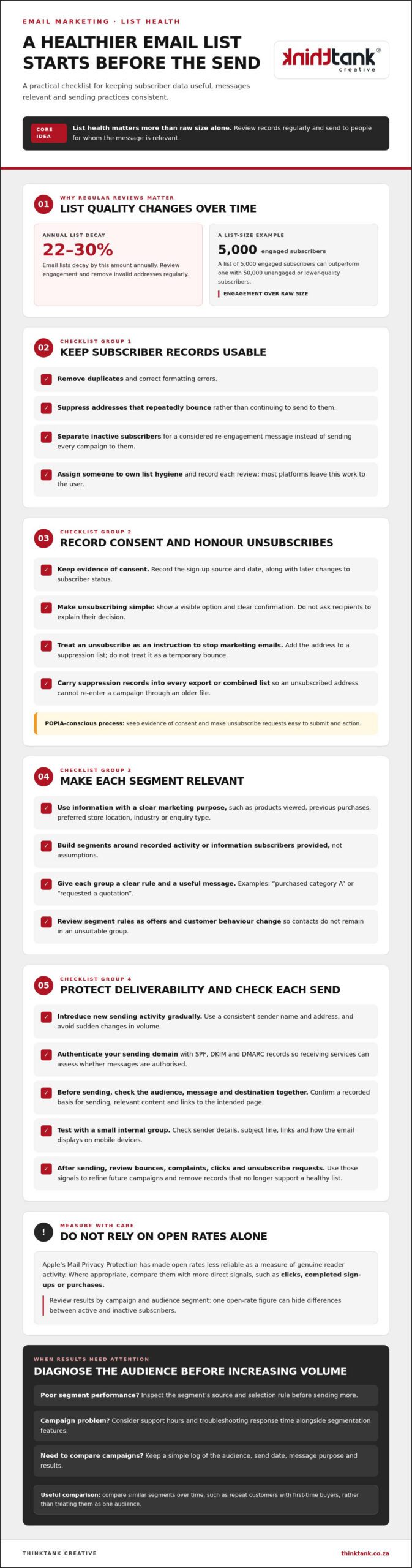
List quality affects campaign relevance, engagement and deliverability, so review it regularly. For a POPIA-conscious email process in South Africa, keep evidence of consent and make unsubscribe requests easy to submit and action.

For an overview of email tools and their features, watch this video:

Maintaining List Quality

List hygiene means keeping subscriber records accurate, permission-based and useful for relevant campaigns. Email lists decay by 22 to 30 per cent annually, so review engagement and remove invalid addresses regularly. A list of 5,000 engaged subscribers can outperform one with 50,000 unengaged or lower-quality subscribers. This makes list health a stronger measure than raw size alone.

Build a repeatable review process. Remove duplicate records, correct formatting errors and suppress addresses that repeatedly bounce. Separate inactive subscribers for a considered re-engagement message instead of sending every campaign to them. Most platforms leave list hygiene to the user, so assign responsibility within your team and record each review.

Unsubscribe Requests

An unsubscribe request is an instruction to stop receiving marketing emails. Treat it differently from a temporary bounce: add the address to your suppression list so it’s excluded from future marketing sends. Make the process simple, with a visible unsubscribe option and clear confirmation. Don’t require recipients to explain their decision.

Record consent and any subsequent changes to each subscriber’s status. Note the sign-up source and date, for example, then record when someone withdraws permission. Apply the suppression record when exporting or combining lists so an unsubscribed address doesn’t re-enter a campaign through an older file. This helps keep list management consistent.

Interpret open rates carefully. Apple’s Mail Privacy Protection has made them less reliable as a measure of genuine reader activity. Where appropriate, compare them with more direct signals, such as clicks, completed sign-ups or purchases. Review results by campaign and audience segment, as a single open-rate figure can hide differences between active and inactive subscribers.

Before sending, check the audience, message and destination together. Confirm that selected contacts have a recorded basis for receiving the email, that the content matches why they subscribed, and that links lead to the intended page. After sending, review bounces, complaints, clicks and unsubscribe requests. Use these signals to refine future campaigns and remove records that no longer support a healthy list.

List segmentation and deliverability

Segmentation helps each campaign reach subscribers who are more likely to find it relevant. Deliverability is about getting those messages accepted by recipients’ email services and placed where they can be seen.

Start with information that has a clear marketing purpose. For example, a retailer could group customers by products viewed, previous purchases or preferred store location. A business-to-business firm might segment contacts by industry, enquiry type or stage in the sales process. Use information subscribers have provided or their recorded activity, and link every segment to a useful message.

Build segments around actions, not assumptions. A recent purchaser may need product guidance, while a prospect who downloaded a service guide may benefit from a relevant follow-up. Set a clear rule for each group, such as “purchased category A” or “requested a quotation”. Review the rules as offers and customer behaviour change, so contacts don’t remain in an unsuitable segment.

Deliverability also depends on consistent sending practices. Introduce new sending activity gradually, use a consistent sender name and address, and avoid sudden changes in volume. Authenticate your sending domain with SPF, DKIM and DMARC records. These technical settings help receiving services assess whether messages are authorised to come from your domain.

For South African teams, response time can matter during a campaign problem. A platform headquartered fourteen time zones away may not respond to a deliverability issue at 10am SAST. Consider the support hours and troubleshooting process alongside the platform’s segmentation features, particularly if a time-sensitive campaign depends on prompt resolution.

Before each send, test the message with a small internal group. Check the sender details, subject line, links and display on mobile devices. Then review delivery reports for hard bounces, spam complaints and sudden changes in engagement. If a segment performs poorly, inspect its source and selection rule before increasing send volume. This diagnosis is more useful than sending the same message to every contact.

Keep a simple campaign log recording the audience, send date, message purpose and results. Comparing similar segments over time can show whether a subject line, offer or audience rule needs adjustment. For example, compare repeat customers with first-time buyers rather than treating them as one audience. Clear segments make results easier to interpret and future campaigns easier to refine.

For a more coherent customer journey, connect audience choices with the wider message and brand experience. Explore audience-focused campaign planning as you shape that approach.

Choosing a platform for different business needs

Platform features, billing and integrations vary, so choose one that suits your business model and workflow. Some platforms used by South African businesses support rand billing and local integrations; others use foreign-currency billing or third-party connectors.

Start by mapping how you’ll use email. A small service business sending occasional updates needs a different setup from an online retailer sending abandoned-cart messages and post-purchase follow-ups. Compare audience management, automation, integration fit, reporting and the time your team can devote to campaigns.

Option Best suited to Compare carefully
Basic newsletter platform Small teams sending planned updates Contact limits, templates and reporting
Automation-focused platform Businesses building triggered customer journeys Workflow complexity and setup effort
E-commerce platform integration Retailers using purchase or browsing activity Product data, order syncing and event triggers
CRM-connected platform Sales teams managing enquiries and follow-ups Contact-field mapping and record synchronisation
Managed platform with support Teams needing help with campaign operations Scope of support and responsibility split

Check billing currency separately from the subscription structure. Find out whether charges are in rand or another currency, and what affects the bill, such as stored contacts, sending volume, user seats or optional features. A lower entry tier may not suit a growing list if essential automation is only available on a higher plan.

For local integrations, list the systems your team already uses, such as an online shop, customer database or payment workflow. Then check whether the platform connects directly, uses an established connector or requires manual data transfer. A retailer, for example, needs reliable order and product data before sending purchase-related messages. A service firm may prioritise enquiry forms and CRM records instead.

Assess the user experience, not just the feature list. Can staff build a campaign, apply a saved audience and review results without specialist help? A complex workflow can be valuable if it reduces repetitive manual work, but unnecessary automation adds setup and maintenance. Match the level of sophistication to the customer journey you actually run.

Use a short decision process: define your campaign types, list required integrations, estimate how your contact base may change, then compare plans against those needs. Test a representative workflow, such as a welcome email after sign-up, before committing. The right fit supports the next stage of your marketing without making routine sends harder to manage.

Email Marketing Services in South Africa: Costs and Options

Email marketing agencies in South Africa

A South African email marketing agency can bring strategy, campaign production and ongoing optimisation together. The value depends on the scope, from planning and copywriting to audience setup, design, testing and performance reporting. Compare the work included, not just the label “agency”, as responsibilities differ between providers.

Some agencies focus on campaign execution, preparing a scheduled newsletter, formatting its content and coordinating a send using your existing platform. Others offer broader strategic support, such as customer journey planning, automation mapping and analysis. A retailer preparing a seasonal promotion may need creative production and scheduling, while a business nurturing sales enquiries may prioritise automated follow-ups.

Agency fees depend on the scope and are provided after a quote request. Key cost factors include the number and complexity of campaigns, level of strategy, copy and design requirements, automation setup, reporting, and whether the agency or your team manages the platform.

Clarify ownership and responsibilities before work begins. A useful scope sets out the campaign calendar, approval process, data your team will supply and the person responsible for each task. For a welcome sequence, agree who writes the messages, builds the workflow, tests links and reviews results. Clear handovers help prevent missed steps and unexpected rework.

Consider how the agency’s support fits your working day. An agency operating locally may coordinate around SAST, while an overseas team may work to different hours. This can matter during a live campaign issue, such as a broken link or incorrect offer. Compare the agreed communication process and escalation route, not location alone.

Assess an agency’s capability against observable outcomes. Look for a clear explanation of how campaign goals inform audience selection, message content and reporting. A useful report connects activity to the intended objective, such as event registrations or service enquiries. Open rates alone give an incomplete picture, particularly since Apple’s Mail Privacy Protection made them less reliable.

Use this decision guide to compare agency support with a self-managed platform:

Before committing, map one upcoming campaign from brief to reporting. That practical exercise reveals whether the proposed scope covers the work your South African business needs.

What email marketing services are available in South Africa?

Businesses in South Africa can choose a self-managed email platform, specialist agency support or a combination of both. The right service depends on whether you need campaign production, technical setup, ongoing strategy or simply a tool for sending newsletters.

A platform gives your team software to create, schedule and monitor campaigns. Your staff generally manage the audience, content and sending process. For example, a small consultancy might send a monthly update and track link clicks. This approach suits teams with time to manage campaigns and a clear process for reviewing results.

Agency-managed support can cover more of the work behind each send. Depending on the scope, it may include planning, copywriting, email design, campaign setup, testing and reporting. A retailer preparing a product launch may need coordinated messages before and after launch, rather than a single newsletter. Define which tasks are included and which remain with your team.

Some businesses use a blended model. Their staff provide product knowledge and approve content, while an external specialist handles campaign design or automation. This can suit a team that understands its customers but needs extra capacity to build a welcome sequence or organise a campaign calendar. Agree responsibilities, approval stages and reporting needs before work starts.

Common service components include:

Compare the scope of services rather than relying on labels like “full service”. Ask for a clear breakdown of campaign planning, content creation, platform management and performance reporting. A proposal may include newsletter design, for example, but leave copywriting and audience preparation to your team. That affects the time and expertise you’ll need internally.

Choose based on the gap you need to fill. If your team can produce content and manage sends, a platform may be sufficient. If campaigns need strategic direction or specialist execution, agency support may fit better. To shape a more cohesive approach, explore email marketing campaign planning as part of your wider marketing activity.

ThinkTank Creative: Website Design and Development

ThinkTank Creative can connect your email activity with a website experience that supports your business goals. Its Website Design and Development service is relevant when campaign traffic needs a clear destination, such as a service page explaining an offer or a form inviting enquiries.

Consistent branding also matters across email and social channels. ThinkTank Creative’s creative design, Logo and Corporate Identity Design, and Social Media Marketing can help align the way your business presents itself to customers. Consider this support when your campaigns and website feel disconnected, or when your digital presence needs a more coherent direction.

To discuss how ThinkTank Creative’s services could support your marketing, get in touch with the team.

Turn your email strategy into a connected customer experience

Take a practical next step: decide what action you want readers to take after opening an email, then make sure the destination supports it. A campaign can introduce your brand, while a clear website journey helps visitors understand your offer and move towards an enquiry. That connection gives email marketing services in South Africa a purposeful role in your wider digital presence.

ThinkTank Creative can bring that experience together through Website Design and Development, Social Media Marketing and creative design. These offerings can help align your campaign messages with the pages and brand identity customers encounter elsewhere. The result is a more coherent foundation for communicating with your audience and guiding them towards meaningful next steps.

Ready to shape an email approach that fits your business and its wider marketing goals? Contact ThinkTank Creative about email marketing to start the conversation and explore a considered direction for your campaigns.

Frequently Asked Questions

How much does email marketing cost in South Africa?

Costs vary according to whether you use software independently or pay for managed campaign work. A platform subscription and an agency’s planning, content, design or reporting are separate cost components. For email marketing services in South Africa, the price depends on the scope and is provided after a quote request. Main cost factors include campaign frequency, audience size, automation complexity, creative requirements and the level of ongoing support.

What kind of activities will an email marketing company develop?

An email marketing company can plan and produce campaigns around specific business objectives. These may include promotional newsletters, product announcements, event invitations, customer onboarding messages and enquiry follow-ups. For example, a training business could send course information to prospective learners, then a reminder before enrolment closes. Before production, agree on the audience, message, desired action and how you’ll measure each campaign.

Which email marketing platform should you choose?

Choose a platform that suits your team’s workflow, not simply the one with the most features. A business sending occasional newsletters may prioritise simple campaign creation, while a retailer may need purchase-triggered messages and shop integration. Consider contact management, automation, reporting, billing currency and available support. Test a typical task, such as creating a newsletter and reviewing its click report, before deciding.

Which South African email marketing platforms are best for small businesses?

The best option for a small business is one its team can manage consistently and affordably within its budget. Compare South African billing options, contact or sending limits, ease of use, customer support and connections to tools already in use. A local service business may need enquiry-form connections, while a small online shop may prioritise order data. Select features that support current needs without complicating routine campaigns.

How much do email marketing services cost in South Africa?

Service costs depend on the agreed scope, so compare the campaign work included rather than relying on a headline fee. A project covering strategy, copywriting and design differs from one involving campaign execution alone. The price depends on the scope and is provided after a quote request. Relevant factors include campaign volume, creative work, automation setup, reporting requirements and the division of responsibilities between your team and the provider.

How can a business choose and set up an email marketing service in South Africa?

Start by defining a campaign goal, such as event registrations or product enquiries, then choose a service suited to that workflow. Prepare approved brand assets, a permission-based contact source and the destination page before setup. Configure the sender identity and domain authentication, import only relevant records, and test the message across devices. Send a controlled first campaign, then use the results to refine the next one.

Which email marketing services offer automation, segmentation, and analytics?

Many email platforms offer these capabilities, but their depth and usability vary. Check whether automation supports the triggers you need, such as a follow-up after a form submission, and whether segments can use relevant customer fields. Analytics should connect campaign activity to your objective, such as link clicks leading to enquiries. Trial a representative workflow, then assess whether your team can act on the reporting.

What deliverability and spam risks affect email marketing in South Africa?

Common risks include outdated addresses, contacts without appropriate permission, sudden changes in sending patterns and messages reported as spam. Errors in sender authentication can also affect how receiving services handle a campaign. Keep contact records current, use a recognisable sender identity and test links before sending. Monitor bounce and complaint reports, and investigate unusual changes rather than repeating the same send.

Email Automation for Beginners: 2026 Strategic Guide

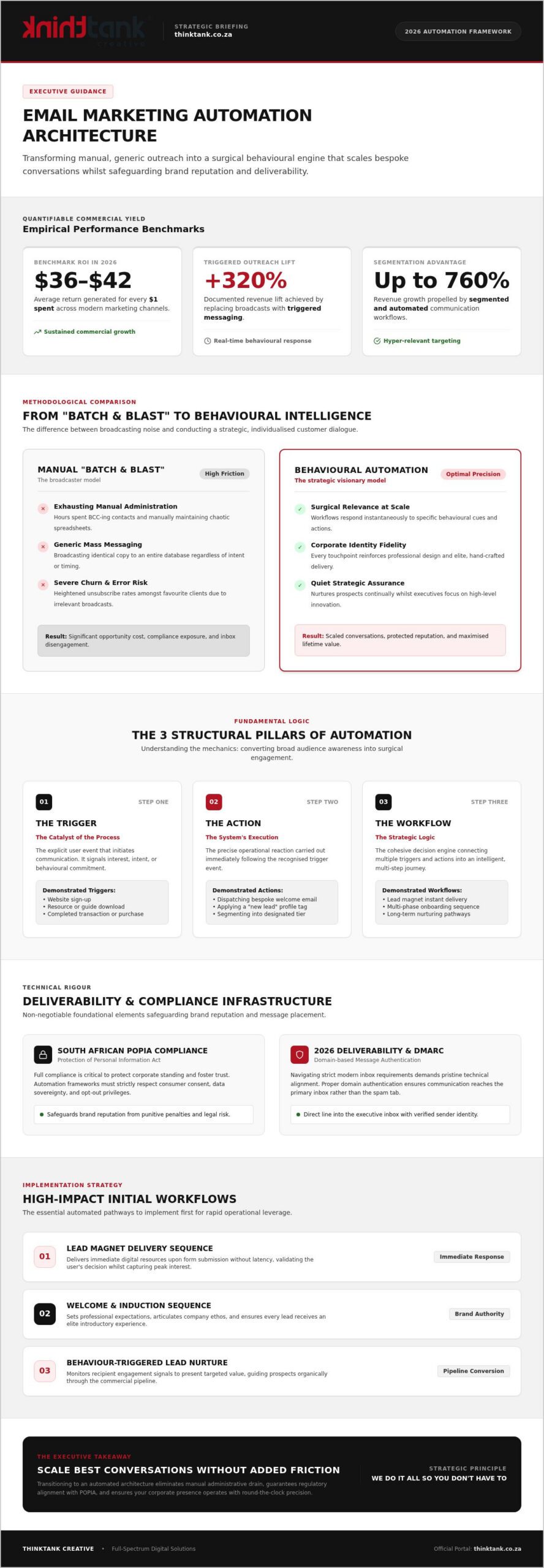
What if your brand's most persuasive conversations happened whilst you were focused on high-level strategy instead of your inbox? With email marketing generating an average return of $36 to $42 for every $1 spent in 2026, the potential for growth is immense; yet many businesses remain tethered to the exhausting cycle of manual BCC-ing and generic "blasts". Mastering email marketing automation for beginners isn't about becoming a technical wizard; it's about reclaiming your time and ensuring every lead receives a bespoke experience.

We understand that the transition from manual outreach to sophisticated workflows can feel daunting, especially when faced with complex jargon like "triggers" and "DMARC alignment". You likely feel that your current approach lacks the precision needed to cut through the noise of modern inboxes. This strategic guide provides a clear roadmap to transform those manual efforts into a high-performance engine that nurtures your audience automatically. We will explore which sequences to prioritise first, how to ensure South African POPIA compliance, and the methodology for achieving a 320% lift in revenue through triggered messaging. By the end, you will have the clarity to move from technical confusion to creative leadership, resting in the assurance that we do it all so you don’t have to.

Key Takeaways

  • Move beyond the exhausting "batch and blast" approach by mastering email marketing automation for beginners, focusing instead on triggered messages that respond to specific user behaviours.
  • Elevate your professional presence by ensuring every automated touchpoint reflects your corporate identity and provides immediate, bespoke value to your leads.
  • Navigate the complexities of 2026 deliverability standards and South African POPIA compliance to protect your brand reputation and ensure your messages reach the primary inbox.
  • Follow a structured roadmap to launch your first high-impact workflows, from welcome sequences to lead magnet delivery, without the typical technical friction.
  • Learn how a complete digital solution allows you to scale your best conversations and improve ROI whilst you remain focused on high-level creative strategy.

Understanding Email Marketing Automation: Beyond the Newsletter

Email marketing automation for beginners is the art of scaling your most valuable conversations without sacrificing a personal touch. Unlike the traditional "batch and blast" method, where a generic message is sent to an entire list regardless of their specific interests, automation relies on behavioural signals to deliver relevance. It's a fundamental shift from being a broadcaster to becoming a strategic partner in your customer's journey. By utilising marketing automation systems, you ensure that every interaction is timely, purposeful, and aligned with your brand's growth objectives.

To better understand how these systems function in a real-world setting, watch this helpful tutorial:

Adopting this technology represents the "Strategic Visionary" approach to business growth. Instead of reacting to immediate needs, you design a system that guides a prospect from their first touchpoint through to becoming a loyal advocate. This journey is no longer a manual struggle. It's a refined process that operates with quiet assurance, allowing you to focus on the creative strategy that truly moves the needle for your brand.

Why Manual Emailing is Costing Your Business

Manual administration is a silent drain on your most precious resource: time. Every hour spent BCC-ing clients or manually segmenting spreadsheets represents a significant opportunity cost that could be better spent on innovation. Beyond the administrative burden, manual list management is rife with the risk of human error, which can lead to embarrassing mistakes or compliance slips. Generic emails often feel exclusionary to recipients, which frequently leads to high unsubscribe rates amongst your favourite customers who expect a more tailored, professional experience.

The Core Components: Triggers, Actions, and Workflows

To master the technical side of email marketing automation for beginners, you only need to understand three fundamental pillars:

By organising these elements into a seamless flow, you create a sense of reliability that mirrors the stability of a long-standing enterprise. This methodical approach ensures that no lead is left behind, moving your audience from broad awareness to specific engagement with surgical precision.

The Strategic Benefits of Automating Your Outreach

Elevate your brand presence by delivering surgical relevance at scale. When exploring email marketing automation for beginners, the primary objective is to move beyond generic broadcasts toward a model of precision that honours the recipient's time and intent. This transition allows you to maintain a steady, reassuring cadence of communication that feels both elite in its execution and warm in its professional delivery.

Consistency is the hallmark of a professional enterprise. By automating your outreach, you ensure that every digital touchpoint reflects your professional logo and corporate identity design with absolute fidelity. This uniformity builds trust, transforming a cold lead into a confident advocate through a series of interactions that appear meticulously hand-crafted rather than mass-produced. It's about projecting the quiet assurance of a market leader whilst maintaining the fluid energy of a creative agency.

Strategic lead nurturing allows you to guide prospects through your sales funnel whilst you focus on high-level operations. This isn't merely a convenience; research indicates that segmented and automated campaigns can drive up to 760% more revenue compared to general blanket newsletters. By utilising data-driven reporting, you can fine-tune your messaging based on actual engagement behaviour, ensuring your strategy remains fluid and effective as you grow your national presence.

Scaling Your Personal Touch

Automation allows for bespoke communication on a national scale without the administrative burden of manual entry. By integrating custom video posts and tailored content creation into your sequences, you maintain a collaborative and imaginative tone that resonates deeply with your audience. This approach ensures that even as your volume grows, the quality of the interaction remains elite and personalised. It is essential to ensure your campaigns adhere to CAN-SPAM compliance requirements and local POPIA regulations to protect your brand's integrity and ensure long-term deliverability.

Improving ROI and Conversion Rates

The true power of automation is realised when it is integrated into your broader how to create a content marketing plan. Automated follow-ups significantly reduce the cost of lead acquisition by ensuring no opportunity is missed through human fatigue or oversight. There is also a powerful synergy between email sequences and remarketing campaign best practices, where your digital presence becomes a cohesive ecosystem of persuasion. If you are looking to refine these systems, our team can help you develop a bespoke email strategy tailored to your specific goals, with an estimated cost provided after our initial discussion.

Essential Tools and Requirements for Beginners

Building a high-performance engine requires the right components. For those embarking on email marketing automation for beginners, the focus shouldn't be on the most expensive enterprise tools, but on a scalable marketing automation strategy that aligns with your specific growth trajectory. This foundation rests on three pillars: a robust Email Service Provider (ESP), a clean subscriber list, and a website designed to convert visitors into leads. Without these elements working in synergy, even the most creative campaigns will struggle to find their audience.

Choosing the Right ESP for Your Budget

Your choice of platform should balance intuitive usability with the depth of segmentation required as your audience matures. Whilst entry-level platforms often provide essential auto-responder features, you must ensure the tool can eventually handle more complex behavioural workflows. We believe in providing a bespoke fit for every client; therefore, an estimated cost is provided only after we've discussed your list size and technical requirements. This ensures you aren't paying for enterprise-grade features you don't yet need, whilst maintaining the flexibility to scale as your national presence expands.

Lead Capture: The Foundation of Automation

Your website is the primary engine for list growth. It's not enough to simply have a "sign up" button; your lead capture forms must be an extension of your corporate identity, reflecting the same precision as your logo. Utilising custom website design allows you to place these forms strategically within the user journey, ensuring they appear at the exact moment of peak interest. Successful automation relies on a fair value exchange. By offering expertly crafted templates or industry guides in exchange for an email address, you build an ethically sourced list of individuals who are genuinely energised by your brand.

Integrating your chosen platform with your existing CMS or CRM is the final piece of the puzzle. This synergy allows for real-time data flow, ensuring your automated messages are triggered by actual user behaviour on your site. In the South African context, maintaining a clean, ethically sourced list is a legal necessity under POPIA. Avoid the temptation of purchased lists; they damage your deliverability and brand reputation. Instead, focus on organic growth and transparent consent, which yields far higher engagement rates and a more stable foundation for long-term success. By organising your technical stack this way, you move from manual administration to a system of quiet, automated assurance.

Email Automation for Beginners: 2026 Strategic Guide

The Beginner Roadmap: 3 Workflows to Start Today

Launch your automation journey with a deliberate, phased approach. When implementing email marketing automation for beginners, the goal is to create a series of self-sustaining loops that maintain your brand's presence without constant manual intervention. These workflows act as your digital representatives, ensuring that every lead is acknowledged and nurtured with the same meticulous care you would provide in person. Every sequence requires ongoing fine-tuning and revision based on the feedback provided by your reporting dashboard to ensure long-term resonance.

The Welcome Sequence: Your Virtual Handshake

A brilliant first impression is non-negotiable. Your welcome sequence should consist of at least three strategic touchpoints, beginning with the immediate delivery of your promised resource followed by a deeper introduction to your brand's core values. This initial email establishes your reliability. The second message should set clear expectations, sharing your "Strategic Visionary" story to build an emotional connection. Finally, the third email serves as an invitation to engage further, perhaps by following your social media channels or exploring your latest content creation. This methodical progression moves the subscriber from a casual sign-up to an energised participant in your brand's ecosystem.

Beyond the welcome, your lead magnet delivery sequence must provide immediate, high-register value. This workflow ensures that the guides or templates promised during sign-up are delivered seamlessly, reinforcing your position as a dependable partner. Conversely, a re-engagement flow targets cold subscribers who have not interacted with your emails in recent months. By offering a bespoke "win-back" incentive or simply asking for feedback, you can revitalise these relationships or clean your list to maintain high deliverability rates amongst your most active audience members.

Compliance and Ethics in South Africa

Operating within the South African market requires strict adherence to the Protection of Personal Information Act (POPIA). Under Section 69, direct marketing via automated emails is strictly opt-in, meaning outreach is prohibited unless the recipient has given prior, informed consent. The 2025 regulatory amendments clarified that pre-ticked opt-out boxes can never constitute lawful consent; it must be a specific and proactive choice by the user. You must ensure every automated message includes a clear, one-click unsubscribe option and that your data protection protocols are robust to avoid significant administrative fines. If you need assistance building a compliant, high-performance system, we invite you to partner with our digital marketing experts to ensure your strategy is both effective and legally sound.

Partnering for Automation Success

Transforming your digital outreach requires more than just software; it demands a strategic partnership that bridges the gap between technical execution and creative excellence. Whilst the initial steps of email marketing automation for beginners may seem straightforward, the path to long-term scalability often reveals complexities that can stall even the most energised brands. Choosing a complete solution over a DIY technical struggle ensures that your brand identity remains cohesive whilst your messaging remains precise. By integrating professional copywriting and meticulous reporting, you move beyond mere delivery to a state of sustained engagement that fuels national growth.

From Simple Auto-Responders to Full Funnel Management

Email serves as the connective tissue for your broader lead generation strategies, acting as the primary vehicle for nurturing interest into action. However, a common pitfall is viewing automation as a "set and forget" task. In reality, your sequences require ongoing support and maintenance to adapt to changing consumer behaviours and evolving inbox regulations. We believe in a holistic brand experience, which is why our digital marketing services include critical components such as FAQ setup and community management. This integrated approach ensures that every touchpoint, from an automated response to a direct query, feels like a seamless extension of your professional corporate identity.

This methodical progression allows you to transition from basic automation to advanced digital paid advertising with total confidence. By aligning your automated workflows with your Pay-Per-Click (PPC) and social media marketing efforts, you create a synergetic ecosystem where every lead is captured, tagged, and nurtured through a bespoke journey of imagination. This level of precision is what separates industry leaders from those who simply send newsletters.

Taking the Next Step with ThinkTank Creative

Since our founding in 2001, ThinkTank Creative has championed an end-to-end process that moves from deep research and strategy to award-winning final delivery. Our team of designers prioritises professional visualisation, ensuring that your email campaigns are as aesthetically compelling as they are functional. We manage the entire creative journey for your brand, providing the stability of a long-standing enterprise alongside the fluid energy of a creative agency.

Because every business possesses unique requirements and specific timelines, an estimated cost is provided after our initial consultation to ensure our solution is perfectly tailored to your needs. We invite you to contact us to embark on a journey of innovative creativity together. We do it all so you don’t have to.

Mastering the Future of Your Digital Conversations

Embracing email marketing automation for beginners is the first step toward transforming your outreach from a manual burden into a sophisticated engine of growth. By moving beyond generic broadcasts and implementing the targeted workflows we've discussed, you ensure that every lead receives a bespoke experience that honours their intent. This transition not only protects your brand reputation through POPIA compliance but also reclaims the time you need to focus on high-level creative strategy.

Since 2001, we've helped brands navigate the evolving digital landscape with quiet assurance and award-winning in-house design. Our comprehensive "We Do It All So You Don’t Have To" service model ensures that every technical hurdle is handled with precision. Because every brand's journey is unique, an estimated cost is provided after our initial discussion to ensure our solution aligns perfectly with your objectives. Ready to automate your growth? Contact ThinkTank Creative for a strategic email marketing consultation and let's begin your journey of transformation together. The potential for your business is limitless when your systems are as visionary as your goals.

Frequently Asked Questions

What is the difference between an auto-responder and email automation?

An auto-responder is a fundamental tool that sends a single message or a simple linear sequence after a specific trigger, such as a contact form submission. In contrast, email marketing automation for beginners involves more sophisticated, behaviour-based workflows. These systems use logic to send different messages based on how a user interacts with your brand. This methodical approach ensures that your communication remains relevant, providing a complete solution for nurturing leads without manual intervention.

Is email marketing automation expensive for a small business?

Automation is a scalable investment that grows alongside your business. Whilst entry-level software often has accessible tiers, the true value lies in the time saved and the increased ROI from targeted messaging. Because every project has unique requirements, an estimated cost is provided after we discuss your specific goals and list size. This ensures you receive a bespoke strategy that delivers professional results without the unnecessary overhead of exclusionary, enterprise-only features.

How do I ensure my automated emails do not end up in the spam folder?

Ensuring your messages reach the inbox requires a combination of technical precision and ethical practice. You must configure your SPF, DKIM, and DMARC records to authenticate your domain, whilst strictly adhering to South African POPIA regulations. Avoid purchased lists and focus on ethically sourced subscribers who have proactively opted in. By maintaining a clean list and providing high-register, valuable content, you build a dependable sender reputation that mailbox providers trust.

Do I need a large email list to start with automation?

You don't need thousands of subscribers to see the benefits of automated workflows. Starting with a smaller audience allows you to refine your "journey of imagination" and perfect your messaging before you scale. Implementing email marketing automation for beginners early on ensures that every new lead is greeted with a professional welcome sequence. This foundation creates a sense of reliability and elite execution that helps your brand grow steadily and purposefully.

What is the best time of day to send automated emails in South Africa?

Whilst global trends offer a baseline, the best time to send emails in South Africa depends entirely on your specific audience's behaviour. Generally, mid-week mornings are effective for professional services, whilst retail brands often find success during month-end periods or evenings. The key is to utilise the reporting and analytics provided in your automation platform. This data-driven approach allows you to move from guesswork to a strategic understanding of when your subscribers are most engaged.

Can I use email automation to improve my SEO or website traffic?

Automated sequences are a powerful driver of consistent website traffic. By directing subscribers to specific landing pages, custom video posts, or educational resources, you increase on-site engagement and reduce bounce rates. This steady flow of visitors signals to search engines that your website is a functional and authoritative resource. Integrating your email strategy with your broader SEO efforts creates a synergetic effect that elevates your brand's visibility across the entire digital space.

How do I measure the success of my automated email workflows?

Measuring success involves looking beyond simple open rates to understand the deeper impact on your business objectives. Key indicators include click-through rates, revenue per email, and the overall health of your subscriber list. Our end-to-end process includes comprehensive reporting to track these metrics, providing the insights needed for fine-tuning and revision. This methodical analysis ensures that your workflows remain effective and continue to support your long-term growth and brand transformation goals.

Is my business too small for email marketing automation?

No business is too small to benefit from the efficiency and precision that automation provides. In fact, smaller organisations often gain the most by reclaiming hours previously spent on manual administration. Automation allows you to project the quiet assurance of an industry leader whilst maintaining the approachable, creative partner persona your clients value. By organising your outreach this way, you can focus on innovative creativity and high-level strategy whilst your system nurtures leads automatically.