Instagram marketing examples to help South African brands choose an agency
Effective Instagram marketing for South African brands starts with a clear goal, content planned for the audience and measurement that looks beyond views. A practical engagement rate counts likes, comments, saves and shares, divided by reach. This helps show whether people responded to a campaign, rather than simply saw it.
Choosing an agency is about more than finding someone to publish posts. You need a partner who can shape a distinctive content plan, connect creative choices to brand awareness or conversions, and assess performance against the outcome you want. Look for clear thinking as well as appealing visuals.
This article explores how South African brands and creators can use Instagram content in practice. It covers planning for awareness and action, interpreting engagement alongside views, and assessing what an agency or platform feature could contribute. Use these considerations to make your next Instagram decision with greater clarity.
Key Takeaways
- Use South African campaign examples to understand how creator partnerships can build visibility, then assess results against your own objectives.
- Plan a content mix that supports brand awareness and conversion, with formats and publishing rhythms suited to your audience and capacity.
- When choosing an agency, look for a clear connection between creative direction, campaign goals and meaningful performance measures.
- Explore Instagram Business features, including analytics, advertising and profile action buttons, to see which tools support your customer journey.
- Instagram has over 4 million active users in South Africa, but audience relevance matters more than reach alone when deciding whether the platform fits your brand.
Campaign views and engagement rates
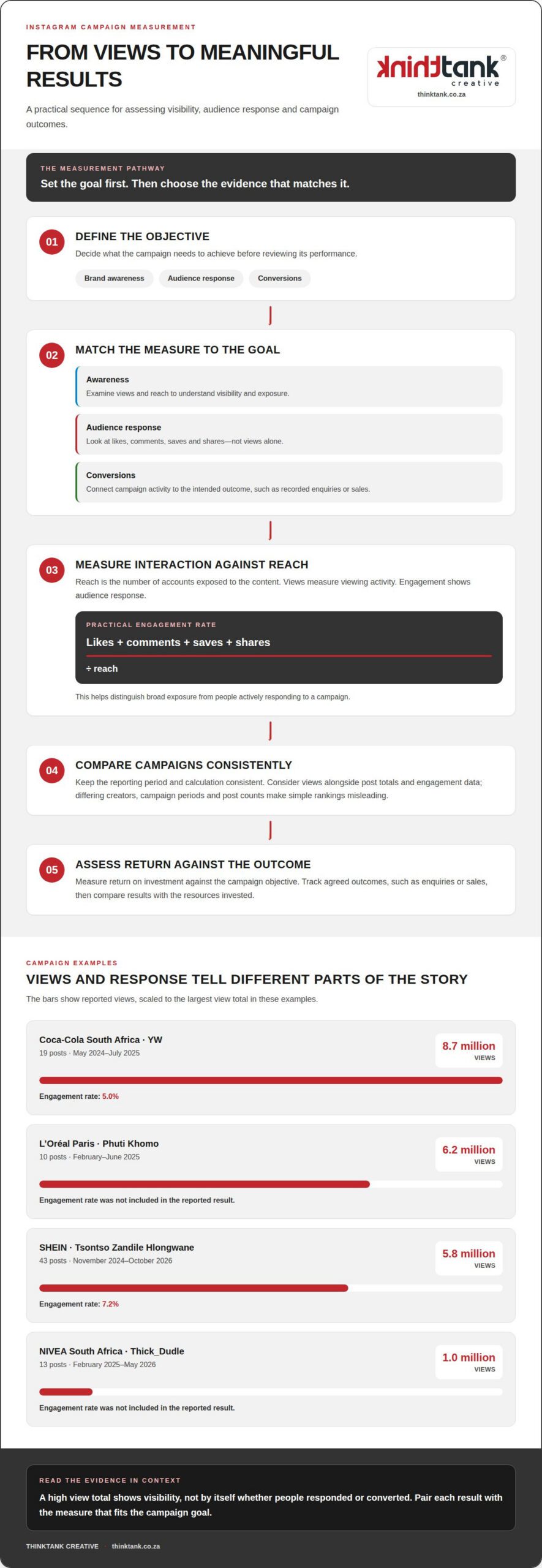
Views show how often campaign content was watched, while engagement indicates audience response. For South African creator Tsontso Zandile Hlongwane, 43 SHEIN promotion posts generated 5.8 million views between November 2024 and October 2026. Those posts recorded a 7.2% engagement rate, adding a response measure alongside visibility.
To assess engagement consistently, divide the total of likes, comments, saves and shares by reach. Reach measures the accounts exposed to content; views measure viewing activity. Comparing the figures helps distinguish broad exposure from active audience response. A high view total alone doesn’t show whether people saved a post, shared it or took another useful action.
A professional Instagram marketing team measures return on investment (ROI) against the campaign objective, linking activity to outcomes such as enquiries or sales. It tracks conversions through agreed campaign reporting, then compares the results with the resources invested.
Creator campaigns: reach and response
Situation: SHEIN ran Instagram promotions with South African creator Tsontso Zandile Hlongwane. Action: The partnership appeared across 43 posts during the period from November 2024 to October 2026. Result: The posts generated 5.8 million views and a 7.2% engagement rate. Together, these measures show both exposure and interaction, rather than treating views as the complete performance story.
Situation: Coca-Cola South Africa also worked with creator YW on Instagram promotions. Action: The activity comprised 19 posts between May 2024 and July 2025. Result: Those posts generated 8.7 million views and a 5.0% engagement rate. Comparing this example with Hlongwane’s campaign illustrates why post totals and view totals should sit beside engagement data.
Different campaigns, different measures
Situation: L’Oréal Paris promotions featured South African creator Phuti Khomo. Action: Khomo published 10 Instagram posts between February and June 2025. Result: The posts generated 6.2 million views. This example provides a visibility measure, but the supplied campaign result doesn’t include an engagement rate. Avoid treating view totals alone as proof of audience response.
Situation: NIVEA South Africa partnered with Thick_Dudle for Instagram promotion. Action: The creator published 13 posts between February 2025 and May 2026. Result: The posts generated 1.0 million views. This gives a further point of comparison, but not a direct ranking: campaign periods, creators and post counts differ.
For a useful report, set the objective first, then choose measures that match it. A brand-awareness campaign can examine views and reach; a response-focused campaign should also examine likes, comments, saves and shares. For conversions, connect campaign activity to the intended outcome, such as recorded enquiries or sales. Keep the reporting period and calculation consistent so you can interpret changes across campaigns fairly.
Content planning for brand awareness and conversion
For organic reach, Instagram Reels lead the formats discussed in 2026. Short-form videos lasting 15-60 seconds can introduce a product, demonstrate a service or show how a customer uses it. Carousels of 5-8 slides suit step-by-step explanations, comparisons and useful advice. Stories can support timely updates and reminders, especially when they give followers a clear next action.
No format guarantees sales. Reels can help a South African brand reach new viewers, whilst carousels can explain an offer in more detail. Stories can draw attention to an event, product or enquiry route. A professional team selects formats according to the campaign objective, then shapes each post around an action the audience can take.
Build a workable publishing rhythm
Publishing recommendations vary: one approach suggests 3-4 feed posts per week for South African SMEs, whilst another favours three strong posts over seven mediocre ones. The practical lesson is to plan a consistent cadence that preserves quality and fits the available content. Daily Stories can add timely touchpoints when relevant, rather than becoming a daily obligation without purpose.
Situation: Garnier South Africa worked with creator Hope Mbhele. Action: The campaign used 10 Instagram promotional posts between November 2024 and July 2025. Result: Those posts generated 955.7 thousand views. The example shows how a defined series can deliver campaign visibility; it doesn’t establish which formats were used or prove sales outcomes.
Make content useful beyond visual products
A service brand can still create visual Instagram content. An agency might turn a frequently asked question into a short Reel, map a process across carousel slides or use Stories to share an update. For example, a professional service could explain what happens during an initial enquiry. The creative treatment makes an otherwise abstract offer easier to understand.
Situation: Vaseline South Africa partnered with creator Snikiwe Mhlongo. Action: The promotion appeared in 11 Instagram posts between November 2021 and March 2026. Result: The posts generated 1.3 million views. For a brand planning its own activity, the example supports considering a sustained sequence rather than relying on one isolated post; it doesn’t identify a specific content format.
For a small business with a limited budget, an agency can concentrate production on one campaign objective, prioritise reusable creative and adapt a core idea for Reels, carousels and Stories. This reduces scattered planning without inventing a budget or promising a particular return. A co-ordinated social media content plan can connect the publishing rhythm with the brand’s awareness or conversion goal.
Instagram advertising agencies in South Africa
Instagram can suit South African businesses when its audience, creative formats and campaign goals align. TikTok and Facebook offer different audience environments and content experiences, so compare platforms against the same objective. Assess audience fit, suitable creative and the conversion path instead of assuming one platform always performs best.
For sponsored Instagram posts, make the commercial relationship clear, keep product claims accurate and document approvals. An agency can build these safeguards into creator briefs and content review. This is a practical campaign control, not a substitute for advice on specific legal obligations.
There is no single South African rand price for Instagram advertising that applies to every campaign. Cost depends on the campaign and is provided after a quote request; factors include audience, duration, creative requirements, ad spend and reporting scope.
Match creators to the campaign
An agency can define the intended audience and outcome, then shortlist creators whose content and community fit the brief. It can organise deliverables, agree usage and approval terms, and assess proposed fees against the campaign scope. A brand seeking local product awareness, for example, needs a different creator fit from a business seeking qualified enquiries.
Situation: Cleanipedia South Africa worked with South African creator Thick_Dudle. Action: The partnership used 10 Instagram posts between May 2025 and October 2026. Result: The posts generated 1.1 million views. This demonstrates campaign visibility, but views alone don’t establish sales or return on investment.
Situation: Castle Lite SA partnered with South African actor and creator SENZOKUHLE OFFICIAL. Action: The creator published 15 Instagram posts between November 2022 and December 2023. Result: Those posts generated 775.4 thousand views. The example offers a concrete reference for discussing creator content, not a guaranteed benchmark for another brand.
Protect the campaign and brand
Account security and reputation need attention before publishing. A brand should retain control of its Instagram account, limit access to people involved in campaign delivery, and avoid sharing login credentials through informal messages. An agency can document approvals, access arrangements and creator deliverables, reducing confusion if a post needs correction.
Scams can involve impersonation, suspicious collaboration requests or misleading engagement claims. Review a creator’s content quality, audience relevance and past brand work before agreeing terms. A sudden mismatch between a creator’s usual tone and a proposed sponsored message can also create reputational risk.
For South African brands, a strong agency relationship begins with a clear brief: objective, audience, deliverables, approval process and intended measure. This framework lets the agency compare Instagram with TikTok or Facebook for campaign fit, then recommend a creator or paid approach with defined responsibilities.
Instagram features for businesses
An Instagram Business account gives a South African brand access to analytics and advertising tools. Its profile can also include additional call-to-action buttons, helping direct visitors towards a relevant next step. A bio allows 150 characters, so each word should clarify the offer, audience or action. For example, a local bakery could identify its products and guide profile visitors towards an enquiry or order route.
Instagram analytics cover posts and Stories, giving campaign teams information to assess content performance. A professional can use these insights to compare audience responses across formats and refine the next content plan. If a product demonstration draws more profile actions than a static announcement, for example, the team can consider developing that style further. The goal is to connect each result with a practical decision, rather than collect figures without context.
Local advertising with a clear objective
An agency can set up Instagram ads by defining the campaign objective, choosing suitable creative and selecting an audience relevant to the business. For a South African company serving a specific area, the agency can focus delivery on the locations that matter to its service or sales model. It then aligns the advert’s message and call to action with the intended outcome, such as enquiries, visits or product interest.
Consider a Durban restaurant promoting a new menu. The agency could build an advert around appetising menu imagery, focus its audience on relevant nearby customers, and direct people towards the restaurant’s chosen contact or booking route. A Johannesburg service business would need a different location focus and a message explaining its service. These examples show why location, offer and action need to work together.
Turn profile visits into useful actions
Instagram supports businesses seeking to market and sell directly to consumers in the app. A campaign can connect discovery with product consideration and purchase where that journey suits the business. A professional team plans the creative and profile experience together, so the advert doesn’t promise a route the customer can’t follow.
Before launch, an agency should establish the campaign’s purpose, intended audience, creative format and success measures. It can then use Instagram’s post and Story analytics to review performance against that purpose. An awareness campaign, for example, needs a different assessment from an advert intended to prompt enquiries. This distinction keeps reporting relevant to the decision the business wants customers to make.
A business profile works best when its 150-character bio, call-to-action buttons and campaign message communicate a consistent next step. A South African retailer might direct profile visitors towards product information, whilst a professional service could prioritise enquiries. Aligning these features helps transform Instagram from a posting channel into a more coherent customer journey.
How many South Africans use Instagram, and what are the audience demographics?
Instagram has over 4 million active users in South Africa. That figure signals a substantial potential audience, but it doesn’t show how many users match a particular brand’s customer profile. For a Johannesburg retailer, relevant reach means reaching likely buyers, not simply a large group of people elsewhere in the country.
Demographics matter because age, location, interests and purchasing needs shape how people respond to content. No audience profile fits every South African business. A service company may prioritise people near its operating area, whilst a national retailer may need content that speaks to customers across the country. The campaign’s objective should guide which audience characteristics matter.
A professional team starts with the business’s existing customer knowledge and campaign goal. It can shape the audience and creative around those details, then use Instagram Business analytics for posts and Stories to assess how published content performs. A campaign aimed at product discovery, for example, needs a different message from one designed to prompt enquiries. Comparing performance against the objective helps refine later content.
Translate audience knowledge into relevant content
Situation: A fitness studio wants to promote a new class to prospective members nearby. Action: The campaign team centres the creative on the class experience and gives the intended audience a clear next step. Result: The campaign has a defined audience and purpose, making its performance easier to interpret than a general post aimed at everyone.
Situation: A South African homeware retailer wants to introduce a product to customers across the country. Action: The team develops content around how the product fits everyday household needs, then assesses post and Story performance. Result: The brand can identify which creative direction is more relevant to its campaign, without assuming that broad reach alone proves customer interest.
Audience data needs context. A post may attract attention from people who aren’t likely to buy, whilst a smaller audience may include more suitable prospects. A team should therefore interpret Instagram activity alongside the business goal and customer journey. For a Gauteng-based service provider, for instance, enquiries from relevant local prospects may matter more than broad exposure across South Africa.
Use the 4 million active-user figure as market context, not a forecast for any single campaign. A clear brief should identify the customer, location and desired action before content is planned. Build an audience-led Instagram strategy around those priorities, then use campaign results to sharpen the next decision.
ThinkTank Creative
ThinkTank Creative helps South African brands turn Instagram insights into a coherent marketing direction. Its Social Media Marketing and creative design services can align campaign content with your brand identity and business goals, whether you’re building awareness or encouraging enquiries. When Instagram activity needs to connect with a broader digital presence, Website Design and Development can support the customer journey beyond the social profile.
Bring a clear sense of your audience, the outcome you want and the content challenges you’re facing. These priorities provide a useful starting point for shaping an approach around your brand, rather than relying on a generic posting template.
Contact ThinkTank Creative to discuss your Instagram marketing goals.
Shape your next Instagram campaign with purpose
Make your next campaign a deliberate step towards stronger brand recognition and customer relationships. Effective Instagram marketing for South African brands begins with a clear business goal, then brings audience insight, creative direction and measurement into alignment.
ThinkTank Creative can support that direction through Social Media Marketing, creative design and Website Design and Development. These services can connect Instagram activity with a consistent brand presence and the experience customers encounter beyond the platform. Start by clarifying what you want your audience to notice, understand or do.
Contact ThinkTank Creative to discuss Instagram marketing and explore an approach shaped around your business. Strong campaigns start with a clear direction, and your next one can build from there.
Frequently Asked Questions
Looking for a top Instagram agency in South Africa?
Choose an agency whose capabilities suit the work your brand needs, rather than relying on a title such as “top”. ThinkTank Creative offers Social Media Marketing and creative design, supporting businesses with campaign planning and brand-consistent content. A retailer preparing a product launch, for example, can benefit from a joined-up approach to campaign messaging and visual direction, with responsibilities and objectives clearly understood.
Posting Frequency: How Often is Enough?
Post at a pace your team can sustain whilst keeping each update relevant to customers. A business with changing stock might share timely product updates, whilst a professional service could prioritise useful explanations and customer questions. Review the workload alongside audience response, then adjust the schedule if quality or consistency starts to slip. The right rhythm serves the business and its followers, rather than meeting a fixed quota for its own sake.
What Instagram marketing strategies work best for South African brands?
Effective Instagram marketing for South African brands connects a clear business objective with content that reflects the brand’s audience and context. For example, a retailer could build a campaign around a seasonal product range, while a service business could address a recurring customer question. Use a consistent brand voice across campaign posts, profile messaging and follow-up, then assess whether the activity supports the intended outcome before shaping the next campaign.
What are South Africa’s legal rules for influencer marketing and sponsored Instagram posts?
For sponsored posts, make the commercial relationship clear, keep product claims accurate and document approvals. These are practical campaign safeguards, not a substitute for advice on specific legal obligations.
How can brands find and price South African Instagram influencers?
Define the campaign’s audience and outcome, then shortlist creators whose content and community fit the brief. Agree on deliverables, usage and approval terms, and assess proposed fees against the campaign scope.
How does Instagram marketing compare with TikTok and Facebook for South African businesses?
Instagram, TikTok and Facebook offer different audience environments and content experiences. Compare them against the same campaign objective, considering audience fit, suitable creative and the conversion path rather than assuming one platform performs best.