Google Ads Agency South Africa: How to Choose the Right Partner

Clicks can look like progress while telling you little about business growth. A search for a google ads agency south africa can bring up plenty of confident promises, but the real challenge is finding a partner who can connect campaign activity to meaningful business objectives.

Before committing advertising spend, get clear on what success means, how it will be measured and what the reports will show. Impressions and clicks describe activity, but they don’t tell you on their own whether advertising is contributing to relevant enquiries or sales. This guide will help you assess an agency’s strategy, measurement and communication so you can choose an approach that fits your business and growth plans.

We’ll look at what effective Google Ads management involves, which questions to raise before work begins, and how to compare a paid-media specialist with a broader marketing partner. ThinkTank Creative offers digital paid advertising alongside website design and development, SEO and ongoing support. That combination can help connect advertising with the experience customers find after they click. Choose based on the strength of the plan for measuring and improving business outcomes, not on promises alone.

Key Takeaways

  • Assess a google ads agency south africa by how it links campaign planning and optimisation to agreed business objectives.
  • Look beyond clicks and impressions. Clear conversion tracking and reporting can help connect advertising activity with qualified enquiries.
  • Compare agencies on strategy, measurement, communication, website integration and ongoing support to find a suitable fit.
  • Prepare your goals, audience, offer and website context. Consider how your team records lead quality or sales feedback.
  • Decide whether a paid-media specialist or an integrated partner better suits your needs, especially if you want advertising aligned with your website and wider digital marketing.

What a Google Ads agency in South Africa should actually do

A Google Ads agency should do more than launch adverts. It should plan, manage and evaluate paid campaigns against business objectives agreed with you. That means connecting campaign choices to what the business needs, whether that is relevant product enquiries, bookings or online sales, then reviewing evidence to guide the next steps.

For a business searching for a google ads agency south africa, it helps to separate campaign activity from business outcomes. Activity is the work carried out; outcomes are what that work is intended to support. An agency can influence planning, targeting, advertising and measurement, but results also depend on the strength of the offer, the audience’s needs, the website experience and the quality of the tracking. Campaign activity alone cannot guarantee a particular outcome.

What does Google Ads campaign management include?

Campaign management begins with research and strategy. The agency needs to understand your objectives, audience and offer, then translate them into priorities that reflect what potential customers are looking for. The Google Ads platform supports paid advertising across different formats and campaign types. The appropriate choices depend on the goal and the options available in the platform.

From there, management can include preparing campaigns, overseeing advertising activity, reporting on performance and making adjustments as evidence develops. A considered process can involve:

These activities create a structured basis for improvement, not a promise that every click will become a customer.

How paid advertising fits into the wider marketing picture

Paid advertising can create visibility for selected audiences, while search engine optimisation (SEO) works to improve a website’s organic visibility in search results. They serve different roles and can complement one another: paid activity can support a focused campaign, while SEO and useful content can contribute to a longer-term presence. The right balance depends on your priorities, resources and customer journey.

The journey doesn’t end at the click. A relevant advert can bring someone to a landing page, but a confusing page, unclear offer or difficult enquiry process may weaken their experience. Website design, usability and a clear next step all matter. Social media marketing and content can also support how people discover and understand a business. A joined-up South African digital marketing strategy connects these channels rather than treating each campaign in isolation.

Choose an agency approach that considers the full path from audience intent to website interaction and business feedback. This wider view grounds campaign decisions and gives you a clearer basis for evaluating the work.

How strategy, tracking and reporting make Google Ads accountable

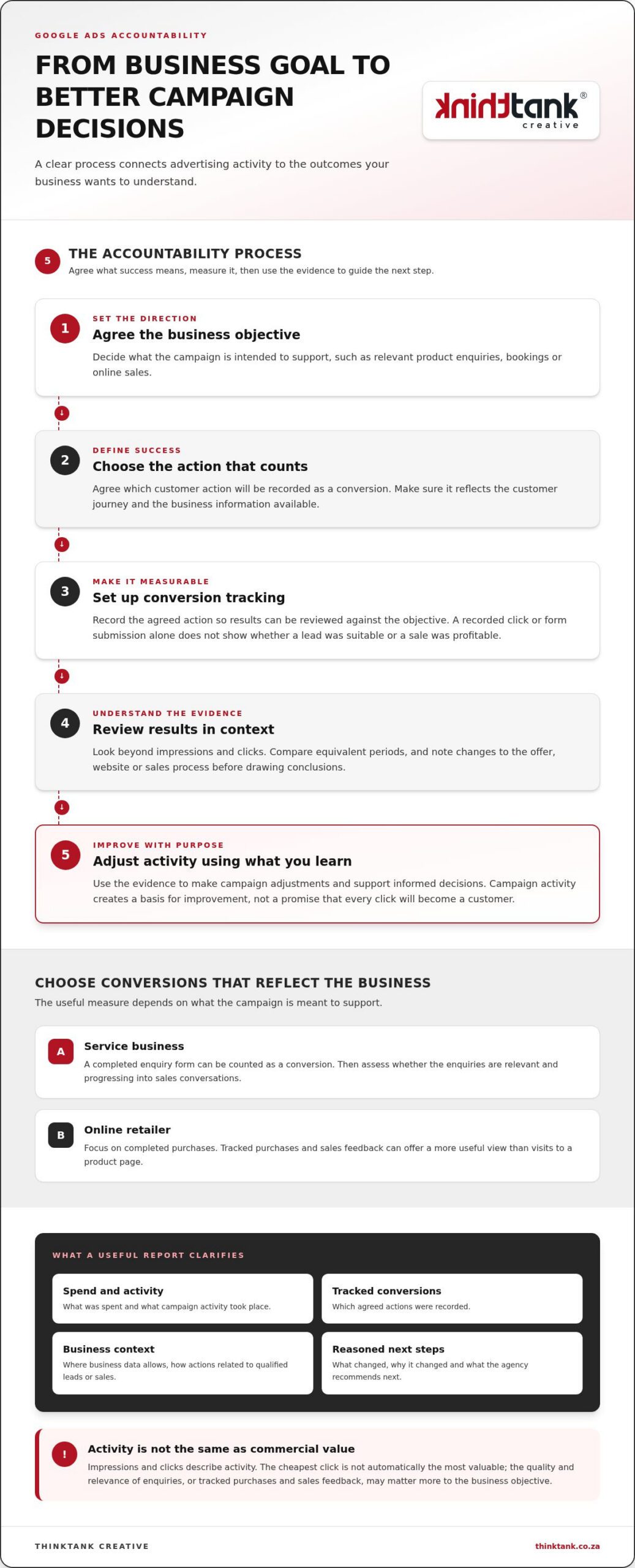
Accountability starts before the first advert runs. Agree the business objective, define the action that will count as a conversion, set up measurement, review the results and adjust activity. This sequence gives you and your agency a shared basis for decisions. Google’s Google Ads platform documentation offers guidance on working with the platform, but reliable conclusions still depend on defining what success means for your organisation.

For example, a service business might count a completed enquiry form as a conversion, then assess whether those enquiries are relevant and progressing into sales conversations. An online retailer might focus on completed purchases. A click or form submission can be recorded, but it doesn’t automatically show whether a lead was suitable or a sale was profitable. Measurement should reflect the customer journey and the business information available.

Campaign metrics only matter when interpreted against the business objective.

Which Google Ads measures matter to your business?

Impressions and clicks show that adverts were displayed or interacted with. They describe campaign activity, not necessarily commercial value. If the goal is to generate qualified enquiries, the number and quality of those enquiries matter more than click volume alone. If the goal is sales, tracked purchases and sales feedback may offer a more useful view than visits to a product page.

The cheapest click isn’t automatically the most valuable. A lower-cost visit that rarely leads to a relevant enquiry may be less useful than an interaction that supports the intended action. Before drawing conclusions, compare equivalent periods and note changes to the offer, website or sales process. This helps distinguish a genuine trend from differences in how data was collected.

What transparent reporting should help you understand

A useful report is a decision-making tool, not a dashboard of unexplained figures. It should make clear what was spent, what campaign activity took place, which conversions were tracked and, where business data allows, how those actions related to qualified leads or sales. It should also explain what changed, why the change was made and what the agency recommends doing next.

Good reporting distinguishes observed data from interpretation. A recorded form submission is an observed event; whether it represents a qualified prospect may require feedback from the team handling enquiries. If sales data isn’t connected to advertising data, the report should say so rather than presenting an assumption as proven attribution. Share lead-quality or sales feedback with your agency so campaign decisions reflect what happens after the conversion.

The post-click experience also shapes what the numbers mean. A visitor may arrive on the right page but leave because the offer or next step is unclear. Reviewing the website experience can help identify friction beyond the advert itself. If you’re evaluating a google ads agency south africa, look for a partner that connects measurement with practical next steps. ThinkTank Creative brings paid advertising together with wider digital capabilities. Explore ThinkTank Creative’s digital marketing approach to see how those pieces can work together.

How to compare Google Ads agencies in South Africa

Compare the work behind each proposal, not just its headline promise. A useful proposal shows how an agency will understand your objectives, manage the agreed scope and keep you informed. If you’re assessing a google ads agency south africa, the criteria below can make different approaches easier to compare side by side.

Criterion What to look for
Strategy Does the proposal connect your business priorities and audience intent to campaign choices?
Scope Are research, campaign management, reporting and optimisation responsibilities clearly described?
Measurement Does the approach explain what will be tracked and how performance will be interpreted?
Communication Are reporting frequency, points of contact and decision-making processes set out?
Website integration Does the plan consider the landing page and the experience after an advert is clicked?
Ongoing support Is it clear how reviews, feedback and campaign adjustments will be handled over time?

Use the table to identify gaps and differences, not to award points mechanically. A proposal that promises growth but doesn’t define the objective, measurement basis or responsibilities is difficult to assess. Treat performance claims with the same care: look for context, clear definitions and an explanation of how the result was measured. Headline figures alone may not show whether the work fits your business.

Specialist PPC agency or integrated marketing partner?

A specialist may suit a business with a clearly defined paid-media requirement and other marketing capabilities already in place. An integrated partner may be a better fit when paid advertising needs to work alongside website design, SEO, social media or creative activity. Neither model is automatically superior. The right choice depends on which capabilities your priorities require and how much coordination you want across the customer journey.

A specialist can bring depth to paid media; an integrated partner can coordinate paid activity with the wider marketing experience.

A practical agency comparison checklist

Before deciding, check that each proposal explains the objective, scope, responsibilities, reporting and communication process in comparable terms. Consider how the agency will work with your team and how feedback will inform decisions. If proposals use different definitions of a conversion or success, clarify those differences before comparing performance claims.

Fees and scopes vary, so compare the stated work with the estimated cost rather than choosing on price alone. ThinkTank Creative provides an estimated cost after discussing your needs and timeline. A clear discussion helps align expectations about deliverables and collaboration before work begins.
Google Ads Agency South Africa: How to Choose the Right Partner

What to prepare before engaging a Google Ads agency

A focused brief makes the first campaign discussion more useful. It gives an agency a clearer view of what your business needs, what customers can act on and where the customer journey may need attention. You don’t need perfect data or a complete campaign history. Share what you know, flag what’s uncertain and use the discussion to identify what needs further investigation.

Information that helps shape a useful campaign discussion

Start with the business priority, such as attracting relevant enquiries for a particular service or increasing sales of a specific offer. Describe your intended audience, the value you provide and the action you want visitors to take. Include your website address, relevant landing pages and practical constraints, such as pages that need updating or an enquiry process handled by a small team.

That last point matters. A campaign may generate enquiries, but the agency needs a feedback loop to understand which ones are relevant and how they progress. A considered lead-generation strategy takes follow-up into account instead of treating a submitted form as the end of the customer journey.

Questions that reveal how an agency works

Use the discussion to understand how the agency will turn your brief into a working plan. Ask how strategy connects to the stated objective, what campaign management includes, how results will be measured and what the reporting will help you decide. The answers should make responsibilities clear, including what your team needs to provide and who will approve changes.

Agree on practical ways of working before activity begins. Discuss communication routines, access responsibilities, the reporting format and how often the work will be reviewed. Ask how decisions and adjustments will be explained, and how your team’s feedback on lead quality or sales will shape future activity. A google ads agency south africa should be able to describe this collaboration in plain language, without relying on jargon or unsupported promises.

Preparation doesn’t mean having every answer. Bring your priorities, available information and open questions so research and strategy can be tailored to your business. To put these considerations into practice, discuss your paid advertising needs with ThinkTank Creative.

Working with ThinkTank Creative on paid advertising and digital growth

Choose a partner whose process starts with understanding your business, not simply selecting campaign settings. Founded in 2001, ThinkTank Creative is a South African agency offering digital paid advertising alongside website design and development, SEO, social media marketing and creative services. This broader perspective helps businesses consider how advertising fits into the experience customers have before and after they click.

A joined-up approach from strategy to ongoing support

Paid advertising is more useful when it reflects the wider context of your marketing. For example, a campaign may direct people to a landing page, so the page’s content, usability and next step should support the same objective as the advert. If your website needs attention, or your SEO and social media activity also contribute to customer discovery, these elements can be considered alongside PPC rather than in isolation.

ThinkTank Creative’s process puts research and strategy before delivery, with communication and feedback forming part of the working relationship. This creates space to understand your audience, business priorities and existing digital activity before shaping a suitable scope. Rather than applying a fixed campaign formula, the work is shaped around the needs and timeline discussed with you.

Collaboration continues beyond delivery. ThinkTank Creative provides ongoing service after project completion, supporting a longer-term relationship as business needs evolve. Clear communication and review keep the work connected to your priorities, while your feedback can bring practical insight into customer responses and enquiry quality.

Start a conversation about your business objectives

To make an initial discussion productive, share the outcomes you’re working towards, the audiences you want to reach and the offer or service you want to promote. It also helps to explain current challenges, the state of your website and any relevant marketing activity. You don’t need a perfect brief. A clear account of what you know and what you’re still working through gives the conversation a useful starting point.

ThinkTank Creative can discuss an approach and scope that reflect your requirements and timeline, then provide an estimated cost based on that discussion. This gives you a grounded basis for considering the work, rather than relying on a generic package or unsupported promise. The aim is to build a partnership around considered decisions and well-aligned activity.

If you’re looking for a google ads agency south africa that can discuss paid advertising in the context of your wider digital presence, bring your objectives and questions to the conversation. ThinkTank Creative’s guiding phrase, “We Do It All So You Don’t Have To”, reflects its collaborative, broad-service perspective. Start a conversation about your paid advertising goals and explore a scope tailored to your business.

Make your next advertising decision with clarity

Your first step doesn’t need to be a sweeping marketing overhaul. Choose one business priority that matters now, then use it to shape what to promote, what the visitor should do and what evidence will help you decide whether to refine the approach. That focus creates room for steady learning and a more considered path to growth.

The right google ads agency south africa should bring thoughtful collaboration to the process and help connect paid advertising with the wider direction of your business. With a clear shared purpose, campaign decisions can become part of a lasting growth plan rather than isolated activity.

Discuss your digital marketing goals with ThinkTank Creative and take the next step towards an approach shaped around your business.

Frequently Asked Questions

Is a Google Ads agency worth it for a small business in South Africa?

It can be worthwhile if paid search supports a specific business priority and your team can assess and follow up the resulting enquiries or sales. For example, a small business promoting one core service may benefit from structured campaign management, but should weigh the proposed work against internal capacity and marketing priorities. An agency can bring planning and reporting, but hiring one doesn’t guarantee results. Consider whether the proposed scope and working relationship suit your needs.

What does a Google Ads agency do?

A Google Ads agency can plan, manage and evaluate paid campaigns against objectives agreed with a business. The scope may cover research, campaign planning, advertising management, performance updates and adjustments. Before work begins, clarify who will provide business information, approve campaign materials and share feedback from customers. This division of responsibilities helps connect the agency’s activity with the website journey and the way your organisation responds to prospective customers.

How do I choose a Google Ads agency in South Africa?

Start by deciding what you want advertising to contribute, such as enquiries for a particular service or sales of a specific offer. Then compare agencies on how they explain their approach, measurement, communication and responsibilities. A google ads agency south africa should be able to describe how campaign activity relates to meaningful business actions, not just clicks. Consider whether your priorities call for paid-media focus or coordination with other marketing work, and assess claims in context.

How much does a Google Ads agency cost in South Africa?

There isn’t one fee that applies to every agency or campaign. The work required, account scope and level of support all influence an estimate, so compare proposals by what they include rather than by the headline figure alone. Also distinguish the agency’s management fee from the advertising budget paid to the platform. Ask for both to be explained clearly, along with the work and assumptions behind the proposed scope.

Can a Google Ads agency guarantee leads or sales?

No agency can responsibly treat leads or sales as certain outcomes. Results may be affected by the offer, audience, competition, website experience, measurement and how quickly enquiries are followed up. Instead of relying on a guarantee, look for a clear explanation of intended objectives, assumptions and how performance will be assessed. This helps you understand what campaign data can indicate, what it can’t establish on its own and which decisions are reasonable.

What should a Google Ads report include?

A useful report should help you decide what to do next, not simply present a collection of figures. It can show advertising spend, campaign activity and tracked conversions, with relevant trends and recommendations. Check that conversion terms are explained, reporting periods are consistent and data limitations are made clear. Where your team can share sales or enquiry outcomes, those details add context to campaign data and help distinguish recorded actions from business value.

Should I choose a specialist PPC agency or a full-service marketing agency?

Choose according to the work that needs to fit together. A business with an established website and marketing team may prefer a partner focused on paid media. If campaign activity also needs to align with a new landing page, SEO, social media or creative work, an integrated agency may help coordinate those elements. Compare the actual responsibilities, reporting and communication proposed; the agency label alone won’t tell you which model best suits your priorities.
SEO vs PPC for Small Businesses in South Africa: 2026

The channel that brings enquiries this month may not be the one that builds your most dependable source of demand. Choosing seo vs ppc for small business in south africa isn’t simply a choice between free traffic and paid clicks; it’s about matching your marketing to your goals, budget runway and ability to convert interest into business.

If you’re weighing up limited resources, it’s sensible to want a clear way to measure what they’re achieving. PPC can put your offer in front of people actively searching, while SEO works to build organic visibility over time. Paid activity can stop when campaigns pause; organic visibility may continue to attract visitors, although it requires ongoing attention and isn’t guaranteed.

This guide compares the roles, trade-offs and measurement needs of both channels, then shows how to decide whether to focus on one or combine them. You’ll also find practical next steps for testing performance, tracking meaningful outcomes and refining a plan around your South African business’s readiness to grow.

Key Takeaways

  • Understand how SEO builds unpaid search visibility over time, while PPC uses paid campaigns to reach potential customers.
  • Compare SEO and PPC by the effort, control and ongoing investment each requires, rather than assuming one is free or guarantees quick returns.
  • Use seo vs ppc for small business in south africa as a practical decision: align your channel choice with business goals, website readiness and capacity.
  • Follow a clear framework to select a channel, track meaningful outcomes and refine your approach as you learn.
  • See how coordinated SEO and PPC, supported by campaign planning, copywriting and reporting, can contribute to a more considered growth strategy.

SEO vs PPC for South African small businesses: what each channel does

Should your business build organic discoverability, pay for search visibility, or coordinate both? The answer depends on what you need to achieve and how ready your website is to turn visits into enquiries or sales. In the seo vs ppc for small business in south africa comparison, these channels serve different purposes, even though both can help connect your business with people searching online.

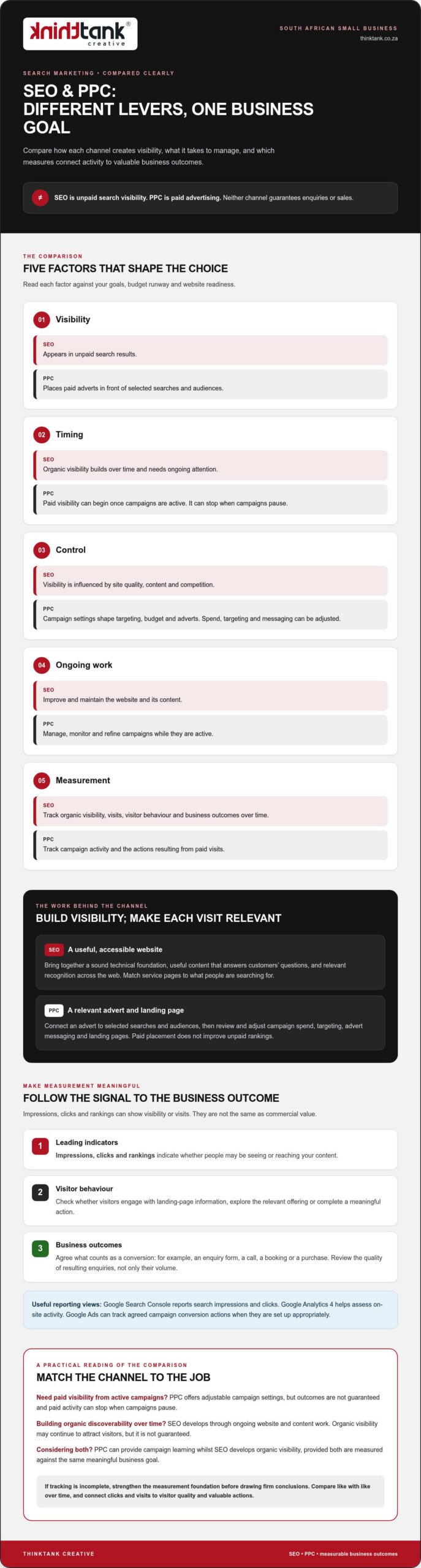
Search Engine Marketing (SEM) is an umbrella term for approaches that increase visibility in search, including Search Engine Marketing (SEM). SEO improves a website’s unpaid visibility in relevant search results. PPC, or pay-per-click advertising, places paid ads in front of selected audiences, with campaign spend and platform settings influencing when and where those ads may appear.

For a concise visual overview of how small businesses can weigh these channels, watch:

Factor SEO PPC
Visibility Unpaid search results Paid ad placements
Timing Builds over time Can begin once campaigns are active
Control Influenced by site quality, content and competition Campaign settings shape targeting, budget and ads
Ongoing work Improve and maintain the website and content Manage, monitor and refine campaigns
Measurement Track visibility, visits and business outcomes over time Track campaign activity and resulting actions

What does SEO involve for a small business?

SEO brings together a sound technical foundation, useful content and signals that help establish a website’s authority. That means making pages accessible to search engines, answering the questions potential customers actually ask, and earning relevant recognition across the web. A person searching for a particular service should land on a page that clearly explains that offering and what to do next. For more context, read this South African SEO strategic guide.

What does PPC involve in search marketing?

Paid search campaigns connect an advert to selected searches, audiences and a relevant landing page. Businesses can manage factors such as spend, targeting and ad messaging, then review results and adjust the campaign. Paid placement is separate from organic rankings: paying for an advert doesn’t improve a page’s unpaid position. PPC is controllable activity, not a promise of traffic, enquiries or sales.

Neither channel produces the same outcome for every business. Competition, execution, website readiness and the clarity of the offer all matter. A coordinated approach can use PPC to gather campaign learning while SEO develops organic visibility, provided both are measured against meaningful business goals.

How SEO and PPC work, and what South African businesses can measure

Measure activity in context, not in isolation. SEO develops through ongoing work, so assess changes in search visibility alongside what visitors do and whether they take valuable action. PPC performance reflects active campaigns, where targeting, advert creative, landing pages and spend settings can be adjusted and reviewed. Google offers a useful explanation of the difference between PPC and SEO, but your reporting should connect that distinction to your own business objectives.

Paid visibility comes from active advertising; organic visibility comes from appearing in unpaid search results. Impressions, clicks and rankings are leading indicators: they show whether people may be seeing or reaching your content. Enquiries, bookings, purchases or other agreed conversions are business outcomes. Define each measure before reporting, so a rise in clicks isn’t mistaken for a rise in commercial value.

Which measures help evaluate SEO?

Review relevant organic impressions and clicks, then examine how visitors behave on the landing pages they reach. Are they engaging with the information, exploring the relevant offering or completing a meaningful action? Google Search Console reports on a site’s search performance, including impressions and clicks. Google Analytics 4 helps assess on-site activity. Together, these views add context, but neither rankings nor traffic alone proves commercial success.

Set a regular review period and compare like with like, such as the same pages or search topics over time. This helps distinguish a visibility change from a change in visitor quality or conversion behaviour.

Which measures help evaluate PPC?

Track campaign impressions and clicks, then look at the conversion actions associated with those visits. Before launch, agree what counts as a conversion, whether that’s a completed enquiry form, a call or a purchase, and ensure the relevant action is tracked appropriately in Google Ads. Then review the quality of resulting enquiries, not just their volume. A lead generation strategy is more useful when it connects activity with the prospects a business can serve.

For a broader approach to assessing lead quality, explore this lead generation strategies framework.

For seo vs ppc for small business in south africa, use consistent definitions across channels and review performance against the same business goal. If the tracking is incomplete, improve that foundation before drawing firm conclusions. A clear reporting approach can connect campaign planning, website experience and customer outcomes; explore ThinkTank Creative’s digital marketing approach as you shape your measurement plan.

SEO or PPC: which trade-offs matter most to a small business?

Neither channel is a shortcut. SEO isn’t automatically free: it takes time and expertise to improve a website, create useful content and maintain visibility. PPC isn’t automatically profitable as soon as an advert goes live. Paid campaigns can be adjusted, but the offer, audience fit and landing page still shape whether clicks become worthwhile enquiries.

For seo vs ppc for small business in south africa, weigh the work each channel needs against what your business can sustain and learn. SEO and PPC answer different needs, and neither guarantees leads or revenue.

Trade-off SEO PPC
Ongoing effort Requires continuing site improvements, relevant content and optimisation. Requires active campaign monitoring and refinement.
Control Search visibility is influenced by relevance, site quality and competition. Campaign settings let you adjust targeting, adverts and spend.
Learning Can reveal which topics and pages attract relevant organic interest over time. Can test messages and audience choices within a defined campaign.
Dependence on activity Visibility may endure, but depends on ongoing quality and changing search conditions. Paid exposure depends on campaigns remaining active.
Key consideration Progress may take sustained effort and is shaped by competition. Control over campaign activity doesn’t guarantee profitable results.

When might SEO be the stronger starting point?

SEO may suit a business that can invest in useful content, site improvements and sustained optimisation, particularly if customers research services through search before deciding. For example, a customer comparing service options may value a clear page that answers common questions and explains what’s offered. That page can support discovery and decision-making, but organic visibility develops amid competition and changing search conditions, so it needs ongoing attention.

When might PPC be the more practical test?

PPC may be a practical way to test demand or messaging when you have a relevant landing page and can set aside capacity to manage a campaign. You can adjust targeting, advert creative and spend settings as you learn. However, a campaign can only direct attention to the offer and experience you provide. If the page is unclear or the next step is difficult, paid activity won’t fix the underlying issue.

Use each channel for the work it does best. PPC can support controlled experiments; SEO can build organic discoverability through continued improvements. A thoughtful mix may make sense when your team can support both, but prioritisation should reflect business readiness, customer behaviour and the outcomes you’re equipped to measure.

SEO vs PPC for Small Businesses in South Africa: 2026

How to choose an SEO and PPC mix for your South African business

Choose the channel mix that fits your business’s current capacity, customer behaviour and website readiness. A focused plan makes it easier to learn what supports your goals, without spreading effort across activities you can’t yet measure or maintain.

Set the goal, check your readiness, choose a channel, track the outcome and review what you learn. Use this framework to decide whether to prioritise SEO, PPC or a coordinated test:

  1. Set a business goal. Be specific about the result you want, such as relevant service enquiries or online sales. Choose an outcome you can track, not just a rise in visits.
  2. Assess website readiness. Check that the right page explains your offer clearly and gives visitors a relevant next step, such as making an enquiry or completing a purchase.
  3. Choose a starting channel. Consider whether customers search for your offering, how much time your team can commit and whether you need to test messaging or build lasting organic visibility.
  4. Track outcomes. Decide what counts as a meaningful action before activity begins, then make sure your reporting captures it consistently.
  5. Review and refine. Use what the data and customer response show to adjust the campaign, improve the page or shape the next piece of SEO work.

This is the practical lens for seo vs ppc for small business in south africa: match your first step to your goal, capacity, customer behaviour and ability to convert, then review before expanding.

Is your website ready to support either channel?

Check that the landing page matches the search message, explains the offering in plain language and makes the next step easy to find. Usability matters too: review the mobile experience, page clarity and loading experience, especially for visitors browsing on mobile data. If the journey feels confusing, improve it before directing more people to the page. Explore this website user experience guide for a deeper look at usability.

How should a small business structure a first test?

Keep the test focused. Agree one business objective, the intended audience, the conversion action and when you’ll review the results. For PPC, test relevant search terms and landing-page messaging, then assess the quality of the resulting actions. For SEO, prioritise useful pages and improvements that answer the same customer need. If both channels are viable, PPC can help explore messaging while SEO develops stronger pages around that demand.

Use the content marketing planning template to align useful content with business goals. For an integrated plan connecting channel choices with your website and customer journey, work with ThinkTank Creative on your SEO and PPC strategy.

Plan your next step with an integrated SEO and PPC strategy

The right mix starts with your business priorities, not a preference for one channel. If your website is ready and customers are actively searching for what you offer, PPC may help you test relevant search activity, while SEO builds a stronger foundation for organic visibility. If the site needs clearer pages or a smoother customer journey, address that readiness as part of the plan. Where capacity allows, coordinated paid tests and longer-term organic improvements can inform one another.

This is the practical conclusion of seo vs ppc for small business in south africa: align the channel with your goal, customer, website and ability to measure meaningful outcomes. There’s no universal mix, so a considered plan should reflect what your business can support and learn from.

What to prepare before planning your search marketing

Bring together the details that help turn a broad marketing ambition into a focused plan:

This preparation helps identify where to begin and which parts of the customer journey may need attention before more traffic is directed to the site.

How ThinkTank Creative can support the planning process

ThinkTank Creative brings SEO and digital paid advertising together with campaign planning, copywriting and reporting. That connected view helps keep channel activity aligned with business goals, the website experience and the actions you want visitors to take. Rather than treating each channel as a separate task, the planning process considers how they can support a coherent customer journey.

If your site needs to better support search visitors and conversions, website design and development can form part of the work. The process can include planning, UX/UI design, coding, testing, launch, training and support, creating a considered connection between how people find your business and what they experience when they arrive.

Discuss your needs and timeline, and an estimated cost is provided to reflect the project. This keeps the proposed scope grounded in your priorities rather than implying a fixed price for every business.

With a clear objective, an honest view of website readiness and a practical measurement plan, you can make a more informed choice about where to focus first. When you’re ready to shape a tailored digital marketing approach, discuss your digital marketing approach with ThinkTank Creative.

Build a search strategy around your next business goal

The choice between SEO and PPC comes down to more than visibility. Match your channel to your business priorities, website readiness and capacity, then measure meaningful outcomes rather than clicks alone. SEO can build organic discoverability through sustained work; PPC offers a way to test campaign activity and refine it. For many businesses, a coordinated approach can connect those roles.

That’s the practical lesson of seo vs ppc for small business in south africa: choose a starting point you can support, make sure your website gives visitors a clear next step, and review what the results tell you before refining the plan.

ThinkTank Creative has served businesses since 2001, bringing SEO and digital paid advertising together with campaign planning, copywriting and reporting. When your website needs to better support search visitors and conversions, its design and development process includes post-launch training and support.

Ready to shape a strategy around your goals and resources? Discuss a tailored SEO and PPC approach with ThinkTank Creative. A thoughtful first step can create a clearer path for your business’s next stage of growth.

Frequently Asked Questions

Is SEO or PPC better for a small business in South Africa?

For seo vs ppc for small business in south africa, the better option depends on your goals, website readiness and capacity. SEO may suit a business building useful content and organic visibility over time. PPC may suit one that wants to test search demand with a managed campaign and a relevant landing page. Compare both against meaningful outcomes, such as qualified enquiries or sales, rather than choosing on clicks alone.

Can a small business use SEO and PPC at the same time?

Yes, a small business can use SEO and PPC together if it can support and measure both. For example, PPC can test which search messages attract relevant visitors, while SEO improves pages that answer the same customer needs. Coordinate the landing pages, messaging and conversion definitions so the channels support a consistent customer journey. If resources are limited, start with a clear priority and expand when you can manage the work.

How long does SEO take compared with PPC?

PPC campaigns can begin generating ad exposure once they’re active, while SEO typically needs sustained work before organic visibility develops. Neither timing guarantees enquiries or sales. Results depend on factors such as competition, campaign or website execution, the relevance of the offer and the landing-page experience. Set an appropriate review period for each channel, and assess progress using agreed business outcomes as well as early indicators such as impressions and visits.

Does PPC improve organic SEO rankings?

No, paying for search adverts doesn’t directly improve a website’s organic rankings. PPC controls paid campaign exposure, whereas SEO work aims to improve unpaid visibility through relevant content, technical foundations and other search-quality factors. The channels can still inform one another: campaign activity may reveal which messages or search needs attract interest, helping you consider what content or pages to develop. Treat that learning as strategic insight, not a ranking boost.

Is SEO free for a small business?

No, SEO isn’t automatically free. A business may not pay for each organic click, but improving and maintaining visibility takes time and work, including website improvements, useful content and ongoing optimisation. There may also be a cost for professional support. Plan for the resources needed to create relevant pages and review their contribution, rather than treating organic traffic as cost-free or assuming that publishing content alone will deliver results.

What should a small business measure when comparing SEO and PPC?

Measure visibility and activity alongside business outcomes. For SEO, review relevant organic impressions and clicks, landing-page behaviour and meaningful enquiries or sales. For PPC, track impressions, clicks, conversion actions and the quality of resulting enquiries. Agree what counts as a conversion before reporting, and use consistent definitions across channels. Rankings or visits alone don’t show whether marketing is contributing to business goals, so review them in context.

Should I run PPC before investing in SEO?

Not necessarily. PPC may be a useful first test if you have a clear offer, a relevant landing page and the capacity to monitor campaign results. SEO may be a better starting point if customers research your services through search and you can invest in useful pages and ongoing improvement. You can also coordinate both around one customer need. Choose based on your readiness, learning priorities and ability to measure meaningful actions.

How to Reduce Google Ads Cost Per Click: The 2026 Strategic Framework

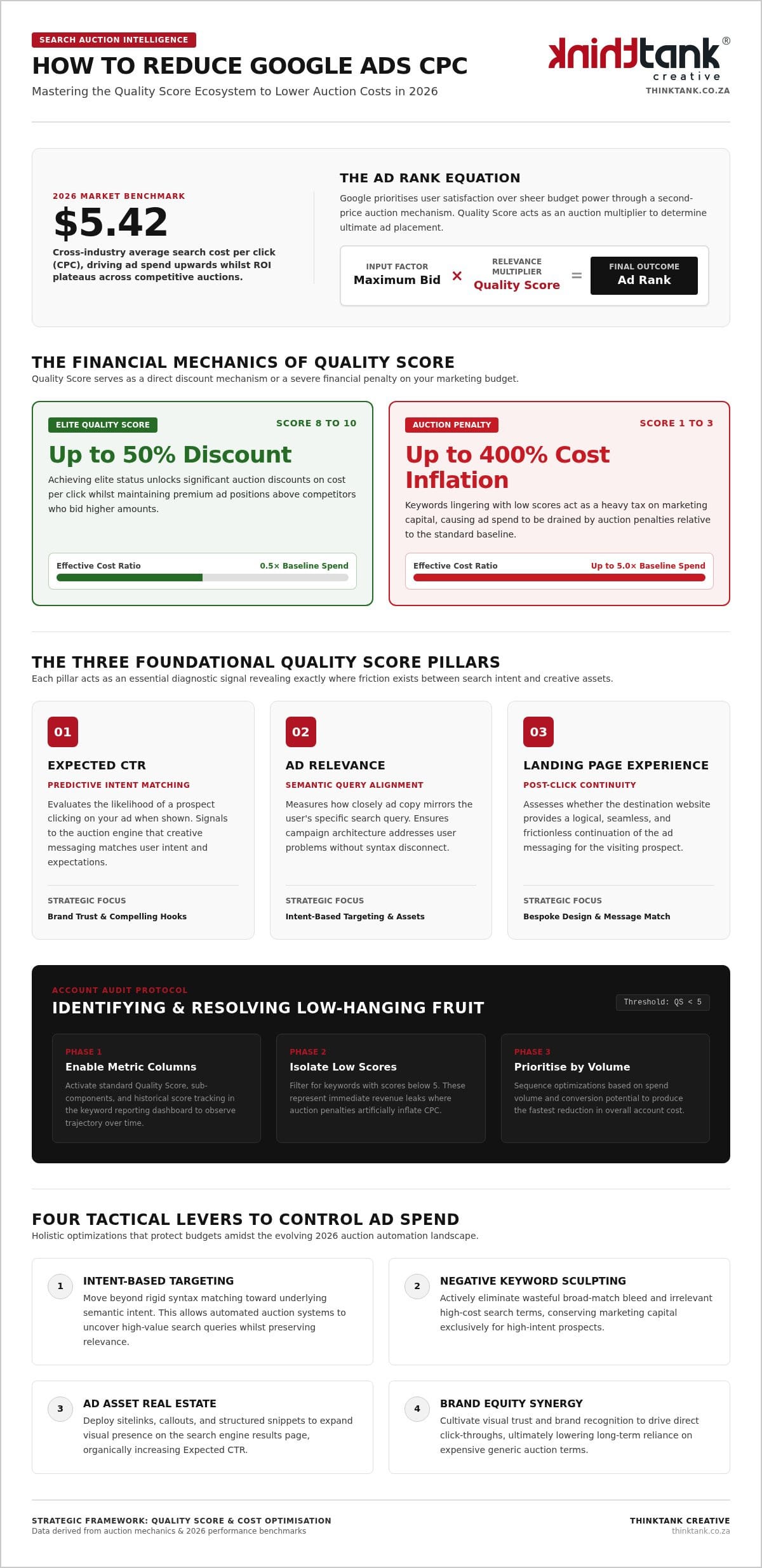
With the cross-industry average search cost per click reaching $5.42 in 2026, many South African advertisers feel they're being priced out of their own growth. It's a frustrating reality. When rising auction prices swallow your profit margins, you're left wondering how to reduce google ads cost per click without sacrificing lead quality. You likely feel the pressure of complex Quality Score metrics and the nagging suspicion that you're overpaying for traffic that doesn't resonate with your brand.

We agree that seeing your ad spend climb whilst your ROI plateaus is a challenge that requires more than just technical bidding tweaks. This guide promises to show you how to secure a sustainable reduction in your CPC by focusing on the synergy between your creative assets and the user experience. We'll explore a strategic framework that moves beyond simple bid adjustments. By the end, you'll understand how refined Quality Score components and precise landing page alignment can unlock higher ad positions for less money.

Key Takeaways

  • Master the three foundational pillars of Quality Score to unlock significant auction discounts and improve your overall ad rank.
  • Discover how to reduce google ads cost per click by refining your keyword strategy to focus on high-intent traffic whilst eliminating wasteful spend through negative lists.
  • Optimise the post-click experience through bespoke website design that ensures your landing pages are a logical and relevant extension of your ad messaging.
  • Utilise advanced bidding strategies and audience targeting to maintain control over your budget amidst the evolving 2026 automation landscape.
  • Cultivate brand equity and visual trust to increase your click-through rates, ultimately lowering your reliance on high-cost generic keywords.

Understanding the Quality Score Ecosystem and Its Impact on Costs

Quality Score isn't just a metric; it's the fundamental lever that determines your financial efficiency in every auction. Think of it as a sophisticated discount mechanism that rewards precision and intent-matching. When you seek to understand how to reduce google ads cost per click, you quickly realise that Google prioritises user satisfaction over the highest bidder. The Google Quality Score mechanism evaluates three core pillars: Expected Click-Through Rate (CTR), Ad Relevance, and Landing Page Experience. Each pillar acts as a diagnostic signal, telling you exactly where the friction exists between your ad and the user's search intent.

These elements combine with your maximum bid to determine your Ad Rank. The formula is elegant in its simplicity: Ad Rank equals your Bid multiplied by your Quality Score. By focusing on quality rather than simply inflating your budget, you can outrank competitors who might be bidding significantly more. Achieving an elite Quality Score of 8 to 10 can lead to a 50% discount on your cost per click whilst maintaining a premium ad position.

To better understand how these mechanics work in practice, watch this helpful video:

The Financial Mechanics of Quality Score

Google rewards relevance because it ensures users find exactly what they're looking for, which maintains the long-term health of the search ecosystem. This alignment creates a direct correlation between higher scores and a lower cost-per-acquisition (CPA). Essentially, you're being rewarded for making the customer look smart and find answers quickly. Conversely, a low score acts as a heavy tax on your marketing budget. If your keywords linger between a score of 1 and 3, you're facing an auction penalty that can inflate your costs by up to 400% relative to the baseline. This financial drain often goes unnoticed until a thorough audit reveals the extent of the overpayment.

Diagnostic Steps for Your Current Account

Auditing your account in the 2026 interface requires a methodical and purposeful approach. Navigate to your keyword report and ensure you've enabled the columns for Quality Score and its three sub-components. You should also look at historical Quality Score data to identify trends over time. Identify your "low-hanging fruit" keywords that currently sit with scores below 5. Prioritise these improvements based on spend volume and conversion potential. Fixing a high-volume keyword with a low score will yield the most immediate results in your effort to learn how to reduce google ads cost per click, ensuring your budget is invested in growth rather than wasted on auction penalties.

Refining Keyword Strategy and Ad Relevance for Maximum Precision

Precision is the hallmark of a high-performing campaign. Whilst earlier eras of digital marketing relied on rigid match types, the 2026 landscape demands a shift toward intent-based targeting. This approach recognises that the semantic meaning behind a query is more valuable than the specific syntax used. By moving away from overly restrictive structures, you allow Google's AI to find high-value users that traditional exact-match lists might overlook. This evolution requires a sophisticated understanding of Generalized Second Price auction dynamics, where ad relevance serves as the primary filter for cost efficiency.

Ad relevance is not just about matching words; it's about matching expectations. When your ad copy mirrors the searcher's specific intent, your Expected CTR rises naturally. This improvement signals to the auction engine that your content is valuable, which is a core component of how to reduce google ads cost per click. You must also maintain rigorous negative keyword lists to eliminate irrelevant, high-cost traffic. Active sculpting ensures your budget is reserved for prospects with genuine conversion potential rather than being drained by broad-match bleed.

Utilising ad assets is another critical lever for success. These elements expand your visual real estate on the results page, providing additional touchpoints like sitelinks, callouts, and structured snippets. They don't just make your ad look larger; they provide immediate utility to the user, which consistently drives higher engagement rates and lowers your blended auction costs.

Strategic Keyword Selection and Grouping

Focusing on long-tail keywords remains a powerful strategy for brands seeking to elevate their performance. These specific, multi-word phrases often carry lower competition and significantly higher intent than generic terms. You should organise your account into tightly themed ad groups to ensure that every ad shown is a perfect reflection of the keyword that triggered it. Integrating a well-researched content marketing plan helps you identify these high-value search terms by understanding the questions your audience is actually asking.

Crafting High-Performance Ad Copy

Strong ad copy commands attention through action-oriented imperatives. Use verbs that invite the user into a partnership, reflecting a tone of quiet assurance and expertise. Incorporate your primary keyword naturally into headlines and descriptions to reinforce relevance. We recommend a constant cycle of A/B testing for your creative elements to refine your messaging. If you find the technical nuances of campaign structure overwhelming, our team is ready to collaborate on your Pay-Per-Click advertising to ensure every rand is spent with purpose.

Optimising Landing Page Experience to Minimise CPC

Elevate your digital performance by refining the destination that follows every click. Whilst many advertisers focus exclusively on bid adjustments, the post-click experience remains a critical pillar that accounts for a significant portion of your Quality Score. Investing in custom website design ensures your site isn't merely a digital brochure but a high-performance asset designed to satisfy user intent. This alignment is essential for anyone investigating how to reduce google ads cost per click, as it directly influences the auction engine's perception of value and relevance.

A landing page must serve as a logical, seamless extension of your ad creative. When a user clicks your ad, they expect an immediate answer to their specific query. If they encounter a generic homepage or irrelevant content, they'll bounce, driving up your costs and damaging your account health. High-quality destinations provide clear, accessible information that satisfies the searcher's needs whilst reinforcing your brand's authority and professional promise.

Technical Excellence and User Flow

Technical friction in the 2026 auction environment translates directly into financial penalties. Google's current standards for Core Web Vitals are stringent; failing to achieve an Interaction to Next Paint (INP) of 200 milliseconds or less can lead to higher CPCs. For the South African market, mobile-first design is a mandatory requirement rather than a secondary consideration. A mobile-optimised interface ensures that users on any device can navigate your site with ease, reducing bounce rates and improving the overall user flow. Security is equally vital. A secure HTTPS connection is a baseline expectation that protects user data and maintains your standing in the auction.

Content Synchronisation for Relevance

Continuity between your ad copy and your landing page content is a powerful lever for cost reduction. Map your primary ad keywords directly to your H1 headings and on-page descriptions to reinforce thematic relevance. Industry insights from Forbes detail how Quality Score reduces cost per click by rewarding this level of synchronisation between the search intent and the final destination. By utilising search engine optimisation principles, you build the structural authority that Google values. Rather than relying on a templated approach, create dedicated landing pages for specific campaigns to ensure every visitor finds a bespoke solution tailored to their search.

How to Reduce Google Ads Cost Per Click: The 2026 Strategic Framework

Advanced Bidding Strategies and Audience Targeting

Master the nuances of auction participation to protect your margins. In June 2026, the decoupling of Target CPA and Target ROAS from "Maximise Conversions" restored granular control to the user interface, allowing for a more bespoke approach to bid management. This structural shift provides the precision needed to apply strategic pressure on the algorithm, which is a vital step in learning how to reduce google ads cost per click. Whilst automated bidding remains the engine of modern search, elite advertisers still utilise manual bid adjustments for specific devices, locations, and peak times of day to prune away auction inefficiency.

Success in the current landscape requires a collaborative relationship between human strategy and machine learning. By leveraging first-party data to refine your audience targeting, you ensure that every rand is directed toward users with the highest intent. Implementing Remarketing Lists for Search Ads (RLSA) further enhances this efficiency, as it allows you to bid more aggressively on past visitors who have already engaged with your brand's professional identity. Understanding remarketing campaign best practices is essential to maximising the value of these warm audiences and reducing your overall cost per acquisition.

Smart Bidding and AI Integration

Following the August 17, 2026, update to budget-limited campaigns, the bidding algorithm now drifts toward your configured target rather than naturally beating it. This change makes setting appropriate Target CPA or Target ROAS goals essential to prevent the engine from driving up costs unnecessarily. Patience remains a strategic necessity during the "Learning Phase," as premature interventions can reset the data model and trigger bid inflation in competitive national sectors. We monitor these shifts meticulously to ensure the algorithm serves your business objectives rather than platform averages.

Audience and Demographic Refinement

Preserve your budget by excluding demographics that don't align with your conversion data. Using "Observation" mode allows you to gather significant performance insights before making aggressive bid changes, ensuring every adjustment is grounded in evidence. This methodical refinement aligns perfectly with a robust lead generation framework that prioritises high-value interactions over raw traffic volume. If you're ready to refine your auction strategy with a partner who understands the technical depth of this landscape, explore our Pay-Per-Click advertising services to secure your growth.

The Synergy of Branding and PPC for Long-Term Efficiency

Branding serves as the silent architect of auction success. Whilst many advertisers view Pay-Per-Click as a purely technical exercise, the most efficient campaigns rely on the psychological foundations of trust and recognition. When a searcher recognises your brand name or visual identity in the results, they're significantly more likely to engage with your ad. This elevated engagement directly raises your Expected CTR, providing a natural answer for how to reduce google ads cost per click without relying solely on aggressive bidding adjustments.

A cohesive brand identity creates a "Halo Effect" that extends from the first impression to the final conversion. By building brand equity, you reduce your reliance on high-cost generic keywords where competition is fiercest and margins are thinnest. Instead, you cultivate a presence that allows you to capture traffic through brand-led searches, which typically enjoy the highest Quality Scores and the lowest costs in the entire account. This synergy ensures your marketing budget is invested in building an asset rather than just renting temporary space on the results page. Complementing your paid search efforts with email marketing automation for beginners allows you to nurture those hard-won leads automatically, compounding the return on every click you've already paid for.

Visual Identity as a Conversion Lever

Professionalism begins with a visual promise that your business can deliver on its claims. Consistency across your ad assets and your website reduces user friction, ensuring the transition from search engine to landing page feels secure and intentional. The psychological impact of professional logo design cannot be overstated; it establishes a perceived value that allows you to stand out amongst generic competitors. High-quality design signals a level of bespoke craftsmanship and dependability that templated identities cannot replicate, turning a simple click into a confident, high-value lead.

Moving from Tactical Clicks to Strategic Growth

Integrated agencies deliver a superior ROI by ensuring that every marketing silo works in perfect harmony. Unlike specialists who focus only on the mechanics of the auction, ThinkTank Creative operates as a "Strategic Visionary," aligning your creative identity with your technical performance. Our collaborative 5-stage process moves from deep research and branding to post-launch ad support, ensuring your growth is both sustainable and measurable. We believe that great marketing makes the customer look smart, and our commitment is captured in our tagline: "We Do It All So You Don't Have To." By merging bespoke creative design with precision-targeted advertising, we transform your digital presence into a powerful engine for long-term success.

Achieving long-term efficiency in the Google Ads auction requires a shift from reactive bidding to proactive, holistic management. By mastering the Quality Score ecosystem and ensuring your landing pages meet the highest technical standards, you create a foundation for sustainable growth. We've explored how a refined keyword strategy and the synergy of professional branding work together to elevate your performance.

Understanding how to reduce google ads cost per click isn't just about technical settings; it's about building a brand that users trust and Google rewards. This strategic alignment ensures your marketing budget works harder whilst making your business look smart. Precise execution across every touchpoint is what separates market leaders from those merely participating in the auction.

Since 2001, our award-winning in-house team has delivered integrated marketing solutions for national South African brands. We invite you to elevate your digital strategy with ThinkTank Creative and leverage 25 years of expertise to transform your results. The digital landscape continues to evolve, but with a strategic partner by your side, the potential for brand transformation remains limitless.

Frequently Asked Questions

What is a good average CPC for South African businesses in 2026?

Average costs vary significantly by sector. Across all industries, the global average sits at $5.42, with legal services reaching $9.87 and arts as low as $1.63. For South African businesses, these figures serve as a useful benchmark, though your specific auction dynamics depend on local competition and Quality Score. We provide an estimated cost for your specific niche after assessing your campaign goals and historical data during our discovery phase.

How long does it take for Quality Score changes to affect my CPC?

Quality Score is calculated in real-time during every single auction. Whilst you might see the 1-10 diagnostic score update in your interface every few days, the actual auction impact is immediate. If you improve your landing page experience or ad relevance today, the algorithm begins factoring those signals into your Ad Rank right away. This rapid feedback loop is essential when learning how to reduce google ads cost per click effectively.

Can I reduce my CPC without changing my website?

You can lower your costs by improving ad relevance and expected click-through rates, but ignoring your website limits your potential. Landing page experience constitutes one-third of your Quality Score. Whilst refining keyword match types and ad copy will help, a technical or content mismatch on your site acts as a permanent tax. Our award-winning design team often finds that bespoke website adjustments provide the most significant long-term CPC discounts available.

Does increasing my budget help reduce my cost per click?

Increasing your budget doesn't directly lower your CPC; in fact, a higher budget without proper targets can lead to bid inflation. Following the August 2026 update, campaigns limited by budget often see the algorithm drift toward higher targets rather than beating them. Strategic growth requires balancing your spend with precise bidding limits and high Quality Scores. We focus on making your budget work smarter through integrated management rather than simply spending more.

How do negative keywords actually save me money on Google Ads?

Negative keywords act as a filter that prevents your ads from appearing for irrelevant search queries. By excluding terms that don't align with your offering, you stop paying for low-quality clicks that won't convert. This refinement naturally improves your click-through rate and ad relevance. These are two vital components of your Quality Score that directly determine how to reduce google ads cost per click over the duration of your campaign.

Will a better logo design really help lower my ad costs?

A professional logo design builds immediate trust, which significantly increases your ad's click-through rate. Because expected CTR is a primary component of Quality Score, this visual trust leads to lower auction costs. When users recognise a polished corporate identity, they're more likely to engage with your content. Our 25 years of expertise in branding ensures that your visual assets work in synergy with your technical PPC strategy to drive efficiency.

What is the difference between CPC and CPA in digital marketing?

Cost Per Click (CPC) measures the price you pay for a single interaction with your ad. In contrast, Cost Per Acquisition (CPA) tracks the total cost to secure a specific conversion, such as a lead or sale. Whilst lowering your CPC is important, the ultimate goal is often a sustainable CPA. We use a 5-stage development process to ensure your website converts those clicks into meaningful business results for your brand.

Is automated bidding better than manual bidding for cost reduction?

Automated bidding is highly effective when you have sufficient conversion data, but it requires human oversight to prevent overspending. Following recent algorithm updates, Smart Bidding can drift toward higher costs if targets aren't calibrated meticulously. Manual bidding offers more control for low-volume accounts or new campaigns. We often recommend a hybrid approach that leverages AI efficiency whilst maintaining the strategic intervention of a seasoned expert to protect your profit margins.