Reasons My Business Is Not Showing Up on Google: 2026 Diagnostic Guide
Google invisibility is rarely a stroke of algorithmic bad luck; it is almost always the direct outcome of architectural neglect and misaligned technical relevance. When you launch a bespoke website, publish your commercial services, and still face zero organic enquiries, uncovering the exact reasons my business is not showing up on google becomes an urgent commercial priority. It is profoundly frustrating to watch your digital investment sit idle whilst competitors capture the high-value search visibility that should rightfully belong to your brand.
Whether you are struggling to distinguish between Google Business Profile visibility and core website indexing, or simply feel overwhelmed by opaque technical jargon, you don't have to leave your presence to chance. This 2026 diagnostic guide details the precise technical, architectural, and operational barriers preventing search engines from listing your platform, cutting through the confusion with actionable clarity. Across the following sections, we outline a rigorous remediation pathway to restore search health, secure commercial indexing, and drive qualified inbound traffic across South Africa.
Key Takeaways
- Distinguish between local map pack placement and organic website indexing to pinpoint precisely where your search visibility breakdown occurs.
- Uncover the core technical reasons my business is not showing up on google, ranging from unintentional robots.txt directives to rendering barriers.
- Understand why simple indexation does not guarantee ranking, and how modern helpful content standards evaluate authentic user value.
- Evaluate off-page authority deficits, equity gaps, and legacy search penalties that allow competing domains to outrank your platform.
- Establish an integrated, stage-by-stage remediation path that rectifies structural flaws to capture qualified national commercial traffic.
Deconstructing Search Invisibility: Google Search versus Google Business Profile
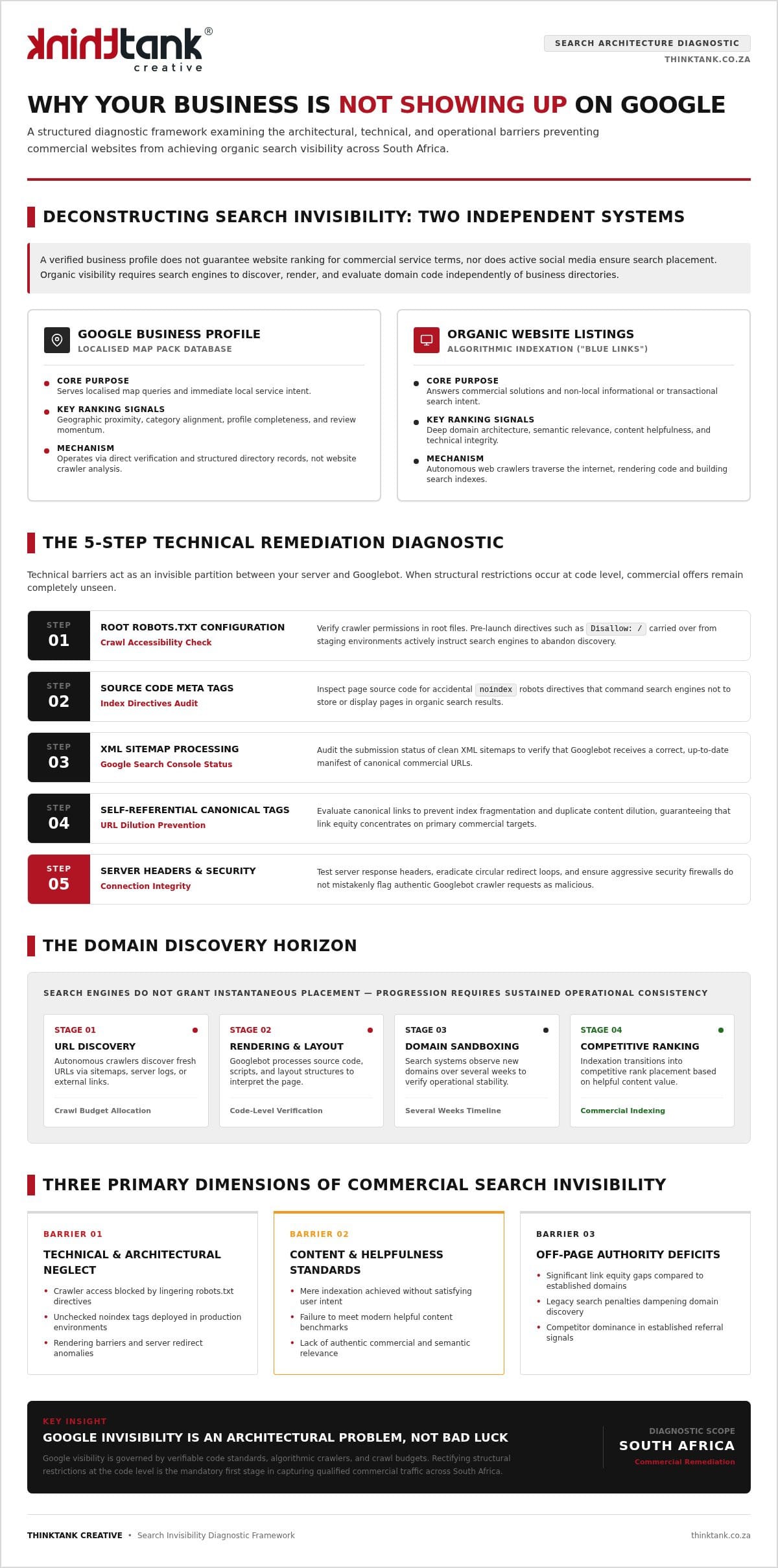
Search invisibility stems from a fundamental misunderstanding of how search systems categorise information. When business leaders explore the reasons my business is not showing up on google, they often conflate Google Business Profile (GBP) visibility with organic website indexation. While GBP powers the local map pack through proximity, category alignment, and direct verification, organic search relies entirely on algorithmic indexation of your actual website code and content.
A fully verified business profile does not guarantee that your website will rank for commercial service terms, nor does an active social media presence ensure search placement. Organic visibility requires search engines to discover, render, and evaluate your domain independently of third-party directories. Understanding search intent and geographic personalisation is vital, as search engines tailor results according to whether a user seeks immediate local services or broad commercial solutions across South Africa.
To visualise how search engines evaluate your presence across different listing formats, watch this practical breakdown:
The Anatomy of Google Search Results: Maps, Profiles, and Organic Listings
Autonomous Web crawlers systematically traverse the internet to index content, operating separately from local business databases. Google Business Profile listings serve localised map queries using review momentum, profile completeness, and location signals. Organic blue links evaluate deep domain architecture, semantic relevance, and technical integrity. Treating these two distinct systems as identical obscures the genuine reasons my business is not showing up on google when enquiries stall.
The Time Horizon of New Domains: Crawling, Indexing, and Sandboxing
Newly published websites never appear instantaneously across search engine result pages. Crawlers require time to discover fresh URLs, allocate crawl budgets, and process page layouts. Domain age also plays a quiet role: search engines observe newly registered domains over several weeks to verify their operational consistency before granting competitive search visibility. Confirming crawl activity in server logs is merely step one; indexing and ranking require sustained structural clarity.
Technical Roadblocks: Why Googlebot Cannot Crawl or Index Your Website
Technical barriers represent the most definitive reasons my business is not showing up on google, acting as an invisible partition between your server and Googlebot. If search crawlers encounter structural restrictions at the code level, even the most exceptional commercial offer will fail to generate search impressions. A systematic five-step technical diagnostic isolates these issues quickly:
- Verify crawler access within your root robots.txt configuration.
- Inspect page source code for accidental noindex directives.
- Audit XML sitemap submission status inside Google Search Console.
- Evaluate self-referential canonical tags to prevent URL dilution.
- Test server response headers and resolve circular redirect loops.
Adhering to the structural benchmarks detailed in Google's SEO Starter Guide guarantees that your core infrastructure actively welcomes search discovery rather than blocking it.
Critical Directives: Deciphering Robots.txt and Noindex Meta Tags
A frequent pitfall occurs when staging configurations carry over into live environments. Developers routinely implement a
Disallow: /
rule or insert a
noindex
meta tag to shield pre-launch builds from public discovery. If these directives linger after deployment, search engines obey them without hesitation. In other scenarios, overly aggressive security firewalls misidentify authentic Googlebot crawler requests as malicious traffic, silently dropping server connections.
Google Search Console Diagnostics: Uncovering Crawl Errors and Exclusions
Google Search Console provides definitive insight into site visibility. Reviewing the Page Indexing report distinguishes between "Discovered – currently not indexed", which reflects crawl priority constraints, and "Crawled – currently not indexed", which highlights quality thresholds. Deploying the URL Inspection tool allows you to perform live fetch tests, identifying soft 404 server errors and rendering failures instantly.
Site Architecture and Canonical Confusion
Conflicting canonical tags split ranking authority by confusing search engines regarding the primary version of a page. Running unencrypted HTTP links alongside secure HTTPS destinations fragments index equity across two duplicate properties. Furthermore, extended redirect chains exhaust crawl resources before discovery finishes. Ensuring clean architecture through bespoke custom website design in South Africa eliminates these foundational errors. If unresolved code conflicts persist, partnering with seasoned specialists for ongoing website maintenance and support provides the strategic oversight needed to safeguard long-term visibility.
Content, Relevance, and User Experience: Moving Beyond Mere Indexation to Ranking
Indexation is merely an invitation to compete; it is never a guarantee of page-one visibility. If your pages exist within Google's database but fail to generate impressions, the real reasons my business is not showing up on google frequently lie in content quality and interface friction. When modern search systems assess your platform, they look past raw keyword stuffing to judge whether your content genuinely answers commercial problems. Unoptimised metadata, thin copywriting, and vague page titles dilute contextual relevance, leaving search engines unsure which queries your pages actually solve.
Bridging this gap requires elevating your digital touchpoints. Prioritising strategic adjustments like improving website user experience safeguards dwell times and signals genuine commercial value to algorithmic evaluators.
The Helpful Content Standard: Avoiding Generic, Low-Value Information
Modern search systems evaluate depth, authoritativeness, and practical usefulness continuously. Mass-produced, automated copywriting lacking authentic perspective quickly triggers quality suppression. Search algorithms reward demonstrated first-hand experience (the vital 'E' in E-E-A-T), favouring organisations that share nuanced case observations over sites repeating generic definitions. If a listing provides zero unique insights beyond what an official Google Business Profile snippet displays, algorithms see little justification to rank it ahead of established category leaders.
Keyword Intent Alignment: Are You Speaking Your Customers' Language?
Organisational jargon frequently creates a severe barrier between services and prospective buyers. When prospective clients search for clear commercial solutions, companies often publish abstract corporate terminology that buyers never type into a search box. Aligning copy with user intent requires categorising target queries precisely:
- Informational: Users researching broader problems or foundational concepts.
- Commercial: Prospects comparing alternative approaches, methodologies, and capabilities.
- Transactional: Ready-to-buy decision-makers seeking immediate proposals and engagements.
Structuring on-page header tags logically around these intent states ensures search algorithms parse your topical hierarchy without ambiguity, rectifying subtle reasons my business is not showing up on google across competitive industry searches.
Core Web Vitals and Mobile Performance Bottlenecks
User patience is exceptionally thin. Page load delays directly compromise engagement, with data indicating that a single-second delay in page load time can reduce conversions by 7%, whilst 40% of users abandon sites taking over three seconds to load. Under mobile-first indexing, sluggish server speeds, visual layout shifts, and unresponsive mobile interfaces destroy organic rankings. Search engines simply refuse to showcase digital assets that frustrate visitors on handheld devices.
Off-Page Signals and Authority Deficits: Why Competitors Outrank You
Technical soundness and polished copy provide the foundation, but external validation determines who claims the top commercial spots. When assessing the competitive reasons my business is not showing up on google, many enterprises overlook domain authority deficits. Search algorithms rely on citations, third-party endorsements, and topically aligned backlinks to verify brand credibility. Without external proof of market leadership, search engines default to ranking entrenched competitors whose domain equity spans decades.
Reversing this dynamic requires structured search engine optimisation in South Africa, replacing passive omission with proactive digital authority building.
The Authority Gap: Backlinks, Mentions, and Trust Signals
Google treats inbound links as peer reviews from other web properties. When high-calibre publications and established trade directories reference your services, they pass link equity that elevates your overall index standing. Low-quality links from generic web directories, however, carry almost no weight. Building genuine domain equity requires strategic digital PR, national media exposure, and verified professional associations that demonstrate industry standing naturally.
Diagnosing Algorithmic Devaluation and Manual Actions
Sudden, severe drops in impressions indicate deeper disciplinary action rather than routine ranking volatility. Algorithmic spam updates, such as the major updates rolled out across 2025 and 2026, actively devalue manipulative link schemes and scraped references. A human reviewer can also apply a manual action, which suppresses your entire domain until you remediate the flagged violations.
Detecting and resolving these penalties demands deliberate, forensic action:
- Review Search Console Security Tabs: Inspect the "Manual actions" panel inside Google Search Console to confirm whether human reviewers issued formal penalties against your platform.
- Audit Inbound Anchor Text: Flag spam-heavy commercial anchors and repetitive paid link patterns that trigger automated spam filters.
- Cleanse Broken Citations: Repair 404 links pointing to obsolete product URLs, reclaiming previously lost domain equity.
- Submit Disavow Directives: Disavow toxic, unremovable spam backlinks systematically to restore organic standing.
Uncovering these hidden liabilities allows your business to rebuild an authentic, penalty-free profile. If historical links or algorithmic suppressions are stifling your growth, you can contact our team to book an SEO diagnostic consultation and formulate a tailored remediation plan.
Transforming Invisibility into Market Dominance: The ThinkTank Creative Approach
Resolving search invisibility requires more than isolated technical patches or fragmented marketing tactics. When diagnosing the fundamental reasons my business is not showing up on google, forward-thinking enterprises recognise that website design, code architecture, and commercial messaging must operate in complete harmony. Established in 2001, ThinkTank Creative operates as a full-service agency nationally, guided by our core philosophy: "We Do It All So You Don’t Have To". We unite technical web development and creative digital strategy into an integrated framework that turns stalled platforms into reliable commercial assets.
Comprehensive Diagnostic Audits: From Code to Creative Narrative
Dismantling search barriers begins with comprehensive diagnostic evaluations that interrogate server configurations, semantic code integrity, and user-facing brand narratives simultaneously. Off-the-shelf site templates frequently introduce bloated scripts, sluggish loading cycles, and structural flaws that silently choke crawler efficiency. Bespoke website development eliminates digital excess, delivering clean markup and purposeful metadata tailored directly to your commercial offerings. Through our structured five-stage development methodology, every platform undergoes exhaustive pre-launch auditing, ensuring crawlability, responsive interface design, and commercial intent alignment are perfected prior to deployment.
The Power of Full-Service Continuity: Design, SEO, and Ongoing Support
Technical oversights typically occur when disparate vendors manage website development and digital marketing in silos. Unifying creative design, bespoke development, search engine optimisation, and continuous website maintenance under one roof ensures unbroken strategic continuity. Search algorithms change continuously, meaning proactive maintenance and regular structural health checks are essential to prevent organic decay. Rather than offering rigid, one-size-fits-all packages, an estimated cost is provided after discussion to reflect your organisation's precise operational requirements. Partnering with a dedicated team ensures you rectify the structural reasons my business is not showing up on google whilst building enduring search visibility across South Africa.
Reclaim Your Search Visibility and Commercial Growth
Pinpointing the precise reasons my business is not showing up on google transforms search frustration into a clear operational roadmap. Long-term commercial visibility is never accidental; it requires removing hidden crawl directives, aligning site architecture with customer intent, and building authentic domain equity. When you separate local map profile configurations from deep organic indexation, technical ambiguity dissolves, revealing a dependable pathway toward qualified enquiry.
Transforming these structural insights into commercial momentum calls for a dedicated, strategic partner. Established in 2001, ThinkTank Creative delivers full-service digital, branding, and web development excellence nationwide. Our award-winning in-house design and development team remains committed to architectural precision and user engagement, ensuring your platform never gets left behind by algorithmic updates. Partner with ThinkTank Creative to diagnose and elevate your online presence, and build the authoritative digital foundation your brand deserves.
Frequently Asked Questions
How long does it take for a new website to appear on Google?
New websites typically take anywhere from a few days to four weeks to be discovered and crawled by Googlebot. Full organic indexing for commercial search phrases often requires several months, as search algorithms observe domain stability and compile trust signals. Submitting an XML sitemap through Google Search Console accelerates initial discovery, but competitive search rankings develop gradually as your digital authority matures across South Africa.
Why is my business showing on Google Maps but not in search results?
Google Maps and organic search results operate on completely separate ranking algorithms and databases. Your Google Business Profile relies heavily on geographical proximity, verified category data, and profile completeness to appear in map packs. In contrast, standard organic search results depend on technical code architecture, page content relevance, and earned backlink authority. A verified business profile cannot compensate for an unindexed or architecturally flawed website.
Can an accidental setting in WordPress make my business invisible on Google?
Yes, an enabled "Search engine visibility" checkbox within WordPress settings can single-handedly hide your entire platform. This single administrative option injects a noindex meta tag into your website header and instructs robots.txt to disallow all crawlers. It is one of the most common technical reasons my business is not showing up on google following a website relaunch, instantly blocking search engines until manually unticked.
What is the difference between a website being crawled and being indexed?
Crawling means Googlebot has visited your web server and downloaded page code to discover its structure. Indexation means Google has analysed that rendered content, determined its quality, and stored it within its searchable database. A page can easily be crawled without being indexed if algorithmic filters identify thin content, duplicate pages, or technical canonical conflicts that suggest the page provides insufficient value to searchers.
How do I know if my website has been penalised by Google?
Review the "Security & Manual Actions" report inside Google Search Console to check for explicit penalties issued by human reviewers. If no manual action appears but organic traffic has dropped overnight, your site may have been devalued by an algorithmic core or spam update. Auditing your backlink profile for spam-heavy anchor text and checking server error logs helps clarify the true cause.
Will redesigning my website fix my Google visibility problems?
A visual redesign alone will not restore missing search traffic unless it fundamentally resolves underlying technical and structural barriers. When diagnosing the reasons my business is not showing up on google, an effective redesign must prioritise semantic code, responsive mobile layouts, and proper URL redirect mapping. Without rigorous pre-launch technical auditing, cosmetic refreshes often carry over legacy indexing flaws or accidentally create new crawl errors.
Do online customer reviews impact whether my business shows up on Google?
Customer reviews significantly influence your visibility within local map packs and profile-driven queries, but they don't directly control organic web indexing. Google's local algorithms evaluate review sentiment, recency, and customer volume to determine map rankings. Whilst reviews enhance consumer trust and click-through rates, traditional organic search positions depend much more heavily on technical site health, topical content depth, and trustworthy external backlinks.