When to Hire a PPC Manager or Choose In-House Management
A PPC manager does more than keep adverts running. They plan paid campaigns, monitor performance and refine targeting, creative and budgets to support business goals. Knowing when to hire a PPC manager depends on whether your campaigns need consistent specialist attention that your current team can’t provide. The right support can help you make clearer decisions and use your advertising budget more deliberately.
It’s worth weighing the options carefully. An in-house specialist can focus on your business day to day, while an agency can bring broader digital marketing expertise. The right fit depends on your workload, team and growth priorities.
This article explains what a PPC manager does, the signs it may be time to hire one, and how fees, salaries, experience and media budgets shape the decision in South Africa. You’ll also learn what to expect from professional campaign management, so you can choose an approach that fits your goals and capacity.
Key Takeaways
- Recognise when campaign oversight is taking attention away from other priorities and specialist management could help.
- Understand how a PPC manager uses targeting, creative testing and performance data to refine paid campaigns.
- Compare agency support with an in-house hire by weighing ongoing workload, expertise and the different cost structures.
- Assess candidates through relevant campaign experience and their ability to explain results, strategy and optimisation decisions.
- Separate management costs from media spend, then consider how your budget and campaign goals shape the level of support you need.
PPC manager responsibilities and campaign optimisation
A PPC manager turns business objectives into paid campaigns, then uses performance data to refine decisions. The right time to hire depends on campaign complexity, available expertise and the cost of leaving campaigns unattended.
Campaign warning signs
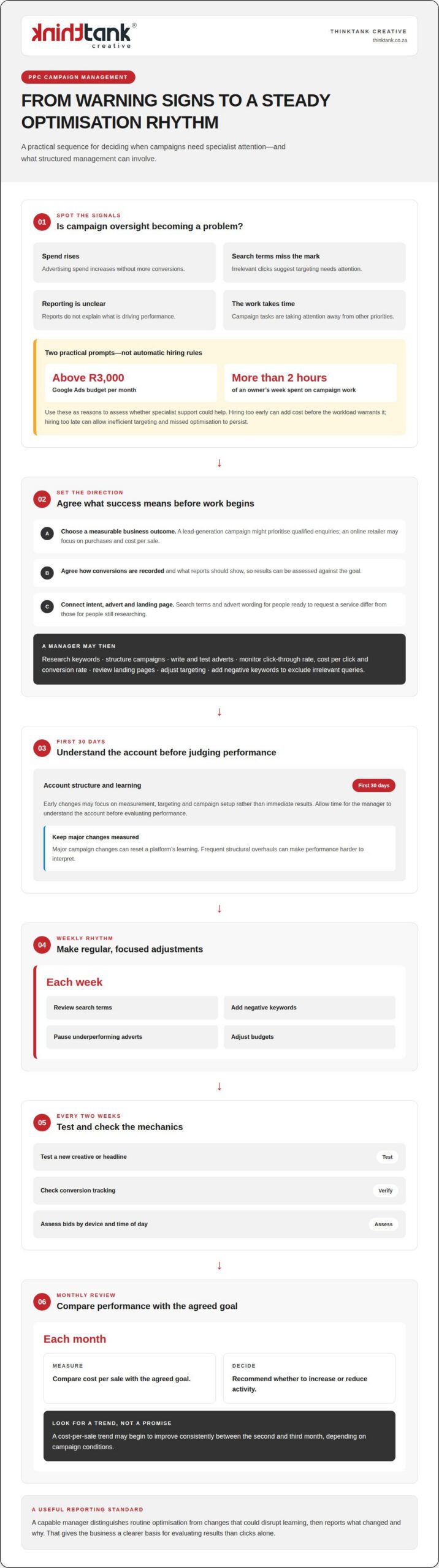
Look for recurring signs that campaigns need more structured oversight: spend rises without more conversions, search terms attract irrelevant clicks, or reports fail to explain performance. A PPC manager researches keywords, structures campaigns, writes and tests ads, and monitors click-through rate, cost per click and conversion rate. They can also review landing pages and adjust targeting to better align the advert with the customer journey.
Two practical signals are a Google Ads budget above R3,000 per month and campaign work taking more than two hours of an owner’s week. These are prompts to assess whether specialist support could help, not automatic hiring rules. Hiring too early can add cost before the workload warrants it; hiring too late can allow inefficient targeting and missed optimisation to persist.
Define the role around a measurable business outcome before hiring. A lead-generation campaign might prioritise qualified enquiries, while an online retailer may focus on purchases and cost per sale. Set the target, establish how conversions are recorded, and agree what reports should show. In South Africa, campaign planning should account for applicable tax treatment, privacy considerations when handling personal information, and advertising standards for accurate claims. A manager should consider these when setting up tracking, handling data and reviewing ads.
Keyword strategy should connect customer intent with your offer and landing page. For example, a campaign aimed at people ready to request a service needs different search terms and advert wording from one targeting people at the research stage. The manager can review search terms, add negative keywords to exclude irrelevant queries and test advert variations. This helps focus budgets on searches that better match the campaign objective.
Expected results timelines
Allow time for the manager to understand the account before judging performance. The first 30 days are usually spent on account structure and learning, so early changes may focus on measurement, targeting and campaign setup rather than immediate results. A cost-per-sale trend may begin to improve consistently between the second and third month, depending on campaign conditions.
Ongoing optimisation needs a measured rhythm. Each week, the manager can review search terms, add negative keywords, pause underperforming ads and adjust budgets. Every two weeks, they can test a new creative or headline, check conversion tracking and assess bids by device and time of day. Each month, they can compare cost per sale with the agreed goal and recommend whether to increase or reduce activity.
Major campaign changes can reset a platform’s learning, so frequent structural overhauls can make performance harder to interpret. A capable manager distinguishes routine optimisation from changes that could disrupt learning, then reports what changed and why. This gives the business a clearer basis for evaluating results than clicks alone.
How much does it cost to hire a PPC specialist?
In South Africa, the cost of hiring a PPC specialist depends on the role, workload and engagement model. Freelance work, an agency contract and a permanent appointment each have different cost structures. Compare the work included, not just the fee or salary: campaign strategy, account management, reporting and conversion tracking may fall under different scopes.
Before interviewing candidates, define what the role needs to deliver. List the platforms, campaign types, target audience and business outcomes involved. For example, managing Google Ads search campaigns involves different day-to-day work from coordinating paid search, display and social campaigns. This scope helps you identify a specialist suited to your account, rather than someone whose experience only matches the job title.
Evaluate evidence rather than broad claims. Ask candidates to explain a campaign they managed, its objective, the decisions they made and how they measured results. A strong response connects changes to outcomes such as conversion rate or cost per sale, and explains what the data couldn’t show. If an account is confidential, a candidate can describe their process without disclosing client information.
Ask: “How would you structure campaigns for our goals?”, “Which metrics would guide your decisions?” and “How do you report results and explain underperformance?” Then ask how they would approach a landing page with relevant clicks but few conversions. Their reasoning should connect targeting, advert messaging, tracking and the customer journey.
Experience gives useful context, but it doesn’t replace clear examples. A common PPC manager qualification is 3-5 years in PPC management, digital advertising, search engine marketing or a related field. Google Ads and Meta Blueprint certifications are preferred qualifications in some role descriptions. Treat these as useful signals, then explore how the candidate applies that knowledge to accounts with comparable objectives and complexity.
Estimate the total hiring cost by identifying what each arrangement includes. A permanent employee involves salary and associated employment costs, as well as training, equipment and management time. An agency or freelancer may charge for a project or ongoing management, with the agreed scope determining what work is covered. For any option, costs depend on account complexity, platforms, reporting needs and the level of strategic involvement. A service fee depends on the case and is provided after a quote request.
Use consistent criteria to compare candidates or proposals. Record agreed responsibilities, reporting frequency, account access, campaign data ownership and how strategic changes will be approved. For example, a candidate who clearly explains conversion tracking and reporting may be a better fit than one who offers only a list of platform credentials. Choose the arrangement that matches your workload and the expertise your campaigns need.
Agency fees and in-house hiring costs
Compare what each arrangement covers before weighing its cost. A PPC agency may provide campaign strategy, implementation and ongoing optimisation under a project contract or retainer. An in-house PPC manager is a full-time employee responsible for the company’s paid campaigns. The models differ in commitment, team structure and how much specialist capacity is available.
A project contract can suit a defined need, such as restructuring an account or creating a campaign plan. A retainer supports continuing work, including campaign monitoring, advert copy testing and performance reporting. Scope matters: an agreement covering Google Ads search campaigns differs from one that includes several platforms, landing pages and ongoing optimisation.
With an in-house hire, salary is only one part of the employment cost. Factor in recruitment, benefits, equipment, management time and ongoing training. PPC platforms and advertising practices change, so a permanent specialist needs continuing development to maintain relevant technical skills. The role also needs a steady workload to make dedicated capacity productive.
That workload creates a clear trade-off. An employee can build detailed knowledge of your products, customers and internal priorities, then coordinate PPC with other teams. However, fixed employment costs remain if campaign demand falls. For a business with seasonal activity, you may be paying for capacity that is less useful during quieter periods.
An agency offers a different capacity model through contracted work. A project can address a specific need, while a retainer provides ongoing management. The agreement should clarify responsibilities, including strategy, implementation, advert copy, reporting and optimisation. This helps distinguish active campaign management from a narrower arrangement covering selected tasks only.
Build a like-for-like comparison with these steps:
- List the campaigns, platforms and reporting requirements the business needs.
- Separate initial setup or restructuring from recurring optimisation work.
- Include in-house employment costs, training and management time.
- Match the contract or retainer scope against the employee’s responsibilities.
- Consider whether the workload remains consistent as business demand changes.
For example, a business with a continuing stream of campaigns may make good use of an employee’s dedicated focus. A business needing a defined account rebuild followed by a lighter workload may prefer project-based support. Neither structure is automatically cheaper. Workload, scope and the need for ongoing expertise shape the comparison.
Choose the model that fits the work, not just the label. A clear scope makes agency proposals easier to assess, while a defined role helps establish the full commitment of an in-house hire. Compare responsibilities and expected capacity first, then decide which arrangement aligns with your campaign needs over time.
Certifications and relevant experience
Assess credentials alongside practical campaign experience. Google Ads and Meta Blueprint certifications can indicate platform knowledge, but they don’t show how a specialist applies it to your business goals. Ask candidates to explain how their training informs decisions about targeting, bidding, advert formats and conversion measurement.
Relevant experience means more than having managed an advertising account. Look for work with similar objectives, customer journeys and campaign complexity. For example, a candidate who has managed lead-generation campaigns should be able to explain how they assessed enquiry quality, not just click volume. Ask what they changed, why, and how they judged the effect.
Use a structured review to compare candidates fairly:
- Match their platform experience to the channels and campaign types your business needs.
- Ask for a clear explanation of campaign goals, actions taken and results measured.
- Explore how they approach keyword research, audience targeting and negative keywords.
- Discuss how they identify tracking issues and distinguish them from campaign problems.
- Ask how they communicate recommendations and document changes for the account.
Technical skills need to go hand in hand with sound judgement. A specialist may understand conversion tracking but still need to determine whether a recorded action represents a valuable enquiry. Ask how they validate tracking, investigate discrepancies and use the data. Their explanation should show a clear method, rather than relying on platform terminology alone.
Test strategic thinking with a realistic scenario. Describe a Google Ads campaign that receives relevant clicks but few enquiries. Ask how the candidate would investigate the search terms, advert promise, landing-page relevance and conversion setup. A considered answer explores possible causes before recommending changes, rather than immediately increasing bids or replacing every advert.
Platform knowledge also needs regular development. Advertising interfaces and features change, so ask how the specialist keeps their skills current and applies new learning. A useful response might describe a recent platform change they evaluated, the business objective it related to and how they decided whether to use it. This shows whether their learning informs deliberate campaign decisions.
Finally, assess how the specialist will work with your team. Ask who will manage the account, how recommendations are prioritised and what reporting will make progress clear. For an in-house appointment, discuss collaboration with sales or customer-service colleagues who can clarify lead quality. For external support, establish how campaign context and feedback will inform optimisation.
Choose a specialist whose experience matches your campaign needs and whose reasoning you can follow. Certifications offer one useful signal; practical examples, disciplined measurement and clear communication show how that knowledge may translate into day-to-day account management.
PPC management fees and media budgets
Separate media budget from management fees when assessing a PPC plan. Media spend pays for advertising on platforms such as Google Ads; the management fee covers professional work. Combining the two obscures how much goes towards reaching an audience and how much funds strategy, optimisation and reporting.
Set the media budget against a defined business outcome. A lead-generation campaign might prioritise qualified enquiries, while an online retailer may assess purchases and revenue. The PPC manager can use these goals to recommend how to allocate budget across campaigns, then monitor whether spend is producing relevant traffic and conversions. Click volume alone doesn’t show whether advertising supports business performance.
Budget size also affects the potential cost of inefficiency. A market fact notes that 20% of wasted ad spend can exceed the campaign management fee once a monthly budget is above R3,000. This makes account oversight especially relevant as spend grows, but the figure isn’t a universal benchmark for every business. Campaign structure, targeting and conversion tracking all influence whether spend is being used effectively.
Ask for a clear breakdown of the work covered by any management arrangement. A proposal should distinguish account setup from ongoing optimisation, and state whether keyword strategy, advert copy, creative testing, reporting and landing-page recommendations are included. For example, a plan covering bid changes alone may not address weak messaging or a landing page that fails to convert.
Agree how budget decisions will be reviewed before campaigns begin. The manager should report spend alongside measures tied to the business goal, such as cost per sale or qualified lead volume. A monthly review can help decide whether to maintain, increase or reduce investment, while regular monitoring can identify search terms or adverts that need attention sooner.
Revenue attribution needs careful interpretation. A sale may follow several interactions, while a lead may need follow-up before its value becomes clear. The manager should explain how conversions are recorded and how reporting connects advertising activity with business outcomes. This gives you a more useful basis for evaluating media spend than platform-reported clicks alone.
Use these points to frame a budget discussion:
- State the business outcome the campaign should support.
- Separate media spend from management responsibilities.
- Confirm how performance and budget adjustments will be reported.
- Consider whether campaign creative and social activity need alignment.
For a more coherent customer experience, explore campaign creative and social media alignment alongside paid activity. A consistent message across adverts and social channels can help customers recognise the offer as they move between touchpoints.
ThinkTank Creative
ThinkTank Creative can help you consider PPC management alongside the wider digital experience that supports your campaigns. Turn to the team when you’re assessing how paid activity fits with your website, social channels and brand presentation, or when campaign traffic reaches a website that needs a clearer customer journey.
Website Design and Development, Social Media Marketing, creative design, and Logo and Corporate Identity Design can help create a more cohesive presence around your marketing. The right priorities depend on your goals, audience and current digital foundations. A conversation can clarify how these elements fit as you decide how to manage paid campaigns and what support your business needs.
Contact ThinkTank Creative to discuss your marketing priorities.
Make your next move with clarity
Deciding when to hire a PPC manager is ultimately about creating the right conditions for your campaigns to be managed well. Consider whether your goals are clear, whether someone can act on performance insights, and whether your current arrangement gives campaigns the attention they need. A considered choice can help align marketing activity with the direction you want your business to take.
ThinkTank Creative can help you consider how paid campaigns fit within your broader digital presence. Use a conversation with the team to clarify your priorities, identify where your marketing needs greater alignment and decide what support makes sense for your next stage.
Contact ThinkTank Creative to discuss your marketing direction and take your next step with confidence.
Frequently Asked Questions
What does a PPC manager do?
A PPC manager oversees the decisions that connect paid advertising with business objectives. Beyond adjusting campaigns, they coordinate information from sales or customer service so lead quality can inform targeting and messaging. For example, if enquiries repeatedly lack a required service, the manager can use that feedback to refine the searches and audiences that campaigns prioritise.
How long until I see results with a specialist?
Initial account analysis and restructuring commonly take the first 30 days; cost per sale may start dropping consistently between the second and third month. The pace depends on factors such as conversion volume, the sales cycle and tracking quality. A business with longer consideration periods should assess qualified leads and pipeline movement, rather than expecting every sale to appear immediately in advertising reports.
What signs indicate a business should hire a PPC manager?
Consider professional management if paid campaigns are a recurring responsibility without clear ownership, or if decisions stall because nobody can interpret performance data. Knowing when to hire a PPC manager also depends on whether sales feedback reaches the person managing campaigns. If enquiries arrive but you can’t identify which campaigns attract suitable prospects, specialist oversight can connect that insight with campaign decisions.
How much monthly ad spend justifies hiring a PPC manager?
A monthly Google Ads budget above R3,000 is a useful point to review whether specialist oversight makes sense, not a universal hiring threshold. For deciding when to hire a PPC manager, consider account complexity, campaign workload and the value of each conversion alongside spend. A smaller budget may still merit support if campaigns are strategically important, whilst a larger budget needs a clear plan for monitoring performance and allocating investment.
Should a business hire an in-house PPC manager, freelancer, or agency?
Choose based on how continuous and varied the work is. An in-house manager suits a business that needs close internal collaboration and a steady stream of campaign decisions. A freelancer can suit a more defined specialist workload, while an agency may fit businesses seeking broader expertise across their campaign needs. For example, seasonal activity may make flexible external support more practical than a permanent role.
What tasks and results should a PPC manager be responsible for?
Set clear responsibility for campaign planning, account management, measurement quality and reporting. Agree how the manager will communicate changes, protect account access and connect advertising results with business outcomes. For example, a lead-generation campaign should distinguish submitted forms from qualified prospects where the business can provide that feedback. Assess results against agreed objectives, not clicks alone.
How can a business assess whether its PPC campaigns are underperforming?
Compare campaign outcomes with business targets and the quality of customers or enquiries generated. A high click-through rate can still conceal weak commercial performance if visitors don’t take useful action. Check whether conversion records match actual enquiries or sales, then examine performance by campaign and audience. This helps distinguish measurement problems from issues with targeting, messaging or the landing page.
What skills and certifications should a PPC manager have?
Look for analytical judgement, clear communication and hands-on experience with the platforms your campaigns use. Google Ads or Meta Blueprint certification can indicate platform learning, while examples of campaign decisions show how those skills are applied. Ask how the candidate diagnosed a challenge, chose a response and evaluated the outcome. Their explanation should make the reasoning clear, rather than relying on technical terms alone.
