Ad copy that matches customer needs and drives action

Strong ad copy does more than describe an offer: it shows the right customer why it matters. Learning how to write compelling ad copy means connecting a real customer need to a clear benefit, using language that matches the search and offering a relevant next step. That turns a description into a reason to act.

It’s easy to focus on clever wording or try to include every product detail. But copy works harder when it answers the questions behind a customer’s decision: What will this help me do? Why is it right for me? What should I do next?

This guide sets out a practical approach, from understanding customer needs and choosing keywords to matching copy with each funnel stage and writing specific calls to action. It also explains how to use competitor messaging as context, so your adverts can express your own value clearly without relying on comparisons alone.

Key Takeaways

  • Make each call to action specific and relevant, showing readers the benefit of taking the next step.
  • Lead with the customer’s need, then support the benefit with a feature that makes your offer credible.
  • Align headlines and descriptions with the keywords and intent behind each search.
  • Adapt your message to the audience’s funnel stage, from initial awareness to a decision about what to do next.
  • Use competitor messaging to identify what matters to buyers, then make your own value clear without relying on disparaging comparisons.

1. Calls to action

A call to action turns an advert’s promise into a clear next step. Instead of ending with “Learn more”, connect the action to a useful outcome: “Compare website design options” or “Plan your next campaign”. Readers should know what happens after clicking and why that step matters to them.

Make the wording specific, relatable and easy to act on. “Get started” can feel vague because it doesn’t explain what the person will receive. “See how the service fits your business” gives more context, while “Request a tailored proposal” names a concrete next step. Match the invitation to what the page actually offers.

Choose a strong action verb, then address the reader directly where it feels natural. “Explore your options”, “Download your guide” and “Book a planning session” each tell the reader what to do. Direct language such as “Find the right approach for your team” makes the benefit feel relevant without sounding forceful.

Numbers can make an offer more tangible when they’re accurate and meaningful. For example, “Compare three service options” sets an expectation about what the click reveals. Don’t add a number just to make a button more persuasive: the landing page must deliver the stated detail or the message loses credibility.

AIDA and PAS are useful frameworks for building a message around a call to action. AIDA moves from attention and interest to desire and action; PAS presents a problem, highlights its impact, then offers a solution. Use either as a planning guide, not a rigid script, and make the final action fit the reader’s need.

Keep the instruction clear throughout the advert. In Google Ads, include at least one well-considered call to action and ensure it aligns with the headline, description and destination page. If the advert promises a guide, for instance, the click should lead to a page where readers can access it.

Adapt the wording to the platform and the audience’s readiness. A social media post introducing a new service might invite people to “Explore how it works”. A search advert for someone comparing solutions could say “View service details”. Each action should suit the intent behind the message, rather than repeat the same button everywhere.

Develop alternative versions that test different benefits, not just minor wording changes. Compare “Plan your next campaign” with “Build a clearer campaign strategy”, keeping the audience and destination consistent. Review clicks alongside conversions, since a high click rate alone doesn’t show whether people completed the intended action.

Before publishing, read the advert and its landing page as one journey. Check that the action is visible, the benefit is clear and the next step works as promised. This final review helps keep the message clear, the platform experience coherent and the conversion goal aligned with customer expectations.

2. Writing ad copy around user needs and benefits

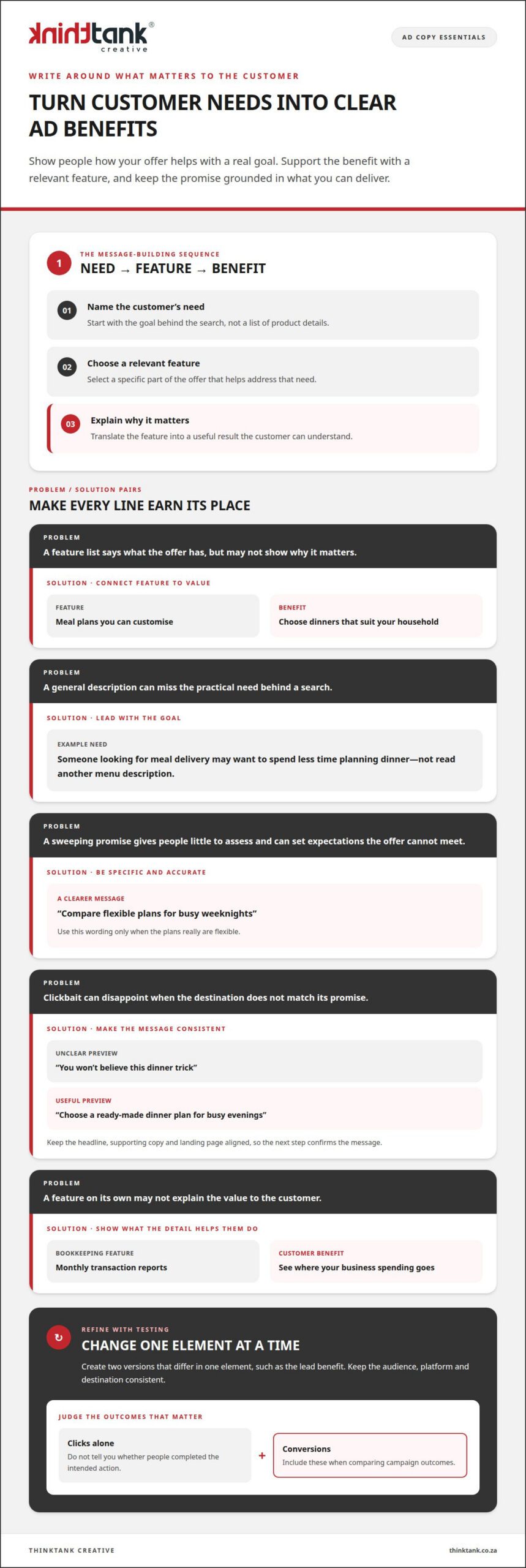
Start with the consumer’s goal, not a list of features. Someone searching Google for a meal delivery service may want to spend less time planning dinner, rather than read another menu description. Identify the practical need behind the search, then explain how the product or service helps meet it. This makes the message relevant from the outset.

Benefits-led writing connects an offer to a useful result. A feature describes what something has or does; a benefit explains why that matters. For example, “meal plans you can customise” is a feature, while “choose dinners that suit your household” translates it into value. Pairing both gives readers a reason to engage and a specific detail to consider.

Keep claims grounded in what the offer can deliver. An advert promising “the perfect solution for everyone” gives consumers little to assess and may set expectations the service cannot meet. A clearer message might say, “Compare flexible plans for busy weeknights”, provided the plans really are flexible. Accurate wording can attract people whose needs match the offer.

Clickbait may attract attention, but it disappoints when the destination fails to match its promise. “You won’t believe this dinner trick” tells readers little about the product or service. “Choose a ready-made dinner plan for busy evenings” gives a more useful preview. Keep the headline, supporting copy and landing page consistent, so the next step confirms the message.

Build each feature-benefit message with a simple sequence: name a customer need, choose a relevant feature, then explain its benefit. For example, a bookkeeping service might turn “monthly transaction reports” into “see where your business spending goes”. The feature supports the benefit; it doesn’t replace it. Use details that distinguish the offer without overloading the copy.

A/B testing can show which message resonates more. Create two versions that change one element, such as the lead benefit, while keeping the audience, platform and destination consistent. Compare the outcomes that matter to the campaign, including conversions, rather than judging a version on clicks alone. Use what you learn to refine the next test.

For a South African audience, reflect the customer’s actual context and vocabulary rather than relying on generic claims. A local service can state the problem it solves and show how its process addresses it, without promising an unsupported outcome. If paid campaigns need closer alignment between audience needs and ad messages, PPC advertising can bring that work together.

3. Matching headlines and descriptions to keywords

Build each Google Ads message around the words that signal customer intent. Keywords help determine when and where adverts can appear on Search and YouTube, so a headline should reflect the meaning of the query. Someone searching “accounting software for small business” needs a message about business accounting, not a general promise to “work smarter”.

Using relevant keywords in headlines and descriptions can help keep Google Ads copy aligned with what people are searching for. Relevance matters more than repeating the same phrase mechanically. For example, an advert targeting “Cape Town wedding photographer” might use “Wedding Photography in Cape Town” as its headline, then explain the service naturally in the description.

Start with the actual search intent, then choose the most useful keyword for the headline. Someone searching “emergency plumber Johannesburg” has a different need from someone searching “plumbing maintenance tips”. The first headline should speak to finding help; the second could offer practical guidance. Matching intent keeps the advert aligned with the reason behind the search.

Give each part of the advert a distinct role. The headline earns attention by naming the relevant service or outcome. The description adds context, such as the audience served or a key feature. The call to action points to an appropriate next step. For example: “Small Business Accounting Software”, “Track invoices and expenses in one place”, and “Explore the features”.

Make headlines specific enough to stand apart from generic alternatives. A useful approach is to combine the keyword with a clear benefit, audience or detail. “Garden Design for Compact Spaces” gives more direction than “Beautiful Gardens”. Numbers can help when they describe a real offer, such as “Choose from 3 garden styles”, but they should never imply a promise the page cannot fulfil.

Google Ads keyword insertion can place a keyword in ad copy based on a user’s search query. This can help the message reflect the search wording, but the surrounding copy still needs to read naturally. Ensure the headline makes sense when the insertion occurs and the description clarifies the actual offer. Avoid copy that becomes awkward or misleading when the query varies.

Before an advert goes live, review the headline, description and destination as one message. Check that the keyword fits the audience, the benefit is clear and the page carries the same idea forward. If an advert targets “online maths tutoring”, for example, its landing page should explain the tutoring offer rather than lead with unrelated educational content.

Use a consistent keyword strategy across related messages, while tailoring each version to its search intent. A headline can attract attention, but the description must provide relevant detail and the destination must meet the expectation. That alignment gives readers a clearer path forward and makes the advert more useful throughout their search.
Ad copy that matches customer needs and drives action

4. Matching copy to the audience funnel stage

Shape each message around what the audience is ready to decide. A reader discovering a service needs different information from someone comparing providers. For example, a first-time homebuyer exploring bond advice may need clear introductory guidance, while a reader comparing advisers may want to understand the service’s approach.

In South Africa, language and cultural differences affect which words, idioms and references feel natural to different audiences. Choose language and examples that suit the intended reader, then make sure the meaning remains clear and respectful. A phrase familiar to one community may not carry the same meaning elsewhere.

At the awareness stage, the audience may recognise a problem but not know which solution fits. Name the challenge plainly, as in “Need help planning household finances?” A gentle call to action, such as “Explore practical budgeting guidance”, invites the reader to learn without pushing for an immediate purchase.

At the consideration stage, people are weighing possible approaches. Someone comparing solar installation options, for example, may want to understand system components, installation processes or ongoing support. Address those objectives directly with specific information that helps the audience assess the offer, rather than broad claims about being the best.

At the decision stage, the audience is closer to choosing. Make the next step explicit and explain what it involves, such as “View service details” or “Request an assessment”. The destination should continue the advert’s message, so someone responding to a solar installation advert finds relevant service information rather than a general home page.

Research audience needs through search terms, customer enquiries and feedback. A Google Ads query such as “accountant for a new business” signals a different objective from “submit company tax return”. Use that distinction to shape the message: one person may need help setting up financial processes, while the other seeks support with a specific task.

Competitor research can reveal common claims and unanswered questions, but it should inform your positioning rather than dictate it. If other adverts emphasise speed, consider whether your audience also values clear communication or a defined process. Then describe your actual strengths with precise wording and evidence, rather than imitating a competitor’s promise.

Map each advert to one audience stage, one primary objective and one suitable next step. For someone researching business accounting, an informative message may be appropriate; for someone comparing providers, service details may be more useful. This structure helps Google Ads address intent and gives each reader a more coherent journey.

5. Competitive search ad copy

Compete on relevance, not volume. When someone searches “accountant for a small business”, several adverts may address the same need. A useful message gives the reader a clear reason to consider your offer, such as a defined specialism, a transparent process or a service feature that genuinely distinguishes it.

Begin with competitor and audience research. Review the search results for the terms you intend to target, then note recurring promises, language and unanswered questions. If several adverts emphasise speed, consider whether customers also need clear pricing information, regular updates or support with a particular task. Use those observations to guide your positioning, not to make claims about rivals.

Turn buyer objections into useful content. Cost, comparisons with competitors and the effort involved can all affect a decision. An advert for bookkeeping could address concerns about effort with “Organise your records with a structured bookkeeping service”, if that accurately describes the offer. A specific explanation helps readers assess its relevance without criticising another provider.

Make every comparison fair and verifiable. Avoid unsupported claims such as “the best service in South Africa” or “faster than every competitor”. Instead, state your actual features and explain their value. For example, if a service includes a dedicated onboarding process, describe what that process helps the customer do. Precision strengthens credibility and keeps advertising focused on the offer.

Search copy should respond to a direct query; display advertising often reaches people in a different browsing context. For a search such as “business email marketing service”, name the relevant service and benefit. A display message might introduce a useful outcome to an audience that hasn’t actively searched for it. Keep both formats consistent with the destination page.

Use a controlled test to learn which competitive message earns meaningful engagement. Create two versions, changing one element such as the benefit or proof point, while keeping the audience and landing page consistent. Review conversions alongside clicks. If one advert attracts attention but few enquiries, the message may not address the decision that matters.

Apply what you learn across your marketing without copying the same wording into every channel. A search advert, social media post and email can each express the same differentiator in a format suited to its audience. This coordinated approach helps keep the message consistent while allowing each platform to answer the customer’s specific question.

For a considered approach to competitive search advertising, plan your PPC advertising strategy around your audience, genuine strengths and campaign goals.

ThinkTank Creative

ThinkTank Creative helps businesses bring customer-focused messaging into a coherent digital presence. When you’re shaping ad copy, this means aligning the message with your audience, campaign and the experience customers find after clicking.

ThinkTank Creative’s Website Design and Development, Social Media Marketing and creative design services can support a consistent brand expression across customer touchpoints. Logo and Corporate Identity Design can also ensure your visual identity complements the words rather than competing with them. The right combination depends on your goals and where your audience engages with your business.

Ready to refine your messaging and create a more joined-up customer experience? Contact ThinkTank Creative to discuss your goals.

Turn strong messaging into lasting momentum

Knowing how to write compelling ad copy is a valuable starting point; the next step is to make every customer interaction feel consistent. When advertising, website content and social channels express the same distinctive value, customers can move from first impression to meaningful engagement with greater clarity. ThinkTank Creative brings together website design and development, social media marketing and creative design to help businesses create that connected experience.

Keep learning from how people respond, then use those insights to refine your message and strengthen the journey around it. Thoughtful copy isn’t a one-off exercise; it can evolve alongside your audience, goals and brand.

Contact ThinkTank Creative today to discuss how your marketing can move forward. A clearer message can be the beginning of something stronger.

Frequently Asked Questions

What Is Ad Copy?

Ad copy is the written message used to promote a product, service or idea and encourage a response. It can appear in a search result, social post, brochure or billboard. For example, a local tutoring business might use a short advert explaining which subjects it supports and inviting parents to view its teaching approach. The copy works alongside design and placement to communicate the offer.

What is ad copywriting?

Ad copywriting is the craft of planning and writing promotional messages for a defined audience and purpose. It involves choosing the central message, selecting language that suits the medium and refining the wording so it’s clear and credible. For a new café, copywriting might produce a launch advert, a social caption and a printed menu insert, each tailored to its context.

What are some examples of great Google Ads copy?

Effective examples make the service, audience and next step easy to understand. For a hypothetical bicycle repair shop: “Bicycle Repairs for Commuters” could headline an advert; “Book a service for your daily ride” could add context; and “View repair options” could guide the click. These are illustrative lines, not performance claims. A strong example also leads to a page that fulfils its promise.

What are the best practices for writing Google Ads?

Write each advert for a specific search intent, and make its destination page relevant to that intent. Check that the wording accurately describes the offer, reads naturally and gives a useful next step. For example, an advert for piano lessons should lead to information about lessons, not a general music shop page. Review results against the campaign’s objective, such as qualified enquiries.

What are the key principles of writing compelling ad copy?

Prioritise clarity, relevance, credibility and a suitable next step. A practical approach to how to write compelling ad copy is to imagine the reader’s immediate concern, then answer it plainly. For a home cleaning service, “Arrange a clean before moving day” speaks to a particular situation more directly than “Exceptional cleaning solutions”. Keep claims accurate and ensure the following page or contact point fits the message.

How do you write effective ad headlines and calls to action?

Give the headline one clear job, such as identifying the offer or naming its audience. Then use the call to action to describe a logical next move. A gardening business could pair “Garden Plans for New Homes” with “View design ideas”. Read both lines together: the headline should set an expectation, and the action should help the reader continue without suggesting a result the business cannot promise.

What makes ad copy persuasive to a specific target audience?

Persuasive copy reflects the audience’s circumstances, priorities and vocabulary. A message for parents arranging after-school care, for instance, should address scheduling and the child’s routine rather than focus only on the provider’s history. Use customer enquiries and feedback to identify the questions people actually ask. Then answer one relevant concern with concrete details the business can stand behind.

How should ad copy differ across Google, Facebook, Instagram, and print ads?

Google Ads should respond closely to the search that prompted them, while Facebook and Instagram copy can introduce an idea during social browsing and work alongside visual creative. Print advertising needs to communicate clearly within its physical layout, whether it appears on a flyer or poster. For a theatre production, search copy might highlight ticket information, social copy could introduce a performer, and a poster might foreground the show title and date.
Long-tail keywords for South African businesses and how they work

A more specific search can be more useful than a popular one. Long-tail keywords for South African businesses are detailed search phrases that reveal what someone wants, rather than simply naming a broad topic. They often contain three or more words, but specificity and intent matter more than a fixed word count.

Broad keywords can help people discover a topic, while a more detailed phrase can signal a particular need, service or location. The challenge is finding phrases that reflect how your audience searches, then using them naturally in useful content. This article explains how long-tail keywords work, how they reveal search intent and how to uncover ideas that fit a South African audience. It also shows why a balanced strategy combines specific phrases with broader terms, rather than relying on either alone.

Key Takeaways

  • Judge a phrase by the specific need it expresses, not simply by how many words it contains.
  • Compare broad and detailed searches to see how competition and the kind of results change.
  • Use search intent to shape pages around what people in your audience are actually looking for.
  • Explore autocomplete, related searches and existing search data to uncover useful keyword ideas.
  • Combine focused phrases with broader terms to support discovery across different stages of the customer journey.

What Are Long-Tail Keywords?

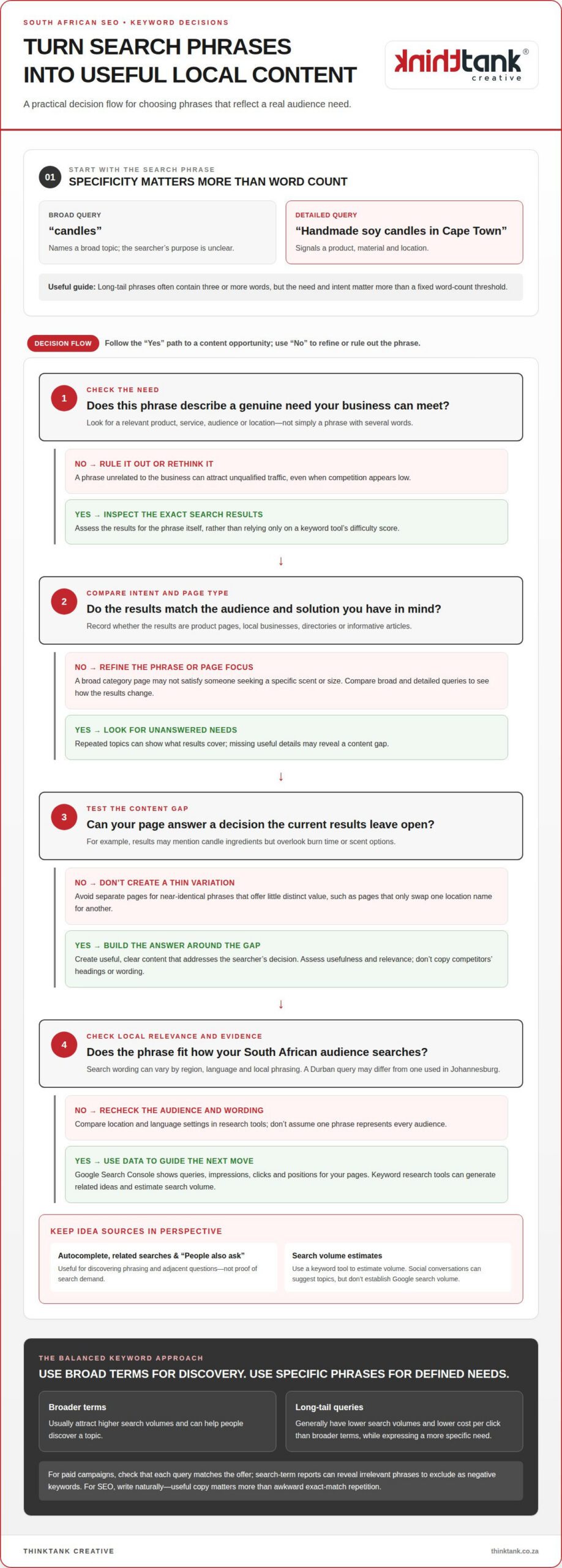
Long-tail keywords are specific search phrases that describe a particular need. They usually contain three or more words, but intent matters more than a word-count threshold. A short-tail query such as “candles” leaves the searcher’s purpose unclear. “Handmade soy candles in Cape Town” points to a product, material and location. Short-tail phrases typically contain one or two words and cover broader subjects.

Assess competition by examining the results for the exact phrase, not just a keyword tool’s difficulty score. Search “handmade soy candles in Cape Town” and note what appears: product pages, local businesses, directories or informative articles. These results reveal the format and purpose search engines consider relevant. A page competing with established retailers may need stronger product detail than one competing with general advice articles.

Use a consistent comparison when assessing the results:

That comparison can reveal content gaps. If results mention candle ingredients but overlook burn time or scent options, a useful page can address those needs clearly. A gap is not simply a missing phrase; it is an unanswered part of the searcher’s decision. Competitor analysis should therefore assess usefulness, relevance and clarity, rather than copy headings or wording.

Specific phrases often face less competition because fewer pages target that precise need. They can attract visitors with clearer intent, which may support conversion when a page offers the right answer or product. But low competition alone does not establish value. A phrase with little relevance to the business can bring unqualified traffic, even if its search results look easy to enter.

Long-tail keywords generally have lower search volumes and lower cost per click than broader terms in paid campaigns. This can make them useful in a PPC strategy, but assess whether each query matches the offer before using it. Search-term reports can reveal irrelevant phrases to exclude as negative keywords. For SEO, avoid awkward repetition: natural, useful copy matters more than exact-match insertion.

Common risks include targeting phrases solely because they contain several words, pursuing queries unrelated to the business and creating thin pages for near-identical variations. For example, separate pages that only swap “Cape Town” for another location may offer little distinct value. Choose phrases that express a genuine need, inspect their search results and create content that answers that need fully.

Comparing search results for specific and generic queries

Compare the results for a broad phrase and a detailed query to see how Google interprets each need. Search suggestions and performance data can then help refine ideas for South African audiences.

Search Console and Keyword Research Tools

Google Search Console shows queries already bringing people to your pages, whilst keyword research tools help generate related ideas and estimate search volume. Together, they reveal opportunities to improve existing content and explore terms your pages don’t yet target. For example, Search Console may show a page appearing for a detailed service query on the 2nd, 3rd, or 4th page of Google search results. A related tool can help assess that phrase against other options.

Start with a broad query such as “accountant”, then compare its Google results with “accountant for small businesses in Durban”. The first may lead to directories, definitions and local firms; the second may surface pages focused on a particular audience and place. Record which page types appear. This comparison shows whether searchers want general information, a nearby service or a specific solution.

Google Autocomplete suggests completions as you type, while “People also ask” and related searches reveal adjacent questions and alternative wording. For example, a search about Durban bookkeeping may suggest questions about small businesses or monthly records. Treat these as idea sources, not proof of demand: suggestions reveal phrasing, but a keyword tool is needed to estimate volume.

Keyword research tools can generate hundreds, sometimes thousands, of related phrases. Group them by customer need rather than creating a separate page for every variation. Social media searches can add another perspective: comments and platform suggestions may surface the language customers use when discussing a product. These conversations can shape topics, but they do not establish Google search volume.

Search Volumes and Regional Trends

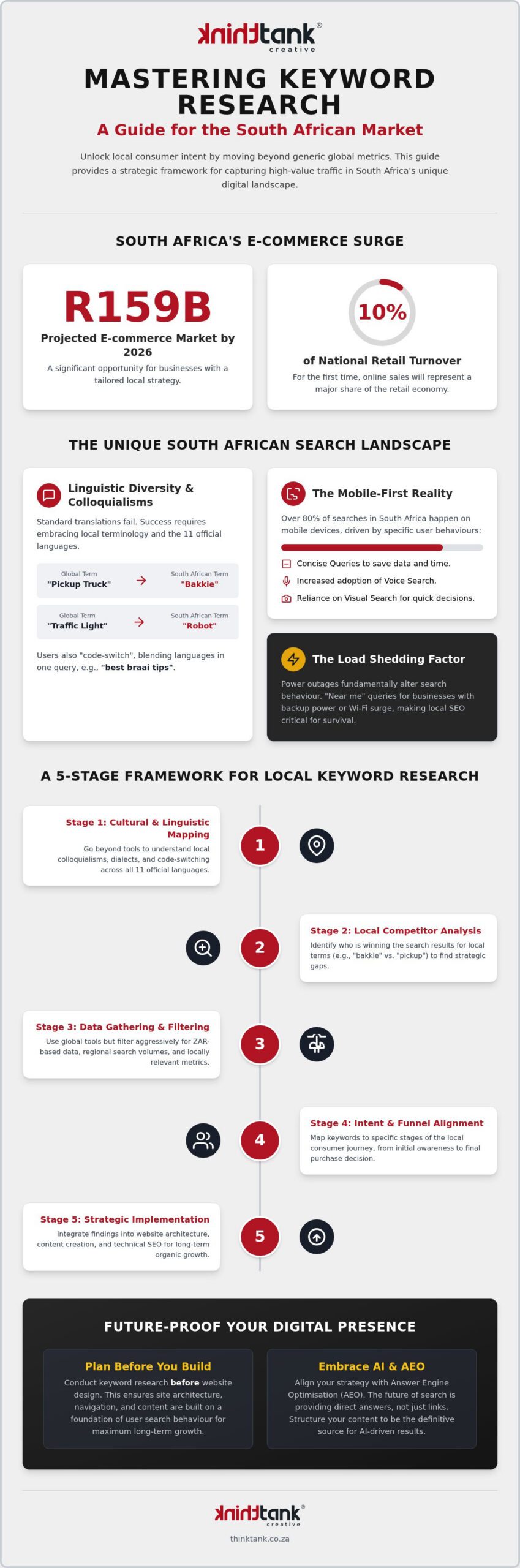
Short-tail terms usually attract higher search volumes, while long-tail queries are more specific and generally have lower volumes. South African search patterns can differ by region, language and local wording; comparing location and language settings in research tools helps identify relevant variations. For instance, people seeking a service in Durban may phrase a query differently from those searching in Johannesburg. Use local context to judge relevance, rather than assuming one phrase represents every audience.

Search Console can show which queries bring impressions and clicks to a page, helping distinguish emerging opportunities from phrases that merely sound useful. Compare the wording and performance of related queries before changing content. A focused search engine optimisation strategy can use broad topics for discovery and specific phrases for clearly defined needs.

Long-tail keyword specificity and search intent

Specificity reveals what a person wants from a search, while intent helps shape the right response. Measure SEO results through Google Search Console impressions, clicks and query positions, then assess whether relevant landing pages lead to enquiries or sales.

Specificity and Audience Intent

A specific search term combines a topic with details that clarify the searcher’s audience, location or need. “Accountant” could mean someone seeking career information, whereas “accountant for a small business in Durban” signals a particular service and audience. The extra detail helps businesses create pages that answer a defined query instead of competing for every possible interpretation.

Geography and wording can refine intent further. Someone searching for “wedding photographer in Pretoria” is likely seeking a local service, while “how to choose a wedding photographer” points to research. In South Africa, English or Afrikaans phrasing may also shape how people describe the same need. Treat each variation as a clue, then match the page language and content to its audience.

Specificity alone does not establish intent. “Affordable laptop for students” could signal active comparison, but “what is a laptop” suggests early learning. Inspect the search results and ask what would satisfy the query: an explainer, comparison, product page or local service page. This alignment helps an SEO strategy serve the searcher rather than simply insert a phrase.

Business Value and Conversion Intent

Conversion intent describes how closely a query connects to an action, such as requesting a quote or making a purchase. “Buy accounting software for a small business” is more commercially focused than “what is accounting software”. Long-tail terms typically have conversion rates 2.5 times higher than head terms, making their potential value relevant even when their search volume is lower.

Consider the customer journey in digital marketing. Someone searching “what does a solar installer do” may be learning, while “solar panel installation quote in Gqeberha” suggests a more specific requirement. The first query suits educational content; the second needs clear service information and a straightforward route to enquire. Match the page’s purpose to the likely stage, not just the keyword.

Track outcomes by connecting query themes to the pages created for them. In Search Console, review impressions, clicks and average position for relevant phrases, then compare those visits with enquiries or purchases recorded for the matching landing page. If “bookkeeping services for a Cape Town startup” earns clicks but few enquiries, examine whether the page clearly addresses that audience’s needs. This gives marketing teams a practical way to refine content, rather than treating rankings as the final measure of business value.

Long-tail keywords for South African businesses and how they work

Definition and characteristics of long-tail keywords

Specificity, not a fixed word count, gives a search phrase its long-tail character. For South African businesses, the detail can reveal which audience or need a page should serve.

Defining Long-Tail Keywords

A long-tail keyword is a specific search phrase, usually containing three or more words, that expresses a clearer need than a broad term. “Garden services” is general; “indigenous garden design in Pretoria” narrows the subject, service and location. This distinction helps businesses create content for particular queries instead of treating every visitor as though they want the same information.

Word count is a useful clue, not a strict test. A four-word phrase can still be broad, while a shorter phrase can communicate a precise need through its context. For instance, “wedding venue Stellenbosch” points to a particular service and place. Judge the phrase by the searcher’s likely purpose and whether a relevant page can answer it.

Long-tail keywords often have lower search volumes than broad terms, but they can attract more relevant traffic. Someone looking for “bulk compost delivery Stellenbosch” has supplied more context than someone searching “compost”. That detail creates an opportunity to explain delivery options, product suitability and the intended location on one focused page.

Characteristics of Long-Tail Keywords

Long-tail phrases typically combine a topic with a qualifier, such as a location, audience, product feature or intended outcome. “Accounting software” becomes more specific as “accounting software for South African freelancers”. The added words help distinguish one audience from others, giving content creators a clearer basis for choosing page topics and examples.

These phrases often have lower search volumes and face less competition than broad terms. Their value depends on relevance, not just ranking potential. A page about accounting software for freelancers should address needs that audience recognises, such as invoicing or organising expenses. Adding “South African” without meaningful local context will not make the content more useful.

Variations can express the same need in different ways. Someone may search “find a wedding photographer in Durban” or “Durban wedding photography packages”. The first focuses on finding a service; the second suggests comparing an offer. Group closely related variations when one page can satisfy both, but create separate content when the intent or answer differs.

For SEO, use the phrase where it fits naturally, including in a page title, heading or relevant passage. Search engines need clear context, while readers need coherent information. Repeating a long-tail phrase in every heading can make copy awkward and obscure its purpose. Instead, build the page around the need expressed by the query, then include useful variations where they clarify the topic.

Long-tail keywords for South African businesses can guide focused content without defining success by word count alone. Assess each phrase’s specificity, audience and search purpose before deciding whether it merits a page. That approach turns variations into content opportunities that serve real queries, rather than a collection of phrases chosen only to attract traffic.

Find niche ideas by combining a core service with a customer need, audience or location. For South African searches, examples include “guesthouse near Addo Elephant Park”, “plumber in Sandton” and “wedding caterer in Stellenbosch”.

Expand each seed topic with Google suggestions, related searches, customer questions and local variations. For popular industries, useful starting examples include “bookkeeping for small businesses in Cape Town”, “family-friendly lodge near Kruger National Park” and “emergency plumber in Pretoria”, then assess whether each reflects a genuine offer and audience.

Expanding Basic Keyword Ideas

Expand a basic keyword by adding details that clarify the service, audience, location or problem. Begin with a seed such as “solar panels”, then develop phrases like “solar panel installation for homes in Durban” or “solar panel maintenance in Johannesburg”. These variations can reveal distinct topics and give each content idea a clearer target.

Use modifiers that match real customer decisions, such as “for small businesses”, “near me” or “cost of installation”. Google Autocomplete can suggest completions as you type a seed term. Record useful search terms, then group phrases that share the same purpose instead of creating pages for every wording variation.

Community Discussions as Keyword Sources

Community discussions reveal how people describe problems in their own words. Questions in local Facebook groups, Reddit discussions or industry forums may surface phrases such as “which guesthouse is close to Addo” or “how do I find a reliable electrician in Soweto”. These examples can suggest content topics grounded in audience language.

Look for repeated questions, not isolated comments, and note the context around each phrase. A Cape Town small-business forum might discuss choosing an accountant, while a gardening group could ask about indigenous plants for dry conditions. Use these signals to shape useful pages, then compare the wording with Google search suggestions.

Finding Keywords for a South African Niche

Finding niche keywords means combining a business’s subject expertise with the specific questions its audience asks. A Durban tour operator might explore “family wildlife tour from Durban”, while a Johannesburg baker could consider “custom birthday cake delivery in Rosebank”. These examples are valuable when the business genuinely serves those needs.

Build topic clusters from related questions. A South African accounting firm could group “tax preparation for freelancers”, “bookkeeping for a new business” and “monthly accounting support for a small company”. Each phrase points to a different audience concern. Separate pages make sense when the answers differ; related questions can share one comprehensive resource.

Local Keywords by Province, City or Suburb

Find local phrases by pairing a service with the places the business serves, moving from province to city and suburb. For example, “plumber in Gauteng” can become “plumber in Pretoria” or “plumber in Hatfield”. This structure helps identify whether a page needs province-wide information or details for a specific neighbourhood.

Use Google suggestions and Search Console queries to discover the place names and service combinations people use. A Cape Town business might compare searches mentioning “Western Cape”, “Cape Town” and “Claremont”. Create local content only where it can offer meaningful detail, such as service coverage or relevant local examples, rather than swapping place names across identical pages.

Turn audience questions and location insights into a coherent SEO keyword strategy that connects each phrase with useful content.

ThinkTank Creative

ThinkTank Creative helps turn audience insights into a coherent digital presence, connecting relevant topics with clear, engaging content. If your keyword ideas reveal gaps in how your business presents its services, Website Design and Development can help shape pages around customer needs. Social Media Marketing and creative design can support consistent communication across your digital channels.

Bring your audience, services and priority topics into the conversation, and ThinkTank Creative can help you consider how they fit together across your online presence. Contact ThinkTank Creative to discuss your goals and decide on a considered next step.

Turn search insight into your next opportunity

Let audience questions shape what your business publishes next. A considered approach to long-tail keywords for South African businesses can connect useful content with the people and places it is meant to reach. Choose a clear priority, then make sure your online presence gives that audience a relevant way to engage.

ThinkTank Creative can help align your digital presence through Website Design and Development, Social Media Marketing and creative design. These elements can work together to present your business consistently, from the page answering a specific query to the wider brand experience. The right focus depends on your audience, goals and the content you need to support them.

Ready to shape a more considered digital strategy? Contact ThinkTank Creative to discuss the direction that suits your business. Each useful insight can become a stronger connection with the people you want to reach.

Frequently Asked Questions

Keyword Generated, Now What?

Decide whether the phrase deserves a new page or belongs in existing content. Review your site’s current pages, choose the closest match, then define what the visitor should do next, such as request a quote or view a product. Add the phrase naturally where it clarifies the page’s purpose. After publication, monitor impressions, clicks and relevant enquiries so you can refine the content based on real performance.

Which free and paid keyword research tools work well for South African SEO?

Start with free Google Search Console to find queries already generating impressions, alongside Google Autocomplete and related search suggestions for wording ideas. Google Ads search-term reports can also show phrases that triggered adverts. Paid keyword research platforms can add estimated search volumes, keyword difficulty comparisons and competitor data, helping you prioritise a larger list. Compare tools using the same South African location and language settings, and treat estimates as planning signals rather than exact demand.

How can businesses assess keyword difficulty, search intent, and conversion potential?

Assess difficulty by reviewing the pages currently ranking and the quality of their coverage, authority and relevance. Identify intent from the results’ format: product listings suggest shopping, while guides signal research. To assess conversion potential, consider whether the query connects to an offer and a measurable action, such as an enquiry or completed purchase. For example, track those actions against visits to the page targeting a quote-related phrase.

How should businesses use long-tail keywords on service pages, product pages, and blog posts?

Give each page a purpose that matches its visitor. A service page can address a defined audience and describe the service clearly; a product page can use specific product attributes in its title and description. A blog post can answer a detailed informational query, such as how to prepare for a service. Use related wording where it reads naturally, and avoid creating near-identical pages solely to target minor phrase variations.

How to Create SEO-Friendly Content for Search and Readers

Create SEO-friendly content by starting with what readers want to know, then organising the page so the answer is clear, useful and easy to navigate. Learning how to create SEO-friendly content means researching relevant keywords and search intent, using related terms naturally, and adding original information that gives readers a reason to choose your page.

It’s easy to focus on keywords and overlook the people behind the searches. Yet a page works best when it meets a real need, reads smoothly and offers more than familiar advice repeated.

This guide explains how to research keywords and your audience, plan a clear page structure, write helpful headings and link thoughtfully. You’ll also learn how original insights can serve search intent, improve the reader experience and support your wider search visibility.

Key Takeaways

  • Choose a primary topic and use relevant keyword variations naturally to keep each page focused and readable.
  • Shape the content around what readers are trying to accomplish, not just the words they type.
  • Use clear titles, descriptive headings and a logical page structure to make your content easier to scan.
  • Link related pages with meaningful anchor text, and use relevant external sources to support key information.
  • Add original insights or practical examples that give readers something valuable beyond familiar advice.

Keyword research and long-tail keywords

Choose one primary keyword, then build a focused page around related searches, useful answers and original detail. On-page SEO improves elements such as headings and body text; technical SEO concerns how a site can be crawled, indexed and used.

  1. Find topics with traffic potential and low difficulty

    Start with topics that connect a reader’s need to your expertise, then assess search demand and keyword difficulty using a keyword research tool. Compare related phrases, estimated traffic and the strength of pages in search results. A broad term may attract interest but face strong competition, while a focused phrase may offer a more realistic chance to reach readers. For example, compare “kiwi fruit” with “kiwi fruit health benefits” before choosing a page topic.

  2. Use long-tail and related terms naturally

    Choose specific phrases that reflect what a reader might actually want to know. Wordstream reports that 56% of buyers use search queries with three or more words, whilst 7% type a single-word query. A phrase such as “how to store kiwi fruit” signals a clearer need than “fruit”. Use the target keyword where it fits, then add natural variations in relevant paragraphs. Avoid repeating one phrase just to increase its frequency.

  3. Cover topics and related keywords comprehensively

    Group related searches by the answer readers need, then decide whether one page can satisfy them together. For the kiwi example, basic information and health benefits may need different emphasis because they reflect distinct interests. A thorough page answers connected questions without drifting into unrelated material. Use an outline to spot gaps, then add sections only when they deepen the answer or clarify a useful detail.

  4. Assign keywords to a clear page focus. Choose a clear primary keyword and related secondary terms that support the same subject. The broader recommendation is three to eight target keywords in total per page. Keep the phrases closely related; don’t combine separate goals, such as choosing a product and learning its history, unless the page can answer both well.
  5. Place target terms where they help readers. Include the primary keyword in a relevant heading and body text, and use related terms in subheadings when they introduce useful sections. For example, a page about kiwi storage could include a heading about ripeness if that helps explain the advice. Search engines can interpret context, so write complete explanations rather than forcing exact-match phrases into every paragraph.

Audience research and user intent

SEO-friendly content clearly answers a reader’s need, uses a suitable format and offers useful information. Identify the audience’s goal, then shape the page around the task they want to complete.

  1. Understand audience search intent

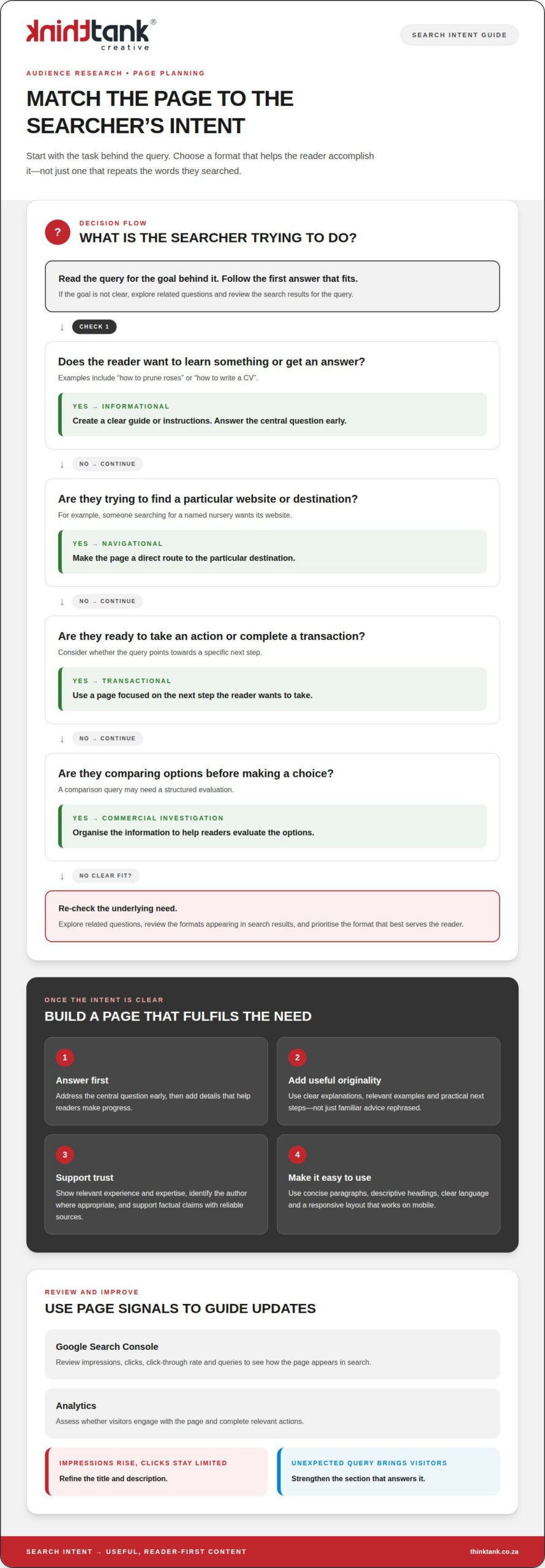
    Identify the audience behind each query and what they need next. Search intent generally falls into four types: informational, navigational, transactional and commercial investigation. Someone searching “how to prune roses” wants instructions, whilst someone searching for a named nursery wants its website. Use Google’s People Also Ask to discover related questions, then check that your page answers the same underlying need.

  2. Match content formats to search intent

    Choose a format that helps readers act on the answer. An informational query such as “how to write a CV” suits a clear guide; a comparison query may need a structured evaluation. A navigational search usually calls for a direct route to a particular destination, while transactional intent favours a page focused on the next step. Review the search results for the query and note which formats appear, but prioritise what serves the reader.

  3. Write useful, original content for readers

    Answer the central question early, then add details that help readers make progress. Useful, original content satisfies intent with clear explanations, relevant examples and practical next steps, rather than rephrasing familiar advice. Build trust by showing relevant experience and expertise, identifying the author where appropriate, and supporting factual claims with reliable sources. For example, a gardening guide can explain a pruning technique and distinguish it from methods for other plants.

  4. Make the page readable and accessible on mobile. Use a responsive layout, concise paragraphs and descriptive headings so readers can follow the content on a small screen. Compress images to support faster loading, write meaningful alt text for informative images, and make links and controls easy to identify and use. Clear language and logical headings also help people using assistive technologies navigate the page.
  5. Measure performance, then improve the page. In Google Search Console, review impressions, clicks, click-through rate and queries to see how the page appears in search. In Analytics, assess whether visitors engage with the page and complete relevant actions. If impressions rise but clicks remain limited, refine the title and description; if visitors arrive through an unexpected query, strengthen the section that answers it. A considered SEO content strategy can connect these improvements with broader search goals.

Title tags, meta descriptions and headings

Optimise titles, meta descriptions, headings, image details and internal links so each element clarifies the page’s purpose. Keep the wording accurate and useful: these elements help readers understand what they’ll find before opening the page.

  1. Write title tags and headings

    Write a distinct title tag that puts the page’s main subject near the beginning and gives readers a clear reason to click. Aim for 50 to 60 characters, such as “Pruning Roses: A Practical Guide for Gardeners”. Keep the promise accurate; a title that suggests a complete guide should lead to one.

    Organise the page with one H1 for its main title, followed by descriptive subheadings. Make each heading introduce the content beneath it, rather than repeating the same keyword. For example, use “When to prune roses” for a section explaining timing. This hierarchy makes the writing easier to scan and helps search engines interpret page structure.

  2. Create compelling meta descriptions

    Summarise the page’s subject and reader benefit in a concise meta description. A useful working range is 140 to 160 characters. Place the focus keyword near the beginning when it reads naturally, then use an active phrase to highlight what the reader will learn. For example: “Learn when to prune roses, which tools to use and how to care for new growth.”

    Give each page a description that reflects its actual content. Avoid generic copy, repeated keyword strings and promises the page doesn’t fulfil. Search engines may generate a different search snippet, so make the description a clear, accurate invitation rather than relying on it as guaranteed wording in search results.

  3. Name image files descriptively. Replace camera defaults such as “IMG_1000.jpg” with a short, accurate filename, such as “pruning-rose-branches.jpg”. Use words that describe the image, not a string of target keywords. Add alt text that explains informative images for readers using assistive technology. For decorative images, avoid alt text that adds irrelevant detail.

    Compress image files to reduce their size whilst preserving visual quality. Choose JPEG for photographs, PNG for graphics or WebP for modern, lighter image use. These choices keep images useful without adding unnecessary weight to a page.

  4. Make internal links descriptive. Link related pages using anchor text that tells readers what the destination covers. Replace “click here” with wording such as “rose pruning advice”. Add each link where it genuinely supports the explanation, and check that it leads to the relevant page. A few purposeful links are more useful than unrelated links added for appearance.
  5. Review the full search presentation. Read the title, description and headings together, then check that they accurately represent the page. The title should set a specific expectation, the description explain the benefit, and the headings lead readers through the answer. For a page about rose care, avoid a title promising a complete gardening guide if the content only discusses pruning.

    Finally, review the page on mobile and check that headings remain clear, snippets communicate the main benefit, and image filenames describe their contents. Consistency between the search result and page experience helps readers find the information they expected.

How to Create SEO-Friendly Content for Search and Readers

Internal and external linking

Use links to connect useful information, guide readers and clarify how pages relate. A considered linking structure can support organic visibility and make a website easier to explore.

  1. Use internal links

    Link each page to relevant content elsewhere on your website. For example, a blog post about choosing running shoes could link to a guide explaining shoe materials. Use descriptive anchor text such as “compare running shoe materials”, rather than “click here”. The link should help readers take a useful next step and give Google context about the linked page.

  2. Map links to the reader’s journey. Place contextual links where readers may need more detail, such as a definition or related process. A beginner’s guide to email marketing could link to an explanation of mailing-list consent. Organise pages into clear topic groups, then link between related sections. The European Union notes that logically organised content and links between related sections can support a website’s online presence.
  3. Prioritise useful destinations. Send readers to a page that extends the current point, not merely one that shares its target keyword. A page about writing product descriptions could link to a guide on product photography if the connection helps explain the task. Check that each destination loads and delivers what its anchor text promises.
  4. Include external links and backlinks

    Link externally when an authoritative source supports a factual claim or gives readers valuable context. For example, a page discussing Google Search features can cite relevant Google documentation. Choose sources closely connected to the claim, and make the anchor text describe the destination. Avoid linking to a source simply to make a page appear more researched.

  5. Understand backlinks as incoming links. A backlink points from another website to yours, unlike an internal link between your own pages. Original research, a practical resource or a useful explanation gives other publishers a reason to reference your work. Focus on earning relevant mentions through valuable content; avoid schemes that create artificial links without serving readers.
  6. Review links during content updates. Open each link in a draft or updated page and confirm that it reaches the intended destination. Replace broken links, revise vague anchor text and remove links that no longer support the surrounding paragraph. If a linked guide has moved, update the destination rather than leaving readers at an error page.
  7. Keep the structure purposeful. Each page should offer a clear route to related information, without becoming crowded with links. Check whether links help readers understand a subject, continue a task or assess a source. A well-optimised linking structure connects valuable pages and makes their relationship clearer to people and search engines.

Creating original content and adding information gain

A key part of how to create SEO-friendly content is giving readers more than a polished version of information they can find elsewhere. Original content adds a useful perspective, evidence or practical detail that helps someone understand a topic or take their next step.

  1. Identify what existing answers leave out. Review the questions a topic raises, then note which answers feel incomplete, difficult to apply or too general. For a guide to planning a garden, existing pages might explain plant choices but overlook how to organise them in a small courtyard. That gap gives your content a clearer purpose and a distinct contribution.
  2. Bring first-hand knowledge into the explanation. Add relevant experience, observations or examples to show how advice works in practice. A business explaining its onboarding process could describe the decisions customers commonly face and how each step helps. Use details you can stand behind, rather than inventing a personal story or presenting assumptions as evidence.
  3. Support claims with a clear basis. Use reliable sources for factual statements, and distinguish sourced information from your interpretation. If a page discusses a product’s performance, explain the circumstances behind the example and avoid turning one result into a universal promise. Clear attribution strengthens readers’ ability to assess the information and supports the authority of the page.
  4. Make the information easier to use. Turn a dense explanation into a practical resource, such as a decision framework, worked example or concise checklist. For instance, a guide to choosing a catering format could compare seated service with a buffet, then explain which event suits each option. The structure should help readers apply the answers, not merely decorate the page.
  5. Add an original visual where it clarifies the subject. A diagram can explain a process more clearly than several paragraphs, whilst a comparison table can make relevant differences easier to assess. Create visuals that add information, label them clearly and explain their meaning in nearby text. Useful images, diagrams and infographics may also be picked up by other websites, which could link back to the original content.
  6. Connect new insights to related topics. Organise the article so each section develops the main answer, then use internal links to direct readers to genuinely relevant detail. A guide to preparing for a website launch could link to a separate explanation of content planning. Each connection should extend the reader’s understanding, rather than divert them to an unrelated topic.
  7. Review the page for distinct value. Before publishing, identify the specific insight, example or resource readers gain from this page. Google’s helpful content update was introduced in 2022 and prioritised original, helpful content written for people. Applying these principles is central to how to create seo-friendly content that offers readers a distinctive visual experience. For distinctive visual storytelling, explore creative design support as part of presenting your ideas clearly.

ThinkTank Creative

ThinkTank Creative helps businesses bring their digital presence into alignment, from website structure to the visual identity that supports its message. When you’re applying these content principles across a new or existing site, its Website Design & Development and Branding & Creative Design services can help create a cohesive reader experience. These services are a natural next step when your content, site structure and brand presentation need to work together rather than feel like separate parts.

Build content that reflects your expertise and gives readers a clear path through your website. Contact ThinkTank Creative to discuss your digital content goals.

Build momentum with your next content decision

Treat each new page as an opportunity to deepen your relationship with readers. A distinctive point of view can strengthen your brand’s voice, whilst careful attention to changing questions keeps your content useful over time. The aim isn’t simply to publish more; it’s to make each contribution worth returning to.

Learning how to create SEO-friendly content is an ongoing practice. Review how your audience responds, listen for emerging needs and let those signals shape what you create next. Consistent, thoughtful choices can help your content strategy develop alongside your business.

If you’re ready to connect your content with a broader digital presence, ThinkTank Creative can help bring that work into focus through its social media marketing offering. Contact ThinkTank Creative to discuss your next step, and keep moving towards a more cohesive online presence.

Frequently Asked Questions

What is SEO writing?

SEO writing creates clear, helpful content that addresses readers’ needs and is structured for search engines to understand. It brings together accurate information, natural language and a defined purpose. For example, a home-maintenance business could publish a guide explaining how to prepare a roof for heavy rain, with advice suited to homeowners. The goal is to make the page useful in its own right, not to write solely for algorithms.

What is SEO content?

SEO content is a web page, article or other digital material created to answer relevant searches and reach an intended audience. It might be a service page explaining what a business does, a blog post answering a common question, or a guide that helps readers make a decision. Its format depends on the reader’s task, while its substance should provide accurate, worthwhile information rather than simply repeat a search term.

How do you research keywords and search intent?

Begin with the audience’s problem, then use a keyword research tool to explore the phrases people use and the questions behind them. Compare the wording and purpose of related searches. For example, “how to fix a leaking tap” suggests someone wants instructions, whilst “plumber near me” signals a service search. Group phrases with the same underlying need, then plan a page that answers that need directly.

How should you structure SEO-friendly content with headings and URLs?

Give each page one clear subject, a descriptive main heading and subheadings that guide readers through its sections. Use a concise URL that reflects the page topic, such as “/roof-maintenance/” for a roof-care guide. Avoid changing an established URL without considering its existing links and visitors. If a change is needed, plan a redirect to the new address so people and search engines can still reach the relevant content.

How often should you update SEO content?

Update a page when its information, examples or purpose no longer match what readers need. A seasonal travel guide, for instance, may need review before the next planning period, whilst an evergreen explanation may remain useful longer. Check for outdated claims, changed processes, broken links and new audience questions. Make revisions that improve accuracy or usefulness, and avoid changing dates or wording just to make an unchanged page appear fresh.

What SEO content practices risk Google penalties?

Practices designed to manipulate search visibility rather than help readers can put a page at risk. Avoid keyword stuffing, copied material, misleading claims and artificial link schemes. Repeating a phrase unnaturally across every paragraph, for example, makes a page harder to read and adds little value. Focus on original, accurate answers and links with a clear purpose. Review Google’s current Search guidance before adopting tactics intended to influence rankings.

SEO Agency Services, Costs, Content and Reporting Explained

An SEO agency should turn search opportunities into a clear programme of research, website improvements, relevant content and performance reporting. Knowing what to expect from an SEO agency means understanding how these activities work together to attract organic traffic and support business goals. Progress should be measured through indicators such as rankings, visits and conversions, not rankings alone.

It’s reasonable to want clarity about the work involved, what you’ll receive and how you’ll know whether a campaign is moving in the right direction. SEO takes time, and priorities depend on your website, audience, competition and objectives. A considered approach links each task to a purpose and makes progress easier to interpret.

This guide explains the services an agency may provide, from technical audits and on-page optimisation to keyword research and content development. It also covers reporting, realistic performance expectations, and how SEO costs and payment models are structured in South Africa, so you can understand the commitment before deciding what approach fits your business.

Key Takeaways

  • Assess campaign progress through rankings, organic traffic and conversions, so reporting reflects business outcomes as well as visibility.
  • Look for a clear strategy, consistent communication and transparent reporting that connects agency activity to agreed goals.
  • Expect content work to begin with relevant keyword research and focus on answering the questions your audience actually has.
  • Technical audits can reveal barriers such as crawl errors, slow pages and mobile usability issues that may limit search performance.
  • Understand the scope, payment model and contract terms before committing, and align the campaign’s goals with a realistic timeframe.

Campaign reporting and performance metrics

Useful SEO reporting connects search visibility with the actions that matter to your business. It should show what changed, what the campaign did and how those findings shape the next priorities.

An agency’s reports should cover website traffic, search rankings, conversions and completed campaign activities. These measures should relate to agreed goals, so you can see whether greater visibility attracts the right audience and supports business outcomes.

Reporting, KPIs and strategy refinement

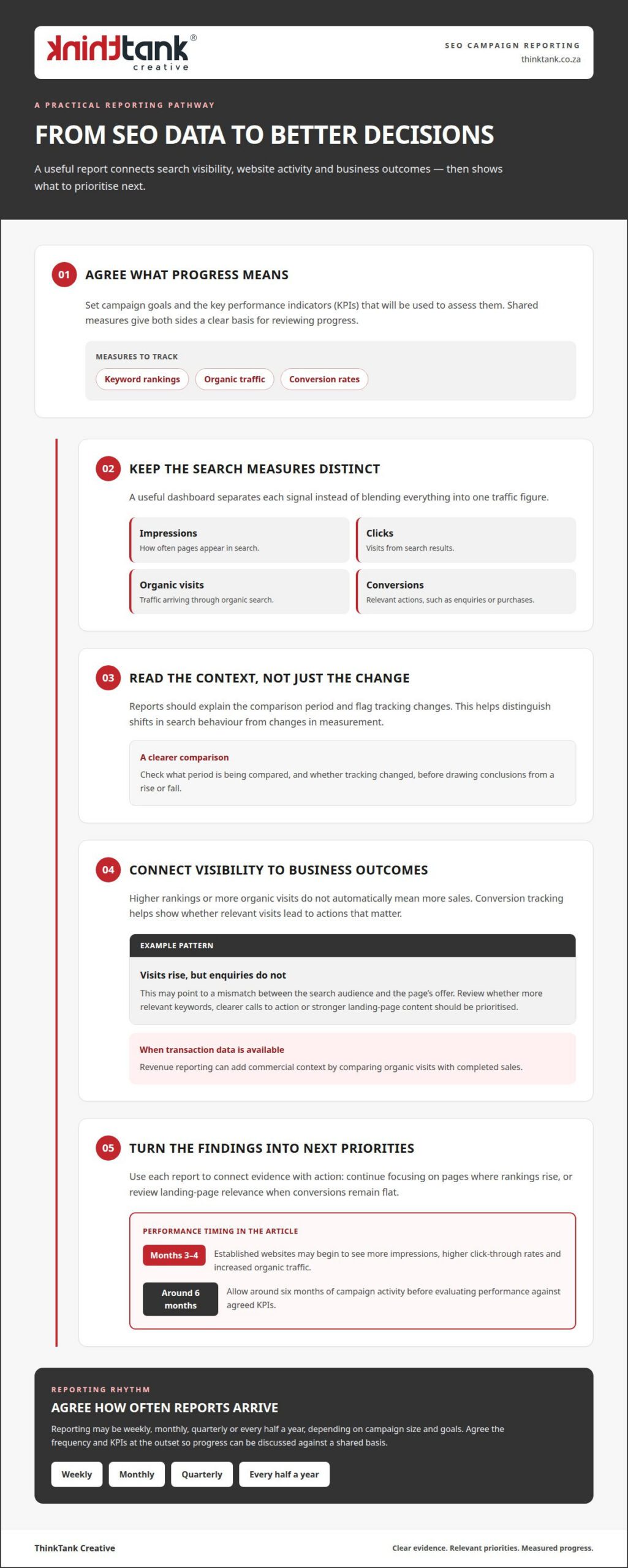
Key performance indicators (KPIs) are measurable signals used to assess progress against campaign goals. An agency can track keyword rankings, organic traffic and conversion rates, then use the findings to refine its strategy. For example, rising visits without enquiries may point to a mismatch between the search audience and a page’s offer. Reviewing that pattern can help prioritise more relevant keywords, clearer calls to action or stronger landing-page content.

SEO tools and reporting dashboards

SEO tools gather search and website data, while a dashboard presents selected measures in one view. A useful report separates impressions, clicks, organic visits and conversions rather than blending them into one traffic figure. It should explain the comparison period and flag any tracking changes, helping you distinguish shifts in search behaviour from changes in measurement.

Performance and revenue reporting

Performance reporting should show whether SEO activity contributes to meaningful business results, not just higher rankings. Organic traffic does not automatically translate into sales, so conversion tracking should connect relevant visits with actions such as enquiries or purchases. Revenue reporting can add commercial context when transaction data is available. Comparing organic visits with completed sales, for instance, can help distinguish useful audience growth from traffic that does not support revenue.

Agency deliverables and reports

Deliverables should make the work and its outcomes visible, including activity summaries, performance measures and recommended next steps. Reports may arrive weekly, monthly, quarterly or every half a year, depending on campaign size and goals. Established websites may begin to see more impressions, higher click-through rates and increased organic traffic during months three and four. Allow around six months of campaign activity before evaluating performance against agreed KPIs.

Use each report to connect evidence with action. A month-on-month rise in rankings may warrant continued focus on those pages, while flat conversions could prompt a closer review of landing-page relevance. Agreeing on reporting frequency and KPIs at the outset gives both sides a shared basis for discussing progress, refining priorities and assessing the value of the SEO investment.

What does an SEO agency/expert do?

An SEO agency aims to grow a website’s organic traffic by improving how it appears in search engines such as Google. Understanding what to expect from an SEO agency includes knowing how to assess its results: review case studies and references from previous clients, prioritising examples from the last three years and outcomes relevant to your business.

Agency experience and approach

An agency’s experience shows in how it diagnoses challenges, sets priorities and explains its approach. A strategy should respond to your website, audience and competition, rather than rely on a generic package. Ask how the proposed work connects with your business goals, and look for examples that explain the starting point, actions taken and measurable outcomes.

References add context to published success stories. A case study might report stronger rankings, while a client reference can explain the working relationship and how the agency handled changing priorities. Consider whether examples involve similar customers or search challenges. An honest explanation of the differences is more useful than a promise to reproduce another business’s results.

Team roles and specialist expertise

SEO work can bring together strategic, technical and content expertise, with each area addressing a different barrier to organic growth. A technically sound website still needs relevant content, while useful pages can struggle if search engines cannot crawl them. Clarify who will lead strategy, implement technical recommendations and shape content, so responsibilities are understood from the outset.

Specialist input is particularly valuable when an issue crosses disciplines. Resolving a website structure problem, for example, may require technical analysis and an understanding of how visitors find information. A coordinated team can connect these perspectives instead of treating each task in isolation. The agency should explain how its specialists contribute to your priorities and who communicates decisions to your team.

Communication and transparency

Transparent communication means explaining planned work, progress, decisions and constraints in language your team can use. You need to understand how activity supports your goals, not just receive a list of completed tasks. Agree who your main contact is, how updates are shared and how strategy changes are discussed. Clear responsibilities make collaboration more productive.

Look for specific explanations rather than vague claims. An agency should describe its methods, explain why a recommendation matters and outline the trade-offs involved. Be wary of promises of overnight results or tactics such as hidden content designed to manipulate search rankings. Ethical practices support a considered strategy, while unrealistic claims make it harder to judge the work objectively.

An SEO agency may research relevant search terms, improve website pages and address technical barriers that limit visibility. It may also analyse competition and identify opportunities to attract qualified traffic. The precise mix depends on the website’s needs and business objectives. Knowing what to expect from an SEO agency means looking for clear reasoning behind its priorities and how the work can contribute to organic growth and revenue.

If your search strategy needs to connect more closely with your wider digital presence, explore how SEO strategy can support that alignment.

Content deliverables and AI-generated content

SEO content work should make useful pages easier to find and more helpful to visitors. Deliverables can include keyword research, new or refreshed copy, on-page updates and an editorial calendar tied to search intent.

Content creation and optimisation

Content creation and optimisation means developing or improving pages around relevant searches and visitor needs. It matters because a page must answer the query clearly, not simply repeat keywords. An agency may research a topic, shape a useful outline, edit the copy and refine its headings. For example, a service page can answer common customer questions before explaining the next step.

Content work can also involve updating existing pages rather than producing new ones. An agency might spend 10 hours in a month editing and optimising content, focusing on outdated details, unclear sections or missed search intent. The deliverable should show which pages changed and why, so each revision has a defined purpose.

Editorial calendars and content marketing

An editorial calendar schedules content topics, formats and publication priorities around audience needs. Planned publishing helps connect individual pages into a coherent content marketing effort. A calendar might map a guide to a broad question, then supporting articles to more specific searches, with each page serving a distinct role.

Weekly, keyword-optimised thought leadership content is one possible deliverable, but frequency alone doesn’t establish value. A useful plan identifies the intended reader, search purpose and action for each piece. For instance, an explanatory article can introduce a topic, while a related service page provides more detail for readers ready to act.

On-page SEO and content strategy

On-page SEO improves elements within a page, including its content, meta tags, headers and images. Clear structure helps visitors navigate information and gives search engines meaningful context. An agency can align a page title, headings and copy around the same topic, then check that images have descriptive alternative text.

A content strategy connects keyword research with the pages a business needs to serve its audience. It can identify gaps, overlapping pages and opportunities to strengthen the user experience. If several pages compete for the same search, for example, an agency may recommend consolidating their focus or clarifying each page’s purpose.

AI-generated content can help with drafting, but finished pages still need editorial judgement. An agency should review every claim, remove repetition and make the language accurate, useful and specific to the intended audience. A generic AI draft about a service needs meaningful details and a clear explanation of how that service addresses readers’ needs.

Expect content deliverables to connect research, writing and optimisation rather than arrive as disconnected copy. A clear brief identifies the target topic, intended reader, page format and review process. This gives each asset a role in the wider digital strategy, whether it answers a question, strengthens a service page or supports an enquiry.

SEO Agency Services, Costs, Content and Reporting Explained

SEO audits and technical website improvements

A technical SEO audit examines whether a website is accessible, understandable and usable for visitors and search engines. Its findings help prioritise fixes that support stronger crawling, clearer page structure and a better user experience.

What a technical SEO audit examines

An audit reviews site structure, content quality, loading speed, mobile optimisation, and inbound and outbound links. These areas are connected: a valuable page may struggle to appear in search results if crawling problems prevent search engines from finding it. The audit should identify issues, explain their impact and organise recommendations by priority.

During months one and two, SEO agencies commonly conduct technical audits, research keywords, optimise pages, set up tracking and resolve crawl errors. A five-hours-each-month technical auditing example shows how audit work may form part of a broader campaign. The time needed depends on the site’s condition and the complexity of the issues found.

Technical, on-page and off-page SEO

Technical SEO addresses how a website functions, including speed, mobile-friendliness, Core Web Vitals and crawl errors. On-page SEO improves elements within the website, such as content, tags and structure. Off-page SEO focuses on activity outside the website, including link building and social media. Together, these areas support a site’s visibility and relevance in organic search.

If an important service page loads slowly and has unclear headings, for example, it may need both technical fixes and on-page changes. An audit helps distinguish the underlying issue from its visible symptoms. This keeps improvements coordinated instead of treating every warning from an SEO tool as equally urgent.

Prioritising and implementing technical improvements

A useful audit turns findings into an implementation plan. It can group issues by affected pages, explain dependencies and identify changes requiring developer input. Resolving a crawl error may come before refining a page that search engines cannot reliably access. Recommendations should describe the issue, the proposed fix and how completion will be assessed.

Technical and on-page improvements can produce minor traffic increases within 3 to 6 months. That timeframe makes tracking important: agencies can monitor whether fixes have been implemented and whether relevant pages become more visible. Results depend on the website and its competition, so an audit should guide priorities rather than promise a specific ranking.

Structured data is another technical consideration. Schema markup can describe step-by-step guides, company information and FAQs, helping AI tools access that content. For an e-commerce website, structured data can support the display of product prices and customer ratings in search results. These additions work best when they accurately reflect information visitors can find on the page.

Sound technical SEO does not rely on hidden content to manipulate search engines. A sound audit focuses on accessible pages, accurate information and usable navigation, giving each recommendation a clear purpose.

SEO campaign costs and payment models

SEO investment should reflect the work required, campaign goals and website needs. When comparing proposals in South Africa, focus on the scope, responsibilities and outcomes the campaign is designed to support.

The price depends on the case and is given after a quote request; cost factors include website condition, competition, target keywords, content requirements and campaign scope. A plan for a new website or a competitive market may require different priorities from one focused on improving existing pages. The proposal should make clear which activities the fee covers and how those activities relate to agreed goals.

Monthly ongoing arrangements are common, and some agencies use fixed-fee packages. A set monthly package needs a clear scope: a fixed list of tasks may not reflect changes in a business, website or market. The value lies in work selected for the campaign’s actual needs, not in the number of items promised. Contract terms should explain duration, included activity, reporting and how either party can end the agreement.

Set business outcomes before assessing performance. A campaign might aim to increase qualified enquiries, improve visibility for a priority keyword or attract customers in a target location. Local SEO can include optimising a Google Business Profile, building local citations and targeting location-based keywords. Keep the business name, address and phone number consistent across the profile, website and directories to reinforce accurate local information.

SEO strategy develops in stages. The first 0-3 months may bring initial improvements; during months 4-9, businesses may begin seeing more impressions, clicks and sales, depending on their goals. From month 10 onward, rankings for highly competitive keywords may start to emerge. These periods are useful planning markers, not a substitute for evaluating progress against the campaign’s KPIs.

A campaign timeframe of at least 6 months, preferably 12 months, allows sustained work and assessment. SEO effects commonly begin to appear after three to six months, while significant improvements in highly competitive rankings and major organic lead generation typically require 9 to 18 months of consistent effort. A new website may need up to a year to build authority.

Hands-free execution means the agency manages agreed research, optimisation and campaign activity, while your team sets priorities and provides business context. The contract should state what approvals, access or specialist input the work requires. Read the terms carefully, clarify responsibilities and agree on goals and KPIs before work begins. That gives both sides a shared basis for assessing the investment.

Plan an SEO campaign around your business objectives and the work your website needs. Discuss an SEO campaign that aligns priorities, scope and performance goals.

ThinkTank Creative

ThinkTank Creative can help when your search strategy needs a stronger digital foundation or a more consistent brand presentation. If your website makes it difficult for visitors to act on the information they find, Website Design and Development can create a clearer, more purposeful experience.

Creative design and Logo and Corporate Identity Design can help keep visual communication cohesive across your brand. Social Media Marketing can extend how you connect with your audience beyond search results. These services are relevant when your website, brand identity and social presence need to work together as part of a wider growth plan.

If you’re ready to discuss how these priorities fit your business, contact ThinkTank Creative.

Make your next SEO decision with clarity

Knowing what to expect from an SEO agency gives you a stronger basis for shaping a campaign around your business priorities. The next step is to connect search visibility with the wider experience customers have of your brand, from finding your website to understanding what you offer.

ThinkTank Creative brings these elements together through Search Engine Optimization (SEO), Website Design and Development, Social Media Marketing and creative design. This approach is relevant when your growth plans involve attracting the right audience and presenting a consistent, compelling brand across digital channels. The focus is on aligning your online presence with the outcomes you want to pursue.

Bring your objectives and current challenges into the conversation, then explore an approach that fits your business. Contact ThinkTank Creative about SEO to discuss your next steps and build a considered foundation for growth.

Frequently Asked Questions

Why do businesses need SEO?

SEO helps businesses reach people looking for relevant products, services or information through unpaid search results. This can support discovery without paying for every click, although the work itself requires time and investment. For example, a business selling locally can improve its chances of appearing for searches that include its service and location. SEO is most useful when its priorities connect with business goals, such as qualified enquiries or online sales.

Do I have to have an ongoing contract?

No, contract terms vary, but ongoing arrangements are common because SEO requires continued work and evaluation. Contracts often last six months to one year, while some agencies offer a three-month trial period. Before agreeing, review the scope, payment schedule, cancellation terms and responsibilities. A shorter agreement may suit an initial assessment, while a longer campaign provides more time to implement work and assess progress against agreed goals.

Does the SEO firm optimise your Google Business Profile?

An SEO firm can optimise a Google Business Profile as part of local search work, improving business information and its relevance to local queries. Keep ownership and control of the profile, then grant the agency manager access for routine tasks. Check that your business name, address and phone number match across the profile, website and directories. Consistent details make it easier for customers to recognise your business.

Does the SEO service provider have a good reputation?

Assess reputation through recent case studies, client references and the quality of the agency’s communication. Look for examples from the last three years, and note whether they explain the challenge, work completed and outcome. A reference can add context about collaboration and follow-through. Also consider whether the agency explains its recommendations clearly, responds directly to concerns and distinguishes measurable results from broad claims.

Does the agency use ethical practices?

Ethical SEO focuses on useful content and legitimate improvements, rather than attempts to manipulate search rankings. Be cautious of proposals involving hidden content, paid backlinks or private blog networks. Ask for a plain-language explanation of how proposed tactics help visitors and search engines. A sound recommendation should improve page usefulness or accessibility, not conceal text from readers while presenting it to a search engine.

How do I know if it is working?

Look for evidence that SEO is attracting relevant visitors and helping them take meaningful actions. Track organic visits alongside enquiries, sales or other conversions that matter to your business. If traffic rises but enquiries remain flat, review whether landing pages match search intent and make the next step clear. Compare performance with the campaign’s agreed goals, rather than judging progress from one ranking alone.

How does the agency improve your online store’s search performance?

An agency can improve an online store by strengthening product and category pages, resolving technical barriers and using accurate structured data. Product structured data can help search results display details such as prices and customer ratings. An agency may refine a category page’s headings and descriptions, then ensure product information is represented clearly. These changes help search engines interpret the store and shoppers find relevant items.

How does the agency optimise for local search results?

Local SEO can include refining a Google Business Profile, building local citations and targeting location-based keywords. A citation is a mention of your business details in an online directory. A service business may create useful pages for the locations it serves and keep its name, address and phone number consistent across listings. These steps help search engines connect the business with relevant local searches.

Keyword Research for South Africa: 2026 Strategic Guide

In 2026, South African e-commerce is projected to hit R159-billion, marking the first time online sales account for a full 10% of our national retail turnover. If your digital presence isn't reflecting this massive shift, it's often because global SEO strategies fail to translate to our unique local context. Learning how to do keyword research for a south african audience requires more than just a tool subscription; it demands a deep understanding of our 11 official languages and the specific colloquialisms that define how we search.

You've likely experienced the frustration of seeing decent traffic numbers that simply don't turn into sales, or perhaps you're struggling to find accurate ZAR-based data in a sea of US-centric metrics. We're here to bridge that gap and help you identify the high-value keywords that truly resonate with local consumers. This strategic guide provides a repeatable framework for local keyword research. We'll show you how to achieve better visibility in both Google and AI-driven search results whilst driving meaningful growth from local leads.

Key Takeaways

  • Gain a competitive edge by mastering how to do keyword research for a south african audience, moving beyond generic global metrics to capture authentic local intent.
  • Explore the impact of linguistic diversity and colloquialisms, ensuring your digital presence speaks the specific language of your target market across all 11 official languages.
  • Future-proof your brand's visibility by aligning your strategy with the rise of AI-driven search and Answer Engine Optimisation (AEO) trends.
  • Recognise the critical importance of conducting research before the website design and development phase to ensure your site architecture supports long-term organic growth.
  • Adopt a structured, 5-stage methodology that transforms raw data into a bespoke digital strategy tailored to the unique South African search landscape.

Understanding the South African Search Landscape in 2026

Mastering how to do keyword research for a south african audience involves a deliberate shift from technical data mining to cultural mapping. South African keyword research is the systematic process of identifying the precise linguistic nuances and search intents used by our diverse population to ensure digital content resonates across multiple cultural contexts. Whilst global platforms provide a foundation, they often overlook the bespoke requirements of the ZAR market, where local intent and cultural relevance dictate visibility.

To truly grasp the complexities of South Africa's internet landscape, one must look past the high-level statistics. Standard international "best practices" typically prioritise high-volume English terms, yet this approach misses the synergy between our 11 official languages. By focusing on precision rather than just volume, businesses can move from being mere vendors to becoming trusted local partners who understand the heartbeat of the local consumer.

To better understand how these search dynamics are evolving and how to apply them to your strategy, watch this helpful tutorial:

The Mobile-First Reality of ZA Search

Mobile devices account for over 80% of searches in the country, creating an environment where speed and brevity are paramount. High data costs influence user behaviour, often leading to specific patterns that digital strategies must accommodate:

Designing your keyword strategy around these mobile-centric habits ensures your brand remains accessible to the 51.7 million active internet users nationwide. It's about creating a seamless path from the initial search to the final conversion.

Search Behaviour During Load Shedding

Power outages have fundamentally altered how we interact with the digital world. When the lights go out, search patterns shift instantly to mobile-first, offline-ready, or location-based behaviours. "Near me" searches for businesses with backup power or reliable Wi-Fi surge during these windows, making local SEO visibility a critical survival trait for retail and service providers. Understanding how to do keyword research for a south african audience means acknowledging that connectivity isn't a constant; it's a variable that requires a strategic, time-sensitive approach to content delivery. Whilst every business journey is unique, an estimated cost for a tailored search strategy is typically provided after a detailed discussion of your specific goals.

Linguistic Diversity: Beyond English Keywords

South Africa's search environment is a vibrant tapestry of 11 official languages. Mastering how to do keyword research for a south african audience requires looking beyond the dominant English queries that many global tools prioritise. Whilst English serves as a commercial bridge, a significant portion of the digital economy in South Africa is driven by users searching in their primary tongue or employing unique local dialects. Developing a framework for how to do keyword research for a south african audience involves a deep dive into these cultural intersections.

Direct translation is a common pitfall that limits reach. A keyword like "traffic light" might have high search volume globally, but a local user is just as likely to search for "robot repair" or "robot malfunctions." Similarly, a "pickup truck" is almost universally a "bakkie" here. Failing to account for these "South Africanisms" means leaving high-intent traffic on the table for your competitors. Code-switching is another reality, as users often blend languages within a single query, searching for "best braai tips" or "isizulu lessons online." This linguistic fusion creates a specific type of search intent that requires a nuanced, human-led approach to strategy.

Targeting Colloquialisms and Local Slang

Informal search terms often carry immense commercial weight with surprisingly low competition. For instance, using local slang in your Search Engine Optimisation strategy can help you connect with the "man on the street" who finds overly formal corporate language exclusionary. We identify these terms through social listening and community engagement, ensuring your brand speaks with an authentic local voice. It's this level of bespoke craftsmanship that distinguishes a generic campaign from a truly resonant one. We do it all so you don't have to.

Multilingual Keyword Mapping

Organising your keyword clusters across different language groups is a hallmark of a sophisticated digital strategy. Languages like Afrikaans and isiZulu frequently present lower difficulty scores, allowing for faster rankings for high-value terms that competitors often ignore. This isn't about simple duplication; it's about strategic alignment that respects the nuances of each audience. Maintaining brand consistency whilst adapting to these linguistic shifts ensures your business remains both elite in its execution and warm in its professional relationships. Our team provides an estimated cost for these bespoke services after a thorough discovery discussion, ensuring our partnership is built on transparency and mutual success.

The Transition to AI Visibility and AEO in South Africa

Search is undergoing a fundamental metamorphosis. Whilst traditional SEO focuses on driving traffic to a specific URL, Answer Engine Optimisation (AEO) aims to position your brand as the definitive response provided by generative AI agents. Understanding how to do keyword research for a south african audience in this new era requires a shift from tracking "blue links" to becoming an authoritative data point within the knowledge graphs of ChatGPT, Gemini, and Claude.

Traditional ranking ensures your site appears in a list, whereas being cited by an AI agent establishes your brand as the expert authority for a specific query. These AI models interpret South African business data by looking for "entities", which are verified facts about your services, location, and reputation. To succeed, you must provide clear, structured data that helps these engines navigate South Africa's linguistic diversity and cultural context without ambiguity.

Global Tools vs Local Reality

Relying solely on global platforms like Ahrefs or Semrush can lead to a significant "ZAR Data Gap." These tools often under-report search volumes for local terms because their data sets are primarily skewed toward Western markets. To master how to do keyword research for a south african audience, we supplement these metrics with manual research using Google Trends (ZA) and AnswerThePublic. This hybrid approach ensures we capture the high-intent queries that global algorithms might overlook, providing a more precise strategic roadmap for your brand's growth.

Optimising for AI Overviews

Google's AI-generated summaries now occupy the most valuable real estate on the search results page. To appear in these overviews, your content must adopt a natural language structure that mirrors how people actually speak and ask questions. We move away from rigid keyword placement toward answering complex, multi-layered queries with clarity and depth. By positioning your brand as a primary cited source for industry-specific queries, you build a level of trust that transcends traditional advertising. It's about creating a synergy between technical excellence and human-centric content that speaks directly to the needs of the local consumer. Whilst every project is unique, we provide an estimated cost for our bespoke strategy services after an initial consultation to ensure alignment with your specific vision.

Keyword Research for South Africa: 2026 Strategic Guide

A 5-Stage Framework for South African Keyword Research

Success in the local digital market is built on a foundation of rigorous methodology. At ThinkTank Creative, we've refined a professional framework that mirrors our proprietary 5-stage process, ensuring every decision is backed by strategic depth rather than guesswork. Mastering how to do keyword research for a south african audience requires moving beyond simple lists to a structured approach that respects our unique market dynamics.

Identifying High-Intent Local Keywords

Distinguishing between informational and transactional intent is vital for driving conversions. Whilst a user searching for "what is a retirement annuity" is seeking knowledge, someone searching for "best RA rates South Africa" is ready to commit. "How to" queries are particularly essential for building trust amongst ZA consumers, as they position your brand as a helpful expert before the sale occurs. We also mine local forums and social media to discover "hidden" keywords that global tools often miss, capturing the authentic voice of your customers. This level of precision is fundamental when learning how to do keyword research for a south african audience effectively.

Analysing the Competitive Landscape

Larger national competitors often leave significant gaps by focusing only on broad, high-volume terms. By evaluating SERP features such as Maps, Snippets, and "People Also Ask" boxes, we identify opportunities to capture visibility where others are absent. Search sentiment also plays a critical role in South Africa; understanding the emotional context of a query allows us to tailor your messaging for maximum impact. If you're ready to elevate your brand, we invite you to partner with our SEO specialists to develop a bespoke keyword roadmap. An estimated cost for this strategic work is provided after our initial discussion. We do it all so you don't have to.

Integrating Keyword Strategy into Website Development

Strategic digital foundations require that keyword research precedes the first line of code or the initial design mock-up. When businesses treat search strategy as a post-launch add-on, they often find themselves retrofitting content into an incompatible architecture that fails to engage. Understanding how to do keyword research for a south african audience ensures that your site's structure mirrors the actual search behaviour of your customers from the outset. This methodology allows us to develop keyword clusters that inform the entire site architecture, ensuring that user experience (UX) and interface design (UI) are aligned with commercial intent.

At ThinkTank Creative, our approach ensures every page is built to be found and recommended by both human users and search algorithms. By mapping high-value terms to specific landing pages before the development phase, we create a logical flow that guides visitors through the conversion funnel. This synergy between creative branding and SEO-driven content is what transforms a standard website into a powerful business tool. Every element of the site, from the navigation menu to the internal linking structure, is crafted with precision to support your long-term visibility goals.

Building for Usability and Visualisation

Great marketing makes the customer look smart, whilst smart marketing merely focuses on the company's own achievements. During the visualisation stage of our design process, we use keyword insights to determine which elements deserve prominence on the page. This data-driven perspective ensures that the most sought-after information is easily accessible. Because mobile search is dominant in the local market, our Website Design and Development process prioritises responsiveness. We ensure that your site captures high-volume mobile search terms whilst maintaining a sophisticated aesthetic that reinforces your brand's elite status.

Ongoing Service and SEO Maintenance

Digital excellence is a continuous evolution rather than a static destination. Keyword research is not a "once-off" task; it requires ongoing refinement to adapt to shifting market trends and competitor movements. Through our Website Maintenance and Support services, we provide the meticulous reporting and post-launch analysis necessary to track your keyword rankings and adjust your strategy in real-time. Complementing this with understanding your website analytics report ensures you can translate those ranking movements into actionable commercial decisions. We invite you to embark on a journey of imagination with a partner deeply invested in your growth. Whilst every project is bespoke, an estimated cost for our strategic services is provided after a detailed discussion of your vision. We do it all so you don't have to.

Elevating Your Digital Presence in 2026

The South African search landscape is a complex, vibrant environment where success is reserved for those who look beyond generic data. By prioritising linguistic nuance and the rise of AI-driven visibility, you position your brand to resonate deeply with local consumers. Mastering how to do keyword research for a south african audience isn't just about technical precision; it's about building a digital foundation that respects our cultural diversity whilst leveraging the latest in Answer Engine Optimisation.

ThinkTank Creative has been a partner in this evolution since 2001. Our award-winning in-house design team utilises a comprehensive 5-stage strategic process to ensure your website is both a creative masterpiece and a high-performing lead generator. We provide an estimated cost for our bespoke services after a thorough discussion of your unique goals, ensuring a partnership built on transparency and mutual growth.

Let's embark on a journey of imagination together; contact ThinkTank Creative today to transform your brand's digital trajectory. We do it all so you don't have to.

Frequently Asked Questions

How is keyword research different for South Africa compared to the UK or USA?

Cultural nuance and linguistic diversity are the primary differentiators. Whilst UK/USA markets are relatively homogeneous in language, South Africa requires a strategy that accounts for 11 official languages and unique colloquialisms. Mobile search dominance and connectivity issues like load shedding also influence local search behaviour. Understanding how to do keyword research for a south african audience means it's essential to prioritise these local realities over generic global trends.

Which tools are best for finding South African search volume?

Premium global platforms like Ahrefs and Semrush provide a solid baseline, yet they often under-report specific ZAR data. Mastering how to do keyword research for a south african audience requires supplementing these metrics with Google Trends (ZA) for local insights. Manual research into forums is also essential to capture authentic South Africanisms that automated tools might miss. This hybrid approach ensures your strategy's grounded in accurate, real-world data.

Should I target keywords in local languages like Afrikaans or isiZulu?

Yes, targeting languages like Afrikaans or isiZulu is a highly effective way to reach underserved market segments. These languages often have lower competition levels compared to English, so they're great for faster rankings and higher engagement. We use a multilingual mapping strategy to ensure your brand remains consistent whilst respecting the specific linguistic nuances of each audience. This bespoke approach fosters a deeper connection with the local consumer.

How does the POPI Act affect my keyword and data strategy?

The POPI Act primarily regulates how you collect and process personal information rather than the keywords themselves. However, it influences your broader data strategy by requiring transparency in how you track user behaviour through cookies and lead generation forms. Your keyword strategy should focus on intent-driven, permission-based marketing. This ensures compliance whilst building trust, as consumers are increasingly wary of intrusive digital practices that don't respect their privacy.

How many keywords should I target per page on my website?

We typically recommend targeting one primary keyword and three to five secondary or long-tail keywords per page. This creates a focused content cluster that signals clear intent to search engines without diluting the user experience. Overloading a page with too many terms can lead to keyword stuffing, which negatively impacts your rankings. Instead, we prioritise thematic depth and natural language that's designed to answer the specific questions your audience is asking.

What is the "estimated cost" for a professional keyword research and SEO strategy?

At ThinkTank Creative, we understand that every business has unique requirements and growth objectives. Since our work isn't templated, an estimated cost is provided after a detailed discussion of your specific needs and project timeline. This collaborative approach ensures that the investment aligns with the value delivered. We focus on providing a comprehensive solution that supports your brand's long-term transformation and commercial success.

How long does it take to see results from new keyword targeting in ZA?

SEO is a long-term investment, and you can generally expect to see meaningful movement in rankings within three to six months. Factors such as domain authority, the competitiveness of your industry, and the technical health of your website influence this timeline. Whilst some quick wins are possible through targeting low-competition colloquialisms, it's sustainable growth that requires a consistent, strategic effort. We provide regular reporting to track progress and refine your strategy.

Can I do keyword research myself or should I hire an agency?

Whilst basic research is possible in-house, a professional agency offers the strategic depth and technical tools required for high-level competition. Since 2001, our award-winning design team has refined a 5-stage process that bridges the gap between raw data and creative execution. Hiring specialists allows you to focus on your core business whilst we handle the complexities of algorithm updates and multilingual targeting. We Do It All So You Don't Have To.