Link building strategies for South African businesses that fit the local market

A backlink is only as valuable as the trust and relevance behind it. The strongest link building strategies for South African businesses prioritise credible local websites, useful content and genuine relationships over a high volume of unrelated links. Start with the audiences and organisations that matter to your market, then build reasons for them to reference your business.

It’s easy to see why link building can feel like a numbers game: more links may seem like a faster route to stronger search visibility. But links that reflect your business’s credibility and fit your sector are more meaningful than links pursued simply to increase a count. Local context matters, too, because audiences, competition and business relationships differ across markets.

This guide explains how to research relevant South African websites, assess link opportunities and earn attention through useful, credible contributions. You’ll also learn how to account for local competition, avoid shortcuts that can undermine trust, and shape a sustainable approach around your business goals. The result is a clearer way to build authority that feels grounded in the market, not copied from a generic playbook.

Key Takeaways

  • Prioritise links from credible South African websites that are relevant to your audience and strengthen your business’s local legitimacy.
  • Give journalists and publications a clear reason to reference your business, such as useful expertise, timely insight or original material.
  • Assess directories and industry associations for relevance and credibility before deciding whether a listing supports your goals.
  • Build partnerships and community involvement around genuine shared value, then make it easy for partners to acknowledge the work online.
  • Link building costs depend on the work involved; understand the scope, content and outreach behind a service before comparing proposals.

Local legitimacy and market competition

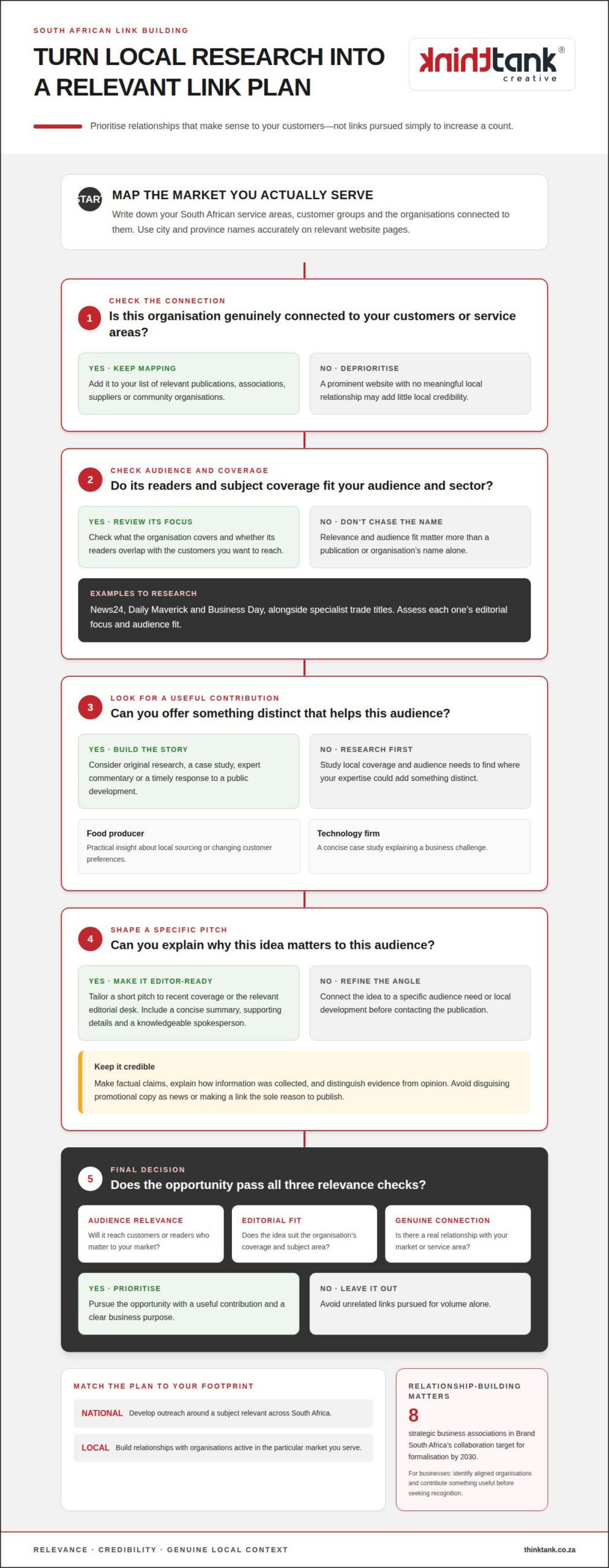
Local relevance gives a backlink context. A mention from a South African organisation familiar with your sector can connect your business with the market it serves. Prioritise publishers, associations, suppliers and community organisations whose readers overlap with your customers. A link from an unrelated website may add little local credibility, even if that site appears prominent.

Adapt links to the places and customers your business serves. For local SEO, seek references from organisations with a genuine connection to your service areas, then make sure your website clearly explains where you operate. Use city and province names accurately in relevant page content, rather than pursuing links from organisations with no meaningful relationship to those places.

Effective link building strategies for South African businesses begin with a focused market map. Record your service areas, customer groups, relevant organisations and the subjects each organisation covers. Then review which websites already earn attention in your sector. Look for specialist commentary, business resources and community initiatives. This reveals where competitors have established relationships and where your expertise could add something distinct.

Competition also shapes how local businesses establish credibility. A company entering a new South African market needs to understand its customers, established organisations and trusted sources of information. Speaking with people in that market can reveal which publications and associations matter. Use those insights to tailor outreach, choose relevant topics and avoid treating every audience as interchangeable.

Brand South Africa has set a target of formalising collaborations with 8 strategic business associations by 2030. This highlights the value of structured relationships in strengthening connections. For an individual business, the practical lesson is to identify organisations aligned with its sector and contribute something useful before seeking recognition.

Use these steps to turn local research into an actionable link plan:

For example, a business serving customers nationally could develop outreach around a subject relevant across South Africa. A business focused on a particular market could seek relationships with organisations active there. The strongest link building strategies for South African businesses reflect this distinction, connecting each opportunity with a real audience and a clear business purpose.

Assess opportunities by audience relevance, editorial fit and genuine connection to your market. These criteria help businesses build credibility while responding to competition, without relying on a generic list of websites.

Give editors a story their readers can use, not a request for a favour. A backlink may follow when a publication references your business as a relevant source. Identify South African publications whose coverage matches your sector, customers or business goals. News24, Daily Maverick and Business Day are examples to research, alongside specialist trade titles. Their editorial focus and audience fit matter more than their names alone.

Build a clear story before contacting a newsroom. A food producer could share practical insight about local sourcing or changing customer preferences. A technology firm might explain a business challenge through a concise case study. Keep claims factual, explain why the subject matters to South African readers and make a knowledgeable spokesperson available for comment.

Useful editorial material can include original research, a case study, expert commentary or a timely response to a public development. Share the underlying information, explain how it was collected and distinguish evidence from opinion. Editors need material they can assess independently. Avoid disguising promotional copy as news or making a link the sole reason to publish.

Make outreach specific. Read the publication’s recent coverage, identify the journalist or relevant editorial desk, then tailor a short pitch to their subject area. For a national story, explain its relevance to South African readers. Include a concise summary, supporting details and spokesperson contact information. A generic message sent to a long list of journalists is easy to ignore.

For instance, an engineering business could offer a journalist a specialist explanation of a relevant infrastructure issue. The pitch should provide an informed perspective, not imply endorsement or demand a link. If the story is published, a natural reference to the company’s relevant resource can help readers explore the subject further.

Prepare your destination before outreach. A journalist or reader should find clear information that supports the story, such as an expert profile or detailed resource. Strong website content for editorial outreach can make that reference useful, while a focused pitch gives South African publications a concrete reason to consider your contribution.

A business expanding into other African markets can make its pitch more useful by explaining how local conditions shape its decisions. South African multinationals expanding elsewhere in Africa face intense competition from local competitors and need to adapt their strategies. A newsroom pitch can describe what local knowledge changed in a company’s approach, while keeping claims tied to its own experience. This gives editors context readers can assess, rather than a broad claim about regional success.

For a proposed international-growth plan, Month 3 is when a South African business should launch a pilot in an international market and establish local partnerships. Documenting the pilot and partnership lessons can provide a concrete follow-up story. The article states that 90% of mobile profits come from applications rather than operating systems. Businesses in that field can use this distinction to frame an informed explanation of where value is created, without turning the pitch into an advert.
Link building strategies for South African businesses that fit the local market

A useful listing connects your business with customers who already use a relevant directory or association. In South Africa, Yellow Pages and Brabys are examples of general business directories to assess. A sector-specific membership directory, such as one maintained by an industry body, may be more relevant than a broad listing. First check whether the organisation serves your market and publishes member profiles online.

Directories differ in purpose. Yellow Pages and Brabys help people discover businesses by category and location, whilst a national business association may connect members with a professional audience. Business Unity South Africa and the South African Chamber of Commerce and Industry are examples to assess for relevance to your organisation. A listing is most useful when its details are accurate and its audience matches your customers.

Industry associations can provide a closer fit for specialist businesses. Master Builders South Africa, for example, is relevant to the building sector; the Institute of Directors in South Africa is more pertinent to governance professionals. Membership may bring opportunities to appear in an online directory, contribute expertise or participate in association activities. Those opportunities depend on each organisation’s membership and publishing practices.

Assess each option before submitting details. Search the organisation’s website for a member directory, profile pages and recent activity. Check whether listings link to members’ websites and whether the page gives visitors useful context. A directory with clear categories and identifiable member information offers more value to users than a page filled with unrelated entries.

For example, a construction firm could compare a Brabys category listing with a profile in a relevant Master Builders South Africa directory. The first may support general discovery, whilst the second can place the company in a sector-specific context. A professional services firm might instead consider a suitable national association, depending on its clients and expertise.

Prioritise quality over accumulating profiles. Avoid submitting the same generic description to every directory, and keep an internal record of each listing’s purpose and details. Yellow Pages, Brabys and national associations are starting points for research, not automatic endorsements. The strongest choices help people understand what your business does and why it belongs in that professional community.

Companies that lead in ESG practices see an average increase of 2.6% in their valuations over companies that lag in those areas.

Build partnerships around a shared purpose, then make the collaboration useful to both audiences. A Johannesburg accounting firm could work with a local entrepreneur network on practical financial education. The network might publish an event recap or resource mentioning the firm. The link follows from a real contribution, rather than a sponsorship payment alone.

Start by mapping organisations connected to your customers and region. A Cape Town retailer might consider a neighbourhood business association, whilst a KwaZulu-Natal tourism operator could approach a local conservation group. Look for shared audiences, active programmes and clear online communication. A partner’s website should explain its work and give visitors a reason to explore its resources.

Sponsorship can create a natural reason for public recognition. Before supporting a school fundraiser, arts event or community sports club, agree how the contribution will be acknowledged. The organiser could include sponsors on an event page, explain their role in a recap or link to a relevant resource. Keep the arrangement transparent and ensure the acknowledgement reflects genuine support.

Community events offer useful material before and after the gathering. A Pretoria business hosting a skills workshop could publish an agenda, speaker profiles and a summary of practical insights. The partner organisation can share those resources with attendees. After the event, provide approved photographs, key points and participant resources, making it easier for partners to create an accurate follow-up page.

For example, a Gqeberha engineering firm could help a youth organisation run a career session. The firm might provide a speaker and a concise guide about engineering pathways. The organisation could publish a recap for families and participants, with a contextual link to the guide. This gives the link a clear purpose for readers.

Keep a specific record of each partnership: the organisation, activity, audience, agreed recognition and resulting page. A link should describe the relationship accurately, not imply an endorsement that never occurred. When a partner publishes event information, share it through your own channels and credit their contribution. That follow-through can strengthen the relationship beyond a single mention.

In South Africa, link building costs depend on the work required, not simply the number of links promised. The price depends on the case and is given after a quote request, with the scope shaped by research, content creation, outreach and reporting. A campaign involving specialist research and original resources requires different work from updating existing business information.

Look at the process behind a proposal. Research may include assessing your website, competitors, target audiences and relevant publications. Content work could involve expert interviews, local case studies or resource development. Outreach takes time to identify suitable contacts, personalise pitches and follow up professionally. Reporting should show what was done and which placements resulted.

Compare proposals by scope rather than headline totals. One provider may focus on prospect research and editorial outreach, whilst another includes content production and campaign management. A monthly retainer, project fee or per-placement arrangement can each describe a different service. Ask what tasks, deliverables and reporting each model covers before comparing them.

For example, a small business with useful existing resources may need targeted outreach and careful prospect selection. A company entering a new South African market may need more research and locally relevant content first. The difference lies in the starting point, audience and work required, not an assumed standard rate.

Businesses should also consider their internal capacity. If your team can provide expert input but cannot develop content, the support required differs from that of a team needing help with research, writing and outreach. A clear brief helps define the work and keep the campaign aligned with business priorities.

Before committing, compare the proposed activities with your objectives. A low headline fee may cover limited tasks, while a broader scope may include more preparation and reporting. Ask for a breakdown of work, intended audiences and how the approach will adapt when a publication declines a pitch. To support outreach with consistent social promotion, plan social promotion for useful content alongside your campaign.

ThinkTank Creative: Website Design and Development

ThinkTank Creative helps businesses build a stronger digital foundation through tailored Website Design and Development. When outreach earns attention, a clear, credible website gives journalists, partners and prospective customers a useful place to learn about your business. Thoughtful page structure can also make your expertise and resources easier to discover and reference.

For businesses refining their online presence, Branding & Creative Design can support a consistent brand experience. Digital Marketing & SEO can help share useful content with relevant audiences. These services work together to present your business clearly, keeping the focus on valuable information rather than links alone.

Contact ThinkTank Creative to discuss your website and digital marketing goals.

Build relationships that support your next stage of growth

Make your next step a repeatable process, not a one-off campaign. Set aside time to review which relationships bring your business closer to relevant audiences, and nurture those connections through useful contributions. A thoughtful follow-up after a publication feature or community project can open the door to future collaboration. Keep your outreach aligned with your business priorities as your markets and customer needs evolve.

Effective link building strategies for South African businesses should sit within a wider digital presence. ThinkTank Creative can support that foundation through Website Design & Development, Digital Marketing & SEO and Branding & Creative Design, helping businesses present and share their work consistently. The right combination depends on what your website and marketing need to communicate.

For a considered next step, contact ThinkTank Creative about link building and discuss how your digital presence can support your growth. Keep building with purpose, and let each relationship strengthen the next opportunity.

Frequently Asked Questions

What link building strategies work best for South African businesses?

The strongest approach combines relevant editorial mentions, accurate industry listings and partnerships that reflect real business activity. Prioritise opportunities that reach your target customers, then direct links to a useful page rather than automatically sending every mention to your homepage. For example, a specialist supplier could connect a technical article with its matching service page. Track each opportunity’s relevance and referral activity to guide future outreach.

How can South African businesses assess backlink quality and domain authority?

Assess whether the linking site is credible, relevant to your sector and service area, and reaches an audience that overlaps with your customers. Editorial fit and a genuine local connection matter more than the website’s prominence or the number of links.
How to Increase Domain Authority in South Africa: A Practical 2026 Guide

A higher Domain Authority score won’t, by itself, move your South African business up Google. If you’re searching for “how to increase domain authority south africa”, the more useful question is how to build a website that earns relevant links, serves its audience and strengthens search visibility over time.

It’s understandable to focus on a number when measuring SEO progress, particularly when relevant links can take time to earn. But Domain Authority is Moz’s third-party metric, not a Google ranking factor. Treat it as a comparative indicator, not a verdict on your website’s health or a score to chase at any cost.

This guide explains what Domain Authority can and can’t tell you, then sets out practical ways to build relevance in the South African market. You’ll learn how useful content, a well-functioning website and thoughtful link-building work together, and how to track progress through search visibility and meaningful business outcomes alongside third-party metrics.

Key Takeaways

  • Learn why authority scores differ between SEO platforms, and use each metric with its calculation method in mind.
  • Build a baseline by recording referring domains and organic performance, then compare your site with relevant South African competitors.
  • Follow a practical process for how to increase domain authority south africa: create a useful asset, identify relevant sources and explain its value.
  • Prioritise content that answers a specific audience need and gives credible websites a reason to reference it.
  • Review earned links, search visibility and enquiries together to decide what to do next.

What domain authority means for South African websites

Domain Authority is a third-party estimate of how likely a website is to rank in search results compared with other sites. Moz developed the Domain Authority metric, which draws on signals such as a site’s link profile. It’s an estimate, not a complete assessment of your website’s SEO health or a promise of future rankings.

Put simply, a third-party authority metric estimates a website’s relative ranking potential. It isn’t a score assigned or used directly by Google. If you’re exploring how to increase domain authority south africa, understanding this distinction helps keep your strategy focused on meaningful progress rather than a number alone.

For a visual introduction to the topic, watch this video:

Domain Authority, Domain Rating and Authority Score: what differs?

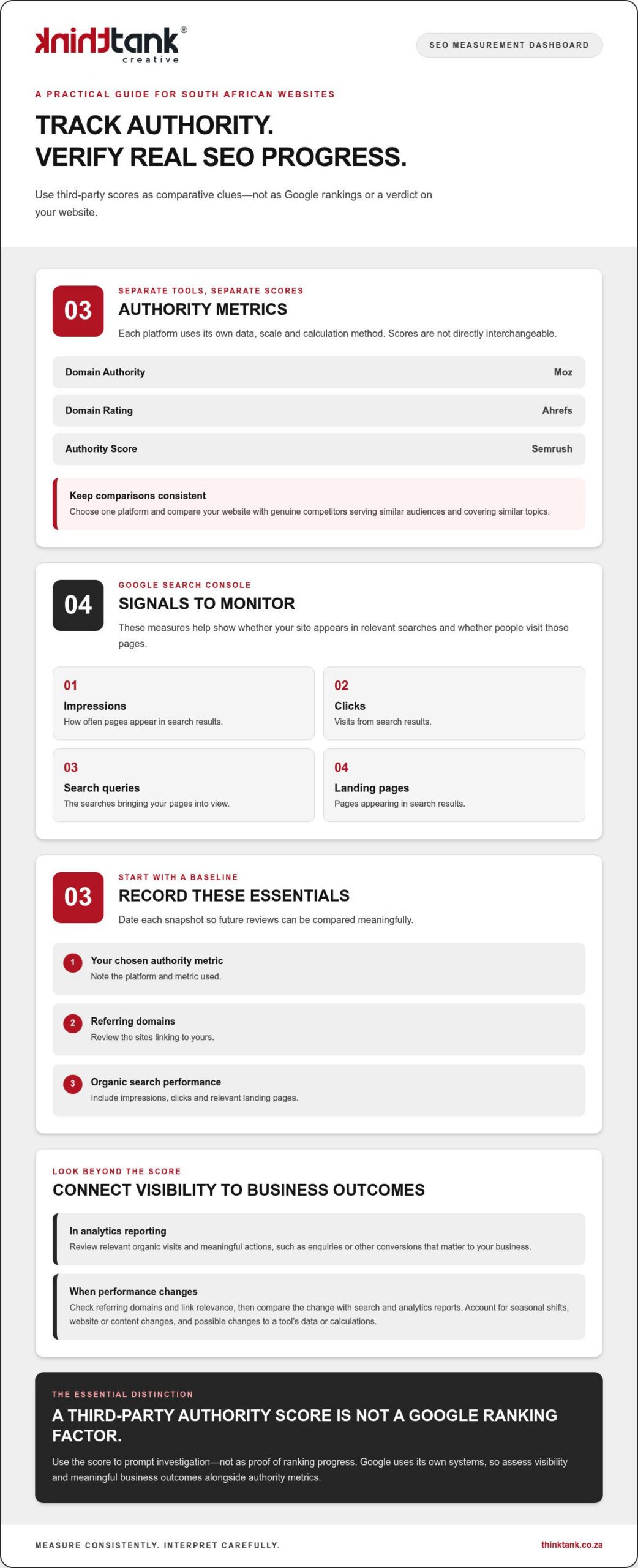
These are separate third-party metrics: Domain Authority is from Moz, Domain Rating from Ahrefs and Authority Score from Semrush. Each platform uses its own data, scale and calculation method, so the scores aren’t directly interchangeable. A site’s score can differ between tools even when its underlying search performance hasn’t changed.

For a useful comparison, choose one platform and use the same metric to review your website and a small set of genuine competitors with similar audiences and subject matter. This gives you a consistent benchmark instead of a misleading comparison between numbers calculated in different ways.

Why South African businesses should look beyond one score

Relevance depends on the people a website serves, the subjects it covers and the market it operates in. A focused South African business site may have a smaller link profile than a national or global publisher and still be useful to people looking for specialised expertise, products or services.

A higher score doesn’t prove that a site will rank above another, and it doesn’t cause Google to award better positions. Sites with stronger backlink profiles may also have better visibility, but that relationship alone doesn’t show that a third-party score caused the rankings. Google uses its own ranking systems.

Use authority scores to spot questions worth investigating, not as targets. A change can prompt you to review links or compare competitors, but assess it alongside relevant search visibility and audience response. That keeps SEO decisions grounded in what your audience needs.

Does domain authority affect Google rankings? Separate the metric from real SEO progress

No. A third-party Domain Authority score is not itself a Google ranking factor. Google doesn’t assign your website a Moz, Ahrefs or Semrush authority score. These tools provide estimates that can help you compare your site with others, but a change in the estimate doesn’t tell you directly what Google will rank or why.

Authority scores and search performance can move in the same direction: websites with strong backlink profiles may also have good visibility. But correlation isn’t causation. A higher third-party score doesn’t prove that the score caused improved rankings, or that every link contributing to it is valuable to your audience.

A rising authority score can’t guarantee better rankings, because Google uses its own systems to assess and rank pages. If you’re considering how to increase domain authority south africa, treat the metric as one diagnostic signal, then judge progress through search visibility and business outcomes.

Which signals are more useful for tracking SEO performance?

Use Google Search Console to monitor impressions, clicks, search queries and the landing pages appearing in results. These measures show whether your website is appearing for relevant searches and whether people are visiting those pages.

Pair that view with analytics reporting. Review relevant organic visits and meaningful actions on your site, such as enquiries or other conversions that matter to your business. Look at trends over time, account for seasonal shifts and note changes to your content or website. Don’t attribute every rise or fall to link-building alone.

Google’s guidance favours creating compelling material that people have a reason to reference, rather than relying on manipulative link schemes. Its advice on earning quality links supports a user-first approach: make your content genuinely useful and relevant.

How to interpret a domain authority score responsibly

Make comparisons consistent. Record the platform, metric and date each time you review your score, then compare it with relevant competitors serving similar audiences and covering similar topics. Unrelated websites and arbitrary targets make poor benchmarks.

If the number changes, investigate before drawing conclusions. Check whether referring domains have changed, review the relevance and quality of those links, and compare the results with your search and analytics reports. The score may also move because a tool’s data or calculations have changed. The aim is to understand what may have influenced the metric, not to pursue a particular number.

Clear reporting makes those signals easier to interpret. Learn more about SEO strategy and reporting as part of a considered approach to measuring website performance.

Start with a baseline before deciding what to improve. Record your chosen authority metric and SEO platform, your number of referring domains, and organic search performance, including impressions, clicks and relevant landing pages. Date each snapshot so you can make meaningful comparisons later.

Next, select a small group of genuine South African competitors. Choose businesses that serve a similar audience and cover related topics, rather than simply picking websites with high scores. For a broader view of how link-building fits into search optimisation, explore this South African SEO strategic guide. Moz also explains how its own Domain Authority metric is intended to be used as a comparative measure.

What makes a backlink relevant and worth pursuing?

Assess the page that links to you, not just the referring domain’s score. Does the page cover a related subject, serve a similar audience or connect to your business community? Is your link included naturally in useful editorial or resource content, where it helps readers understand or explore the topic?

Consider the likely audience value. A link from a relevant South African industry association, professional resource or supplier could introduce your website to interested visitors. A link with no clear connection to your work may offer little practical value, even if a tool gives the referring site a strong score.

How to find gaps against relevant competitors

Review competitors’ referring pages for credible industry, professional, supplier and community sources. Note why each page linked, then ask whether you have a useful resource that could meet a similar need. Separate realistic opportunities from sites that appear to exist mainly to sell links. A raw link count won’t show the difference.

Use a simple comparison to organise your assessment:

What to assess What to look for Question to ask
Relevance Connection to your subject, audience or South African market Would this source make sense to your customers?
Referring-site quality Credible, useful content and a clear purpose Does the site serve a real audience?
Link context A natural mention in relevant editorial or resource content Does the link help readers?
Audience value A plausible route for interested visitors to discover your site Could this referral support awareness or enquiries?

This audit gives you a grounded starting point for how to increase domain authority south africa: identify gaps that matter to your audience, then prioritise relevant opportunities over score-chasing.

How to Increase Domain Authority in South Africa: A Practical 2026 Guide

Earn links by giving relevant websites a genuine reason to reference your work. A strong authority-building plan starts with a useful resource and thoughtful outreach, not a target score. If you’re researching how to increase domain authority south africa, use this process to focus on links that make sense for your audience and market.

  1. Choose a useful asset. Identify a question your audience needs answered, then create a resource that responds clearly and thoroughly.
  2. Find relevant sources. Research South African industry bodies, professional networks, partners, publications and community resources that cover the topic or serve the same audience.
  3. Pitch the value. Contact each relevant organisation with a personal note explaining what the resource offers its readers and why it may be useful.
  4. Review the results. Track who you contacted, responses, links earned and referral or search performance. Use what you learn to refine the next round, without expecting a particular score increase.

For more detailed outreach guidance tailored to the local market, read these local link-building strategies for South Africa.

Create content that deserves references and recommendations

Build resources around genuine knowledge of your business and customers. This might be a practical guide, a clear explanation of a complex topic or a resource that helps people make an informed decision. Start with a defined audience need, then make the content specific, accurate and useful enough to stand on its own.

Presentation matters, too. Use clear headings, concise copy and an easy-to-follow structure so a publisher can quickly assess the resource. Coordinate content creation, copywriting and SEO priorities, rather than publishing material without a defined purpose or audience.

Build relationships without buying shortcuts

Personalise each approach. Refer to the recipient’s publication, resource or community, and explain why your content could help its audience. A relevant partner may value a useful resource, a publication may consider an expert explanation, and a community site may welcome material that answers a recurring question. Keep the pitch specific and respectful.

Avoid paid-link schemes, irrelevant directory submissions and mass-produced outreach promising easy results. These tactics can waste effort and don’t build relevant relationships that support lasting visibility. Record outreach and earned links, then assess quality and outcomes alongside any change in third-party metrics.

Bring research, content and outreach together in a considered plan. ThinkTank Creative provides SEO and content support to align this work with your website and business goals.

How to sustain authority growth and choose the right next steps

Turn your link-profile findings into a focused plan, not an endless list of SEO tasks. Set priorities for useful content and outreach, assign an owner to each action, and agree on reporting checkpoints. Sustainable progress comes from relevant, consistent activity and review. There’s no guaranteed timeline for an authority score or search result to improve.

Keep the objective clear: earn relevant references, improve search visibility and attract the right audience. A third-party score can help you spot changes, but it shouldn’t replace evidence that your website is reaching potential customers and supporting business goals.

What to review in a regular SEO report

Use each report to connect activity with outcomes. Review target-page visibility, organic clicks, relevant queries and meaningful conversions, such as enquiries. Check new referring domains for topical fit, the context of each link and whether the source’s audience is relevant to your business.

Then record what changed, what you learned and the next action that has a clear rationale. If a page earns links but attracts few relevant visits, consider whether its topic, search intent or next step needs refinement. If visibility changes, review other site and content updates before assuming outreach was the cause.

When integrated SEO and website support can help

Authority-building is easier to manage when research, strategy, content creation and reporting work together. Research identifies audience needs and realistic opportunities; strategy sets priorities; useful content gives relevant sources something worth referencing; reporting shows what is gaining traction. A functional, easy-to-use website gives visitors a clear experience once they arrive.

For a practical approach to how to increase domain authority south africa, treat SEO and website quality as connected parts of sustained improvement. ThinkTank Creative brings together SEO, content creation, copywriting, reporting, website development and ongoing support as part of its digital work.

To discuss your SEO and website project needs, explore ThinkTank Creative.

Build lasting search strength through relevant authority

Use Domain Authority as a diagnostic, not a destination. The most effective approach to how to increase domain authority south africa is to understand your baseline, create resources that meet real audience needs and earn relevant references from credible sources. Then assess progress through search visibility, useful website visits and enquiries, not one third-party score.

Keep the work focused and consistent. A practical plan with clear priorities, responsible outreach and regular reporting can help you learn what’s resonating and decide where to invest next. Strong SEO also relies on a functional website that makes it easy for visitors to find information and take action.

ThinkTank Creative, founded in 2001, brings SEO, content creation, copywriting and reporting together with a website process spanning research and strategy through launch and support. Explore ThinkTank Creative’s SEO and website services to discuss your project needs and shape a considered path forward.

Build with relevance, measure what matters and give your South African website room to grow.

Frequently Asked Questions

Is domain authority a Google ranking factor?

No. Domain Authority is a third-party metric developed by Moz, not a score Google uses to rank pages. Google has its own ranking systems, so a change in this metric doesn’t directly cause rankings to rise or fall. Use it as one comparative signal alongside Search Console visibility, relevant organic visits and enquiries. A higher score may coincide with a strong link profile, but that doesn’t prove the score caused better rankings.

How can I increase domain authority in South Africa?

To improve domain authority in South Africa, create genuinely useful content for a defined audience and earn relevant references from credible sources. Consider industry bodies, professional networks, partners, publications and community resources that serve your subject area. Personalise outreach by explaining the value to each source’s readers. Track referring domains and search performance, but don’t use link volume or a third-party score as the only measure of progress.

How long does it take to increase domain authority?

There’s no fixed timetable. Authority metrics can change gradually as your website earns relevant links and the SEO platform updates its data. Sustainable improvement may take several months or longer, and results depend on your starting point, competition and the consistency of your work. Set regular review points rather than expecting a quick score change, and monitor search visibility and business outcomes alongside the metric.

What is a good domain authority score for a South African business?

There isn’t a universal “good” score for South African businesses. Authority metrics are comparative estimates, and results depend on the tool and its calculation method. A useful benchmark is the score of relevant competitors serving similar audiences and covering similar topics, measured using the same platform. Focus on whether your website is improving its visibility for relevant searches and attracting valuable visitors, rather than pursuing an arbitrary score.

Can I improve domain authority without building backlinks?

You can improve other aspects of SEO without acquiring backlinks, including content usefulness, site structure and page experience. These improvements may support search visibility, but they’re unlikely to substantially increase a link-based authority metric on their own. For that, focus on creating resources that relevant websites may choose to reference. Measure progress across your search performance and website outcomes, not the authority score alone.

Should I buy backlinks to increase domain authority?

Don’t buy backlinks simply to inflate an authority score or manipulate search rankings. Paid links created to influence rankings can conflict with Google’s spam policies, and irrelevant links may deliver little audience value. Invest in useful content and relevant relationships instead. If a link is part of a legitimate paid promotion, make sure it’s handled transparently and in line with applicable search engine guidance.

How can I check my website’s domain authority?

Check the metric using the SEO platform that provides it, such as Moz for Domain Authority. Other platforms have their own measures, including Ahrefs’ Domain Rating and Semrush’s Authority Score, so don’t compare these scores as if they were interchangeable. Record the tool and date, then benchmark against relevant competitors using the same metric. Use Google Search Console separately to review impressions, clicks, queries and landing-page visibility.

Local Link Building Strategies South Africa: The 2026 Strategic Guide

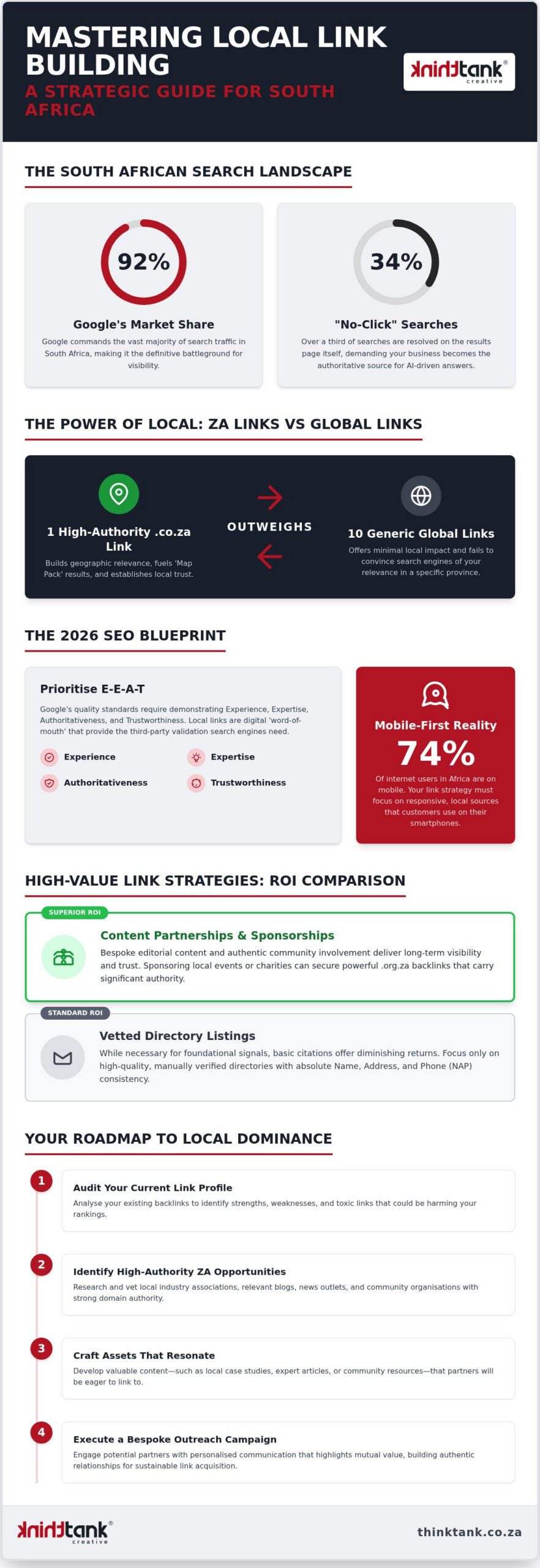
With Google commanding a 92.11% market share in South Africa, it is a sobering reality that 34% of standard searches now result in no click at all. This shift towards AI-integrated search means that simply having a website is no longer enough; you must become the authoritative source that engines trust above all others. You likely find it exhausting to compete with international brands that possess massive budgets, especially when generic global link-building services fail to move the needle in our unique local market.

We are here to transform that challenge into your competitive advantage by helping you master the specific local link building strategies south africa requires to dominate search results. This guide provides a strategic roadmap for securing high-authority ZA backlinks, leveraging hyperlocal signals, and aligning your digital presence with the value-driven behaviour of South African consumers. We will detail how to build authentic partnerships that elevate your domain authority and ensure your business remains the first choice for local customers. By the end of this guide, you will have the tools to outpace national competitors and secure a position of prominence in the 2026 digital ecosystem.

Key Takeaways

  • Understand why .co.za domains and geographic relevance are the cornerstone of search authority in the South African digital landscape.
  • Discover how to implement the most effective local link building strategies south africa offers by prioritising high-authority industry associations over outdated directory listings.
  • Learn why bespoke editorial content delivers a superior return on investment compared to basic citations, ensuring long-term visibility and trust.
  • Master a clear roadmap for your outreach campaign, from auditing your link profile to crafting assets that truly resonate with your target audience.
  • Explore how an integrated approach that combines SEO with expert design can scale your authority whilst we handle the heavy lifting.

Elevate your brand by understanding the specific mechanics of geographic authority. In the South African context, local link building isn't just about volume; it's about anchoring your digital presence within the .co.za ecosystem. To understand the fundamental principles, one should first grasp what is link building in its broadest sense. For service businesses, this means securing citations and mentions from regional directories, local news outlets, and industry-specific associations that signal relevance to Google's South African algorithms.

These signals are the primary fuel for the "Map Pack" results. Whilst a high-authority link from a US-based tech blog might boost your global domain rating, it does little to convince Google that you're the best provider in your specific province. Local links provide the proximity data necessary to outrank national competitors for service-based keywords, ensuring your business appears exactly when and where the searcher needs you.

To better understand how these strategies function in practice, watch this helpful video:

The Link-to-Lead Connection

Trust is the currency of the South African digital market. When a potential client sees your business mentioned by a reputable local industry body, it bridges the gap between a search result and a qualified lead. A single link from a relevant ZA trade guild is worth ten generic global links because it confirms your operational legitimacy within our borders. In 2026, local SEO relevance is defined by the density of high-quality, geographically specific signals that validate a business's physical and professional presence in South Africa.

The 2026 Local SEO Landscape in South Africa

The search environment has evolved to prioritise E-E-A-T (Experience, Expertise, Authoritativeness, and Trustworthiness) above all else. Local links serve as digital word-of-mouth, providing the third-party validation that AI-driven search engines require to recommend your services. With Africa holding the highest share of mobile internet users at 74% as of early 2026, mobile-first indexing is a non-negotiable reality. Your local link building strategies south africa must focus on responsive, local sources that ZA users visit on their smartphones. This synergy between local authority and mobile accessibility ensures your brand remains visible where your customers are actually looking.

Success in the local digital ecosystem depends on the calibre of your associations. Whilst many SEO providers still rely on bulk directory submissions, the 2026 search landscape demands a more refined approach. You must look for platforms that possess genuine regional authority and high engagement. This precision ensures your local link building strategies south africa focus on quality rather than sheer volume, which is essential for maintaining a clean and powerful backlink profile.

Vetted South African Directories

Selecting the right directories is a meticulous process. We prioritise platforms that require manual verification, as these are viewed more favourably by search algorithms. A critical component of this process is ensuring absolute NAP consistency. Your business Name, Address, and Phone number must be identical across every listing to avoid confusing search engines. At ThinkTank Creative, we focus on a curated selection of authoritative ZA directories, ensuring each placement strengthens your geographic relevance rather than diluting it with low-quality signals.

Strategic Partnerships and Sponsorships

Authentic community involvement provides some of the most potent link opportunities available. Sponsoring national events or local charities often leads to highly coveted .org.za backlinks, which carry significant trust signals. These relationships go beyond simple transactions; they represent a collaborative effort to grow the local economy. You might also consider earning local SEO backlinks through partnerships with non-competing service businesses or industry-specific associations like SACCI. These connections act as a digital endorsement, telling both users and search engines that your brand is a pillar of the South African business community.

Beyond traditional listings, leveraging local media through strategic PR can secure mentions on high-traffic news sites. Often, these publications talk about your brand without providing a direct link. Identifying these "unlinked mentions" and requesting a formal backlink is a sophisticated way to reclaim lost authority. If you find the technical nuances of these outreach campaigns overwhelming, our team can help you organise a bespoke SEO strategy that aligns with your specific growth objectives. By collaborating with influencers and industry leaders, we ensure your brand transformation is supported by a network of excellence.

Directory Listings vs. Content Partnerships: Which Delivers Better ROI?

Maximise your marketing spend by distinguishing between foundational visibility and strategic authority. Whilst basic directory listings provide a necessary base for NAP consistency, they rarely offer the transformative growth required to dominate competitive sectors. Content partnerships, by contrast, demand a higher initial investment but yield a far superior return through sustained referral traffic and compound SEO value. Mastering the local link building strategies south africa requires for 2026 involves prioritising editorial relevance over mere existence.

Evaluating the effort-to-reward ratio is essential for any service-based enterprise. In-house teams often struggle with the time-intensive nature of outreach; this makes an "all-rounder" agency a more cost-effective choice for those seeking professional execution without the overhead. Editorial links possess a longevity that directory citations simply cannot match. A well-placed guest contribution on a reputable South African industry site continues to pass authority for years, whereas directories often become cluttered or lose their editorial oversight. You must also remain vigilant against "link farms" specifically targeting the South African market. These low-quality networks offer cheap, bulk links that lead to severe search penalties and long-term brand damage.

The Case for Editorial Content

High-quality copywriting serves as the ultimate magnet for organic link acquisition. By producing original South African industry reports or visually compelling infographics, you create assets that other professionals naturally want to cite. This methodology aligns perfectly with our broader vision for Search Engine Optimisation in South Africa: The 2026 Strategic Guide, where content and authority work in synergy. To ensure these assets consistently attract attention and endorsements, it is equally important to create a content marketing plan that structures your editorial output around genuine audience value and measurable SEO goals. When your brand provides genuine value through expert insights, the links follow as a natural endorsement of your expertise, elevating your domain authority within the South African digital ecosystem.

Managing Your Link Profile

Maintaining a diverse and healthy link profile is a continuous commitment. It's not enough to simply acquire links; you must actively monitor for toxic entries that could compromise your ZA rankings. We recommend a methodical approach to competitor analysis to identify untapped opportunities within the local landscape. By observing where your successful peers are mentioned, you can refine your own outreach strategy to ensure your brand remains at the forefront of the digital ecosystem. This proactive management protects your investment whilst positioning you for consistent, long-term growth. We do it all so you don't have to, ensuring your link profile remains a powerful asset rather than a liability.

Local Link Building Strategies South Africa: The 2026 Strategic Guide

A Step-by-Step Guide to Executing Your Local Outreach Campaign

Transform your strategic vision into a tangible reality through a disciplined execution process. Every successful campaign begins with a meticulous audit of your current backlink profile to identify authority gaps and hidden opportunities. Once you understand your standing, you can move to prospecting for high-relevance South African domains that align with your industry values. This methodical approach ensures your local link building strategies south africa are built on a foundation of data rather than guesswork. By following a structured roadmap, you move from a high-level concept to a concrete acquisition of authority.

Phase 1: Research and Asset Creation

Compelling outreach requires assets that other professionals feel proud to share. We utilise our proven 5-stage design process; planning, design, program, development, and support; to craft visual link magnets that resonate with the South African audience. Professional logo and corporate identity design are critical here. They establish the immediate credibility needed to bypass the initial scepticism of webmasters. Understanding what makes a good logo design is an essential part of this process, as a professionally crafted visual identity signals trustworthiness to both webmasters and potential link partners before they even read your content. A high-quality asset is only effective if the destination is seamless. This is why we emphasise Improving Website User Experience: 2026 Strategic Guide as a prerequisite for any outreach effort. When your site reflects bespoke craftsmanship, partners are far more likely to link to your content. Equally important is ensuring your site loads swiftly for every visitor; understanding how to fix a slow loading WordPress site is a critical technical step that prevents high bounce rates from undermining the authority your links work hard to build.

Phase 2: Personalised Outreach

Connection is the heartbeat of the South African business community. You must avoid generic templates at all costs. South African webmasters value personalised communication that demonstrates a genuine understanding of their platform and audience. Our collaborative approach focuses on building a journey of imagination with potential partners, framing the link as a mutual opportunity for growth rather than a simple transaction. It's about precision and synergy. You should track every interaction and refine your pitch based on real-world feedback. This iterative process ensures your outreach remains fluid and effective. If you are ready to elevate your brand through expert execution, start your collaborative journey with ThinkTank Creative today. We do it all so you don't have to, allowing you to focus on your core business whilst we secure your digital authority.

Relationship management is the final, essential step. Don't let the conversation end once the link is live. Following up and maintaining these connections can lead to future collaborations and a steady stream of referral traffic. Meticulous attention to these professional relationships mirrors the stability of a long-standing enterprise, ensuring your link-building efforts contribute to a sustainable and elite digital presence.

Scaling Your Digital Authority with ThinkTank Creative's Integrated SEO

Elevate your brand by moving beyond isolated tactics and embracing a comprehensive digital ecosystem. At ThinkTank Creative, we understand that successful local link building strategies south africa require more than just securing a mention; they demand a robust technical and creative foundation. By integrating link acquisition into a broader digital strategy, we ensure that every backlink serves as a catalyst for overall brand transformation. Our approach is not merely about rankings but about creating a sustainable presence that commands respect within the South African market. We do it all so you don't have to, allowing you to focus on your core operations whilst we manage the complexities of your digital growth.

Benefit from our all-rounder agency capability, which has been refined over 25 years of experience since our founding in 2001. We utilise a proven 5-stage development process; planning, design, program, development, and support; to ensure your website is technically optimised to handle the high-traffic influx that authoritative links provide. This methodical cadence ensures that when a national publication or industry body links to your site, the user experience is flawless. Ongoing maintenance and support are critical components of our service, protecting your SEO rankings against the ever-evolving search landscape and ensuring your investment continues to yield results.

Beyond the Link: A Holistic Marketing Approach

Amplify your authority by synchronising your link-building efforts with professional social media marketing and email marketing. When we create bespoke content that earns links, we also distribute it across channels to maximise visibility and engagement. Great marketing effectively makes your customers look smart, encouraging them to share your insights and earn you natural endorsements. This synergy is a core part of our Lead Generation Strategies for South African Businesses: The 2026 Strategic Framework, where every touchpoint is designed to foster trust and drive conversions. Complementing this approach, learning how to get more Google reviews in South Africa is an equally powerful way to build the social proof that reinforces your link-building authority and drives local search visibility.

Partnering for Long-Term Growth

Embark on a collaborative journey of imagination where your brand's potential is limited only by our collective creativity. The ThinkTank mission centres on constant communication and innovative problem-solving, positioning us as your strategic partner rather than a mere vendor. We invite you to discuss your unique objectives with our award-winning in-house team. An estimated cost for a customised South African SEO campaign is provided after a thorough initial discussion to ensure the strategy meets your specific needs. If you are ready to dominate the local search results and outpace your competitors, contact ThinkTank Creative to elevate your national visibility and secure your place as an industry leader.

Elevate Your National Visibility Through Strategic Authority

Mastering the digital ecosystem requires a shift from generic volume to precise, geographic relevance. You now have the roadmap to identify high-authority ZA opportunities and understand why editorial partnerships deliver a superior return on investment compared to basic citations. Implementing these local link building strategies south africa demands a blend of technical precision and creative storytelling that resonates with our unique market. It's about building a legacy of trust that search engines cannot ignore.

Since 2001, ThinkTank Creative has empowered businesses with 25 years of expertise in the South African landscape. Our award-winning in-house design and development team is ready to transform your digital presence through an integrated, all-rounder approach. We do it all so you don't have to, ensuring your brand's growth is both steady and sustainable. Partner with ThinkTank Creative for a comprehensive SEO strategy and begin your collaborative journey toward market leadership today. Your brand's transformation is within reach; let's build something exceptional together.

Frequently Asked Questions

What is the most effective local link building strategy for South African businesses?

Editorial content partnerships are the most effective way to secure high-authority backlinks. By creating bespoke reports or infographics that provide genuine value, you encourage natural endorsements from reputable South African industry bodies. This method ensures your local link building strategies south africa are built on trust and relevance rather than temporary volume. It's a collaborative approach that transforms your digital footprint into a position of market leadership.

Are .co.za domains better for SEO than .com domains in South Africa?

Yes, .co.za domains are generally superior for local SEO because they provide a clear geographic signal to search engines. Whilst a .com domain can rank nationally, the .co.za extension reinforces your commitment to the South African market and aligns with the search behaviour of local users. This relevance is a cornerstone of our 5-stage development process, ensuring your site is perfectly anchored within the regional digital ecosystem.

How long does it take to see results from a local link building campaign?

You should expect to see measurable shifts in visibility within three to six months of starting a consistent campaign. SEO is a methodical journey that requires patience and strategic depth rather than instant gratification. The timeline varies based on your existing domain authority and the competitive landscape of your specific industry. We provide ongoing support and maintenance to ensure these rankings remain stable once they're achieved.

Do I need to pay for links in South Africa?

You don't need to pay for links, and doing so often carries significant risk of search penalties. We focus on earned media and authentic relationship building which provides a much higher return on investment. Whilst some niche directories may have a nominal listing fee, the most powerful links come from genuine community involvement and high-quality content. We manage this entire outreach process so you don't have to worry about technical violations.

How many links do I need to rank on the first page of Google ZA?

There is no magic number of links required to reach the first page of Google ZA. Search rankings are determined by the quality and relevance of your link profile compared to your direct competitors. A single link from a high-authority South African news site often carries more weight than fifty low-quality directory listings. Our focus is always on precision and excellence to ensure your link profile outpaces national competitors.

Can social media links improve my local SEO rankings?

Social media links don't pass direct link juice because they are typically no-follow, but they're vital for brand signals. High engagement on social platforms drives referral traffic and increases brand awareness, which can lead to natural backlinks from other bloggers and journalists. Integrating your social strategy with your SEO efforts creates a synergy that amplifies your overall digital authority and improves your visibility for service-based keywords.

What is the difference between a citation and a backlink?

A citation is a mention of your business Name, Address, and Phone number (NAP), whilst a backlink is a clickable hyperlink to your website. Citations are foundational for local map rankings and help establish geographic trust. Backlinks are the primary drivers of domain authority and organic search placement. Both are essential components of the local link building strategies south africa businesses need to dominate the 2026 search landscape.

How do I know if a South African website is a good link prospect?

A good link prospect is a website that's both relevant to your industry and possesses a healthy, active audience in South Africa. You should look for sites with high editorial standards and a history of providing expert content. Avoid platforms that look like link farms or have excessive outbound links to unrelated industries. We meticulously audit every potential partner to ensure they align with your brand's journey of growth and excellence.