Digital Growth Strategy for Business: A Practical 2026 Framework
What if your website, search activity, paid advertising and social media all supported the same business outcome instead of competing for attention? Digital activity often grows one channel at a time, making it hard to tell what deserves investment or whether marketing is moving the business forward. A digital growth strategy for business brings those efforts into a connected, measurable plan.
The answer isn’t simply to add another platform or campaign. Start with clear business priorities, understand how customers discover and evaluate your offer, then give each channel a purposeful role. Progress is easier to assess when the measures you track reflect what matters to the business, not just activity for its own sake.
This practical 2026 framework will help you set priorities, connect your website, SEO, paid advertising, social media and content, and choose useful measures. You’ll learn how to turn scattered digital activity into a coherent plan that can be reviewed and refined as your business and customer needs evolve, from setting goals and understanding your audience to coordinating channels and measuring progress.
Key Takeaways
- A digital growth strategy for business connects your objectives, customer needs and digital activity in one practical plan.
- Give your website a clear role in helping customers understand your offer and take the next step.
- Compare SEO, paid advertising, social media, content and website improvements by relevance, capacity and how progress can be assessed.
- Turn priorities into action by recording who is responsible, what each task depends on and which customer action it supports.
- Strategy, website design and digital marketing can work together to support a more cohesive approach.
What a digital growth strategy for business actually connects
When a website, search activity, social posts and advertising are planned separately, it can be hard to see which priorities matter or whether the work is supporting progress. A digital growth strategy brings these moving parts in line, so each decision has a purpose beyond simply keeping a channel active.
A digital growth strategy is a plan that connects business objectives and customer needs to purposeful digital activity and measurable outcomes. It’s broader than a channel list, campaign calendar or website project. Those can all be part of the plan, but strategy explains why they belong, who they serve and how they relate to the business. This differs from the broader concept of digital transformation, which describes how digital technologies can reshape business models and operations.
For an overview of how strategic choices can shape a business’s position, watch this video:
Start with business outcomes, not a list of platforms
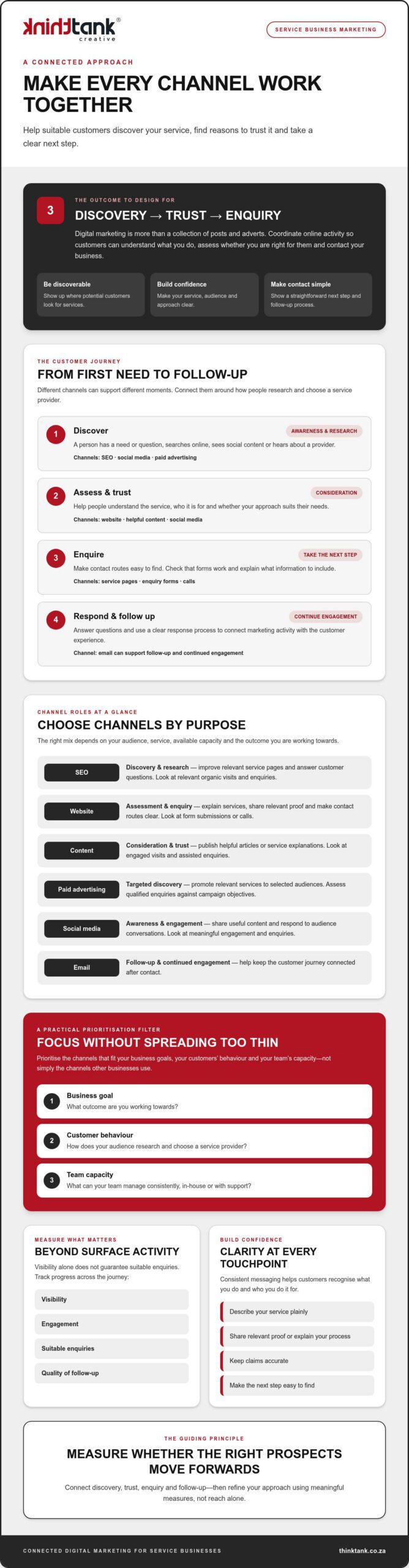
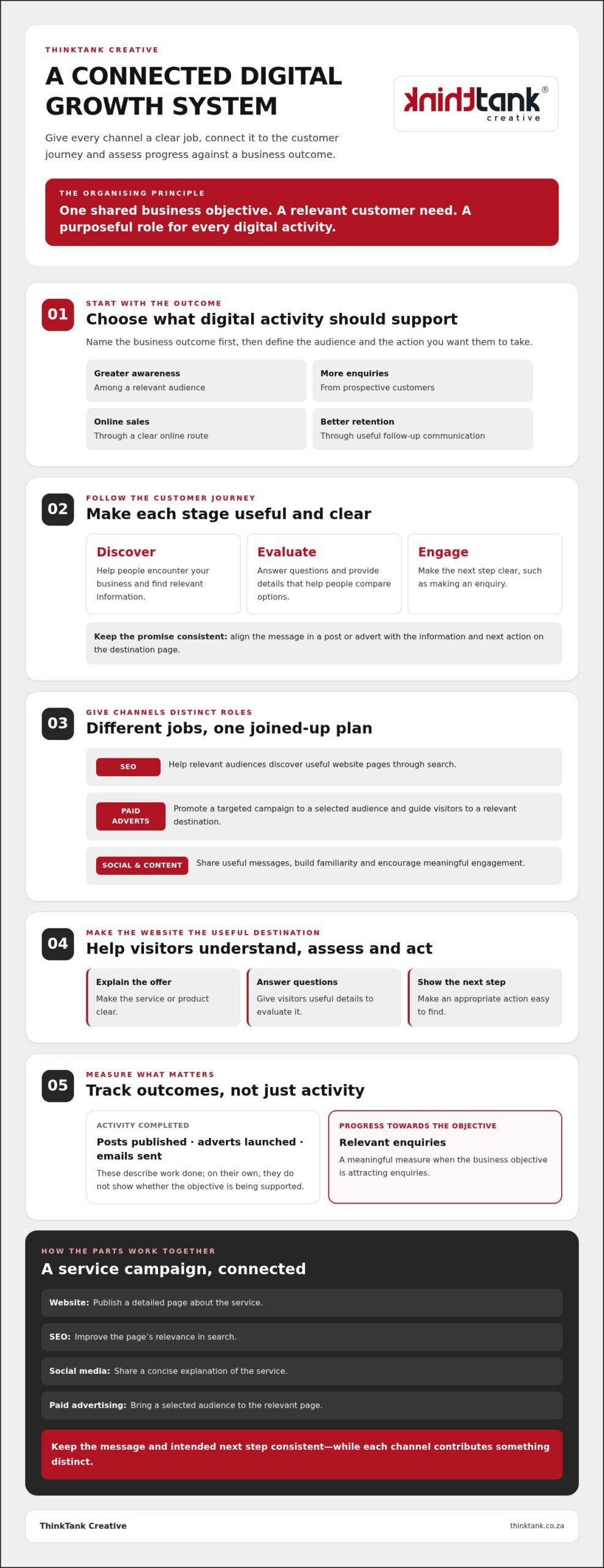
Begin by naming the business outcome you want digital activity to support. It could be greater awareness among a relevant audience, more enquiries from prospective customers, sales through a clear online route or better retention through useful follow-up communication. Define the audience and the action you want them to take. If the priority is enquiries, for example, specify which prospects you want to reach and what you want them to do after finding your business.
Separate outcomes from activity measures. Publishing posts, launching adverts and sending emails describe work completed. On their own, they don’t show whether the objective is being supported. Choose measures that reflect the intended action, such as relevant enquiries if your objective is to attract enquiries. This makes it easier to adjust activity without mistaking busyness for business progress.
Treat the customer journey as the organising principle
Map the customer’s path from discovering your business to evaluating your offer and engaging with you. At each stage, consider what they need to understand, what questions might hold them back and what a useful next step looks like. Someone who encounters your brand on social media may need a clear route to detailed information. A prospective customer comparing options may need relevant service details before making an enquiry.
Consistency matters throughout that journey. If a post sets one expectation but the landing page is unclear, confidence can falter between discovery and evaluation. Align your message, useful information and next action so customers can move forward without unnecessary friction. For more on clarity and ease of use, explore this website user experience guide.
A digital growth strategy for business gives you a practical way to make considered choices: connect each priority to a customer need, a business objective and a meaningful measure. That shared logic gives channels a role and makes the overall plan easier to assess and refine.
How a connected digital growth system works across channels
Channels create more value when they support one another rather than operate as separate projects. A useful digital growth strategy for business gives the website a central role: it helps visitors understand your offer, find answers to their questions and take a relevant next step, such as making an enquiry.
Channels work best when planned around the same audience, objective and next customer action. This turns channel selection into a connected system, with each activity contributing something distinct to the customer experience. The Research Handbook on Digital Strategy offers a broader academic perspective on managing digital strategy as technologies and business environments evolve.
Give each digital channel a clear job
Choose channels according to what your audience needs and what the business is trying to achieve. Search engine optimisation (SEO) can help relevant audiences discover useful pages through search. Paid advertising can promote a targeted campaign to a selected audience, while social media supports ongoing communication and interaction. Content creation gives these channels useful material to share, such as service explanations, answers to common questions or practical insights.
For example, a business promoting a particular service could publish a detailed website page, improve its search relevance, share a concise explanation on social media and use paid advertising to bring a selected audience to that page. Each element has a different job, while the message and intended next step stay consistent. This makes it easier to see how the activity fits together without assuming that any one channel will deliver a particular result.
- SEO: Help people find relevant, useful website pages through search.
- Paid advertising: Put a campaign in front of a defined audience and guide visitors to a relevant destination.
- Social media and content: Share useful messages, build familiarity and encourage meaningful engagement.
Make the website support the whole journey
Make sure the destination matches the promise that brought someone there. If an advert promotes a service, the linked page should explain that service, provide the information visitors need to evaluate it and make the next action clear. A prominent enquiry route may suit someone ready to engage. A visitor still comparing options may first need clear details about what the service involves.
Design matters, but appearance alone isn’t enough. Intuitive navigation, readable content, working forms and a clear page structure all affect whether visitors can find what they need and proceed confidently. These considerations are central to custom website design in South Africa, where planning a site around its purpose helps align its content and functionality with the wider digital system.
Before launching activity, map each channel to its destination, message and intended action. ThinkTank Creative’s digital services bring together website design and development, SEO, paid advertising, social media and content work.
How to prioritise digital growth opportunities and channel trade-offs
You don’t need to use every channel at once. A practical digital growth strategy for business focuses on opportunities that fit your audience, objective and available resources. Before committing, ask four questions: Is this relevant to the customer? Does it support a business priority? Can the team sustain the work? Can you assess whether it’s helping?
Choose focus areas that fit the business
Start with customer needs, not platform popularity. If prospective customers are already searching for the service, improving useful website pages and their search visibility may be a sensible priority. If the destination page is unclear, promoting it more widely could send visitors into a confusing experience. Improve the page first so later activity has a clearer destination.
Sequence work rather than launching everything at once. A business might first clarify its offer and improve a key website page, then support that page with search and a focused social campaign. The right order depends on existing assets, audience behaviour and the team’s capacity to deliver consistently.
| Opportunity | Potential role | Consider before prioritising |
|---|---|---|
| SEO | Help relevant audiences find useful pages through search. | Are there valuable pages to improve, and can the business maintain them? |
| Paid advertising | Promote a defined offer or campaign to a selected audience. | Is the destination relevant, and can the campaign be monitored and refined? |
| Social media | Share updates and encourage audience interaction. | Can the business publish and respond with suitable consistency? |
| Content | Answer questions and explain the offer across touchpoints. | Can useful content be created and kept aligned with customer needs? |
| Website improvements | Make information clearer and intended actions easier to take. | Where do visitors need more clarity or a smoother next step? |
Use this comparison as a starting point, not a universal ranking. Channel suitability depends on the audience, the offer, the quality of existing assets and available resources. Content planning is especially useful when it connects audience needs with organisational goals, an approach also reflected in Content Strategy on Digital.gov.
Balance digital activity with capacity and customer expectations
Every active channel needs attention: people to plan and create content, review performance and respond to customers. A channel that isn’t maintained can create a gap between what the brand promises and what visitors experience. Set a realistic publishing rhythm and clarify who owns updates, approvals and follow-up before adding more activity.
Keep service descriptions, visual identity and calls to action aligned across your website, search results and social profiles. This helps customers encounter a recognisable, coherent business as they move between touchpoints. If generating enquiries is the priority, lead generation strategies for South African businesses offer related guidance. Focus on a small set of connected priorities, then review their contribution before expanding the plan.
How to turn digital growth priorities into a practical plan
Turn your selected priorities into work people can own and review. A practical plan makes the connection between the business objective and each digital task visible, so the team knows what it is doing, why it matters and how progress will be assessed. Keep the plan concise enough to revisit as circumstances change.
- Clarify the objective. State the business outcome in plain language, such as improving awareness with a particular audience or generating more qualified enquiries.
- Understand the audience. Record who you need to reach, what they need to know and what action would represent a useful next step.
- Review current assets. Assess the website, existing content, search visibility and active channels. Note what is useful, what needs attention and where gaps may interrupt the customer journey.
- Choose priorities. Select a manageable set of actions that fits the objective and available capacity. For each, record an owner, dependencies, timing and intended customer action.
- Define measures. Choose indicators that relate to the task and business objective, then record the current baseline before interpreting changes.
For content work, give each planned piece a purpose, audience, owner, destination and next action. A content marketing plan template can help organise these details and keep the content connected to the wider plan.
Set useful measures and establish a starting point
Choose measures that reflect the objective, such as qualified enquiries for lead generation or relevant engagement with a key website page. Record the current position using available analytics and reporting before judging movement. A baseline offers context, not a guarantee or a benchmark to copy. Visits alone can’t show whether the right people arrived, understood the offer or became customers, so interpret activity alongside business results.
Review, learn and refine the plan
Choose a review rhythm that suits the work. A campaign may need closer attention during delivery, while longer-term activity can be assessed at planned intervals. Look for patterns, note what has changed and adjust one relevant element at a time, such as the message, channel emphasis or page experience. Measurement supports informed iteration; it doesn’t guarantee growth.
Keep a simple record of the decision, the evidence behind it and what you’ll observe next. This helps the team learn without reacting to every short-term fluctuation or changing several parts of the plan at once. ThinkTank Creative’s digital strategy services connect planning with website and marketing work.
How ThinkTank Creative can bring a digital growth strategy to life
A strategy becomes practical when the thinking and delivery work together. ThinkTank Creative works with businesses to align website design and development with SEO, digital paid advertising, social media and content creation. The work is shaped around agreed priorities rather than treating each channel as a separate project. Founded in 2001, the agency brings strategic and creative experience to this collaborative process.
Connect strategy with creative and technical delivery
Begin with discussion and research. Understanding your business needs, audience and priorities helps shape a considered direction before creative and technical work starts. ThinkTank’s in-house, award-winning design team contributes work tailored to the project, rather than relying on an assumed template or one-size-fits-all channel mix.
Website projects can span research and strategy, design, development, testing, launch, training and support. This end-to-end view considers the site as part of the wider digital system, with relevant SEO, advertising, social media and content activity connected to its role. Ongoing support is available after project completion, so the relationship can continue beyond launch.
- Research and strategy: discuss needs and shape project priorities.
- Design and development: create and build the website around its intended purpose.
- Testing and launch: prepare the site for launch and check its functionality.
- Training and support: help your team use the website and provide ongoing support after completion.
Agree a tailored way forward
Set the scope together before planning delivery. A collaborative discussion helps clarify which activities should come first, how website work relates to marketing priorities and what the project needs to include. This creates a practical foundation for coordinating digital work without assuming every channel needs attention at once.
Cost depends on the needs and timeline discussed for the project. ThinkTank provides an estimated cost after those details have been discussed, so the proposed work reflects the project scope rather than an assumed fixed price.
The guiding idea is simple: We Do It All So You Don’t Have To. ThinkTank Creative can help shape a digital growth strategy for business around your priorities. Learn more about working with ThinkTank Creative.
Turn your next digital decision into a deliberate step
Your digital growth strategy for business doesn’t need to become another document that sits untouched. Let it guide the choices ahead: what to develop, what to pause and where your team’s attention can make the most difference. As customer needs and business priorities shift, revisit those choices and use what you learn to shape the next move.
Progress can begin with a considered conversation about where you want your business to go and what may help move it forward. ThinkTank Creative works collaboratively with businesses to shape digital direction and bring aligned creative and technical work to life. Start with a shared understanding of your priorities, not a predetermined package.
ThinkTank Creative’s digital planning and creative services can help bring your next steps into focus, with an approach shaped around your business.
Frequently Asked Questions
How much does a digital growth strategy cost for a business?
There isn’t one fixed cost for a digital growth strategy, because the scope depends on your business needs and timeline. A plan focused on refining priorities will differ from work that also includes website design and development, SEO, paid advertising or content creation. ThinkTank Creative provides an estimated cost after discussing the project’s needs and timeline, so the proposed work can reflect what matters to your business.
Can a small business use a digital growth strategy?
Yes. A small business can keep its strategy manageable by focusing on one clear audience and a practical objective, rather than trying to maintain every channel. For example, a specialist firm might improve a key service page and share useful information through one channel its customers use. Review available time, skills and budget before adding more activity, so the plan fits the business’s capacity.
How long does it take for a digital growth strategy to show results?
There’s no dependable timeframe that applies to every business. The pace depends on factors such as the channels selected, the starting condition of existing assets, the level of activity and how customers make decisions. Some indicators, such as engagement with a new page, may be visible before wider business outcomes. Set a baseline, choose review points suited to the work and avoid treating early movement as a promise of future results.
What happens if a business relies on just one digital channel?
Relying on one channel can make a business more exposed if audience behaviour changes or that channel becomes less effective for its needs. It may also leave gaps: social media attention, for instance, is less useful if interested people can’t find clear information about the offer. This doesn’t mean every business needs to be everywhere. Consider whether one channel is sufficient for your audience and provide a clear route to learn more or engage.
Is a digital growth strategy useful for both B2B and B2C businesses?
Yes. Both B2B and B2C businesses can use digital activity to help relevant audiences understand an offer and decide what to do next. The emphasis may differ: a business buyer could need detailed service information to support internal evaluation, while a consumer may want straightforward product or service details before making a purchase enquiry. Shape the content, channels and calls to action around how your customers assess options.
Can digital growth activity support offline sales as well as online enquiries?
Yes. Digital activity can help people discover a business, understand its offer and decide to make an in-person purchase or enquiry. A campaign might direct someone to a website for product details before they visit a showroom, attend an event or speak with a sales team. Make the next step clear, then consider how staff can ask customers what prompted their visit. This helps connect online activity with offline conversations. Talk to ThinkTank Creative about a digital growth strategy for your business.