When to Hire a PPC Manager or Choose In-House Management

A PPC manager does more than keep adverts running. They plan paid campaigns, monitor performance and refine targeting, creative and budgets to support business goals. Knowing when to hire a PPC manager depends on whether your campaigns need consistent specialist attention that your current team can’t provide. The right support can help you make clearer decisions and use your advertising budget more deliberately.

It’s worth weighing the options carefully. An in-house specialist can focus on your business day to day, while an agency can bring broader digital marketing expertise. The right fit depends on your workload, team and growth priorities.

This article explains what a PPC manager does, the signs it may be time to hire one, and how fees, salaries, experience and media budgets shape the decision in South Africa. You’ll also learn what to expect from professional campaign management, so you can choose an approach that fits your goals and capacity.

Key Takeaways

  • Recognise when campaign oversight is taking attention away from other priorities and specialist management could help.
  • Understand how a PPC manager uses targeting, creative testing and performance data to refine paid campaigns.
  • Compare agency support with an in-house hire by weighing ongoing workload, expertise and the different cost structures.
  • Assess candidates through relevant campaign experience and their ability to explain results, strategy and optimisation decisions.
  • Separate management costs from media spend, then consider how your budget and campaign goals shape the level of support you need.

PPC manager responsibilities and campaign optimisation

A PPC manager turns business objectives into paid campaigns, then uses performance data to refine decisions. The right time to hire depends on campaign complexity, available expertise and the cost of leaving campaigns unattended.

Campaign warning signs

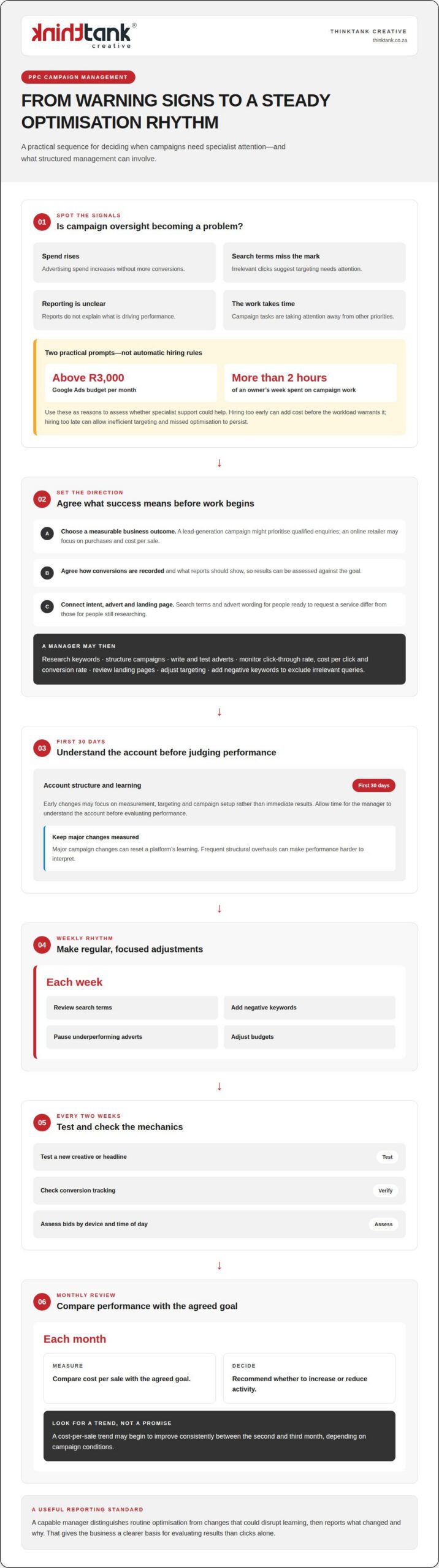
Look for recurring signs that campaigns need more structured oversight: spend rises without more conversions, search terms attract irrelevant clicks, or reports fail to explain performance. A PPC manager researches keywords, structures campaigns, writes and tests ads, and monitors click-through rate, cost per click and conversion rate. They can also review landing pages and adjust targeting to better align the advert with the customer journey.

Two practical signals are a Google Ads budget above R3,000 per month and campaign work taking more than two hours of an owner’s week. These are prompts to assess whether specialist support could help, not automatic hiring rules. Hiring too early can add cost before the workload warrants it; hiring too late can allow inefficient targeting and missed optimisation to persist.

Define the role around a measurable business outcome before hiring. A lead-generation campaign might prioritise qualified enquiries, while an online retailer may focus on purchases and cost per sale. Set the target, establish how conversions are recorded, and agree what reports should show. In South Africa, campaign planning should account for applicable tax treatment, privacy considerations when handling personal information, and advertising standards for accurate claims. A manager should consider these when setting up tracking, handling data and reviewing ads.

Keyword strategy should connect customer intent with your offer and landing page. For example, a campaign aimed at people ready to request a service needs different search terms and advert wording from one targeting people at the research stage. The manager can review search terms, add negative keywords to exclude irrelevant queries and test advert variations. This helps focus budgets on searches that better match the campaign objective.

Expected results timelines

Allow time for the manager to understand the account before judging performance. The first 30 days are usually spent on account structure and learning, so early changes may focus on measurement, targeting and campaign setup rather than immediate results. A cost-per-sale trend may begin to improve consistently between the second and third month, depending on campaign conditions.

Ongoing optimisation needs a measured rhythm. Each week, the manager can review search terms, add negative keywords, pause underperforming ads and adjust budgets. Every two weeks, they can test a new creative or headline, check conversion tracking and assess bids by device and time of day. Each month, they can compare cost per sale with the agreed goal and recommend whether to increase or reduce activity.

Major campaign changes can reset a platform’s learning, so frequent structural overhauls can make performance harder to interpret. A capable manager distinguishes routine optimisation from changes that could disrupt learning, then reports what changed and why. This gives the business a clearer basis for evaluating results than clicks alone.

How much does it cost to hire a PPC specialist?

In South Africa, the cost of hiring a PPC specialist depends on the role, workload and engagement model. Freelance work, an agency contract and a permanent appointment each have different cost structures. Compare the work included, not just the fee or salary: campaign strategy, account management, reporting and conversion tracking may fall under different scopes.

Before interviewing candidates, define what the role needs to deliver. List the platforms, campaign types, target audience and business outcomes involved. For example, managing Google Ads search campaigns involves different day-to-day work from coordinating paid search, display and social campaigns. This scope helps you identify a specialist suited to your account, rather than someone whose experience only matches the job title.

Evaluate evidence rather than broad claims. Ask candidates to explain a campaign they managed, its objective, the decisions they made and how they measured results. A strong response connects changes to outcomes such as conversion rate or cost per sale, and explains what the data couldn’t show. If an account is confidential, a candidate can describe their process without disclosing client information.

Ask: “How would you structure campaigns for our goals?”, “Which metrics would guide your decisions?” and “How do you report results and explain underperformance?” Then ask how they would approach a landing page with relevant clicks but few conversions. Their reasoning should connect targeting, advert messaging, tracking and the customer journey.

Experience gives useful context, but it doesn’t replace clear examples. A common PPC manager qualification is 3-5 years in PPC management, digital advertising, search engine marketing or a related field. Google Ads and Meta Blueprint certifications are preferred qualifications in some role descriptions. Treat these as useful signals, then explore how the candidate applies that knowledge to accounts with comparable objectives and complexity.

Estimate the total hiring cost by identifying what each arrangement includes. A permanent employee involves salary and associated employment costs, as well as training, equipment and management time. An agency or freelancer may charge for a project or ongoing management, with the agreed scope determining what work is covered. For any option, costs depend on account complexity, platforms, reporting needs and the level of strategic involvement. A service fee depends on the case and is provided after a quote request.

Use consistent criteria to compare candidates or proposals. Record agreed responsibilities, reporting frequency, account access, campaign data ownership and how strategic changes will be approved. For example, a candidate who clearly explains conversion tracking and reporting may be a better fit than one who offers only a list of platform credentials. Choose the arrangement that matches your workload and the expertise your campaigns need.

Agency fees and in-house hiring costs

Compare what each arrangement covers before weighing its cost. A PPC agency may provide campaign strategy, implementation and ongoing optimisation under a project contract or retainer. An in-house PPC manager is a full-time employee responsible for the company’s paid campaigns. The models differ in commitment, team structure and how much specialist capacity is available.

A project contract can suit a defined need, such as restructuring an account or creating a campaign plan. A retainer supports continuing work, including campaign monitoring, advert copy testing and performance reporting. Scope matters: an agreement covering Google Ads search campaigns differs from one that includes several platforms, landing pages and ongoing optimisation.

With an in-house hire, salary is only one part of the employment cost. Factor in recruitment, benefits, equipment, management time and ongoing training. PPC platforms and advertising practices change, so a permanent specialist needs continuing development to maintain relevant technical skills. The role also needs a steady workload to make dedicated capacity productive.

That workload creates a clear trade-off. An employee can build detailed knowledge of your products, customers and internal priorities, then coordinate PPC with other teams. However, fixed employment costs remain if campaign demand falls. For a business with seasonal activity, you may be paying for capacity that is less useful during quieter periods.

An agency offers a different capacity model through contracted work. A project can address a specific need, while a retainer provides ongoing management. The agreement should clarify responsibilities, including strategy, implementation, advert copy, reporting and optimisation. This helps distinguish active campaign management from a narrower arrangement covering selected tasks only.

Build a like-for-like comparison with these steps:

For example, a business with a continuing stream of campaigns may make good use of an employee’s dedicated focus. A business needing a defined account rebuild followed by a lighter workload may prefer project-based support. Neither structure is automatically cheaper. Workload, scope and the need for ongoing expertise shape the comparison.

Choose the model that fits the work, not just the label. A clear scope makes agency proposals easier to assess, while a defined role helps establish the full commitment of an in-house hire. Compare responsibilities and expected capacity first, then decide which arrangement aligns with your campaign needs over time.
When to Hire a PPC Manager or Choose In-House Management

Certifications and relevant experience

Assess credentials alongside practical campaign experience. Google Ads and Meta Blueprint certifications can indicate platform knowledge, but they don’t show how a specialist applies it to your business goals. Ask candidates to explain how their training informs decisions about targeting, bidding, advert formats and conversion measurement.

Relevant experience means more than having managed an advertising account. Look for work with similar objectives, customer journeys and campaign complexity. For example, a candidate who has managed lead-generation campaigns should be able to explain how they assessed enquiry quality, not just click volume. Ask what they changed, why, and how they judged the effect.

Use a structured review to compare candidates fairly:

Technical skills need to go hand in hand with sound judgement. A specialist may understand conversion tracking but still need to determine whether a recorded action represents a valuable enquiry. Ask how they validate tracking, investigate discrepancies and use the data. Their explanation should show a clear method, rather than relying on platform terminology alone.

Test strategic thinking with a realistic scenario. Describe a Google Ads campaign that receives relevant clicks but few enquiries. Ask how the candidate would investigate the search terms, advert promise, landing-page relevance and conversion setup. A considered answer explores possible causes before recommending changes, rather than immediately increasing bids or replacing every advert.

Platform knowledge also needs regular development. Advertising interfaces and features change, so ask how the specialist keeps their skills current and applies new learning. A useful response might describe a recent platform change they evaluated, the business objective it related to and how they decided whether to use it. This shows whether their learning informs deliberate campaign decisions.

Finally, assess how the specialist will work with your team. Ask who will manage the account, how recommendations are prioritised and what reporting will make progress clear. For an in-house appointment, discuss collaboration with sales or customer-service colleagues who can clarify lead quality. For external support, establish how campaign context and feedback will inform optimisation.

Choose a specialist whose experience matches your campaign needs and whose reasoning you can follow. Certifications offer one useful signal; practical examples, disciplined measurement and clear communication show how that knowledge may translate into day-to-day account management.

PPC management fees and media budgets

Separate media budget from management fees when assessing a PPC plan. Media spend pays for advertising on platforms such as Google Ads; the management fee covers professional work. Combining the two obscures how much goes towards reaching an audience and how much funds strategy, optimisation and reporting.

Set the media budget against a defined business outcome. A lead-generation campaign might prioritise qualified enquiries, while an online retailer may assess purchases and revenue. The PPC manager can use these goals to recommend how to allocate budget across campaigns, then monitor whether spend is producing relevant traffic and conversions. Click volume alone doesn’t show whether advertising supports business performance.

Budget size also affects the potential cost of inefficiency. A market fact notes that 20% of wasted ad spend can exceed the campaign management fee once a monthly budget is above R3,000. This makes account oversight especially relevant as spend grows, but the figure isn’t a universal benchmark for every business. Campaign structure, targeting and conversion tracking all influence whether spend is being used effectively.

Ask for a clear breakdown of the work covered by any management arrangement. A proposal should distinguish account setup from ongoing optimisation, and state whether keyword strategy, advert copy, creative testing, reporting and landing-page recommendations are included. For example, a plan covering bid changes alone may not address weak messaging or a landing page that fails to convert.

Agree how budget decisions will be reviewed before campaigns begin. The manager should report spend alongside measures tied to the business goal, such as cost per sale or qualified lead volume. A monthly review can help decide whether to maintain, increase or reduce investment, while regular monitoring can identify search terms or adverts that need attention sooner.

Revenue attribution needs careful interpretation. A sale may follow several interactions, while a lead may need follow-up before its value becomes clear. The manager should explain how conversions are recorded and how reporting connects advertising activity with business outcomes. This gives you a more useful basis for evaluating media spend than platform-reported clicks alone.

Use these points to frame a budget discussion:

For a more coherent customer experience, explore campaign creative and social media alignment alongside paid activity. A consistent message across adverts and social channels can help customers recognise the offer as they move between touchpoints.

ThinkTank Creative

ThinkTank Creative can help you consider PPC management alongside the wider digital experience that supports your campaigns. Turn to the team when you’re assessing how paid activity fits with your website, social channels and brand presentation, or when campaign traffic reaches a website that needs a clearer customer journey.

Website Design and Development, Social Media Marketing, creative design, and Logo and Corporate Identity Design can help create a more cohesive presence around your marketing. The right priorities depend on your goals, audience and current digital foundations. A conversation can clarify how these elements fit as you decide how to manage paid campaigns and what support your business needs.

Contact ThinkTank Creative to discuss your marketing priorities.

Make your next move with clarity

Deciding when to hire a PPC manager is ultimately about creating the right conditions for your campaigns to be managed well. Consider whether your goals are clear, whether someone can act on performance insights, and whether your current arrangement gives campaigns the attention they need. A considered choice can help align marketing activity with the direction you want your business to take.

ThinkTank Creative can help you consider how paid campaigns fit within your broader digital presence. Use a conversation with the team to clarify your priorities, identify where your marketing needs greater alignment and decide what support makes sense for your next stage.

Contact ThinkTank Creative to discuss your marketing direction and take your next step with confidence.

Frequently Asked Questions

What does a PPC manager do?

A PPC manager oversees the decisions that connect paid advertising with business objectives. Beyond adjusting campaigns, they coordinate information from sales or customer service so lead quality can inform targeting and messaging. For example, if enquiries repeatedly lack a required service, the manager can use that feedback to refine the searches and audiences that campaigns prioritise.

How long until I see results with a specialist?

Initial account analysis and restructuring commonly take the first 30 days; cost per sale may start dropping consistently between the second and third month. The pace depends on factors such as conversion volume, the sales cycle and tracking quality. A business with longer consideration periods should assess qualified leads and pipeline movement, rather than expecting every sale to appear immediately in advertising reports.

What signs indicate a business should hire a PPC manager?

Consider professional management if paid campaigns are a recurring responsibility without clear ownership, or if decisions stall because nobody can interpret performance data. Knowing when to hire a PPC manager also depends on whether sales feedback reaches the person managing campaigns. If enquiries arrive but you can’t identify which campaigns attract suitable prospects, specialist oversight can connect that insight with campaign decisions.

How much monthly ad spend justifies hiring a PPC manager?

A monthly Google Ads budget above R3,000 is a useful point to review whether specialist oversight makes sense, not a universal hiring threshold. For deciding when to hire a PPC manager, consider account complexity, campaign workload and the value of each conversion alongside spend. A smaller budget may still merit support if campaigns are strategically important, whilst a larger budget needs a clear plan for monitoring performance and allocating investment.

Should a business hire an in-house PPC manager, freelancer, or agency?

Choose based on how continuous and varied the work is. An in-house manager suits a business that needs close internal collaboration and a steady stream of campaign decisions. A freelancer can suit a more defined specialist workload, while an agency may fit businesses seeking broader expertise across their campaign needs. For example, seasonal activity may make flexible external support more practical than a permanent role.

What tasks and results should a PPC manager be responsible for?

Set clear responsibility for campaign planning, account management, measurement quality and reporting. Agree how the manager will communicate changes, protect account access and connect advertising results with business outcomes. For example, a lead-generation campaign should distinguish submitted forms from qualified prospects where the business can provide that feedback. Assess results against agreed objectives, not clicks alone.

How can a business assess whether its PPC campaigns are underperforming?

Compare campaign outcomes with business targets and the quality of customers or enquiries generated. A high click-through rate can still conceal weak commercial performance if visitors don’t take useful action. Check whether conversion records match actual enquiries or sales, then examine performance by campaign and audience. This helps distinguish measurement problems from issues with targeting, messaging or the landing page.

What skills and certifications should a PPC manager have?

Look for analytical judgement, clear communication and hands-on experience with the platforms your campaigns use. Google Ads or Meta Blueprint certification can indicate platform learning, while examples of campaign decisions show how those skills are applied. Ask how the candidate diagnosed a challenge, chose a response and evaluated the outcome. Their explanation should make the reasoning clear, rather than relying on technical terms alone.
Ways to Promote Your New Website and Attract More Users

A new website needs a launch plan, not just a launch date. To learn how to promote your new website launch, begin with two marketing channels and use them consistently. Email and social media can announce the site, show people what’s new and guide them towards useful pages.

You’ve invested time in building a website that reflects your business; attracting visitors takes a deliberate next step. This guide shows how to build interest through email, social media, guest blogging, press releases and paid advertising, so launch day isn’t your only chance to be seen.

Give the announcement a clear purpose and coordinate it across channels that suit your audience. Plan the rollout over several weeks so each message supports the next and gives potential visitors a reason to explore.

Key Takeaways

  • Choose two promotional channels to start, then tailor your launch messages to the people you want to reach.
  • Use email to tell existing customers what’s new and guide them to relevant pages on your website.
  • Share useful, engaging social content and make the next step clear, whether that’s visiting a page or joining your mailing list.
  • Explore guest posts with local groups and coordinate press releases or paid adverts with the experience visitors find on your site.
  • Plan announcements over several weeks so each message builds on the last and keeps your launch visible beyond its first day.

1. Email marketing

Measure website launch marketing by connecting each email to activity on your website. Use tagged campaign links, then compare email analytics with website traffic, page visits and completed actions, such as an enquiry or signup. This shows which messages bring relevant visitors, not just opens.

Start with people who already know your business. Email customers and members with a clear announcement, explain what has changed and show how the new site helps them. For example, point customers to a refreshed service page or a simpler way to find information. Make the next step obvious by linking directly to the page that delivers the promised benefit.

Give friends, family and existing clients a personal heads-up before or on launch day. Invite them to visit the site and share the announcement with someone who may find it useful. Tailor each note: a client might value a new portfolio page, while a friend may be glad to pass on your business details. Personal relevance makes a message feel considered, not like mass promotion.

Add an email signup form to useful places on your new website, such as the homepage, blog or contact page. Explain what subscribers will receive, such as launch updates, practical advice or new content. Ask only for the information needed to sign up, and make the call to action clear. Social posts can direct interested people to the form, turning launch attention into an audience you can reach again.

A giveaway can encourage signups when the reward suits your business and audience. For example, offer a 5% discount on services in exchange for joining the newsletter. Make the entry steps clear and ensure the prize feels worthwhile to participants. Then follow up with useful emails, rather than relying on the giveaway announcement alone to maintain interest.

Coordinate email and social media so both channels reinforce the same launch message. Share a short announcement on your social accounts, then send subscribers a more detailed email with direct links to relevant pages. Adapt the wording for each audience, but keep the core message consistent. This gives people more than one way to discover the site without making every post or email identical.

Plan the email around the launch, prepare it before publishing and test its links on mobile and desktop. After sending, review which messages attract visits and meaningful actions. Use those insights to refine the next email, whether by changing its subject, destination page or call to action.

2. Social media promotion

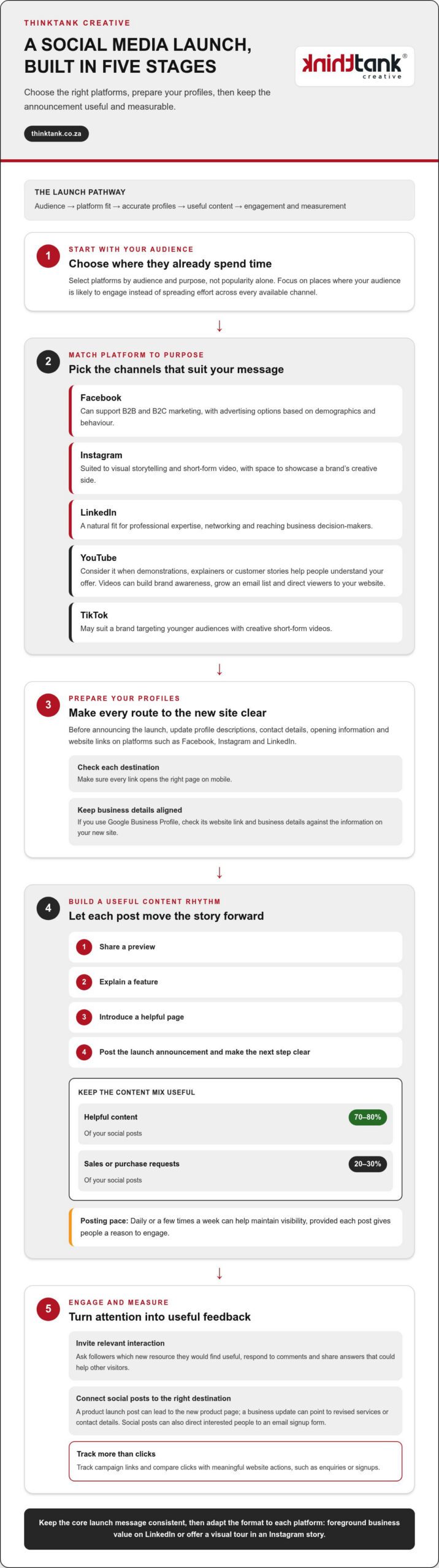
Make your website launch visible where your audience already spends time. Share a clear announcement across your social media accounts, then direct each post to a relevant page. A product launch post could lead to the new product page, while a business update might point visitors to revised services or contact details.

Choose platforms by audience and purpose, not by popularity alone. Facebook can support both B2B and B2C marketing, with advertising options based on demographics and behaviour. Instagram suits visual storytelling and short-form video, giving brands space to showcase their creative side. LinkedIn is a natural fit for professional expertise, networking and reaching business decision-makers.

Consider YouTube if demonstrations, explainers or customer stories help people understand your offer. Videos can build brand awareness, grow an email list and direct viewers to your website. TikTok may suit a brand targeting younger audiences with creative short-form videos. Focus on platforms where your audience is likely to engage instead of spreading effort across every available channel.

Refresh your online profiles before announcing the site. Update profile descriptions, contact details, opening information and website links on platforms such as Facebook, Instagram and LinkedIn. Check that each link opens the right page on mobile. If you use Google Business Profile, make sure its website link and business details match the information on your new site.

Build a useful content rhythm around the announcement. Share a preview, explain a feature, introduce a helpful page, then post the launch announcement with a direct call to action. Aim to make helpful content 70-80% of your social posts and sales or purchase requests 20-30%. Publishing daily or a few times a week can help maintain visibility, provided each post offers a reason to engage.

Encourage interaction with specific prompts. Ask followers which new resource they’d find useful, respond to comments and share answers that could help other visitors. Track campaign links and compare clicks with meaningful website actions, such as enquiries or signups. Social content can also guide interested followers to an email signup form, helping you stay in touch after launch.

Keep the message consistent, but adapt its format to each platform. A LinkedIn post can foreground business value, whilst an Instagram story can offer a visual tour. For support shaping a connected social media campaign, align each post with the page it promotes and the action you want visitors to take.

3. Guest blogging

Reach new readers by contributing useful articles to websites your audience already trusts. A South African business could write for a local chamber of commerce or community organisation, explaining how its website helps residents solve a familiar problem. A relevant guest post introduces your expertise, gives readers a reason to visit and directs interested visitors to a focused page.

For local opportunities, approach your chamber of commerce, business associations, neighbourhood groups and community publications. These can help you find organisations whose readers live or work near your business. Ask whether they accept guest contributions, then suggest a specific topic showing how your website helps local residents. Keep the pitch relevant to their audience rather than making it a general advert.

Choose a subject that offers practical value and naturally connects to a page on your site. For example, a South African accountant might write about preparing records for a small business, then link readers to a relevant service page. A home-care business could explain how families compare local support options. Answer the subject fully, with the website link offering a useful next step.

Shape each contribution around the publication’s audience and editorial style. Read existing articles, note the questions they address and propose a fresh angle. Use clear headings, concrete examples and accurate information. Don’t republish a page from your website as a guest article. Original, useful content earns attention, while a relevant author biography can explain your expertise and direct readers to your site.

Podcast interviews offer another way to introduce your work. Look for South African shows covering your sector, local enterprise or issues your customers care about. Pitch a discussion topic, such as common mistakes in your field, rather than asking for a platform to promote your launch. Prepare examples and a concise explanation of what listeners can find on your website.

Make every referral easy to track. Link to the page that best matches the guest article or interview, rather than sending everyone to your homepage. Use campaign tracking in the link and review referral traffic in your analytics. Compare visits, enquiries and other meaningful actions to see which publication or podcast attracts engaged visitors. Use these results to improve your outreach.

Guest blogging supports visibility, but works best alongside on-page optimisation. Check that the destination page answers the question raised in your contribution, works well on mobile and offers a clear next step. For instance, a local guide should lead to relevant details, not an unrelated announcement. Build relationships with editors and community organisers by responding thoughtfully to feedback and suggesting useful follow-up topics.

South African chambers of commerce, business associations, neighbourhood groups and community publications can help you reach local readers. Approach those whose audiences live or work near your business and ask whether they accept relevant guest contributions.

Ways to Promote Your New Website and Attract More Users

4. Press releases and paid advertising

Give journalists a clear reason to cover your website launch. Lead a press release with what is genuinely new, such as a South African service becoming available online or a useful resource for local residents. Include the launch date, intended audience, a concise business description and a contact for media enquiries. Send it to relevant publications and journalists instead of widely distributing a generic announcement.

To earn backlinks and press coverage, offer a publication a timely local story, expert comment or original resource its readers can use. Make the website link relevant to the story, such as a detailed guide that supports the article. Follow up with a concise pitch and make it easy for the journalist to verify names, details and quotes.

Pay-per-click advertising can put a relevant page in front of people already searching for a product or service. Choose a clear target, such as a location or search phrase, then match the advert to a landing page that answers that need. A campaign estimate suggests that an advert shown to 10,000 people could produce 100-200 buyers or subscribers at a 1-2% conversion rate. Treat this as a planning estimate, not a forecast for every campaign.

Build the advert around what the searcher is looking for. For example, a South African business promoting a booking page could target searches related to its service and the areas it serves. Write specific advert copy, use relevant keywords and send clicks to the booking page rather than the homepage. If the advert and landing page don’t match, visitors may lose trust and leave before taking action.

Paid advertising carries financial risk: clicks can use your budget without producing enquiries or sales. Set a spending limit, define what counts as a conversion and review performance before expanding. Consider how competitive your target terms are, whether the landing page is relevant and what each conversion is worth. Pause poorly matched adverts and refine the message or destination before spending more.

Don’t launch adverts before the destination page works properly. Broken links, unclear calls to action and slow-loading pages can waste paid traffic. Another common mistake is relying on paid promotion alone; combine it with useful content and direct announcements. Avoid broad targeting that attracts unlikely customers, and don’t judge success by impressions alone.

Review results by campaign and landing page. Compare clicks with conversions, enquiries and signups, then identify which message attracts visitors who take meaningful action. Press coverage and paid search serve different purposes: editorial attention can introduce your story, while PPC can reach people expressing intent through a search engine. Use each channel deliberately and refine your approach based on what the data shows.

5. Planning website launch announcements

Before launching a new website, complete checks on its pages, links, forms and mobile display. Keep the site marked as coming soon until those checks are complete or your website professional confirms it’s ready. Verify that 301 redirects work correctly, since working redirects prevent 404 errors when the new site goes live.

A practical plan for promoting your new website launch starts with a schedule covering several weeks. Set the launch date, prepare key messages and assign each task an owner, audience and purpose. For example, plan an email for existing customers, a social post for followers and a press release for relevant publications. Allow time to review every message before it goes out.

Make the announcement useful, not just celebratory. Explain what has changed, who the website serves and where visitors should start. A new booking feature, updated service information or downloadable guide gives people a clear reason to explore. Use one main call to action in each message, such as viewing the guide or submitting an enquiry.

Prepare launch-day material in advance. Draft social posts, email copy and a short announcement for your business blog, then check that each links to the intended page. Keep the message consistent across channels while adapting its format for each audience. A concise social post can introduce the update; a blog post can explain its purpose in more depth.

Include search engine readiness in the plan. Submit or share your sitemap with Google so the search engine can discover the website’s pages. Check that old page addresses point to their relevant new destinations through working 301 redirects. Make sure important pages have clear titles and descriptions, and that visitors can reach key information without dead ends.

On launch day, publish the site before sending announcements, then open the links in your messages to make sure they work. Monitor analytics for referral traffic, page visits and completed actions, such as enquiries or signups. Record which channels brought visitors and which pages held their interest. Use those findings to shape follow-up messages and decide how to promote your new website launch beyond the initial announcement.

Assign time after launch to respond to questions, fix broken links and share useful updates. A planned follow-up can highlight a page people missed or answer a question raised by customers. For a coordinated approach to your website launch planning, map each announcement to its audience, destination page and desired action.

ThinkTank Creative: Website Design and Development

ThinkTank Creative helps businesses build a consistent digital presence through custom website design and development. If you’re preparing to launch, your website should support the same message and identity as your promotional activity. A clear structure, purposeful page content and cohesive creative design give visitors a consistent experience from announcement to action.

For businesses refreshing their online presence, ThinkTank Creative can also align social media marketing and logo and corporate identity design with the website. This coordinated approach connects the brand people see in a campaign with the pages they visit afterwards. Consider this support when you need a new site or a more unified launch across digital channels.

To discuss your website project, contact ThinkTank Creative or visit thinktank.co.za.

Build on your launch momentum

Treat launch day as the start of an ongoing relationship, not the finish line. A thoughtful approach to promoting your new website launch connects each campaign’s promise with the experience visitors find when they arrive. Use early responses to understand what people value, where they hesitate and which pages need more attention. Then refine the site and future communications around those signals, keeping the experience relevant as your business evolves.

Look beyond immediate traffic when deciding what to improve next. Consider whether visitors understand your offer, find the information they need and know what action to take. These observations can guide decisions about content, design and the journey from first interaction to enquiry. Small, considered refinements help keep your website aligned with customer needs and your business direction.

When you’re ready to create a more cohesive digital presence, ThinkTank Creative offers Website Design and Development, Social Media Marketing and Creative design. These capabilities can bring your website, campaign visuals and social content together around a consistent brand direction.

Contact ThinkTank Creative to discuss your next step and build on your launch with confidence.

Frequently Asked Questions

How do I attract more users to my website?

Give the people you want to reach a clear reason to visit and a useful next step once they arrive. For example, a South African consultancy could publish a practical guide answering a question prospective clients often ask, then link it to a relevant service page. Make navigation straightforward, explain benefits in plain language and ensure key pages work smoothly on mobile devices.

How do I get traffic to my website?

Combine discovery with reasons to return. Publish useful pages that answer your customers’ questions, then share them through channels where those customers are active. Ask relevant business partners or community organisations to mention a resource when it genuinely helps their audience. Review which sources bring visitors who explore further or enquire, then focus your effort on the sources that support your business goals.

What’s the cheapest way to promote a new website?

Start with channels you already control, such as your social accounts, customer conversations and business email list. Share a useful resource rather than a bare announcement, and invite relevant partners to pass it on if it helps their audience. These approaches avoid paid media spend, though they still take time to create, publish and respond to useful content consistently.

How can you promote a new website using SEO and Google Search Console?

Use SEO to make important pages clear to search engines and valuable to visitors. In Google Search Console, check whether key pages are indexed, review the queries generating impressions and identify pages with impressions but few clicks. Use the findings to improve page titles, descriptions and content relevance. Submit your sitemap, then revisit the reports as your site gains search visibility.

How do you announce a website launch on social media and email?

Make the announcement specific to each audience. A customer email can explain how a change affects an existing service, while a social post can introduce a useful new resource to a wider audience. Use a clear subject line or opening sentence, identify who benefits and direct people to the relevant page. Make sure the message remains accurate if someone shares it without extra context.

How can paid search and social media ads drive traffic to a new website?

Paid search can reach people actively looking for a relevant service, while social adverts can introduce it to audiences selected by interests or other targeting options. Match each advert to a dedicated landing page, define the action you want visitors to take and monitor conversions alongside clicks. If visitors arrive but don’t act, review the advert’s promise, audience and landing-page relevance before increasing spend.

What website launch promotions, offers or giveaways attract visitors?

Choose an offer that is genuinely useful to your intended audience, such as a downloadable checklist, introductory resource or relevant service benefit. Explain the entry steps clearly and make sure the perceived value of the reward matches or exceeds the effort required to participate. Keep the promotion connected to your business, then direct entrants to a page where they can explore the offer further.

How much should you budget to promote a new website in South Africa?

Start with free options, such as regular, engaging social media posts.

Digital Growth Strategy for Business: A Practical 2026 Framework

What if your website, search activity, paid advertising and social media all supported the same business outcome instead of competing for attention? Digital activity often grows one channel at a time, making it hard to tell what deserves investment or whether marketing is moving the business forward. A digital growth strategy for business brings those efforts into a connected, measurable plan.

The answer isn’t simply to add another platform or campaign. Start with clear business priorities, understand how customers discover and evaluate your offer, then give each channel a purposeful role. Progress is easier to assess when the measures you track reflect what matters to the business, not just activity for its own sake.

This practical 2026 framework will help you set priorities, connect your website, SEO, paid advertising, social media and content, and choose useful measures. You’ll learn how to turn scattered digital activity into a coherent plan that can be reviewed and refined as your business and customer needs evolve, from setting goals and understanding your audience to coordinating channels and measuring progress.

Key Takeaways

  • A digital growth strategy for business connects your objectives, customer needs and digital activity in one practical plan.
  • Give your website a clear role in helping customers understand your offer and take the next step.
  • Compare SEO, paid advertising, social media, content and website improvements by relevance, capacity and how progress can be assessed.
  • Turn priorities into action by recording who is responsible, what each task depends on and which customer action it supports.
  • Strategy, website design and digital marketing can work together to support a more cohesive approach.

What a digital growth strategy for business actually connects

When a website, search activity, social posts and advertising are planned separately, it can be hard to see which priorities matter or whether the work is supporting progress. A digital growth strategy brings these moving parts in line, so each decision has a purpose beyond simply keeping a channel active.

A digital growth strategy is a plan that connects business objectives and customer needs to purposeful digital activity and measurable outcomes. It’s broader than a channel list, campaign calendar or website project. Those can all be part of the plan, but strategy explains why they belong, who they serve and how they relate to the business. This differs from the broader concept of digital transformation, which describes how digital technologies can reshape business models and operations.

For an overview of how strategic choices can shape a business’s position, watch this video:

Start with business outcomes, not a list of platforms

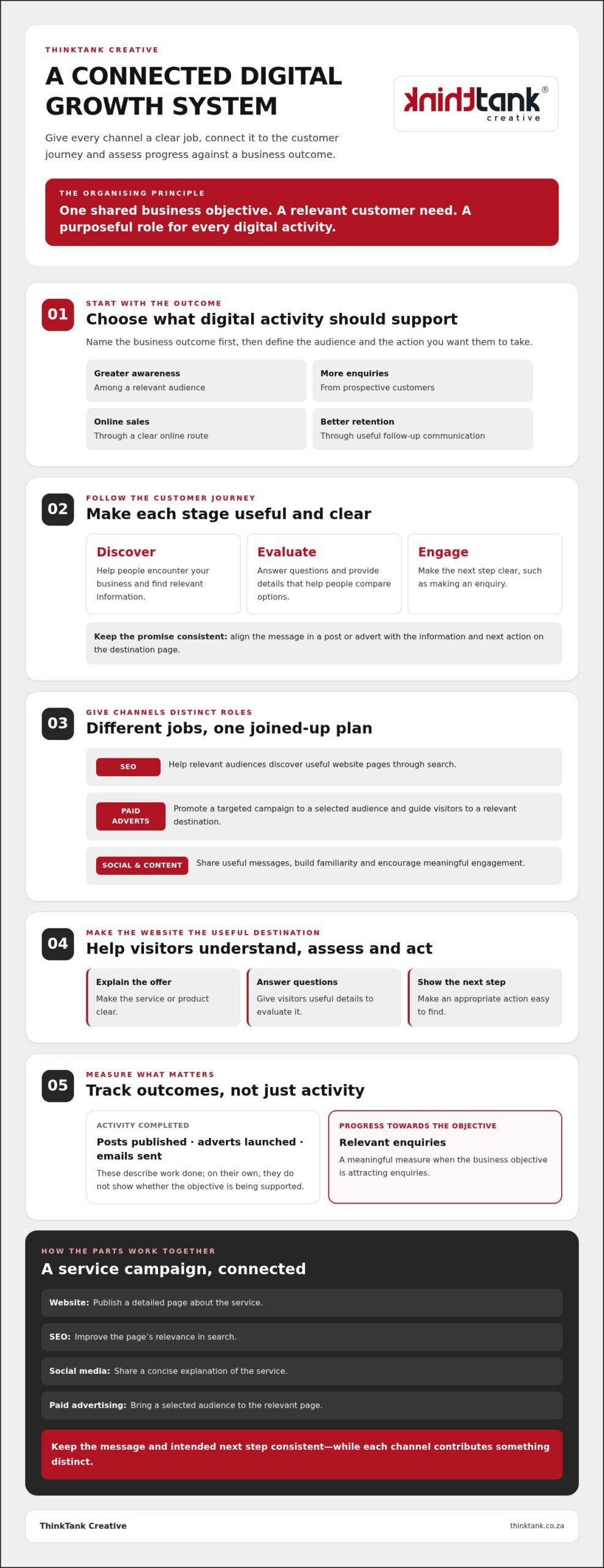
Begin by naming the business outcome you want digital activity to support. It could be greater awareness among a relevant audience, more enquiries from prospective customers, sales through a clear online route or better retention through useful follow-up communication. Define the audience and the action you want them to take. If the priority is enquiries, for example, specify which prospects you want to reach and what you want them to do after finding your business.

Separate outcomes from activity measures. Publishing posts, launching adverts and sending emails describe work completed. On their own, they don’t show whether the objective is being supported. Choose measures that reflect the intended action, such as relevant enquiries if your objective is to attract enquiries. This makes it easier to adjust activity without mistaking busyness for business progress.

Treat the customer journey as the organising principle

Map the customer’s path from discovering your business to evaluating your offer and engaging with you. At each stage, consider what they need to understand, what questions might hold them back and what a useful next step looks like. Someone who encounters your brand on social media may need a clear route to detailed information. A prospective customer comparing options may need relevant service details before making an enquiry.

Consistency matters throughout that journey. If a post sets one expectation but the landing page is unclear, confidence can falter between discovery and evaluation. Align your message, useful information and next action so customers can move forward without unnecessary friction. For more on clarity and ease of use, explore this website user experience guide.

A digital growth strategy for business gives you a practical way to make considered choices: connect each priority to a customer need, a business objective and a meaningful measure. That shared logic gives channels a role and makes the overall plan easier to assess and refine.

How a connected digital growth system works across channels

Channels create more value when they support one another rather than operate as separate projects. A useful digital growth strategy for business gives the website a central role: it helps visitors understand your offer, find answers to their questions and take a relevant next step, such as making an enquiry.

Channels work best when planned around the same audience, objective and next customer action. This turns channel selection into a connected system, with each activity contributing something distinct to the customer experience. The Research Handbook on Digital Strategy offers a broader academic perspective on managing digital strategy as technologies and business environments evolve.

Give each digital channel a clear job

Choose channels according to what your audience needs and what the business is trying to achieve. Search engine optimisation (SEO) can help relevant audiences discover useful pages through search. Paid advertising can promote a targeted campaign to a selected audience, while social media supports ongoing communication and interaction. Content creation gives these channels useful material to share, such as service explanations, answers to common questions or practical insights.

For example, a business promoting a particular service could publish a detailed website page, improve its search relevance, share a concise explanation on social media and use paid advertising to bring a selected audience to that page. Each element has a different job, while the message and intended next step stay consistent. This makes it easier to see how the activity fits together without assuming that any one channel will deliver a particular result.

Make the website support the whole journey

Make sure the destination matches the promise that brought someone there. If an advert promotes a service, the linked page should explain that service, provide the information visitors need to evaluate it and make the next action clear. A prominent enquiry route may suit someone ready to engage. A visitor still comparing options may first need clear details about what the service involves.

Design matters, but appearance alone isn’t enough. Intuitive navigation, readable content, working forms and a clear page structure all affect whether visitors can find what they need and proceed confidently. These considerations are central to custom website design in South Africa, where planning a site around its purpose helps align its content and functionality with the wider digital system.

Before launching activity, map each channel to its destination, message and intended action. ThinkTank Creative’s digital services bring together website design and development, SEO, paid advertising, social media and content work.

Digital Growth Strategy for Business: A Practical 2026 Framework

How to prioritise digital growth opportunities and channel trade-offs

You don’t need to use every channel at once. A practical digital growth strategy for business focuses on opportunities that fit your audience, objective and available resources. Before committing, ask four questions: Is this relevant to the customer? Does it support a business priority? Can the team sustain the work? Can you assess whether it’s helping?

Choose focus areas that fit the business

Start with customer needs, not platform popularity. If prospective customers are already searching for the service, improving useful website pages and their search visibility may be a sensible priority. If the destination page is unclear, promoting it more widely could send visitors into a confusing experience. Improve the page first so later activity has a clearer destination.

Sequence work rather than launching everything at once. A business might first clarify its offer and improve a key website page, then support that page with search and a focused social campaign. The right order depends on existing assets, audience behaviour and the team’s capacity to deliver consistently.

Opportunity Potential role Consider before prioritising
SEO Help relevant audiences find useful pages through search. Are there valuable pages to improve, and can the business maintain them?
Paid advertising Promote a defined offer or campaign to a selected audience. Is the destination relevant, and can the campaign be monitored and refined?
Social media Share updates and encourage audience interaction. Can the business publish and respond with suitable consistency?
Content Answer questions and explain the offer across touchpoints. Can useful content be created and kept aligned with customer needs?
Website improvements Make information clearer and intended actions easier to take. Where do visitors need more clarity or a smoother next step?

Use this comparison as a starting point, not a universal ranking. Channel suitability depends on the audience, the offer, the quality of existing assets and available resources. Content planning is especially useful when it connects audience needs with organisational goals, an approach also reflected in Content Strategy on Digital.gov.

Balance digital activity with capacity and customer expectations

Every active channel needs attention: people to plan and create content, review performance and respond to customers. A channel that isn’t maintained can create a gap between what the brand promises and what visitors experience. Set a realistic publishing rhythm and clarify who owns updates, approvals and follow-up before adding more activity.

Keep service descriptions, visual identity and calls to action aligned across your website, search results and social profiles. This helps customers encounter a recognisable, coherent business as they move between touchpoints. If generating enquiries is the priority, lead generation strategies for South African businesses offer related guidance. Focus on a small set of connected priorities, then review their contribution before expanding the plan.

How to turn digital growth priorities into a practical plan

Turn your selected priorities into work people can own and review. A practical plan makes the connection between the business objective and each digital task visible, so the team knows what it is doing, why it matters and how progress will be assessed. Keep the plan concise enough to revisit as circumstances change.

  1. Clarify the objective. State the business outcome in plain language, such as improving awareness with a particular audience or generating more qualified enquiries.
  2. Understand the audience. Record who you need to reach, what they need to know and what action would represent a useful next step.
  3. Review current assets. Assess the website, existing content, search visibility and active channels. Note what is useful, what needs attention and where gaps may interrupt the customer journey.
  4. Choose priorities. Select a manageable set of actions that fits the objective and available capacity. For each, record an owner, dependencies, timing and intended customer action.
  5. Define measures. Choose indicators that relate to the task and business objective, then record the current baseline before interpreting changes.

For content work, give each planned piece a purpose, audience, owner, destination and next action. A content marketing plan template can help organise these details and keep the content connected to the wider plan.

Set useful measures and establish a starting point

Choose measures that reflect the objective, such as qualified enquiries for lead generation or relevant engagement with a key website page. Record the current position using available analytics and reporting before judging movement. A baseline offers context, not a guarantee or a benchmark to copy. Visits alone can’t show whether the right people arrived, understood the offer or became customers, so interpret activity alongside business results.

Review, learn and refine the plan

Choose a review rhythm that suits the work. A campaign may need closer attention during delivery, while longer-term activity can be assessed at planned intervals. Look for patterns, note what has changed and adjust one relevant element at a time, such as the message, channel emphasis or page experience. Measurement supports informed iteration; it doesn’t guarantee growth.

Keep a simple record of the decision, the evidence behind it and what you’ll observe next. This helps the team learn without reacting to every short-term fluctuation or changing several parts of the plan at once. ThinkTank Creative’s digital strategy services connect planning with website and marketing work.

How ThinkTank Creative can bring a digital growth strategy to life

A strategy becomes practical when the thinking and delivery work together. ThinkTank Creative works with businesses to align website design and development with SEO, digital paid advertising, social media and content creation. The work is shaped around agreed priorities rather than treating each channel as a separate project. Founded in 2001, the agency brings strategic and creative experience to this collaborative process.

Connect strategy with creative and technical delivery

Begin with discussion and research. Understanding your business needs, audience and priorities helps shape a considered direction before creative and technical work starts. ThinkTank’s in-house, award-winning design team contributes work tailored to the project, rather than relying on an assumed template or one-size-fits-all channel mix.

Website projects can span research and strategy, design, development, testing, launch, training and support. This end-to-end view considers the site as part of the wider digital system, with relevant SEO, advertising, social media and content activity connected to its role. Ongoing support is available after project completion, so the relationship can continue beyond launch.

Agree a tailored way forward

Set the scope together before planning delivery. A collaborative discussion helps clarify which activities should come first, how website work relates to marketing priorities and what the project needs to include. This creates a practical foundation for coordinating digital work without assuming every channel needs attention at once.

Cost depends on the needs and timeline discussed for the project. ThinkTank provides an estimated cost after those details have been discussed, so the proposed work reflects the project scope rather than an assumed fixed price.

The guiding idea is simple: We Do It All So You Don’t Have To. ThinkTank Creative can help shape a digital growth strategy for business around your priorities. Learn more about working with ThinkTank Creative.

Turn your next digital decision into a deliberate step

Your digital growth strategy for business doesn’t need to become another document that sits untouched. Let it guide the choices ahead: what to develop, what to pause and where your team’s attention can make the most difference. As customer needs and business priorities shift, revisit those choices and use what you learn to shape the next move.

Progress can begin with a considered conversation about where you want your business to go and what may help move it forward. ThinkTank Creative works collaboratively with businesses to shape digital direction and bring aligned creative and technical work to life. Start with a shared understanding of your priorities, not a predetermined package.

ThinkTank Creative’s digital planning and creative services can help bring your next steps into focus, with an approach shaped around your business.

Frequently Asked Questions

How much does a digital growth strategy cost for a business?

There isn’t one fixed cost for a digital growth strategy, because the scope depends on your business needs and timeline. A plan focused on refining priorities will differ from work that also includes website design and development, SEO, paid advertising or content creation. ThinkTank Creative provides an estimated cost after discussing the project’s needs and timeline, so the proposed work can reflect what matters to your business.

Can a small business use a digital growth strategy?

Yes. A small business can keep its strategy manageable by focusing on one clear audience and a practical objective, rather than trying to maintain every channel. For example, a specialist firm might improve a key service page and share useful information through one channel its customers use. Review available time, skills and budget before adding more activity, so the plan fits the business’s capacity.

How long does it take for a digital growth strategy to show results?

There’s no dependable timeframe that applies to every business. The pace depends on factors such as the channels selected, the starting condition of existing assets, the level of activity and how customers make decisions. Some indicators, such as engagement with a new page, may be visible before wider business outcomes. Set a baseline, choose review points suited to the work and avoid treating early movement as a promise of future results.

What happens if a business relies on just one digital channel?

Relying on one channel can make a business more exposed if audience behaviour changes or that channel becomes less effective for its needs. It may also leave gaps: social media attention, for instance, is less useful if interested people can’t find clear information about the offer. This doesn’t mean every business needs to be everywhere. Consider whether one channel is sufficient for your audience and provide a clear route to learn more or engage.

Is a digital growth strategy useful for both B2B and B2C businesses?

Yes. Both B2B and B2C businesses can use digital activity to help relevant audiences understand an offer and decide what to do next. The emphasis may differ: a business buyer could need detailed service information to support internal evaluation, while a consumer may want straightforward product or service details before making a purchase enquiry. Shape the content, channels and calls to action around how your customers assess options.

Can digital growth activity support offline sales as well as online enquiries?

Yes. Digital activity can help people discover a business, understand its offer and decide to make an in-person purchase or enquiry. A campaign might direct someone to a website for product details before they visit a showroom, attend an event or speak with a sales team. Make the next step clear, then consider how staff can ask customers what prompted their visit. This helps connect online activity with offline conversations. Talk to ThinkTank Creative about a digital growth strategy for your business.

Remarketing Campaign Best Practices: The 2026 Strategic How-To Guide

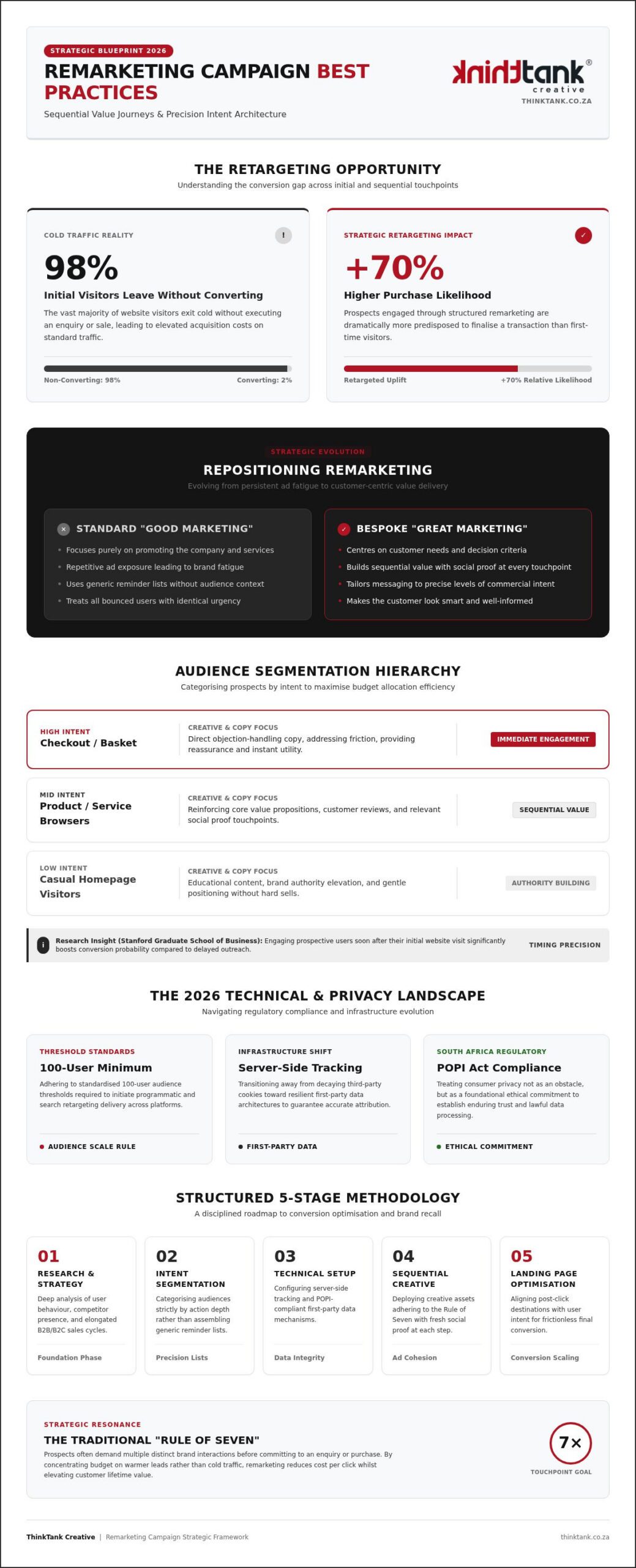
Did you know that whilst 98% of your website visitors leave without converting, those who are retargeted are 70% more likely to complete a purchase? It is a staggering reality that highlights the immense untapped potential sitting within your existing traffic. By implementing sophisticated remarketing campaign best practices, you can transform these missed opportunities into loyal customers through precise, value-driven touchpoints that respect the modern user journey.

We understand the frustration of seeing high acquisition costs on cold traffic and the concern that repetitive ads might lead to negative brand perception. You want to build a cohesive digital presence that respects your audience's privacy whilst driving measurable growth. This strategic guide provides a clear framework for segmenting your audiences and navigating the technical shifts of 2026, such as the standardised 100-user audience thresholds and the move toward server-side tracking. We will show you how to refine your creative approach to ensure every interaction feels like a bespoke invitation rather than a generic reminder.

At ThinkTank Creative, we believe that great marketing makes your customer look smart. By the end of this article, you will have the tools to improve your ROI and deliver a seamless brand experience across all digital touchpoints. We do it all so you don't have to, allowing you to focus on your business whilst we elevate your digital strategy.

Key Takeaways

  • Move beyond generic lists by categorising users based on their specific level of intent, ensuring your budget is directed toward high-value prospects.
  • Maintain brand cohesion and trust through sophisticated design principles that align your creative assets with a customer-centric journey.
  • Master the essential Research & Strategy phase required to implement remarketing campaign best practices that drive high-quality leads and measurable sales.
  • Utilise a structured 5-stage methodology to ensure your technical setup and landing pages are perfectly optimised for conversion and long-term growth.
  • Shift your perspective from chasing users to providing sequential value, evolving your digital presence from standard advertising to truly great marketing.

The Strategic Foundations of Modern Remarketing

Remarketing is often misunderstood as a digital shadow that follows users across the internet. In reality, it's a precise strategic tool designed to re-engage high-intent visitors who showed interest but did not convert during their initial visit. By understanding behavioral retargeting fundamentals, you can move beyond "Good Marketing" that merely promotes your company. We focus on "Great Marketing" that centres on the customer's needs, making them feel smart and well-informed throughout their decision-making process.

To better understand how these technical foundations are built and managed, watch this helpful guide on setting up your segments correctly:

In the South African B2B and B2C sectors, sales cycles have lengthened as consumers become more discerning and price-sensitive. You shouldn't expect a single visit to result in a conversion when competitors are only a click away. Effective remarketing campaign best practices involve creating a sequential value journey that respects the user's intelligence. Instead of repetitive ad exposure that leads to fatigue, we aim to provide new information or social proof at every touchpoint, guiding the prospect naturally toward a successful outcome.

Why Remarketing is Critical for ROI

Digital spaces are more crowded than ever, making the traditional "Rule of Seven" even more relevant for brand resonance. A prospect often needs multiple interactions with your brand before they feel confident enough to commit to a purchase or an enquiry. By focusing your spend on these warmer leads, you can significantly assist in reducing Google Ads cost per click. This strategic focus ensures that your budget isn't wasted on cold traffic, ultimately elevating your long-term brand recall and customer lifetime value.

The 2026 Privacy Landscape in South Africa

Privacy isn't a hurdle; it's an opportunity for brand transformation and building deeper trust with your audience. All data collection in South Africa must remain strictly compliant with the POPI Act to protect consumer rights. As third-party cookies lose their efficacy, successful brands are pivoting toward robust first-party data strategies that offer more reliable insights. We define POPI compliance for remarketing as a fundamental ethical commitment to user privacy that ensures every interaction is both lawful and respectful.

Audience Segmentation: The Key to Relevance

Broad remarketing lists are often the quickest way to erode a digital marketing budget. When you treat a casual homepage browser with the same urgency as someone who abandoned a shopping basket, your messaging loses its edge. Precision in segmentation ensures that your creative assets resonate with the user's current mindset, transforming a generic advert into a timely, helpful reminder. This tailored approach is the cornerstone of remarketing campaign best practices in a market where relevance is the primary currency of attention.

A strategic visionary approach requires mapping a clear hierarchy of intent. High-intent users, such as those who reached the final checkout stage, require direct, objection-handling copy. Conversely, top-of-funnel visitors benefit from educational content that reinforces your brand's authority. This level of granular tracking is only possible when you invest in custom website design that prioritises data integrity and user journey mapping from the ground up.

The timing of these interactions is just as vital as the content itself. According to Stanford Graduate School of Business retargeting research, engaging users soon after their initial visit significantly boosts return rates and conversion efficacy. However, this momentum must be balanced with strict exclusion discipline. Failing to remove converted users from your active lists leads to wasted spend and customer annoyance, which can quickly tarnish your brand's reputation.

Behaviour-Based Segmentation Strategies

Distinguishing between "lurkers" and "active researchers" allows you to allocate your budget more effectively. If a visitor spends several minutes on a specific service page, they've signalled a high level of interest that warrants a deeper nurture sequence, such as a case study or a detailed testimonial. For those who interact with lead magnets but stop short of a booking, your remarketing should focus on providing the next logical step in their research journey, rather than a repetitive sales pitch.

Technical Implementation and Compliance

Success on a national scale requires a robust technical foundation using the Meta Pixel and Google Tag Manager. In South Africa, this setup must be balanced with a commitment to privacy. Your cookie consent banner should be a user-friendly, POPI Act compliant interface that builds trust rather than creating friction. By integrating these segments with your CRM, you create a unified view of the customer journey. This synergy ensures that your PPC advertising efforts are always informed by real-time sales data, allowing for more agile and effective campaign adjustments.

Creative Excellence and Brand Cohesion

Visual identity serves as the silent ambassador of your brand, providing a sense of continuity that bridges the gap between a visitor's initial interest and their final decision. Within our award-winning design team, we approach the "Visualisation" stage of creative development with meticulous care, ensuring that every asset reflects the bespoke craftsmanship your brand deserves. Maintaining this visual consistency is a non-negotiable anchor of trust, especially when implementing remarketing campaign best practices that target users who are already familiar with your digital presence.

However, even the most stunning visuals can lose their impact if shown too frequently. Ad fatigue is a genuine threat to ROI, typically manifesting when users see the same creative more than three or four times within an active window. To maintain engagement, you must embrace best practices for retargeting advertising campaigns, which include rotating your creative assets every two to four weeks. This proactive refreshing prevents your brand from becoming background noise and preserves the integrity of your professional reputation.

Recognition often begins with the smallest details. A strong, professional logo design ensures that your ad units are instantly identifiable, even on a cluttered social media feed or a busy mobile site. This immediate recognition reduces the cognitive load on the user, making them more likely to stop scrolling and engage with your message.

Designing for Conversion

High-converting remarketing ads rely on a precise anatomy: a compelling headline that addresses a specific pain point, a high-quality visual that evokes an emotional response, and a clear, punchy CTA. Integrating social proof, such as short testimonials or star ratings, can effectively dismantle the final objections a prospect might have. We believe in balancing sophisticated brand aesthetics with performance-driven imperatives, ensuring your ads are as effective as they are beautiful.

Dynamic Creative vs. Static Assets

Choosing between dynamic product ads and static assets depends entirely on your business model. E-commerce brands often thrive on dynamic creative that displays the exact products a user viewed, whilst service-based businesses benefit from bespoke static ads that highlight unique value propositions. Custom video posts have also emerged as a powerful tool for re-engaging South African audiences on social platforms. Given that the majority of local traffic is mobile-based, every creative asset must be designed with a mobile-first mindset to ensure seamless usability and visual impact.

Remarketing Campaign Best Practices: The 2026 Strategic How-To Guide

Step-by-Step: Implementing Remarketing Best Practices

Launch with purpose by establishing a comprehensive Research & Strategy phase before any technical assets go live. This foundational step ensures that every interaction is grounded in a deep understanding of your customer's intent and pain points. You must define your primary conversion goal with absolute clarity from the outset. Whether you're seeking a lead form submission, a direct phone call, or a completed sale, this goal will dictate the structure of your lists and the tone of your messaging.

Setting realistic frequency caps is essential to avoid the common pitfall of over-exposing your brand to potential customers. Performance data from 2026 confirms that campaign efficiency begins to decay once a user sees an ad more than 3 to 4 times within an active window. By implementing remarketing campaign best practices, you can maintain a presence that feels supportive rather than intrusive. A cross-channel approach is vital here, following the user seamlessly from a Google Search to an Instagram feed whilst maintaining a cohesive brand narrative.

Bidding and Budget Management

Strategic budget allocation requires a delicate balance between Brand Awareness and Direct Response remarketing. You don't want to spend your entire budget on users who have already decided not to buy. Whilst automated bidding strategies like Target CPA offer significant efficiency in the 2026 AI-driven landscape, they still require the discerning oversight of a human expert to ensure alignment with broader business objectives. We also recommend monitoring the View-Through Conversion metric closely. This provides a clearer picture of how display ads influence decisions, even when a direct click doesn't occur immediately.

Testing and Fine-Tuning

Continuous refinement is the hallmark of a high-performing campaign. You should regularly A/B test your CTAs, comparing options like "Enquire Now" against "Get My Free Estimate" to see which resonates more deeply with your specific audience segments. Analysing the "Time to Conversion" report allows you to optimise your list duration, ensuring your budget is focused on the window when prospects are most likely to act. We utilise our ThinkTank 5-stage development process to fine-tune landing page performance, ensuring the post-click experience is as polished as the ad itself.

If you're ready to transform your digital strategy, partner with us for expert PPC advertising that delivers measurable growth.

Scaling Your Success with ThinkTank Creative

Mastering the nuances of the digital landscape requires more than just technical proficiency; it demands a strategic visionary who can see the thread connecting every touchpoint. We manage the complexity of your cross-channel presence, ensuring that your brand remains prominent and persuasive without becoming a burden on your internal resources. Our guiding principle is simple: we do it all so you don't have to. This collaborative approach allows you to focus on your core operations whilst we orchestrate a sophisticated presence that reflects your brand's excellence and commitment to quality.

A truly effective engine requires high-quality fuel to maintain its momentum. This is why our integrated content marketing plans are so vital to the success of your digital strategy. By aligning your top-of-funnel content with your lower-funnel retargeting, we create a seamless flow of information that educates and excites your prospects. This synergy ensures that your remarketing campaign best practices are supported by relevant, authoritative messaging that builds trust at every stage of the buyer's journey, moving them naturally from curiosity to conversion. Pairing this approach with email marketing automation for beginners allows you to nurture those same prospects automatically, ensuring no lead falls through the cracks between ad impressions.

Our End-to-End Remarketing Process

We utilise a meticulous 5-stage process to ensure your campaigns are both resilient and high-performing. This journey begins with an in-depth Research & Strategy phase where we assess your specific needs and national growth goals. From there, we move through design, development, and fine-tuning, culminating in a launch that's backed by ongoing support. We provide continuous reporting and revisions based on real-time South African market data, ensuring your strategy remains agile. An estimated cost is provided only after a thorough discussion of your unique requirements and timelines, ensuring the solution is as bespoke as your brand.

Ready to Re-engage Your Audience?

Professional management transforms a standard advertising effort into a powerful engine for brand transformation. By choosing a partner deeply invested in your success, you move beyond the technical hurdles of audience thresholds and tracking pixels into a space of pure creative potential. We invite you to embark on a journey of imagination and conversion that makes your customers look smart and your brand feel indispensable. Contact us today for a professional consultation and let's begin the work of elevating your digital presence to new heights of excellence.

Elevate Your Digital Strategy for 2026

Mastering remarketing campaign best practices is no longer just about tracking visitors; it's about respecting the user's journey through sophisticated segmentation and visual excellence. By moving beyond generic lists and embracing a hierarchy of intent, you ensure your budget is invested in high-value prospects who are ready to convert. Consistency in your brand's visual identity, supported by professional design and mobile-first creative, remains the ultimate anchor of trust in a crowded digital landscape.

At ThinkTank Creative, we bring 25 years of digital marketing expertise and an award-winning design team to every partnership. Our comprehensive 5-stage strategic process ensures that your campaigns are meticulously planned, launched, and optimised for national growth. We believe that great marketing makes your customer look smart, and we're dedicated to helping you achieve that transformation whilst handling the technical complexity on your behalf. We do it all so you don't have to.

Contact ThinkTank Creative to Organise Your Strategic Remarketing Campaign and let's begin the work of re-engaging your audience with purpose. The potential for brand growth is immense, and we look forward to building your future together.

Frequently Asked Questions

What is the difference between remarketing and retargeting?

Remarketing and retargeting are often used interchangeably, although they traditionally held distinct technical meanings. Retargeting specifically refers to using browser pixels to serve ads to previous site visitors as they browse other websites. Remarketing historically focused on re-engaging existing customers through email or CRM lists. Today, most digital platforms have merged these concepts into a single strategic approach aimed at re-engaging high-intent users across multiple digital touchpoints.

How long should a user stay on my remarketing list?

The ideal duration for a user to stay on your list is determined by the length of your specific sales cycle. For quick impulse purchases, a window of 7 to 14 days is often sufficient to drive action. For complex B2B services, you might extend this to 60 or 90 days to stay top-of-mind. We recommend segmenting your lists by recency, as users who visited in the last 3 days typically show the highest conversion potential.

Is remarketing compliant with the POPI Act in South Africa?

Remarketing is fully compliant with the POPI Act provided you maintain transparency and secure explicit user consent. You must ensure your website features a clear, user-friendly cookie consent banner and an updated privacy policy that explains how data is collected. Implementing remarketing campaign best practices involves treating personal information as a private asset, ensuring all tracking is handled ethically and in accordance with national data protection regulations.

How many times should a potential customer see my ads per day?

We suggest a frequency cap of 3 to 4 impressions per user within a 24-hour window to maintain brand resonance without causing annoyance. Seeing an ad too often can lead to negative brand perception and diminishing returns on your ad spend. By carefully managing these limits, you ensure your brand remains visible whilst respecting the user's digital experience and preventing the intrusive "stalking" effect that many consumers find frustrating.

Do I need a large budget to start a remarketing campaign?

You don't need a massive budget to launch a successful remarketing campaign because you're only targeting a refined, pre-qualified audience. Since these users have already interacted with your brand, the cost-per-acquisition is often significantly lower than cold traffic prospecting. We provide an estimated cost after discussing your specific goals, allowing us to tailor a strategy that maximises your existing ROI regardless of your initial investment size.

Why are my remarketing ads not showing to my audience?

The most common reason remarketing ads don't show is that your audience list hasn't reached the minimum size threshold. Google Ads officially standardised the minimum audience size to 100 active users within the last 30 days across all networks. Other factors include overly restrictive bidding, narrow geographic settings, or technical issues with your tag implementation that prevent the pixel from firing correctly. We ensure your technical setup is flawless during our 5-stage development process.

Can I do remarketing across different platforms like Google and Meta simultaneously?

You can and should run remarketing campaigns across Google and Meta simultaneously to create a cohesive brand experience. A cross-channel approach ensures that your message follows the user from search results to their social media feeds, reinforcing brand recall. This synergy provides multiple opportunities for conversion across different devices. Our team handles this complexity for you, ensuring that your creative assets and messaging remain consistent across every digital touchpoint.

What is ad fatigue and how do I prevent it?

Ad fatigue occurs when your audience becomes so familiar with your creative that they stop noticing it or become annoyed by the repetition. You can prevent this by rotating your ad visuals and copy every two to four weeks to keep the message fresh. Using custom video posts and varying your value propositions helps maintain engagement. This proactive approach ensures your remarketing campaign best practices continue to deliver high click-through rates and strong performance.