Pay-per-click management company: how to choose the right partner
What should a pay per click management company do beyond generate clicks? A good partner connects campaign decisions to what happens after someone clicks, helping your advertising reach relevant prospects and guide them towards a clear next step.
Before investing in paid advertising, get clarity on what the agency will manage, what your team will contribute and how performance will be reported. You also need to understand how the budget will support business goals, rather than simply paying for traffic that does not become a meaningful enquiry.
This guide explains what effective PPC management can involve and how to compare agencies on planning, tracking, communication and reporting, rather than broad performance promises. It also explores how campaign creative and landing pages work together, and why paid advertising is more effective when it aligns with your website and wider marketing. With a collaborative approach, PPC can become a considered part of your business’s growth, not a channel operating in isolation.
Key Takeaways
- Understand how PPC management brings campaign planning, advertising activity and ongoing review together, while keeping management fees and ad spend distinct.
- Trace the path from audience targeting and ad messaging to the landing page, and assess whether the page delivers on the ad’s promise.
- Compare a pay per click management company by the clarity of its strategy, scope, communication, reporting and website alignment, not broad success claims.
- Prepare for a collaborative campaign process: agree objectives, share relevant business information, then review performance and refine the approach together.
- See how ThinkTank Creative connects paid advertising with campaign planning, copywriting, reporting and website design and development.
What does a pay-per-click management company do for a business?
A paid campaign needs more than an advert and a budget. A pay per click management company plans, runs, reviews and improves paid advertising campaigns, connecting decisions about audiences and messages to the business objective. Pay-per-click (PPC) advertising generally charges the advertiser when someone clicks an advert, but managing a campaign involves much more than monitoring clicks.
Think of the budget in two parts: the money paid to advertising platforms for media, and the agency’s fee for campaign management. These are separate costs, so a clear proposal should explain what each covers. Results depend on several connected factors, including the objective, audience or keyword choices, creative, the website experience after the click and decisions made during performance reviews. No responsible agency can guarantee leads, sales or returns.
For a practical overview of what to consider when selecting an agency, watch this video:
Which tasks can PPC management cover?
Management commonly starts with campaign planning: clarifying the objective, selecting relevant audiences and keywords, and shaping ad messages around the offer. Once campaigns are live, the agency reviews performance and makes considered adjustments. Reporting should help both parties understand what the activity is doing and decide what, if anything, to change next.
Responsibilities are shared. The agency can manage campaign planning, copywriting, advertising activity and reporting. The business contributes its goals, accurate offer details, knowledge of customers and timely feedback. That context helps keep campaign decisions grounded in the organisation’s priorities.
- Agency contribution: planning, audience and keyword choices, ad messaging, campaign management and performance reporting.
- Business contribution: objectives, offer information, insight into suitable enquiries and feedback on the quality of responses.
What should a business expect from a PPC agency?
Expect an agreed objective, an understandable process, clear communication and reporting that explains more than the number of clicks. For instance, a business seeking enquiries should agree what makes an enquiry relevant, then use that shared definition when reviewing campaign activity. The agency can explain its decisions, while the business shares whether the responses match its priorities.
Clicks are one signal, not the whole purpose. A rise in traffic may be less useful if visitors are not a good fit or the website does not help them take the next step. Ask for a clear account of what is being managed, what information your team needs to provide and how reviews will inform future decisions. A sound partnership sets direction and learns from campaign data without presenting uncertain outcomes as guaranteed.
How a PPC campaign connects targeting, ads and the landing page
A paid campaign works as a connected journey: a person searches or is selected as part of an audience, sees an advert that speaks to their needs, then arrives on a page that helps them decide what to do next. Each step should support the same objective. If the targeting attracts the wrong audience, the message overstates the offer or the page feels unrelated, the journey loses coherence.
That connection matters more than click volume alone. A well-aligned campaign gives visitors a consistent experience from the first impression to the next action. A pay per click management company should consider the advert and destination page together, rather than treating the click as the finish line.
How do targeting and ad messaging work together?
Start with the campaign goal. It shapes which audiences or search terms are relevant and what the advert should say. Someone searching for a specific service may be ready to compare options; someone encountering an advert while browsing may need a clearer introduction. The message should reflect that difference without promising more than the business can deliver.
For example, a business offering website design might distinguish between a search for “website redesign services” and a broader interest in improving an online presence. The first advert could speak directly to redesign needs, whilst the second may introduce the business’s website services more generally. In both cases, relevance matters more than attracting the largest possible audience.
- Targeting: Focus on the audience or search intent that fits the campaign objective.
- Ad message: Set an accurate expectation about the offer and its value.
- Landing page: Continue that message and make the next step clear.
Why does the landing page matter after an ad click?
The landing page is where the visitor checks whether the advert’s promise matches the business’s offer. If an ad promotes a particular service, the page should make that service easy to find, explain the relevant details clearly and avoid distracting visitors with unrelated information. A useful page also makes the next action understandable, whether that means making an enquiry or exploring the offer further.
Clarity and usability influence how easily a visitor can move forward. Consider whether the page works logically, presents information in a helpful order and makes its main action easy to recognise. If the advert promises information about one service but leads to a broad homepage, visitors may have to search again to find what they expected.
ThinkTank Creative’s website design and development work includes UX/UI, which can help align the post-click experience with campaign messaging. A considered layout, clear content and purposeful next step give the advert somewhere relevant to lead. Explore this website user experience guide for further ways to assess how visitors interact with a page.
Message-to-page relevance makes a paid campaign feel like one coherent conversation, guiding the right visitor from interest towards an informed next step. ThinkTank Creative offers paid advertising alongside website design and development, bringing campaign and website considerations into the same conversation. Find out more at ThinkTank Creative.
How to compare pay-per-click management companies
Look beyond polished promises. Comparing a pay per click management company means understanding how its approach will work for your business: what it plans to manage, how it will communicate and how campaign activity will be assessed. A clear process is more useful than a broad claim of success because it shows how decisions connect to your objectives.
Use the same criteria to assess each agency. This makes differences in scope and working style easier to see, even when proposals use different language.
| Area | What to look for |
|---|---|
| Strategy | Does planning begin with your business goals and intended audience? |
| Scope | Are campaign planning, copywriting, management and reporting clearly described? |
| Communication | Are responsibilities, contact points and review discussions explained? |
| Reporting | Will reports explain the metrics, findings and proposed next steps? |
| Website alignment | Does the approach consider the page visitors reach after clicking an ad? |
Use the table as a prompt for discussion, not a scorecard that reduces every agency to a number. A suitable partner should be able to explain its process in language you understand and show how the work relates to your priorities.
Which questions reveal an agency’s working approach?
Ask how the agency connects campaign goals with planning, ad copy and reporting. Clarify what information it needs from your team, how campaign updates will be communicated and when you will review progress together. You could also ask how it decides whether to adjust a campaign and what evidence would support that change. The answers should describe a shared working relationship, not just a list of platform tasks.
How should you assess reporting and performance claims?
Separate activity metrics from business-relevant outcomes. Clicks show that people interacted with an advert; they do not, by themselves, establish whether those visitors were suitable prospects or took a valuable next step. Ask what each reported metric means, how it is measured and how it relates to the agreed objective.
Put examples and performance figures in context before using them to compare proposals. Consider the campaign goal, the period measured, the audience and the method used to define an outcome. A result from one campaign may not predict what another will achieve. Clear reporting should make strengths, limitations and possible next actions understandable, without implying that paid advertising can guarantee a particular result.
Campaign evaluation also benefits from a clear view of how enquiries fit into wider marketing activity. ThinkTank Creative’s lead generation strategies guide explores how businesses can think about attracting and developing potential customers. For a collaborative approach that connects PPC planning, copywriting and reporting with wider marketing work, explore ThinkTank Creative’s marketing services.
What should happen during PPC planning, management and review?
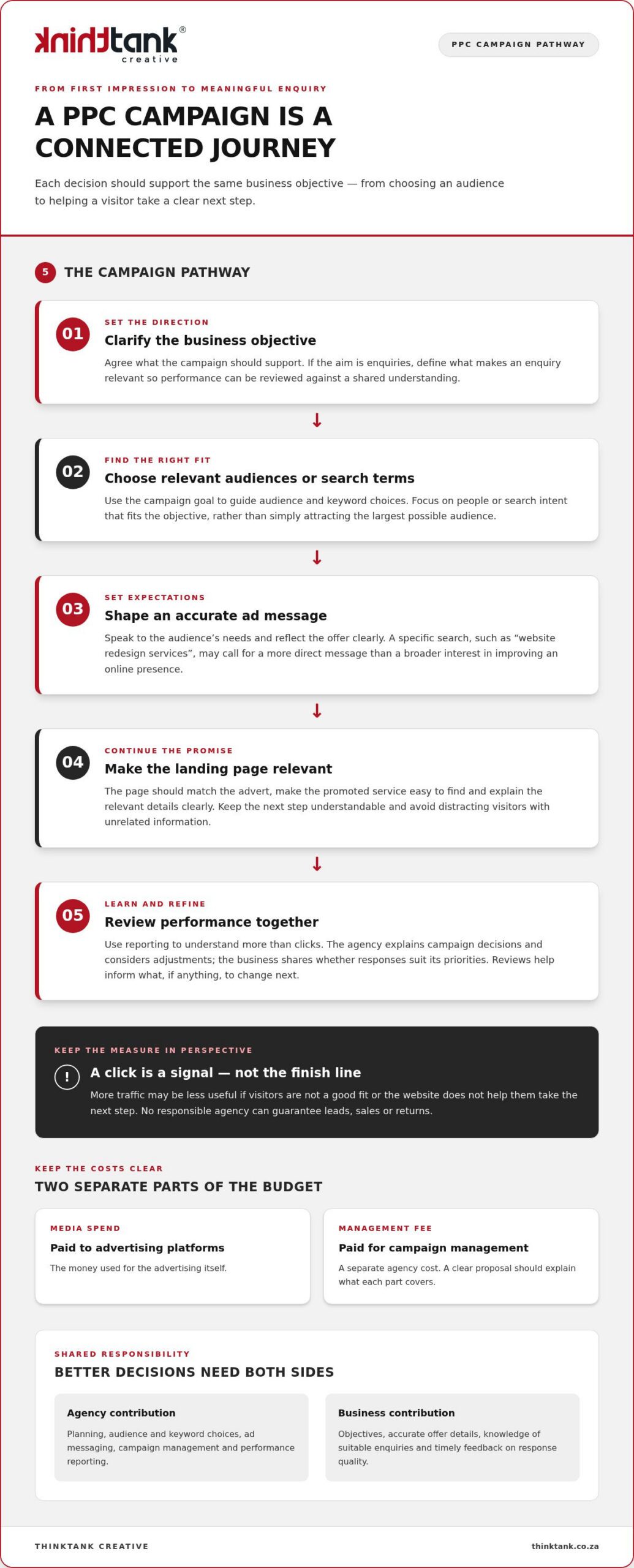
A well-managed campaign follows a deliberate cycle, from agreeing what the business needs to learn or achieve through to reviewing activity and deciding what to refine. The agency brings campaign planning, copywriting and reporting; the business brings its knowledge of the offer, customers and commercial priorities. Each side contributes to decisions, keeping the work grounded in the business rather than turning it into a set of disconnected platform tasks.
What should be agreed before a campaign launches?
Before launch, clarify the objective, intended audience, offer and action you want visitors to take. For example, if the priority is service enquiries, discuss what makes an enquiry relevant and what information a potential customer needs before getting in touch. This gives the agency a useful foundation for planning and helps the business assess whether campaign activity is aligned with its aims.
Set expectations for the campaign’s scope, how information and feedback will be shared, and how progress will be reviewed. Accurate details about services and the intended audience help shape clear messaging. Timely feedback from the business can also inform campaign decisions, particularly when responses reveal that prospects are asking different questions or interpreting an offer in an unexpected way.
A practical sequence can keep planning focused:
- Define the objective: Agree what the campaign is intended to support and how the business will recognise a relevant response.
- Plan the campaign: Shape targeting and campaign structure around that objective and the information available.
- Prepare the messaging: Develop ad copy that represents the offer accurately and gives visitors a clear expectation.
- Launch and review: Observe campaign activity, share relevant business feedback and consider possible refinements.
How can reporting guide campaign improvements?
Reporting is most useful when it brings campaign observations back to the agreed objective. Rather than treating a metric as a verdict on the whole campaign, the agency and business can discuss what it indicates, what it does not show and what decision might follow. Reports should make the measures understandable and give the team a basis for considering changes, not imply that a particular performance level is guaranteed.
For instance, if an advert attracts attention but the responses are not well matched to the offer, the team might revisit the wording or audience choices. If visitors arrive but seem unsure how to proceed, the landing page’s message or next action may need attention. These are questions to investigate together, not automatic conclusions: campaign data gains meaning when considered alongside the business’s experience of the enquiries it receives.
Joined-up planning also helps keep paid campaigns connected to wider marketing activity. ThinkTank Creative’s digital marketing for service businesses guide can inform that broader perspective. To discuss how campaign planning, copywriting and reporting can support your priorities, explore ThinkTank Creative’s digital marketing services.
How ThinkTank Creative brings PPC into a broader marketing partnership
Paid advertising is more connected when campaign decisions sit alongside the website and wider marketing work. ThinkTank Creative is a South African agency offering digital paid advertising, campaign planning, copywriting and reporting, as well as website design and development. This breadth creates room to consider both the advert and the experience visitors encounter after clicking it.
Founded in 2001, ThinkTank Creative takes a collaborative approach to marketing projects. The aim is to understand the business’s needs, shape a plan around them and keep communication open as the work progresses. That partnership helps campaign choices reflect the business’s offer and priorities, without treating clicks or other activity as guaranteed commercial outcomes.
How can paid advertising and website work support one another?
Ad messaging sets an expectation. The page visitors land on should continue that message with relevant information and a clear next step. If the advert introduces a particular service, for example, the page should make it easy to understand that service rather than requiring visitors to search across the site. This continuity helps the campaign feel considered from first impression to next action.
ThinkTank Creative’s website design and development work includes UX/UI, coding, testing and launch. These capabilities support a thoughtful review of how the website presents information and guides visitors, alongside the campaign’s messaging. Website or advertising changes are not a promise of a particular result; they are opportunities to align the journey more closely with the business’s goals and customer needs.
When paid advertising and website work are considered together, teams can discuss whether the page reflects the offer, whether its content is clear and whether visitors can identify what to do next. The business contributes its knowledge of customers and enquiries, while campaign and website decisions can be shaped around that practical context.
What does working with ThinkTank Creative look like?
Start with a discussion about your business needs and timeline. That conversation helps establish the project’s direction and the work required, with an estimated cost provided after those details have been discussed. Planning is tailored to the needs of the project.
Collaboration matters throughout the work. ThinkTank Creative brings campaign planning, copywriting and reporting; the business shares relevant offer information, priorities and feedback. Reporting then supports discussion about campaign activity and possible next steps. ThinkTank Creative also provides ongoing service after project completion, helping maintain a continuing relationship as business needs evolve.
If you are considering a pay per click management company, look for a partner that can connect campaign activity with the experience your website provides. ThinkTank Creative brings paid advertising and broader marketing capabilities into the same conversation, guided by your objectives and project requirements. We Do It All So You Don’t Have To, with a collaborative process shaped around your business.
Shape your next campaign with a clear direction
Choosing a pay per click management company is an opportunity to create a more intentional connection between your marketing goals and the way people discover your business. Start by bringing your priorities into focus: consider what you want paid advertising to support, what your audience needs to understand and how your wider marketing can reinforce that experience.
A thoughtful partnership starts with a conversation, then develops through shared planning and clear decisions. With an agreed direction, campaign activity can be assessed in context and adjusted as your business learns more about what resonates with the people you want to reach.
ThinkTank Creative takes a collaborative approach, shaping digital marketing around each business’s needs and timeline. An estimated cost is provided after discussing the project, so the conversation can begin with your objectives and the work involved.
Discuss your digital marketing needs with ThinkTank Creative and take the next step towards a considered campaign partnership. Your business has room to grow, and a clear plan can help you move forward with confidence.
Frequently Asked Questions
What does a pay-per-click management company do?
A pay per click management company coordinates paid campaign work and helps the business make informed decisions about its advertising. Before starting, agree practical details such as who approves ad copy, who provides account access and what counts as a relevant enquiry. For example, a request that matches your offer and intended audience may be more valuable than a general question. Clear responsibilities help prevent delays and misunderstandings.
Is hiring a PPC management company worth it for a small business?
It can be worthwhile if specialist campaign work would otherwise take time away from serving customers or managing the business. Consider whether you can consistently plan, monitor and review campaigns internally, and compare that commitment with the agency’s proposed scope. A small business should also assess whether its offer and website are ready to support advertising. The decision should reflect available resources and priorities, not simply business size.
How much does a PPC management company cost in South Africa?
There is no one standard cost for PPC management in South Africa, because the work depends on the project’s needs and timeline. Keep the agency’s management fee separate from the budget paid to advertising platforms, then look at what the proposed scope includes. ThinkTank Creative provides an estimated cost after discussing project needs and timeline. Reviewing the scope alongside your objectives helps you understand what the estimate covers.
Can a PPC agency guarantee leads or sales?
No responsible PPC agency can guarantee a set number of leads or sales. Even a carefully planned campaign is influenced by factors outside the agency’s direct control, such as whether people are actively seeking the offer and how compelling they find it. Instead, agree what the campaign is intended to support and how you will assess progress. Treat projections as planning tools, not certain outcomes, and discuss changes as evidence develops.
What happens if my website is not ready for PPC advertising?
If your website is not ready, identify what needs attention before directing paid visitors to it. Check that the page explains the advertised offer, works well for its intended audience and provides a clear next step. A service page with missing details, for instance, may leave prospects unsure whether the offer suits them. Website improvements can be considered alongside campaign preparation, with priorities and timing shaped around the business’s requirements.
How long does it take to see results from PPC management?
There is no fixed timeframe for meaningful results, as campaign readiness, audience response and the amount of useful data available all differ. Agree in advance when the team will review activity and what evidence will inform decisions. Early engagement can show whether people notice an advert, but it may not reveal whether the campaign is contributing to business priorities. Use reviews to build a considered picture before judging its value.
Should I choose PPC or search engine optimisation?
The right choice depends on your objectives and how you want to build visibility. PPC uses paid advertising to reach an intended audience, while SEO works towards visibility in organic search results. For example, a business may use PPC to promote a specific offer while developing useful website content for longer-term search visibility. Consider how each channel supports your wider marketing plan, rather than assuming they are mutually exclusive.