How to Set Up a Google Ads Campaign at a Profitable CPC

A low cost per click can still lose money if the clicks don’t become customers. The practical answer to how to set up a Google Ads campaign at a profitable CPC is to base your maximum bid on what a conversion is worth to your business and how often clicks convert. Set a daily budget by dividing your monthly budget by 30.4, then track conversions so you can assess results against real business outcomes.

It’s easy to focus on choosing keywords and writing ads, but approval and performance also depend on how well your campaign, ad copy and landing page work together. A relevant click matters only if the next step is clear and the page gives visitors a reason to act.

This guide explains how to set a CPC ceiling, choose a budget and bidding approach, organise keywords and targeting, and prepare ads for approval. It also covers what to monitor after launch, so optimisation decisions are based on conversion data rather than clicks alone.

Key Takeaways

  • Shape your campaign around a clear business goal, then align keywords, ads and landing pages with the action you want visitors to take.
  • Use focused keyword groups and negative keywords to help limit irrelevant clicks and keep your targeting purposeful.
  • Set location, language and audience settings to reflect who you want to reach in South Africa.
  • Prepare relevant ad variations and review approval status before launch, then use campaign performance data to guide changes.
  • When campaign setup, creative or landing-page alignment needs a considered approach, ThinkTank Creative can support the work through PPC advertising, website design and development, and creative design.

Calculating a profitable CPC from margins and conversion rates

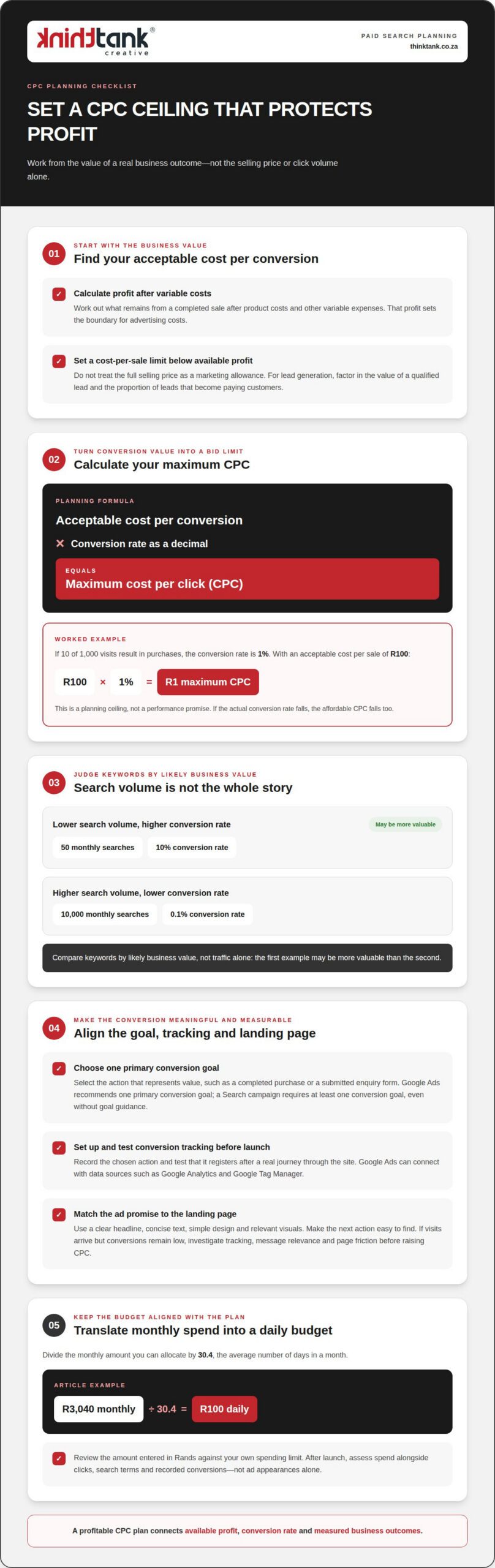
  1. Start with profit, not revenue. Calculate what remains from a completed sale after product costs and other variable expenses. This sets a boundary for advertising: a campaign can attract profitable sales only if acquisition costs leave enough margin for the business.

    Next, estimate the maximum cost per sale you can accept. Set the target below the profit available, rather than treating the full selling price as a marketing allowance. For lead generation, consider the value of a qualified lead and the proportion of leads that become paying customers.

  2. Translate that cost-per-conversion limit into a maximum CPC. Multiply your acceptable cost per conversion by your conversion rate, expressed as a decimal. For example, if 10 of 1,000 visits result in purchases, the conversion rate is 1%. A maximum cost per sale of R100 would therefore support a maximum CPC of R1 at that rate.

    This is a planning ceiling, not a promise of performance. If actual conversion rates fall, the affordable CPC falls too. Compare keywords by likely business value, not traffic alone: a keyword with 50 monthly searches and a 10% conversion rate may be more valuable than one with 10,000 monthly searches and a 0.1% conversion rate.

  3. Choose your campaign objective before selecting a campaign type. Google Ads recommends one primary conversion goal, such as sales, lead generation or brand awareness, to guide that choice. A Search campaign requires at least one conversion goal, even when created without goal guidance.

    Define the action that represents value for your business. A completed purchase is clearer than a product-page visit for an online shop; a submitted enquiry form may suit a service business. Align the goal with your CPC calculation so reported conversions reflect meaningful outcomes.

  4. If you’re optimising for online conversions, set up conversion tracking before launch. Record the chosen action, then test that it registers after a real journey through the site. Google Ads can connect with data sources such as Google Analytics and Google Tag Manager, bringing campaign and website activity into the same measurement process.

    Finally, match each ad to a landing page with a clear headline, concise text, simple design and relevant visuals. Make sure the page delivers on the ad’s promise and makes the next action easy to find. If visits arrive but conversions remain low, investigate tracking, message relevance and page friction before raising your CPC.

Daily budgets and bidding strategies

Set a spending limit that supports your campaign goal and gives Google Ads a clear bidding framework. Your bids compete for placement in search results, so budget and bidding choices need to work together.

  1. Set a daily campaign budget

    Choose a daily budget by dividing the monthly amount you can allocate by 30.4, the average number of days in a month. For example, a monthly budget of R3,040 gives a daily budget of R100. This calculation helps translate a South African Rand budget into a campaign setting without relying on a foreign-currency example.

    Enter your intended budget in the campaign settings, then review it before publishing. Google Ads provides recommendations based on your chosen audience and budget setup, but compare these with your own spending limit. Don’t treat a recommendation as a reason to exceed the amount you can sustain.

  2. Choose a bidding strategy

    Choose a bidding approach that matches your campaign objective and the data available. Google Ads uses a pay-per-click model, so advertisers pay for each ad click. Decide whether the campaign aims to attract relevant visits or achieve a measured conversion goal, then align the bid settings with that outcome.

    Keep your profitable CPC ceiling in mind when setting bids. The auction determines ad placement for relevant keywords, but a higher bid alone doesn’t make a click more valuable. Use your campaign’s conversion tracking to assess whether the traffic supports its chosen goal.

  3. Decide whether to use a daily budget or a total campaign budget. A total campaign budget requires a start date and an end date, making it suitable for campaigns with a defined run. For ongoing activity, a daily budget provides a recurring amount to manage in the campaign settings.

    Before launch, compare the campaign’s budget field with your planned spend. A misplaced digit can make the entered limit very different from your intention. Review the amount in Rands and confirm you’ve selected the right campaign, especially if your account contains multiple campaigns.

  4. After launch, review the budget and bidding combination using actual campaign activity, not assumptions. Compare spend with clicks, search terms and recorded conversions. If the campaign aims for sales or lead generation, focus on whether the budget supports that goal, not simply how often the ads appear.

    Make one considered adjustment at a time, then observe how it affects campaign delivery and results. For example, revise the daily limit if spend is constrained, or refine bids when click costs exceed your planned ceiling. A well-aligned search engine optimisation strategy can also support visibility beyond paid search results.

Keyword match types and negative keywords

Build your keyword list around what potential customers want, then control which searches can trigger your ads. Google Ads match settings affect reach, so review them alongside each ad group and its message.

  1. Use Google Keyword Planner to explore terms related to your products or services. Enter a core offer, such as “plumbing repairs”, then assess suggested keywords for relevance and likely customer intent. Prioritise phrases that signal a next step, such as “book a plumber” or “plumber quote”, over broad research terms.

    Group terms by the need they express. Someone searching “emergency plumber Johannesburg” has a specific service and location in mind; someone searching “plumbing tips” may simply want information. Separate these intentions so the ad and landing page address the searcher’s actual need.

  2. Choose keyword match types

    Choose a match type for each keyword based on how closely you want to control search relevance. Google Ads defaults to broad match, which can show ads for searches that aren’t closely related to your products or services. Review the search terms it attracts, and don’t use broad match without checking that those queries fit your offer.

    Use focused ad groups with 5 to 15 closely related keywords. For example, keep “plumbing repairs” and “leaking tap repair” together only when one ad and landing page can address both clearly. Separate distinct services into different groups to keep the keyword, ad and destination aligned.

  3. Add negative keywords

    Add negative keywords to stop ads appearing for searches that don’t match your offer. If you sell plumbing services, terms such as “jobs” or “training” may be unsuitable if you don’t provide employment or courses. Review search-term reports and exclude irrelevant phrases carefully.

    Check negative keywords against your intended customers before applying them. Excluding “cheap”, for instance, could block useful searches if your business serves price-conscious customers. Keep a shared exclusion list for unrelated intent, then add campaign-specific negatives where a term conflicts with the service being advertised.

  4. Write headlines that reflect the searcher’s intent and the offer on the landing page. A Google Ads Search ad can have 1-3 headlines, and responsive search ads can include up to 15 headlines, each with a maximum of 30 characters. Use distinct messages, such as the service, location or a clear next step.

    Keep descriptions concise and specific: Search ads can include up to 2 lines of description text, with each description allowing up to 90 characters. For “emergency plumber Johannesburg”, a headline could name the service and location; the description should explain the next action. This keeps ad copy relevant to its keyword group.
How to Set Up a Google Ads Campaign at a Profitable CPC

Location, language and audience targeting

Define where your campaign should appear, which languages it should reach, and which audience it should prioritise. For a South African business, match each setting to the customers and service areas the campaign can genuinely serve.

  1. Set location and language targeting

    Choose the South African locations relevant to your offer, such as the whole country, a province or a city. If your business serves customers only in Cape Town, targeting that city is more precise than selecting every province.

    Select languages your intended customers use when searching, and keep the ad copy consistent with those choices. Review location and language settings together: an English ad aimed at a specific service area should lead to a page that clearly explains the offer to that audience.

  2. Select audience targeting

    Choose an audience based on the people most likely to need your product or service. Choose interests and other audience signals that genuinely relate to your offer.

    For example, a business promoting gardening services could consider people interested in gardening, then assess whether the campaign’s search terms and conversions reflect relevant demand. Avoid adding unrelated interests simply to make an audience seem more specific.

  3. Decide whether audience settings should focus on reaching a selected group or observing its performance alongside other traffic. The right approach depends on your campaign goal: a new service may need room to find relevant searchers, whilst a specialised offer may benefit from tighter audience selection.

    Use conversion tracking to evaluate audience quality, not just click volume. Compare which audience segments lead to meaningful actions, such as completed enquiries, and adjust targeting if the data shows a group engaging without converting.

  4. Build remarketing around a clear follow-up purpose. For example, you can show remarketing ads for 30 days to people who visited your website but didn’t buy. Tailor the message to their previous interest, such as returning to a product page, rather than showing a broad advert with no connection to their visit.

    Keep the audience and message aligned with the campaign’s location, language and offer. A visitor who viewed a service page in Johannesburg should see relevant follow-up content, not an advert for a different service or an area the business doesn’t serve.

  5. Review targeting as a connected system after launch. If a campaign attracts visits from the right South African locations but few meaningful actions, examine the audience, language, ad and destination together. Change one setting at a time so you can tell which adjustment affects performance.

    Let campaign evidence guide refinements. Search terms can reveal what people want, while conversion tracking shows whether visits lead to the intended next step. Use both signals to keep targeting purposeful without excluding prospective customers too early.

Ad approval and campaign optimisation

Prepare accurate ads, review the campaign settings, then use performance data to guide refinements. Approval is a checkpoint, not proof that your advertising is reaching the right people.

  1. Check ads against policies and advertising rules

    Review every claim, offer and destination against Google Ads policies and applicable South African advertising requirements. Keep statements truthful, support claims with evidence, and make offer conditions clear in the ad or landing page. Avoid misleading wording, mismatched destinations and creative that does not accurately represent the advertised product or service.

    Before submission, check that the landing page works and matches the ad. Google Ads ads are typically approved within one business day, but they may take a few days to start showing after campaign setup.

  2. Review setup mistakes and optimise the campaign

    Before launch, check the campaign’s daily budget, location, language, keyword settings and conversion goal. Common causes of wasted spend include an incorrect budget, broad keywords that attract unrelated searches, and a landing page that doesn’t match the ad. Check each setting against the campaign objective.

    Google Ads recommends creating at least 3 ads per ad group for a Search campaign. Use variations that test distinct messages, such as a service benefit against a location-led headline, without changing the underlying offer.

  3. Give the campaign time to collect useful evidence before making major changes. Allow most campaigns 2 to 4 weeks of data before meaningful optimisation decisions. During that period, monitor clicks, search terms and conversions; fix clear setup errors promptly, but avoid changing several variables at once.

    Assess keyword relevance alongside Quality Score, which runs from 1 to 10 and reflects expected click-through rate, ad relevance and landing-page experience. A score below 5 signals that ad copy or landing-page relevance needs attention. Improve the specific weak element rather than raising bids automatically.

  4. Use conversion results to decide what to refine. If clicks increase but enquiries don’t, review whether the ad promise, mobile page experience and conversion action align. If irrelevant searches appear, add suitable negative keywords; if relevant traffic converts, preserve that intent as you adjust the campaign.

    For focused support with campaign setup, review and ongoing PPC advertising optimisation, take the next step with a strategy built around your business goals.

ThinkTank Creative

ThinkTank Creative helps businesses create a coherent digital experience around their marketing goals. If an advertising campaign needs a clearer destination or stronger brand consistency, website design and development, creative design, and logo and corporate identity design can help bring the customer journey together.

Social Media Marketing can also complement a broader digital presence and help keep brand messaging consistent across customer touchpoints. The right combination depends on your campaign, audience and existing assets, with each element serving a defined role rather than operating in isolation.

Ready to strengthen the wider experience around your campaign? Contact ThinkTank Creative to discuss your goals.

Build your next campaign with intention

Your next campaign can be more than a source of clicks. Treat it as part of a connected customer experience, where every interaction strengthens your understanding of what people need and how your business can respond. This keeps future decisions anchored in meaningful business outcomes.

A thoughtful approach to how to set up a Google Ads campaign gives you a framework for learning as your objectives evolve. Use what each campaign reveals to refine the experience around it, from the first impression to the next step a potential customer takes. Progress comes from deliberate choices, not simply increasing activity.

When you’re ready to shape the next stage of your digital marketing, plan your campaign with ThinkTank Creative. Take the next step with a clear direction and room to grow.

Frequently Asked Questions

What are the steps to create a Google Ads account and campaign?

To set up a Google Ads campaign, add your business name and website, select a primary objective, then configure the campaign. Link relevant Google accounts, such as Google Analytics, to support setup and recommendations. Create the ads and choose their audience, keywords and budget. Before submitting, confirm payment details and review the settings. Google Ads saves campaign changes as a draft during creation, so you can revisit them before launch.

Which Google Ads campaign type should I choose for my business?

Choose the campaign type that best supports your main marketing objective. For example, a business seeking enquiries should prioritise a lead-focused approach, while an online shop may centre its campaign on sales. Brand awareness and app promotion call for different goals. Consider where prospective customers are likely to respond, then make sure the campaign’s creative and destination support that action.

How do I choose keywords and set up keyword match types?

Choose keywords that reflect what a potential customer might search before taking action. Google Keyword Planner can help you explore terms related to your offer; separate research searches from purchase-ready phrases. Then select match settings according to how closely you want searches to align with each keyword. After launch, review actual search terms and add negative keywords when queries clearly relate to a different need.

How do I set a daily budget and bidding strategy in Google Ads?

Set a daily budget that fits the amount your business can allocate to advertising, then choose bidding settings that support the campaign’s objective. Evaluate a sales campaign against sales outcomes and a lead campaign against qualified enquiries. Keep the daily limit and bid approach consistent with your acceptable acquisition cost. Review spend alongside conversion quality before changing either setting.

How do I target locations, languages, and audiences in Google Ads?

Target places where you can serve customers, and select languages that match your ads and landing pages. In South Africa, a business serving nationally can choose broad coverage, whilst a locally focused service can narrow its intended area. Add audience signals only when they relate to likely customers. For example, interests connected to a specialist product may help distinguish relevant prospects from general browsers.

What conversion tracking and analytics should I set up before launching?

Track actions that indicate genuine business value, such as a completed purchase or submitted enquiry, and ensure each is recorded only when it happens. Link Google Ads with relevant Google Analytics or Google Tag Manager data sources. Test the full customer journey, including confirmation pages and mobile forms. Avoid counting every page view as a conversion, since that can make campaign reports less useful.

How much does Google Ads cost in South Africa, and what is a realistic starting budget?

Google Ads costs depend on the keywords, competition, bids and daily limit you choose; there isn’t one starting budget for every South African business. Begin with an amount you can allocate to a controlled test, then estimate how many clicks it could buy at your planned CPC. Compare that traffic with your conversion rate and acceptable acquisition cost before setting the campaign limit.

How do I monitor campaign performance and optimise ads after launch?

Review search terms, clicks, conversions and spend together, rather than judging performance by impressions alone. Check whether each search matches your offer and whether the resulting visit completes the intended action. If the ad attracts relevant traffic but few conversions, examine the landing page and conversion setup. Test one meaningful change at a time, such as a new headline or a more relevant destination.
Lead Generation Strategies for South African Businesses: The 2026 Strategic Framework

Did you know that the average South African now spends over nine hours online every day? While this digital immersion offers a massive opportunity, many organisations find that traditional lead generation strategies for south african businesses are failing to deliver the quality or volume required for sustainable growth. You've likely felt the frustration of rising costs on generic platforms or the anxiety of ensuring every enquiry form perfectly aligns with the latest POPIA enforcement trends. It's disheartening to see healthy traffic figures on your dashboard when those visitors simply don't convert into meaningful business relationships.

Elevate your brand beyond the noise of the digital marketplace by mastering the art of attracting and converting high-quality leads with our comprehensive 2026 digital marketing blueprint. This framework provides a steady path toward measurable returns by balancing technical precision with creative excellence. You'll discover how to integrate search engine optimisation, social media marketing, and sophisticated email nurturing into a singular, high-performing system. This guide details a strategic methodology designed to build national brand authority and turn digital interactions into lasting commercial success.

Key Takeaways

  • Shift your focus from lead volume to high-intent quality by understanding the evolving 2026 regulatory landscape and shifting consumer behaviours.
  • Optimise your digital presence using a rigorous 5-stage development process that transforms your website into a high-performance conversion engine.
  • Discover how to balance long-term organic visibility with immediate traffic through a strategic blend of professional SEO and precision-targeted PPC advertising.
  • Implement sophisticated conversion rate optimisation and automated email nurturing to ensure every visitor interaction is maximised for commercial growth.
  • Learn how to scale your reach effectively by implementing integrated lead generation strategies for south african businesses through a collaborative agency partnership.

Understanding the Modern South African Lead Generation Landscape

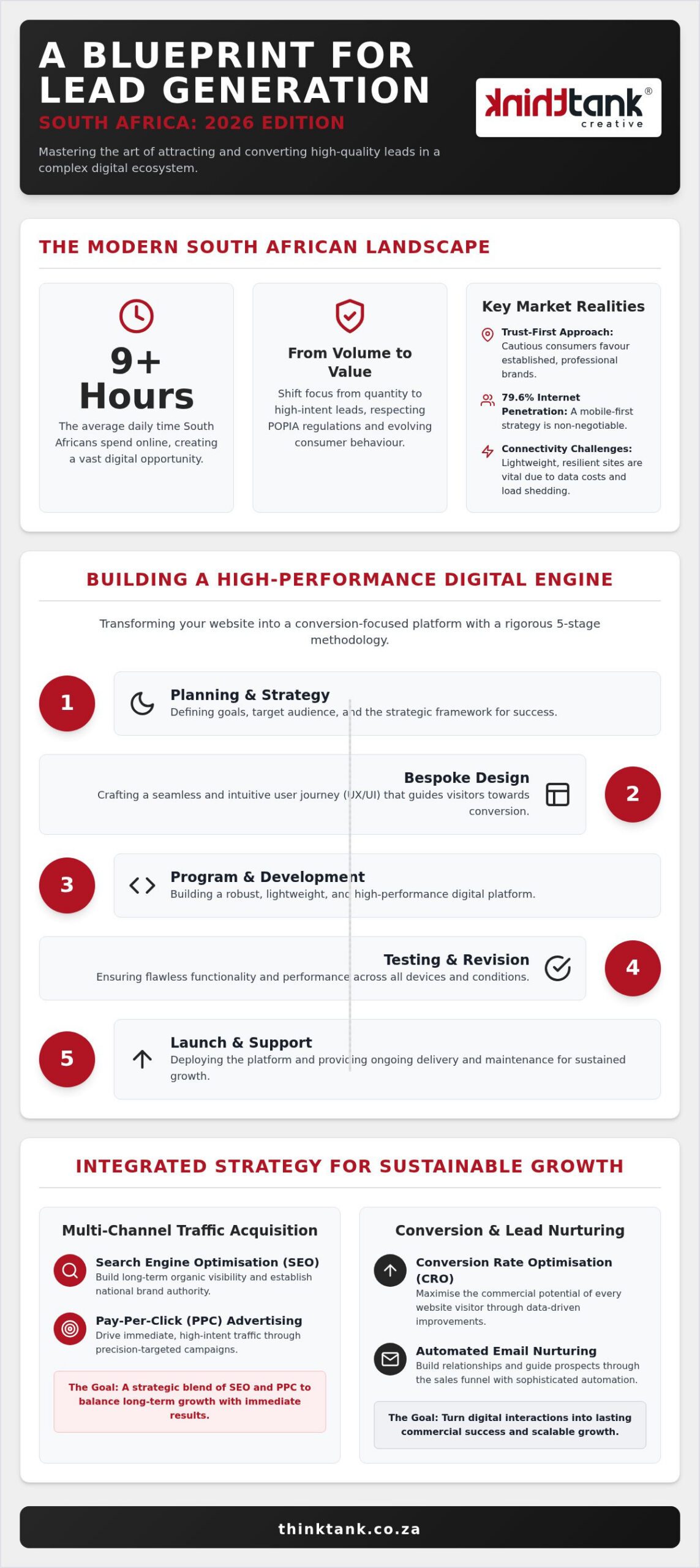
Lead generation in 2026 isn't just about collecting data; it's about initiating a meaningful dialogue within a complex digital ecosystem. To answer the fundamental question, What is lead generation?, we must look beyond simple contact forms and view it as the strategic cultivation of interest. In South Africa, this process has evolved into a sophisticated dance of precision and regulatory integrity. It requires a blend of creative vision and technical rigour to capture the attention of a discerning national audience.

Gone are the days of mass email blasts and unvetted lists. Today, the most effective lead generation strategies for south african businesses prioritises high-intent prospects who are ready to engage. This shift is driven by the intensification of POPIA enforcement in early 2026, where the Information Regulator has focused on proactive investigations into customer-heavy sectors like insurance and retail. Businesses must now balance marketing efficiency with strict data privacy to avoid significant administrative fines whilst building genuine rapport with their audience.

To gain further insight into how these dynamics play out in the local market, consider this overview of modern lead acquisition:

The Role of Trust in the ZA Market

South African consumers are inherently cautious, often favouring established brands that project a sense of quiet assurance and professional excellence. Your corporate identity serves as a visual shorthand for reliability, making cohesive creative design a core component of your sales funnel. Within this unique landscape, lead generation is a trust-first strategy that bridges the gap between a prospect's initial curiosity and their eventual commitment to a partnership. By adopting an 'all-rounder' agency approach, you ensure that every touchpoint—from your logo to your landing pages—reinforces this authority. This unified front reduces the perceived risk for the buyer, leading to higher conversion rates and better-qualified enquiries.

Mobile-First and Connectivity Realities

With internet penetration reaching 79.6% across the nation, a mobile-first approach is no longer optional. However, the South African context presents specific challenges such as fluctuating data costs and the impact of load shedding on network stability. Your digital presence must be lightweight and resilient to ensure it remains accessible even during power outages or on slower connections. Lead generation strategies for south african businesses must account for these friction points by streamlining user journeys and ensuring that enquiry forms are functional on basic mobile browsers. This technical precision ensures your brand remains visible and dependable, regardless of the external environment or the user's device constraints.

Building a High-Performance Digital Engine for Lead Capture

Your website serves as the central nervous system for all effective lead generation strategies for south african businesses. It's not merely a digital brochure; it's a sophisticated tool designed to capture intent and foster trust at every touchpoint. To achieve this, we employ a rigorous 5-stage development process that ensures every pixel serves a purpose. This methodology begins with strategic Planning and bespoke Design before moving into the Program and Development phase. We then transition into meticulous Testing and Revision, culminating in a successful Launch followed by ongoing Delivery and Support. This structured approach guarantees that your platform is both functional and future-proof.

Effective lead generation strategies rely on a seamless user journey where technical performance meets aesthetic excellence. If your site is slow or difficult to navigate, potential leads will vanish before they even see your offer. Precision in UX/UI design ensures that visitors are guided naturally toward conversion, removing the friction that often plagues generic, templated sites. Being aware of the common website design mistakes to avoid is an essential first step in ensuring your digital presence actively supports your lead generation goals rather than undermining them.

Custom Website Design as a Conversion Tool

Relying on standard templates often leads to a diluted brand presence that fails to stand out in a competitive market. By opting for bespoke Custom Website Design in South Africa: 2026 Strategic Guide, you create an environment tailored specifically to your audience's needs. This involves prioritising rapid loading times and clear calls-to-action that guide visitors toward secure, POPIA-compliant enquiry forms. A site built with conversion in mind reduces friction, making it effortless for a prospect to take the next step in their journey with you. Understanding how to choose a web design agency in South Africa is equally critical, as the right partner will ensure your site integrates branding, SEO, and user experience into a single, high-performance engine rather than a visually appealing but commercially ineffective platform.

The Power of Professional Branding

A professional logo and corporate identity design act as the silent ambassadors of your business. They inspire immediate confidence, signalling to potential leads that they're dealing with an industry leader. Understanding what makes a good logo design is fundamental to ensuring your visual identity commands attention and builds the trust required to convert prospects into clients. This visual cohesion should extend beyond the screen; integrating high-quality printing solutions into your multi-channel strategy provides tangible touchpoints that stay with a client long after they've closed their browser. When your digital and physical assets work in synergy, you craft a brand story that truly resonates across the nation. If you're ready to elevate your presence, you might consider how a tailored creative partnership can transform your results.

Multi-Channel Traffic Acquisition: SEO, PPC, and Beyond

Achieve market dominance by orchestrating a symphony of digital channels that work in perfect unison. Whilst organic visibility provides the foundation, paid interventions offer the acceleration your growth requires. According to the Digital 2026: South Africa report, there were 51.7 million internet users in the country as of late 2025. This vast audience demands a multi-faceted approach to capture attention across various digital touchpoints. Effective lead generation strategies for south african businesses don't rely on a single source of traffic; they leverage the unique strengths of SEO, PPC, and social media marketing to build a resilient pipeline.

Deciding where to allocate your budget depends on your immediate objectives. PPC delivers high-intent traffic instantly, making it ideal for seasonal promotions or rapid scaling. Conversely, SEO builds long-term equity that reduces your cost-per-lead over time. Social media marketing bridges the gap by fostering community engagement and brand loyalty amongst the 29.1 million active social users in the nation. For most service-based enterprises, the highest ROI emerges from an integrated model where these channels support rather than compete with each other. This holistic perspective ensures your brand remains visible throughout the entire customer journey.

Dominating Local Search Results

Optimise your organic footprint to ensure your business remains visible long after the initial ad spend has vanished. Precision keyword research tailored to local nuances ensures your brand appears when it matters most to your target audience. By implementing advanced on-page techniques, you elevate your national search rankings and establish lasting authority. Securing high-authority backlinks through proven local link building strategies south africa businesses can rely on is an equally vital component of this organic growth framework. For a deeper dive into these methodologies, explore our Search Engine Optimisation in South Africa: The 2026 Strategic Guide. This long-term investment ensures your brand remains the first choice for prospects navigating the organic landscape, providing a steady stream of enquiries without the recurring costs of traditional advertising.

Strategic Paid Advertising

Accelerate your market penetration with precision-targeted advertising that yields immediate, measurable outcomes. Google Ads allows you to intercept customers at the exact moment of need, whilst social media paid campaigns reach specific demographics with surgical accuracy. Incorporating custom video posts into your strategy significantly increases engagement, as visual storytelling resonates deeply with South African users who spend an average of three hours and 36 minutes on social platforms daily. This proactive approach ensures your brand remains top-of-mind across the most used platforms, including WhatsApp and Facebook. By combining these efforts with a refined creative vision, you turn simple clicks into high-quality enquiries that drive business growth.

Lead Generation Strategies for South African Businesses: The 2026 Strategic Framework

Conversion Optimisation and Lead Nurturing

Transforming passive visitors into active enquiries requires more than just a functional form; it demands a psychological alignment between your brand's promise and the user's intent. Lead generation strategies for south african businesses often fail at the final hurdle because the digital experience feels fragmented or untrustworthy. Conversion Rate Optimisation (CRO) is the meticulous process of refining these touchpoints to ensure your website functions as an elite sales representative that never sleeps. By analysing user behaviour and removing technical friction, you turn your traffic into a measurable stream of qualified opportunities.

In our unique market, instant engagement is a non-negotiable expectation. With WhatsApp being used by 93.9% of active social media users across the nation, it has become a primary channel for quotes and support. However, simply receiving a lead isn't enough. You must implement a fast follow-up system that contacts prospects within minutes, as delayed responses are the leading cause of lost revenue. Coupling this with a robust FAQ section allows you to address common concerns immediately, positioning your brand as a transparent and dependable partner from the very first interaction.

Crafting Compelling Calls to Action

Designing effective buttons and forms is an exercise in strategic empathy. You aren't just asking for data; you're inviting a conversation. Great marketing makes the customer feel smart, and your calls to action should reflect this by offering clear, high-value outcomes rather than generic "Submit" commands. Every element, from the colour of a button to the simplicity of a form field, must be optimised to reduce cognitive load. To explore how to refine these elements further, read our guide on Improving Website User Experience: 2026 Strategic Guide. This approach ensures that your lead generation strategies for south african businesses remain both persuasive and user-centric.

Nurturing the Sales Pipeline

Because B2B buyer behaviour in South Africa typically involves a three to nine month purchase decision window, consistent nurturing is vital. Automated email marketing and tailored auto-responders keep your brand top-of-mind whilst providing the prospect with the information they need to move forward. This isn't about aggressive selling; it's about maintaining a professional work environment through constant, high-quality communication. By leveraging detailed reporting and analytics, we can measure exactly which messages resonate and fine-tune the process for maximum impact. If you're ready to build a more resilient pipeline, our team is here to help you organise your digital strategy for long-term success.

Ongoing website maintenance and support are the final pieces of the retention puzzle. A broken form or a slow-loading page can undo months of hard work in an instant. Regular updates and security patches ensure your lead capture engine remains secure and POPIA-compliant, protecting both your business and your customers' data. This meticulous attention to detail ensures that your brand transformation is not just a moment in time, but a sustainable foundation for growth.

Scaling Your Business with an Integrated Marketing Partnership

Choosing a partner for your lead generation strategies for south african businesses is a decision that defines your brand's trajectory. Many organisations struggle with fragmented services, where the design team doesn't speak to the developers, and the marketers are left guessing the strategic intent. The 'All-Rounder' agency model eliminates this chaos by providing a unified vision from inception to execution. Since our founding in 2001, we've pioneered this collaborative approach, ensuring that every creative asset and technical update serves a singular goal: your sustainable growth.

Our methodology is a journey of imagination and strategic execution. Whether you're starting with a simple flyer and corporate identity or scaling into an international web company, our scalability ensures your brand remains consistent. We do it all so you don't have to, allowing busy entrepreneurs to focus on their core operations whilst we handle the complexities of the digital space. This quiet assurance in our expertise allows us to act as an approachable creative partner, moving your brand from a high-level concept to a concrete market leader.

The Value of End-to-End Execution

A seamless transition between creative design, website development, and search engine optimisation is only possible when all experts sit under one roof. Our award-winning in-house team follows a rigorous 5-stage development process: Planning, Design, Program, Development, and Launch. This ensures every enquiry form and landing page is functional and high-performing. This relationship doesn't end at the launch; ongoing website maintenance and support are essential for long-term lead retention and technical excellence. By eliminating the friction between different service areas, we provide a polished, invitation-based approach that emphasises mutual success and high-quality outcomes.

Securing Your 2026 Marketing Estimated Cost

Precision in marketing requires a bespoke approach, which is why we provide estimated costs only after a detailed discussion of your specific goals and target audience. Preparing for a strategic consultation with an industry leader is the first step toward achieving national brand dominance and a measurable return on your marketing spend. During this discussion, we'll explore how to align your lead generation strategies for south african businesses with your long-term vision. This methodical and purposeful cadence ensures that every cent of your budget is utilised effectively, mirroring the stability of a long-standing enterprise whilst maintaining the fluid energy of a creative agency.

Elevating Your Brand for Sustainable Growth

Mastering the digital landscape requires a deliberate shift from simply chasing volume to cultivating high-intent connections. Success in the 2026 market hinges on your ability to blend technical excellence with a trustworthy brand identity that resonates on a national scale. By prioritising user experience and maintaining strict regulatory integrity, you create a resilient foundation for long-term growth. This approach ensures that every interaction moves your prospect closer to a meaningful partnership whilst building your authority in the marketplace.

Implementing effective lead generation strategies for south african businesses is a journey best taken with a seasoned expert. Since 2001, we've provided comprehensive all-rounder marketing solutions that empower brands to reach their full potential. Our award-winning in-house design team is ready to transform your vision into a high-performing reality. It's time to elevate your market presence and secure a future defined by measurable success. Partner with ThinkTank Creative for your 2026 lead generation strategy and embark on your journey of transformation today. We look forward to building something extraordinary together.

Frequently Asked Questions

What is the most effective lead generation strategy for South African SMEs in 2026?

The most effective approach is a cohesive multi-channel strategy that integrates organic visibility with precision-targeted paid advertising. SMEs should focus on building a robust digital presence that balances long-term SEO with immediate PPC results. This ensures a steady flow of high-intent prospects who are actively searching for your services. By combining these efforts with automated email nurturing, you create a resilient system that captures and converts interest across the entire national market.

How do POPIA regulations affect my digital marketing and lead collection?

POPIA mandates that you collect personal information transparently and secure it against unauthorised access. As enforcement intensified in early 2026, the Information Regulator began proactive investigations into sectors with large consumer databases. You must ensure your enquiry forms include clear consent checkboxes and that your data storage protocols are fully compliant. Failing to align your lead generation strategies for south african businesses with these regulations can lead to significant administrative fines and damage your brand's reputation.

Is SEO or PPC better for generating leads in the South African market?

Neither is objectively better as they serve distinct strategic purposes within your sales funnel. PPC advertising offers immediate results by positioning your brand in front of high-intent searchers at the moment of need. Conversely, Search Engine Optimisation builds lasting organic authority that reduces your cost-per-lead over several months. A balanced framework uses PPC to drive rapid growth whilst SEO creates a sustainable foundation for long-term national visibility and brand dominance.

How much should a South African business budget for lead generation?

Your budget should align with your specific growth objectives and the competitiveness of your industry. Rather than a fixed fee, we provide an estimated cost after a thorough discussion of your needs and timeline. This bespoke approach ensures that your investment is allocated effectively across channels like SEO, PPC, and social media. Investing in a comprehensive marketing package typically yields a more measurable return than fragmented, low-budget attempts that fail to achieve critical mass.

Does social media marketing actually generate high-quality leads for service businesses?

Social media is a powerful tool for generating high-quality leads when used for more than just brand awareness. By utilising targeted digital paid advertising and active community management, service businesses can engage specific demographics across the country. Platforms like Facebook and Instagram are particularly effective for fostering trust through custom video posts. When integrated with WhatsApp for instant enquiries, social media becomes a high-conversion channel that drives meaningful commercial outcomes for professional organisations.

What role does website design play in the lead generation process?

Your website is the central engine of your entire lead capture system. Professional website design and development ensures that visitors experience a frictionless journey from their initial click to the final enquiry. By following a rigorous 5-stage development process, we prioritise usability and functionality to reduce bounce rates. A site that looks smart and functions perfectly inspires the confidence required for a prospect to share their contact details and engage with your brand.

How can I track the ROI of my lead generation campaigns?

Tracking ROI involves monitoring specific metrics through comprehensive reporting and analytics tools. You should measure your cost-per-lead, conversion rates, and the eventual lifetime value of the customers acquired through digital channels. By using auto-responders and CRM integration, you can trace an enquiry from the first click on a Google Ad to the final sale. This data-driven approach allows you to fine-tune your strategy and ensure every cent of your marketing spend is working effectively.

Why is a mobile-first approach critical for South African lead capture?

With internet penetration at 79.6% and a mobile-dominant population, your digital presence must be optimised for smartphones. South Africans spend an average of nine hours online daily, mostly via mobile devices. A mobile-first approach ensures your site loads quickly and functions perfectly despite fluctuating data costs or network instability during load shedding. If your lead generation strategies for south african businesses aren't mobile-friendly, you risk losing nearly 80% of your potential audience before they can even see your offer.