How to Measure SEO Success Through Traffic and Authority

A ranking can rise while search results still fail to bring the right visitors to your website. To understand how to measure SEO success, track search visibility, click-through rate (CTR), organic traffic, visitor engagement, conversions and backlink quality together. CTR shows whether search listings turn visibility into visits: Carnegie Higher Ed reports an overall site CTR benchmark of 2% to 3% for higher education websites. That figure is specific to higher education, but the principle applies broadly: impressions matter most when they attract relevant searchers.

Rankings and traffic matter, but neither tells the whole story. A useful SEO measurement connects search visibility with visitor quality, business outcomes, brand authority and backlinks. This guide explains which metrics to track, how to interpret click-through rate (CTR) in context, and how to tell meaningful progress from activity that looks impressive but has little impact.

Key Takeaways

  • Assess SEO performance across visibility, organic visits, engagement and conversions rather than relying on rankings alone.
  • Compare branded and non-branded search traffic to distinguish existing awareness from discovery by new audiences.
  • Evaluate backlinks by relevance and trust, and watch for anchor-text patterns that could look unnatural.
  • Interpret click-through rates in context: search position and sector affect how impressions translate into visits.
  • Use Google Search Console to explore queries, pages and search trends, then connect those insights to on-site outcomes.

What are SEO performance metrics?

SEO performance metrics show whether organic search is supporting visibility, engagement and business goals. To understand how to measure SEO success, connect search activity to valuable actions rather than counting rankings alone.

Setting SEO goals and choosing KPIs

An SEO goal describes the change you want, while a key performance indicator (KPI) tracks progress towards it. This distinction helps you choose metrics that reflect business priorities. If the goal is to grow organic traffic, measure visits alongside leads or sales from those visits. For example, a company targeting 5% year-on-year organic traffic growth that achieves 10% has exceeded its target, but should still assess visitor relevance.

For lead generation, compare organic visits with qualified enquiries. Calculate organic SEO cost per acquisition by dividing SEO spend by the number of customers it generates. This connects search activity to customer outcomes instead of treating every additional visit as valuable.

Monitoring SEO performance with tools

Analytics and webmaster tools show different aspects of SEO performance. Google Analytics can report organic sessions, engaged sessions, conversions and landing pages. Search Console reports impressions, clicks, click-through rate and average position. Reviewing both helps connect search visibility with what visitors do after arriving.

For example, 75 engaged sessions out of 100 sessions produce a 75% engagement rate. Compare trends over consistent periods, then inspect the pages or queries behind a change. Check rankings and technical alerts weekly, review analytics and Search Console trends monthly, and assess backlinks, Core Web Vitals, content decay and revenue attribution quarterly.

Business, accessibility and proxy KPIs

Business KPIs connect organic search with leads, sales or revenue. Accessibility measures can reveal barriers, while proxy KPIs indicate technical progress. Together, these measures can help explain why a page performs poorly despite receiving search exposure.

Review website templates for issues involving headings, landmarks, alt text, focus order and form labels. These accessibility improvements can reduce friction for users and crawlers. To assess technical coverage, track the ratio of crawled to indexed URLs. Google’s good threshold for Interaction to Next Paint is 200 milliseconds or faster, providing a reference point for this Core Web Vitals measure.

Reporting and misleading metrics

Match your review schedule to the metric. Weekly checks can catch ranking changes and technical alerts; monthly reviews help reveal analytics and Search Console trends; quarterly audits can assess backlinks, Core Web Vitals, content decay and revenue attribution. A consistent schedule helps you respond to issues without overreacting to isolated changes.

Rankings, impressions and raw traffic can mislead if they aren’t connected to relevant visits or business actions. Measuring SEO success also means separating branded from non-branded queries and checking whether visibility leads to useful engagement. Rising impressions alongside few clicks, for example, may point to a mismatch between the page and the query, not stronger performance.

How Do You Measure The Quality Of Organic Traffic?

Quality organic traffic comes from people whose search intent matches your offer and who engage meaningfully. Compare queries and landing pages with visitors’ subsequent actions instead of treating every visit as equally valuable.

Branded and non-branded organic traffic

Branded traffic comes from searches that include a business or product name; non-branded traffic comes from broader topic or service searches. Separating them helps show whether organic search is building discovery or capturing existing awareness.

Google Search Console lets you compare queries and landing pages, then connect each group to on-site conversions. Branded searchers convert at rates 3-5 times higher, so a rise in total conversions may reflect stronger brand awareness rather than wider reach among new audiences. Review both segments to understand what is driving progress.

Organic impressions and clicks

An impression means a listing appeared in search results; a click means someone selected it. Together, these metrics show whether a page is visible and attracting visits for its target queries.

Compare impressions, clicks, click-through rate and average position by query and page. Rising impressions with few clicks may mean a listing appears for relevant searches but doesn’t persuade people to visit. Check the page title, description and search intent, then assess whether changes increase clicks without reducing relevance.

Clicks alone don’t show whether traffic is valuable. Compare organic visits to the landing page with engagement and conversion actions to see whether searchers find what they expected.

Core Web Vitals and impressions

Core Web Vitals measure aspects of page experience, while impressions indicate search visibility; reviewing both helps connect technical performance with organic search activity. Google’s good threshold for Largest Contentful Paint is 2.5 seconds or faster, and its good threshold for Cumulative Layout Shift is 0.1 or lower.

Track these measures alongside impressions and clicks for key landing pages. If a page gains visibility but provides a poor experience, investigate its loading behaviour and layout stability. Improving the experience can reduce friction after the click, while impression trends show whether search exposure is changing.

Measuring conversions and organic revenue

Conversion measurement attributes valuable actions, such as enquiries or purchases, to organic search visits. Revenue measurement connects those actions to business value, giving you a clearer picture than traffic alone.

In analytics, define meaningful actions and track the landing pages and organic sessions associated with them. Compare conversion volume and revenue over the same reporting period, segmenting by page or query where possible. If visits rise while revenue falls, investigate weaker intent, a less effective landing page or a change in demand.

Conversion rates depend on the offer and industry; a 1% visitor-to-sale or visitor-to-lead rate can be excellent in some industries. Use your own baseline and the quality of resulting leads or orders to judge performance. For a clearer link between search activity and site outcomes, consider a focused SEO measurement strategy.

A backlink profile is the collection of links pointing to your website. Domain authority scores estimate its relative strength. These measures can help assess whether other sites refer to your content, but they don’t reveal search visibility or conversions on their own. Treat an authority score as a comparative signal from its provider, not a direct measure of business results.

Look beyond the total number of links. Assess referring websites for relevance, credibility and genuine audience value, and consider whether their pages attract people interested in your subject. A hundred backlinks from unsafe, low-traffic or unrelated websites may bring fewer page views and conversions than a handful from reputable sites. Link quality and context matter more than a large tally.

Anchor text, the clickable wording of a backlink, gives readers and search engines context about its destination. A profile where over 85% of referring pages use targeted keywords in anchor text can appear unnatural. For links built in an SEO campaign, aim for 95% or more to use branded, raw-URL or generic anchor text. Relevant, descriptive anchors still have a role, but an overly repetitive pattern can look manipulated.

Review referring domains, destination pages and anchor wording together. Ask whether each link is relevant to the page and could send an interested visitor. Look for sudden changes, repeated keyword-rich anchors and links from unrelated subjects. These patterns can guide further investigation, but don’t assume every low-value link is harmful or every high-authority link will improve performance.

Google Search Console’s links report can help you review external links and the pages they point to. Compare its findings with backlink data from the same SEO platform over time, as tools can show different link sets and authority scores. Use a consistent source for comparisons, then connect changes in referring pages with organic landing-page visibility, engagement and conversions. Search Console performance reports provide query and click context, while analytics show what visitors do after arriving.

Make backlink measurement useful by linking it to optimisation decisions. If a relevant industry site links to a detailed resource, for example, track whether that page earns organic impressions and qualified visits. If a campaign builds links but target pages show no corresponding movement, investigate relevance, page quality and search intent before drawing conclusions. Authority is a supporting indicator; a sound evaluation combines a credible backlink profile with visibility and meaningful audience outcomes.

How to Measure SEO Success Through Traffic and Authority

Click-through rate benchmarks

Good SEO benchmarks depend on sector, search position and business goals, so compare like with like. Carnegie Higher Ed reports an overall site click-through rate (CTR) of 2% to 3% for higher education websites, and page-level rates of 1% to 2%. For traffic, rankings and conversions, use your own relevant baseline and assess whether trends bring qualified visits and business outcomes.

CTR measures the share of search impressions that become clicks. A result with 100 impressions and 50 clicks has a 50% CTR, showing how the calculation works, not a typical target. Google Search Console provides impressions, clicks and CTR by query or page. Segmenting those figures helps you see whether a particular source, landing page or search intent affects performance.

Search position changes the opportunity to earn clicks. A first-position result has an estimated CTR of approximately 28%, compared with approximately 15% for second position. These are estimates, not promises for every query. Compare pages competing for similar searches, then investigate whether title wording, result features or intent may explain a difference.

Rankings offer another reference point: positions one through 10 count as page one, positions 11 through 20 as page two, and positions 21 to 30 as page three. Track movement by target query and landing page, but connect it to clicks and sessions. A competitor’s position can provide context, yet it doesn’t show whether their visitors convert or whether your audience has the same needs.

To benchmark traffic, compare organic sessions over consistent periods and across relevant pages. A growing session count is useful when it reflects searchers who engage or take valuable action. If impressions rise but clicks remain flat, inspect CTR and average position before changing content. If clicks increase but sessions or conversions don’t, review analytics tracking and the landing-page experience.

Conversion benchmarks need the same care. Compare actions that matter to your organisation, such as completed enquiries or purchases, with organic sessions. A rate can mislead without a clear conversion definition, audience and measurement period. Check that Google Analytics records the intended action, then interpret changes alongside traffic quality and revenue.

Use each benchmark as a diagnostic, not a pass-or-fail score. A page gaining impressions but losing CTR may need a closer review of its search snippet and query match. A page with strong CTR but few conversions requires a different investigation. This layered approach turns comparisons with competitors into practical decisions and keeps visibility, visits and business impact distinct.

How to use Google Search Console to analyse SEO performance

Google Search Console shows how your pages appear and perform in Google Search. Its Performance report connects queries and pages with impressions, clicks, click-through rate and average position. These measures help identify which searches bring visibility and where a page’s search presence may need attention.

Start by selecting a consistent date range and comparing it with an earlier period. Review the totals before filtering by query or page. A page that gains impressions while clicks stay level, for example, warrants a closer look at its search snippet, position and query relevance. Don’t treat one change as proof of a lasting trend.

Use the query table to explore the words people use before reaching your site. Filter by a service or topic, then compare impressions and clicks across related queries. Search Console can also separate branded from non-branded searches, helping you see whether visibility comes from people who already know your name or from broader discovery.

Next, open the Pages view and select a landing page. Review the queries leading to it, then compare its performance with pages serving a similar purpose. If unrelated queries dominate, the page may not align clearly with search intent. If relevant queries generate impressions but few clicks, assess the title and description shown in Google Search.

Use device and country filters to see whether performance varies across audiences. For a South African business, the country filter can isolate impressions and clicks from South Africa instead of combining them with other markets. Device comparisons can show whether pages attract search activity on mobile but receive fewer clicks on desktop, or vice versa.

Search Console can also help investigate issues beyond the Performance report. Review indexing reports to identify pages Google has or hasn’t indexed, then inspect affected URLs to understand their reported status. Check the links data to see which pages receive external links and which internal pages are linked most often. These reports connect technical coverage and link discovery with organic visibility.

Keep a log when you change a page. Record its URL, query group, change date and subsequent Search Console movement. Compare equivalent periods rather than drawing conclusions from a single day. Search Console reporting can involve a three-day wait, so give data time to appear before assessing a recent change.

Turn those findings into focused improvements: refine a page’s search alignment, investigate indexing issues or strengthen internal links. If you want expert support interpreting search data and prioritising SEO improvements, get help with SEO performance.

ThinkTank Creative: Website Design and Development

ThinkTank Creative designs and develops websites around business goals and audience needs. If your SEO reports show that searchers reach important pages but don’t take the next step, the website experience may need attention. Clear navigation, relevant content and a considered user journey help visitors understand your offer and find the right action.

ThinkTank Creative’s Website Design and Development service can shape a site around your business needs. Creative design and logo and corporate identity design can support a consistent brand experience. These services can help when your measurements reveal a disconnect between search visibility and what visitors encounter on the page.

To discuss how your website can better support your digital goals, contact ThinkTank Creative.

Turn your SEO insight into purposeful growth

Make your next step a clear decision, not another dashboard metric. Use your data to prioritise the pages, audience needs and website experience most closely connected to your business goals. Measuring SEO success this way keeps attention on outcomes and helps your strategy adapt as customer behaviour changes.

ThinkTank Creative supports the wider digital picture through Search Engine Optimization, Website Design and Development, Social Media Marketing and creative design. These services can help when your next opportunity is to improve organic visibility, strengthen the website journey or create a more consistent brand experience. Let the challenge your data reveals guide your focus.

Contact ThinkTank Creative for SEO support to discuss a considered next step for your digital growth. Build on what you’ve learned and keep moving towards a stronger online presence.

Frequently Asked Questions

How can you tell if SEO is helping sales?

Compare sales opportunities from organic visits with your usual lead-to-sale process. For example, label enquiry forms by acquisition source, then follow each qualified lead through your customer relationship management system. This shows whether organic search contributes to closed business, not just form submissions. Also review assisted conversions: someone may first discover your business through search, then return through another channel before purchasing.

How do I prioritise which metrics to focus on?

Choose metrics based on the decision you need to make. If a key service page attracts enquiries but few become qualified opportunities, prioritise lead quality and page-specific conversion actions. If visibility is the immediate concern, examine search exposure and query relevance first. Keep the main report focused, adding supporting metrics only when they explain a change or guide a practical next step.

How do you build an SEO dashboard that reflects real growth?

Build your dashboard around a clear business question, such as whether organic search generates qualified enquiries. Show the outcome alongside its source pages and supporting indicators, and annotate major website or campaign changes. Separate acquisition from conversion outcomes so readers can follow the journey. Use consistent date ranges and labels, and don’t combine figures based on different attribution definitions.

How do you know when SEO is failing despite good rankings?

Good rankings can hide weak results if they attract the wrong audience or lead to an unhelpful page. Check whether the query matches the page’s offer, visitors can complete the intended action, and forms or checkout steps work. Compare affected pages and look for changes in demand or competitor search features before deciding rankings alone explain the problem.

How do you measure SEO in business terms?

Connect search activity to outcomes your organisation values, such as qualified enquiries, completed purchases or opportunities entering the sales pipeline. Define each outcome clearly, then report which organic landing pages contributed. For longer sales cycles, compare lead quality and progression through sales stages instead of judging performance only by the date someone first visited the website.

How do I measure user engagement on my website?

Track meaningful interactions that show what visitors do after arriving. In Google Analytics, consider events such as starting a form, completing an enquiry, using site search or clicking to view contact details. Separate these actions by landing page and traffic source. A page may encourage exploration without an immediate sale, so interpret interactions according to its role in the customer journey.

Which SEO KPIs should you track to measure success?

Choose a focused set of metrics that reflects your objective: search visibility for discovery, organic visits for acquisition, engagement actions for page usefulness, and qualified leads or sales for business impact. Add a technical indicator only when it supports a specific investigation. If important pages aren’t appearing in search, for example, examine index coverage. Review each KPI alongside its related pages and intended audience.

How do you track keyword rankings and search visibility?

Track a representative group of queries that reflect your products, services and audience needs. Record the ranking page for each query, as different pages can compete for similar searches. Keep tracking settings consistent, including country and device, so comparisons remain useful. Combine ranking observations with actual search impressions and clicks: a position change alone doesn’t show how visibility or traffic has changed.
Improving Business Search Rankings: Where Should You Focus

A useful first checkpoint for improving business search rankings is 4–6 months: review SEO impressions then, while recognising that this is a point to assess progress, not a promised date for higher positions. Search results respond to a combination of relevant content, technical performance, local information and other ranking signals, so changes may take time to show.

If your visibility hasn’t improved as quickly as you’d hoped, you’re not alone in looking for a clearer way to prioritise the work. Repeating keywords more often isn’t the answer. Focus instead on making each page useful, easy to understand and technically accessible to visitors and search engines.

This article explains where to place keywords, how AI search affects the way people discover businesses, and why site speed, local listings and other ranking factors matter. You’ll also learn how to track progress and use the results to guide your next improvements.

Key Takeaways

  • Give each page a clear search focus, then use relevant terms naturally in its title, headings and content rather than repeating them excessively.
  • Match content to what people are trying to find, whether they need information, a particular website or a service.
  • Prioritise a responsive mobile experience and review Core Web Vitals, including a Largest Contentful Paint under 2.5 seconds and Cumulative Layout Shift under 0.1.
  • Keep your local business details accurate and complete; Google’s local results are mainly shaped by relevance, distance and prominence.
  • Track impressions and other performance signals over time. SEO progress depends on several ranking factors, so use the data to guide ongoing improvements.

1. Keyword placement in URLs, titles, headings and content

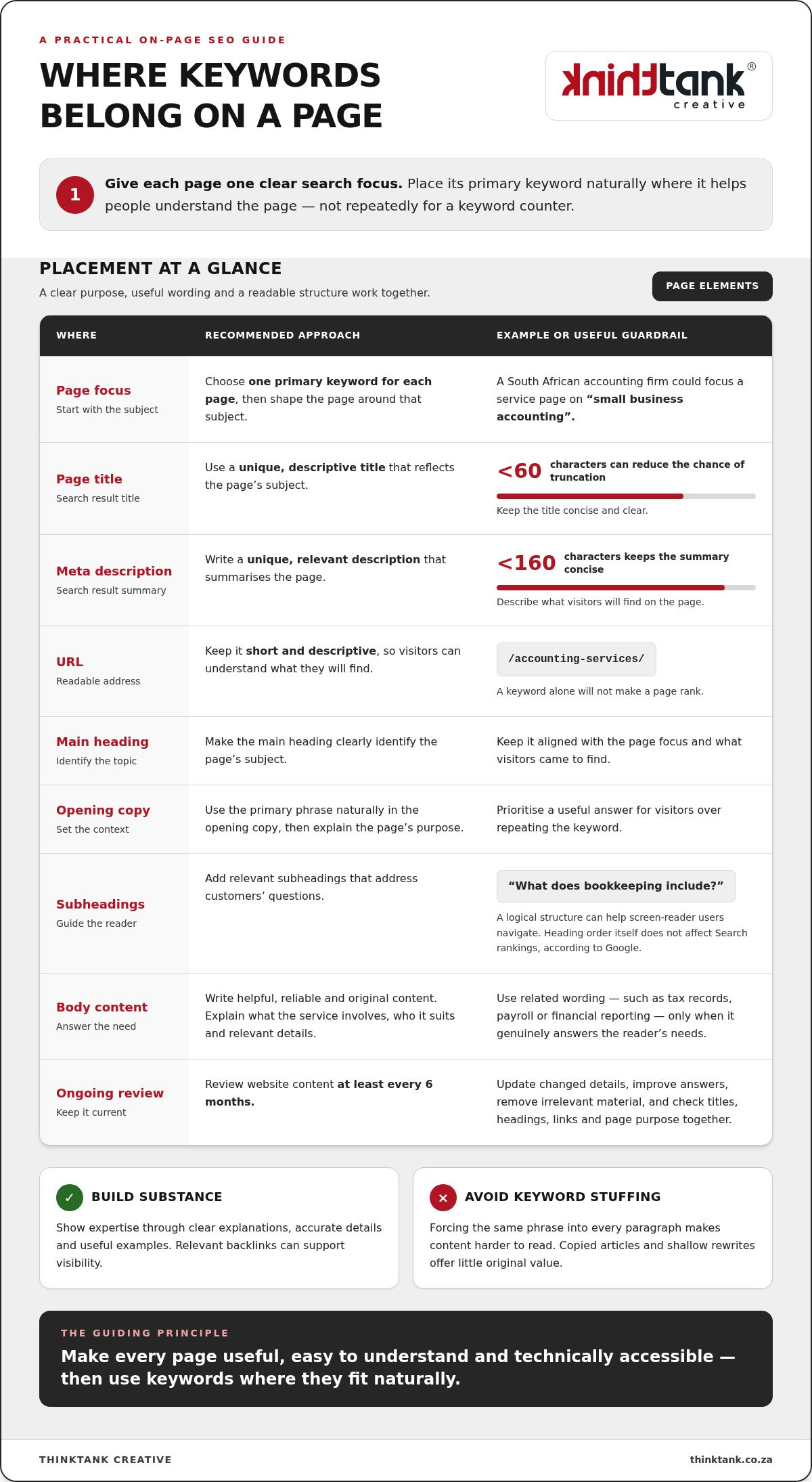
Start with one primary keyword for each page, then shape the page around that subject. For example, a South African accounting firm could focus a service page on “small business accounting”. This gives the page a clear purpose and helps visitors judge its relevance before reading further.

Place the phrase naturally in the page title, main heading, opening copy and relevant metadata. Give every page a unique, descriptive title and meta description. A title under 60 characters can reduce the chance of truncation, while a meta description under 160 characters keeps its search-result summary concise.

For a practical overview of prioritising search visibility, watch Ahrefs’ video:

Keep URLs short and descriptive, such as “/accounting-services/”, rather than using random identifiers. Google recommends descriptive URLs, but a keyword alone won’t make a page rank. A readable address also helps visitors understand what they’ll find before clicking.

Organise the page with a clear heading structure. Use the main heading to identify the topic, then add relevant subheadings that address customer questions, such as “What does bookkeeping include?” Google says heading order doesn’t affect Search rankings, although a logical structure can help screen-reader users navigate.

Write for visitors, not a keyword counter. Google recommends helpful, reliable and original content that answers people’s questions. Explain what the service involves, who it suits and what a prospective customer should do next. Add relevant keywords where they fit, rather than forcing the same phrases into every paragraph.

Keyword stuffing makes content harder to read, and Google doesn’t recommend it as an SEO focus. Use related wording when it clarifies meaning. An accounting page might naturally cover tax records, payroll or financial reporting, provided those details genuinely answer the reader’s needs.

Build authority through substance: show expertise with clear explanations, accurate details and useful examples. Relevant backlinks can support visibility, but copied articles and shallow rewrites give other sites little reason to reference your work. Prioritise original insight over keyword repetition.

Review website content at least every 6 months. Update details that have changed, improve answers that no longer serve visitors, and remove material that has become irrelevant. Check titles, headings, links and page purpose together, so each update strengthens the content and its technical structure.

Make search intent your starting point, including when preparing content for AI search. Someone searching “accounting services” may be comparing options, while “how to prepare invoices” signals an informational need. Google recognises informational, navigational and transactional intent. Match each page to one clear need and answer it directly, rather than trying to serve every possible search.

Build a focused keyword plan before you publish. Use Google Keyword Planner, SEMrush or Ahrefs to explore relevant terms, search volume and competition. Use keyword metadata thoughtfully, focusing on phrases that accurately reflect the page’s subject. Treat that range as a planning prompt, not a reason to cram phrases into a page. Prioritise terms that connect your offer to a real customer need.

Compare search results for each target phrase. If results show service pages, create a page that explains your service; if they show guides, prepare a useful explanation. This simple check helps align format with intent. An algorithm can match a page to a query, but clear relevance gives people a reason to choose and read it.

Search volume helps estimate interest, while ranking difficulty indicates how challenging a term may be to compete for. Consider both alongside content quality, niche difficulty and user intent. Avoid targeting keywords with no search volume, as they may consume effort without reaching an active audience. For a South African business, assess whether a phrase reflects its actual services and target market.

Long-tail keywords often reveal the detail behind a search. Instead of targeting only “accountant”, consider a specific phrase such as “bookkeeping for small businesses”, if that accurately reflects the service. Another example is “how to organise receipts for tax records”. These searches point to different needs, so separate service pages from educational articles where appropriate.

Use the chosen phrase naturally in the page title, opening, relevant headings and body copy. Add related terms only where they clarify the topic. The guidance recommends using the target phrase once or twice across the opening and closing paragraphs. Keep headings specific, such as “What records should a small business keep?”, rather than repeating the same keyword in every heading.

To support discovery across Google Search and AI-led search experiences, publish original answers that are easy to scan. Use concise explanations, descriptive headings and examples that reflect customers’ real questions. A page about invoices, for instance, can explain the process, common records and next steps. Revisit performance data and update the page when customer needs or search patterns change.

3. Website speed and Core Web Vitals

Technical SEO helps search engines access and understand a website, while speed and mobile usability shape the visitor’s experience. Structured data describes page details in a consistent format, helping Google interpret content. A clear site structure also helps crawlers find important pages.

Google has used site speed as a ranking factor since 2010, and its 2018 Speed Update affected mobile search ranking. Core Web Vitals assess loading, responsiveness and visual stability, giving you measurable signals to investigate rather than relying on a general impression of performance.

Use these thresholds to identify areas for improvement: Largest Contentful Paint should be under 2.5 seconds, First Input Delay under 100 milliseconds, and Cumulative Layout Shift under 0.1. A product page that loads its main image slowly, for example, may need image compression or a review of how page elements load.

Start with the pages that matter most to your customers, such as a South African service page or contact page. Compress large images, remove unnecessary page elements and investigate technical issues. Then test the page on mobile, where small text, crowded buttons or shifting layouts can make key actions difficult.

Google’s mobile-first indexing makes mobile-friendliness important for search visibility. Check that menus, forms and page content work on a phone, not just on a desktop screen. Visitors trying to submit an enquiry should be able to find the form and use its fields without awkward zooming or horizontal scrolling.

Google Search uses crawlers to explore the web, discover pages and process their content for indexing. Make sure important pages, including their CSS and JavaScript, are accessible to crawlers. A sitemap can help search engines find new content, but submitting one is optional and doesn’t guarantee indexing.

Structured data adds machine-readable context, such as a page’s subject or details about an organisation. Keep the markup aligned with visible page content and correct any errors. It can help Google understand a page, but no markup guarantees a particular search result display or ranking.

Links from other websites can also contribute to how search engines assess authority. Focus on earning relevant backlinks from trusted industry or community sources through useful resources and genuine collaboration. A relevant South African business association referencing a practical guide is more valuable than unrelated links created simply to influence search results.

Encourage discovery by sharing useful content with people who may reference it. Social media engagement isn’t a direct ranking factor, but wider reach can support visits and opportunities to earn backlinks. Prioritise a positive user experience, accessible pages and trustworthy sources alongside technical fixes.

Review technical performance regularly, then resolve issues according to their impact on visitors and crawlers. Website maintenance and support can help keep page components functioning as content changes, while a sound development approach can address speed, structure and mobile usability at their source.

Improving Business Search Rankings: Where Should You Focus

4. Local SEO and business listings

For local visibility, make your business easy to identify and relevant to nearby searches. Google says local results are mainly based on relevance, distance and prominence. A local electrician, for example, should clearly describe their services and the areas they serve.

Complete and verify your Google Business Profile, then keep its details accurate. Add the correct business category, address or service area, opening hours and contact information. Google says a complete, detailed profile can help it understand a business and match it with relevant searches.

Consistency matters across your website and local directories. Use the same business name, address and telephone details wherever they appear. If your trading name or premises change, update the profile and directory listings. Conflicting information can confuse potential customers and weaken their confidence.

Prominence reflects signals that help establish a business’s presence. According to Google, links to a business and customer reviews contribute to prominence. Encourage genuine reviews from customers, respond thoughtfully to feedback and earn relevant mentions from trusted local organisations. Google says businesses cannot request or pay for better local rankings.

Make your website support your profile. Create a location page for each genuine customer-facing branch, with useful details such as services, directions and local contact information. Use a clear title and meta description, and ensure the page answers what a nearby customer needs. Don’t create pages for locations the business doesn’t serve.

Relevant images can help customers understand what a business offers. Add current, accurate photographs to the profile, and use descriptive file names and alt text for website images. These details help search engines interpret image content, while accessible descriptions also help people who cannot see an image.

How can businesses measure search rankings, organic traffic and SEO return on investment? Use Google Search Console to monitor search impressions, clicks and queries, then review organic traffic and engagement in Google Analytics. To assess return, compare SEO-attributed enquiries or sales with the cost of the work over the same period.

What SEO tactics can cause ranking penalties, and how can businesses avoid them? Google identifies keyword stuffing as a practice to avoid, and manipulative backlinks can also put visibility at risk. Publish useful content, use keywords naturally and build links through relevant, trustworthy relationships rather than schemes.

Local results can appear in map packs, featured snippets and traditional search listings. Track which queries bring visitors, which profile actions lead to enquiries and which pages attract organic traffic. That evidence helps you prioritise practical updates rather than judging performance by one ranking alone.

Review local profiles whenever business details change, and check your website pages alongside them. Accurate hours, clear service descriptions and a consistent customer experience help people move from discovery to contact. Search engine optimisation works best as an ongoing process, guided by real customer behaviour and performance data.

5. Search engine algorithms and ranking factors

A search engine weighs multiple signals, not one optimisation trick. Google considers hundreds of factors when assessing relevance and authority. A page’s position reflects how its content, links and technical accessibility work together for a particular search.

What are the most effective SEO strategies for improving business rankings? Develop useful pages that match search intent, keep them accessible and earn quality backlinks from relevant, reputable websites. Then use performance data to refine the work, rather than chasing one phrase or ranking signal.

Start with relevance. Google’s systems assess whether a page answers the search, so a Durban accounting service page should explain that service clearly. Include the phrases customers use where they fit naturally, but don’t force them into every sentence. Google says keywords in a domain name or URL path alone have little ranking effect.

Content length isn’t a shortcut either. Google says there’s no target minimum or maximum word count for ranking. A concise page can serve a clear query better than a longer page that adds unrelated detail. Develop content around the customer’s task, then include enough explanation to answer it accurately.

Authority is shaped by signals beyond your own website. Links and citations from other websites can help search engines assess a page’s reputation. A relevant mention from a respected South African industry association may be more meaningful than several links from unrelated sites. Focus on quality backlinks earned through useful resources, expertise and genuine collaboration.

Technical trust matters, too. HTTPS is a ranking factor, while accessible pages help Google’s automated crawlers explore and understand content. Check that important pages load and their essential content is available to crawlers. A polished page that search engines cannot access cannot effectively serve its search audience.

Social media signals aren’t direct ranking factors. However, sharing a useful guide can increase its reach, bring visitors and create opportunities for other websites to reference it. Treat social engagement as a way to support discovery, not as a direct lever for moving a page higher in Google Search.

For local searches, location can change which businesses appear. Google may use what it knows about a searcher’s location, and local results weigh relevance, distance and prominence. A business serving a particular area should make its location and service details clear, rather than relying on broad phrases alone.

Avoid tactics designed to manipulate ranking signals. Google warns against keyword stuffing and spammy backlinks, which can undermine visibility. Build pages for people, use phrases in context and pursue references that make sense for your business. A practical review should consider relevance, technical access, link quality and local context together.

Apply these principles through a measured SEO strategy, then assess how changes affect relevant searches and enquiries. Explore SEO support for your business to develop a considered approach to search visibility.

ThinkTank Creative: Website Design and Development

ThinkTank Creative can bring your search strategy into your website through Website Design and Development. Consider this work when your site structure, mobile experience or brand presentation needs a considered refresh. Clear navigation, purposeful page layouts and cohesive creative design can make it easier for visitors to understand your offer and take the next step. Logo and Corporate Identity Design can also help create a consistent presence across your website and other customer touchpoints.

Strong search visibility depends on useful content and a website that supports it. ThinkTank Creative can shape a digital experience around your business goals, rather than applying a one-size-fits-all template. Contact ThinkTank Creative to discuss your website design and development needs, or visit thinktank.co.za.

Turn search visibility into sustained momentum

A durable approach to improving business search rankings is built on decisions you can keep refining. Treat each change as part of a wider digital experience: what people discover, what they understand about your business and what helps them take the next step. This keeps search activity connected to broader goals, rather than making rankings an end in themselves.

ThinkTank Creative can help align that experience through Website Design and Development, Social Media Marketing and Creative design. These disciplines can work together to express your brand consistently and give your audience a clearer journey from discovery to engagement. Choose a starting point based on the opportunity you want to address, then develop the next step with purpose.

If you’re ready to shape a stronger digital presence, contact ThinkTank Creative to discuss your goals. Your next considered improvement can create a foundation for continued growth.

Frequently Asked Questions

How long until I see impact in search results?

Look for early visibility signals before expecting a steady change in enquiries. Google Search Console can show whether updated pages begin receiving impressions for relevant searches. Review SEO impressions after 4–6 months, then compare query patterns and clicks with your earlier data. For improving business search rankings, use that review to decide which pages need clearer answers, stronger relevance or further technical attention.

How to Optimise for AI Search?

Make each page answer a specific customer question in language people naturally use. For example, a service page can explain who the service suits, what it involves and what happens next. Use clear headings and distinct, factual answers so readers can find key details quickly. Keep business information consistent across your website, and update pages when your services or customer questions change.

Why Is It Important to Rank High on Google?

A prominent position can put your business in front of people already looking for relevant information or services. That visibility matters only if the result accurately represents what you offer. A clear search listing, for example, can help a prospective customer distinguish your specialist service from a broad category. Consider rankings alongside qualified visits, enquiries and sales, rather than treating position as the sole measure of success.

Why Prioritize Content Creation Over Off-Page SEO?

Useful content gives people and other websites a substantive reason to engage with your business. It can explain a service, address a customer concern or provide a practical resource worth referencing. Off-page activity can support visibility, but promoting a page with little original value offers a weaker foundation. Develop helpful pages first, then share them with relevant audiences and build relationships that may earn genuine references.

How do Google search rankings work for businesses?

Google’s automated systems discover and assess pages, then return results that appear relevant to a search. A business page’s visibility can reflect its usefulness, accessibility, reputation and the searcher’s location. The same business may appear differently for broad and local queries because the search context changes. Give each page a clear purpose, and judge performance against the searches and customers it is meant to reach.

How can a business research keywords and optimise website pages for search?

Begin with customer language: note the questions you hear during sales conversations, support requests and enquiries. Compare those phrases in keyword research tools, then inspect search results to understand what format people expect. Assign a clear topic to each page, such as a service explanation or practical guide. After publishing, review which queries generate impressions and refine pages to address gaps in usefulness or clarity.

How can businesses earn quality backlinks without violating Google guidelines?

Create resources that others have a genuine reason to cite, such as original guidance, a useful checklist or clear explanations of industry processes. Share them with relevant professional groups and consider contributing informed guest articles where appropriate. Build links through genuine relevance and relationships, not paid schemes or automated exchanges intended to manipulate rankings. Check prospective references for topical fit and audience value before investing time in outreach.

How long does SEO take to improve rankings, and what results are realistic?

SEO develops over time as search engines process changes and competing pages continue to evolve. Review impressions after 4–6 months, then assess whether relevant queries, qualified visits and enquiries are moving in the right direction. A realistic outcome is a clearer understanding of what is gaining traction and what needs refinement, rather than a promised position. The pace depends on competition, site condition, content relevance and the work sustained.

How to Increase Domain Authority in South Africa: A Practical 2026 Guide

A higher Domain Authority score won’t, by itself, move your South African business up Google. If you’re searching for “how to increase domain authority south africa”, the more useful question is how to build a website that earns relevant links, serves its audience and strengthens search visibility over time.

It’s understandable to focus on a number when measuring SEO progress, particularly when relevant links can take time to earn. But Domain Authority is Moz’s third-party metric, not a Google ranking factor. Treat it as a comparative indicator, not a verdict on your website’s health or a score to chase at any cost.

This guide explains what Domain Authority can and can’t tell you, then sets out practical ways to build relevance in the South African market. You’ll learn how useful content, a well-functioning website and thoughtful link-building work together, and how to track progress through search visibility and meaningful business outcomes alongside third-party metrics.

Key Takeaways

  • Learn why authority scores differ between SEO platforms, and use each metric with its calculation method in mind.
  • Build a baseline by recording referring domains and organic performance, then compare your site with relevant South African competitors.
  • Follow a practical process for how to increase domain authority south africa: create a useful asset, identify relevant sources and explain its value.
  • Prioritise content that answers a specific audience need and gives credible websites a reason to reference it.
  • Review earned links, search visibility and enquiries together to decide what to do next.

What domain authority means for South African websites

Domain Authority is a third-party estimate of how likely a website is to rank in search results compared with other sites. Moz developed the Domain Authority metric, which draws on signals such as a site’s link profile. It’s an estimate, not a complete assessment of your website’s SEO health or a promise of future rankings.

Put simply, a third-party authority metric estimates a website’s relative ranking potential. It isn’t a score assigned or used directly by Google. If you’re exploring how to increase domain authority south africa, understanding this distinction helps keep your strategy focused on meaningful progress rather than a number alone.

For a visual introduction to the topic, watch this video:

Domain Authority, Domain Rating and Authority Score: what differs?

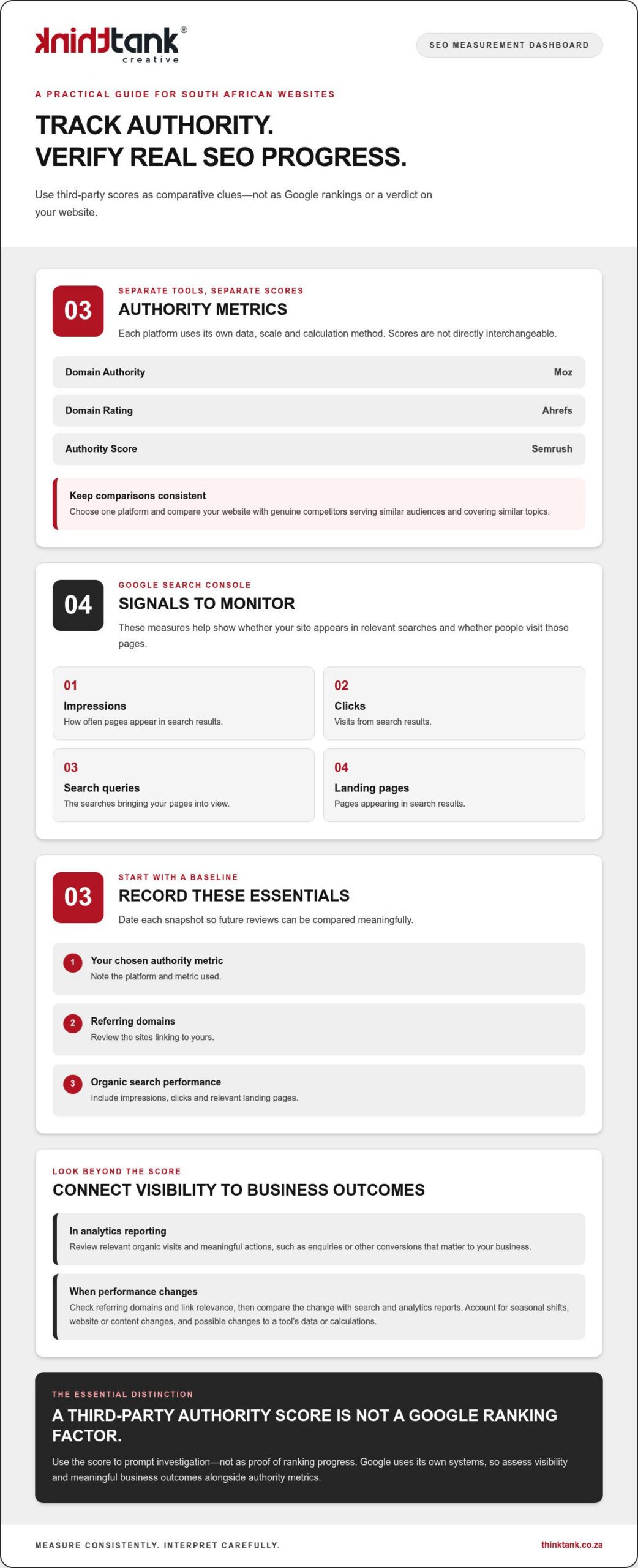
These are separate third-party metrics: Domain Authority is from Moz, Domain Rating from Ahrefs and Authority Score from Semrush. Each platform uses its own data, scale and calculation method, so the scores aren’t directly interchangeable. A site’s score can differ between tools even when its underlying search performance hasn’t changed.

For a useful comparison, choose one platform and use the same metric to review your website and a small set of genuine competitors with similar audiences and subject matter. This gives you a consistent benchmark instead of a misleading comparison between numbers calculated in different ways.

Why South African businesses should look beyond one score

Relevance depends on the people a website serves, the subjects it covers and the market it operates in. A focused South African business site may have a smaller link profile than a national or global publisher and still be useful to people looking for specialised expertise, products or services.

A higher score doesn’t prove that a site will rank above another, and it doesn’t cause Google to award better positions. Sites with stronger backlink profiles may also have better visibility, but that relationship alone doesn’t show that a third-party score caused the rankings. Google uses its own ranking systems.

Use authority scores to spot questions worth investigating, not as targets. A change can prompt you to review links or compare competitors, but assess it alongside relevant search visibility and audience response. That keeps SEO decisions grounded in what your audience needs.

Does domain authority affect Google rankings? Separate the metric from real SEO progress

No. A third-party Domain Authority score is not itself a Google ranking factor. Google doesn’t assign your website a Moz, Ahrefs or Semrush authority score. These tools provide estimates that can help you compare your site with others, but a change in the estimate doesn’t tell you directly what Google will rank or why.

Authority scores and search performance can move in the same direction: websites with strong backlink profiles may also have good visibility. But correlation isn’t causation. A higher third-party score doesn’t prove that the score caused improved rankings, or that every link contributing to it is valuable to your audience.

A rising authority score can’t guarantee better rankings, because Google uses its own systems to assess and rank pages. If you’re considering how to increase domain authority south africa, treat the metric as one diagnostic signal, then judge progress through search visibility and business outcomes.

Which signals are more useful for tracking SEO performance?

Use Google Search Console to monitor impressions, clicks, search queries and the landing pages appearing in results. These measures show whether your website is appearing for relevant searches and whether people are visiting those pages.

Pair that view with analytics reporting. Review relevant organic visits and meaningful actions on your site, such as enquiries or other conversions that matter to your business. Look at trends over time, account for seasonal shifts and note changes to your content or website. Don’t attribute every rise or fall to link-building alone.

Google’s guidance favours creating compelling material that people have a reason to reference, rather than relying on manipulative link schemes. Its advice on earning quality links supports a user-first approach: make your content genuinely useful and relevant.

How to interpret a domain authority score responsibly

Make comparisons consistent. Record the platform, metric and date each time you review your score, then compare it with relevant competitors serving similar audiences and covering similar topics. Unrelated websites and arbitrary targets make poor benchmarks.

If the number changes, investigate before drawing conclusions. Check whether referring domains have changed, review the relevance and quality of those links, and compare the results with your search and analytics reports. The score may also move because a tool’s data or calculations have changed. The aim is to understand what may have influenced the metric, not to pursue a particular number.

Clear reporting makes those signals easier to interpret. Learn more about SEO strategy and reporting as part of a considered approach to measuring website performance.

Start with a baseline before deciding what to improve. Record your chosen authority metric and SEO platform, your number of referring domains, and organic search performance, including impressions, clicks and relevant landing pages. Date each snapshot so you can make meaningful comparisons later.

Next, select a small group of genuine South African competitors. Choose businesses that serve a similar audience and cover related topics, rather than simply picking websites with high scores. For a broader view of how link-building fits into search optimisation, explore this South African SEO strategic guide. Moz also explains how its own Domain Authority metric is intended to be used as a comparative measure.

What makes a backlink relevant and worth pursuing?

Assess the page that links to you, not just the referring domain’s score. Does the page cover a related subject, serve a similar audience or connect to your business community? Is your link included naturally in useful editorial or resource content, where it helps readers understand or explore the topic?

Consider the likely audience value. A link from a relevant South African industry association, professional resource or supplier could introduce your website to interested visitors. A link with no clear connection to your work may offer little practical value, even if a tool gives the referring site a strong score.

How to find gaps against relevant competitors

Review competitors’ referring pages for credible industry, professional, supplier and community sources. Note why each page linked, then ask whether you have a useful resource that could meet a similar need. Separate realistic opportunities from sites that appear to exist mainly to sell links. A raw link count won’t show the difference.

Use a simple comparison to organise your assessment:

What to assess What to look for Question to ask
Relevance Connection to your subject, audience or South African market Would this source make sense to your customers?
Referring-site quality Credible, useful content and a clear purpose Does the site serve a real audience?
Link context A natural mention in relevant editorial or resource content Does the link help readers?
Audience value A plausible route for interested visitors to discover your site Could this referral support awareness or enquiries?

This audit gives you a grounded starting point for how to increase domain authority south africa: identify gaps that matter to your audience, then prioritise relevant opportunities over score-chasing.

How to Increase Domain Authority in South Africa: A Practical 2026 Guide

Earn links by giving relevant websites a genuine reason to reference your work. A strong authority-building plan starts with a useful resource and thoughtful outreach, not a target score. If you’re researching how to increase domain authority south africa, use this process to focus on links that make sense for your audience and market.

  1. Choose a useful asset. Identify a question your audience needs answered, then create a resource that responds clearly and thoroughly.
  2. Find relevant sources. Research South African industry bodies, professional networks, partners, publications and community resources that cover the topic or serve the same audience.
  3. Pitch the value. Contact each relevant organisation with a personal note explaining what the resource offers its readers and why it may be useful.
  4. Review the results. Track who you contacted, responses, links earned and referral or search performance. Use what you learn to refine the next round, without expecting a particular score increase.

For more detailed outreach guidance tailored to the local market, read these local link-building strategies for South Africa.

Create content that deserves references and recommendations

Build resources around genuine knowledge of your business and customers. This might be a practical guide, a clear explanation of a complex topic or a resource that helps people make an informed decision. Start with a defined audience need, then make the content specific, accurate and useful enough to stand on its own.

Presentation matters, too. Use clear headings, concise copy and an easy-to-follow structure so a publisher can quickly assess the resource. Coordinate content creation, copywriting and SEO priorities, rather than publishing material without a defined purpose or audience.

Build relationships without buying shortcuts

Personalise each approach. Refer to the recipient’s publication, resource or community, and explain why your content could help its audience. A relevant partner may value a useful resource, a publication may consider an expert explanation, and a community site may welcome material that answers a recurring question. Keep the pitch specific and respectful.

Avoid paid-link schemes, irrelevant directory submissions and mass-produced outreach promising easy results. These tactics can waste effort and don’t build relevant relationships that support lasting visibility. Record outreach and earned links, then assess quality and outcomes alongside any change in third-party metrics.

Bring research, content and outreach together in a considered plan. ThinkTank Creative provides SEO and content support to align this work with your website and business goals.

How to sustain authority growth and choose the right next steps

Turn your link-profile findings into a focused plan, not an endless list of SEO tasks. Set priorities for useful content and outreach, assign an owner to each action, and agree on reporting checkpoints. Sustainable progress comes from relevant, consistent activity and review. There’s no guaranteed timeline for an authority score or search result to improve.

Keep the objective clear: earn relevant references, improve search visibility and attract the right audience. A third-party score can help you spot changes, but it shouldn’t replace evidence that your website is reaching potential customers and supporting business goals.

What to review in a regular SEO report

Use each report to connect activity with outcomes. Review target-page visibility, organic clicks, relevant queries and meaningful conversions, such as enquiries. Check new referring domains for topical fit, the context of each link and whether the source’s audience is relevant to your business.

Then record what changed, what you learned and the next action that has a clear rationale. If a page earns links but attracts few relevant visits, consider whether its topic, search intent or next step needs refinement. If visibility changes, review other site and content updates before assuming outreach was the cause.

When integrated SEO and website support can help

Authority-building is easier to manage when research, strategy, content creation and reporting work together. Research identifies audience needs and realistic opportunities; strategy sets priorities; useful content gives relevant sources something worth referencing; reporting shows what is gaining traction. A functional, easy-to-use website gives visitors a clear experience once they arrive.

For a practical approach to how to increase domain authority south africa, treat SEO and website quality as connected parts of sustained improvement. ThinkTank Creative brings together SEO, content creation, copywriting, reporting, website development and ongoing support as part of its digital work.

To discuss your SEO and website project needs, explore ThinkTank Creative.

Build lasting search strength through relevant authority

Use Domain Authority as a diagnostic, not a destination. The most effective approach to how to increase domain authority south africa is to understand your baseline, create resources that meet real audience needs and earn relevant references from credible sources. Then assess progress through search visibility, useful website visits and enquiries, not one third-party score.

Keep the work focused and consistent. A practical plan with clear priorities, responsible outreach and regular reporting can help you learn what’s resonating and decide where to invest next. Strong SEO also relies on a functional website that makes it easy for visitors to find information and take action.

ThinkTank Creative, founded in 2001, brings SEO, content creation, copywriting and reporting together with a website process spanning research and strategy through launch and support. Explore ThinkTank Creative’s SEO and website services to discuss your project needs and shape a considered path forward.

Build with relevance, measure what matters and give your South African website room to grow.

Frequently Asked Questions

Is domain authority a Google ranking factor?

No. Domain Authority is a third-party metric developed by Moz, not a score Google uses to rank pages. Google has its own ranking systems, so a change in this metric doesn’t directly cause rankings to rise or fall. Use it as one comparative signal alongside Search Console visibility, relevant organic visits and enquiries. A higher score may coincide with a strong link profile, but that doesn’t prove the score caused better rankings.

How can I increase domain authority in South Africa?

To improve domain authority in South Africa, create genuinely useful content for a defined audience and earn relevant references from credible sources. Consider industry bodies, professional networks, partners, publications and community resources that serve your subject area. Personalise outreach by explaining the value to each source’s readers. Track referring domains and search performance, but don’t use link volume or a third-party score as the only measure of progress.

How long does it take to increase domain authority?

There’s no fixed timetable. Authority metrics can change gradually as your website earns relevant links and the SEO platform updates its data. Sustainable improvement may take several months or longer, and results depend on your starting point, competition and the consistency of your work. Set regular review points rather than expecting a quick score change, and monitor search visibility and business outcomes alongside the metric.

What is a good domain authority score for a South African business?

There isn’t a universal “good” score for South African businesses. Authority metrics are comparative estimates, and results depend on the tool and its calculation method. A useful benchmark is the score of relevant competitors serving similar audiences and covering similar topics, measured using the same platform. Focus on whether your website is improving its visibility for relevant searches and attracting valuable visitors, rather than pursuing an arbitrary score.

Can I improve domain authority without building backlinks?

You can improve other aspects of SEO without acquiring backlinks, including content usefulness, site structure and page experience. These improvements may support search visibility, but they’re unlikely to substantially increase a link-based authority metric on their own. For that, focus on creating resources that relevant websites may choose to reference. Measure progress across your search performance and website outcomes, not the authority score alone.

Should I buy backlinks to increase domain authority?

Don’t buy backlinks simply to inflate an authority score or manipulate search rankings. Paid links created to influence rankings can conflict with Google’s spam policies, and irrelevant links may deliver little audience value. Invest in useful content and relevant relationships instead. If a link is part of a legitimate paid promotion, make sure it’s handled transparently and in line with applicable search engine guidance.

How can I check my website’s domain authority?

Check the metric using the SEO platform that provides it, such as Moz for Domain Authority. Other platforms have their own measures, including Ahrefs’ Domain Rating and Semrush’s Authority Score, so don’t compare these scores as if they were interchangeable. Record the tool and date, then benchmark against relevant competitors using the same metric. Use Google Search Console separately to review impressions, clicks, queries and landing-page visibility.

Search Engine Optimisation in South Africa: The 2026 Strategic Guide

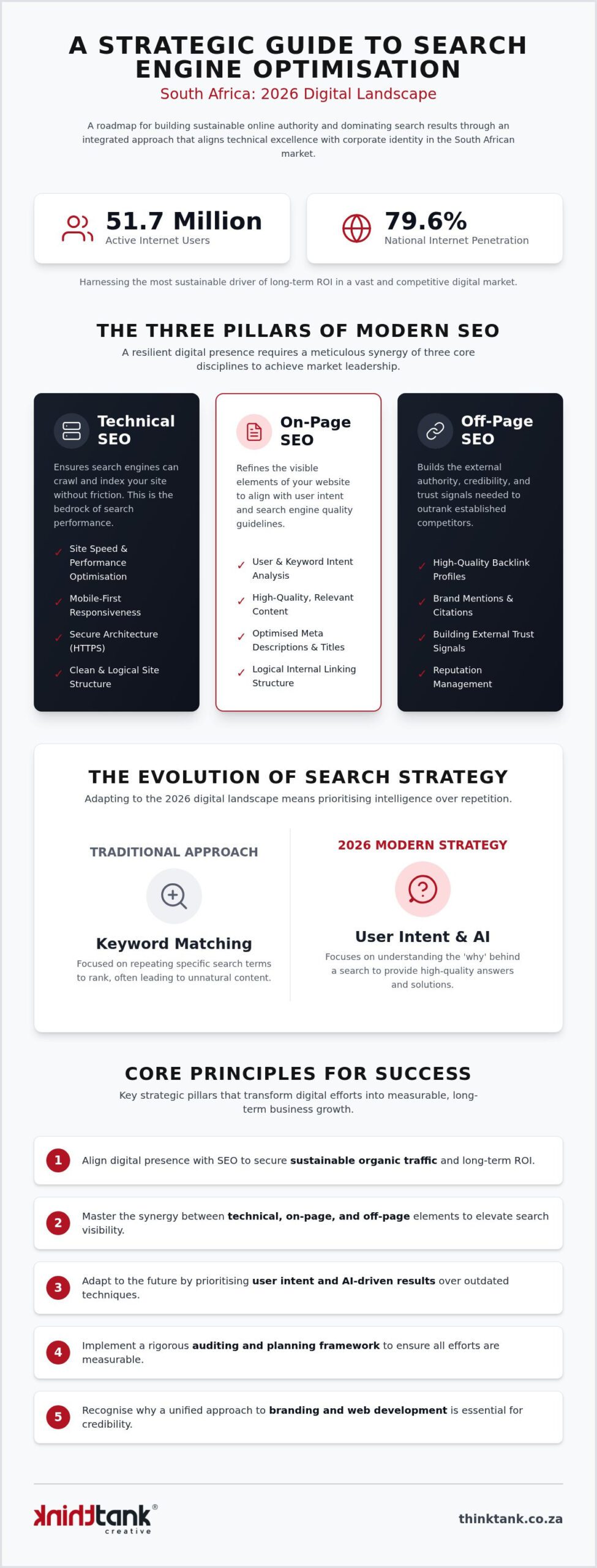
With 51.7 million internet users now active across the nation, why does it feel like your digital presence is shouting into a void? You've likely watched your PPC budgets climb while lead generation stalls, or perhaps you're tired of agencies hiding behind technical jargon that doesn't translate into revenue. Achieving effective search engine optimisation south africa requires more than just chasing algorithms. It demands a synergy between technical precision and user engagement. It's a common frustration to see search rankings fluctuate just as you're starting to gain momentum, but we believe your brand deserves a more stable path to success.

This 2026 strategic guide is designed to cut through the noise and provide a clear roadmap for digital growth. Discover how to build sustainable online authority and dominate search results through an integrated approach that aligns technical excellence with your corporate identity. We'll explore the shift toward Answer Engine Optimisation and mobile-first dominance, ensuring your strategy is both future-proof and results-driven. Our goal is to move you from high-cost uncertainty to a position of market leadership. At ThinkTank Creative, we focus on the potential for your brand transformation because we do it all so you don't have to.

Key Takeaways

  • Align your digital presence with the core principles of search engine optimisation south africa to secure sustainable organic traffic and long-term ROI.
  • Master the synergy between technical, on-page, and off-page elements to elevate your site speed and overall search visibility.
  • Adapt to the 2026 digital landscape by prioritising user intent and AI-driven results over traditional keyword-matching techniques.
  • Implement a rigorous auditing and planning framework to ensure every digital marketing effort remains measurable and results-oriented.
  • Recognise why a unified approach to branding and web development is essential for building the high-level credibility search engines reward.

Understanding Search Engine Optimisation in the South African Landscape

Master your digital presence by recognising that SEO is the strategic process of enhancing a website's visibility for relevant searches. In the South African market of 2026, search engine optimisation south africa represents the most sustainable driver of ROI for businesses seeking long-term stability. Whilst paid advertising offers immediate visibility, the rising costs of PPC often lead to thinning margins. Organic search builds a compounding asset that continues to deliver value long after a campaign concludes. For those seeking a comprehensive overview of search engine optimisation, it's clear that the methodology has shifted from simple tricks to deep strategic integration. With internet penetration reaching 79.6% as of early 2026, the potential for organic reach is vast, yet many businesses remain trapped in a cycle of expensive, short-term clicks.

To better understand the investment required for these strategies, watch this helpful video:

The Distinction Between Good and Great Marketing

Good marketing often screams for attention by focusing on the company, but great marketing empowers the customer to make informed decisions. We've always maintained that great marketing makes the customer look smart, a philosophy that sits at the heart of our SEO methodology. By providing high-quality answers to specific queries at the exact moment of need, your brand becomes a trusted advisor rather than just another vendor. SEO is the digital bridge between a customer's problem and a brand's solution. This approach transforms the search experience into a collaborative journey of discovery and growth, ensuring that your technical competence serves a greater business benefit.

Why National Visibility Matters for SA Brands

Securing national visibility is no longer a luxury reserved for global giants. The competitive nature of the digital market across South Africa means that local brands must be meticulous in their approach to search. Effective search engine optimisation south africa allows smaller, agile businesses to compete directly with international corporations by targeting specific niches and national intent with precision. Whether your target audience is located in established urban centres or emerging regional markets, a unified national strategy ensures consistency. ThinkTank Creative has been navigating this complex landscape since 2001, refining a 5-stage process that balances elite execution with warm professional relationships. We understand the nuances of the South African consumer, ensuring your brand stands out in a crowded marketplace. We do it all so you don't have to.

The Technical Pillars: How Modern SEO Actually Functions

Constructing a resilient digital presence requires a meticulous blend of three core disciplines. Technical SEO ensures search engines can crawl and index your site without friction. On-page optimisation refines the visible elements. Off-page strategies build the external authority needed to outrank competitors. As the digital economy in South Africa matures, these pillars must work in perfect synergy to support search engine optimisation south africa across all platforms. Mastering these components allows a brand to move beyond mere visibility toward genuine market leadership.

Technical Excellence and Site Architecture

Your website's architecture serves as the bedrock of your search performance. A secure, functional site isn't just a preference; it's a prerequisite for ranking. Our in-house team prioritises usability and functionality, ensuring that every design choice supports positive user engagement signals. We utilise a comprehensive 5-stage development process, spanning Planning, Design, Program, Development, Revise, Testing, Launch, Delivery and Support, to guarantee that technical SEO is baked into the code from day one. This methodical approach ensures your site remains fast and accessible, particularly for the 69% of South Africans who primarily access the web via smartphones. By integrating creative design with technical stability, we create a seamless experience that satisfies both the user and the algorithm.

Content Strategy and Copywriting

Professional copywriting creates a bridge between technical precision and human connection. Modern search engine optimisation south africa has evolved beyond simple keyword matching toward semantic relevance and topical authority. Search engines now reward content that demonstrates genuine expertise and addresses complex user intent. This level of craftsmanship ensures your content fits seamlessly into a broader digital marketing strategy, turning casual visitors into loyal brand advocates. High-quality copy works in tandem with your corporate identity and logo design to build the trust signals search engines crave. If you're ready to refine your approach, exploring integrated digital solutions can help align your technical pillars with your commercial goals. We do it all so you don't have to.

Beyond Keywords: Navigating AI and User Intent in 2026

Transform your digital strategy by moving beyond the rigid constraints of traditional keyword matching. In 2026, search engine optimisation south africa has transitioned into a sophisticated understanding of user intent, where search engines interpret the nuance behind a query rather than just the words themselves. This shift is driven by Large Language Models (LLMs) that prioritise context, authority, and the overall quality of information. To maintain an effective SEO strategy, your brand must focus on becoming the definitive answer that AI systems confidently recommend to users. Branding is no longer a separate endeavour; it is a critical signal that tells AI your business is a trusted leader in its field.

The Rise of Generative Engine Optimisation

Generative Engine Optimisation, or GEO, is the practice of tailoring your digital presence to be featured in AI-generated snapshots and conversational summaries. For a South African business owner, this means ensuring your data is structured and your expertise is unmistakable. AI engines don't just look for phrases. They look for entities they can trust to provide accurate, helpful summaries. To ensure your brand is AI-ready, consider this focused checklist:

Aligning Content with the Customer Journey

Capturing a user's attention requires a deep alignment with their specific stage in the buyer's journey. Whether a consumer is seeking informational guidance, navigational direction, or is ready for a transactional engagement, your content must pivot to meet those needs. Custom video posts and bespoke content have become vital for maintaining engagement in an era of rapid information consumption. A robust custom website design south africa provides the necessary framework to house this high-value content, ensuring that your user experience matches the sophistication of your search strategy. By integrating these elements, you create a synergy that guides the customer from their first question to a final, successful outcome. Modern search engine optimisation south africa demands this level of bespoke craftsmanship. ThinkTank Creative is deeply invested in this journey, ensuring that your brand is not just seen, but respected and recommended. We do it all so you don't have to.

Search Engine Optimisation in South Africa: The 2026 Strategic Guide

The Strategic Framework: Auditing and Planning for Growth

Precision defines the success of any high-performing digital strategy. Before a single line of code is altered or a word of copy is written, a comprehensive SEO audit must serve as your diagnostic foundation. This meticulous evaluation uncovers the hidden friction points that prevent your brand from reaching its full potential. By setting realistic KPIs and measuring ROI effectively, we move away from vanity metrics toward tangible business growth. Strategy is the engine of growth. The Research & Strategy stage remains the most critical part of this journey, as it defines the trajectory of every subsequent action. We believe in total transparency; an estimated cost is provided only after a thorough discussion of your specific needs and objectives.

The 5-Stage SEO Strategy Process

We approach search engine optimisation south africa through a refined, multi-stage methodology that ensures quality at every turn. This isn't a templated service. It's a bespoke craftsmanship designed for national impact. Our process moves through these logical phases:

Measuring Success Beyond Rankings

Ranking on the first page of Google is essential, but it's merely a means to an end. The ultimate goal of any sophisticated campaign is conversion rate optimisation (CRO). We focus on how users behave once they reach your site, ensuring that traffic translates into revenue and long-term brand loyalty. Our reporting phase is built on transparent communication and the value of clear data. During this time, ThinkTank Creative fosters innovative creativity and teamwork to interpret results and refine the roadmap. If you're ready to move beyond guesswork and high-cost PPC, you can start your strategic journey with a partner who values precision as much as you do. We do it all so you don't have to.

Integrating SEO with Branding and Web Development

Elevate your digital strategy by recognising that search engine optimisation south africa is most effective when woven into the very fabric of your brand identity. It should never be an afterthought or a secondary layer applied to a finished website. Instead, we treat SEO as a foundational element that informs everything from site architecture to your corporate identity. When your visual language and technical structure work in harmony, you create a cohesive experience that search engines recognise as authoritative. As a comprehensive all-rounder agency, we ensure that every touchpoint, from custom system development to printing solutions, reinforces your online presence. This holistic approach ensures that your marketing efforts aren't siloed but are instead driving toward a single, unified goal of market dominance.

Synergy Between Visual Identity and Search Trust

A professional brand identity does more than just look polished; it actively influences user behaviour and search signals. High-calibre logo and corporate identity design reduce bounce rates by immediately establishing credibility with your audience. When visitors trust what they see, their dwell time increases, sending positive engagement signals back to search algorithms. Our award-winning design team understands that even "leave-behind" print marketing plays a role in this ecosystem by driving branded search queries. When a potential client sees your high-quality printed materials, they're more likely to search for your brand specifically, which is a powerful indicator of authority to search engines. This synergy ensures that every creative asset contributes to your overall search engine optimisation south africa strategy.

The Long-Term Value of Managed Support

Maintaining your lead in a dynamic search environment requires more than just a successful launch. Ongoing website maintenance and support are essential for preserving the SEO health we've meticulously built. A static website is a vulnerable one, as outdated plugins, slow loading times, or broken links can quickly erode your hard-won rankings. Understanding how to improve website user experience is equally critical, as search engines increasingly reward sites that keep visitors engaged and satisfied across every device. By treating your digital presence as a living asset, we ensure it evolves alongside the latest algorithm shifts and consumer behaviours. For businesses looking to expand their revenue streams, investing in robust e-commerce website development south africa is a natural extension of a mature SEO strategy, ensuring your online store is built on a technically sound foundation that search engines reward. This constant vigilance is what separates temporary spikes in traffic from sustainable online authority. We invite you to embark on a journey of imagination with a partner who handles every technical and creative detail. From initial planning to lifelong delivery and support, we do it all so you don't have to.

Commanding the Search Landscape in 2026

Mastering the complexities of the digital space requires a shift from reactive tactics to a unified, strategic vision. We've explored how the evolution of user intent and the rise of generative engines demand a more sophisticated approach to search engine optimisation south africa. Success in this landscape isn't found in isolated efforts; it's the result of aligning technical excellence with a powerful corporate identity. By integrating bespoke web development with award-winning creative design, your brand moves beyond mere visibility to achieve true market dominance.

Since 2001, ThinkTank Creative has served as a top all-rounder agency, guiding businesses through every stage of their digital transformation. Our comprehensive 5-stage process ensures that every detail, from the initial audit to ongoing support, is handled with meticulous precision by our in-house experts. You don't have to navigate these technical shifts alone. We invite you to partner with ThinkTank Creative for a complete digital solution that transforms your online authority into a sustainable asset. Your journey toward growth and brand elevation starts with a single, purposeful step. We do it all so you don't have to.

Frequently Asked Questions

What is search engine optimisation and how does it work for South African businesses?

SEO is the strategic process of aligning your digital presence with the criteria search engines use to rank websites. For South African businesses, this involves optimising for local search intent and ensuring a seamless mobile experience. By improving technical health and content relevance, you capture organic traffic from the 51.7 million internet users currently active in the country. This methodical approach builds sustainable online authority and ensures your brand appears when customers need solutions most.

How long does it take to see results from an SEO campaign?

Most businesses begin to see measurable improvements in their search rankings and organic traffic within four to six months. SEO is a long-term investment rather than a quick fix. The timeline depends on your industry's competitiveness, your site's current technical state, and the consistency of your strategy. While some technical wins appear sooner, building sustainable online authority in the South African market requires a steady, rhythmic approach to achieve compounding returns over time.

Is SEO better than PPC advertising for my business?

Both channels offer unique benefits, but SEO provides more sustainable long-term value. PPC delivers immediate visibility but stops the moment your budget ends. In contrast, search engine optimisation south africa builds a permanent asset that continues to attract leads without a per-click cost. Whilst PPC is excellent for short-term promotions, organic search remains the most reliable driver of ROI. Integrating both allows you to dominate the search results page whilst your organic authority matures.

What is the average cost of SEO services in South Africa?

Industry reports indicate that professional SEO services in South Africa usually range from R2,500 to upwards of R10,000 per month. This investment level depends heavily on the scale of your objectives and the competitive landscape of your industry. We avoid one-size-fits-all pricing in favour of bespoke craftsmanship. An estimated cost is provided after a thorough discussion of your requirements to ensure our integrated digital marketing strategy delivers the highest possible quality and long-term value.

Can I do my own SEO or should I hire a professional agency?

You can manage basic SEO tasks, but achieving national dominance usually requires professional expertise. An agency brings a multi-disciplinary team of designers, developers, and copywriters who understand the technical nuances of the 2026 search landscape. Hiring a partner allows you to focus on your core business operations whilst experts manage complex algorithm updates and technical maintenance. We focus on the potential for your brand transformation so you don't have to manage the technical burden.

How does AI and ChatGPT affect my website's search rankings in 2026?

AI has shifted the focus from simple keywords to Answer Engine Optimisation. Search engines now use Large Language Models to provide direct answers, meaning your content must be the most authoritative source for these summaries. To maintain your rankings, your site needs structured data and high-quality, expert-led content that AI systems can easily parse and recommend. This evolution makes professional branding and technical precision more critical than ever for maintaining search engine visibility and user trust.

What is the difference between on-page and off-page SEO?

On-page SEO involves optimising elements within your own website, such as your content, meta tags, and site architecture. It ensures your pages are relevant to specific search queries. Off-page SEO focuses on building your site's reputation through external signals like high-quality backlinks and social mentions. Both are essential pillars of search engine optimisation south africa. They work in synergy to prove to search engines that your brand is both relevant to the topic and trusted by the wider web.

Does my website design really affect my Google rankings?

Your website design significantly impacts your rankings through user experience signals. Google rewards sites that load quickly, are easy to navigate, and provide a seamless mobile experience. A professional design reduces bounce rates and increases the time users spend on your site, which tells search engines your content is valuable. Integrating creative design with technical SEO ensures that your site is aesthetically pleasing whilst remaining highly functional for both users and algorithms across South Africa.