SEO Agency Services, Costs, Content and Reporting Explained
An SEO agency should turn search opportunities into a clear programme of research, website improvements, relevant content and performance reporting. Knowing what to expect from an SEO agency means understanding how these activities work together to attract organic traffic and support business goals. Progress should be measured through indicators such as rankings, visits and conversions, not rankings alone.
It’s reasonable to want clarity about the work involved, what you’ll receive and how you’ll know whether a campaign is moving in the right direction. SEO takes time, and priorities depend on your website, audience, competition and objectives. A considered approach links each task to a purpose and makes progress easier to interpret.
This guide explains the services an agency may provide, from technical audits and on-page optimisation to keyword research and content development. It also covers reporting, realistic performance expectations, and how SEO costs and payment models are structured in South Africa, so you can understand the commitment before deciding what approach fits your business.
Key Takeaways
- Assess campaign progress through rankings, organic traffic and conversions, so reporting reflects business outcomes as well as visibility.
- Look for a clear strategy, consistent communication and transparent reporting that connects agency activity to agreed goals.
- Expect content work to begin with relevant keyword research and focus on answering the questions your audience actually has.
- Technical audits can reveal barriers such as crawl errors, slow pages and mobile usability issues that may limit search performance.
- Understand the scope, payment model and contract terms before committing, and align the campaign’s goals with a realistic timeframe.
Campaign reporting and performance metrics
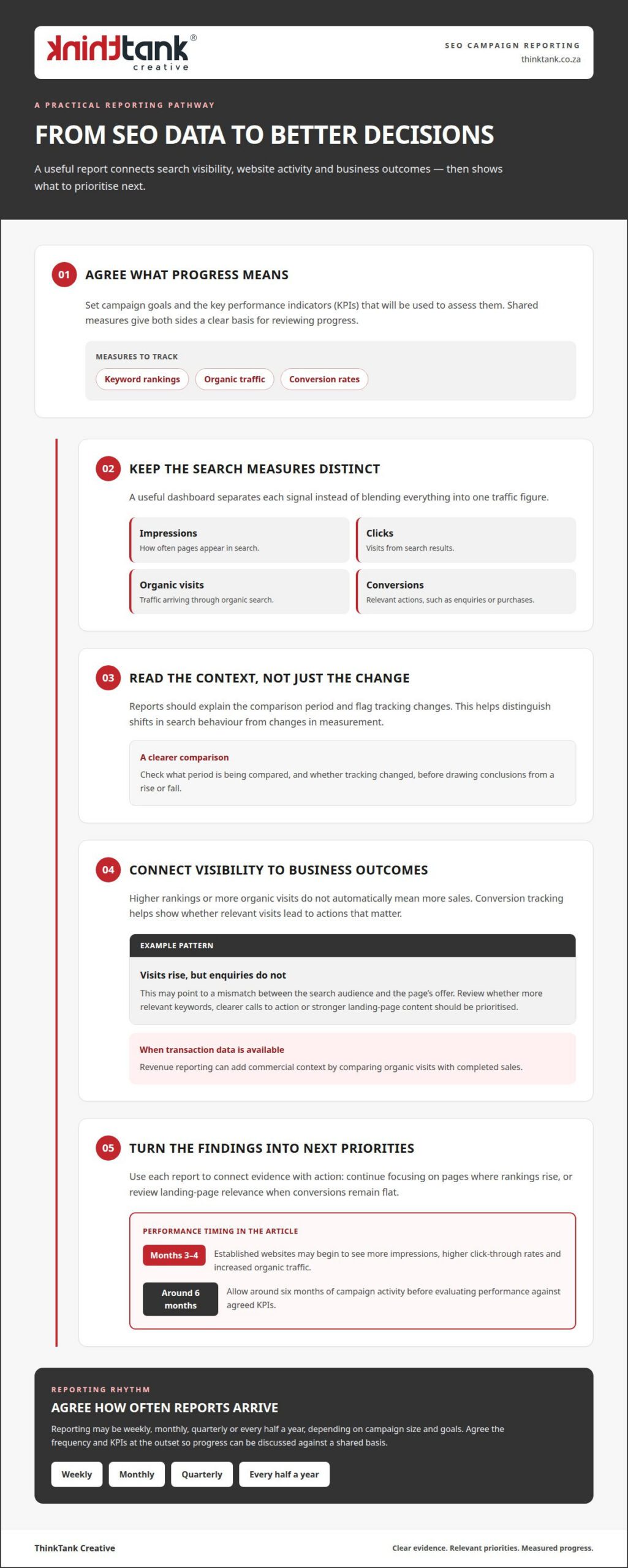
Useful SEO reporting connects search visibility with the actions that matter to your business. It should show what changed, what the campaign did and how those findings shape the next priorities.
An agency’s reports should cover website traffic, search rankings, conversions and completed campaign activities. These measures should relate to agreed goals, so you can see whether greater visibility attracts the right audience and supports business outcomes.
Reporting, KPIs and strategy refinement
Key performance indicators (KPIs) are measurable signals used to assess progress against campaign goals. An agency can track keyword rankings, organic traffic and conversion rates, then use the findings to refine its strategy. For example, rising visits without enquiries may point to a mismatch between the search audience and a page’s offer. Reviewing that pattern can help prioritise more relevant keywords, clearer calls to action or stronger landing-page content.
SEO tools and reporting dashboards
SEO tools gather search and website data, while a dashboard presents selected measures in one view. A useful report separates impressions, clicks, organic visits and conversions rather than blending them into one traffic figure. It should explain the comparison period and flag any tracking changes, helping you distinguish shifts in search behaviour from changes in measurement.
Performance and revenue reporting
Performance reporting should show whether SEO activity contributes to meaningful business results, not just higher rankings. Organic traffic does not automatically translate into sales, so conversion tracking should connect relevant visits with actions such as enquiries or purchases. Revenue reporting can add commercial context when transaction data is available. Comparing organic visits with completed sales, for instance, can help distinguish useful audience growth from traffic that does not support revenue.
Agency deliverables and reports
Deliverables should make the work and its outcomes visible, including activity summaries, performance measures and recommended next steps. Reports may arrive weekly, monthly, quarterly or every half a year, depending on campaign size and goals. Established websites may begin to see more impressions, higher click-through rates and increased organic traffic during months three and four. Allow around six months of campaign activity before evaluating performance against agreed KPIs.
Use each report to connect evidence with action. A month-on-month rise in rankings may warrant continued focus on those pages, while flat conversions could prompt a closer review of landing-page relevance. Agreeing on reporting frequency and KPIs at the outset gives both sides a shared basis for discussing progress, refining priorities and assessing the value of the SEO investment.
What does an SEO agency/expert do?
An SEO agency aims to grow a website’s organic traffic by improving how it appears in search engines such as Google. Understanding what to expect from an SEO agency includes knowing how to assess its results: review case studies and references from previous clients, prioritising examples from the last three years and outcomes relevant to your business.
Agency experience and approach
An agency’s experience shows in how it diagnoses challenges, sets priorities and explains its approach. A strategy should respond to your website, audience and competition, rather than rely on a generic package. Ask how the proposed work connects with your business goals, and look for examples that explain the starting point, actions taken and measurable outcomes.
References add context to published success stories. A case study might report stronger rankings, while a client reference can explain the working relationship and how the agency handled changing priorities. Consider whether examples involve similar customers or search challenges. An honest explanation of the differences is more useful than a promise to reproduce another business’s results.
Team roles and specialist expertise
SEO work can bring together strategic, technical and content expertise, with each area addressing a different barrier to organic growth. A technically sound website still needs relevant content, while useful pages can struggle if search engines cannot crawl them. Clarify who will lead strategy, implement technical recommendations and shape content, so responsibilities are understood from the outset.
Specialist input is particularly valuable when an issue crosses disciplines. Resolving a website structure problem, for example, may require technical analysis and an understanding of how visitors find information. A coordinated team can connect these perspectives instead of treating each task in isolation. The agency should explain how its specialists contribute to your priorities and who communicates decisions to your team.
Communication and transparency
Transparent communication means explaining planned work, progress, decisions and constraints in language your team can use. You need to understand how activity supports your goals, not just receive a list of completed tasks. Agree who your main contact is, how updates are shared and how strategy changes are discussed. Clear responsibilities make collaboration more productive.
Look for specific explanations rather than vague claims. An agency should describe its methods, explain why a recommendation matters and outline the trade-offs involved. Be wary of promises of overnight results or tactics such as hidden content designed to manipulate search rankings. Ethical practices support a considered strategy, while unrealistic claims make it harder to judge the work objectively.
An SEO agency may research relevant search terms, improve website pages and address technical barriers that limit visibility. It may also analyse competition and identify opportunities to attract qualified traffic. The precise mix depends on the website’s needs and business objectives. Knowing what to expect from an SEO agency means looking for clear reasoning behind its priorities and how the work can contribute to organic growth and revenue.
If your search strategy needs to connect more closely with your wider digital presence, explore how SEO strategy can support that alignment.
Content deliverables and AI-generated content
SEO content work should make useful pages easier to find and more helpful to visitors. Deliverables can include keyword research, new or refreshed copy, on-page updates and an editorial calendar tied to search intent.
Content creation and optimisation
Content creation and optimisation means developing or improving pages around relevant searches and visitor needs. It matters because a page must answer the query clearly, not simply repeat keywords. An agency may research a topic, shape a useful outline, edit the copy and refine its headings. For example, a service page can answer common customer questions before explaining the next step.
Content work can also involve updating existing pages rather than producing new ones. An agency might spend 10 hours in a month editing and optimising content, focusing on outdated details, unclear sections or missed search intent. The deliverable should show which pages changed and why, so each revision has a defined purpose.
Editorial calendars and content marketing
An editorial calendar schedules content topics, formats and publication priorities around audience needs. Planned publishing helps connect individual pages into a coherent content marketing effort. A calendar might map a guide to a broad question, then supporting articles to more specific searches, with each page serving a distinct role.
Weekly, keyword-optimised thought leadership content is one possible deliverable, but frequency alone doesn’t establish value. A useful plan identifies the intended reader, search purpose and action for each piece. For instance, an explanatory article can introduce a topic, while a related service page provides more detail for readers ready to act.
On-page SEO and content strategy
On-page SEO improves elements within a page, including its content, meta tags, headers and images. Clear structure helps visitors navigate information and gives search engines meaningful context. An agency can align a page title, headings and copy around the same topic, then check that images have descriptive alternative text.
A content strategy connects keyword research with the pages a business needs to serve its audience. It can identify gaps, overlapping pages and opportunities to strengthen the user experience. If several pages compete for the same search, for example, an agency may recommend consolidating their focus or clarifying each page’s purpose.
AI-generated content can help with drafting, but finished pages still need editorial judgement. An agency should review every claim, remove repetition and make the language accurate, useful and specific to the intended audience. A generic AI draft about a service needs meaningful details and a clear explanation of how that service addresses readers’ needs.
Expect content deliverables to connect research, writing and optimisation rather than arrive as disconnected copy. A clear brief identifies the target topic, intended reader, page format and review process. This gives each asset a role in the wider digital strategy, whether it answers a question, strengthens a service page or supports an enquiry.
SEO audits and technical website improvements
A technical SEO audit examines whether a website is accessible, understandable and usable for visitors and search engines. Its findings help prioritise fixes that support stronger crawling, clearer page structure and a better user experience.
What a technical SEO audit examines
An audit reviews site structure, content quality, loading speed, mobile optimisation, and inbound and outbound links. These areas are connected: a valuable page may struggle to appear in search results if crawling problems prevent search engines from finding it. The audit should identify issues, explain their impact and organise recommendations by priority.
During months one and two, SEO agencies commonly conduct technical audits, research keywords, optimise pages, set up tracking and resolve crawl errors. A five-hours-each-month technical auditing example shows how audit work may form part of a broader campaign. The time needed depends on the site’s condition and the complexity of the issues found.
Technical, on-page and off-page SEO
Technical SEO addresses how a website functions, including speed, mobile-friendliness, Core Web Vitals and crawl errors. On-page SEO improves elements within the website, such as content, tags and structure. Off-page SEO focuses on activity outside the website, including link building and social media. Together, these areas support a site’s visibility and relevance in organic search.
If an important service page loads slowly and has unclear headings, for example, it may need both technical fixes and on-page changes. An audit helps distinguish the underlying issue from its visible symptoms. This keeps improvements coordinated instead of treating every warning from an SEO tool as equally urgent.
Prioritising and implementing technical improvements
A useful audit turns findings into an implementation plan. It can group issues by affected pages, explain dependencies and identify changes requiring developer input. Resolving a crawl error may come before refining a page that search engines cannot reliably access. Recommendations should describe the issue, the proposed fix and how completion will be assessed.
Technical and on-page improvements can produce minor traffic increases within 3 to 6 months. That timeframe makes tracking important: agencies can monitor whether fixes have been implemented and whether relevant pages become more visible. Results depend on the website and its competition, so an audit should guide priorities rather than promise a specific ranking.
Structured data is another technical consideration. Schema markup can describe step-by-step guides, company information and FAQs, helping AI tools access that content. For an e-commerce website, structured data can support the display of product prices and customer ratings in search results. These additions work best when they accurately reflect information visitors can find on the page.
Sound technical SEO does not rely on hidden content to manipulate search engines. A sound audit focuses on accessible pages, accurate information and usable navigation, giving each recommendation a clear purpose.
SEO campaign costs and payment models
SEO investment should reflect the work required, campaign goals and website needs. When comparing proposals in South Africa, focus on the scope, responsibilities and outcomes the campaign is designed to support.
The price depends on the case and is given after a quote request; cost factors include website condition, competition, target keywords, content requirements and campaign scope. A plan for a new website or a competitive market may require different priorities from one focused on improving existing pages. The proposal should make clear which activities the fee covers and how those activities relate to agreed goals.
Monthly ongoing arrangements are common, and some agencies use fixed-fee packages. A set monthly package needs a clear scope: a fixed list of tasks may not reflect changes in a business, website or market. The value lies in work selected for the campaign’s actual needs, not in the number of items promised. Contract terms should explain duration, included activity, reporting and how either party can end the agreement.
Set business outcomes before assessing performance. A campaign might aim to increase qualified enquiries, improve visibility for a priority keyword or attract customers in a target location. Local SEO can include optimising a Google Business Profile, building local citations and targeting location-based keywords. Keep the business name, address and phone number consistent across the profile, website and directories to reinforce accurate local information.
SEO strategy develops in stages. The first 0-3 months may bring initial improvements; during months 4-9, businesses may begin seeing more impressions, clicks and sales, depending on their goals. From month 10 onward, rankings for highly competitive keywords may start to emerge. These periods are useful planning markers, not a substitute for evaluating progress against the campaign’s KPIs.
A campaign timeframe of at least 6 months, preferably 12 months, allows sustained work and assessment. SEO effects commonly begin to appear after three to six months, while significant improvements in highly competitive rankings and major organic lead generation typically require 9 to 18 months of consistent effort. A new website may need up to a year to build authority.
Hands-free execution means the agency manages agreed research, optimisation and campaign activity, while your team sets priorities and provides business context. The contract should state what approvals, access or specialist input the work requires. Read the terms carefully, clarify responsibilities and agree on goals and KPIs before work begins. That gives both sides a shared basis for assessing the investment.
Plan an SEO campaign around your business objectives and the work your website needs. Discuss an SEO campaign that aligns priorities, scope and performance goals.
ThinkTank Creative
ThinkTank Creative can help when your search strategy needs a stronger digital foundation or a more consistent brand presentation. If your website makes it difficult for visitors to act on the information they find, Website Design and Development can create a clearer, more purposeful experience.
Creative design and Logo and Corporate Identity Design can help keep visual communication cohesive across your brand. Social Media Marketing can extend how you connect with your audience beyond search results. These services are relevant when your website, brand identity and social presence need to work together as part of a wider growth plan.
If you’re ready to discuss how these priorities fit your business, contact ThinkTank Creative.
Make your next SEO decision with clarity
Knowing what to expect from an SEO agency gives you a stronger basis for shaping a campaign around your business priorities. The next step is to connect search visibility with the wider experience customers have of your brand, from finding your website to understanding what you offer.
ThinkTank Creative brings these elements together through Search Engine Optimization (SEO), Website Design and Development, Social Media Marketing and creative design. This approach is relevant when your growth plans involve attracting the right audience and presenting a consistent, compelling brand across digital channels. The focus is on aligning your online presence with the outcomes you want to pursue.
Bring your objectives and current challenges into the conversation, then explore an approach that fits your business. Contact ThinkTank Creative about SEO to discuss your next steps and build a considered foundation for growth.
Frequently Asked Questions
Why do businesses need SEO?
SEO helps businesses reach people looking for relevant products, services or information through unpaid search results. This can support discovery without paying for every click, although the work itself requires time and investment. For example, a business selling locally can improve its chances of appearing for searches that include its service and location. SEO is most useful when its priorities connect with business goals, such as qualified enquiries or online sales.
Do I have to have an ongoing contract?
No, contract terms vary, but ongoing arrangements are common because SEO requires continued work and evaluation. Contracts often last six months to one year, while some agencies offer a three-month trial period. Before agreeing, review the scope, payment schedule, cancellation terms and responsibilities. A shorter agreement may suit an initial assessment, while a longer campaign provides more time to implement work and assess progress against agreed goals.
Does the SEO firm optimise your Google Business Profile?
An SEO firm can optimise a Google Business Profile as part of local search work, improving business information and its relevance to local queries. Keep ownership and control of the profile, then grant the agency manager access for routine tasks. Check that your business name, address and phone number match across the profile, website and directories. Consistent details make it easier for customers to recognise your business.
Does the SEO service provider have a good reputation?
Assess reputation through recent case studies, client references and the quality of the agency’s communication. Look for examples from the last three years, and note whether they explain the challenge, work completed and outcome. A reference can add context about collaboration and follow-through. Also consider whether the agency explains its recommendations clearly, responds directly to concerns and distinguishes measurable results from broad claims.
Does the agency use ethical practices?
Ethical SEO focuses on useful content and legitimate improvements, rather than attempts to manipulate search rankings. Be cautious of proposals involving hidden content, paid backlinks or private blog networks. Ask for a plain-language explanation of how proposed tactics help visitors and search engines. A sound recommendation should improve page usefulness or accessibility, not conceal text from readers while presenting it to a search engine.
How do I know if it is working?
Look for evidence that SEO is attracting relevant visitors and helping them take meaningful actions. Track organic visits alongside enquiries, sales or other conversions that matter to your business. If traffic rises but enquiries remain flat, review whether landing pages match search intent and make the next step clear. Compare performance with the campaign’s agreed goals, rather than judging progress from one ranking alone.
How does the agency improve your online store’s search performance?
An agency can improve an online store by strengthening product and category pages, resolving technical barriers and using accurate structured data. Product structured data can help search results display details such as prices and customer ratings. An agency may refine a category page’s headings and descriptions, then ensure product information is represented clearly. These changes help search engines interpret the store and shoppers find relevant items.
How does the agency optimise for local search results?
Local SEO can include refining a Google Business Profile, building local citations and targeting location-based keywords. A citation is a mention of your business details in an online directory. A service business may create useful pages for the locations it serves and keep its name, address and phone number consistent across listings. These steps help search engines connect the business with relevant local searches.