Signs of a Bad SEO Agency: A Practical Checklist for Businesses
What if the biggest warning sign isn’t a ranking drop, but an agency that can’t explain what it’s doing or why? The signs of a bad seo agency often show up in the gaps between promised results, completed work and evidence you can inspect. A change in traffic alone doesn’t prove an agency has failed, but vague answers and unexplained tactics deserve attention.
It’s reasonable to expect SEO reports to show more than rankings and activity. You need to understand how the work supports your business objectives, what the results mean and what happens next. Comparing agencies can be difficult when proposals use different terms and measures, so look for clarity as well as confidence.
This practical checklist will help you recognise risky practices, assess evidence and accountability, and ask informed questions about strategy, access and communication. You’ll also learn how to distinguish normal fluctuations from more serious concerns, so you can choose a collaborative SEO partner with a clear view of the next steps.
Key Takeaways
- Treat the signs of a bad seo agency as prompts to investigate, not automatic proof of misconduct.
- Use a structured review of goals, baseline results, completed work, supporting evidence and next steps to assess an agency’s reporting.
- Compare contracts, account access and link-building practices, then use focused questions to clarify responsibilities and expectations.
- If concerns arise, document them, request clear explanations and preserve access to accounts and records before making changes.
- Look for a partner whose transparent process connects SEO with relevant content, paid advertising and website development.
Signs of a bad SEO agency: warning signs worth investigating
Vague promises, unclear work and reports that don’t connect activity to business results can leave you wondering what your SEO agency is actually doing. These are among the signs of a bad seo agency worth investigating, but a red flag calls for scrutiny, not an automatic conclusion. Look for repeated patterns and ask for evidence before deciding whether there’s a problem.
SEO involves more than chasing rankings. A neutral overview of search engine optimization can help clarify the range of work involved. Strategy should account for your business goals and circumstances, and the agency should be able to explain its approach in language you can understand.
Use this video as a prompt for questions to raise with your agency:
Which SEO agency promises should make you pause?
A guaranteed first-place ranking or a precise traffic outcome deserves questions, not blind trust. Search results are influenced by factors such as competition, your website’s condition and the resources available for the work. A credible agency can set measurable goals, explain its assumptions and review progress, but it shouldn’t present an uncertain outcome as assured.
Measurable targets show what you’re working towards; guaranteed rankings claim control over an outcome no agency can fully dictate. Be cautious if an agency promises results before discussing your goals or assessing your starting point. “Secret methods” that can’t be explained, or pressure to sign before the strategy is clear, also make the work and its risks harder to assess.
When does poor communication become a warning sign?
One delayed reply or a short-term ranking change isn’t enough to establish a problem. Pay attention to a pattern: questions repeatedly go unanswered, reports arrive without explanation, or updates use jargon instead of describing what was done and what comes next. Technical work can be complex, but its purpose and business relevance should still be understandable.
SEO often involves research, implementation, testing and adjustment over time. Rankings can move as search conditions and strategies change, so judge performance in context rather than reacting to a single fluctuation. Ask what changed, what evidence supports the explanation and whether any follow-up is planned. A clear, considered response helps distinguish normal movement from an accountability concern.
How to check an SEO agency’s strategy, evidence and reporting
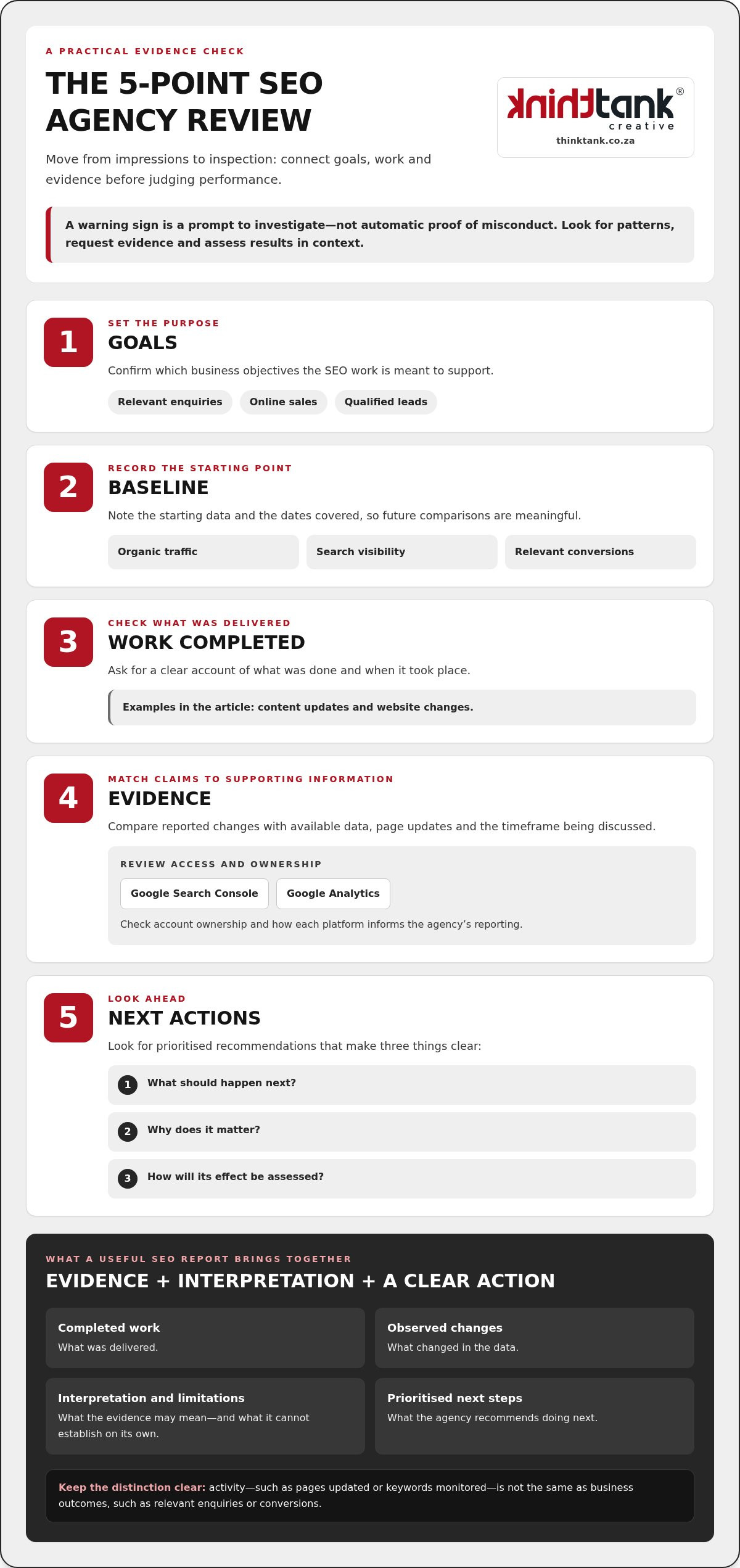
Move from impressions to inspection. Reviewing goals, baseline data, completed work and outcomes helps you assess whether an agency’s strategy is connected to your business, rather than simply producing activity. These checks can help distinguish genuine signs of a bad seo agency from a report that needs more context.
Use this five-step review:
- 1. Goals: Confirm which business objectives the SEO work is intended to support, such as relevant enquiries, online sales or qualified leads.
- 2. Baseline: Record the starting point for organic traffic, search visibility and relevant conversions. Note the dates and measurement period so future comparisons are meaningful.
- 3. Work completed: Ask for a clear account of what was delivered, such as content updates or website changes, and when the work took place.
- 4. Evidence: Match reported changes to available data, page updates and the timeframe being discussed. Review Google Search Console and Google Analytics access, account ownership and how the agency uses each platform in its reporting.
- 5. Next actions: Look for prioritised recommendations that explain what should happen next, why it matters and how its effect will be assessed.
For broader context on SEO strategy in South Africa, read this South African SEO strategic guide.
What should an SEO report explain?
A useful report sets out completed work, observed changes, the agency’s interpretation, any limitations and prioritised next steps. It distinguishes activity, such as pages updated or keywords monitored, from outcomes that matter to your business, such as relevant enquiries or conversions. Search visibility and organic traffic can indicate whether more people are finding your site, but the business context helps reveal whether that attention is valuable.
A useful SEO report combines evidence with interpretation and a clear action. If a metric has changed, the report should explain what it may mean, what it can’t establish on its own and what the agency recommends doing next.
How can you assess SEO claims without relying on rankings alone?
Compare each claim with the dates, baseline, pages changed, search data and relevant business outcomes. Rankings vary, so consider them alongside organic traffic, conversions and the quality of enquiries. A sudden traffic spike or impressive backlink total is a reason to ask for context: which pages or sources drove the change, and did it reach the intended audience?
Clear reporting makes collaboration easier. For more on assessing an SEO approach, explore SEO strategy and reporting as part of a wider digital marketing plan.
SEO agency red flags in contracts, access and link-building
Review the working arrangements as carefully as the strategy. A clear agreement should explain what the agency will do, how progress will be communicated and what happens if the relationship ends. Vague terms, restricted access or unexplained link-building methods are signs of a bad seo agency worth examining, but they aren’t proof of wrongdoing on their own.
Use this comparison to identify what needs clarification:
| Transparent practice | Concerning practice | Follow-up question |
|---|---|---|
| Deliverables, responsibilities and reporting cadence are described plainly. | The scope is vague, or reports and updates are irregular or undefined. | What work will be completed, by whom and how often will progress be reported? |
| Cancellation and exit terms are understandable. | It’s unclear how to end the arrangement or what happens to work in progress. | What steps, notice and handover apply if either party ends the agreement? |
| Your business can access its website and analytics accounts, with responsibilities agreed. | Access is controlled solely by the agency, or account ownership is unclear. | Who owns each account, and how can authorised people access it? |
| Link acquisition methods and their purpose can be explained. | Links are undisclosed, irrelevant or presented in reports that can’t be verified. | How were these links acquired, and where can I review them? |
What contract details should an SEO client understand?
Before work begins, check that the scope, deliverables, each party’s responsibilities, reporting cadence and exit terms are clear. An agreed activity, such as updating pages, is different from a promised ranking or revenue result. If a clause is unclear or its implications matter, seek qualified professional advice on the contract rather than relying on an agency’s explanation alone.
Make access practical, too. Your organisation should understand who controls its website, Google Search Console and Google Analytics accounts, and how access can be maintained if the working relationship changes. Clarify who is responsible for changes and approvals so important work isn’t left in limbo.
What makes backlink work difficult to trust?
Ask the agency to explain how links are acquired and what role they play in the strategy. Undisclosed paid links, irrelevant placements or reports that don’t let you verify the sites involved warrant further questions. Link volume alone doesn’t show whether the work is relevant or responsibly carried out. For a deeper look at ethical authority-building, explore local link-building strategies in South Africa.
Look for explanations you can follow and records you can review. Clear terms and accessible accounts help you assess the work and keep your digital assets under your organisation’s control.
What to do when your SEO agency shows warning signs
Take a measured approach. One disappointing metric or unclear report doesn’t automatically mean your agency is acting irresponsibly, but repeated gaps deserve a direct conversation. Document what concerns you, ask for an explanation and agree on specific next steps before making a decision about the relationship.
How should you raise concerns with an SEO agency?
Prepare for a focused review. Bring examples, dates, relevant reports and the business priorities the SEO work is meant to support. For instance, note which deliverable you expected, when it was due and what information you’ve received so far. This keeps the discussion grounded in observable details rather than general frustration.
Ask the agency to explain its findings, decisions and any risks or limitations, then set out what needs to happen next. Confirm the agreed actions, who is responsible and a practical date to review progress in writing. A clear record helps both sides understand the plan and makes it easier to assess whether concerns are being addressed.
When should you consider changing SEO agencies?
Consider a change if material concerns persist after you’ve raised them clearly and allowed for agreed follow-up. Repeatedly unexplained tactics, missing work or an unwillingness to clarify responsibilities may point to a working relationship that no longer supports your objectives. Slow progress on its own doesn’t prove poor or unethical work; SEO outcomes can take time, and performance needs to be assessed in context.
Before ending an engagement, review the transition carefully. Preserve access to your website, Google Search Console and Google Analytics accounts, along with reports, records of completed work and relevant communications. Clarify what work is under way, what remains outstanding and how access or responsibilities will be handed over. Check the agreement’s exit terms and seek professional advice if you need help interpreting them. Avoid making abrupt changes based on one ranking movement.
If you’re unsure how to interpret the evidence, return to the same practical checks: what work was agreed, what was completed, what the data shows and what action is proposed. Use the answers to make a considered decision rather than abandoning useful work without understanding the consequences.
For more context as you review your approach, explore ThinkTank Creative’s SEO strategic guide for South Africa.
To understand how SEO work can fit into a wider digital marketing plan, review ThinkTank Creative’s SEO services.
Choose an accountable SEO partner with a clear working process
A strong SEO partnership makes the work understandable and keeps it connected to your business priorities. Look for a transparent scope, clear responsibilities, reporting you can interpret and communication that welcomes informed questions. Realistic expectations matter, too: a credible partner can explain the intended direction and how progress will be assessed without promising instant, guaranteed transformation.
What does a credible SEO partnership look like?
Start with shared objectives. You and the agency should understand what SEO is meant to support, who is responsible for each part of the work and how decisions will be reviewed. As results and circumstances change, an accountable partner explains the evidence behind adjustments, including the trade-offs involved. The strategy shouldn’t be a black box.
SEO also works best when it fits the wider digital picture. Relevant content can support search visibility, paid advertising can complement broader marketing activity, and website development can help address user experience or site needs. The right mix depends on your goals; connected services should work together rather than become a list of disconnected tasks.
How does ThinkTank Creative approach connected digital work?
ThinkTank Creative’s approach includes research and strategy, clear communication, testing and delivery. Its digital work includes SEO alongside content creation, digital paid advertising, copywriting and reporting. Where appropriate, these activities can align with website development so search strategy, content and the website contribute to a coherent direction.
ThinkTank Creative provides ongoing service after project completion, supporting continued collaboration as priorities and learning develop. You should be able to understand what is being done, why it matters and how the work relates to your objectives. That’s a more dependable foundation than unexplained tactics or claims of overnight success. We Do It All So You Don’t Have To reflects an integrated approach, with communication and strategy helping connect the work.
As you weigh the signs of a bad seo agency against the qualities of a more accountable partner, focus on whether the process gives you clarity and a meaningful role in decisions. Consider how the proposed work will support your objectives, how progress will be communicated and what the next steps involve.
Discussing your SEO needs and timeline is a practical way to establish those priorities. An estimated cost is provided after discussion of your needs and timeline, so you can consider the proposed work in context.
Choose clarity and build a stronger SEO partnership
The signs of a bad seo agency are reasons to investigate, not a verdict based on one ranking change. Look for a consistent pattern: promises without a clear strategy, work you can’t verify, reports without business context or unclear access and responsibilities. A credible partner makes its approach understandable, connects activity to your goals and agrees practical next steps with you.
Founded in 2001, ThinkTank Creative provides connected digital work that includes SEO, content creation, digital paid advertising, copywriting and reporting, with ongoing service after project completion. This creates room for a considered approach that can bring related marketing activity together where it supports your objectives.
Ready to discuss your digital marketing needs and timeline? Talk with ThinkTank Creative. An estimated cost follows a discussion of your requirements, so the proposed work can reflect your priorities.
Choose a partnership built on clear communication, thoughtful strategy and progress you can understand.
Frequently Asked Questions
What are the biggest signs of a bad SEO agency?
The clearest signs of a bad seo agency include guaranteed rankings, unexplained tactics, unclear deliverables and reports that don’t connect work to business goals. Repeatedly unanswered questions or pressure to sign before the strategy is explained also deserve scrutiny. Look for patterns, not one isolated incident. Ask the agency to show what it has done, explain the evidence and outline what it recommends next before deciding whether there’s a serious concern.
Can an SEO agency guarantee first-page rankings?
No agency can credibly guarantee a specific first-page ranking, because search results depend on factors beyond its control, including competition and changes in search systems. A responsible agency can set measurable goals, explain its strategy and track progress against an agreed baseline. Treat promises of a precise position or outcome as a reason to ask how that result is assured. Distinguish a target the agency will work towards from a result it claims to guarantee.
How do I know if my SEO agency is doing a good job?
Assess whether the agency’s work is clear, evidence-led and relevant to your business objectives. Check what was completed, compare search visibility and organic traffic with a baseline, and review whether those changes are contributing to relevant enquiries or conversions. Reports should interpret results, acknowledge limitations and identify next actions, not just list rankings or activity. Good work also includes understandable communication, agreed responsibilities and a strategy that can be adjusted as evidence develops.
Should an SEO agency own my website or Google Analytics account?
Your business should retain ownership and control of its website and analytics accounts, whilst giving the agency the access it needs to carry out agreed work. Make sure authorised people in your organisation can access Google Analytics and Google Search Console, and understand who manages permissions. Clarify account responsibilities at the start of the relationship. Keeping access and records in your control helps protect continuity if staff, suppliers or working arrangements change.
Is a sudden drop in organic traffic proof my SEO agency is bad?
No. A traffic drop by itself doesn’t prove that your agency has done poor work or used harmful tactics. Check the dates, affected pages and search data, and consider whether website changes or broader search fluctuations could provide context. Ask the agency to investigate the change, explain what the evidence shows and recommend next steps. Look for a clear response and follow-through rather than drawing a firm conclusion from one metric.
What should I do if I think my SEO agency is using harmful tactics?
Document the specific work or claims that concern you, including dates, pages and reports, then ask the agency for a clear explanation of its methods and their purpose. Preserve access to your website and analytics accounts, along with relevant records, before making changes to the relationship. Agree corrective actions and a review point in writing. If concerns persist, assess the transition options carefully rather than reacting on incomplete evidence.
How often should an SEO agency report on its work?
Agree a reporting cadence that suits the scope of work and your decision-making needs; there isn’t one frequency that fits every SEO engagement. Reports should arrive consistently and explain completed work, changes in relevant metrics, context, limitations and prioritised next steps. Make sure you know who will provide updates and how questions will be handled between reports. A regular, understandable reporting rhythm helps you evaluate progress without treating every short-term movement as a final verdict.