Local SEO for South African Service Businesses: 2026 Plan
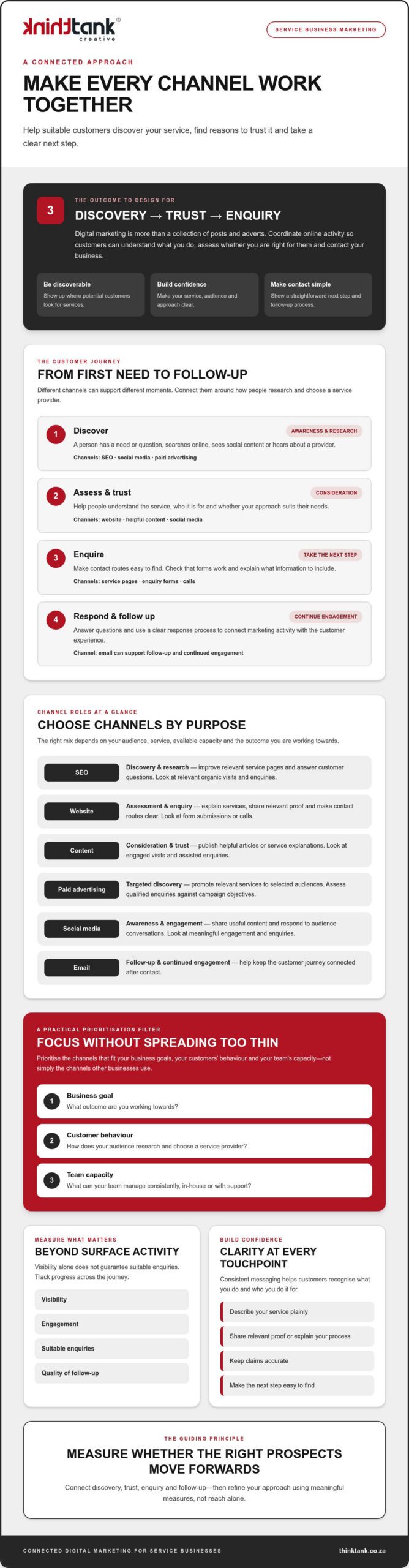
What if better local visibility depends less on publishing more location pages and more on making your Google profile, website and customer proof work together? This local seo guide for service businesses za starts with that practical shift. If you’re unsure whether to optimise your Google Business Profile, improve your website or focus on reviews first, start by bringing those elements together. A connected presence helps nearby customers understand what you do, where you work and why they can trust you.
In this guide, you’ll find a prioritised local SEO plan for South African service businesses, with practical steps to strengthen your presence across Google Search and Maps. You’ll learn how to explain your service coverage without creating thin, repetitive location pages, and how to connect useful website content with genuine trust signals.
We’ll also look at what to measure, from visibility and website actions to qualified enquiries, so you can judge progress by business relevance rather than rankings alone. Build a clear foundation, then refine it through consistent updates and careful measurement.
Key Takeaways
- Start with an accurate, well-managed Google Business Profile so customers can quickly understand your services and relevance.
- Use clear service pages to explain what you do and where you work, rather than relying on repetitive location pages.
- Strengthen local trust with accurate business information and genuine customer reviews, then keep your online presence up to date.
- This local seo guide for service businesses za shows how to distinguish search visibility from actions that can lead to qualified enquiries.
- Bring your profile, website content and reporting together in a practical routine that supports steady improvement.
What local SEO means for South African service businesses
Local SEO helps people find a relevant service business when they search for that service in a particular place or service area. For example, someone searching “electrician near me” has local intent: they’re looking for a service they can access, rather than general information about electrical work. This local seo guide for service businesses za focuses on making that connection clearer across your Google presence and website.
Local SEO overlaps with general organic SEO, but the searcher’s location and purpose matter. A broad search such as “how does solar energy work?” is informational; “solar panel installer in my area” signals a possible need for a service. As the Local search engine optimization overview explains, local search helps people find relevant businesses in a geographic context. Results aren’t guaranteed: relevance, competition, accurate business details and the searcher’s context all play a part.
For another perspective on planning geographic content, watch this video:
How local searches connect customers with services
Local discovery can begin in Google Search or Google Maps. Someone might search for “mobile dog groomer in my area”, compare the businesses shown, then visit a website to understand the services, coverage and next steps. Search and Maps help with discovery; a clear website supports consideration by answering practical questions and establishing credibility.
Enquiry is a separate step. After weighing up the available information, the customer may call or submit a form. A visible profile can earn attention, but useful service details and a straightforward route to enquire help turn that attention into a meaningful opportunity.
Can a service-area business use local SEO without a shopfront?
A business that travels to customers may still have a local search strategy, but Google Business Profile eligibility and address-display choices depend on Google’s current rules. Review the latest Google Business Profile guidance before creating a profile or changing how an address is displayed. Don’t publish a customer-facing address if the applicable guidance doesn’t support it.
Describe the areas the business genuinely serves, not locations added solely to influence rankings. Service coverage should reflect real operations and be explained consistently across the profile and website. This helps potential customers judge whether the service is relevant without relying on invented locations or repetitive pages.
Build a strong Google Business Profile for local service searches
A well-maintained Google Business Profile helps potential customers assess whether your business offers the service they need and how to take the next step. Set it up carefully, then revisit the details as your business changes. A complete profile can support discovery, but it can’t guarantee a particular ranking or placement in Google Maps.
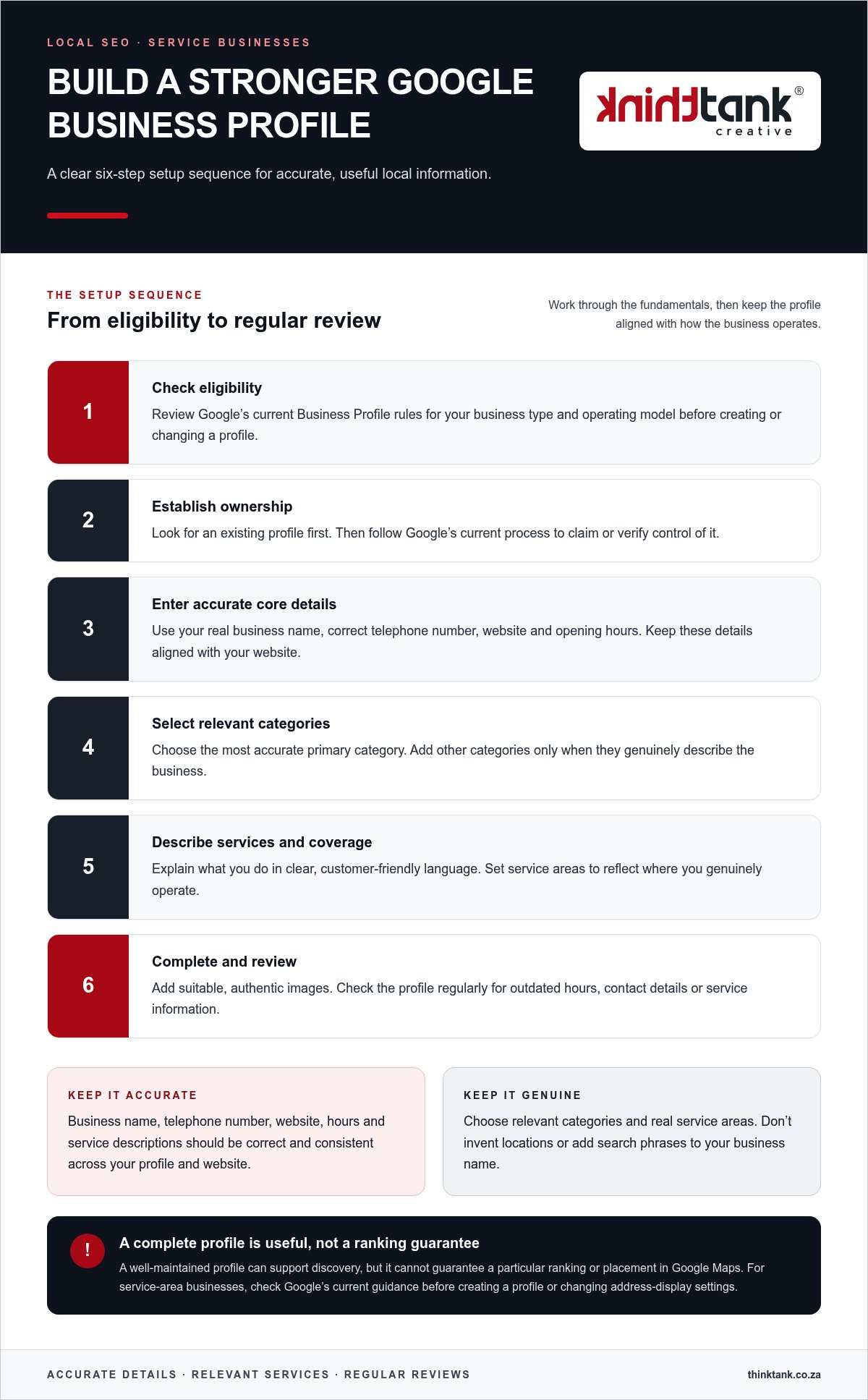
Set up the profile in a clear sequence
- 1. Check eligibility: Review Google’s current Business Profile rules for your business type and operating model before creating or changing a profile.
- 2. Establish ownership: Look for an existing profile first, then follow Google’s current process to claim or verify control of it.
- 3. Enter accurate core details: Use your real business name and correct telephone number, website and opening hours. Keep these details aligned with your website.
- 4. Select relevant categories: Choose the most accurate primary category, then add only additional categories that genuinely describe the business.
- 5. Describe services and coverage: Explain what you do in clear, customer-friendly language, and set service areas to reflect where you genuinely operate.
- 6. Complete and review: Add suitable, authentic images and check the profile regularly for outdated hours, contact details or service information.
Choose accurate categories and describe services clearly
Categories help Google and customers interpret what your business does. A business providing plumbing repairs, for example, should select the closest accurate category rather than add unrelated categories in the hope of appearing for more searches. Describe each service plainly, using wording that matches the information on your website. Don’t add search phrases to your business name, invent locations or make claims your business can’t support.
Keep business details and service coverage consistent
Consistency makes it easier for customers to recognise your business across its profile and website. Check that the business name, telephone number, website address, hours and service descriptions are accurate in both places. For a service-area business, use Google’s current guidance to decide how to represent coverage and whether an address should be displayed. Don’t expose a private address or add locations solely to influence rankings.
Opening hours help customers judge when to make contact, while a working telephone number and website link give them clear next steps. Genuine images can help people understand the business and its work. Keep profile details useful and current rather than treating completion as a one-off task.
For a deeper walkthrough, read this Google Business Profile optimisation guide. A stronger local seo guide for service businesses za starts with the same fundamentals: accurate information, relevant categories and credible details that match the customer experience.
Make your website reinforce local SEO trust and relevance
Your website should confirm what a customer has seen in search and help them decide what to do next. A useful service page explains the work, who it is for, what the process involves and how to enquire. A thin location page simply swaps one place name for another without adding meaningful information. If a page doesn’t answer a distinct customer need, it’s unlikely to build trust or clarify your coverage.
Create service pages that answer real customer questions
Give each important service its own page when there’s enough useful information to make it distinct. Describe the service in familiar customer language, clarify what’s involved and make the next step easy to find. Where coverage matters, explain it accurately and in context, rather than publishing near-identical pages with only a place name changed. A broader content plan can help organise these pages; explore this South African SEO strategic guide for related planning principles.
Build pages around genuine differences in the service, audience or customer questions. A location page earns its place only when it provides helpful local detail, such as relevant service information or a clear explanation of coverage. Avoid claims that imply you serve places or customers you don’t.
Use local proof without overstating your coverage
Trust grows through specific, credible evidence. Where accurate and shared with permission, include customer testimonials, relevant credentials or examples of completed work. Keep the business name and contact details consistent across relevant pages, and make sure service descriptions match the information shown on your Google profile. These details help visitors understand who they’re dealing with and whether the service fits their needs.
Make the site comfortable to use on a mobile phone. Keep key information readable, make contact options easy to find and reduce friction in forms. Visitors shouldn’t have to search through several pages to work out how to call or submit an enquiry.
Structured data, including Schema.org markup, can help describe page information to search engines. Use it only when it accurately reflects content people can see on the page. Markup doesn’t guarantee rich results or better rankings, so prioritise clear, useful content first.
This local seo guide for service businesses za treats the website as part of the customer’s decision, not just a destination for search traffic. Research and strategy can help align page structure, content and enquiry goals. ThinkTank Creative brings SEO and custom website design and development together to support that planning.
Turn local SEO into a manageable routine and measure progress
Local SEO is easier to improve when you treat it as an ongoing cycle, not a one-off profile update. Set a baseline before making changes: note the profile’s visible interactions, relevant website visits and enquiries you can identify. Review the same measures regularly, recording what changed and when. A monthly check-in can provide a practical rhythm, with a deeper review when you update services, coverage or website content.
What should a service business track in local SEO?
Separate visibility from outcomes. Visibility indicators show whether people may be finding you; actions show whether they engage; lead quality helps establish whether those actions matter to the business.
- Visibility: Review relevant search queries and website performance in Google Search Console. Use profile insights to understand interactions where available.
- Actions: Monitor website visits, calls and form submissions, using consistent methods to identify their source where possible.
- Quality: Record which enquiries relate to your services and genuine coverage, rather than counting every interaction as a useful lead.
Google Search Console and Business Profile reporting can change, and available data has limits. Check Google’s current documentation for the reporting names and measures shown in your account. Don’t assume that a position, profile interaction or traffic increase alone proves success. Read the indicators together, alongside actual enquiries, and handle customer information carefully in your tracking process.
Which local SEO task should you do first?
Prioritise issues that create friction or mislead customers. Correct inaccurate profile details, clarify confusing service pages and fix broken phone links or enquiry forms before making cosmetic changes. Next, use real customer questions to identify content gaps. A useful answer to a recurring question can strengthen a page; another near-identical page that only swaps a place name usually adds little value.
Keep the routine simple. Check profile accuracy and enquiry routes during regular reviews, note new customer questions as they arise, and assess website content and reporting together. If a measure changes, investigate likely causes before making several changes at once. This makes it easier to assess which actions appear to help.
Credible local relevance can also extend beyond your own website. Explore local link-building strategies in South Africa, but keep the focus on useful relationships and relevant resources rather than links for their own sake. A clear local seo guide for service businesses za connects visibility to useful actions, not rankings in isolation. Aligning SEO, website content and reporting makes progress easier to assess.
Bring your local SEO strategy together with the right website and support
Local visibility is built through connected signals: an accurate Google Business Profile, useful service pages, credible proof and ongoing measurement. If these elements tell different stories, potential customers may struggle to understand what you offer, where you work or how to enquire. A joined-up strategy brings them into alignment around genuine customer needs and business goals.
When does an integrated local SEO approach make sense?
Look for gaps between your search presence and the experience on your website. Your profile might describe services that are difficult to find on the site, key pages may leave coverage or next steps unclear, or reporting may focus on rankings without showing whether relevant enquiries follow. These are signs to review the whole customer journey rather than adjusting one element in isolation.
Website design, SEO and content creation can work together to make that journey more coherent. Research helps identify which services and questions deserve attention; strategy then shapes page structure, useful content and clear enquiry routes. This is especially valuable for service businesses working across genuine service areas, where content needs to communicate coverage without relying on repetitive location pages.
What happens when strategy, delivery and support work together?
ThinkTank Creative’s process starts with research and strategy, then moves through planning, design, development, testing and launch. SEO, content creation, reporting and page optimisation can inform how a website is structured and how its performance is assessed. The aim is a practical, connected foundation, not a promise of rankings, enquiry volumes or fixed outcomes.
Work continues after launch. Ongoing website support gives a business room to maintain its site and refine its approach as services, customer questions and priorities develop. ThinkTank Creative, founded in 2001, brings website and digital marketing capabilities together through a collaborative approach. “We Do It All So You Don’t Have To” captures that all-rounder perspective.
This local seo guide for service businesses za has set out the core components, but the right priorities depend on your current profile, website and enquiry goals. ThinkTank Creative starts by discussing your business needs and timeline, then provides an estimated cost that reflects the project’s scope.
Build a stronger foundation for local enquiries
Local visibility works best as a connected effort: keep your Google presence accurate, make service pages genuinely useful, and give customers clear ways to take the next step. Then measure more than exposure. Calls, relevant form submissions and qualified enquiries help show whether your local SEO is supporting business goals.
This local seo guide for service businesses za offers a practical place to begin, but priorities will differ with your services, coverage and website. Research can help identify valuable improvements and bring search strategy, content and customer journeys into closer alignment.
ThinkTank Creative combines SEO, content creation, reporting and custom website design and development to support that joined-up approach. Start a conversation with ThinkTank Creative about a local SEO and website strategy shaped around your business needs. With clear priorities and consistent attention, you can build a more credible presence and make it easier for the right customers to enquire.
Frequently Asked Questions
What is local SEO for a service business?
Local SEO helps a service business appear when people search for relevant services in a place or service area. It brings together accurate business information, useful website content and credible customer feedback so searchers can assess whether the service suits their needs. Unlike a broad informational search, a query for a nearby service suggests a possible need for a provider. This local seo guide for service businesses za explains how to build that presence without promising specific rankings.
Can a service-area business use Google Business Profile without showing its address?
It may be possible, depending on the business’s eligibility and Google’s current Business Profile rules. A service-area business should review Google’s latest guidance before creating a profile or deciding whether to display an address. Set the profile to reflect genuine operations, and don’t use a private address or invented location simply to influence search visibility. Accurate coverage information helps customers understand where the business actually works.
How do I get my service business on Google Maps in South Africa?
Start by checking that your business meets Google Business Profile eligibility requirements, then claim or create its profile and complete Google’s verification process. Enter accurate business details, choose a relevant category, describe your services and set genuine service coverage according to current guidance. Keep the profile aligned with your website. A profile can make your business eligible to appear on Maps, but completion doesn’t guarantee a particular placement.
Do service businesses need a separate page for every area they cover?
No, not unless each page offers distinct, useful information for customers in that area. Repeating the same service copy and changing only the place name can create thin pages that add little value. Start with clear service pages that explain what you do and how to enquire. Describe your genuine coverage where it helps customers decide whether your service is relevant, and create additional pages only when there’s meaningful content to support them.
How long does local SEO take to show results?
There’s no dependable fixed timeframe for local SEO results. Progress depends on factors such as your starting point, the competitiveness of your services, the accuracy of your online information and how well your website meets searchers’ needs. Establish a baseline, make improvements in a considered order and review visibility and enquiries consistently. This approach helps you assess whether actions are moving in the right direction without relying on promises of a set outcome.
What should a service business measure to track local SEO?
Measure visibility, customer actions and enquiry quality together. Review relevant search visibility and website visits in Google Search Console, alongside available Google Business Profile insights. Track calls and form submissions using a consistent method, then assess whether enquiries match your services and genuine coverage. Reporting labels and available data can change, so check current Google documentation. No single ranking or interaction proves that local SEO is delivering valuable business outcomes.
Do Google reviews help local SEO for service businesses?
Reviews help potential customers assess a business and can strengthen trust in its online presence. Encourage genuine feedback without pressuring customers or selectively asking only for positive reviews. Respond professionally and use recurring comments to identify questions your website or profile could answer more clearly. Reviews are one part of a broader local presence, not a guarantee of rankings or enquiries, so consider them alongside accurate business details and useful service information.