Social media content ideas for small businesses that connect

A feed built around one kind of post can leave a business’s personality and expertise unseen. The strongest social media content ideas for small businesses combine behind-the-scenes moments, cross-promotion, customer recognition, practical tutorials and competitor research. Together, these formats help content feel more varied, relevant and connected to the people a business wants to reach.

It makes sense to want posts that do more than fill a calendar. Social media content works harder when each format has a purpose: introducing the people behind the business, answering a customer question or celebrating a positive review. A social media professional can shape these ideas into a considered plan that reflects your brand and speaks to your audience.

Explore how different content types can support a more engaging social presence, from showing how your business works to sharing useful advice and recognising customers. You’ll also see how competitor research can inform original content without simply copying what others post.

Key Takeaways

  • Use behind-the-scenes moments to show the people, process and personality that make your business distinctive.
  • Plan cross-promotion so social posts and email support one another, rather than competing for attention.
  • Recognise customers and share positive feedback to make your online community feel valued.
  • Turn common questions into practical tips and tutorials that demonstrate your expertise.
  • Use competitor research to spot content gaps and shape original posts around your audience’s needs.

1. Behind-the-scenes content

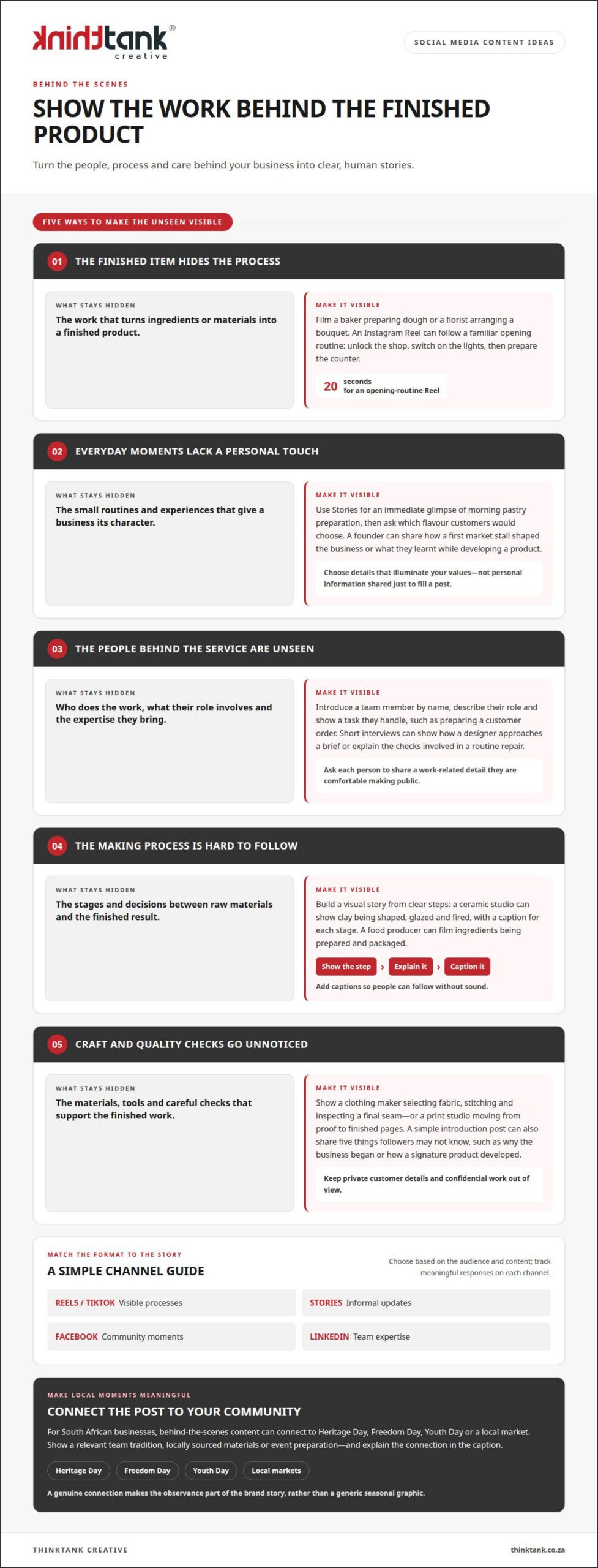
Show the work behind the finished product. A short clip of a baker preparing dough or a florist arranging a bouquet gives the audience a closer view of the process. For Instagram, a 20-second Reel of the opening routine can capture a familiar sequence: unlocking the shop, switching on the lights and preparing the counter. The detail makes the scenes recognisable, while the routine gives viewers a reason to watch through.

Stories can make these moments feel immediate. A café might share the morning’s pastry preparation, then add a poll asking which flavour customers would choose. Personal experiences can add context: a founder could explain how a first market stall shaped the business or what they learnt while developing a product. Choose details that illuminate the brand’s values, rather than sharing personal information just to fill a post.

Introduce the people behind the service, too. A team post could name a staff member, describe their role and show one task they handle, such as preparing a customer order. Short interviews can reveal useful details: a designer might explain how they approach a brief, while a mechanic describes the checks involved in a routine repair. Ask each person to share a work-related detail they are comfortable making public.

How-it’s-made posts turn a sequence of steps into a clear visual story. A ceramic studio could show clay being shaped, glazed and fired, with captions explaining each stage. A food producer might film ingredients being prepared and packaged. Keep the camera focused on the process, and add captions so viewers can follow without sound. These examples help people see the care and decisions behind the finished product.

Production content can also feature tools, materials and quality checks. A clothing maker could show fabric selection, stitching and a final seam inspection; a print studio could show a design moving from proof to finished pages. Avoid revealing private customer details or confidential work. For a simple introduction post, share five things about the business that followers may not know, such as why it began or how a signature product developed.

On Instagram, Facebook, TikTok and LinkedIn, choose formats that suit the story: Reels or TikTok clips for visible processes, Stories for informal updates, Facebook posts for community moments, and LinkedIn posts for team expertise. The most engaging option depends on the audience and the content, so track meaningful responses on each channel.

South African businesses can connect behind-the-scenes posts to Heritage Day, Freedom Day, Youth Day or a local market. Show a relevant team tradition, locally sourced materials or event preparation, and explain the connection in the caption. A genuine link makes the observance part of the brand story, rather than a generic seasonal graphic.

2. Cross-promotion across social platforms and email

Give each platform a role, then connect content so interested customers can follow the story. A business could publish a product highlight on Instagram, share a useful excerpt from its blog on Facebook, and send subscribers an email with further details. Cross-promotion works best when each version suits its platform, rather than repeating identical copy everywhere.

For a South African campaign, use content you own or have permission to share, protect identifiable customer information, and make promotional incentives clear. Keep product descriptions and advertising claims accurate. These practices help a professional plan content responsibly across social channels and email.

Choose formats that make the offer easy to understand. An infographic can explain a service process or compare product features, while a podcast excerpt can introduce an expert opinion. A blog post can provide fuller detail, with social posts highlighting a useful takeaway and directing interested followers to the relevant page. A customer quote can add a human perspective, provided you secure permission before sharing it.

Promotions should offer a clear reason to act. A retailer might highlight a seasonal product, while a service business could explain what an introductory offer covers. Contests and giveaways can encourage participation and invite people to join an email list. For example, a business could offer a 15-minute coaching call as a prize, then promote the entry details across its platforms and email. The campaign should state the entry conditions plainly and make the next step easy to find.

Posting frequency should reflect your audience’s habits, each platform’s purpose and the content you have available. A professional can review channel performance and production capacity, then set a sustainable cadence rather than applying the same schedule everywhere. A content calendar brings the plan together: it maps campaign dates, platform formats, email sends, product highlights and review points. It also leaves room to respond to relevant news or customer questions.

To measure performance and return on investment, align metrics with the campaign goal. Reach and interaction can indicate whether content attracts attention; tracked links, enquiries and sales can show whether that attention leads to action. Comparing campaign results with the resources invested gives the business a clearer view of value. Use the findings to inform the next calendar, including which messages to refine or reuse.

For businesses that need a coordinated plan across social platforms and email, professional social media marketing can connect content choices to business objectives.

3. Follower recognition and customer testimonials

Make customers part of the story, not just the audience. A thoughtful reply to a positive post shows followers that their feedback matters. For example, a coffee shop could thank a customer who shared a photograph of their takeaway cup, then ask permission before featuring it. This turns a real interaction into content while keeping recognition personal and respectful.

User-generated content is unsponsored social media content shared by a business or its followers across social platforms. It might include customer photos, short videos or a post describing a service experience. A professional can identify relevant posts, confirm permission to reuse them and add a brief caption explaining the context. This gives prospective customers a genuine view of how people experience the business.

Reviews can provide useful social proof when they are shared with care. A post might quote a customer praising a local clothing shop’s helpful fitting service, alongside the review’s original meaning and attribution. Keep the wording accurate, avoid implying that one person’s experience represents everyone’s, and respond constructively to criticism. A considered reply can show how the business handles concerns, not only compliments.

Testimonials work in several formats. A short quote can sit on a branded graphic, while a video can let a customer explain what they valued in their own words. For a home bakery, a testimonial might describe the ordering process and the presentation of a celebration cake. Choose feedback that illustrates a specific strength, rather than publishing praise without useful detail.

Customer support questions can also become helpful posts. A professional can review FAQs and recurring questions recorded by sales or support teams, then shape clear answers into captions, carousel posts or short videos. For instance, a local salon could explain how to prepare for an appointment, while avoiding customer names or private details. This turns repeated enquiries into accessible information for followers.

Recognition can mark community milestones as well as individual contributions. When a business reaches 1,000 followers, a thank-you post can celebrate the people who helped build its community. Another idea is a shoutout to its top five fans, with a specific reason for recognising each person. Thoughtful details make the acknowledgement feel sincere instead of like a standard promotional graphic.

A content plan should balance reviews, customer photos, support answers and direct appreciation. Rotate formats, match each post to a relevant product or service, and invite followers to contribute their experiences. For example, a garden centre could ask customers to share photos of plants bought there, then feature selected submissions and thank each contributor. This creates a continuing conversation grounded in real customer voices.
Social media content ideas for small businesses that connect

4. Educational tips and tutorials

Teach one useful skill at a time, and make each post easy to apply. A hardware shop could publish a short video showing how to use a new drill safely for a basic household task. A bookkeeper might explain an invoice term in a caption, then add an example using a fictional transaction. Clear, focused lessons give followers a practical reason to save or share a post.

For businesses with limited time and budget, a social media professional can build posts from existing expertise, common questions and simple demonstrations. A hair salon could turn an appointment question into a short tip, while a garden centre could explain how to identify dry soil. These ideas need useful knowledge and a clear format, not elaborate production.

Quick tips work well when they solve one small problem. A Pretoria vehicle workshop could share a checklist for preparing a car before a long drive, while a Durban guesthouse might explain how to pack for a coastal weekend. A professional can shape each tip around the audience’s needs, then use concise captions and showing-focused visuals to make the advice straightforward.

Some topics deserve a sequence rather than a single post. A professional could plan a five-day mini-course around a business speciality, with each lesson building on the previous one. For example, a nutrition practice might cover meal planning, ingredient labels and preparation routines. A seven-day mini-course in a Facebook group can create a longer learning journey and give participants space to discuss each lesson.

Useful resources can make tutorials more actionable. A property maintenance firm could share a seasonal home-care checklist, then explain one task in a short video. A stationery shop might demonstrate a simple weekly planning method using a notebook and pen. Show how the resource supports a real activity, rather than displaying products without context.

Life tips can connect expertise to everyday routines. A local optician could explain how to organise a work desk for comfortable screen use, while a coffee roaster might show how grind size affects a home brew. A social media professional can adapt these subjects into a carousel, a short video or a caption-led post, depending on the detail and audience.

Interactive prompts can turn education into participation. A career coach could ask followers to write down three work goals and aim to achieve at least one within a week. Follow-up content could offer a planning tip and invite people to share progress. This gives the series a clear purpose, supports engagement and makes success visible through audience responses.

5. Competitor research and content creation

Research competitors to find unanswered audience needs, not posts to reproduce. A social media professional can review public content from similar South African businesses, noting recurring themes, formats and questions in comments. For example, if local estate agents mainly post property listings, a useful gap might be practical explanations of viewing preparation or rental terminology. The opportunity lies in adding a distinct perspective, not copying their wording or visuals.

Start with the business goal and target audience. A Durban homeware shop might want more enquiries about custom orders, whilst a Johannesburg accountant may need to explain services clearly. The professional can select relevant competitors, assess how they present similar offers, and identify topics their own audience asks about. This keeps research focused on business relevance instead of collecting examples without a clear purpose.

Look beyond visible likes. Comments can reveal what followers find confusing, and repeated questions can point to content worth developing. If several posts about skincare attract questions about product order, a beauty retailer could create an original routine guide. If Instagram competitors rely on polished product images, a brand might stand apart by talking through materials, care or practical use in short videos.

Turn findings into a content brief. It should connect an audience need with the brand’s expertise, the intended format and a clear next step. For instance, a Cape Town tour operator could address questions about choosing a neighbourhood through a local guide carousel. A follow-up post might explain one area in greater depth. The professional keeps the message grounded in the business’s own knowledge and voice.

Competitor research also informs posting choices. If other businesses publish frequently but repeat the same message, you do not need to match their volume. Instead, plan varied, purposeful posts and use performance data to refine themes. Reach, saves, comments and enquiries each reveal different signals. The most useful measure depends on whether the content aims to inform, build awareness or prompt contact.

Keep research current through regular review, especially when customer questions or business priorities shift. A simple working record can capture a competitor’s topic, format, audience response and the content gap it suggests. Turn those observations into original ideas, check that examples fit the brand, and avoid treating another business’s popularity as proof that the same approach will work.

Use competitor insight as a starting point for distinctive creative work, not a template. Develop original content with tailored creative design that reflects your business’s own expertise and identity.

ThinkTank Creative: Social Media Marketing

ThinkTank Creative offers Social Media Marketing for businesses that want a more considered, consistent online presence. Turn to a social media professional when planning posts takes time, content feels disconnected from your brand, or competitor research could help inform a fresh direction. A tailored approach can bring behind-the-scenes stories, customer recognition, tutorials and promotional content together around your business goals and audience.

Strong social content also needs a cohesive visual identity. Creative design and Logo and Corporate Identity Design can align your posts with your wider brand, while Website Design and Development can support a consistent journey from social discovery to your online presence. The right combination depends on what your business needs to communicate.

To discuss social media marketing for your business, contact ThinkTank Creative.

Build a social presence that grows with your business

Your social presence can become a clearer expression of what your business stands for as your priorities and audience develop. Treat planning as an ongoing connection between brand strategy and customer insight: each conversation can reveal what people value, what they need explained and where your next opportunity lies. That perspective keeps social media content ideas for small businesses connected to real business direction, rather than simply filling a publishing schedule.

A professional can help translate those insights into a coherent approach, aligning social content with the wider customer journey. ThinkTank Creative brings social media marketing together with creative design and website development, so the experience can feel consistent from first discovery to further engagement. The right next step is a conversation about your goals, your audience and the role social media should play in your growth.

Contact ThinkTank Creative today to discuss a considered direction for your business. Your next stage of growth can begin with a clear, collaborative plan.

Frequently Asked Questions

Why should you use different types of social media posts?

Different post types let a business inform, entertain and invite action without making every update feel like an advert. A mix of formats can also suit different audience preferences: one follower may watch a brief demonstration, while another prefers a concise written tip. For social media content ideas for small businesses, variety gives each post a distinct purpose and helps the brand communicate beyond a single product or promotion.

How can a social media professional create engaging product and service posts for your business without making them sound too promotional?

Start with the customer’s need, then show how a product or service fits into a real situation. For example, a stationery business could demonstrate how a particular notebook helps organise meeting notes, instead of relying on repeated sales language. Clear captions, useful context and a restrained invitation to learn more keep the focus on value. Make the benefit understandable without overstating what the offer can do.

What user-generated content and customer testimonial ideas can small businesses use?

Invite customers to share how they use a purchase, what they enjoyed about an experience or what problem it helped them address. A craft shop might feature a customer’s finished project made with supplies from the shop, while a service business could publish a short testimonial about the experience from enquiry to completion. Ask permission before reposting, credit the contributor as agreed, and preserve the meaning of their original words.

Which content formats get the most engagement on Instagram, Facebook, TikTok and LinkedIn?

The article doesn’t identify a single format as generating the most engagement. It suggests Reels for Instagram, TikTok clips for visible processes, Stories for informal updates, Facebook posts for community moments and LinkedIn posts for team expertise, then recommends tracking responses on each channel.

How often should a small business post on each social media platform?

Post regularly, using a sustainable cadence based on your audience’s habits, each platform’s purpose and the content you can produce. Avoid relying on posting to Instagram only once a month, and use a content calendar to plan consistently.
SEO vs PPC for Small Businesses in South Africa: 2026

The channel that brings enquiries this month may not be the one that builds your most dependable source of demand. Choosing seo vs ppc for small business in south africa isn’t simply a choice between free traffic and paid clicks; it’s about matching your marketing to your goals, budget runway and ability to convert interest into business.

If you’re weighing up limited resources, it’s sensible to want a clear way to measure what they’re achieving. PPC can put your offer in front of people actively searching, while SEO works to build organic visibility over time. Paid activity can stop when campaigns pause; organic visibility may continue to attract visitors, although it requires ongoing attention and isn’t guaranteed.

This guide compares the roles, trade-offs and measurement needs of both channels, then shows how to decide whether to focus on one or combine them. You’ll also find practical next steps for testing performance, tracking meaningful outcomes and refining a plan around your South African business’s readiness to grow.

Key Takeaways

  • Understand how SEO builds unpaid search visibility over time, while PPC uses paid campaigns to reach potential customers.
  • Compare SEO and PPC by the effort, control and ongoing investment each requires, rather than assuming one is free or guarantees quick returns.
  • Use seo vs ppc for small business in south africa as a practical decision: align your channel choice with business goals, website readiness and capacity.
  • Follow a clear framework to select a channel, track meaningful outcomes and refine your approach as you learn.
  • See how coordinated SEO and PPC, supported by campaign planning, copywriting and reporting, can contribute to a more considered growth strategy.

SEO vs PPC for South African small businesses: what each channel does

Should your business build organic discoverability, pay for search visibility, or coordinate both? The answer depends on what you need to achieve and how ready your website is to turn visits into enquiries or sales. In the seo vs ppc for small business in south africa comparison, these channels serve different purposes, even though both can help connect your business with people searching online.

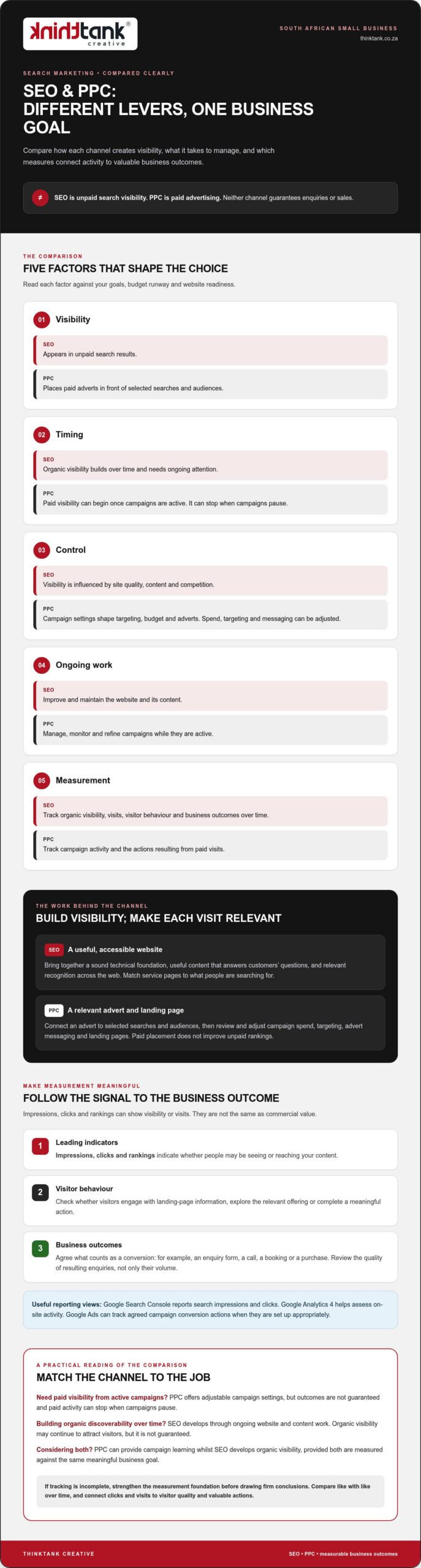
Search Engine Marketing (SEM) is an umbrella term for approaches that increase visibility in search, including Search Engine Marketing (SEM). SEO improves a website’s unpaid visibility in relevant search results. PPC, or pay-per-click advertising, places paid ads in front of selected audiences, with campaign spend and platform settings influencing when and where those ads may appear.

For a concise visual overview of how small businesses can weigh these channels, watch:

Factor SEO PPC
Visibility Unpaid search results Paid ad placements
Timing Builds over time Can begin once campaigns are active
Control Influenced by site quality, content and competition Campaign settings shape targeting, budget and ads
Ongoing work Improve and maintain the website and content Manage, monitor and refine campaigns
Measurement Track visibility, visits and business outcomes over time Track campaign activity and resulting actions

What does SEO involve for a small business?

SEO brings together a sound technical foundation, useful content and signals that help establish a website’s authority. That means making pages accessible to search engines, answering the questions potential customers actually ask, and earning relevant recognition across the web. A person searching for a particular service should land on a page that clearly explains that offering and what to do next. For more context, read this South African SEO strategic guide.

What does PPC involve in search marketing?

Paid search campaigns connect an advert to selected searches, audiences and a relevant landing page. Businesses can manage factors such as spend, targeting and ad messaging, then review results and adjust the campaign. Paid placement is separate from organic rankings: paying for an advert doesn’t improve a page’s unpaid position. PPC is controllable activity, not a promise of traffic, enquiries or sales.

Neither channel produces the same outcome for every business. Competition, execution, website readiness and the clarity of the offer all matter. A coordinated approach can use PPC to gather campaign learning while SEO develops organic visibility, provided both are measured against meaningful business goals.

How SEO and PPC work, and what South African businesses can measure

Measure activity in context, not in isolation. SEO develops through ongoing work, so assess changes in search visibility alongside what visitors do and whether they take valuable action. PPC performance reflects active campaigns, where targeting, advert creative, landing pages and spend settings can be adjusted and reviewed. Google offers a useful explanation of the difference between PPC and SEO, but your reporting should connect that distinction to your own business objectives.

Paid visibility comes from active advertising; organic visibility comes from appearing in unpaid search results. Impressions, clicks and rankings are leading indicators: they show whether people may be seeing or reaching your content. Enquiries, bookings, purchases or other agreed conversions are business outcomes. Define each measure before reporting, so a rise in clicks isn’t mistaken for a rise in commercial value.

Which measures help evaluate SEO?

Review relevant organic impressions and clicks, then examine how visitors behave on the landing pages they reach. Are they engaging with the information, exploring the relevant offering or completing a meaningful action? Google Search Console reports on a site’s search performance, including impressions and clicks. Google Analytics 4 helps assess on-site activity. Together, these views add context, but neither rankings nor traffic alone proves commercial success.

Set a regular review period and compare like with like, such as the same pages or search topics over time. This helps distinguish a visibility change from a change in visitor quality or conversion behaviour.

Which measures help evaluate PPC?

Track campaign impressions and clicks, then look at the conversion actions associated with those visits. Before launch, agree what counts as a conversion, whether that’s a completed enquiry form, a call or a purchase, and ensure the relevant action is tracked appropriately in Google Ads. Then review the quality of resulting enquiries, not just their volume. A lead generation strategy is more useful when it connects activity with the prospects a business can serve.

For a broader approach to assessing lead quality, explore this lead generation strategies framework.

For seo vs ppc for small business in south africa, use consistent definitions across channels and review performance against the same business goal. If the tracking is incomplete, improve that foundation before drawing firm conclusions. A clear reporting approach can connect campaign planning, website experience and customer outcomes; explore ThinkTank Creative’s digital marketing approach as you shape your measurement plan.

SEO or PPC: which trade-offs matter most to a small business?

Neither channel is a shortcut. SEO isn’t automatically free: it takes time and expertise to improve a website, create useful content and maintain visibility. PPC isn’t automatically profitable as soon as an advert goes live. Paid campaigns can be adjusted, but the offer, audience fit and landing page still shape whether clicks become worthwhile enquiries.

For seo vs ppc for small business in south africa, weigh the work each channel needs against what your business can sustain and learn. SEO and PPC answer different needs, and neither guarantees leads or revenue.

Trade-off SEO PPC
Ongoing effort Requires continuing site improvements, relevant content and optimisation. Requires active campaign monitoring and refinement.
Control Search visibility is influenced by relevance, site quality and competition. Campaign settings let you adjust targeting, adverts and spend.
Learning Can reveal which topics and pages attract relevant organic interest over time. Can test messages and audience choices within a defined campaign.
Dependence on activity Visibility may endure, but depends on ongoing quality and changing search conditions. Paid exposure depends on campaigns remaining active.
Key consideration Progress may take sustained effort and is shaped by competition. Control over campaign activity doesn’t guarantee profitable results.

When might SEO be the stronger starting point?

SEO may suit a business that can invest in useful content, site improvements and sustained optimisation, particularly if customers research services through search before deciding. For example, a customer comparing service options may value a clear page that answers common questions and explains what’s offered. That page can support discovery and decision-making, but organic visibility develops amid competition and changing search conditions, so it needs ongoing attention.

When might PPC be the more practical test?

PPC may be a practical way to test demand or messaging when you have a relevant landing page and can set aside capacity to manage a campaign. You can adjust targeting, advert creative and spend settings as you learn. However, a campaign can only direct attention to the offer and experience you provide. If the page is unclear or the next step is difficult, paid activity won’t fix the underlying issue.

Use each channel for the work it does best. PPC can support controlled experiments; SEO can build organic discoverability through continued improvements. A thoughtful mix may make sense when your team can support both, but prioritisation should reflect business readiness, customer behaviour and the outcomes you’re equipped to measure.

SEO vs PPC for Small Businesses in South Africa: 2026

How to choose an SEO and PPC mix for your South African business

Choose the channel mix that fits your business’s current capacity, customer behaviour and website readiness. A focused plan makes it easier to learn what supports your goals, without spreading effort across activities you can’t yet measure or maintain.

Set the goal, check your readiness, choose a channel, track the outcome and review what you learn. Use this framework to decide whether to prioritise SEO, PPC or a coordinated test:

  1. Set a business goal. Be specific about the result you want, such as relevant service enquiries or online sales. Choose an outcome you can track, not just a rise in visits.
  2. Assess website readiness. Check that the right page explains your offer clearly and gives visitors a relevant next step, such as making an enquiry or completing a purchase.
  3. Choose a starting channel. Consider whether customers search for your offering, how much time your team can commit and whether you need to test messaging or build lasting organic visibility.
  4. Track outcomes. Decide what counts as a meaningful action before activity begins, then make sure your reporting captures it consistently.
  5. Review and refine. Use what the data and customer response show to adjust the campaign, improve the page or shape the next piece of SEO work.

This is the practical lens for seo vs ppc for small business in south africa: match your first step to your goal, capacity, customer behaviour and ability to convert, then review before expanding.

Is your website ready to support either channel?

Check that the landing page matches the search message, explains the offering in plain language and makes the next step easy to find. Usability matters too: review the mobile experience, page clarity and loading experience, especially for visitors browsing on mobile data. If the journey feels confusing, improve it before directing more people to the page. Explore this website user experience guide for a deeper look at usability.

How should a small business structure a first test?

Keep the test focused. Agree one business objective, the intended audience, the conversion action and when you’ll review the results. For PPC, test relevant search terms and landing-page messaging, then assess the quality of the resulting actions. For SEO, prioritise useful pages and improvements that answer the same customer need. If both channels are viable, PPC can help explore messaging while SEO develops stronger pages around that demand.

Use the content marketing planning template to align useful content with business goals. For an integrated plan connecting channel choices with your website and customer journey, work with ThinkTank Creative on your SEO and PPC strategy.

Plan your next step with an integrated SEO and PPC strategy

The right mix starts with your business priorities, not a preference for one channel. If your website is ready and customers are actively searching for what you offer, PPC may help you test relevant search activity, while SEO builds a stronger foundation for organic visibility. If the site needs clearer pages or a smoother customer journey, address that readiness as part of the plan. Where capacity allows, coordinated paid tests and longer-term organic improvements can inform one another.

This is the practical conclusion of seo vs ppc for small business in south africa: align the channel with your goal, customer, website and ability to measure meaningful outcomes. There’s no universal mix, so a considered plan should reflect what your business can support and learn from.

What to prepare before planning your search marketing

Bring together the details that help turn a broad marketing ambition into a focused plan:

This preparation helps identify where to begin and which parts of the customer journey may need attention before more traffic is directed to the site.

How ThinkTank Creative can support the planning process

ThinkTank Creative brings SEO and digital paid advertising together with campaign planning, copywriting and reporting. That connected view helps keep channel activity aligned with business goals, the website experience and the actions you want visitors to take. Rather than treating each channel as a separate task, the planning process considers how they can support a coherent customer journey.

If your site needs to better support search visitors and conversions, website design and development can form part of the work. The process can include planning, UX/UI design, coding, testing, launch, training and support, creating a considered connection between how people find your business and what they experience when they arrive.

Discuss your needs and timeline, and an estimated cost is provided to reflect the project. This keeps the proposed scope grounded in your priorities rather than implying a fixed price for every business.

With a clear objective, an honest view of website readiness and a practical measurement plan, you can make a more informed choice about where to focus first. When you’re ready to shape a tailored digital marketing approach, discuss your digital marketing approach with ThinkTank Creative.

Build a search strategy around your next business goal

The choice between SEO and PPC comes down to more than visibility. Match your channel to your business priorities, website readiness and capacity, then measure meaningful outcomes rather than clicks alone. SEO can build organic discoverability through sustained work; PPC offers a way to test campaign activity and refine it. For many businesses, a coordinated approach can connect those roles.

That’s the practical lesson of seo vs ppc for small business in south africa: choose a starting point you can support, make sure your website gives visitors a clear next step, and review what the results tell you before refining the plan.

ThinkTank Creative has served businesses since 2001, bringing SEO and digital paid advertising together with campaign planning, copywriting and reporting. When your website needs to better support search visitors and conversions, its design and development process includes post-launch training and support.

Ready to shape a strategy around your goals and resources? Discuss a tailored SEO and PPC approach with ThinkTank Creative. A thoughtful first step can create a clearer path for your business’s next stage of growth.

Frequently Asked Questions

Is SEO or PPC better for a small business in South Africa?

For seo vs ppc for small business in south africa, the better option depends on your goals, website readiness and capacity. SEO may suit a business building useful content and organic visibility over time. PPC may suit one that wants to test search demand with a managed campaign and a relevant landing page. Compare both against meaningful outcomes, such as qualified enquiries or sales, rather than choosing on clicks alone.

Can a small business use SEO and PPC at the same time?

Yes, a small business can use SEO and PPC together if it can support and measure both. For example, PPC can test which search messages attract relevant visitors, while SEO improves pages that answer the same customer needs. Coordinate the landing pages, messaging and conversion definitions so the channels support a consistent customer journey. If resources are limited, start with a clear priority and expand when you can manage the work.

How long does SEO take compared with PPC?

PPC campaigns can begin generating ad exposure once they’re active, while SEO typically needs sustained work before organic visibility develops. Neither timing guarantees enquiries or sales. Results depend on factors such as competition, campaign or website execution, the relevance of the offer and the landing-page experience. Set an appropriate review period for each channel, and assess progress using agreed business outcomes as well as early indicators such as impressions and visits.

Does PPC improve organic SEO rankings?

No, paying for search adverts doesn’t directly improve a website’s organic rankings. PPC controls paid campaign exposure, whereas SEO work aims to improve unpaid visibility through relevant content, technical foundations and other search-quality factors. The channels can still inform one another: campaign activity may reveal which messages or search needs attract interest, helping you consider what content or pages to develop. Treat that learning as strategic insight, not a ranking boost.

Is SEO free for a small business?

No, SEO isn’t automatically free. A business may not pay for each organic click, but improving and maintaining visibility takes time and work, including website improvements, useful content and ongoing optimisation. There may also be a cost for professional support. Plan for the resources needed to create relevant pages and review their contribution, rather than treating organic traffic as cost-free or assuming that publishing content alone will deliver results.

What should a small business measure when comparing SEO and PPC?

Measure visibility and activity alongside business outcomes. For SEO, review relevant organic impressions and clicks, landing-page behaviour and meaningful enquiries or sales. For PPC, track impressions, clicks, conversion actions and the quality of resulting enquiries. Agree what counts as a conversion before reporting, and use consistent definitions across channels. Rankings or visits alone don’t show whether marketing is contributing to business goals, so review them in context.

Should I run PPC before investing in SEO?

Not necessarily. PPC may be a useful first test if you have a clear offer, a relevant landing page and the capacity to monitor campaign results. SEO may be a better starting point if customers research your services through search and you can invest in useful pages and ongoing improvement. You can also coordinate both around one customer need. Choose based on your readiness, learning priorities and ability to measure meaningful actions.