How to Measure Social Media Marketing ROI and Track Business Impact

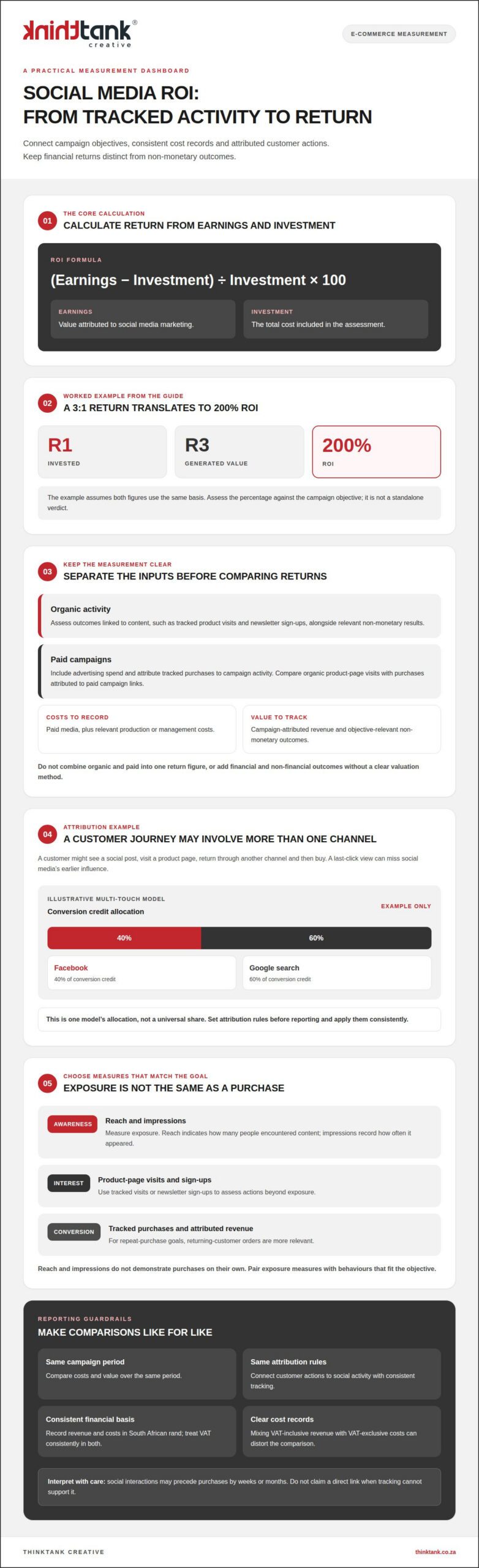
A campaign’s value isn’t measured by likes alone. Measuring social media marketing ROI means comparing the value generated with the total investment: subtract costs from earnings, divide the result by costs, then multiply by 100 to express the return as a percentage. For an e-commerce business, the calculation is only as useful as the objectives and sales attribution behind it.

It’s understandable to want a clear link between social activity and business results, especially when a sale may follow several interactions rather than a single click. A considered approach to measuring social media marketing ROI shows what social contributes, which parts of a strategy are working and where there’s room to improve.

This guide explains how to define social media ROI, choose awareness, engagement and conversion metrics, and assess returns for an e-commerce business. It also explores why measurement matters and how professional social media marketing can connect campaign activity with meaningful business outcomes.

Key Takeaways

  • Separate campaign costs from the value generated to build a more meaningful view of e-commerce returns.
  • Connect social interactions with purchase behaviour by considering the customer journey, not just the final click.
  • Choose awareness, engagement and conversion metrics that match the business objective you want to assess.
  • Set a clear definition of value before comparing campaigns, so financial and non-financial outcomes have context.
  • Use consistent measurement to identify what is working, refine strategy and make stronger decisions about investment.

How does a professional calculate social media ROI for an e-commerce business?

A sound measurement approach connects campaign objectives with costs, tracked customer actions and business value. Keep organic activity, paid media and financial reporting distinct to understand what each contributes.

  1. How a professional measures organic and paid social media ROI separately

    Separate organic and paid social media before assigning value. For organic activity, assess outcomes linked to content, such as tracked product visits or newsletter sign-ups, alongside relevant non-monetary results. For paid campaigns, include advertising spend and attribute tracked purchases to campaign activity. This distinction helps show whether results came from paid distribution or organic engagement. Avoid combining both into a single return figure, which can obscure how each approach contributes to the campaign objective.

    For example, compare organic product-page visits with purchases attributed to paid campaign links. Apply the same attribution method consistently to both.

  2. How a professional calculates campaign costs and revenue

    Keep a campaign cost record that captures the investment being assessed, including paid media and relevant production or management costs. Compare that total with campaign-attributed revenue, using tracking data that links social interactions to e-commerce purchases. A purchase is not automatically attributable just because it happened during a campaign: the tracking rules must connect the customer action with social activity.

    There is no single typical advertising cost or return for South African businesses. Costs depend on campaign objectives, paid spend and the scope of the work; returns depend on attributed revenue and which costs are included.

  3. How a professional compares social media costs with value

    Compare like with like: use the same campaign period and attribution rules for costs and value. Value may include revenue from tracked purchases or non-monetary outcomes, such as comments or newsletter sign-ups, when they support the stated objective. Keep these outcome types separate rather than adding them together without a clear valuation method.

    For financial reporting, record revenue and costs consistently in South African rand. Treat VAT consistently in both figures and keep the underlying financial records clear. Mixing VAT-inclusive revenue with VAT-exclusive costs can distort the comparison.

  4. How a professional calculates ROI from earnings and costs

    Apply the formula: (earnings minus investment) divided by investment, multiplied by 100. In this calculation, earnings are the value attributed to social media marketing, and investment is its total cost. For example, a 3:1 return means R3 in generated value for every R1 invested; if both figures use the same basis, the formula produces a 200% ROI.

    Use the result to assess the campaign against its objective, not as a standalone verdict. A percentage may look strong while overlooking non-monetary outcomes or an incomplete cost record.

Can a Professional Measure the ROI of Your Social Media Marketing?

Yes. A considered approach connects social activity with business objectives, tracked actions and purchase behaviour. Common mistakes include treating reach as revenue, relying only on last-click attribution and overlooking the influence of other channels.

  1. How a professional matches goals with ROI measures

    Start by translating each marketing objective into a metric that shows progress towards it. For a product launch, reach and product-page visits can indicate whether the campaign is attracting attention. For repeat purchases, returning-customer orders are more relevant. Avoid using the same metric for every objective: a large audience alone doesn’t show that a campaign generated sales.

    Record the objective, its matching metric and the assessment period in the measurement plan. This gives brands a consistent basis for interpreting results and keeps marketing strategy connected to business priorities. For awareness, assess exposure and subsequent interest; for sales, assess tracked purchases and attributed revenue.

  2. How a professional connects social metrics to purchases

    Map the customer journey from social interaction to purchase, using tracked visits and defined conversion events. A customer might see a post, visit a product page, return through another channel and then buy. A last-click view may award all the credit to that final channel, obscuring social media’s earlier influence.

    Set attribution rules before reporting, then apply them consistently across the campaign. Multi-touch attribution can distribute conversion credit across channels according to predefined rules or a statistical model. For example, one model assigns 40% of conversion credit to Facebook and 60% to Google search. The allocation describes that model, not a universal share for either channel.

    Allow for delayed influence when interpreting results. Social interactions can precede purchases by weeks or months, particularly for B2B and enterprise buyers. For e-commerce, compare the tracked journey with purchase records, and avoid claiming a direct link when tracking cannot support it.

  3. How a professional uses reach and impression measures

    Use reach and impressions to assess exposure, then connect that exposure with deeper actions. Reach indicates how many people encountered content; impressions record how often it appeared. Neither measure demonstrates purchases on its own, so pair it with relevant behaviours such as product-page visits, sign-ups or completed orders.

    Interpret each measure against the campaign objective and audience. An increase in impressions may reflect repeated exposure rather than more distinct people or stronger purchase intent. Compare it with engagement and subsequent actions to see whether content moved audiences towards the next step. Qualitative feedback, including positive comments, can add context to numerical metrics.

    Fragmented platform dashboards can make this assessment harder. Nielsen’s 2025 Marketing Report identifies bringing data together across separate platform dashboards as a top barrier to calculating ROI. A unified reporting view helps professionals interpret the campaign’s signals together. A coordinated social measurement approach can connect those signals with business objectives.

Awareness, engagement and conversion metrics

Useful KPIs depend on the objective: awareness uses reach and impressions, engagement tracks interactions, and conversion measures actions such as sign-ups or purchases. A professional groups these measures to show how social media efforts move audiences from exposure towards business outcomes.

  1. How a professional tracks awareness and engagement measures

    Choose awareness measures that describe exposure, then pair them with engagement measures that show audience response. Reach and impressions indicate whether content appeared before an audience; comments, shares, saves and clicks show how people interacted. A high impression count alone doesn’t establish brand awareness or commercial impact, so interpret it alongside meaningful engagement.

    Use campaign examples to give the figures context. Blendtec’s “Will It Blend?” videos had been viewed more than 100 million times on YouTube, illustrating substantial content exposure. That view count is an awareness signal, not proof of purchases. A professional assesses it alongside responses and subsequent actions, rather than treating views as a complete measure of return.

    For website activity, compare social-driven visits with relevant behaviour after arrival. Southwest Airlines’ redesigned blog recorded a 25% increase in visits and a 40% increase in page views. Those measures show changes in site activity; a separate conversion measure is needed to establish whether visitors took a valuable action.

  2. How a professional distinguishes micro and macro conversions

    Classify each conversion by its place in the customer journey. Ebook downloads, newsletter sign-ups and trial registrations are micro-conversions: they indicate interest before a final purchase. A completed product order is a macro-conversion for an e-commerce business. This distinction helps explain progress when a campaign generates engagement before sales appear.

    Where tracking allows, link each micro-conversion to a relevant later outcome. For example, assess whether newsletter sign-ups from social activity are followed by purchases, rather than automatically assigning them the same value. Keep the two event types separate in reporting, and don’t count one person’s sign-up and purchase as two completed sales.

    Micro-conversions can help assess campaigns whose immediate objective is consideration. They are useful indicators, but not substitutes for a purchase KPI when the objective is revenue. Report the sequence clearly, from social interaction to sign-up and, where tracked, purchase.

  3. How a professional selects conversion performance indicators

    Match conversion KPIs to the action the campaign is designed to generate. For an online shop, these may include tracked orders and revenue; for a lead-focused campaign, they may include qualified enquiries. Google Analytics can support analysis of website activity and defined events, while social platform reports provide channel-specific interaction measures.

    Set a consistent reporting window and event definition before comparing campaign performance. A click is not a purchase, and a landing-page visit is not necessarily a sign-up. Pair conversion volume with conversion value where available, then interpret both against campaign costs and the stated objective.

    Include qualitative feedback when it helps explain performance. Positive comments can add context to engagement figures, while completed orders show a direct commercial outcome. Reporting both gives decision-makers a clearer view of what social media activity achieved.
How to Measure Social Media Marketing ROI and Track Business Impact

Defining social media ROI

Define social media marketing ROI before measuring it. The business objective determines which outcomes count as value, from sales to newsletter sign-ups.

  1. How a professional sets social media goals

    Translate a business priority into a specific social media goal. For example, a retailer launching a product could target product-page visits, while a brand focused on repeat purchases could track returning-customer orders. The goal should describe a business outcome, not simply activity such as publishing posts or gaining followers.

    Next, match the goal to an observable measure and decide how the result will be attributed. For a Facebook campaign, track visits from campaign links and subsequent purchases. Don’t choose metrics just because a platform makes them easy to report: each measure should help assess the intended outcome.

    Set the scope before evaluating results. Specify which campaign, platforms and audience the assessment covers, and keep those boundaries consistent when comparing performance. If a campaign supports both awareness and sales, record them as distinct objectives so engagement doesn’t become a substitute for purchase results.

  2. Define the return being measured

    Social media ROI is the value generated by social media investment, assessed against the chosen objective. Value may be financial, such as attributed e-commerce revenue, or non-financial, such as comments and newsletter sign-ups. Both outcomes can matter, but they shouldn’t be combined as if they were equivalent measures.

    For a sales objective, focus on purchases and revenue attributed to social activity. For an awareness objective, relevant indicators might include audience response or new newsletter sign-ups. Define what counts as value before reporting, so measuring social media marketing ROI reflects the goal rather than whichever metric looks most impressive.

    Then document the attribution approach. A customer may encounter a social post, visit a product page later and complete a purchase after another interaction. The chosen rules determine how much credit social receives. Applying the same approach across campaigns makes comparisons more meaningful, while recognising that a single platform interaction may not capture the whole customer journey.

    Finally, separate return from performance activity. Facebook likes, comments and clicks describe interactions; they don’t automatically demonstrate financial return. If the objective is community engagement, comments may represent relevant value. If it is sales, connect platform activity to tracked purchases before presenting it as revenue generated.

Reasons to measure social media ROI

Measurement turns social activity into evidence for decisions about strategy, investment and customer relationships. Its value goes beyond showing whether a campaign generated sales.

  1. Use performance evidence to explain social media’s contribution to business outcomes. Sixty-eight per cent of marketers report worrying about proving the return on their social media efforts, while 46% believe social media use improves sales. Tracking results against a stated objective helps distinguish evidence of progress from assumptions about impact.

    For example, an e-commerce team can connect social activity with product interest and tracked orders. If orders rise but social-attributed visits do not, examine the attribution approach before claiming social caused the increase.

  2. Compare results over time to identify which content supports growth. Tracking progress across six months, for example, can show whether product demonstrations or customer stories generate stronger responses. A consistent comparison period helps teams interpret changes without treating one successful post as proof of a lasting trend.

    Pair the figures with platform context. Google Analytics can help assess website activity alongside platform engagement, while positive comments may explain why a particular message resonated. Neither comments nor visits alone prove revenue, but together they can inform the next campaign decision.

  3. Connect social insights with decisions beyond the marketing team. Among marketers who work with social data, 98% agree that social insights have enabled cross-functional business outcomes. Social feedback can help teams consider customer experience, retention and messaging, rather than limiting reporting to likes or reach.

    For instance, repeated questions in comments about product sizing could help a retailer identify an issue with content or product information. Sharing that pattern with the relevant team gives the feedback a practical purpose, while keeping it distinct from measured sales outcomes.

  4. Use audience signals to inform retention and market decisions. Among marketers reporting business outcomes from social intelligence, 45% cite customer retention as a benefit, and 40% cite identifying a new audience or market shift. These findings show why social analysis can contribute to decisions beyond campaign reporting.

    A rise in positive comments from a previously overlooked audience, for example, may prompt a brand to examine that audience’s needs. Comments are a signal to investigate, not proof of demand or a substitute for purchase data.

  5. Make budget discussions more evidence-led by showing what social activity supports. Kellogg found that Special K cereal’s online return on investment was twice the return from television over 18 months. The comparison illustrates how channel-level evaluation can inform investment choices, while each business still needs measures suited to its own objectives.

    Use findings to refine the next campaign, not simply to defend past spending. Strengthen your social media measurement approach by connecting campaign results with the business decisions they can inform.

ThinkTank Creative: Social Media Marketing

ThinkTank Creative provides Social Media Marketing to help businesses shape campaigns around clear objectives and meaningful outcomes. Turn to this support when social activity needs a more considered strategy, or when reporting needs to connect engagement with business impact.

Effective measurement depends on more than platform figures. It requires a coherent approach to objectives, audience response and the actions that matter to the business. Where digital touchpoints need closer alignment, Website Design and Development and Creative design can support a consistent experience from social content to the website.

Bring your business goals and current measurement challenges into the conversation. Contact ThinkTank Creative to discuss your social media marketing needs.

Turn your social data into your next decision

Make each reporting cycle a starting point for a sharper business decision. A disciplined approach to measuring social media marketing ROI can help your team decide which audience to prioritise, what creative direction to develop and how social activity should support the wider customer experience. The next opportunity may not be another campaign; it could be improving how people move from discovering your brand to engaging with it.

That work benefits from alignment between strategy, creative and the digital destination. ThinkTank Creative offers Social Media Marketing, Creative design and Website Design and Development, bringing relevant disciplines together around your business objectives. Use each measurement cycle to refine the connection between what your audience sees and the action you want them to take.

Ready to shape a more considered approach for your business? Contact ThinkTank Creative to discuss your goals and take the next step with confidence.

Frequently Asked Questions

How do data silos across platforms affect ROI tracking?

Data silos make it harder to connect platform activity with website behaviour and completed orders. For example, Facebook may record an advert click while website analytics records a later purchase under another source. Align campaign names, tracking labels and conversion definitions across reports, then investigate mismatches. This helps reduce inconsistent attribution and prevent the same purchase from being counted more than once.

How do delayed conversions and long sales cycles affect ROI measurement?

Delayed conversions can make a campaign appear ineffective if reporting ends before customers purchase. Social media influence may precede a decision by weeks or months, particularly in B2B and enterprise sales. A professional follows campaign cohorts over a reporting window suited to the sales journey, separating early indicators from completed revenue. This gives later conversions room to appear without treating every subsequent sale as social-driven.

How does a professional calculate ROI for brand awareness campaigns?

To calculate awareness ROI, assign a defensible value to the awareness outcome, then compare it with campaign investment. For example, a business might assess a defined increase in relevant audience attention against its campaign objective. Any monetary valuation should use a consistent method and be labelled as estimated value, not sales revenue. Without a credible valuation, report awareness outcomes separately rather than implying financial ROI.

How does a professional quantify non-monetary value?

First define which non-monetary outcomes matter, such as positive comments, newsletter sign-ups or qualified interactions. Count each outcome using a consistent event definition, then assess it against the campaign objective. If a business assigns a financial equivalent, it needs a clear rationale, such as a known relationship between sign-ups and later purchases. Otherwise, keep the outcome as a separate performance measure.

What is multi-touch attribution across channels?

Multi-touch attribution distributes conversion credit across the channels a customer interacted with before purchasing. A customer might discover a product through a social post, return through an email and complete an order after a search. Apply predefined rules or a statistical model to allocate credit across those interactions. The chosen model shapes the reported contribution, so comparisons require consistent attribution rules.

What metrics should you track for awareness and reach?

Track reach to understand how many people saw content, and impressions to assess total exposure. Audience growth, video views and relevant profile visits can add context, depending on the campaign format. Compare these measures with the intended audience and content type: high exposure alone doesn’t demonstrate recognition or purchase intent. Comments and shares can also help explain how people respond to the message.

What metrics should you track for conversion and revenue?

For an e-commerce campaign, track completed purchases and revenue attributed to social activity. Conversion rate shows how often relevant visits lead to the chosen action, while average order value adds context to revenue. Cost per acquisition can help compare spending with acquired customers. Define whether cancelled or refunded orders are included, then apply that treatment consistently across campaign reports.

How does a professional calculate social media marketing ROI?

A professional subtracts social media investment from the value attributed to social activity, divides the result by that investment and multiplies by 100. The result is a percentage. For example, a return above zero indicates attributed value exceeded the included investment; a result below zero indicates the opposite. The calculation is only meaningful when earnings and costs cover the same campaign scope and reporting period.
Social Media Posting Times in South Africa by Platform

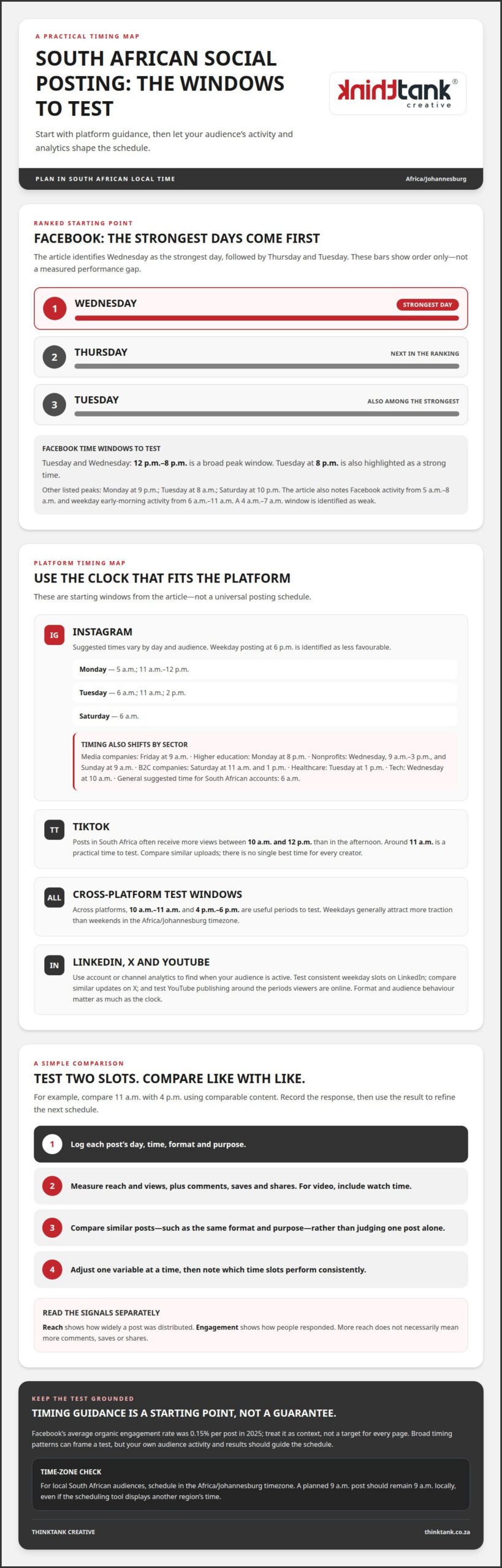
Tuesday and Wednesday, from 12 p.m. to 8 p.m. South African time, are a useful starting window for Facebook posts. The best times to post on social media in South Africa still vary by platform and audience, with Tuesday at 8 p.m. also identified as a strong time to test.

It’s understandable to want a clear schedule: posting at the wrong time can limit the chance for good content to be seen. Treat suggested times as a starting point, then refine your schedule using your audience’s activity and your own analytics.

This guide covers recommended posting times by platform and day, explains how to adapt them for different audiences, and shows how to use engagement data to build a schedule for your brand. It also accounts for South African local time, so you can plan posts for the people you want to reach.

Key Takeaways

  • Use platform- and audience-specific timing rather than relying on one universal posting schedule.
  • Compare Instagram’s recommended weekday and weekend windows with your audience’s own activity patterns.
  • Assess posts through meaningful engagement signals, including views, watch time, comments, saves and shares.
  • Test posting days and times consistently, then use the results to refine your schedule.
  • Plan around South African local time and account for time-zone differences when reaching audiences elsewhere.

What is the best time to post on social media in 'Africa/Johannesburg' timezone?

For Facebook, Tuesday and Wednesday from 12 p.m. to 8 p.m. form a broad peak window. Tuesday at 8 p.m. is also identified as a strong time. Across platforms, 10 a.m. to 11 a.m. and 4 p.m. to 6 p.m. are useful periods to test. Weekdays generally attract more traction than weekends in the Africa/Johannesburg timezone. These patterns help identify the best times to post on social media in South Africa, but your audience’s activity should guide the final schedule.

Instagram recommendations differ by weekday and audience. Monday suggestions are 5 a.m. and 11 a.m. to 12 p.m.; Tuesday suggestions are 6 a.m., 11 a.m. and 2 p.m. Saturday’s suggested time is 6 a.m. Media companies’ Instagram content performs best on Fridays at 9 a.m. Higher education content performs best on Mondays at 8 p.m. Nonprofits see strong windows on Wednesdays from 9 a.m. to 3 p.m., and Sundays at 9 a.m. Weekday Instagram posting at 6 p.m. is identified as less favourable.

TikTok posts in South Africa often receive more views between 10 a.m. and 12 p.m. than during the afternoon. Around 11 a.m. is a practical starting point for testing. There is no single best time for every TikTok creator, so compare performance across similar uploads.

For LinkedIn, start with the periods when your audience is active, as shown in account analytics. Test a consistent weekday slot, then compare impressions and engagement across posts. On X, schedule comparable updates at different times when your audience is active and assess the response. On YouTube, check channel analytics to see when viewers are online, then test publishing around those periods. Format and audience behaviour matter as much as the clock.

South African businesses reaching local audiences should schedule in the Africa/Johannesburg timezone. This keeps a planned 9 a.m. post at 9 a.m. locally, even when the scheduling tool displays another region’s time.

To find the best times to post on social media in South Africa for your page, run a simple comparison. Choose two candidate slots, such as 11 a.m. and 4 p.m., and publish comparable content in each. Record reach, views, comments, saves and shares; compare like with like, rather than judging one post alone. Facebook’s weekday early-morning activity has also been noted between 6 a.m. and 11 a.m., while 4 a.m. to 7 a.m. is identified as a weak window. Treat these platform patterns as starting points, then let page performance shape your next schedule.

Using social media analytics to improve engagement

Use analytics to turn publishing times into testable decisions. Record each post’s publishing time, weekday, format and audience response. Then compare similar posts, such as two product demonstrations published in different time slots. This separates timing effects from differences in subject or creative execution. Facebook’s average organic engagement rate was 0.15% per post in 2025. Treat this as context, not a guaranteed target for every page or post.

Look for patterns across your own account before changing the schedule. Sprout Social identifies weekends as Facebook’s weakest days overall, while weekday performance can vary by audience. Buffer’s analysis found Facebook engagement tends to fall between 12 p.m. and 5 p.m. These broad patterns help frame a test, but they don’t show how your followers behave. Compare weekday results with weekend results using the same content type and measurement period.

Measure reach and engagement separately. Reach shows how widely a post was distributed; engagement shows how people responded. A post can reach more people without earning more comments, saves or shares. Set a baseline for your account by comparing posts with similar formats and goals. For example, assess awareness posts by reach and views, then compare discussion posts by comments and shares. Use the same measure for each comparison.

Format matters too. Socialinsider’s benchmarks found Reels were the only Facebook content format to increase engagement in Q1 2026. That makes format an important variable in timing tests: compare Reels with Reels, rather than crediting a time slot for a format difference. For video, include watch time alongside views. For other posts, track comments, saves and shares to understand whether the content prompted useful action.

Build a simple review routine around each publishing test:

Reviewing these signals together helps distinguish a timing pattern from a one-off result. An analytics-led social media publishing strategy can connect content planning with performance measurement, making each schedule adjustment more deliberate.

Best day and time to post

Wednesday is the strongest Facebook posting day, followed by Thursday and Tuesday. Weekdays generally attract more social media traction in South Africa, but the best day depends on the platform, audience and content. Treat these patterns as a starting point, not a universal schedule for every account.

For Facebook, daily peak hours can sharpen that starting point. Monday’s listed peaks are 7 p.m., 9 p.m. and 10 p.m., with 9 p.m. the strongest. Tuesday’s are 7 a.m., 8 a.m. and 7 p.m., with 8 a.m. the peak. Saturday’s listed hours are 6 a.m., 9 p.m. and 10 p.m., with 10 p.m. highest. Hootsuite’s data also places Facebook activity between 5 a.m. and 8 a.m. Use these morning windows as tests alongside weekday evening activity.

Instagram timing shifts with sector. South African B2C companies see their best engagement on Saturdays at 11 a.m. and 1 p.m. Healthcare companies perform best on Tuesdays at 1 p.m., while tech companies see strong engagement on Wednesdays at 10 a.m. A general suggested time for South African Instagram accounts is 6 a.m. These differences show why business type and audience habits matter as much as platform-wide averages.

Which days of the week get the most social media engagement in South Africa? Wednesday, Thursday and Tuesday are the leading Facebook days in Buffer’s ranking, while Instagram results vary by sector. For example, B2C Instagram engagement peaks on Saturday, so a weekday-only schedule could miss that audience.

Choose a posting day according to the action you want people to take. A B2C brand could test Saturday at 11 a.m. against 1 p.m.; a healthcare page could compare Tuesday at 1 p.m. with another suitable weekday slot. Keep the topic and format as consistent as possible, then compare reach and interactions. This helps show whether timing, rather than a different creative approach, shaped the response.

Treat the algorithm as one factor in distribution, rather than a reason to chase every reported peak. A morning slot may suit one audience, while an evening post may better match another’s routine. Choose a small set of day-and-time combinations, publish consistently, then use your account’s performance to refine the schedule. For a Facebook page, Wednesday is a sound first test. For Instagram, choose a sector-specific window that best matches your audience.

Social Media Posting Times in South Africa by Platform

Local-time and time-zone considerations

Schedule for the clock your South African audience uses. The Africa/Johannesburg timezone is the reference for local posting recommendations, so a Tuesday slot listed at 8 p.m. means 8 p.m. there. If a dashboard or imported chart displays another timezone, its clock time may not match the local recommendation. Confirm the schedule’s timezone before setting a post to publish.

Time differences can shift recommended windows. Some charts may need a one-hour adjustment to account for timezone and daylight-saving differences. That matters when applying a global report to a South African account: a displayed 10 a.m. peak might need to be interpreted against the report’s stated timezone before scheduling. Preserve the original time and timezone in your planning notes, then convert the slot for your target audience.

Use a consistent conversion method for every scheduled post. First, identify the timezone used by the recommendation. Next, identify the timezone selected in your publishing tool. Then convert the intended local posting time before scheduling. For example, if your target is Tuesday at 8 p.m. in Africa/Johannesburg, make sure the tool’s displayed time represents that local moment, not simply the same clock reading elsewhere.

Separate local and international audiences rather than forcing them into one schedule. A South African post planned for 4 p.m. should reach local followers at that time. If a campaign also targets people in another timezone, create a separate publishing slot based on their local activity. This keeps the South African schedule anchored to local behaviour while allowing international posts to follow their intended audience’s clock.

Keep a timezone record beside each performance result. Include the platform, intended location, scheduled time and timezone, then compare engagement only after confirming the records use a consistent local reference. A Tuesday post recorded as 8 p.m. Africa/Johannesburg should not be compared casually with a report showing 8 p.m. in another timezone. That distinction helps prevent a scheduling conversion from being mistaken for an audience preference.

Before publishing, use this short time-zone check:

For a campaign aimed at a South African audience, keep the final calendar in South African local time. If you use an international chart, check its timezone first, then convert the suggested window to Africa/Johannesburg. This makes a Tuesday peak or another recommended slot actionable without confusing the chart’s reporting time with the time your audience sees the post.

Scheduling posts across time zones

Start with the audience’s local clock, not the location of the person scheduling. For South African followers, plan posts in Africa/Johannesburg time. A post intended for 9 a.m. locally should reach that audience at 9 a.m., even if the person preparing it works elsewhere.

For a campaign serving audiences in South Africa and other countries, create separate time slots for each location. One publishing time might be morning for one group and evening for another. Separate schedules help each audience see the same campaign at a time that fits its local routine.

Before scheduling, establish which timezone the platform or planning calendar displays. Compare that setting with the timezone used by the timing recommendation. If a chart gives a peak at 10 a.m. in another timezone, don’t enter 10 a.m. automatically. Convert the intended moment to the target audience’s local time first.

Some charts may need a one-hour adjustment to account for timezone and daylight-saving differences. Preserve the source timezone alongside any converted slot, so the original recommendation remains clear. For example, record both the source’s 10 a.m. suggestion and the resulting Africa/Johannesburg schedule time. This makes later review more reliable than keeping only a clock reading.

Use a repeatable scheduling workflow for every platform:

Keep records for each platform and audience segment. For example, a South African Facebook post and an international Instagram post might use the same campaign artwork but need separate local publishing slots. Label each calendar entry with its platform, market, timezone and intended posting time. This helps your team distinguish the scheduled time from a converted display time.

When comparing results, group posts by audience location and local time. A South African post published at 9 a.m. should not be treated as equivalent to an overseas post published at 9 a.m. unless both audiences experienced the same local timing. Compare similar content within each market, then adjust the relevant schedule based on its own engagement.

For a coordinated campaign, get support with social media planning so publishing calendars align with audience locations and local timing.

ThinkTank Creative: Social Media Marketing

ThinkTank Creative’s Social Media Marketing service helps businesses build a more cohesive social media presence. It’s a natural next step when your team needs support aligning platform-specific timing with consistent content and a clear brand identity.

Social media works best as part of a considered brand experience. Creative design and Logo and Corporate Identity Design help keep campaign visuals recognisable across posts, while Website Design and Development can support the journey from social content to your online presence. The right combination depends on your goals and the role social media plays in your wider marketing.

To shape a more coordinated social media approach, contact ThinkTank Creative to discuss your goals.

Make your next publishing cycle more intentional

Make your social media calendar a working plan, not a fixed set of times. Use the best times to post on social media in South Africa as a starting point, then let audience responses guide what you publish next. Your campaign can evolve as your content, objectives and audience behaviour change.

Next, connect posting times with the wider experience your brand creates. Social Media Marketing, Creative design and Website Design and Development can each support a more coherent journey from a post to meaningful interaction with your business. ThinkTank Creative can shape that work around your brand and marketing priorities.

Bring your goals and the questions you want your social media activity to answer. A considered conversation can help clarify the direction of your next campaign and how its content should work together.

Contact ThinkTank Creative to discuss a more cohesive approach to your social media presence. Build on what you’ve learned, keep refining your direction, and give your next publishing cycle a purposeful start.

Frequently Asked Questions

What are the best days and times to post on Facebook?

Wednesday, Thursday and Tuesday rank as Facebook’s strongest days in the available weekday ranking. Tuesday and Wednesday from 12 p.m. to 8 p.m. are broad posting windows, while Tuesday at 8 p.m. is a specific time to test. For a practical comparison, schedule similar posts on Wednesday and Thursday, then assess their responses using the same measures and time period.

Can a business enjoy greater profits by timing their social media posts?

Better timing can help a post reach people when they’re active, but publishing time alone doesn’t determine profit. The offer, creative, audience fit and path to purchase all affect whether engagement leads to a sale. To assess commercial impact, use tracked links or campaign-specific codes, then compare enquiries or purchases with the posts that generated them.

Does time of day matter when posting?

Yes. Publishing when your intended audience is active gives a post a better opportunity to be seen promptly. However, suitable times vary by platform, audience and content. A morning post may suit one audience, while an evening slot may better match another’s routine. Compare similar posts published at different times to find what fits your followers’ behaviour.

Does time-zones matter when scheduling social media posts?

Yes. A scheduling tool may display a different timezone from the one in your posting plan. For South African audiences, use Africa/Johannesburg as the local reference and confirm that the scheduled time reflects it. If a recommendation uses another timezone, convert the suggested time before scheduling. Keep the original timezone in your records so later comparisons remain meaningful.

Does timing on Facebook matter?

Timing can influence whether a Facebook post appears when followers are available to engage, but it’s only one part of performance. Format and content also affect the response. For example, compare similar posts published at different times, then measure reach and interactions separately. This helps you avoid mistaking wider distribution for stronger audience engagement.

When is the best time to post on Instagram in South Africa?

Six a.m. is a recommended starting time for South African Instagram accounts, but suitable slots vary by sector. For example, healthcare content performs best on Tuesdays at 1 p.m., whilst tech content sees strong engagement on Wednesdays at 10 a.m. Choose the window closest to your audience and content, then assess results against comparable posts rather than relying on one upload.

Why is it important to publish content at the right time on social media?

Timing helps align a post with periods when its intended audience is likely to be active, giving useful content a better opportunity to attract attention and interaction. For example, publishing a campaign announcement during a relevant audience window may make it easier for people to see and respond promptly. A good schedule also supports consistency without treating every platform alike.

What are the best times to post on Instagram in South Africa?

For a general starting point, test 6 a.m. on Instagram, then compare it with times suited to your industry. Media companies’ content performs best on Fridays at 9 a.m.; nonprofits see strong windows on Wednesdays from 9 a.m. to 3 p.m. and Sundays at 9 a.m. Treat these as audience-specific clues, and compare like-for-like posts before changing your ongoing schedule.

Ways to Promote Your New Website and Attract More Users

A new website needs a launch plan, not just a launch date. To learn how to promote your new website launch, begin with two marketing channels and use them consistently. Email and social media can announce the site, show people what’s new and guide them towards useful pages.

You’ve invested time in building a website that reflects your business; attracting visitors takes a deliberate next step. This guide shows how to build interest through email, social media, guest blogging, press releases and paid advertising, so launch day isn’t your only chance to be seen.

Give the announcement a clear purpose and coordinate it across channels that suit your audience. Plan the rollout over several weeks so each message supports the next and gives potential visitors a reason to explore.

Key Takeaways

  • Choose two promotional channels to start, then tailor your launch messages to the people you want to reach.
  • Use email to tell existing customers what’s new and guide them to relevant pages on your website.
  • Share useful, engaging social content and make the next step clear, whether that’s visiting a page or joining your mailing list.
  • Explore guest posts with local groups and coordinate press releases or paid adverts with the experience visitors find on your site.
  • Plan announcements over several weeks so each message builds on the last and keeps your launch visible beyond its first day.

1. Email marketing

Measure website launch marketing by connecting each email to activity on your website. Use tagged campaign links, then compare email analytics with website traffic, page visits and completed actions, such as an enquiry or signup. This shows which messages bring relevant visitors, not just opens.

Start with people who already know your business. Email customers and members with a clear announcement, explain what has changed and show how the new site helps them. For example, point customers to a refreshed service page or a simpler way to find information. Make the next step obvious by linking directly to the page that delivers the promised benefit.

Give friends, family and existing clients a personal heads-up before or on launch day. Invite them to visit the site and share the announcement with someone who may find it useful. Tailor each note: a client might value a new portfolio page, while a friend may be glad to pass on your business details. Personal relevance makes a message feel considered, not like mass promotion.

Add an email signup form to useful places on your new website, such as the homepage, blog or contact page. Explain what subscribers will receive, such as launch updates, practical advice or new content. Ask only for the information needed to sign up, and make the call to action clear. Social posts can direct interested people to the form, turning launch attention into an audience you can reach again.

A giveaway can encourage signups when the reward suits your business and audience. For example, offer a 5% discount on services in exchange for joining the newsletter. Make the entry steps clear and ensure the prize feels worthwhile to participants. Then follow up with useful emails, rather than relying on the giveaway announcement alone to maintain interest.

Coordinate email and social media so both channels reinforce the same launch message. Share a short announcement on your social accounts, then send subscribers a more detailed email with direct links to relevant pages. Adapt the wording for each audience, but keep the core message consistent. This gives people more than one way to discover the site without making every post or email identical.

Plan the email around the launch, prepare it before publishing and test its links on mobile and desktop. After sending, review which messages attract visits and meaningful actions. Use those insights to refine the next email, whether by changing its subject, destination page or call to action.

2. Social media promotion

Make your website launch visible where your audience already spends time. Share a clear announcement across your social media accounts, then direct each post to a relevant page. A product launch post could lead to the new product page, while a business update might point visitors to revised services or contact details.

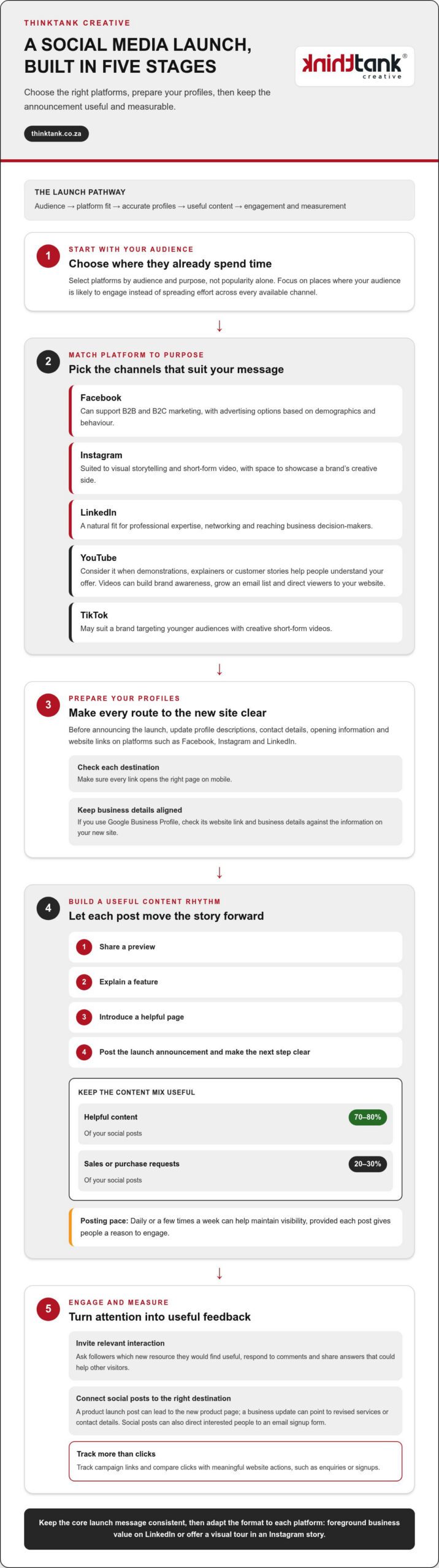
Choose platforms by audience and purpose, not by popularity alone. Facebook can support both B2B and B2C marketing, with advertising options based on demographics and behaviour. Instagram suits visual storytelling and short-form video, giving brands space to showcase their creative side. LinkedIn is a natural fit for professional expertise, networking and reaching business decision-makers.

Consider YouTube if demonstrations, explainers or customer stories help people understand your offer. Videos can build brand awareness, grow an email list and direct viewers to your website. TikTok may suit a brand targeting younger audiences with creative short-form videos. Focus on platforms where your audience is likely to engage instead of spreading effort across every available channel.

Refresh your online profiles before announcing the site. Update profile descriptions, contact details, opening information and website links on platforms such as Facebook, Instagram and LinkedIn. Check that each link opens the right page on mobile. If you use Google Business Profile, make sure its website link and business details match the information on your new site.

Build a useful content rhythm around the announcement. Share a preview, explain a feature, introduce a helpful page, then post the launch announcement with a direct call to action. Aim to make helpful content 70-80% of your social posts and sales or purchase requests 20-30%. Publishing daily or a few times a week can help maintain visibility, provided each post offers a reason to engage.

Encourage interaction with specific prompts. Ask followers which new resource they’d find useful, respond to comments and share answers that could help other visitors. Track campaign links and compare clicks with meaningful website actions, such as enquiries or signups. Social content can also guide interested followers to an email signup form, helping you stay in touch after launch.

Keep the message consistent, but adapt its format to each platform. A LinkedIn post can foreground business value, whilst an Instagram story can offer a visual tour. For support shaping a connected social media campaign, align each post with the page it promotes and the action you want visitors to take.

3. Guest blogging

Reach new readers by contributing useful articles to websites your audience already trusts. A South African business could write for a local chamber of commerce or community organisation, explaining how its website helps residents solve a familiar problem. A relevant guest post introduces your expertise, gives readers a reason to visit and directs interested visitors to a focused page.

For local opportunities, approach your chamber of commerce, business associations, neighbourhood groups and community publications. These can help you find organisations whose readers live or work near your business. Ask whether they accept guest contributions, then suggest a specific topic showing how your website helps local residents. Keep the pitch relevant to their audience rather than making it a general advert.

Choose a subject that offers practical value and naturally connects to a page on your site. For example, a South African accountant might write about preparing records for a small business, then link readers to a relevant service page. A home-care business could explain how families compare local support options. Answer the subject fully, with the website link offering a useful next step.

Shape each contribution around the publication’s audience and editorial style. Read existing articles, note the questions they address and propose a fresh angle. Use clear headings, concrete examples and accurate information. Don’t republish a page from your website as a guest article. Original, useful content earns attention, while a relevant author biography can explain your expertise and direct readers to your site.

Podcast interviews offer another way to introduce your work. Look for South African shows covering your sector, local enterprise or issues your customers care about. Pitch a discussion topic, such as common mistakes in your field, rather than asking for a platform to promote your launch. Prepare examples and a concise explanation of what listeners can find on your website.

Make every referral easy to track. Link to the page that best matches the guest article or interview, rather than sending everyone to your homepage. Use campaign tracking in the link and review referral traffic in your analytics. Compare visits, enquiries and other meaningful actions to see which publication or podcast attracts engaged visitors. Use these results to improve your outreach.

Guest blogging supports visibility, but works best alongside on-page optimisation. Check that the destination page answers the question raised in your contribution, works well on mobile and offers a clear next step. For instance, a local guide should lead to relevant details, not an unrelated announcement. Build relationships with editors and community organisers by responding thoughtfully to feedback and suggesting useful follow-up topics.

South African chambers of commerce, business associations, neighbourhood groups and community publications can help you reach local readers. Approach those whose audiences live or work near your business and ask whether they accept relevant guest contributions.

Ways to Promote Your New Website and Attract More Users

4. Press releases and paid advertising

Give journalists a clear reason to cover your website launch. Lead a press release with what is genuinely new, such as a South African service becoming available online or a useful resource for local residents. Include the launch date, intended audience, a concise business description and a contact for media enquiries. Send it to relevant publications and journalists instead of widely distributing a generic announcement.

To earn backlinks and press coverage, offer a publication a timely local story, expert comment or original resource its readers can use. Make the website link relevant to the story, such as a detailed guide that supports the article. Follow up with a concise pitch and make it easy for the journalist to verify names, details and quotes.

Pay-per-click advertising can put a relevant page in front of people already searching for a product or service. Choose a clear target, such as a location or search phrase, then match the advert to a landing page that answers that need. A campaign estimate suggests that an advert shown to 10,000 people could produce 100-200 buyers or subscribers at a 1-2% conversion rate. Treat this as a planning estimate, not a forecast for every campaign.

Build the advert around what the searcher is looking for. For example, a South African business promoting a booking page could target searches related to its service and the areas it serves. Write specific advert copy, use relevant keywords and send clicks to the booking page rather than the homepage. If the advert and landing page don’t match, visitors may lose trust and leave before taking action.

Paid advertising carries financial risk: clicks can use your budget without producing enquiries or sales. Set a spending limit, define what counts as a conversion and review performance before expanding. Consider how competitive your target terms are, whether the landing page is relevant and what each conversion is worth. Pause poorly matched adverts and refine the message or destination before spending more.

Don’t launch adverts before the destination page works properly. Broken links, unclear calls to action and slow-loading pages can waste paid traffic. Another common mistake is relying on paid promotion alone; combine it with useful content and direct announcements. Avoid broad targeting that attracts unlikely customers, and don’t judge success by impressions alone.

Review results by campaign and landing page. Compare clicks with conversions, enquiries and signups, then identify which message attracts visitors who take meaningful action. Press coverage and paid search serve different purposes: editorial attention can introduce your story, while PPC can reach people expressing intent through a search engine. Use each channel deliberately and refine your approach based on what the data shows.

5. Planning website launch announcements

Before launching a new website, complete checks on its pages, links, forms and mobile display. Keep the site marked as coming soon until those checks are complete or your website professional confirms it’s ready. Verify that 301 redirects work correctly, since working redirects prevent 404 errors when the new site goes live.

A practical plan for promoting your new website launch starts with a schedule covering several weeks. Set the launch date, prepare key messages and assign each task an owner, audience and purpose. For example, plan an email for existing customers, a social post for followers and a press release for relevant publications. Allow time to review every message before it goes out.

Make the announcement useful, not just celebratory. Explain what has changed, who the website serves and where visitors should start. A new booking feature, updated service information or downloadable guide gives people a clear reason to explore. Use one main call to action in each message, such as viewing the guide or submitting an enquiry.

Prepare launch-day material in advance. Draft social posts, email copy and a short announcement for your business blog, then check that each links to the intended page. Keep the message consistent across channels while adapting its format for each audience. A concise social post can introduce the update; a blog post can explain its purpose in more depth.

Include search engine readiness in the plan. Submit or share your sitemap with Google so the search engine can discover the website’s pages. Check that old page addresses point to their relevant new destinations through working 301 redirects. Make sure important pages have clear titles and descriptions, and that visitors can reach key information without dead ends.

On launch day, publish the site before sending announcements, then open the links in your messages to make sure they work. Monitor analytics for referral traffic, page visits and completed actions, such as enquiries or signups. Record which channels brought visitors and which pages held their interest. Use those findings to shape follow-up messages and decide how to promote your new website launch beyond the initial announcement.

Assign time after launch to respond to questions, fix broken links and share useful updates. A planned follow-up can highlight a page people missed or answer a question raised by customers. For a coordinated approach to your website launch planning, map each announcement to its audience, destination page and desired action.

ThinkTank Creative: Website Design and Development

ThinkTank Creative helps businesses build a consistent digital presence through custom website design and development. If you’re preparing to launch, your website should support the same message and identity as your promotional activity. A clear structure, purposeful page content and cohesive creative design give visitors a consistent experience from announcement to action.

For businesses refreshing their online presence, ThinkTank Creative can also align social media marketing and logo and corporate identity design with the website. This coordinated approach connects the brand people see in a campaign with the pages they visit afterwards. Consider this support when you need a new site or a more unified launch across digital channels.

To discuss your website project, contact ThinkTank Creative or visit thinktank.co.za.

Build on your launch momentum

Treat launch day as the start of an ongoing relationship, not the finish line. A thoughtful approach to promoting your new website launch connects each campaign’s promise with the experience visitors find when they arrive. Use early responses to understand what people value, where they hesitate and which pages need more attention. Then refine the site and future communications around those signals, keeping the experience relevant as your business evolves.

Look beyond immediate traffic when deciding what to improve next. Consider whether visitors understand your offer, find the information they need and know what action to take. These observations can guide decisions about content, design and the journey from first interaction to enquiry. Small, considered refinements help keep your website aligned with customer needs and your business direction.

When you’re ready to create a more cohesive digital presence, ThinkTank Creative offers Website Design and Development, Social Media Marketing and Creative design. These capabilities can bring your website, campaign visuals and social content together around a consistent brand direction.

Contact ThinkTank Creative to discuss your next step and build on your launch with confidence.

Frequently Asked Questions

How do I attract more users to my website?

Give the people you want to reach a clear reason to visit and a useful next step once they arrive. For example, a South African consultancy could publish a practical guide answering a question prospective clients often ask, then link it to a relevant service page. Make navigation straightforward, explain benefits in plain language and ensure key pages work smoothly on mobile devices.

How do I get traffic to my website?

Combine discovery with reasons to return. Publish useful pages that answer your customers’ questions, then share them through channels where those customers are active. Ask relevant business partners or community organisations to mention a resource when it genuinely helps their audience. Review which sources bring visitors who explore further or enquire, then focus your effort on the sources that support your business goals.

What’s the cheapest way to promote a new website?

Start with channels you already control, such as your social accounts, customer conversations and business email list. Share a useful resource rather than a bare announcement, and invite relevant partners to pass it on if it helps their audience. These approaches avoid paid media spend, though they still take time to create, publish and respond to useful content consistently.

How can you promote a new website using SEO and Google Search Console?

Use SEO to make important pages clear to search engines and valuable to visitors. In Google Search Console, check whether key pages are indexed, review the queries generating impressions and identify pages with impressions but few clicks. Use the findings to improve page titles, descriptions and content relevance. Submit your sitemap, then revisit the reports as your site gains search visibility.

How do you announce a website launch on social media and email?

Make the announcement specific to each audience. A customer email can explain how a change affects an existing service, while a social post can introduce a useful new resource to a wider audience. Use a clear subject line or opening sentence, identify who benefits and direct people to the relevant page. Make sure the message remains accurate if someone shares it without extra context.

How can paid search and social media ads drive traffic to a new website?

Paid search can reach people actively looking for a relevant service, while social adverts can introduce it to audiences selected by interests or other targeting options. Match each advert to a dedicated landing page, define the action you want visitors to take and monitor conversions alongside clicks. If visitors arrive but don’t act, review the advert’s promise, audience and landing-page relevance before increasing spend.

What website launch promotions, offers or giveaways attract visitors?

Choose an offer that is genuinely useful to your intended audience, such as a downloadable checklist, introductory resource or relevant service benefit. Explain the entry steps clearly and make sure the perceived value of the reward matches or exceeds the effort required to participate. Keep the promotion connected to your business, then direct entrants to a page where they can explore the offer further.

How much should you budget to promote a new website in South Africa?

Start with free options, such as regular, engaging social media posts.