When to Hire a PPC Manager or Choose In-House Management

A PPC manager does more than keep adverts running. They plan paid campaigns, monitor performance and refine targeting, creative and budgets to support business goals. Knowing when to hire a PPC manager depends on whether your campaigns need consistent specialist attention that your current team can’t provide. The right support can help you make clearer decisions and use your advertising budget more deliberately.

It’s worth weighing the options carefully. An in-house specialist can focus on your business day to day, while an agency can bring broader digital marketing expertise. The right fit depends on your workload, team and growth priorities.

This article explains what a PPC manager does, the signs it may be time to hire one, and how fees, salaries, experience and media budgets shape the decision in South Africa. You’ll also learn what to expect from professional campaign management, so you can choose an approach that fits your goals and capacity.

Key Takeaways

  • Recognise when campaign oversight is taking attention away from other priorities and specialist management could help.
  • Understand how a PPC manager uses targeting, creative testing and performance data to refine paid campaigns.
  • Compare agency support with an in-house hire by weighing ongoing workload, expertise and the different cost structures.
  • Assess candidates through relevant campaign experience and their ability to explain results, strategy and optimisation decisions.
  • Separate management costs from media spend, then consider how your budget and campaign goals shape the level of support you need.

PPC manager responsibilities and campaign optimisation

A PPC manager turns business objectives into paid campaigns, then uses performance data to refine decisions. The right time to hire depends on campaign complexity, available expertise and the cost of leaving campaigns unattended.

Campaign warning signs

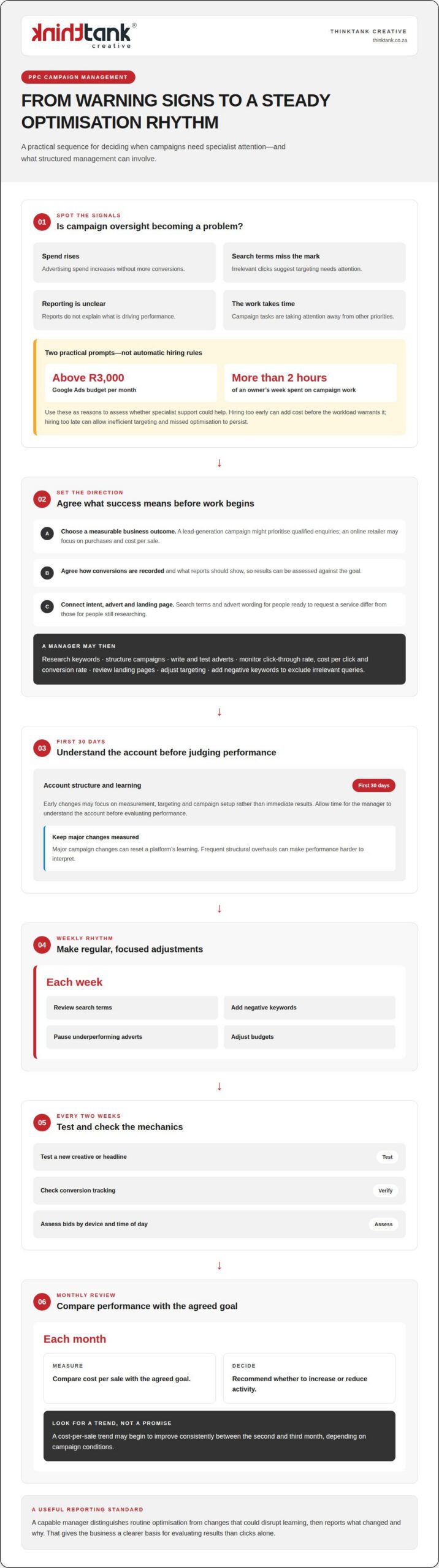
Look for recurring signs that campaigns need more structured oversight: spend rises without more conversions, search terms attract irrelevant clicks, or reports fail to explain performance. A PPC manager researches keywords, structures campaigns, writes and tests ads, and monitors click-through rate, cost per click and conversion rate. They can also review landing pages and adjust targeting to better align the advert with the customer journey.

Two practical signals are a Google Ads budget above R3,000 per month and campaign work taking more than two hours of an owner’s week. These are prompts to assess whether specialist support could help, not automatic hiring rules. Hiring too early can add cost before the workload warrants it; hiring too late can allow inefficient targeting and missed optimisation to persist.

Define the role around a measurable business outcome before hiring. A lead-generation campaign might prioritise qualified enquiries, while an online retailer may focus on purchases and cost per sale. Set the target, establish how conversions are recorded, and agree what reports should show. In South Africa, campaign planning should account for applicable tax treatment, privacy considerations when handling personal information, and advertising standards for accurate claims. A manager should consider these when setting up tracking, handling data and reviewing ads.

Keyword strategy should connect customer intent with your offer and landing page. For example, a campaign aimed at people ready to request a service needs different search terms and advert wording from one targeting people at the research stage. The manager can review search terms, add negative keywords to exclude irrelevant queries and test advert variations. This helps focus budgets on searches that better match the campaign objective.

Expected results timelines

Allow time for the manager to understand the account before judging performance. The first 30 days are usually spent on account structure and learning, so early changes may focus on measurement, targeting and campaign setup rather than immediate results. A cost-per-sale trend may begin to improve consistently between the second and third month, depending on campaign conditions.

Ongoing optimisation needs a measured rhythm. Each week, the manager can review search terms, add negative keywords, pause underperforming ads and adjust budgets. Every two weeks, they can test a new creative or headline, check conversion tracking and assess bids by device and time of day. Each month, they can compare cost per sale with the agreed goal and recommend whether to increase or reduce activity.

Major campaign changes can reset a platform’s learning, so frequent structural overhauls can make performance harder to interpret. A capable manager distinguishes routine optimisation from changes that could disrupt learning, then reports what changed and why. This gives the business a clearer basis for evaluating results than clicks alone.

How much does it cost to hire a PPC specialist?

In South Africa, the cost of hiring a PPC specialist depends on the role, workload and engagement model. Freelance work, an agency contract and a permanent appointment each have different cost structures. Compare the work included, not just the fee or salary: campaign strategy, account management, reporting and conversion tracking may fall under different scopes.

Before interviewing candidates, define what the role needs to deliver. List the platforms, campaign types, target audience and business outcomes involved. For example, managing Google Ads search campaigns involves different day-to-day work from coordinating paid search, display and social campaigns. This scope helps you identify a specialist suited to your account, rather than someone whose experience only matches the job title.

Evaluate evidence rather than broad claims. Ask candidates to explain a campaign they managed, its objective, the decisions they made and how they measured results. A strong response connects changes to outcomes such as conversion rate or cost per sale, and explains what the data couldn’t show. If an account is confidential, a candidate can describe their process without disclosing client information.

Ask: “How would you structure campaigns for our goals?”, “Which metrics would guide your decisions?” and “How do you report results and explain underperformance?” Then ask how they would approach a landing page with relevant clicks but few conversions. Their reasoning should connect targeting, advert messaging, tracking and the customer journey.

Experience gives useful context, but it doesn’t replace clear examples. A common PPC manager qualification is 3-5 years in PPC management, digital advertising, search engine marketing or a related field. Google Ads and Meta Blueprint certifications are preferred qualifications in some role descriptions. Treat these as useful signals, then explore how the candidate applies that knowledge to accounts with comparable objectives and complexity.

Estimate the total hiring cost by identifying what each arrangement includes. A permanent employee involves salary and associated employment costs, as well as training, equipment and management time. An agency or freelancer may charge for a project or ongoing management, with the agreed scope determining what work is covered. For any option, costs depend on account complexity, platforms, reporting needs and the level of strategic involvement. A service fee depends on the case and is provided after a quote request.

Use consistent criteria to compare candidates or proposals. Record agreed responsibilities, reporting frequency, account access, campaign data ownership and how strategic changes will be approved. For example, a candidate who clearly explains conversion tracking and reporting may be a better fit than one who offers only a list of platform credentials. Choose the arrangement that matches your workload and the expertise your campaigns need.

Agency fees and in-house hiring costs

Compare what each arrangement covers before weighing its cost. A PPC agency may provide campaign strategy, implementation and ongoing optimisation under a project contract or retainer. An in-house PPC manager is a full-time employee responsible for the company’s paid campaigns. The models differ in commitment, team structure and how much specialist capacity is available.

A project contract can suit a defined need, such as restructuring an account or creating a campaign plan. A retainer supports continuing work, including campaign monitoring, advert copy testing and performance reporting. Scope matters: an agreement covering Google Ads search campaigns differs from one that includes several platforms, landing pages and ongoing optimisation.

With an in-house hire, salary is only one part of the employment cost. Factor in recruitment, benefits, equipment, management time and ongoing training. PPC platforms and advertising practices change, so a permanent specialist needs continuing development to maintain relevant technical skills. The role also needs a steady workload to make dedicated capacity productive.

That workload creates a clear trade-off. An employee can build detailed knowledge of your products, customers and internal priorities, then coordinate PPC with other teams. However, fixed employment costs remain if campaign demand falls. For a business with seasonal activity, you may be paying for capacity that is less useful during quieter periods.

An agency offers a different capacity model through contracted work. A project can address a specific need, while a retainer provides ongoing management. The agreement should clarify responsibilities, including strategy, implementation, advert copy, reporting and optimisation. This helps distinguish active campaign management from a narrower arrangement covering selected tasks only.

Build a like-for-like comparison with these steps:

For example, a business with a continuing stream of campaigns may make good use of an employee’s dedicated focus. A business needing a defined account rebuild followed by a lighter workload may prefer project-based support. Neither structure is automatically cheaper. Workload, scope and the need for ongoing expertise shape the comparison.

Choose the model that fits the work, not just the label. A clear scope makes agency proposals easier to assess, while a defined role helps establish the full commitment of an in-house hire. Compare responsibilities and expected capacity first, then decide which arrangement aligns with your campaign needs over time.
When to Hire a PPC Manager or Choose In-House Management

Certifications and relevant experience

Assess credentials alongside practical campaign experience. Google Ads and Meta Blueprint certifications can indicate platform knowledge, but they don’t show how a specialist applies it to your business goals. Ask candidates to explain how their training informs decisions about targeting, bidding, advert formats and conversion measurement.

Relevant experience means more than having managed an advertising account. Look for work with similar objectives, customer journeys and campaign complexity. For example, a candidate who has managed lead-generation campaigns should be able to explain how they assessed enquiry quality, not just click volume. Ask what they changed, why, and how they judged the effect.

Use a structured review to compare candidates fairly:

Technical skills need to go hand in hand with sound judgement. A specialist may understand conversion tracking but still need to determine whether a recorded action represents a valuable enquiry. Ask how they validate tracking, investigate discrepancies and use the data. Their explanation should show a clear method, rather than relying on platform terminology alone.

Test strategic thinking with a realistic scenario. Describe a Google Ads campaign that receives relevant clicks but few enquiries. Ask how the candidate would investigate the search terms, advert promise, landing-page relevance and conversion setup. A considered answer explores possible causes before recommending changes, rather than immediately increasing bids or replacing every advert.

Platform knowledge also needs regular development. Advertising interfaces and features change, so ask how the specialist keeps their skills current and applies new learning. A useful response might describe a recent platform change they evaluated, the business objective it related to and how they decided whether to use it. This shows whether their learning informs deliberate campaign decisions.

Finally, assess how the specialist will work with your team. Ask who will manage the account, how recommendations are prioritised and what reporting will make progress clear. For an in-house appointment, discuss collaboration with sales or customer-service colleagues who can clarify lead quality. For external support, establish how campaign context and feedback will inform optimisation.

Choose a specialist whose experience matches your campaign needs and whose reasoning you can follow. Certifications offer one useful signal; practical examples, disciplined measurement and clear communication show how that knowledge may translate into day-to-day account management.

PPC management fees and media budgets

Separate media budget from management fees when assessing a PPC plan. Media spend pays for advertising on platforms such as Google Ads; the management fee covers professional work. Combining the two obscures how much goes towards reaching an audience and how much funds strategy, optimisation and reporting.

Set the media budget against a defined business outcome. A lead-generation campaign might prioritise qualified enquiries, while an online retailer may assess purchases and revenue. The PPC manager can use these goals to recommend how to allocate budget across campaigns, then monitor whether spend is producing relevant traffic and conversions. Click volume alone doesn’t show whether advertising supports business performance.

Budget size also affects the potential cost of inefficiency. A market fact notes that 20% of wasted ad spend can exceed the campaign management fee once a monthly budget is above R3,000. This makes account oversight especially relevant as spend grows, but the figure isn’t a universal benchmark for every business. Campaign structure, targeting and conversion tracking all influence whether spend is being used effectively.

Ask for a clear breakdown of the work covered by any management arrangement. A proposal should distinguish account setup from ongoing optimisation, and state whether keyword strategy, advert copy, creative testing, reporting and landing-page recommendations are included. For example, a plan covering bid changes alone may not address weak messaging or a landing page that fails to convert.

Agree how budget decisions will be reviewed before campaigns begin. The manager should report spend alongside measures tied to the business goal, such as cost per sale or qualified lead volume. A monthly review can help decide whether to maintain, increase or reduce investment, while regular monitoring can identify search terms or adverts that need attention sooner.

Revenue attribution needs careful interpretation. A sale may follow several interactions, while a lead may need follow-up before its value becomes clear. The manager should explain how conversions are recorded and how reporting connects advertising activity with business outcomes. This gives you a more useful basis for evaluating media spend than platform-reported clicks alone.

Use these points to frame a budget discussion:

For a more coherent customer experience, explore campaign creative and social media alignment alongside paid activity. A consistent message across adverts and social channels can help customers recognise the offer as they move between touchpoints.

ThinkTank Creative

ThinkTank Creative can help you consider PPC management alongside the wider digital experience that supports your campaigns. Turn to the team when you’re assessing how paid activity fits with your website, social channels and brand presentation, or when campaign traffic reaches a website that needs a clearer customer journey.

Website Design and Development, Social Media Marketing, creative design, and Logo and Corporate Identity Design can help create a more cohesive presence around your marketing. The right priorities depend on your goals, audience and current digital foundations. A conversation can clarify how these elements fit as you decide how to manage paid campaigns and what support your business needs.

Contact ThinkTank Creative to discuss your marketing priorities.

Make your next move with clarity

Deciding when to hire a PPC manager is ultimately about creating the right conditions for your campaigns to be managed well. Consider whether your goals are clear, whether someone can act on performance insights, and whether your current arrangement gives campaigns the attention they need. A considered choice can help align marketing activity with the direction you want your business to take.

ThinkTank Creative can help you consider how paid campaigns fit within your broader digital presence. Use a conversation with the team to clarify your priorities, identify where your marketing needs greater alignment and decide what support makes sense for your next stage.

Contact ThinkTank Creative to discuss your marketing direction and take your next step with confidence.

Frequently Asked Questions

What does a PPC manager do?

A PPC manager oversees the decisions that connect paid advertising with business objectives. Beyond adjusting campaigns, they coordinate information from sales or customer service so lead quality can inform targeting and messaging. For example, if enquiries repeatedly lack a required service, the manager can use that feedback to refine the searches and audiences that campaigns prioritise.

How long until I see results with a specialist?

Initial account analysis and restructuring commonly take the first 30 days; cost per sale may start dropping consistently between the second and third month. The pace depends on factors such as conversion volume, the sales cycle and tracking quality. A business with longer consideration periods should assess qualified leads and pipeline movement, rather than expecting every sale to appear immediately in advertising reports.

What signs indicate a business should hire a PPC manager?

Consider professional management if paid campaigns are a recurring responsibility without clear ownership, or if decisions stall because nobody can interpret performance data. Knowing when to hire a PPC manager also depends on whether sales feedback reaches the person managing campaigns. If enquiries arrive but you can’t identify which campaigns attract suitable prospects, specialist oversight can connect that insight with campaign decisions.

How much monthly ad spend justifies hiring a PPC manager?

A monthly Google Ads budget above R3,000 is a useful point to review whether specialist oversight makes sense, not a universal hiring threshold. For deciding when to hire a PPC manager, consider account complexity, campaign workload and the value of each conversion alongside spend. A smaller budget may still merit support if campaigns are strategically important, whilst a larger budget needs a clear plan for monitoring performance and allocating investment.

Should a business hire an in-house PPC manager, freelancer, or agency?

Choose based on how continuous and varied the work is. An in-house manager suits a business that needs close internal collaboration and a steady stream of campaign decisions. A freelancer can suit a more defined specialist workload, while an agency may fit businesses seeking broader expertise across their campaign needs. For example, seasonal activity may make flexible external support more practical than a permanent role.

What tasks and results should a PPC manager be responsible for?

Set clear responsibility for campaign planning, account management, measurement quality and reporting. Agree how the manager will communicate changes, protect account access and connect advertising results with business outcomes. For example, a lead-generation campaign should distinguish submitted forms from qualified prospects where the business can provide that feedback. Assess results against agreed objectives, not clicks alone.

How can a business assess whether its PPC campaigns are underperforming?

Compare campaign outcomes with business targets and the quality of customers or enquiries generated. A high click-through rate can still conceal weak commercial performance if visitors don’t take useful action. Check whether conversion records match actual enquiries or sales, then examine performance by campaign and audience. This helps distinguish measurement problems from issues with targeting, messaging or the landing page.

What skills and certifications should a PPC manager have?

Look for analytical judgement, clear communication and hands-on experience with the platforms your campaigns use. Google Ads or Meta Blueprint certification can indicate platform learning, while examples of campaign decisions show how those skills are applied. Ask how the candidate diagnosed a challenge, chose a response and evaluated the outcome. Their explanation should make the reasoning clear, rather than relying on technical terms alone.
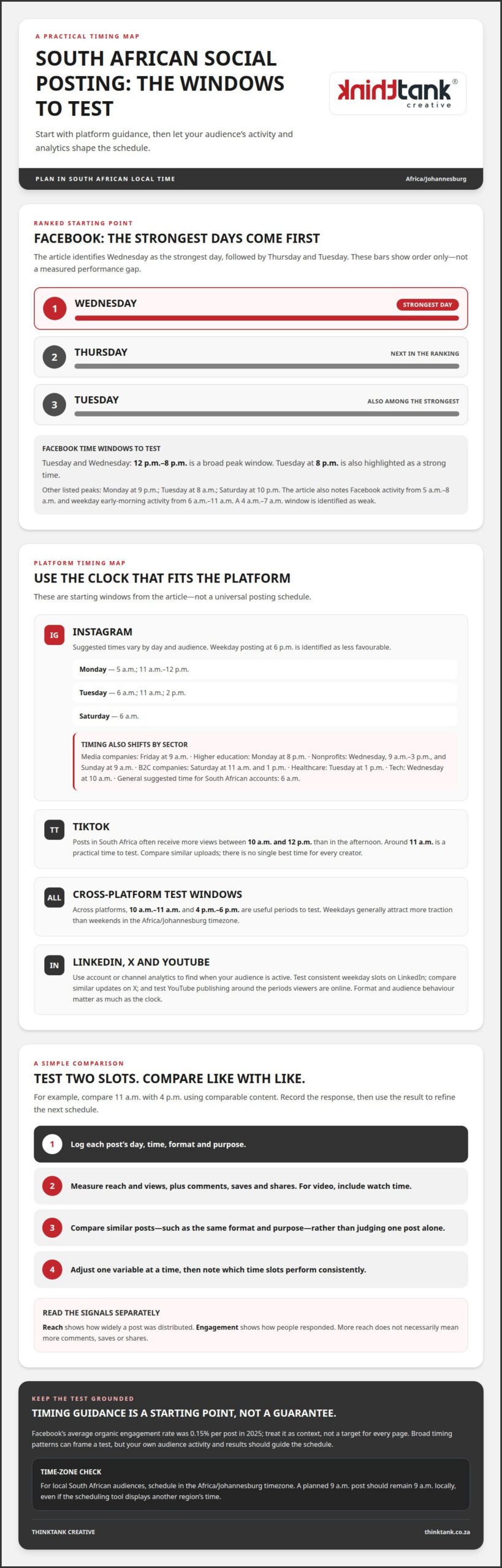
Social Media Posting Times in South Africa by Platform

Tuesday and Wednesday, from 12 p.m. to 8 p.m. South African time, are a useful starting window for Facebook posts. The best times to post on social media in South Africa still vary by platform and audience, with Tuesday at 8 p.m. also identified as a strong time to test.

It’s understandable to want a clear schedule: posting at the wrong time can limit the chance for good content to be seen. Treat suggested times as a starting point, then refine your schedule using your audience’s activity and your own analytics.

This guide covers recommended posting times by platform and day, explains how to adapt them for different audiences, and shows how to use engagement data to build a schedule for your brand. It also accounts for South African local time, so you can plan posts for the people you want to reach.

Key Takeaways

  • Use platform- and audience-specific timing rather than relying on one universal posting schedule.
  • Compare Instagram’s recommended weekday and weekend windows with your audience’s own activity patterns.
  • Assess posts through meaningful engagement signals, including views, watch time, comments, saves and shares.
  • Test posting days and times consistently, then use the results to refine your schedule.
  • Plan around South African local time and account for time-zone differences when reaching audiences elsewhere.

What is the best time to post on social media in 'Africa/Johannesburg' timezone?

For Facebook, Tuesday and Wednesday from 12 p.m. to 8 p.m. form a broad peak window. Tuesday at 8 p.m. is also identified as a strong time. Across platforms, 10 a.m. to 11 a.m. and 4 p.m. to 6 p.m. are useful periods to test. Weekdays generally attract more traction than weekends in the Africa/Johannesburg timezone. These patterns help identify the best times to post on social media in South Africa, but your audience’s activity should guide the final schedule.

Instagram recommendations differ by weekday and audience. Monday suggestions are 5 a.m. and 11 a.m. to 12 p.m.; Tuesday suggestions are 6 a.m., 11 a.m. and 2 p.m. Saturday’s suggested time is 6 a.m. Media companies’ Instagram content performs best on Fridays at 9 a.m. Higher education content performs best on Mondays at 8 p.m. Nonprofits see strong windows on Wednesdays from 9 a.m. to 3 p.m., and Sundays at 9 a.m. Weekday Instagram posting at 6 p.m. is identified as less favourable.

TikTok posts in South Africa often receive more views between 10 a.m. and 12 p.m. than during the afternoon. Around 11 a.m. is a practical starting point for testing. There is no single best time for every TikTok creator, so compare performance across similar uploads.

For LinkedIn, start with the periods when your audience is active, as shown in account analytics. Test a consistent weekday slot, then compare impressions and engagement across posts. On X, schedule comparable updates at different times when your audience is active and assess the response. On YouTube, check channel analytics to see when viewers are online, then test publishing around those periods. Format and audience behaviour matter as much as the clock.

South African businesses reaching local audiences should schedule in the Africa/Johannesburg timezone. This keeps a planned 9 a.m. post at 9 a.m. locally, even when the scheduling tool displays another region’s time.

To find the best times to post on social media in South Africa for your page, run a simple comparison. Choose two candidate slots, such as 11 a.m. and 4 p.m., and publish comparable content in each. Record reach, views, comments, saves and shares; compare like with like, rather than judging one post alone. Facebook’s weekday early-morning activity has also been noted between 6 a.m. and 11 a.m., while 4 a.m. to 7 a.m. is identified as a weak window. Treat these platform patterns as starting points, then let page performance shape your next schedule.

Using social media analytics to improve engagement

Use analytics to turn publishing times into testable decisions. Record each post’s publishing time, weekday, format and audience response. Then compare similar posts, such as two product demonstrations published in different time slots. This separates timing effects from differences in subject or creative execution. Facebook’s average organic engagement rate was 0.15% per post in 2025. Treat this as context, not a guaranteed target for every page or post.

Look for patterns across your own account before changing the schedule. Sprout Social identifies weekends as Facebook’s weakest days overall, while weekday performance can vary by audience. Buffer’s analysis found Facebook engagement tends to fall between 12 p.m. and 5 p.m. These broad patterns help frame a test, but they don’t show how your followers behave. Compare weekday results with weekend results using the same content type and measurement period.

Measure reach and engagement separately. Reach shows how widely a post was distributed; engagement shows how people responded. A post can reach more people without earning more comments, saves or shares. Set a baseline for your account by comparing posts with similar formats and goals. For example, assess awareness posts by reach and views, then compare discussion posts by comments and shares. Use the same measure for each comparison.

Format matters too. Socialinsider’s benchmarks found Reels were the only Facebook content format to increase engagement in Q1 2026. That makes format an important variable in timing tests: compare Reels with Reels, rather than crediting a time slot for a format difference. For video, include watch time alongside views. For other posts, track comments, saves and shares to understand whether the content prompted useful action.

Build a simple review routine around each publishing test:

Reviewing these signals together helps distinguish a timing pattern from a one-off result. An analytics-led social media publishing strategy can connect content planning with performance measurement, making each schedule adjustment more deliberate.

Best day and time to post

Wednesday is the strongest Facebook posting day, followed by Thursday and Tuesday. Weekdays generally attract more social media traction in South Africa, but the best day depends on the platform, audience and content. Treat these patterns as a starting point, not a universal schedule for every account.

For Facebook, daily peak hours can sharpen that starting point. Monday’s listed peaks are 7 p.m., 9 p.m. and 10 p.m., with 9 p.m. the strongest. Tuesday’s are 7 a.m., 8 a.m. and 7 p.m., with 8 a.m. the peak. Saturday’s listed hours are 6 a.m., 9 p.m. and 10 p.m., with 10 p.m. highest. Hootsuite’s data also places Facebook activity between 5 a.m. and 8 a.m. Use these morning windows as tests alongside weekday evening activity.

Instagram timing shifts with sector. South African B2C companies see their best engagement on Saturdays at 11 a.m. and 1 p.m. Healthcare companies perform best on Tuesdays at 1 p.m., while tech companies see strong engagement on Wednesdays at 10 a.m. A general suggested time for South African Instagram accounts is 6 a.m. These differences show why business type and audience habits matter as much as platform-wide averages.

Which days of the week get the most social media engagement in South Africa? Wednesday, Thursday and Tuesday are the leading Facebook days in Buffer’s ranking, while Instagram results vary by sector. For example, B2C Instagram engagement peaks on Saturday, so a weekday-only schedule could miss that audience.

Choose a posting day according to the action you want people to take. A B2C brand could test Saturday at 11 a.m. against 1 p.m.; a healthcare page could compare Tuesday at 1 p.m. with another suitable weekday slot. Keep the topic and format as consistent as possible, then compare reach and interactions. This helps show whether timing, rather than a different creative approach, shaped the response.

Treat the algorithm as one factor in distribution, rather than a reason to chase every reported peak. A morning slot may suit one audience, while an evening post may better match another’s routine. Choose a small set of day-and-time combinations, publish consistently, then use your account’s performance to refine the schedule. For a Facebook page, Wednesday is a sound first test. For Instagram, choose a sector-specific window that best matches your audience.

Social Media Posting Times in South Africa by Platform

Local-time and time-zone considerations

Schedule for the clock your South African audience uses. The Africa/Johannesburg timezone is the reference for local posting recommendations, so a Tuesday slot listed at 8 p.m. means 8 p.m. there. If a dashboard or imported chart displays another timezone, its clock time may not match the local recommendation. Confirm the schedule’s timezone before setting a post to publish.

Time differences can shift recommended windows. Some charts may need a one-hour adjustment to account for timezone and daylight-saving differences. That matters when applying a global report to a South African account: a displayed 10 a.m. peak might need to be interpreted against the report’s stated timezone before scheduling. Preserve the original time and timezone in your planning notes, then convert the slot for your target audience.

Use a consistent conversion method for every scheduled post. First, identify the timezone used by the recommendation. Next, identify the timezone selected in your publishing tool. Then convert the intended local posting time before scheduling. For example, if your target is Tuesday at 8 p.m. in Africa/Johannesburg, make sure the tool’s displayed time represents that local moment, not simply the same clock reading elsewhere.

Separate local and international audiences rather than forcing them into one schedule. A South African post planned for 4 p.m. should reach local followers at that time. If a campaign also targets people in another timezone, create a separate publishing slot based on their local activity. This keeps the South African schedule anchored to local behaviour while allowing international posts to follow their intended audience’s clock.

Keep a timezone record beside each performance result. Include the platform, intended location, scheduled time and timezone, then compare engagement only after confirming the records use a consistent local reference. A Tuesday post recorded as 8 p.m. Africa/Johannesburg should not be compared casually with a report showing 8 p.m. in another timezone. That distinction helps prevent a scheduling conversion from being mistaken for an audience preference.

Before publishing, use this short time-zone check:

For a campaign aimed at a South African audience, keep the final calendar in South African local time. If you use an international chart, check its timezone first, then convert the suggested window to Africa/Johannesburg. This makes a Tuesday peak or another recommended slot actionable without confusing the chart’s reporting time with the time your audience sees the post.

Scheduling posts across time zones

Start with the audience’s local clock, not the location of the person scheduling. For South African followers, plan posts in Africa/Johannesburg time. A post intended for 9 a.m. locally should reach that audience at 9 a.m., even if the person preparing it works elsewhere.

For a campaign serving audiences in South Africa and other countries, create separate time slots for each location. One publishing time might be morning for one group and evening for another. Separate schedules help each audience see the same campaign at a time that fits its local routine.

Before scheduling, establish which timezone the platform or planning calendar displays. Compare that setting with the timezone used by the timing recommendation. If a chart gives a peak at 10 a.m. in another timezone, don’t enter 10 a.m. automatically. Convert the intended moment to the target audience’s local time first.

Some charts may need a one-hour adjustment to account for timezone and daylight-saving differences. Preserve the source timezone alongside any converted slot, so the original recommendation remains clear. For example, record both the source’s 10 a.m. suggestion and the resulting Africa/Johannesburg schedule time. This makes later review more reliable than keeping only a clock reading.

Use a repeatable scheduling workflow for every platform:

Keep records for each platform and audience segment. For example, a South African Facebook post and an international Instagram post might use the same campaign artwork but need separate local publishing slots. Label each calendar entry with its platform, market, timezone and intended posting time. This helps your team distinguish the scheduled time from a converted display time.

When comparing results, group posts by audience location and local time. A South African post published at 9 a.m. should not be treated as equivalent to an overseas post published at 9 a.m. unless both audiences experienced the same local timing. Compare similar content within each market, then adjust the relevant schedule based on its own engagement.

For a coordinated campaign, get support with social media planning so publishing calendars align with audience locations and local timing.

ThinkTank Creative: Social Media Marketing

ThinkTank Creative’s Social Media Marketing service helps businesses build a more cohesive social media presence. It’s a natural next step when your team needs support aligning platform-specific timing with consistent content and a clear brand identity.

Social media works best as part of a considered brand experience. Creative design and Logo and Corporate Identity Design help keep campaign visuals recognisable across posts, while Website Design and Development can support the journey from social content to your online presence. The right combination depends on your goals and the role social media plays in your wider marketing.

To shape a more coordinated social media approach, contact ThinkTank Creative to discuss your goals.

Make your next publishing cycle more intentional

Make your social media calendar a working plan, not a fixed set of times. Use the best times to post on social media in South Africa as a starting point, then let audience responses guide what you publish next. Your campaign can evolve as your content, objectives and audience behaviour change.

Next, connect posting times with the wider experience your brand creates. Social Media Marketing, Creative design and Website Design and Development can each support a more coherent journey from a post to meaningful interaction with your business. ThinkTank Creative can shape that work around your brand and marketing priorities.

Bring your goals and the questions you want your social media activity to answer. A considered conversation can help clarify the direction of your next campaign and how its content should work together.

Contact ThinkTank Creative to discuss a more cohesive approach to your social media presence. Build on what you’ve learned, keep refining your direction, and give your next publishing cycle a purposeful start.

Frequently Asked Questions

What are the best days and times to post on Facebook?

Wednesday, Thursday and Tuesday rank as Facebook’s strongest days in the available weekday ranking. Tuesday and Wednesday from 12 p.m. to 8 p.m. are broad posting windows, while Tuesday at 8 p.m. is a specific time to test. For a practical comparison, schedule similar posts on Wednesday and Thursday, then assess their responses using the same measures and time period.

Can a business enjoy greater profits by timing their social media posts?

Better timing can help a post reach people when they’re active, but publishing time alone doesn’t determine profit. The offer, creative, audience fit and path to purchase all affect whether engagement leads to a sale. To assess commercial impact, use tracked links or campaign-specific codes, then compare enquiries or purchases with the posts that generated them.

Does time of day matter when posting?

Yes. Publishing when your intended audience is active gives a post a better opportunity to be seen promptly. However, suitable times vary by platform, audience and content. A morning post may suit one audience, while an evening slot may better match another’s routine. Compare similar posts published at different times to find what fits your followers’ behaviour.

Does time-zones matter when scheduling social media posts?

Yes. A scheduling tool may display a different timezone from the one in your posting plan. For South African audiences, use Africa/Johannesburg as the local reference and confirm that the scheduled time reflects it. If a recommendation uses another timezone, convert the suggested time before scheduling. Keep the original timezone in your records so later comparisons remain meaningful.

Does timing on Facebook matter?

Timing can influence whether a Facebook post appears when followers are available to engage, but it’s only one part of performance. Format and content also affect the response. For example, compare similar posts published at different times, then measure reach and interactions separately. This helps you avoid mistaking wider distribution for stronger audience engagement.

When is the best time to post on Instagram in South Africa?

Six a.m. is a recommended starting time for South African Instagram accounts, but suitable slots vary by sector. For example, healthcare content performs best on Tuesdays at 1 p.m., whilst tech content sees strong engagement on Wednesdays at 10 a.m. Choose the window closest to your audience and content, then assess results against comparable posts rather than relying on one upload.

Why is it important to publish content at the right time on social media?

Timing helps align a post with periods when its intended audience is likely to be active, giving useful content a better opportunity to attract attention and interaction. For example, publishing a campaign announcement during a relevant audience window may make it easier for people to see and respond promptly. A good schedule also supports consistency without treating every platform alike.

What are the best times to post on Instagram in South Africa?

For a general starting point, test 6 a.m. on Instagram, then compare it with times suited to your industry. Media companies’ content performs best on Fridays at 9 a.m.; nonprofits see strong windows on Wednesdays from 9 a.m. to 3 p.m. and Sundays at 9 a.m. Treat these as audience-specific clues, and compare like-for-like posts before changing your ongoing schedule.

Website maintenance packages in South Africa and starting budgets

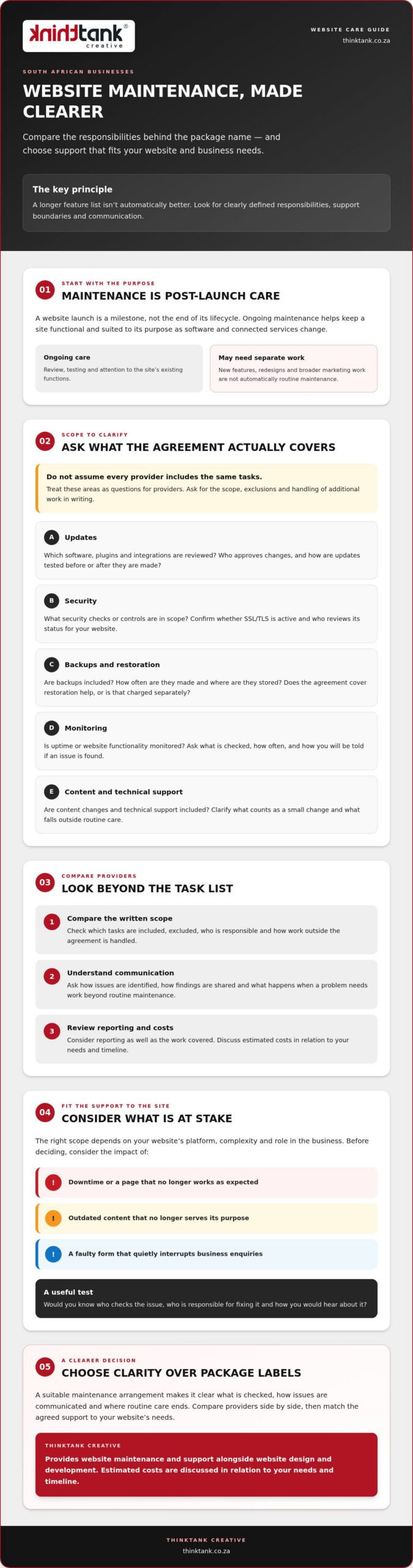
The lowest monthly figure isn’t necessarily the lowest website maintenance budget. Costs depend on your site’s complexity and the work required, such as updates, routine checks and ongoing support. A clearly defined scope shows what a package covers and what affects its cost.

It’s reasonable to want a dependable website without paying for work your business doesn’t need. When comparing website maintenance packages in South Africa, look beyond tier names and assess the tasks, support and exclusions that fit your site. Start by understanding how your website works and what upkeep it needs.

This guide explains what starting project budgets involve and how to assess website maintenance packages across South Africa. You’ll learn which scope details to compare, what to look for in an agency proposal and when maintenance may need to sit alongside broader website design and development.

Key Takeaways

  • Set a realistic starting budget by defining the maintenance work your website actually needs, rather than comparing package labels alone.
  • Assess agencies by the clarity of their scope and how well their proposed support fits your site and business priorities.
  • Compare basic, standard and premium plans by the tasks covered, including updates, backups and security measures.
  • Clarify how support time, content changes and technical assistance are handled so you can plan for ongoing needs.
  • Separate maintenance from hosting, domain renewal and SSL costs to understand what your overall website budget must cover.

Website maintenance agencies in South Africa

South African agencies differ in scope, specialisation and how they describe their work. ThinkTank Creative offers comprehensive national coverage, while other providers operate from various regional hubs. These operational bases offer a starting point for understanding where agencies are situated, but a physical address alone does not show whether their approach suits your website.

Read each agency’s service description for the actual maintenance tasks. A clear description should explain routine work, support requests and exclusions. For example, a business needing regular content changes should distinguish those requests from technical fixes. Compare the stated work, not just labels such as “basic” or “complete”. This makes website maintenance packages in South Africa easier to assess against your requirements.

For a practical overview of possible inclusions and plan tiers, watch this video:

Use a short comparison to assess agency fit. Record each provider’s stated specialisation, maintenance tasks and support process. Then match these details to your site’s needs, such as WordPress updates, new pages or technical fixes. If an agency focuses on a particular platform or website type, that experience may suit your setup. Treat it as a fit criterion, not proof of quality. This comparison helps distinguish website maintenance packages in South Africa by their actual scope.

Ratings and reviews add context, but look beyond an overall score. Seek specific comments about communication, follow-through and issue handling. A review about a redesign may not describe ongoing maintenance, so look for feedback about post-launch support. Compare recurring themes and consider whether the examples resemble your needs. Several detailed accounts provide more context than an isolated comment.

A service-level agreement should define support hours, issue priorities, escalation steps and the difference between acknowledging a request and resolving it. Response targets should be explicit for each priority, with operating hours clearly stated.

Without maintenance, outdated software can create security exposure, while unresolved faults may cause downtime or broken pages. If search engines cannot reliably access important pages, search visibility may also be affected.

Before choosing an agency, map your priorities against its written scope. A nationwide presence can help with flexible communication, while a clearly described specialisation can indicate relevant experience. Use reviews to understand reported working relationships, and the agreement to see how support operates. Together, these details give you a grounded basis for comparing providers beyond their plan names.

What are the differences between basic, standard and premium website maintenance plans?

Basic, standard and premium are package labels, not fixed industry definitions. Agencies in South Africa can use them differently. Compare the written tasks, limits and exclusions instead of assuming plans with matching names provide identical support. One basic plan, for example, may cover routine software updates, while another offers only limited technical assistance.

A basic plan may suit a straightforward website that needs few changes. Its scope might focus on essential upkeep, such as applying available updates and checking key pages remain accessible. For a small business site with service descriptions and a contact form, identify whether the plan covers the components your site relies on, not just its main platform.

A standard plan may include a broader range of recurring tasks. Check whether it covers routine checks, minor site changes or attention to features such as enquiry forms. An organisation that regularly updates staff details, for example, may need content assistance as well as technical upkeep. Confirm whether these tasks are included or treated as additional work.

A premium plan is typically positioned for websites with more complex requirements or a greater need for ongoing attention. A shop with changing product information, for instance, may need broader support than a simple brochure site. Assess whether the proposed plan addresses the actual components and workflows involved. A higher tier adds value only when its extra tasks match your operational needs.

Use this comparison method to assess any tier:

Then compare the proposal against your list, line by line. A plan that excludes a key feature may leave a practical gap, even if its tier sounds comprehensive. The fee is set after a quote request and depends on site complexity, task scope, support volume and required expertise. Ask for the deliverables to be described plainly, including how the agency handles work beyond routine maintenance.

Choose the smallest scope that reliably covers your website’s needs, then review it when the site changes. A new booking function, refreshed page structure or expanding content library can alter the work required. This step-by-step comparison makes website maintenance packages in South Africa easier to evaluate without treating “basic”, “standard” or “premium” as guarantees of specific inclusions.

Do website maintenance packages cover WordPress updates, backups, security and malware removal?

Some plans include these tasks; others separate them or limit their scope. For a WordPress site, ask for each task to be named in the package. “Security included” might mean routine checks, not investigation and removal after an infection. A written scope helps distinguish preventative upkeep from specialist repair work.

WordPress updates may cover the core software, themes and plugins. These components work together, so an update could affect a contact form, layout or payment function. A useful maintenance process identifies what will be updated, how compatibility will be checked and what happens if a change causes a fault. For example, updating a form plugin should include checking that enquiries still reach the right inbox.

Backups need equally clear detail. Find out what is copied, where it is stored and how restoration is handled. A database backup may preserve website content, while files can include images, themes and uploaded documents. If a product page disappears after an update, restoring a suitable backup may help recover it. A backup is most useful when its contents and restoration process are clear.

Security work may include routine software updates, account checks or monitoring for suspicious activity. These measures differ from malware removal, which involves finding and cleaning malicious code, then addressing how it entered the site. A package should state whether investigation, cleanup and recovery are included or treated as separate work. Ask how the agency handles a compromised WordPress login or an unfamiliar script.

Use this checklist to compare the written scope:

Consider a small business site with a WordPress contact form and several service pages. Routine updates may keep its components current, while a form test confirms enquiries still work. If malware is found, cleaning the site may require separate expertise and a defined response process. Package wording should make that distinction clear before work begins.

When comparing website maintenance packages in South Africa, assess named tasks rather than broad claims such as “fully protected”. Match the scope to your platform, plugins and business-critical functions. This gives you a practical basis for choosing ongoing maintenance and understanding which issues need a separate remediation project.

Website maintenance packages in South Africa and starting budgets

How much support time, content updates and technical support do plans include?

Support time depends on the plan’s scope, not its label. One agreement may reserve time for routine requests, while another defines tasks individually. Focus on the work that allocation can complete. Changing a staff photograph, for example, differs from investigating a checkout fault. Compare the allowance with your likely workload and find out whether unused time carries forward or expires.

Content updates might include adding a news item, replacing a service description or changing opening hours. Each task takes different effort: replacing a short sentence is not the same as building a new landing page. A clear plan defines what counts as a small edit, how requests are submitted and whether image preparation or copywriting is included. This helps prevent a simple content change from becoming an unexpected project.

Technical support covers problems that affect the site’s function. Examples include a broken enquiry form, a display issue after a browser update or an error following a plugin change. The plan should explain how requests are logged, prioritised and escalated. It should also distinguish initial acknowledgement from resolution, since diagnosing a fault may take longer than confirming receipt.

Map your needs before comparing website maintenance packages in South Africa. Review recent requests and group them by task: content changes, routine troubleshooting or larger development work. A business publishing monthly news may need regular editorial assistance. A company relying on online enquiries may place greater value on prompt help with form problems. This review helps align the support allocation with actual website activity.

A small retailer, for instance, might need seasonal banner changes and help correcting product-page errors. These requests are different: one is planned content work, while the other may require technical diagnosis. A documented allocation makes the distinction clear, helping the business plan recurring updates and recognise when a larger change needs separate scoping.

Keep a simple request log with the date, task, outcome and time used. Over time, patterns become clearer: repeated image edits may call for a different content workflow, while recurring form faults may signal a deeper technical issue. Use these examples to refine the scope, so support time meets day-to-day needs rather than being consumed by unclear requests.

Are website hosting, domain renewal and SSL certificates included in South African maintenance packages

Hosting, domain renewal and SSL certificates are separate parts of keeping a website online. A maintenance plan may bundle them, manage them or exclude them. The package name alone won’t tell you which applies. Check the written scope for each item, renewal arrangements and who controls the relevant account.

Hosting provides the server space where a website’s files and data are stored. It can also involve server configuration, performance and account administration. A business might pay its host directly while an agency handles website updates. In that arrangement, maintenance support does not automatically include hosting fees. Confirm whether the plan covers hosting costs, technical hosting assistance, both or neither.

A domain is the address people use to reach your website. Renewal keeps the registration active, while maintenance covers work on the site itself. If your business owns its domain account, it can manage renewal independently. If an agency administers it, establish who receives renewal notices and handles payment. Make account ownership and access clear, especially if you change providers.

An SSL certificate enables encrypted connections between a website and its visitors. Browsers may show a security indicator when a valid certificate is in place. Certificate arrangements vary: a plan may include configuration, renewal management or troubleshooting, while the certificate cost is separate. Ask what happens if a certificate expires or causes a browser warning, and who is responsible for resolving it.

Use this checklist to compare proposals:

Consider a retailer whose website uses a domain, hosted server and SSL certificate. Its maintenance agreement could cover site changes, while the retailer pays hosting and domain renewals separately. Another arrangement might bundle administration. Compare the actual inclusions and exclusions, and separate recurring third-party charges from agency work. This gives you a clearer view of the website budget without confusing technical upkeep with infrastructure costs.

Before approving a proposal, map each responsibility to a named account and renewal process. If hosting, domain management or certificate configuration needs to be coordinated with site work, discuss a website maintenance scope that reflects those requirements.

ThinkTank Creative: Website Design and Development

ThinkTank Creative can help when website upkeep reveals a need for broader structural change. If your current site no longer supports your services, customer journey or brand direction, Website Design and Development provides a way to rethink its design and functionality. This differs from routine maintenance: it addresses the website’s foundations and how they serve your business.

A business adding new services, for example, may need clearer page structure, while a refreshed visual identity may call for coordinated creative design or logo and corporate identity design. These elements can create a more cohesive experience across the website and brand. Choose this next step when your priorities extend beyond keeping existing pages operational.

If you’d like to discuss your website’s next steps, visit thinktank.co.za.

Build your website’s next phase with intention

Think of maintenance as part of your website’s wider direction, not simply a recurring task. As your business evolves, your site may need clearer messaging, a refreshed visual identity or a stronger connection with your marketing. Comparing website maintenance packages in South Africa is a practical starting point. Then consider whether your existing site still supports where you want to go.

ThinkTank Creative brings together Website Design and Development, Social Media Marketing and creative design. These capabilities can help align your online presence with your business goals, whether you’re refining an existing site or planning a broader refresh. Take the next step with a focused conversation about what your website needs to do.

Contact ThinkTank Creative about your website and explore a considered path forward for your brand.

Frequently Asked Questions

What do website maintenance packages in South Africa typically include?

Packages may combine technical upkeep with agreed support tasks, but inclusions vary. Beyond updates and troubleshooting, look for clear documentation of completed work, a record of changes and a process for approving requests. A business with staff editing pages, for example, should know how changes are tracked and who can authorise them. Compare the deliverables with your website’s ownership, workflows and business-critical features before deciding.

How much do website maintenance packages cost in South Africa in 2026?

There’s no single standard fee for website maintenance in South Africa in 2026. The price depends on the case and is given after a quote request; factors include site complexity, required tasks, support volume and the expertise involved. A simple informational site and a website with more complex functions can require different levels of work. Use the scope, rather than a package label, to understand what a quoted fee covers.

Which South African providers offer website maintenance packages, and what do they charge?

ThinkTank Creative offers ongoing website maintenance and support in South Africa. Its charge depends on the project scope and is provided after a quote request, rather than as a published package price. To make the proposed work easier to assess, outline your website’s purpose, platform, current issues and expected changes. That context helps define the maintenance tasks and support your business needs.

Are website maintenance package prices quoted in rand inclusive of VAT?

Don’t assume a quoted amount is inclusive of VAT unless the proposal states this clearly. Check that the document identifies the currency as South African rand and distinguishes the service fee from any applicable tax or third-party charges. For example, a quote may list maintenance separately from hosting or domain costs. Compare the stated total payable, not just the headline amount, before approving the work.

What should businesses check before choosing a South African website maintenance provider?

Check that the agreement identifies the website covered, included tasks, exclusions, support process and billing basis. Confirm who controls the domain, hosting and administrator accounts, and how access is handled if the arrangement ends. Ensure your business retains access to its website credentials and project records. A written scope, clear ownership and practical handover terms help prevent avoidable disruption as your needs change.

Email Marketing Services in South Africa: Costs and Options

There’s no standard price for email marketing services in South Africa. Costs depend on factors such as the platform, list quality, automation, segmentation, deliverability requirements and level of agency support. Compare the work you need, not just the monthly subscription. The price for a tailored service depends on the scope and is provided after a quote request.

It’s reasonable to expect a clear view of what drives the cost before choosing a platform or agency. This guide explains the main cost factors and shows how to compare options by their automation capabilities, approach to list quality, segmentation tools and deliverability support. You’ll also find a practical decision guide to help match those priorities to your business needs, so you can assess the value of each option with greater confidence.

Key Takeaways

  • Compare the full cost drivers, including list size, automation, segmentation and the level of strategic support, rather than judging an option by its subscription alone.
  • Review how you collect and maintain subscriber data; a smaller, engaged list can be more valuable than a larger, inactive one.
  • Match segmentation and deliverability features to your sending needs so relevant messages reach the right audience.
  • Choose between a self-managed platform and agency support by weighing the expertise, time and ongoing campaign management your team needs.
  • Use the decision guide to narrow your options according to your business goals, audience and available resources.

List quality and email hygiene

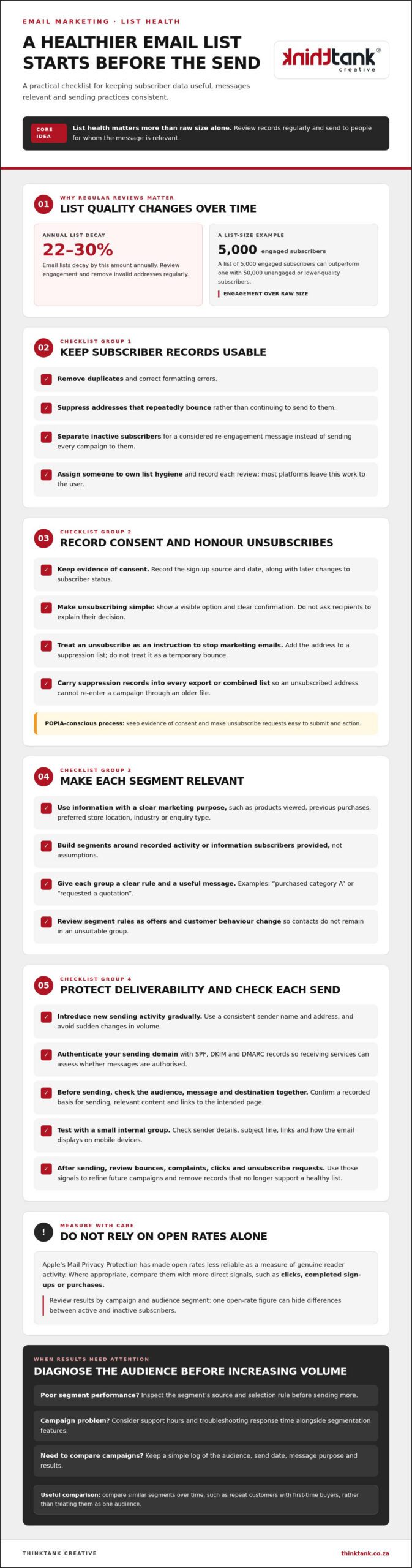
List quality affects campaign relevance, engagement and deliverability, so review it regularly. For a POPIA-conscious email process in South Africa, keep evidence of consent and make unsubscribe requests easy to submit and action.

For an overview of email tools and their features, watch this video:

Maintaining List Quality

List hygiene means keeping subscriber records accurate, permission-based and useful for relevant campaigns. Email lists decay by 22 to 30 per cent annually, so review engagement and remove invalid addresses regularly. A list of 5,000 engaged subscribers can outperform one with 50,000 unengaged or lower-quality subscribers. This makes list health a stronger measure than raw size alone.

Build a repeatable review process. Remove duplicate records, correct formatting errors and suppress addresses that repeatedly bounce. Separate inactive subscribers for a considered re-engagement message instead of sending every campaign to them. Most platforms leave list hygiene to the user, so assign responsibility within your team and record each review.

Unsubscribe Requests

An unsubscribe request is an instruction to stop receiving marketing emails. Treat it differently from a temporary bounce: add the address to your suppression list so it’s excluded from future marketing sends. Make the process simple, with a visible unsubscribe option and clear confirmation. Don’t require recipients to explain their decision.

Record consent and any subsequent changes to each subscriber’s status. Note the sign-up source and date, for example, then record when someone withdraws permission. Apply the suppression record when exporting or combining lists so an unsubscribed address doesn’t re-enter a campaign through an older file. This helps keep list management consistent.

Interpret open rates carefully. Apple’s Mail Privacy Protection has made them less reliable as a measure of genuine reader activity. Where appropriate, compare them with more direct signals, such as clicks, completed sign-ups or purchases. Review results by campaign and audience segment, as a single open-rate figure can hide differences between active and inactive subscribers.

Before sending, check the audience, message and destination together. Confirm that selected contacts have a recorded basis for receiving the email, that the content matches why they subscribed, and that links lead to the intended page. After sending, review bounces, complaints, clicks and unsubscribe requests. Use these signals to refine future campaigns and remove records that no longer support a healthy list.

List segmentation and deliverability

Segmentation helps each campaign reach subscribers who are more likely to find it relevant. Deliverability is about getting those messages accepted by recipients’ email services and placed where they can be seen.

Start with information that has a clear marketing purpose. For example, a retailer could group customers by products viewed, previous purchases or preferred store location. A business-to-business firm might segment contacts by industry, enquiry type or stage in the sales process. Use information subscribers have provided or their recorded activity, and link every segment to a useful message.

Build segments around actions, not assumptions. A recent purchaser may need product guidance, while a prospect who downloaded a service guide may benefit from a relevant follow-up. Set a clear rule for each group, such as “purchased category A” or “requested a quotation”. Review the rules as offers and customer behaviour change, so contacts don’t remain in an unsuitable segment.

Deliverability also depends on consistent sending practices. Introduce new sending activity gradually, use a consistent sender name and address, and avoid sudden changes in volume. Authenticate your sending domain with SPF, DKIM and DMARC records. These technical settings help receiving services assess whether messages are authorised to come from your domain.

For South African teams, response time can matter during a campaign problem. A platform headquartered fourteen time zones away may not respond to a deliverability issue at 10am SAST. Consider the support hours and troubleshooting process alongside the platform’s segmentation features, particularly if a time-sensitive campaign depends on prompt resolution.

Before each send, test the message with a small internal group. Check the sender details, subject line, links and display on mobile devices. Then review delivery reports for hard bounces, spam complaints and sudden changes in engagement. If a segment performs poorly, inspect its source and selection rule before increasing send volume. This diagnosis is more useful than sending the same message to every contact.

Keep a simple campaign log recording the audience, send date, message purpose and results. Comparing similar segments over time can show whether a subject line, offer or audience rule needs adjustment. For example, compare repeat customers with first-time buyers rather than treating them as one audience. Clear segments make results easier to interpret and future campaigns easier to refine.

For a more coherent customer journey, connect audience choices with the wider message and brand experience. Explore audience-focused campaign planning as you shape that approach.

Choosing a platform for different business needs

Platform features, billing and integrations vary, so choose one that suits your business model and workflow. Some platforms used by South African businesses support rand billing and local integrations; others use foreign-currency billing or third-party connectors.

Start by mapping how you’ll use email. A small service business sending occasional updates needs a different setup from an online retailer sending abandoned-cart messages and post-purchase follow-ups. Compare audience management, automation, integration fit, reporting and the time your team can devote to campaigns.

Option Best suited to Compare carefully
Basic newsletter platform Small teams sending planned updates Contact limits, templates and reporting
Automation-focused platform Businesses building triggered customer journeys Workflow complexity and setup effort
E-commerce platform integration Retailers using purchase or browsing activity Product data, order syncing and event triggers
CRM-connected platform Sales teams managing enquiries and follow-ups Contact-field mapping and record synchronisation
Managed platform with support Teams needing help with campaign operations Scope of support and responsibility split

Check billing currency separately from the subscription structure. Find out whether charges are in rand or another currency, and what affects the bill, such as stored contacts, sending volume, user seats or optional features. A lower entry tier may not suit a growing list if essential automation is only available on a higher plan.

For local integrations, list the systems your team already uses, such as an online shop, customer database or payment workflow. Then check whether the platform connects directly, uses an established connector or requires manual data transfer. A retailer, for example, needs reliable order and product data before sending purchase-related messages. A service firm may prioritise enquiry forms and CRM records instead.

Assess the user experience, not just the feature list. Can staff build a campaign, apply a saved audience and review results without specialist help? A complex workflow can be valuable if it reduces repetitive manual work, but unnecessary automation adds setup and maintenance. Match the level of sophistication to the customer journey you actually run.

Use a short decision process: define your campaign types, list required integrations, estimate how your contact base may change, then compare plans against those needs. Test a representative workflow, such as a welcome email after sign-up, before committing. The right fit supports the next stage of your marketing without making routine sends harder to manage.

Email Marketing Services in South Africa: Costs and Options

Email marketing agencies in South Africa

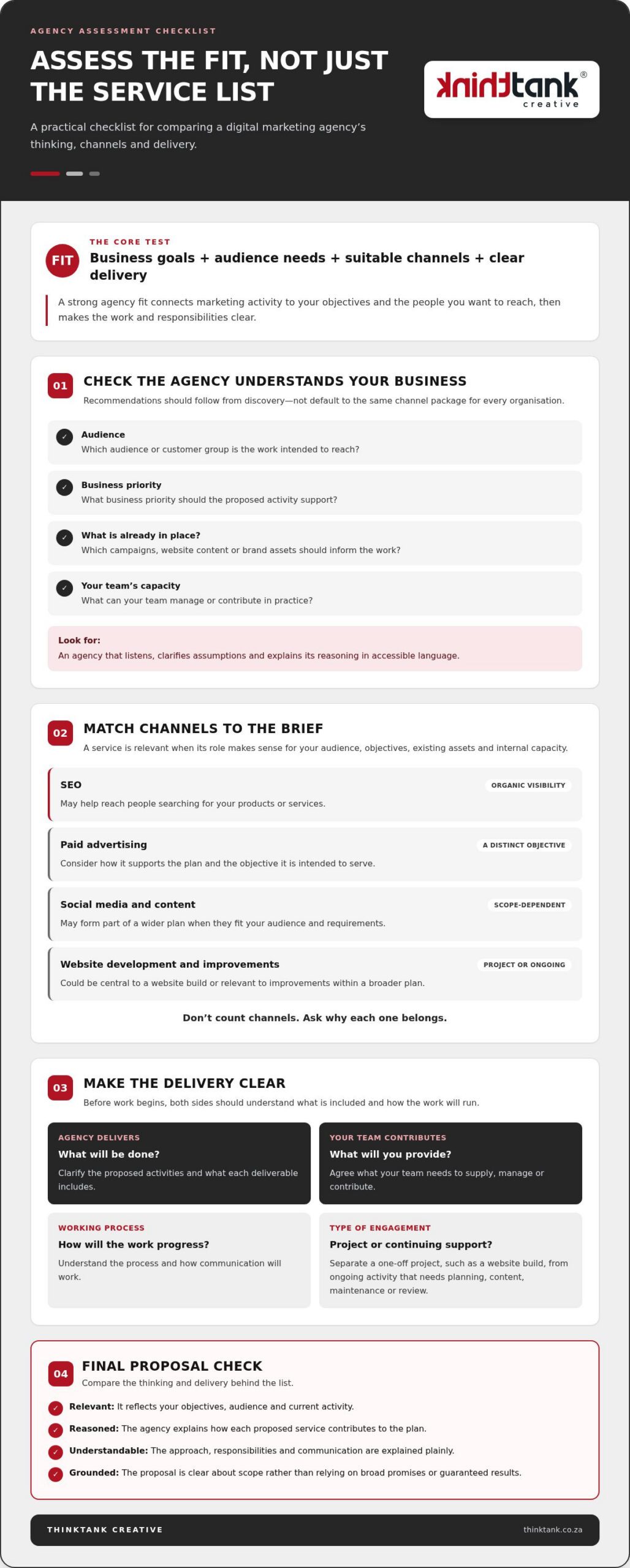
A South African email marketing agency can bring strategy, campaign production and ongoing optimisation together. The value depends on the scope, from planning and copywriting to audience setup, design, testing and performance reporting. Compare the work included, not just the label “agency”, as responsibilities differ between providers.

Some agencies focus on campaign execution, preparing a scheduled newsletter, formatting its content and coordinating a send using your existing platform. Others offer broader strategic support, such as customer journey planning, automation mapping and analysis. A retailer preparing a seasonal promotion may need creative production and scheduling, while a business nurturing sales enquiries may prioritise automated follow-ups.

Agency fees depend on the scope and are provided after a quote request. Key cost factors include the number and complexity of campaigns, level of strategy, copy and design requirements, automation setup, reporting, and whether the agency or your team manages the platform.

Clarify ownership and responsibilities before work begins. A useful scope sets out the campaign calendar, approval process, data your team will supply and the person responsible for each task. For a welcome sequence, agree who writes the messages, builds the workflow, tests links and reviews results. Clear handovers help prevent missed steps and unexpected rework.

Consider how the agency’s support fits your working day. An agency operating locally may coordinate around SAST, while an overseas team may work to different hours. This can matter during a live campaign issue, such as a broken link or incorrect offer. Compare the agreed communication process and escalation route, not location alone.

Assess an agency’s capability against observable outcomes. Look for a clear explanation of how campaign goals inform audience selection, message content and reporting. A useful report connects activity to the intended objective, such as event registrations or service enquiries. Open rates alone give an incomplete picture, particularly since Apple’s Mail Privacy Protection made them less reliable.

Use this decision guide to compare agency support with a self-managed platform:

Before committing, map one upcoming campaign from brief to reporting. That practical exercise reveals whether the proposed scope covers the work your South African business needs.

What email marketing services are available in South Africa?

Businesses in South Africa can choose a self-managed email platform, specialist agency support or a combination of both. The right service depends on whether you need campaign production, technical setup, ongoing strategy or simply a tool for sending newsletters.

A platform gives your team software to create, schedule and monitor campaigns. Your staff generally manage the audience, content and sending process. For example, a small consultancy might send a monthly update and track link clicks. This approach suits teams with time to manage campaigns and a clear process for reviewing results.

Agency-managed support can cover more of the work behind each send. Depending on the scope, it may include planning, copywriting, email design, campaign setup, testing and reporting. A retailer preparing a product launch may need coordinated messages before and after launch, rather than a single newsletter. Define which tasks are included and which remain with your team.

Some businesses use a blended model. Their staff provide product knowledge and approve content, while an external specialist handles campaign design or automation. This can suit a team that understands its customers but needs extra capacity to build a welcome sequence or organise a campaign calendar. Agree responsibilities, approval stages and reporting needs before work starts.

Common service components include:

Compare the scope of services rather than relying on labels like “full service”. Ask for a clear breakdown of campaign planning, content creation, platform management and performance reporting. A proposal may include newsletter design, for example, but leave copywriting and audience preparation to your team. That affects the time and expertise you’ll need internally.

Choose based on the gap you need to fill. If your team can produce content and manage sends, a platform may be sufficient. If campaigns need strategic direction or specialist execution, agency support may fit better. To shape a more cohesive approach, explore email marketing campaign planning as part of your wider marketing activity.

ThinkTank Creative: Website Design and Development

ThinkTank Creative can connect your email activity with a website experience that supports your business goals. Its Website Design and Development service is relevant when campaign traffic needs a clear destination, such as a service page explaining an offer or a form inviting enquiries.

Consistent branding also matters across email and social channels. ThinkTank Creative’s creative design, Logo and Corporate Identity Design, and Social Media Marketing can help align the way your business presents itself to customers. Consider this support when your campaigns and website feel disconnected, or when your digital presence needs a more coherent direction.

To discuss how ThinkTank Creative’s services could support your marketing, get in touch with the team.

Turn your email strategy into a connected customer experience

Take a practical next step: decide what action you want readers to take after opening an email, then make sure the destination supports it. A campaign can introduce your brand, while a clear website journey helps visitors understand your offer and move towards an enquiry. That connection gives email marketing services in South Africa a purposeful role in your wider digital presence.

ThinkTank Creative can bring that experience together through Website Design and Development, Social Media Marketing and creative design. These offerings can help align your campaign messages with the pages and brand identity customers encounter elsewhere. The result is a more coherent foundation for communicating with your audience and guiding them towards meaningful next steps.

Ready to shape an email approach that fits your business and its wider marketing goals? Contact ThinkTank Creative about email marketing to start the conversation and explore a considered direction for your campaigns.

Frequently Asked Questions

How much does email marketing cost in South Africa?

Costs vary according to whether you use software independently or pay for managed campaign work. A platform subscription and an agency’s planning, content, design or reporting are separate cost components. For email marketing services in South Africa, the price depends on the scope and is provided after a quote request. Main cost factors include campaign frequency, audience size, automation complexity, creative requirements and the level of ongoing support.

What kind of activities will an email marketing company develop?

An email marketing company can plan and produce campaigns around specific business objectives. These may include promotional newsletters, product announcements, event invitations, customer onboarding messages and enquiry follow-ups. For example, a training business could send course information to prospective learners, then a reminder before enrolment closes. Before production, agree on the audience, message, desired action and how you’ll measure each campaign.

Which email marketing platform should you choose?

Choose a platform that suits your team’s workflow, not simply the one with the most features. A business sending occasional newsletters may prioritise simple campaign creation, while a retailer may need purchase-triggered messages and shop integration. Consider contact management, automation, reporting, billing currency and available support. Test a typical task, such as creating a newsletter and reviewing its click report, before deciding.

Which South African email marketing platforms are best for small businesses?

The best option for a small business is one its team can manage consistently and affordably within its budget. Compare South African billing options, contact or sending limits, ease of use, customer support and connections to tools already in use. A local service business may need enquiry-form connections, while a small online shop may prioritise order data. Select features that support current needs without complicating routine campaigns.

How much do email marketing services cost in South Africa?

Service costs depend on the agreed scope, so compare the campaign work included rather than relying on a headline fee. A project covering strategy, copywriting and design differs from one involving campaign execution alone. The price depends on the scope and is provided after a quote request. Relevant factors include campaign volume, creative work, automation setup, reporting requirements and the division of responsibilities between your team and the provider.

How can a business choose and set up an email marketing service in South Africa?

Start by defining a campaign goal, such as event registrations or product enquiries, then choose a service suited to that workflow. Prepare approved brand assets, a permission-based contact source and the destination page before setup. Configure the sender identity and domain authentication, import only relevant records, and test the message across devices. Send a controlled first campaign, then use the results to refine the next one.

Which email marketing services offer automation, segmentation, and analytics?

Many email platforms offer these capabilities, but their depth and usability vary. Check whether automation supports the triggers you need, such as a follow-up after a form submission, and whether segments can use relevant customer fields. Analytics should connect campaign activity to your objective, such as link clicks leading to enquiries. Trial a representative workflow, then assess whether your team can act on the reporting.

What deliverability and spam risks affect email marketing in South Africa?

Common risks include outdated addresses, contacts without appropriate permission, sudden changes in sending patterns and messages reported as spam. Errors in sender authentication can also affect how receiving services handle a campaign. Keep contact records current, use a recognisable sender identity and test links before sending. Monitor bounce and complaint reports, and investigate unusual changes rather than repeating the same send.

Best Digital Marketing Agency in South Africa: 2026 Guide

The best agency isn’t necessarily the one with the longest service list. Finding the best digital marketing agency south africa can support your business means looking beyond polished promises. Assess whether its strategy, creative work and digital channels connect to your priorities and whether you understand what the agency will deliver.

When agency claims sound similar, it can be difficult to tell what will make a practical difference. Disconnected campaigns, unclear reporting and vague processes can make a long-term partnership feel like a risk. A good fit brings relevant work together, defines responsibilities and keeps activity focused on your business objectives.

This 2026 guide will help you assess an agency’s strategic thinking, creative capabilities, digital services and ongoing support. You’ll learn how these elements can work together, what to look for in a clear process and useful reporting, and what information to prepare before an agency discussion. With a focused brief and the right questions, you can compare potential partners more confidently and discuss an estimated cost based on your needs and timeline.

Key Takeaways

  • Find the best digital marketing agency south africa for your business by matching its strategy and capabilities to your objectives, audience and delivery needs.
  • Look beyond a long channel list: assess how an agency connects relevant services with communication, reporting and accountability.
  • Weigh integrated agency support against separately coordinated specialists, focusing on which approach suits your scope and resources.
  • Prepare objectives, audience insights, current challenges, scope and timeline to make agency discussions and estimates more useful.
  • Discover how ThinkTank Creative brings connected services and ongoing support together, drawing on experience since 2001.

Best digital marketing agency in South Africa: what should the right fit deliver?

Agency proposals can look remarkably similar at first glance. SEO, paid advertising, social media and website development appear on many service lists, but the difference lies in how those activities are selected, connected and delivered. A strong fit starts with your organisation’s priorities and intended audience, then defines a practical scope around the work that supports them.

There’s no universal winner. The best digital marketing agency south africa for one business may not suit another: requirements depend on desired outcomes, customer behaviour and the capacity available within the organisation. A business launching a website may need a defined project; another may need ongoing marketing activity and regular collaboration. Knowing which channels exist is a useful starting point, but their value depends on how they support your goals.

For background on the channels and activities agencies may bring together, see this Digital Marketing Overview. Use that context to identify which channels may be relevant to your organisation, rather than treating every option as essential.

What should a South African business expect from a digital marketing agency?

Expect a working relationship that links marketing activity to business objectives and the people you want to reach. The agency should explain its recommended approach in plain language: what it proposes to do, why those activities suit the brief, who is responsible for each part, what will be delivered and how communication will work. This gives both sides a shared reference point before work begins.

Agency fit is the alignment of business goals, audience needs, suitable channels and a clear delivery process. In practice, discuss whether your priority is strengthening your brand identity, developing a website, improving organic visibility or coordinating several activities. Distinguish a one-off project, such as a website build, from ongoing work that needs continuing planning, content, maintenance or review.

Why do service lists alone make agency comparisons difficult?

A service name tells you what an agency may do, but not how that work relates to your situation. SEO may help reach people searching for your products or services; paid advertising may support a different objective, while social media and a website each play distinct roles. The right mix depends on your audience, existing assets, internal capacity and priorities, not simply on how many channels appear in a proposal.

Compare the thinking and delivery behind the list. Look for a clear explanation of how activities fit together, what each deliverable includes, how progress will be communicated and what your team needs to contribute. Before work begins, make sure responsibilities and scope are clear so everyone understands the work involved.

This turns agency comparison into a decision about fit, not a contest between service menus.

How to assess a digital marketing agency’s strategy, services and accountability

A useful agency assessment goes beyond whether a provider offers a particular channel. Look for recommendations shaped around your business, a clearly scoped project and a way to understand what is happening as the work progresses. The following framework helps you compare substance, not just polished proposals.

Which questions reveal whether an agency understands your business?

Start with discovery. A useful discussion should cover who you want to reach, what the business needs to achieve, what marketing is already in place and what practical constraints could affect delivery. Recommendations should follow from those details, rather than defaulting to the same channel package for every organisation.

Notice whether the agency listens, clarifies assumptions and explains its reasoning in accessible language. At ThinkTank Creative, research and strategy establish project direction before design and delivery. This discussion-led approach brings client needs into the work from the outset, rather than treating the brief as a channel checklist.

How can you assess service breadth and reporting?

Broad capabilities are valuable when they match your requirements. A brief focused on organic search may call for SEO and relevant website improvements; a wider plan might also involve paid advertising, social media, content, copywriting or email marketing. Website development and reporting may be relevant too, depending on the scope. Ask how each proposed service contributes to the plan and what the work involves in practice.

Use this checklist to assess whether the proposal is relevant and accountable:

Reporting should support conversation and review. It gives both sides a shared view of the work, helps surface questions and creates an opportunity to refine priorities. It does not guarantee a particular business outcome. Before work begins, clarify what will be reported, how often you’ll review it and who will discuss the findings with you.

These criteria can help you identify the best digital marketing agency south africa for your needs, rather than the provider with the broadest-sounding promise. To see how connected services can support a project, explore ThinkTank Creative’s services.

Does one full-service digital marketing agency suit every South African business?

No single agency model is right for every organisation. A broad range of services can be useful when several parts of a project need to work together, but breadth alone is no reason to commission work you don’t need. Base the decision on your objectives, requirements and the time and skills your team can contribute.

An integrated agency can bring related activities into one coordinated relationship. A business with a clearly defined need may instead scope a focused project within a wider agency partnership. Consider how much coordination the work involves, how you want responsibilities handled and how much internal capacity is available.

Consideration Integrated agency support Separately coordinated specialists
Coordination Related work can be planned within one agency relationship. Your team may need to coordinate handovers between providers.
Scope A wider mix of services can be brought together when the brief calls for it. Each engagement can focus on a specific requirement.
Communication Updates and discussion can be managed through a shared agency relationship. Communication may happen across separate working relationships.
Internal capacity May suit teams seeking a connected partner across several work areas. May suit teams able to manage different relationships and workflows.

When can an integrated agency approach make sense?

Integration can be practical when a project spans brand identity, website development and digital marketing. For example, a business refreshing its corporate identity and website may want the visual direction, site content and planned marketing activity to feel consistent to customers. Shared communication can help keep decisions and project information connected across those work areas.

ThinkTank Creative brings services such as branding, websites, advertising, printing and digital marketing together where they fit the brief. Its process moves from research and strategy into design and delivery, with ongoing service after project completion. The value comes from matching connected capabilities to the project, not using every service by default.

When might a business need a narrower project scope?

A defined objective can call for a focused brief. If your immediate requirement is a new website, for example, the initial scope can centre on that project rather than expanding automatically into every marketing channel. Priorities, timing and the people available to contribute internally all shape what is realistic to deliver and manage.

Choose the working model that fits the brief. Separate essential work from possible future activity, then decide which responsibilities your team can own and where you need agency support. The best digital marketing agency south africa for your organisation isn’t determined by a universal preference for full-service or specialist support; it’s the one whose approach aligns with the work you need and how you can collaborate.

Best Digital Marketing Agency in South Africa: 2026 Guide

How to prepare a useful South African agency brief and measure progress

A clear brief gives an agency a stronger starting point and helps you assess whether its recommendations fit your business. It doesn’t need to be lengthy. Focus on the decisions and context that will shape the work, then agree how you’ll review progress before delivery begins.

What information belongs in an agency brief?

Build the brief in a practical sequence. First, describe your organisation and the business objective behind the project. Next, identify the audiences you want to reach, your current marketing activity and the challenges you want to address. Then set out the scope, desired outcomes and timeline, separating essential work from possible future activity.

Make the intended outcome as clear as possible. If lead generation is a priority, define what a useful lead means to your organisation and how you’ll recognise one; lead generation strategies for South African businesses can help you shape that objective. If content is part of the scope, clarify its role, audience and subject areas, then use a strategic content marketing plan to organise your thinking.

How should a business review marketing progress?

Agree the review framework with the agency before work starts. Choose measures that reflect the objectives in the brief, rather than adopting generic targets. If the agreed goal is to generate enquiries, for example, decide what counts as an enquiry and how it will be recorded. If the project is a website build, clarify which deliverables and project stages will be reviewed. Choose measures in context rather than assuming a benchmark.

Set expectations for responsibilities, communication, reporting and review points. Confirm who supplies information or approvals, who presents updates, what the report will cover and how often you’ll discuss it. This makes the collaboration easier to manage and helps prevent different expectations from emerging mid-project.

At each review, consider three questions: what work was completed, what does the agreed reporting show, and what should happen next? Keep recommendations tied to the scope and the evidence available. A report should inform discussion and decisions, not be treated as a promise of a particular result.

A well-prepared brief can make your conversation with the best digital marketing agency south africa more focused and useful. To discuss a project shaped around your objectives and timeline, talk to ThinkTank Creative about your brief.

Why consider ThinkTank Creative as your digital marketing agency in South Africa?

ThinkTank Creative is an independent South African agency founded in 2001. It brings branding, advertising, printing, website and system development, and digital marketing into one agency relationship. Depending on your brief, this can include logo and corporate identity design, creative design, SEO, paid advertising, social media marketing, email marketing, and website maintenance and support.

This range of capabilities can help keep related work aligned, from how a brand is presented to how its website and marketing communicate with customers. The right combination depends on your objectives and project requirements. ThinkTank Creative’s collaborative approach brings client needs into the discussion, research, strategy and delivery, with ongoing service after project completion.

What does ThinkTank Creative’s project process involve?

For design work, the process can move from research and strategy into design and production, followed by presentation, refinement and feedback before delivery. This gives clients room to develop the direction through discussion and refine the work, rather than treating delivery as a one-way handover.

Website development follows a considered sequence, from planning and design through programming and development, revision and testing. After launch, training and support form part of the process. These stages take a website project from its initial brief to launch and support, while allowing the work to respond to the agreed requirements. The scope is shaped around the project, rather than assumed to be the same for every business.

How can a business begin a conversation with ThinkTank Creative?

Bring a clear starting point, even if every detail isn’t settled. Share what you want to achieve, who you need to reach, which services you have in mind and your preferred timeline. It’s also useful to outline current challenges, existing marketing or brand materials, and who will be involved in decisions. This context makes the discussion specific and gives the agency a basis for understanding the work.

If you’re considering the best digital marketing agency south africa for your organisation, focus the conversation on fit: what needs to be done, how the work should support your objectives and what collaboration will look like. After discussing your needs and timeline, ThinkTank Creative provides an estimated cost tailored to the project, rather than a fixed figure detached from its scope.

ThinkTank Creative’s guiding principle is: “We Do It All So You Don’t Have To”. Start with your goals and the work you have in mind, then start a conversation with ThinkTank Creative.

Turn your next marketing decision into a clear first step

The search for the best digital marketing agency south africa doesn’t need to end with a perfect plan. Begin with one meaningful business priority, then use it to guide a focused conversation about what to do next, what to leave for later and how you’ll work together. A thoughtful starting point can make a complex marketing challenge more manageable.

ThinkTank Creative’s collaborative approach starts with understanding your needs and shaping the work around them. Bring your objectives, audience context and preferred timeline to the discussion. From there, you can explore a suitable scope and next steps with greater clarity.

Discuss your marketing goals with ThinkTank Creative and take the next step towards marketing that feels purposeful, connected and right for your business.

Frequently Asked Questions

How do I choose the best digital marketing agency in South Africa?

Choose the best digital marketing agency south africa by assessing whether its recommendations make sense for your business, not by comparing slogans. Ask how it would approach a real priority, such as refreshing a service page or supporting a product launch. Notice whether the discussion clarifies your needs, assumptions and the input required from your team. You should leave with a clearer sense of the proposed scope and working relationship.

What services should a digital marketing agency offer?

The right services depend on your objectives. A business strengthening its online presence might need website design and development, SEO, social media marketing or paid advertising. Other needs may call for creative design, logo and corporate identity design, email marketing, website maintenance and support, or printing solutions. Consider which activities address your current priorities and how they relate to one another, rather than assuming a longer service list is more suitable.

Is a full-service digital marketing agency right for a small business?

It can be, if the business needs support across several connected areas and can manage the agreed scope. For instance, a small organisation preparing a rebrand might need identity design, a website update and supporting digital activity. It may make sense to begin with the most pressing requirement and plan other work for later. A clear project owner on your side can help keep decisions and approvals moving.

Can one agency manage SEO, social media and paid advertising together?

Yes. One agency can coordinate SEO, social media marketing and paid advertising as parts of a broader digital marketing approach. The activities still need distinct plans and responsibilities. Agree which content is planned for social channels, what paid campaigns will cover and how SEO work relates to the website. Shared objectives and regular communication help your team understand how the separate workstreams fit together.

How much does a digital marketing agency cost in South Africa?

Costs vary according to the work required, so there isn’t one suitable price for every business. A focused website project differs from a scope involving several marketing services and ongoing support. ThinkTank Creative provides an estimated cost after discussing your needs and timeline. To make the estimate more relevant, describe the outcomes you want, the services under consideration and any important timing requirements.

What should I include in a digital marketing agency brief?

Include a concise description of your business, the audience you want to reach and the reason for starting the project now. Add links to relevant website pages or examples of existing marketing materials, plus the services you’re considering, preferred timeline and key decision-makers. If you have constraints, such as limited staff time for approvals or content input, state them early so the proposed workflow reflects reality.

How can I measure whether a digital marketing agency is making progress?

Agree on measures that correspond to the project’s purpose, then review them alongside the work completed. For a website project, check progress against agreed stages and deliverables; for an enquiry-focused campaign, define what qualifies as an enquiry and how it will be recorded. Ask for reporting that explains activity, observations and recommended next steps. Use review meetings to discuss adjustments, rather than expecting a report to guarantee results.

SEO vs PPC for Small Businesses in South Africa: 2026

The channel that brings enquiries this month may not be the one that builds your most dependable source of demand. Choosing seo vs ppc for small business in south africa isn’t simply a choice between free traffic and paid clicks; it’s about matching your marketing to your goals, budget runway and ability to convert interest into business.

If you’re weighing up limited resources, it’s sensible to want a clear way to measure what they’re achieving. PPC can put your offer in front of people actively searching, while SEO works to build organic visibility over time. Paid activity can stop when campaigns pause; organic visibility may continue to attract visitors, although it requires ongoing attention and isn’t guaranteed.

This guide compares the roles, trade-offs and measurement needs of both channels, then shows how to decide whether to focus on one or combine them. You’ll also find practical next steps for testing performance, tracking meaningful outcomes and refining a plan around your South African business’s readiness to grow.

Key Takeaways

  • Understand how SEO builds unpaid search visibility over time, while PPC uses paid campaigns to reach potential customers.
  • Compare SEO and PPC by the effort, control and ongoing investment each requires, rather than assuming one is free or guarantees quick returns.
  • Use seo vs ppc for small business in south africa as a practical decision: align your channel choice with business goals, website readiness and capacity.
  • Follow a clear framework to select a channel, track meaningful outcomes and refine your approach as you learn.
  • See how coordinated SEO and PPC, supported by campaign planning, copywriting and reporting, can contribute to a more considered growth strategy.

SEO vs PPC for South African small businesses: what each channel does

Should your business build organic discoverability, pay for search visibility, or coordinate both? The answer depends on what you need to achieve and how ready your website is to turn visits into enquiries or sales. In the seo vs ppc for small business in south africa comparison, these channels serve different purposes, even though both can help connect your business with people searching online.

Search Engine Marketing (SEM) is an umbrella term for approaches that increase visibility in search, including Search Engine Marketing (SEM). SEO improves a website’s unpaid visibility in relevant search results. PPC, or pay-per-click advertising, places paid ads in front of selected audiences, with campaign spend and platform settings influencing when and where those ads may appear.

For a concise visual overview of how small businesses can weigh these channels, watch:

Factor SEO PPC
Visibility Unpaid search results Paid ad placements
Timing Builds over time Can begin once campaigns are active
Control Influenced by site quality, content and competition Campaign settings shape targeting, budget and ads
Ongoing work Improve and maintain the website and content Manage, monitor and refine campaigns
Measurement Track visibility, visits and business outcomes over time Track campaign activity and resulting actions

What does SEO involve for a small business?

SEO brings together a sound technical foundation, useful content and signals that help establish a website’s authority. That means making pages accessible to search engines, answering the questions potential customers actually ask, and earning relevant recognition across the web. A person searching for a particular service should land on a page that clearly explains that offering and what to do next. For more context, read this South African SEO strategic guide.

What does PPC involve in search marketing?

Paid search campaigns connect an advert to selected searches, audiences and a relevant landing page. Businesses can manage factors such as spend, targeting and ad messaging, then review results and adjust the campaign. Paid placement is separate from organic rankings: paying for an advert doesn’t improve a page’s unpaid position. PPC is controllable activity, not a promise of traffic, enquiries or sales.

Neither channel produces the same outcome for every business. Competition, execution, website readiness and the clarity of the offer all matter. A coordinated approach can use PPC to gather campaign learning while SEO develops organic visibility, provided both are measured against meaningful business goals.

How SEO and PPC work, and what South African businesses can measure

Measure activity in context, not in isolation. SEO develops through ongoing work, so assess changes in search visibility alongside what visitors do and whether they take valuable action. PPC performance reflects active campaigns, where targeting, advert creative, landing pages and spend settings can be adjusted and reviewed. Google offers a useful explanation of the difference between PPC and SEO, but your reporting should connect that distinction to your own business objectives.

Paid visibility comes from active advertising; organic visibility comes from appearing in unpaid search results. Impressions, clicks and rankings are leading indicators: they show whether people may be seeing or reaching your content. Enquiries, bookings, purchases or other agreed conversions are business outcomes. Define each measure before reporting, so a rise in clicks isn’t mistaken for a rise in commercial value.

Which measures help evaluate SEO?

Review relevant organic impressions and clicks, then examine how visitors behave on the landing pages they reach. Are they engaging with the information, exploring the relevant offering or completing a meaningful action? Google Search Console reports on a site’s search performance, including impressions and clicks. Google Analytics 4 helps assess on-site activity. Together, these views add context, but neither rankings nor traffic alone proves commercial success.

Set a regular review period and compare like with like, such as the same pages or search topics over time. This helps distinguish a visibility change from a change in visitor quality or conversion behaviour.

Which measures help evaluate PPC?

Track campaign impressions and clicks, then look at the conversion actions associated with those visits. Before launch, agree what counts as a conversion, whether that’s a completed enquiry form, a call or a purchase, and ensure the relevant action is tracked appropriately in Google Ads. Then review the quality of resulting enquiries, not just their volume. A lead generation strategy is more useful when it connects activity with the prospects a business can serve.

For a broader approach to assessing lead quality, explore this lead generation strategies framework.

For seo vs ppc for small business in south africa, use consistent definitions across channels and review performance against the same business goal. If the tracking is incomplete, improve that foundation before drawing firm conclusions. A clear reporting approach can connect campaign planning, website experience and customer outcomes; explore ThinkTank Creative’s digital marketing approach as you shape your measurement plan.

SEO or PPC: which trade-offs matter most to a small business?

Neither channel is a shortcut. SEO isn’t automatically free: it takes time and expertise to improve a website, create useful content and maintain visibility. PPC isn’t automatically profitable as soon as an advert goes live. Paid campaigns can be adjusted, but the offer, audience fit and landing page still shape whether clicks become worthwhile enquiries.

For seo vs ppc for small business in south africa, weigh the work each channel needs against what your business can sustain and learn. SEO and PPC answer different needs, and neither guarantees leads or revenue.

Trade-off SEO PPC
Ongoing effort Requires continuing site improvements, relevant content and optimisation. Requires active campaign monitoring and refinement.
Control Search visibility is influenced by relevance, site quality and competition. Campaign settings let you adjust targeting, adverts and spend.
Learning Can reveal which topics and pages attract relevant organic interest over time. Can test messages and audience choices within a defined campaign.
Dependence on activity Visibility may endure, but depends on ongoing quality and changing search conditions. Paid exposure depends on campaigns remaining active.
Key consideration Progress may take sustained effort and is shaped by competition. Control over campaign activity doesn’t guarantee profitable results.

When might SEO be the stronger starting point?

SEO may suit a business that can invest in useful content, site improvements and sustained optimisation, particularly if customers research services through search before deciding. For example, a customer comparing service options may value a clear page that answers common questions and explains what’s offered. That page can support discovery and decision-making, but organic visibility develops amid competition and changing search conditions, so it needs ongoing attention.

When might PPC be the more practical test?

PPC may be a practical way to test demand or messaging when you have a relevant landing page and can set aside capacity to manage a campaign. You can adjust targeting, advert creative and spend settings as you learn. However, a campaign can only direct attention to the offer and experience you provide. If the page is unclear or the next step is difficult, paid activity won’t fix the underlying issue.

Use each channel for the work it does best. PPC can support controlled experiments; SEO can build organic discoverability through continued improvements. A thoughtful mix may make sense when your team can support both, but prioritisation should reflect business readiness, customer behaviour and the outcomes you’re equipped to measure.

SEO vs PPC for Small Businesses in South Africa: 2026

How to choose an SEO and PPC mix for your South African business

Choose the channel mix that fits your business’s current capacity, customer behaviour and website readiness. A focused plan makes it easier to learn what supports your goals, without spreading effort across activities you can’t yet measure or maintain.

Set the goal, check your readiness, choose a channel, track the outcome and review what you learn. Use this framework to decide whether to prioritise SEO, PPC or a coordinated test:

  1. Set a business goal. Be specific about the result you want, such as relevant service enquiries or online sales. Choose an outcome you can track, not just a rise in visits.
  2. Assess website readiness. Check that the right page explains your offer clearly and gives visitors a relevant next step, such as making an enquiry or completing a purchase.
  3. Choose a starting channel. Consider whether customers search for your offering, how much time your team can commit and whether you need to test messaging or build lasting organic visibility.
  4. Track outcomes. Decide what counts as a meaningful action before activity begins, then make sure your reporting captures it consistently.
  5. Review and refine. Use what the data and customer response show to adjust the campaign, improve the page or shape the next piece of SEO work.

This is the practical lens for seo vs ppc for small business in south africa: match your first step to your goal, capacity, customer behaviour and ability to convert, then review before expanding.

Is your website ready to support either channel?

Check that the landing page matches the search message, explains the offering in plain language and makes the next step easy to find. Usability matters too: review the mobile experience, page clarity and loading experience, especially for visitors browsing on mobile data. If the journey feels confusing, improve it before directing more people to the page. Explore this website user experience guide for a deeper look at usability.

How should a small business structure a first test?

Keep the test focused. Agree one business objective, the intended audience, the conversion action and when you’ll review the results. For PPC, test relevant search terms and landing-page messaging, then assess the quality of the resulting actions. For SEO, prioritise useful pages and improvements that answer the same customer need. If both channels are viable, PPC can help explore messaging while SEO develops stronger pages around that demand.

Use the content marketing planning template to align useful content with business goals. For an integrated plan connecting channel choices with your website and customer journey, work with ThinkTank Creative on your SEO and PPC strategy.

Plan your next step with an integrated SEO and PPC strategy

The right mix starts with your business priorities, not a preference for one channel. If your website is ready and customers are actively searching for what you offer, PPC may help you test relevant search activity, while SEO builds a stronger foundation for organic visibility. If the site needs clearer pages or a smoother customer journey, address that readiness as part of the plan. Where capacity allows, coordinated paid tests and longer-term organic improvements can inform one another.

This is the practical conclusion of seo vs ppc for small business in south africa: align the channel with your goal, customer, website and ability to measure meaningful outcomes. There’s no universal mix, so a considered plan should reflect what your business can support and learn from.

What to prepare before planning your search marketing

Bring together the details that help turn a broad marketing ambition into a focused plan:

This preparation helps identify where to begin and which parts of the customer journey may need attention before more traffic is directed to the site.

How ThinkTank Creative can support the planning process

ThinkTank Creative brings SEO and digital paid advertising together with campaign planning, copywriting and reporting. That connected view helps keep channel activity aligned with business goals, the website experience and the actions you want visitors to take. Rather than treating each channel as a separate task, the planning process considers how they can support a coherent customer journey.

If your site needs to better support search visitors and conversions, website design and development can form part of the work. The process can include planning, UX/UI design, coding, testing, launch, training and support, creating a considered connection between how people find your business and what they experience when they arrive.

Discuss your needs and timeline, and an estimated cost is provided to reflect the project. This keeps the proposed scope grounded in your priorities rather than implying a fixed price for every business.

With a clear objective, an honest view of website readiness and a practical measurement plan, you can make a more informed choice about where to focus first. When you’re ready to shape a tailored digital marketing approach, discuss your digital marketing approach with ThinkTank Creative.

Build a search strategy around your next business goal

The choice between SEO and PPC comes down to more than visibility. Match your channel to your business priorities, website readiness and capacity, then measure meaningful outcomes rather than clicks alone. SEO can build organic discoverability through sustained work; PPC offers a way to test campaign activity and refine it. For many businesses, a coordinated approach can connect those roles.

That’s the practical lesson of seo vs ppc for small business in south africa: choose a starting point you can support, make sure your website gives visitors a clear next step, and review what the results tell you before refining the plan.

ThinkTank Creative has served businesses since 2001, bringing SEO and digital paid advertising together with campaign planning, copywriting and reporting. When your website needs to better support search visitors and conversions, its design and development process includes post-launch training and support.

Ready to shape a strategy around your goals and resources? Discuss a tailored SEO and PPC approach with ThinkTank Creative. A thoughtful first step can create a clearer path for your business’s next stage of growth.

Frequently Asked Questions

Is SEO or PPC better for a small business in South Africa?

For seo vs ppc for small business in south africa, the better option depends on your goals, website readiness and capacity. SEO may suit a business building useful content and organic visibility over time. PPC may suit one that wants to test search demand with a managed campaign and a relevant landing page. Compare both against meaningful outcomes, such as qualified enquiries or sales, rather than choosing on clicks alone.

Can a small business use SEO and PPC at the same time?

Yes, a small business can use SEO and PPC together if it can support and measure both. For example, PPC can test which search messages attract relevant visitors, while SEO improves pages that answer the same customer needs. Coordinate the landing pages, messaging and conversion definitions so the channels support a consistent customer journey. If resources are limited, start with a clear priority and expand when you can manage the work.

How long does SEO take compared with PPC?

PPC campaigns can begin generating ad exposure once they’re active, while SEO typically needs sustained work before organic visibility develops. Neither timing guarantees enquiries or sales. Results depend on factors such as competition, campaign or website execution, the relevance of the offer and the landing-page experience. Set an appropriate review period for each channel, and assess progress using agreed business outcomes as well as early indicators such as impressions and visits.

Does PPC improve organic SEO rankings?

No, paying for search adverts doesn’t directly improve a website’s organic rankings. PPC controls paid campaign exposure, whereas SEO work aims to improve unpaid visibility through relevant content, technical foundations and other search-quality factors. The channels can still inform one another: campaign activity may reveal which messages or search needs attract interest, helping you consider what content or pages to develop. Treat that learning as strategic insight, not a ranking boost.

Is SEO free for a small business?

No, SEO isn’t automatically free. A business may not pay for each organic click, but improving and maintaining visibility takes time and work, including website improvements, useful content and ongoing optimisation. There may also be a cost for professional support. Plan for the resources needed to create relevant pages and review their contribution, rather than treating organic traffic as cost-free or assuming that publishing content alone will deliver results.

What should a small business measure when comparing SEO and PPC?

Measure visibility and activity alongside business outcomes. For SEO, review relevant organic impressions and clicks, landing-page behaviour and meaningful enquiries or sales. For PPC, track impressions, clicks, conversion actions and the quality of resulting enquiries. Agree what counts as a conversion before reporting, and use consistent definitions across channels. Rankings or visits alone don’t show whether marketing is contributing to business goals, so review them in context.

Should I run PPC before investing in SEO?

Not necessarily. PPC may be a useful first test if you have a clear offer, a relevant landing page and the capacity to monitor campaign results. SEO may be a better starting point if customers research your services through search and you can invest in useful pages and ongoing improvement. You can also coordinate both around one customer need. Choose based on your readiness, learning priorities and ability to measure meaningful actions.

South Africa Web Maintenance Packages: 2026 Comparison

A package name can sound comprehensive without making clear who is responsible when your website needs attention. A search for website maintenance packages south africa businesses can rely on may bring up similar descriptions, yet the scope of updates, backups, security checks and ongoing support can differ. It’s reasonable to want reassurance that important tasks won’t be overlooked, and to know what falls outside the agreement.

The right choice isn’t necessarily the package with the longest list of features. It’s the support arrangement with clear responsibilities that fits your website and business needs. This guide explains the main areas of ongoing website care and how to compare options without assuming every provider includes the same work.

You’ll find practical questions to ask about maintenance tasks, support boundaries, communication and costs, so you can assess what’s covered before you commit. We’ll also look at how post-launch support fits into your website’s wider lifecycle, helping you choose an approach with greater clarity.

Key Takeaways

  • Website maintenance packages south africa businesses compare can differ in scope, so look beyond the package name to understand the actual responsibilities.
  • Ask whether updates, security, backups, monitoring, content changes and technical support are included or excluded.
  • Compare providers side by side, considering communication and reporting as well as the work covered.
  • Assess your website’s needs and the impact of downtime, outdated content or faulty forms before deciding what support makes sense.
  • ThinkTank Creative provides website maintenance and support alongside website design and development. Estimated costs are discussed in relation to your needs and timeline.

Website maintenance packages in South Africa: what ongoing support is for

A website launch is a milestone, not the end of its lifecycle. Website maintenance is post-launch care that helps keep a site functional and suited to its purpose. It’s different from building new features or redesigning pages, although maintenance may reveal when a larger development project is needed.

Even a website that appears to work can benefit from planned oversight. Software changes, and a form, booking path or other feature may need attention if it no longer behaves as expected. The practical question is not simply whether a provider offers a package, but what responsibilities the package clearly describes.

This short video offers another perspective on website maintenance packages:

What does website maintenance usually mean?

Think of maintenance as a set of responsibilities to discuss, not a standard checklist guaranteed by a package label. Ask whether the proposed scope covers software updates, security checks, backups, monitoring, content changes or technical support, and how often each task is carried out. These are useful comparison criteria, not confirmed inclusions in every provider’s offer. The right scope depends on your site’s platform, complexity and role in the business.

Routine care also has boundaries. A small text correction may be treated differently from a redesign, a new booking function or other feature development. Broader marketing work is separate too. Clarifying these distinctions helps prevent a mismatch between your expectations and the agreement. In software, maintenance can involve corrective, adaptive, perfective and preventive work; see this overview of ongoing support for the underlying concepts.

Why does a business website need ongoing support?

Websites rely on software components that can change over time. An update or an alteration to a connected service may affect how a page or feature works, so review and testing can help identify problems before they disrupt visitors. For example, a contact form that stops sending enquiries may quietly interrupt an important business interaction.

Planned oversight gives a business a way to check that its site continues to serve its purpose, rather than waiting for a visitor to report a fault. Ask providers how they identify issues, what happens when work falls outside routine maintenance, and how they communicate their findings. Clear answers make it easier to compare website maintenance packages south africa businesses are considering, based on documented responsibilities rather than package names alone.

What should website maintenance packages cover? Compare the service scope

A useful package makes responsibilities clear. Use the categories below as questions for providers, not as a checklist that every website maintenance package in South Africa automatically includes. Ask for the answers in writing, including what’s excluded and how additional work is handled.

Which technical tasks should you ask about?

Don’t settle for a broad promise to “keep the site updated”. Find out who is responsible for each task, what testing takes place and what restoration assistance covers. The answers should suit your site’s platform and the way your business uses it.

How are support and content changes handled?

Clarify how to submit a request, how progress is tracked and who communicates with you. Ask whether small content edits, such as updating a paragraph or replacing an image, are within the agreed scope or need a separate arrangement. Establish what response arrangements apply, including how issues are prioritised and handled. Never assume round-the-clock emergency support is included.

Draw a clear line between routine maintenance and work that changes the site’s structure or capabilities. A new booking feature, a significant redesign or a development project may need separate planning, testing and approval. Likewise, technical support for the website should not be assumed to include broader marketing work.

These distinctions help you compare website maintenance packages south africa businesses may consider without relying on tier names or feature lists alone. A provider’s written scope should explain what happens regularly, what happens when a problem is identified and what falls outside the agreement. If you’re exploring ongoing website maintenance and support, ThinkTank Creative’s website maintenance and support offering is one option to discuss in relation to your site’s requirements.

How to compare website maintenance packages and providers

Compare the work, not the label. A “standard” or “premium” package doesn’t tell you who does what, how requests are handled or which tasks will cost extra. For website maintenance packages south africa businesses are assessing, a side-by-side comparison brings these differences into view before you choose.

Use the same criteria for each provider. Your comparison can include:

Look for precise, written answers. If a description promises “ongoing care” but doesn’t explain the tasks, ask for clarification rather than filling in the gaps yourself.

What questions should you ask before choosing a provider?

Ask who carries out the work and how proposed changes are reviewed before implementation. Confirm how requests are logged, whether you approve changes in advance, how progress updates are shared and what follow-up looks like if an issue remains. Request written confirmation of inclusions, exclusions and work that would be scoped separately. This gives both your team and the provider a shared reference point.

How do platform and business needs affect the choice?

Start with an inventory of your website platform, integrations and essential functions. If you use WordPress, for example, ask which WordPress-specific tasks the provider supports. Don’t assume that mentioning the platform means every relevant task is covered. A simple information site and a website with complex integrations may need different support priorities.

Set your criteria around the consequences a problem could have for your business, rather than an assumed industry standard. If online enquiries are central, ask how the provider would assess and communicate an issue with your enquiry process. If your site relies on an integration, confirm that the provider understands its role and limitations.

Your website’s original design and development decisions can also shape its ongoing support needs. A custom website design guide can provide useful context for understanding how platform and feature choices affect future care. To discuss website design and development alongside ongoing support, explore ThinkTank Creative’s website services.

South Africa Web Maintenance Packages: 2026 Comparison

How to choose a website maintenance package for your South African business

Choose support around the work your website needs to do. A simple assessment can help you turn a general sense of risk into a clear brief, making it easier to compare website maintenance packages south africa businesses may consider.

How can you assess your website’s maintenance needs?

Start by listing your website platform, connected integrations, forms and functions that your business relies on. Note recurring issues and tasks that currently have no clear owner. For example, if customers use a form to enquire, record it as a business-critical function and identify how you would know if it stopped working.

Then separate continuity from improvement. Keeping existing functions working is different from refreshing content, adding a feature or redesigning a page. Rank your priorities by the effect an issue could have on visitors and daily operations. A visitor journey or website user experience guide can also help you consider how people find key information and complete important actions. This perspective can help distinguish essential functions from optional enhancements.

What should a written maintenance agreement clarify?

Before support begins, make sure the agreement identifies the website covered and sets out task boundaries, communication channels and approval responsibilities. Confirm who can provide access, who owns the relevant accounts and how access will be managed. Agree how changes are reviewed before implementation, and how completed work or discovered issues will be reported.

Be specific about what happens if a request falls outside the agreed scope. Ask how additional work will be described, approved and costed. ThinkTank Creative provides an estimated cost after discussing requirements and timeline, rather than presenting a fixed maintenance price.

Review any security or compliance commitments carefully. Ask what the provider means in practical terms, which responsibilities belong to your business and which relate to the support arrangement. Check legal or regulatory statements against current authoritative guidance relevant to your circumstances. Don’t rely on a vague promise of “compliance” as a substitute for clear responsibilities.

Finally, compare providers against the priorities you’ve documented. A dependable fit is one where the scope aligns with your website, exclusions are understandable and communication arrangements are clear. If you’re ready to discuss your website’s requirements and ongoing support, contact ThinkTank Creative about website maintenance.

ThinkTank Creative website maintenance and support: plan the next step

Good support starts with a clear understanding of how your website works and what your business needs it to do. ThinkTank Creative provides website maintenance and support alongside website design and development, connecting post-launch care with the broader website lifecycle. Its website process includes planning, design, development, testing, launch, training and support, with service continuing after project completion.

This context can make a conversation about website maintenance packages south africa more useful. Rather than assuming a package includes particular tasks, outline your needs and discuss the scope, communication and support arrangement that may suit your website.

What can you discuss with ThinkTank Creative?

Prepare a concise picture of your website before the conversation. Note its platform, key functions, known issues and current support arrangements. Then identify which ongoing tasks matter most to your business and which requests, such as a redesign or new functionality, may need to be scoped as separate development work.

Share your priorities and timeline openly. This gives both sides a foundation for discussing practical requirements and how communication may work. ThinkTank Creative describes its approach as collaborative, with ongoing service after project completion. Its guiding message is: “We Do It All So You Don’t Have To”.

How do you move from comparison to a support conversation?

Bring your comparison notes, a list of essential website functions and the questions you still need answered. Ask what responsibilities could be covered, what would fall outside the proposed scope, how requests and approvals would be handled, and how post-launch support could fit alongside your wider website needs. These details turn a general enquiry into a focused discussion without presuming unconfirmed package features or response times.

Cost is part of that discussion, not a figure to assume from a package label. ThinkTank Creative provides an estimated cost after discussing your requirements and timeline; no fixed maintenance price or specific package inclusions are confirmed here. Share the context needed to understand the work, then clarify the estimate and scope together.

If you’re ready to explore an ongoing support arrangement for your website, discuss your website support needs with ThinkTank Creative.

Choose support that keeps your website moving forward

The strongest website maintenance packages south africa businesses consider are defined by clear responsibilities, not impressive-sounding labels. Compare what’s included, what sits outside the scope and how communication is handled. Then choose support that reflects your website’s role and the issues that matter most to your business.

ThinkTank Creative was founded in 2001 and provides ongoing service after project completion. Its website design and development service includes testing, launch, training and support, connecting the initial build with the next stage of your website’s life. The specific maintenance scope and estimated cost are discussed in relation to your needs and timeline.

Bring your priorities and questions to that conversation, and take the next step towards a support arrangement that fits. Discuss your website maintenance and support needs with ThinkTank Creative. Clear expectations and a collaborative approach can give your website a considered foundation for what comes next.

Frequently Asked Questions

What do website maintenance packages usually include?

Website maintenance packages can cover different tasks, so check the provider’s written scope rather than assuming a standard set of inclusions. Ask whether software updates, security checks, backups, monitoring, content changes and technical support are included, and how each is handled. Confirm what falls outside the agreement, such as new functionality or redesign work. For website maintenance packages south africa businesses are comparing, clear responsibilities matter more than the package name.

How often should a business website be maintained?

There’s no single schedule that suits every business website. The appropriate frequency depends on the platform, integrations, how the site is used and the support tasks agreed with your provider. Ask how often each task will be carried out, and who will review the site’s key functions. A site that supports important customer actions may need different oversight from a basic information site. Agree the schedule in writing and review it as your needs change.

Can I maintain my business website myself?

Yes, you may be able to handle some website care yourself if you have the knowledge, time and access required. First, identify the platform and tasks involved, then make sure you understand how changes will be checked and what to do if something goes wrong. If updates, integrations or technical issues feel beyond your capability, consider discussing support with a provider. You can also agree which responsibilities stay with your team and which need professional assistance.

What happens if a website breaks during maintenance?

Ask the provider what happens if a change causes a problem before maintenance begins. Clarify how the issue will be reported, who investigates it, whether restoration assistance is included and what work may require separate approval. Don’t assume a backup or recovery service is part of the arrangement unless it’s confirmed in writing. If you manage changes yourself, understand how you can reverse them or seek help. Response arrangements and support boundaries should be clear.

Are website maintenance and website redesign the same thing?

No. Maintenance is ongoing care for a website after launch, whilst a redesign changes its visual presentation, structure or user experience more substantially. Routine support may involve reviewing existing functions, depending on the agreed scope; new features or significant layout changes may require separate development work. If your website no longer meets your business needs, discuss whether ongoing maintenance is sufficient or a redesign should be planned as a distinct project.

How do I compare website maintenance providers in South Africa?

Compare providers using the same written criteria: tasks included, exclusions, platform and integration support, communication, reporting and how additional work is agreed. Ask who carries out and reviews changes, how requests are managed and what response arrangements apply. Check that the proposed scope fits your website’s role and complexity, rather than relying on package labels. Discuss your requirements and timeline before deciding, and make sure any cost is presented as an estimate based on that discussion.

Choosing a Domain Name in South Africa: 2026 Guide

What if the best domain for your South African business isn’t the one with the most keywords? When choosing the right domain name for your business za, you’re doing more than selecting a web address: you’re creating a recognisable brand anchor that can support local relevance and future growth. It’s worth balancing a name that’s memorable and available with checks for potential trademark conflicts, then deciding whether .co.za or .com better suits your audience.

This guide explains how to weigh brand clarity against keywords, choose an extension and check and register a suitable domain. It also covers what happens next: hosting and DNS settings connect your domain to a working website and email. From the first naming ideas to launch and ongoing website support, the process can be collaborative. ThinkTank Creative brings that work together through Corporate Identity Design and website design and development, guided by our tagline: “We Do It All So You Don’t Have To”.

Key Takeaways

  • Learn how choosing the right domain name for your business za can support a distinctive brand identity and signal local relevance.
  • Compare .co.za’s local focus with .com’s international reach, then choose the extension that fits your audience and plans.
  • Choose wording that’s easy to type and pronounce, and check availability and potential brand conflicts before committing.
  • Follow the practical steps from brainstorming and registration to connecting your domain with a website and email.
  • See how a domain can anchor Corporate Identity Design and website development through ThinkTank Creative’s process, with ongoing support after launch. An estimated cost is provided after discussion. We Do It All So You Don’t Have To.

What is a Business Domain Name and Why Does It Matter in 2026?

Your domain is more than an online address. It’s the name people type, remember and associate with your business, making it an important part of your brand identity. A domain such as brightpath.co.za is easier to recognise than a long string of unrelated words, helping customers identify your business before they reach your website.

In 2026, choosing the right domain name for your business za means looking beyond keywords. A brand-first name can be distinctive, easy to recall and flexible enough to grow with your business. By contrast, a keyword-stuffed address may feel awkward or limit the impression your brand makes. Your domain also sets expectations for the experience that follows, making it a natural starting point for improving website user experience.

For a concise overview of how domains work within the Domain Name System, see What is a Business Domain Name.

This video offers a practical South African perspective on domains and hosting:

The Difference Between Your Brand Name and Your Domain

Your public-facing brand and registered company name don’t have to match word for word. If the company name is lengthy or difficult to spell, consider a shorter domain that keeps its recognisable core. Test the name aloud: customers should be able to say it, type it correctly and find it again. Before deciding, picture it on your website, business card, brochure and other printed materials. It should be clear and consistent in each setting.

Domain Names as a Strategic Business Asset

A well-chosen domain can support long-term brand recognition and give your business a consistent home online. It can also underpin professional email communication and Corporate Identity Design, bringing your website, logo and other brand materials into alignment. For South African audiences, a .co.za address can signal local relevance. The extension alone won’t secure search rankings, so pair it with useful content and considered SEO.

ThinkTank Creative approaches naming as a collaborative journey of imagination, connecting the domain to the wider identity and digital experience. An estimated cost for related design and development work is provided after discussion. We Do It All So You Don’t Have To.

Domain Extensions: Is .co.za or .com Right for You?

Choose an extension that reflects where your business operates now and where it may grow. In a web address, the top-level domain (TLD) is the final part, such as .za or .com. In example.co.za, .za is South Africa’s country-code TLD and co is the label beneath it. Together, .co.za is the familiar domain ending businesses register. Extensions can signal location or purpose, but they don’t define the quality of a business.

For a business focused on South African customers, .co.za can reinforce local relevance and may provide a geographic signal in search. It doesn’t guarantee rankings: useful content, a strong website and considered SEO still matter. A .com may suit a business serving international customers or planning to expand beyond South Africa. Some brands also consider niche endings such as .agency or .tech, but an unusual extension is less useful if customers find the address hard to remember or type.

When to Prioritise a .co.za Extension

A .co.za address can make a locally focused business feel familiar and clearly rooted in South Africa, which may reassure customers looking for a local provider. Typical registration and renewal prices range from R89 to R150 a year, though registrar rates vary. ZADNA regulates the .za namespace and oversees registrars; it doesn’t sell domains directly. A wholesale fee increase is scheduled for 1 October 2026, which may affect retail pricing.

The Case for .com and International Extensions

If export markets or global services are part of your plans, check .com availability early. It’s widely recognised, but don’t choose an unfamiliar extension just because it sounds distinctive. A memorable, easy-to-spell name is more practical than a clever one people can’t recall. Typical .com registration and renewal costs in South Africa are R255 to R300 a year, and Verisign’s wholesale fee increase is scheduled for 1 November 2026.

Use Multiple Extensions Strategically

For some businesses, registering both .co.za and .com is a sensible defensive step. It can help protect the brand across local and international audiences, without requiring separate websites. Choose one primary domain and configure the other to redirect to it, so visitors reach the same destination. As Cloudflare explains when integrating your domain, DNS connects a human-readable address with the relevant online resources. Check that the redirects and settings work as intended.

Choosing the right domain name for your business za is a branding decision, not simply a registration task. ThinkTank Creative can help connect your domain with Corporate Identity Design and website development. Explore ThinkTank Creative’s services; an estimated cost is provided after discussion. We Do It All So You Don’t Have To.

The Strategic Criteria for Selecting a High-Performance Name

Choose a name that works with your brand and plans. Consider what the business offers now, as well as how people will remember, share and experience the name as the business grows. Treat naming as a collaborative journey of imagination: generate possibilities, test them against your goals, then refine the strongest options into a distinctive foundation for Corporate Identity Design.

Make the name easy to type and pronounce. Try the radio test: say it aloud to someone who hasn’t seen it and ask them to spell it. If they hesitate or guess incorrectly, customers may mistype the address after hearing it in conversation. Hyphens and numbers can create uncertainty about whether to include a hyphen or spell out a numeral. A clean, professional name is generally easier to communicate across websites, email and marketing materials.

Branded vs. Keyword-Rich Domains

A descriptive domain such as southafricancatering.co.za tells visitors what a business does, but may be hard to distinguish from competitors and restrictive if its services evolve. A distinctive brand name can be more memorable and give marketing a broader creative platform. A middle ground is to pair a unique brand with a broad industry cue, as long as the result remains easy to say and spell. Keywords can clarify relevance, but shouldn’t come at the expense of identity or readability.

Future-Proof Your Choice

Look beyond launch. A name tied to one location may not suit a business serving customers nationally, while a domain focused on a single service could become limiting if the offering expands. Check whether your preferred name also works across social media handles, so customers can recognise and find your brand consistently. For more on availability checks and choosing a registrar, see this guide to how to register a domain name.

As you shortlist options, ask: Is it memorable after one hearing? Can someone spell it without help? Will it still fit if the business changes or grows? These tests add discipline to the creative process and help turn a promising idea into a name with room to develop. ThinkTank Creative connects that foundation to Corporate Identity Design, website development and ongoing support after launch. An estimated cost is provided after discussion.

Choosing a Domain Name in South Africa: 2026 Guide

The Step-by-Step Process for Research and Registration

Turn a promising idea into a domain you can build on. Choosing the right domain name for your business za involves more than finding an available address: make brand, reputation and ownership checks before registering.

Protect Your Ownership and Keep It Current

Use your business’s own contact details for the registrant account rather than relying solely on a developer’s details. Make sure authorised people can access the account, keep the contact information current and enable auto-renewal if the registrar offers it. Domain registration is a renewable service, not permanent ownership. Track renewal dates and payment arrangements to reduce the risk of an expired domain disrupting your website or email.

Domain management is part of preparing a reliable website, not an isolated technical task. It connects your brand identity to hosting, DNS and the visitor experience. Explore how it fits into custom website design in South Africa, from planning through launch and ongoing support.

ThinkTank Creative can help shape a considered digital foundation through website design and development and Corporate Identity Design. Discuss your domain and website project.

Integrating Your Domain into a Complete Digital Strategy

A domain should lead into a coherent digital experience, not sit apart from one. It’s a starting point for design and development: the name you choose helps shape how your brand looks, sounds and welcomes visitors online. It can also anchor Corporate Identity Design, giving your logo, website and communications a shared point of reference.

Keep the name, visual identity and message aligned. A distinctive domain paired with a mismatched logo or unclear website copy can leave visitors unsure whether they’ve found the right business. Consider how your wording carries through every touchpoint, including effective website copy. A consistent identity helps people recognise your brand as they move from an advert or social post to your website.

From Domain to Live Website: The Development Arc

Your domain can inform UX and UI decisions by setting expectations for the audience and the experience they’ll find. For example, a simple, welcoming brand name should be supported by clear navigation and equally accessible language. Before launch, arrange suitable website hosting and ensure the site uses an SSL certificate to encrypt connections. These are separate from domain registration, so clarify who manages each element and how access is retained.

Launch is a milestone, not the end of the work. Keep contact and renewal details current, check that DNS settings direct visitors correctly, and maintain the website as your content and business develop. Ongoing website maintenance and support can help keep the site aligned with your goals after it goes live.

The ThinkTank Creative Collaborative Approach

ThinkTank Creative’s design and development process takes a project from its domain foundation towards launch. As an all-rounder agency in South Africa, ThinkTank Creative brings together Logo and Corporate Identity Design, website development, SEO, PPC advertising and social media marketing. A consistent domain can make campaigns easier to recognise and share, while a considered brand name gives each channel a common thread.

Choosing the right domain name for your business za begins a broader brand-building decision. Bring your naming ideas and digital goals into a discussion about how they can work together, from identity and website design to ongoing support.

Set Your Brand’s Digital Foundation in Motion

A considered domain gives your business a clear starting point online. The strongest option balances a memorable brand name with an extension suited to your audience, while availability and trademark checks help you make an informed decision. Choosing the right domain name for your business za also begins a joined-up digital identity, connecting your name with your visual brand, website and future marketing.

ThinkTank Creative was founded in 2001 and brings together branding, website design and development, and digital marketing, with support that continues beyond launch. Its award-winning design team works across these services as part of an all-rounder agency.

Ready to shape a digital presence around your ambitions? Embark on your journey of imagination with ThinkTank Creative today. Bring your ideas and goals to a discussion about a brand identity and website that work together.

Frequently Asked Questions

Should I choose a .com or .co.za domain for my South African business?

Choose .co.za if your primary audience is in South Africa, and consider .com if you’re targeting international customers or planning global expansion. A local extension can signal relevance to South African visitors, but doesn’t guarantee search rankings. If both versions are available and protecting your brand across markets makes sense, register both and direct one to your main website.

Can I change my business domain name later if I rebrand?

Yes, you can move to a new domain, but plan the change carefully to reduce disruption. Keep control of the old address and arrange redirects to relevant pages on the new site. Update your email addresses, social profiles, advertising and printed materials, and tell customers about the change. A domain migration can affect search visibility, so consider SEO and technical requirements before launch.

How much does it cost to register a business domain in South Africa?

As a 2026 guide, .co.za registration and renewal commonly fall between R89 and R150 per year, while .com domains are generally R255 to R300 per year. Prices vary by registrar, and a promotional first-year rate may differ from the renewal fee. Domain registration doesn’t include website or email hosting, so check what each service costs and when renewals are due.

Is it better to have a short domain name or one with keywords?

Prioritise a name that’s easy to remember, type and pronounce over one packed with keywords. A relevant word can help visitors understand your business, but it shouldn’t make the address long or difficult to share. Try the radio test: say the domain aloud and ask someone to spell it. A distinctive brand name can also give you more room to grow than a phrase tied to one service.

What happens if the domain name I want is already taken?

First, check whether a suitable version is available under another extension, such as .co.za or .com. You could also refine the name with a clear, relevant word, provided it remains easy to say and spell. Before choosing an alternative, check for possible trademark conflicts and avoid confusingly similar names. Don’t assume an unavailable domain is safe to use as a business identity.

Do I need to register multiple versions of my domain name?

No, it isn’t essential, but registering relevant versions can help protect your brand and make it easier for visitors to reach you. For example, a South African business might use .co.za as its main address and register the matching .com if available. Direct additional domains to the primary website, and track each renewal so a protective registration doesn’t lapse unexpectedly.

How do I check if a domain name is trademarked in South Africa?

Search South African trademark records, including resources provided by the Companies and Intellectual Property Commission (CIPC), for the proposed name and similar variations. A domain being available doesn’t confirm that using it as a brand is clear of conflicts. Trademark rights can depend on factors beyond an exact-name match, so consult an intellectual property professional if your search raises concerns or the name is central to your brand.

Who should legally own the domain name: me or my web designer?

Your business should generally be named as the registrant, using contact details it controls, rather than leaving the domain solely in a designer’s name. Make sure an authorised person in your business can access the registrar account, manage renewals and update contact information. Your web designer can have the access needed to work on the site without becoming the only person able to control this important business asset.

Lead Generation Strategies for South African Businesses: The 2026 Strategic Framework

Did you know that the average South African now spends over nine hours online every day? While this digital immersion offers a massive opportunity, many organisations find that traditional lead generation strategies for south african businesses are failing to deliver the quality or volume required for sustainable growth. You've likely felt the frustration of rising costs on generic platforms or the anxiety of ensuring every enquiry form perfectly aligns with the latest POPIA enforcement trends. It's disheartening to see healthy traffic figures on your dashboard when those visitors simply don't convert into meaningful business relationships.

Elevate your brand beyond the noise of the digital marketplace by mastering the art of attracting and converting high-quality leads with our comprehensive 2026 digital marketing blueprint. This framework provides a steady path toward measurable returns by balancing technical precision with creative excellence. You'll discover how to integrate search engine optimisation, social media marketing, and sophisticated email nurturing into a singular, high-performing system. This guide details a strategic methodology designed to build national brand authority and turn digital interactions into lasting commercial success.

Key Takeaways

  • Shift your focus from lead volume to high-intent quality by understanding the evolving 2026 regulatory landscape and shifting consumer behaviours.
  • Optimise your digital presence using a rigorous 5-stage development process that transforms your website into a high-performance conversion engine.
  • Discover how to balance long-term organic visibility with immediate traffic through a strategic blend of professional SEO and precision-targeted PPC advertising.
  • Implement sophisticated conversion rate optimisation and automated email nurturing to ensure every visitor interaction is maximised for commercial growth.
  • Learn how to scale your reach effectively by implementing integrated lead generation strategies for south african businesses through a collaborative agency partnership.

Understanding the Modern South African Lead Generation Landscape

Lead generation in 2026 isn't just about collecting data; it's about initiating a meaningful dialogue within a complex digital ecosystem. To answer the fundamental question, What is lead generation?, we must look beyond simple contact forms and view it as the strategic cultivation of interest. In South Africa, this process has evolved into a sophisticated dance of precision and regulatory integrity. It requires a blend of creative vision and technical rigour to capture the attention of a discerning national audience.

Gone are the days of mass email blasts and unvetted lists. Today, the most effective lead generation strategies for south african businesses prioritises high-intent prospects who are ready to engage. This shift is driven by the intensification of POPIA enforcement in early 2026, where the Information Regulator has focused on proactive investigations into customer-heavy sectors like insurance and retail. Businesses must now balance marketing efficiency with strict data privacy to avoid significant administrative fines whilst building genuine rapport with their audience.

To gain further insight into how these dynamics play out in the local market, consider this overview of modern lead acquisition:

The Role of Trust in the ZA Market

South African consumers are inherently cautious, often favouring established brands that project a sense of quiet assurance and professional excellence. Your corporate identity serves as a visual shorthand for reliability, making cohesive creative design a core component of your sales funnel. Within this unique landscape, lead generation is a trust-first strategy that bridges the gap between a prospect's initial curiosity and their eventual commitment to a partnership. By adopting an 'all-rounder' agency approach, you ensure that every touchpoint—from your logo to your landing pages—reinforces this authority. This unified front reduces the perceived risk for the buyer, leading to higher conversion rates and better-qualified enquiries.

Mobile-First and Connectivity Realities

With internet penetration reaching 79.6% across the nation, a mobile-first approach is no longer optional. However, the South African context presents specific challenges such as fluctuating data costs and the impact of load shedding on network stability. Your digital presence must be lightweight and resilient to ensure it remains accessible even during power outages or on slower connections. Lead generation strategies for south african businesses must account for these friction points by streamlining user journeys and ensuring that enquiry forms are functional on basic mobile browsers. This technical precision ensures your brand remains visible and dependable, regardless of the external environment or the user's device constraints.

Building a High-Performance Digital Engine for Lead Capture

Your website serves as the central nervous system for all effective lead generation strategies for south african businesses. It's not merely a digital brochure; it's a sophisticated tool designed to capture intent and foster trust at every touchpoint. To achieve this, we employ a rigorous 5-stage development process that ensures every pixel serves a purpose. This methodology begins with strategic Planning and bespoke Design before moving into the Program and Development phase. We then transition into meticulous Testing and Revision, culminating in a successful Launch followed by ongoing Delivery and Support. This structured approach guarantees that your platform is both functional and future-proof.

Effective lead generation strategies rely on a seamless user journey where technical performance meets aesthetic excellence. If your site is slow or difficult to navigate, potential leads will vanish before they even see your offer. Precision in UX/UI design ensures that visitors are guided naturally toward conversion, removing the friction that often plagues generic, templated sites. Being aware of the common website design mistakes to avoid is an essential first step in ensuring your digital presence actively supports your lead generation goals rather than undermining them.

Custom Website Design as a Conversion Tool

Relying on standard templates often leads to a diluted brand presence that fails to stand out in a competitive market. By opting for bespoke Custom Website Design in South Africa: 2026 Strategic Guide, you create an environment tailored specifically to your audience's needs. This involves prioritising rapid loading times and clear calls-to-action that guide visitors toward secure, POPIA-compliant enquiry forms. A site built with conversion in mind reduces friction, making it effortless for a prospect to take the next step in their journey with you. Understanding how to choose a web design agency in South Africa is equally critical, as the right partner will ensure your site integrates branding, SEO, and user experience into a single, high-performance engine rather than a visually appealing but commercially ineffective platform.

The Power of Professional Branding

A professional logo and corporate identity design act as the silent ambassadors of your business. They inspire immediate confidence, signalling to potential leads that they're dealing with an industry leader. Understanding what makes a good logo design is fundamental to ensuring your visual identity commands attention and builds the trust required to convert prospects into clients. This visual cohesion should extend beyond the screen; integrating high-quality printing solutions into your multi-channel strategy provides tangible touchpoints that stay with a client long after they've closed their browser. When your digital and physical assets work in synergy, you craft a brand story that truly resonates across the nation. If you're ready to elevate your presence, you might consider how a tailored creative partnership can transform your results.

Multi-Channel Traffic Acquisition: SEO, PPC, and Beyond

Achieve market dominance by orchestrating a symphony of digital channels that work in perfect unison. Whilst organic visibility provides the foundation, paid interventions offer the acceleration your growth requires. According to the Digital 2026: South Africa report, there were 51.7 million internet users in the country as of late 2025. This vast audience demands a multi-faceted approach to capture attention across various digital touchpoints. Effective lead generation strategies for south african businesses don't rely on a single source of traffic; they leverage the unique strengths of SEO, PPC, and social media marketing to build a resilient pipeline.

Deciding where to allocate your budget depends on your immediate objectives. PPC delivers high-intent traffic instantly, making it ideal for seasonal promotions or rapid scaling. Conversely, SEO builds long-term equity that reduces your cost-per-lead over time. Social media marketing bridges the gap by fostering community engagement and brand loyalty amongst the 29.1 million active social users in the nation. For most service-based enterprises, the highest ROI emerges from an integrated model where these channels support rather than compete with each other. This holistic perspective ensures your brand remains visible throughout the entire customer journey.

Dominating Local Search Results

Optimise your organic footprint to ensure your business remains visible long after the initial ad spend has vanished. Precision keyword research tailored to local nuances ensures your brand appears when it matters most to your target audience. By implementing advanced on-page techniques, you elevate your national search rankings and establish lasting authority. Securing high-authority backlinks through proven local link building strategies south africa businesses can rely on is an equally vital component of this organic growth framework. For a deeper dive into these methodologies, explore our Search Engine Optimisation in South Africa: The 2026 Strategic Guide. This long-term investment ensures your brand remains the first choice for prospects navigating the organic landscape, providing a steady stream of enquiries without the recurring costs of traditional advertising.

Strategic Paid Advertising

Accelerate your market penetration with precision-targeted advertising that yields immediate, measurable outcomes. Google Ads allows you to intercept customers at the exact moment of need, whilst social media paid campaigns reach specific demographics with surgical accuracy. Incorporating custom video posts into your strategy significantly increases engagement, as visual storytelling resonates deeply with South African users who spend an average of three hours and 36 minutes on social platforms daily. This proactive approach ensures your brand remains top-of-mind across the most used platforms, including WhatsApp and Facebook. By combining these efforts with a refined creative vision, you turn simple clicks into high-quality enquiries that drive business growth.

Lead Generation Strategies for South African Businesses: The 2026 Strategic Framework

Conversion Optimisation and Lead Nurturing

Transforming passive visitors into active enquiries requires more than just a functional form; it demands a psychological alignment between your brand's promise and the user's intent. Lead generation strategies for south african businesses often fail at the final hurdle because the digital experience feels fragmented or untrustworthy. Conversion Rate Optimisation (CRO) is the meticulous process of refining these touchpoints to ensure your website functions as an elite sales representative that never sleeps. By analysing user behaviour and removing technical friction, you turn your traffic into a measurable stream of qualified opportunities.

In our unique market, instant engagement is a non-negotiable expectation. With WhatsApp being used by 93.9% of active social media users across the nation, it has become a primary channel for quotes and support. However, simply receiving a lead isn't enough. You must implement a fast follow-up system that contacts prospects within minutes, as delayed responses are the leading cause of lost revenue. Coupling this with a robust FAQ section allows you to address common concerns immediately, positioning your brand as a transparent and dependable partner from the very first interaction.

Crafting Compelling Calls to Action

Designing effective buttons and forms is an exercise in strategic empathy. You aren't just asking for data; you're inviting a conversation. Great marketing makes the customer feel smart, and your calls to action should reflect this by offering clear, high-value outcomes rather than generic "Submit" commands. Every element, from the colour of a button to the simplicity of a form field, must be optimised to reduce cognitive load. To explore how to refine these elements further, read our guide on Improving Website User Experience: 2026 Strategic Guide. This approach ensures that your lead generation strategies for south african businesses remain both persuasive and user-centric.

Nurturing the Sales Pipeline

Because B2B buyer behaviour in South Africa typically involves a three to nine month purchase decision window, consistent nurturing is vital. Automated email marketing and tailored auto-responders keep your brand top-of-mind whilst providing the prospect with the information they need to move forward. This isn't about aggressive selling; it's about maintaining a professional work environment through constant, high-quality communication. By leveraging detailed reporting and analytics, we can measure exactly which messages resonate and fine-tune the process for maximum impact. If you're ready to build a more resilient pipeline, our team is here to help you organise your digital strategy for long-term success.

Ongoing website maintenance and support are the final pieces of the retention puzzle. A broken form or a slow-loading page can undo months of hard work in an instant. Regular updates and security patches ensure your lead capture engine remains secure and POPIA-compliant, protecting both your business and your customers' data. This meticulous attention to detail ensures that your brand transformation is not just a moment in time, but a sustainable foundation for growth.

Scaling Your Business with an Integrated Marketing Partnership

Choosing a partner for your lead generation strategies for south african businesses is a decision that defines your brand's trajectory. Many organisations struggle with fragmented services, where the design team doesn't speak to the developers, and the marketers are left guessing the strategic intent. The 'All-Rounder' agency model eliminates this chaos by providing a unified vision from inception to execution. Since our founding in 2001, we've pioneered this collaborative approach, ensuring that every creative asset and technical update serves a singular goal: your sustainable growth.

Our methodology is a journey of imagination and strategic execution. Whether you're starting with a simple flyer and corporate identity or scaling into an international web company, our scalability ensures your brand remains consistent. We do it all so you don't have to, allowing busy entrepreneurs to focus on their core operations whilst we handle the complexities of the digital space. This quiet assurance in our expertise allows us to act as an approachable creative partner, moving your brand from a high-level concept to a concrete market leader.

The Value of End-to-End Execution

A seamless transition between creative design, website development, and search engine optimisation is only possible when all experts sit under one roof. Our award-winning in-house team follows a rigorous 5-stage development process: Planning, Design, Program, Development, and Launch. This ensures every enquiry form and landing page is functional and high-performing. This relationship doesn't end at the launch; ongoing website maintenance and support are essential for long-term lead retention and technical excellence. By eliminating the friction between different service areas, we provide a polished, invitation-based approach that emphasises mutual success and high-quality outcomes.

Securing Your 2026 Marketing Estimated Cost

Precision in marketing requires a bespoke approach, which is why we provide estimated costs only after a detailed discussion of your specific goals and target audience. Preparing for a strategic consultation with an industry leader is the first step toward achieving national brand dominance and a measurable return on your marketing spend. During this discussion, we'll explore how to align your lead generation strategies for south african businesses with your long-term vision. This methodical and purposeful cadence ensures that every cent of your budget is utilised effectively, mirroring the stability of a long-standing enterprise whilst maintaining the fluid energy of a creative agency.

Elevating Your Brand for Sustainable Growth

Mastering the digital landscape requires a deliberate shift from simply chasing volume to cultivating high-intent connections. Success in the 2026 market hinges on your ability to blend technical excellence with a trustworthy brand identity that resonates on a national scale. By prioritising user experience and maintaining strict regulatory integrity, you create a resilient foundation for long-term growth. This approach ensures that every interaction moves your prospect closer to a meaningful partnership whilst building your authority in the marketplace.

Implementing effective lead generation strategies for south african businesses is a journey best taken with a seasoned expert. Since 2001, we've provided comprehensive all-rounder marketing solutions that empower brands to reach their full potential. Our award-winning in-house design team is ready to transform your vision into a high-performing reality. It's time to elevate your market presence and secure a future defined by measurable success. Partner with ThinkTank Creative for your 2026 lead generation strategy and embark on your journey of transformation today. We look forward to building something extraordinary together.

Frequently Asked Questions

What is the most effective lead generation strategy for South African SMEs in 2026?

The most effective approach is a cohesive multi-channel strategy that integrates organic visibility with precision-targeted paid advertising. SMEs should focus on building a robust digital presence that balances long-term SEO with immediate PPC results. This ensures a steady flow of high-intent prospects who are actively searching for your services. By combining these efforts with automated email nurturing, you create a resilient system that captures and converts interest across the entire national market.

How do POPIA regulations affect my digital marketing and lead collection?

POPIA mandates that you collect personal information transparently and secure it against unauthorised access. As enforcement intensified in early 2026, the Information Regulator began proactive investigations into sectors with large consumer databases. You must ensure your enquiry forms include clear consent checkboxes and that your data storage protocols are fully compliant. Failing to align your lead generation strategies for south african businesses with these regulations can lead to significant administrative fines and damage your brand's reputation.

Is SEO or PPC better for generating leads in the South African market?

Neither is objectively better as they serve distinct strategic purposes within your sales funnel. PPC advertising offers immediate results by positioning your brand in front of high-intent searchers at the moment of need. Conversely, Search Engine Optimisation builds lasting organic authority that reduces your cost-per-lead over several months. A balanced framework uses PPC to drive rapid growth whilst SEO creates a sustainable foundation for long-term national visibility and brand dominance.

How much should a South African business budget for lead generation?

Your budget should align with your specific growth objectives and the competitiveness of your industry. Rather than a fixed fee, we provide an estimated cost after a thorough discussion of your needs and timeline. This bespoke approach ensures that your investment is allocated effectively across channels like SEO, PPC, and social media. Investing in a comprehensive marketing package typically yields a more measurable return than fragmented, low-budget attempts that fail to achieve critical mass.

Does social media marketing actually generate high-quality leads for service businesses?

Social media is a powerful tool for generating high-quality leads when used for more than just brand awareness. By utilising targeted digital paid advertising and active community management, service businesses can engage specific demographics across the country. Platforms like Facebook and Instagram are particularly effective for fostering trust through custom video posts. When integrated with WhatsApp for instant enquiries, social media becomes a high-conversion channel that drives meaningful commercial outcomes for professional organisations.

What role does website design play in the lead generation process?

Your website is the central engine of your entire lead capture system. Professional website design and development ensures that visitors experience a frictionless journey from their initial click to the final enquiry. By following a rigorous 5-stage development process, we prioritise usability and functionality to reduce bounce rates. A site that looks smart and functions perfectly inspires the confidence required for a prospect to share their contact details and engage with your brand.

How can I track the ROI of my lead generation campaigns?

Tracking ROI involves monitoring specific metrics through comprehensive reporting and analytics tools. You should measure your cost-per-lead, conversion rates, and the eventual lifetime value of the customers acquired through digital channels. By using auto-responders and CRM integration, you can trace an enquiry from the first click on a Google Ad to the final sale. This data-driven approach allows you to fine-tune your strategy and ensure every cent of your marketing spend is working effectively.

Why is a mobile-first approach critical for South African lead capture?

With internet penetration at 79.6% and a mobile-dominant population, your digital presence must be optimised for smartphones. South Africans spend an average of nine hours online daily, mostly via mobile devices. A mobile-first approach ensures your site loads quickly and functions perfectly despite fluctuating data costs or network instability during load shedding. If your lead generation strategies for south african businesses aren't mobile-friendly, you risk losing nearly 80% of your potential audience before they can even see your offer.

Lead Generation Website Design South Africa: The 2026 Strategic Guide

Why does a website with thousands of monthly visitors often result in a silent inbox and a frustrated sales team? You likely understand the exhausting reality of seeing healthy traffic metrics that fail to translate into meaningful growth, especially when your lead generation website design south africa feels outdated compared to national competitors. It's a common hurdle amongst local businesses; maintaining a digital presence that looks acceptable but lacks the strategic architecture required to convert a casual browser into a high-quality enquiry.

We believe your website should be your most tireless salesperson, working around the clock to build credibility and filter for the right opportunities. In this 2026 strategic guide, you'll learn how to transform your digital presence into a high-performance lead engine that commands authority and secures immediate trust. We'll explore the synergy of conversion-focused design, our proven 5-stage development process, and the essential POPIA compliance measures that define the most successful brands in our market, whilst explaining how a thorough discussion of your needs leads to a clear, estimated cost for your project.

Key Takeaways

  • Understand the shift from passive "brochureware" to intentional lead-gen architecture that prioritises user action and business growth.
  • Discover why mobile-first performance and site speed are non-negotiable factors for capturing leads within the unique South African digital landscape.
  • Master the nuances of lead generation website design south africa by choosing bespoke builds that avoid the technical limitations and poor lead quality of generic templates.
  • Learn how a structured 5-stage development process provides a clear roadmap from initial strategy and design through to a successful, high-performance launch.
  • Explore the vital synergy between professional branding and strategic content in building immediate authority and reducing bounce rates.

What is Lead Generation Website Design and Why is it Vital in 2026?

Static brochureware has officially reached its expiration date in 2026. For years, businesses treated their websites as digital business cards, passive repositories of information that waited for the phone to ring. Modern lead generation website design south africa has evolved into a sophisticated discipline of intentional architecture. It prioritises user action over passive browsing, transforming every pixel into a strategic touchpoint designed to capture interest and cultivate trust. This shift is driven by a market that no longer tolerates digital friction; if your site doesn't immediately solve a problem, your potential client is only one click away from a competitor who does.

Success in this space begins with your digital anchor, which is your strategic domain choice. A well-considered domain acts as the foundation for your lead generation efforts, signaling relevance to both search engines and local users. By aligning your technical infrastructure with a clear conversion-focused vision, you create an environment where high-performance growth becomes inevitable rather than accidental.

The Psychology of the South African Digital Consumer

Building trust is the primary hurdle in a national market where concerns regarding online fraud remain prevalent. South African consumers are discerning; they demand immediate value and professional credibility before they'll consider sharing their personal details. This is why professional branding is the critical first step in the lead conversion process. Meticulous logo and corporate identity design do more than look polished; they signal stability and excellence. Great marketing doesn't shout at the audience. It empowers them, providing the clarity and insight that makes the customer feel smart for choosing your business as their partner.

Key Metrics for Measuring Lead Generation Success

Precision in measurement is what separates a visionary strategy from a hopeful guess. We encourage our partners to look past vanity metrics like page views or generic traffic spikes. Instead, the focus must remain on conversion rates and the quality of the enquiries received. A "Qualified Lead" looks different depending on your sector; a B2B service provider might value a detailed project brief from a corporate decision-maker, whilst a B2C retailer seeks immediate transactional intent. Understanding these nuances is essential when measuring the ROI of a website redesign. By tracking the right data, you gain a concrete understanding of how your bespoke build contributes to your bottom line, ensuring your digital investment remains a high-yielding asset for years to come.

The Anatomy of a High-Converting Lead Generation Website

High-performance lead generation website design south africa relies on a meticulous arrangement of technical and visual components. It isn't enough to simply have a contact form; every element must work in synergy to guide the visitor toward a specific outcome. This architectural approach ensures that your digital presence acts as a filter, attracting high-quality enquiries whilst discouraging time-wasters. By integrating strategic Call-to-Action (CTA) placements that feel helpful rather than intrusive, you respect the user's journey whilst maintaining a clear path to conversion. These prompts should appear at logical decision points, providing the next step exactly when the user's interest is piqued.

Trust signals serve as the psychological glue of your lead engine. When a visitor arrives, they subconsciously look for indicators of stability and professional excellence. Integrating client logos, verified testimonials, and a cohesive corporate identity provides the immediate reassurance needed to move forward. At ThinkTank Creative, we've refined this process since 2001, ensuring that every design element reinforces your brand's authority within the national market. This level of meticulous detail transforms a generic website into a bespoke sales tool that commands respect and builds immediate rapport with your audience.

Mobile-First UX/UI for National Accessibility

Designing for the South African thumb is a practical necessity. With the majority of local traffic originating from mobile devices, navigation must be effortless and reachable. We prioritise large, tappable areas and streamlined forms that minimise friction on small screens. It's essential to ensure your site follows the principles in our Improving Website User Experience Guide to maintain engagement across all device types. This focus on accessibility ensures that even users on older smartphones or fluctuating networks can interact with your brand without frustration. Every tap should lead the user closer to a conversion, not a dead end.

Technical Performance and Lead Retention

Technical performance is the silent driver of lead retention. In a landscape where connectivity can be inconsistent, a slow-loading page is the fastest way to lose a prospect. Mastering lead generation website design south africa requires more than aesthetic appeal; it demands a deep understanding of technical performance. Data suggests that even a one-second delay can lead to a sharp increase in abandonment rates. Our development team focuses on clean, efficient coding that balances high-impact visualisations with rapid load times. This technical rigour doesn't just improve user experience; it significantly enhances your national search visibility, as search engines prioritise sites that provide a stable and fast environment. If you're ready to elevate your digital presence, our specialised website design team is here to help you build a platform that truly performs.

Bespoke vs. Template: Which Generates Better Leads in ZA?

Choosing between a pre-built template and a bespoke digital architecture is the first critical decision in your growth journey. Whilst templates offer a tempting shortcut, they often trap businesses in a cycle of mediocrity characterised by bloated code and a generic aesthetic that fails to inspire trust. This "Template Trap" might save costs during the initial build, but the long-term impact on lead quality is frequently devastating. A template is designed to fit everyone, which means it isn't specifically engineered to fit your unique customer journey or the specific nuances of the South African market. Entrepreneurs looking to avoid these pitfalls will find valuable guidance in our dedicated resource on small business website design South Africa, which outlines the strategic foundations needed for a high-converting online presence.

Strategic lead generation website design south africa requires a level of precision that only bespoke builds can provide. Custom architecture allows for the seamless integration of unique sales funnels tailored to your industry's specific pain points. For scaling organisations, the transition to custom website design in South Africa is a vital step in moving from a passive online presence to a proactive lead-generation engine. By building from the ground up, you ensure that every design choice serves a purpose, guiding the user toward a conversion with quiet, authoritative assurance.

Scalability and Long-Term Digital Growth

Bespoke builds offer a level of flexibility that templates simply cannot match as your business expands. Custom sites are inherently easier to maintain and upgrade because the underlying code is clean and purposeful, avoiding the technical debt that accumulates with pre-packaged themes. We focus on bespoke system development that can automate your lead management, ensuring that every enquiry is tracked and handled with precision. This approach maintains absolute brand consistency across every digital touchpoint, reinforcing your authority whilst your organisation grows. It's about creating a foundation that supports future innovation rather than one that restricts it.

The SEO Advantage of Custom Architecture

Bespoke coding provides a significant advantage when competing for national visibility. Unlike restrictive website builders that often impose an "SEO ceiling", custom architecture allows for the integration of on-page SEO from the very first stage of our 5-stage development process. By eliminating unnecessary scripts and optimising the site's structure, we ensure your platform is primed to rank for competitive national keywords. This technical excellence ensures that your lead generation efforts aren't hampered by the hidden limitations of a rigid, pre-packaged solution. You aren't just building a site; you're engineering a high-performance asset that search engines can easily understand and prioritise.

Lead Generation Website Design South Africa: The 2026 Strategic Guide

The ThinkTank 5-Stage Framework for Lead Generation Success

High-performance growth is never a product of chance; it's the outcome of a disciplined, methodical framework. We follow a structured 5-stage development process that has been refined since 2001 to ensure every project delivers measurable results. This journey begins with Step 1: Research & Strategy, where we define your lead goals, followed by Step 2: Planning & Design to visualise the customer journey. We then move into Step 3: Program & Development to build your technical engine, followed by a rigorous Step 4: Testing & Revise phase. Finally, Step 5: Launch & Support ensures your digital presence maintains its momentum long after the initial build is complete. This journey transforms your lead generation website design south africa from a conceptual vision into a concrete, high-yielding asset. To understand exactly what to expect at each milestone, our website design process for clients guide provides a transparent, step-by-step walkthrough of the entire collaborative journey.

Research & Strategy: The Foundation of Every Lead

Effective lead generation starts with a deep dive into the competitive landscape. We embark on a journey of imagination to define your lead goals, ensuring every technical decision serves a strategic purpose. This stage involves analysing competitor behaviour in the South African market to identify gaps and opportunities that allow your brand to stand out. We carefully define your primary and secondary lead actions, such as direct WhatsApp enquiries or detailed form submissions, to ensure the site architecture supports your specific sales goals. By aligning this strategy with your established corporate identity, we create a synergy between your brand's heritage and its digital future. We do it all so you don't have to, managing the complex research required to anchor your project in reality.

The Importance of Testing and Post-Launch Support

A high-performance lead engine is never truly finished. The digital environment is fluid, requiring constant vigilance to ensure every form and CTA performs flawlessly across all devices. Our Testing & Revise phase is meticulous, identifying potential friction points before they can impact your conversion rates or brand reputation. Once the site is live, we use real-world data and feedback to fine-tune your conversion funnels, ensuring the platform evolves alongside your business. ThinkTank Creative's commitment to ongoing service means you have an approachable creative partner dedicated to your long-term success, providing the stability of a long-standing enterprise with the agility of a creative agency. If you're ready to begin your brand transformation, we invite you to contact our expert design team for a thorough discussion of your needs and a bespoke project estimate.

Maximising Conversions: Integrating Branding and Content

High-performance growth is the result of a seamless marriage between visual authority and persuasive messaging. Whilst technical speed and mobile-first architecture provide the foundation, it is your brand's unique identity that ultimately secures a conversion. Professional logo and corporate identity design act as critical trust markers; they reduce bounce rates by immediately signaling that your business is established, capable, and elite. In the competitive landscape of lead generation website design south africa, a polished visual presence ensures that you don't just attract visitors, but you command their respect from the very first second they land on your page.

The true power of a lead engine lies in the synergy between writing effective website copy and bespoke visual design. Words and imagery must work in perfect unison to guide the user through the sales funnel without friction. We enhance this journey by utilising custom video posts and detailed reporting, keeping users engaged whilst providing you with the data needed to understand their behaviour. This holistic approach reinforces the ThinkTank promise: "We Do It All So You Don't Have To". By managing every aspect of the creative and technical process, we allow you to focus on your core operations whilst we engineer your growth.

Branding as a Trust Engine

A cohesive visual brand does more than just look attractive; it makes your organisation look smart and dependable. This sense of professional excellence must extend beyond the digital screen to include high-quality printing solutions. When your digital leads are supported by synchronised print marketing collateral, such as professional "leave-behind" brochures, it creates a unified brand experience that builds immediate authority. Ensuring your digital and physical branding are perfectly aligned prevents the cognitive dissonance that often kills a sale. It's about creating a bespoke craftsmanship feel that makes every client interaction feel tailored and high-value.

Ready to Transform Your Digital Presence?

Our "all-rounder" team provides a comprehensive solution that moves your business from a passive observer to an industry leader. We don't just build websites; we facilitate a collaborative process of discussion and debate that leads to innovative, results-driven outcomes. This partnership ensures that every facet of your lead generation website design south africa is meticulously planned and expertly executed. We invite you to contact us for a thorough discussion of your specific business needs. Following our consultation, we provide a detailed project proposal and an estimated cost, ensuring you have a clear understanding of the ROI and strategic path ahead. Let's embark on this journey together to elevate your brand and secure your digital future.

Elevate Your Brand and Secure Your Digital Future

Transforming your digital presence from a passive brochure into a high-performance engine requires a meticulous blend of strategy, technical excellence, and visual authority. We've explored how bespoke architecture and a mobile-first approach eliminate user friction, whilst a structured 5-stage framework ensures your investment delivers measurable growth. Mastering lead generation website design south africa is no longer just about aesthetics; it's about engineering a platform that builds immediate trust and converts casual browsers into loyal partners.

At ThinkTank Creative, our award-winning design team has been refining this collaborative process since 2001. As an all-rounder agency, we handle everything from corporate identity to complex development, ensuring your brand remains consistent and competitive. We do it all so you don't have to, providing the strategic depth and creative craftsmanship needed to scale your organisation with confidence. We invite you to embark on a journey of imagination with ThinkTank Creative today and discover the potential for your brand's transformation. The future of your digital growth starts with a single, purposeful step toward excellence.

Frequently Asked Questions

What is the best type of website for lead generation in South Africa?

The most effective platform for lead generation website design south africa is a bespoke build designed with a conversion-focused architecture. Unlike passive brochure sites, these platforms are engineered to guide visitors through a specific journey, utilising clear calls-to-action and strategic trust signals. By focusing on usability and functionality, you ensure the site acts as a tireless salesperson, filtering for high-quality enquiries that align with your business goals and national market demands.

How long does it take to design and launch a lead generation website?

Launch timelines vary based on the project's complexity and your specific requirements. We follow a structured 5-stage development process encompassing planning, design, programming, testing, and delivery to ensure precision at every step. This methodical approach allows us to maintain competitive time limits whilst delivering award-winning quality. We provide a detailed project timeline and estimated cost after a thorough discussion of your needs, ensuring you have a clear roadmap for your brand's digital transformation. For a detailed breakdown of what each stage involves, our guide to the website design process for clients offers a transparent overview of every milestone from concept to launch.

Do I need a separate landing page for my lead generation campaigns?

Dedicated landing pages are often essential for high-performance campaigns, such as PPC or social media advertising. By removing global navigation and focusing on a single objective, you significantly reduce user distraction and improve conversion rates. Whilst your main website serves as a comprehensive brand anchor, these specialised pages act as targeted entry points. They allow for precise reporting and A/B testing, ensuring your marketing spend generates the highest possible volume of qualified leads.

How does mobile-first design impact lead conversion in ZA?

Mobile-first design is a non-negotiable requirement for success in the South African market. With the majority of local internet traffic originating from smartphones, your site must perform flawlessly on devices with varying screen sizes and connectivity speeds. A mobile-optimised interface reduces friction, making it easier for users to complete forms or initiate calls whilst on the move. This accessibility directly correlates with higher lead retention and a more professional brand image amongst national consumers.

Is custom web design better than using a template for leads?

Bespoke web design consistently outperforms templates by providing a foundation of clean, efficient code and unique functionality. Templates often carry unnecessary technical debt and bloated scripts that can hinder site speed and national search visibility. A custom build allows for the integration of specific sales funnels tailored to your industry's nuances. This investment ensures your platform is scalable and perfectly synchronised with your corporate identity, avoiding the restrictive SEO ceiling found in generic builders.

How much should I budget for a lead generation website in 2026?

Budgeting for a digital project in 2026 depends entirely on your organisation's scale and the technical complexity required. We don't offer one-size-fits-all pricing because every business has unique goals and challenges. Instead, we provide a comprehensive estimated cost after an initial discussion and debate regarding your strategic needs. This collaborative approach ensures that your budget is allocated effectively toward features that drive actual ROI, rather than unnecessary bells and whistles that don't support growth.

What are the most important trust signals for a South African website?

Establishing credibility in the national market requires a mix of visual and technical trust signals. Professional logo and corporate identity design are the first indicators of stability, whilst clear contact details and verified testimonials provide social proof. Additionally, transparent compliance with POPIA regulations and secure data handling are vital for reassuring South African consumers. These elements work together to reduce bounce rates and create a sense of quiet assurance that encourages visitors to share their information.

Does ThinkTank Creative provide ongoing support after the site goes live?

We are committed to providing ongoing service long after your lead engine goes live. Our all-rounder team offers comprehensive website maintenance and support to ensure your platform remains secure, functional, and optimised for growth. This includes everything from reporting and content creation to channel optimisation and technical updates. By acting as your approachable creative partner, we ensure your digital presence continues to evolve, reinforcing our core promise: "We Do It All So You Don't Have To."