Long-tail keywords for South African businesses and how they work
A more specific search can be more useful than a popular one. Long-tail keywords for South African businesses are detailed search phrases that reveal what someone wants, rather than simply naming a broad topic. They often contain three or more words, but specificity and intent matter more than a fixed word count.
Broad keywords can help people discover a topic, while a more detailed phrase can signal a particular need, service or location. The challenge is finding phrases that reflect how your audience searches, then using them naturally in useful content. This article explains how long-tail keywords work, how they reveal search intent and how to uncover ideas that fit a South African audience. It also shows why a balanced strategy combines specific phrases with broader terms, rather than relying on either alone.
Key Takeaways
- Judge a phrase by the specific need it expresses, not simply by how many words it contains.
- Compare broad and detailed searches to see how competition and the kind of results change.
- Use search intent to shape pages around what people in your audience are actually looking for.
- Explore autocomplete, related searches and existing search data to uncover useful keyword ideas.
- Combine focused phrases with broader terms to support discovery across different stages of the customer journey.
What Are Long-Tail Keywords?
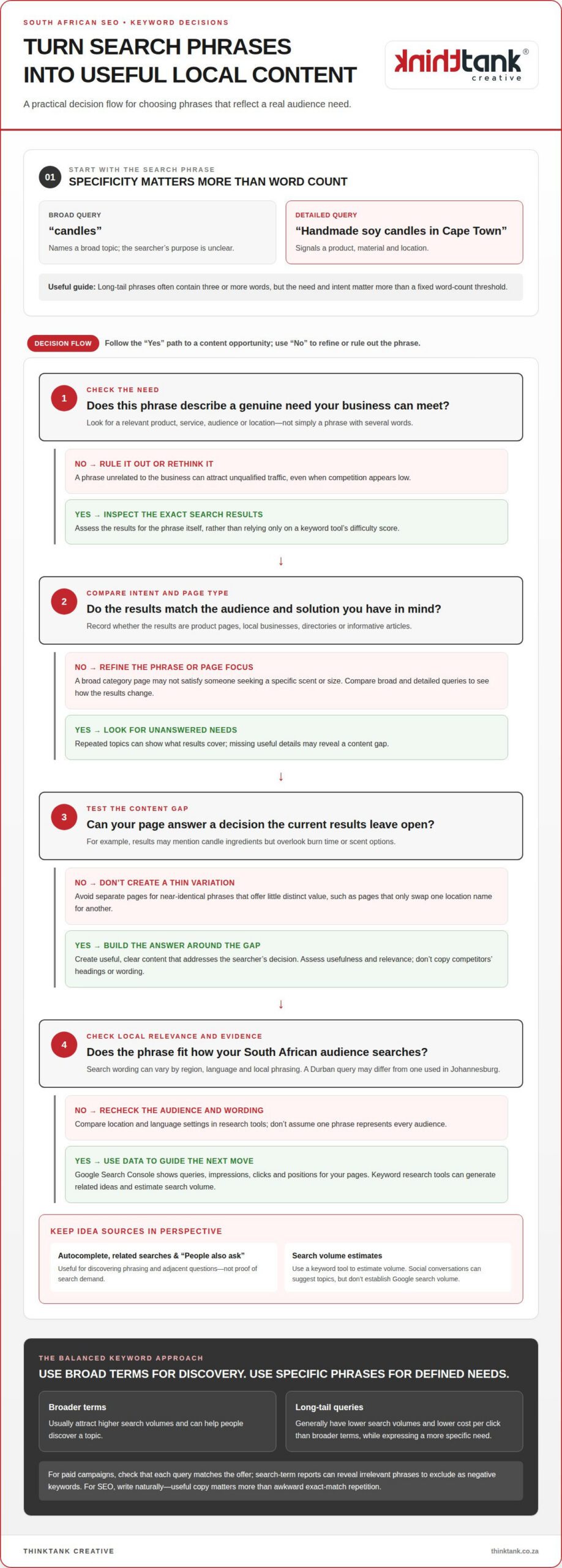
Long-tail keywords are specific search phrases that describe a particular need. They usually contain three or more words, but intent matters more than a word-count threshold. A short-tail query such as “candles” leaves the searcher’s purpose unclear. “Handmade soy candles in Cape Town” points to a product, material and location. Short-tail phrases typically contain one or two words and cover broader subjects.
Assess competition by examining the results for the exact phrase, not just a keyword tool’s difficulty score. Search “handmade soy candles in Cape Town” and note what appears: product pages, local businesses, directories or informative articles. These results reveal the format and purpose search engines consider relevant. A page competing with established retailers may need stronger product detail than one competing with general advice articles.
Use a consistent comparison when assessing the results:
- Check whether the top pages answer the query directly, such as showing candle scents, sizes and delivery locations.
- Look for repeated topics, including buying guides or local service details, then identify useful information those pages omit.
- Compare page type and focus. A broad category page may not satisfy someone seeking a specific scent or size.
That comparison can reveal content gaps. If results mention candle ingredients but overlook burn time or scent options, a useful page can address those needs clearly. A gap is not simply a missing phrase; it is an unanswered part of the searcher’s decision. Competitor analysis should therefore assess usefulness, relevance and clarity, rather than copy headings or wording.
Specific phrases often face less competition because fewer pages target that precise need. They can attract visitors with clearer intent, which may support conversion when a page offers the right answer or product. But low competition alone does not establish value. A phrase with little relevance to the business can bring unqualified traffic, even if its search results look easy to enter.
Long-tail keywords generally have lower search volumes and lower cost per click than broader terms in paid campaigns. This can make them useful in a PPC strategy, but assess whether each query matches the offer before using it. Search-term reports can reveal irrelevant phrases to exclude as negative keywords. For SEO, avoid awkward repetition: natural, useful copy matters more than exact-match insertion.
Common risks include targeting phrases solely because they contain several words, pursuing queries unrelated to the business and creating thin pages for near-identical variations. For example, separate pages that only swap “Cape Town” for another location may offer little distinct value. Choose phrases that express a genuine need, inspect their search results and create content that answers that need fully.
Comparing search results for specific and generic queries
Compare the results for a broad phrase and a detailed query to see how Google interprets each need. Search suggestions and performance data can then help refine ideas for South African audiences.
Search Console and Keyword Research Tools
Google Search Console shows queries already bringing people to your pages, whilst keyword research tools help generate related ideas and estimate search volume. Together, they reveal opportunities to improve existing content and explore terms your pages don’t yet target. For example, Search Console may show a page appearing for a detailed service query on the 2nd, 3rd, or 4th page of Google search results. A related tool can help assess that phrase against other options.
Start with a broad query such as “accountant”, then compare its Google results with “accountant for small businesses in Durban”. The first may lead to directories, definitions and local firms; the second may surface pages focused on a particular audience and place. Record which page types appear. This comparison shows whether searchers want general information, a nearby service or a specific solution.
Google Autocomplete suggests completions as you type, while “People also ask” and related searches reveal adjacent questions and alternative wording. For example, a search about Durban bookkeeping may suggest questions about small businesses or monthly records. Treat these as idea sources, not proof of demand: suggestions reveal phrasing, but a keyword tool is needed to estimate volume.
Keyword research tools can generate hundreds, sometimes thousands, of related phrases. Group them by customer need rather than creating a separate page for every variation. Social media searches can add another perspective: comments and platform suggestions may surface the language customers use when discussing a product. These conversations can shape topics, but they do not establish Google search volume.
Search Volumes and Regional Trends
Short-tail terms usually attract higher search volumes, while long-tail queries are more specific and generally have lower volumes. South African search patterns can differ by region, language and local wording; comparing location and language settings in research tools helps identify relevant variations. For instance, people seeking a service in Durban may phrase a query differently from those searching in Johannesburg. Use local context to judge relevance, rather than assuming one phrase represents every audience.
Search Console can show which queries bring impressions and clicks to a page, helping distinguish emerging opportunities from phrases that merely sound useful. Compare the wording and performance of related queries before changing content. A focused search engine optimisation strategy can use broad topics for discovery and specific phrases for clearly defined needs.
Long-tail keyword specificity and search intent
Specificity reveals what a person wants from a search, while intent helps shape the right response. Measure SEO results through Google Search Console impressions, clicks and query positions, then assess whether relevant landing pages lead to enquiries or sales.
Specificity and Audience Intent
A specific search term combines a topic with details that clarify the searcher’s audience, location or need. “Accountant” could mean someone seeking career information, whereas “accountant for a small business in Durban” signals a particular service and audience. The extra detail helps businesses create pages that answer a defined query instead of competing for every possible interpretation.
Geography and wording can refine intent further. Someone searching for “wedding photographer in Pretoria” is likely seeking a local service, while “how to choose a wedding photographer” points to research. In South Africa, English or Afrikaans phrasing may also shape how people describe the same need. Treat each variation as a clue, then match the page language and content to its audience.
Specificity alone does not establish intent. “Affordable laptop for students” could signal active comparison, but “what is a laptop” suggests early learning. Inspect the search results and ask what would satisfy the query: an explainer, comparison, product page or local service page. This alignment helps an SEO strategy serve the searcher rather than simply insert a phrase.
Business Value and Conversion Intent
Conversion intent describes how closely a query connects to an action, such as requesting a quote or making a purchase. “Buy accounting software for a small business” is more commercially focused than “what is accounting software”. Long-tail terms typically have conversion rates 2.5 times higher than head terms, making their potential value relevant even when their search volume is lower.
Consider the customer journey in digital marketing. Someone searching “what does a solar installer do” may be learning, while “solar panel installation quote in Gqeberha” suggests a more specific requirement. The first query suits educational content; the second needs clear service information and a straightforward route to enquire. Match the page’s purpose to the likely stage, not just the keyword.
Track outcomes by connecting query themes to the pages created for them. In Search Console, review impressions, clicks and average position for relevant phrases, then compare those visits with enquiries or purchases recorded for the matching landing page. If “bookkeeping services for a Cape Town startup” earns clicks but few enquiries, examine whether the page clearly addresses that audience’s needs. This gives marketing teams a practical way to refine content, rather than treating rankings as the final measure of business value.
Definition and characteristics of long-tail keywords
Specificity, not a fixed word count, gives a search phrase its long-tail character. For South African businesses, the detail can reveal which audience or need a page should serve.
Defining Long-Tail Keywords
A long-tail keyword is a specific search phrase, usually containing three or more words, that expresses a clearer need than a broad term. “Garden services” is general; “indigenous garden design in Pretoria” narrows the subject, service and location. This distinction helps businesses create content for particular queries instead of treating every visitor as though they want the same information.
Word count is a useful clue, not a strict test. A four-word phrase can still be broad, while a shorter phrase can communicate a precise need through its context. For instance, “wedding venue Stellenbosch” points to a particular service and place. Judge the phrase by the searcher’s likely purpose and whether a relevant page can answer it.
Long-tail keywords often have lower search volumes than broad terms, but they can attract more relevant traffic. Someone looking for “bulk compost delivery Stellenbosch” has supplied more context than someone searching “compost”. That detail creates an opportunity to explain delivery options, product suitability and the intended location on one focused page.
Characteristics of Long-Tail Keywords
Long-tail phrases typically combine a topic with a qualifier, such as a location, audience, product feature or intended outcome. “Accounting software” becomes more specific as “accounting software for South African freelancers”. The added words help distinguish one audience from others, giving content creators a clearer basis for choosing page topics and examples.
These phrases often have lower search volumes and face less competition than broad terms. Their value depends on relevance, not just ranking potential. A page about accounting software for freelancers should address needs that audience recognises, such as invoicing or organising expenses. Adding “South African” without meaningful local context will not make the content more useful.
Variations can express the same need in different ways. Someone may search “find a wedding photographer in Durban” or “Durban wedding photography packages”. The first focuses on finding a service; the second suggests comparing an offer. Group closely related variations when one page can satisfy both, but create separate content when the intent or answer differs.
For SEO, use the phrase where it fits naturally, including in a page title, heading or relevant passage. Search engines need clear context, while readers need coherent information. Repeating a long-tail phrase in every heading can make copy awkward and obscure its purpose. Instead, build the page around the need expressed by the query, then include useful variations where they clarify the topic.
Long-tail keywords for South African businesses can guide focused content without defining success by word count alone. Assess each phrase’s specificity, audience and search purpose before deciding whether it merits a page. That approach turns variations into content opportunities that serve real queries, rather than a collection of phrases chosen only to attract traffic.
Finding keyword ideas from related topics and audience needs
Find niche ideas by combining a core service with a customer need, audience or location. For South African searches, examples include “guesthouse near Addo Elephant Park”, “plumber in Sandton” and “wedding caterer in Stellenbosch”.
Expand each seed topic with Google suggestions, related searches, customer questions and local variations. For popular industries, useful starting examples include “bookkeeping for small businesses in Cape Town”, “family-friendly lodge near Kruger National Park” and “emergency plumber in Pretoria”, then assess whether each reflects a genuine offer and audience.
Expanding Basic Keyword Ideas
Expand a basic keyword by adding details that clarify the service, audience, location or problem. Begin with a seed such as “solar panels”, then develop phrases like “solar panel installation for homes in Durban” or “solar panel maintenance in Johannesburg”. These variations can reveal distinct topics and give each content idea a clearer target.
Use modifiers that match real customer decisions, such as “for small businesses”, “near me” or “cost of installation”. Google Autocomplete can suggest completions as you type a seed term. Record useful search terms, then group phrases that share the same purpose instead of creating pages for every wording variation.
Community Discussions as Keyword Sources
Community discussions reveal how people describe problems in their own words. Questions in local Facebook groups, Reddit discussions or industry forums may surface phrases such as “which guesthouse is close to Addo” or “how do I find a reliable electrician in Soweto”. These examples can suggest content topics grounded in audience language.
Look for repeated questions, not isolated comments, and note the context around each phrase. A Cape Town small-business forum might discuss choosing an accountant, while a gardening group could ask about indigenous plants for dry conditions. Use these signals to shape useful pages, then compare the wording with Google search suggestions.
Finding Keywords for a South African Niche
Finding niche keywords means combining a business’s subject expertise with the specific questions its audience asks. A Durban tour operator might explore “family wildlife tour from Durban”, while a Johannesburg baker could consider “custom birthday cake delivery in Rosebank”. These examples are valuable when the business genuinely serves those needs.
Build topic clusters from related questions. A South African accounting firm could group “tax preparation for freelancers”, “bookkeeping for a new business” and “monthly accounting support for a small company”. Each phrase points to a different audience concern. Separate pages make sense when the answers differ; related questions can share one comprehensive resource.
Local Keywords by Province, City or Suburb
Find local phrases by pairing a service with the places the business serves, moving from province to city and suburb. For example, “plumber in Gauteng” can become “plumber in Pretoria” or “plumber in Hatfield”. This structure helps identify whether a page needs province-wide information or details for a specific neighbourhood.
Use Google suggestions and Search Console queries to discover the place names and service combinations people use. A Cape Town business might compare searches mentioning “Western Cape”, “Cape Town” and “Claremont”. Create local content only where it can offer meaningful detail, such as service coverage or relevant local examples, rather than swapping place names across identical pages.
Turn audience questions and location insights into a coherent SEO keyword strategy that connects each phrase with useful content.
ThinkTank Creative
ThinkTank Creative helps turn audience insights into a coherent digital presence, connecting relevant topics with clear, engaging content. If your keyword ideas reveal gaps in how your business presents its services, Website Design and Development can help shape pages around customer needs. Social Media Marketing and creative design can support consistent communication across your digital channels.
Bring your audience, services and priority topics into the conversation, and ThinkTank Creative can help you consider how they fit together across your online presence. Contact ThinkTank Creative to discuss your goals and decide on a considered next step.
Turn search insight into your next opportunity
Let audience questions shape what your business publishes next. A considered approach to long-tail keywords for South African businesses can connect useful content with the people and places it is meant to reach. Choose a clear priority, then make sure your online presence gives that audience a relevant way to engage.
ThinkTank Creative can help align your digital presence through Website Design and Development, Social Media Marketing and creative design. These elements can work together to present your business consistently, from the page answering a specific query to the wider brand experience. The right focus depends on your audience, goals and the content you need to support them.
Ready to shape a more considered digital strategy? Contact ThinkTank Creative to discuss the direction that suits your business. Each useful insight can become a stronger connection with the people you want to reach.
Frequently Asked Questions
Keyword Generated, Now What?
Decide whether the phrase deserves a new page or belongs in existing content. Review your site’s current pages, choose the closest match, then define what the visitor should do next, such as request a quote or view a product. Add the phrase naturally where it clarifies the page’s purpose. After publication, monitor impressions, clicks and relevant enquiries so you can refine the content based on real performance.
Which free and paid keyword research tools work well for South African SEO?
Start with free Google Search Console to find queries already generating impressions, alongside Google Autocomplete and related search suggestions for wording ideas. Google Ads search-term reports can also show phrases that triggered adverts. Paid keyword research platforms can add estimated search volumes, keyword difficulty comparisons and competitor data, helping you prioritise a larger list. Compare tools using the same South African location and language settings, and treat estimates as planning signals rather than exact demand.
How can businesses assess keyword difficulty, search intent, and conversion potential?
Assess difficulty by reviewing the pages currently ranking and the quality of their coverage, authority and relevance. Identify intent from the results’ format: product listings suggest shopping, while guides signal research. To assess conversion potential, consider whether the query connects to an offer and a measurable action, such as an enquiry or completed purchase. For example, track those actions against visits to the page targeting a quote-related phrase.
How should businesses use long-tail keywords on service pages, product pages, and blog posts?
Give each page a purpose that matches its visitor. A service page can address a defined audience and describe the service clearly; a product page can use specific product attributes in its title and description. A blog post can answer a detailed informational query, such as how to prepare for a service. Use related wording where it reads naturally, and avoid creating near-identical pages solely to target minor phrase variations.