More audience filters don’t automatically make a Facebook campaign smarter. A practical approach to how to target customers on Facebook in South Africa combines relevant demographic and life-event audiences with a clear campaign objective. For location-led advertising, Facebook can target a 10-mile radius around a central point.
Choosing an audience is only the starting point. Even a well-defined group needs messaging that speaks to its needs, followed by careful review of campaign performance so you can refine the targeting and creative.
This article explains how to shape audience choices for the South African market, interpret campaign results and make informed adjustments. These elements work together to create a considered Facebook advertising strategy.
Key Takeaways
- Assess campaign results against the objective, then use those signals to guide thoughtful refinements.
- Combine relevant demographic and life-event audiences with messaging suited to the people you want to reach.
- Build a campaign around a clear goal, audience, creative direction and measurement plan.
- Shape location targeting around where customers are, from broad areas to more focused local audiences.
- Understand how CPM and CPC reflect different ways of measuring ad costs, and what can influence them.
1. How professionals analyse and iterate on ad campaigns
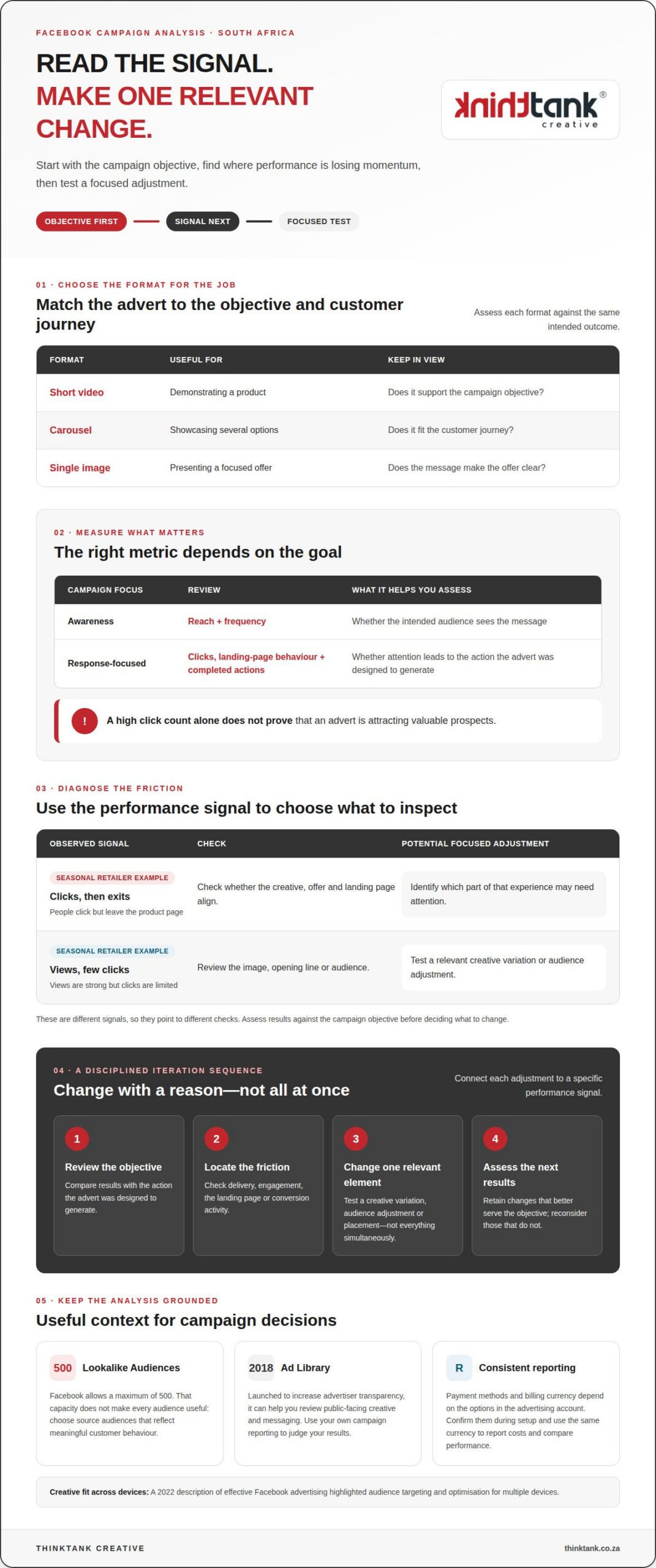
Facebook ad formats work best when they match the campaign objective and customer journey. You might use a short video to demonstrate a product, a carousel to showcase several options, or a single image for a focused offer. Assess each format against the same goal, such as qualified enquiries or completed purchases.
Start analysis with the objective, not the most visible metric. For an awareness campaign, reach and frequency help show whether the intended audience sees the message. For a response-focused campaign, examine clicks, landing-page behaviour and completed actions. A high click count alone does not prove that an advert is attracting valuable prospects.
Imagine a South African retailer promoting a seasonal range. If people click the advert but leave the product page, check whether the creative, offer and landing page align. If views are strong but clicks are limited, the image, opening line or audience may need adjustment. Each diagnosis points to a different test.
Keep campaign changes meaningful by refining them in a structured sequence:
- Review the objective: compare campaign results with the action the advert was designed to generate.
- Locate the friction: assess whether the issue appears in delivery, engagement, the landing page or conversion activity.
- Change a relevant element: test a creative variation, audience adjustment or placement without changing everything simultaneously.
- Assess the next results: retain changes that better serve the objective and reconsider those that do not.
Audience testing also requires discipline. Facebook allows advertisers to create a maximum of 500 Lookalike Audiences. That capacity does not make every audience useful: professionals select source audiences that reflect meaningful customer behaviour, then assess whether the resulting delivery supports the campaign objective.
Facebook launched the Ad Library in 2018 to increase transparency around advertisers. It can help professionals review the public-facing creative and messaging used by advertisers, while campaign reporting remains essential for judging their own results. A 2022 description of effective Facebook advertising highlighted audience targeting and optimisation for multiple devices. These remain useful considerations when assessing creative fit across placements.
For South African businesses, payment methods and billing currency depend on the options shown in the advertising account. During account setup, confirm the selected method and currency, then report campaign costs clearly in that currency. Use the same currency consistently when making budget decisions and comparing performance.
Iteration is not a sequence of arbitrary edits. Connect each adjustment to a specific signal so you can distinguish a creative issue from an audience or landing-page issue, then make the next campaign decision with greater clarity.
2. How professionals target by demographics and life events
Strong audience choices start with the customer, not a long list of filters. Map your product or service to relevant demographic signals, such as location, age range or language, and check that each choice supports the campaign objective. A tutoring service, for example, should define its intended learners and guardians before setting its audience.
Life events can make a message more timely when the offer genuinely relates to that moment. A moving company might tailor creative around relocation, while a photographer could develop messaging for engagements. Match the audience signal to the service, and do not treat a life event as proof that someone needs to buy.
Meta’s advertising rules and targeting controls apply in South Africa. Plan campaigns around relevant, non-discriminatory criteria, avoid sensitive personal assumptions, and make sure the advert and audience choices comply with Meta’s current policies.
POPIA is an important privacy consideration when customer data informs Facebook targeting. Use customer information through appropriate business processes, limit its use to the campaign purpose and handle it carefully. Your business should have a sound basis for using those records.
For custom audiences, you can use suitable customer information or engagement with your business’s content, then assess whether the source reflects meaningful interest. For lookalike audiences, the selected source audience guides Meta towards people with similar characteristics. The source matters: genuine customer records can provide a more relevant signal than a broad collection of casual interactions.
Audience design is a sequence of considered choices:
- Define relevance: connect the offer to the customer’s needs, location and likely decision stage.
- Select suitable signals: use demographics or life events only when they support that connection.
- Review data suitability: consider the origin, relevance and intended use of customer information.
- Assess delivery: analyse whether the audience produces useful engagement or business outcomes.
For instance, a Durban furniture retailer could separate people engaging with its product content from existing customers. Distinct groups allow professionals to shape different messages, rather than showing every person the same advert. They can then assess performance and refine the audience or creative accordingly.
Audience settings also need room to reach relevant people. Adding overlapping demographic filters may narrow delivery without improving customer fit. A professional weighs each filter against the offer and campaign objective, then uses performance signals to guide adjustments. For businesses planning paid campaigns, professional PPC advertising can bring audience strategy and campaign execution into one considered plan.
3. How does a professional create a Facebook ad campaign targeting customers in South Africa?
A professional begins with the business outcome, then builds the campaign around it. A Johannesburg retailer may want online purchases, while a South African consultancy may prioritise qualified enquiries. That distinction shapes the advert’s objective, audience, message and destination. A clear goal also gives the professional a practical basis for assessing whether the campaign is reaching suitable customers.
A considered approach to how to target customers on Facebook in South Africa starts with customer needs and the business’s reach. Define who the offer serves, then select relevant geographic and audience settings. A business serving customers nationally may need a different campaign structure from one whose service depends on local access.
Organise campaigns to make results easier to interpret. In Meta Ads Manager, group adverts according to distinct audiences or creative approaches. For example, a retailer might separate people who have engaged with its content from a broader prospect audience. This structure helps reveal which message and audience combination is producing useful responses.
Make the offer clear in your creative. Match the image or video, wording and call to action to the action you want customers to take. An advert for a consultation, for instance, can explain the service’s relevance and direct interested people to an appropriate enquiry page. The page should continue the same message, not introduce an unexpected offer.
The destination forms part of the campaign experience. Before launch, the professional reviews whether it loads, works on mobile screens and makes the advertised next step clear. If a South African retailer promotes a particular product, the relevant product information should be easy to find. A confusing or mismatched destination can weaken the response to an otherwise well-targeted advert.
Before activating a campaign, check its objective, audience, creative, destination and tracking arrangements. Measurement should reflect the intended outcome. A lead-focused campaign, for example, needs attention on the relevance of enquiries, not just the number of advert interactions. This preparation gives later analysis a meaningful point of reference.
Once the campaign is running, base adjustments on evidence. If people engage but do not enquire, examine the offer and destination before changing the audience. If responses are poorly matched to the business, refine the advert’s wording or audience criteria. Each change should address a specific point in the customer journey.
Ultimately, how to target customers on Facebook in South Africa depends on aligning business goals with the audience, message and next step. Develop that alignment into a coherent campaign, then use customer responses to guide ongoing decisions. The result is a strategy shaped around your business and the people it aims to serve.
4. How can a professional target South African customers by province, city, or location on Facebook?
Location targeting should reflect where customers can realistically buy or receive a service. First map the business’s operating area, then select suitable places in Meta Ads Manager. A retailer delivering nationally may target a broad South African audience, while a local clinic would focus on nearby customers.
Province-level targeting suits offers available across a large area. For example, a business serving an entire province can shape its audience around that area rather than paying to reach people elsewhere. Consider delivery coverage, travel requirements and customer demand before choosing a province-wide audience.
City targeting makes sense when a business concentrates on a particular urban market. A Cape Town restaurant, for instance, may prioritise customers near its location, while a Johannesburg service provider could focus on areas it can reach. City boundaries alone may not reflect practical travel distance, so professionals assess the business’s actual service footprint.
Facebook can use a radius of 10 miles around a central point. A professional might centre that radius near a shop, venue or service hub, then consider whether the resulting area aligns with customer access. The stated radius is in miles, so it should not be silently treated as kilometres when planning a South African campaign.
If your business serves several distinct areas, structure locations to make campaign delivery easier to interpret. You might group or separate markets according to the offer and operational reach. The right structure depends on whether customers receive the same service and message in each place.
Location settings also need to match the advert. A promotion tied to a specific branch should name that location clearly, rather than implying nationwide availability. A national online offer can use broader geographic coverage, while its creative and landing page explain delivery details to South African customers.
Professionals typically assess these location decisions in sequence:
- Map service coverage: identify provinces, cities and local areas the business can serve.
- Choose geographic scale: match province, city or radius targeting to the offer.
- Align the message: make branch-specific or national availability clear in the advert.
- Review results by area: assess which locations generate relevant enquiries or purchases.
For example, if a Pretoria campaign attracts enquiries from outside the business’s practical service area, the professional can refine the geographic selection. If a Cape Town advert performs well in one part of its intended market, that signal can inform future campaign planning. These adjustments connect location choices to real business outcomes, rather than treating every South African audience as one uniform market.
5. Facebook Ad Costs in South Africa: CPM and CPC
Facebook advertising has no single fixed average CPM or CPC for every South African campaign. Costs depend on the auction, audience, campaign objective, advert and competition for placements. A national retail campaign and a focused local campaign can therefore have different costs.
CPM means cost per thousand impressions. It helps a business assess how much it pays to show an advert, making it useful for campaigns focused on awareness or reach. A lower CPM alone does not prove success, since impressions may not lead to meaningful interest or action.
CPC means cost per click. It indicates the cost associated with advert clicks and can help assess campaigns intended to bring people to a website or another destination. Clicks still need context: a campaign generating visits but few relevant enquiries may not deliver the intended business value.
For example, a Cape Town retailer promoting a new range might compare CPM when assessing exposure and CPC when assessing visits. If the campaign’s purpose is product enquiries, the professional also considers whether those clicks lead to useful conversations. The right metric follows the objective, not simply the lowest reported cost.
Several campaign conditions influence CPM and CPC. A narrowly defined audience may compete for a different set of placements than a broad audience. Creative quality and relevance can affect how people respond, while the campaign objective influences which actions Meta seeks. Seasonal demand and competing advertisers may also affect auction conditions.
Evaluate cost alongside the customer journey. If CPC rises, examine the audience, creative and placement before changing the campaign. If clicks remain steady but enquiries fall, assess the landing page and offer. This prevents one metric from prompting an adjustment that misses the actual issue.
Cost planning should distinguish Meta’s advertising spend from professional campaign fees. Advertising spend is set for the campaign, while professional fees depend on the project and an estimated cost is provided after discussion of needs and timeline. A clear plan identifies the intended outcome, audience, creative needs and measurement approach before budget decisions are made.
For a South African business, a professional can compare campaign results using the same objective and reporting period, then interpret CPM and CPC alongside relevant outcomes. That makes cost comparisons more useful than treating one campaign’s rate as a universal benchmark. Plan Facebook campaign costs around the audience, objective and results that matter to your business.
There is no single average CPM or CPC for South Africa. Both vary with the auction, audience, campaign objective, advert and competition for placements.
ThinkTank Creative
ThinkTank Creative helps South African businesses bring audience strategy, campaign messaging and creative direction together in a coherent digital approach. Its Social Media Marketing service supports businesses seeking professional guidance with Facebook campaign planning, audience selection and performance refinement.
Turn to ThinkTank Creative when your campaigns need a clearer connection between the people you want to reach, the message they see and the action you want them to take. When a campaign leads to a website, Website Design & Development can create a destination that reflects the advert and guides visitors towards the next step. Branding & Creative Design can also shape advertising visuals around your brand.
Share your campaign goals and the customers you want to reach. Contact ThinkTank Creative to discuss a considered approach to your Facebook advertising.
Build a stronger connection with your audience
Make each campaign a starting point for a more relevant relationship with your customers. Learn what earns their attention, what prompts meaningful engagement and how your brand can respond with communication that feels timely and useful.
A considered approach to how to target customers on Facebook in South Africa is not simply about choosing an audience. Align your message with what your business wants to achieve, then make deliberate decisions as customer needs evolve. This perspective helps keep your advertising connected to the people it is intended to serve.
ThinkTank Creative can help shape that direction through its work in digital marketing and creative development. If you’re ready to discuss your Facebook advertising goals, start a conversation with ThinkTank Creative. Take the next step with clarity, and give your campaigns a thoughtful foundation for what comes next.
Frequently Asked Questions
What Facebook ad strategy can a professional use to reach customers in South Africa?
A professional can tailor campaign messages to where potential customers are in their decision journey. For a South African software firm, one advert might introduce a service to new prospects, while another addresses people who have already engaged with the business. The professional then assesses which approach attracts more relevant enquiries, rather than focusing on volume alone, and adapts messaging to better reflect each audience’s familiarity with the offer.
What Facebook audience targeting options are available for South African advertisers?
South African advertisers can use geographic and demographic selections, interests, life-event signals, custom audiences and lookalike audiences. Each option serves a different purpose: a local retailer might focus on people near its shop, while an established business could use an appropriate customer group to inform audience expansion. Consider how audience groups overlap and choose options that support the campaign’s purpose, rather than layering on filters without a clear reason.
Can Facebook ads target South Africans by language, interests, age, and demographics?
Yes, Facebook campaign settings can include language, interests, age and other demographic criteria, subject to the options available and advertising policies. An education provider, for example, might create language-appropriate advert copy and choose age settings relevant to its intended audience. Make sure these selections suit the offer, keep the advert clear and avoid messaging that suggests sensitive personal knowledge about the people who see it.
What are Meta's advertising rules and prohibited targeting practices in South Africa?
In South Africa, campaigns must follow Meta’s advertising rules and targeting controls. Use relevant, non-discriminatory criteria, avoid sensitive personal assumptions, and ensure the advert and audience choices comply with Meta’s current policies.