Website Redesign Checklist for SEO: Protect Rankings in 2026

What if the greatest risk in a website redesign isn’t the new design, but the search value you leave behind? A redesign can change URLs, content and technical settings that help valuable pages earn visibility. Treat it as a controlled migration of existing search equity, not simply a visual refresh. This website redesign checklist for SEO is built around that principle.

If you’re concerned about losing rankings, organic traffic or important landing pages, that concern is justified. Knowing what to preserve, and when to check it, helps your team make considered decisions before launch rather than react to avoidable issues afterwards. A successful redesign brings SEO, design and development into the same conversation from the outset.

Use this practical checklist to plan the transition, protect valuable pages and links, and verify key content and technical details before and after launch. You’ll document what matters before work begins, test as the redesigned site takes shape, and monitor performance once it’s live. The result is a clearer, more coordinated path to a refreshed website that supports both search visibility and future growth.

Key Takeaways

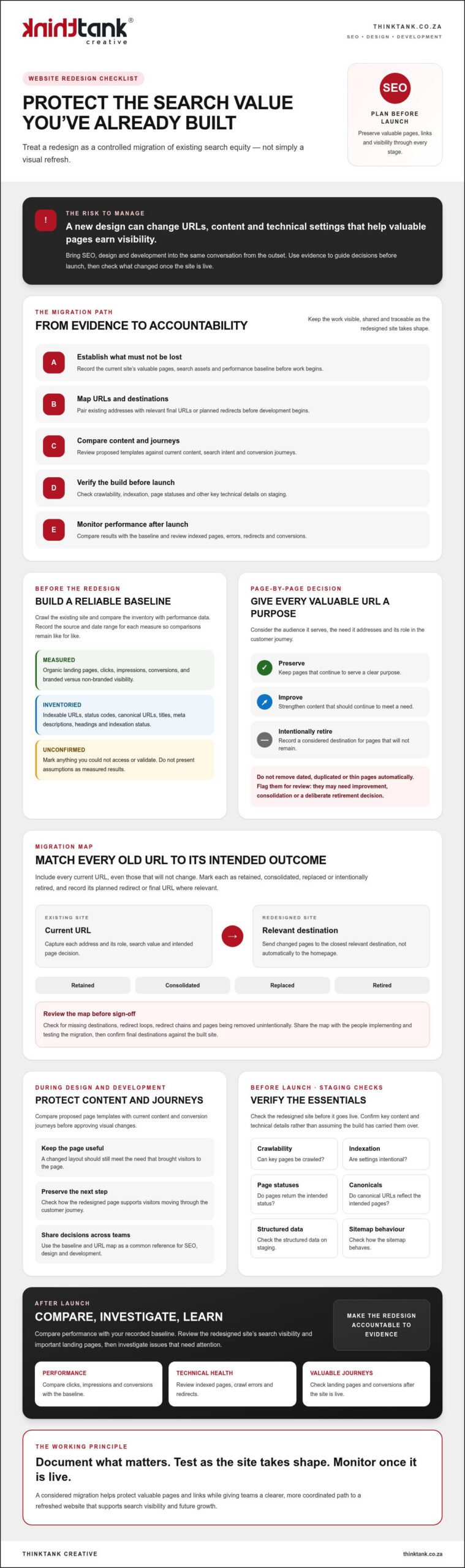
  • Use a website redesign checklist for SEO to establish which pages, search assets and performance measures need to be protected.
  • Map existing URLs to their intended destinations before development, so changed pages have considered redirects and relevant paths.
  • Compare proposed page templates with current content and conversion journeys before approving visual changes.
  • Check crawlability, indexation settings, page statuses, canonicals, structured data and sitemap behaviour on staging before launch.
  • After launch, compare performance with your baseline and review indexed pages, crawl errors, redirects, landing pages and conversions.

Website redesign checklist for SEO: establish what must not be lost

A redesign should do more than give your website a new appearance. It should retain the pages, content and authority that already help people find your business. Before changing layouts or navigation, establish what the current site contributes: which landing pages attract organic visits, which generate conversions, and where search visibility comes from.

Use this evidence to guide design and development decisions. Strong web design principles bring usability and search considerations together, so document the current experience before deciding what to change.

For an overview of SEO considerations during a redesign, watch:

Which SEO assets should you record before redesigning?

Crawl the existing site to create an inventory of indexable URLs, status codes, canonical URLs, titles, meta descriptions, headings and indexation status. Compare that inventory with performance data. Identify pages associated with organic visits, conversions, quality backlinks or meaningful impressions. Separate branded searches from non-branded searches to understand how people are finding you.

Keep the baseline concise and traceable. For each measure, record its source and date range so post-launch comparisons are like for like. Clearly distinguish verified results from assumptions or data you could not access.

How do you decide what content deserves to survive?

Give each valuable URL a clear purpose: the audience it serves, the need it addresses and its role in the customer journey. For example, a service page may attract relevant searches and help visitors understand how to take the next step. Its redesigned version should retain that usefulness, even if the layout changes.

Don’t automatically remove pages because they’re dated, duplicated or thin. Flag them for review. They may need improvement, consolidation or a deliberate retirement decision. Record the intended destination for any page that won’t remain at its current URL, ready for the migration planning that follows.

Decide page by page: preserve, improve or intentionally retire each valuable URL. This website redesign checklist for SEO starts with evidence, giving your design, development and SEO teams a shared reference before work begins.

Map URLs, redirects and site structure before development begins

Once you’ve identified the pages worth protecting, decide where each one will live in the redesigned site. A changed URL without a relevant destination can leave visitors facing a broken page and disconnect an established search result from the content users expect. Build the migration map before development, while the structure can still be adjusted.

A comprehensive website redesign guide can help frame the wider project, but URL decisions need to reflect your own pages, audience journeys and search evidence. Include every current URL in a source-to-destination map, including those that won’t change. Mark each as retained, consolidated, replaced or intentionally retired, and record the planned redirect or final URL where relevant.

How should you create a URL and redirect map?

Pair each old address with the closest relevant destination. If an existing service page gets a new address, redirect it to that service’s replacement page, not automatically to the homepage. A homepage redirect may technically send visitors somewhere, but it won’t meet the original page’s intent.

Before sign-off, check the map for missing destinations, loops, redirect chains and pages being removed unintentionally. Give the map to the people responsible for implementation and testing, then have them confirm the final destinations against the built site. A shared, reviewed document helps SEO, design and development teams work from the same plan.

How can you protect internal links and site architecture?

Review proposed navigation and internal links against key audience journeys and the important landing pages identified in your baseline. High-value pages should be reachable through clear navigation or relevant contextual links, rather than becoming isolated after a menu or content restructure. Clear journeys help visitors find the next useful step, while a guide to improving website user experience can offer further ideas for assessing those paths.

Update internal links to point directly to final destination URLs. Don’t leave links pointing to old addresses and rely on redirects to complete the journey. This makes pathways clearer for visitors and avoids unnecessary redirect steps.

Include technical changes in the same review. Flag redirect rules, canonical tags, robots directives and XML sitemap updates for technical review before launch. For example, confirm that a canonical points to the intended live URL and that staging-only crawl restrictions won’t carry over to the public site.

A well-maintained URL map turns the website redesign checklist for SEO into a practical handover between planning and development. If you’re aligning website development with SEO decisions, explore website design and SEO planning as part of your project preparation.

Compare redesign content and on-page SEO before approving templates

A polished template can still underperform if it removes the information that made a page useful. Before approving designs, compare the current and proposed versions by page type. Check whether each still serves the same search purpose, answers the audience’s questions and supports a clear conversion path. A service page, for instance, may need descriptive detail to explain the offer before inviting a visitor to enquire.

Keep the review collaborative. Designers can identify opportunities to simplify the layout, while content and SEO reviewers confirm that key information remains easy to find and understand. Visual restraint is valuable, but it shouldn’t mean stripping out relevant explanations, headings or internal links just to create more empty space.

What should each redesigned page retain or improve?

Assess content in context rather than copying it wholesale. Retain subject coverage that meets a genuine audience need, improve unclear or outdated explanations, and review duplicated or irrelevant material before it moves across. Each page should have a clear purpose, not just a familiar appearance.

Check that titles and headings describe the page accurately, body copy is useful, image alternatives convey relevant information where needed, and calls to action make the next step clear. Don’t promise that these changes will secure a particular ranking. They can make a page more coherent and useful, while search performance depends on multiple factors.

Use a comparison matrix to make decisions visible and assign responsibility. For each page type, record:

How should design and UX decisions support SEO?

Review proposed templates on mobile as well as desktop. Text should remain readable, navigation should be clear, and important content shouldn’t disappear behind design choices that make it difficult to find. Check that headings create a logical structure and links help visitors move naturally between related information and next steps.

Image choices also affect the page experience. Discuss image dimensions, formats and how assets are handled with the development team, then test the built pages rather than assuming they’ll perform well. A visually minimal page isn’t automatically faster, just as a content-rich page isn’t automatically slow. Measure the implementation and address any issues you find.

Use this part of your website redesign checklist for SEO to approve content and templates together, not in separate silos. For broader planning, place those decisions within your wider search engine optimisation strategy, with clear responsibilities for design, development and content review.
Website Redesign Checklist for SEO: Protect Rankings in 2026

Run this pre-launch SEO checklist before the redesigned site goes live

Make the staging site a formal quality-assurance checkpoint, not just a place to preview the design. Work through the checks with SEO, design and development together, and record an owner plus a clear pass or fix status for each item. This creates an accountable sign-off without implying that any launch is entirely risk-free.

What technical SEO checks belong on a staging site?

Check that staging isn’t accidentally available for public indexing, and verify how that restriction will be removed for the live site. Review representative page templates and priority URLs, including their titles, meta descriptions, canonical tags, robots directives and structured data. Confirm each setting against the project scope rather than assuming it’s correct by default.

Use a crawler to review the staging site, then investigate issues such as unexpected status codes, missing metadata, broken internal links or pages blocked from crawling. Test important URLs individually as well as across representative templates. A correct homepage doesn’t confirm that every page type is ready.

For each item, record the reviewer, result and any follow-up action. A check isn’t complete if an issue has been spotted but no one owns its resolution.

How do you prepare the launch handover?

Before release, confirm that the final redirect rules and updated XML sitemap are ready, and that analytics measurement can continue across the transition. Document the planned launch timing, who is responsible for each task, how the team will decide whether rollback needs consideration, and which contacts should be notified if a critical issue appears.

Agree how changes will be checked after release, including who will verify priority pages and confirm that staging restrictions haven’t carried over. A guide on what to do after a new website goes live can help structure the next phase. The handover should make clear who will carry out those follow-up checks.

This step turns the website redesign checklist for SEO into a shared release plan, connecting technical checks with real responsibilities. For support coordinating website development and SEO considerations, review website launch requirements with ThinkTank Creative.

Monitor SEO after launch and make the redesign accountable

Launch is a transition point, not the end of the redesign. Use the baseline you documented earlier to compare performance, keeping the same reporting periods where possible. This gives your team a consistent reference for spotting changes in organic visibility, landing-page activity and conversions.

What should you monitor after the redesigned site launches?

Review Search Console for indexing issues, crawl anomalies and unexpected URL changes. Check that priority pages are being indexed as intended, then test key redirects and landing pages directly. Compare organic clicks, impressions and conversions with corresponding baseline periods where possible, and note any differences in tracking or measurement that could affect the comparison.

A change in performance doesn’t automatically mean the redesign caused it. Investigate in a considered sequence: confirm the page is accessible, check its status and redirect destination, review indexation and internal links, then compare the affected URL and reporting period with your baseline. Consider other possible influences before deciding on a cause. Record what you find, the action taken and the outcome, so decisions are grounded in evidence rather than guesswork.

When can an agency help coordinate the redesign?

Bringing strategy, design, development, testing and SEO together takes time and clear handovers. If your internal team is finding it difficult to coordinate these decisions, a partner offering website development and SEO may help keep search considerations in view throughout the project.

ThinkTank Creative’s website process covers research and strategy, design, development, testing, launch, training and support, with ongoing service after project completion. This provides a structured path from early planning into post-launch work, without implying any particular ranking outcome.

Discuss your project needs and timeline before deciding on the next step. An estimated cost can be provided after that discussion. Discuss your website redesign with ThinkTank Creative.

A well-managed website redesign checklist for SEO continues after release: compare, investigate and document, so the redesigned site remains accountable to the goals set before work began.

Make your redesign a stronger foundation for growth

A successful redesign protects the value your existing website has built while creating a clearer, more useful experience for what comes next. This website redesign checklist for SEO gives your team a practical sequence: document valuable pages, map URL changes, review content and templates, complete pre-launch checks, then monitor performance against your baseline.

Coordination matters at every stage. ThinkTank Creative, founded in 2001, brings website design and development together with SEO through a process spanning research and strategy, design, development, testing, launch, training and support. Its award-winning design team and ongoing service after project completion provide continuity from planning into post-launch care.

Every redesign has its own priorities and timeline. Review your website redesign requirements with ThinkTank Creative. An estimated cost can be provided after discussing your requirements and timeline.

Plan carefully, bring the right people into the conversation and treat launch as the start of the next phase. With a considered approach, your redesigned website can be ready to serve both your audience and your business goals.

Frequently Asked Questions

Can a website redesign affect SEO rankings?

Yes, a redesign can affect rankings if it changes URLs, removes useful content, disrupts internal links or introduces technical problems. A new visual identity alone doesn’t determine search performance, but changes to the pages and signals search engines rely on can influence visibility. Record existing performance before work begins, then check key pages, redirects and indexation after launch. This helps your team identify issues and investigate changes using evidence.

What should be included in an SEO website redesign checklist?

An SEO website redesign checklist should cover the current site baseline, valuable URLs, content decisions, redirect mapping, page templates and pre-launch testing. Include checks for crawlability, indexation settings, page status codes, canonical tags, structured data and sitemap behaviour. Assign an owner and pass or fix status to each check. After launch, monitor indexed pages, crawl errors, organic landing pages and conversions against the baseline, recording findings and follow-up actions.

Should I change URLs during a website redesign?

Change URLs only when there’s a clear reason, such as improving an inconsistent structure or consolidating overlapping pages. If an address changes, map the old URL to the closest relevant destination and test the redirect. Don’t send unrelated pages to the homepage simply to avoid a missing page. Keep a record of URLs that stay the same as well, and update internal links to point directly to each final address.

How do I keep SEO traffic when launching a new website?

You can reduce avoidable disruption by protecting valuable pages and checking the migration carefully, although no checklist can guarantee unchanged traffic. Before launch, document search performance, preserve useful content, test redirects and confirm that live pages can be crawled and indexed as intended. Once the new site is public, check priority URLs, redirects, crawl issues and organic landing-page performance. Compare results with consistent baseline periods and investigate changes before deciding what caused them.

When should SEO be considered in a website redesign?

Consider SEO from the research and planning stage, before approving the site structure, page templates or content changes. Early input gives the team time to identify valuable landing pages, decide what content should remain and map URL changes before development is complete. It also helps design, development and SEO reviewers coordinate their work. Leaving search checks until just before launch can make important changes harder to assess and resolve.

How long does it take for SEO to recover after a website redesign?

There’s no reliable fixed recovery period. The time and direction of any change depend on what altered, whether search engines can access and understand the new pages, and how quickly problems are identified and addressed. Check Search Console and site performance after launch, comparing results with your baseline rather than assuming every fluctuation is caused by the redesign. If visibility falls, investigate affected URLs, redirects, indexation and content before choosing a response.
Reasons My Business Is Not Showing Up on Google: 2026 Diagnostic Guide

Google invisibility is rarely a stroke of algorithmic bad luck; it is almost always the direct outcome of architectural neglect and misaligned technical relevance. When you launch a bespoke website, publish your commercial services, and still face zero organic enquiries, uncovering the exact reasons my business is not showing up on google becomes an urgent commercial priority. It is profoundly frustrating to watch your digital investment sit idle whilst competitors capture the high-value search visibility that should rightfully belong to your brand.

Whether you are struggling to distinguish between Google Business Profile visibility and core website indexing, or simply feel overwhelmed by opaque technical jargon, you don't have to leave your presence to chance. This 2026 diagnostic guide details the precise technical, architectural, and operational barriers preventing search engines from listing your platform, cutting through the confusion with actionable clarity. Across the following sections, we outline a rigorous remediation pathway to restore search health, secure commercial indexing, and drive qualified inbound traffic across South Africa.

Key Takeaways

  • Distinguish between local map pack placement and organic website indexing to pinpoint precisely where your search visibility breakdown occurs.
  • Uncover the core technical reasons my business is not showing up on google, ranging from unintentional robots.txt directives to rendering barriers.
  • Understand why simple indexation does not guarantee ranking, and how modern helpful content standards evaluate authentic user value.
  • Evaluate off-page authority deficits, equity gaps, and legacy search penalties that allow competing domains to outrank your platform.
  • Establish an integrated, stage-by-stage remediation path that rectifies structural flaws to capture qualified national commercial traffic.

Deconstructing Search Invisibility: Google Search versus Google Business Profile

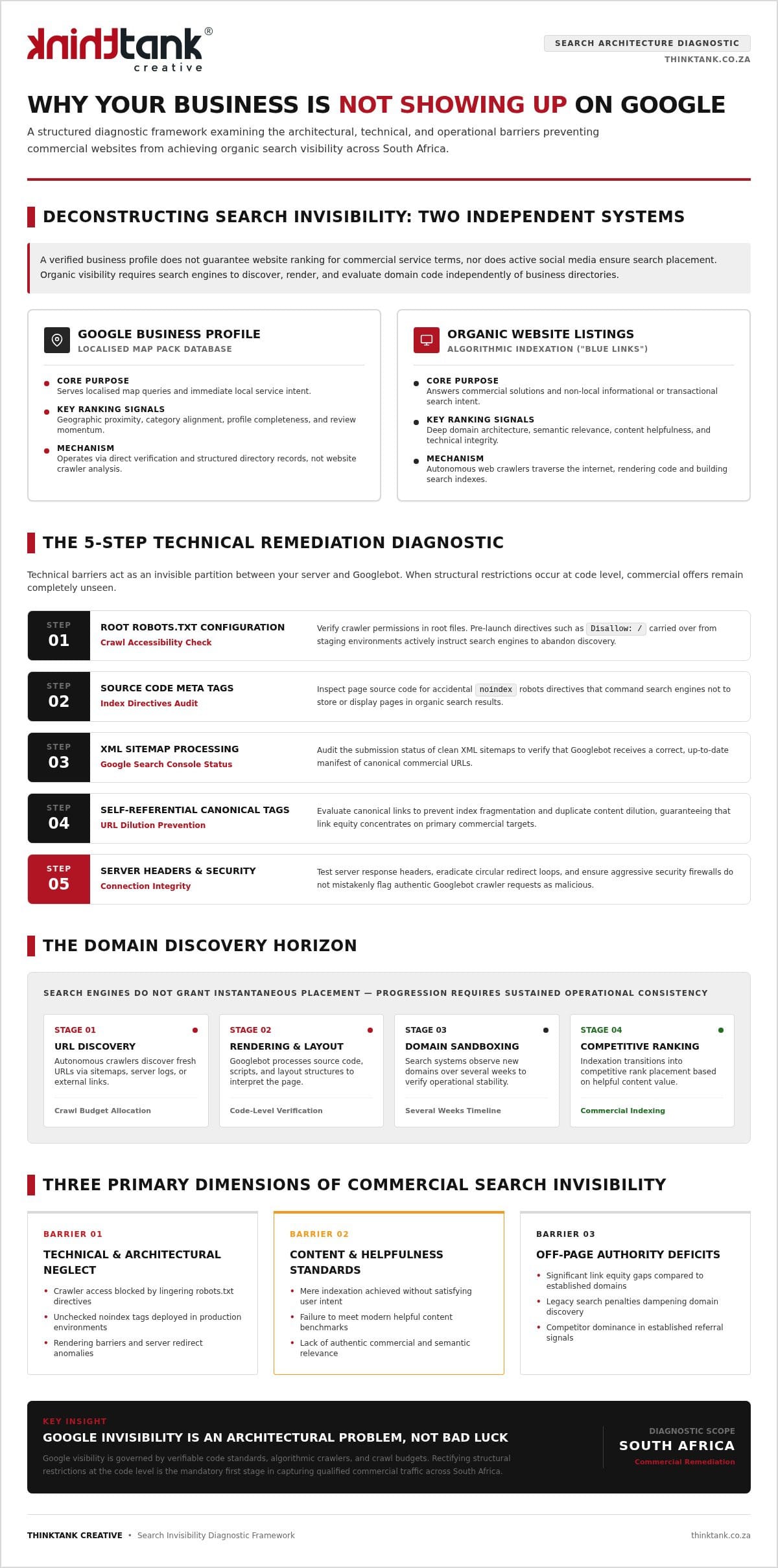
Search invisibility stems from a fundamental misunderstanding of how search systems categorise information. When business leaders explore the reasons my business is not showing up on google, they often conflate Google Business Profile (GBP) visibility with organic website indexation. While GBP powers the local map pack through proximity, category alignment, and direct verification, organic search relies entirely on algorithmic indexation of your actual website code and content.

A fully verified business profile does not guarantee that your website will rank for commercial service terms, nor does an active social media presence ensure search placement. Organic visibility requires search engines to discover, render, and evaluate your domain independently of third-party directories. Understanding search intent and geographic personalisation is vital, as search engines tailor results according to whether a user seeks immediate local services or broad commercial solutions across South Africa.

To visualise how search engines evaluate your presence across different listing formats, watch this practical breakdown:

The Anatomy of Google Search Results: Maps, Profiles, and Organic Listings

Autonomous Web crawlers systematically traverse the internet to index content, operating separately from local business databases. Google Business Profile listings serve localised map queries using review momentum, profile completeness, and location signals. Organic blue links evaluate deep domain architecture, semantic relevance, and technical integrity. Treating these two distinct systems as identical obscures the genuine reasons my business is not showing up on google when enquiries stall.

The Time Horizon of New Domains: Crawling, Indexing, and Sandboxing

Newly published websites never appear instantaneously across search engine result pages. Crawlers require time to discover fresh URLs, allocate crawl budgets, and process page layouts. Domain age also plays a quiet role: search engines observe newly registered domains over several weeks to verify their operational consistency before granting competitive search visibility. Confirming crawl activity in server logs is merely step one; indexing and ranking require sustained structural clarity.

Technical Roadblocks: Why Googlebot Cannot Crawl or Index Your Website

Technical barriers represent the most definitive reasons my business is not showing up on google, acting as an invisible partition between your server and Googlebot. If search crawlers encounter structural restrictions at the code level, even the most exceptional commercial offer will fail to generate search impressions. A systematic five-step technical diagnostic isolates these issues quickly:

  1. Verify crawler access within your root robots.txt configuration.
  2. Inspect page source code for accidental noindex directives.
  3. Audit XML sitemap submission status inside Google Search Console.
  4. Evaluate self-referential canonical tags to prevent URL dilution.
  5. Test server response headers and resolve circular redirect loops.

Adhering to the structural benchmarks detailed in Google's SEO Starter Guide guarantees that your core infrastructure actively welcomes search discovery rather than blocking it.

Critical Directives: Deciphering Robots.txt and Noindex Meta Tags

A frequent pitfall occurs when staging configurations carry over into live environments. Developers routinely implement a Disallow: / rule or insert a noindex meta tag to shield pre-launch builds from public discovery. If these directives linger after deployment, search engines obey them without hesitation. In other scenarios, overly aggressive security firewalls misidentify authentic Googlebot crawler requests as malicious traffic, silently dropping server connections.

Google Search Console Diagnostics: Uncovering Crawl Errors and Exclusions

Google Search Console provides definitive insight into site visibility. Reviewing the Page Indexing report distinguishes between "Discovered – currently not indexed", which reflects crawl priority constraints, and "Crawled – currently not indexed", which highlights quality thresholds. Deploying the URL Inspection tool allows you to perform live fetch tests, identifying soft 404 server errors and rendering failures instantly.

Site Architecture and Canonical Confusion

Conflicting canonical tags split ranking authority by confusing search engines regarding the primary version of a page. Running unencrypted HTTP links alongside secure HTTPS destinations fragments index equity across two duplicate properties. Furthermore, extended redirect chains exhaust crawl resources before discovery finishes. Ensuring clean architecture through bespoke custom website design in South Africa eliminates these foundational errors. If unresolved code conflicts persist, partnering with seasoned specialists for ongoing website maintenance and support provides the strategic oversight needed to safeguard long-term visibility.

Content, Relevance, and User Experience: Moving Beyond Mere Indexation to Ranking

Indexation is merely an invitation to compete; it is never a guarantee of page-one visibility. If your pages exist within Google's database but fail to generate impressions, the real reasons my business is not showing up on google frequently lie in content quality and interface friction. When modern search systems assess your platform, they look past raw keyword stuffing to judge whether your content genuinely answers commercial problems. Unoptimised metadata, thin copywriting, and vague page titles dilute contextual relevance, leaving search engines unsure which queries your pages actually solve.

Bridging this gap requires elevating your digital touchpoints. Prioritising strategic adjustments like improving website user experience safeguards dwell times and signals genuine commercial value to algorithmic evaluators.

The Helpful Content Standard: Avoiding Generic, Low-Value Information

Modern search systems evaluate depth, authoritativeness, and practical usefulness continuously. Mass-produced, automated copywriting lacking authentic perspective quickly triggers quality suppression. Search algorithms reward demonstrated first-hand experience (the vital 'E' in E-E-A-T), favouring organisations that share nuanced case observations over sites repeating generic definitions. If a listing provides zero unique insights beyond what an official Google Business Profile snippet displays, algorithms see little justification to rank it ahead of established category leaders.

Keyword Intent Alignment: Are You Speaking Your Customers' Language?

Organisational jargon frequently creates a severe barrier between services and prospective buyers. When prospective clients search for clear commercial solutions, companies often publish abstract corporate terminology that buyers never type into a search box. Aligning copy with user intent requires categorising target queries precisely:

Structuring on-page header tags logically around these intent states ensures search algorithms parse your topical hierarchy without ambiguity, rectifying subtle reasons my business is not showing up on google across competitive industry searches.

Core Web Vitals and Mobile Performance Bottlenecks

User patience is exceptionally thin. Page load delays directly compromise engagement, with data indicating that a single-second delay in page load time can reduce conversions by 7%, whilst 40% of users abandon sites taking over three seconds to load. Under mobile-first indexing, sluggish server speeds, visual layout shifts, and unresponsive mobile interfaces destroy organic rankings. Search engines simply refuse to showcase digital assets that frustrate visitors on handheld devices.

Reasons My Business Is Not Showing Up on Google: 2026 Diagnostic Guide

Off-Page Signals and Authority Deficits: Why Competitors Outrank You

Technical soundness and polished copy provide the foundation, but external validation determines who claims the top commercial spots. When assessing the competitive reasons my business is not showing up on google, many enterprises overlook domain authority deficits. Search algorithms rely on citations, third-party endorsements, and topically aligned backlinks to verify brand credibility. Without external proof of market leadership, search engines default to ranking entrenched competitors whose domain equity spans decades.

Reversing this dynamic requires structured search engine optimisation in South Africa, replacing passive omission with proactive digital authority building.

The Authority Gap: Backlinks, Mentions, and Trust Signals

Google treats inbound links as peer reviews from other web properties. When high-calibre publications and established trade directories reference your services, they pass link equity that elevates your overall index standing. Low-quality links from generic web directories, however, carry almost no weight. Building genuine domain equity requires strategic digital PR, national media exposure, and verified professional associations that demonstrate industry standing naturally.

Diagnosing Algorithmic Devaluation and Manual Actions

Sudden, severe drops in impressions indicate deeper disciplinary action rather than routine ranking volatility. Algorithmic spam updates, such as the major updates rolled out across 2025 and 2026, actively devalue manipulative link schemes and scraped references. A human reviewer can also apply a manual action, which suppresses your entire domain until you remediate the flagged violations.

Detecting and resolving these penalties demands deliberate, forensic action:

Uncovering these hidden liabilities allows your business to rebuild an authentic, penalty-free profile. If historical links or algorithmic suppressions are stifling your growth, you can contact our team to book an SEO diagnostic consultation and formulate a tailored remediation plan.

Transforming Invisibility into Market Dominance: The ThinkTank Creative Approach

Resolving search invisibility requires more than isolated technical patches or fragmented marketing tactics. When diagnosing the fundamental reasons my business is not showing up on google, forward-thinking enterprises recognise that website design, code architecture, and commercial messaging must operate in complete harmony. Established in 2001, ThinkTank Creative operates as a full-service agency nationally, guided by our core philosophy: "We Do It All So You Don’t Have To". We unite technical web development and creative digital strategy into an integrated framework that turns stalled platforms into reliable commercial assets.

Comprehensive Diagnostic Audits: From Code to Creative Narrative

Dismantling search barriers begins with comprehensive diagnostic evaluations that interrogate server configurations, semantic code integrity, and user-facing brand narratives simultaneously. Off-the-shelf site templates frequently introduce bloated scripts, sluggish loading cycles, and structural flaws that silently choke crawler efficiency. Bespoke website development eliminates digital excess, delivering clean markup and purposeful metadata tailored directly to your commercial offerings. Through our structured five-stage development methodology, every platform undergoes exhaustive pre-launch auditing, ensuring crawlability, responsive interface design, and commercial intent alignment are perfected prior to deployment.

The Power of Full-Service Continuity: Design, SEO, and Ongoing Support

Technical oversights typically occur when disparate vendors manage website development and digital marketing in silos. Unifying creative design, bespoke development, search engine optimisation, and continuous website maintenance under one roof ensures unbroken strategic continuity. Search algorithms change continuously, meaning proactive maintenance and regular structural health checks are essential to prevent organic decay. Rather than offering rigid, one-size-fits-all packages, an estimated cost is provided after discussion to reflect your organisation's precise operational requirements. Partnering with a dedicated team ensures you rectify the structural reasons my business is not showing up on google whilst building enduring search visibility across South Africa.

Reclaim Your Search Visibility and Commercial Growth

Pinpointing the precise reasons my business is not showing up on google transforms search frustration into a clear operational roadmap. Long-term commercial visibility is never accidental; it requires removing hidden crawl directives, aligning site architecture with customer intent, and building authentic domain equity. When you separate local map profile configurations from deep organic indexation, technical ambiguity dissolves, revealing a dependable pathway toward qualified enquiry.

Transforming these structural insights into commercial momentum calls for a dedicated, strategic partner. Established in 2001, ThinkTank Creative delivers full-service digital, branding, and web development excellence nationwide. Our award-winning in-house design and development team remains committed to architectural precision and user engagement, ensuring your platform never gets left behind by algorithmic updates. Partner with ThinkTank Creative to diagnose and elevate your online presence, and build the authoritative digital foundation your brand deserves.

Frequently Asked Questions

How long does it take for a new website to appear on Google?

New websites typically take anywhere from a few days to four weeks to be discovered and crawled by Googlebot. Full organic indexing for commercial search phrases often requires several months, as search algorithms observe domain stability and compile trust signals. Submitting an XML sitemap through Google Search Console accelerates initial discovery, but competitive search rankings develop gradually as your digital authority matures across South Africa.

Why is my business showing on Google Maps but not in search results?

Google Maps and organic search results operate on completely separate ranking algorithms and databases. Your Google Business Profile relies heavily on geographical proximity, verified category data, and profile completeness to appear in map packs. In contrast, standard organic search results depend on technical code architecture, page content relevance, and earned backlink authority. A verified business profile cannot compensate for an unindexed or architecturally flawed website.

Can an accidental setting in WordPress make my business invisible on Google?

Yes, an enabled "Search engine visibility" checkbox within WordPress settings can single-handedly hide your entire platform. This single administrative option injects a noindex meta tag into your website header and instructs robots.txt to disallow all crawlers. It is one of the most common technical reasons my business is not showing up on google following a website relaunch, instantly blocking search engines until manually unticked.

What is the difference between a website being crawled and being indexed?

Crawling means Googlebot has visited your web server and downloaded page code to discover its structure. Indexation means Google has analysed that rendered content, determined its quality, and stored it within its searchable database. A page can easily be crawled without being indexed if algorithmic filters identify thin content, duplicate pages, or technical canonical conflicts that suggest the page provides insufficient value to searchers.

How do I know if my website has been penalised by Google?

Review the "Security & Manual Actions" report inside Google Search Console to check for explicit penalties issued by human reviewers. If no manual action appears but organic traffic has dropped overnight, your site may have been devalued by an algorithmic core or spam update. Auditing your backlink profile for spam-heavy anchor text and checking server error logs helps clarify the true cause.

Will redesigning my website fix my Google visibility problems?

A visual redesign alone will not restore missing search traffic unless it fundamentally resolves underlying technical and structural barriers. When diagnosing the reasons my business is not showing up on google, an effective redesign must prioritise semantic code, responsive mobile layouts, and proper URL redirect mapping. Without rigorous pre-launch technical auditing, cosmetic refreshes often carry over legacy indexing flaws or accidentally create new crawl errors.

Do online customer reviews impact whether my business shows up on Google?

Customer reviews significantly influence your visibility within local map packs and profile-driven queries, but they don't directly control organic web indexing. Google's local algorithms evaluate review sentiment, recency, and customer volume to determine map rankings. Whilst reviews enhance consumer trust and click-through rates, traditional organic search positions depend much more heavily on technical site health, topical content depth, and trustworthy external backlinks.

How to Fix a Slow Loading WordPress Site: A 2026 Strategic Guide

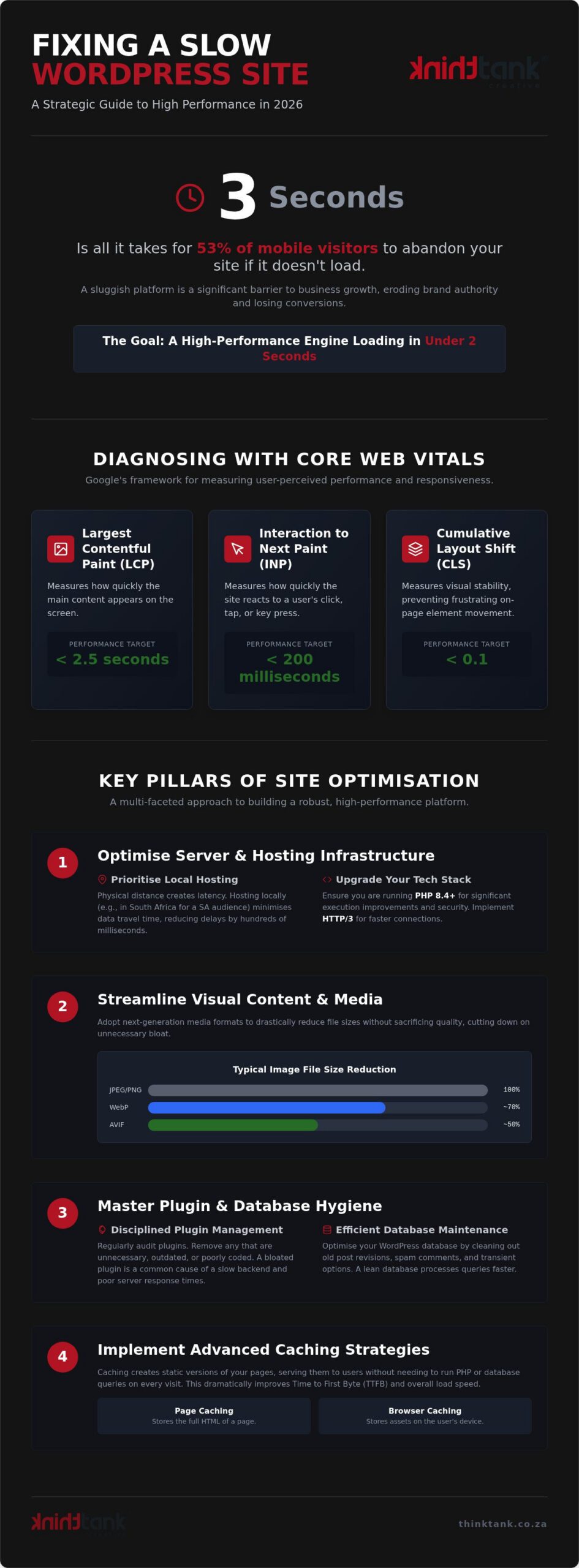
Fifty-three per cent of mobile visitors will abandon your brand's digital experience before it even begins if your page takes longer than three seconds to load. It's a sobering reality that highlights the thin margin between a successful conversion and a lost opportunity. You've likely felt the frustration of high bounce rates and poor search visibility whilst your competitors seem to glide effortlessly to the top of the rankings. It's clear that a sluggish platform isn't just a technical glitch; it's a significant barrier to your business growth.

We're here to help you reclaim your competitive edge. This strategic guide details exactly how to fix a slow loading wordpress site by aligning technical precision with sophisticated design principles. You'll learn to master the nuances of the WordPress 7.1 environment, from optimising for the latest Interaction to Next Paint (INP) standards to leveraging the power of PHP 8.4. We'll move from the anxiety of complex optimisations to the quiet assurance of a high-performance engine that loads in under two seconds. Let's transform your site into a stable, secure platform that reflects the excellence of your brand and supports your long-term vision.

Key Takeaways

  • Gain a precise understanding of Core Web Vitals, including the latest Interaction to Next Paint (INP) standards, to diagnose exactly where your user experience is faltering.
  • Explore our strategic methodology on how to fix a slow loading wordpress site by optimising server infrastructure and leveraging national expertise for superior performance.
  • Elevate your site's performance by streamlining visual delivery and adopting next-generation media formats like WebP and AVIF to reduce unnecessary bloat.
  • Implement a disciplined approach to plugin hygiene and database maintenance, ensuring your platform's backend remains lean and efficient.
  • Discover how professional maintenance and advanced caching strategies can sustain a high-performance engine, allowing you to focus on growth whilst we manage the technical complexity.

Diagnosing Performance Bottlenecks and Core Web Vitals

High-performance websites aren't built by accident; they're the result of meticulous planning and technical precision. In the digital economy of 2026, speed has evolved from a technical luxury into a fundamental pillar of professional user experience (UX). When you're investigating how to fix a slow loading wordpress site, you must first view performance through the lens of your audience's expectations. A site that lags behind the national two-second benchmark doesn't just lose traffic; it erodes the brand authority you've worked so hard to establish. We believe that every millisecond shaved off your load time is an investment in your brand's reputation and its ability to convert visitors into loyal clients.

Understanding Core Web Vitals in 2026

Google's Core Web Vitals provide a structured framework for measuring how users actually perceive your site's responsiveness. Largest Contentful Paint (LCP) tracks how quickly the main content appears, aiming for a target of 2.5 seconds or less to ensure your visitors aren't left staring at a blank screen. Cumulative Layout Shift (CLS) measures visual stability, preventing the frustrating experience where buttons or text jump around as the page loads. Whilst Interaction to Next Paint (INP) has succeeded First Input Delay (FID) as the primary metric for responsiveness, both focus on how quickly your site reacts to a user's click or tap. Core Web Vitals represent the gold standard for 2026 SEO.

Setting Up Your Performance Audit

Before you can implement a solution, you need a clear, data-driven map of your current infrastructure. Utilise professional diagnostic tools like Google PageSpeed Insights, GTmetrix, and Pingdom to establish a baseline across multiple global locations. These platforms provide a detailed "Waterfall" chart, which is a chronological view of every script, image, and style sheet your site requests. By analysing this chart, you can pinpoint specific delays within the WordPress architecture, such as a bloated plugin or a slow server response. This level of precision is essential for moving beyond generic fixes toward a bespoke optimisation strategy.

Whilst DIY audits are a useful starting point, our Website Maintenance and Support team often steps in to handle the heavy lifting. We adopt the philosophy that "We Do It All So You Don't Have To", managing the technical complexities so you can focus on your core business. As part of our rigorous development process, we ensure that speed is baked into the custom design rather than being an afterthought. If you require a tailored performance strategy to elevate your digital presence, an estimated cost is provided after discussion to ensure the solution matches your specific growth objectives.

Optimising Server Infrastructure and Hosting Latency

Your server is the silent engine of your digital presence. If the foundation is weak, even the most polished front-end will struggle to perform. When considering how to fix a slow loading wordpress site, many businesses overlook the physical reality of data transmission. Speed isn't just about code; it's about the distance that data must travel between your server and your user's device. We believe that a high-performance platform begins with a robust hosting strategy that prioritises low latency and professional-grade resources.

The Impact of Local vs International Hosting

Physical distance creates latency. If your primary audience is based in South Africa but your server sits in North America or Europe, you're adding hundreds of milliseconds of delay to every request. Choosing a host with a local South African presence ensures that your content reaches your audience with minimal resistance. This is particularly vital for custom website design south africa, where high-quality visual assets require dedicated resources. Cheap shared hosting plans often force you to compete for CPU cycles with thousands of other sites, leading to unpredictable performance dips. Moving to a VPS or managed WordPress environment provides the stability and scalability your business growth demands.

Upgrading Your Technical Stack

Modern performance requires modern tools. By September 2026, running any version of PHP below 8.3 is a significant risk to both speed and security. PHP 8.4 offers substantial execution improvements that allow your server to process requests more efficiently. We also recommend implementing HTTP/3 to facilitate faster handshakes and improved multiplexing. This technical synergy ensures that your server-side optimisations complement your front-end efforts. It's a common misconception that a few plugins can solve everything, but WordPress site performance and bloat often stem from an inadequate technical stack trying to carry too much weight. For those seeking national reach, integrating a Content Delivery Network (CDN) further reduces the load on your origin server by caching content at edge locations across the country.

Building a high-performance platform is a collaborative journey. Our 5-stage development process places server optimisation at the heart of our strategy, ensuring your site remains agile as you scale. We adopt a "We Do It All So You Don't Have To" approach to technical maintenance, providing you with the peace of mind that your infrastructure is secure. If you're ready to move beyond generic templates toward a bespoke solution, our Website Maintenance and Support team is here to guide the transition. We provide an estimated cost after discussion to ensure our services align perfectly with your business requirements.

Streamlining Visual Content and Media Delivery

Visual excellence defines the modern digital experience. However, unoptimised media assets remain the primary reason businesses struggle with how to fix a slow loading wordpress site. We believe that aesthetic brilliance and technical efficiency should exist in a perfect synergy; high-resolution imagery must enhance the user journey without causing friction. By adopting a disciplined approach to media delivery, you transform your site from a heavy, static brochure into a fluid, responsive platform that respects your visitor's time and data.

Professional Image Optimisation Workflow

Precision begins before you even touch the upload button. Every image must be resized to its exact display dimensions to avoid forcing the browser to perform unnecessary scaling tasks. Whilst legacy formats like JPEG and PNG served us well for decades, the transition to WebP and AVIF is now mandatory for high-performance platforms. These modern formats offer superior compression, allowing you to maintain bespoke visual quality at a fraction of the file size. For a full-width hero image, you should aim for a file size under 150KB to ensure immediate visual impact without delaying the page load.

Managing Video and External Embeds

Self-hosting large video files is a common mistake that quickly exhausts server resources and creates massive latency for your visitors. We always recommend utilising professional hosting platforms like YouTube or Vimeo, which are engineered for high-speed global delivery. Understanding how to fix a slow loading wordpress site also requires a holistic view of third-party scripts. Elements like Google Maps or social media feeds can trigger multiple requests that stall your site's rendering. To mitigate this, we implement "facading" techniques, where a static placeholder image appears first, and the heavy script only executes when the user interacts with the element.

At ThinkTank Creative, we integrate these meticulous optimisations into our 5-stage development process. We adopt a "We Do It All So You Don't Have To" philosophy, refining every asset to ensure your custom design remains agile and competitive. Performance is never a secondary thought; it's a core component of our craftsmanship. If you're looking to elevate your site's media strategy, an estimated cost is provided after discussion to ensure our services align perfectly with your business goals.

How to Fix a Slow Loading WordPress Site: A 2026 Strategic Guide

Mastering Plugin Hygiene and Database Maintenance

Curate your digital tools with the same precision you apply to your business operations. A common misconception when investigating how to fix a slow loading wordpress site is that you need more tools to solve the problem. In reality, performance excellence often requires a disciplined "less is more" philosophy. Every active plugin adds a layer of complexity and potential script bloat that can drag down your Core Web Vitals. We advocate for a lean, purposeful architecture where every element serves a specific strategic goal.

The Plugin Audit: Quality over Quantity

Execution speed is frequently compromised by "plugin overlap", where multiple tools perform similar functions or load unnecessary CSS and JavaScript on every single page. A professional audit identifies these redundancies, allowing you to replace several single-purpose plugins with one high-quality, well-coded solution. This streamlined approach reduces the number of external requests your site makes, directly improving your Interaction to Next Paint (INP) scores. Understanding how to maintain a wordpress website involves regular reviews to ensure your technical stack remains agile and secure.

Database Cleaning and Optimisation

Your database is the heart of your site's information retrieval, but it can quickly become cluttered with "orphaned" data from uninstalled plugins, thousands of post revisions, and expired transients. This bloat forces your server to work harder to find the information it needs, slowing down every query. By limiting post revisions to a manageable number, such as three or five, you prevent the database from swelling unnecessarily. Scheduling automated optimisations ensures that your tables remain defragmented and efficient, providing a stable foundation for your business growth.

Bespoke craftsmanship is the ultimate antidote to performance issues. Whilst generic "all-in-one" themes promise versatility, they often arrive with massive amounts of unused code that permanently throttles your speed. Our custom development process eliminates this weight, providing a tailored platform built specifically for your brand's requirements. We adopt a "We Do It All So You Don't Have To" approach, managing these intricate technical details so your team can focus on high-level strategy. Secure your platform's future with our professional Website Maintenance and Support; we provide an estimated cost after discussion to ensure our methodology matches your scale.

Implementing Advanced Caching and Professional Support

Caching represents the pinnacle of digital efficiency, acting as a strategic bridge between complex server-side logic and the immediate needs of your audience. When you're determining how to fix a slow loading wordpress site, implementing a robust caching strategy is often the final step in achieving that elusive sub-two-second load time. By storing "static" versions of your content, you eliminate the need for the server to execute heavy PHP scripts for every request, ensuring a fluid experience even during significant traffic surges. We view caching not as a simple plugin setting, but as a multi-layered architecture designed to ensure your site remains resilient and responsive.

The Three Layers of Effective Caching

A truly high-performance platform utilises three distinct layers of caching to maintain its competitive edge. Browser caching involves setting precise expiry headers for static assets, which allows returning visitors to retrieve your site's architecture from their local device rather than your server. Page caching elevates this efficiency by generating static HTML versions of your dynamic content, effectively bypassing the PHP execution process for every session. Amongst the most sophisticated techniques is object caching, utilising Redis or Memcached to store the results of intricate database queries, which ensures that even the most complex interactive elements respond with absolute precision.

Why Professional Maintenance Beats DIY Fixes

Whilst caching offers transformative speed benefits, a DIY approach often results in "broken" layouts or the display of outdated content. We believe that professional oversight is the cornerstone of a stable, high-growth platform. Our team manages the intricate balance of performance through our rigorous "Program, Development, and Testing" stages, ensuring every technical adjustment is verified before it impacts your audience. We adopt a "We Do It All So You Don't Have To" philosophy, allowing our innovative creativity to secure your digital presence whilst you focus on high-level strategy.

Speed is a moving target that requires meticulous, ongoing attention to detail. Our Website Maintenance and Support services are engineered to protect your investment and provide a foundation for long-term scalability. We provide an estimated cost after discussion to ensure our bespoke approach aligns perfectly with your specific technical requirements and business goals. If you're ready to transform your site into a high-performance engine for growth, Contact ThinkTank for a professional website audit today.

Elevating Your Digital Performance for Future Growth

Mastering how to fix a slow loading wordpress site is a journey that moves beyond simple technical tweaks toward a holistic vision of brand excellence. By aligning your server infrastructure with streamlined media delivery and a disciplined maintenance schedule, you create a platform that doesn't just load faster but actively supports your business growth. We believe that a high-performance website is a direct reflection of your professional standards; it's the stable foundation your audience expects in 2026.

Since 2001, our award-winning design team has utilised a rigorous 5-stage development process to ensure every project achieves its full potential. As a national agency with deep South African expertise, we understand the specific nuances of local latency and technical optimisation. We adopt a "We Do It All So You Don't Have To" approach, providing the quiet assurance you need to focus on your core objectives whilst we manage the technical complexity. An estimated cost for our bespoke support is provided after discussion to ensure the perfect fit for your requirements. Enquire about our Website Maintenance and Support services today and let's transform your digital presence together.

Frequently Asked Questions

How do I know if my WordPress site is slow?

You can confirm your site's performance by utilising professional diagnostic tools such as PageSpeed Insights or GTmetrix. A high-performance platform should ideally load in under two seconds to meet modern user expectations. If your visitors report sluggish behaviour or if your bounce rates are climbing, it's a clear signal that your infrastructure requires attention. We recommend running these tests from a local South African server to get the most accurate reflection of your national audience's experience.

Will deleting plugins really speed up my website?

Deleting unnecessary or redundant plugins is a critical step when learning how to fix a slow loading wordpress site. Every active plugin adds extra scripts, styles, and database queries that can throttle your server's execution speed. By conducting a lean audit and removing "plugin overlap", you reduce the technical weight on your platform. We often replace multiple single-purpose tools with one custom-coded solution to ensure your site remains agile, secure, and professional.

What is the best hosting for a fast WordPress site in South Africa?

For businesses serving a national audience, the best hosting is a managed WordPress environment with local South African servers. Physical proximity reduces latency, ensuring your data doesn't have to travel across oceans to reach your visitors. Whilst cheap international shared plans might seem attractive, they often lack the dedicated CPU and memory resources required for a fast, stable platform. We prioritise robust infrastructure that supports your business growth and provides a seamless user journey.

Can a slow website affect my Google rankings in 2026?

Yes, site speed is a non-negotiable ranking factor for Google in 2026. Search engines prioritise platforms that deliver a superior user experience, which is measured through Core Web Vitals. If your site is sluggish, you'll likely see a decline in search visibility compared to faster competitors. High bounce rates caused by slow loading times also signal to Google that your content isn't meeting user needs, which impacts your organic performance and erodes your brand's authority. Pairing a fast platform with a strategy built around how to do keyword research for a south african audience ensures your optimised site is also targeting the right local search terms.

What are Core Web Vitals and why should I care?

Core Web Vitals are a set of specific metrics, including Largest Contentful Paint (LCP) and Interaction to Next Paint (INP), that Google uses to quantify user experience. You should care because these scores directly influence your SEO rankings and conversion rates. A site that scores well in visual stability and responsiveness builds immediate trust with your audience. We integrate these standards into our 5-stage development process to ensure your platform meets the highest technical benchmarks.

How much does it cost to fix a slow loading WordPress site?

The investment required to optimise your platform depends entirely on its current technical state and your specific growth objectives. Every project is unique, involving different server configurations, plugin counts, and media assets. At ThinkTank Creative, we believe in a tailored approach rather than templated pricing. An estimated cost is provided after a detailed discussion of your timeline and requirements, ensuring that our professional maintenance and support services align perfectly with your business's long-term vision.

Do I need a developer to fix my site speed or can I use a plugin?

Whilst basic caching plugins can offer marginal improvements, they often fail to address deeper server-side bottlenecks or database bloat. Professional intervention is usually required for complex tasks like script minification, HTTP/3 implementation, and custom UX/UI optimisations. Our "We Do It All So You Don't Have To" philosophy means we handle the intricate technical heavy lifting. We move beyond simple plugin fixes to create a stable, high-performance engine that is built specifically for your brand's excellence.

How often should I perform speed maintenance on my site?

Speed maintenance should be a continuous part of your digital strategy rather than a one-off event. We recommend performing a comprehensive audit at least once a month to check for database clutter, plugin updates, and media bloat. Regular maintenance ensures that your platform remains agile as you add new content or features. By partnering with an award-winning team for ongoing support, you ensure your site stays fast, secure, and ready to support your business growth. Complementing your maintenance routine with a clear process for understanding your website analytics report allows you to translate performance improvements into measurable commercial outcomes.

Technical SEO Checklist for Small Business: Debunking the Myths of Search Invisibility

What if the reason your website remains invisible isn't a lack of quality content, but a fundamental breakdown in your digital plumbing? It's a common frustration for many entrepreneurs who find their beautiful pages ignored by search engines whilst competitors with less flair seem to climb the rankings. You've likely felt the sting of a wasted investment, where sophisticated copy and bespoke designs fail to move the needle because the underlying architecture is flawed. This is where a technical seo checklist for small business becomes your most vital strategic asset, ensuring that Google and AI agents can actually find, trust, and surface your brand.

We understand that the technicalities of modern search can feel overwhelming, but you don't need a massive team to achieve elite results. This guide will help you ground your site for the AI-driven search landscape of 2026, focusing on the precision of Core Web Vitals and the synergy of structured data. We'll explore how to refine your site's performance and security, ensuring your online behaviour aligns with the latest standards for excellence. We Do It All So You Don't Have To, allowing you to focus on your vision whilst we handle the complexity of the digital infrastructure.

Key Takeaways

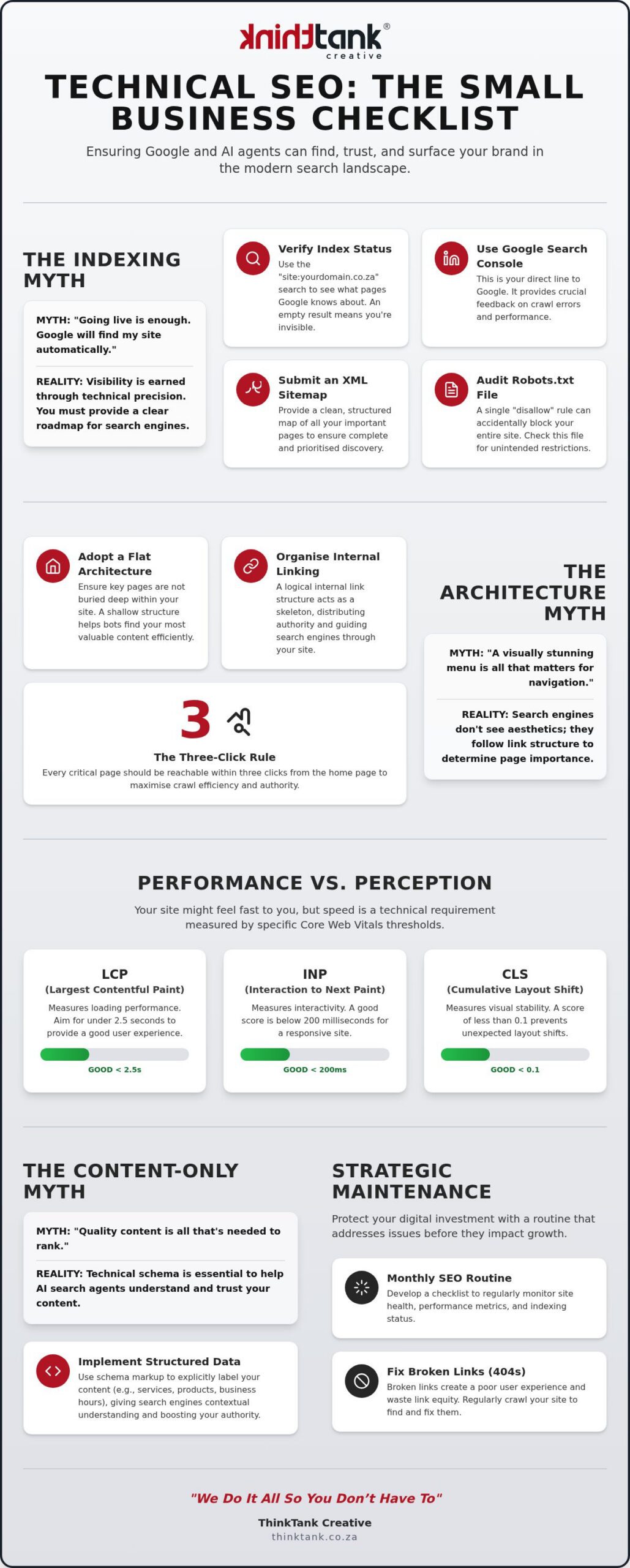
  • Move beyond the myth of automatic indexing by providing search engines with a precise XML roadmap and logical site architecture.
  • Shift from purely aesthetic design to technical performance by meeting the specific Core Web Vitals thresholds required for elite rankings.
  • Utilise our technical seo checklist for small business to implement structured data that allows AI agents to surface your brand with confidence.
  • Protect your digital investment through strategic ongoing maintenance that addresses broken links and outdated code before they impact your growth.

Debunking the Indexing Myth: Why "Going Live" Is Not Enough

Launch day often brings a sense of relief, but it's usually followed by a confusing silence. Many entrepreneurs believe the myth that once a site is live, Google automatically finds and ranks it. Search engines aren't psychic; they require a structured roadmap and explicit permission to explore your pages. Visibility is earned through technical precision, not just existence. Understanding the foundations of Search Engine Optimization (SEO) reveals that visibility is a deliberate outcome of strategic configuration rather than a lucky accident.

To better understand this concept, watch this helpful video:

A quick reality check involves the "site:yourdomain.co.za" test. By typing this into a search bar, you'll see exactly which pages Google has committed to its memory. If the results are sparse or non-existent, your business is effectively invisible. In 2026, the most common hurdle for small enterprises is the "crawled - currently not indexed" status. This indicates that while Google's bots have visited your site, they haven't deemed the technical health or content structure worthy of being served to users. Implementing a robust technical seo checklist for small business starts with verifying this indexation status to ensure your foundations are secure.

The Essential Indexing Toolkit

Your journey toward visibility requires the right diagnostic tools. Setting up Google Search Console provides the only honest view into your search performance, offering direct feedback from the algorithm itself. You must submit a clean XML sitemap to ensure every service page is discovered and prioritised. Additionally, audit your Robots.txt file. A single accidental "disallow" rule can hide your entire site from the world, turning your digital investment into a ghost ship. At ThinkTank Creative, We Do It All So You Don't Have To, ensuring these technical gatekeepers are always working in your favour.

Reasons My Business Is Not Showing Up on Google

When a site fails to appear, the culprit is often found in the code. A common oversight is the presence of "noindex" tags, often left over from the development staging site by mistake. Security issues or manual actions can also lead to sudden de-indexing, requiring a professional eye to resolve. Duplicate content caused by multiple URL versions, such as the conflict between www and non-www addresses, confuses search bots and dilutes your authority. Addressing these overlaps is a critical step in any technical seo checklist for small business, as it ensures search engines see one clear, authoritative version of your brand.

The Architecture Myth: Why Your Site Navigation Might Be Blocking Google

Aesthetic appeal often masks structural decay. Whilst a visually stunning menu might impress your visitors, it offers little value to a search engine if the underlying hierarchy is convoluted or illogical. Search engines don't see the colours or the sleek animations; they follow link equity to determine which pages are important. If a page isn't linked properly within your site's framework, it effectively doesn't exist to the bots that decide your ranking. As noted in foundational guides regarding SEO for Small Business, your site structure is the skeleton that supports all your other marketing efforts.

Adopting a flat site architecture is a strategic move that allows smaller brands to compete with national players. We recommend the "Three-Click Rule," which ensures every critical service or product page is reachable within three clicks from the home page. When your architecture is deep and buried, link authority dissipates before it reaches your high-value content. By keeping your structure shallow, you ensure that search engines can crawl your site efficiently and index your most important offerings without getting lost in a digital labyrinth. Including this structural audit in your technical seo checklist for small business ensures your site remains accessible and authoritative.

Organising Your Digital Hierarchy

Precision in your hierarchy helps both users and bots understand the relationship between your pages. Breadcrumbs act as an essential orientation tool, providing a clear path back to the home page whilst signalling page depth to search engines. You must also identify and fix "orphan pages," which are those isolated sections of your site with no internal links pointing to them. These pages are invisible to crawlers and provide zero SEO value. Additionally, ensure your URL slugs are descriptive and clean. A slug like /services/website-design-development/ provides immediate context, whereas a generic string of numbers offers no strategic benefit. If you're unsure where your site structure stands, our team can help you organise your digital presence for maximum impact.

The Role of Internal Linking

Internal linking is the mechanism that distributes authority across your domain. Use keyword-rich anchor text to link from your high-traffic blog posts to your core service pillars, building topical authority as you go. This practice tells Google exactly what the target page is about whilst helping visitors discover more of your expertise. Internal link equity serves as the primary currency of your website architecture, distributing authority from your most popular pages to those that drive conversions. By meticulously mapping these connections, you create a web of relevance that is difficult for competitors to ignore. This level of detail is a cornerstone of any comprehensive technical seo checklist for small business, transforming a simple website into a powerful lead-generation tool.

Performance vs. Perception: Why Speed is a Technical Requirement

Many small business owners believe that a slightly sluggish website is merely a minor inconvenience for their visitors. This perception is a dangerous myth that can cripple your search presence before you've even begun. Google prioritises user experience above all else, treating site speed as a direct and non-negotiable ranking factor. If your site doesn't load quickly, it doesn't matter how high the quality of your copy is; you'll be penalised and pushed down the rankings. Following a comprehensive technical SEO guide for small business helps you move past the "Content is King" mantra to realise that performance is the actual foundation of your digital authority.

Understanding Core Web Vitals in 2026

Google's metrics have evolved to measure real-world user behaviour with extreme precision, focusing on how a page feels rather than just how it loads. The Largest Contentful Paint (LCP) requires your main content to appear in under 2.5 seconds, whilst current 2026 standards suggest a target of 2.0 seconds for those aiming for elite status. Interaction to Next Paint (INP) measures the delay of every user interaction, ensuring your site reacts instantly to a click or a tap. Finally, Cumulative Layout Shift (CLS) prevents the annoying "jumping" of content as images load. These aren't just abstract numbers; they're the technical benchmarks that stop Google from ignoring your hard-earned traffic. For a deeper understanding of how these metrics apply locally, our dedicated guide to core web vitals for South African websites provides a strategic roadmap tailored to our unique digital environment.

Optimising for the National User

In our national context, performance is not just about pleasing an algorithm; it's about accessibility and resilience. Our digital landscape is defined by high mobile data costs and the persistent challenge of load shedding, which can impact server uptime and connection stability. A lightweight, efficient site performs better for users on limited data plans or those trying to access your services between power cuts. Choosing a server location with national proximity is a strategic decision that reduces latency and ensures your site remains responsive when your customers need it most. This focus on the end-user is a vital component of any technical seo checklist for small business.

Modern image optimisation is another pillar of a successful strategy. Moving beyond outdated JPEGs to next-gen formats like WebP can reduce file sizes by up to 30% without sacrificing visual quality, which is essential for a mobile-first world. However, technical performance isn't a one-time fix. It requires high-quality website maintenance and support to ensure your plugins remain updated and your code stays clean. We handle these intricate details with a sense of quiet assurance, ensuring your brand remains fast, responsive, and ready for growth in any environment.

Technical SEO Checklist for Small Business: Debunking the Myths of Search Invisibility

Many business owners believe that high-quality prose is the final frontier of search visibility. Whilst compelling copy engages human readers, AI agents like ChatGPT and Google Gemini require a different kind of clarity to function effectively. These systems rely on structured data to ground their responses in verifiable facts, ensuring that the information they provide is accurate and sourced from reliable domains. If your site lacks this technical layer, even your most insightful articles may remain invisible to the generative engines that define the search landscape of 2026.

Technical SEO has evolved from simply ranking in a list to becoming the cited source in an AI-generated answer. Small businesses can win this race by being the most readable and reliable source of truth within their specific niche. By following a robust technical seo checklist for small business, you provide the structural clarity these machines crave, moving your brand from the shadows into the spotlight of modern search. This approach transforms your website from a static brochure into a dynamic data source that search engines can trust and surface with confidence. Understanding what makes a good business website in 2026 means recognising that technical precision and content quality must work together as a unified strategy.

Essential Schema for Small Businesses

Precision in your structured data allows you to claim digital space that competitors often overlook. Organisation Schema is the first step, defining your brand identity, logo, and national contact details for search engines. Service Schema goes further, telling the algorithm exactly what you sell and who your target audience is. Whilst Google retired visual FAQ rich results in May 2026, implementing FAQ Schema remains a vital strategy; it helps AI systems understand the depth of your expertise and can still capture valuable real estate in "People Also Ask" sections. Including these elements in your technical seo checklist for small business ensures your brand is not just indexed, but deeply understood.

Preparing for Generative Engine Optimisation (GEO)

The transition toward generative engine optimisation requires a meticulous approach to your site's underlying code. AI crawlers prefer clean HTML that allows them to parse text without getting stuck in bloated scripts or outdated tags. Security also plays a vital role in this new era, as HTTPS and valid SSL certificates serve as essential trust signals for AI grounding. Schema acts as the translator between your bespoke business language and complex machine logic, ensuring your data is surfaced accurately across all platforms. To ensure your site is ready for this evolution, partner with our SEO experts to build a future-proof foundation that handles the complexity whilst you focus on your growth.

Strategic Maintenance: Developing Your Monthly Technical SEO Routine

Achieving a high ranking is a significant milestone, but maintaining that position requires constant vigilance and precision. There's a common misconception that SEO is a project with a definitive finish line, yet the reality of the digital space is far more fluid. Technical decay is an inevitable byproduct of a growing site; broken links, bloated plugins, and outdated code accumulate naturally as your business evolves. By adopting a proactive mindset, you protect your digital assets from the slow erosion of performance that often leads to a sudden loss in visibility. Investing in a consistent routine is always more cost-effective than an emergency SEO rescue after your traffic has already plummeted.

Your Monthly Technical SEO Checklist

A disciplined technical seo checklist for small business transforms maintenance from a chore into a strategic advantage. This routine allows you to catch minor issues before they escalate into systemic failures that alienate both users and search engines. We recommend a methodical approach to your monthly health checks:

Factoring in these recurring tasks prevents the accumulation of technical debt, ensuring your website remains a stable platform for your marketing efforts.

When to Call in the Experts

Whilst routine checks are manageable, certain digital bottlenecks require the intervention of a seasoned partner. Complex issues such as redirect loops, server-side performance drags, or database optimisations can be difficult to diagnose without specialised tools and deep technical expertise. If your rankings have plateaued despite producing high-quality content, it's often a sign that deeper architectural issues are hindering your progress.

At ThinkTank Creative, we provide a meticulous end-to-end process that spans from initial research to launch and comprehensive ongoing support. We believe in building long-term relationships where we handle the intricate plumbing of your digital presence whilst you focus on your core vision. We Do It All So You Don't Have To, ensuring your brand remains elite, dependable, and perfectly positioned for the AI-driven search landscape of 2026. By combining our award-winning design with technical excellence, we help you turn search invisibility into a thing of the past.

Elevating Your Digital Presence for the AI Era

Securing a prominent position in the digital landscape requires more than just high-quality content; it demands a foundation built on technical excellence and structural integrity. By implementing a robust technical seo checklist for small business, you ensure that your architecture is logical, your performance is optimised for Core Web Vitals, and your data is perfectly translated for AI agents. This strategic approach transforms your website from a quiet digital brochure into a powerful, visible asset that search engines can trust and surface with confidence. It's about moving beyond simple visibility to achieve a state of digital authority that lasts.

As a top all-rounder agency in South Africa since 2001, ThinkTank Creative brings over 25 years of experience to every project. Our award-winning design and development team is dedicated to handling the complex digital plumbing that keeps your brand moving forward. We provide bespoke solutions where estimated costs are provided after a detailed discussion of your unique needs. We Do It All So You Don't Have To, allowing you to focus on your vision whilst we secure your growth. Partner with ThinkTank Creative for a comprehensive SEO strategy and begin your journey toward lasting search visibility today.

Frequently Asked Questions

Why is my business not showing up on Google after my website launch?

Your site may not be showing up because search engines haven't crawled your pages or have been blocked by technical barriers. This often happens if you haven't submitted an XML sitemap or if a "noindex" tag was accidentally left in the code from the development stage. Google needs a clear roadmap to find you. Without these essential signals, your professional website remains invisible to the very customers you're trying to reach.

How long does it take for technical SEO changes to affect my rankings?

Technical SEO changes usually take between a few days and several weeks to reflect in search results. The timeline depends entirely on how often Google crawls your specific domain. Whilst smaller sites might see a slower response, larger sites with high authority are indexed more frequently. You can accelerate this process by manually requesting indexation through Google Search Console after you've implemented critical fixes to your site's infrastructure.

Do I need a technical SEO checklist if I use a platform like Wix or Shopify?

You absolutely need a technical seo checklist for small business even when using closed platforms like Wix or Shopify. Whilst these systems handle basic hosting and server security, they don't automatically organise your site hierarchy or implement bespoke schema markup. You're still responsible for managing URL structures, internal linking, and image optimisation. Relying solely on a platform's default settings often leads to a generic, underperforming presence that fails to compete.

What is the difference between on-page SEO and technical SEO?

On-page SEO focuses on the visible content and keywords your visitors read, whilst technical SEO handles the invisible infrastructure that search engines crawl. Think of on-page SEO as the beautiful interior design of a house and technical SEO as the essential plumbing and foundations. Both must work in synergy to achieve success. If your foundations are cracked, even the most compelling copy won't be enough to secure a top ranking.

Can a slow website really stop my business from showing up on Google?

A sluggish website can definitely prevent your business from appearing in top search results. Google prioritises user experience, and their Core Web Vitals update directly penalises sites that fail to load quickly on mobile devices. If your page takes too long to respond, visitors will bounce back to the search results, signalling to the algorithm that your site is not a high-quality destination for national users on limited data plans.

Is technical SEO a one-time cost for small businesses?

Technical SEO is not a one-time investment but an ongoing commitment to your site's health. Digital infrastructure naturally decays as plugins update, links break, and search algorithms evolve. Regular maintenance prevents these minor issues from turning into major ranking drops. At ThinkTank Creative, we provide continuous support to ensure your site remains fast and secure, protecting your long-term marketing investment from the risks of technical obsolescence.

How does the POPI Act affect technical SEO for South African websites?

The POPI Act impacts technical SEO by making website security and data privacy essential trust signals. Implementing SSL certificates and secure data handling isn't just a legal requirement; it's a technical necessity that tells search engines your site is safe for South African users. Google's algorithms increasingly prioritise secure domains, meaning that a failure to comply with privacy standards can indirectly damage your search visibility and brand reputation.

What is schema markup and why does my small business need it for AI search?

Schema markup is a specific vocabulary of code that helps search engines and AI agents understand the context of your content. By using this structured data, you provide a clear "translator" for machine logic, allowing AI systems to ground their answers in your business facts. This is vital for appearing in AI-driven search results, as it ensures your services and contact details are surfaced accurately across the modern digital landscape. To build a truly high-performance platform, it helps to first understand what makes a good business website at a foundational level, combining technical rigour with strategic design.

Search Engine Optimisation in South Africa: The 2026 Strategic Guide

With 51.7 million internet users now active across the nation, why does it feel like your digital presence is shouting into a void? You've likely watched your PPC budgets climb while lead generation stalls, or perhaps you're tired of agencies hiding behind technical jargon that doesn't translate into revenue. Achieving effective search engine optimisation south africa requires more than just chasing algorithms. It demands a synergy between technical precision and user engagement. It's a common frustration to see search rankings fluctuate just as you're starting to gain momentum, but we believe your brand deserves a more stable path to success.

This 2026 strategic guide is designed to cut through the noise and provide a clear roadmap for digital growth. Discover how to build sustainable online authority and dominate search results through an integrated approach that aligns technical excellence with your corporate identity. We'll explore the shift toward Answer Engine Optimisation and mobile-first dominance, ensuring your strategy is both future-proof and results-driven. Our goal is to move you from high-cost uncertainty to a position of market leadership. At ThinkTank Creative, we focus on the potential for your brand transformation because we do it all so you don't have to.

Key Takeaways

  • Align your digital presence with the core principles of search engine optimisation south africa to secure sustainable organic traffic and long-term ROI.
  • Master the synergy between technical, on-page, and off-page elements to elevate your site speed and overall search visibility.
  • Adapt to the 2026 digital landscape by prioritising user intent and AI-driven results over traditional keyword-matching techniques.
  • Implement a rigorous auditing and planning framework to ensure every digital marketing effort remains measurable and results-oriented.
  • Recognise why a unified approach to branding and web development is essential for building the high-level credibility search engines reward.

Understanding Search Engine Optimisation in the South African Landscape

Master your digital presence by recognising that SEO is the strategic process of enhancing a website's visibility for relevant searches. In the South African market of 2026, search engine optimisation south africa represents the most sustainable driver of ROI for businesses seeking long-term stability. Whilst paid advertising offers immediate visibility, the rising costs of PPC often lead to thinning margins. Organic search builds a compounding asset that continues to deliver value long after a campaign concludes. For those seeking a comprehensive overview of search engine optimisation, it's clear that the methodology has shifted from simple tricks to deep strategic integration. With internet penetration reaching 79.6% as of early 2026, the potential for organic reach is vast, yet many businesses remain trapped in a cycle of expensive, short-term clicks.

To better understand the investment required for these strategies, watch this helpful video:

The Distinction Between Good and Great Marketing

Good marketing often screams for attention by focusing on the company, but great marketing empowers the customer to make informed decisions. We've always maintained that great marketing makes the customer look smart, a philosophy that sits at the heart of our SEO methodology. By providing high-quality answers to specific queries at the exact moment of need, your brand becomes a trusted advisor rather than just another vendor. SEO is the digital bridge between a customer's problem and a brand's solution. This approach transforms the search experience into a collaborative journey of discovery and growth, ensuring that your technical competence serves a greater business benefit.

Why National Visibility Matters for SA Brands

Securing national visibility is no longer a luxury reserved for global giants. The competitive nature of the digital market across South Africa means that local brands must be meticulous in their approach to search. Effective search engine optimisation south africa allows smaller, agile businesses to compete directly with international corporations by targeting specific niches and national intent with precision. Whether your target audience is located in established urban centres or emerging regional markets, a unified national strategy ensures consistency. ThinkTank Creative has been navigating this complex landscape since 2001, refining a 5-stage process that balances elite execution with warm professional relationships. We understand the nuances of the South African consumer, ensuring your brand stands out in a crowded marketplace. We do it all so you don't have to.

The Technical Pillars: How Modern SEO Actually Functions

Constructing a resilient digital presence requires a meticulous blend of three core disciplines. Technical SEO ensures search engines can crawl and index your site without friction. On-page optimisation refines the visible elements. Off-page strategies build the external authority needed to outrank competitors. As the digital economy in South Africa matures, these pillars must work in perfect synergy to support search engine optimisation south africa across all platforms. Mastering these components allows a brand to move beyond mere visibility toward genuine market leadership.

Technical Excellence and Site Architecture

Your website's architecture serves as the bedrock of your search performance. A secure, functional site isn't just a preference; it's a prerequisite for ranking. Our in-house team prioritises usability and functionality, ensuring that every design choice supports positive user engagement signals. We utilise a comprehensive 5-stage development process, spanning Planning, Design, Program, Development, Revise, Testing, Launch, Delivery and Support, to guarantee that technical SEO is baked into the code from day one. This methodical approach ensures your site remains fast and accessible, particularly for the 69% of South Africans who primarily access the web via smartphones. By integrating creative design with technical stability, we create a seamless experience that satisfies both the user and the algorithm.

Content Strategy and Copywriting

Professional copywriting creates a bridge between technical precision and human connection. Modern search engine optimisation south africa has evolved beyond simple keyword matching toward semantic relevance and topical authority. Search engines now reward content that demonstrates genuine expertise and addresses complex user intent. This level of craftsmanship ensures your content fits seamlessly into a broader digital marketing strategy, turning casual visitors into loyal brand advocates. High-quality copy works in tandem with your corporate identity and logo design to build the trust signals search engines crave. If you're ready to refine your approach, exploring integrated digital solutions can help align your technical pillars with your commercial goals. We do it all so you don't have to.

Beyond Keywords: Navigating AI and User Intent in 2026

Transform your digital strategy by moving beyond the rigid constraints of traditional keyword matching. In 2026, search engine optimisation south africa has transitioned into a sophisticated understanding of user intent, where search engines interpret the nuance behind a query rather than just the words themselves. This shift is driven by Large Language Models (LLMs) that prioritise context, authority, and the overall quality of information. To maintain an effective SEO strategy, your brand must focus on becoming the definitive answer that AI systems confidently recommend to users. Branding is no longer a separate endeavour; it is a critical signal that tells AI your business is a trusted leader in its field.

The Rise of Generative Engine Optimisation

Generative Engine Optimisation, or GEO, is the practice of tailoring your digital presence to be featured in AI-generated snapshots and conversational summaries. For a South African business owner, this means ensuring your data is structured and your expertise is unmistakable. AI engines don't just look for phrases. They look for entities they can trust to provide accurate, helpful summaries. To ensure your brand is AI-ready, consider this focused checklist:

Aligning Content with the Customer Journey

Capturing a user's attention requires a deep alignment with their specific stage in the buyer's journey. Whether a consumer is seeking informational guidance, navigational direction, or is ready for a transactional engagement, your content must pivot to meet those needs. Custom video posts and bespoke content have become vital for maintaining engagement in an era of rapid information consumption. A robust custom website design south africa provides the necessary framework to house this high-value content, ensuring that your user experience matches the sophistication of your search strategy. By integrating these elements, you create a synergy that guides the customer from their first question to a final, successful outcome. Modern search engine optimisation south africa demands this level of bespoke craftsmanship. ThinkTank Creative is deeply invested in this journey, ensuring that your brand is not just seen, but respected and recommended. We do it all so you don't have to.

Search Engine Optimisation in South Africa: The 2026 Strategic Guide

The Strategic Framework: Auditing and Planning for Growth

Precision defines the success of any high-performing digital strategy. Before a single line of code is altered or a word of copy is written, a comprehensive SEO audit must serve as your diagnostic foundation. This meticulous evaluation uncovers the hidden friction points that prevent your brand from reaching its full potential. By setting realistic KPIs and measuring ROI effectively, we move away from vanity metrics toward tangible business growth. Strategy is the engine of growth. The Research & Strategy stage remains the most critical part of this journey, as it defines the trajectory of every subsequent action. We believe in total transparency; an estimated cost is provided only after a thorough discussion of your specific needs and objectives.

The 5-Stage SEO Strategy Process

We approach search engine optimisation south africa through a refined, multi-stage methodology that ensures quality at every turn. This isn't a templated service. It's a bespoke craftsmanship designed for national impact. Our process moves through these logical phases:

Measuring Success Beyond Rankings

Ranking on the first page of Google is essential, but it's merely a means to an end. The ultimate goal of any sophisticated campaign is conversion rate optimisation (CRO). We focus on how users behave once they reach your site, ensuring that traffic translates into revenue and long-term brand loyalty. Our reporting phase is built on transparent communication and the value of clear data. During this time, ThinkTank Creative fosters innovative creativity and teamwork to interpret results and refine the roadmap. If you're ready to move beyond guesswork and high-cost PPC, you can start your strategic journey with a partner who values precision as much as you do. We do it all so you don't have to.

Integrating SEO with Branding and Web Development

Elevate your digital strategy by recognising that search engine optimisation south africa is most effective when woven into the very fabric of your brand identity. It should never be an afterthought or a secondary layer applied to a finished website. Instead, we treat SEO as a foundational element that informs everything from site architecture to your corporate identity. When your visual language and technical structure work in harmony, you create a cohesive experience that search engines recognise as authoritative. As a comprehensive all-rounder agency, we ensure that every touchpoint, from custom system development to printing solutions, reinforces your online presence. This holistic approach ensures that your marketing efforts aren't siloed but are instead driving toward a single, unified goal of market dominance.

Synergy Between Visual Identity and Search Trust

A professional brand identity does more than just look polished; it actively influences user behaviour and search signals. High-calibre logo and corporate identity design reduce bounce rates by immediately establishing credibility with your audience. When visitors trust what they see, their dwell time increases, sending positive engagement signals back to search algorithms. Our award-winning design team understands that even "leave-behind" print marketing plays a role in this ecosystem by driving branded search queries. When a potential client sees your high-quality printed materials, they're more likely to search for your brand specifically, which is a powerful indicator of authority to search engines. This synergy ensures that every creative asset contributes to your overall search engine optimisation south africa strategy.

The Long-Term Value of Managed Support

Maintaining your lead in a dynamic search environment requires more than just a successful launch. Ongoing website maintenance and support are essential for preserving the SEO health we've meticulously built. A static website is a vulnerable one, as outdated plugins, slow loading times, or broken links can quickly erode your hard-won rankings. Understanding how to improve website user experience is equally critical, as search engines increasingly reward sites that keep visitors engaged and satisfied across every device. By treating your digital presence as a living asset, we ensure it evolves alongside the latest algorithm shifts and consumer behaviours. For businesses looking to expand their revenue streams, investing in robust e-commerce website development south africa is a natural extension of a mature SEO strategy, ensuring your online store is built on a technically sound foundation that search engines reward. This constant vigilance is what separates temporary spikes in traffic from sustainable online authority. We invite you to embark on a journey of imagination with a partner who handles every technical and creative detail. From initial planning to lifelong delivery and support, we do it all so you don't have to.

Commanding the Search Landscape in 2026

Mastering the complexities of the digital space requires a shift from reactive tactics to a unified, strategic vision. We've explored how the evolution of user intent and the rise of generative engines demand a more sophisticated approach to search engine optimisation south africa. Success in this landscape isn't found in isolated efforts; it's the result of aligning technical excellence with a powerful corporate identity. By integrating bespoke web development with award-winning creative design, your brand moves beyond mere visibility to achieve true market dominance.

Since 2001, ThinkTank Creative has served as a top all-rounder agency, guiding businesses through every stage of their digital transformation. Our comprehensive 5-stage process ensures that every detail, from the initial audit to ongoing support, is handled with meticulous precision by our in-house experts. You don't have to navigate these technical shifts alone. We invite you to partner with ThinkTank Creative for a complete digital solution that transforms your online authority into a sustainable asset. Your journey toward growth and brand elevation starts with a single, purposeful step. We do it all so you don't have to.

Frequently Asked Questions

What is search engine optimisation and how does it work for South African businesses?

SEO is the strategic process of aligning your digital presence with the criteria search engines use to rank websites. For South African businesses, this involves optimising for local search intent and ensuring a seamless mobile experience. By improving technical health and content relevance, you capture organic traffic from the 51.7 million internet users currently active in the country. This methodical approach builds sustainable online authority and ensures your brand appears when customers need solutions most.

How long does it take to see results from an SEO campaign?

Most businesses begin to see measurable improvements in their search rankings and organic traffic within four to six months. SEO is a long-term investment rather than a quick fix. The timeline depends on your industry's competitiveness, your site's current technical state, and the consistency of your strategy. While some technical wins appear sooner, building sustainable online authority in the South African market requires a steady, rhythmic approach to achieve compounding returns over time.

Is SEO better than PPC advertising for my business?

Both channels offer unique benefits, but SEO provides more sustainable long-term value. PPC delivers immediate visibility but stops the moment your budget ends. In contrast, search engine optimisation south africa builds a permanent asset that continues to attract leads without a per-click cost. Whilst PPC is excellent for short-term promotions, organic search remains the most reliable driver of ROI. Integrating both allows you to dominate the search results page whilst your organic authority matures.

What is the average cost of SEO services in South Africa?

Industry reports indicate that professional SEO services in South Africa usually range from R2,500 to upwards of R10,000 per month. This investment level depends heavily on the scale of your objectives and the competitive landscape of your industry. We avoid one-size-fits-all pricing in favour of bespoke craftsmanship. An estimated cost is provided after a thorough discussion of your requirements to ensure our integrated digital marketing strategy delivers the highest possible quality and long-term value.

Can I do my own SEO or should I hire a professional agency?

You can manage basic SEO tasks, but achieving national dominance usually requires professional expertise. An agency brings a multi-disciplinary team of designers, developers, and copywriters who understand the technical nuances of the 2026 search landscape. Hiring a partner allows you to focus on your core business operations whilst experts manage complex algorithm updates and technical maintenance. We focus on the potential for your brand transformation so you don't have to manage the technical burden.

How does AI and ChatGPT affect my website's search rankings in 2026?

AI has shifted the focus from simple keywords to Answer Engine Optimisation. Search engines now use Large Language Models to provide direct answers, meaning your content must be the most authoritative source for these summaries. To maintain your rankings, your site needs structured data and high-quality, expert-led content that AI systems can easily parse and recommend. This evolution makes professional branding and technical precision more critical than ever for maintaining search engine visibility and user trust.

What is the difference between on-page and off-page SEO?

On-page SEO involves optimising elements within your own website, such as your content, meta tags, and site architecture. It ensures your pages are relevant to specific search queries. Off-page SEO focuses on building your site's reputation through external signals like high-quality backlinks and social mentions. Both are essential pillars of search engine optimisation south africa. They work in synergy to prove to search engines that your brand is both relevant to the topic and trusted by the wider web.

Does my website design really affect my Google rankings?

Your website design significantly impacts your rankings through user experience signals. Google rewards sites that load quickly, are easy to navigate, and provide a seamless mobile experience. A professional design reduces bounce rates and increases the time users spend on your site, which tells search engines your content is valuable. Integrating creative design with technical SEO ensures that your site is aesthetically pleasing whilst remaining highly functional for both users and algorithms across South Africa.